Search Results: "tg"

17 April 2011

Russell Coker: More about the Xperia X10

I ve now had a Sony Ericsson Xperia X10 for almost two months (here is a link for my first review) [1]. This is a phone that people seem to really dislike because the battery life is poor and Sony doesn t allow replacing the kernel. I m happy with mine, happy enough that after buying one for my wife and trying it out I bought one for myself. I knew about it s problems in advance and wanted a relatively cheap phone with a large high resolution screen, and the Xperia X10 was the best match for my criteria.ChargingThere has been a recent trend towards using USB for charging devices. Sony provides a tiny wall-wart PSU which has a USB socket and a short (1m) USB cable that can be used to charge the phone from it s PSU or from a PC. The size is really convenient, as the phone has a short battery life I ll probably want to take the PSU to more places than I would for other phones I ve owned.The short USB cable saves weight and tangle when travelling, but can be inconvenient. I m currently working on the phone while it s plugged into my laptop, that works well and I can make calls while it s connected. If the phone was connected to a USB port on a tower computer that was on the ground then the cable could be too short to make a call, if it was charging on a power point near the floor then I wouldn t even be able to use the computer functionality let alone make calls without kneeling. My Viewty has a 175cm charging cable which alleviates these problems. I ve got a 50cm USB extension cable that I use for charging my phone while I m in bed that is just long enough to allow me to check my email without getting out of bed!The socket for connecting the USB cable is protected by a plastic lid that is connected by a strip of rubber. For a socket that will be used at least twice a day this isn t a good mechanical design. The plastic slide on the LG U990 Viewty seems like a much better design.As an aside it s a pity that they aren t designing cars with USB charging sockets built in. Some new cars have a socket for one USB flash drive to be attached to the radio, but really they need at least one USB charging port per seat. It would also be nice if they made power points with USB charging sockets built in, I d buy a few of those if they made them.Preserving the BatteryI ve been running Juice Defender to reduce the battery use, at the moment it is claiming to have extended battery life by 69%. That combined with turning off things that aren t needed (such as WiFi) has made the phone reasonably usable. I can survive more than 12 hours during which I use the phone a lot without charging it.XperiaX10.net has an interesting review of replacement batteries [5]. I m not going to buy them because the largest battery requires a replacement back case which prevents using an external case to prevent damage and the smaller one doesn t provide enough of a benefit and the design of the phone makes it difficult to change batteries so carrying a spare battery isn t a good option.Cursor Control KeysThe HP/Compaq iPaQs that I own from ~10 years ago have a single button that can be moved up/down/left/right to act as a cursor, it can also be pressed inwards to act as an ENTER key (or whatever the application might want for a fifth function). Having some sort of hardware cursor control is really handy, I often end up deleting several characters when I want to replace one because getting the cursor onto the desired character is too difficult.Adding more hardware keys would require making the phone bigger, but that would be fine by me. As described in my previous post about phone cameras I d like to have a phone that s thicker to have a better camera with a greater focal distance for a larger lens [2].Core Phone FunctionalityI really miss having separate green and red buttons for making/answering calls and for rejecting/ending calls.A really common operation is to call back the last person who called. To do this on my LG U990 Viewty I press the green button twice on my home screen which took less than a second. On the Xperia this involves selecting the phone icon from the home screen, then the call log icon, then the call that is desired, then the Call user line. That is four presses in different parts of the screen compared to pressing the same hardware button twice. I m investigating dialer applets right now, the Dialler One applet has a good interface for calling people who have called or been called recently but it still requires two presses on different parts of the screen. With my old Viewty I could call back the last person by feel without even looking at the phone!In the last 6 years the standard functionality of phones has been to include multiple profiles for noises. My Viewty has profiles named Normal , Silent , Vibrate only , Outdoor , Headset (automatically selected when a headset is connected), and three customised ones. The Xperia has only one setting, and that is three icon presses away from the home screen. It does allow changing the volume by hardware switches on the side which includes going to vibrate-only and silent mode. While this is useful, it s not the best way that two precious hardware keys could be used. It also doesn t allow control over all the different notifications, I d like to be able to activate a noise profile and have every application respond to it in an appropriate manner. This is a deficiency in Android 2.1 not in the phone itself.In many ways this phone has the worst phone functionality of any mobile phone I ve ever owned, I think that this is more the fault of the Android designers than Sony Ericsson.Android UpdatesSony had previously claimed that they wouldn t support Android later than 2.1. Now Sony has announced that they will support Gingerbread Android 2.3 [3]. So one of the major complaints about the Xperia will soon be addressed.TetheringThe build of Android that the Xperia runs at the moment doesn t support Wifi tethering. I m currently using with Easy Tether for USB tethering [4]. It s not free software and requires it s own code to run as root on your Linux system that is being tethered (which is easily locked down with SE Linux), but it basically works. The down-side with Easy Tether is that it proxies all the connections so you can t run traceroute etc and in the free version you can t use UDP.K9 MailK9 Mail fixes some of the problems in the default Android email program that I described in my previous post. It allows selection of SSL with a default port of 993 for IMAPs. It uses mail.example.com as the mail server address for an email address of user@example.com (so I ll add a mail CNAME to the domains I run). When I connected initially it told me that the SSL key was not signed by a CA and asked if I wanted to save it or reject it this is the correct and desired functionality. It also correctly parses URLs from the email (or at least has fixed the bug that I discovered in the default email app).One problem I ve found with K9 is that it seems to timeout on large folders. This is probably partly the fault of Virgin Mobile being slow for IP access, but I wonder whether K9 doesn t pipeline IMAP commands as Virgin can do bulk transfer at reasonable speeds (80KB/s) and it mainly fails on latency (900ms being typical). The result is that a folder with more than 500 messages that need to be copied to the phone will never get synchronised. When I started reading mail on my phone I had to move mail from some of the bigger folders into other folders to avoid timeouts. As an aside the amount of time I ve saved by reading email on the go has already paid for the phone.MediascapeThe Sony Mediascape software is used for categorising photos. One function of this is to assign names to photos, the names come from the contact list so if you photograph someone who you can t phone then you need to add a contact list entry for them. This also means that you couldn t conveniently add names to non-humans, I guess I could have added a contact list entry Mr Crash Dump for photos of system crash logs. But a bigger problem is that it decides what is a picture of a person, a picture of someone who is not centered in the photo or a profile picture can be regarded as not a photo of a person and therefore not subject to being associated with a contact list. Finally when selecting a name for a picture it displays the entire contacts list in a small font instead of displaying favorites, I have the phone numbers of many clients in my contacts list who I will never photograph Mediascape just isn t much good. If I feel the need to do something serious in this regard I ll search the app store for something free that s better.ProtectionFor $15 each I bought one grey and one clear Gel Case from J2K. This case covers the sides and back of the phone with a firm rubber layer that will hopefully allow it to bounce rather than break. It also extends slightly higher than the screen which should stop the screen being scratched if the phone is left face-down on a hard surface on the vibrate setting.One problem with the Gel Case is that by it s design it has to cover the buttons on the sides, due to a design or manufacturing problem the clear case that my wife uses can press slightly on the shutter button which disables the three main buttons on the front. So when the menu or back button stops working she has to slightly move the Gel Case out from the side. I m thinking of just cutting out a section of the Gel Case there, that will make it difficult to press the shutter button, but you can use the touch screen to take photos and there doesn t seem to be any other use for the shutter button so this shouldn t be a problem. The clear and grey cases have different designs, the grey one has a hole over the raised Sony logo which makes it fit a little better as well as not having the shutter problem, so it seems to be a later design I don t know whether all clear cases have the same problem but I recommend that someone who only has one Xperia X10 get the grey case just in case.Web BrowsingI m experimenting with using my own web proxy to compress the data sent to the phone. Unfortunately the Android settings for a web proxy only apply to the main web browser, not to all the other applications that use web services. Also the built-in web browser requires pressing the settings hardware button followed by at least two touch-screen presses to change between windows or close a window and it doesn t seem to support making the short-press action be to open a link in a new window. So I will have to find another web browser to use.Bandwidth UseThe 3G Watchdog applet is really good for tracking the data transfer and optionally cutting off 3G access before the quota is exceeded. Unfortunately Virgin has already sent me a bill with $234 in extra charges for bandwidth use because I used 1.6G instead of my 1.5G quota. A Virgin representative had told me over the phone that the billing period would be based on the end of the month, so while every calendar month has had less than 1.5G used because I used more than average in the end of March and the start of April that counts as excess data in the 14th March to 13th April period.I m going to appeal this to the Telecommunications Industry Ombudsman, I don t think that it s reasonable that I should be billed almost 7* the normal bill for exceeding the quota by 7.4% based on following the instructions of a Virgin employee. While I could have read the previous bill that they sent me to discover the end of billing period dates, I don t think that I should be expected to distrust everything that a Virgin employee says. If they billed me an extra $20 then I d just pay it, but $234 is unreasonable.ConclusionSince using the phone I ve found significant benefits in web browsing and reading email with the major limitation being the small screen (relative to a Netbook or Laptop). So if I was to buy another phone I would probably consider a Dell Streak which seems to be the largest Android phone on the market at the moment.Given the amount of use that I ve got I would be happy to spend more money and therefore consider a more expensive phone. But I don t regret the decision to save money by getting an Xperia X10.Finally when a telco tries to stick me with a $234 excess charge it really detracts from the value of having a phone contract. If I end up having to pay that then it s half the value of a smart-phone lost in one telco scam. This is enough to make a contract with Virgin a bad option, after this contract expires I may use VOIP and a pre-paid SIM from Telstra NextG if their network is still the best. Another possibility is to just use a small tablet and skip having a mobile phone, email and Jabber plus SMS from the people who lack net access will probably do.

14 April 2011

Timo Jyrinki: MeeGo Summit FI starts tomorrow

I'm participating in the MeeGo Summit FI that starts tomorrow, and I'm already in Tampere now, as you can see. The summit is at an interesting time, given that there is a huge amount of stuff happening around MeeGo while at the same time Nokia is balancing on what do both in the far future and what to do to ship the MeeGo device they've already promised. The summit is fully and overly booked for >300 attendees. There is also Finhack free software event happening alongside on Saturday at the same venue.

A view towards the venue(s), Finlayson area in Tampere.
The company I work for, Nomovok's CEO illustrated the MeeGo situation extraordinarily well a little less than two months ago. I think it's one of the best insights you can get from anywhere in public at the moment. Now things are starting to really heat up. Of course the Big thing is the MeeGo Conference in San Francisco in the end of May, but it takes nothing away from this being the major event both in the country formerly known as NokiaLandia, and also globally given the amount of MeeGo related talent here. Nomovok is teasing people with the SteelRat - a launchpad for MeeGo tablet creation and an UX, based on latest MeeGo Core - a beta of which will be available now in Tampere and first version in San Fransisco. Meanwhile we and others are investing in also the MeeGo IVI and MeeGo TV platforms, not forgetting about the handset industry that is more visible to many tech savvy consumers.

Pre-registration and building on-going.
At the same time there is a lot of exciting stuff going on in the Ubuntu project (Ubuntu 11.04 upcoming, I'm already using it and reporting bugs), together with Linaro and other ARM players. As a founder of Ubuntu Finland I'm always eager to see if I can work there also on work time, not only on free time. And regarding ARM, Nomovok is the key player in having ARM on MeeGo as well.

Then on the completely other end of spectrum, I'm eagerly waiting for the GTA04 project to have my Neo FreeRunner(s) bumped up to modern specs. At the end of the day I'm still using over 2,5 year old phone myself, since I want to run the software that is both free and completely selected (and if I want, done) by me. With GTA04, I could choose between MeeGo armv7hl port, Debian armhf port or Ubuntu as the base distribution to use my software.

6 April 2011

Petter Reinholdtsen: Gnash enteres Google Summer of Code 2011

The Gnash project is still the most promising solution for a Free Software Flash implementation. A few days ago the project announced that it will participate in Google Summer of Code. I hope many students apply, and that some of them succeed in getting AVM2 support into Gnash.

3 April 2011

David Watson: Project 52 - Week 13

Today I shot an image of a bear my daughter gave to my wife for mothers day. Week 13 - Mothers Day This week I am also including a behind the scenes shot that shows how cheap my home "studio" is. In case you can't tell that is my bed with t-shirt covered boxes on it. All the light for this image comes from the window. After a little editing of the image the final outcome is what you see at the top of this post.

Junichi Uekawa: Bought NetGear N300.

Bought NetGear N300. It is supposed to run linux on it.

31 March 2011

Christoph Berg: PostgreSQL in Debian

At work, I'm dealing with lots of different database setups, luckily mostly PostgreSQL running on Debian. At the same time, a fair amount of the tools in the PostgreSQL ecosystem (not the PostgreSQL server packages itself) are not in the best shape in the Debian archive. I'm trying to change that by adopting some of the packages. So far, I have fixed a few RC bugs where packages where suddenly trying to build against PostgreSQL 9.0 while expecting 8.4. To my surprise, there are no packages yet in the archive that support multiple PostgreSQL versions in parallel. There is even a package ready to help doing this - postgresql-server-dev-all, but apparently nobody has used it yet. It turned out that after working around a few trivial problems and adding just a few lines of sh code, it was pretty straightforward to port skytools and postgresql-pllua to 9.0 while keeping 8.4 support. The latter has no version-specific code left in debian/ except for a list of supported versions in debian/pgversions, so a future port to 9.1 will be trivial. (Fun fact: the old postgresql-pllua version 0.8.1 was actually a typoed 0.3.1 version.) Most PostgreSQL tools use a common subversion repository on Alioth, but there is no common mailing list address that is put into the Uploaders fields, so it is hard to get an overview over the state of all packages. I've compiled a list of all packages in svn, git, bzr (the server packages), and a few others in DDPO to fix that for now. Other packages I've updated so far are pgtune, pgbouncer, and pgpool2.

29 March 2011

Francois Marier: Preventing man-in-the-middle attacks on fetchmail and postfix

Recent attacks against the DNS infrastructure have exposed the limitations of relying on TLS/SSL certificates for securing connections on the Internet.

Given that typical mail servers don't rotate their keys very often, it's not too cumbersome to hardcode their fingerprints and prevent your mail software from connecting to them should the certificate change. This is similar to how most people use ssh: assume that the certificate is valid on the first connection, but be careful if the certificate changes afterwards.

FetchmailHere's how to specify a certificate for a POP/IMAP server (Gmail in this example).

First of all, you need to download the server certificate:

openssl s_client -connect pop.gmail.com:995 -showcerts
openssl s_client -connect imap.gmail.com:993 -showcerts

Then copy the output of that command to a file, say gmail.out, and extract its md5 fingerprint:

openssl x509 -fingerprint -md5 -noout -in gmail.out

Once you have the fingerprint, add it to your ~/.fetchmailrc:

poll pop.gmail.com protocol pop3 user "remoteusername" is "localusername" password "mypassword" fetchall ssl sslproto ssl3 sslfingerprint "12:34:AB:CD:56:78:EF:12:34:AB:CD:56:78:EF:12:34"

PostfixSimilarly, to detect changes to the certificate on your outgoing mail server (used as a smarthost on your local postfix instance), extract its sha1 fingerprint:

openssl s_client -connect mail.yourisp.net:465 -showcerts
openssl x509 -fingerprint -sha1 -noout -in isp.out

Then add the fingerprint to /etc/postfix/main.cf:

relayhost = mail.isp.net
smtp_sasl_password_maps = hash:/etc/postfix/sasl_passwd
smtp_sasl_auth_enable = yes
smtp_sasl_security_options = noanonymous
smtp_tls_security_level = fingerprint
smtp_tls_mandatory_ciphers = high
smtp_tls_mandatory_protocols = !SSLv2, !SSLv3
smtp_tls_fingerprint_digest = sha1
smtp_tls_fingerprint_cert_match =
12:34:AB:CD:56:78:EF:90:12:AB:CD:34:56:EF:78:90:AB:CD:12:34

26 March 2011

Thorsten Glaser: Various joys

I m online again. (In case you didn t notice, duh ) Seems as if we (the Telco/ISP guy and me) just needed to look at it hard enough for it to go away first he could dial in, using my account data, which I probably should change now, then herc with ppp(8) and pppoe(8) was working (although at about 50 KiB/s down, he showed me 508 KiB/s a rate I had never achieved with his WiXP), then I took my notebook, which worked with pppoe(4). Now herc s working again. (Maybe altq(9) can explain the slowdown? Hm, from debian.netcologne.de I get 500 so it looks okay.)
But eurynome isn t, oh the joy. Luckily, gecko2 who administers its host system just woke up. Things we do want to see: the Telco/ISP guy accepting that I run MirBSD on a P-233MMX box with Hercules graphics card and a 9 monitor with no comment other than considering its age (and that it usually runs 24/7) as partial cause for the bug. Thanks, Netcologne! Things we don t want to see:
Mar 26 10:40:02 blau /bsd: signal 11 received by (screen:16857) UID(2999) EUID(2999), parent (screen:19111) UID(2999) EUID(2999)
Suddenly the Dungeon collapses!! - You die... (luckily, I get it about once a year only) ObCoffeeSpices: Marrakech (Cumin, Allspice, Cumin Aroma) though, due to its relative strength compared to the others, the only coffee spice I have left. And another hint: pre-warming the coffee cup with hot water, so it doesn t cool down too fast with the amounts of milk I put in, rocks. I just wore the Squeeze Release (FOSDEM, Spacefun) T-Shirt to the bakery and got asked by a neighbour: Oh, a Debian fan? Developer, even now imagine the typical informed interested guy talk for a conference booth of your OS of choice here. How proud he was to get his wife and himself Windows -free at home; how he likes to tinker a bit (if he s got any time left), which has become harder with Windows; how his time constraints have him at OpenSuSE currently but asked how squeeze is; and the usual complaints at places like $ork where they have to use Windows and MSIE (apparently you can t centrally manage Firefox, eh, good someone tells me, because that s what we do ). Wow. Anyway, it s spring, so people, wear your shirts. (Hrm, what do I make of the fact that this is my only Debian shirt although I m thinking how to get Tartan Trousers if money were no issue and nobody had ever commented on my various BSD, FOSDEM, FrOSCon, etc. wear )

25 March 2011

Dirk Eddelbuettel: R inside Qt: A simple RInside application

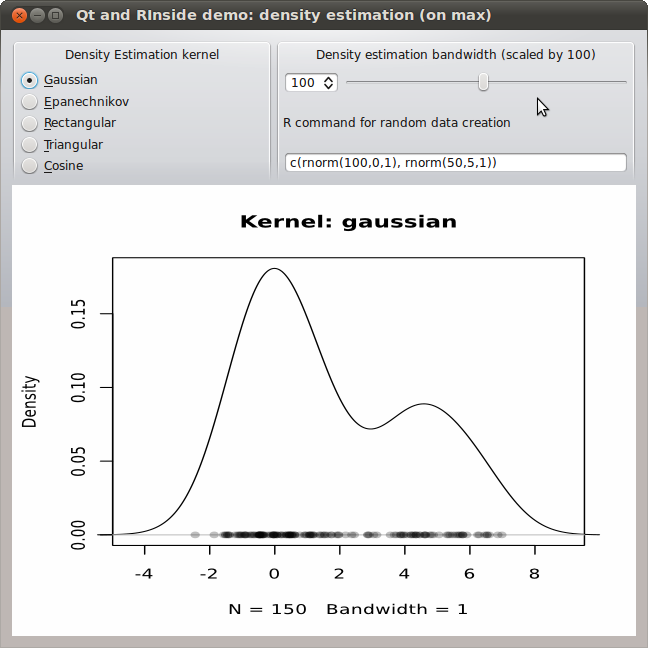
The RInside package makes it pretty simple and straightforward to embed R, the wonderful statistical programming environment and language, inside of a C++ application. This uses both the robust embedding API provided by R itself, and the higher-level abstractions from our Rcpp package. A number of examples are shown on this blog both here and here as well as on the RInside page; and the source package actually contains well over a dozen complete examples which cover anything from simple examples to parallel use via MPI for parallel computing. Beginning users sometimes ask about how to use RInside inside larger projects. And as I had meant to experiment with embedding inside of the powerful Qt framework anyway, I started to dabble a little. A first result is now in the SVN sources of RInside. My starting point was the classic tkdensity demo that comes with R itself. It is a good point of departure as Tcl/Tk makes it very portable---in fact it should run on every platform that runs R---and quite expressive. And having followed some of the GUI experiments around R over the years, I have also seen various re-implementations using different GUI frameworks. And so I am adding mine to this body of work: Example of embedding R via RInside into a Qt C++ application: density estimation for a mixture The problem I addressed first was actual buildability. For the RInside examples, Romain and I provide a Makefile that just works by making calls to R itself to learn about flags for R, Rcpp and RInside such that all required headers and libraries are found. That is actually relatively straightforward (and documented in our vignettes) but a little intimidating at first---which is why a ready-made Makefile is a good thing. Qt of course uses qmake and the .pro files to encode / resolve dependencies. So task one was to map what our Makefile does into its variables. Turns out that wasn't all that hard:
## -*- mode: Makefile; c-indent-level: 4; c-basic-offset: 4;  tab-width: 8; -*-
##
## Qt usage example for RInside, inspired by the standard 'density
## sliders' example for other GUI toolkits
##
## Copyright (C) 2011  Dirk Eddelbuettel and Romain Francois
TEMPLATE =              app
HEADERS =               qtdensity.h 
SOURCES =               qtdensity.cpp main.cpp
QT +=                   svg
## comment this out if you need a different version of R, 
## and set set R_HOME accordingly as an environment variable
R_HOME =                $$system(R RHOME)
## include headers and libraries for R 
RCPPFLAGS =             $$system($$R_HOME/bin/R CMD config --cppflags)
RLDFLAGS =              $$system($$R_HOME/bin/R CMD config --ldflags)
RBLAS =                 $$system($$R_HOME/bin/R CMD config BLAS_LIBS)
RLAPACK =               $$system($$R_HOME/bin/R CMD config LAPACK_LIBS)
## if you need to set an rpath to R itself, also uncomment
#RRPATH =               -Wl,-rpath,$$R_HOME/lib
## include headers and libraries for Rcpp interface classes
RCPPINCL =              $$system($$R_HOME/bin/Rscript -e \'Rcpp:::CxxFlags\(\)\')
RCPPLIBS =              $$system($$R_HOME/bin/Rscript -e \'Rcpp:::LdFlags\(\)\')
## for some reason when building with Qt we get this each time
## so we turn unused parameter warnings off
RCPPWARNING =           -Wno-unused-parameter 
## include headers and libraries for RInside embedding classes
RINSIDEINCL =           $$system($$R_HOME/bin/Rscript -e \'RInside:::CxxFlags\(\)\')
RINSIDELIBS =           $$system($$R_HOME/bin/Rscript -e \'RInside:::LdFlags\(\)\')
## compiler etc settings used in default make rules
QMAKE_CXXFLAGS +=       $$RCPPWARNING $$RCPPFLAGS $$RCPPINCL $$RINSIDEINCL
QMAKE_LFLAGS +=         $$RLDFLAGS $$RBLAS $$RLAPACK $$RCPPLIBS $$RINSIDELIBS
## addition clean targets
QMAKE_CLEAN +=          qtdensity Makefile
The double dollar signs and escaping of parentheses are a little tedious, but hey it works and expands the compiler and linker flags such that everything <emjust works="Works">. The code itself is pretty straightforward too. We instantiate the RInside object as well as the main Qt application object. We then instantiate a new object of class QtDensity that will launch the main widget; it is given a reference to the RInside object.
// -*- mode: C++; c-indent-level: 4; c-basic-offset: 4;  tab-width: 8; -*-
//
// Qt usage example for RInside, inspired by the standard 'density
// sliders' example for other GUI toolkits
//
// Copyright (C) 2011  Dirk Eddelbuettel and Romain Francois
#include <QApplication>
#include "qtdensity.h"
int main(int argc, char *argv[])
 
    RInside R(argc, argv);  		// create an embedded R instance
    QApplication app(argc, argv);
    QtDensity qtdensity(R);
    return app.exec();
 
The definition of the main object is pretty simple: a few private variables, and a few functions to interact with the GUI and get values from the radio buttons, slider or input field---as well as functions to update the chart or re-draw the random variables.
// -*- mode: C++; c-indent-level: 4; c-basic-offset: 4;  tab-width: 8; -*-
//
// Qt usage example for RInside, inspired by the standard 'density
// sliders' example for other GUI toolkits
//
// Copyright (C) 2011  Dirk Eddelbuettel and Romain Francois
#ifndef QTDENSITY_H
#define QTDENSITY_H
#include <RInside.h>
#include <QMainWindow>
#include <QHBoxLayout>
#include <QSlider>
#include <QSpinBox>
#include <QLabel>
#include <QTemporaryFile>
#include <QSvgWidget>
class QtDensity : public QMainWindow
 
    Q_OBJECT
public:
    QtDensity(RInside & R);
private slots:
    void getBandwidth(int bw);
    void getKernel(int kernel);
    void getRandomDataCmd(QString txt);
    void runRandomDataCmd(void);
private:
    void setupDisplay(void);    // standard GUI boilderplate of arranging things
    void plot(void);            // run a density plot in R and update the
    void filterFile(void);      // modify the richer SVG produced by R
    QSvgWidget *m_svg;          // the SVG device
    RInside & m_R;              // reference to the R instance passed to constructor
    QString m_tempfile;         // name of file used by R for plots
    QString m_svgfile;          // another temp file, this time from Qt
    int m_bw, m_kernel;         // parameters used to estimate the density
    QString m_cmd;              // random draw command string
 ;
#endif
Lastly, no big magic in the code either (apart from the standard magic provided by RInside). A bit of standard GUI layouting, and then some functions to pick values from the inputs as well as to compute / update the output. One issue is worth mentioning. The screenshot and code show the second version of this little application. I built a first one using a standard portable network graphics (png) file. That was fine, but not crisp as png is a pixel format so I went back and experimented with scalable vector graphics (svg) instead. One can create svg output with R in a number of ways, one of which is the cairoDevice package by Michael Lawrence (who also wrote RGtk2 and good chunks of Ggobi). Now, it turns out that Qt displays the so-called SVG tiny standard whereas R creates a fuller SVG format. Some discussion with Michael reveals that one can modify the svg file suitably (which is what the function filterFile below does) and it all works. Well: almost. There is a bug (and Michael thinks it is the SVG rendering) in which the density estimate does not get clipped to the plotting region.
// -*- mode: C++; c-indent-level: 4; c-basic-offset: 4;  tab-width: 8; -*-
//
// Qt usage example for RInside, inspired by the standard 'density
// sliders' example for other GUI toolkits -- this time with SVG
//
// Copyright (C) 2011  Dirk Eddelbuettel and Romain Francois
#include <QtGui>
#include "qtdensity.h"
QtDensity::QtDensity(RInside & R) : m_R(R)
 
    m_bw = 100;                 // initial bandwidth, will be scaled by 100 so 1.0
    m_kernel = 0;               // initial kernel: gaussian
    m_cmd = "c(rnorm(100,0,1), rnorm(50,5,1))"; // simple mixture
    m_R["bw"] = m_bw;           // pass bandwidth to R, and have R compute a temp.file name
    m_tempfile = QString::fromStdString(Rcpp::as<std::string>(m_R.parseEval("tfile <- tempfile()")));
    m_svgfile = QString::fromStdString(Rcpp::as<std::string>(m_R.parseEval("sfile <- tempfile()")));
    m_R.parseEvalQ("library(cairoDevice)");
    setupDisplay();
 
void QtDensity::setupDisplay(void)   
    QWidget *window = new QWidget;
    window->setWindowTitle("Qt and RInside demo: density estimation");
    QSpinBox *spinBox = new QSpinBox;
    QSlider *slider = new QSlider(Qt::Horizontal);
    spinBox->setRange(5, 200);
    slider->setRange(5, 200);
    QObject::connect(spinBox, SIGNAL(valueChanged(int)), slider, SLOT(setValue(int)));
    QObject::connect(slider, SIGNAL(valueChanged(int)), spinBox, SLOT(setValue(int)));
    spinBox->setValue(m_bw);
    QObject::connect(spinBox, SIGNAL(valueChanged(int)), this, SLOT(getBandwidth(int)));
    QLabel *cmdLabel = new QLabel("R command for random data creation");
    QLineEdit *cmdEntry = new QLineEdit(m_cmd);
    QObject::connect(cmdEntry,  SIGNAL(textEdited(QString)), this, SLOT(getRandomDataCmd(QString)));
    QObject::connect(cmdEntry,  SIGNAL(editingFinished()), this, SLOT(runRandomDataCmd()));
    QGroupBox *kernelRadioBox = new QGroupBox("Density Estimation kernel");
    QRadioButton *radio1 = new QRadioButton("&Gaussian");
    QRadioButton *radio2 = new QRadioButton("&Epanechnikov");
    QRadioButton *radio3 = new QRadioButton("&Rectangular");
    QRadioButton *radio4 = new QRadioButton("&Triangular");
    QRadioButton *radio5 = new QRadioButton("&Cosine");
    radio1->setChecked(true);
    QVBoxLayout *vbox = new QVBoxLayout;
    vbox->addWidget(radio1);
    vbox->addWidget(radio2);
    vbox->addWidget(radio3);
    vbox->addWidget(radio4);
    vbox->addWidget(radio5);
    kernelRadioBox->setMinimumSize(260,140);
    kernelRadioBox->setMaximumSize(260,140);
    kernelRadioBox->setSizePolicy(QSizePolicy::Fixed, QSizePolicy::Fixed);
    kernelRadioBox->setLayout(vbox);
    QButtonGroup *kernelGroup = new QButtonGroup;
    kernelGroup->addButton(radio1, 0);
    kernelGroup->addButton(radio2, 1);
    kernelGroup->addButton(radio3, 2);
    kernelGroup->addButton(radio4, 3);
    kernelGroup->addButton(radio5, 4);
    QObject::connect(kernelGroup, SIGNAL(buttonClicked(int)), this, SLOT(getKernel(int)));
    m_svg = new QSvgWidget();
    runRandomDataCmd();         // also calls plot()
    QGroupBox *estimationBox = new QGroupBox("Density estimation bandwidth (scaled by 100)");
    QHBoxLayout *spinners = new QHBoxLayout;
    spinners->addWidget(spinBox);
    spinners->addWidget(slider);
    QVBoxLayout *topright = new QVBoxLayout;
    topright->addLayout(spinners);
    topright->addWidget(cmdLabel);
    topright->addWidget(cmdEntry);
    estimationBox->setMinimumSize(360,140);
    estimationBox->setMaximumSize(360,140);
    estimationBox->setSizePolicy(QSizePolicy::Fixed, QSizePolicy::Fixed);
    estimationBox->setLayout(topright);
    QHBoxLayout *upperlayout = new QHBoxLayout;
    upperlayout->addWidget(kernelRadioBox);
    upperlayout->addWidget(estimationBox);
    QHBoxLayout *svglayout = new QHBoxLayout;
    svglayout->addWidget(m_svg);
    QVBoxLayout *outer = new QVBoxLayout;
    outer->addLayout(upperlayout);
    outer->addLayout(svglayout);
    window->setLayout(outer);
    window->show();
 
void QtDensity::plot(void)  
    const char *kernelstrings[] =   "gaussian", "epanechnikov", "rectangular", "triangular", "cosine"  ;
    m_R["bw"] = m_bw;
    m_R["kernel"] = kernelstrings[m_kernel]; // that passes the string to R
    std::string cmd1 = "Cairo(width=6,height=6,pointsize=10,surface='svg',filename=tfile); "
                       "plot(density(y, bw=bw/100, kernel=kernel), xlim=range(y)+c(-2,2), main=\"Kernel: ";
    std::string cmd2 = "\"); points(y, rep(0, length(y)), pch=16, col=rgb(0,0,0,1/4));  dev.off()";
    std::string cmd = cmd1 + kernelstrings[m_kernel] + cmd2; // stick the selected kernel in the middle
    m_R.parseEvalQ(cmd);
    filterFile();               // we need to simplify the svg file for display by Qt 
    m_svg->load(m_svgfile);
 
void QtDensity::getBandwidth(int bw)  
    if (bw != m_bw)  
        m_bw = bw;
        plot();
     
 
void QtDensity::getKernel(int kernel)  
    if (kernel != m_kernel)  
        m_kernel = kernel;
        plot();
     
 
void QtDensity::getRandomDataCmd(QString txt)  
    m_cmd = txt;
 
void QtDensity::runRandomDataCmd(void)  
    std::string cmd = "y <- " + m_cmd.toStdString();
    m_R.parseEvalQ(cmd);
    plot();                     // after each random draw, update plot with estimate
 
void QtDensity::filterFile()  
    // cairoDevice creates richer SVG than Qt can display
    // but per Michaele Lawrence, a simple trick is to s/symbol/g/ which we do here
    QFile infile(m_tempfile);
    infile.open(QFile::ReadOnly);
    QFile outfile(m_svgfile);
    outfile.open(QFile::WriteOnly   QFile::Truncate);
    
    QTextStream in(&infile);
    QTextStream out(&outfile);
    QRegExp rx1("<symbol"); 
    QRegExp rx2("</symbol");    
    while (!in.atEnd())  
        QString line = in.readLine();
        line.replace(rx1, "<g"); // so '<symbol' becomes '<g ...'
        line.replace(rx2, "</g");// and '</symbol becomes '</g'
        out << line << "\n";
     
    infile.close();
    outfile.close();
 
What the little application does is actually somewhat neat for the few lines. One key features is that the generated data can be specified directly by an R expression which allows for mixtures (as shown, and as is the default). With that it easy to see how many points are needed in the second hump to make the estimate multi-modal, and how much of a distance between both centers is needed and so on. Obviously, the effect of the chosen kernel and bandwidth can also be visualized. And with the chart the being a support vector graphics display, we can resize and scale at will and it still looks crisp. The code (for both the simpler png variant and the svg version shown here) is in the SVN repository for RInside and will be in the next release. Special thanks to Michael Lawrence for patiently working through some svg woes with me over a few emails.

Update: Some typos fixed.

Update 2: Two URLs corrected.

Philipp Kern: Debian ftpmaster Meeting The wanna-build/buildd part

I've joined the Debian ftpmaster team in the Linuxhotel in Essen-Horst and so far my coding/hacking has been quite productive (it wasn't on dak after all). Linuxhotel has both a nice working and holiday atmosphere. Albeit I'm not taking much time off anyway.
  • Reenabled mipsel d-i autobuilding. (#618989)
  • Added support to filter the buildd overview pages by out-of-date/uncompiled. (#555527)
  • Adapted the wanna-build triggers (i.e. the scripts that import an archive into wanna-build and which are called by dak instances, for instance) to not start processing immediately but flag that a push happened. The real work is then done by a cronjob that loops through the various flags until there's nothing to do anymore. That avoids losing triggers on the way due to locking. (#602841)
  • All buildds (regardless whether they are running lenny or squeeze) are now running sbuild/buildd 0.61.0. Of course there are quite some patches on top of the upstream version. Packages are available in our repository.
  • Autosigning: adjusted buildd to pass a keyid to sbuild and to arrange for the then-signed .changes to be uploaded (configurable per dist in .builddrc); this involved some hackery in sbuild to actually cope correctly with a keyid passed on the CLI and to sign the package at the right time in the build process
  • Updated the unit tests of the build log importer: mocking more objects (especially the PostgreSQL log database; the tests were broken ever since pkg_history was added as a table) and testing that the actual content we write to disk matches up with our expectations
  • Added support for MIME encoded build logs to the build log importer. The log is still transmitted by mail from the buildd to the admins/security team and to the central log host. However it's now gzip-compressed, which shouldn't cause "this mail is too big" bounces anymore and also save some unneeded traffic for our buildd host sponsors. Furthermore .changes files are now attached to the mail instead of placed somewhere within the log, so it's also easier to sign packages without relying on regular expressions identifying the right portion within the log.
  • Added initial support for arch:all autobuilding to the database, wanna-build and buildd. The merging still needs more thinking as the cases in which an arch:all needs to be built still need to be determined. (Also it needs a Packages file for all the arch:all packages in a suite because it's not guaranteed that the newest arch:all is listed in any of the arch-specific Packages files.)
  • Adjusted my own scripts for build processing (which are used by a few others) to at least ignore autosigned logs. It still needs to grow deMIME abilities, though.
Autosigning will get its own posting later on, unless Joerg gets there first. There is currently one buildd (zandonai/s390) that has working autosigning for all suites on ftp-master (but not for security, backports or edu). More will be added in the next days.

22 March 2011

Joerg Jaspert: Debian FTPMaster meeting 2011

I am at the next edition of Debian FTPMaster meetings in the LinuxHotel Essen currently. We arrived Sunday evening and will stay until 27th March, giving us again a nice week of time to work on outstanding archive issues. And our todo does list a good number of points. Currently we are 3 persons, all 3 FTPMasters. On Wednesday evening one wanna-build member will join and on Friday evening one FTPTeam member arrives for the weekend. While thats not all of our team it still gives us a good base to work on. And so we already did, starting Sunday evening with unbreaking some fallout from Lenny->Squeeze update of the ftpmaster host as well as discussing some of our agenda points and how to tackle them. Today I started changing our backup strategy. Instead of dumping the whole dak database at dinstall start and end, a 4gb file each time, later compressing and then expiring them, we don t dump them at all anymore. Instead we save the postgres transaction id and let the Debian Sysadmin team do the backup. Which they do anyways, using the PostgreSQL WAL stuff. Which means we can just tell them to please reset the dak db to the place of transaction $BLA . Something that only works as we are switching to Postgres 9.0 and will use replication to sync our DD-accessible machine. Torsten started work by explaining us his ORMObject idea in our database layer, then violently vomitting when I pointed him at some code to fixup. Seems that code isn t all the most beautiful one, so he switched to cleanup in a different place. Lets see if I get him back to that bad code. Mark is playing with our database and trying to get that from 8.4 to 9.0, seems like some stuff we are using isn t all that en vogue anymore in 9.0, so might need adjustments.

21 March 2011

Joerg Jaspert: Debian FTPMaster meeting 2011 - Alright Brain...Its all up to you

And so there went a day of work. Minutes done, come back tomorrow
Okok, more text: We did lots of stuff. There was breakfast, soon after we had Lunch, and guess, Dinner also. Now, would you please come back tomorrow?
Anyways, we did some things. One of those was to have PostgreSQL 9.0 and to enable the replication to the machine any DD can access. Which is, from today on, ries.debian.org. And for the first time ever (since that time ftp-master got closed to the public), DDs can now see the live status of the archive, literally a second after a package got accepted a dak ls on ries will show you that fact. Torsten worked on fixing up old remnants of code and database entries around contents and also tackled a problem between our usage of SQLalchemy and the python multiprocessing module. He also started working on the source contents and was weird enough to get us standardized logging into a dak tool. Mark worked with DSA on the Postgres 9.0 upgrade to fix what was to fix in out database and did some tests with our environment in squeeze and coordinated changes in python-apt needed for multiarch and xz. He then started working on some larger database changes around the built-using feature. I myself started off with getting generate-packages-sources to behave when there is an error instead of silently ignoring that. I also did a bit of groundwork to enable us to do NEW processing adding overrides for all affected binary packages, not just those from the architecture currently uploaded. That will allow stuff like linux-2.6 to pass NEW just once, not once per architecture. That involves a new field in our dsc files and the status of that is tracked in Bug #619131.

Thorsten Glaser: M back.

Two DNF out of four geocaches, well one was too muggled, the other was no longer there, judging from the previous visitors log entries. Cached with natureshadow and bought his book on how not to cycle across Germany. CLT was a blast, and it s refreshing to attend an event without having to drive a booth of our own. Talked to lots of people. Since the boss was paying, even did some mingling in that area. My ADSL line has been hiccupping

20 March 2011

Ana Beatriz Guerrero Lopez: Small applications missing in KDE 4

I have been working in the last weeks in the removal of the last pieces of KDE 3 from the Debian archive and I have found there are a lot of packages that is sad having to remove. If you are looking for a good idea/excuse to learn and improve your KDE 4 / C++ /Qt4 skills, have to do a small application for school or you just feel like some useful coding, here is the list:
  • creox real-time guitar effects
  • kbarcode barcode and label printing application for KDE
  • kbiff KDE mail notification utility
  • KKBSwitch keyboard layout indicator for KDE (see this post also)
  • kmyfirewall iptables based firewall configuration tool for KDE
  • kpogre a graphical administrator tool for PostgreSQL
  • kredentials KDE taskbar applet to update kerberos/AFS credentials
  • ksociograma technical educational software to make sociograms
  • ktechlab circuit simulator for microcontrollers and electronics
  • qalculate-kde Powerful and easy to use desktop calculator KDE version
  • score-reading-trainer trainer for reading music notes
Note that I do not list here software whose port in KDE 4 is being developed although it is still not finished and therefore it is not packaged in Debian. By the way, even if all those packages are being removed from Debian testing and unstable, they will remain in Squeeze, so you can keep using them or install it from there.

19 March 2011

Thorsten Glaser: Yawn.

Will drive to Chemnitz now. Maybe meet me there. No booth, just visiting to meet everyone again, rather spontaneous.

16 March 2011

Thorsten Glaser: HOWTO OpenID Delegate with Launchpad Login Service

Rhonda suggested I document how to use the LLS (Launchpad Login Service their implementation of an OpenID provider) as Delegate, which basically means, you can put something up on your webpage, which can be a simple static (X)HTML page like mine (a /index.htm is especially nice, a /~user/index.htm works too), and use its URI and not https://launchpad.net/~me to login. For example, this often hides the LLS from view e.g. in blog comments, such as those where Canonical is being criticised but it s also yours, easier to type and to change if you switch service providers. The basic idea is to go to your Launchpad user page and view its page source. Look for openid relation links in the header on Rhonda s the value we re looking for is cyLQbcp , and you see it several times.

Now you put this on your web page:

	<!-- begin: OpenID delegation to LP -->
	 <link rel="openid.server" href="https://login.launchpad.net/+openid" />
	 <link rel="openid.delegate" href="https://login.launchpad.net/+id/cyLQbcp" />
	 <link rel="openid2.provider" href="https://login.launchpad.net/+openid" />
	 <link rel="openid2.local_id" href="https://login.launchpad.net/+id/cyLQbcp" />
	<!-- end: OpenID delegation -->
 

Of course, insert your, not Rhonda s, ID. Do note that we don t copy the X-XRDS-Location tag (that breaks things for some unknown reason), but otherwise, what we insert on our page is pretty much a copy of the info on the user page (maybe it s a Delegate page, too?). As usual, try at your own risk, bug Canonical if it breaks. It works with AO3, Gerrit Code Review, and others though (interestingly enough, better in Lynx than GUI browsers because I stay logged in across Lynx sessions (and just have to confirm sending my information to the accessing site), whereas I have to re-login to the LLS in every GUI browser session). As with the LLS generally, to access a site which is not recognised is expected and worked on with low urgency (mostly cosmetical, I think).

6 March 2011

Tim Retout: Software Architect

I've been promoted - my job title will now be 'Software Architect'. This seems to mean I'll be writing documents rather than code - any higher-level, and I'd need Mark Shuttleworth's spacesuit. Is this a good thing? Anyway, I celebrated by opening my last bottle of Debian wine. <spam>Unfortunately, I can't take up my new role until we have hired a replacement. UK-based developers who know Perl and ideally PostgreSQL might want to look at the job description, although I'd recommend sending your CV and covering letter to me directly. I don't get a referral bonus, it's just that I don't like what that agency does with your carefully-crafted application.</spam> I'd like to thank everyone who maintains LaTeX for their assistance in this matter. In other news, I'm studying a couple of Open University courses part-time - one on software development (i.e. UML), and one on interaction design. They're going well so far - I've had a couple of tutorials, and the first part of an assignment came back with good marks. I've been reading the Lean Software Development books by Mary and Tom Poppendieck. They seem to put Agile development into a 'respectable' historical context of similar improvements in manufacturing, which might be useful for persuading project managers.

Thorsten Glaser: mksh gains recursive parser for command substitutions $( )

mksh-current has just gained an experimental recursive parser for command substitutions, fixing RedHat BZ#496791 and decades-old complaints about the pdksh codebase, compared to AT&T ksh93. (GNU bash could also do the example, but not some other things mksh(1) parses fine now.)

This means that things like the following work now.

	# POSIX, should  always  work
	echo $(case 1 in (1) echo yes;; (2) echo no;; esac)
	# POSIX optional, works now in mksh, works in GNU bash
	echo $(case 1 in 1) echo yes;; 2) echo no;; esac)
	# GNU bash seems to choke on comments ending with backslash
	# a comment with " ' \
	x=$(
	echo yes
	# a comment with " ' \
	)
	# No non-recursive COMSUB parser can pass all of the above
	# tests and these below at the same time (some extensions)
	echo $(typeset -i10 x=16#20; echo $x)
	echo $(typeset -Uui16 x=16#$(id -u)
	) .
	echo $(c=1; d=1
	typeset -Uui16 a=36#foo; c=2
	typeset -Uui16 b=36 #foo; d=2
	echo $a $b $c $d)
	# the  #  is especially tricky, that s why the above cases
 

Next on my TODO is the complete rewrite of the read built-in command, as well as its documentation. I think that the (reduced) goals for mksh R40 will have been met by then, except porting to LynxOS and MPE, but we re working on it, and re-testing Syllable and Plan 9). Of course, a release implies testing on a lot of the supposedly supported platforms, so it won t be out immediately . Though, associative arrays have been removed from the R40 goals, so that I can at least get a new release out. Note that Debian and OpenSuSE Buildservice users have been provided with somewhat well-tested mksh-current snapshots for a while already, and Gentoo users can use the live ebuild ; there s always compiling from source too

3 March 2011

Thorsten Glaser: (Free)BSD vs. Linux

Warning: this is a rant against BSD (specifically FreeBSD , but don t let me get started on DragonFly, who think it s wise to drop all shells except ash from the base system and rely on pkgsrc yay let s compile a dozen packages just to get a shell with tab completion, not to mention boxen with no network access for the task although others seem to go into that direction too ; you know, there s BSD, and then there s FreeBSD ) don t like, don t read. If you want to change something in the BSD world, you gotta fork your own BSD no other way around the thickheads. Ok, back then, I ran into a particularily thick one, but others tend to not be much better. Users share the thickness. If you want to change something in the GNU/Linux world, just make a package, have someone upload it, prod (or pay, Hanno got a Radler) people to do it, or just upload it yourself. At the BSD booth at FOSDEM, despite me bringing the Windows Mobile 6 Professional devive, strictly for Geocaching mind you, Macintosh boxen had a share of more than 50% I didn t manage to tip the scale. At the Debian booth, almost everyone had a I want to buy a new laptop some day, but it just keeps on working and doesn t break pre-Lenovo IBM laptop. No hyping of Google either. (Last year s CLT saw BSD people advocating pro-Schily the guy with the broken encoding in his name shockingly.) Honestly, tcsh, FreeBSD people? Sorry. While I agree that there is merit on having the same script and interactive shell, as someone has pointed out (copy-paste examples into the command line), there s those zsh users who use mksh or GNU bash for scripting. Or just POSIX shell. And that s with an interactive shell which can be used for scripting. On the other hand, the C shell (both csh and tcsh) cannot. And what s with pretending the accent gravis is non-combining, called backtick (such a thing does not exist); and advocating it? Sorry, if your csh/tcsh doesn t handle the POSIX $( ) you should just drop it. (By the way, there is a convention that example command lines are prefixed with % for csh and $ for sh (or # but we write $ sudo instead, these days). Use it. Or leave it. If you have examples that substitute another process output, be specific.) It s funny to see how one person tries to defuse my arguments against csh by telling me it s just an interactive shell , while the other argues that people copy-paste between them, to which that was my response. Read the thread! And please, get your facts right. I would prefer that the standard shell be at least Bourne-compatible. You don t want Bourne ( ^ instead of for pipes), you want POSIX. That GNU bash is called the Bourne-Again Shell in one of their usual semi-bad puns doesn t help the global perception of such things any. Also, the root shell and /bin/sh are disjunct. (Plus, why change the root shell, use sudo(8), plain and simple.) ObNote: in jupp (should I package that for Debian, btw? rather upload, packages are ready ) the key is used as pr fix for Ctrl-X ( X) or to directly enter numerical (decimal, octal, sedecimal/hexadecadic) ASCII, 8-bit or Unicode codepoints. Yay!
And even the FSF has seen the light; for a few releases already, GCC uses ' ' instead of ' for quoting in messages, even without locales. Great job there! (LC_MESSAGES=en_GB.UTF-8 usually works, too, though.) ObDisclaimer: I have an (yes, Google ) Alert on the word mksh , so I know when it s being discussed. This obviously includes certain fora. Also, I m a shell implementer and bound to know a certain amount of details. Plus, mksh s build script runs with pretty much any Bourne/POSIX/Z Shell which has functions and not too many bugs. I wrote it. Go figure. No lowly trolling. FWIW, mksh(1) has the cat(1) builtin both because Android has no cat(1), and as speed hack. Almost all other shells have worse speed hacks, like a printf(1) builtin. And recently, builtins have become direct-callable, so this actually reduces the overall system footprint. (Its inclusion also provides for some other possibilities, internally.) And as two final side notes, if you haven t seen this: determine which shell we are run under (CVS) and I still offer a prompt conversion service (send me any GNU bash or oksh $PS1 and I ll send that to you in mksh(1) syntax optionally with adjustments/improvements, like cwd uses only up to 1/3 of screen width).

19 February 2011

Thorsten Glaser: Where in the world is Carmen Sanbuggo?

Eh. Why does mksh built with (a patched: mkstemp(3) added) klibc work suddenly, unexpectedly? To reproduce, I just uploaded mksh_39.3.20110218-1.dsc and you can run DEB_BUILD_OPTIONS=mksh-static=klibc,dietlibc,eglibc dpkg-buildpackage -rfakeroot to verify it, once you have mkstemp(3). (I will probably send a smaller implementation of that in, later.) I have that and the open fix and the m68k patch applied, nothing else where did my bug go? ObQuestion: what s the legal (copyright/trademark) status of the Atari logo (the one in rainbow colours, with three things going up, right and left leg looking like an umbrella stand s)?

Next.

Previous.