Search Results: "tb"

12 April 2021

Russell Coker: Storage Trends 2021

The Viability of Small Disks Less than a year ago I wrote a blog post about storage trends [1]. My main point in that post was that disks smaller than 2TB weren t viable then and 2TB disks wouldn t be economically viable in the near future. Now MSY has 2TB disks for $72 and 2TB SSD for $245, saving $173 if you get a hard drive (compared to saving $240 10 months ago). Given the difference in performance and noise 2TB hard drives won t be worth using for most applications nowadays. NVMe vs SSD Last year NVMe prices were very comparable for SSD prices, I was hoping that trend would continue and SSDs would go away. Now for sizes 1TB and smaller NVMe and SSD prices are very similar, but for 2TB the NVMe prices are twice that of SSD presumably partly due to poor demand for 2TB NVMe. There are also no NVMe devices larger than 2TB on sale at MSY (a store which caters to home stuff not special server equipment) but SSDs go up to 8TB. It seems that NVMe is only really suitable for workstation storage and for cache etc on a server. So SATA SSDs will be around for a while. Small Servers There are a range of low end servers which support a limited number of disks. Dell has 2 disk servers and 4 disk servers. If one of those had 8TB SSDs you could have 8TB of RAID-1 or 24TB of RAID-Z storage in a low end server. That covers the vast majority of servers (small business or workgroup servers tend to have less than 8TB of storage). Larger Servers Anandtech has an article on Seagates roadmap to 120TB disks [2]. They currently sell 20TB disks using HAMR technology Currently the biggest disks that MSY sells are 10TB for $395, which was also the biggest disk they were selling last year. Last year MSY only sold SSDs up to 2TB in size (larger ones were available from other companies at much higher prices), now they sell 8TB SSDs for $949 (4* capacity increase in less than a year). Seagate is planning 30TB disks for 2023, if SSDs continue to increase in capacity by 4* per year we could have 128TB SSDs in 2023. If you needed a server with 100TB of storage then having 2 or 3 SSDs in a RAID array would be much easier to manage and faster than 4*30TB disks in an array. When you have a server with many disks you can expect to have more disk failures due to vibration. One time I built a server with 18 disks and took disks from 2 smaller servers that had 4 and 5 disks. The 9 disks which had been working reliably for years started having problems within weeks of running in the bigger server. This is one of the many reasons for paying extra for SSD storage. Seagate is apparently planning 50TB disks for 2026 and 100TB disks for 2030. If that s the best they can do then SSD vendors should be able to sell larger products sooner at prices that are competitive. Matching hard drive prices is not required, getting to less than 4* the price should be enough for most customers. The Anandtech article is worth reading, it mentions some interesting features that Seagate are developing such as having 2 actuators (which they call Mach.2) so the drive can access 2 different tracks at the same time. That can double the performance of a disk, but that doesn t change things much when SSDs are more than 100* faster. Presumably the Mach.2 disks will be SAS and incredibly expensive while providing significantly less performance than affordable SATA SSDs. Computer Cases In my last post I speculated on the appearance of smaller cases designed to not have DVD drives or 3.5 hard drives. Such cases still haven t appeared apart from special purpose machines like the NUC that were available last year. It would be nice if we could get a new industry standard for smaller power supplies. Currently power supplies are expected to be almost 5 inches wide (due to the expectation of a 5.25 DVD drive mounted horizontally). We need some industry standards for smaller PCs that aren t like the NUC, the NUC is very nice, but most people who build their own PC need more space than that. I still think that planning on USB DVD drives is the right way to go. I ve got 4PCs in my home that are regularly used and CDs and DVDs are used so rarely that sharing a single DVD drive among all 4 wouldn t be a problem. Conclusion I m tempted to get a couple of 4TB SSDs for my home server which cost $487 each, it currently has 2*500G SSDs and 3*4TB disks. I would have to remove some unused files but that s probably not too hard to do as I have lots of old backups etc on there. Another possibility is to use 2*4TB SSDs for most stuff and 2*4TB disks for backups. I m recommending that all my clients only use SSDs for their storage. I only have one client with enough storage that disks are the only option (100TB of storage) but they moved all the functions of that server to AWS and use S3 for the storage. Now I don t have any clients doing anything with storage that can t be done in a better way on SSD for a price difference that s easy for them to afford. Affordable SSD also makes RAID-1 in workstations more viable. 2 disks in a PC is noisy if you have an office full of them and produces enough waste heat to be a reliability issue (most people don t cool their offices adequately on weekends). 2 SSDs in a PC is no problem at all. As 500G SSDs are available for $73 it s not a significant cost to install 2 of them in every PC in the office (more cost for my time than hardware). I generally won t recommend that hard drives be replaced with SSDs in systems that are working well. But if a machine runs out of space then replacing it with SSDs in a RAID-1 is a good choice. Moore s law might cover SSDs, but it definitely doesn t cover hard drives. Hard drives have fallen way behind developments of most other parts of computers over the last 30 years, hopefully they will go away soon.

11 April 2021

Jelmer Vernooij: The upstream ontologist

The Debian Janitor is an automated system that commits fixes for (minor) issues in Debian packages that can be fixed by software. It gradually started proposing merges in early December. The first set of changes sent out ran lintian-brush on sid packages maintained in Git. This post is part of a series about the progress of the Janitor. The upstream ontologist is a project that extracts metadata about upstream projects in a consistent format. It does this with a combination of heuristics and reading ecosystem-specific metadata files, such as Python s setup.py, rust s Cargo.toml as well as e.g. scanning README files.

Supported Data Sources It will extract information from a wide variety of sources, including:
Supported Fields Fields that it currently provides include:
  • Homepage: homepage URL
  • Name: name of the upstream project
  • Contact: contact address of some sort of the upstream (e-mail, mailing list URL)
  • Repository: VCS URL
  • Repository-Browse: Web URL for viewing the VCS
  • Bug-Database: Bug database URL (for web viewing, generally)
  • Bug-Submit: URL to use to submit new bugs (either on the web or an e-mail address)
  • Screenshots: List of URLs with screenshots
  • Archive: Archive used - e.g. SourceForge
  • Security-Contact: e-mail or URL with instructions for reporting security issues
  • Documentation: Link to documentation on the web:
  • Wiki: Wiki URL
  • Summary: one-line description of the project
  • Description: longer description of the project
  • License: Single line license description (e.g. GPL 2.0 ) as declared in the metadata[1]
  • Copyright: List of copyright holders
  • Version: Current upstream version
  • Security-MD: URL to markdown file with security policy
All data fields have a certainty associated with them ( certain , confident , likely or possible ), which gets set depending on how the data was derived or where it was found. If multiple possible values were found for a specific field, then the value with the highest certainty is taken.
Interface The ontologist provides a high-level Python API as well as two command-line tools that can write output in two different formats: For example, running guess-upstream-metadata on dulwich:
 % guess-upstream-metadata
 <string>:2: (INFO/1) Duplicate implicit target name: "contributing".
 Name: dulwich
 Repository: https://www.dulwich.io/code/
 X-Security-MD: https://github.com/dulwich/dulwich/tree/HEAD/SECURITY.md
 X-Version: 0.20.21
 Bug-Database: https://github.com/dulwich/dulwich/issues
 X-Summary: Python Git Library
 X-Description:  
   This is the Dulwich project.
   It aims to provide an interface to git repos (both local and remote) that
   doesn't call out to git directly but instead uses pure Python.
 X-License: Apache License, version 2 or GNU General Public License, version 2 or later.
 Bug-Submit: https://github.com/dulwich/dulwich/issues/new
Lintian-Brush lintian-brush can update DEP-12-style debian/upstream/metadata files that hold information about the upstream project that is packaged as well as the Homepage in the debian/control file based on information provided by the upstream ontologist. By default, it only imports data with the highest certainty - you can override this by specifying the uncertain command-line flag.
[1]Obviously this won t be able to describe the full licensing situation for many projects. Projects like scancode-toolkit are more appropriate for that.

Vishal Gupta: Sikkim 101 for Backpackers

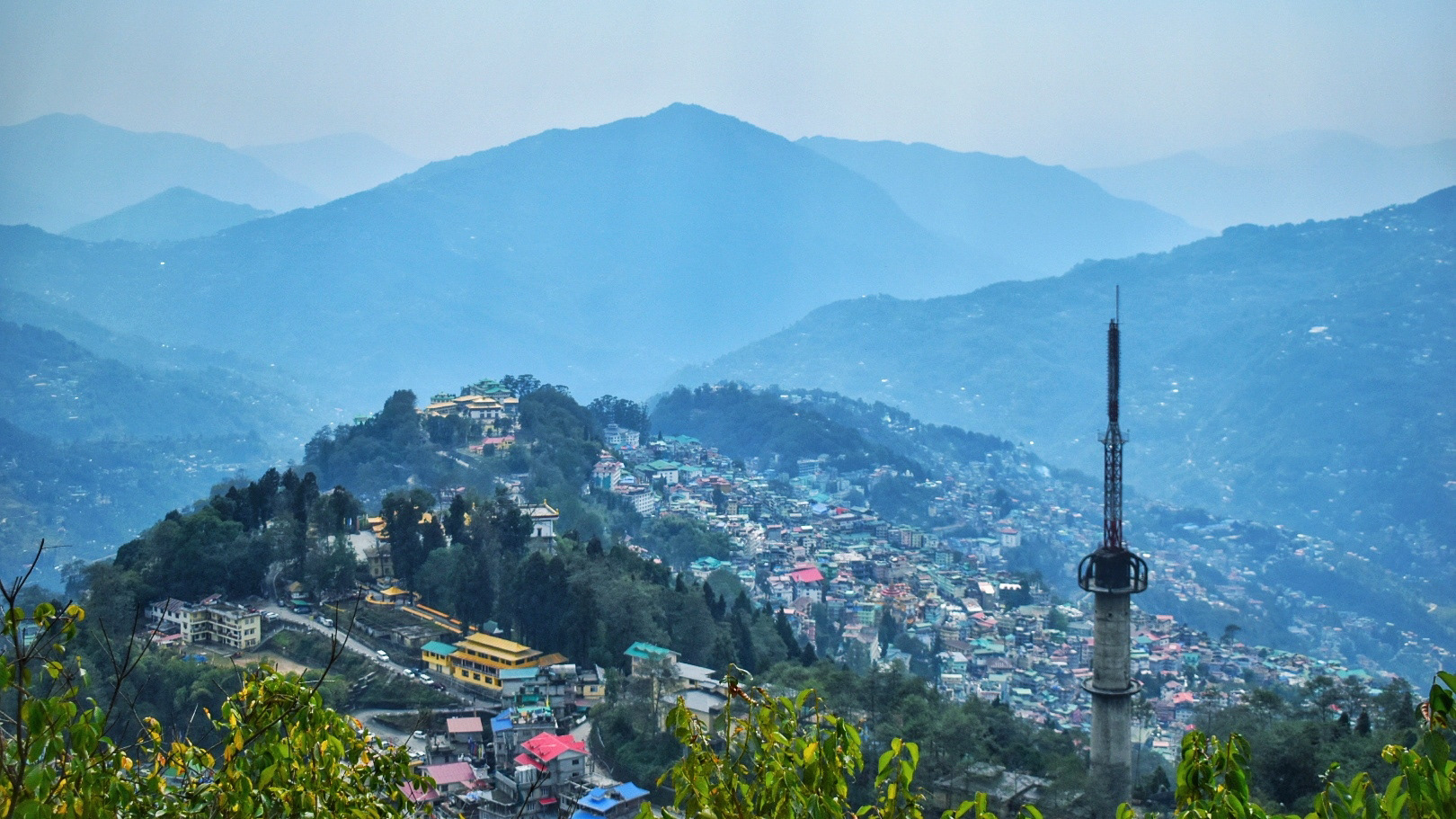
Host to Kanchenjunga, the world s third-highest mountain peak and the endangered Red Panda, Sikkim is a state in northeastern India. Nestled between Nepal, Tibet (China), Bhutan and West Bengal (India), the state offers a smorgasbord of cultures and cuisines. That said, it s hardly surprising that the old spice route meanders through western Sikkim, connecting Lhasa with the ports of Bengal. Although the latter could also be attributed to cardamom (kali elaichi), a perennial herb native to Sikkim, which the state is the second-largest producer of, globally. Lastly, having been to and lived in India, all my life, I can confidently say Sikkim is one of the cleanest & safest regions in India, making it ideal for first-time backpackers.

Brief History
  • 17th century: The Kingdom of Sikkim is founded by the Namgyal dynasty and ruled by Buddhist priest-kings known as the Chogyal.
  • 1890: Sikkim becomes a princely state of British India.
  • 1947: Sikkim continues its protectorate status with the Union of India, post-Indian-independence.
  • 1973: Anti-royalist riots take place in front of the Chogyal's palace, by Nepalis seeking greater representation.
  • 1975: Referendum leads to the deposition of the monarchy and Sikkim joins India as its 22nd state.
Languages
  • Official: English, Nepali, Sikkimese/Bhotia and Lepcha
  • Though Hindi and Nepali share the same script (Devanagari), they are not mutually intelligible. Yet, most people in Sikkim can understand and speak Hindi.
Ethnicity
  • Nepalis: Migrated in large numbers (from Nepal) and soon became the dominant community
  • Bhutias: People of Tibetan origin. Major inhabitants in Northern Sikkim.
  • Lepchas: Original inhabitants of Sikkim

Food
  • Tibetan/Nepali dishes (mostly consumed during winter)
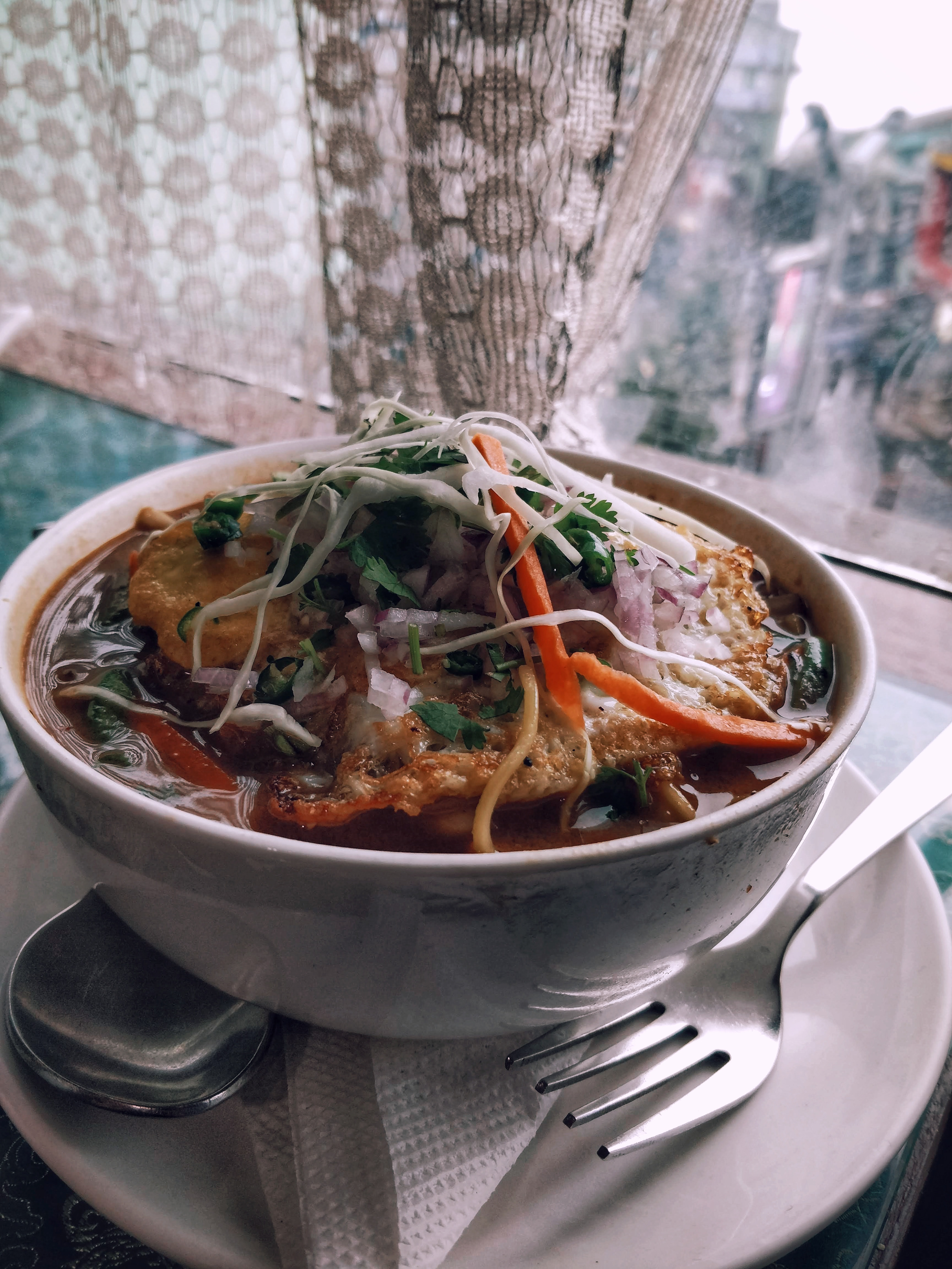
    • Thukpa: Noodle soup, rich in spices and vegetables. Usually contains some form of meat. Common variations: Thenthuk and Gyathuk
    • Momos: Steamed or fried dumplings, usually with a meat filling.
    • Saadheko: Spicy marinated chicken salad.
    • Gundruk Soup: A soup made from Gundruk, a fermented leafy green vegetable.
    • Sinki : A fermented radish tap-root product, traditionally consumed as a base for soup and as a pickle. Eerily similar to Kimchi.
  • While pork and beef are pretty common, finding vegetarian dishes is equally easy.
  • Staple: Dal-Bhat with Subzi. Rice is a lot more common than wheat (rice) possibly due to greater carb content and proximity to West Bengal, India s largest producer of Rice.
  • Good places to eat in Gangtok
    • Hamro Bhansa Ghar, Nimtho (Nepali)
    • Taste of Tibet
    • Dragon Wok (Chinese & Japanese)

Buddhism in Sikkim
  • Bayul Demojong (Sikkim), is the most sacred Land in the Himalayas as per the belief of the Northern Buddhists and various religious texts.
  • Sikkim was blessed by Guru Padmasambhava, the great Buddhist saint who visited Sikkim in the 8th century and consecrated the land.
  • However, Buddhism is said to have reached Sikkim only in the 17th century with the arrival of three Tibetan monks viz. Rigdzin Goedki Demthruchen, Mon Kathok Sonam Gyaltshen & Rigdzin Legden Je at Yuksom. Together, they established a Buddhist monastery.
  • In 1642 they crowned Phuntsog Namgyal as the first monarch of Sikkim and gave him the title of Chogyal, or Dharma Raja.
  • The faith became popular through its royal patronage and soon many villages had their own monastery.
  • Today Sikkim has over 200 monasteries.

Major monasteries
  • Rumtek Monastery, 20Km from Gangtok
  • Lingdum/Ranka Monastery, 17Km from Gangtok
  • Phodong Monastery, 28Km from Gangtok
  • Ralang Monastery, 10Km from Ravangla
  • Tsuklakhang Monastery, Royal Palace, Gangtok
  • Enchey Monastery, Gangtok
  • Tashiding Monastery, 35Km from Ravangla


Reaching Sikkim
  • Gangtok, being the capital, is easiest to reach amongst other regions, by public transport and shared cabs.
  • By Air:
    • Pakyong (PYG) :
      • Nearest airport from Gangtok (about 1 hour away)
      • Tabletop airport
      • Reserved cabs cost around INR 1200.
      • As of Apr 2021, the only flights to PYG are from IGI (Delhi) and CCU (Kolkata).
    • Bagdogra (IXB) :
      • About 20 minutes from Siliguri and 4 hours from Gangtok.
      • Larger airport with flights to most major Indian cities.
      • Reserved cabs cost about INR 3000. Shared cabs cost about INR 350.
  • By Train:
    • New Jalpaiguri (NJP) :
      • About 20 minutes from Siliguri and 4 hours from Gangtok.
      • Reserved cabs cost about INR 3000. Shared cabs from INR 350.
  • By Road:
    • NH10 connects Siliguri to Gangtok
    • If you can t find buses plying to Gangtok directly, reach Siliguri and then take a cab to Gangtok.
  • Sikkim Nationalised Transport Div. also runs hourly buses between Siliguri and Gangtok and daily buses on other common routes. They re cheaper than shared cabs.
  • Wizzride also operates shared cabs between Siliguri/Bagdogra/NJP, Gangtok and Darjeeling. They cost about the same as shared cabs but pack in half as many people in luxury cars (Innova, Xylo, etc.) and are hence more comfortable.

Gangtok
  • Time needed: 1D/1N
  • Places to visit:
    • Hanuman Tok
    • Ganesh Tok
    • Tashi View Point [6,800ft]
    • MG Marg
    • Sikkim Zoo
    • Gangtok Ropeway
    • Enchey Monastery
    • Tsuklakhang Palace & Monastery
  • Hostels: Tagalong Backpackers (would strongly recommend), Zostel Gangtok
  • Places to chill: Travel Cafe, Caf Live & Loud and Gangtok Groove
  • Places to shop: Lal Market and MG Marg

Getting Around
  • Taxis operate on a reserved or shared basis. In case of the latter, you can pool with other commuters your taxis will pick up and drop en-route.
  • Naturally shared taxis only operate on popular routes. The easiest way to get around Gangtok is to catch a shared cab from MG Marg.
  • Reserved taxis for Gangtok sightseeing cost around INR 1000-1500, depending upon the spots you d like to see
  • Key taxi/bus stands :
    • Deorali stand: For Darjeeling, Siliguri, Kalimpong
    • Vajra stand: For North & East Sikkim (Tsomgo Lake & Nathula)
    • Rumtek taxi: For Ravangla, Pelling, Namchi, Geyzing, Jorethang and Singtam.
Exploring Gangtok on an MTB

North Sikkim
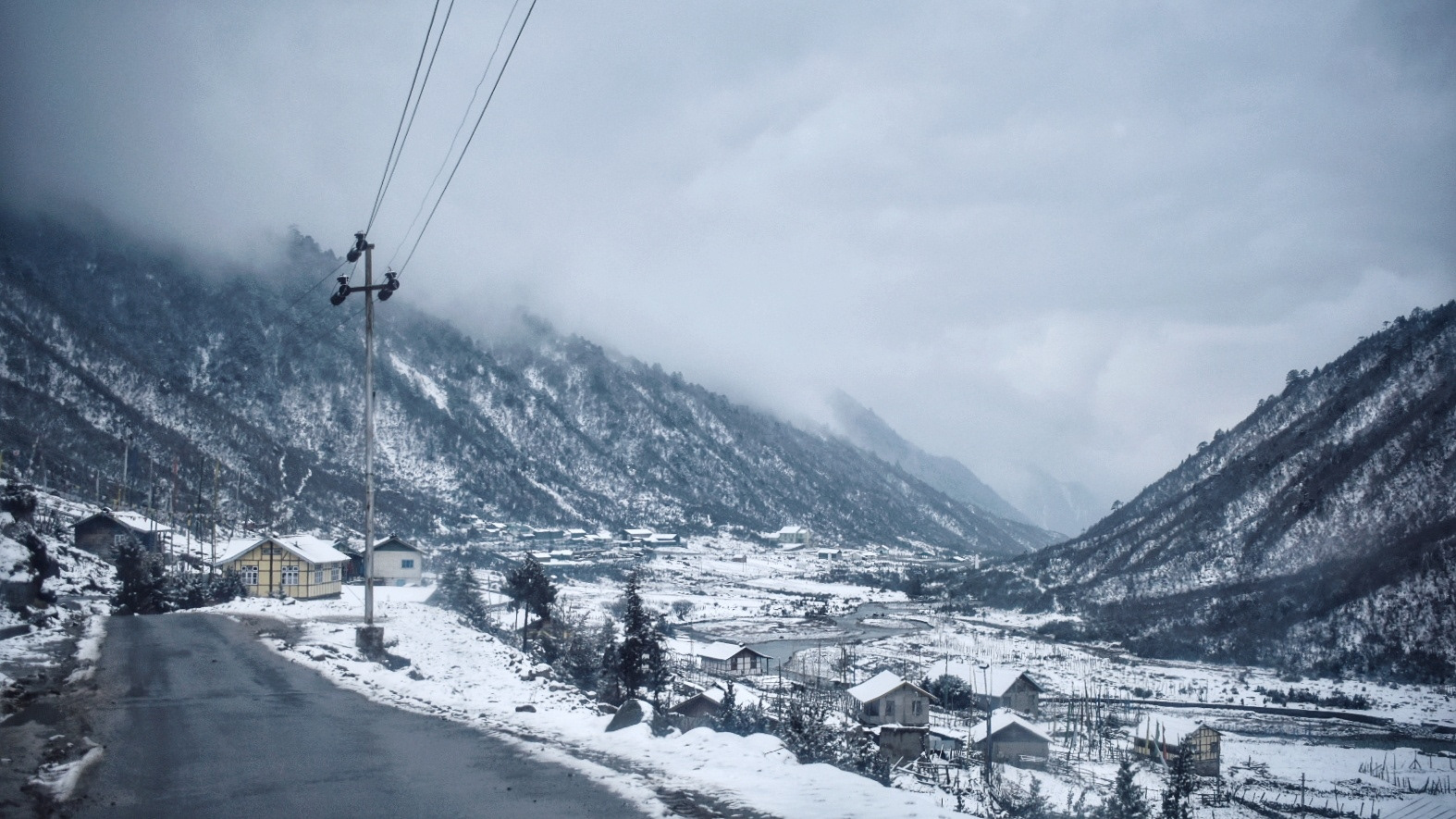
  • The easiest & most economical way to explore North Sikkim is the 3D/2N package offered by shared-cab drivers.
  • This includes food, permits, cab rides and accommodation (1N in Lachen and 1N in Lachung)
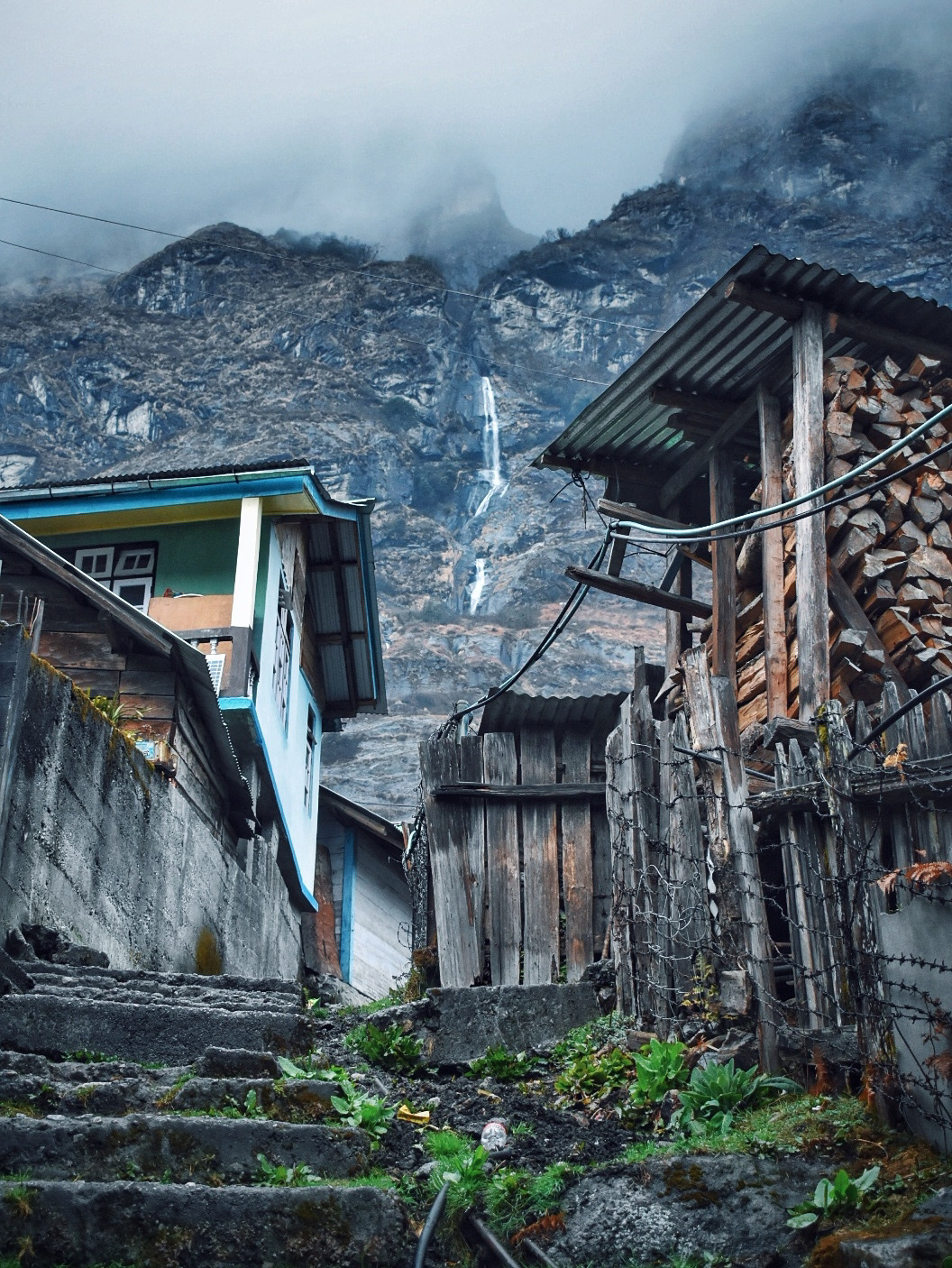
  • The accommodation on both nights are at homestays with bare necessities, so keep your hopes low.
  • In the spirit of sustainable tourism, you ll be asked to discard single-use plastic bottles, so please carry a bottle that you can refill along the way.
  • Zero Point and Gurdongmer Lake are snow-capped throughout the year
3D/2N Shared-cab Package Itinerary
  • Day 1
    • Gangtok (10am) - Chungthang - Lachung (stay)
  • Day 2
    • Pre-lunch : Lachung (6am) - Yumthang Valley [12,139ft] - Zero Point - Lachung [15,300ft]
    • Post-lunch : Lachung - Chungthang - Lachen (stay)
  • Day 3
    • Pre-lunch : Lachen (5am) - Kala Patthar - Gurdongmer Lake [16,910ft] - Lachen
    • Post-lunch : Lachen - Chungthang - Gangtok (7pm)
  • This itinerary is idealistic and depends on the level of snowfall.
  • Some drivers might switch up Day 2 and 3 itineraries by visiting Lachen and then Lachung, depending upon the weather.
  • Areas beyond Lachen & Lachung are heavily militarized since the Indo-China border is only a few miles away.

East Sikkim

Zuluk and Silk Route
  • Time needed: 2D/1N
  • Zuluk [9,400ft] is a small hamlet with an excellent view of the eastern Himalayan range including the Kanchenjunga.
  • Was once a transit point to the historic Silk Route from Tibet (Lhasa) to India (West Bengal).
  • The drive from Gangtok to Zuluk takes at least four hours. Hence, it makes sense to spend the night at a homestay and space out your trip to Zuluk

Tsomgo Lake and Nathula
  • Time Needed : 1D
  • A Protected Area Permit is required to visit these places, due to their proximity to the Chinese border
  • Tsomgo/Chhangu Lake [12,313ft]
    • Glacial lake, 40 km from Gangtok.
    • Remains frozen during the winter season.
    • You can also ride on the back of a Yak for INR 300
  • Baba Mandir
    • An old temple dedicated to Baba Harbhajan Singh, a Sepoy in the 23rd Regiment, who died in 1962 near the Nathu La during Indo China war.
  • Nathula Pass [14,450ft]
    • Located on the Indo-Tibetan border crossing of the Old Silk Route, it is one of the three open trading posts between India and China.
    • Plays a key role in the Sino-Indian Trade and also serves as an official Border Personnel Meeting(BPM) Point.
    • May get cordoned off by the Indian Army in event of heavy snowfall or for other security reasons.


West Sikkim
  • Time needed: 3N/1N
  • Hostels at Pelling : Mochilerro Ostillo

Itinerary

Day 1: Gangtok - Ravangla - Pelling
  • Leave Gangtok early, for Ravangla through the Temi Tea Estate route.
  • Spend some time at the tea garden and then visit Buddha Park at Ravangla
  • Head to Pelling from Ravangla

Day 2: Pelling sightseeing
  • Hire a cab and visit Skywalk, Pemayangtse Monastery, Rabdentse Ruins, Kecheopalri Lake, Kanchenjunga Falls.

Day 3: Pelling - Gangtok/Siliguri
  • Wake up early to catch a glimpse of Kanchenjunga at the Pelling Helipad around sunrise
  • Head back to Gangtok on a shared-cab
  • You could take a bus/taxi back to Siliguri if Pelling is your last stop.

Darjeeling
  • In my opinion, Darjeeling is lovely for a two-day detour on your way back to Bagdogra/Siliguri and not any longer (unless you re a Bengali couple on a honeymoon)
  • Once a part of Sikkim, Darjeeling was ceded to the East India Company after a series of wars, with Sikkim briefly receiving a grant from EIC for gifting Darjeeling to the latter
  • Post-independence, Darjeeling was merged with the state of West Bengal.

Itinerary

Day 1 :
  • Take a cab from Gangtok to Darjeeling (shared-cabs cost INR 300 per seat)
  • Reach Darjeeling by noon and check in to your Hostel. I stayed at Hideout.
  • Spend the evening visiting either a monastery (or the Batasia Loop), Nehru Road and Mall Road.
  • Grab dinner at Glenary whilst listening to live music.

Day 2:
  • Wake up early to catch the sunrise and a glimpse of Kanchenjunga at Tiger Hill. Since Tiger Hill is 10km from Darjeeling and requires a permit, book your taxi in advance.
  • Alternatively, if you don t want to get up at 4am or shell out INR1500 on the cab to Tiger Hill, walk to the Kanchenjunga View Point down Mall Road
  • Next, queue up outside Keventers for breakfast with a view in a century-old cafe
  • Get a cab at Gandhi Road and visit a tea garden (Happy Valley is the closest) and the Ropeway. I was lucky to meet 6 other backpackers at my hostel and we ended up pooling the cab at INR 200 per person, with INR 1400 being on the expensive side, but you could bargain.
  • Get lunch, buy some tea at Golden Tips, pack your bags and hop on a shared-cab back to Siliguri. It took us about 4hrs to reach Siliguri, with an hour to spare before my train.
  • If you ve still got time on your hands, then check out the Peace Pagoda and the Darjeeling Himalayan Railway (Toy Train). At INR 1500, I found the latter to be too expensive and skipped it.


Tips and hacks
  • Download offline maps, especially when you re exploring Northern Sikkim.
  • Food and booze are the cheapest in Gangtok. Stash up before heading to other regions.
  • Keep your Aadhar/Passport handy since you need permits to travel to North & East Sikkim.
  • In rural areas and some cafes, you may get to try Rhododendron Wine, made from Rhododendron arboreum a.k.a Gurans. Its production is a little hush-hush since the flower is considered holy and is also the National Flower of Nepal.
  • If you don t want to invest in a new jacket, boots or a pair of gloves, you can always rent them at nominal rates from your hotel or little stores around tourist sites.
  • Check the weather of a region before heading there. Low visibility and precipitation can quite literally dampen your experience.
  • Keep your itinerary flexible to accommodate for rest and impromptu plans.
  • Shops and restaurants close by 8pm in Sikkim and Darjeeling. Plan for the same.

Carry
  • a couple of extra pairs of socks (woollen, if possible)
  • a pair of slippers to wear indoors
  • a reusable water bottle
  • an umbrella
  • a power bank
  • a couple of tablets of Diamox. Helps deal with altitude sickness
  • extra clothes and wet bags since you may not get a chance to wash/dry your clothes
  • a few passport size photographs

Shared-cab hacks
  • Intercity rides can be exhausting. If you can afford it, pay for an additional seat.
  • Call shotgun on the drives beyond Lachen and Lachung. The views are breathtaking.
  • Return cabs tend to be cheaper (WB cabs travelling from SK and vice-versa)

Cost
  • My median daily expenditure (back when I went to Sikkim in early March 2021) was INR 1350.
  • This includes stay (bunk bed), food, wine and transit (shared cabs)
  • In my defence, I splurged on food, wine and extra seats in shared cabs, but if you re on a budget, you could easily get by on INR 1 - 1.2k per day.
  • For a 9-day trip, I ended up shelling out nearly INR 15k, including 2AC trains to & from Kolkata
  • Note : Summer (March to May) and Autumn (October to December) are peak seasons, and thereby more expensive to travel around.

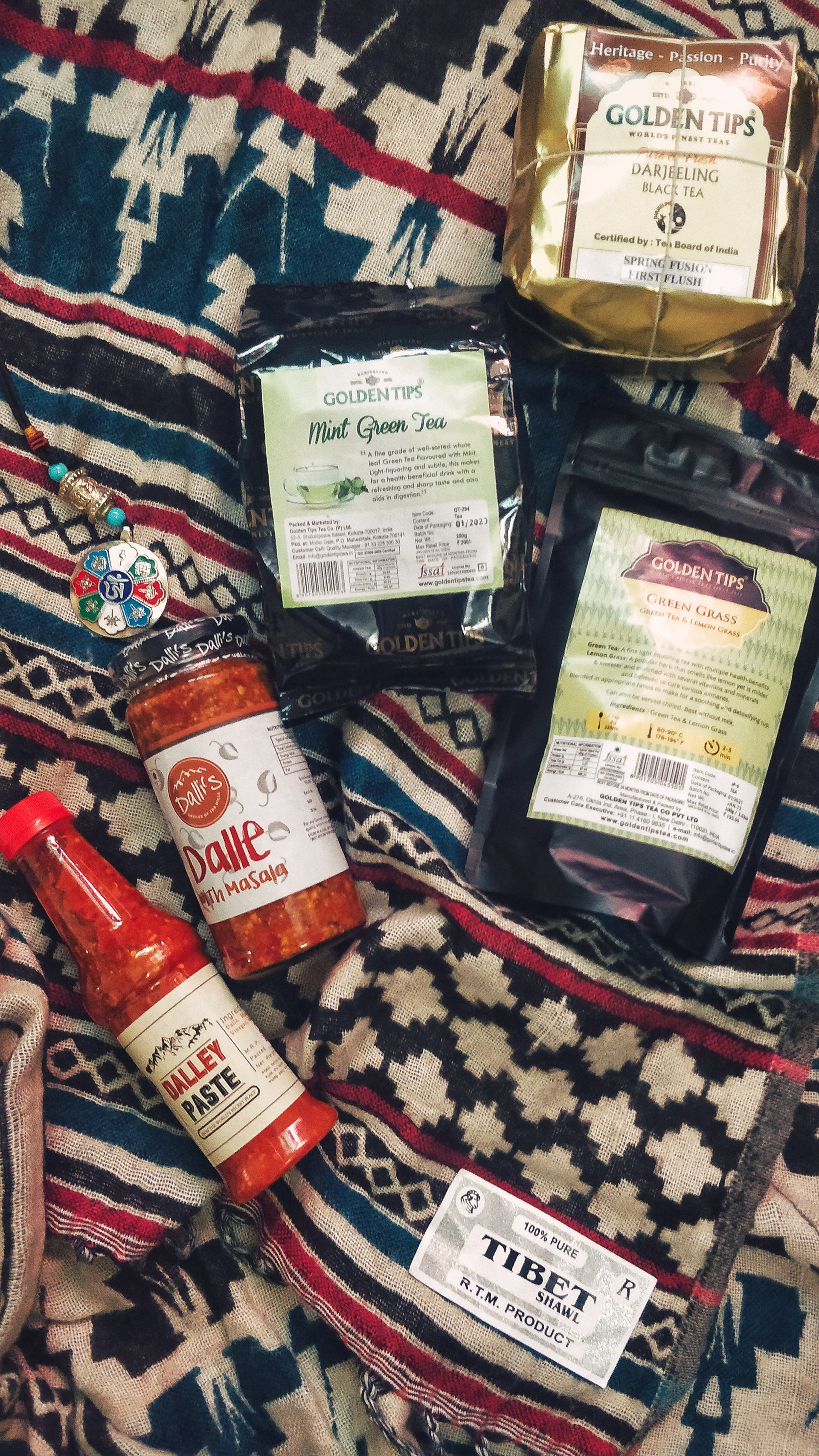
Souvenirs and things you should buy

Buddhist souvenirs :
  • Colourful Prayer Flags (great for tying on bikes or behind car windshields)
  • Miniature Prayer/Mani Wheels
  • Lucky Charms, Pendants and Key Chains
  • Cham Dance masks and robes
  • Singing Bowls
  • Common symbols: Om mani padme hum, Ashtamangala, Zodiac signs

Handicrafts & Handlooms
  • Tibetan Yak Wool shawls, scarfs and carpets
  • Sikkimese Ceramic cups
  • Thangka Paintings

Edibles
  • Darjeeling Tea (usually brewed and not boiled)
  • Wine (Arucha Peach & Rhododendron)
  • Dalle Khursani (Chilli) Paste and Pickle

Header Icon made by Freepik from www.flaticon.com is licensed by CC 3.0 BY

9 April 2021

Michael Prokop: A Ceph war story

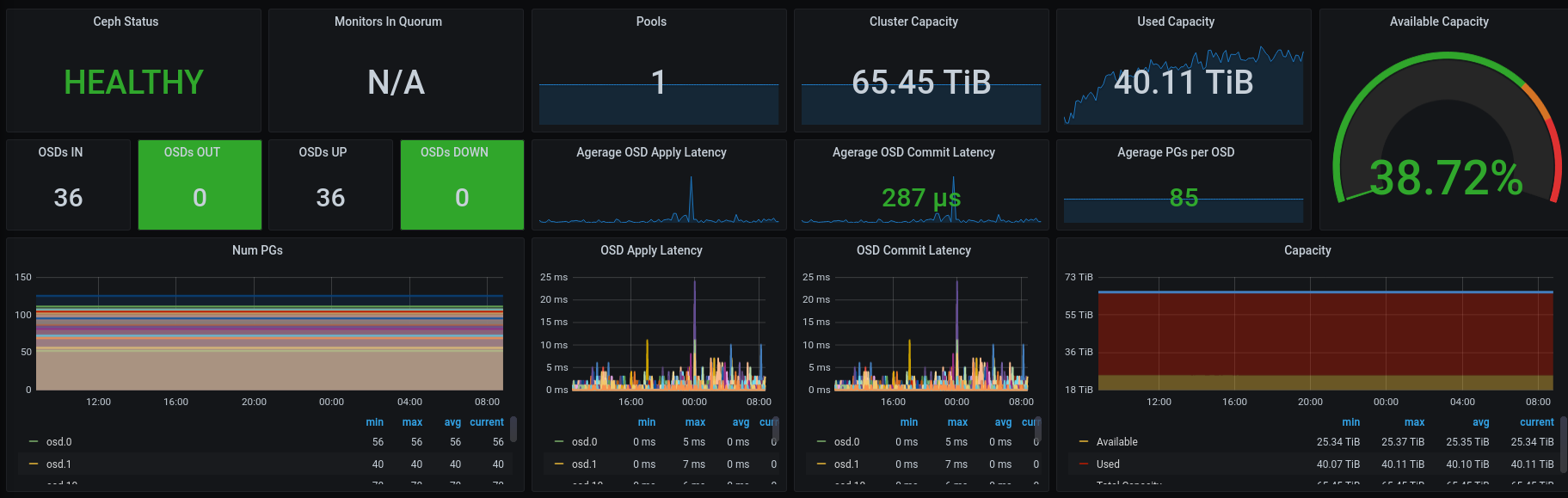
It all started with the big bang! We nearly lost 33 of 36 disks on a Proxmox/Ceph Cluster; this is the story of how we recovered them. At the end of 2020, we eventually had a long outstanding maintenance window for taking care of system upgrades at a customer. During this maintenance window, which involved reboots of server systems, the involved Ceph cluster unexpectedly went into a critical state. What was planned to be a few hours of checklist work in the early evening turned out to be an emergency case; let s call it a nightmare (not only because it included a big part of the night). Since we have learned a few things from our post mortem and RCA, it s worth sharing those with others. But first things first, let s step back and clarify what we had to deal with. The system and its upgrade One part of the upgrade included 3 Debian servers (we re calling them server1, server2 and server3 here), running on Proxmox v5 + Debian/stretch with 12 Ceph OSDs each (65.45TB in total), a so-called Proxmox Hyper-Converged Ceph Cluster. First, we went for upgrading the Proxmox v5/stretch system to Proxmox v6/buster, before updating Ceph Luminous v12.2.13 to the latest v14.2 release, supported by Proxmox v6/buster. The Proxmox upgrade included updating corosync from v2 to v3. As part of this upgrade, we had to apply some configuration changes, like adjust ring0 + ring1 address settings and add a mon_host configuration to the Ceph configuration. During the first two servers reboots, we noticed configuration glitches. After fixing those, we went for a reboot of the third server as well. Then we noticed that several Ceph OSDs were unexpectedly down. The NTP service wasn t working as expected after the upgrade. The underlying issue is a race condition of ntp with systemd-timesyncd (see #889290). As a result, we had clock skew problems with Ceph, indicating that the Ceph monitors clocks aren t running in sync (which is essential for proper Ceph operation). We initially assumed that our Ceph OSD failure derived from this clock skew problem, so we took care of it. After yet another round of reboots, to ensure the systems are running all with identical and sane configurations and services, we noticed lots of failing OSDs. This time all but three OSDs (19, 21 and 22) were down:
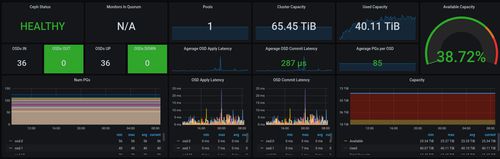
% sudo ceph osd tree
ID CLASS WEIGHT   TYPE NAME      STATUS REWEIGHT PRI-AFF
-1       65.44138 root default
-2       21.81310     host server1
 0   hdd  1.08989         osd.0    down  1.00000 1.00000
 1   hdd  1.08989         osd.1    down  1.00000 1.00000
 2   hdd  1.63539         osd.2    down  1.00000 1.00000
 3   hdd  1.63539         osd.3    down  1.00000 1.00000
 4   hdd  1.63539         osd.4    down  1.00000 1.00000
 5   hdd  1.63539         osd.5    down  1.00000 1.00000
18   hdd  2.18279         osd.18   down  1.00000 1.00000
20   hdd  2.18179         osd.20   down  1.00000 1.00000
28   hdd  2.18179         osd.28   down  1.00000 1.00000
29   hdd  2.18179         osd.29   down  1.00000 1.00000
30   hdd  2.18179         osd.30   down  1.00000 1.00000
31   hdd  2.18179         osd.31   down  1.00000 1.00000
-4       21.81409     host server2
 6   hdd  1.08989         osd.6    down  1.00000 1.00000
 7   hdd  1.08989         osd.7    down  1.00000 1.00000
 8   hdd  1.63539         osd.8    down  1.00000 1.00000
 9   hdd  1.63539         osd.9    down  1.00000 1.00000
10   hdd  1.63539         osd.10   down  1.00000 1.00000
11   hdd  1.63539         osd.11   down  1.00000 1.00000
19   hdd  2.18179         osd.19     up  1.00000 1.00000
21   hdd  2.18279         osd.21     up  1.00000 1.00000
22   hdd  2.18279         osd.22     up  1.00000 1.00000
32   hdd  2.18179         osd.32   down  1.00000 1.00000
33   hdd  2.18179         osd.33   down  1.00000 1.00000
34   hdd  2.18179         osd.34   down  1.00000 1.00000
-3       21.81419     host server3
12   hdd  1.08989         osd.12   down  1.00000 1.00000
13   hdd  1.08989         osd.13   down  1.00000 1.00000
14   hdd  1.63539         osd.14   down  1.00000 1.00000
15   hdd  1.63539         osd.15   down  1.00000 1.00000
16   hdd  1.63539         osd.16   down  1.00000 1.00000
17   hdd  1.63539         osd.17   down  1.00000 1.00000
23   hdd  2.18190         osd.23   down  1.00000 1.00000
24   hdd  2.18279         osd.24   down  1.00000 1.00000
25   hdd  2.18279         osd.25   down  1.00000 1.00000
35   hdd  2.18179         osd.35   down  1.00000 1.00000
36   hdd  2.18179         osd.36   down  1.00000 1.00000
37   hdd  2.18179         osd.37   down  1.00000 1.00000
Our blood pressure increased slightly! Did we just lose all of our cluster? What happened, and how can we get all the other OSDs back? We stumbled upon this beauty in our logs:
kernel: [   73.697957] XFS (sdl1): SB stripe unit sanity check failed
kernel: [   73.698002] XFS (sdl1): Metadata corruption detected at xfs_sb_read_verify+0x10e/0x180 [xfs], xfs_sb block 0xffffffffffffffff
kernel: [   73.698799] XFS (sdl1): Unmount and run xfs_repair
kernel: [   73.699199] XFS (sdl1): First 128 bytes of corrupted metadata buffer:
kernel: [   73.699677] 00000000: 58 46 53 42 00 00 10 00 00 00 00 00 00 00 62 00  XFSB..........b.
kernel: [   73.700205] 00000010: 00 00 00 00 00 00 00 00 00 00 00 00 00 00 00 00  ................
kernel: [   73.700836] 00000020: 62 44 2b c0 e6 22 40 d7 84 3d e1 cc 65 88 e9 d8  bD+.."@..=..e...
kernel: [   73.701347] 00000030: 00 00 00 00 00 00 40 08 00 00 00 00 00 00 01 00  ......@.........
kernel: [   73.701770] 00000040: 00 00 00 00 00 00 01 01 00 00 00 00 00 00 01 02  ................
ceph-disk[4240]: mount: /var/lib/ceph/tmp/mnt.jw367Y: mount(2) system call failed: Structure needs cleaning.
ceph-disk[4240]: ceph-disk: Mounting filesystem failed: Command '['/bin/mount', '-t', u'xfs', '-o', 'noatime,inode64', '--', '/dev/disk/by-parttypeuuid/4fbd7e29-9d25-41b8-afd0-062c0ceff05d.cdda39ed-5
ceph/tmp/mnt.jw367Y']' returned non-zero exit status 32
kernel: [   73.702162] 00000050: 00 00 00 01 00 00 18 80 00 00 00 04 00 00 00 00  ................
kernel: [   73.702550] 00000060: 00 00 06 48 bd a5 10 00 08 00 00 02 00 00 00 00  ...H............
kernel: [   73.702975] 00000070: 00 00 00 00 00 00 00 00 0c 0c 0b 01 0d 00 00 19  ................
kernel: [   73.703373] XFS (sdl1): SB validate failed with error -117.
The same issue was present for the other failing OSDs. We hoped, that the data itself was still there, and only the mounting of the XFS partitions failed. The Ceph cluster was initially installed in 2017 with Ceph jewel/10.2 with the OSDs on filestore (nowadays being a legacy approach to storing objects in Ceph). However, we migrated the disks to bluestore since then (with ceph-disk and not yet via ceph-volume what s being used nowadays). Using ceph-disk introduces these 100MB XFS partitions containing basic metadata for the OSD. Given that we had three working OSDs left, we decided to investigate how to rebuild the failing ones. Some folks on #ceph (thanks T1, ormandj + peetaur!) were kind enough to share how working XFS partitions looked like for them. After creating a backup (via dd), we tried to re-create such an XFS partition on server1. We noticed that even mounting a freshly created XFS partition failed:
synpromika@server1 ~ % sudo mkfs.xfs -f -i size=2048 -m uuid="4568c300-ad83-4288-963e-badcd99bf54f" /dev/sdc1
meta-data=/dev/sdc1              isize=2048   agcount=4, agsize=6272 blks
         =                       sectsz=4096  attr=2, projid32bit=1
         =                       crc=1        finobt=1, sparse=1, rmapbt=0
         =                       reflink=0
data     =                       bsize=4096   blocks=25088, imaxpct=25
         =                       sunit=128    swidth=64 blks
naming   =version 2              bsize=4096   ascii-ci=0, ftype=1
log      =internal log           bsize=4096   blocks=1608, version=2
         =                       sectsz=4096  sunit=1 blks, lazy-count=1
realtime =none                   extsz=4096   blocks=0, rtextents=0
synpromika@server1 ~ % sudo mount /dev/sdc1 /mnt/ceph-recovery
SB stripe unit sanity check failed
Metadata corruption detected at 0x433840, xfs_sb block 0x0/0x1000
libxfs_writebufr: write verifer failed on xfs_sb bno 0x0/0x1000
cache_node_purge: refcount was 1, not zero (node=0x1d3c400)
SB stripe unit sanity check failed
Metadata corruption detected at 0x433840, xfs_sb block 0x18800/0x1000
libxfs_writebufr: write verifer failed on xfs_sb bno 0x18800/0x1000
SB stripe unit sanity check failed
Metadata corruption detected at 0x433840, xfs_sb block 0x0/0x1000
libxfs_writebufr: write verifer failed on xfs_sb bno 0x0/0x1000
SB stripe unit sanity check failed
Metadata corruption detected at 0x433840, xfs_sb block 0x24c00/0x1000
libxfs_writebufr: write verifer failed on xfs_sb bno 0x24c00/0x1000
SB stripe unit sanity check failed
Metadata corruption detected at 0x433840, xfs_sb block 0xc400/0x1000
libxfs_writebufr: write verifer failed on xfs_sb bno 0xc400/0x1000
releasing dirty buffer (bulk) to free list!releasing dirty buffer (bulk) to free list!releasing dirty buffer (bulk) to free list!releasing dirty buffer (bulk) to free list!found dirty buffer (bulk) on free list!bad magic number
bad magic number
Metadata corruption detected at 0x433840, xfs_sb block 0x0/0x1000
libxfs_writebufr: write verifer failed on xfs_sb bno 0x0/0x1000
releasing dirty buffer (bulk) to free list!mount: /mnt/ceph-recovery: wrong fs type, bad option, bad superblock on /dev/sdc1, missing codepage or helper program, or other error.
Ouch. This very much looked related to the actual issue we re seeing. So we tried to execute mkfs.xfs with a bunch of different sunit/swidth settings. Using -d sunit=512 -d swidth=512 at least worked then, so we decided to force its usage in the creation of our OSD XFS partition. This brought us a working XFS partition. Please note, sunit must not be larger than swidth (more on that later!). Then we reconstructed how to restore all the metadata for the OSD (activate.monmap, active, block_uuid, bluefs, ceph_fsid, fsid, keyring, kv_backend, magic, mkfs_done, ready, require_osd_release, systemd, type, whoami). To identify the UUID, we can read the data from ceph --format json osd dump , like this for all our OSDs (Zsh syntax ftw!):
synpromika@server1 ~ % for f in  0..37  ; printf "osd-$f: %s\n" "$(sudo ceph --format json osd dump   jq -r ".osds[]   select(.osd==$f)   .uuid")"
osd-0: 4568c300-ad83-4288-963e-badcd99bf54f
osd-1: e573a17a-ccde-4719-bdf8-eef66903ca4f
osd-2: 0e1b2626-f248-4e7d-9950-f1a46644754e
osd-3: 1ac6a0a2-20ee-4ed8-9f76-d24e900c800c
[...]
Identifying the corresponding raw device for each OSD UUID is possible via:
synpromika@server1 ~ % UUID="4568c300-ad83-4288-963e-badcd99bf54f"
synpromika@server1 ~ % readlink -f /dev/disk/by-partuuid/"$ UUID "
/dev/sdc1
The OSD s key ID can be retrieved via:
synpromika@server1 ~ % OSD_ID=0
synpromika@server1 ~ % sudo ceph auth get osd."$ OSD_ID " -f json 2>/dev/null   jq -r '.[]   .key'
AQCKFpZdm0We[...]
Now we also need to identify the underlying block device:
synpromika@server1 ~ % OSD_ID=0
synpromika@server1 ~ % sudo ceph osd metadata osd."$ OSD_ID " -f json   jq -r '.bluestore_bdev_partition_path'    
/dev/sdc2
With all of this, we reconstructed the keyring, fsid, whoami, block + block_uuid files. All the other files inside the XFS metadata partition are identical on each OSD. So after placing and adjusting the corresponding metadata on the XFS partition for Ceph usage, we got a working OSD hurray! Since we had to fix yet another 32 OSDs, we decided to automate this XFS partitioning and metadata recovery procedure. We had a network share available on /srv/backup for storing backups of existing partition data. On each server, we tested the procedure with one single OSD before iterating over the list of remaining failing OSDs. We started with a shell script on server1, then adjusted the script for server2 and server3. This is the script, as we executed it on the 3rd server. Thanks to this, we managed to get the Ceph cluster up and running again. We didn t want to continue with the Ceph upgrade itself during the night though, as we wanted to know exactly what was going on and why the system behaved like that. Time for RCA! Root Cause Analysis So all but three OSDs on server2 failed, and the problem seems to be related to XFS. Therefore, our starting point for the RCA was, to identify what was different on server2, as compared to server1 + server3. My initial assumption was that this was related to some firmware issues with the involved controller (and as it turned out later, I was right!). The disks were attached as JBOD devices to a ServeRAID M5210 controller (with a stripe size of 512). Firmware state:
synpromika@server1 ~ % sudo storcli64 /c0 show all   grep '^Firmware'
Firmware Package Build = 24.16.0-0092
Firmware Version = 4.660.00-8156
synpromika@server2 ~ % sudo storcli64 /c0 show all   grep '^Firmware'
Firmware Package Build = 24.21.0-0112
Firmware Version = 4.680.00-8489
synpromika@server3 ~ % sudo storcli64 /c0 show all   grep '^Firmware'
Firmware Package Build = 24.16.0-0092
Firmware Version = 4.660.00-8156
This looked very promising, as server2 indeed runs with a different firmware version on the controller. But how so? Well, the motherboard of server2 got replaced by a Lenovo/IBM technician in January 2020, as we had a failing memory slot during a memory upgrade. As part of this procedure, the Lenovo/IBM technician installed the latest firmware versions. According to our documentation, some OSDs were rebuilt (due to the filestore->bluestore migration) in March and April 2020. It turned out that precisely those OSDs were the ones that survived the upgrade. So the surviving drives were created with a different firmware version running on the involved controller. All the other OSDs were created with an older controller firmware. But what difference does this make? Now let s check firmware changelogs. For the 24.21.0-0097 release we found this:
- Cannot create or mount xfs filesystem using xfsprogs 4.19.x kernel 4.20(SCGCQ02027889)
- xfs_info command run on an XFS file system created on a VD of strip size 1M shows sunit and swidth as 0(SCGCQ02056038)
Our XFS problem certainly was related to the controller s firmware. We also recalled that our monitoring system reported different sunit settings for the OSDs that were rebuilt in March and April. For example, OSD 21 was recreated and got different sunit settings:
WARN  server2.example.org  Mount options of /var/lib/ceph/osd/ceph-21      WARN - Missing: sunit=1024, Exceeding: sunit=512
We compared the new OSD 21 with an existing one (OSD 25 on server3):
synpromika@server2 ~ % systemctl show var-lib-ceph-osd-ceph\\x2d21.mount   grep sunit
Options=rw,noatime,attr2,inode64,sunit=512,swidth=512,noquota
synpromika@server3 ~ % systemctl show var-lib-ceph-osd-ceph\\x2d25.mount   grep sunit
Options=rw,noatime,attr2,inode64,sunit=1024,swidth=512,noquota
Thanks to our documentation, we could compare execution logs of their creation:
% diff -u ceph-disk-osd-25.log ceph-disk-osd-21.log
-synpromika@server2 ~ % sudo ceph-disk -v prepare --bluestore /dev/sdj --osd-id 25
+synpromika@server3 ~ % sudo ceph-disk -v prepare --bluestore /dev/sdi --osd-id 21
[...]
-command_check_call: Running command: /sbin/mkfs -t xfs -f -i size=2048 -- /dev/sdj1
-meta-data=/dev/sdj1              isize=2048   agcount=4, agsize=6272 blks
[...]
+command_check_call: Running command: /sbin/mkfs -t xfs -f -i size=2048 -- /dev/sdi1
+meta-data=/dev/sdi1              isize=2048   agcount=4, agsize=6336 blks
          =                       sectsz=4096  attr=2, projid32bit=1
          =                       crc=1        finobt=1, sparse=0, rmapbt=0, reflink=0
-data     =                       bsize=4096   blocks=25088, imaxpct=25
-         =                       sunit=128    swidth=64 blks
+data     =                       bsize=4096   blocks=25344, imaxpct=25
+         =                       sunit=64     swidth=64 blks
 naming   =version 2              bsize=4096   ascii-ci=0 ftype=1
 log      =internal log           bsize=4096   blocks=1608, version=2
          =                       sectsz=4096  sunit=1 blks, lazy-count=1
 realtime =none                   extsz=4096   blocks=0, rtextents=0
[...]
So back then, we even tried to track this down but couldn t make sense of it yet. But now this sounds very much like it is related to the problem we saw with this Ceph/XFS failure. We follow Occam s razor, assuming the simplest explanation is usually the right one, so let s check the disk properties and see what differs:
synpromika@server1 ~ % sudo blockdev --getsz --getsize64 --getss --getpbsz --getiomin --getioopt /dev/sdk
4685545472
2398999281664
512
4096
524288
262144
synpromika@server2 ~ % sudo blockdev --getsz --getsize64 --getss --getpbsz --getiomin --getioopt /dev/sdk
4685545472
2398999281664
512
4096
262144
262144
See the difference between server1 and server2 for identical disks? The getiomin option now reports something different for them:
synpromika@server1 ~ % sudo blockdev --getiomin /dev/sdk            
524288
synpromika@server1 ~ % cat /sys/block/sdk/queue/minimum_io_size
524288
synpromika@server2 ~ % sudo blockdev --getiomin /dev/sdk 
262144
synpromika@server2 ~ % cat /sys/block/sdk/queue/minimum_io_size
262144
It doesn t make sense that the minimum I/O size (iomin, AKA BLKIOMIN) is bigger than the optimal I/O size (ioopt, AKA BLKIOOPT). This leads us to Bug 202127 cannot mount or create xfs on a 597T device, which matches our findings here. But why did this XFS partition work in the past and fails now with the newer kernel version? The XFS behaviour change Now given that we have backups of all the XFS partition, we wanted to track down, a) when this XFS behaviour was introduced, and b) whether, and if so how it would be possible to reuse the XFS partition without having to rebuild it from scratch (e.g. if you would have no working Ceph OSD or backups left). Let s look at such a failing XFS partition with the Grml live system:
root@grml ~ # grml-version
grml64-full 2020.06 Release Codename Ausgehfuahangl [2020-06-24]
root@grml ~ # uname -a
Linux grml 5.6.0-2-amd64 #1 SMP Debian 5.6.14-2 (2020-06-09) x86_64 GNU/Linux
root@grml ~ # grml-hostname grml-2020-06
Setting hostname to grml-2020-06: done
root@grml ~ # exec zsh
root@grml-2020-06 ~ # dpkg -l xfsprogs util-linux
Desired=Unknown/Install/Remove/Purge/Hold
  Status=Not/Inst/Conf-files/Unpacked/halF-conf/Half-inst/trig-aWait/Trig-pend
 / Err?=(none)/Reinst-required (Status,Err: uppercase=bad)
 / Name           Version      Architecture Description
+++-==============-============-============-=========================================
ii  util-linux     2.35.2-4     amd64        miscellaneous system utilities
ii  xfsprogs       5.6.0-1+b2   amd64        Utilities for managing the XFS filesystem
There it s failing, no matter which mount option we try:
root@grml-2020-06 ~ # mount ./sdd1.dd /mnt
mount: /mnt: mount(2) system call failed: Structure needs cleaning.
root@grml-2020-06 ~ # dmesg   tail -30
[...]
[   64.788640] XFS (loop1): SB stripe unit sanity check failed
[   64.788671] XFS (loop1): Metadata corruption detected at xfs_sb_read_verify+0x102/0x170 [xfs], xfs_sb block 0xffffffffffffffff
[   64.788671] XFS (loop1): Unmount and run xfs_repair
[   64.788672] XFS (loop1): First 128 bytes of corrupted metadata buffer:
[   64.788673] 00000000: 58 46 53 42 00 00 10 00 00 00 00 00 00 00 62 00  XFSB..........b.
[   64.788674] 00000010: 00 00 00 00 00 00 00 00 00 00 00 00 00 00 00 00  ................
[   64.788675] 00000020: 32 b6 dc 35 53 b7 44 96 9d 63 30 ab b3 2b 68 36  2..5S.D..c0..+h6
[   64.788675] 00000030: 00 00 00 00 00 00 40 08 00 00 00 00 00 00 01 00  ......@.........
[   64.788675] 00000040: 00 00 00 00 00 00 01 01 00 00 00 00 00 00 01 02  ................
[   64.788676] 00000050: 00 00 00 01 00 00 18 80 00 00 00 04 00 00 00 00  ................
[   64.788677] 00000060: 00 00 06 48 bd a5 10 00 08 00 00 02 00 00 00 00  ...H............
[   64.788677] 00000070: 00 00 00 00 00 00 00 00 0c 0c 0b 01 0d 00 00 19  ................
[   64.788679] XFS (loop1): SB validate failed with error -117.
root@grml-2020-06 ~ # mount -t xfs -o rw,relatime,attr2,inode64,sunit=1024,swidth=512,noquota ./sdd1.dd /mnt/
mount: /mnt: wrong fs type, bad option, bad superblock on /dev/loop1, missing codepage or helper program, or other error.
32 root@grml-2020-06 ~ # dmesg   tail -1
[   66.342976] XFS (loop1): stripe width (512) must be a multiple of the stripe unit (1024)
root@grml-2020-06 ~ # mount -t xfs -o rw,relatime,attr2,inode64,sunit=512,swidth=512,noquota ./sdd1.dd /mnt/
mount: /mnt: mount(2) system call failed: Structure needs cleaning.
32 root@grml-2020-06 ~ # dmesg   tail -14
[   66.342976] XFS (loop1): stripe width (512) must be a multiple of the stripe unit (1024)
[   80.751277] XFS (loop1): SB stripe unit sanity check failed
[   80.751323] XFS (loop1): Metadata corruption detected at xfs_sb_read_verify+0x102/0x170 [xfs], xfs_sb block 0xffffffffffffffff 
[   80.751324] XFS (loop1): Unmount and run xfs_repair
[   80.751325] XFS (loop1): First 128 bytes of corrupted metadata buffer:
[   80.751327] 00000000: 58 46 53 42 00 00 10 00 00 00 00 00 00 00 62 00  XFSB..........b.
[   80.751328] 00000010: 00 00 00 00 00 00 00 00 00 00 00 00 00 00 00 00  ................
[   80.751330] 00000020: 32 b6 dc 35 53 b7 44 96 9d 63 30 ab b3 2b 68 36  2..5S.D..c0..+h6
[   80.751331] 00000030: 00 00 00 00 00 00 40 08 00 00 00 00 00 00 01 00  ......@.........
[   80.751331] 00000040: 00 00 00 00 00 00 01 01 00 00 00 00 00 00 01 02  ................
[   80.751332] 00000050: 00 00 00 01 00 00 18 80 00 00 00 04 00 00 00 00  ................
[   80.751333] 00000060: 00 00 06 48 bd a5 10 00 08 00 00 02 00 00 00 00  ...H............
[   80.751334] 00000070: 00 00 00 00 00 00 00 00 0c 0c 0b 01 0d 00 00 19  ................
[   80.751338] XFS (loop1): SB validate failed with error -117.
Also xfs_repair doesn t help either:
root@grml-2020-06 ~ # xfs_info ./sdd1.dd
meta-data=./sdd1.dd              isize=2048   agcount=4, agsize=6272 blks
         =                       sectsz=4096  attr=2, projid32bit=1
         =                       crc=1        finobt=1, sparse=0, rmapbt=0
         =                       reflink=0
data     =                       bsize=4096   blocks=25088, imaxpct=25
         =                       sunit=128    swidth=64 blks
naming   =version 2              bsize=4096   ascii-ci=0, ftype=1
log      =internal log           bsize=4096   blocks=1608, version=2
         =                       sectsz=4096  sunit=1 blks, lazy-count=1
realtime =none                   extsz=4096   blocks=0, rtextents=0
root@grml-2020-06 ~ # xfs_repair ./sdd1.dd
Phase 1 - find and verify superblock...
bad primary superblock - bad stripe width in superblock !!!
attempting to find secondary superblock...
..............................................................................................Sorry, could not find valid secondary superblock
Exiting now.
With the SB stripe unit sanity check failed message, we could easily track this down to the following commit fa4ca9c:
% git show fa4ca9c5574605d1e48b7e617705230a0640b6da   cat
commit fa4ca9c5574605d1e48b7e617705230a0640b6da
Author: Dave Chinner <dchinner@redhat.com>
Date:   Tue Jun 5 10:06:16 2018 -0700
    
    xfs: catch bad stripe alignment configurations
    
    When stripe alignments are invalid, data alignment algorithms in the
    allocator may not work correctly. Ensure we catch superblocks with
    invalid stripe alignment setups at mount time. These data alignment
    mismatches are now detected at mount time like this:
    
    XFS (loop0): SB stripe unit sanity check failed
    XFS (loop0): Metadata corruption detected at xfs_sb_read_verify+0xab/0x110, xfs_sb block 0xffffffffffffffff
    XFS (loop0): Unmount and run xfs_repair
    XFS (loop0): First 128 bytes of corrupted metadata buffer:
    0000000091c2de02: 58 46 53 42 00 00 10 00 00 00 00 00 00 00 10 00  XFSB............
    0000000023bff869: 00 00 00 00 00 00 00 00 00 00 00 00 00 00 00 00  ................
    00000000cdd8c893: 17 32 37 15 ff ca 46 3d 9a 17 d3 33 04 b5 f1 a2  .27...F=...3....
    000000009fd2844f: 00 00 00 00 00 00 00 04 00 00 00 00 00 00 06 d0  ................
    0000000088e9b0bb: 00 00 00 00 00 00 06 d1 00 00 00 00 00 00 06 d2  ................
    00000000ff233a20: 00 00 00 01 00 00 10 00 00 00 00 01 00 00 00 00  ................
    000000009db0ac8b: 00 00 03 60 e1 34 02 00 08 00 00 02 00 00 00 00  ... .4..........
    00000000f7022460: 00 00 00 00 00 00 00 00 0c 09 0b 01 0c 00 00 19  ................
    XFS (loop0): SB validate failed with error -117.
    
    And the mount fails.
    
    Signed-off-by: Dave Chinner <dchinner@redhat.com>
    Reviewed-by: Carlos Maiolino <cmaiolino@redhat.com>
    Reviewed-by: Darrick J. Wong <darrick.wong@oracle.com>
    Signed-off-by: Darrick J. Wong <darrick.wong@oracle.com>
diff --git fs/xfs/libxfs/xfs_sb.c fs/xfs/libxfs/xfs_sb.c
index b5dca3c8c84d..c06b6fc92966 100644
--- fs/xfs/libxfs/xfs_sb.c
+++ fs/xfs/libxfs/xfs_sb.c
@@ -278,6 +278,22 @@ xfs_mount_validate_sb(
                return -EFSCORRUPTED;
         
        
+       if (sbp->sb_unit)  
+               if (!xfs_sb_version_hasdalign(sbp)  
+                   sbp->sb_unit > sbp->sb_width  
+                   (sbp->sb_width % sbp->sb_unit) != 0)  
+                       xfs_notice(mp, "SB stripe unit sanity check failed");
+                       return -EFSCORRUPTED;
+                 
+         else if (xfs_sb_version_hasdalign(sbp))   
+               xfs_notice(mp, "SB stripe alignment sanity check failed");
+               return -EFSCORRUPTED;
+         else if (sbp->sb_width)  
+               xfs_notice(mp, "SB stripe width sanity check failed");
+               return -EFSCORRUPTED;
+        
+
+       
        if (xfs_sb_version_hascrc(&mp->m_sb) &&
            sbp->sb_blocksize < XFS_MIN_CRC_BLOCKSIZE)  
                xfs_notice(mp, "v5 SB sanity check failed");
This change is included in kernel versions 4.18-rc1 and newer:
% git describe --contains fa4ca9c5574605d1e48
v4.18-rc1~37^2~14
Now let s try with an older kernel version (4.9.0), using old Grml 2017.05 release:
root@grml ~ # grml-version
grml64-small 2017.05 Release Codename Freedatensuppe [2017-05-31]
root@grml ~ # uname -a
Linux grml 4.9.0-1-grml-amd64 #1 SMP Debian 4.9.29-1+grml.1 (2017-05-24) x86_64 GNU/Linux
root@grml ~ # lsb_release -a
No LSB modules are available.
Distributor ID: Debian
Description:    Debian GNU/Linux 9.0 (stretch)
Release:        9.0
Codename:       stretch
root@grml ~ # grml-hostname grml-2017-05
Setting hostname to grml-2017-05: done
root@grml ~ # exec zsh
root@grml-2017-05 ~ #
root@grml-2017-05 ~ # xfs_info ./sdd1.dd
xfs_info: ./sdd1.dd is not a mounted XFS filesystem
1 root@grml-2017-05 ~ # xfs_repair ./sdd1.dd
Phase 1 - find and verify superblock...
bad primary superblock - bad stripe width in superblock !!!
attempting to find secondary superblock...
..............................................................................................Sorry, could not find valid secondary superblock
Exiting now.
1 root@grml-2017-05 ~ # mount ./sdd1.dd /mnt
root@grml-2017-05 ~ # mount -t xfs
/root/sdd1.dd on /mnt type xfs (rw,relatime,attr2,inode64,sunit=1024,swidth=512,noquota)
root@grml-2017-05 ~ # ls /mnt
activate.monmap  active  block  block_uuid  bluefs  ceph_fsid  fsid  keyring  kv_backend  magic  mkfs_done  ready  require_osd_release  systemd  type  whoami
root@grml-2017-05 ~ # xfs_info /mnt
meta-data=/dev/loop1             isize=2048   agcount=4, agsize=6272 blks
         =                       sectsz=4096  attr=2, projid32bit=1
         =                       crc=1        finobt=1 spinodes=0 rmapbt=0
         =                       reflink=0
data     =                       bsize=4096   blocks=25088, imaxpct=25
         =                       sunit=128    swidth=64 blks
naming   =version 2              bsize=4096   ascii-ci=0 ftype=1
log      =internal               bsize=4096   blocks=1608, version=2
         =                       sectsz=4096  sunit=1 blks, lazy-count=1
realtime =none                   extsz=4096   blocks=0, rtextents=0
Mounting there indeed works! Now, if we mount the filesystem with new and proper sunit/swidth settings using the older kernel, it should rewrite them on disk:
root@grml-2017-05 ~ # mount -t xfs -o sunit=512,swidth=512 ./sdd1.dd /mnt/
root@grml-2017-05 ~ # umount /mnt/
And indeed, mounting this rewritten filesystem then also works with newer kernels:
root@grml-2020-06 ~ # mount ./sdd1.rewritten /mnt/
root@grml-2020-06 ~ # xfs_info /root/sdd1.rewritten
meta-data=/dev/loop1             isize=2048   agcount=4, agsize=6272 blks
         =                       sectsz=4096  attr=2, projid32bit=1
         =                       crc=1        finobt=1, sparse=0, rmapbt=0
         =                       reflink=0
data     =                       bsize=4096   blocks=25088, imaxpct=25
         =                       sunit=64    swidth=64 blks
naming   =version 2              bsize=4096   ascii-ci=0, ftype=1
log      =internal log           bsize=4096   blocks=1608, version=2
         =                       sectsz=4096  sunit=1 blks, lazy-count=1
realtime =none                   extsz=4096   blocks=0, rtextents=0
root@grml-2020-06 ~ # mount -t xfs                
/root/sdd1.rewritten on /mnt type xfs (rw,relatime,attr2,inode64,logbufs=8,logbsize=32k,sunit=512,swidth=512,noquota)
FTR: The sunit=512,swidth=512 from the xfs mount option is identical to xfs_info s output sunit=64,swidth=64 (because mount.xfs s sunit value is given in 512-byte block units, see man 5 xfs, and the xfs_info output reported here is in blocks with a block size (bsize) of 4096, so sunit = 512*512 := 64*4096 ). mkfs uses minimum and optimal sizes for stripe unit and stripe width; you can check this e.g. via (note that server2 with fixed firmware version reports proper values, whereas server3 with broken controller firmware reports non-sense):
synpromika@server2 ~ % for i in /sys/block/sd*/queue/ ; do printf "%s: %s %s\n" "$i" "$(cat "$i"/minimum_io_size)" "$(cat "$i"/optimal_io_size)" ; done
[...]
/sys/block/sdc/queue/: 262144 262144
/sys/block/sdd/queue/: 262144 262144
/sys/block/sde/queue/: 262144 262144
/sys/block/sdf/queue/: 262144 262144
/sys/block/sdg/queue/: 262144 262144
/sys/block/sdh/queue/: 262144 262144
/sys/block/sdi/queue/: 262144 262144
/sys/block/sdj/queue/: 262144 262144
/sys/block/sdk/queue/: 262144 262144
/sys/block/sdl/queue/: 262144 262144
/sys/block/sdm/queue/: 262144 262144
/sys/block/sdn/queue/: 262144 262144
[...]
synpromika@server3 ~ % for i in /sys/block/sd*/queue/ ; do printf "%s: %s %s\n" "$i" "$(cat "$i"/minimum_io_size)" "$(cat "$i"/optimal_io_size)" ; done
[...]
/sys/block/sdc/queue/: 524288 262144
/sys/block/sdd/queue/: 524288 262144
/sys/block/sde/queue/: 524288 262144
/sys/block/sdf/queue/: 524288 262144
/sys/block/sdg/queue/: 524288 262144
/sys/block/sdh/queue/: 524288 262144
/sys/block/sdi/queue/: 524288 262144
/sys/block/sdj/queue/: 524288 262144
/sys/block/sdk/queue/: 524288 262144
/sys/block/sdl/queue/: 524288 262144
/sys/block/sdm/queue/: 524288 262144
/sys/block/sdn/queue/: 524288 262144
[...]
This is the underlying reason why the initially created XFS partitions were created with incorrect sunit/swidth settings. The broken firmware of server1 and server3 was the cause of the incorrect settings they were ignored by old(er) xfs/kernel versions, but treated as an error by new ones. Make sure to also read the XFS FAQ regarding How to calculate the correct sunit,swidth values for optimal performance . We also stumbled upon two interesting reads in RedHat s knowledge base: 5075561 + 2150101 (requires an active subscription, though) and #1835947. Am I affected? How to work around it? To check whether your XFS mount points are affected by this issue, the following command line should be useful:
awk '$3 == "xfs" print $2 ' /proc/self/mounts   while read mount ; do echo -n "$mount " ; xfs_info $mount   awk '$0 ~ "swidth" gsub(/.*=/,"",$2); gsub(/.*=/,"",$3); print $2,$3 '   awk '  if ($1 > $2) print "impacted"; else print "OK" ' ; done
If you run into the above situation, the only known solution to get your original XFS partition working again, is to boot into an older kernel version again (4.17 or older), mount the XFS partition with correct sunit/swidth settings and then boot back into your new system (kernel version wise). Lessons learned Thanks: Darshaka Pathirana, Chris Hofstaedtler and Michael Hanscho. Looking for help with your IT infrastructure? Let us know!
6 April 2021

Jelmer Vernooij: Automatic Fixing of Debian Build Dependencies

The Debian Janitor is an automated system that commits fixes for (minor) issues in Debian packages that can be fixed by software. It gradually started proposing merges in early December. The first set of changes sent out ran lintian-brush on sid packages maintained in Git. This post is part of a series about the progress of the Janitor. In my last blogpost, I introduced the buildlog consultant - a tool that can identify many reasons why a Debian build failed. For example, here s a fragment of a build log where the Build-Depends lack python3-setuptools:
849
850
851
852
853
854
855
856
857
858
 dpkg-buildpackage: info: host architecture amd64
  fakeroot debian/rules clean
 dh clean --with python3,sphinxdoc --buildsystem=pybuild
    dh_auto_clean -O--buildsystem=pybuild
 I: pybuild base:232: python3.9 setup.py clean
 Traceback (most recent call last):
   File "/<<PKGBUILDDIR>>/setup.py", line 2, in <module>
     from setuptools import setup
 ModuleNotFoundError: No module named 'setuptools'
 E: pybuild pybuild:353: clean: plugin distutils failed with: exit code=1: python3.9 setup.py clean
The buildlog consultant can identify the line in bold as being key, and interprets it:

 % analyse-sbuild-log --json ~/build.log
  
    "stage": "build",
    "section": "Build",
    "lineno": 857,
    "kind": "missing-python-module",
    "details":  "module": "setuptools", "python_version": 3, "minimum_version": null 
  
Automatically acting on buildlog problems A common reason why Debian builds fail is missing dependencies or incorrect versions of dependencies declared in the package build depends. Based on the output of the buildlog consultant, it is possible in many cases to determine what dependency needs to be added to Build-Depends. In the example given above, we can use apt-file to look for the package that contains the path /usr/lib/python3/dist-packages/setuptools/__init__.py - and voila, we find python3-setuptools:
 % apt-file search /usr/lib/python3/dist-packages/setuptools/__init__.py
 python3-setuptools: /usr/lib/python3/dist-packages/setuptools/__init__.py
The deb-fix-build command automates these steps:
  1. It builds the package using sbuild; if the package successfully builds then it just exits successfully
  2. It tries to identify the problem by looking through the build log; if it can t or if it s a problem it has seen before (but apparently failed to resolve), then it exits with a non-zero exit code
  3. It tries to find a dependency that can address the problem
  4. It updates Build-Depends in debian/control or Depends in debian/tests/control
  5. Go to step 1
This takes away the tedious manual process of building a package, discovering that a dependency is missing, updating Build-Depends and trying again. For example, when I ran deb-fix-build while packaging saneyaml, the output looks something like this:
 % deb-fix-build
 Using output directory /tmp/tmpyz0nkgqq
 Using sbuild chroot unstable-amd64-sbuild
 Using fixers:  
 Building debian packages, running 'sbuild --no-clean-source -A -s -v'.
 Attempting to use fixer upstream requirement fixer(apt) to address MissingPythonDistribution('setuptools_scm', python_version=3, minimum_version='4')
 Using apt-file to search apt contents
 Adding build dependency: python3-setuptools-scm (>= 4)
 Building debian packages, running 'sbuild --no-clean-source -A -s -v'.
 Attempting to use fixer upstream requirement fixer(apt) to address MissingPythonDistribution('toml', python_version=3, minimum_version=None)
 Adding build dependency: python3-toml
 Building debian packages, running 'sbuild --no-clean-source -A -s -v'.
 Built 0.5.2-1- changes files at [ saneyaml_0.5.2-1_amd64.changes ].
And in our Git repository, we see these changes as well:
% git log -p
 commit 5a1715f4c7273b042818fc75702f2284034c7277 (HEAD -> master)
 Author: Jelmer Vernoo  <jelmer@jelmer.uk>
 Date:   Sun Apr 4 02:35:56 2021 +0100
     Add missing build dependency on python3-toml.
 diff --git a/debian/control b/debian/control
 index 5b854dc..3b27b73 100644
 --- a/debian/control
 +++ b/debian/control
 @@ -1,6 +1,6 @@
  Rules-Requires-Root: no
  Standards-Version: 4.5.1
 -Build-Depends: debhelper-compat (= 12), dh-sequence-python3, python3-all, python3-setuptools (>= 50), python3-wheel, python3-setuptools-scm (>= 4)
 +Build-Depends: debhelper-compat (= 12), dh-sequence-python3, python3-all, python3-setuptools (>= 50), python3-wheel, python3-setuptools-scm (>= 4), python3-toml
  Testsuite: autopkgtest-pkg-python
  Source: python-saneyaml
  Priority: optional
 commit f03047da80fcd8468ee231fbc4cf8488d7a0acd1
 Author: Jelmer Vernoo  <jelmer@jelmer.uk>
 Date:   Sun Apr 4 02:35:34 2021 +0100
     Add missing build dependency on python3-setuptools-scm (>= 4).
 diff --git a/debian/control b/debian/control
 index a476cc2..5b854dc 100644
 --- a/debian/control
 +++ b/debian/control
 @@ -1,6 +1,6 @@
  Rules-Requires-Root: no
  Standards-Version: 4.5.1
 -Build-Depends: debhelper-compat (= 12), dh-sequence-python3, python3-all, python3-setuptools (>= 50), python3-wheel
 +Build-Depends: debhelper-compat (= 12), dh-sequence-python3, python3-all, python3-setuptools (>= 50), python3-wheel, python3-setuptools-scm (>= 4)
  Testsuite: autopkgtest-pkg-python
  Source: python-saneyaml
  Priority: optional
Using deb-fix-build You can run deb-fix-build by installing the ognibuild package from unstable. The only requirements for using it are that:
  • The package is maintained in Git
  • A sbuild schroot is available for use
Caveats deb-fix-build is fairly easy to understand, and if it doesn t work then you re no worse off than you were without it - you ll have to add your own Build-Depends. That said, there are a couple of things to keep in mind:
  • At the moment, it doesn t distinguish between general, Arch or Indep Build-Depends.
  • It can only add dependencies for things that are actually in the archive
  • Sometimes there are multiple packages that can provide a file, command or python package - it tries to find the right one with heuristics but doesn t always get it right

5 April 2021

Jelmer Vernooij: The Buildlog Consultant

Reading build logs Build logs for Debian packages can be quite long and difficult for a human to read. Anybody who has looked at these logs trying to figure out why a build failed will have spent time scrolling through them and skimming for certain phrases (lines starting with error: for example). In many cases, you can spot the problem in the last 10 or 20 lines of output but it s also quite common that the error is somewhere at the beginning of many pages of error output.
The buildlog consultant The buildlog consultant project attempts to aid in this process by parsing sbuild and non-Debian (e.g. the output of make ) build logs and trying to identify the key line that explains why a build failed. It can then either display this specific line, or a fragment of the log around surrounding the key line.
Classification In addition to finding the key line explaining the failure, it can also classify and parse the error in many cases and return a result code and some metadata. For example, in a failed build of gnss-sdr that has produced 2119 lines of output, the reason for the failure is that log4cpp is missing which is on line 641:
634
635
636
637
638
639
640
641
642
643
644
645
646
647
 -- Required GNU Radio Component: ANALOG missing!
 -- Could NOT find GNURADIO (missing: GNURADIO_RUNTIME_FOUND)
 -- Could NOT find PkgConfig (missing: PKG_CONFIG_EXECUTABLE)
 -- Could NOT find LOG4CPP (missing: LOG4CPP_INCLUDE_DIRS
 LOG4CPP_LIBRARIES)
 CMake Error at CMakeLists.txt:593 (message):
   *** Log4cpp is required to build gnss-sdr
 -- Configuring incomplete, errors occurred!
 See also "/<<PKGBUILDDIR>>/obj-x86_64-linux-gnu/CMakeFiles/
 CMakeOutput.log".
 See also "/<<PKGBUILDDIR>>/obj-x86_64-linux-gnu/CMakeFiles/
 CMakeError.log".
In this case, the buildlog consultant can both figure out line was problematic and what the problem was:
 % analyse-sbuild-log build.log
 Failed stage: build
 Section: build
 Failed line: 641:
   *** Log4cpp is required to build gnss-sdr
 Error: Missing dependency: Log4cpp
Or, if you'd like to do something else with the output, use JSON output:
 % analyse-sbuild-log --json build.log
  "stage": "build", "section": "Build", "lineno": 641, "kind": "missing-dependency", "details":  "name": "Log4cpp"" 
How it works The consultant does some structured parsing (most notably it can parse the sections from a sbuild log), but otherwise is a large set of carefully crafted regular expressions and heuristics. It doesn t always find the problem, but has proven to be fairly accurate. It is constantly improved as part of the Debian Janitor project, and that exposes it to a wide variety of different errors. You can see the classification and error detection in action on the result codes page of the Janitor.
Using the buildlog consultant You can get the buildlog consultant from either pip or Debian unstable (package: python3-buildlog-consultant ). The buildlog consultant comes with two scripts analyse-build-log and analyse-sbuild-log, for analysing build logs and sbuild logs respectively.

4 April 2021

Russ Allbery: Review: Prince Caspian

Review: Prince Caspian, by C.S. Lewis
Illustrator: Pauline Baynes
Series: Chronicles of Narnia #2
Publisher: Collier Books
Copyright: 1951
Printing: 1979
ISBN: 0-02-044240-8
Format: Mass market
Pages: 216
Prince Caspian is the second book of the Chronicles of Narnia in the original publication order (the fourth in the new publication order) and a direct sequel to The Lion, the Witch and the Wardrobe. As much as I would like to say you could start here if you wanted less of Lewis's exploration of secondary-world Christianity and more children's adventure, I'm not sure it would be a good reading experience. Prince Caspian rests heavily on the events of The Lion, the Witch and the Wardrobe. If you haven't already, you may also want to read my review of that book for some introductory material about my past relationship with the series and why I follow the original publication order. Prince Caspian always feels like the real beginning of a re-read. Re-reading The Lion, the Witch and the Wardrobe is okay but a bit of a chore: it's very random, the business with Edmund drags on, and it's very concerned with hitting the mandatory theological notes. Prince Caspian is more similar to the following books and feels like Narnia proper. That said, I have always found the ending of Prince Caspian oddly forgettable. This re-read helped me see why: one of the worst bits of the series is in the middle of this book, and then the dramatic shape of the ending is very strange. MAJOR SPOILERS BELOW for both this book and The Lion, the Witch and the Wardrobe. Prince Caspian opens with the Pevensie kids heading to school by rail at the end of the summer holidays. They're saying their goodbyes to each other at a train station when they are first pulled and then dumped into the middle of a wood. After a bit of exploration and the discovery of a seashore, they find an overgrown and partly ruined castle. They have, of course, been pulled back into Narnia, and the castle is Cair Paravel, their great capital when they ruled as kings and queens. The twist is that it's over a thousand years later, long enough that Cair Paravel is now on an island and has been abandoned to the forest. They discover parts of how that happened when they rescue a dwarf named Trumpkin from two soldiers who are trying to drown him near the supposedly haunted woods. Most of the books in this series have good hooks, but Prince Caspian has one of the best. I adored everything about the start of this book as a kid: the initial delight at being by the sea when they were on their way to boarding school, the realization that getting food was not going to be easy, the abandoned castle, the dawning understanding of where they are, the treasure room, and the extended story about Prince Caspian, his discovery of the Old Narnia, and his flight from his usurper uncle. It becomes clear from Trumpkin's story that the children were pulled back into Narnia by Susan's horn (the best artifact in these books), but Caspian's forces were expecting the great kings and queens of legend from Narnia's Golden Age. Trumpkin is delightfully nonplussed at four school-age kids who are determined to join up with Prince Caspian and help. That's the first half of Prince Caspian, and it's a solid magical adventure story with lots of potential. The ending, alas, doesn't entirely work. And between that, we get the business with Aslan and Lucy in the woods, or as I thought of it even as a kid, the bit where Aslan is awful to everyone for no reason. For those who have forgotten, or who don't care about spoilers, the kids plus Trumpkin are trying to make their way to Aslan's How (formerly the Stone Table) where Prince Caspian and his forces were gathered, when they hit an unexpected deep gorge. Lucy sees Aslan and thinks he's calling for them to go up the gorge, but none of the other kids or Trumpkin can see him and only Edmund believes her. They go down instead, which almost gets them killed by archers. Then, that night, Lucy wakes up and finds Aslan again, who tells her to wake the others and follow him, but warns she may have to follow him alone if she can't convince the others to go along. She wakes them up (which does not go over well), Aslan continues to be invisible to everyone else despite being right there, Susan is particularly upset at Lucy, and everything is awful. But this time they do follow her (with lots of grumbling and over Susan's objections). This, of course, is the right decision: Aslan leads them to a hidden path that takes them over the river they're trying to cross, and becomes visible to everyone when they reach the other side. This is a mess. It made me angry as a kid, and it still makes me angry now. No one has ever had trouble seeing Aslan before, so the kids are rightfully skeptical. By intentionally deceiving them, Aslan puts the other kids in an awful position: they either have to believe Lucy is telling the truth and Aslan is being weirdly malicious, or Lucy is mistaken even though she's certain. It not only leads directly to conflict among the kids, it makes Lucy (the one who does all the right things all along) utterly miserable. It's just cruel and mean, for no purpose. It seems clear to me that this is C.S. Lewis trying to make a theological point about faith, and in a way that makes it even worse because I think he's making a different point than he intended to make. Why is religious faith necessary; why doesn't God simply make himself apparent to everyone and remove the doubt? This is one of the major problems in Christian apologetics, Lewis chooses to raise it here, and the answer he gives is that God only shows himself to his special favorites and hides from everyone else as a test. It's clearly not even a question of intention to have faith; Edmund has way more faith here than Lucy does (since Lucy doesn't need it) and still doesn't get to see Aslan properly until everyone else does. Pah. The worst part of this is that it's effectively the last we see of Susan. Prince Caspian is otherwise the book in which Susan comes into her own. The sibling relationship between the kids is great here in general, but Susan is particularly good. She is the one who takes bold action to rescue Trumpkin, risking herself by firing an arrow into the helmet of one of the soldiers despite being the most cautious of the kids. (And then gets a little defensive about her shot because she doesn't want anyone to think she would miss that badly at short range, a detail I just love.) I identified so much with her not wanting to beat Trumpkin at an archery contest because she felt bad for him (but then doing it anyway). She is, in short, awesome. I was fine with her being the most grumpy and frustrated with the argument over picking a direction. They're all kids, and sometimes one gets grumpy and frustrated and awful to the people around you. Once everyone sees Aslan again, Susan offers a truly excellent apology to Lucy, so it seemed like Lewis was setting up a redemption arc for her the way that he did for Edmund in The Lion, the Witch and the Wardrobe (although I maintain that nearly all of this mess was Aslan's fault). But then we never see Susan's conversation with Aslan, Peter later says he and Susan are now too old to return to Narnia, and that's it for Susan. Argh. I'll have more to say about this later (and it's not an original opinion), but the way Lewis treats Susan is the worst part of this series, and it adds insult to injury that it happens immediately after she has a chance to shine. The rest of the book suffers from the same problem that The Lion, the Witch and the Wardrobe did, namely that Aslan fixes everything in a somewhat surreal wild party and it's unclear why the kids needed to be there. (This is the book where Bacchus and Silenus show up, there is a staggering quantity of wine for a children's book, and Aslan turns a bunch of obnoxious school kids into pigs.) The kids do have more of a role to play this time: Peter and Edmund help save Caspian, and there's a (somewhat poorly motivated) duel that sends up the ending. But other than the brief battle in the How, the battle is won by Aslan waking the trees, and it's not clear why he didn't do that earlier. The ending is, at best, rushed and not worthy of its excellent setup. I was also disappointed that the "wait, why are you all kids?" moment was hand-waved away by Narnia giving the kids magical gravitas. Lewis never felt in control of either The Lion, the Witch and the Wardrobe or Prince Caspian. In both cases, he had a great hook and some ideas of what he wanted to hit along the way, but the endings are more sense of wonder and random Aslan set pieces than anything that follows naturally from the setup. This is part of why I'm not commenting too much on the sour notes, such as the red dwarves being the good and loyal ones but the black dwarves being suspicious and only out for themselves. If I thought bits like that were deliberate, I'd complain more, but instead it feels like Lewis threw random things he liked about children's books and animal stories into the book and gave it a good stir, and some of his subconscious prejudices fell into the story along the way. That said, resolving your civil war children's book by gathering all the people who hate talking animals (but who have lived in Narnia for generations) and exiling them through a magical gateway to a conveniently uninhabited country is certainly a choice, particularly when you wrote the book only two years after the Partition of India. Good lord. Prince Caspian is a much better book than The Lion, the Witch and the Wardrobe for the first half, and then it mostly falls apart. The first half is so good, though. I want to read the book that this could have become, but I'm not sure anyone else writes quite like Lewis at his best. Followed by The Voyage of the Dawn Treader, which is my absolute favorite of the series. Rating: 7 out of 10

1 April 2021

Russell Coker: Censoring Images

A client asked me to develop a system for censoring images from an automatic camera. The situation is that we have a camera taking regular photos from a fixed location which includes part of someone else s property. So my client made a JPEG with some black rectangles in the sections that need to be covered. The first thing I needed to do was convert the JPEG to a PNG with transparency for the sections that aren t to be covered. To convert it I loaded the JPEG in the GIMP and went to the Layer->Transparency->Add Alpha Channel menu to enabled the Alpha channel. Then I selected the Bucket Fill tool and used Mode Erase and Fill by Composite and then clicked on the background (the part of the JPEG that was white) to make it transparent. Then I exported it to PNG. If anyone knows of an easy way to convert the file then please let me know. It would be nice if there was a command-line program I could run to convert a specified color (default white) to transparent. I say this because I can imagine my client going through a dozen iterations of an overlay file that doesn t quite fit. To censor the image I ran the composite command from imagemagick. The command I used was composite -gravity center overlay.png in.jpg out.jpg . If anyone knows a better way of doing this then please let me know. The platform I m using is a ARM926EJ-S rev 5 (v5l) which takes 8 minutes of CPU time to convert a single JPEG at full DSLR resolution (4 megapixel). It also required enabling swap on a SD card to avoid running out of RAM and running systemctl disable tmp.mount to stop using tmpfs for /tmp as the system only has 256M of RAM.

Utkarsh Gupta: FOSS Activites in March 2021

Here s my (eighteenth) monthly update about the activities I ve done in the F/L/OSS world.

Debian
This was my 27th month of active contributing to Debian. I became a DM in late March 2019 and a DD on Christmas 19! \o/ This month was a bit exhausting; lots of moving parts. With the financial year ending, it was even more crazy, with me running around to banks, CA, et al.
Anyway, with now working on Ubuntu full-time, I did little of Debian this month. Here are the following things I worked on:

Uploads and bug fixes:

Other $things:
  • Attended the Debian LTS team meeting.
  • Mentoring for newcomers.
  • Moderation of -project mailing list.

Debian (E)LTS
Debian Long Term Support (LTS) is a project to extend the lifetime of all Debian stable releases to (at least) 5 years. Debian LTS is not handled by the Debian security team, but by a separate group of volunteers and companies interested in making it a success. And Debian Extended LTS (ELTS) is its sister project, extending support to the Jessie release (+2 years after LTS support). This was my eighteenth month as a Debian LTS and ninth month as a Debian ELTS paid contributor.
I was assigned 60.00 hours for LTS and 39.00 hours for ELTS and worked on the following things:

LTS CVE Fixes and Announcements:

ELTS CVE Fixes and Announcements:

Other (E)LTS Work:
  • Front-desk duty from 01-03 until 07-03 for ELTS and then from 29-03 until 04-04 for both LTS and ELTS.
  • Triaged wpa, python-aiohttp, spip, wpa, qemu, tomcat7, tomcat8, grub2, mupdf, openssh, tiff, spice, pillow, xmlgraphics-commons, batik, libupnp, ca-certificates, salt, squid3, shibboleth-sp2, courier-authlib, cloud-init, spamassassin, openssl, libcaca, and openjpeg2.
  • Marked CVE-2021-21330/python-aiohttp as not-affected for stretch.
  • Marked CVE-2021-20233, CVE-2021-20225, CVE-2020-27779, CVE-2020-27778, CVE-2020-27749, CVE-2020-27748, CVE-2020-25647, CVE-2020-25632, CVE-2020-25631, and CVE-2020-14372, affecting grub2, as ignored for stretch and jessie.
  • Marked CVE-2020-27842/openjpeg2 as no-dsa for jessie.
  • Marked CVE-2020-27843/openjpeg2 as no-dsa for jessie.
  • Marked CVE-2021-28041/openssh as not-affect for jessie.
  • Marked CVE-2020-3552 3,4 /tiff as no-dsa for jessie.
  • Marked CVE-2021-20201/spice as no-dsa for jessie.
  • Marked CVE-2020-11988/xmlgraphics-commons as postponed for jessie.
  • Marked CVE-2020-11987/batik as postponed for jessie.
  • Marked CVE-2020-12695/libupnp as no-dsa for stretch.
  • Marked CVE-2021-25122/tomcat7 as not-affected for stretch.
  • Marked CVE-2021-25329/tomcat7 as ignored for stretch.
  • Marked CVE-2021-28116/squid3 as postponed for stretch and jessie.
  • Marked CVE-2021-3449/openssl as not-affected for stretch.
  • Document extra notes for grub2 for LTS and co-ordinate with the sec-team.
  • Document extra notes for pillow about piled-up issues in jessie.
  • Issued DLA-2593-1 for ca-certificates on Microsoft s request; co-ordinating w/ them.
  • Co-ordinating w/ maintainer of courier-authlib for stretch and jessie update.
  • Fixing build failures of ELTS security tracker and re-ordering entries in data/CVE-EXTENDED-LTS/list file.
  • Answer queries of dupondje and mikap about openssl on IRC; and it being not-affected for stretch.
  • Help review the status of CVE-2021-3121/golang-github-gogo-protobuf-dev for Ola.
  • Co-ordinating w/ Noah for cloud-init and setuptools.
  • Auto EOL ed mongodb, linux, guacamole-client, node-xmlhttprequest, newlib, neutron, privoxy, glpi, and zabbix for jessie.
  • Attended monthly meeting for Debian LTS.
  • Answered questions (& discussions) on IRC (#debian-lts and #debian-elts).
  • General and other discussions on LTS private and public mailing list.

Until next time.
:wq for today.

Paul Wise: FLOSS Activities March 2021

Focus This month I didn't have any particular focus. I just worked on issues in my info bubble.

Changes

Issues

Debugging

Review

Administration
  • Debian packages: migrate flower git repo from alioth-archive to salsa
  • Debian: restart bacula-director after PostgreSQL restart
  • Debian wiki: block spammer, clean up spam, approve accounts

Communication

Sponsors The librecaptcha/libpst/flower/marco work was sponsored by my employers. All other work was done on a volunteer basis.

31 March 2021

Russ Allbery: Review: Paladin's Strength

Review: Paladin's Strength, by T. Kingfisher
Series: The Saint of Steel #2
Publisher: Red Wombat Studio
Copyright: 2021
ASIN: B08WWKXXVY
Format: Kindle
Pages: 474
Paladin's Strength is a sequel of sorts to Paladin's Grace, but it has different protagonists. It picks up a subplot from that novel with another former follower of the Saint of Steel. You can safely read the books in any order; there are some minor spoilers for the Paladin's Grace subplot in this book, but nothing that would matter for the enjoyment of the story. Istvhan and his fellow brother Galen are acting as the head of a mercenary band, which has hired on to escort Master Distiller Brant and his collection of Emperor Oak barrels. In truth, they have another mission from the Temple of the White Rat: to track down a disturbing monster that leaves a trail of beheaded bodies. Clara is a lay sister of St. Ursa, a convent that was raided by slavers who hauled away the nuns. She was left for dead in Arral territory when she fell sick, and was taken as a house slave after they nursed her back to life. The story opens with her holding a sword in front of Istvhan's tent, part of the fallout of Istvhan killing a young Arral in self-defense. The politics of that fallout are not at all what Istvhan expects. They end with Clara traveling with Istvhan's company, at least for a while. Both Istvhan and Clara are telling the truth: Istvhan is escorting a merchant, and Clara is hoping to rescue her sisters. Both of them are also hiding a great deal. Istvhan's quiet investigation of the trail of a monster is easy enough to reveal once he knows Clara well enough. That he's a berserker who no longer has a god in control of his battle rage is another matter; the reader knows that, and of course so does Galen, but Istvhan has no intention of telling anyone else. Clara has her own secrets about herself and the sisters of St. Ursa, ones that neither the reader nor Istvhan knows. This is a T. Kingfisher novel about paladins, so of course it's also a romance. If you've read Kingfisher's other books, you know she writes slow burn romances, but Paladin's Strength is next level. Istvhan and Clara have good reasons to not want to get involved and to doubt the other person's attraction or willingness, but this goes far beyond the obvious to become faintly absurd. If you like the sort of romance where both leads generate endless reasons to not pursue the relationship (some legitimate, some not) while steadfastly refusing to talk to each other about them and endlessly rehashing hints and interpretations, you're in for a treat. For me, it was too much and crossed over into irritation. By the two-thirds point, Kingfisher was gleefully throwing obstacles in their way to drag out the suspense, and I just wanted everyone to shut up about having sex and get on with the rest of the story. That's unfortunate because I really liked Clara. She isn't the same type as Grace, Halla from Swordheart, or even Slate from Clockwork Boys and The Wonder Engine, the other novels set in this universe. She's self-contained, physically intimidating, cautious, deliberate, and very good at keeping her own counsel. I won't spoil her secret, since it's fun to work it out at the start of the book, but it's a lovely bit of characterization and world-building that Kingfisher handles with a thoughtful eye for its ramifications and effect on Clara's psychology. I would happily read more books about Clara. I liked Istvhan well enough when he was doing anything other than mooning over Clara. As with all of Kingfisher's paladins, he's not a very subtle person, but he's a good straight man for Clara's quiet bemusement. He fills the paladin slot in this story, which is all he needs to do. There's enough else going on with Clara and with the plot two separate major plotlines, plus a few subplots that Paladin's Strength can use a protagonist who heads straight forward and hits things until they fall down. The mooning, though... this is going to be a matter of personal taste. I think the intent was to contrast Istvhan's rather straightforward lustful appreciation with Clara's nuanced and trauma-laced reservations, and to play Istvhan's reactions in part for humor. I'm sure it works for some people, but I found Istvhan juvenile and puerile (albeit, to be clear, in a respectful and entirely consensual way), which didn't help me invest in a romance plot that I already thought dragged on too long. Thankfully the characters finally get past this in time for a dramatic and satisfying conclusion to the plot. The joy of Paladin's Grace (and Swordheart for that matter) was the character dynamics and quirky female lead, which made the romance work even when Stephen was being dense. The joy of Paladin's Strength for me was primarily Clara's matter-of-fact calm bemusement and secondarily the plot and the world-building. (Kingfisher's gnoles continue to be the best thing about this setting.) None of that helps the romance as much, and the slow burn was far, far too slow for me, which lowers this one a notch. Still, this was fun, and I'll keep reading books about the Temple of the White Rat and their various friends and encounters for as long as Kingfisher keeps writing them. Rating: 7 out of 10

29 March 2021

Russ Allbery: Review: JavaScript: The Definitive Guide

Review: JavaScript: The Definitive Guide, by David Flanagan
Publisher: O'Reilly
Copyright: May 2020
ISBN: 1-4919-5202-4
Format: Trade paperback
Pages: 665
JavaScript: The Definitive Guide has been frequently revised for new versions of JavaScript and therefore has multiple editions. This review is of the seventh edition, first published in May of 2020. Reviews of programming language books are challenging since people learn languages in different ways. A short calibration for my preferences may therefore be useful. I'm both an experienced programmer in multiple languages (C, Perl, Python, and some Java and Ruby professionally; Rust, some PHP, and a few minor languages as a hobby) and I specialized in software theory in college. I therefore like to learn languages comparatively and am comfortable with a lot of up-front syntax and discussion of the unique properties of the language. Introductory programs and practical exercises doesn't matter as much to me; I'm happy to hold the syntax in my head until enough of the language has been introduced to write simple programs. For me, this book is excellent. It's one of the best language manuals that I've read, and that requires some work because JavaScript is a sprawling mess with odd corners, deprecated features, and alternate implementations of core constructs. Flanagan takes the syntax-first, comprehensive approach that I prefer, working methodically through the language (defining your own functions aren't introduced until chapter eight) and discussing all of the quirks as he goes. I felt like I thoroughly understood each portion of the language before moving on. And this book is tight. Some comprehensive language introductions sprawl, but the benefit of seven editions of iteration is a book that has been honed to the most direct and effective explanation of each concept. The section on type conversions with operators, for example, was so good that I was able to immediately understand the unintuitive result of [1] + 2 (the string '12'), despite this being one of the most confusing parts of the language. The sections on JavaScript's prototype-based object type system and its three concurrency models (callbacks, promises, and async/await) were equally good. I came away feeling like I not only understood promises and callback chains but had a feel for how the same code would look when written in the different systems. The drawback in this approach is that if you instead want a language reference that only tells you the parts of the language that you should use and leaves out the legacy weirdness and obscure corners for later (or never), this may not be the book for you. Flanagan labels the obsolete constructs, but he's meticulous about explaining the entire language, including such things as new Boolean or var variables that no one should use. This is what I wanted; I prefer to have a thorough grounding in language primitives so that it doesn't surprise me. But it can be a lot to juggle and prune in your head. JavaScript is a language used in some very different domains. The approach Flanagan takes to that is to spend as long as possible on the core language that's usable both in the browser and on the server (while marking the pieces, such as the module system, that are markedly different between Node and browsers). He then puts two monster chapters at the back of the book that cover JavaScript in web browsers and JavaScript as implemented by Node. Both are more of overviews than orientations, since a comprehensive manual for either is probably as long again as this book, but they were more than adequate for my purposes. (I bogged down a bit in the web browser chapter, in part because I didn't have an immediate use for most of the material.) Flanagan wisely defers to MDN as the reference manual for the JavaScript APIs available in web browsers. I thought Flanagan also hit the right balance of explanation to examples, and did a good job controlling the length of the examples. Most of the code excerpts are short and to the point. The longer ones have a high level of explanatory power per line, since Flanagan uses them to pull together multiple concepts and show how they interact. I was particularly impressed with the example that closes the chapter on web browsers, which uses <canvas>, ImageData, generators, promises, web workers, and other areas of the language Flanagan previously explained to implement a Mandelbrot set explorer in eleven pages of code. I think that's the longest example in the book, and it's well worth it. This sort of introduction will always have limitations. Flanagan provides a brief orientation to the ecosystem surrounding JavaScript in the last chapter, but most JavaScript programmers will be working with packaging tools and frameworks that could themselves be the topic of another book and that he doesn't have room to cover. JavaScript, even more than most languages, is commonly used via a heavy layer of supporting libraries and abstractions, so you will probably not be able to tackle a practical JavaScript project using solely the material in this book. But if you're the sort of programmer who wants to start with a solid syntactical and conceptual understanding of the language core before starting on more applied topics, I've rarely seen it done better than this book. If you want a quick-start guide that will get you writing code quickly and is opinionated about what parts of the language you should learn, this may not be the book for you. But if you're comfortable with comprehensive detail in your language guides, this was exactly what I was looking for. Recommended. Rating: 9 out of 10

13 March 2021

Dima Kogan: Making the Supernova E3 tail light brighter

I got a dynamo hub for my bike and a fancy headlight. It's sweet, but I'm discovering that there're no standards for making tail lights work, so I just had to do some light reverse-engineering and soldering. And this is the findings. Different manufacturers do tail lights differently. Most tail lights are not connected directly to the dynamo, but to the headlight instead. Busch+M ller tail lights take an AC signal that looks very similar to what the hub is producing. You're not supposed to hook it up to the hub directly, but it does appear to work, and it's not clear how the headlight's tail-light output is different from the hub input. I haven't scoped it. Supernova tail lights work differently. Some guy on the internet reverse-engineered the headlight circuit showing an LM317 regulator producing 5.9V for the tail light. I have a Supernova E3 tail light (original one; model E161). The case says "6V", which is close to the 5.9V they give it. It wants its 6V, but I don't have a Supernova headlight, so I don't have 6V to give it. I do have a USB charger, so I have 5V instead. Giving it 5V does appear to work, but that results in less brightness than I would like. Presumably the voltage difference is to blame? I took apart the tail light. The circuitry is encased in hot glue. Scraping that off, we can see the action:
before.jpg
The circuit looks like this:
e3.svg
More or less, this is as expected. The circuit was designed to receive 6V, so the resistances (180 ohms) were selected to produce a certain amount of current. Given 5V, there's less current and less brightness. I can fix this by reducing the amount of resistance to bring the current levels up. I hooked up a power supply to produce 5V and 5.9V, and I measured the voltages in the circuit in those two states. Assume little accuracy in all of this
5V 5.9V
V across input diode 0.8V 0.8V
V across the resistors 2.37V 3.25V
V across the LEDs 1.83V 1.85V
As expected, the voltages across the diodes are stable, and the resistors see the bulk of the voltage difference. The circuit designers wanted 3.25/180 ~ 18mA. With my reduced voltage I was getting 2.37/180 ~ 13mA instead. So I was 28% less bright than I should have been. That doesn't sound like a lot, but it's hard to tell by just looking at the thing. In any case, I can reduce the resistances to get the higher current at 5V: I want a resistance R of 180/3.25*2.37 ~ 131 ohms. In the interest of doing less work, I simply added more resistors in parallel instead of replacing the existing ones. So I need to add in parallel a resistance R such that 180R/(180+R) = 131. So I want a parallel R ~ 485 ohms. Looking through my box of parts, I don't have any nice surface-mount resistors with anywhere near the right resistance. But I do have through-hole ones at 470 ohms. Close-enough. I did some soldering gymnastics:
after.jpg
And I'm done. Haven't done any night rides outside yet with this setup, but in theory this should be bright-enough. And since the resistors are just burning off the excess voltage, and I'm giving it less voltage to burn off, I'm being more efficient than I would have been with 6V and the stock resistors.

7 March 2021

Louis-Philippe V ronneau: New Year, New OpenPGP Key

-----BEGIN PGP SIGNED MESSAGE-----
Hash: SHA512
Sun, 07 Mar 2021 13:00:17 -0500
I've recently set up a new OpenPGP key and will be transitioning away from my
old one.
It is a chance for me to start using a OpenPGP hardware token and to transition
to a new personal email address (my main public contact is still my
 @debian.org  address).
Please note that I've partially redacted some email addresses from this
statement to minimise the amount of spam I receive. It shouldn't be hard for
actual humans to follow the instructions below to find the complete addresses.
The old key will continue to be valid for a few months, but will eventually be
revoked.
You might know my old OpenPGP certificate as:
pub   rsa4096/0x7AEAC4EC6AAA0A97 2014-12-22 [expires: 2021-06-02]
      Key fingerprint = 677F 54F1 FA86 81AD 8EC0  BCE6 7AEA C4EC 6AAA 0A97
uid       Louis-Philippe V ronneau <REDACTED@riseup.net>
uid       Louis-Philippe V ronneau (alias) <REDACTED@riseup.net>
uid       Louis-Philippe V ronneau (debian) <REDACTED@debian.org>
My new OpenPGP certificate is:
pub   ed25519/0xE1E5457C8BAD4113 2021-03-06 [expires: 2022-03-06]
      Key fingerprint = F64D 61D3 21F3 CB48 9156  753D E1E5 457C 8BAD 4113
uid       Louis-Philippe V ronneau <REDACTED@veronneau.org>
uid       Louis-Philippe V ronneau <REDACTED@debian.org>
These days, I mostly use my key for Debian and to sign git commit. I don't
really expect you to sign my new key if you had signed my old one.
I've published the new certificate on keys.openpgp.org as well as on my
personal website. You can fetch it like this:
    $ wget -O- https://veronneau.org/media/openpgp.key   gpg --import
-----BEGIN PGP SIGNATURE-----
iQIzBAEBCgAdFiEEZ39U8fqGga2OwLzmeurE7GqqCpcFAmBFFM8ACgkQeurE7Gqq
CpcuchAAscAeszdtA+TlCI4YvK5nlk+nJnCnNBSnl7Et+jiNjq8kB/Fud+dWMTXC
Zag8oJkalbbxub0BT0bEAn+BiBunu58E0gd0Xq4syTbqZ5o5IN17S/tfxCD0k1hf
ewrnYZ2l0i5g4YvHGKC+Xv4D+Z84BylnIRaXHqlUdluOVfVYDfLybOAqoktO/KUH
I+vQBwXj0Fr/QAtgiz5Nwh/YHFiU9xMSvr5ozRwAFs6+xfIqFHuVPRRkEN5iVo4D
kkMIz+kFfkoh4aWIP4dgAu39XnEgxwTR9J+4yE8TzCCMzO7xCK0X6vqgPAxYMPvb
RuP4FnGWOnGnlcudCUAUkOaryrwRi+dPQTnNICHTYsvVc7dg+W0EhVUkwEuuEwpI
qtcB/Y5AGhqK0Cc11uXiFjIQwLTgwcUez4F0xrGeqsTtAM5gyRup2w0jbocTuYSh
ZRv/2zwrq/S3xVrUYGqdT+L5odmkBzz9zOwY5WlU2H9CMFOdh71XOv9wWQXan9ou
hLRodeOQ8MinIBP+sX36ol1zg/aP7mCHvRRSBzWt7l3WhVxgZFpNwIfp/RZqU0R4
IEq48mntFhPvHJjFmAKLKK/ckzNMtSn+HWQPJV3HTInKCTu5PTNMU3SAvPHOHEps
V6WWSOPB+1Lm/tlIULDc+0SopWoiWO4NObCSs8zMZHlYPBk5x/KIdQQBFgoAHRYh
BMqnQAcHqBawIC/DzfQlelCyHPqFBQJgRRTPAAoJEPQlelCyHPqFFVEA/1qScaAk
O+eBEE4q0BaJDsqweCS1XCcuQGkQCKi5Zv6kAQChQ96Ve7cKbN/wRkT9pdIhmx01
+CmIsnp3k6N0ZYLLCg==
=onl0
-----END PGP SIGNATURE-----

6 March 2021

Michael Stapelberg: Debian Code Search: OpenAPI now available

Debian Code Search now offers an OpenAPI-based API! Various developers have created ad-hoc client libraries based on how the web interface works. The goal of offering an OpenAPI-based API is to provide developers with automatically generated client libraries for a large number of programming languages, that target a stable interface independent of the web interface s implementation details.

Getting started
  1. Visit https://codesearch.debian.net/apikeys/ to download your personal API key. Login via Debian s GitLab instance salsa.debian.org; register there if you have no account yet.
  2. Find the Debian Code Search client library for your programming language. If none exists yet, auto-generate a client library on editor.swagger.io: click Generate Client .
  3. Search all code in Debian from your own analysis tool, migration tracking dashboard, etc.

curl example
curl \
  -H "x-dcs-apikey: $(cat dcs-apikey-stapelberg.txt)" \
  -X GET \
  "https://codesearch.debian.net/api/v1/search?query=i3Font&match_mode=regexp" 

Web browser example You can try out the API in your web browser in the OpenAPI documentation.

Code example (Go) Here s an example program that demonstrates how to set up an auto-generated Go client for the Debian Code Search OpenAPI, run a query, and aggregate the results:
func burndown() error  
	cfg := openapiclient.NewConfiguration()
	cfg.AddDefaultHeader("x-dcs-apikey", apiKey)
	client := openapiclient.NewAPIClient(cfg)
	ctx := context.Background()
	// Search through the full Debian Code Search corpus, blocking until all
	// results are available:
	results, _, err := client.SearchApi.Search(ctx, "fmt.Sprint(err)", &openapiclient.SearchApiSearchOpts 
		// Literal searches are faster and do not require escaping special
		// characters, regular expression searches are more powerful.
		MatchMode: optional.NewString("literal"),
	 )
	if err != nil  
		return err
	 
	// Print to stdout a CSV file with the path and number of occurrences:
	wr := csv.NewWriter(os.Stdout)
	header := []string "path", "number of occurrences" 
	if err := wr.Write(header); err != nil  
		return err
	 
	occurrences := make(map[string]int)
	for _, result := range results  
		occurrences[result.Path]++
	 
	for _, result := range results  
		o, ok := occurrences[result.Path]
		if !ok  
			continue
		 
		// Print one CSV record per path:
		delete(occurrences, result.Path)
		record := []string result.Path, strconv.Itoa(o) 
		if err := wr.Write(record); err != nil  
			return err
		 
	 
	wr.Flush()
	return wr.Error()
 
The full example can be found under burndown.go.

Feedback? File a GitHub issue on github.com/Debian/dcs please!

Migration status I m aware of the following third-party projects using Debian Code Search:
Tool Migration status
Debian Code Search CLI tool Updated to OpenAPI
identify-incomplete-xs-go-import-path Update pending
gnome-codesearch makes no API queries
If you find any others, please point them to this post in case they are not using Debian Code Search s OpenAPI yet.

2 March 2021

Russ Allbery: Review: The Lion, the Witch and the Wardrobe

Review: The Lion, the Witch and the Wardrobe, by C.S. Lewis
Illustrator: Pauline Baynes
Series: Chronicles of Narnia #1
Publisher: Collier Books
Copyright: 1950
Printing: 1978
ISBN: 0-02-044220-3
Format: Mass market
Pages: 186
Although it's been more than 20 years since I last read it, I believe I have read The Lion, the Witch and the Wardrobe more times than any other book. The count is certainly in double digits. As you might guess, I also have strong opinions about it, some of which are unorthodox, and I've been threatening to write this review for years. It seemed a fitting choice for my 1000th review. There is quite a lot that can and has been said about this book and this series, and this review is already going to be much too long, so I'm only going to say a fraction of it. I'm going to focus on my personal reactions as someone raised a white evangelical Christian but no longer part of that faith, and the role this book played in my religion. I'm not going to talk much about some of its flaws, particularly Lewis's treatment of race and gender. This is not because I don't agree they're there, but only that I don't have much to say that isn't covered far better in other places. Unlike my other reviews, this one will contain major spoilers. If you have managed to remain unspoiled for a 70-year-old novel that spawned multiple movies and became part of the shared culture of evangelical Christianity, and want to stay that way, I'll warn you in ALL CAPS when it's time to go. But first, a few non-spoiler notes. First, reading order. Most modern publications of The Chronicles of Narnia will list The Magician's Nephew as the first book. This follows internal chronological order and is at C.S. Lewis's request. However, I think Lewis was wrong. You should read this series in original publication order, starting with The Lion, the Witch and the Wardrobe (which I'm going to abbreviate as TLtWatW like everyone else who writes about it). I will caveat this by saying that I have a bias towards reading books in the order an author wrote them because I like seeing the development of the author's view of their work, and I love books that jump back in time and fill in background, so your experience may vary. But the problem I see with the revised publication order is that The Magician's Nephew explains the origins of Narnia and, thus, many of the odd mysteries of TLtWatW that Lewis intended to be mysterious. Reading it first damages both books, like watching a slow-motion how-to video for a magic trick before ever seeing it performed. The reader is not primed to care about the things The Magician's Nephew is explaining, which makes it less interesting. And the bits of unexpected magic and mystery in TLtWatW that give it so much charm (and which it needs, given the thinness of the plot) are already explained away and lose appeal because of it. I have read this series repeatedly in both internal chronological order and in original publication order. I have even read it in strict chronological order, wherein one pauses halfway through the last chapter of TLtWatW to read The Horse and His Boy before returning. I think original publication order is the best. (The Horse and His Boy is a side story and it doesn't matter that much where you read it as long as you read it after TLtWatW. For this re-read, I will follow original publication order and read it fifth.) Second, allegory. The common understanding of TLtWatW is that it's a Christian allegory for children, often provoking irritated reactions from readers who enjoyed the story on its own terms and later discovered all of the religion beneath it. I think this view partly misunderstands how Lewis thought about the world and there is a more interesting way of looking at the book. I'm not as dogmatic about this as I used to be; if you want to read it as an allegory, there are plenty of carefully crafted parallels to the gospels to support that reading. But here's my pitch for a different reading. To C.S. Lewis, the redemption of the world through the death of Jesus Christ is as foundational a part of reality as gravity. He spent much of his life writing about religion and Christianity in both fiction and non-fiction, and this was the sort of thing he constantly thought about. If somewhere there is another group of sentient creatures, Lewis's theology says that they must fit into that narrative in some way. Either they would have to be unfallen and thus not need redemption (roughly the position taken by The Space Trilogy), or they would need their own version of redemption. So yes, there are close parallels in Narnia to events of the Christian Bible, but I think they can be read as speculating how Christian salvation would play out in a separate creation with talking animals, rather than an attempt to disguise Christianity in an allegory for children. It's a subtle difference, but I think Narnia more an answer to "how would Christ appear in this fantasy world?" than to "how do I get children interested in the themes of Christianity?", although certainly both are in play. Put more bluntly, where other people see allegory, I see the further adventures of Jesus Christ as an anthropomorphic lion, which in my opinion is an altogether more delightful way to read the books. So much for the preamble; on to the book. The Pevensie kids, Peter, Susan, Edmund, and Lucy, have been evacuated to a huge old house in the country due to the air raids (setting this book during World War II, something that is passed over with barely a mention and not a hint of trauma in a way that a modern book would never do). While exploring this house, which despite the scant description is still stuck in my mind as the canonical huge country home, Lucy steps into a wardrobe because she wants to feel the fur of the coats. Much to her surprise, the wardrobe appears not to have a back, and she finds herself eventually stepping into a snow-covered pine forest where she meets a Fawn named Mr. Tumnus by an unlikely lamp-post. MAJOR SPOILERS BELOW, so if you don't want to see those, here's your cue to stop reading. Two things surprised me when re-reading TLtWatW. The first, which I remember surprising me every time I read it, is how far into this (very short) book one has to go before the plot kicks into gear. It's not until "What Happened After Dinner" more than a third in that we learn much of substance about Narnia, and not until "The Spell Begins to Break" halfway through the book that things start to happen. The early chapters are concerned primarily with the unreliability of the wardrobe portal, with a couple of early and brief excursions by Edmund and Lucy, and with Edmund being absolutely awful to Lucy. The second thing that surprised me is how little of what happens is driven by the kids. The second half of TLtWatW is about the fight between Aslan and the White Witch, but this fight was not set off by the children and their decisions don't shape it in any significant way. They're primarily bystanders; the few times they take action, it's either off-camera or they're told explicitly what to do. The arguable exception is Edmund, who provides the justification for the final conflict, but he functions more as plot device than as a character with much agency. When that is combined with how much of the story is also on rails via its need to recapitulate part of the gospels (more on that in a moment), it makes the plot feel astonishingly thin and simple. Edmund is the one protagonist who gets to make some decisions, all of them bad. As a kid, I hated reading these parts because Edmund is an ass, the White Witch is obviously evil, and everyone knows not to eat the food. Re-reading now, I have more appreciation for how Lewis shows Edmund's slide into treachery. He starts teasing Lucy because he thinks it's funny (even though it's not), has a moment when he realizes he was wrong and almost apologizes, but then decides to blame his discomfort on the victim. From that point, he is caught, with some help from the White Witch's magic, in a spiral of doubling down on his previous cruelty and then feeling unfairly attacked. Breaking the cycle is beyond him because it would require admitting just how badly he behaved and, worse, that he was wrong and his little sister was right. He instead tries to justify himself by spreading poisonous bits of doubt, and looks for reasons to believe the friends of the other children are untrustworthy. It's simplistic, to be sure, but it's such a good model of how people slide into believing conspiracy theories and joining hate groups. The Republican Party is currently drowning in Edmunds. That said, Lewis does one disturbing thing with Edmund that leaped out on re-reading. Everyone in this book has a reaction when Aslan's name is mentioned. For the other three kids, that reaction is awe or delight. For Edmund, it's mysterious horror. I know where Lewis is getting this from, but this is a nasty theological trap. One of the problems that religion should confront directly is criticism that questions the moral foundations of that religion. If one postulates that those who have thrown in with some version of the Devil have an instinctual revulsion for God, it's a free intellectual dodge. Valid moral criticism can be hand-waved away as Edmund's horrified reaction to Aslan: a sign of Edmund's guilt, rather than a possible flaw to consider seriously. It's also, needless to say, not the effect you would expect from a god who wants universal salvation! But this is only an odd side note, and once Edmund is rescued it's never mentioned again. This brings us to Aslan himself, the Great Lion, and to the heart of why I think this book and series are so popular. In reinterpreting Christianity for the world of Narnia, Lewis created a far more satisfying and relatable god than Jesus Christ, particularly for kids. I'm not sure I can describe, for someone who didn't grow up in that faith, how central the idea of a personal relationship with Jesus is to evangelical Christianity. It's more than a theological principle; it's the standard by which one's faith is judged. And it is very difficult for a kid to mentally bootstrap themselves into a feeling of a personal relationship with a radical preacher from 2000 years ago who spoke in gnomic parables about subtle points of adult theology. It's hard enough for adults with theological training to understand what that phrase is intended to mean. For kids, you may as well tell them they have a personal relationship with Aristotle. But a giant, awe-inspiring lion with understanding eyes, a roar like thunder, and a warm mane that you can bury your fingers into? A lion who sacrifices himself for your brother, who can be comforted and who comforts you in turn, and who makes a glorious surprise return? That's the kind of god with which one can imagine having a personal relationship. Aslan felt physical and embodied and present in the imagination in a way that Jesus never did. I am certain I was not the only Christian kid for whom Aslan was much more viscerally real than Jesus, and who had a tendency to mentally substitute Aslan for Jesus in most thoughts about religion. I am getting ahead of myself a bit because this is a review of TLtWatW and not of the whole series, and Aslan in this book is still a partly unformed idea. He's much more mundanely present here than he is later, more of a field general than a god, and there are some bits that are just wrong (like him clapping his paws together). But the scenes with Susan and Lucy, the night at the Stone Table and the rescue of the statues afterwards, remain my absolute favorite parts of this book and some of the best bits of the whole series. They strike just the right balance of sadness, awe, despair, and delight. The image of a lion also lets Lewis show joy in a relatable way. Aslan plays, he runs, he wrestles with the kids, he thrills in the victory over evil just as much as Susan and Lucy do, and he is clearly having the time of his life turning people back to flesh from stone. The combination of translation, different conventions, and historical distance means the Bible has none of this for the modern reader, and while people have tried to layer it on with Bible stories for kids, none of them (and I read a lot of them) capture anything close to the sheer joy of this story. The trade-off Lewis makes for that immediacy is that Aslan is a wonderful god, but TLtWatW has very little religion. Lewis can have his characters interact with Aslan directly, which reduces the need for abstract theology and difficult questions of how to know God's will. But even when theology is unavoidable, this book doesn't ask for the type of belief that Christianity demands. For example, there is a crucifixion parallel, because in Lewis's world view there would have to be. That means Lewis has to deal with substitutionary atonement (the belief that Christ died for the sins of the world), which is one of the hardest parts of Christianity to justify. How he does this is fascinating. The Narnian equivalent is the Deep Magic, which says that the lives of all traitors belong to the White Witch. If she is ever denied a life, Narnia will be destroyed by fire and water. The Witch demands Edmund's life, which sets up Aslan to volunteer to be sacrificed in Edmund's place. This triggers the Deeper Magic that she did not know about, freeing Narnia from her power. You may have noticed the card that Lewis is palming, and to give him credit, so do the kids, leading to this exchange when the White Witch is still demanding Edmund:
"Oh, Aslan!" whispered Susan in the Lion's ear, "can't we I mean, you won't, will you? Can't we do something about the Deep Magic? Isn't there something you can work against it?" "Work against the Emperor's magic?" said Aslan, turning to her with something like a frown on his face. And nobody ever made that suggestion to him again.
The problem with substitutionary atonement is why would a supposedly benevolent god create such a morally abhorrent rule in the first place? And Lewis totally punts. Susan is simply not allowed to ask the question. Lewis does try to tackle this problem elsewhere in his apologetics for adults (without, in my opinion, much success). But here it's just a part of the laws of this universe, which all of the characters, including Aslan, have to work within. That leads to another interesting point of theology, which is that if you didn't already know about the Christian doctrine of the trinity, you would never guess it from this book. The Emperor-Beyond-the-Sea and Aslan are clearly separate characters, with Aslan below the Emperor in the pantheon. This makes rules like the above work out more smoothly than they do in Christianity because Aslan is bound by the Emperor's rules and the Emperor is inscrutable and not present in the story. (The Holy Spirit is Deity Not-appearing-in-this-book, but to be fair to Lewis, that's largely true of the Bible as well.) What all this means is that Aslan's death is presented straightforwardly as a magic spell. It works because Aslan has the deepest understanding of the fixed laws of the Emperor's magic, and it looks nothing like what we normally think of as religion. Faith is not that important in this book because Aslan is physically present, so it doesn't require any faith for the children to believe he exists. (The Beavers, who believed in him from prophecy without having seen him, are another matter, but this book never talks about that.) The structure of religion is therefore remarkably absent despite the story's Christian parallels. All that's expected of the kids is the normal moral virtues of loyalty and courage and opposition to cruelty. I have read this book so many times that I've scrutinized every word, so I have to resist the temptation to dig into every nook and cranny: the beautiful description of spring, the weird insertion of Lilith as Adam's first wife, how the controversial appearance of Santa Claus in this book reveals Lewis's love of Platonic ideals... the list is endless, and the review is already much longer than normal. But I never get to talk about book endings in reviews, so one more indulgence. The best thing that can be said about the ending of TLtWatW is that it is partly redeemed by the start of Prince Caspian. Other than that, the last chapter of this book has always been one of my least favorite parts of The Chronicles of Narnia. For those who haven't read it (and who by this point clearly don't mind spoilers), the four kids are immediately and improbably crowned Kings and Queens of Narnia. Apparently, to answer the Professor from earlier in the book, ruling magical kingdoms is what they were teaching in those schools? They then spend years in Narnia, never apparently giving a second thought to their parents (you know, the ones who are caught up in World War II, which prompted the evacuation of the kids to the country in the first place). This, for some reason, leaves them talking like medieval literature, which may be moderately funny if you read their dialogue in silly voices to a five-year-old and is otherwise kind of tedious. Finally, in a hunt for the white stag, they stumble across the wardrobe and tumble back into their own world, where they are children again and not a moment has passed. I will give Lewis credit for not doing a full reset and having the kids not remember anything, which is possibly my least favorite trope in fiction. But this is almost as bad. If the kids returned immediately, that would make sense. If they stayed in Narnia until they died, that arguably would also make sense (their poor parents!). But growing up in Narnia and then returning as if nothing happened doesn't work. Do they remember all of their skills? How do you readjust to going to school after you've lived a life as a medieval Queen? Do they remember any of their friends after fifteen years in Narnia? Argh. It's a very "adventures are over, now time for bed" sort of ending, although the next book does try to patch some of this up. As a single book taken on its own terms, TLtWatW is weirdly slight, disjointed, and hits almost none of the beats that one would expect from a children's novel. What saves it is a sense of delight and joy that suffuses the descriptions of Narnia, even when locked in endless winter, and Aslan. The plot is full of holes, the role of the children in that plot makes no sense, and Santa Claus literally shows up in the middle of the story to hand out plot devices and make an incredibly sexist statement about war. And yet, I memorized every gift the children received as a kid, I can still feel the coziness of the Beaver's home while Mr. Beaver is explaining prophecy, and the night at the Stone Table remains ten times more emotionally effective for me than the description of the analogous event in the Bible. And, of course, there's Aslan.
"Safe?" said Mr. Beaver. "Don't you hear what Mrs. Beaver tells you? Who said anything about safe? 'Course he isn't safe. But he's good. He's the king, I tell you."
Aslan is not a tame lion, to use the phrase that echos through this series. That, I think, is the key to the god that I find the most memorable in all of fantasy literature, even in this awkward, flawed, and decidedly strange introduction. Followed by Prince Caspian, in which the children return to a much-changed Narnia. Lewis has gotten most of the obligatory cosmological beats out of the way in this book, so subsequent books can tell more conventional stories. Rating: 7 out of 10

1 March 2021

Utkarsh Gupta: FOSS Activites in February 2021

Here s my (seventeenth) monthly update about the activities I ve done in the F/L/OSS world.

Debian
This was my 26th month of active contributing to Debian. I became a DM in late March 2019 and a DD on Christmas 19! \o/ This month was a nice mix of amusement, excitement, nervousness, and craziness. More on it below.
Anyway, whilst I was super-insanely busy this month, I still did some Debian stuff here and there. Here are the following things I worked on:

Uploads and bug fixes:

Other $things:
  • Attended the Debian LTS team meeting.
  • Mentoring for newcomers.
  • Moderation of -project mailing list.
  • Sponsored ruby-rspec-stubbed-env for C dric Boutillier, heh :P

Interesting Bits!
  • Last month, I wrote:
    Besides, there s something more that is in the pipelines. Can t talk about it now, shh. But hopefully very sooooooon!
    And now I can talk about it! So here it is..
    I ve joined Canonical as a SDE to work on Ubuntu, full time!!! \o/
    Fully remote + dream job/work + most of the work is in the open-source domain + the beessstttt co-workers one could ever ask for! It s been an amazing time so far and I ll talk more about it later this month.
    But for now, here s our team monitor selfie (with Rick missing because of his secret plan ! )

    We ll soon e-meet them in a more detailed manner in the next blog post, that is, later this month!
  • In another exciting news, I got 2 more CVEs assigned!!! \o/
    No, it is not something that I found, it was discovered by Tavis Ormandy. I just assigned them a CVE ID, CVE-2021-26937 for screen and CVE-2021-27135 for xterm.
    This is my 2nd and 3rd, so I am (still) very excited about this! ^_^

Debian (E)LTS
Debian Long Term Support (LTS) is a project to extend the lifetime of all Debian stable releases to (at least) 5 years. Debian LTS is not handled by the Debian security team, but by a separate group of volunteers and companies interested in making it a success. And Debian Extended LTS (ELTS) is its sister project, extending support to the Jessie release (+2 years after LTS support). This was my sixteenth month as a Debian LTS and seventh month as a Debian ELTS paid contributor.
I was assigned 60.00 hours for LTS and 60.00 hours for ELTS and worked on the following things:
(however, I had overworked for 9 hours for both, LTS and ELTS, last month so I had to work for 51 hours for both this month!)

LTS CVE Fixes and Announcements:

ELTS CVE Fixes and Announcements:

Other (E)LTS Work:
  • Front-desk duty from 22-02 until 28-02 for both LTS and ELTS.
  • Triaged privoxy, dnsmasq, openldap, libzstd, ruby-mechanize, firefox-esr, thunderbird, screen, xterm, glibc, isync, rails, openscad, imagemagick, avahi, gdk-pixbuf, python-reportlab, python-aiohttp, spip, gdisk, and jasper.
  • Marked CVE-2021-20214/privoxy as not-affected for stretch.
  • Marked CVE-2021-27645/glibc as no-dsa for stretch.
  • Marked CVE-2021-20247/isync as no-dsa for stretch.
  • Marked CVE-2020-28599/openscad as no-dsa for stretch.
  • Markec CVE-2021-2024 1,4-6 /imagemagick as ignored for stretch.
  • Marked CVE-2021-26720/avahi as postponed for jessie.
  • Marked CVE-2021-20240/gdk-pixbuf as not-affected for jessie.
  • Marked CVE-2021-27645/glibc as no-dsa for jessie.
  • Marked CVE-2020-28463/python-reportlab as postponed for jessie.
  • Document extra CVEs as notes for imagemagick in jessie.
  • Auto EOL ed libupnp, webkit2gtk, libraw, jackson-dataformat-cbor, node-lodash, linux, asterisk, yara, python-django, botan1.10, smarty3, xen, u-boot, steghide, mumble, gsoap, ruby-twitter-stream, isync, nodejs, openscad, mupdf, mongo-java-driver, firefox-esr, thunderbird, and salt for jessie.
  • Sponsored upload for php-horde-text-filter for Sylvain and published its DLA announcement.
  • Got CVE-2021-26937 for screen. Yay, this is the 2nd one I got assigned! \o/
  • Got CVE-2021-27135 for xterm. Woah, this is the 3rd one, am I on a roll or what? \o/
  • Co-ordinated with package maintainer (and upstream) of ca-certificates for backporting patch to stretch.
  • Co-ordinated with package maintainer of ca-certificates for backporting patch to stretch.
  • Co-ordinated with package maintainer of screen for fixing vulnerabilites in stretch.
  • Attended monthly meeting for Debian LTS.
  • Answered questions (& discussions) on IRC (#debian-lts and #debian-elts).
  • Cross-checked LTS survey results, emailed Ola about the problems found.
  • General and other discussions on LTS private and public mailing list.

Until next time.
:wq for today.

Russ Allbery: Review: Architects of Memory

Review: Architects of Memory, by Karen Osborne
Series: Memory War #1
Publisher: Tor
Copyright: 2020
ISBN: 1-250-21546-3
Format: Kindle
Pages: 350
Ash is an Aurora Company indenture working as a salvage pilot in the wreckage of the Battle of Tribulation. She's been on the crew of the Twenty-Five and indentured to Aurora for about a year. Before that, she was an indenture in the mines of Bittersweet, where her fianc died in an attack from the alien Vai and where she contracted the celestium poisoning that's slowly killing her. Her only hope for treatment is to work off her indenture and become a corporate citizen, a hope that is doomed if Aurora discovers her illness. Oh, and she's in love with the citizen captain of the Twenty-Five, a relationship that's a bad idea for multiple reasons and which the captain has already cut off. This is the hopeful, optimistic part of the book, before things start getting grim. The setting of Architects of Memory is a horrifying future of corporate slavery and caste systems that has run head-long into aliens. The Vai released mysterious and beautiful weapons that kill humans horribly and were wreaking havoc on the corporate ships, but then the Vai retreated in the midst of their victory. The Twenty-Five is salvaging useful equipment and undetonated Vai ordnance off the dead hulk of the Aurora ship London when corporate tells them that the London may be hiding a more potent secret: a captured Vai weapon that may be the reason the Vai fled. I was tempted into reading this because the plot is full of elements I usually like: a tight-knit spaceship crew, alien first contact full of mysterious discoveries, corporate skulduggery, and anti-corporate protagonists. However, I like those plot elements when they support a story about overthrowing oppression and improving the universe. This book, instead, is one escalating nightmare after another. Ash starts the book sick but functional and spends much of the book developing multiple forms of brain damage. She's not alone; the same fate awaits several other likable characters. The secret weapon has horrible effects while also being something more terrible than a weapon. The corporations have an iron and apparently inescapable grip on humanity, with no sign of even the possibility of rebellion, and force indentures to cooperate with their slavery in ways that even the protagonists can't shake. And I haven't even mentioned the organ harvesting and medical experiments. The plot is a spiral between humans doing awful things to aliens and then doing even more awful things to other humans. I don't want to spoil the ending, but I will say that it was far less emotionally satisfying than I needed. I'm not sure this was intentional; there are some indications that Osborne meant for it to be partly cathartic for the characters. But not only didn't it work for me at all, it emphasized my feelings about the hopelessness and futility of the setting. If a book is going to put me through that amount of character pain and fear, I need a correspondingly significant triumph at the end. If that doesn't bother you as much as it does me, this book does have merits. The descriptions of salvage on a disabled starship are vivid and memorable and a nice change of pace from the normal military or scientific space stories. Salvage involves being careful, methodical, and precise in the face of tense situations; combined with the eerie feeling of battlefield remnants, it's an evocative scene. The Vai devices are satisfyingly alien, hitting a good balance between sinister and exotically beautiful. The Vai themselves, once we finally learn something about them, are even better: a truly alien form of life at the very edge of mutual understanding. There was the right amount of inter-corporate skulduggery, with enough factions for some tense complexity and double-crossing, but not so many that I lost track. And there is some enjoyably tense drama near the climax. Unfortunately, the unremitting horrors were too much for me. They're also too much for the characters, who oscillate between desperate action and psychological meltdowns that become more frequent and more urgently described as one gets farther into the book. Osborne starts the book with the characters already so miserable that this constant raising of the stakes became overwrought and exhausting for me. By the end of the book, the descriptions of the mental state of the characters felt like an endless, incoherent scream of pain. Combine that with a lot of body horror, physical and mental illness, carefully-described war crimes, and gruesome death, and I hit mental overload. This is not the type of science fiction novel (thankfully getting rarer) in which the author thinks any of these things are okay. Osborne is clearly on the side of her characters and considers the events of this story as horrible as I do. I think her goal was to tell a story about ethics and courage in the face of atrocities and overwhelming odds, and maybe another reader would find that. For me, it was lost in the darkness. Architects of Memory reaches a definite conclusion but doesn't resolve some major plot elements. It's followed by Engines of Oblivion, which might, based on the back-cover text, be more optimistic? I don't think I have it in me to find out, though. Rating: 4 out of 10

28 February 2021

Jamie McClelland: From openbox to sway

I've been running the Openbox window manager since 2005. That's longer then I've lived in any one apartment in my entire life! However, over the years I've been bracing for a change. It seems clear the Wayland is the future, although when that future is supposed to begin is much more hazy. Really, I've felt a bit like a ping pong ball, from panicking over whether Xorg is abandoned (with a follow up from a X server maintainer) to anxiously wondering if literally everything will break the moment I switch to Wayland. In fact, I started this blog post over a year ago when I first decided to switch from the Openbox to Sway. This is my third major attempt to make the change and I think it will finally stick this time. In retrospect, it would have been more sensible to first switch from openbox to i3 (which is a huge transition) and then from i3 to sway, but I decided to dive into the deep end with both changes. So... I'm on debian bullseye so I installed sway and friends (from sid). Then I copied /etc/sway/config to ~/.config/sway/config. I start openbox after logging in with exec startx so after rebooting, I ran exec sway and to my astonishment sway started. Hooray! However, I found that ssh-agent wasn't running so I couldn't ssh into any servers. That's kinda a problem. Launching ssh-agent under openbox was buried deep in /etc/X11/Xsession.d/90x11-common_ssh-agent and clearly was not going to happen via wayland. Since programs using ssh-agent depend on the environment variables SSH_AUTH_SOCK and SSH_AGENT_PID being globally available I thought I could simply run $(eval ssh-agent) via my tty terminal before running exec sway. And, that would have worked. Except... I like to add my keys via ssh-add -c so that everytime my key is being used I get a ssh-askpass prompt to confirm the use. It seems that since ssh-add is started before a window manager is running, it can't run the prompt. Ok, we can fix this. After searching the web, I came upon a solution of running ssh-agent via systemctl --user:
# This service myst be started manually after sway
# starts.
[Unit]
Description=OpenSSH private key agent
IgnoreOnIsolate=true
[Service]
Type=forking
Environment=SSH_AUTH_SOCK=%t/ssh-agent.socket
ExecStart=/usr/bin/ssh-agent -a $SSH_AUTH_SOCK
Then, in my ~/.bashrc file I have:
if [ -n WAYLAND_DISPLAY ]; then
  export SSH_AUTH_SOCK=/run/user/1000/ssh-agent.socket
fi
I think $SSH_AGENT_PID is only used by ssh-agent to kill itself. Now that is running via systemd - killing it should be do-able without a global environment variable. Done? Hardly. I've been using impass (nee assword) happily for years but alas it is tightly integrated with xdo and xclip. So... I've switched to keepassxc which works out of the box with wayland. My next challenge was the status bar. Farewell faithful tint2. One of the reasons I failed on my first two attempts to switch to Sway was the difficulty of getting the swaybar to work how I wanted, particularly with nm-applet. Two things allowed me to move forward: Next up: the waybar clock module doesn't work, but that is easy enough to work around. Replacing my uses of xclip with wl-clipboard was a little tedious but really not that difficult. Getting my screen shot and screen recorder functionality was a bit harder. I did a lot of searching before I finally found and compiled both swappy, screen shot and wf-recorder. In the course of all my adventures, I came across the following helpful tips:
Updates
  1. I've installed libreoffice-gtk3 to ensure libre office runs under wayland
  2. I've installed the latest Gimp via flatpak to get proper wayland support
  3. I've exported MOZ_ENABLE_WAYLAND to ensure firefox works properly.
  4. I've found that passing -c to my ssh-add command to ensure I am prompted for each use of my key seems to cause sway to crash intermittently.
  5. I am working on a questionable work around to get screen sharing to work in zoom. I haven't actually tried it on a real zoom call yet.
  6. Speaking of screen sharing - when using Firefox, I can only share Xwayland screens. Firefox is running under wayland so I can't share it. Chromium is running under xwayland, so I have to use Chromium when screen sharing.
  7. Wait, scratch that about screen sharing in Firefox. I've installed xdg-desktop-portal-wlr, added export XDG_CURRENT_DESKTOP=sway and export XDG_SESSION_TYPE=wayland to my .bashrc, and after hours of frustration, realize that I needed to configured firejail to allow it so that I can share my entire screen in Firefox. It doesn't yet support sharing a specific window, so I still have to keep chromium around for that (and Chromium can only share xwayland windows). Sigh. Oh, one more thing about Firefox: the option to choose what to share doesn't have "Entire Screen" as an option, you are just supposed to know that you should choose "Use operating system settings".
  8. I still am getting weekly crashes. Some of them I've fixed by switching to wayland friendly versions (e.g. Libre Office and Gimp) but others I haven't yet tracked down.
  9. My keyboard does not have an altgr key, so even though I have selected the "English (US) - English (intl., with AltGr dead keys)" I can't get accent marks. I went down a rabbit hole of trying to re-map the Alt key to the right of my space bar but it all seemed too complicated. So - I found a way easier approach. In my ~/.config/sway/config file I have: bindsym Mod4+e exec wtype " ". I have repeated that line for the main accent marks I need.
  10. Due to a Firefox Bug, when I share my desktop or mic or camera, the sharing indicator expands like a normal tiling window instead of remaining a tiny little box on each desktop reminding me that I'm sharing something. I'd prefer to have it be a tiny little box, but since I can't figure that out, I've disabled it by typing about:config in the Firefox location window, searching for privacy.webrtc.legacyGlobalIndicator and setting it to False. The reddit thread also suggested finding privacy.webrtc.hideGlobalIndicator and setting it to True, but that setting doesn't seem to be available and setting the first one alone seems to do the trick.
  11. Oh, one more environment variable to set: GDK_BACKEND=wayland,x11. First I just set it to wayland to get gtk3 apps to use wayland (like gajim). But that broke electron apps (like signal) which notice that variable but don't have a way to display via wayland (at least not yet). Setting it to "wayland,x11" shows the priority. Thank you ubuntu community.
  12. I've also finally consolidated where my environment variables go. I've added them all to ~/.config/sway/env. That seems like an official sway place to put them, but sway doesn't pay any attention to them. So I start sway via my own bash script which sources that file via [ -f "$HOME/.config/sway/env" ] && . "$HOME/.config/sway/env" before exec'ing sway.

27 February 2021

Russell Coker: Links February 2021

Elestic Search gets a new license to deal with AWS not paying them [1]. Of course AWS will fork the products in question. We need some anti-trust action against Amazon. Big Think has an interesting article about what appears to be ritualistic behaviour in chompanzees [2]. The next issue is that if they are developing a stone-age culture does that mean we should treat them differently from other less developed animals? Last Week in AWS has an informative article about Parler s new serverless architecture [3]. They explain why it s not easy to move away from a cloud platform even for a service that s designed to not be dependent on it. The moral of the story is that running a service so horrible that none of the major cloud providers will touch it doesn t scale. Patheos has an insightful article about people who spread the most easily disproved lies for their religion [4]. A lot of political commentary nowadays is like that. Indi Samarajiva wrote an insightful article comparing terrorism in Sri Lanka with the right-wing terrorism in the US [5]. The conclusion is that it s only just starting in the US. Belling Cat has an interesting article about the FSB attempt to murder Russian presidential candidate Alexey Navalny [6]. Russ Allbery wrote an interesting review of Anti-Social, a book about the work of an anti-social behavior officer in the UK [7]. The book (and Russ s review) has some good insights into how crime can be reduced. Of course a large part of that is allowing people who want to use drugs to do so in an affordable way. Informative post from Electrical Engineering Materials about the difference between KVW and KW [8]. KVA is bigger than KW, sometimes a lot bigger. Arstechnica has an interesting but not surprising article about a supply chain attack on software development [9]. Exploiting the way npm and similar tools resolve dependencies to make them download hostile code. There is no possibility of automatic downloads being OK for security unless they are from known good sites that don t allow random people to upload. Any sort of system that allows automatic download from sites like the Node or Python repositories, Github, etc is ripe for abuse. I think the correct solution is to have dependencies installed manually or automatically from a distribution like Debian, Ubuntu, Fedora, etc where there have been checks on the source of the source. Devon Price wrote an insightful Medium article Laziness Does Not Exist about the psychological factors which can lead to poor results that many people interpret as laziness [10]. Everyone who supervises other people s work should read this.

Next.

Previous.