Search Results: "ron"

10 September 2023

Bits from Debian: DebConf23 starts today in Kochi On Sun 10 September 2023

DebConf23, the 24th annual Debian Developer Conference, is taking place in Kochi, India from September 10th to 17th, 2023. Debian contributors from all over the world have come together at Infopark, Kochi to participate and work in a conference exclusively run by volunteers. Today the main conference starts with over 373 expected attendants and 92 scheduled activities, including 45-minute and 20-minute talks, Bird of a Feather ("BoF") team meetings, workshops, a job fair, as well as a variety of other events. The full schedule is updated each day, including activities planned ad-hoc by attendees over the course of the conference. If you would like to engage remotely, you can follow the video streams available from the DebConf23 website for the events happening in the three talk rooms: Anamudi, Kuthiran and Ponmudi. Or you can join the conversations happening inside the talk rooms via the OFTC IRC network in the #debconf-anamudi, #debconf-kuthiran, and the #debconf-ponmudi channels. Please also join us in the #debconf channel for common discussions related to DebConf. You can also follow the live coverage of news about DebConf23 provided by our micronews service or the @debian profile on your favorite social network. DebConf is committed to a safe and welcoming environment for all participants. Please see our Code of Conduct page on the DebConf23 website for more information on this. Debian thanks the commitment of numerous sponsors to support DebConf23, particularly our Platinum Sponsors: Infomaniak, Proxmox and Siemens. DebConf23 logo ~

Bits from Debian: DebConf23 welcomes its sponsors!

DebConf23 logo DebConf23, the 24th edition of the Debian conference is taking place in Infopark at Kochi, Kerala, India. Thanks to the hard work of its organizers, it will be, this year as well, an interesting and fruitful event for attendees. We would like to warmly welcome the sponsors of DebConf23, and introduce them to you. We have three Platinum sponsors. Our Gold sponsors are: Our Silver sponsors are: Bronze sponsors: And finally, our Supporter level sponsors: A special thanks to the Infoparks Kerala, our Venue Partner! Thanks to all our sponsors for their support! Their contributions make it possible for a large number of Debian contributors from all over the globe to work together, help and learn from each other in DebConf23.

9 September 2023

Dirk Eddelbuettel: Carmageddon by Daniel Knowles: A Brief Review

Carmageddon Daniel Knowles Carmageddon: How Cars Make Life Worse and What to Do About It is an entertaining, lucid, and well-written manifesto (to borrow a term from the author) aiming to get us all thinking a bit more about what cars do to society, and how to move on to a better outcome for all. The book alternates between historical context and background, lived experience (as the author is a foreign correspondent who had the opportunity to travel), and researched content. It is refreshingly free of formalities (no endless footnotes or endnotes with references, though I would have liked occassional references but hey we all went to school long enough to do a bit of research given a pointer or two). I learned or relearned a few things as I was for example somewhat unaware of the air pollution (micro-particle) impact stemming from tires and brake abrasions for which electronic vehicles do zilch, and for which the auto-obesity of ever larger and heavier cars is making things much worse. And some terms (even when re-used by Knowles) are clever such bionic duckweed. But now you need to read the book to catch up on it. Overall, the book argues its case rather well. The author brings sufficient evidence to make the formal guilty charge quite convincing. It is also recent having come out just months ago, making current figures even more relevant. I forget the exact circumstance but I think I came across the author in the context of our joint obsession with both Chicago and cycling (as there may have been a link from a related social media post) and/or the fact that I followed some of his colleagues at The Economist on social media. Either way, the number of Chicago and MidWest references made for some additional fun when reading the book over a the last few days. And for me another highlight was the ode to Tokyo which I wholeheartedly agree with: on my second trip to Japan I spent a spare day cycling across the city as the AirBnB host kindly gave me access to his bicycles. Great weather, polite drivers, moderate traffic, and just wicked good infrastructure made me wonder why I did not see more cyclists. I have little to criticize beyond the lack of any references. The repeated insistence on reminding us that Knowles comes from Birmingham gets a little old by the fifth or sixth repetition. It is all a wee bit anglo- or UK-centric. It obviously has a bit on France, Paris, and all the recent success of Anne Hidalgo (who, when I was in graduate school in France, was still a TV person rather than the very successful mayor she is now) but then does not mention the immense (and well known) success of the French train system which lead to a recent dictum to no longer allow intra-Frace air travel if train rides of under 2 1/2 hours are available which is rather remarkable. (Though in fairness that may have been enacted once the book was finished.) Lastly, the book appears to have a few sections available via Google Books. My copy will good back from one near-west suburban library to the neighbouring one. Overall a strong recommendation for a very good and timely book.

Bits from Debian: DebianDay Celebrations and comments

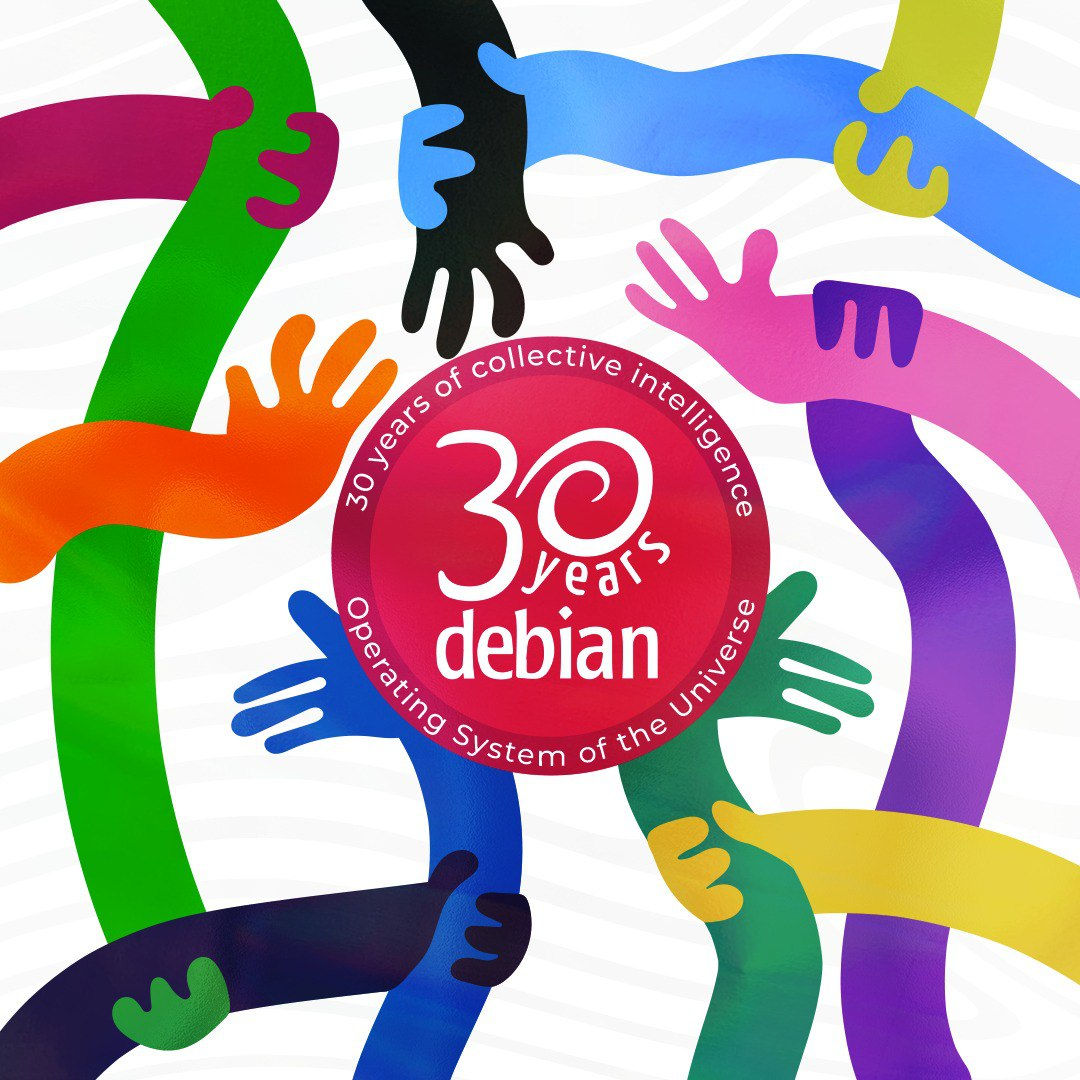
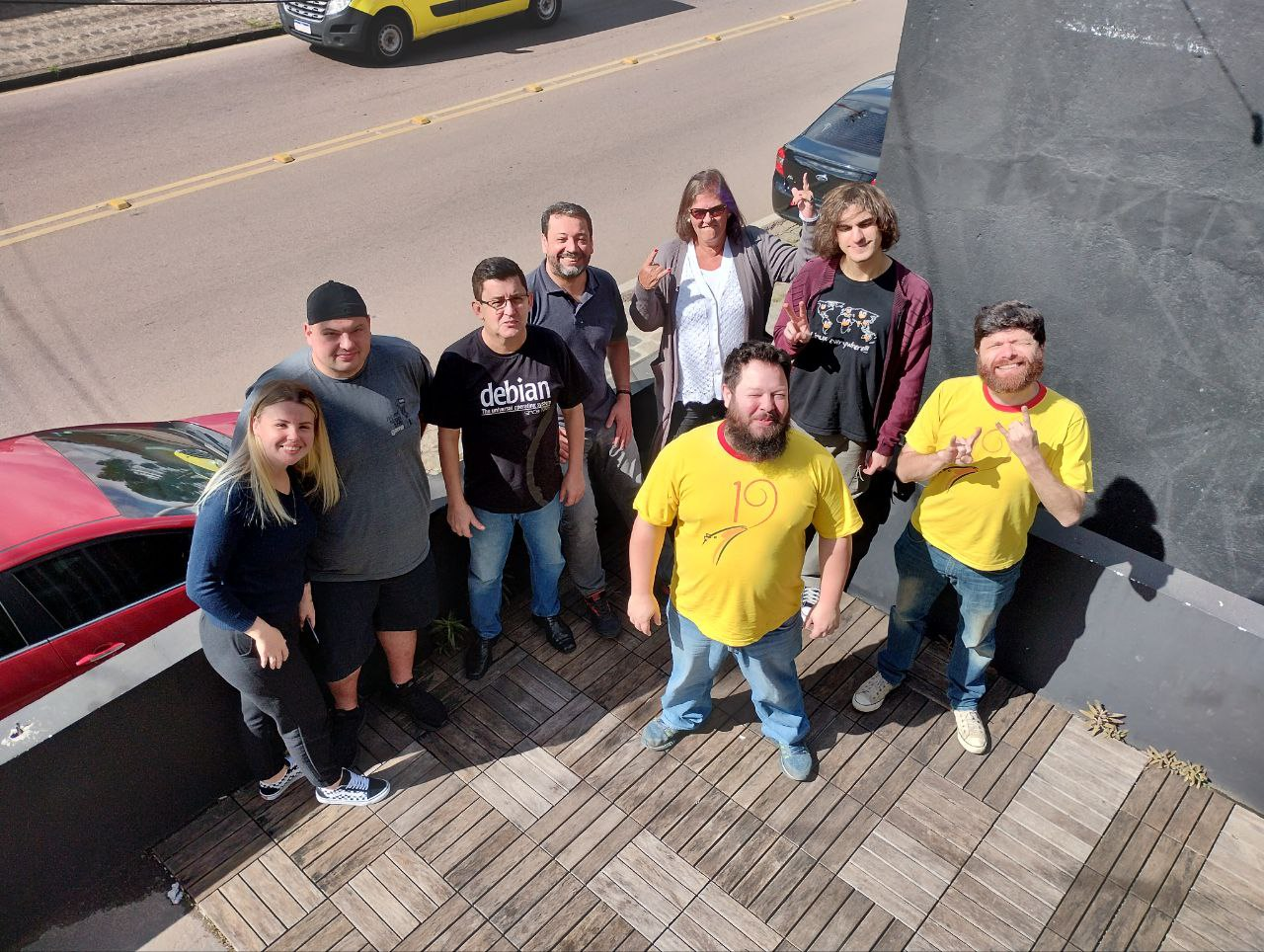
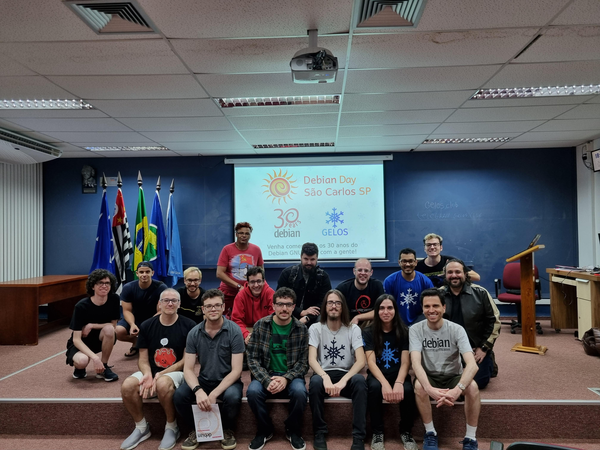
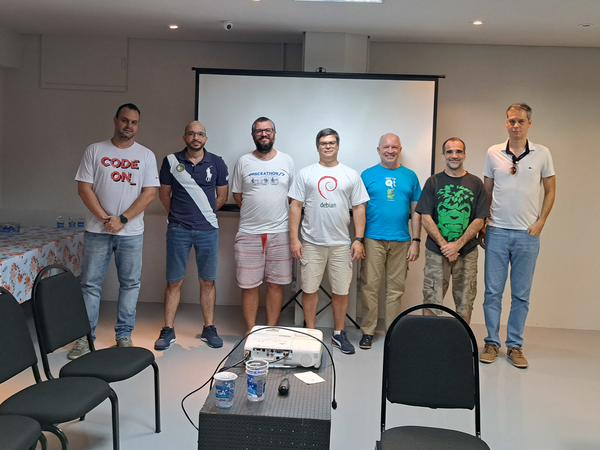
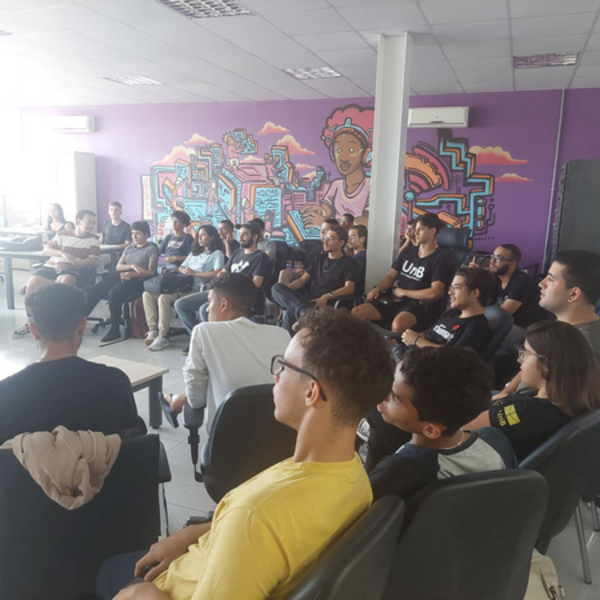
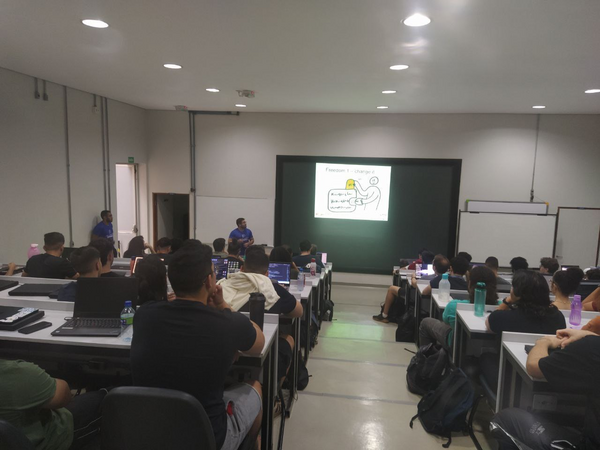
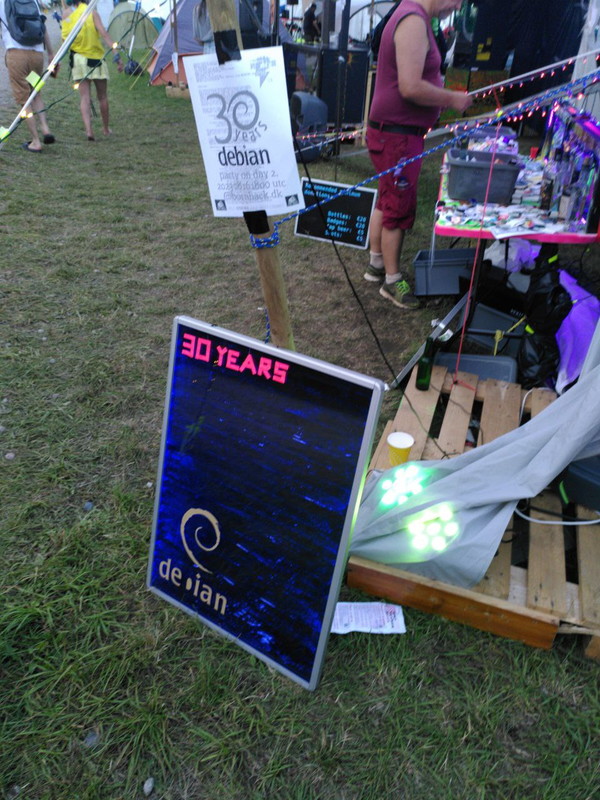
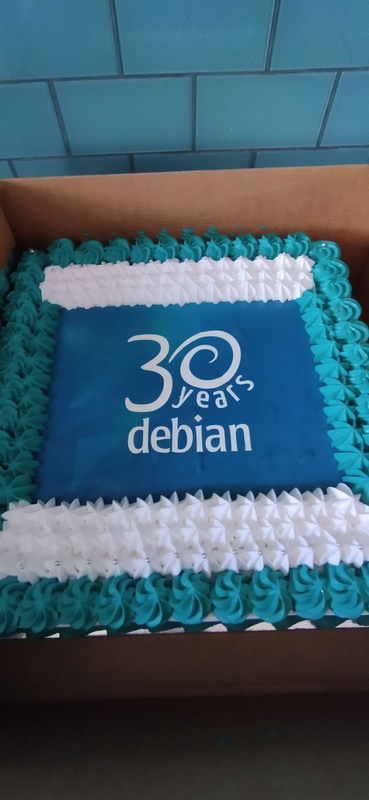
Debian Celebrates 30 years! We celebrated our birthday this year and we had a great time with new friends, new members welcomed to the community, and the world. We have collected a few comments, videos, and discussions from around the Internet, and some images from some of the DebianDay2023 events. We hope that you enjoyed the day(s) as much as we did! Maqsuel Maqson

"Debian 30 years of collective intelligence" -Maqsuel Maqson Brazil Thiago Pezzo

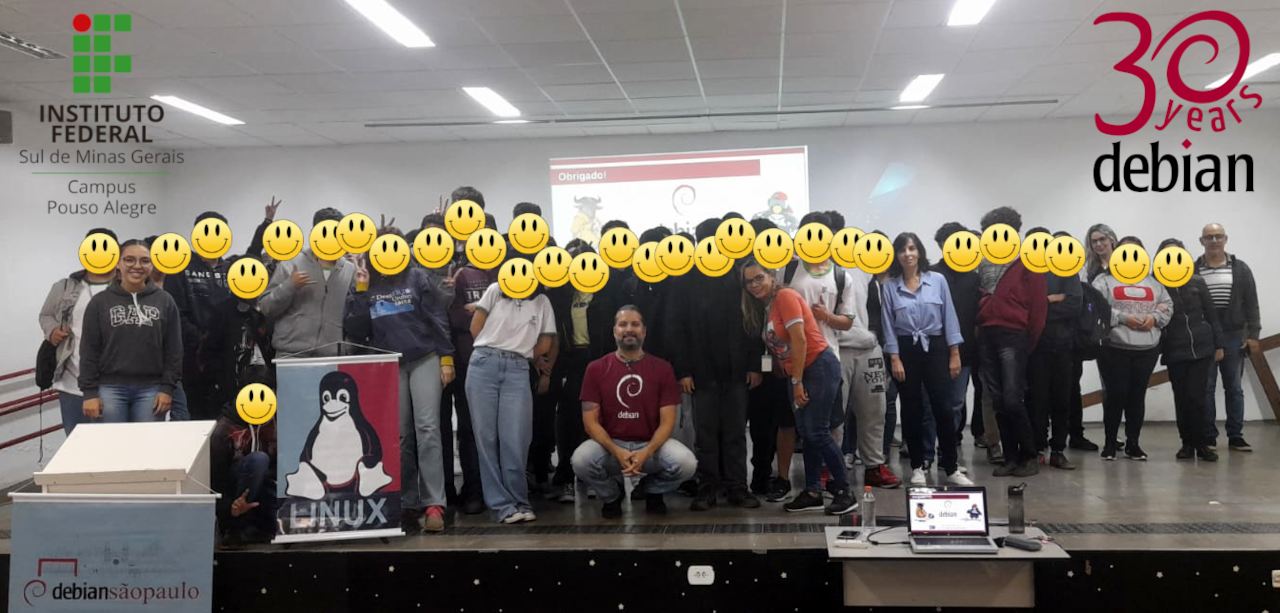
Pouso Alegre, Brazil Daniel Pimentel

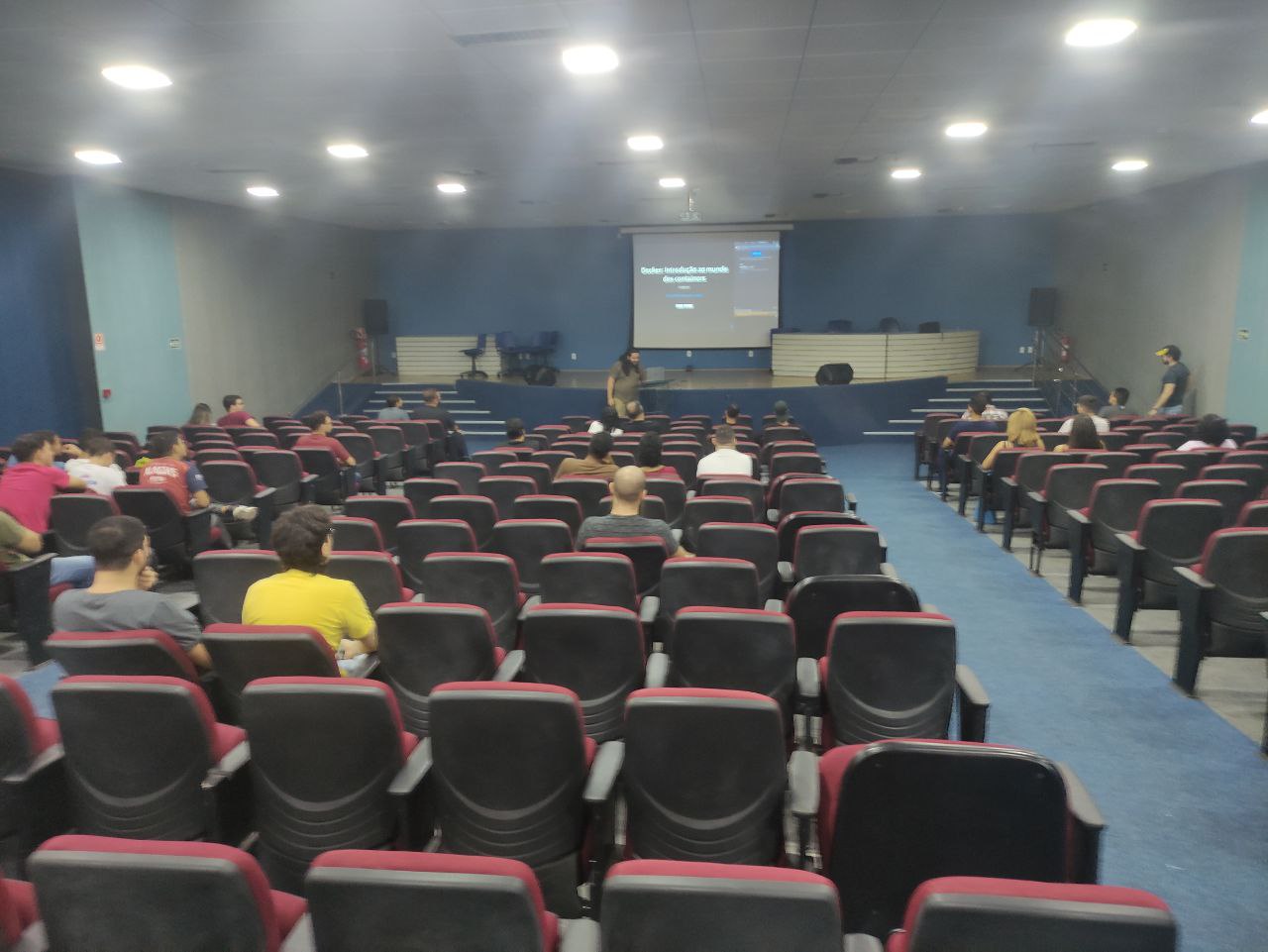
Macei , Brazil Daniel Lenharo

Curitiba, Brazil Daniel Lenharo

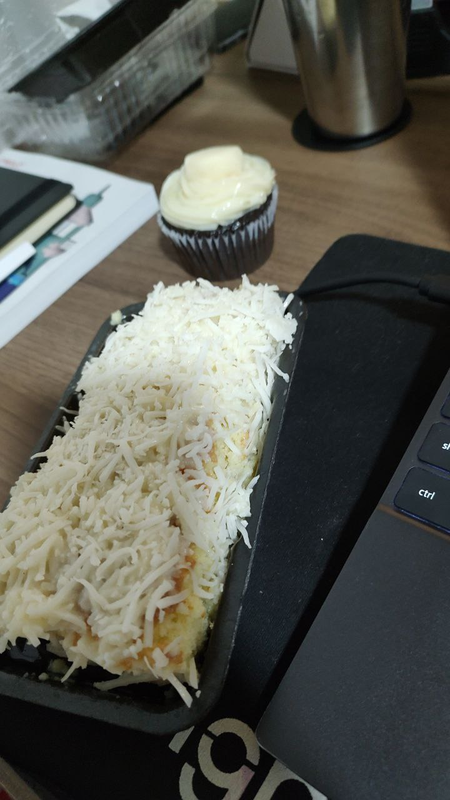
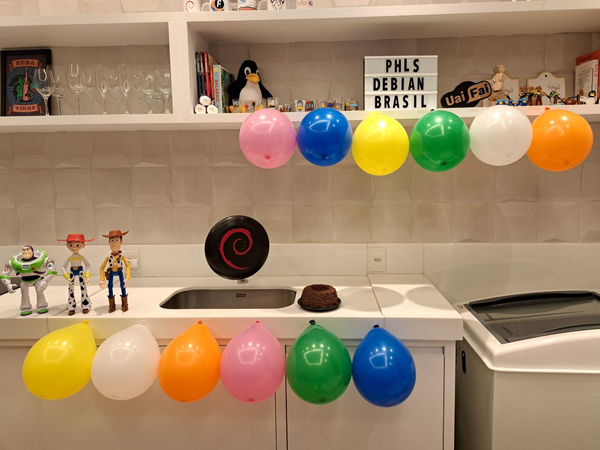
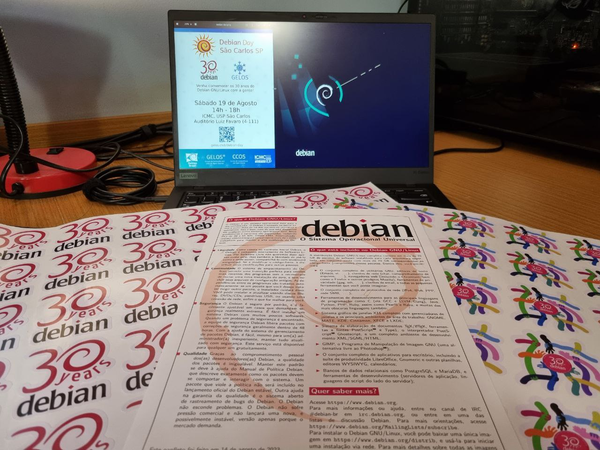
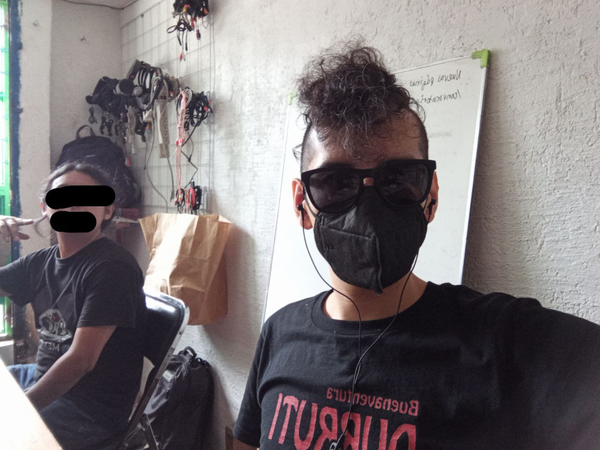
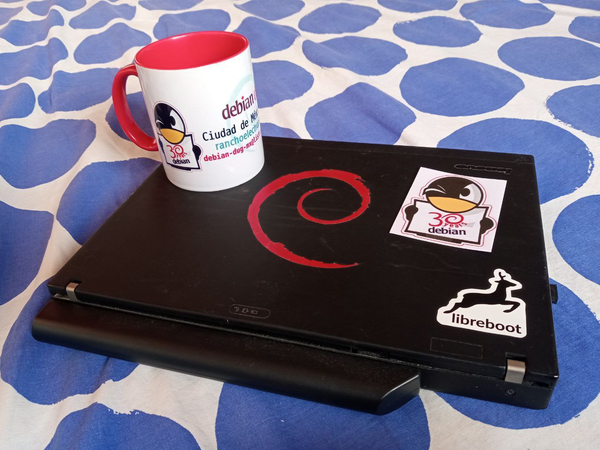
The cake is there. :) phls Honorary Debian Developers: Buzz, Jessie, and Woody welcome guests to this amazing party. Carlos Melara Sao Carlos, state of Sao Paulo, Brazil Carlos Melara Stickers, and Fliers, and Laptops, oh my! phls Belo Horizonte, Brazil sergiosacj Bras lia, Brazil sergiosacj Bras lia, Brazil Mexico Jathan 30 a os! Jathan A quick Selfie Jathan We do not encourage beverages on computing hardware, but this one is okay by us. Germany h01ger

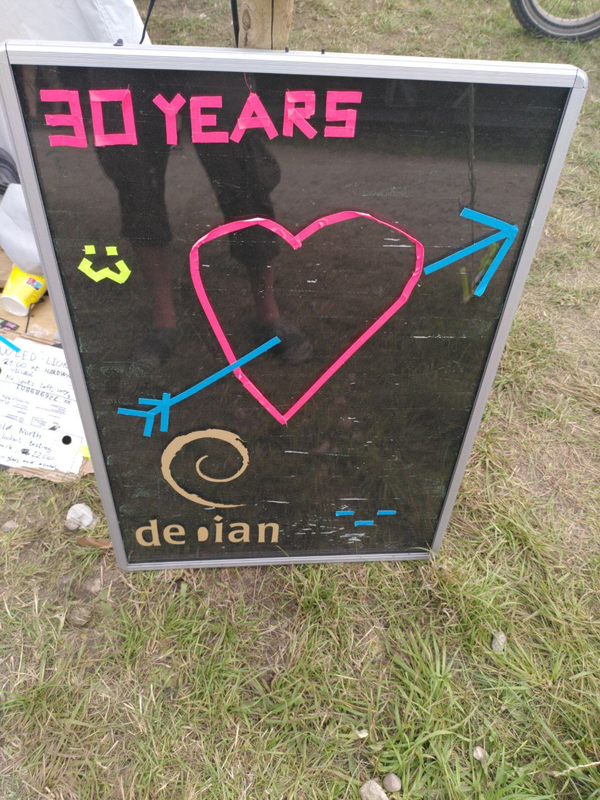
30 years of love h01ger

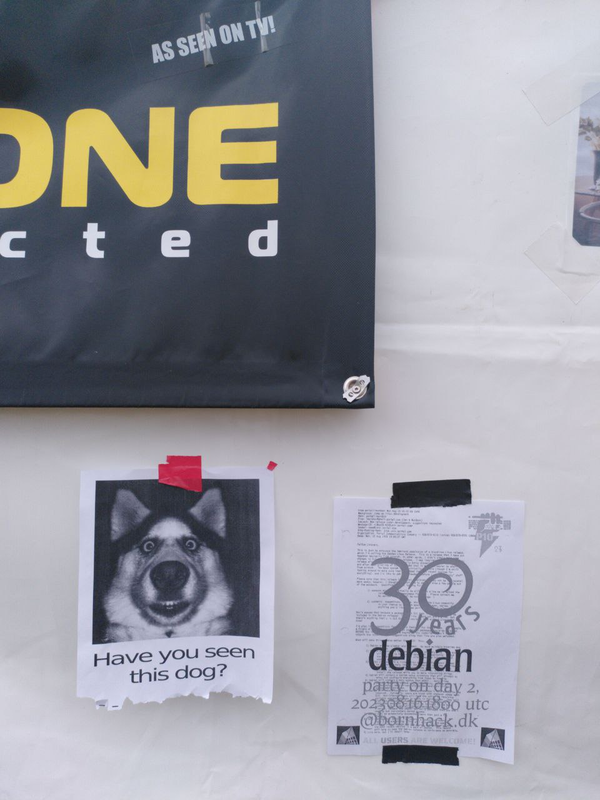
The German Delegation is also looking for this dog who footed the bill for the party, then left mysteriously. h01ger

We took the party outside Stefano Rivera

We brought the party back inside at CCCamp Belgium Stefano Rivera

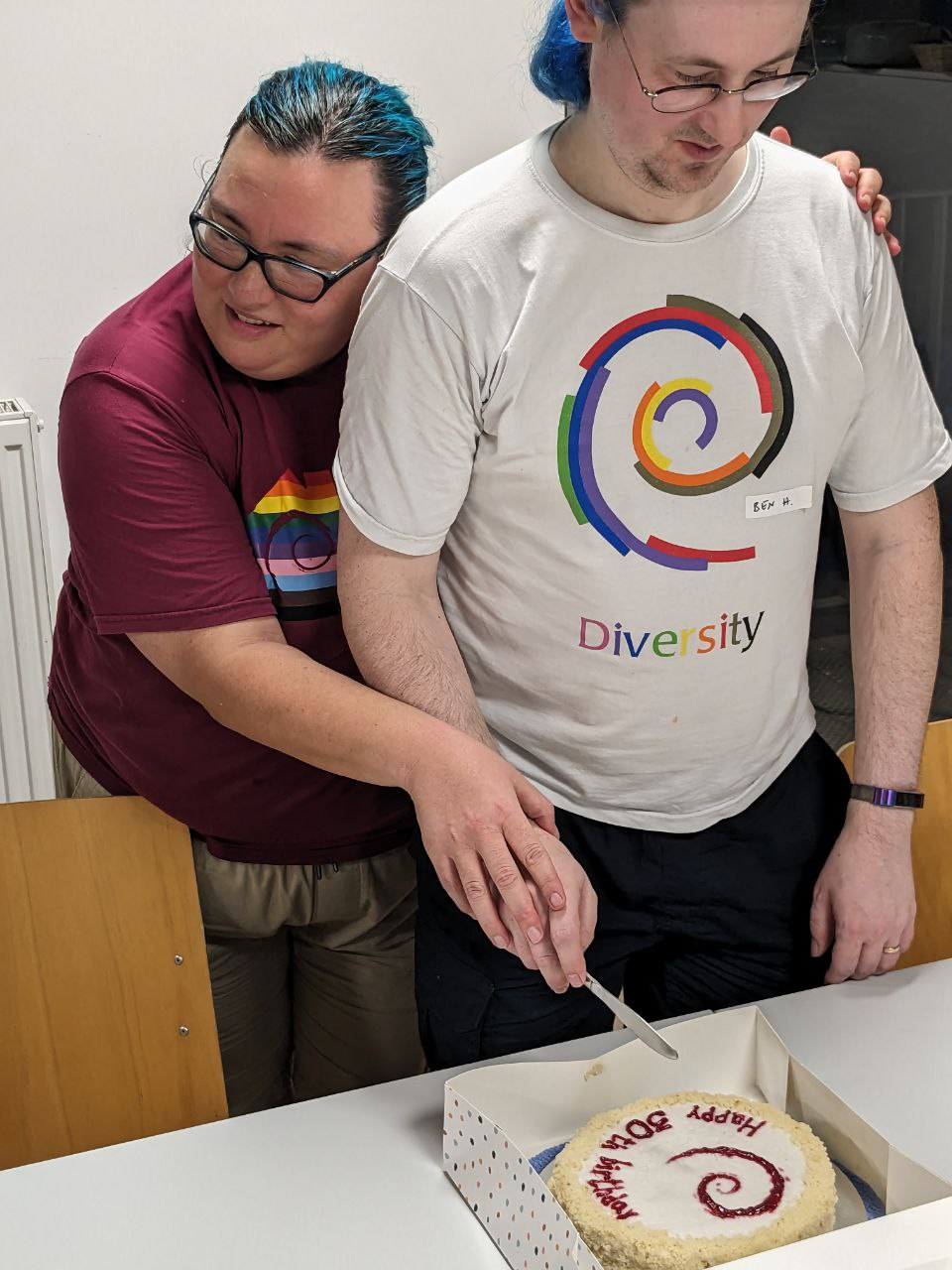
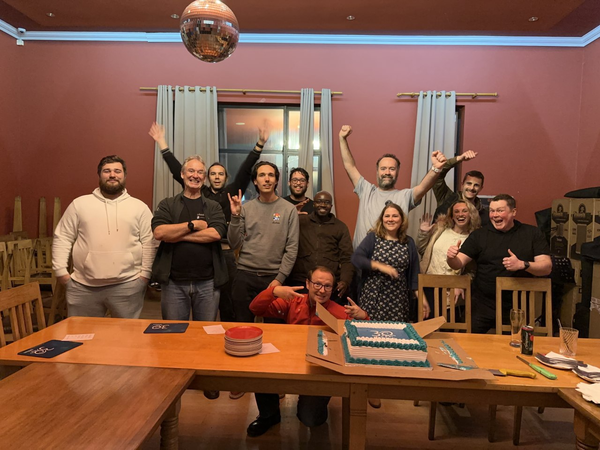
Cake and Diversity in Belgium El Salvador Gato Barato Canel n Pulgosky

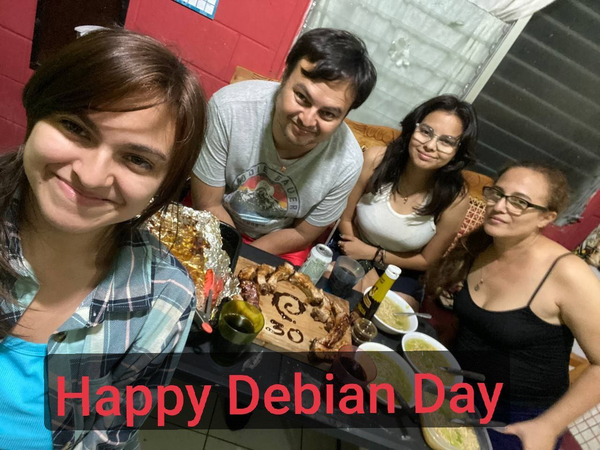
Food and Fellowship in El Salvador South Africa highvoltage

Debian is also very delicious! highvoltage

All smiles waiting to eat the cake Reports Debian Day 30 years in Macei - Brazil Debian Day 30 years in S o Carlos - Brazil Debian Day 30 years in Pouso Alegre - Brazil Debian Day 30 years in Belo Horizonte - Brazil Debian Day 30 years in Curitiba - Brazil Debian Day 30 years in Bras lia - Brazil Debian Day 30 years online in Brazil Articles & Blogs Happy Debian Day - going 30 years strong - Liam Dawe Debian Turns 30 Years Old, Happy Birthday! - Marius Nestor 30 Years of Stability, Security, and Freedom: Celebrating Debian s Birthday - Bobby Borisov Happy 30th Birthday, Debian! - Claudio Kuenzier Debian is 30 and Sgt Pepper Is at Least Ninetysomething - Christine Hall Debian turns 30! -Corbet Thirty years of Debian! - Lennart Hengstmengel Debian marks three decades as 'Universal Operating System' - Sam Varghese Debian Linux Celebrates 30 Years Milestone - Joshua James 30 years on, Debian is at the heart of the world's most successful Linux distros - Liam Proven Looking Back on 30 Years of Debian - Maya Posch Cheers to 30 Years of Debian: A Journey of Open Source Excellence - arindam Discussions and Social Media Debian Celebrates 30 Years - Source: News YCombinator Brand-new Linux release, which I'm calling the Debian ... Source: News YCombinator Comment: Congrats @debian !!! Happy Birthday! Thank you for becoming a cornerstone of the #opensource world. Here's to decades of collaboration, stability & #software #freedom -openSUSELinux via X (formerly Twitter) Comment: Today we #celebrate the 30th birthday of #Debian, one of the largest and most important cornerstones of the #opensourcecommunity. For this we would like to thank you very much and wish you the best for the next 30 years! Source: X (Formerly Twitter -TUXEDOComputers via X (formerly Twitter) Happy Debian Day! - Source: Reddit.com Video The History of Debian The Beginning - Source: Linux User Space Debian Celebrates 30 years -Source: Lobste.rs Video Debian At 30 and No More Distro Hopping! - LWDW388 - Source: LinuxGameCast Debian Celebrates 30 years! - Source: Debian User Forums Debian Celebrates 30 years! - Source: Linux.org

8 September 2023

Reproducible Builds: Reproducible Builds in August 2023

Welcome to the August 2023 report from the Reproducible Builds project! In these reports we outline the most important things that we have been up to over the past month. As a quick recap, whilst anyone may inspect the source code of free software for malicious flaws, almost all software is distributed to end users as pre-compiled binaries. The motivation behind the reproducible builds effort is to ensure no flaws have been introduced during this compilation process by promising identical results are always generated from a given source, thus allowing multiple third-parties to come to a consensus on whether a build was compromised. If you are interested in contributing to the project, please visit our Contribute page on our website.

Rust serialisation library moving to precompiled binaries Bleeping Computer reported that Serde, a popular Rust serialization framework, had decided to ship its serde_derive macro as a precompiled binary. As Ax Sharma writes:
The move has generated a fair amount of push back among developers who worry about its future legal and technical implications, along with a potential for supply chain attacks, should the maintainer account publishing these binaries be compromised.
After intensive discussions, use of the precompiled binary was phased out.

Reproducible builds, the first ten years On August 4th, Holger Levsen gave a talk at BornHack 2023 on the Danish island of Funen titled Reproducible Builds, the first ten years which promised to contain:
[ ] an overview about reproducible builds, the past, the presence and the future. How it started with a small [meeting] at DebConf13 (and before), how it grew from being a Debian effort to something many projects work on together, until in 2021 it was mentioned in an executive order of the president of the United States. (HTML slides)
Holger repeated the talk later in the month at Chaos Communication Camp 2023 in Zehdenick, Germany: A video of the talk is available online, as are the HTML slides.

Reproducible Builds Summit Just another reminder that our upcoming Reproducible Builds Summit is set to take place from October 31st November 2nd 2023 in Hamburg, Germany. Our summits are a unique gathering that brings together attendees from diverse projects, united by a shared vision of advancing the Reproducible Builds effort. During this enriching event, participants will have the opportunity to engage in discussions, establish connections and exchange ideas to drive progress in this vital field. If you re interested in joining us this year, please make sure to read the event page, the news item, or the invitation email that Mattia Rizzolo sent out, which have more details about the event and location. We are also still looking for sponsors to support the event, so do reach out to the organizing team if you are able to help. (Also of note that PackagingCon 2023 is taking place in Berlin just before our summit, and their schedule has just been published.)

Vagrant Cascadian on the Sustain podcast Vagrant Cascadian was interviewed on the SustainOSS podcast on reproducible builds:
Vagrant walks us through his role in the project where the aim is to ensure identical results in software builds across various machines and times, enhancing software security and creating a seamless developer experience. Discover how this mission, supported by the Software Freedom Conservancy and a broad community, is changing the face of Linux distros, Arch Linux, openSUSE, and F-Droid. They also explore the challenges of managing random elements in software, and Vagrant s vision to make reproducible builds a standard best practice that will ideally become automatic for users. Vagrant shares his work in progress and their commitment to the last mile problem.
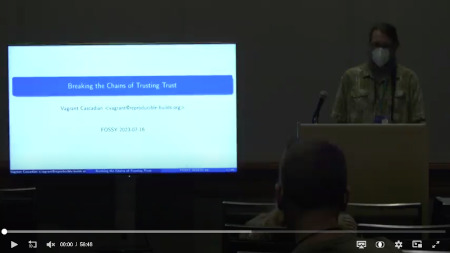
The episode is available to listen (or download) from the Sustain podcast website. As it happens, the episode was recorded at FOSSY 2023, and the video of Vagrant s talk from this conference (Breaking the Chains of Trusting Trust is now available on Archive.org: It was also announced that Vagrant Cascadian will be presenting at the Open Source Firmware Conference in October on the topic of Reproducible Builds All The Way Down.

On our mailing list Carles Pina i Estany wrote to our mailing list during August with an interesting question concerning the practical steps to reproduce the hello-traditional package from Debian. The entire thread can be viewed from the archive page, as can Vagrant Cascadian s reply.

Website updates Rahul Bajaj updated our website to add a series of environment variations related to reproducible builds [ ], Russ Cox added the Go programming language to our projects page [ ] and Vagrant Cascadian fixed a number of broken links and typos around the website [ ][ ][ ].

Software development In diffoscope development this month, versions 247, 248 and 249 were uploaded to Debian unstable by Chris Lamb, who also added documentation for the new specialize_as method and expanding the documentation of the existing specialize as well [ ]. In addition, Fay Stegerman added specialize_as and used it to optimise .smali comparisons when decompiling Android .apk files [ ], Felix Yan and Mattia Rizzolo corrected some typos in code comments [ , ], Greg Chabala merged the RUN commands into single layer in the package s Dockerfile [ ] thus greatly reducing the final image size. Lastly, Roland Clobus updated tool descriptions to mark that the xb-tool has moved package within Debian [ ].
reprotest is our tool for building the same source code twice in different environments and then checking the binaries produced by each build for any differences. This month, Vagrant Cascadian updated the packaging to be compatible with Tox version 4. This was originally filed as Debian bug #1042918 and Holger Levsen uploaded this to change to Debian unstable as version 0.7.26 [ ].

Distribution work In Debian, 28 reviews of Debian packages were added, 14 were updated and 13 were removed this month adding to our knowledge about identified issues. A number of issue types were added, including Chris Lamb adding a new timestamp_in_documentation_using_sphinx_zzzeeksphinx_theme toolchain issue.
In August, F-Droid added 25 new reproducible apps and saw 2 existing apps switch to reproducible builds, making 191 apps in total that are published with Reproducible Builds and using the upstream developer s signature. [ ]
Bernhard M. Wiedemann published another monthly report about reproducibility within openSUSE.

Upstream patches The Reproducible Builds project detects, dissects and attempts to fix as many currently-unreproducible packages as possible. We endeavour to send all of our patches upstream where appropriate. This month, we wrote a large number of such patches, including:

Testing framework The Reproducible Builds project operates a comprehensive testing framework (available at tests.reproducible-builds.org) in order to check packages and other artifacts for reproducibility. In August, a number of changes were made by Holger Levsen:
  • Debian-related changes:
    • Disable Debian live image creation jobs until an OpenQA credential problem has been fixed. [ ]
    • Run our maintenance scripts every 3 hours instead of every 2. [ ]
    • Export data for unstable to the reproducible-tracker.json data file. [ ]
    • Stop varying the build path, we want reproducible builds. [ ]
    • Temporarily stop updating the pbuilder.tgz for Debian unstable due to #1050784. [ ][ ]
    • Correctly document that we are not variying usrmerge. [ ][ ]
    • Mark two armhf nodes (wbq0 and jtx1a) as down; investigation is needed. [ ]
  • Misc:
    • Force reconfiguration of all Jenkins jobs, due to the recent rise of zombie processes. [ ]
    • In the node health checks, also try to restart failed ntpsec, postfix and vnstat services. [ ][ ][ ]
  • System health checks:
    • Detect Debian live build failures due to missing credentials. [ ][ ]
    • Ignore specific types of known zombie processes. [ ][ ]
In addition, Vagrant Cascadian updated the scripts to use a predictable build path that is consistent with the one used on buildd.debian.org. [ ][ ]

If you are interested in contributing to the Reproducible Builds project, please visit our Contribute page on our website. However, you can get in touch with us via:

7 September 2023

Thorsten Alteholz: My Debian Activities in August 2023

FTP master This month I accepted 347 and rejected 39 packages. The overall number of packages that got accepted was 349. Debian LTS This was my hundred-tenth month that I did some work for the Debian LTS initiative, started by Raphael Hertzog at Freexian. During my allocated time I uploaded: The open CVE for ffmpeg was already fixed in a previous upload and could be marked as such.
I also started to work on amanda and did some work on security-master. Last but not least I did some days of frontdesk duties and took part in the LTS meeting. Debian ELTS This month was the sixty-first ELTS month. During my allocated time I uploaded: Yeah, finally openssl1.0 was uploaded! I also started to work on amanda, but for whatever reason the package does not build in my chroot. Why do I always choose the packages with quirks? Last but not least I did some days of frontdesk duties. debian-printing This month I tried to update package hplip. Unfortunately upstream added some new compressed files that need to appear uncompressed in the package. Even though this sounded like an easy task, which seemed to be already implemented in the current debian/rules, the new type of files broke this implementation and made the package no longer buildable. There is also an RC-bug waiting that needs some love. I still hope to upload the package soon. This work is generously funded by Freexian! Other stuff Unfortunately $job demanded lots of attention this month, so I only uploaded: Due to the recent license change of Hashicorp, I am no longer willing to spend time working on their products. I therefore filed RM-bugs for golang-github-hashicorp-go-gcp-common, golang-github-hashicorp-go-tfe, golang-github-hashicorp-go-slug and golang-github-hashicorp-terraform-json.
As there seemed to be others involved in golang-github-hashicorp-terraform-svchost and golang-github-hashicorp-go-azure-helpers, I only orphaned both packages. I hope OpenTF will be successful!

6 September 2023

Jonathan McDowell: DebConf 23 Key Signing + setting up a new key

I ve just finalised the OpenPGP key list for the DebConf 23 Keysigning party. This will follow the new style approach of being a continuous keysigning throughout the course of the conference, with an introduction session up front to confirm no one s fingerprint is corrupted and that we all calculated the same hash of the file. Participants will then verify each other s identities over the conference week, hopefully being able to build up a better level of verification than a one shot key signing session. Those paying attention will note that my key details have changed this year; I am finally make a concerted effort to migrate to an elliptic curve based key. I managed to bootstrap it sufficiently at OMGWTFBBQ, but I m keen to ensure it s well integrated into the web of trust, so please do come talk to me at DebConf so we can exchange fingerprints!
pub   ed25519 2023-08-19 [C] [expires: 2025-08-18]
      419F B4B6 567E 6EF7 DEAF  80A0 9026 108F B942 BEA4
uid           [ultimate] Jonathan McDowell <noodles@earth.li>
(I ve no reason to suspect problems with my old key and will be making a graceful changeover in the Debian keyring at some point in October after I ve performed the September keyring update; that ll give things a couple of months to catch up before it s my turn to do an update again.)

1 September 2023

Scarlett Gately Moore: KDE: Weekly report and News, 23.08.0 Snaps call for testing!

Another busy week in the KDE snap world. Most of the release-service apps are in candidate channel waiting to be tested. Testing is the bottle neck in the process, so I am trying something new and calling for help! Please test your favorite apps and report on https://discuss.kde.org/t/all-things-snaps-questions-concerns-praise/ any issues and which apps tested. Thanks! There are some very big fixes in this release: The KF6 content pack is coming along nicely using qt-framework-sdk snap! Qt5 content snap using KDE patch set is nearly complete! I believe I have a solution for our PIM applications by creating an Akondai dbus provider snap and setting all the PIM applications as consumers. I am waiting for manual review to pass. I have a pile of new applications waiting for reserved name approvals. Igor has pinged the relevant people to speed this normally quick process up. The pushback on per repository snapcraft files has stopped, so I have begun the process, which will take some time. This is a huge step in automating snap builds and cutting down my manual work so I can do more exciting things like plasma snaps! Some big news on my project, a big thank you goes out to Kevin Ottens for reaching out, his company does exactly what I need to move it forward. I will update as we hash out the details, but it looks like my project isn t dead after all! I know many have asked Why haven t you given up already?? The answer in short, I am stubborn. I refuse to give up on anything until I am given a good reason to. When I started my path in computers oh so many years ago, you would be surprised how many people told me to give it up, you ll never make it as a woman. Challenge accepted. Here I am, still going strong. When I want something, I go get it, no matter what it takes! I still need to have a ( somewhat desperate ) call for donations. This will hopefully end soon, but for now, please consider donating to my September survival fund! Please share with anyone you that may find my work useful in any way. Thanks for your consideration
PS: Debian uploads for bubble-gum are moving along. Please if you have any packaging you need done in Debian proper, let me know and I will get on it, time allowing of course.

30 August 2023

Andrew Cater: Building a mirror of various Red Hat oriented "stuff"

Building a mirror for rpm-based distributions.
I've already described in brief how I built a mirror that currently mirrors Debian and Ubuntu on a daily basis. That was relatively straightforward given that I know how to install Debian and configure a basic system without a GUI and the ftpsync scripts are well maintained, I can pull some archives and get one pushed to me such that I've always got up to date copies of Debian and Ubuntu.I wanted to do something similar using Rocky Linux to pull in archives for Almalinux, Rocky Linux, CentOS, CentOS Stream and (optionally) Fedora.(This was originally set up using Red Hat Enterprise Linux on a developer's subscription and rebuilt using Rocky Linux so that the machine could be passed on to someone else if necessary. Red Hat 9.1 has moved to x86_64v2 - on the machine I have (HP Microserver gen 8) 9.1 it fails immediately. It has been rebuilt to use Rocky 8.8).This is a minimal install of Rocky as console only - the machine it's on only has 4G of memory so won't run a GUI reliably. It will run Cockpit so can be remotely administered. One user to run everything - mirror.
Minimal install of Rocky 8.7 from DVD .iso. SELinux is enabled, SSH works for remote access. SELinux had to be tweaked to allow /srv/ the appropriate permissions to be served by nginx. /srv is a large LVM volume rather than a RAID 6 - I didn't have enough disks
Adding nginx, enabling Cockpit and editing the Rocky Linux mirroring scripts resulted in something straightforward to reproduce.

nginx

I cheated and stole large parts of my Debian config. The crucial part to remember is that there is no autoindexing by default and I had to dig to find the correct configuration snippet.

# Load configuration files for the default server block.

include /etc/nginx/default.d/*.conf;

location /
autoindex on;
autoindex_exact_size off;
autoindex_format html;
autoindex_localtime off;
# First attempt to serve request as file, then
# as directory, then fall back to displaying a 404.
try_files $uri $uri/ =404;

Rocky Linux mirroring scripts

Systemd unit file for service

[Unit]
Description=Rocky Linux Mirroring script

[Service]
Type=simple
User=mirror
Group=mirror
ExecStart=/usr/local/bin/rockylinux

[Install]
WantedBy=multi-user.target

Rocky linux timer file
[Unit]
Description=Run Rocky Linux mirroring script daily

[Timer]
OnCalendar=*-*-* 08:13:00
OnCalendar=*-*-* 22:13:00
Persistent=true

[Install]
WantedBy=timers.target

Mirror script

#!/bin/env bash
#
# mirrorsync - Synchronize a Rocky Linux mirror
# By: Dennis Koerner <koerner@netzwerge.de>
#

# The latest version of this script can be found at:
# https://github.com/rocky-linux/rocky-tools
#
# Please read https://docs.rockylinux.org/en/rocky/8/guides/add_mirror_manager
# for further information on setting up a Rocky mirror.
#
# Copyright (c) 2021 Rocky Enterprise Software Foundation

This is a very long script in total.
Crucial parts I changed only listed the mirror to pull from and the place to put it.

# A complete list of mirrors can be found at
# https://mirrors.rockylinux.org/mirrormanager/mirrors/Rocky
src="mirrors.vinters.com::rocky"

# Your local path. Change to whatever fits your system.
# $mirrormodule is also used in syslog output.
mirrormodule="rocky-linux"
dst="/srv/$ mirrormodule "

filelistfile="fullfiletimelist-rocky"
lockfile="/home/mirror/rocky.lockfile"
logfile="/home/mirror/rocky.log"

Logfile looks something like this: the single time spec file is used to check whether another rsync needs to be run
deleting 9.1/plus/x86_64/os/repodata/3585b8b5-90e0-4856-9df2-95f646bc62c7-PRIMARY.xml.gz

sent 606,565 bytes received 38,808,194,155 bytes 44,839,746.64 bytes/sec
total size is 1,072,593,052,385 speedup is 27.64
End: Fri 27 Jan 2023 08:27:49 GMT
fullfiletimelist-rocky unchanged. Not updating at Fri 27 Jan 2023 22:13:16 GMT
fullfiletimelist-rocky unchanged. Not updating at Sat 28 Jan 2023 08:13:16 GMT
It was essentially easier to store fullfiletimelist-rocky in /home/mirror than anywhere else.

Very similar small modifications to the Rocky mirroring scripts were used to mirror the other distributions I'm mirroring. (Almalinux, CentOS, CentOS Stream, EPEL and Rocky Linux).

Dirk Eddelbuettel: RcppArmadillo 0.12.6.3.0 on CRAN: New Upstream Bugfix

armadillo image Armadillo is a powerful and expressive C++ template library for linear algebra and scientific computing. It aims towards a good balance between speed and ease of use, has a syntax deliberately close to Matlab, and is useful for algorithm development directly in C++, or quick conversion of research code into production environments. RcppArmadillo integrates this library with the R environment and language and is widely used by (currently) 1092 other packages on CRAN, downloaded 30.3 million times (per the partial logs from the cloud mirrors of CRAN), and the CSDA paper (preprint / vignette) by Conrad and myself has been cited 549 times according to Google Scholar. This release brings bugfix upstream release 12.6.3. We skipped 12.6.2 at CRAN (as discussed in the previous release notes) as it only affected Armadillo-internal random-number generation (RNG). As we default to supplying the RNGs from R, this did not affect RcppArmadillo. The bug fixes in 12.6.3 are for csv reading which too will most likely be done by R tools for R users, but given two minor bugfix releases an update was in order. I ran the full reverse-depenency check against the now more than 1000 packages overnight: no issues. armadillo processing CRAN processed the package fully automatically as it has no issues, and nothing popped up in reverse-dependency checking. The set of changes for the last two RcppArmadillo releases follows.

Changes in RcppArmadillo version 0.12.6.3.0 (2023-08-28)
  • Upgraded to Armadillo release 12.6.3 (Cortisol Retox)
    • Fix for corner-case in loading CSV files with headers
    • For consistent file handling, all .load() functions now open text files in binary mode

Changes in RcppArmadillo version 0.12.6.2.0 (2023-08-08)
  • Upgraded to Armadillo release 12.6.2 (Cortisol Retox)
    • use thread-safe Mersenne Twister as the default RNG on all platforms
    • use unique RNG seed for each thread within multi-threaded execution (such as OpenMP)
    • explicitly document arma_rng::set_seed() and arma_rng::set_seed_random()
  • None of the changes above affect R use as RcppArmadillo connects the RNGs used by R to Armadillo

Courtesy of my CRANberries, there is a diffstat report relative to previous release. More detailed information is on the RcppArmadillo page. Questions, comments etc should go to the rcpp-devel mailing list off the Rcpp R-Forge page. If you like this or other open-source work I do, you can sponsor me at GitHub.

This post by Dirk Eddelbuettel originated on his Thinking inside the box blog. Please report excessive re-aggregation in third-party for-profit settings.

29 August 2023

Andrew Cater: 20230828 - OMGWTFBBQ - Breakfast is happening more or less

And nothing changes: rediscovered from past Andrew at his first Cambridge BBQ and almost the first blog post here:

"House full of people I knew only from email, some very old friends. Wires and leads filling the front room floor - laptops _everywhere_ .

...

Thirty second rule on sofa space - if you left for more than about 30 seconds you had to sit on the floor when you got back (I jammed myself onto a corner of the sofa once I realised I'd barely get through the crush :) )
[Forget students in a mini / UK telephone box - how many DDs can you fit into a very narrow kitchen :) ]

It's a huge, dysfunctional family with its own rules, geeky humour and in-jokes but it's MINE - it's the people I want to hang out with and, as perverse as it sounds, just being there gave me a whole new reaffirmed sense of identity and a large amount of determination to carry on "wasting my time with Linux" and Debian"

The *frightening* thing - this is from August 31st 2009 ... where have the years gone in between.

Jonathan Dowland: Gazelle Twin

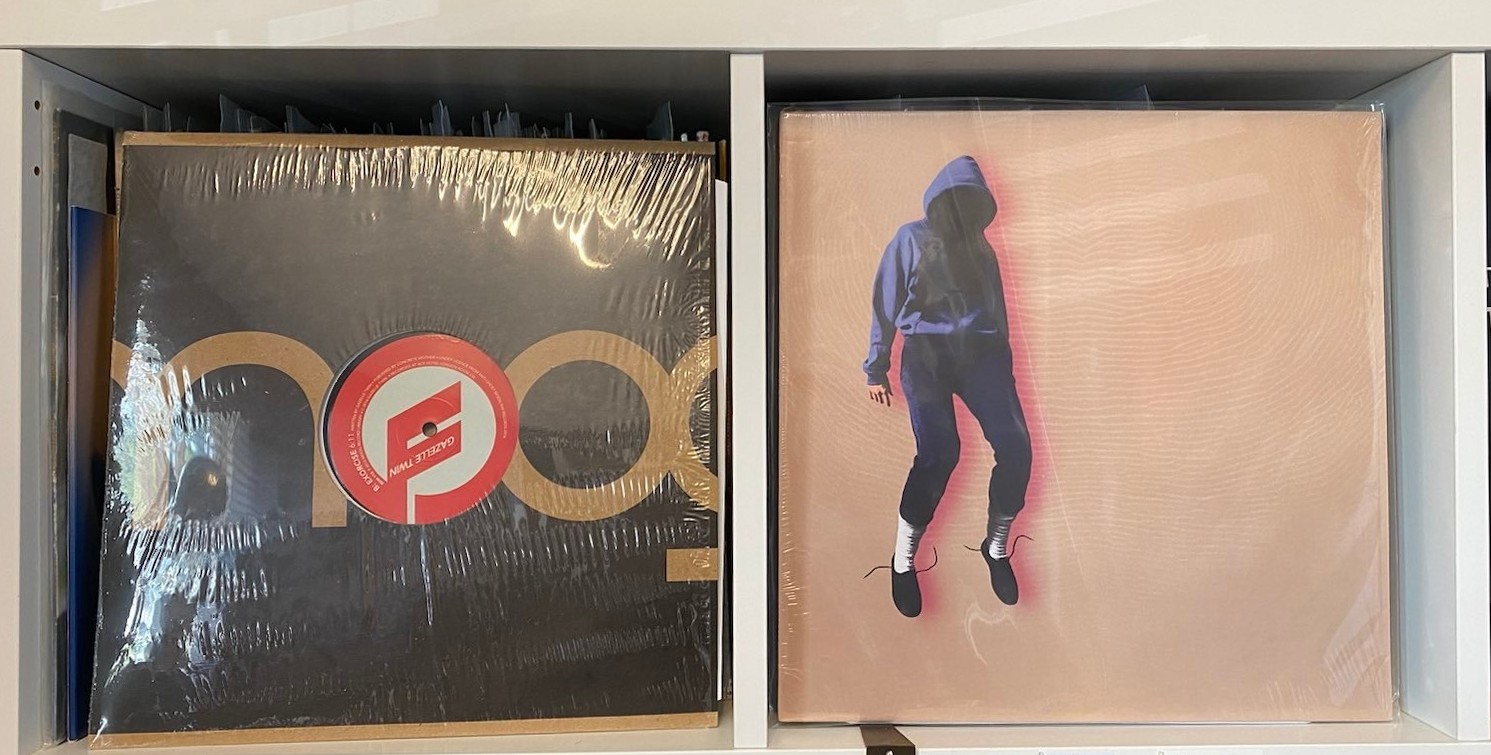
A couple of releases A couple of releases
I discovered Gazelle Twin last year via Stuart Maconie's Freak Zone (two of her tracks ended up on my 2022 Halloween playlist). Through her website I learned of The Horror Show! exhibition at Somerset House1 in London that I managed to visit earlier this year. I've been intending to write a 5-track blog post (a la Underworld, the Cure, Coil) for a while but I have been spurred on by the excellent news that she's got a new album on the way, and, she's performing at the Sage Gateshead in November. Buy tickets now!! Here's the five tracks I recommend to get started:
  1. Anti-Body, from 2014's UNFLESH. I particularly love the percussion. Perc did a good hard-house-style remix on Fleshed Out, the companion remix album. Anti-Body by Gazelle Twin
  2. Fire Leap, from Gazelle Twin and NYX's collaborative album Deep England. The album is a re-interpretation of material from Gazelle Twin's earlier album, Pastoral, with the exception of this track, which is a cover of Paul Giovanni's song from The Wicker Man. There's a common aesthetic in all three works: eerie-folk, England's self-mythologising as seen through a warped and cracked lens. Anti-Body by Gazelle Twin There's a fantastic performance video of the whole album, directed by Iain Forsyth and Jane Pollard, available on YouTube.
  3. Better In My Day, from the aforementioned Pastoral. This track and this album are, I think, less accessible, more challenging than the re-interpreted material. That's not a bad thing: I'm still working on digesting it! This is one of the more abrasive, confrontational tracks. Better In My Day by Gazelle Twin
  4. I am Shell I am Bone, from way back to her first release, The Entire City in 2011. Composed, recorded, self-produced, self-released. It's remarkable to me how different each phase of GT's work are to one another. This album evokes a strong sense of atmosphere and place to me. There's a hint of possible influence of Joy Division's Unknown Pleasures (or New Order's Movement) in places. The b-side to this song is a cover of Joy Division's The Eternal. I Am Shell I Am Bone by Gazelle Twin
  5. GT re-issued This Entire City in 2022 along with a companion-piece EP of newly-released material from the same era, The Wastelands. This isn't cutting room floor stuff, though, as evidenced by the strength of my final pick, Hole in my Heart. Hole In My Heart by Gazelle Twin
It's hard to pick just five tracks when doing these (that's the point I suppose). I note that I haven't picked anything from her wide-ranging soundtrack work: her last three or four of her releases have been soundtrack works, released on the well-respected UK label Invada, as will be her forthcoming album. You can find all the released stuff on Gazelle Twin's Bandcamp Page.

  1. I recently learned that PJ Harvey once hosted album sessions in Somerset House, and allowed fans to watch her at work during the recording: https://www.theguardian.com/music/2015/jan/16/pj-harvey-somerset-house-recording-in-progress

28 August 2023

Jonathan McDowell: OMGWTFBBQ 2023

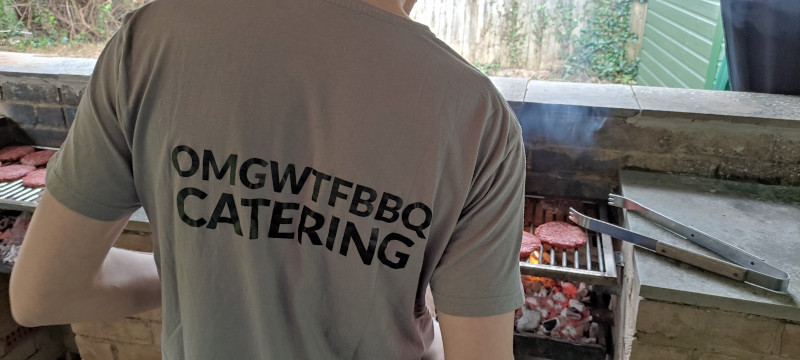
A person wearing an OMGWTFBBQ Catering t-shirt standing in front of a BBQ. Various uncooked burgers are visible. As is traditional for the UK August Bank Holiday weekend I made my way to Cambridge for the Debian UK BBQ. As was pointed out we ve been doing this for more than 20 years now, and it s always good to catch up with old friends and meet new folk. Thanks to Collabora, Codethink, and Andy for sponsoring a bunch of tasty refreshments. And, of course, thanks to Steve for hosting us all.

27 August 2023

Shirish Agarwal: FSCKing /home

There is a bit of context that needs to be shared before I get to this and would be a long one. For reasons known and unknown, I have a lot of sudden electricity outages. Not just me, all those who are on my line. A discussion with a lineman revealed that around 200+ families and businesses are on the same line and when for whatever reason the electricity goes for all. Even some of the traffic lights don t work. This affects software more than hardware or in some cases, both. And more specifically HDD s are vulnerable. I had bought an APC unit several years for precisely this, but over period of time it just couldn t function and trips also when the electricity goes out. It s been 6-7 years so can t even ask customer service to fix the issue and from whatever discussions I have had with APC personnel, the only meaningful difference is to buy a new unit but even then not sure this is an issue that can be resolved, even with that. That comes to the issue that happens once in a while where the system fsck is unable to repair /home and you need to use an external pen drive for the same. This is my how my hdd stacks up
/ is on dev/sda7 /boot is on /dev/sda6, /boot/efi is on /dev/sda2 and /home is on /dev/sda8 so theoretically, if /home for some reason doesn t work I should be able drop down on /dev/sda7, unmount /dev/sda8, run fsck and carry on with my work. I tried it number of times but it didn t work. I was dropping down on tty1 and attempting the same, no dice as root/superuser getting the barest x-term. So first I tried asking couple of friends who live nearby me. Unfortunately, both are MS-Windows users and both use what are called as company-owned laptops . Surfing on those systems were a nightmare. Especially the number of pop-ups of ads that the web has become. And to think about how much harassment ublock origin has saved me over the years. One of the more interesting bits from both their devices were showing all and any downloads from fosshub was showing up as malware. I dunno how much of that is true or not as haven t had to use it as most software we get through debian archives or if needed, download from github or wherever and run/install it and you are in business. Some of them even get compiled into a good .deb package but that s outside the conversation atm. My only experience with fosshub was few years before the pandemic and that was good. I dunno if fosshub really has malware or malwarebytes was giving false positives. It also isn t easy to upload a 600 MB+ ISO file somewhere to see whether it really has malware or not. I used to know of a site or two where you could upload a suspicious file and almost 20-30 famous and known antivirus and anti-malware engines would check it and tell you the result. Unfortunately, I have forgotten the URL and seeing things from MS-Windows perspective, things have gotten way worse than before. So left with no choice, I turned to the local LUG for help. Fortunately, my mobile does have e-mail and I could use gmail to solicit help. While there could have been any number of live CD s that could have helped but one of my first experiences with GNU/Linux was that of Knoppix that I had got from Linux For You (now known as OSFY) sometime in 2003. IIRC, had read an interview of Mr. Klaus Knopper as well and was impressed by it. In those days, Debian wasn t accessible to non-technical users then and Knoppix was a good tool to see it. In fact, think he was the first to come up with the idea of a Live CD and run with it while Canonical/Ubuntu took another 2 years to do it. I think both the CD and the interview by distrowatch was shared by LFY in those early days. Of course, later the story changes after he got married, but I think that is more about Adriane rather than Knoppix. So Vishal Rao helped me out. I got an HP USB 3.2 32GB Type C OTG Flash Drive x5600c (Grey & Black) from a local hardware dealer around similar price point. The dealer is a big one and has almost 200+ people scattered around the city doing channel sales who in turn sell to end users. Asking one of the representatives about their opinion on stopping electronic imports (apparently more things were added later to the list including all sorts of sundry items from digital cameras to shavers and whatnot.) The gentleman replied that he hopes that it would not happen otherwise more than 90% would have to leave their jobs. They already have started into lighting fixtures (LED bulbs, tubelights etc.) but even those would come in the same ban  The main argument as have shared before is that Indian Govt. thinks we need our home grown CPU and while I have no issues with that, as shared before except for RISC-V there is no other space where India could look into doing that. Especially after the Chip Act, Biden has made that any new fabs or any new thing in chip fabrication will only be shared with Five Eyes only. Also, while India is looking to generate about 2000 GW by 2030 by solar, China has an ambitious 20,000 GW generation capacity by the end of this year and the Chinese are the ones who are actually driving down the module prices. The Chinese are also automating their factories as if there s no tomorrow. The end result of both is that China will continue to be the world s factory floor for the foreseeable future and whoever may try whatever policies, it probably is gonna be difficult to compete with them on prices of electronic products. That s the reason the U.S. has been trying so that China doesn t get the latest technology but that perhaps is a story for another day.

HP USB 3.2 Type C OTG Flash Drive x5600c For people who have had read this blog they know that most of the flash drives today are MLC Drives and do not have the longevity of the SLC Drives. For those who maybe are new, this short brochure/explainer from Kingston should enhance your understanding. SLC Drives are rare and expensive. There are also a huge number of counterfeit flash drives available in the market and almost all the companies efforts whether it s Kingston, HP or any other manufacturer, they have been like a drop in the bucket. Coming back to the topic at hand. While there are some tools that can help you to figure out whether a pen drive is genuine or not. While there are products that can tell you whether they are genuine or not (basically by probing the memory controller and the info. you get from that.) that probably is a discussion left for another day. It took me couple of days and finally I was able to find time to go Vishal s place. The journey of back and forth lasted almost 6 hours, with crazy traffic jams. Tells you why Pune or specifically the Swargate, Hadapsar patch really needs a Metro. While an in-principle nod has been given, it probably is more than 5-7 years or more before we actually have a functioning metro. Even the current route the Metro has was supposed to be done almost 5 years to the date and even the modified plan was of 3 years ago. And even now, most of the Stations still need a lot of work to be done. PMC, Deccan as examples etc. still have loads to be done. Even PMT (Pune Muncipal Transport) that that is supposed to do the last mile connections via its buses has been putting half-hearted attempts

Vishal Rao While Vishal had apparently seen me and perhaps we had also interacted, this was my first memory of him although we have been on a few boards now and then including stackexchange. He was genuine and warm and shared 4-5 distros with me, including Knoppix and System Rescue as shared by Arun Khan. While this is and was the first time I had heard about Ventoy apparently Vishal has been using it for couple of years now. It s a simple shell script that you need to download and run on your pen drive and then just dump all the .iso images. The easiest way to explain ventoy is that it looks and feels like Grub. Which also reminds me an interaction I had with Vishal on mobile. While troubleshooting the issue, I was unsure whether it was filesystem that was the issue or also systemd was corrupted. Vishal reminded me of putting fastboot to the kernel parameters to see if I m able to boot without fscking and get into userspace i.e. /home. Although journalctl and systemctl were responding even on tty1 still was a bit apprehensive. Using fastboot was able to mount the whole thing and get into userspace and that told me that it s only some of the inodes that need clearing and there probably are some orphaned inodes. While Vishal had got a mini-pc he uses that a server, downloads stuff to it and then downloads stuff from it. From both privacy, backup etc. it is a better way to do things but then you need to laptop to access it. I am sure he probably uses it for virtualization and other ways as well but we just didn t have time for that discussion. Also a mini-pc can set you back anywhere from 25 to 40k depending on the mini-pc and the RAM and the SSD. And you need either a lappy or an Raspberry Pi with some kinda visual display to interact with the mini-pc. While he did share some of the things, there probably could have been a far longer interaction just on that but probably best left for another day. Now at my end, the system I had bought is about 5-6 years old. At that time it only had 6 USB 2.0 drives and 2 USB 3.0 (A) drives.
The above image does tell of the various form factors. One of the other things is that I found the pendrive and its connectors to be extremely fiddly. It took me number of times fiddling around with it when I was finally able to put in and able to access the pen drive partitions. Unfortunately, was unable to see/use systemrescue but Knoppix booted up fine. I mounted the partitions briefly to see where is what and sure enough /dev/sda8 showed my /home files and folders. Unmounted it, then used $fsck -y /dev/sda8 and back in business. This concludes what happened. Updates Quite a bit was left out on the original post, part of which I didn t know and partly stuff which is interesting and perhaps need a blog post of their own. It s sad I won t be part of debconf otherwise who knows what else I would have come to know.
  1. One of the interesting bits that I came to know about last week is the Alibaba T-Head T-Head TH1520 RISC-V CPU and saw it first being demoed on a laptop and then a standalone tablet. The laptop is an interesting proposition considering Alibaba opened up it s chip thing only couple of years ago. To have an SOC within 18 months and then under production for lappies and tablets is practically unheard of especially of a newbie/startup. Even AMD took 3-4 years for its first chip.It seems they (Alibaba) would be parceling them out by quarter end 2023 and another 1000 pieces/Units first quarter next year, while the scale is nothing compared to the behemoths, I think this would be more as a matter of getting feedback on both the hardware and software. The value proposition is much better than what most of us get, at least in India. For example, they are doing a warranty for 5 years and also giving spare parts. RISC-V has been having a lot of resurgence in China in part as its an open standard and partly development will be far cheaper and faster than trying x86 or x86-64. If you look into both the manufacturers, due to monopoly, both of them now give 5-8% increment per year, and if you look back in history, you would find that when more chips were in competition, they used to give 15-20% performance increment per year.
2. While Vishal did share with me what he used and the various ways he uses the mini-pc, I did have a fun speculating on what he could use it. As shared by Romane as his case has shared, the first thing to my mind was backups. Filesystems are notorious in the sense they can be corrupted or can be prone to be corrupted very easily as can be seen above  . Backups certainly make a lot of sense, especially rsync. The other thing that came to my mind was having some sort of A.I. and chat server. IIRC, somebody has put quite a bit of open source public domain data in debian servers that could be used to run either a chatbot or an A.I. or both and use that similar to how chatGPT but with much limited scope than what chatgpt uses. I was also thinking a media server which Vishal did share he does. I may probably visit him sometime to see what choices he did and what he learned in the process, if anything. Another thing that could be done is just take a dump of any of commodity markets or any markets and have some sort of predictive A.I. or whatever. A whole bunch of people have scammed thousands of Indian users on this, but if you do it on your own and for your own purposes to aid you buy and sell stocks or whatever commodity you may fancy. After all, nowadays markets themselves are virtual. While Vishal s mini-pc doesn t have any graphics, if it was an AMD APU mini-pc, something like this he could have hosted games in the way of thick server, thin client where all graphics processing happens on the server rather than the client. With virtual reality I think the case for the same case could be made or much more. The only problem with VR/AR is that we don t really have mass-market googles, eye pieces or headset. The only notable project that Google has/had in that place is the Google VR Cardboard headset and the experience is not that great or at least was not that great few years back when I could hear and experience the same. Most of the VR headsets say for example the Meta Quest 2 is for around INR 44k/- while Quest 3 is INR 50k+ and officially not available. As have shared before, the holy grail of VR would be when it falls below INR 10k/- so it becomes just another accessory, not something you really have to save for. There also isn t much content on that but then that is also the whole chicken or egg situation. This again is a non-stop discussion as so much has been happening in that space it needs its own blog post/article whatever. Till later.

25 August 2023

Scarlett Gately Moore: KDE Snaps Weekly report, Debian recommenced!

Now that all the planets are fixed, please see what you missed here! /https://www.scarlettgatelymoore.dev/kde-a-day-in-the-life-the-kde-snapcrafter-part-2/ EXTREMELY IMPORTANT: I am still looking for a super awesome team lead for a super amazing project involving KDE and Snaps. Time is running out and well the KDE world will be a better a better place if this project goes through! I would like to clarify, this is a paid position! A current KDE developer would be ideal as it is a small team so your time will be split managing and coding alike. If you or anyone you know might be interested please contact me ASAP! Lots of news on the snap front 23.04.3 is now complete with new snaps! I know, just in time for 23.08.0. I have fixed some major issues in this release, 23.08 should go much quicker. Even quicker if my per repo snapcraft files gets approved! We have more PIM snaps, however I am waiting for reserved name approvals from the snap store. I was approached to decouple qt and frameworks sdk snaps and I have agreed for the fact that security updates are near impossible when new versions are released. Conversation here: https://forum.snapcraft.io/t/proposal-for-changes-to-kde-content-snap-and-extension I have started qt5 here https://github.com/ScarlettGatelyMoore/qt-5-15-10-snap And some exciting news I have started the KF6 content pack! I am doing like above and I am using the qt6 content pack Jarred Wilson has made. This is a requirement to start the plasma snap. Progress can be tracked here: https://github.com/ScarlettGatelyMoore/kf6-snap I am still have on on going request for snapcraft files in their respective repositories. While defending my request I have tested some options. Snapcraft files in the repository does allow for proper snap recipes in launchpad by mirroring the repo in launchpad -> create snap recipe. I created a recipe based on stable branch and it created and published the snap as expected. After being pointed to the flatpak workflow I discovered snaps has a similiar store feature with github, however I will need to create a github repo for each snap, which is tempting. I want to avoid duplication of snapcraft files, but I guess this is what they do for flatpak? I never received an answer. Snapcraft: Some more tidying of the qmake plugin and resolved some review conversations. Debian! I am back to getting things in Debian proper, starting with the golang packages I was working on for bubble-gum a cool console beautification application. As each one passes through NEW I will keep uploading. I will be checking in with the qt-kde team to see what needs doing. I am looking into seeing if openvoices is still a viable replacement for mycroft, hopefully all that work isn t wasted time. And finally, I do hate having to ask, but as we quickly approach September, I have not come close to enough to pay my pesky bills, required to have a place to live and eat! I am seeking employment as a backup if my amazing project falls through. I tried to enable ads, but that broke my planet feeds, I can t have that! So without further ado Anything helps! Also please share! Thanks for your consideration.

24 August 2023

Lukas M rdian: Netplan v0.107 is now available

I m happy to announce that Netplan version 0.107 is now available on GitHub and is soon to be deployed into a Linux installation near you! Six months and more than 200 commits after the previous version (including a .1 stable release), this release is brought to you by 8 free software contributors from around the globe.

Highlights Highlights of this release include the new configuration types for veth and dummy interfaces:
network:
  version: 2
  virtual-ethernets:
    veth0:
      peer: veth1
    veth1:
      peer: veth0
  dummy-devices:
    dm0:
      addresses:
        - 192.168.0.123/24
      ...
Furthermore, we implemented CFFI based Python bindings on top of libnetplan s API, that can easily be consumed by 3rd party applications (see full cffi-bindings.py example):
from netplan import Parser, State, NetDefinition
from netplan import NetplanException, NetplanParserException

parser = Parser()
# Parse the full, existing YAML config hierarchy
parser.load_yaml_hierarchy(rootdir='/')
# Validate the final parser state
state = State()
try:
    # validation of current state + new settings
    state.import_parser_results(parser)
except NetplanParserException as e:
    print('Error in', e.filename, 'Row/Col', e.line, e.column, '->', e.message)
except NetplanException as e:
    print('Error:', e.message)
# Walk through ethernet NetdefIDs in the state and print their backend
# renderer, to demonstrate working with NetDefinitionIterator &
# NetDefinition
for netdef in state.ethernets.values():
    print('Netdef', netdef.id, 'is managed by:', netdef.backend)
    print('Is it configured to use DHCP?', netdef.dhcp4 or netdef.dhcp6)

Changelog:

Bug fixes:

21 August 2023

Russ Allbery: Review: Some Desperate Glory

Review: Some Desperate Glory, by Emily Tesh
Publisher: Tordotcom
Copyright: 2023
ISBN: 1-250-83499-6
Format: Kindle
Pages: 438
Some Desperate Glory is a far-future space... opera? That's probably the right genre classification given the setting, but this book is much more intense and character-focused than most space opera. It is Emily Tesh's first novel, although she has two previous novellas that were published as books. The alien majo and their nearly all-powerful Wisdom have won the war by destroying Earth with an antimatter bomb. The remnants of humanity were absorbed into the sprawling majo civilization. Gaea Station is the lone exception: a marginally viable station deep in space, formed from a lifeless rocky planetoid and the coupled hulks of the last four human dreadnoughts. Gaea Station survives on military discipline, ruthless use of every available resource, and constant training, raising new generations of soldiers for the war that it refuses to let end. While Earth's children live, the enemy shall fear us. Kyr is a warbreed, one of a genetically engineered line of soldiers that, following an accident, Gaea Station has lost the ability to make except the old-fashioned way. Among the Sparrows, her mess group, she is the best at the simulated combat exercises they use for training. She may be the best of her age cohort except her twin Magnus. As this novel opens, she and the rest of the Sparrows are about to get their adult assignments. Kyr is absolutely focused on living up to her potential and the attention of her uncle Jole, the leader of the station. Kyr's future will look nothing like what she expects. This book was so good, and I despair of explaining why it was so good without unforgivable spoilers. I can tell you a few things about it, but be warned that I'll be reduced to helpless gestures and telling you to just go read it. It's been a very long time since I was this surprised by a novel, possibly since I read Code Name: Verity for the first time. Some Desperate Glory follows Kyr in close third-person throughout the book, which makes the start of this book daring. If you're getting a fascist vibe from the setup, you're not wrong, and this is intentional on Tesh's part. But Kyr is a true believer at the start of the book, so the first quarter has a protagonist who is sometimes nasty and cruel and who makes some frustratingly bad decisions. Stay with it, though; Tesh knows exactly what she's doing. This is a coming of age story, in a way. Kyr has a lot to learn and a lot to process, and Some Desperate Glory is about that process. But by the middle of part three, halfway through the book, I had absolutely no idea where Tesh was going with the story. She then pulled the rug out from under me, in the best way, at least twice more. Part five of this book is an absolute triumph, the payoff for everything that's happened over the course of the novel, and there is no way I could have predicted it in advance. It was deeply satisfying in that way where I felt like I learned some things along with the characters, and where the characters find a better ending than I could possibly have worked out myself. Tesh does use some world-building trickery, which is at its most complicated in part four. That was the one place where I can point to a few chapters where I thought the world-building got a bit too convenient in order to enable the plot. But it also allows for some truly incredible character work. I can't describe that in detail because it would be a major spoiler, but it's one of my favorite tropes in fiction and Tesh pulls it off beautifully. The character growth and interaction in this book is just so good: deep and complicated and nuanced and thoughtful in a way that revises reader impressions of earlier chapters. The other great thing about this book is that for a 400+ page novel, it moves right along. Both plot and character development is beautifully paced with only a few lulls. Tesh also doesn't belabor conversations. This is a book that provides just the right amount of context for the reader to fully understand what's going on, and then trusts the reader to be following along and moves straight to the next twist. That makes it propulsively readable. I had so much trouble putting this book down at any time during the second half. I can't give any specifics, again because of spoilers, but this is not just a character story. Some Desperate Glory has strong opinions on how to ethically approach the world, and those ethics are at the center of the plot. Unlike a lot of books with a moral stance, though, this novel shows the difficulty of the work of deriving that moral stance. I have rarely read a book that more perfectly captures the interior experience of changing one's mind with all of its emotional difficulty and internal resistance. Tesh provides all the payoff I was looking for as a reader, but she never makes it easy or gratuitous (with the arguable exception of one moment at the very end of the book that I think some people will dislike but that I personally needed). This is truly great stuff, probably the best science fiction novel that I've read in several years. Since I read it (I'm late on reviews again), I've pushed it on several other people, and I've not had a miss yet. The subject matter is pretty heavy, and this book also uses several tropes that I personally adore and am therefore incapable of being objective about, but with those caveats, this gets my highest possible recommendation. Some Desperate Glory is a complete story in one novel with a definite end, although I love these characters so much that I'd happily read their further adventures, even if those are thematically unnecessary. Content warnings: Uh, a lot. Genocide, suicide, sexual assault, racism, sexism, homophobia, misgendering, and torture, and I'm probably forgetting a few things. Tesh doesn't linger on these long, but most of them are on-screen. You may have to brace yourself for this one. Rating: 10 out of 10

16 August 2023

Sam Hartman: A First Exercise with AI Training

Taking a hands-on low-level approach to learning AI has been incredibly rewarding. I wanted to create an achievable task that would motivate me to learn the tools and get practical experience training and using large language models. Just at the point when I was starting to spin up GPU instances, Llama2 was released to the public. So I elected to start with that model. As I mentioned, I m interested in exploring how sex-positive AI can help human connection in positive ways. For that reason, I suspected that Llama2 might not produce good results without training: some of Meta s safety goals run counter to what I m trying to explore. I suspected that there might be more attention paid to safety in the chat variants of Llama2 rather than the text generation variants, and working against that might be challenging for a first project, so I started with Llama-2-13b as a base. Preparing a Dataset I elected to generate a fine tuning dataset using fiction. Long term, that might not be a good fit. But I ve always wanted to understand how an LLM s tone is adjusted how you get an LLM to speak in a different voice. So much of fine tuning focuses on examples where a given prompt produces a particular result. I wanted to understand how to bring in data that wasn t structured as prompts. The Huggingface course actually gives an example of how to adjust a model set up for masked language modeling trained on wikitext to be better at predicting the vocabulary of movie reviews. There though, doing sample breaks in the dataset at movie review boundaries makes sense. There s another example of training an LLM from scratch based on a corpus of python code. Between these two examples, I figured out what I needed. It was relatively simple in retrospect: tokenize the whole mess, and treat everything as output. That is, compute loss on all the tokens. Long term, using fiction as a way to adjust how the model responds is likely to be the wrong starting point. However, it maximized focus on aspects of training I did not understand and allowed me to satisfy my curiosity. Rangling the Model I decided to actually try and add additional training to the model directly rather than building an adapter and fine tuning a small number of parameters. Partially this was because I had enough on my mind without understanding how LoRA adapters work. Partially, I wanted to gain an appreciation for the infrastructure complexity of AI training. I have enough of a cloud background that I ought to be able to work on distributed training. (As it turned out, using BitsAndBytes 8-bit optimizer, I was just able to fit my task onto a single GPU). I wasn t even sure that I could make a measurable difference in Llama-2-13b running 890,000 training tokens through a couple of training epochs. As it turned out I had nothing to fear on that front. Getting everything to work was more tricky than I expected. I didn t have an appreciation for exactly how memory intensive training was. The Transformers documentation points out that with typical parameters for mixed-precision training, it takes 18 bytes per model parameter. Using bfloat16 training and an 8-bit optimizer was enough to get things to fit. Of course then I got to play with convergence. My initial optimizer parameters caused the model to diverge, and before I knew it, my model had turned to NAN, and would only output newlines. Oops. But looking back over the logs, watching what happened to the loss, and looking at the math in the optimizer to understand how I ended up getting something that rounded to a divide by zero gave me a much better intuition for what was going on. The results. This time around I didn t do anything in the way of quantitative analysis of what I achieved. Empirically I definitely changed the tone of the model. The base Llama-2 model tends to steer away from sexual situations. It s relatively easy to get it to talk about affection and sometimes attraction. Unsurprisingly, given the design constraints, it takes a bit to get it to wonder into sexual situations. But if you hit it hard enough with your prompt, it will go there, and the results are depressing. At least for prompts I used, it tended to view sex fairly negatively. It tended to be less coherent than with other prompts. One inference managed to pop out in the middle of some text that wasn t hanging together well, Chapter 7 - Rape. With my training, I did manage to achieve my goal of getting the model to use more positive language and emotional signaling when talking about sexual situations. More importantly, I gained a practical understanding of many ways training can go wrong. A lot of articles I ve been reading about training make more sense. I have better intuition for why you might want to do training a certain way, or why mechanisms for countering some problem will be important. Future Activities:

comment count unavailable comments

Bits from Debian: Debian Celebrates 30 years!

Debian 30 years by Jeff Maier Over 30 years ago the late Ian Murdock wrote to the comp.os.linux.development newsgroup about the completion of a brand-new Linux release which he named "The Debian Linux Release". He built the release by hand, from scratch, so to speak. Ian laid out guidelines for how this new release would work, what approach the release would take regarding its size, manner of upgrades, installation procedures; and with great care of consideration for users without Internet connection. Unaware that he had sparked a movement in the fledgling F/OSS community, Ian worked on and continued to work on Debian. The release, now aided by volunteers from the newsgroup and around the world, grew and continues to grow as one of the largest and oldest FREE operating systems that still exist today. Debian at its core is comprised of Users, Contributors, Developers, and Sponsors, but most importantly, People. Ians drive and focus remains embedded in the core of Debian, it remains in all of our work, it remains in the minds and hands of the users of The Universal Operating System. The Debian Project is proud and happy to share our anniversary not exclusively unto ourselves, instead we share this moment with everyone, as we come together in celebration of a resounding community that works together, effects change, and continues to make a difference, not just in our work but around the world. Debian is present in cluster systems, datacenters, desktop computers, embedded systems, IoT devices, laptops, servers, it may possibly be powering the web server and device you are reading this article on, and it can also be found in Spacecraft. Closer to earth, Debian fully supports projects for accessibility: Debian Edu/Skolelinux - an operating system designed for educational use in schools and communities, Debian Science - providing free scientific software across many established and emerging fields, Debian Hamradio - for amateur radio enthusiasts, Debian-Accessibility - a project focused on the design of an operating system suited to fit the requirements of people with disabilites, and Debian Astro - focused on supporting professional and hobbyist astronomers. Debian strives to give, reach, embrace, mentor, share, and teach with internships through many programs internally and externally such as the Google Summer of Code, Outreachy, and the Open Source Promotion Plan. None of this could be possible without the vast amount of support, care, and contributions from what started as and is still an all volunteer project. We celebrate with each and every one who has helped shape Debian over all of these years and toward the future. Today we all certainly celebrate 30 years of Debian, but know that Debian celebrates with each and every one of you all at the same time. Over the next few days Celebration parties are planned to take place in Austria, Belgium, Bolivia, Brazil, Bulgaria, Czech Republic, France, Germany (CCCcamp), India, Iran, Portugal, Serbia, South Africa, and Turkey. You are of course, invited to join us! Check out, attend, or form your very own DebianDay 2023 Event. See you then! Thank you, thank you all so very much. With Love, The Debian Project

Wouter Verhelst: Perl test suites in GitLab

I've been maintaining a number of Perl software packages recently. There's SReview, my video review and transcoding system of which I split off Media::Convert a while back; and as of about a year ago, I've also added PtLink, an RSS aggregator (with future plans for more than just that). All these come with extensive test suites which can help me ensure that things continue to work properly when I play with things; and all of these are hosted on salsa.debian.org, Debian's gitlab instance. Since we're there anyway, I configured GitLab CI/CD to run a full test suite of all the software, so that I can't forget, and also so that I know sooner rather than later when things start breaking. GitLab has extensive support for various test-related reports, and while it took a while to be able to enable all of them, I'm happy to report that today, my perl test suites generate all three possible reports. They are: Additionally, I also store the native perl Devel::Cover report as job artifacts, as they show some information that GitLab does not. It's important to recognize that not all data is useful. For instance, the JUnit report allows for a test name and for details of the test. However, the module that generates the JUnit report from TAP test suites does not make a distinction here; both the test name and the test details are reported as the same. Additionally, the time a test took is measured as the time between the end of the previous test and the end of the current one; there is no "start" marker in the TAP protocol. That being said, it's still useful to see all the available information in GitLab. And it's not even all that hard to do:
test:
  stage: test
  image: perl:latest
  coverage: '/^Total.* (\d+.\d+)$/'
  before_script:
    - cpanm ExtUtils::Depends Devel::Cover TAP::Harness::JUnit Devel::Cover::Report::Cobertura
    - cpanm --notest --installdeps .
    - perl Makefile.PL
  script:
    - cover -delete
    - HARNESS_PERL_SWITCHES='-MDevel::Cover' prove -v -l -s --harness TAP::Harness::JUnit
    - cover
    - cover -report cobertura
  artifacts:
    paths:
    - cover_db
    reports:
      junit: junit_output.xml
      coverage_report:
        path: cover_db/cobertura.xml
        coverage_format: cobertura
Let's expand on that a bit. The first three lines should be clear for anyone who's used GitLab CI/CD in the past. We create a job called test; we start it in the test stage, and we run it in the perl:latest docker image. Nothing spectacular here. The coverage line contains a regular expression. This is applied by GitLab to the output of the job; if it matches, then the first bracket match is extracted, and whatever that contains is assumed to contain the code coverage percentage for the code; it will be reported as such in the GitLab UI for the job that was ran, and graphs may be drawn to show how the coverage changes over time. Additionally, merge requests will show the delta in the code coverage, which may help deciding whether to accept a merge request. This regular expression will match on a line of that the cover program will generate on standard output. The before_script section installs various perl modules we'll need later on. First, we intall ExtUtils::Depends. My code uses ExtUtils::MakeMaker, which ExtUtils::Depends depends on (no pun intended); obviously, if your perl code doesn't use that, then you don't need to install it. The next three modules -- Devel::Cover, TAP::Harness::JUnit and Devel::Cover::Report::Cobertura are necessary for the reports, and you should include them if you want to copy what I'm doing. Next, we install declared dependencies, which is probably a good idea for you as well, and then we run perl Makefile.PL, which will generate the Makefile. If you don't use ExtUtils::MakeMaker, update that part to do what your build system uses. That should be fairly straightforward. You'll notice that we don't actually use the Makefile. This is because we only want to run the test suite, which in our case (since these are PurePerl modules) doesn't require us to build the software first. One might consider that this makes the call of perl Makefile.PL useless, but I think it's a useful test regardless; if that fails, then obviously we did something wrong and shouldn't even try to go further. The actual tests are run inside a script snippet, as is usual for GitLab. However we do a bit more than you would normally expect; this is required for the reports that we want to generate. Let's unpack what we do there:
cover -delete
This deletes any coverage database that might exist (e.g., due to caching or some such). We don't actually expect any coverage database, but it doesn't hurt.
HARNESS_PERL_SWITCHES='-MDevel::Cover'
This tells the TAP harness that we want it to load the Devel::Cover addon, which can generate code coverage statistics. It stores that in the cover_db directory, and allows you to generate all kinds of reports on the code coverage later (but we don't do that here, yet).
prove -v -l -s
Runs the actual test suite, with verbose output, shuffling (aka, randomizing) the test suite, and adding the lib directory to perl's include path. This works for us, again, because we don't actually need to compile anything; if you do, then -b (for blib) may be required. ExtUtils::MakeMaker creates a test target in its Makefile, and usually this is how you invoke the test suite. However, it's not the only way to do so, and indeed if you want to generate a JUnit XML report then you can't do that. Instead, in that case, you need to use the prove, so that you can tell it to load the TAP::Harness::JUnit module by way of the --harness option, which will then generate the JUnit XML report. By default, the JUnit XML report is generated in a file junit_output.xml. It's possible to customize the filename for this report, but GitLab doesn't care and neither do I, so I don't. Uploading the JUnit XML format tells GitLab which tests were run and Finally, we invoke the cover script twice to generate two coverage reports; once we generate the default report (which generates HTML files with detailed information on all the code that was triggered in your test suite), and once with the -report cobertura parameter, which generates the cobertura XML format. Once we've generated all our reports, we then need to upload them to GitLab in the right way. The native perl report, which is in the cover_db directory, is uploaded as a regular job artifact, which we can then look at through a web browser, and the two XML reports are uploaded in the correct way for their respective formats. All in all, I find that doing this makes it easier to understand how my code is tested, and why things go wrong when they do.

Next.

Previous.