Search Results: "js"

22 February 2013

Gunnar Wolf: So ZTE it is

Some weeks ago I posted about the long-expected demise of my old phone. And even given I don't usually don't pay much attention to phones (and could care less about the smartphone fad), I asked for a recommendation here on what to change to. The only thing that made me look for something other than a ~US$15 phone is that I enjoy having a GPS-enabled device. So, with that in mind, I went to my carrier's offices, with a top budget of MX$2,000 (~US$150), and asked for help. After being a Telcel subscriber for ~10 years (and ~6 with the same device), even though I use prepaid cards only (and seldom pay over MX$100 a month), I expected some advice. So, when the employee told me to go to the phone exhibit they have and pick my favorite, I declined, by telling I just want the cheapest unit with a GPS. He almost immediately offered me the ZTE V791, an Android 2.3-based unit, for MX$990 (~US$75), just around half of what I expected to pay. So I got two - One for myself, one for Regina, as her previous "nice" phone died under the Bosnian rain and had one of the sturdy, reliable but utterly boring US$15 phones for over a year ;-) As a new Mexican resident, she can surely use a GPS as well! (and some other tools in it). So, two nice phones, and still (squarely!) in my projected budget! I *did* give some thought to the comments posted in my original post, but given I don't want to bite in to the tendency too much, I let price determine what we get. And after all, I do not plan to ever enable data over the phone network (if at all, I use it on wifi). A recommendation for people with similar profiles/interest than me: Maps with me allows for downloading OpenStreetMap data on a country basis (so I get all of Mexico with me). I also got Vespucci OSM Editor, to be able to do OpenStreetMap updates from the phone, but given it has some stability issues I have not used it much (and it's understandably not so disconnected-mode-friendly) Not much more to add to this. I am writing this prompted by Russell's "iPhone vs. Android" post. My point after getting these two cheap phones? Having a wide range of devices under this same OS (even if it still has long ways to go freedom-wise) makes it a choice for people like me, who don't want to save money for a couple of months in order to get the newest gadget. I hope this phone lasts with me several years as well, without changing my usage pattern!

18 February 2013

John Sullivan: SCALE

I will be speaking at the Southern California Linux Expo (and yes, given the topics covered, it's missing a GNU). My talk, "Four Freedoms for Freedom," is on Sunday, February 24, 2013 from 16:30 to 17:30.
The most obvious people affected by all four of the freedoms that define free software are the programmers. They are the ones who will likely want to -- and are able to -- modify software running on their computers. But free software is a movement to advance and defend freedom for anyone and everyone using any computing device, not just programmers. In many countries now, given the ubiquity of tablets, phones, laptops and desktops, "anyone and everyone using any computing device" means nearly all citizens. But new technological innovations in these areas keep coming with new restrictions, frustrating and controlling users even while creating a perception of empowerment. The Free Software Foundation wants to gain the support and protect the interests of everyone, not just programmers. How do we reach people who have no intention of ever modifying a program, and how do we help them?
Other presentations on my list to check out (in chronological order, some conflicting): If you will be there and want to meet up, drop me a line.

14 February 2013

Robert Collins: Time to revise the subunit protocol

Subunit is seven and a half years old now Conrad Parker and I first sketched it up at a CodeCon camping and coding, a brilliant combination in mid 2005.
revno: 1
committer: Robert Collins <robertc@robertcollins.net>
timestamp: Sat 2005-08-27 15:01:20 +1000
message:  design up a protocol with kfish
It has proved remarkably resilient as a protocol the basic nature hasn t changed at all, even though we ve added tags, timestamps, support for attachments of arbitrary size. However a growing number of irritations have been building up with it. I think it is time to design another iteration of the protocol, one that will retain the positive qualities of the current protocol, while helping it become suitable for the next 7 years. Ideally we can keep compatibility and make it possible for a single stream to be represented in any format. Existing design The existing design is a mostly human readable line orientated protocol that can be sniffed out from the regular output of make or other build systems. Binary attachments are done using HTTP chunking, and the parser has to maintain state about the current test, tags, timing data and test progression [a simple stack of progress counters]. How to arrange subunit output is undefined, how to select tests to run is undefined. This makes writing a parser quite easy, and the tagging and timestamp facility allow multiplexing streams from two or more concurrent test runs into one with good fidelity but also requires that state be buffered until the end of a test, as two tests cannot be executing at once. Dealing with debuggers The initial protocol was intended to support dropping into a debugger just pass each line read through to stdout, and connect stdin to the test process, and voila, you have a working debugger connection. This works, but the current line based parsers make using it tedious the line buffered nature of it makes feedback on what has been typed fiddly, and stdout tends to be buffered, leading to an inability to see print statements and the like. All in-principle fixable, right ? When running two or more test processes, which test process should stdin be connected to? What if two or more drop into a debugger at once? What is being typed to which process is more luck than anything else. We ve added some idioms in testrepository that control test execution by a similar but different format one test per line to list tests, and have runners permit listing and selecting by a list. This works well, but the inconsistency with subunit itself is a little annoying you need two parsers, and two output formats. Good points The current protocol is extremely easy to implement for emitters, and the arbitrary attachments and tagging features have worked extremely well. There is a comprehensive Python parser which maps everything into Python unittest API calls (an extended version of the standard, with good backwards compatibility). Pain points The debugging support was a total failure, and the way the parser depraminates it s toys when a test process corrupts an outcome line is extremely frustrating. (other tests execute but the parser sees them as non-subunit chatter and passes the lines on through stdout). Dealing with concurrency The original design didn t cater for concurrency. There are three concurrency issues the corruption issue (see below for more detail) and multiplexing. Consider two levels of nested concurrency: A supervisor process such as testrepository starts 2 (or more but 2 is sufficient to reason about the issue) subsidiary worker processes (I1 and I2), each of which starts 2 subsidiary processes of their own (W1, W2, W3, W4). Each of the 4 leaf processes is outputting subunit which gets multiplexed in the 2 intermediary processes, and then again in the supervisor. Why would there be two layers? A concrete example is using testrepository to coordinate test runs on multiple machines at once, with each machine running a local testrepository to broker tests amongst the local CPUs. This could be done with 4 separate ssh sessions and no intermediaries, but that only removes a fraction of the issues. What issues? Well, consider some stdout chatter that W1 outputs. That will get passed to I1 and from there to the supervisor and captured. But there is nothing marking the chatter as belonging to W1: there is no way to tell where it came from. If W1 happened to fail, and there was a diagnostic message printed, we ve lost information. Or at best muddled it all up. Secondly, buffering imagine that a test on W1 hangs. I1 will know that W1 is running a test, but has no way to tell the supervisor (and thus the user) that this is the case, without writing to stdout [and causing a *lot* of noise if that happens a lot]. We could have I1 write to stdout only if W1 s test is taking more than 5 seconds or something but this is a workaround for a limitation of the protocol. Adding to the confusion, the clock on W1 and W3 may be very skewed, so timestamps for everything have to be carefully synchronised by the multiplexer. Thirdly, scheduling if W1/W2 are on a faster machine than W3/W4 then a partition of equal-timed tests onto each machine will lead one idle before the other finishes. It would be nice to be able to pass tests to run to the faster machine when it goes idle, rather than having to start a new runner each time. Lastly, what to do when W1 and W2 both wait for user input on stdin (e.g. passphrases, debugger input, $other). Naively connecting stdin to all processes doesn t work well. A GUI supervisor could connect a separate fd to each of I1 and I2, but that doesn t help when it is W1 and W2 reading from stdin. So additional requirement over baseline subunit:
  1. make it possible for stdout and stderr output to be captured from W1 and routed through I1 to the supervisor without losing its origin. It might be chatter from a noisy test, or it might be build output. Either way, the user probably will benefit if we can capture it and show it to them later when they review the test run. The supervisor should probably show it immediately as well the protocol doesn t need to care about that, just make it possible.
  2. make it possible to pass information about tests that have not completed through one subunit stream while they are still incomplete.
  3. make it possible (but optional) to pass tests to run to a running process that accepts subunit.
  4. make it possible to route stdin to a specific currently process like W1. This and point 3 suggest that we need a bidirectional protocol rather than the solely unidirectional protocol we have today. I don t know of a reliable portable way to tell when some process is seeking such input, so that will be up to the user I think. (e.g. printing (pdb) to stdout might be a sufficiently good indicator.)
Dealing with corruption Consider the following subunit fragment:
test: foo
starting serversuccess:foo
This is a classic example of corruption: the test foo started a server and helpfully wrote to stdout explaining that it did that, but missed the newline. As a result the success message for the test wasn t printed on a line of its own, and the subunit parser will believe that foo never completed. Every subsequent test is then ignored. This is usually easy to identify and fix, but its a head-scratcher when it happens. Another way it can happen is when a build tool like make runs tests in parallel, and they output subunit onto the same stdout file handle. A third way is when a build tool like make runs two separate test scripts serially, and the first one starts a test but errors hard and doesn t finish it. That looks like:
test: foo
test: bar
success: bar
One way that this sort of corruption can be mitigated is to put subunit on it s own file descriptor, but this has several caveats: it is harder to tunnel through things like ssh and it doesn t solve the failing test script case. I think it is unreasonable to require a protocol where arbitrary interleaving of bytes between different test runner streams will work so the make -j2 case can be ignored at the wire level though we should create a simple way to safely mux the output from such tests when the execute. The root of the issue is that a dropped update leaves bad state in the parser and it never recovers. So some way to recover, or less state to carry in the parser, would neatly solve things. I favour reducing parser state as that should shift stateful complexity onto end nodes / complex processors, rather than being carried by every node in the transmission path. Dependencies Various suggestions have been made JSON, Protobufs, etc A key design goal of the first subunit was a low barrier to entry. We keep that by being backward compatible, but being easy to work with for the new revision is also a worthy goal. High level proposal A packetised length prefixed binary protocol, with each packet containing a small signature, length, routing code, a binary timestamp in UTC, a set of UTF8 tags (active only, no negative tags), a content tag one of (estimate + number, stdin, stdout, stderr, test- + test id), test status (one of exists/inprogress/xfail/xsuccess/success/fail/skip), an attachment name, mime type, a last-block marker and a block of bytes. The content tags: Test status values are pretty ordinary. Exists is used to indicate a test that can be run when listing tests, and inprogress is used to report a test that has started but not necessarily completed. Attachment names must be unique per routing code + testid. So how does this line up? Interleaving and recovery We could dispense with interleaving and say the streams are wholly binary, or we can say that packets can start either after a \n or directly after another packet. If we say that binary-only is the approach to take, it would be possible to write a filter that would apply the newline heuristic (or even look for packet headers at every byte offset. I think mandating adjacent to a packet or after \n is a small concession to make and will avoid tools like testrepository forcing users to always configure a heuristic filter. Non-subunit content can be wrapped in subunit for forwarding (the I1 in W1->I1->Supervisor chain would do the wrapping). This won t eliminate corruption but it will localise it and permit the stream to recover: the test that was corrupted will show up as incomplete, or with incomplete attachment data. listing Test listing would emit many small non-timestamped packets. It may be useful to have a wrapper packet for bulk amounts of fine grained data like listing is, or for multiplexers with many input streams that will often have multiple data packets available to write at once. Selecting tests to run Same as for listing while passing regexes down to the test runner to select groups of tests is a valid use case, thats not something subunit needs to worry about : if the selection is not the result of the supervisor selecting by test id, then it is known at the start of the test run and can just be a command line parameter to the backend : subunit is relevant for passing instructions to a runner mid-execution. Because the supervisor cannot just hand out some tests and wait for the thing it ran to report that it can accept incremental tests on stdin, supervisor processes will need to be informed about that out of band. Debugging Debugging is straight forward . The parser can read the first 4 or so bytes of a packet one at a time to determine if it is a packet or a line of stdout/stderr, and then either read to end of line, or the binary length of the packet. So, we combine a few things; non-subunit output should be wrapped and presented to the user. Subunit that is being multiplexed and forwarded should prepend a routing code to the packet (e.g. I1 would append 1 or 2 to select which of W1/W2 the content came from, and then forward the packet. S would append 1 or 2 to indicate I1/I2 the routing code is a path through the tree of forwarding processes). The UI the user is using needs to supply some means to switch where stdin is attached. And stdin input should be routed via stdin packets. When there is no routing code left, the packet should be entirely unwrapped and presented as raw bytes to the process in question. Multiplexing Very straight forward unwrap the outer layer of the packet, add or adjust the routing code, serialise a header + adjusted length + rest of packet as-is. No buffering is needed, so the supervisor can show in-progress tests (and how long they have been running for). Parsing / representation in Python or other languages The parser should be very simple to write. Once parsed, this will be fundamentally different to the existing Python TestCase->TestResult API that is in used today. However it should be easy to write two adapters: old-style <-> this new-style. old-style -> new-style is useful for running existing tests suites and generating subunit, because thats way the subunit generation is transparent. new-style->old-style is useful for using existing test reporting facilities (such as junitxml or html TestResult objects) with subunit streams. Importantly though, a new TestResult style that supports the features of this protocol would enable some useful features for regular Python test suites: The API might be something like:
class StreamingResult(object):
    def startTestRun(self):
        pass
    def stopTestRun(self):
        pass
    def estimate(self, count, route_code=None):
        pass
    def stdin(self, bytes, route_code=None):
        pass
    def stdout(self, bytes, route_code=None):
        pass
    def test(self, test_id, status, attachment_name=None, attachment_mime=None, attachment_eof=None, attachment_bytes=None):
        pass
This would support just-in-time debugging by wiring up pdb to the stdin/stdout handlers of the result object, rather than actual stdin/stdout of the process a simple matter once written. Alternatively, the test runner could replace sys.stdin/stdout etc with thunk file-like objects, which might be a good idea anyway to capture spurious output happening during a test run. That would permit pdb to Just Work (even if the test process is internally running concurrent tests.. until it has two pdb objects running concurrently :) Generation new streams Should be very easy in anything except shell. For shell, we can have a command line tool that when invoked outputs a subunit stream for one instruction. E.g. test foo completed + some attachments or test foo starting .

13 February 2013

Jan Wagner: Searching painting: Strawberry and Man on Pumps with Sparkling wine

We are searching a motive for a painting or a painting itself for a quite while now. This should find it's place in our living room. Unfortunately we didn't found one, which matched our both prospect and/or wasn't compatible with the rest of our living room. Yesterday we stumbled upon a motive which was quite nice, but was too small and it was neighter possible to get it in a bigger size nor to find out who was the origin painter of the picture. Now we are searching for the name of the picture and/or the painter. Any hints appreciated at 'blog - at - waja - dot - info'. A photo with higher resolution can be found here Update: Okay ... an unknown people (many thanks) hinted me, that google image search is the tool that could be very usefull. Google revealed that the painter is Inna Panasenko. P.S. Is it noticeable that I'm in vacation mode? ;)

Patrick Matth i: otrs and geoip-database updates

I have just uploaded the monthly update of geoip-database to Debian unstable and squeeze-backports, unblock request already filled. I also uploaded otrs2 in the new version 3.2.1+dfsg1-1, which is also fixing bug #690306, fixing because the upgrade will abort with a list of MySQL tables where the administrator has to fix ether the engine from MyISAM to InnoDB (or the other way, as he want to) and by fxing the default engine of his MySQL database server. Ugly issue, ugly hack, but there is no better solution.. Full changelog of otrs Debian packaging:
   * New upstream release.
     - Add new dependency libyaml-libyaml-perl.
     - Refresh patch 03-postmaster.
     - Refresh patch 05-opt.
     - Refresh patch 13-dont-chown-links.
     - Refresh patch 16-disable-DashboardProductNotify.
     - Refresh patch 19-fix-SetPermissions-to-include-some-more-dirs.
     - Rewrite patch 25-use-locale-country, since all_country_names() does not
       accept arguments.
     - Refresh patch 26-font-paths.
     - Rewrite patch 04-backup.
     - Rewrite patch 15-usable-apache-config.
     - Rewrite patch 21-use-debian-libjs-packages.
     - Rewrite patch 23-load-debian-libjs.
     - Remove old database schemas and add new 3.2 ones.
   * Monitor all releases again.
   * Drop patch 24-default-myisam and check with the new otrs.CheckDB.pl script,
     if the available tables and the used storage engine are equal. If it is not
     the case the installation should abort, so that the administrator can fix
     his MySQL server or the already created tables.
     Closes: #690306
   * Remove deprecated packaging notes from README.Debian.
   * Remove deprecated NEWS file from packaging.
   * Remove deprecated files from otrs2.examples.
   * Solve duplicate-changelog-files by not installing the CHANGES file.
   * Remove some more deprecated files from otrs2.docs.
   * Add lintian override for empty-binary package otrs.
   * Remove some old permission fixes from debian/rules.
   * Add upstream patch 01-innodb-fk-error to fix some foreign key errors if the
     tables are created with InnoDB.

6 February 2013

Biella Coleman: Edward Tufte was a phreak

It has been so very long since I have left a trace here. I guess moving to two new countries (Canada and Quebec), starting a new job, working on Anonymous, and finishing my first book was a bit much. I miss this space, not so much because what I write here is any good. But it a handy way for me to keep track of time and what I do and even think. My life feels like a blur at times and hopefully here I can see its rhythms and changes a little more clearly if I occasionally jot things down here. So I thought it would nice to start with something that I found surprising: famed information designer, Edward Tufte, a professor emeritus at Yale was a phone phreak (and there is a stellar new book on the topic by former phreak Phil Lapsley. He spoke about his technological exploration during a sad event, a memorial service in NYC which I attended for the hacker and activist Aaron Swartz. I had my wonderful RA transcribe the speech, so here it is [we may not have the right spelling for some of the individuals so please let us know of any mistakes]:
Edward Tufte s Speech From Aaron Swartz s Memorial
Speech starts 41:00 [video cuts out in beginning]
We would then meet over the years for a long talk every now and then, and my responsibility was to provide him with a reading list, a reading list for life and then about two years ago Quinn had Aaron come to Connecticut and he told me about the four and a half million downloads of scholarly articles and my first question is, Why isn t MIT celebrating this? .
[Video cuts out again]
Obviously helpful in my career there, he then became president of the Mellon foundation, he then retired from the Mellon foundation, but he was asked by the Mellon foundation to handle the problem of JSTOR and Aaron. So I wrote Bill Bullen(sp?) an email about it, I said first that Aaron was a treasure and then I told a personal story about how I had done some illegal hacking and been caught at it and what happened. In 1962, my housemate and I invented the first blue box, that s a device that allows for free, undetectable, unbillable long distance telephone calls. And we got this up and played around with it and the end of our research came when we concluded what was the longest long distance call ever made, which was from Palo Alto to New York time-of-day via Hawaii, well during our experimentation, AT&T, on the second day it turned out, had tapped our phone and uh but it wasn t until about 6 months later when I got a call from the gentleman, AJ Dodge, senior security person at AT&T and I said, I know what you re calling about. and so we met and he said You what you are doing is a crime that would , you know all that. But I knew it wasn t serious because he actually cared about the kind of engineering stuff and complained that the tone signals we were generating were not the standard because they record them and play them back in the network to see what numbers they we were that you were trying to reach, but they couldn t break though the noise of our signal. The upshot of it was that uh oh and he asked why we went off the air after about 3 months, because this was to make long distance telephone calls for free and I said this was because we regarded it as an engineering problem and we made the longest long distance call and so that was it. So the deal was, as I explained in my email to Bill Bullen, that we wouldn t try to sell this and we were told, I was told that crime significance would pay a great deal for this, we wouldn t do any more of it and that we would turn our equipment over to AT&T, and so they got a complete vacuum tube isolator kit for making long distance phone calls. But I was grateful for AJ Dodge and I must say, AT&T that they decided not to wreck my life. And so I told Bill Bullen that he had a great opportunity here, to not wreck somebody s life, course he thankfully did the right thing.
Aaron s unique quality was that he was marvelously and vigorously different. There is a scarcity of that. Perhaps we can be all a little more different too.
Thank you very much.

5 February 2013

Michael Stapelberg: RC bugs

I recently worked on the following RC bugs: It is getting hard to find RC bugs to work on. If you have access to ia64 hardware, have a look at #694971 Epiphany browser crashes within JSC::JSArray::increaseVectorLength() or #697172 sporadic crashes of epiphany browser due to a thread-unsafe favicon database. Both have patches available that just need to be tested.

1 February 2013

Martin F. Krafft: A botnet for configuration management

Following my last rant about configuration management, I've had a closer look at Salt, both for my personal use, as well as for a client who would like to deploy something that is not Puppet. Salt has some very good ideas, for instance: But there are also a couple of downsides to Salt: Those are the big issues. There are many small issues two, but those won't be around for too long as the project is moving along quickly and the community is vibrant. This is surely an important point that speaks for Salt. However, the above issues seem to hint at design choices that might well turn out to stand in the way later. Following a day of frustration, I now feel the overpowering urge to write my own configuration management system, because of course I feel that I could do it better than everyone else. Does this sound familiar to you? Let's just say hypothetically that I would, then I'd want to reuse as much existing functionality as possible. For instance, I'd want the entire remote execution framework to be independent from any configuration management implemented on top. So what does this mean? What would such a remote execution framework need? Here are some thoughts: Doesn't this sound like a Unix botnet to you? ;) I could imagine whacking this up with a bit of Python, some shell glue, socat and SSH: the server would have an authorized_keys file with forced commands connecting the client to the server process via sockets. Or I could imagine using twisted for that. But I would prefer if something like this already existed. Anyone? Comments are broken on my blog, and I cannot be bothered to work on them. If you have any input, please write to me. I will (eventually) condense all feedback into a new article. NP: Mouse on Mars: Parastrophics

30 January 2013

James Morrison: ndb OR query with cursors

I have two annoyances with Appengine's NDB OR queries. One is that the order must be by key, the other is that OR queries are done in series, so ndb.OR(a == 1, a == 2) are done as query(a == 1) then query(a == 2). To work around this, I created a new cursor class that allows sorting by any attribute.

Using this cursor does come with it's own caveats, one is that the order between the queries is not maintained (fixable) and two the limit attribute is per query not for the results of all queries (fixable).

import base64
import json

from google.appengine.ext import ndb

class MultiCursor(object):
@staticmethod
def from_websafe_string(value):
values = None
try:
value = base64.urlsafe_b64decode(str(value))
values = json.loads(value)
except Exception as e:
logging.error('Invalid Cursor %s - %s', e, value)
if not values:
return MultiCursor()

cursors = MultiCursor()
for key, cursor in values.iteritems():
try:
if isinstance(cursor, basestring):
cursors.set(key, ndb.Cursor.from_websafe_string(cursor))
else:
cursors.set(key, cursor)
except:
logging.error('MultiCursor.from_string - bad cursor (%s) for %s in %s',
cursor, key, values)
return cursors

def to_websafe_string(self):
values =
for key, value in self.values:
if isinstance(value, ndb.Cursor):
values[key] = value.to_websafe_string()
else:
values[key] = value
return base64.urlsafe_b64encode(json.dumps(values))

def __init__(self, values=None):
self.values = values or

def get(self, key):
return self.values.get(key), self.values.get(key + _'done')

def set(self, key, cursor, more):
self.values[key] = cursor
self.values[key + _'done'] = not more

def __len__(self):
return len(self.values)

To use the cursor the code should look like:
@ndb.tasklet
def _query_A_by_value_async(value, cursor, limit=100):
start_cursor, done = cursor.get(value)
if not done:
query = Foo.query(Foo.A == value)
query = Foo.order(-Foo.last_access_time)
foos, end_cursor, more = yield query.fetch_page_async(
limit, start_cursor=start_cursor)
cursor.set(value, end_cursor, more)
raise ndb.Return(foos, end_cursor, more)
raise ndb.Return([], None, False)

28 January 2013

John Sullivan: FOSDEM

I'll be at FOSDEM again this year, arriving in Brussels on Thursday 31st and leaving on Tuesday 5th. I'll be speaking on Sunday in the legal issues devroom at 10:00. If you will be there and want to meet up, let me know. I may be trying to watch the Super Bowl from there, a plan that didn't quite work out last year but seems more likely this year. State of the GNUnion FSF licensing policy challenges in 2013 This talk will cover the main challenges facing the Free Software Foundation's Licensing and Compliance lab in 2013, and will invite discussion of the FSF's work and policies in this area. We'll explore:

27 January 2013

Dmitrijs Ledkovs: Thoughts on Debian package policies

configure, Makefile.in, config.guess & config.sub
Are static, included copies of code that should always be rebuild during build. If they are not rebuild at build time, it should be documented/automated the relevant helpers that are needed to rebuild the package. If they are failing to rebuild it's RC since source code is provided that is effectively cannot be modified in the preferred form. They also should not be modified in patch form, as editing generated code is not preferred form of modification. Also it constantly hurts us when bringing up new kernels and architectures (recently kfreebsd, armhf, aarch64). dh_autoreconf is a great tool to achieve thiis s.

no native packages
Generally if software is useful in Debian Project it can be useful for other debian-like and unlike projects. In particular native packages do not offer the same patching flexibility as 3.0 (quilt), thus forcing downstream distributions to inline modify packages without DEP-3 headers. This hurts us, when trying to merge useful stuff from derivatives back into Debian, as changes are not split into individual patches.

shared maintainership
I'd like to put all my packages under "Debian Developers <debian-devel d.o="">" maintainership. There is no need for NMU, QA, TEAM upload. If you have a patch, I don't want a bug in BTS nor commits, I'd like you to simply upload it into the archive. Especially blanket changes must be welcomed across the whole archive: translations, unit tests, porting to new debhelper versions, FTBFS fixes against next versions of compilers and interpreters, multiarch & cross-building fixes, porting to latest best packaging practices.</debian-devel>

ps. comments are turned off. All further discussion is redirected to your choice of: debian-devel or my personal email.

25 January 2013

Steve Kemp: Shame there isn't more competition for self-hosted analytics

Today I've been mostly replanting spider-plants, aloe-vera plants, and shuffling trees around inside my flat. Beyond that I've been updating my trivial dashboard skeleton, which was put together as part of this simple introduction article. (So there is a standalone redis&sinatra-using visualization server) After working on the display I was suddenly reminded that I run a cluster now. That means I have four servers each writing a local Apache logfile, and no central way of viewing all my visitor-data. There are several open source analytic packages such as piwik and openwebanalytics - but they require MySQL & PHP at the back-end. Given that node.js is "teh new shiny" it is a surprise there isn't something out there using that, and web sockets perhaps, to collect visitor data. I found a few toy projects, but nothing that seemed to be a clear winner. Adding some javascript to webpages to submit: Is trivial. The hard part is storing that and visualizing it in a neat way. Making data pretty is something I'm notoriously bad at - unless it is turning numbers into graphs using a good library I'm out of luck most of the time. Anyway I will keep digging. Ideally I'll have a scalable node service that'll receive submissions, bung them in redis, and then show real-time activity in a sexy fashion. I can dream?

Johannes Schauer: Bootstrappable Debian - New Milestone

This post is about the port bootstrap build ordering tool (naming suggestions welcome) which was started as a Debian Google Summer of Code project in 2012 and continued to be developed afterwards. Sources are available through gitorious. In the end of November 2012, I managed to put down an approximation algorithm to the feedback arc set problem which allowed to break the dependency graph into a directed acyclic graph with only few removed build dependencies. I wrote about this effort on our mailinglist but didnt mention it here because it was still too much of a proof-of-concept. Later, in January 2013, I mentioned the result of this algorithm in an email wookey and me wrote to debian-devel mailinglist. Many things happened since November 2012:
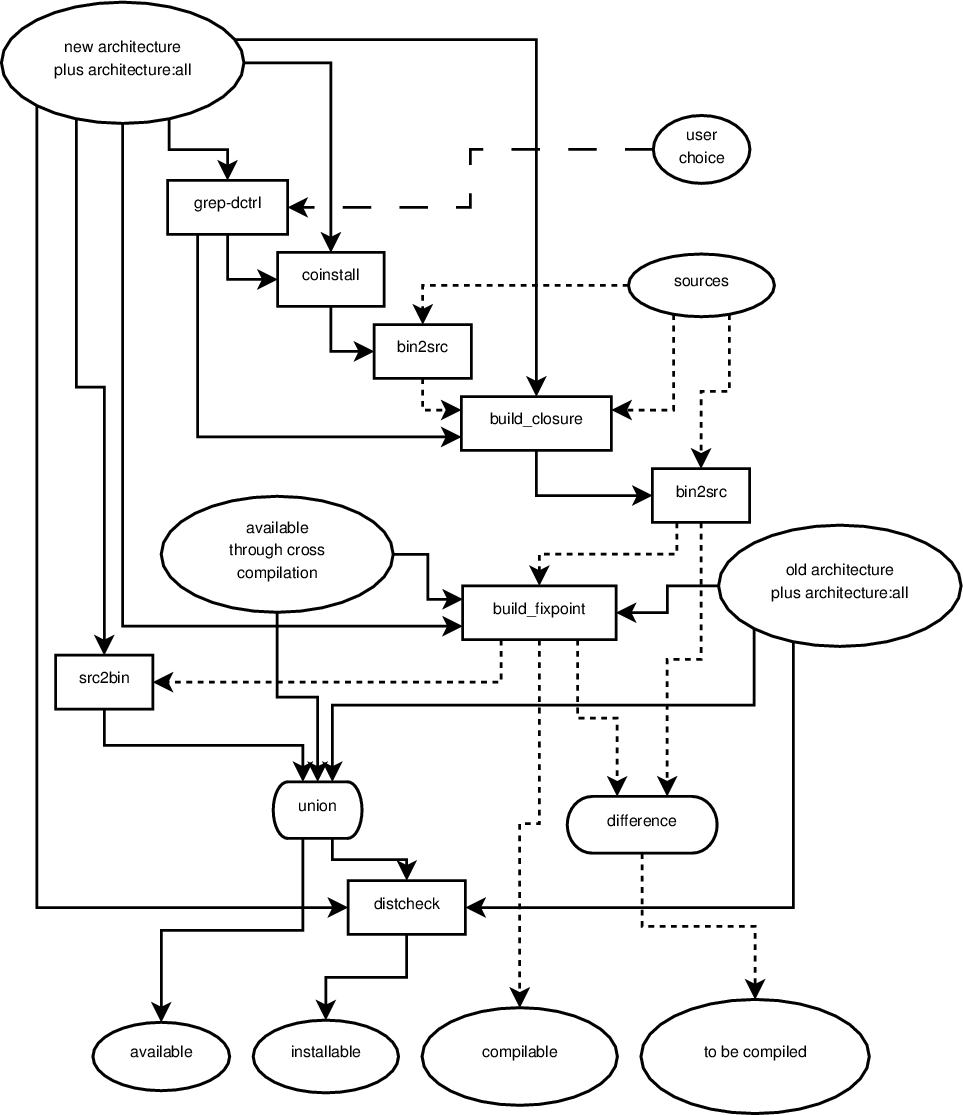
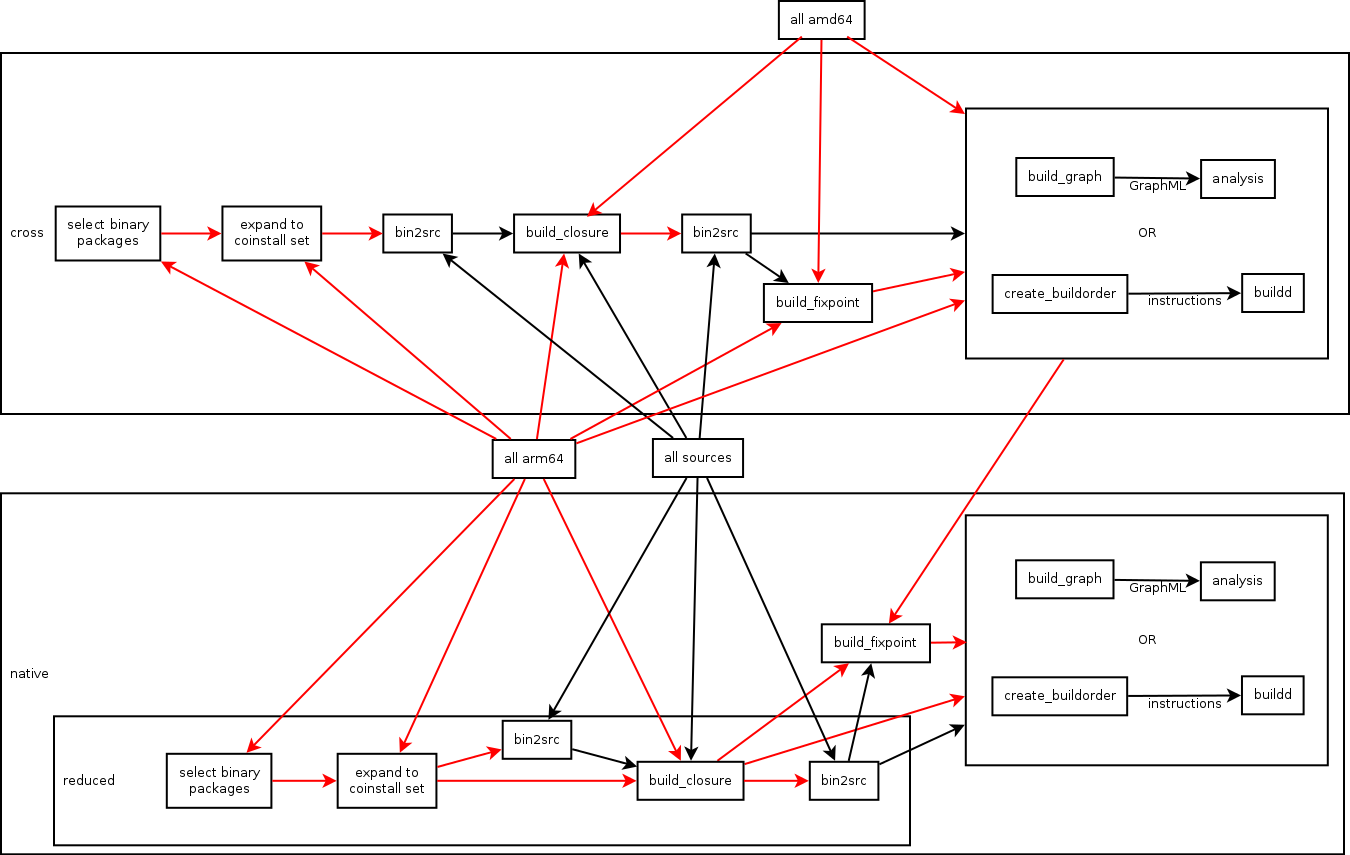
Processing pipeline instead of monolithic tools The tools I developed so far tried to accomplish everything by themselves, reusing functionality implemented in a central library. Therefor, if one wanted to try out even trivial new things, it mostly meant to hack some OCaml code. Pietro Abate suggested to instead develop smaller tools which could work independently of each other, would only execute one algorithm each and could easily be connected together in different ways to achieve different effects. This switch is now done and all functionality from the old tools is moved into a new toolset. The exchange format between the tools is either plain text files in deb822 control format (Packages/Sources files) or a dependency graph. The dependency graph is currently marshalled by OCaml but future versions should work with just passing a GraphML (an XML graph format) representation around. This new way of doing things seems close to the UNIX philosophy (each program does one thing well, data is stored as text, every program is a filter). For example the deb822 control output can easily be manipulated using grep-dctrl(1) and there exist many tools which can read, analyze and manipulate GraphML. It is a big improvement over the old, monolithic tools which did not allow to manipulate any intermediate result by external, existing tools. Currently, a shell script (native.sh) will execute all tools in a meaningful order, connecting them together correctly. The same tools will be used for a future cross.sh but they will be connected differently. I wrote about a first proposal of what the individual tools should do and how they should be connected in this email from which I also linked a confusing overview of the pipeline. This overview has recently been improved to be even more confusing and the current version of the lower half (the native part) now looks like this: native reduced Solid arrows represent a flow of binary packages, dottend arrows represent a flow of source packages, ovals represent a set of packages, boxes with rounded corners represent set operations, rectangular boxes represent filters. There is only one input to a filter, which is the arrow connected to the top of the box. Outgoing arrows from the bottom represent the filtered input. Ingoing arrows to either side are arguments to the filter and control how the filter behaves depending on the algorithm. I will explain this better once the pipeline proved to be less in flux. The pipeline is currently executed like this by native.sh.

Two new ways to break dependency cycles have been discovered So far, we knew of three ways to formally break dependency cycles:
  • remove build dependencies through build profiles
  • find out that the build dependency is only used to build arch:all packages and therefor put it into Build-Depends-Indep
  • cross compile some source packages
Two new methods can be added to the above:

Dependency graph definition changed Back in September when I was visiting irill, Pietro found a flaw in how the dependency graph used to be generated. He supplied a new definition of the dependency graph which does away with the problem he found. After fixing some small issues with his code, I changed all the existing algorithms to use the new graph definition. The old graph is as of today removed from the repository. Thanks to Pietro for supplying the new graph definition - I must still admit that my OCaml foo is not strong enough to have come up with his code.

Added complexity for profile built source packages As mentioned in the introduction, wookey and me addressed the debian-devel list with a proposal on necessary changes for an automated bootstrapping of Debian. During the discussiong, two important things came up which are to be considered by the dependency graph algorithms:
  • profile built source packages may not create all binary packages
  • profile built source packages may need additional build dependencies
Both things make it necessary to alter the dependency graph during the generation of a feedback arc set and feedback vertex set beyond the simple removal of edges. Luckily, the developed approximation algorithms can be extended to support such changes in the graph.

Different feedback arc set algorithms The initially developed feedback arc set algorithm is well suited to discover build dependency edges which should be dropped. It performs far worse when creating the final build order because it only considers edges by itself and not how many edges of a source package can be dropped by profile building it. The adjusted algorithm for generating a build order is more of a feedback vertex set algorithm because instead of greedily finding the edge with most cycles through it, it greedily finds the source package which would break most cycles if it was profile built.

Generating a build order with less profile built source packages After implementing all the features above I now feel more confident to publish the current status of the tools to a wider audience. The following test shows a run of the aforementioned ./native.sh shell script. Its final output is a list of source packages which have to be profile built and a build order. Using the resulting build order, starting from a minimal build system (essential:yes, build-essential and debhelper), all source packages will be compiled which are needed to compile all binary packages in the system. The result will therefor be a list of source and binary packages which fulfill the following property:
  • all binary packages can be built from the available source packages
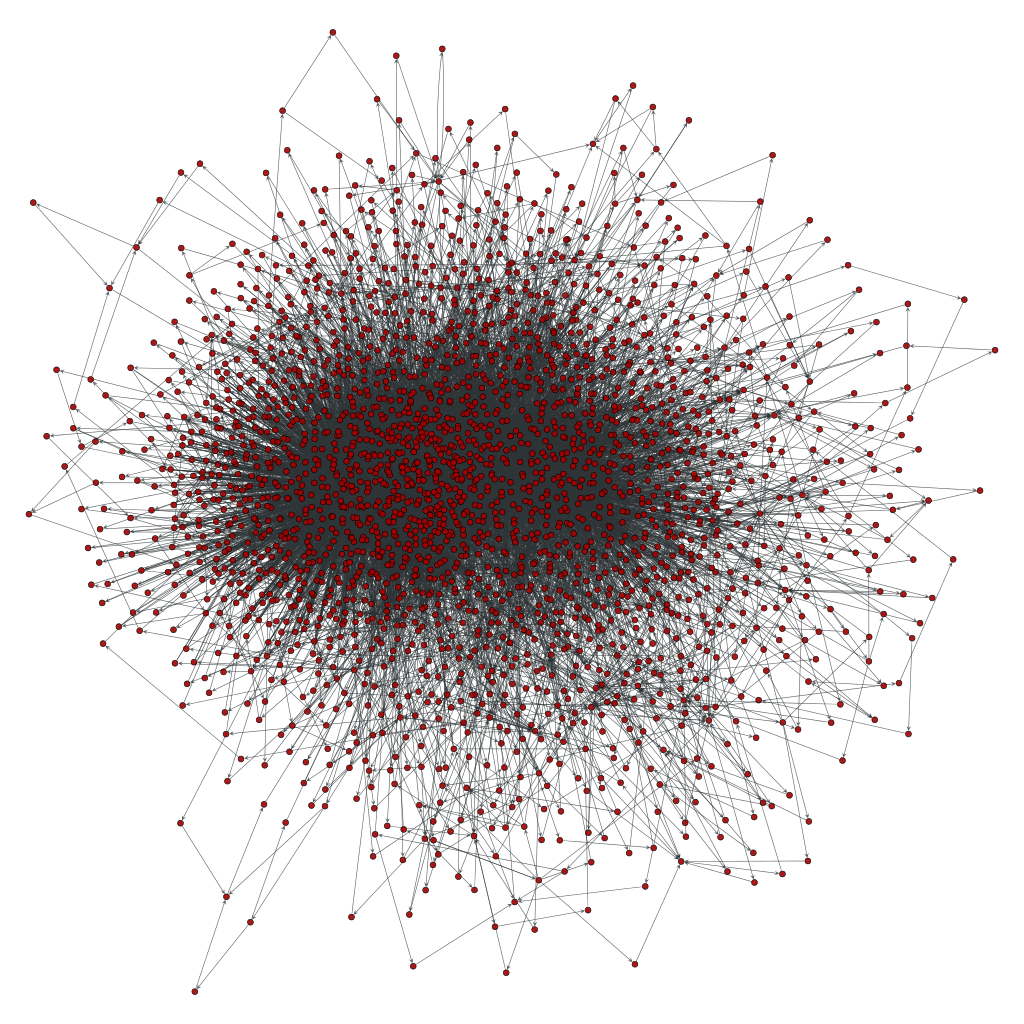
  • all source packages can be built with the available binary packages
I called this a "reduceded distribution" in earlier posts. The interesting property of this specific selection is, that it contains the biggest problem set of Debian when bootstrapping it: a 900 to 1000 nodes big strongly connected component. Here is a visualization of the problem: hideous mess Source packages do not yet come with build profiles and the cross build situation can not yet be analyzed, so the following assumptions were made: The last point is about 14 build dependencies which were decided to be broken by the feedback arc set algorithm but for which other data sources did not indicate that they are actually breakable. Those 14 are dynamically generated by native.sh. If above assumptions should not be too far from the actual situation, then not more than 73 source packages have to be modified to bootstrap a reduced distribution. This reduced distribution even includes dependency-wise "big" packages like webkit, metacity, iceweasel, network-manager, tracker, gnome-panel, evolution-data-server, kde-runtime, libav and nautilus. By changing one line in native.sh one could easily develop a build order which generates gnome-desktop or really any given (meta-)package selection. All of native.sh takes only 80 seconds to execute on my system (Core i5, 2.5 GHz, singlethreaded). Here is the final build order which creates 2044 binary packages from 613 source packages.
  1. nspr, libio-pty-perl, libmcrypt, unzip, libdbi-perl, cdparanoia, libelf, c-ares, liblocale-gettext-perl, libibverbs, numactl, ilmbase, tbb, check, libogg, libatomic-ops, libnl($), orc($), libaio, tcl8.4, kmod, libgsm, lame, opencore-amr, tcl8.5, exuberant-ctags, mhash, libtext-iconv-perl, libutempter, pciutils, gperf, hspell, recode, tcp-wrappers, fdupes, chrpath, libbsd, zip, procps, wireless-tools, cpufrequtils, ed, libjpeg8, hesiod, pax, less, dietlibc, netkit-telnet, psmisc, docbook-to-man, libhtml-parser-perl, libonig, opensp($), libterm-size-perl, linux86, libxmltok, db-defaults, java-common, sharutils, libgpg-error, hardening-wrapper, cvsps, p11-kit, libyaml, diffstat, m4
  2. openexr, enca, help2man, speex, libvorbis, libid3tag, patch, openjade1.3, openjade, expat, fakeroot, libgcrypt11($), ustr, sysvinit, netcat, libirman, html2text, libmad, pth, clucene-core, libdaemon($), texinfo, popt, net-tools, tar, libsigsegv, gmp, patchutils($), dirac, cunit, bridge-utils, expect, libgc, nettle, elfutils, jade, bison
  3. sed, indent, findutils, fastjar, cpio, chicken, bzip2, aspell, realpath, dctrl-tools, rsync, ctdb, pkg-config($), libarchive, gpgme1.0, exempi, pump, re2c, klibc, gzip, gawk, flex-old, original-awk, mawk, libtasn1-3($), flex($), libtool
  4. libcap2, mksh, readline6, libcdio, libpipeline, libcroco, schroedinger, desktop-file-utils, eina, fribidi, libusb, binfmt-support, silgraphite2.0, atk1.0($), perl, gnutls26($), netcat-openbsd, ossp-uuid, gsl, libnfnetlink, sg3-utils, jbigkit, lua5.1, unixodbc, sqlite, wayland, radvd, open-iscsi, libpcap, linux-atm, gdbm, id3lib3.8.3, vo-aacenc, vo-amrwbenc, fam, faad2, hunspell, dpkg, tslib, libart-lgpl, libidl, dh-exec, giflib, openslp-dfsg, ppl($), xutils-dev, blcr, bc, time, libdatrie, libpthread-stubs, guile-1.8, libev, attr, libsigc++-2.0, pixman, libpng, libssh2, sqlite3, acpica-unix, acl, a52dec
  5. json-c, cloog-ppl, libverto, glibmm2.4, rtmpdump, libdbd-sqlite3-perl, nss, freetds, slang2, libpciaccess, iptables, e2fsprogs, libnetfilter-conntrack, bash, libthai, python2.6($), libice($), libpaper, libfontenc($), libxau, libxdmcp($), openldap($), cyrus-sasl2($), openssl, python2.7($)
  6. psutils, libevent, stunnel4, libnet-ssleay-perl, libffi, readline5, file, libvoikko, gamin, libieee1284, build-essential, libcap-ng($), lcms($), keyutils, libxml2, libxml++2.6, gcc-4.6($), binutils, dbus($), libsm($), libxslt, doxygen($)
  7. liblqr, rarian, xmlto, policykit-1($), libxml-parser-perl, tdb, devscripts, eet, libasyncns, libusbx, icu, linux, libmng, shadow, xmlstarlet, tidy, gavl, flac, dbus-glib($), libxcb, apr, krb5, alsa-lib
  8. usbutils, enchant, neon27, uw-imap, libsndfile, yasm, xcb-util, gconf($), shared-mime-info($), audiofile, ijs($), jbig2dec, libx11($)
  9. esound, freetype, libxkbfile, xvidcore, xcb-util-image, udev($), libxfixes, libxext($), libxt, libxrender
  10. tk8.4, startup-notification, libatasmart, fontconfig, libxp, libdmx, libvdpau, libdrm, libxres, directfb, libxv, libxxf86dga, libxxf86vm, pcsc-lite, libxss, libxcomposite, libxcursor, libxdamage, libxi($), libxinerama, libxrandr, libxmu($), libxpm, libxfont($)
  11. xfonts-utils, libxvmc, xauth, libxtst($), libxaw($)
  12. pmake, corosync, x11-xserver-utils, x11-xkb-utils, coreutils, xft, nas, cairo
  13. libedit, cairomm, tk8.5, openais, pango1.0($)
  14. ocaml, blt, ruby1.8, firebird2.5, heimdal, lvm2($)
  15. cvs($), python-stdlib-extensions, parted, llvm-2.9, ruby1.9.1, findlib, qt4-x11($)
  16. xen, mesa, audit($), avahi($)
  17. x11-utils, xorg-server, freeglut, libva
  18. jasper, tiff3, python3.2($)
  19. openjpeg, qt-assistant-compat, v4l-utils, qca2, jinja2, markupsafe, lcms2, sip4, imlib2, netpbm-free, cracklib2, cups($), postgresql-9.1
  20. py3cairo, pycairo, pam, libgnomecups, gobject-introspection($)
  21. gdk-pixbuf, libgnomeprint, gnome-menus, gsettings-desktop-schemas, pangomm, consolekit, vala-0.16($), colord($), atkmm1.6
  22. libgee, gtk+3.0($), gtk+2.0($)
  23. gtkmm2.4, poppler($), openssh, libglade2, libiodbc2, gcr($), libwmf, systemd($), gcj-4.7, java-atk-wrapper($)
  24. torque, ecj($), vala-0.14, gnome-keyring($), gcc-defaults, gnome-vfs($)
  25. libidn, libgnome-keyring($), openmpi
  26. mpi-defaults, dnsmasq, wget, lynx-cur, ghostscript, curl
  27. fftw3, gnupg, libquvi, xmlrpc-c, raptor, liboauth, groff, fftw, boost1.49, apt
  28. boost-defaults, libsamplerate, cmake, python-apt
  29. qjson, qtzeitgeist, libssh, qimageblitz, pkg-kde-tools, libical, dwarves-dfsg, automoc, attica, yajl, source-highlight, pygobject, pygobject-2, mysql-5.5($)
  30. libdbd-mysql-perl, polkit-qt-1, libdbusmenu-qt, raptor2, dbus-python, apr-util
  31. rasqal, serf, subversion($), apache2
  32. git, redland
  33. xz-utils, util-linux, rpm, man-db, make-dfsg, libvisual, cryptsetup, libgd2, gstreamer0.10
  34. mscgen, texlive-bin
  35. dvipng, luatex
  36. libconfig, transfig, augeas, blas, libcaca, autogen, libdbi, linuxdoc-tools, gdb, gpm
  37. ncurses, python-numpy($), rrdtool, w3m, iproute, gcc-4.7, libtheora($), gcc-4.4
  38. libraw1394, base-passwd, lm-sensors, netcf, eglibc, gst-plugins-base0.10
  39. libiec61883, qtwebkit, libvirt, libdc1394-22, net-snmp, jack-audio-connection-kit($), bluez
  40. redhat-cluster, gvfs($), pulseaudio($)
  41. phonon, libsdl1.2, openjdk-6($)
  42. phonon-backend-gstreamer($), gettext, libbluray, db, swi-prolog, qdbm, swig2.0($)
  43. highlight, libselinux, talloc, libhdate, libftdi, libplist, python-qt4, libprelude, libsemanage, php5
  44. samba, usbmuxd, libvpx, lirc, bsdmainutils, libiptcdata, libgtop2, libgsf, telepathy-glib, libwnck3, libnotify, libunique3, gnome-desktop3, gmime, glib2.0, json-glib, libgnomecanvas, libcanberra, orbit2, udisks, d-conf, libgusb
  45. libgnomeprintui, libimobiledevice, nautilus($), libbonobo, librsvg
  46. evas, wxwidgets2.8, upower, gnome-disk-utility, libgnome
  47. ecore, libbonoboui
  48. libgnomeui
  49. graphviz
  50. exiv2, libexif, lapack, soprano, libnl3, dbus-c++
  51. atlas, libffado, graphicsmagick, libgphoto2, network-manager
  52. pygtk, jackd2, sane-backends, djvulibre
  53. libav($), gpac($), ntrack, python-imaging, imagemagick, dia
  54. x264($), matplotlib, iceweasel
  55. strigi, opencv, libproxy($), ffms2
  56. kde4libs, frei0r, glib-networking
  57. kde-baseapps, kate, libsoup2.4
  58. geoclue, kde-runtime, totem-pl-parser, libgweather, librest, libgdata
  59. webkit
  60. zenity, gnome-online-accounts
  61. metacity, evolution-data-server
  62. gnome-panel
  63. tracker
The final recompilation of profile built source packages is omitted. Source packages marked with a ($) are selected to be profile built. All source packages listed in the same line can be built in parallel as they do not depend upon each other. This order looks convincing as it first compiles a multitude of source packages which have no or only few build dependencies lacking. Later steps allow fewer source packages to be compiled in parallel. The amount of needed build dependencies is highest in the source packages that are built last.

19 January 2013

Dmitrijs Ledkovs: #takethestage


#stagetaken
I have now permanently settled in the UK.


<iframe allowfullscreen="allowfullscreen" frameborder="0" height="480" src="https://www.youtube-nocookie.com/embed/Ke1Ilm6joO0" width="853"></iframe>

17 January 2013

Craig Small: Pre-selecting ToscaWidgets jqgrid values in TurboGears

My Turbogears project has recently reached an important milestone; one of the back-end processes now runs pretty much continuously and the plugins it use (or at least the ones I can see) are also working. That means I can turn to the front-end which displays the data the back-end collected. For some of the data I am using a ToscaWidgets (or TW2) widget called a jqGridWidget which is a very nice jquery device that separates the presentation and data using a json query. I ve mentioned previously about how to get a jqGridWidget working but left the pre-filtering out until now. This meant that my grid showed all the items in the database, not just the ones I wanted to see, but it was a start. Now this widget displays things called Attributes which are basically children of another model called Hosts. Basically, Attributes are things you want to check or track about a Host. My widget used to show all Attributes but often on a Host screen, I want to see its hosts only. So, this is how I got my widget to behave; I m not sure this is THE CORRECT way of doing it, but it does work. First, in the Hosts controller you need to create the widget and pass along the host_id that the controller has obtained. I was not able to use the sub-classing trick you see in some TW2 documentation but actually make a widget instance.
class HostsController(BaseController):
    # other stuff here
    class por2(portlets.Portlet):
        title = 'Host Attributes'
        widget = AttributeGrid()
        widget.host_id = host_id
Next, the prepare() method in the Widget needs to get hold of the host_id and put it into the postData list. I needed to do it before calling super() because the options become one long string in the sub-class.
class AttributeGrid(jqgrid.jqGridWidget):
    def prepare(self, **kw):
        if self.host_id is not None:
            self.options['postData'] =  'hostid': self.host_id 
        super(AttributeGrid, self).prepare()
This means the jqgrid when it asks for its JSON data will include the hostid parameter as well. We need that method to see the host ID so we can filter the database access. Finally in the JSON method for the Attribute we pick up and filter on the hostid.
    @expose('json')
    @validate(validators= 'hostid':validators.Int() )
    def jqsumdata(self, hostid=0, page=1, rows=1, *args, **kw):
        conditions = []
        if hostid &gt; 0:
            conditions.append(model.Attribute.host_id == hostid)
        attributes =model.DBSession.query(model.Attribute).filter(and_(*conditions))
From there you run through the attributes variable and build your JSON reply.

Craig Small: Pre-selecting ToscaWidgets jqgrid values in TurboGears

My Turbogears project has recently reached an important milestone; one of the back-end processes now runs pretty much continuously and the plugins it use (or at least the ones I can see) are also working. That means I can turn to the front-end which displays the data the back-end collected. For some of the data I am using a ToscaWidgets (or TW2) widget called a jqGridWidget which is a very nice jquery device that separates the presentation and data using a json query. I ve mentioned previously about how to get a jqGridWidget working but left the pre-filtering out until now. This meant that my grid showed all the items in the database, not just the ones I wanted to see, but it was a start. Now this widget displays things called Attributes which are basically children of another model called Hosts. Basically, Attributes are things you want to check or track about a Host. My widget used to show all Attributes but often on a Host screen, I want to see its hosts only. So, this is how I got my widget to behave; I m not sure this is THE CORRECT way of doing it, but it does work. First, in the Hosts controller you need to create the widget and pass along the host_id that the controller has obtained. I was not able to use the sub-classing trick you see in some TW2 documentation but actually make a widget instance.
class HostsController(BaseController):
    # other stuff here
    class por2(portlets.Portlet):
        title = 'Host Attributes'
        widget = AttributeGrid()
        widget.host_id = host_id
Next, the prepare() method in the Widget needs to get hold of the host_id and put it into the postData list. I needed to do it before calling super() because the options become one long string in the sub-class.
class AttributeGrid(jqgrid.jqGridWidget):
    def prepare(self, **kw):
        if self.host_id is not None:
            self.options['postData'] =  'hostid': self.host_id 
        super(AttributeGrid, self).prepare()
This means the jqgrid when it asks for its JSON data will include the hostid parameter as well. We need that method to see the host ID so we can filter the database access. Finally in the JSON method for the Attribute we pick up and filter on the hostid.
    @expose('json')
    @validate(validators= 'hostid':validators.Int() )
    def jqsumdata(self, hostid=0, page=1, rows=1, *args, **kw):
        conditions = []
        if hostid &gt; 0:
            conditions.append(model.Attribute.host_id == hostid)
        attributes =model.DBSession.query(model.Attribute).filter(and_(*conditions))
From there you run through the attributes variable and build your JSON reply.

15 January 2013

Daniel Kahn Gillmor: in memory of Aaron Swartz

I was upset to learn about Aaron Swartz's death last week. I continue to be upset about his loss, and about our loss. He didn't just show promise of great things to come in the future -- he had already done more work for the public good than many of us will ever do. I'd only met him IRL a couple times, but (like many others) i had encountered him on the 'net in many places. He was a good person, someone i didn't need to always agree with to respect. I read Russ Allbery's posts about Aaron and "slacktivism" with much appreciation. I had been ambivalent about signing the whitehouse.gov petition asking for the removal of the prosecutor for overreach, because I generally distrust the effectiveness of online petitions (and offline petitions, for that matter). But Russ's analysis convinced me to go ahead and sign it. The petition is concrete, clear (despite wanting a grammatical proofread), and actionable. For people willing to go beyond petition signing to civil disobedience, The Aaron Swartz Memorial JSTOR Liberator is an option. It makes it straightforward to potentially violate the onerous JSTOR terms of service by re-publishing a public-domain article from JSTOR to archive.org, where it will be accessible to anyone directly. As someone who builds and maintains information/communications infrastructure, i have very mixed feelings about most online civil disobedience, since it often takes the form of a Distributed Denial of Service (DDoS) attack of some sort. DDoS attacks of public services are notoriously difficult to defend against without having huge resources to throw at the problem, so encouraging participation in a DDoS often feels a little bit like handing out cans of gasoline when you know that everyone is living in a house of straw. However, the JSTOR Liberator is not a DDoS at all -- it's simply a facilitation of people breaking the JSTOR Terms of Service (ToS), some of the same terms that Aaron was facing charges for violating. So it is a well-targeted way to demonstrate that the prosecutions were overreaching. I wanted to take issue with one of Russ' statements, though. In his second post about the situation, Russ wrote:
Social activism and political disobedience are important and often valuable things, but performing your social activism using other people's stuff is just rude. I think it can be a forgivable rudeness; people can get caught up in the moment and not realize what they're doing. But it's still rude, and it's still not the way to go about civil disobedience.
While i generally agree with Russ' thoughtful consideration of consent, I have to take issue with this elevation of some sort of hyper-extended property right over the moral agency that drives civil disobedience. To use someone else's property for the sake of a just cause without damaging the property or depriving the owner of its use is not "forgivable rudeness" -- it's forgivable, laudable even, because it is just. And the person using the property doesn't need to be "caught up in the moment and not realize what they're doing" for it to be acceptable. Civil disobedience often involves putting some level of inconvenience or discomfort on other people, including innocent people. It might be the friends and family of the activist who have to deal with the jail time; it might be the drivers stuck in a traffic jam caused by a demonstration; it might be the people forced to shop elsewhere because the store's doors are barricaded by protestors. All of these people could be troubled by the civil disobedience more than MIT's network users and admins were troubled by Aaron's protest, and that doesn't make the protests described worse or "not the way to go about civil disobedience." The trouble highlights a more significant injustice, and in its troubling way does what it can to help right it. Aaron was a troublemaker, and a good one. He will be missed. Tags: aaronsw

Russ Allbery: More on Aaron Swartz

I got some feedback that the analogy I used in my last post was a bit confusing, and indeed I blew the phrasing of the analogy (also now corrected). So let me try this again, since I think there's a subtlety here that may be missed. I should note for the record that my understanding of what Swartz did that started the process is apparently somewhat based on the description from the prosecution, so it may not be the complete or accurate facts. Since there will now be no trial, we may never find out what the defense was, and whether those facts would be challenged. So it may be best to think of this as a hypothetical. We never established, or will establish, in court exactly what happened. Swartz was, generally speaking, charged with two things that I consider quite distinct, at least from an ethical perspective. Most of the focus is on the copyright part: downloading JSTOR articles with an intent (never acted upon) to distribute them to the world. There are a bunch of reasons why this may or may not be justified, which are tied into the origin of those articles (many of them were publicly funded) and the legitimacy of copyright licensing agreements. I think there is significant room to hold a variety of opinions on this, although I don't believe that "crime worth 35 years in prison" is even remotely close to justifiable under any interpretation. However, there is a second part of what he was charged with, and that's primarily what I was commenting on, not the copyright part. He allegedly hooked up a laptop in an unlocked MIT wiring closet without permission and then used MIT's network and JSTOR license to download information. This is, to me, a subtlely but entirely distinct act from the question of whether taking JSTOR's data was ethically or legally wrong. Whether or not one believes that JSTOR's copyrights are not legitimate, it's still not okay to use someone else's network and license or to trespass in their wiring closets without permission. (I work in central IT for a university, so this strikes closer to home.) And this is where the analogy came in, which I flubbed. I had originally said that this was akin to "traipsing into someone's barn or backyard shed without their permission and taking some of their tools because you want to use them." The word "taking" was wrong; it falsely implies that you weren't going to return the tools. I had been thinking "taking and then returning" when I wrote that, and the important second part didn't make it into the post. So let's try this again: Swartz's actions at MIT, as I understand them (and many things could change this, such as a revelation that he had MIT's prior permission), are akin to going onto someone's property and into their barn without permission, borrowing their hedge trimmer for a while because you want to use it, and returning the hedge trimmer without any damage when you're done (and without them noticing it was gone). I'm quite fond of this analogy, since I think it clearly establishes two things:
  1. Most people are going to be unhappy about this happening and will intuitively feel like it should probably be illegal. Not everyone; there are folks who don't believe in personal property, or at least wouldn't extend it to tools in a barn. But most people will feel that someone should ask first before they come borrow your tools. Even if they don't damage them, even if they return them before you notice they're gone, you might have wanted to use the tool at the same time or they might have damaged them without intending to, and they should just ask first. It's common politeness, and depending on the circumstances, someone who doesn't ask and is covert about borrowing tools might be worth calling the police over.
  2. There is absolutely no way in any reasonable moral system that doing this should result in 35 years in prison. Or even 10, or even 1. Yes, most people would consider this a crime, but most people would consider it a minor crime. It's the sort of thing where you might have to impose some consequences just to make sure the message of "knock it off" is delivered firmly, but someone doing this is rude and inconsiderate, not evil.
The JSTOR copyright stuff is more complex to analyze and is more politically divisive, but for me the key points are (a) Swartz never released the data, and (b) JSTOR declined to press charges. To me, that means the deeper copyright questions, which are quite interesting, were never actually reached in this particular case. The crime that did apparently happen was the trespass at MIT, for which I think the above analogy is the right way to think about it. The point I do want people to take away from this is that one should not overlook the trespass at MIT even if one wants to celebrate the undermining of the copyright regime and doesn't believe JSTOR's data should be considered their private property. Social activism and political disobedience are important and often valuable things, but performing your social activism using other people's stuff is just rude. I think it can be a forgivable rudeness; people can get caught up in the moment and not realize what they're doing. But it's still rude, and it's still not the way to go about civil disobedience. For both ethical and tactical reasons, involving bystanders in your act of social activism without their consent is a bad approach. ETA: The problem, of course, with discussing all of this is that while it's relevant and possibly even somewhat important in the broader sense of how our community acts going forward, it also doesn't capture the fact that this was only one incident in a remarkable life. One of the worst problems with the abusive prosecution of Swartz is that it blew this incident completely out of proportion. A moment of arguable judgement should not dominate one's life or cast a shadow over all of one's other accomplishments; the prosecution tried to make it do just that. That's part of what I'm arguing, but ironically that partly feeds into the lack of proportionality in the discussion. I've gotten kind of far afield here, so let me go back and say explicitly: Swartz was a remarkable person who did much to admire and respect, and the world is a worse place without him.

13 January 2013

Thorsten Glaser: PSA: Unicode codepoints, referring to

PSA: Referring to Unicode codepoints. If your Unicode codepoint is, numerically, between 0 and 65533, inclusive, convert it to hexadecimal and zero-pad it to four nibbles. For example, the Euro sign is Unicode codepoint #8364 which is 20AC hex; the Eszett is 223 which is DF hex, padded 00DF.
Then write an uppercase U , a plus sign + , and the four nibbles: U+20AC U+00DF
In mksh, JSON, etc. it s a backslash \ , a lower-case u and four nibbles. Otherwise, your Unicode codepoint will be, numerically, between 65536 and 1114111, inclusive, that is hex 10000 to 10FFFF. (There s nothing on 65534 and 65535, nor above these figures.) In this case, convert it to hex, zero-pad it to eight nibbles and write it as an uppercase U , a hyphen-minus - and the eight nibbles. In C-like escapes for environments supporting the Unicode SMP, that s a backslash \ , an upper-case U and eight nibbles. Do not, in either case, use less (or more) hex digits than specified here. For example, there s a famous Unicode codepoint U-0001F4A9 PILE OF POO . That s not the same as U+1F4A9. The latter reads as U+1F4A GREEK CAPITAL LETTER OMICRON WITH PSILI AND VARIA and a digit 9 ( 9). Be educated.

Bernhard R. Link: some signature basics

While almost everyone has already worked with cryptographic signatures, they are usually only used as black boxes, without taking a closer look. This article intends to shed some lights behind the scenes. Let's take a look at some signature. In ascii-armoured form or behind a clearsigned message one often does only see something like this:
-----BEGIN PGP SIGNATURE-----
Version: GnuPG v1.4.12 (GNU/Linux)
iQIcBAABAgAGBQJQ8qxQAAoJEH8RcgMj+wLc1QwP+gLQFEvNSwVonSwSCq/Dn2Zy
fHofviINC1z2d/voYea3YFENNqFE+Vw/KMEBw+l4kIdJ7rii1DqRegsWQ2ftpno4
BFhXo74vzkFkTVjo1s05Hmj+kGy+v9aofnX7CA9D/x4RRImzkYzqWKQPLrAEUxpa
xWIije/XlD/INuhmx71xdj954MHjDSCI+9yqfl64xK00+8NFUqEh5oYmOC24NjO1
qqyMXvUO1Thkt6pLKYUtDrnA2GurttK2maodWpNBUHfx9MIMGwOa66U7CbMHReY8
nkLa/1SMp0fHCjpzjvOs95LJv2nlS3xhgw+40LtxJBW6xI3JvMbrNYlVrMhC/p6U
AL+ZcJprcUlVi/LCVWuSYLvUdNQOhv/Z+ZYLDGNROmuciKnvqHb7n/Jai9D89HM7
NUXu4CLdpEEwpzclMG1qwHuywLpDLAgfAGp6+0OJS5hUYCAZiE0Gst0sEvg2OyL5
dq/ggUS6GDxI0qUJisBpR2Wct64r7fyvEoT2Asb8zQ+0gQvOvikBxPej2WhwWxqC
FBYLuz+ToVxdVBgCvIfMi/2JEE3x8MaGzqnBicxNPycTZqIXjiPAGkODkiQ6lMbK
bXnR+mPGInAAbelQKmfsNQQN5DZ5fLu+kQRd1HJ7zNyUmzutpjqJ7nynHr7OAeqa
ybdIb5QeGDP+CTyNbsPa
=kHtn
-----END PGP SIGNATURE-----
This is actually only a form of base64 encoded data stream. It can be translated to the actual byte stream using gpg's --enarmor and --dearmour commands (Can be quite useful if some tool only expects one BEGIN SIGNATURE/END SIGNATURE block but you want to include multiple signatures but cannot generate them with a single gpg invocation because the keys are stored too securely in different places). Reading byte streams manually is not much fun, so I wrote gpg2txt some years ago, which can give you some more information. Above signature looks like the following:
89 02 1C -- packet type 2 (signature) length 540
        04 00 -- version 4 sigclass 0
        01 -- pubkey 1 (RSA)
        02 -- digest 2 (SHA1)
        00 06 -- hashed data of 6 bytes
                05 02 -- subpacket type 2 (signature creation time) length 4
                        50 F2 AC 50 -- created 1358081104 (2013-01-13 12:45:04)
        00 0A -- unhashed data of 10 bytes
                09 10 -- subpacket type 16 (issuer key ID) length 8
                        7F 11 72 03 23 FB 02 DC -- issuer 7F11720323FB02DC
        D5 0C -- digeststart 213,12
        0F FA -- integer with 4090 bits
                02 D0 [....]
Now, what does this mean. First all gpg data (signatures, keyrings, ...) is stored as a series of blocks (which makes it trivial to concatenate public keys, keyrings or signatures). Each block has a type and a length. A single signature is a single block. If you create multiple signatures at once (by giving multiple -u to gpg) there are simple multiple blocks one after the other. Then there is a version and a signature class. Version 4 is the current format, some really old stuff (or things wanting to be compatible with very old stuff) sometimes still have version 3. The signature class means what kind of signature it is. There are roughly two signature classes: A verbatim signature (like this one), or a signature of a clearsigned signature. With a clearsigned signature not the file itself is hashed, but instead a normalized form that is supposed to be invariant under usual modifications by mailers. (This is done so people can still read the text of a mail but the recipient can still verify it even if there were some slight distortions on the way.) Then the type of the key used and the digest algorithm used for creating this signature. The digest algorithm (together with the signclass, see above) describes which hashing algorithm is used. (You never sign a message, you only sign a hashsum. (Otherwise your signature would be as big as your message and it would take ages to create a signature, as asymetric keys are necessarily very slow)). This example uses SHA1, which is no longer recommended: As SHA1 has shown some weaknesses, it may get broken in the not too distant future. And then it might be possible to take this signature and claim it is the signature of something else. (If your signatures are still using SHA1, you might want to edit your key preferences and/or set a digest algorithm to use in your ~/.gnupg/gpg.conf. Then there are some more information about this signature: the time it was generated on and the key it was generated with. Then, after the first 2 bytes of the message digest (I suppose it was added in cleartext to allow checking if the message is OK before starting with expensive cryptograhic stuff, but it might not checked anywhere at all), there is the actual signature. Format-wise the signature itself is the most boring stuff. It's simply one big number for RSA or two smaller numbers for DSA. Some little detail is still missing: What is this "hashed data" and "unhashed data" about? If the signed digest would only be a digest of the message text, then having a timestamp in the signature would not make much sense, as anyone could edit it without making the signature invalid. That's why the digest is not only signed message, but also parts of the information about the signature (those are the hashed parts) but not everything (not the unhashed parts).

Next.

Previous.