Search Results: "hug"

8 August 2012

Johannes Schauer: Bootstrappable Debian - How to help

TLDR: multiarch, multiarch, multiarch, cross buildability, staged build dependencies, wiki page, corrections/hints/requests to debian-bootstrap at lists.mister-muffin.de This summer (and this year's GSoC) is nearing its end and to make it easier for people to make use of the information my tools produced so far, I created a page in the Debian wiki. It lists not only the open issues I see but also statistics that I gathered using the output of my GSoC project. I want to use this blog post to make people aware of that page as well as to get some feedback on it and anything related to it. The biggest blocker my tools face, is that many packages are still missing multiarch information. As long as at least the basic packages do not have their cross build dependencies satisfied via multiarch for an existing foreign architecture, automated tools can not properly analyze the dependency situation in the bootstrapping case, when many packages of the new foreign architecture do not even exist yet. If Debian is supposed to be bootstrappable, then the first stage is to make a set of basic packages cross compile for an existing foreign architecture. Once this is possible, a tool of mine can analyze the cyclic build dependency situation that might occur when cross compiling for an architecture that does not exist yet. Then, staged cross builds can be used to cross compile a minimal foreign system. Due to missing multiarch classification, it is not known yet how big the cyclic build dependency situation is for the base packages. It is not only the conversion of packages to multiarch that is needed but also the adding of the :any (and rare cases :native) qualifier to build dependencies on M-A: allowed packages. Prominent build dependencies that should (but are not yet) be M-A: allowed are python and gettext. Both are needed as a build dependency by many packages of the base system. Unfortunately wanna-build does not understand qualifiers like :any and :native yet. Until it does, no package can be marked :any or :native and cross compilation of many base packages can not succeed. Once the point is reached, where a base system can be cross compiled from nothing, native compilation can start. Since native compilation doesnt depend on multiarch, the dependency situation when trying to natively compiling all of Debian from nothing is understood much better. Unfortunately, the cyclic build dependency situation is also much worse in the native case and there exists a big 1000 node strongly connected component of binary and source packages that all interdepend on each other. This dependency mess can be solved using three approaches: The wiki page gives many hints on how to find packages that each method can be applied to. Stage building is a tool that might be useful for cross building (we dont know for sure yet) but is definitely needed for native compilation. It is needed for native compilation because after all possible dependencies are moved to Build-Depends-Indep, the only other alternative to stage building for breaking dependency cycles is to cross build source packages. Since building a package without one of its build dependencies "staged" is often much easier than making the package in question cross compile, it is a preferred alternative. Once more packages have been made multiarch, it might be possible to prove that there is no alternative to introducing a notion of staged builds. Some people (wookey, Patrick McDermott, Guillem Jover, myself) decided that the following format to mark staged build dependencies would be preferred over others:
Build-Depends: huge (>= 1.0) [i386 arm] <!embedded !bootstrap>, tiny
The <> format was proposed by Guillem Jover in bug#661538. Patches for dpkg and dose3 are done. More people need to discuss about this format for a final decision on how to indicate staged build dependencies. For more information on the topic, have a look at the corresponding wiki page. Feel free to direct any comments/critique/hints to debian-bootstrap at lists.mister-muffin.de or directly to me.

30 July 2012

Johannes Schauer: port bootstrap build-ordering tool report 4

A copy of this post is sent to soc-coordination@lists.alioth.debian.org as well as to debian-bootstrap@lists.mister-muffin.de.

Diary

July 2
  • playing around with syntactic dependency graphs and how to use them to flatten dependencies

July 4
  • make work with dose 3.0.2
  • add linux-amd64 to source architectures
  • remove printing in build_compile_rounds
  • catch Not_found exception and print warning
  • use the whole installation set in crosseverything.ml instead of flattened dependencies
  • detect infinite loop and quit in crosseverything.ml
  • use globbing in _tags file
  • use wildcards and patsubst in makefile

July 5
  • throw a warning if there exist binary packages without source packages
  • add string_of_list and string_of_pkglist and adapt print_pkg_list and print_pkg_list_full to use them
  • fix and extend flatten_deps - now also tested with Debian Sid

July 6
  • do not exclude the crosscompiled packages from being compiled in crosseverything.ml
  • clean up basebuildsystem.ml, remove old code, use BootstrapCommon code
  • clean up basenocycles.ml, remove unused code and commented out code
  • add option to print statistics about the generated dependency graph
  • implement most_needed_fast_wrong as well as most_needed_slow_correct and make both available through the menu

July 7
  • allow to investigate all scc, not only the full graph and the scc containing the investigated package
  • handle Not_found in src_list_from_bin_list with warning message
  • handle the event of the whole archive actually being buildable
  • replace raise Failure with failwith
  • handle incorrectly typed package names
  • add first version of reduced_dist.ml to create a self-contained mini distribution out of a big one

July 8
  • add script to quickly check for binary packages without source package
  • make Debian Sid default in makefile
  • add *.d.byte files to .gitignore
  • README is helpful now
  • more pattern matching and recursiveness everywhere

July 9
  • fix termination condition of reduced_dist.ml
  • have precise as default ubuntu distribution
  • do not allow to investigate an already installable package

July 10
  • milestone: show all cycles in a graph
  • add copyright info (LGPL3+)

July 11
  • advice to use dose tools in README

July 16
  • write apt_pkg based python filter script replacing grep-dctrl

July 17
  • use Depsolver.listcheck more often
  • add dist_graph.ml
  • refactor dependency graph code into its own module

July 18
  • improve package selection for reduced_dist.ml
  • improve performance of cycle enumeration code

July 20
  • implement buildprofile support into dose3

July 22
  • let dist_graph.ml use commandline arguments

July 23
  • allow dose3 to generate source package lists without Build- Depends Conflicts -Indep

July 29
  • implement crosscompile support into dose3

Results

Readme There is not yet a writeup on how everything works and how all the pieces of the code work together but the current README file provides a short introduction on how to use the tools.
  • build and runtime dependencies
  • compile instructions
  • execution examples for each program
  • step by step guide how to analyze the dependency situation
  • explanation of general commandline options
A detailed writeup about the inner workings of everything will be part of a final documentation stage.

License All my code is now released under the terms of the LGPL either version 3, or (at your option) any later version. A special linking exception is made to the license which can be read at the top of the provided COPYING file. The exception is necessary because Ocaml links statically, which means that without that exception, the conditions of distribution would basically equal GPL3+.

reduced_dist.ml Especially the Debian archive is huge and one might want to work on a reduced selection of packages first. Having a smaller selection of the archive would be significantly faster and would also not add thousands of packages that are not important for an extended base system. I call a reduced distribution a set of source packages A and a set of binary packages B which fulfill the following three properties:
  • all source packages A must be buildable with only binary packages B being available
  • all binary packages B except for architecture:all packages must be buildable from source packages A
The set of binary packages B and source packages A can be retrieved using the reduced_dist program. It allows to either build the most minimal reduced distribution or one that includes a certain package selection. To filter out the package control stanzas for a reduced distribution from a full distribution, I originally used a call to grep-dctrl but later replaced that by a custom python script called filter-packages.py. This script uses python-apt to filter Packages and Sources files for a certain package selection.

dist_graph.ml It soon became obvious that there were not many independent dependency cycle situation but just one big scc that would contain 96% of the packages that are involved in build dependency cycles. Therefor it made sense to write a program that does not iteratively build the dependency graph starting from a single package, but which builds a dependency graph for a whole archive.

Cycles I can now enumerate all cycles in the dependency graph. I covered the theoretical part in another blog post and wrote an email about the achievement to the list. Both resources contain more links to the respective sourcecode. The dependency graph generated for Debian Sid has 39486 vertices. It has only one central scc with 1027 vertices and only eight other scc with 2 to 7 vertices. All the other source and binary packages in the dependency graph for the archive are degenerate components of length one. Obtaining the attached result took 4 hours on my machine (Core i5 @ 2.53GHz). 1.5 h of that were needed to build the dependency graph, the other 2.5 hours were needed to run johnson's algorithm on the result. Memory consumption of the program was at about 700 MB. It is to my joy that apparently the runtime of the cycle finding algorithm for a whole Debian Sid repository as well as the memory requirements are within orders of magnitude that are justifiable when being run on off-the-shelf hardware. It must also be noted that nothing is optimized for performance yet. A list of all cycles in Debian Sid up to length 4 can be retrieved from this email. This cycle analysis assumes that only essential packages, build-essential and dependencies and debhelper are available. Debhelper is not an essential or build-essential package but 79% of the archive build-depends on it. The most interesting cycles are probably those of length 2 that need packages that they build themselves. Noticeable examples for these situations are vala, python, mlton, fpc, sbcl and ghc. Languages seem love to need themselves to be built.

Buildprofiles There is a long discussion of how to encode staged build dependency information in source packages. While the initial idea was to use Build-Depends-StageN fields, this solution would duplicate large parts of the Build-Depends field, which leads to bitrot as well as it is inflexible to possible other build "profiles". To remedy the situation it was proposed to use field names like Build-Depends[stage1 embedded] but this would also duplicate information and would break with the rfc822 format of package description files. A document maintained by Guillem Jover gives even more ideas and details. Internally, Patrick and me decided for another idea of Guillem Jover to annotate staged build dependencies. The format reads like:
Build-Depends: huge (>= 1.0) [i386 arm] <!embedded !bootstrap>, tiny
So each build profile would follow a dependency in <> "brackets" an have a similar format as architecture options. Patrick has a patch for dpkg that implements this functionality while I patched dose3.

Dropping Build-Depends-Indep and Build-Conflicts-Indep When representing the dependencies of a source package, dose3 concatenates its Build-Depends and Build-Depends-Indep dependency information. So up to now, a source package could only be compiled, if it manages to compile all of its binary packages including architecture:all packages. But when bootstrapping a new architecture, it should be sufficient to only build the architecture dependent packages and therefor to only build the build-arch target in debian/rules and not the build-indep target. Only considering the Build-Depends field and dismissing the Build-Depends-Indep field, reduced the main scc from 1027 vertices to 979 vertices. The amount of cycles up to length four reduced from 276 to 206. Especially the cycles containing gtk-doc-tools, doxygen, debiandoc-sgml and texlive-latex-base got much less. Patrick managed to add a Build-Depends-Indep field to four packages so far which reduced the scc further by 14 vertices down to 965 vertices. So besides staged build dependencies and cross building there is now a third method that can be applied to break dependency cycles: add Build-Depends-Indep information to them or update existing information. I submitted a list of packages that have a binary-indep and/or a build-indep target in their debian/rules to the list. I also submitted a patch for dose3 to be able to specify to ignore Build-Depends-Indep and Build-Conflicts-Indep information.

Dose3 crossbuilding So far I only looked at dependency situations in the native case. While the native case contains a huge scc of about 1000 packages, the dependency situation will be much nicer when cross building. But dose3 was so far not able to simulate cross building of source packages. I wrote a patch that implements this functionality and will allow me to write programs that help analyze the cross-situation as well.

Debconf Presentation Wookey was giving a talk at debconf12 for which I was supplying him with slides. The slides in their final version can be downloaded here

Future Patrick maintains a list of "weak" build dependencies. Those are dependencies that are very likely to be droppable in either a staged build or using Build-Depends-Indep. I must make use of this list to make it easier to find packages that can easily be removed of their dependencies. I will have to implement support for resolving the main scc using staged build dependencies. Since it is unlikely that Patrick will be fast enough in supplying me with modified packages, I will need to create myself a database of dummy packages. Another open task is to allow to analyze the crossbuilding dependency situation. What I'm currently more or less waiting on is the inclusion of my patches into dose3 as well as a decision on the buildprofile format. More people need to discuss about it until it can be included into tools as well as policy. Every maintainer of a package can help making bootstrapping easier by making sure that as many dependencies as possible are part of the Build-Depends-Indep field.

24 July 2012

Wouter Verhelst: DebConf 12 is over :(

As I write this, DebConf12 has actually been over for more than a week. Usually during DebConf, I'm a more proficient blogger than during other times of the year, since I'm not doing as much work that I have to remain quiet about at that time, which simply means I have more to blog about. Unfortunately, however, this year the server on which this blog runs managed to become unavailable on the second day of DebCamp, an issue that I could only fix once I was back in Belgium, which meant I haven't been able to blog as much as I would've wanted to. Anyway, all I can say is that both DebConf and DebCamp have been a huge success for me again, this year. I'd started the second rewrite of ipcfg a few weeks before DebCamp, and spent most of DebCamp whipping the basic framework into shape. It's nowhere near ready yet, but I'm confident it'll get further this time than it did before. During DebConf, I was also responsible for doing the group photo. I'd done that (together with Andrew McMillan) during DebConf8 before (if you look closely, you'll see me pressing the remote which actually triggers that picture), and I still like that picture. This time around, we didn't have a beach nearby (at least not as nearby as during DebConf8), so we had to do things slightly differently. Rather than doing one large picture, I took several pictures and used Hugin to stitch them together. Unfortunately however, some things did go wrong with the group photo. For starters, the weather wasn't very helpful, in that I noticed it was about to rain. As such, the main bunch of pictures were taken slightly before the announced time of 14:30, which meant that some people had missed it. To make matters worse, I had rushed to the group and handed the camera to someone else, so that I could gimp myself onto the picture too; but that meant that some people who were arriving as these pictures were being taken thought they were on the picture, when they really weren't. I've fixed most of these by just gimping them into the picture as well, but I might've missed some of them. If you're one of them, talk to me! Preferably now. If you're not one of them (or even if you are), hold off on doing things like printing it in large format or some such. I'll re-upload improved versions onto the same location once they're ready.

19 July 2012

Matthew Palmer: Melt your cores with Rake's multitask

Reading documentation does pay off. Browsing through the Rakefile format documentation for Rake, just now, I found mention of the multitask method which declares that all of that task s prerequisites can be executed in parallel. A comparison run:
$ rake clean; time rake build
real    0m7.116s
user    0m6.788s
sys     0m0.260s
$rake clean; time rake multibuild
real    0m3.820s
user    0m8.809s
sys     0m0.288s
This is a trivially small build I m doing, I must admit, but halving the build time (in this case at least) pays huge dividends in my perceived productivity. It really blows the dust out of my CPU cores, too, which tend to be woefully underutilised (being this is a quad-core laptop and all). So I say unto you all: go forth and multitask!

17 July 2012

Luciano Bello: there is no cabal.. but, what s a cabal?

In my long trip to Nicaragua I made progress in my reading: Quicksilver, by Neal Stephenson. In the Spanish edition the title is Azogue. But I m assuming that you are not a Spanish speaker. Here is a small fragment (in English) I found there:
You must remember that the planters are short-sighted. They re all desperate to get out of Jamaica they wake up every day expecting to find themselves, or their children, in the grip of some tropical fever. To import female Neegers would cost nearly as much as to import males, but the females cannot produce as much sugar particularly when they are breeding. Daniel had finally recognized this voice as belonging to Sir Richard Apthorp the second A in the CABAL.
It s a bit embarrassing when I discovered myself realizing where the word cabal comes from. And I m posting this as a head-up for everyone who know there is no cabal in Debian; but they don t know which is the origin of the word cabal. Stephenson changed the name of the historic cabal, a group of high councillers of King Charles II of England, Scotland and Ireland, in 1668. In the novel, they are: John Comstock (Earl of Epsom), Louis Anglesey (Duke of Gunfleet), Knott Bolstrood (Count Penistone), Sir Richard Apthorp and Hugh Lewis (Duke of Tweed). In the real world they had been:
Thomas Clifford, 1st Baron Clifford of Chudleigh (1630-1673). Henry Bennet, 1st Earl of Arlington (1618-1685). George Villiers, 2nd Duke of Buckingham (1628-1687). Anthony Ashley Cooper, 1st Baron Ashley of Wimborne St Giles (1621-1683). John Maitland, 1st Duke of Lauderdale (1616-1682).
This group shared the effective power in a royal council rather than the King.

13 July 2012

Matthew Garrett: A 12pt font should look useful everywhere

In the past I used to argue that accurate desktop DPI was important, since after all otherwise you could print out a 12 point font and hold up the sheet of paper to your monitor and it would be different. I later gave up on the idea that accurate DPI measurement was generally useful to the desktop, but there's still something seductively attractive about the idea that a 12 point font should be the same everywhere, and someone recently wrote about that. Like many seductively attractive ideas it's actually just trying to drug you and steal your kidneys, so here's why it's a bad plan.

Solutions solve problems. Before we judge whether a solution is worthwhile or not, we need to examine the problem that it's solving. "My 12pt font looks different depending on the DPI of my display" isn't a statement of a problem, it's a statement of fact. How do we turn it into a problem? "My 12pt font looks different depending on which display I'm using and so it's hard to judge what it'll look like on paper" is a problem. Way back in prehistory when Apple launched the original Mac, they defined 72dpi as their desktop standard because the original screen was approximately 72dpi. Write something on a Mac, print it and hold the paper up to the monitor and the text would be the same size. This sounds great! Except that (1) this is informative only if your monitor is the same distance away as your reader will be from the paper, and (2) even in the classic Mac period of the late 80s and early 90s, Mac monitors varied between 66 and 80dpi and so this was already untrue. It turns out that this isn't a real problem. It's arguably useful for designers to be able to scale their screen contents to match a sheet of paper the same distance away, but that's still not how they'll do most of their work. And it's certainly not an argument for enforcing this on the rest of the UI.

So "It'll look different on the screen and paper" isn't really a problem, and so that's not what this is a solution for. Let's find a different problem. Here's one - "I designed a UI that works fine on 100DPI displays but is almost unusable on 200DPI displays". This problem is a much better one to solve, because it actually affects real people rather than the dying breed who have to care about what things look like when turned into ink pasted onto bits of dead tree. And it sounds kind of like designing UIs to be resolution independent would be a great solution to this. Instead of drawing a rectangle that's 100 pixels wide, let me draw one that's one inch wide. That way it'll look identical on 100dpi and 200dpi systems, and now I can celebrate with three lines of coke and wake up with $5,000 of coffee table made out of recycled cinema posters or whatever it is that designers do these days. A huge pile of money from Google will be turning up any day now.

Stop. Do not believe this.

Websites have been the new hotness for a while now, so let's apply this to them. Let's imagine a world in which the New York Times produced an electronic version in the form of a website, and let's imagine that people viewed this website on both desktops and phones. In this world the website indicates that content should be displayed in a 12pt font, and that both the desktop and phone software stacks render this to an identical size, and as such the site would look identical if the desktop's monitor and the phone were the same distance away from me.

The flaw in this should be obvious. If I'm reading something on my phone then the screen is a great deal closer to me than my desktop's monitor usually is. If the fonts are rendered identically on both then the text on my phone will seem unnecessarily large and I won't get to see as much content. I'll end up zooming out and now your UI is smaller than you expected it to be, and if your design philosophy was based on the assumption that the UI would be identical on all displays then there's probably now a bunch of interface that's too small for me to interact with. Congratulations. I hate you.

So "Let's make our fonts the same size everywhere" doesn't solve the problem, because you still need to be aware of how different devices types are used differently and ensure that your UI works on all of them. But hey, we could special case that - let's have different device classes and provide different default font sizes for each of them. We'll render in 12pt on desktops and 7pt on phones. Happy now?

Not really, because it still makes this basic assumption that people want their UI to look identical across different machines with different DPI. Some people do buy high-DPI devices because they want their fonts to look nicer, and the approach Apple have taken with the Retina Macbook Pro is clearly designed to cater to that group. But other people buy high-DPI devices because they want to be able to use smaller fonts and still have them be legible, and they'll get annoyed if all their applications just make the UI larger to compensate for their increased DPI. And let's not forget the problem of wildly differing displays on the same hardware. If I have a window displaying a 12pt font on my internal display and then drag that window to an attached projector, what size should that font be? If you say 12pt then I really hope that this is an accurate representation of your life, because I suspect most people have trouble reading a screen of 12pt text from the back of an auditorium.

That covers why I think this approach is wrong. But how about why it's dangerous? Once you start designing with the knowledge that your UI will look the same everywhere, you start enforcing that assumption in your design. 12pt text will look the same everywhere, so there's no need to support other font sizes. And just like that you've set us even further back in terms of accessibility support, because anyone who actually needs to make the text bigger only gets to do so if they also make all of your other UI elements bigger. Full marks. Dismissed.

The only problem "A 12pt font should be the same everywhere" solves is "A 12pt font isn't always the same size". The problem people assume it solves is "It's difficult to design a UI that is appropriate regardless of display DPI", and it really doesn't. Computers aren't sheets of paper, and a real solution to the DPI problem needs to be based on concepts more advanced than one dating back to the invention of the printing press. Address the problem, not your assumption of what the problem is.

comment count unavailable comments

10 July 2012

Gunnar Wolf: From DebCamp to DebConf through cheese, wine and an intro track

One week. One long week. One beautiful week. One of the two major weeks of the year has passed since my previous post. Surely, we are in the middle of the two Major Weeks of the year, in the yearly schedule I have upheld for almost(!) ten years: DebConf+DebCamp. Yesterday, DebConf officially started. For the first time ever, we had a DebConf track targetted at the local (for a wide definition of local: All of the Central American countries) communities, which I chaired. We had the following talk lineup during this track: I believe it was a great success, and I hope the talks are useful in the future. They will be put online soon thanks to the tireless work of our work team. Today we sadly lost the presence of our DPL due to very happy circumstances he will surely announce himself. But DebConf will continue nevertheless - And proof of that is our anual, great, fun and inviting Cheese and Wine Party! After a series of organizational hiccups I hope nobody notices (oops, was I supposed not to say this?), today we had a beautiful, fun and most successful cheese and wine party, as we have had year after year since 2005. As many other people, we did our humble contribution for this party to be the success it deserves. There is lots of great cheeses, great wines, and much other great stuff we have to thank to each of the individuals who made this C&W party the success it was. Yes, it might be among the least-academic parts of our conference, but at the same time, it's one of its most cherished -and successful- traditions. And above all else, we have to thank our Great Leader^W^WCheeseMaster (who we still need to convince to play by our Great Leader's mandates - And no, I don't mean Zack here!) Hugs and thanks to my good and dear friend Christian Perrier for giving form to one of DebConf's social traditions that makes it so unique, so different from every other academic or communitary conference I have ever been part of. We still have most of the week to go. And if you are not in Managua (and are not coming soon), you can follow our activities following our video streams. Remember, debian/rules, now more than ever! And even given the (perpetual) heat in Managua: Wheezy is frozen, whee! [ all photos here taken by regina ]
AttachmentSize
100_2110.JPG1.53 MB
100_2119.JPG1.49 MB
100_2121.JPG1.52 MB
100_2135.JPG1.49 MB
100_2144.JPG1.11 MB
100_2146.JPG1.53 MB
100_2145.JPG1.08 MB
100_2122.JPG1.51 MB

7 July 2012

Christian Perrier: DebConf running: take 5 (South-West suburbs of Managua)

The challenge is now more and more to find good places to run without too much cars and noises....and not too far away. Today, I think I made it well..:-) After a look on the map, and some wild guess from what I now know of the way the city is organized, I decided to go south-west of Managa, from the hotel Seminole. This is again a hilly run because, anyway, wherever you go south in Managua, you're going up. Ralf, who arrived just yesterday, joined me and, I guess, enjoyed the run. After going through an obviously quite rich neighbourhood with nice villas, gardeners, huge US truck-style cars, we went close to the Mormonschurch...and a mosque, then headed westward close to "Colegio Americano", with fences, walls, guards in the corner, etc. Seems that any tiny bit of USA in the world needs an army to protect it. Crossing la Pista Suburbana, we then went on a very quiet roads towards the hill, in a very green and peaceful area. House there were really not as fancy as in other places, even seeming quite "poor" in some way. However, we never felt any problem and people we meet on the way are always friendly and smiling : "Hola", "Buenos Dias", etc. At the end of the road, after about half an hour, we decided to head back. However, as going back the same way is boring, I suggested we head up west as my phone's map (it is very helpful to have a smartphone with GPS and Google Maps for wandering through unknwon places) was mentioning another road going north-west a little bit westward. So we entered a small trail between house farms...with dogs! These were a bit "scary" as they were barking at us and of course running entirely freely. On the other hand, none was really aggressive and we had no problem. I however saw a few people really staring at us as I guess there are not so many runners in this place..:-). But still, we never felt unsafe: just in a quite uncommon place. After abotu 500m we found the "road" that was on my map: indeed a path going down slowly along the hill. And there was the marvel. An incredible panoramic view going going the volcanoes that are East and North of Leon : San Cristobal, Telica Rota, Pilas elHoj and last but definitely not least: EL MOMOTOMBO. A nearly perfect pyramid-style volcano that lies about 50km north-west of Managua, on the eastern shore of Managua Lake. The view there is...just fantastic with also a 180 panorama to West and North-West of the lake and the volcanoes area. After this, all we had to do was heading back to the hotel and share this with you...:-) As usual, the full GPS trace is here.

6 July 2012

John Goerzen: How to listen to music?

This seems like a simple question: how do you listen to music? But in a way, I think I ve fallen behind the times. I ve enjoyed listening to digital music for years, since well before MP3 even existed (MIDI files could be comfortably downloaded over dialup; some of you may even remember MOD files). Anyhow, a few years ago, I digitized my entire CD collection, ripping it to FLAC and encoding to high-bitrate MP3 for storage on my 160GB iPod. Since, I ve purchased some music from DRM-free MP3 retailers, and even FLAC files from Magnatune, but at this point I basically say that I have enough music. I have only rarely bought anything new in the last couple of years. I have used Musicbrainz Picard to enforce consistent tagging across almost my entire collection. I am usually in front of a Linux machine. I run mt-daapd on my fileserver, so I can stream music from it to any other machine in the house. However, this has a lot of drawbacks. It is generally impossible to create or modify persistent playlists with this protocol. I can t modify metadata. I can t assign ratings. Though perhaps I don t need to. There are a lot of online services I could think of: Pandora, Spotify, Rdio, Slacker. Plus, of course, the upload your music to the cloud services such as Google and Amazon. Have people tried these? I m hesitant to use a service where I pay a monthly fee, unless I wind up owning the music in a DRM-free fashion. And I m a little nervous about the privacy implications of uploading a vast amount of music to the cloud. There are some items in my collection that I am certain are not available on any of those others, but for the most part I m willing to take what is out there if it meets my tastes. My tastes, by the way, typically run to classical and opera but also can go towards middle eastern or certain new age music (though I m very picky about that, since I don t care for most new age stuff I hear.) But these are huge categories; sometimes I d like to hear some load and noisy classical (say, Beethoven s Ninth conclusion, some Wagner, Verdi arias, etc.) And other times, something more contemplative (a Mozert concerto) or even quiet (a nice sonata) meet my mood. I have playlists for these on my iPod Classic a bit of a problem, since I don t use that device much anymore except in the car, and it takes a LOT of time to categorize things into these playlists. (An opera or a symphony could have parts in various styles and various levels of energy, for instance.) I keep a small manually-managed subset on my Android phone, which works fine. A recommendation engine for things like this could be useful, if it works well. My requirements, basically: I want something that will play the same music on my Linux machines. I want to be able to have playlists kept in sync across my machines. And I don t want a monthly fee. Ideally, the software will work on Android as well, and provide similar features there. Anything that requires Windows is a non-starter. I ve considered NFS mounts, but that s a bit annoying when the laptop disconnects from the network or when it s not at home. What are your thoughts? Ideas?

4 July 2012

Stefano Zacchiroli: bits from the DPL for June 2012

Monthly DPL bits, fresh from the oven^W^W^W hot from DebConf12, and just posted to d-d-a.
Howdy from DebConf12. It's hot, but it's also time to bother you again with a (not so) brief DPL activity report, this time for June 2012. Time-based freeze: DONE, short freeze: TODO Two highlights for this month. First, you've probably noticed Wheezy is now frozen, YAY. This is huge achievement for the release, but also for the project. It's the first time we do a time-based freeze, and it took some quite heated discussion at the beginning of the release cycle to decide to do this. And we did it properly: respecting the planned month and narrowing down the period later. This exercise has hopefully helped both DDs in their package planning and our upstreams in targeting Wheezy with stable releases of their software. Kudos to the release team for their coordination work! Now we've the second part still TODO: releasing Wheezy, without RC bugs, with a freeze period as short as possible. See the beginning of my last "bits from the DPL" mail for my usual song and dance :-P on how to deliver that, together. DebConf12 A lot of us will attend DebConf12. Enjoy it! ... and take the chance to both have fun and make great plans for Debian's future. But remember that "if it didn't happen on a mailing list, it didn't happen". Not all of us will be lucky enough to attend DebConf (in person or remotely). Make sure that those who don't can take part in your team decisions and get informed of what is going to happen here. Politics Zack's spring tour I spent a significant part of June doing Debian talks ins some sort of "spring tour" between Italy and France. In particular: Many thanks to the organizers of these events for inviting and sponsoring me (as well as other Debian people, in the ESRF case) and for their interest in Debian. Sprints Assets Discussions Some relevant discussions for project evolution has been going on in June and I took part into them. You might want to have a look at them: Misc Cheers.
PS the boring day-to-day activity log for June is available at master:/srv/leader/news/bits-from-the-DPL.txt.201206

2 July 2012

Johannes Schauer: port bootstrap build-ordering tool report 3

A copy of this post is sent to soc-coordination@lists.alioth.debian.org as well as to debian-bootstrap@lists.mister-muffin.de.

Diary

June 18 Pietro suggests a faster way to generate installation sets for a list of packages. In my case, I need an installation set for every source package in the archive to find out how often a binary package is needed to build a source package. As a result, the speed is doubled in contrast to the original approach.

June 19
  • adapt code to work with new dose release 3.0
  • remove unneeded parts of code
  • add different possibilities to find amount of source packages that need a binary package
  • add code to get multiple installation sets using Depsolver_int.solve

June 20
  • add ~global_constraints:false to Depsolver.listcheck, Depsolver.trim and Depsolver.edos_install calls
  • adapt output graph to limited xdot capabilities

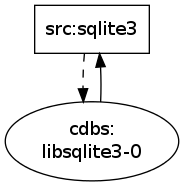
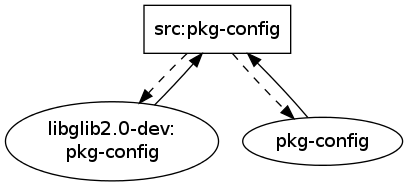
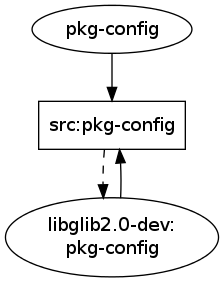
June 21 I formulate an email to the list, reporting of dependency graphs of debhelper, cdbs, pkg-config and libgtk2.0-dev. My current technique gets an installation set for a source package, removes all those that are already installable and adds the others as a dependency of that source package. This dependency will include an installation set of that binary as well minus all packages that are already available. The problem with that approach are dependency cycles created by long dependency chains. Example: src:A needs B needs C needs A. B and C would both be added as a dependency of src:A. B as well as C would also include their installation set which in both cases includes A. So now there are two cycles: src:A->B->A and src:A->C->A. For a real life example, look at the following situation of cdbs and src:sqlite3. cdbs old situation It is created because src:sqlite3 needs cdbs needs python-scour needs python needs python2.7 needs libsqlite3-0. Therfor libsqlite3-0 is in the installation set of cdbs, python-scour, python and python2.7. This creates five cycles in the graph even though there is only one. It would be better to reduce the dependencies added to src:sqlite3 to its direct dependency which is cdbs. Package dependencies are disjunctions from which the solver chooses one or the other to build an installation set. To solve the problem above I would need to know which disjunction the solver chose and then only add the direct dependency of a package to the dependency graph.
  • improve build_compile_rounds performance
  • big overhaul of menu structure
  • fix subgraph extraction code

June 22
  • do not create a universe if not needed - use hashtables instead
  • for sorting packages, generating difference of package sets and otherwise comparing packages, always use CudfAdd.compare
  • as a custom list membership function, use List.exists instead of trying List.find
  • more speedup for build_compile_rounds
  • the number of source packages that can be built does NOT include the cross built packages
  • print closure members in graph
  • refactor code and move common functions to bootstrapCommon.ml
  • add breakcycles.ml for future code to break cycles using staged build dependencies
  • use more extlib functionality
  • extended package list input format

June 23 After several emails with Pietro I learn about syntactic dependency graphs. To document my progress and prove my efforts I committed the code as commit 6684c13. But this code was soon found out to be unecessary so it will be removed later and just serves as documentation.

June 24 I came up with another (better?) solution to get the chosen disjunctions. It simply uses the calculated installation set to decide for each disjunction which one was taken by the solver. I reported that important step and the open questions involved with it in an email to the list. The problem always was, that an installation set can easily contain more than one package of a disjunction. In this case it is not clear which branch was chosen by the solver. I found, that in Ubuntu Natty there are only 6 such packages and for each of them the situation can be solved. It can be solved because in all of those cases it is that either one package of a disjunction provides the other or that both packages depend upon each other, which means that both have to be included.

June 27
  • use installation set to flatten build dependencies of source packages
  • refactor code and move common functions to bootstrapCommon.ml

June 25 I have to have an algorithm that finds all circuits in a given graph. This is necessary so that:
  1. cycles can be enumerated for huge dependency graphs where cycles are hard to see
  2. cycles can be enumerated to find a cycle that can be broken using staged build dependencies
It seems that Johnson's algorithm is the best way to do this complexity wise and Pietro already blogged about the problem together with an implementation of the algorithm in ocaml. Unfortunately it turns out that his code doesnt implement the algorithm correctly and hence misses out on some cycles. The fix seems not to be too trivial so I'm still investigating it.

June 28
  • add crosseverything.ml to obtain a list of source packages that, if cross compiled, would make the whole archive available

Results While the first week was productive as usual, I had to work some time on a University project during the second week as well as attend a family meeting. I will catch up with the lost time over the course of the next week.

dose3 Using dose 3.0 (which fixes a bug about essential packages) the output of the algorithms is now likely less wrong then before.

performance Performance was improved in the generation of installation sets as well as in the code that tries out how many packages can be built in multiple rounds. This was achieved by more caching, less unnecessary operations in looping constructs, replacing lists with hashtables, not creating universes where not necessary.

user interface The main program, basenocycles.ml now has a much better menu structure.

input format The programs take two package file inputs. The list of source packages that has to be cross built for a minimal build system and the list of source packages that was chosen to be cross compiled in addition to that. Both files list one source package per line and now allow comments.

refactoring As more and more scripts are added, more and more functionality is moved to bootstrapCommon.ml which makes each script much cleaner.

what to test for cross building As discussed in the "Future" section of the last report, I now automated the process of finding out which packages, if they were cross compiled, would make the whole archive available because they break all cycles and allow native compilation of the rest. The outcome: to build 3333 out of 3339 packages in natty natively, at most 186 source packages must be cross compiled. The other six cannot be compiled because of version mismatches in the Natty Sources.bz2 and Packages.bz2. The code can be run from crosseverything.ml.

limit source dependencies to direct dependencies Reducing the dependencies of source packages from their full installation set to their direct dependencies by finding out which disjunction of their dependency list were taken, greatly simplifies the dependency graphs. The dependency graph created for libgtk2.0-dev could be reduced from 491 to 247 vertices for a depth of three. For cdbs it is now clearly visible that cdbs depends on libsqlite3-0 which builds from src:sqlite3 which depends on cdbs. Before: cdbs old situation After: cdbs new situation For pkg-config the graph also has been reduced to the one single cycle that matters: src:pkg-config needs libglib2.0-dev which depends on pkg-config which builds from src:pkg-config. Before: pkg-config old situation After: pkg-config old situation

Future I will prepare content for wookey's debconf talk on crossbuilding and bootstrapping. As this will include directions how to use the current code, I will kill two birds with one stone and write some proper documentation for my current source. The following two lists will be displayed after a dependency graph is calculated and reduced to its scc:
  • those source packages that have the least build dependencies not fulfilled. Those might be candidates for easy staged build dependencies. Since the source package is part of the scc, it will definitely be involved in some cycle somewhere.
  • those binary packages that most source packages depend upon. Those could be candidates for cross compilation as it might be easier to cross compile the source package than using staged build dependencies.
Patrick managed to cross build packages with sbuild now. So the list of packages that crosseverything.ml produces can now be checked efficiently for cross buildability. With this list, potentially more cycles can be broken out of the box. A feature will be added that allows the user to remove all packages from a dependency graph that can be cross compiled without any additional effort. Version mismatches between source and binary packages in Sources.bz2 and Packages.bz2 respectively in Ubuntu make the scripts fail and/or produce wrong results. Debian (even Sid) doesnt have this problem so I should find out where to report this problem to Ubuntu. I need to write a working version of Johnson's algorithm because much functionality depends upon it. I have the option to improve Pietro's version or write one from scratch. Writing one from scratch might be easier as I have Pietro's code as template as well as a Java implementation of Johnson's algorithm which seems to work. The following functionalities need working cycle enumeration:
  • given source packages with staged build dependencies, an enumeration of cycles is needed to find out which cycles can be broken by building packages staged. It makes less sense to blindly build a package stage and then check if this makes more packages available.
  • display cycles of a dependency graph to the user. After obtaining all cycles in the graph it makes sense to sort them by their length. The user would then investigate the situation of the smallest cycles first. This makes sense because breaking small cycles can potentially break bigger cycles. Since in the end, all cycles have to be eliminated anyway, it makes sense for the user to first tackle the small ones.
  • display the feedback arc set to the user. The packages in the feedback arc set might be very good candidates for reduced build dependencies or cross compilation.

27 June 2012

Michal &#268;iha&#345;: Weblate - over 20000 translations in 3 months

Today, I wondered how much translations were done using Weblate since it was born. Of course I can give only numbers for services I maintain, the biggest one being translation server for phpMyAdmin, Gammu and Weblate. Looking at the logs, the server l10n.cihar.com helped to contribute over 20000 (actually little bit more as tracked are only changes after releasing Weblate 0.8), what is quite impressive number. Of course biggest amount of contributions came in time of preparing phpMyAdmin 3.5.0 release, where I gave it huge amount of publicity (AKA spamming my blog), but number of people accessing the website still grows since then (still number of submitted translations is slightly lower). Now as 1.0 release proved to be quite stable, it's time to focus on 1.1 development, which will bring offloading of fulltext indexing (it was proven to be unreliable to update index online for bigger sites). Almost all issues targeted for 1.1 are already fixed and all what needs to be done is testing in real life situations.

Filed under: English Phpmyadmin Weblate 0 comments Flattr this!

25 June 2012

Rapha&#235;l Hertzog: Test Driven Development with CppUTest, now in Debian

I have recently read Test Driven Development with Embedded C by James W. Grenning and published by Pragmatic Programmers. I really enjoyed the book: while I was aware of the huge benefits of having a comprehensive test suite, I never studied seriously the principles behind Test Driven Development (TDD) and this book makes a good introduction to the topic. At the same time it focuses on the C language and contains lots of examples on how you can create tests even for projects which have to interact with hardware or other unpredictable components (the key is to create many abstractions) using all the possibilities that C offers. The author convincingly argues that developing code with TDD forces you to create a modular design that is easier to evolve when the underlying requirements change. He also highlights how the tests serve as reference documentation of the API. James W. Grenning recommends CppUTest as his xUnit test framework of choice. When I wanted to try this test framework, I discovered that it was not available in Debian. I decided to package it because it has some interesting features not offered by the contenders (at least not to my knowledge). It s now available in Debian and in Ubuntu. First, it doesn t require any explicit registration of tests and has a very lightweight syntax. The small downside is that CppUTest requires the usage of C++ for the tests. But C++ is compatible with C so it doesn t matter much if you have a C++ compiler for your target. On the contrary, usage of variables and methods scoped to the test group makes it easy to write clear tests. Here s a short sample of test code:
extern "C"  
#include "timer.h"
#include "timefn.h"
 
 
#include "CppUTest/TestHarness.h"
 
static Time the_time;
static const int start_sec = 123;
static const int start_nsec = 456789000;
static const int delay_sec = 8;
static const int delay_nsec = 111111000; // start_nsec + delay_nsec < 10^9
 
TEST_GROUP(Timer)
 
    /* Class variables available to all tests in the group */
    Timer timer;
    Delay remaining;
 
    /* Standard setup/teardown methods of xUnit tests */
    void setup()  
        timer = timer_new();
        time_set(&the_time, start_sec, start_nsec);
        /* [...] */
     
 
    void teardown()  
        timer_free(timer);
        /* [...] */
     
 
    /* Helper functions specific to the test group */
    void start_timer_with_delay(long sec, long nsec)
     
        timer_set_real_delay(timer, sec, nsec);
        timer_start(timer);
     
 
    void ensure_remaining_is(long sec, long nsec)
     
        CHECK_EQUAL(sec, delay_get_seconds(remaining));
        CHECK_EQUAL(nsec, delay_get_nanoseconds(remaining));
     
 ;
 
TEST(Timer, NewIsNotStarted)
 
    CHECK(!timer->started);
 
/* [...] */
TEST(Timer, GetRemainingTimeWithNanosecondPrecision_ShiftOfSeconds)
 
    start_timer_with_delay(delay_sec, delay_nsec);
    time_set(&the_time, start_sec + delay_sec - 5, start_nsec + delay_nsec + 1000);
 
    remaining = timer_get_remaining_time(timer);
 
    ensure_remaining_is(4, 999999000);
 
To run those tests, you just need this boilerplate code in a main.cpp:
#include "CppUTest/CommandLineTestRunner.h"
 
int main(int argc, char** argv)
 
   return CommandLineTestRunner::RunAllTests(argc, argv);
 
Another interesting feature is its integrated memory leak detection system. Any test that hasn t released allocated memory at the end of the teardown process will be marked as failed. The upstream developers have made some unusual choices (static library only, installation in a private directory) but this will likely change with the switch to an automake and autoconf-based build system. I have reported the oddities that I found and I requested them to provide a pkg-config file to make it easier to compile and link unit tests exploiting CppUTest. I already used CppUTest to develop a small application running on an embedded Linux. At some point, I might try to use CppUTest for dpkg development. I believe that it makes for a good fit. dpkg is already C++ ready since dselect is written in C++ and reuses a good part of dpkg s code. In any case, if you like Test Driven Development and are writing C or C++ based applications, I invite you to try CppUTest.

No comment Liked this article? Click here. My blog is Flattr-enabled.

23 June 2012

Bernd Zeimetz: Report from the Bug Squashing Party in Salzburg

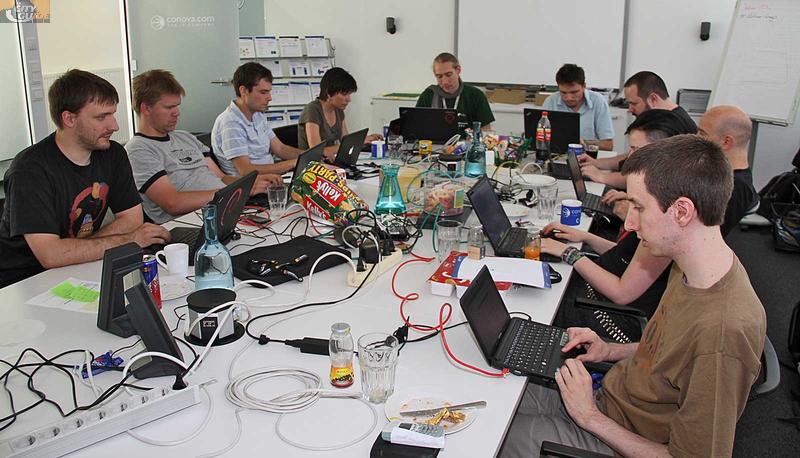
bsp_2012_salzburg photo from salzburg-cityguide.com, Copyright (C) Uwe Brandl

Participation and Results From June 15-17th we held a Debian BugSquashingParty in Salzburg, hosted and sponsored by conova communications GmbH. It was a fun and busy weekend, with 15-17 people from 5 countries being around, mainly working on RC bugs in Testing/Unstable. Gerfried Fuchs (rhonda) also worked on triaging the impact of RC bugs on the version in Squeeze, while Peter Palfrader (weasel) took care of Tor related things and Debian sysadmin work, including starting on the new bugs and udd hosts. Phillip Hug (hug) worked on the debian.ch infrastructure. Together with Miroslav Such from Red Hat Bernd Zeimetz (bzed) worked on the packaging of the necessary libraries and daemons to add (basic) Spacewalk client support to Debian. As soon as the packages passed NEW and #677871 was applied (thanks to the APT guys for working on that already), managing Debian clients with Spacewalk should work out of the box. Of course we also had a little keysigning party :)

Statistics
  • about 68 bugs in unstable/testing were triaged/patched/fixed or at least pinged
  • 54 bugs were tagged to show if they affect Squeeze, several other bugs were pinged to retrieve necessary information or to trigger an update in the next stable pointrelease.
  • 5 packages were introduced into Debian (still in NEW, though) - the Spacewalk client related packages and libapache2-mod-auth-memcookie.

Accomodation Thanks to Debian funds we were able to provide accomodation for four participants in the JUFA youth hostel in Salzburg. We had paid in advance for eight, but changing to rooms with a higher category for only 4 people would have been equally or more expensive.

Press/Media coverage Additionally to being mentioned in the calendars on ProLinux and similar pages, we had some press coverage by the local newspaper and online magazines:

Fun facts We consumed 2kg of Leberkas, a big plate of "Buchteln mit Vanillesosse", about 16000cm^2 of Pizza, about 80 litres of coke, juice, beer and wine and I guess we drank at least the same amount of water. We had coffee made of 1.5kg coffee beans and managed to empty the (formerly well filled) icemaker in the fridge. Also we had successful training sessions of a standard Debconf game (rules won't be explained here obviously). Maybe we even successfully spread the game to the employees of a commercial linux distribution ;)

20 June 2012

Andrew Pollock: [life] On running, Android apps, personal area networks and fund raising

Sarah and I are running in the 5K Packard Summer Scamper on Saturday. Sarah's been working on her fitness for a few months now, and I belatedly started working on mine about a 6 weeks ago. (Sarah's fund raising, so if you'd like to sponsor her, her page is here) I've been using the Couch to 5K program to get my fitness up, but I haven't managed to stick to it exactly, due to a combination of injury and wet weather. I have still managed to get myself to the point where I can run for 28 minutes solidly, which is close to 5K (I'm doing my last training run tomorrow, so I'll see what the distance comes out to). I've been doing up to three runs a week at lunchtime around the Shoreline Amphitheatre area, using my Galaxy Nexus and some Bluetooth headphones, and I've got a pretty nice little setup. I'm using Pandora for some music to listen to, C25K Pro for the actual running intervals. It has voice prompts that tell me when to run, or to start a walk interval. Finally, I'm using Strava Run for recording the run and getting some additional statistics during the run (kilometre markers, split times and time elapsed). These also come through as voice prompts. I'm not currently wearing a watch, and I want to keep track of the wall time, so I've also found Audio Clock, which verbally announces the time (I've set it to do it every 15 minutes that a Bluetooth headset is connected). What I really like about all of this is that I get spoken voice prompts and information, seamlessly mixed in with the music from Pandora, all while I'm running. I've got my phone strapped to my arm, and I don't have to look at it during the run, and there's no wires. I'm a huge personal metrics junkie, and that was why I previously eschewed running outdoors. I wanted that information on the treadmill display so I could push myself that little bit further. Sure, I'm not getting the constant information as much as if I had a treadmill display in front of me the whole time, but I'll settle for running in the great outdoors and getting some feedback every kilometre (if I get really desperate, Strava will do it every half kilometre). Not to diss optical augmented reality efforts too much, but I'd rather go for a combination of discreet audio announcements through a Bluetooth earpiece, perhaps complemented with something I choose to look at like a Pebble watch, than an in-your-face pair of glasses. My Bluetooth headphones are the around the back of the head variety that aren't going to bounce off during a run. I've really enjoyed doing the runs during the week, and when I was doing the full 3 runs a week of a given week of the Couch to 5K program, I'd really notice a difference by run number 3. I'm currently planning on sticking with doing a 5K run hopefully at least twice a week after this weekend. It's certainly done wonders for my waistline.

19 June 2012

Wouter Verhelst: E-voting in Belgium

A post by Gunnar reminded me that I wanted to blog about this: e-voting in Belgium is going to change slightly. Previously, e-voting worked with a computer with a lightpen on which you would enter your vote, a magnetic card that would contain your vote in encoded form, and a magnetic card reader that would count the votes. After more than a decade when I was first eligible to vote back in 1996, it had already been implemented in the city of Antwerp, where my vote would be cast, so I've never voted on paper it had still not been rolled out everywhere, and some of the computers used for the voting were now starting to show their age. A few days ago on the news, they reported that the e-voting system was to change so that rather than magnetic cards, it would use pieces of paper. This way, voters would be able to check that the information on the piece of paper conforms with their vote. Investigating what this means, I found this website by the federal government, where they have some pictures of a test run of the new system which they ran in October last year. Rather than using magnetic cards, the new system uses paper slips with the voted information in two forms: once as a (huge) QR code, and once as a human-readable text. In theory, this is a more transparent system than using a magnetic card, and that's a good thing; additionally, it allows for a traditional recount (by people, not computers) should the need ever arise. However, I do still see some problems: Having said that, I do think the new system is an improvement over the old (in fact, it's exactly the kind of system I had thought about myself earlier when thinking about ways to improve e-voting); and if the two problems are solved in some way (it's not impossible to do that, just requires some clever thinking), I believe it has potential as a way to implement electronic voting in a good way.

15 June 2012

Erich Schubert: Dritte Startbahn - 2 gewinnt!

Usually I don't post much about politics. And this even is a highly controversial issue. Please do not feel offended.

This weekend, there is an odd election in Munich. Outside of Munich, nearby the cities of Freising and Erding, there is the Munich airport. The company operating the airport is owned partially by the city of Munich, which gives the city a veto option.
The Munich airport has grown a lot. Everybody who has been flying a bit knows that big airports (such as Heathrow) are oft the worst. If anything goes wrong, you are busted, because it will take them a long time to resume operations. This just happened to me in Munich, where the luggage system was down, and no luggage arrived at the airplanes.
Yet, they want to take the airport further down this road, and make it even bigger: add two satellite terminals, and a third runway. I'm convinved that this will make the airport much worse for anybody around here. The security checkpoints will be even more crowded, the lines for the baggage drop-off too, and you will have to walk much further on the airport.
Up to now, the Munich airport was pretty good compared to others. In particular given that is is one of the largest in Europe! It is because it had been designed from the ground up for this size. Now they plan to screw it up.
But there are other arguments against this, not the egoist view of a traveller. The first is the money issue. The airport is continuously making losses. It's the taxpayer that has to pay for all of this - and the current cost estimation is 1200 million. This is not appropriate, in particular since history shows that you can take this x2 to x10 to get the real number. They should first get the airport into a financial stable condition, then plan on making it even bigger.
Then there are the numbers. Just like with any polticial large-scale project, the numbers are all fake. The current airport was planned to cost 800 million, in the end it was about 8550 million. The politicians happily lie to us. Because they want to push their pet projects. We must no longer accept such projects based on fake numbers and old predictions.
If you are already one of the 10 largest airports in Europe, can you really expect to grow even further?!? There is a natural limit to growth, unless you want to have every single passenger on the world first travel to Munich multiple times, then go to his final destination ...
One thing they seem to have completely neglected is that Berlin is currently getting a brand new airport. And very likely, this is going to divert quite some traffic away from Munich. Just like the Munich airport diverted a lot of traffic away from Frankfurt. To some extend because many people actually want to go to Berlin, not Munich, but they currently have to change planes here or in Frankfurt. So when Berlin finally is operational, this will have an impact on Munich.
And speaking of the Berlin airport, this is a good example to not trust the numbers and our politicians. It is another example of a way-over-budget, way-behind-time project the politicians screwed up badly and where they lied to us. If we should not have trusted them with Berlin, why should we trust them with the Munich addon?
A lot of people whose families have been living there for years will have to be resettled. Whole towns are going to disappear. An airport is huge. Yet, they cannot vote against it, because their small towns do not own shares of the airport. The polticians don't even talk to them, not even to their poltical representatives.
Last but not least, the airport is in a sensitive ecological area. The directly affected area is an European special protection area for wild birds. There are nature preserves nearby, and all this area already suffers badly from airport drainage, pollution and noise. When they built the airport originally, the replacement areas they setup were badly done, and are mostly inhabited by nettles and goldenrod (which is not even native to Europe). See this article in S ddeutsche Zeitung on the impact on nature. You can't replace the loss of the original habitats just by digging some pools and filling them with water ...
If you want more information, go to this page, by Bund Naturschutz.
This is not about progress ("Fortschritt"). That is a killer argument the politicians love, but it doesn't hold. Nobody is trying to shut down the airport. Munich will be better of by keeping the balance having both a reasonably sized airport (and in fact, the airport is already one of the 10 largest in Europe!) and preserving some nature to make it worth living here.
If you are located in Munich, please go vote against the airport extension, and enjoy the DEN-GER soccer game afterwards. Thank you.

Christian Perrier: [Running] Caen "Courants de la Libert " marathon...outcome

I made it..:-) Despite quite horrible weather conditions (heavy rain before the race, strong rain during the first 1/2h, light rain up to half-marathon....and wind during the first 25 kilometers), I managed to break my personal best in a marathon, down to 3h38'45". Not a huge improvement (1'35") but, given that this race is not the easiest ever (the last 17 kilometers are made of ups and downs, for a total 150 meters positive slope and 60 meters height difference between start and finish), a very good result indeed. This has been my first "negative split" marathon, with a second half faster than the first. Also I managed to keep the same speed all along the race, each kilometer being 5'02" and 5'16" except one at 5'23 because of the steepest hill there. Final kilometer in 4'50"! As I was hoping, training gives results... Now, I'm heading to a summer without races, but probably great runs during DebConf in Nicaragua. Next "big" race : Seine-Eure marathon, in Val de Rueil, France, on October 20th. Here, I again expect to break my PB as this is a very flat race (the place where I set my previous PB, indeed)

11 June 2012

Aigars Mahinovs: New camera research

So, I was reading the coverage of the newly announced Canon 650D last week and it so happened that a friend needed a camera, so I sold my old Canon 550D and started looking for a replacement. For the last few years 95+% of the photos I have taken were with Canon 35mm f/2.0 lens on my Canon 550D, sometimes helped with a bounce&swivel flash. Which is very close to 50mm in full-frame equivalent. So I am looking to continue shooting in a similar way with a near-50mm prime lens and sometimes with bounce flash. As a given I have: Canon 35mm f/2.0, Canon 50mm f/1.8, Canon Speedlite 430EX II (bounce&swivel flash) and a budget of around 1k USD. It is a fun time to be looking around for a new camera body, so I found that I have many interesting options: Option 1: safe bet. Wait a bit and get the new Canon 650D body and continue shooting with the 35mm and the Canon flash. Pros: safe, new tech, good video. Cons: rather bulky and heavy, boring. Option 2: old school. Get a used Canon 5D Mark II body that pros are selling off to buy their Mark III and then start taking photos with the Canon 50mm f/1.8 lens and the Canon flash. Sell Canon 35mm f/2.0 to cover the price difference between bodies. Pros: full frame, higher resolution, huge viewfinder. Cons: very heavy and bulky, evolutionary dead-end, used, bad corner performance even with best lenses. Option 3: new wave. Sell the rest of my Canon stuff and buy into one of the new mirrorless cameras. The problem with this approach is that I can not find a mirrorless camera with all of: 18+ Mpix, sharp and fast near-50mm-equivalent prime autofocus lens, bounce&swivel external flash. Pros: light and small, new tech, funky. Cons: lens fragmentation, bad adapters (no AF), bad flashes. So, basically I am torn three ways. Any advice? Which mirrorless camera system would best match my needs? P.S. Due to work issues and the long distance, I am *not* attending this years Debconf.
P.P.S. To keep this slightly more on-topic how is the RAW files support on Linux for the new crop of the mirrorless cameras?

4 June 2012

Steve McIntyre: Wandering around Hong Kong

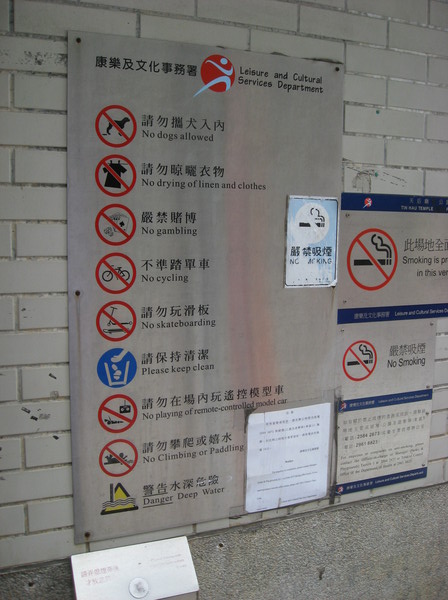
Jo and I flew in to HK a few days early for the Linaro conference, so we got some time to ourselves for doing touristy stuff. That was a good plan - we got to see quite a lot of Kowloon for a couple of days, then we wandered over to Hong Kong island itself for a day. Jo also had more time during the week while I was in the sessions at the conference. Hong Kong is a busy place, very densely packed at all times of day and night that we could see. The first impression we got on the taxi from the airport on day one was that it was a city full of tower blocks - huge numbers of apartments stacked very closely together for living space. That makes sense, I guess, with the large population in such a small space. There are houses around with more space for people to live, but they are understandably very expensive. Later on in Kowloon, we got to meet lots of the local street vendors, mostly offering us "Copy Rolex", "Fake handbag" and the like. Even "Sharp trousers" at one point. We decided not to try them out... :-) We saw lots and lots of very expensive shops downtown, crammed into huge shopping centres in the tourist area. As an antidote for all of that, we headed up to the "Golden Computer Arcade" to go browsing around the vast array of tiny technology stalls and shops there. Picked up some nice cheap laptop memory and some SD cards there. Yay! Across on Hong Kong island itself on Sunday, we found my grandfather's grave then rode around on the trams for a while to get a good view of the city, including a democracy protest that happened to be on that day! We had a quick look around Tin Hau Temple, where we found a very specific set of rules for visitors:
temple rules I can only guess that they must have been terrified by gangs of kids racing their RC cars at one point! We finished the day by heading up to Victoria Peak for the sunset view and some dinner, then back to the hotel. Killing time in a shopping centre waiting for the bus to turn up, we found a truly astonishing little item on sale, a Solar Queen!

solar queen Apparently this gift has a solar panel on the handbag to provide power to a little motor in the Queen's hand to make her wave to her subjects. We decided that we'd somehow have to live without such a delight in our lives... :-) HK was a cool place to visit. It still feels very British in some ways, as you'd expect from an ex-colony (power sockets are still the same as ours, driving on the left, everybody spoke English, etc.) but utterly alien in others (the climate, working public transport *grin*). I look forwards to heading out there again!

Next.

Previous.