Russ Allbery: Review: Seraphina
| Series: | Seraphina #1 |
| Publisher: | Ember |
| Copyright: | 2012 |
| ISBN: | 0-375-89658-9 |
| Format: | Kindle |
| Pages: | 360 |
| Series: | Seraphina #1 |
| Publisher: | Ember |
| Copyright: | 2012 |
| ISBN: | 0-375-89658-9 |
| Format: | Kindle |
| Pages: | 360 |
I realised this week that for some years I have been applying Inbox
Zero
indiscriminately to all e-mail that I receive, but this does not make
sense, and has some downsides.
My version of Inbox Zero works very well when applied to mail
addressed directly to me, and for mail to certain mailing lists, where
each post to the list might as well be addressed directly to me, in
addition to the list. However, I also receive by e-mail the following
things to which I now believe Inbox Zero should not be applied:
/etc/hostname: foobar/etc/mailname: foobar.example.com/etc/hosts: 127.0.0.1 foobar.example.com vogar localhostavahi-daemon package to be able to reach this box
using foobar.local.
I noticed the presence of a world-writable
directory and so I
tightened the security of some of the default mount points by putting the following
in /etc/rc.local:
mount -o remount,nodev,nosuid /etc/network
mount -o remount,nodev,nosuid /lib/modules
chmod 755 /etc/network
exit 0
/dev/sda) is a small SSD so that the GnuBee can run silently when the
spinning disks aren't needed. To hold the backup data on the other hand, I
got three 4-TB drives drives which I setup in a
RAID-5 array.
If the data were valuable, I'd use
RAID-6 instead
since it can survive two drives failing at the same time, but in this case
since it's only holding backups, I'd have to lose the original machine at
the same time as two of the 3 drives, a very unlikely scenario.
I created new gpt partition tables on /dev/sdb, /dev/sdbc, /dev/sdd
and used fdisk to create a single partition of type 29 (Linux RAID) on
each of them.
Then I created the RAID array:
mdadm /dev/md127 --create -n 3 --level=raid5 -a /dev/sdb1 /dev/sdc1 /dev/sdd1
and waited more than 24 hours for that operation to finish. Next, I
formatted the array:
mkfs.ext4 -m 0 /dev/md127
and added the following to /etc/fstab:
/dev/md127 /mnt/data/ ext4 noatime,nodiratime 0 2
To reduce unnecessary noise and reduce power consumption, I also installed
hdparm:
apt install hdparm
and configured all spinning drives to spin down after being idle for 10
minutes by putting the following in /etc/hdparm.conf:
/dev/sdb
spindown_time = 120
/dev/sdc
spindown_time = 120
/dev/sdd
spindown_time = 120
and then reloaded the configuration:
/usr/lib/pm-utils/power.d/95hdparm-apm resume
Finally I setup smartmontools by putting
the following in /etc/smartd.conf:
/dev/sda -a -o on -S on -s (S/../.././02 L/../../6/03)
/dev/sdb -a -o on -S on -s (S/../.././02 L/../../6/03)
/dev/sdc -a -o on -S on -s (S/../.././02 L/../../6/03)
/dev/sdd -a -o on -S on -s (S/../.././02 L/../../6/03)
and restarting the daemon:
systemctl restart smartd.service
adduser machine1
adduser machine1 sshuser
adduser machine1 sftponly
chsh machine1 -s /bin/false
and then matching directories under /mnt/data/home/:
mkdir /mnt/data/home/machine1
chown machine1:machine1 /mnt/data/home/machine1
chmod 700 /mnt/data/home/machine1
Then I created a custom ssh key for each machine:
ssh-keygen -f /root/.ssh/foobar_backups -t ed25519
and placed it in /home/machine1/.ssh/authorized_keys on the GnuBee.
On each machine, I added the following to /root/.ssh/config:
Host foobar.local
User machine1
Compression no
Ciphers aes128-ctr
IdentityFile /root/backup/foobar_backups
IdentitiesOnly yes
ServerAliveInterval 60
ServerAliveCountMax 240
The reason for setting the ssh cipher and disabling compression is to speed
up the ssh connection as much
as possible given that the GnuBee has avery small RAM
bandwidth.
Another performance-related change I made on the GnuBee was switching to the internal sftp
server
by putting the following in /etc/ssh/sshd_config:
Subsystem sftp internal-sftp
# Configure for each host
PASSWORD="XXXX" # use pwgen -s 64 to generate a good random password
BACKUP_HOME="/root/backup"
REMOTE_URL="sftp:foobar.local:"
RETENTION_POLICY="--keep-daily 7 --keep-weekly 4 --keep-monthly 12 --keep-yearly 2"
# Internal variables
SSH_IDENTITY="IdentityFile=$BACKUP_HOME/foobar_backups"
EXCLUDE_FILE="$BACKUP_HOME/exclude"
PKG_FILE="$BACKUP_HOME/dpkg-selections"
PARTITION_FILE="$BACKUP_HOME/partitions"
# If the list of files has been requested, only do that
if [ "$1" = "--list-current-files" ]; then
RESTIC_PASSWORD=$PASSWORD restic --quiet -r $REMOTE_URL ls latest
exit 0
# Show list of available snapshots
elif [ "$1" = "--list-snapshots" ]; then
RESTIC_PASSWORD=$GPG_PASSWORD restic --quiet -r $REMOTE_URL snapshots
exit 0
# Restore the given file
elif [ "$1" = "--file-to-restore" ]; then
if [ "$2" = "" ]; then
echo "You must specify a file to restore"
exit 2
fi
RESTORE_DIR="$(mktemp -d ./restored_XXXXXXXX)"
RESTIC_PASSWORD=$PASSWORD restic --quiet -r $REMOTE_URL restore latest --target "$RESTORE_DIR" --include "$2" exit 1
echo "$2 was restored to $RESTORE_DIR"
exit 0
# Delete old backups
elif [ "$1" = "--prune" ]; then
# Expire old backups
RESTIC_PASSWORD=$PASSWORD restic --quiet -r $REMOTE_URL forget $RETENTION_POLICY
# Delete files which are no longer necessary (slow)
RESTIC_PASSWORD=$PASSWORD restic --quiet -r $REMOTE_URL prune
exit 0
# Catch invalid arguments
elif [ "$1" != "" ]; then
echo "Invalid argument: $1"
exit 1
fi
# Check the integrity of existing backups
RESTIC_PASSWORD=$PASSWORD restic --quiet -r $REMOTE_URL check exit 1
# Dump list of Debian packages
dpkg --get-selections > $PKG_FILE
# Dump partition tables from harddrives
/sbin/fdisk -l /dev/sda > $PARTITION_FILE
/sbin/fdisk -l /dev/sdb > $PARTITION_FILE
# Do the actual backup
RESTIC_PASSWORD=$PASSWORD restic --quiet --cleanup-cache -r $REMOTE_URL backup / --exclude-file $EXCLUDE_FILE
I run it with the following cronjob in /etc/cron.d/backups:
30 8 * * * root ionice nice nocache /root/backup/backup-machine1-to-foobar
30 2 * * Sun root ionice nice nocache /root/backup/backup-machine1-to-foobar --prune
in a way that doesn't impact the rest of the system too much.
Finally, I printed a copy of each of my backup script, using
enscript, to stash in a safe place:
enscript --highlight=bash --style=emacs --output=- backup-machine1-to-foobar ps2pdf - > foobar.pdf
This is actually a pretty important step since without the password, you
won't be able to decrypt and restore what's on the GnuBee.
$home.
--gem-install layout and fixing autopkgtest.Conflicts field.ARM $arch.Breaks+Replaces for ruby-sass-rails (#952682 and #954544).cut -d'-' -f1 to just show upstream version.
encryptor for Ruby2.7 test failures.image_science for removing relative paths.ffi-yajl for Ruby2.7 test failures.aggregate for simply using require.aggregate for modernizing CI and adding Ruby 2.5 and 2.7 support.espeak-ruby for Ruby2.7 test failures.tty-which for test failures in general.packable for Ruby2.7 test failures. PR #12 has been proposed.growl for test failures and proposed an initial patch.
hugo-coder, asking to enable RSS feed for blogs.hugo-coder for fixing the above issue myself.arbre for requesting a release.combustion, asking to relax dependency on rubocop. Fixed in this commit.ffi-compiler for requesting to fix homepage and license.gographviz for requesting a release.crb-blast, suggesting compatability with bio 2.0.x.uniform_notifier for asking to drop the use of ruby-growl.polybar, adding installation instructions on Debian systems.:wq for today.
Here is my monthly update covering what I have been doing in the free software world during April 2020 (previous month's report). Looking it over prior to publishing, I am surprised how much I got done this month I felt that I was not only failing to do all the extra things I had planned, but I was doing far less than normal. But let us go easy on ourselves; nobody is nailing this.
send-later command's message limit. [...]
debian/rules files that specify -Wl,--as-needed as this is now the default from bullseye onwards. (#956146).debug. (#958945)--with=systemd with a Debhelper compatibility level of 10 or higher. (#949844)$* as using the Debhelper sequencer. (#930679)override dh_install (ie. with a space) in debian/rules; in 99% of cases this will be an omission of the underscore. [...]python3-all-dev and python3-all-dbg to satisfy the check for packages that use py3versions with the -s argument. (#955799, #956134)Build-Depends-Arch and Build-Depends-Indep do not imply each other, so don't warn about "duplicate" dependencies in this case. (#956368)py3versions -s without the corresponding Build-Depends. (#958794)pre-depends-directly-on-multiarch-support tag; any package pre-depending on the multiarch-support will not be installable in the bullseye distribution. (#798762)mailing-list-obsolete-in-debian-infrastructure as being experimental. (#958182, #958666)dh_dwz-generated "multi-files". (#955752)package-relation-with-self if we have specified a required architecture. (#956227)package-uses-old-debhelper-compat-version when run against itself. [...].travis.yml file as we are using Salsa now. [...]
One of the original promises of open source software is that distributed peer review and transparency of process results in enhanced end-user security. However, whilst anyone may inspect the source code of free and open source software for malicious flaws, almost all software today is distributed as pre-compiled binaries. This allows nefarious third-parties to compromise systems by injecting malicious code into ostensibly secure software during the various compilation and distribution processes.
The motivation behind the Reproducible Builds effort is to ensure no flaws have been introduced during this compilation process by promising identical results are always generated from a given source, thus allowing multiple third-parties to come to a consensus on whether a build was compromised.
The initiative is proud to be a member project of the Software Freedom Conservancy, a not-for-profit 501(c)(3) charity focused on ethical technology and user freedom.
Conservancy acts as a corporate umbrella allowing projects to operate as non-profit initiatives without managing their own corporate structure. If you like the work of the Conservancy or the Reproducible Builds project, please consider becoming an official supporter.
otf-active mailing list this final report described in detail the status of each objective, our overall lessons and our future plans.
disorderfs-debug prefix in log output when we change non-disorderfs things in the file and, as it happens, do not run disorderfs at all. [...]a HTML elements under li ones, which was causing a comma/bullet spacing issue. [...]*.sym files as Java archives. (#15).zip filename filtering and exclude two patterns of files generated by Maven projects in "fork" mode. (#13)
Elsewhere in our tooling, I made the following changes to diffoscope, our in-depth and content-aware diff utility that can locate and diagnose reproducibility issues, including preparing and uploading versions 139, 140, 141 and 142 to Debian:
.dex files can also serve as APK containers so restrict the narrower identification of .dex files to files ending with this extension and widen the identification of APK files to when file(1) discovers a Dalvik file. (#28).p7c and .p7b certificates. (#94)zipinfo(1) warnings. (#97)pdftotext as a requirement to run the PDF test_metadata text. (#99)python3-h5py in debian/tests/control.in to ensure that we have this module installed during a test run to generate the fixtures in these tests. [...]./setup.py test --pytest-args arguments. [...]rb-general mailing list is probably a first step for contributors to take. [...]/docs/buildinfo/ to /docs/recording/. (#23)/news/ namespace [...] and improve formatting of archived news links [...].ntp Network Time Protocol server to prevent a denial of service vulnerability (CVE-2020-11868).
ntp in ELA-224-2 to add further protection that was not present in the previous update.
Content-Type HTTP header is missing when downloading .deb files (#956471) and to report build failures in the macs & ruby-enumerable-statistics packages:
6.0~rc3-1 New upstream beta release.6.0~rc4-1 New upstream beta release and use the newly-packaged liblzf-dev package over the local version. (#958321)5.0.7-3 Fix build failures with GCC 10. (#957751)5.0.7-4 Use the newly-packaged liblzf-dev package over the bundled version. (#958321)5.0.7-5 Ensure that the daemon is running prior to running the autopkgtests.5.0.7-6 Perform a "no change" sourceful upload to permit migration to the testing distribution.5.0.7-7 Add a sleep to ensure that the server has started before running the tests.2.2.12-1 New upstream release.3.0.5-1 New upstream release.1.6.3-1 New upstream release.1.6.5-1 New upstream release.1.6.5-2 Fix a failing autopkgtest that assumes a particular string is in the first kilobyte of the response which was no longer the case due to the addition of new configuration options.1.2.2-1 New upstream release.1.2.2-2 Ensure that the server is started before running autopkgtests.1.2.2-3 Sleep to ensure the server has really started before running the autopkgtests.2.2-2) Replace python-nautilus in the build-dependencies with python3-nautilus. (#943137)
15) Correct the (confusing) internal logic of --force from being visible to users. (#895686)
20.0.0-1) New upstream release and refresh packaging.
1.0.1-1) New upstream release and refresh packaging.
0.6-3) Mark a non-deterministic autopkgtest as "flaky" for now to ease migration (#930448) and use DEB_VERSION_UPSTREAM_REVISION over manually parsing dpkg-parsechangelog in debian/rules.
# include <signal.h>
# include <stdlib.h>
# include <stdio.h>
# include <time.h>
int main(int argc, char **argv)
union sigval sigval;
pid_t pid;
if (argc < 2 (pid = atoi(argv[1])) < 0)
return EXIT_FAILURE;
sigval.sival_int = time(NULL) & 0xff;
printf("sender: sending %d to PID %d\n",
sigval.sival_int, pid);
sigqueue(pid, SIGUSR1, sigval);
return EXIT_SUCCESS;
The key lines are 13 and 16 where the random (ish) integer is stored in the sigval union and then sent to the other process with the sigqueue.
The receiver
The receiver just sets up the signal handler, sends its PID (so I know what to tell the sender) and sits in a sleeping loop.
# include <stdio.h>
# include <stdlib.h>
# include <sys/types.h>
# include <unistd.h>
# include <signal.h>
void signal_handler(int signum, siginfo_t *siginfo, void *ucontext)
if (signum != SIGUSR1) return;
if (siginfo->si_code != SI_QUEUE) return;
printf("receiver: Got value %d\n",
siginfo->si_int);
int main(int argc, char **argv)
pid_t pid = getpid();
struct sigaction signal_action;
printf("receiver: PID is %d\n", pid);
signal_action.sa_sigaction = signal_handler;
sigemptyset (&signal_action.sa_mask);
signal_action.sa_flags = SA_SIGINFO;
sigaction(SIGUSR1, &signal_action, NULL);
while(1) sleep(100);
return EXIT_SUCCESS;
Lines 16-26 setup the signal handler. The main difference here is SA_SIGINFO used for the signal flags and sigaction references a sa_sigaction function rather than sa_handler.
We need to use a different function because the sigaction only is passed the signal number but we need more information, including the integer that the sender process stored in sigval.
Lines 7-14 are the signal handler function itself. It first checks that the receiver process got the correct signal (SIGUSR1 in this case) and that we got this signal from sigqueue because the type is SI_QUEUE. Checking the type of signal is important because different signals give you different data. For example, if you signalled this process with kill then si_int is undefined.
The result
As a proof of concept, the results are not terribly exciting. We see the sender say what it will be sending and the receiver saying it got it. It was useful to get some results, especially when things went wrong.
$ ./receiver & [1] 370216 receiver: PID is 370216 $ ./sender 370216 sender: sending 133 to (gdPID 370216 receiver: Got value 133Gotchas While testing the two process there was two gotchas I encountered. GDB and the siginfo structure The sigaction manual page shows a simple siginfo_t structure, however when looking at what is passed to the signal handler, it s much more complicated.
(gdb) p *siginfo
$2 = si_signo = 10, si_errno = 0, si_code = -1, __pad0 = 0, _sifields = _pad = 371539, 1000, 11, 32766, 0 <repeats 24 times> , _kill = si_pid = 371539, si_uid = 1000 , _timer = si_tid = 371539,
si_overrun = 1000, si_sigval = sival_int = 11, sival_ptr = 0x7ffe0000000b , _rt = si_pid = 371539, si_uid = 1000, si_sigval = sival_int = 11, sival_ptr = 0x7ffe0000000b , _sigchld =
si_pid = 371539, si_uid = 1000, si_status = 11, si_utime = 0, si_stime = 0 , _sigfault = si_addr = 0x3e80005ab53, si_addr_lsb = 11, _bounds = _addr_bnd = _lower = 0x0, _upper = 0x0 , _pkey = 0 ,
_sigpoll = si_band = 4294967667539, si_fd = 11 , _sigsys = _call_addr = 0x3e80005ab53, _syscall = 11, _arch = 32766
(gdb) p siginfo->_sifields._rt.si_sigval.sival_int
$3 = 11
So the integer is stored in a union in a structure in a structure. Much harder to find than just simply sival_int.
The pointer is just a pointer
So perhaps sending an integer is not enough. The sigval is a union with an integer and a pointer. Could a string be sent instead? I changed line 13 of the sender so it used a string instead of an integer.
sigval.sival_ptr = "Hello, World!"The receiver needed a minor adjustment to print out the string. I tried this and the receiver segmentation faulted. What was going on? The issue is the set of system calls does a simple passing of the values. So if the sender sends a pointer to a string located at 0x1234567 then the receiver will have a pointer to the same location. When the receiver tries to dereference the sival_ptr, it is pointing to memory that is not owned by it but by another process (the sender) so it segmentation faults. The solution would be to use shared memory between the processes. The signal queue would then use the pointer to the shared memory and, in theory, all would be well.
Armadillo is a powerful and expressive C++ template library for linear algebra aiming towards a good balance between speed and ease of use with a syntax deliberately close to a Matlab. RcppArmadillo integrates this library with the R environment and language and is widely used by (currently) 705 other packages on CRAN.
A new upstream release 9.870.2 of Armadillo was released a few days ago. We had tested two release candidates, and this caught one bug. The release was held up at CRAN for a few days as one package had an overly sensitive test depending on random input data; eventually we all convinced ourselves that there was no (Rcpp)Armadillo issue here. So morale: friends don t let friends have tests depend on random behavior.
Changes in the new release are noted below.
Courtesy of CRANberries, there is a diffstat report relative to previous release. More detailed information is on the RcppArmadillo page. Questions, comments etc should go to the rcpp-devel mailing list off the R-Forge page. If you like this or other open-source work I do, you can now sponsor me at GitHub. For the first year, GitHub will match your contributions.Changes in RcppArmadillo version 0.9.870.2.0 (2020-04-24)
- Upgraded to Armadillo release 9.870.2 (Roasted Mocha Retox)
- faster handling of matrix multiplication expressions by
diagvec()anddiagmat()- added
trimatu_ind()andtrimatl_ind()- more consistent detection of sparse vector expressions
This post by Dirk Eddelbuettel originated on his Thinking inside the box blog. Please report excessive re-aggregation in third-party for-profit settings.
| Publisher: | Silvertail |
| Copyright: | 2014-2016 |
| Printing: | 2016 |
| ISBN: | 1-909269-42-5 |
| Format: | Kindle |
| Pages: | 308 |
Every damaging resignation letter, every cornered truth attack, every out-of-control speech by a former friend, is more than just an inconvenience, to be countered with positive spin and internal memos: it's an open challenge to the official version of the story, the perfectly controlled brand. They are breaks in an otherwise perfectly planned, smoothly executed narrative of the powerful. Holes in the program code. A rare, irresistible chance to hack into history's shiny, unstoppable operation.The Last Goodbye: A History of the World in Resignation Letters is not, in truth, a history of the world. It is, first and foremost, a taxonomy, because there are types of resignation letters. The opening chapter, the truth bomb, is the type that one would expect upon discovering that someone wrote a book on the topic (that wasn't advice on how to write a good one). But there are other types, less heavy on the fireworks but just as fascinating. The unquotable expert construction. The knife in the back. The incoherent scream of rage. But also the surprisingly gentle and graceful conclusion.
It is the question that the letters themselves try in vain to answer, over and over again even as they explain, analyse, protest and bear witness to a million other details. The question is: Why? All the forces in the universe stack up against unburdening ourselves in a resignation letter. Professionally, it can be suicide. In practical terms, it is often self-defeating. Self-help books coach against unleashing its force; colleagues and confidantes urge caution, self-restraint. And yet we do it, and damn the consequences. We have no choice but to speak in sorrow, love, grief, cold anger, thirst for revenge, wounded pride, the pain of injustice, loyalty, pangs of regret, throes of vengeful madness, deluded righteousness, panic, black distress, isolation, ecstasies of martyrdom, and a million other shades of human extremity we need to say our piece even as we leave the stage.The risk of the enthusiast's book is that the lack of structural grounding can leave the conclusions unsupported. A fair critique of this book is that it contains a lot of amateur sociology. Potter has a journalist's eye for motive and narrative, but some of his conclusions may not be warranted. But he compensates for the lack of rigor with, well, enthusiasm. Potter is fascinated by resignation letters and the insight they offer, and that fascination is irresistibly contagious. It's probably obvious that the chapters on truth bombs, fuck yous, and knives in the back have visceral appeal. The resignation letter as a force of truth-telling, as the revenge of a disregarded peon, as a crack in the alliance between the powerful that may let some truth shine through, is what got me to buy this book. And Potter doesn't disappoint; he quotes from both famous and nearly unknown examples, dissects the writing and the intent, and gives us a ringside seat to a few effective acts of revenge. That's not the best part of this book, though. The chapter that I will remember the longest is Potter's dissection of the constructed resignation letter. The carefully drafted public relations statement, the bland formality, the attempt to make a news story disappear. The conversation-ender. It's a truism that any area of human endeavor involves more expertise than those who have only observed it from the outside will realize, but I had never thought to apply that principle to the ghost-written resignation letter. The careful non-apology, the declaration that one has "become a distraction," the tell-tale phrasing of "spending more time with my family" is offensive in its bland dishonesty. But Potter shows that the blandness is expertly constructed to destroy quotability. Those statements are nearly impossible to remember or report on because they have been built that way: nouns carefully separated from verbs, all force dissipated by circuities and modifiers, and subtle grammatical errors introduced to discourage written news from including direct quotes. Potter's journalism background shines here because he can describe the effect on news reporting. He walks the reader through the construction to reveal that the writing is not incompetent but instead is skillfully bad in a way that causes one's attention to skitter off of it. The letter vanishes into its own vagueness. The goal is to smother the story in such mediocrity that it becomes forgettable. And it works. I've written several resignation letters of my own. Somewhat unusually, I've even sent several of them, although (as Potter says is typical) fewer than I've written. I've even written (and sent) the sort of resignation letter that every career advisor will say to never send. Potter's discussion of the motives and thought process behind those letters rang true for me. It's a raw and very human moment, one is never in as much control of it as one wishes, the cracks and emotions break through in the writing, and often those letters are trying to do far too many things at the same time. But it's also a moment in which one can say something important and have others listen, which can be weirdly challenging to do in the normal course of a job. Potter ends this book beautifully by looking at resignation letters that break or transcend the mold of most of the others he's examined: letters where the author seems to have found some peace and internal understanding and expresses that simply and straightforwardly. I found this surprisingly touching after the emotional roller-coaster of the rest of the book, and a lovely note on which to end. This is a great book. Potter has a good eye for language and the emotion encoded in it, a bracing preference for the common worker or employee over the manager or politician, and the skill to produce some memorable turns of phrase. Most importantly, he has the enthusiast's love of the topic. Even if you don't care about resignation letters going in, it will be hard to avoid some fascination with them by the end of this book. Recommended. This book was originally published as F*ck You and Goodbye in the UK. Rating: 8 out of 10
cloud.geek.nz) to host my blog. These notifications were all
for spam messages spoofing the From address since I do not use that domain
for email.
I decided to try setting a strict DMARC
policy
to see if DMARC-using mail servers (e.g. GMail) would then drop these
spoofed emails without notifying me about it.
I started by setting this initial DMARC policy in DNS in order to monitor the change:
@ TXT v=spf1 -all
_dmarc TXT v=DMARC1; p=none; ruf=mailto:dmarc@fmarier.org; sp=none; aspf=s; fo=0:1:d:s;
Then I waited three weeks without receiving anything before updating the
relevant DNS records to this final DMARC policy:
@ TXT v=spf1 -all
_dmarc TXT v=DMARC1; p=reject; sp=reject; aspf=s;
This policy states that nobody is allowed to send emails for this domain and
that any incoming email claiming to be from this domain should be silently
rejected.
I haven't noticed any bounce notifications for messages spoofing this domain
in a while, so maybe it's working?
Earlier this month, GitLab B.V.'s package signing key expired, requiring
them to rotate their key. This means that anyone who uses one of their
packages needs to jump through a number of manual hoops to update their
apt key configuration, which is an annoying manual process that also
requires people to download random files from the Internet -- something
extrepo was written to prevent. At least they're served over https, but
still.
I didn't notice until today, but I just updated the extrepo
metadata to carry
the new key. That means that if you enable one of the GitLab
repositories through extrepo enable, you will get the new key rather
than the old one. On top of that, if you had already enabled the
repository through extrepo, all that is needed for you right now to
pull in the new key is to run extrepo update.
While I do apologise for the late update, hopefully this should make
some people's lives a bit easier.
And if GitLab B.V. reads this: please send me a MR to the repository
next time, so that we can make process be done in time
If you never heard of the 10x engineer myth, it's a pretty great concept. It boils down to the idea where an engineer could be 10x more efficient than a random engineer. I find this fantastically twisted.Last week, I sat and chat with Alexis Monville in Le Podcast a podcast that equips you to make positive change in your organization. We talked about that 10x Engineer myth, and from there we digressed on how to grow your career and handle the different aspects of it.This was a very interesting exchange. Alexis is actually going to publish a new book next month (May 2020) entitled I am a Software Engineer and I am in charge.
Like each month, here comes a report about the work of paid contributors to Debian LTS.
Individual reports
In March, 252 work hours have been dispatched among 14 paid contributors. Their reports are available:
No comment Liked this article? Click here. My blog is Flattr-enabled.
/etc/opendkim/signing.table:
*@debian.org marcos-debian.anarcat.user
/etc/opendkim/key.table:
marcos-debian.anarcat.user debian.org:marcos-debian.anarcat.user:/etc/opendkim/keys/marcos-debian.anarcat.user.private
Yes, that's quite a mouthful! That magic selector is long in that
way because it needs a special syntax (specifically the
.anarcat.user suffix) for Debian to be happy. The -debian
string is to tell me where the key is published. The marcos
prefix is to remind me where the private is used.opendkim-genkey --directory=/etc/opendkim/keys/ --selector=marcos-debian.anarcat.user --domain=debian.org --verbose
This creates the DNS record in
/etc/opendkim/keys/marcos-debian.anarcat.user.txt (alongside the
private key in .key).service opendkim restart
The DNS record will look something like this:
marcos-debian.anarcat.user._domainkey IN TXT ( "v=DKIM1; h=sha256; k=rsa; "
"p=MIIBIjANBgkqhkiG9w0BAQEFAAOCAQ8AMIIBCgKCAQEAtKzBK2f8vg5yV307WAOatOhypQt3ANQ95iDaewkVehmx42lZ6b4PzA1k5DkIarxjkk+7m6oSpx5H3egrUSLMirUiMGsIb5XVGBPFmKZhDVmC7F5G1SV7SRqqKZYrXTufRRSne1eEtA31xpMP0B32f6v6lkoIZwS07yQ7DDbwA9MHfyb6MkgAvDwNJ45H4cOcdlCt0AnTSVndcl"
"pci5/2o/oKD05J9hxFTtlEblrhDXWRQR7pmthN8qg4WaNI4WszbB3Or4eBCxhUdvAt2NF9c9eYLQGf0jfRsbOcjSfeus0e2fpsKW7JMvFzX8+O5pWfSpRpdPatOt80yy0eqpm1uQIDAQAB" ) ; ----- DKIM key marcos-debian.anarcat.user for debian.org
"p=MIIB..." string needs to be joined together, without the
quotes and the p=, and sent in a signed email to
changes@db.debian.org:
-----BEGIN PGP SIGNED MESSAGE-----
dkimPubKey: marcos.anarcat.user MIIB[...]
-----BEGIN PGP SIGNATURE-----
[...]
host -t TXT marcos-debian.anarcat.user._domainkey.debian.org nsp.dnsnode.net
(nsp.dnsnode.net being one of the NS records of the
debian.org zone.)anarcat@debian.org.
check-auth@verifier.port25.com. Those tools will run Spamassassin
on the received emails and report the results. What you are looking
for is:
-0.1 DKIM_VALID: Message has at least one valid DKIM or DK
signature-0.1 DKIM_VALID_AU: Message has a valid DKIM or DK signature from
author's domain-0.1 DKIM_VALID_EF: Message has a valid DKIM or DK signature from
envelope-from domainMAIL FROM: header
as sent by the originating MTA, which you see as from=<> in the
postfix lost.
The following will happen anyways, as soon as you have a signature,
that's normal:
0.1 DKIM_SIGNED: Message has a DKIM or DK signature, not necessarily valid1.1 DKIM_ADSP_ALL No valid author signature, domain signs all mail--- a/opendkim/key.table
+++ b/opendkim/key.table
@@ -1 +1 @@
-marcos anarc.at:marcos:/etc/opendkim/keys/marcos.private
+marcos %:marcos:/etc/opendkim/keys/marcos.private
" 'Boa constrictors swallow their prey whole, without chewing it. After that they are not able to move, and they sleep through the six months that they need for digestion.'
I pondered deeply, then, over the adventures of the jungle. And after some work with a colored pencil I succeeded in making my first drawing.
My Drawing Number One.
It looked something like this:
I showed my masterpiece to the grown-ups, and asked them whether the drawing frightened them.
But they answered: 'Frighten? Why should any one be frightened by a hat?'
My drawing was not a picture of a hat. It was a picture of a boa constrictor digesting an elephant. But since the grown-ups were not able to understand it, I made another drawing: I drew the inside of a boa constrictor, so that the grown-ups could see it clearly. They always need to have things explained.
My Drawing Number Two looked like this:
The grown-ups' response, this time, was to advise me to lay aside my drawings of boa constrictors, whether from the inside or the outside, and devote myself instead to geography, history, arithmetic, and grammar.
That is why, at the age of six, I gave up what might have been a magnificent career as a painter. I had been disheartened by the failure of my Drawing Number One and my Drawing Number Two.
Grown-ups never understand anything by themselves, and it is tiresome for children to be always and forever explaining things to them."
from The Little Prince by Antoine de Saint Exup ry
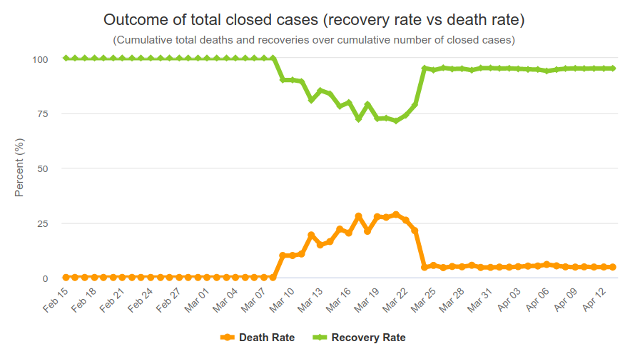
from the Corona Fun with Statistics department at Worldometers
(source, archive.org link)
@debian.org are very nice and well-behaving, any random spammer can
easily send emails from whatever@debian.org, and even if you trust
people from @debian.org you cannot easily configure your antispam
filter to just accept all emails from @debian.org, because spammers
would get in too.
Since nearly ten years DKIM is there to help you. If you send an email
from @debian.org with DKIM, it will have a header like this:
DKIM-Signature: v=1; a=rsa-sha256; c=simple/simple; d=debian.org;
s=vps.gio.user; t=1586779391;
bh=B6tckJy2cynGjNRdm3lhFDrp0tD7fF8hS4x0FCfLADo=;
h=From:Subject:To:Date:From;
b=H4EDlATxVm7XNqPy2x7IqCchBUz1SxFtUSstB23BAsdyTKJIohM0O4RRWhrQX+pqE
prPVhzcfNALMwlfExNE69940Q6pMCuYsoxNQjU7Jl/UX1q6PGqdVSO+mKv/aEI+N49
vvYNgPJNLaAFnYqbWCPI8mNskLHLe2VFYjSjE4GJFOxl9o2Gpe9f5035FYPJ/hnqBF
XPnZq7Osd9UtBrBq8agEooTCZHbNFSyiXdS0qp1ts7HAo/rfrBfbQSk39fOOQ5GbjV
6FehkN4GAXFNoFnjfmjrVDJC6hvA8m0tJHbmZrNQS0ljG/SyffW4OTlzFzu4jOmDNi
UHLnEgT07eucw==
d=debian.org is the domain this email claims to be from
and the fields bh= and b= are a cryptographic public key signature
certifying this fact. How do I check that the email is actually from
@debian.org? I use the selector s=vps.gio.user to fetch the public
key via DNS, and then use the public key to verify the signature.
$ host -t TXT vps.gio.user._domainkey.debian.org
vps.gio.user._domainkey.debian.org descriptive text "v=DKIM1; k=rsa; s=email; h=sha256; p=" "MIIBIjANBgkqhkiG9w0BAQEFAAOCAQ8AMIIBCgKCAQEAsM/W/kxtKWT58Eak0cfm/ntvurfbkkvugrG2jfvSMnHHkFyfJ34Xvn/HhQPLwX1QsjhuLV+tW+BQtxY7jxSABCee6nHQRBrpDej1t86ubw3CSrxcg1mzJI5BbL8un0cwYoBtUvhCYAZKarv1W2otCGs43L0s" "GtEqqtmYN/hIVVm4FcqeYS1cYrZxDsjPzCEocpYBhqHh1MTeUEddVmPHKZswzvllaWF0mgIXrfDNAE0LiX39aFKWtgvflrYFKiL4hCDnBcP2Mr71TVblfDY0wEdAEbGEJqHR1SxvWyn0UU1ZL4vTcylB/KJuV2gMhznOjbnQ6cjAhr2JYpweTYzz3wIDAQAB"
@debian.org. The spammer
hopefully does not have access to Debian's DKIM keys, and they cannot
sign emails.
Many large and small email services have already deployed DKIM since
years, while most @debian.org emails still do not use it. Why not?
Because people send @debian.org emails from many different
servers. Basically, every DD used their @debian.org address sends
email from their own mail server, and those mail servers (fortunately)
do not have access to Debian's DNS record to install their DKIM
keys. Well, that was true until yesterday! :-)
A few weeks ago I poked DSA asking to allow any Debian Developer to
install their DKIM keys, so that DDs could use DKIM to sign their
emails and hopefully reduce the amount of spam sent from
@debian.org. They have done it (thank you DSA very much, especially
adsb), and now it is possible to use it!
How do I configure it?
I will not write here a full DKIM tutorial, there are
many
around. You
have to use opendkim-genkey to generate a key and then configure
your mail server to use opendkim to digitally sign outbound email.
There are a few Debian-specific things you have to care about, though.
First the have to choose a selector, which is a string used to
distinguish many DKIM keys belonging to the same domain. Debian allows
you to installa a key whose selector is <something>.<uid>.user,
where <uid> is your Debian uid (this is done both for namespacing
reasons and for exposing who might be abusing the system). So check
carefully that your selector has this form.
Then you cannot edit directly Debian's DNS record. But you can use the
email-LDAP gateway on db.debian.org to
install your key in a way similar to how entries in debian.net are
handled (see the updated
documentation). Specifically,
suppose that opendkim-genkey generated the following thing for
selector vps.gio.user and domain debian.org:
vps.gio.user._domainkey IN TXT ( "v=DKIM1; h=sha256; k=rsa; "
"p=MIIBIjANBgkqhkiG9w0BAQEFAAOCAQ8AMIIBCgKCAQEAsM/W/kxtKWT58Eak0cfm/ntvurfbkkvugrG2jfvSMnHHkFyfJ34Xvn/HhQPLwX1QsjhuLV+tW+BQtxY7jxSABCee6nHQRBrpDej1t86ubw3CSrxcg1mzJI5BbL8un0cwYoBtUvhCYAZKarv1W2otCGs43L0sGtEqqtmYN/hIVVm4FcqeYS1cYrZxDsjPzCEocpYBhqHh1MTeUE"
"ddVmPHKZswzvllaWF0mgIXrfDNAE0LiX39aFKWtgvflrYFKiL4hCDnBcP2Mr71TVblfDY0wEdAEbGEJqHR1SxvWyn0UU1ZL4vTcylB/KJuV2gMhznOjbnQ6cjAhr2JYpweTYzz3wIDAQAB" ) ; ----- DKIM key vps.gio.user for debian.org
p= field (without
being fooled by it being split between different strings) and
construct a request of the form:
dkimPubKey: vps.gio.user MIIBIjANBgkqhkiG9w0BAQEFAAOCAQ8AMIIBCgKCAQEAsM/W/kxtKWT58Eak0cfm/ntvurfbkkvugrG2jfvSMnHHkFyfJ34Xvn/HhQPLwX1QsjhuLV+tW+BQtxY7jxSABCee6nHQRBrpDej1t86ubw3CSrxcg1mzJI5BbL8un0cwYoBtUvhCYAZKarv1W2otCGs43L0sGtEqqtmYN/hIVVm4FcqeYS1cYrZxDsjPzCEocpYBhqHh1MTeUEddVmPHKZswzvllaWF0mgIXrfDNAE0LiX39aFKWtgvflrYFKiL4hCDnBcP2Mr71TVblfDY0wEdAEbGEJqHR1SxvWyn0UU1ZL4vTcylB/KJuV2gMhznOjbnQ6cjAhr2JYpweTYzz3wIDAQAB
changes@db.debian.org:
echo 'dkimPubKey: vps.gio.user blahblahblah' gpg --clearsign mail changes@db.debian.org
host -t TXT vps.gio.user._domainkey.debian.org to chech the
key gets published (it will probably take some minutes/hours, I don't
know). Once it is published, you can enable DKIM in you mail server
and your email will be signed. Congratulations, you will not look like
a spammer any more!
You can send an email to check-auth@verifier.port25.com to check
that your setup is correct. They will reply with a report, including
the success of DKIM test.
Notice that currently Debian's setup only allows you to use RSA DKIM
keys and doesn't allow you to set other DKIM fields (but you probably
won't need to set them).
EDIT DSA made an official announcement about DKIM
support,
which you might want to check out as well, together with its links.
EDIT 2 Now ed25519 keys are supported, the syntax for specifying
keys on LDAP is a little bit more flexible and you can also insert
CNAME records. See the official
documentation for the updated
details.
So we have solved our problems with spam?
Ha, no! DKIM is only a small step. Useful, also because it enable
other steps to be taken in the future, but small.
In particular, DKIM enables you to say: "This particular email
actually comes from @debian.org", but doesn't tell anybody what to
do with emails that are not signed. A third-party mail server might
wonder whether @debian.org emails are actually supposed to be signed
or not.
There is another standard for dealing with that, which is called
DMARD, and I believe that Debian should eventually use it, but not
now: the problem is that currently virtually no email from
@debian.org is signed with DKIM, so if DMARC was enabled other mail
servers would start to nuke all @debian.org emails, except those
which are already signed, a minority. If people and services sending
emails from @debian.org will start configuring DKIM on their
servers, which is now possible, it will eventually come a time when
DMARC can be enabled, and spammers will find themselves unable to send
forged @debian.org emails. We are not there yet, but todays we are a
little step closer than yesterday.
Also, notice that having DKIM on @debian.org only counters spam
pretending to be from @debian.org, but there is much more. The
policy on what to accept is mostly independent on that on what you
send. However, knowing that @debian.org emails have DKIM and DMARC
would mean that we can set our spam filters to be more aggressive in
general, but whitelist official Debian Developers and services. And
the same can be done for other domains using DKIM and DMARC.
Finally, notice that some incompatibilities between DKIM and mailing
lists are known, and do not have a definitive answer yet. Basically,
most mailing list engines modify either the body of the headers in
forwarded emails, which means that DKIM does not validate any
more. There are many proposed solutions, possibly none completely
satisfying, but since spam is not very satisfying as well, something
will have to be worked out. I wrote a lot already, though, so I wont't
discuss this here.
I was gonna use this blog post to share about the migrant worker woes as there has been multiple stories doing the rounds. For e.g. a story which caught the idea of few people but most of us, i.e. middle-class people are so much into our own thing that we care a fig leaf about what happens to migrants. This should not be a story coming from a humane society but it seems India is no different than any other country of the world and in not a good way. Allow me to share
Or for those who don t like youtube, here s an alternative link
https://www.invidio.us/watch?v=JGEgZq_1jmc
Now the above two editorial shares two stories, one of Trump retaliatory threat to India in the Q&A of the journalist. In fact, Trump has upped the ante on visa sanctions as India buckled so easily under pressure.
There have been other stories doing the rounds how people who have illnesses who need HCQ in India are either dying or are close to death because of unavailability of HCQ in the medicine shop. There have been reports in Pune as well as South Mumbai (one of the poshest localities in Mumbai/Bombay) that medicine shops are running empty or emptier. There have been so many stories on that, with reporters going to shops and asking owners of the medicine shops and shop-owners being clueless.
I think the best article which vividly describes the Government of India (GOI) response to the pandemic is the free-to-read article shared by Arundhati Roy in Financial Times. It has reduced so much of my work or sharing that it s unbelievable. And she has shared it with pictures and all so I can share other aspects of how the pandemic has been affecting India and bringing the worst out in the Government in its our of need. In fact, not surprisingly though, apparently there was also a pro-Israel similar thing which happened in Africa too . As India has too few friends now globally, hence it decided to give a free pass to them.
News Broadcasters Association reply to Mrs. Gandhi
Aryan Plastic bottle
Dhauladhar range Northern Punjab Copyright CNN.Com
Welcome to the 25nd post in the randomly recurring R recitations series, or R4 for short.
Just yesterday, we posted a short post along with a video and supporting slides. It covered how to test the soon-to-be-released R 4.0.0 on a custom Ubuntu 18.04 Rocker container.
A container for Ubuntu 20.04, which is itself in final beta stages, was being built while the video was made. As it is available now, we created a quick follow-up video showing the use under Ubuntu 20.04:
The updated supporting slides from the video are still at this link. What we showed in both videos does of course also work directly on Ubuntu (or Debian, using those source repos) installations; the commands shown in the Rocker use case generally apply equally to a normal installation. If you like this or other open-source work I do, you can now sponsor me at GitHub. For the first year, GitHub will match your contributions.
This post by Dirk Eddelbuettel originated on his Thinking inside the box blog. Please report excessive re-aggregation in third-party for-profit settings.
about:config to spoof its user agent to Chrome for Windows:
general.useragent.override=Mozilla/5.0 (Windows NT 10.0; Win64; x64) AppleWebKit/537.36 (KHTML, like Gecko) Chrome/79.0.3945.117 Safari/537.36
general.useragent.updates.enabled=false
privacy.resistFingerprinting=false
The last two prefs are necessary in order for the hidden
general.useragent.override pref to not be
ignored.
Here's a blog post I wrote for the puppet.com blog. Many thanks
to Ben Ford and all their team!.
With everything that is currently happening around the world, many of us IT
folks have had to solve complex problems in a very short amount of time. Pretty
quickly at work, I was tasked with finding a way to make virtual meetings easy,
private and secure.
Whereas many would have turned to a SaaS offering, we decided to use Jitsi
Meet, a modern and fully on-premise FOSS videoconferencing solution.
Jitsi works on all platforms by running in a browser and comes with nifty
Android and iOS applications.
We've been using our instance quite a bit, and so far everyone from technical
to non-technical users have been pretty happy with it.
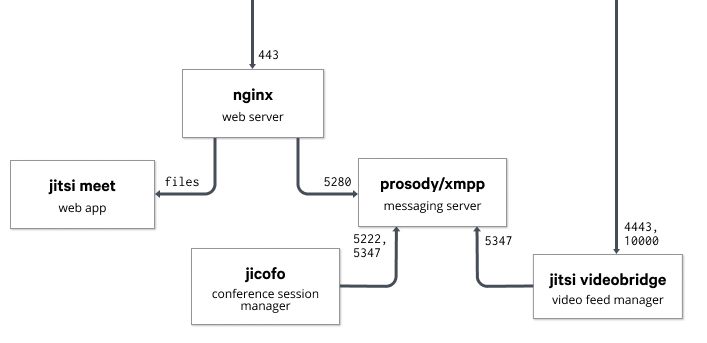
Jitsi Meet is powered by WebRTC and can be broken into multiple parts across
multiple machines if needed. In addition to the webserver running the Jitsi
Meet JavaScript code, the base configuration uses the Videobridge to manage
users' video feeds, Jicofo as a conference focus to manage media sessions and
the Prosody XMPP server to tie it all together.
Here's a network diagram I took from their documentation to show
how those applications interact:
Getting started with the Jitsi Puppet module
First of all, you'll need a valid domain name and a server with decent
bandwidth. Jitsi has published a performance evaluation of the
Videobridge to help you spec your instance appropriately. You will also need to
open TCP ports 443, 4443 and UDP port 10000 in your firewall. The
puppetlabs/firewall module could come in handy here.
Once that is done, you can use the smash/jitsimeet Puppet module on
a Debian 10 (Buster) server to spin up an instance. A basic configuration would
look like this:
class 'jitsimeet':
fqdn => 'jitsi.example.com',
repo_key => puppet:///files/apt/jitsimeet.gpg,
manage_certs => true,
jitsi_vhost_ssl_key => '/etc/letsencrypt/live/jitsi.example.com/privkey.pem'
jitsi_vhost_ssl_cert => '/etc/letsencrypt/live/jitsi.example.com/cert.pem'
auth_vhost_ssl_key => '/etc/letsencrypt/live/auth.jitsi.example.com/privkey.pem'
auth_vhost_ssl_cert => '/etc/letsencrypt/live/auth.jitsi.example.com/cert.pem'
jvb_secret => 'mysupersecretstring',
focus_secret => 'anothersupersecretstring',
focus_user_password => 'yetanothersecret',
meet_custom_options =>
'enableWelcomePage' => true,
'disableThirdPartyRequests' => true,
;
jitsimeet module is still pretty young: it clearly isn't perfect and some
external help would be very appreciated. If you have some time, here are a few
things that would be nice to work on:
Next.