Search Results: "ah"

29 November 2016

Shirish Agarwal: The Iziko South African Museum

This would be a bit long on my stay in Cape Town, South Africa after Debconf16. Before I start, let me share the gallery works, you can see some photos that I have been able to upload to my gallery . It seems we are using gallery 2 while upstream had made gallery 3 and then it sort of died. I actually asked in softwarerecs stackexchange site if somebody knows of a drop-in replacement for gallery and was told/shared about Pwigo . I am sure the admin knows about it. There would be costs to probably migrate from gallery to Pwigo with the only benefit that it would be something which would perhaps be more maintainable. The issues I face with the current gallery system are few things a. There is no way to know how much your progress your upload has taken.
b. After it has submit, it gives a fake error message saying some error has occurred. This has happened on every occasion/attempt. Now I don t know whether it is because I have slow upload speeds or something else altogether. I had shared the error page last time in the blog post hence not sharing again. Although, all the pictures which would be shared in this blog post would be from the same gallery Another thing I would like to share is a small beginner article I wrote about why I like Debian. Another interesting/tit-bit of news I came to know few days back that both Singapore and Qatar have given 96 hours visa free stopovers for Indians for select destinations. Now to start with the story/experience due to some unknown miracle/angel looking upon me I got the chance to go to Debconf16, South Africa. I m sure there was lot of backend discussions but in the end I was given the opportunity to be part of Debcamp and Debconf. While I hope to recount my Debcamp and Debconf experience in another or two blog posts, this would be exclusively the Post-Debconf Experiences I had. As such opportunities to visit another country are rare, I wanted to make the most of it. Before starting from Pune, I had talked with Amey about Visas, about Debconf as he had just been to Debconf15 the year before and various things related to travel. He was instrumental in me having a bit more knowledge about how to approach things. I was also lucky to have both Graham and Bernelle who also suggested, advised and made it possible to have a pleasant stay both during Debcamp and Debconf. The only quibble is I didn t know heaters were being made available to us without any cost. Moving on, a day or two before Debconf was about to conclude, I asked Bernelle s help even though she was battling a burn-out I believe as I was totally clueless about Cape Town. She accepted my request and asked me to look at hostels near Longmarket Street. I had two conditions a. It should not be very far from the airport
b. It should be near to all or most cultural experiences the city has to offer. We looked at hostelworld and from the options listed, it looked like Homebasecapetown looked to be a perfect fit. It was one of the cheaper options and they also had breakfast included in the pricing. I booked through hostelworld for a mixed dorm for 2 days as I was unsure how it would be (the first night effect I have shared about previously) . When I reached there, I found it to be as good as the pictures shared were, the dorm was clean (most important), people were friendly (also important) as well as toilets and shower were also clean while the water was hot, so all in all it was a win-win situation for me. Posters I saw at homebasecapetown While I m not much of an adrenaline-junkie it was nice to know the activities that could be done/taken. Brochures and Condoms just left of main hall. This was again interesting. While apologies for the poor shaky quality of the picture, I believe it is easy to figure out. There were Brochures of the city attractions as well as condoms that people could discreetly use if need be. I had seen such condoms in few toilets during and around Debconf and it felt good that the public were aware and prioritizing safety for their guests and students instead of having fake holier than thou attitudes that many places have. For instance, you wouldn t find something like this in toilets of most colleges in India or anywhere else for that matter. There are few vending machines in what are termed as red light areas or where prostitution is known/infamous to happen and even then most times it is empty. I have 2-3 social workers as friends and they are a source of news on such things. While I went to few places and each had an attraction to it, the one which had my literally eyes out of socket was the Iziko South African Museum . I have been lucky to been quite a few museums in India, the best rated science museum in India in my limited experience has been the Visvesvaraya Industrial & Technological Museum, Bengaluru India . A beer from me if a European can get it right. Don t worry if you mispronounce it, I mispronounce it couple of times till I get it right . Looking up the word Iziko the meaning of the word seems to be the hearth and if you look at the range of collections in the museum, you would think it fits. I was lucky to find couple of friends, one of whom was living at homebase and we decided to go to the museum together. Making friends on the road So Eduardo, my friend on the left and his friend, we went to the museum. While viewing the museum, there were no adjectives to describe it other than Wow and Endless . See fossils of fish-whale-shark ? OR Giant fish-whale-dolphin-shark some million years ago. and Reminder of JAWS ;) While I have more than a few pictures, the point is easily made. It seems almost inconceivable that creatures of such masses actually were on earth. While I played with the model of the jaws of a whale/shark in reality if something like that happened, I would have been fighting for my life. The only thing I missed or could have been better if they had some interactive installations to showcase the now universally accepted Charles Darwin s On the Origin of Species I had never seen anything like this. Sadly, there was nobody around to help us figure out things as I had read that most species of fish don t leave a skeleton behind so how were these models made? It just boggles the mind. Apart from the Science Museum I was also introduced to the bloody history that South Africa had. I saw The 1913 native land act which was not honored . I had been under the impression that India had got a raw deal when it was under British rule but looking at South African history I don t know. While we got our freedom in 1947 they got rid of apartheid about 20 years+ . I talked to lot of young African males and there was lot of naked hostility for the Europeans even today. It was a bit depressing but could relate to their point of view as similar sentiments were echoed by our forefathers. I read in the newspapers and it seemed to be a pretty mixed picture. I can t comment as only South Africans can figure out the way forward. For me, it was enough to know and see that we both had similar political histories as nations. It seemed the racial divide and anger was much more highly pronounced towards Europeans and divisive then the caste divisions here between Indians. I also shared with them my limited knowledge and understanding of the Indian history (as history is re-written all the time) and it was clear to them that we had common/similar pasts. As a result, what was surprising (actually not) is that many South Africans have no knowledge of Indian history. as well otherwise the political differences that South Africa and India has in the current scenario wouldn t have been. In the end, the trip proved to be fun, stimulating, educative, thought-provoking as questions about self-identity , national identity, our place in the Universe kinda questions which should be asked all the time. Thank you Bremmer and the team for letting me experience Cape Town, South Africa, I would have been poorer if I hadn t had the experience.
Filed under: Miscellenous Tagged: #Debconf16, #Dinosaur Fishes, #gallery, #Identity, #Iziko South African Museum, #Nation-state Identity, #pwigo

Reproducible builds folks: Reproducible Builds: week 83 in Stretch cycle

What happened in the Reproducible Builds effort between Sunday November 20 and Saturday November 26 2016: Reproducible work in other projects Bugs filed Chris Lamb: Daniel Shahaf: Reiner Herrmann: Reviews of unreproducible packages 63 package reviews have been added, 73 have been updated and 41 have been removed in this week, adding to our knowledge about identified issues. 4 issue types have been added: Weekly QA work During our reproducibility testing, some FTBFS bugs have been detected and reported by: strip-nondeterminism development debrepatch development Continuous integration: tests.reproducible-builds.org Debian: Since the stretch freeze is getting closer, Holger made the following changes: Misc. This week's edition was written by Ximin Luo, Holger Levsen & Chris Lamb and reviewed by a bunch of Reproducible Builds folks on IRC.

23 November 2016

Joachim Breitner: microG on Jolla

I am a incorrigibly in picking non-mainstream, open smartphones, and then struggling hard. Back then in 2008, I tried to use the OpenMoko FreeRunner, but eventually gave up because of hardware glitches and reverted to my good old Siemens S35. It was not that I would not be willing to put up with inconveniences, but as soon as it makes live more difficult for the people I communicate with, it becomes hard to sustain. Two years ago I tried again, and got myself a Jolla phone, running Sailfish OS. Things are much nicer now: The hardware is mature, battery live is good, and the Android compatibility layer enables me to run many important apps that are hard to replace, especially the Deutsche Bahn Navigator and various messengers, namely Telegram, Facebook Messenger, Threema and GroupMe. Some apps that require Google Play Services, which provides a bunch of common tasks and usually comes with the Google Play store would not run on my phone, as Google Play is not supported on Sailfish OS. So far, the most annoying ones of that sort were Uber and Lyft, making me pay for expensive taxis when others would ride cheaper, but I can live with that. I tried to install Google Play Services from shady sources, but it would regularly crash.

Signal on Jolla Now in Philadelphia, people urged me to use the Signal messenger, and I was convinced by its support for good end-to-end crypto, while still supporting offline messages and allowing me to switch from my phone to my desktop and back during a conversation. The official Signal app uses Google Cloud Messaging (GCM, part of Google Play Services) to get push updates about new posts, and while I do not oppose this use of Google services (it really is just a ping without any metadata), this is a problem on Sailfish OS. Luckily, the Signal client is open source, and someone created a LibreSignal edition that replaced the use of GCM with websockets, and indeed, this worked on my phone, and I could communicate. Things were not ideal, though: I would often have to restart the app to get newly received messages; messages that I send via Signal Desktop would often not show up on the phone and, most severe, basically after every three messages, sending more messages from Desktop would stop working for my correspondents, which freaked them out. (Strangely it continued working from their phone app, so we coped for a while.) So again, my choice of non-standard devices causes inconveniences to others. This, and the fact that the original authors of Signal and the maintainers of LibreSignal got into a fight that ended LibreSignal discontinued, meant that I have to change something about this situation. I was almost ready to give in and get myself a Samsung S7 or something boring of the sort, but then I decided to tackle this issue once more, following some of the more obscure instructions out there, trying to get vanilla Signal working on my phone. About a day later, I got it, and this is how I did it.

microG So I need Google Play Services somehow, but installing the real thing did not seem to be very promising (I tried, and regularly got pop-ups telling me that Play Services has crashed.) But I found some references to a project called microG , which is an independent re-implementation of (some of) of the play services, in particular including GCM. Installing microG itself was easy, as you can add their repository to F-Droid. I installed the core services, the services framework and the fake store apps. If this had been all that was to do, things would be easy!

Play Store detection work arounds But Signal would still complain about the lack of Google Play Services. It asks Android if an app with a certain name is installed, and would refuse to work if this app does not exist. For some reason, the microG apps cannot just have the names of the real Google apps. There seem to be two ways of working around this: Patching Signal, or enabling Signature Spoofing. The initially most promising instructions (which are in a README in a tarball on a fishy file hoster linked from an answer on the Jolla support forum ) suggested patching Signal, and actually came both with a version of an app called Lucky Patcher as well as a patched Android package, but both about two years old. I tried a recent version of the Lucky Patcher, but it failed to patch the current version of Signal.

Signature Spoofing So on to Signature Spoofing. This is a feature of some non-standard Android builds that allow apps (such as microG) to fake the existence of other apps (the Play Store), and is recommended by the microG project. Sailfish OS s Android compatibility layer Alien Dalvik does not support it out of the box, but there is a tool tingle that adds this feature to existing Android systems. One just has to get the /system/framework/framework.jar file, put it into the input folder of this project, run python main.py, select 2, and copy the framework.jar from output/ back. Great.

Deodexing Alien Dalvik Only that it only works on deodexed files. I did not know anything about odexed Android Java classes (and did not really want to know), but there was not way around. Following this explanation I gathered that one finds files foo.odex in the Android system folder, runs some tool on them to create a classes.dex file, and adds that to the corresponding foo.jar or foo.apk file, copies this back to the phone and deletes the foo.odex file. The annoying this is that one does not only have to do it for framework.jar in order to please tingle, because if one does it to one odex file, one has to do to all! It seems that for people using Windows, the Universal Deodexer V5 seems to be a convenient tool, but I had to go more manually. So I first fetched smali , compiled it using ./gradlew build. Then I fetched the folders /opt/alien/system/framework and /opt/alien/system/app from the phone (e.g. using scp). Keep a backup of these in case something breaks. Then I ran these commands (disclaimer: I fetched these from my bash history and slightly cleaned them up. This is not a fire-and-forget script! Use it when you know what it and you are doing):
cd framework
for file in *.odex
do
  java -jar ~/build/smali/baksmali/build/libs/baksmali.jar deodex $file -o out
  java -jar ~/build/smali/smali/build/libs/smali.jar a out -o classes.dex
  zip -u $(basename $file .odex).jar classes.dex
  rm -rf out classes.dex $file
done
cd ..
cd app
for file in *.odex
do
  java -jar ~/build/smali/baksmali/build/libs/baksmali.jar deodex -d ../framework $file -o out
  java -jar ~/build/smali/smali/build/libs/smali.jar a out -o classes.dex
  zip -u $(basename $file .odex).apk classes.dex
  rm -rf out classes.dex $file
done
cd ..
The resulting framework.jar can now be patched with tingle:
mv framework/framework.jar ~/build/tingle/input
cd ~/build/tingle
./main.py
# select 2
cd -
mv ~/build/tingle/output/framework.jar framework/framework.jar
Now I copy these framework and app folders back on my phone, and restart Dalvik:
devel-su systemctl restart aliendalvik.service
It might start a bit slower than usually, but eventually, all the Android apps should work as before. The final bit that was missing in my case was that I had to reinstall Signal: If it is installed before microG is installed, it does not get permission to use GCM, and when it tries (while registering: After generating the keys) it just crashes. I copied /data/data/org.thoughtcrime.secretsms/ before removing Signal and moved it back after (with cp -a to preserve permissions) so that I could keep my history. And now, it seems, vanilla Signal is working just fine on my Jolla phone!

What s missing Am I completely happy with Signal? No! An important feature that it is lacking is a way to get out all data (message history including media files) in a file format that can be read without Signal; e.g. YAML files or clean HTML code. I do want to be able to re-read some of the more interesting conversations when I am 74 or 75, and I doubt that there will be a Signal App, or even Android, then. I hope that this becomes available in time, maybe in the Desktop version. I would also hope that pidgin gets support to the Signal protocol, so that I conveniently use one program for all my messaging needs on the desktop. Finally it would be nice if my Signal identity was less tied to one phone number. I have a German and a US phone number, and would want to be reachable under both on all my clients. (If you want to contact me on Signal, use my US phone number.)

Alternatives Could I have avoided this hassle by simply convincing people to use something other than Signal? Tricky, at the moment. Telegram (which works super reliable for me, and has a pidgin plugin) has dubious crypto and does not support crypto while using multiple clients. Threema has no desktop client that I know of. OTR on top of Jabber does not support offline messages. So nothing great seems to exist right now. In the long run, the best bet seems to be OMEMO (which is, in essence, the Signal protocol) on top of Jabber. It is currently supported by one Android Jabber client (Conversations) and one Desktop application (gajim, via a plugin). I should keep an eye on pidgin support for OMEMO and other development around this.

17 November 2016

Reproducible builds folks: Reproducible Builds: week 81 in Stretch cycle

What happened in the Reproducible Builds effort between Sunday November 6 and Saturday November 12 2016: Media coverage Matthew Garrett blogged about Tor, TPMs and service integrity attestation and how reproducible builds are the base for systems integrity. The Linux Foundation announced renewed funding for us as part of the Core Infrastructure Initiative. Thank you! Outreachy updates Maria Glukhova has been accepted into the Outreachy winter internship and will work with us the Debian reproducible builds team. To quote her words
siamezzze: I've been accepted to #outreachy winter internship - going to
work with Debian reproducible builds team. So excited about that! <3
Debian
Toolchain development and fixes dpkg: debrebuild: Bugs filed Chris Lamb: Daniel Shahaf: Niko Tyni: Reiner Herrman: Reviews of unreproducible packages 136 package reviews have been added, 5 have been updated and 7 have been removed in this week, adding to our knowledge about identified issues. 3 issue types have been updated: Weekly QA work During of reproducibility testing, some FTBFS bugs have been detected and reported by: diffoscope development A new version of diffoscope 62~bpo8+1 was uploaded to jessie-backports by Mattia Rizzolo. Meanwhile in git, Ximin Luo greatly improved speed by fixing a O(n2) lookup which was causing diffs of large packages such as GCC and glibc to take many more hours than was necessary. When this commit is released, we should hopefully see full diffs for such packages again. Currently we have 197 source packages which - when built - diffoscope fails to analyse. buildinfo.debian.net development tests.reproducible-builds.org Debian: reproducible-builds.org website F-Droid was finally added to our list of partner projects. (This was an oversight and they had already been working with us for some time.) Misc. This week's edition was written by Ximin Luo and Holger Levsen and reviewed by a bunch of Reproducible Builds folks on IRC.

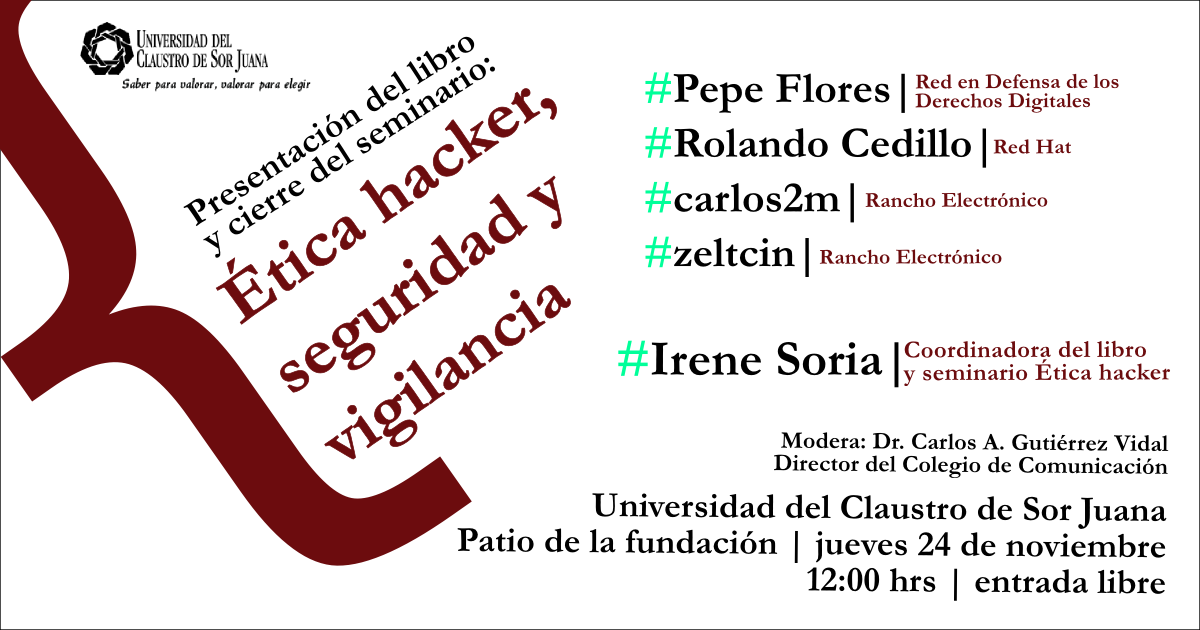
Gunnar Wolf: Book presentation by @arenitasoria: Hacker ethics, security and surveillance

At the beginning of this year, Irene Soria invited me to start a series of talks on the topic of hacker ethics, security and surveillance. I presented a talk titled Cryptography and identity: Not everything is anonymity. The talk itself is recorded and available in archive.org (sidenote: I find it amazing that Universidad del Claustro de Sor Juana uses archive.org as their main multimedia publishing platform!) But as part of this excercise, Irene invited me to write a chapter for a book covering the series. And, yes, she delivered! So, finally, we will have the book presentation: I know, not everybody following my posts (that means... Only those at or near Mexico City) will be able to join. But the good news: The book, as soon as it is presented, will be published under a CC BY-SA license. Of course, I will notify when it is ready.

Urvika Gola: Reaching out to Outreachy

The past few weeks have been a whirlwind of work with my application process for Outreachy taking my full attention. When I got to know about Outreachy, I was intrigued as well as dubious. I had many unanswered questions in my mind. Honestly, I had that fear of failure which prevented me from submitting my partially filled application form. I kept contemplating if the application was good enough , if my answers were perfect and had the right balance of du-uh and oh-ah!
In moments of doubt, it is important to surround yourself with people who believe in you more than you believe in yourself. I ve been fortunate enough to have two amazing people, my sister Anjali, who is an engineer at Intel and my friend, Pranav Jain who completed his GSoC 16 with Debian.
They believed in me when I sat staring at my application and encouraged me to click that final button. When I initially applied for Outreachy, I was given a task for building Lumicall and subsequent task was to examine a BASH script which solves the DNS-01 Challenge.
I deployed the DNS-01 challenge in Java and tested my solution against a server.
Within a limited time frame, I figured things out and wrote my solution in Java and then eagerly waited for the results to come out. Going through a full cycle of : lifecycle.JPG I was elated with joy when I got to know I ve been selected for Outreachy to work with Debian. I was excited about open source & found the idea of working on the project open source fun because of the numerous possibilities of contributing towards a voice video and chat communication software.
My project mentor, Daniel Pocock, played a pivotal role in the time after I had submitted my application. Like a true mentor, he replied to my queries promptly and guided me towards finding the solutions to problems on my own. He exemplified how to feel comfortable with developing on open source. I felt inspired and encouraged to move along in my work. Beyond him, The MiniDebConf was when I was finally introduced to the Debian community. It was an overwhelming experience and I felt proud to have come so far.. It was pretty cool to see JitsiMeet being used for this video call. I was also introduced to two of my mentors , Juliana Louback & Bruno Magalh es . I am very excited to learn from them.

I am glad I applied for Outreachy which helped me identify my strengths and I am totally excited to be working with Debian on the project and learn as much as I can throughout the period. I am not a blog person, this is my first blog ever! I would love to share my experience with you all in the hopes of inspiring someone else who is afraid of clicking that final button!

Mart n Ferrari: Replacing proprietary Play Services with MicroG

For over a year now, I have been using CyanogenMod in my Nexus phone. At first I just installed some bundle that brought all the proprietary Google applications and libraries, but later I decided that I wanted more control over it, so I did a clean install with no proprietary stuff. This was not so great at the beginning, because the base system lacks the geolocation helpers that allow you to get a position in seconds (using GSM antennas and Wifi APs). And so, every time I opened OsmAnd (a great maps application, free software and free maps), I would have to wait minutes for the GPS radio to locate enough satellites. Shortly after, I found about the UnifiedNLP project that provided a drop-in replacement for the location services, using pluggable location providers. This worked great, and you could choose to use the Apple or Mozilla on-line providers, or off-line databases that you could download or build yourself. This worked well for most of my needs, and I was happy about it. I also had F-droid for installing free software applications, DAVdroid for contacts and calendar synchronisation, K9 for reading email, etc. I still needed some proprietary apps, but most of the stuff in my phone was Free Software. But sadly, more and more application developers are buying into the vendor lock-in that is Google Play Services, which is a set of APIs that offer some useful functionality (including the location services), but that require non-free software that is not part of the AOSP (Android Open-Source Project). Mostly, this is because they make push notifications a requirement, or because they want you to be able to buy stuff from the application. This is not limited to proprietary software. Most notably, the Signal project refuses to work without these libraries, or even to distribute the pre-compiled binaries on any platform that is not Google Play! (This is one of many reason why I don't recommend Signal to anybody). And of course, many very useful services that people use every day require you to install proprietary applications, which care much less about your choices of non-standard platforms. For the most part, I had been able to just get the package files for these applications1 from somewhere, and have the functionality I wanted. Some apps would just work perfectly, others would complain about the lack of Play Services, but offer a degraded experience. You would not get notifications unless you re-opened the application, stuff like that. But they worked. Lately, some of the closed-source apps I sometimes use stopped working altogether. So, tired of all this, I decided to give the MicroG project a try.

MicroG MicroG is a direct descendant of UnifiedNLP and the NOGAPPS project. I had known about it for a while, but the installation procedures always put me off. LWN published an article about them recently, and so I decided to spend a good chunk of time making it work. This blog post is to help making this a bit less painful. Some prerequisites:
  • No Gapps installed.
  • Rooted phone (at least for the mechanism I describe here).
  • Working ADB with root access to the phone.
  • UnifiedNLP needs to be uninstalled (MicroG carries its own version of it).

Signature spoofing The main problem with the installation, is that MicroG needs to pretend to be the original Google bundle. It has to show the same name, but most importantly, it has to spoof its cryptographic signatures so other applications do not realise it is not the real thing. OmniROM and MarshROM (other alternative firmwares for Android) provide support for signature spoofing out of the box. If you are running these, go ahead and install MicroG, it will be very easy! Sadly, the CyanogenMod refused allowing signature spoofing, citing security concerns2, so most users will have to go the hard way. The options for enabling this feature are basically two: either patch some core libraries H4xx0r style, or use the "Xposed framework". Since I still don't really understand what this Xposed thing is, and it is one of these projects that distributes files on XDA forums, I decided to go the dirty way.

Patching the ROM Note: this method requires a rooted phone, java, and adb. The MicroG wiki links to three different projects for patching your ROM, but turns out that two of them would not work at all with CyanogenMod 11 and 13 (the two versions I tried), because the system is "odexed" (whatever that means, the Android ecosystem is really annoying). I actually upgraded CM to version 13 just to try this, so a couple of hours went there, with no results. The project that did work is Haystack by Lanchon, which seems to be the cleaner and better developed of the three. Also the one with the most complex documentation. In a nutshell, you need to download a bunch of files from the phone, apply a series of patches to it, and then reupload it. To obtain the files and place them in the maguro (the codename for my phone) directory:
$ ./pull-fileset maguro
Now you need to apply some patches with the patch-fileset script. The patches are located in the patches directory:
$ ls patches
sigspoof-core
sigspoof-hook-1.5-2.3
sigspoof-hook-4.0
sigspoof-hook-4.1-6.0
sigspoof-hook-7.0
sigspoof-ui-global-4.1-6.0
sigspoof-ui-global-7.0
The patch-fileset script takes these parameters:
patch-fileset <patch-dir> <api-level> <input-dir> [ <output-dir> ]
Note that this requires knowing your Android version, and the API level. If you don't specify an output directory, it will append the patch name to the input directory name. Note that you should also check the output of the script for any warnings or errors! First, you need to apply the patch that hooks into your specific version of Android (6.0, API level 23 in my case):
$ ./patch-fileset patches/sigspoof-hook-4.1-6.0 23 maguro
>>> target directory: maguro__sigspoof-hook-4.1-6.0
[...]
*** patch-fileset: success
Now, you need to add the core spoofing module:
$ ./patch-fileset patches/sigspoof-core 23 maguro__sigspoof-hook-4.1-6.0
>>> target directory: maguro__sigspoof-hook-4.1-6.0__sigspoof-core
[...]
*** patch-fileset: success
And finally, add the UI elements that let you enable or disable the signature spoofing:
$ ./patch-fileset patches/sigspoof-ui-global-4.1-6.0 23 maguro__sigspoof-hook-4.1-6.0__sigspoof-core
>>> target directory: maguro__sigspoof-hook-4.1-6.0__sigspoof-core__sigspoof-ui-global-4.1-6.0
[...]
*** patch-fileset: success
Now, you have a bundle ready to upload to your phone, and you do that with the push-fileset script:
$ ./push-fileset maguro__sigspoof-hook-4.1-6.0__sigspoof-core__sigspoof-ui-global-4.1-6.0
After this, reboot your phone, go to settings / developer settings, and at the end you should find a checkbx for "Allow signature spoofing" which you should now enable.

Installing MicroG Now that the difficult part is done, the rest of the installation is pretty easy. You can add the MicroG repository to F-Droid and install the rest of the modules from there. Check the installation guide for all the details. Once all the parts are in place, and after a last reboot, you should find a MicroG settings icon that will check that everything is working correctly, and give you the choice of which components to enable. So far, other applications believe this phone has nothing weird, I get quick GPS fixes, push notifications seem to work... Not bad at all for such a young project! Hope this is useful. I would love to hear your feedback in the comments!

  1. Which is a pretty horrible thing, having to download from fishy sites because Google refuses to let you use the marketplace without their proprietary application. I used to use a chrome extension to trick Google Play into believing your phone was downloading it, and so you could get the APK file, but now that I have no devices running stock Android, that does not work any more.
  2. Actually, I am still a bit concerned about this, because it is not completely clear to me how protected this is against malicious actors (I would love to get feedback on this!).
3 comments

16 November 2016

Shirish Agarwal: The long tail in a common s man journey to debconf16 2

This is an extension of part 1 which I shared few days ago. This would be a longish one so please bear. First of all somebody emailed me this link so in the future a layover at Doha Airport will be a bit expensive from before, approx INR 700/- added to the ticket costs Moving on, Let me share an experience I shared one of the last few days I had while I was in Cape Town
Singer singing some great oldies from 60's , 70's till 90's.

Singer singing some great oldies from 60 s , 70 s till 90 s.

I had booked a place near Long Street, Cape Town using Bernelle s help. What I had not known at that time that near Long Street there are free walking tours every couple of hours. I took part in all the tours and those were nice experiences. Where they start the walk, there was the gentleman pictured above. I was amazed by this gentleman s rich voice. He strummed lot of classics from the 60 s, 70 s till the 90 s . I had two coffees and thought I was at a premium rock concert. It was a bitter-sweet experience for me because I could see that he has such prodigious talent and still he had to struggle to survive to make ends meet. I did my 2 bit but wish I could have done something more. Side note Before I forget there is one trick of feh which I use to view images without it getting very high-resolution (especially on my low-end systems) [shirish@debian] - [/run/user/1000/gvfs/mtp:host=%5Busb%3A001%2C006%5D/Card/DCIM/Camera] - [4621]
[$] feh -g 1350x1000 .
This actually makes it far far easier to traverse through the 1000 odd photos of the trip that I have in my personal archive without doing any sort of conversion methodology. Btw, it took me time but finally was able to create an album at gallery.debconf.org . Haven t been able to upload photos as came across an error which I have shared at https://lists.debconf.org/lurker/message/20161113.215659.fce58823.en.html Moving on, here s the funny story/experience I wanted to share could have been arrested ;) What happened was this. This is from the Doha Airport. I had seen big buggies (ones similar to golf carts) which was ferrying people from end of the concourse to the other. I had been walking the whole day and even with the horizontal escalators and everything, it takes a toll. I was half-tired, half-sleepy and saw a buggy stationed. From behind it looked like the buggies I had seen. As there was no place to park my behind there, I entered into the buggy and sat there. Around 15-20 minutes later a Doha cop in another buggy came to me and asked me if something had happened ? I had no clue what he was talking about. He told/shared/asked me in friendly tone whether I had committed a crime or wanted to report a crime. When I replied in negative to both, he asked then why I was sitting there. I replied it was for stretching my legs and it was the buggy which was being used to transport people from A. to B. He gently told me I had entered into the wrong one and it was actually a cop buggy. I couldn t believe it. He did go his own way as he saw I was dead-tired. After 10-15 minutes, half-believingly I came out of the buggy and to my shock the gentleman was right. There was nothing to do but solder on to find a spot in this big airport. I shared this with few friends and family and managed to elicit few laughs hence sharing. The somewhat sad one was I had met a couple with a baby. Now as shared before, Most Airports including the Doha Airport is Air-Conditioned/Climate-Controlled and is probably in mid-20 s so it was more than cold for me. The couples with the baby were from Asian sub-continent. From their clothes and the way they were, they were not very well off. I do remember them sharing that they had a death in the family and hence were going. I didn t know at that point in time that there was something called bereavement fares and if they were able to take opportunity of those tickets. But this is besides the point . The issue was that their baby had been running a high-fever and the A/C was making matters worse. I had seen a pharmacy but no clinic in the airport. It was much later I came across http://dohahamadairport.com/airport-guide/facilities-services/medical-emergencies but as can be seen on the web-page it doesn t tell whether the services are chargeable or not. I assume it would be paid, although in some of the developed/industrialized countries it is rumoured not to be for simple ailments such as the baby was going through. Have no idea if that s true or not. I also don t know how it equates with travel insurance as well as most travel insurance is also supposed to help you in situations like these. I was concerned as it was a baby and babies as all know are very very fragile. If anybody has an idea or had similar experience would like to know specifically related to International Airport environment as it has transit issues unlike in domestic airports where I don t think it would be a bit more easy. Now coming to my own inadequacies/lack of foresight which I had mentioned I will share, I had asked/queried and got to lead a Debian-installation workshop on the Open Debian Day. I had done a few earlier and had installed it a few times on my system and for my friends, relatives and some clients. The only bad experiences I had were to do with UEFI but even those in the jessie releases had got resolved quite a bit, so was pretty confident. The day before the Installfest was to happen, Mensah Nyarko Yaa Dufie (one full name) of Ghana approached me to install Debian on her system. I had some older version of the Debian DVD either 8.1 or 8.3 and had known that 8.5 had been released just a few days back. Had seen pretty fast internet (as far as downloading Debian DVD) is concerned hence asked her to wait a bit while I downloaded the newest image. I sha256summed it to make sure that the image was bit-to-bit perfect. Now I hadn t bought a pen drive/disk from India as I was under the impression that in such conferences, pen drives should not be an issue. I had asked Bernelle privately before via e-mail as well and she had assured me that some pen-drives would be available. She gave me a handful of HP pen drives. The pen drives as we came know during our usage were somewhat flaky. It would pop out/lose connection even with the slightest nudge to the lappy. Somehow I was able to transfer the image to the usb disk. As people say hindsight is 50:50 maybe it was not such a smart move on my part to download the big DVD image and maybe I should have got the netinstall iso . Be careful, the link I have just shared is of the old version, if you have good web link and want to try the newest stable netinstall head to cdimage.debian.org . Apart from that goof-up I dunno (still) of anyway to know if a copy from an .iso image to usb was successful or not and did it do correctly I did the following command sudo dd if=/path_to/debian-dvd.iso of=/dev/usb-mount-point which is usually /dev/sdb on all of my systems . Her system was a brand new HP (don t remember the model details) which she had bought just a few weeks/months before debconf. We tried a few times but it failed at installing the boot-loader stage. I asked Ritesh Raj Saraff (a friend and DD) and while he had some ideas, none of them worked. Ritesh later pointed out Steve McIntyre and shared he is part of the Debian-Installer team. At that point in time, I had no clue who Steve McIntyre was otherwise I probably would not have approached him. He quickly acquiesced to my request and shared that he would be there for the workshop. With load of my mind little bit, I apologized to mensah and asked her to be at the workshop the following day. I had no clue what was wrong at this point in time, whether it was the iso image in the usb disk or a UEFI issue. This also wasn t good for my confidence but as somebody from the Debian-Installer team was there, I was somewhat relaxed. Next day, some more people came for the Installfest. While I had made 2-3 copies, clearly it was not enough as more people came. I was in a frenzy and asked Deven Bansod, Keerthana Krishnan, Prabaharan Jaminy (the whole GSOC and Outreachy attendees) to volunteer to help out in making more iso images on usb disks. I introduced mensah to Steve McIntyre and we tried 2-3 times to get debian installed on the system but it didn t move from the same place. Ritesh shared that dd had a memory leak and hence cat was a better way to do it. So we did

$ cat debian.iso > /dev/sdb
and soon other machines had debian sporting on their desktops. But mensa s lappy wouldn t get move from the boot-loader stage. Suddenly Steve had the bright idea (light bulb moment) that maybe the .iso is corrupted/usb disk is bad or something is incomplete. We started on another usb disk. Now this is where I have a query While I don t want to compare, in Ubuntu there was an image self-checking mechanism where probably behind the scenes (backend) the checksums published in a file are compared with checksums generated by apps. which are on the .iso image. While it does extend your time, the end result is you know if there is some issue on the decompressed image on the usb disk. AFAIK we don t have anything similar. The only two things I know is the wiki page and of course the various checksums of the image as shared at http://cdimage.debian.org/debian-cd/8.6.0/amd64/iso-cd/ or http://cdimage.debian.org/debian-cd/8.6.0/amd64/iso-dvd/ If anybody knows of any movement or a bug in the BTS which I can follow for the above issue please let me know. This time Steve was able to install it without any issues. I asked him whether he had to make some specific FAT/Ex-FAT/NTFS partitions as some new UEFI-based lappies need one or more but he replied in the negative. While mensa did get her debian install, the GUI didn t come while command-prompt was available. Then Steve added backports to the sources.list, got the new kernel, new Intel/Nvidia drivers (think it was one of those hybrid models IIRC) and she was able to boot into GNOME-Debian. I didn t saw any bug-reports about checksumming state of the applications before installation but did couple of reports about badblocks support and memory checking and from action on both bug-reports it is also need of the hour (although the earlier one has been marked as won t fix :(). In this whole thing, I liked/appreciated the way Steve handled things, I intuitively understood/knew that he wasn t just part of the Debian-installer team but someone better. I can t explain it but it was there. A little investigation in the evening and it turned out that he had been Debian Project Leader for two consecutive years (2008 and 2009) . In hindsight it probably was a good thing I didn t know that before otherwise I probably wouldn t have interacted with him and it would have been my loss. To have been the DPL and still being so humble while technically being so proficient, I was amazed and didn t know what to make of it. Here i.e. in India, if somebody wins even the mohalla elections (neighbourhood elections) the person carries a big chip on her/is shoulder not just till he is on the seat but even beyond, and here was an example of a previous DPL asking time from one of the developers in a video if it s possible in the next couple of days. Lastly,last week have able to report 2 bugs upstream. The first one is of youtube-dl . It s somewhat complicated hence will not go there atm. The second and more surprising one was from nano our esteemed text-editor- Hopefully the bug will be fixed once a new version comes.
Filed under: Miscellenous Tagged: #buggy, #cop, #Debconf16, #doha airport, #Installfest, #nano, #singer, #youtube-dl, travel

15 November 2016

Russ Allbery: Review: The Broken Kingdoms

Review: The Broken Kingdoms, by N.K. Jemisin
Series: Inheritance #2
Publisher: Orbit
Copyright: November 2010
Printing: September 2011
ISBN: 0-316-04395-8
Format: Mass market
Pages: 395
The Broken Kingdoms is a fairly direct sequel to The Hundred Thousand Kingdoms and depends heavily on the end of that book. It had been a long time since I'd read the previous book (about five years), and I looked up plot summaries to remind myself what happened. It turned out that I probably didn't have to do that; the explanation does come when it's critical. But this book will definitely spoil the end of The Hundred Thousand Kingdoms. Oree is an artist who sells her work to tourists in Shadow, the city beneath the World Tree. It's a good enough living, particularly for a blind immigrant from Nimaro, the area settled by the survivors of the destruction of Maro. Oree is not strictly entirely blind, since she can see magic, but that's not particularly helpful in daily life. She's content to keep that quiet, along with her private paintings that carry a strange magic not found in her public trinkets. One of the many godlings who inhabit Shadow is Oree's former lover, so she has some connection to the powerful of the city. But she prefers her quiet life until, that is, she finds a man at sunrise in a pile of muck and takes him home to clean him up. A man who she ends up taking care of, despite the fact that he never speaks to her, and despite his total lack of desire or apparent capability to take care of himself or avoid any danger. Not that it seems to matter, since he comes back to life every time he dies. If you've read The Hundred Thousand Kingdoms, you have a pretty good guess at who the man Oree calls Shiny actually is. But that discovery is not the core plot of this book. Someone is killing the godlings. They're not immortal, although they don't age, but killing them should require immense power or the intervention of the Three, the gods who run the metaphysical universe of this series. Neither of those seem to be happening, and still godlings are being murdered. Nahadoth is not amused: the humans and godlings have one month to find the killer before he does something awful to all of them. Then Shiny somehow kills a bunch of priests of Itempas, and the Order is after both him and Oree. Desperate, she turns to her former boyfriend and the godlings for help, and is pulled into the heart of a dark conspiracy. The Broken Kingdoms adds a few new elements to Jemisin's world-building, although it never quite builds up to the level of metaphysics of the previous book. But it's mostly a book about Oree: her exasperated care of Shiny, her attempts to navigate her rapidly complicating life, and her determination to do the right thing for her friends. It's the sort of book that pits cosmic power and grand schemes against the determined inner morality of a single person who is more powerful than she thinks she is. That part of the story I liked quite a lot. Shiny, and Oree's complicated relationship with Shiny, I wasn't as fond of. Oree treats him like a broken and possibly healing person, which is true, but he's also passively abusive in his dark moping. Jemisin tries very hard throughout the book to help the reader try to grasp a bit of what must be going through Shiny's head, and she does succeed at times, but I never much cared for what I found there. And neither Nahadoth nor Yeine, when they finally make their appearance, are very likable. (Yeine in particular I found deeply disappointing and not up to her level of ethics in the first book.) Oree is still quite capable of carrying the story single-handed, and I did like her godling friends. But I felt like the ending required liking Shiny a lot more than I did, or being a lot more sympathetic to Nahadoth and Yeine than I was, and it left a bad taste in my mouth. I enjoyed reading about Oree, but I felt like this story gave her a remarkably depressing ending. This book is also structured with a long middle section where everything seems to get more and more horrible and the antagonists are doing awful things. It's a common structural way to build tension that I rarely like. Even knowing that there's doubtless an upward arc and protagonist triumph coming, those sections are often unpleasant and difficult to read through, and I had that reaction here. The Broken Kingdoms is less of a weird romance than The Hundred Thousand Kingdoms (although there is some romance), so you may enjoy it more if you thought that angle was overdone. It does have some interesting world-building, particularly at the godling level, and Lil is one of my favorite characters. I think Oree got a raw deal from the story and would have preferred a different ending, but I'm not sorry I read it. Followed by The Kingdoms of Gods. Rating: 7 out of 10

13 November 2016

Gregor Herrmann: RC bugs 2016/40-45

time for a quick update, I guess. here's the list of release-critical bugs in debian I've worked on during the last couple of weeks.

7 November 2016

Jaldhar Vyas: New Laptop / Problems with Windows part 896,324

I had mentioned previously that I had been forced to purchase a new laptop. I decided that I didn't want another Thinkpad. The Lenovo ones no longer have the high quality they had in the IBM days and while support is still pretty good by todays dismal standards it's not worth the premium price. (If I'm buying it with my own money that is.) I had heard good thing about Dells' Linux support so I looked into their offerings and ended up buying a Precision 7510. Mind you this model came with Windows 7 installed but I didn't mind. As I wanted to install Debian according to my own specs anyway, I was ok with just knowing that the hardware would be compatible. So I prepared a Jessie USB installation stick (This model doesn't have a CD/DVD drive.) and shrunk down the Windows installation (but not deleted it altogether for reasons to be explained below.) At this point it is traditional to give a long, tortured account of how Heaven and Earth had to be moved to get Linux installed. But that is a thing of the past. The combination of good hardware and the excellent work of the debian-installer team, made the setup a breeze with only a couple of minor bumps in the road. One is that the kernel on the Jessie cd was not quite up to snuff. Downloading 4.6.0 from backports did the trick. Post-install, to get the most out of my nifty new 4K display, I needed the latest, alas non-free, nvidia-drivers. And for stable wifi (I always install over ethernet for this reason) I had to install the firmware-iwlwifi package. Everything else even my printer either "just worked" or needed only minor fiddling around. Having used this machine for a while, the biggest problem I have is with the keyboard. It is nowhere near as tactile and comfortable to use as the old IBM Thinkpads. Even Lenovo Thinkpad keyboards are better. I'm a hunt-and-peck type myself but it is annoying. I think a real touch typist would hate it. The cursor and home, end, page up, page down etc. keys are in the wrong place and home and end are actually function keys. There is a pointer and a trackpad and two sets of mouse buttons which seems like a waste of space. In fact much space is wasted everywhere, space which could be used to improve the keyboard. Other than that I like it. The battery life is not the best but fairly good. It's a bit heavier than I was used to but I've gotten used to it. Although I didn't go with the SSD option, it is not that noisy; again you can get used to it. All in all, I think it is worth it for the price.
I installed Debian but I only really use it as a base to run VMWare Workstation. I occasionally have to support software across multiple platforms but I don't want the hassle or expense of multiple computers so I have Windows (the original installation upgraded to Windows 10) and Mac OS X running in VMs. Plus I have another VM running Kubuntu LTS for my day to day computing, another Debian install running sid for packaging, and Minix. Backups are as simple as making a snapshot of the VM. If something accidently gets screwed up, I can easily revert it back to a known good state. Ideally, I would like to replace VMWare with a free solution such as qemu or virtualbox etc. but as far as I know VMWare is far ahead in emulation capabilities (OpenGL support for example.) which is vital for efficiently using the proprietary OS's. Things were going swimmingly until a few days ago which brings me to part two of this post. I booted into the Windows 10 VM only to be greeted by a message from the Windows boot manager that "A component of the operating system has expired." I tried going back to a snapshot from September (when this definitely was working) but I still got the same thing. A bit of googling revealed this has happened to others and the advice seemed to be to reset the computers date and reinstall Windows 10. It took several tries but I finally got that done, completed the task I needed to do and shut it down. At the end of the day I shut the whole laptop down and thought no more of it. The next day I boot up and...where is grub? It seems that during the Windows reinstall, it had overwritten grub with the Windows boot loader. And while grub is nice enough to add an entry for Windows when detected, Windows does not extend the same courtesy to Linux. Ok time to bring out my trusty USB stick again and reinstall grub. Oops I've wiped it off to store other things. No matter, download another image and do it again. Reboot and...back in Windows. Fiddle around in the EFI settings until I can get it to boot from USB. Now i'm in the shell provided by debian-installer so I can mount and chroot my Linux partition and reinstall grub. Except no I can't because it is Luks encrypted. Ok apt-get install cryptsetup, open it with my passphrase and now I can mount the partion, chroot into and reinstall grub. Except no I can't because it is a logical volume group. Back to apt-get, install lvm2, vgscan (because of course I've forgotten the name of the group,) vgchange and now I can mount, chroot, etc. etc. Except no I can't.

# mount /dev/mapper/vg00-root /mnt
# chroot /mnt
# grub-install /dev/sda
error: cannot find a device for /boot/grub (is /dev mounted?).
sigh

# mount /dev/sda5 /boot
special device /dev/sda5 does not exist.
Well, /dev is mounted but it does indeed not contain a device called sda5.

# /etc/init.d/udev start
udev requires a mounted procfs.  not started.
Very well then.

# mount -t proc none /proc
# /etc/init.d/udev start
Nope. proc needs sysfs.

# mount -t sysfs none /sys
# /etc/init.d/udev start
Still no. You get a warning about how it is a bad idea to run udev from an interactive shell and there is still not /dev/sda5. Time to start googling again. It turns out what I should have done is open another shell from the installer environment and do...

# mount --bind /dev/ /mnt/dev
Now I can mount /boot/grub and reinstall grub and it should all work right? I should be so lucky. Ok back to square one. I now did what I should have done in the first place and searched the Debian wiki. Sure enough there is a page which deals exactly with my predicament. Finally I get everything installed correctly and triumphantly reboot into Linux. Of course now Windows doesn't work again...

5 November 2016

Russ Allbery: Fall haul post

It's been a while since I've done one of these. danah boyd It's Complicated (non-fiction)
Jeffrey A. Carver Eternity's End (sff)
Becky Chambers A Closed and Common Orbit (sff)
Stephen Deas The Adamantine Palace (sff)
Robert Heinlein The Green Hills of Earth / The Menace from Earth (sff)
Robert Heinlein Revolt in 2100 / Methuselah's Children (sff)
Marjorie M. Liu The Iron Hunt (sff)
Larry Niven The Ringworld Engineers (sff)
Don Norman The Design of Everyday Things (non-fiction)
Kurt Vonnegut Slaughterhouse-Five (sff)
Jo Walton Necessity (sff)
Eileen Wilks Tempting Danger (sff) I picked up some extra used books since I was placing a book order to pick up Necessity anyway, and fleshed out my early Heinlein novels mostly out of curiousity. I've already reviewed The Design of Everyday Things, which I got from the work book club.

3 November 2016

Bits from Debian: New Debian Developers and Maintainers (September and October 2016)

The following contributors got their Debian Developer accounts in the last two months: The following contributors were added as Debian Maintainers in the last two months: Congratulations!

2 November 2016

Reproducible builds folks: Reproducible Builds: week 79 in Stretch cycle

What happened in the Reproducible Builds effort between Sunday October 23 and Saturday October 29 2016: Upcoming events The second Reproducible Builds World Summit will be held from December 13th-15th in Berlin! See the link for more details. Other events: Introduction to Reproducible Builds - Vagrant Cascadian will be presenting at the SeaGL.org Conference In Seattle, USA on November 12th, 2016. Reproducible Debian Hackathon - A small hackathon organized in Boston, USA on December 3rd and 4th. If you are interested in attending, contact Valerie Young - spectranaut in the #debian-reproducible IRC channel on irc.oftc.net. IRC meeting The next IRC meeting will be held on 2016-11-01 at 18:00 UTC. The meeting after that will be held on 2016-11-15 at 18:00 UTC. Reproducible work in other projects Ximin Luo has had his fix to bug 77985 accepted into GCC. This is needed to be able to write test cases for patches to make GCC produce debugging symbols that are reproducible regardless of the build path. There was continued discussion on the mailing list regarding our build path proposals. It has now been decided to use an environment variable SOURCE_PREFIX_MAP instead of the older proposal SOURCE_ROOT_DIR. This would be similar to GCC's existing -fdebug-prefix-map option, which allows for better disambiguation between paths from different packages. mandoc's makewhatis is now reproducible. It is used by all the BSDs, including FreeBSD, as well as Alpine Linux and Void Linux. Packages reviewed and fixed, and bugs filed Chris Lamb: Reiner Herrmann: Reviews of unreproducible packages 145 package reviews have been added, 608 have been updated and 94 have been removed in this week, adding to our knowledge about identified issues. 3 issue types have been updated: Weekly QA work During of reproducibility testing, some FTBFS bugs have been detected and reported by: tests.reproducible-builds.org Debian: General: diffoscope development Misc. This week's edition was written by Ximin Luo, Chris Lamb and Holger Levsen and reviewed by a bunch of Reproducible Builds folks on IRC.

1 November 2016

Jaldhar Vyas: Sal Mubarak 2073!

Wishing every one a happy Gujarati New Year, Vikram Samvat 2073 named Kilaka and hoping the upcoming year will be yuuge for you. These next couple of paragraphs are totally not an excuse for why it will take a few more days for me to reach seven blog posts. Reading reports about Diwali in the American press, I see a bit of confusion whether Diwali is one day or five. Well, technically it is just one (Sunday 30th this year.) but there are a number of other observances around it which could be classed as subsidiaries if you want to look at it that way. The season commenced last Wednesday with Rama Ekadashi. (where the Gujarati name is different I'll use that and put the Sanskrit name in parentheses.) That's a fast day and therefore not much fun. Thursday was Vagh Barash (vyaghra dvadashi) which as the name suggests is something to do with tigers but we don't in my experience particularly do anything special that day. Friday, things began in earnest with Dhan Terash (dhana trayodashi) when Lakshmi the Goddess of prosperity is worshipped. It is also a good day to buy gold. Saturday was Kali Chaudash (Kali Chaturdashi or Naraka Chaturdashi) On this day many Gujarati families including mine worship their Kuladevi (patron Goddess of the family) even if She is not an aspect of Kali. (Others observe this on the Ashtami of Navaratri.) The day is also associated with the God Hanuman. Some people say it is His Jayanti (birthday) though we observe it in Chaitra (March-April.) It is also the best day for learning mantras and I initiated a couple of people including my son into a mantra I know. Sunday was Diwali (Deepavali) proper. As a Brahmana I spent much of the day signing blessings in the account books of shopkeepers. Well, nowadays only a few old people have actual account books so usually the print out a spreadsheet and I sign that. But home is where the main action is. Lights are lit, fireworks are set off, and prayers are offered to Lakshmi. But most important of all, this is the day good boys and girls get presents. Unfortunately I have nothing interesting to report; just the usual utilitarian items of clothing. Fireworks by the way are technically illegal in New Jersey not that that ever stopped anyone from getting them. The past few years, Jersey City has attempted to compromise by allowing a big public fireworks display. Although it was nice and sunny all day, by nighttime we had torrential rain and the firework display got washed out. So I'm glad I rebelled against the system with my small cache of sparklers. Today (or yesterday by the time this gets posted.) was the Gujarati New Years Day. There is also the commemoration of the time the God Krishna lifted up Mt Govardhan with one finger which every mandir emulates by making an annakuta or mountain of food. Tuesday is Bhai Beeja (Yama Dvitiya in Sanskrit or Bhai Duj in Hindi) when sisters cook a meal for their brothers. My son is also going to make something (read: microwave something) for his sister. So those are the five days of Diwali. Though many will not consider it to be truly over until this Saturday, the lucky day of Labh Pancham (Labha panchami.) And if I still haven't managed to write seven blog posts by then, there is always Deva Diwali...

31 October 2016

Chris Lamb: Free software activities in October 2016

Here is my monthly update covering what I have been doing in the free software world (previously):

Debian & Reproducible builds

Whilst anyone can inspect the source code of free software for malicious flaws, most GNU/Linux distributions provide binary (or "compiled") packages to end users. The motivation behind the Reproducible Builds effort is to allow verification that no flaws have been introduced either maliciously and accidentally during this compilation process by promising identical binary packages are always generated from a given source.

  • Presented a talk entitled "Reproducible Builds" talk at Software Freedom Kosova, in Prishtina, Republic of Kosovo.

  • I filed my 2,500th bug in the Debian BTS: #840972: golang-google-appengine: accesses the internet during build.

  • In order to build packages reproducibly, one not only needs identical sources but also some external and sharable definition of the environment used for a particular build, stipulating such things such as the version numbers of the required build-dependencies. It is not currently clear how to handle these .buildinfo files after the archive software has processed them and how to make them available to the world so I started development on a proof-of-concept server to see what issues arise in practice. It is available at buildinfo.debian.net.

  • Chaired an IRC meeting and ran a poll to determine a regular time .

  • Submitted two design proposals to our wiki page.

  • Improvements to our tests.reproducible-builds.org testing framework:

    • Move regular "Scheduled in..." messages to the #debian-reproducible-changes IRC channel.
    • Use our log_info method instead of manual echo calls.
    • Correct an "all sources packages" "all source packages" typo.
    • Submit .buildinfo files to buildinfo.debian.net.
    • Create GPG key on nodes for buildinfo.debian.net at deploy time, not "lazily".

My work in the Reproducible Builds project was also covered in our weekly reports. (#75, #76, #77 & #78).

I also submitted 14 patches to fix specific reproducibility issues in bio-eagle, cf-python, fastx-toolkit, fpga-icestorm, http-icons, lambda-align, mypy, playitslowly, seabios, stumpwm, sympa, tj3, wims-help & xotcl.
Debian LTS

This month I have been paid to work 13 hours on Debian Long Term Support (LTS). In that time I did the following:
  • Seven days of "frontdesk" duties, triaging CVEs, etc.
  • Issued DLA 647-1 for freeimage correcting an out-of-bounds write vulnerability in the XMP image handling functionality.
  • Issued DLA 649-1 for python-django fixing a possible CSRF protection bypass on sites that use Google Analytics.
  • Issued DLA 654-1 for libxfixes preventing an integer overflow when a malicious client sent INT_MAX as a "length".
  • Issued DLA 662-1 for quagga correcting a programming error where two constants were confused that could cause stack overrun in IPv6 routing code.
  • Issued DLA 688-1 for cairo to prevent a DoS attack where a malicious SVG could generate invalid pointers.

Uploads
  • gunicorn:
    • 19.6.0-7 Set supplementary groups when changing uid, add an example systemd .service file to gunicorn-examples, and expand README.Debian to make it clearer what to do now that /etc/gunicorn.d has been removed.
    • 19.6.0-8 Correct previous supplementary groups patch to be compatible with Python 3.
  • redis:
    • 3:3.2.4-2 Ensure that sentinel's configuration actually writes to a pidfile location so that systemd can detect that the daemon has started.
    • 3:3.2.5-1 New upstream release.
  • libfiu:
    • 0.94-8 Fix FTBFS under Bash due to lack of && in debian/rules.
    • 0.94-9 Ensure the build is reproducible by sorting injected modules.
  • aptfs (2:0.8-2) Minor cosmetic changes.

NMUs
  • libxml-dumper-perl (0.81-1.2) Move away from a unsupported debhelper compat level 4.
  • netatalk (2.2.5-1.1) Drop build-dependency on hardening-includes.

QA uploads
  • anon-proxy (00.05.38+20081230-4) Move to a supported debhelper compatibility level 9.
  • ara (1.0.32) Make the build reproducible.
  • binutils-m68hc1x (1:2.18-8) Make the build reproducible & move to a supported debhelper compatibility level.
  • fracplanet (0.4.0-5) Make the build reproducible.
  • libnss-ldap (265-5) Make the build reproducible.
  • python-uniconvertor (1.1.5-3) Fix an "option release requires an argument" FTBFS. (#839375)
  • ripole (0.2.0+20081101.0215-3) Actually include the ripole binary in package. (#839919) & enable hardening flags.
  • twitter-bootstrap (2.0.2+dfsg-10) Fix incorrect copyright formatting when building under Bash. (#824592)
  • zpaq (1.10-3) Make the build reproducible.


Debian FTP Team

As a Debian FTP assistant I ACCEPTed 147 packages: ace-link, amazon-s2n, avy, basez, bootstrap-vz, bucklespring, camitk, carettah, cf-python, debian-reference, dfcgen-gtk, efivar, entropybroker, fakesleep, gall, game-data-packager, gitano, glare, gnome-panel, gnome-shell-extension-dashtodock, gnome-shell-extension-refreshwifi, gnome-shell-extension-remove-dropdown-arrows, golang-github-gogits-go-gogs-client, golang-github-gucumber-gucumber, golang-github-hlandau-buildinfo, golang-github-hlandau-dexlogconfig, golang-github-hlandau-goutils, golang-github-influxdata-toml, golang-github-jacobsa-crypto, golang-github-kjk-lzma, golang-github-miekg-dns, golang-github-minio-sha256-simd, golang-github-nfnt-resize, golang-github-nicksnyder-go-i18n, golang-github-pointlander-compress, golang-github-pointlander-jetset, golang-github-pointlander-peg, golang-github-rfjakob-eme, golang-github-thecreeper-go-notify, golang-github-twstrike-gotk3adapter, golang-github-unknwon-goconfig, golang-gopkg-dancannon-gorethink.v1, golang-petname, haskell-argon2, haskell-binary-parsers, haskell-bindings-dsl, haskell-deriving-compat, haskell-hackage-security, haskell-hcwiid, haskell-hsopenssl-x509-system, haskell-megaparsec, haskell-mono-traversable-instances, haskell-prim-uniq, haskell-raaz, haskell-readable, haskell-readline, haskell-relational-record, haskell-safe-exceptions, haskell-servant-client, haskell-token-bucket, haskell-zxcvbn-c, irclog2html, ironic-ui, lace, ledger, libdancer2-plugin-passphrase-perl, libdatetime-calendar-julian-perl, libdbix-class-optimisticlocking-perl, libdbix-class-schema-config-perl, libgeo-constants-perl, libgeo-ellipsoids-perl, libgeo-functions-perl, libgeo-inverse-perl, libio-async-loop-mojo-perl, libmojolicious-plugin-assetpack-perl, libmojolicious-plugin-renderfile-perl, libparams-validationcompiler-perl, libspecio-perl, libtest-time-perl, libtest2-plugin-nowarnings-perl, linux, lua-scrypt, mono, mutt-vc-query, neutron, node-ansi-font, node-buffer-equal, node-defaults, node-formatio, node-fs-exists-sync, node-fs.realpath, node-is-buffer, node-jison-lex, node-jju, node-jsonstream, node-kind-of, node-lex-parser, node-lolex, node-loud-rejection, node-random-bytes, node-randombytes, node-regex-not, node-repeat-string, node-samsam, node-set-value, node-source-map-support, node-spdx-correct, node-static-extend, node-test, node-to-object-path, node-type-check, node-typescript, node-unset-value, nutsqlite, opencv, openssl1.0, panoramisk, perl6, pg-rage-terminator, pg8000, plv8, puppet-module-oslo, pymoc, pyramid-jinja2, python-bitbucket-api, python-ceilometermiddleware, python-configshell-fb, python-ewmh, python-gimmik, python-jsbeautifier, python-opcua, python-pyldap, python-s3transfer, python-testing.common.database, python-testing.mysqld, python-testing.postgresql, python-wheezy.template, qspeakers, r-cran-nleqslv, recommonmark, rolo, shim, swift-im, tendermint-go-clist, tongue, uftrace & zaqar-ui.

Antoine Beaupr : My free software activities, October 2016

Debian Long Term Support (LTS) This is my 7th month working on Debian LTS, started by Raphael Hertzog at Freexian, after a long pause during the summer. I have worked on the following packages and CVEs: I have also helped review work on the following packages:
  • imagemagick: reviewed BenH's work to figure out what was done. unfortunately, I forgot to officially take on the package and Roberto started working on it in the meantime. I nevertheless took time to review Roberto's work and outline possible issues with the original patchset suggested
  • tiff: reviewed Raphael's work on the hairy TIFFTAG_* issues, all the gory details in this email
The work on ImageMagick and GraphicsMagick was particularly intriguing. Looking at the source of those programs makes me wonder why were are still using them at all: it's a tangled mess of C code that is bound to bring up more and more vulnerabilities, time after time. It seems there's always an "Magick" vulnerability waiting to be fixed out there... I somehow hoped that the fork would bring more stability and reliability, but it seems they are suffering from similar issues because, fundamentally, they haven't rewritten ImageMagick... It looks this is something that affects all image programs. The review I have done on the tiff suite give me the same shivering sensation as reviewing the "Magick" code. It feels like all image libraries are poorly implemented and then bound to be exploited somehow... Nevertheless, if I had to use a library of the sort in my software, I would stay away from the "Magick" forks and try something like imlib2 first... Finally, I also did some minor work on the user and developer LTS documentation and some triage work on samba, xen and libass. I also looked at the dreaded CVE-2016-7117 vulnerability in the Linux kernel to verify its impact on wheezy users. I also looked at implementing a --lts flag for dch (see bug #762715). It was difficult to get back to work after such a long pause, but I am happy I was able to contribute a significant number of hours. It's a bit difficult to find work sometimes in LTS-land, even if there's actually always a lot of work to be done. For example, I used to be one of the people doing frontdesk work, but those duties are now assigned until the end of the year, so it's unlikely I will be doing any of that for the forseable future. Similarly, a lot of packages were assigned when I started looking at the available packages. There was an interesting discussion on the internal mailing list regarding unlocking package ownership, because some people had packages locked for weeks, sometimes months, without significant activity. Hopefully that situation will improve after that discussion. Another interesting discussion I participated in is the question of whether the LTS team should be waiting for unstable to be fixed before publishing fixes in oldstable. It seems the consensus right now is that it shouldn't be mandatory to fix issues in unstable before we fix security isssues in oldstable and stable. After all, security support for testing and unstable is limited. But I was happy to learn that working on brand new patches is part of our mandate as part of the LTS work. I did work on such a patch for tar which ended up being adopted by the original reporter, although upstream ended up implementing our recommendation in a better way. It's coincidentally the first time since I start working on LTS that I didn't get the number of requested hours, which means that there are more people working on LTS. That is a good thing, but I am worried it may also mean people are more spread out and less capable of focusing for longer periods of time on more difficult problems. It also means that the team is growing faster than the funding, which is unfortunate: now is a good time as any to remind you to see if you can make your company fund the LTS project if you are still running Debian wheezy.

Other free software work It seems like forever that I did such a report, and while I was on vacation, a lot has happened since the last report.

Monkeysign I have done extensive work on Monkeysign, trying to bring it kicking and screaming in the new world of GnuPG 2.1. This was the objective of the 2.1 release, which collected about two years of work and patches, including arbitrary MUA support (e.g. Thunderbird), config files support, and a release on PyPI. I have had to release about 4 more releases to try and fix the build chain, ship the test suite with the program and have a primitive preferences panel. The 2.2 release also finally features Tor suport! I am also happy to have moved more documentation to Read the docs, part of which I mentionned in in a previous article. The git repositories and issues were also moved to a Gitlab instance which will hopefully improve the collaboration workflow, although we still have issues in streamlining the merge request workflow. All in all, I am happy to be working on Monkeysign, but it has been a frustrating experience. In the last years, I have been maintaining the project largely on my own: although there are about 20 contributors in Monkeysign, I have committed over 90% of the commits in the code. New contributors recently showed up, and I hope this will release some pressure on me being the sole maintainer, but I am not sure how viable the project is.

Funding free software work More and more, I wonder how to sustain my contributions to free software. As a previous article has shown, I work a lot on the computer, even when I am not on a full-time job. Monkeysign has been a significant time drain in the last months, and I have done this work on a completely volunteer basis. I wouldn't mind so much except that there is a lot of work I do on a volunteer basis. This means that I sometimes must prioritize paid consulting work, at the expense of those volunteer projects. While most of my paid work usually revolves around free sofware, the benefits of paid work are not always immediately obvious, as the primary objective is to deliver to the customer, and the community as a whole is somewhat of a side-effect. I have watched with interest joeyh's adventures into crowdfunding which seems to be working pretty well for him. Unfortunately, I cannot claim the incredible (and well-deserved) reputation Joey has, and even if I could, I can't live with 500$ a month. I would love to hear if people would be interested in funding my work in such a way. I am hesitant in launching a crowdfunding campaign because it is difficult to identify what exactly I am working on from one month to the next. Looking back at earlier reports shows that I am all over the place: one month I'll work on a Perl Wiki (Ikiwiki), the next one I'll be hacking at a multimedia home cinema (Kodi). I can hardly think of how to fund those things short of "just give me money to work on anything I feel like", which I can hardly ask for of anyone. Even worse, it feels like the audience here is either friends or colleagues. It would make little sense for me to seek funding from those people: colleagues have the same funding problems I do, and I don't want to empoverish my friends... So far I have taken the approach of trying to get funding for work I am doing, bit by bit. For example, I have recently been told that LWN actually pays for contributed articles and have started running articles by them before publishing them here. This is looking good: they will publish an article I wrote about the Omnia router I have recently received. I give them exclusive rights on the article for two weeks, but I otherwise retain full ownership over the article and will publish them after the exclusive period here. Hopefully, I will be able to find more such projects that pays for the work I do on a day to day basis.

Open Street Map editing I have ramped up my OpenStreetMap contributions, having (temporarily) moved to a different location. There are lots of things to map here: trails, gaz stations and lots of other things are missing from the map. Sometimes the effort looks a bit ridiculous, reminding me of my early days of editing OSM. I have registered to OSM Live, a project to fund OSM editors that, I must admit, doesn't help much with funding my work: with the hundreds of edits I did in October, I received the equivalent of 1.80$CAD in Bitcoins. This may be the lowest hourly salary I have ever received, probably going at a rate of 10 per hour! Still, it's interesting to be able to point people to the project if someone wants to contribute to OSM mappers. But mappers should have no illusions about getting a decent salary from this effort, I am sorry to say.

Bounties I feel this is similar to the "bounty" model used by the Borg project: I claimed around $80USD in that project for what probably amounts to tens of hours of work, yet another salary that would qualify as "poor". Another example is a feature I would like to implement in Borg: support for protocols other than SSH. There is currently no bounty on this, but a similar feature, S3 support has one of the largest bounties Borg has ever seen: $225USD. And the claimant for the bounty hasn't actually implemented the feature, instead backing up to S3, the patch (to a third-party tool) actually enables support for Amazon Cloud Drive, a completely different API. Even at $225, I wouldn't be able to complete any of those features and get a decent salary. As well explained by the Snowdrift reviews, bounties just don't work at all... The ludicrous 10% fee charged by Bountysource made sure I would never do business with them ever again anyways.

Other work There are probably more things I did recently, but I am having difficulty keeping track of the last 5 months of on and off work, so you will forgive that I am not as exhaustive as I usually am.

30 October 2016

Dirk Eddelbuettel: RProtoBuf 0.4.7: Mostly harmless

CRAN requested a release updating any URLs for Omegahat to the (actually working) omegahat.net URL. The RProtoBuf package had this in one code comment (errr...) and on bibfile entry. Oh well -- so that caused this 0.4.7 release which arrived on CRAN today. It contains the requested change, and pretty much nothing else. RProtoBuf provides R bindings for the Google Protocol Buffers ("Protobuf") data encoding and serialization library used and released by Google, and deployed as a language and operating-system agnostic protocol by numerous projects. The NEWS file summarises the release as follows:

Changes in RProtoBuf version 0.4.7 (2016-10-27)
  • At the request of CRAN, two documentation instances referring to the Omegehat repository were updated to http://omegahat.net

CRANberries also provides a diff to the previous release. The RProtoBuf page has an older package vignette, a 'quick' overview vignette, a unit test summary vignette, and the pre-print for the JSS paper. Questions, comments etc should go to the GitHub issue tracker off the GitHub repo.

This post by Dirk Eddelbuettel originated on his Thinking inside the box blog. Please report excessive re-aggregation in third-party for-profit settings.

Dirk Eddelbuettel: drat 0.1.2: Mostly harmless

CRAN requested a release updating any URLs for Omegahat to the (actually working) omegahat.net URL. So that caused this 0.1.2 release which arrived on CRAN yesterday. It contains the requested change along with one or two other mostly minor changes which accumulated since the last release. drat stands for drat R Archive Template, and helps with easy-to-create and easy-to-use repositories for R packages. Since its inception in early 2015 it has found reasonably widespread adoption among R users because repositories is what we use. In other words, friends don't let friends use install_github(). Just kidding. Maybe. Or not. The NEWS file summarises the release as follows:

Changes in drat version 0.1.2 (2016-10-28)
  • Changes in drat documentation
    • The FAQ vignette added a new question Why use drat
    • URLs were made canonical, omegahat.net was updated from .org
    • Several files (README.md, Description, help pages) were edited

Courtesy of CRANberries, there is a comparison to the previous release. More detailed information is on the drat page.

This post by Dirk Eddelbuettel originated on his Thinking inside the box blog. Please report excessive re-aggregation in third-party for-profit settings.

29 October 2016

Jaldhar Vyas: Dawkins Weasel

Happy Dhanteras from Bappy Lahiri
It's already Dhan Terash so I better pick up the pace if I want to beat my blogging challenge before Diwali so in this post I'll discuss a program I wrote earlier this year.
I dread to look up anything on Wikipedia because I always end up going down a rabbit hole and surfacing hours later on a totally unrelated topic. Case in point, some months ago, I ended up on the page of the title. This is an interesting little experiment illustrating how random selection can result in the evolution of a specific form. The algorithm is:

  1. Start with a random string of 28 characters.
  2. Make 100 copies of this string, with a 5% chance per character of that character being replaced with a random character.
  3. Compare each new string with "METHINKS IT IS LIKE A WEASEL", and give each a score (the number of letters in the string that are correct and in the correct position).
  4. If any of the new strings has a perfect score (== 28), halt.
  5. Otherwise, take the highest scoring string, and go to step 2.
I had to try this myself so I wrote a little implementation in C++. A sample run looks like this:
  
$ ./weasel
0000 DNCFICBLUZVC JF KKNVJJASCJRW (0)
0001 DNIFICOLUZVC JFLIKNVAJASCJEW (6)
0002 DNNWICKSUZVCRSFLIKNVA ASCJEL (11)
0003 DNNWICKSUZVCRSFLIKNVA ASCJEL (11)
0004 MNNVICKSQZVCRSFLIKNVA WSCJEL (13)
0005 MENVICKSQZVCRSFLIKNVA WSCJEL (14)
0006 MENVISKS ZTCRSFLIKNVA WLCJEL (16)
0007 MENVISKS ZTCRSFLIKNVA WLCJEL (16)
0008 MEDHISKS ZTCISFLIKNVA WLCJEL (18)
0009 MEDHISKS ZTCISFLIKNVA WLCJEL (18)
0010 MEDHISKS ZTCISFLIKNVA WLCJEL (18)
0011 MEDHISKS ZTCIS LIKTKA WLCZEL (19)
0012 MEDHISKS ZTCIS LIKTKA WLCZEL (19)
0013 MEDHISKS ZTCIS LIKT A WLCZEL (20)
0014 MEDHISKS ZTCIS LIKT A WLCZEL (20)
0015 MEDHISKS ZTCIS LIKE A WLAZEL (22)
0016 MEDHIGKS ITCIS LIKE A WLAZEL (23)
0017 MEDHIGKS ITCIS LIKE A WLAZEL (23)
0018 MEDHIGKS ITCIS LIKE A WLAZEL (23)
0019 MEDHIGKS ITCIS LIKE A WLAZEL (23)
0020 MEDHIGKS ITCIS LIKE A WLAZEL (23)
0021 MEDHIGKS ITCIS LIKE A WLAZEL (23)
0022 METHINKS ITCIS LIKE A WLASEL (26)
0023 METHINKS ITCIS LIKE A WLASEL (26)
0024 METHINKS ITCIS LIKE A WLASEL (26)
0025 METHINKS ITCIS LIKE A WEASEL (27)
0026 METHINKS ITCIS LIKE A WEASEL (27)
0027 METHINKS ITCIS LIKE A WEASEL (27)
0028 METHINKS ITCIS LIKE A WEASEL (27)
0029 METHINKS ITCIS LIKE A WEASEL (27)
0030 METHINKS ITCIS LIKE A WEASEL (27)
0031 METHINKS ITCIS LIKE A WEASEL (27)
0032 METHINKS ITCIS LIKE A WEASEL (27)
0033 METHINKS ITCIS LIKE A WEASEL (27)
0034 METHINKS ITCIS LIKE A WEASEL (27)
0035 METHINKS ITCIS LIKE A WEASEL (27)
0036 METHINKS ITCIS LIKE A WEASEL (27)
0037 METHINKS ITCIS LIKE A WEASEL (27)
0038 METHINKS ITCIS LIKE A WEASEL (27)
0039 METHINKS ITCIS LIKE A WEASEL (27)
0040 METHINKS ITCIS LIKE A WEASEL (27)
0041 METHINKS ITCIS LIKE A WEASEL (27)
0042 METHINKS ITCIS LIKE A WEASEL (27)
0043 METHINKS ITCIS LIKE A WEASEL (27)
0044 METHINKS ITCIS LIKE A WEASEL (27)
0045 METHINKS ITCIS LIKE A WEASEL (27)
0046 METHINKS ITCIS LIKE A WEASEL (27)
0047 METHINKS ITCIS LIKE A WEASEL (27)
0048 METHINKS ITCIS LIKE A WEASEL (27)
0049 METHINKS ITCIS LIKE A WEASEL (27)
0050 METHINKS ITCIS LIKE A WEASEL (27)
0051 METHINKS ITCIS LIKE A WEASEL (27)
0052 METHINKS ITCIS LIKE A WEASEL (27)
0053 METHINKS ITCIS LIKE A WEASEL (27)
0054 METHINKS IT IS LIKE A WEASEL (28)

My program lets you adjust the input string, the number of copies, and the mutation threshold. I also thought it might be interesting to implement the Generator design pattern. In C++ this is done by making a class which implements begin() and end() methods and atleast a forward iterator. You can find the source code on Github.

Next.

Previous.