It was out at 3pm, and I managed to finish uploading the last bits to Unstable at 9pm Of course, that s because all of the packaging and testing work was done before the release date. All of it is, as usual, also available through a Bullseye non-official backports repository that can be added using extrepo (ie: extrepo enable openstack_xena ).
The goal behind reproducible builds is to ensure that no deliberate flaws have been introduced during compilation processes via promising or mandating that identical results are always generated from a given source. This allowing multiple third-parties to come to an agreement on whether a build was compromised or not by a system of distributed consensus.
In these reports we outline the most important things that have been happening in the world of reproducible builds in the past month:
First mentioned in our March 2021 report, Martin Heinz published two blog posts on sigstore, a project that endeavours to offer software signing as a public good, [the] software-signing equivalent to Let s Encrypt . The two posts, the first entitled Sigstore: A Solution to Software Supply Chain Security outlines more about the project and justifies its existence:
Software signing is not a new problem, so there must be some solution already, right? Yes, but signing software and maintaining keys is very difficult especially for non-security folks and UX of existing tools such as PGP leave much to be desired. That s why we need something like sigstore - an easy to use software/toolset for signing software artifacts.
Some time ago I checked Signal s reproducibility and it failed. I asked others to test in case I did something wrong, but nobody made any reports. Since then I tried to test the Google Play Store version of the apk against one I compiled myself, and that doesn t match either.
BitcoinBinary.org was announced this month, which aims to be a repository of Reproducible Build Proofs for Bitcoin Projects :
Most users are not capable of building from source code themselves, but we can at least get them able enough to check signatures and shasums. When reputable people who can tell everyone they were able to reproduce the project s build, others at least have a secondary source of validation.
Related to this, there was continuing discussion on how to embed/encode the build metadata for the Debian live images which were being worked on by Roland Clobus.
Ariadne Conill published another detailed blog post related to various security initiatives within the Alpine Linux distribution. After summarising some conventional security work being done (eg. with sudo and the release of OpenSSH version 3.0), Ariadne included another section on reproducible builds: The main blocker [was] determining what to do about storing the build metadata so that a build environment can be recreated precisely .
Finally, Bernhard M. Wiedemann posted his monthly reproducible builds status report.
Community news
On our website this month, Bernhard M. Wiedemann fixed some broken links [] and Holger Levsen made a number of changes to the Who is Involved? page [][][]. On our mailing list, Magnus Ihse Bursie started a thread with the subject Reproducible builds on Java, which begins as follows:
I m working for Oracle in the Build Group for OpenJDK which is primary responsible for creating a built artifact of the OpenJDK source code. [ ] For the last few years, we have worked on a low-effort, background-style project to make the build of OpenJDK itself building reproducible. We ve come far, but there are still issues I d like to address. []
diffoscopediffoscope is our in-depth and content-aware diff utility. Not only can it locate and diagnose reproducibility issues, it can provide human-readable diffs from many kinds of binary formats. This month, Chris Lamb prepared and uploaded versions 183, 184 and 185 as well as performed significant triaging of merge requests and other issues in addition to making the following changes:
New features:
Support a newer format version of the R language s .rds files. []
Don t call close_archive when garbage collecting Archive instances, unless open_archive definitely returned successfully. This prevents, for example, an AttributeError where PGPContainer s cleanup routines were rightfully assuming that its temporary directory had actually been created. []
Fix (and test) the comparison of R language s .rdb files after refactoring temporary directory handling. []
Ensure that RPM archives exists in the Debian package description, regardless of whether python3-rpm is installed or not at build time. []
Codebase improvements:
Use our assert_diff routine in tests/comparators/test_rdata.py. []
Move diffoscope.versions to diffoscope.tests.utils.versions. []
Reformat a number of modules with Black. [][]
However, the following changes were also made:
Mattia Rizzolo:
Fix an autopkgtest caused by the androguard module not being in the (expected) python3-androguard Debian package. []
Appease a shellcheck warning in debian/tests/control.sh. []
Ignore a warning from h5py in our tests that doesn t concern us. []
Drop a trailing .1 from the Standards-Version field as it s required. []
Zbigniew J drzejewski-Szmek:
Stop using the deprecated distutils.spawn.find_executable utility. [][][][][]
Adjust an LLVM-related test for LLVM version 13. []
Update invocations of llvm-objdump. []
Adjust a test with a one-byte text file for file version 5.40. []
And, finally, Benjamin Peterson added a --diff-context option to control unified diff context size [] and Jean-Romain Garnier fixed the Macho comparator for architectures other than x86-64 [].
Upstream patches
The Reproducible Builds project detects, dissects and attempts to fix as many currently-unreproducible packages as possible. We endeavour to send all of our patches upstream where appropriate. This month, we wrote a large number of such patches, including:
#990246 filed against vlc (forwarded upstream [][])
Testing framework
The Reproducible Builds project runs a testing framework at tests.reproducible-builds.org, to check packages and other artifacts for reproducibility. This month, the following changes were made:
Holger Levsen:
Drop my package rebuilder prototype as it s not useful anymore. []
Schedule old packages in Debian bookworm. []
Stop scheduling packages for Debian buster. [][]
Don t include PostgreSQL debug output in package lists. []
Detect Python library mismatches during build in the node health check. []
Update a note on updating the FreeBSD system. []
Mattia Rizzolo:
Silence a warning from Git. []
Update a setting to reflect that Debian bookworm is the new testing. []
Upgrade the PostgreSQL database to version 13. []
Roland Clobus (Debian live image generation):
Workaround non-reproducible config files in the libxml-sax-perl package. []
Use the new DNS for the snapshot service. []
Vagrant Cascadian:
Also note that the armhf architecture also systematically varies by the kernel. []
Contributing
If you are interested in contributing to the Reproducible Builds project, please visit our Contribute page on our website. However, you can get in touch with us via:
In my past, I ve had experiences that have had me thinking. My experiences have been mostly in the South Asian Indian Sub-Continent, so may not be fair to generalize it.
Help with finding a job: I ve learnt many times, that when people reach out asking for help, say, for helping them with finding a job; it isn t about you making a recommendation/referral for them. It, instead, implies that you are indirectly being asked to find and arrange them a job.
Gifts for people: My impression of offering a gift to someone is usually presenting them with something I ve found useful and dear to me. This is irrespective of whether the gift is a brand new unpacked item or a used (immaculate) one. On the contrary, many people define a gift as an item which is unpacked and one that comes with its sealed original packaging.
One of the assumptions baked deeply into US society (and many others) is
that people are largely defined by the work they do, and that work is the
primary focus of life. Even in Marxist analysis, which is otherwise
critical of how work is economically organized, work itself reigns
supreme. This has been part of the feminist critique of both capitalism
and Marxism, namely that both devalue domestic labor that has
traditionally been unpaid, but even that criticism is normally framed as
expanding the definition of work to include more of human activity. A
few exceptions aside, we shy away from
fundamentally rethinking the centrality of work to human experience.
The Problem with Work begins as a critical analysis of that
centrality of work and a history of some less-well-known movements against
it. But, more valuably for me, it becomes a discussion of the types and
merits of utopian thinking, including why convincing other people is not
the only purpose for making a political demand.
The largest problem with this book will be obvious early on: the writing
style ranges from unnecessarily complex to nearly unreadable. Here's an
excerpt from the first chapter:
The lack of interest in representing the daily grind of work routines
in various forms of popular culture is perhaps understandable, as is
the tendency among cultural critics to focus on the animation and
meaningfulness of commodities rather than the eclipse of laboring
activity that Marx identifies as the source of their fetishization
(Marx 1976, 164-65). The preference for a level of abstraction that
tends not to register either the qualitative dimensions or the
hierarchical relations of work can also account for its relative
neglect in the field of mainstream economics. But the lack of
attention to the lived experiences and political textures of work
within political theory would seem to be another matter. Indeed,
political theorists tend to be more interested in our lives as
citizens and noncitizens, legal subjects and bearers of rights,
consumers and spectators, religious devotees and family members, than
in our daily lives as workers.
This is only a quarter of a paragraph, and the entire book is written like
this.
I don't mind the occasional use of longer words for their precise meanings
("qualitative," "hierarchical") and can tolerate the academic habit of
inserting mostly unnecessary citations. I have less patience with the
meandering and complex sentences, excessive hedge words ("perhaps," "seem
to be," "tend to be"), unnecessarily indirect phrasing ("can also account
for" instead of "explains"), or obscure terms that are unnecessary to the
sentence (what is "animation of commodities"?). And please have mercy and
throw a reader some paragraph breaks.
The writing style means substantial unnecessary effort for the reader,
which is why it took me six months to read this book. It stalled all of
my non-work non-fiction reading and I'm not sure it was worth the effort.
That's unfortunate, because there were several important ideas in here
that were new to me.
The first was the overview of the "wages for housework" movement, which I
had not previously heard of. It started from the common feminist position
that traditional "women's work" is undervalued and advocated taking the
next logical step of giving it equality with paid work by making it
paid work. This was not successful, obviously, although the increasing
prevalence of day care and cleaning services has made it partly true
within certain economic classes in an odd and more capitalist way. While
I, like Weeks, am dubious this was the right remedy, the observation
that household work is essential to support capitalist activity but is
unmeasured by GDP and often uncompensated both economically and socially
has only become more accurate since the 1970s.
Weeks argues that the usefulness of this movement should not be judged by
its lack of success in achieving its demands, which leads to the second
interesting point: the role of utopian demands in reframing and expanding
a discussion. I normally judge a political demand on its effectiveness at
convincing others to grant that demand, by which standard many activist
campaigns (such as wages for housework) are unsuccessful. Weeks points
out that making a utopian demand changes the way the person making the
demand perceives the world, and this can have value even if the demand
will never be granted. For example, to demand wages for housework
requires rethinking how work is defined, what activities are compensated
by the economic system, how such wages would be paid, and the implications
for domestic social structures, among other things. That, in turn, helps
in questioning assumptions and understanding more about how existing
society sustains itself.
Similarly, even if a utopian demand is never granted by society at large,
forcing it to be rebutted can produce the same movement in thinking in
others. In order to rebut a demand, one has to take it seriously and
mount a defense of the premises that would allow one to rebut it. That
can open a path to discussing and questioning those premises, which can
have long-term persuasive power apart from the specific utopian demand.
It's a similar concept as the Overton Window, but with more nuance: the
idea isn't solely to move the perceived range of accepted discussion, but
to force society to examine its assumptions and premises well enough to
defend them, or possibly discover they're harder to defend than one might
have thought.
Weeks applies this principle to universal basic income, as a utopian
demand that questions the premise that work should be central to personal
identity. I kept thinking of the Black Lives Matter movement and the
demand to abolish the police, which (at least in popular discussion) is a
more recent example than this book but follows many of the same
principles. The demand itself is unlikely to be met, but to rebut it
requires defending the existence and nature of the police. That in turn
leads to questions about the effectiveness of policing, such as clearance
rates (which are far lower than one might have assumed). Many more
examples came to mind. I've had that experience of discovering problems
with my assumptions I'd never considered when debating others, but had not
previously linked it with the merits of making demands that may be
politically infeasible.
The book closes with an interesting discussion of the types of utopias,
starting from the closed utopia in the style of Thomas More in which the
author sets up an ideal society. Weeks points out that this sort of
utopia tends to collapse with the first impossibility or inconsistency the
reader notices. The next step is utopias that acknowledge their own
limitations and problems, which are more engaging (she cites Le Guin's
The Dispossessed). More conditional
than that is the utopian manifesto, which only addresses part of society.
The least comprehensive and the most open is the utopian demand, such as
wages for housework or universal basic income, which asks for a specific
piece of utopia while intentionally leaving unspecified the rest of the
society that could achieve it. The demand leaves room to maneuver; one
can discuss possible improvements to society that would approach that
utopian goal without committing to a single approach.
I wish this book were better-written and easier to read, since as it
stands I can't recommend it. There were large sections that I read but
didn't have the mental energy to fully decipher or retain, such as the
extended discussion of Ernst Bloch and Friedrich Nietzsche in the context
of utopias. But that way of thinking about utopian demands and their
merits for both the people making them and for those rebutting them, even
if they're not politically feasible, will stick with me.
Rating: 5 out of 10
In this blog post, I will cover a few related but also different topics around X2Go - the GNU/Linux based remote computing framework.
Introduction and Catch Up
For those, who haven't come across X2Go, so far... With X2Go [0] you can log into remote GNU/Linux machines graphically and launch headless desktop environments, seamless/published applications or access an already running desktop session (on a local Xserver or running as a headless X2Go desktop session) via X2Go's session shadowing / mirroring feature.
Graphical backend: NXv3
For several years, there was only one graphical backend available in X2Go, the NXv3 software. In NXv3, you have a headless or nested (it can do both) Xserver that has some remote magic built-in and is able to transfer the Xserver's graphical data to a remote client (NX proxy). Over the wire, the NX protocol allows for data compression (JPEG, PNG, etc.) and combines it with bitmap caching, so that the overall result is a fast and responsive desktop experience even on low latency and low bandwidth connections. This especially applies to X desktop environments that use many native X protocol operations for drawing windows and widget onto the screen. The more bitmaps involved (e.g. in applications with client-side rendering of window controls and such), the worse the quality of a session experience.
The current main maintainer of NVv3 (aka nx-libs [1]) is Ulrich Sibiller. Uli has my and the X2Go community's full appreciation, admiration and gratitude for all the work he does on nx-libs, constantly improving NXv3 without breaking compatibility with legacy use cases (yes, FreeNX is still alive, by the way).
NEW: Alternative Graphical Backend: X2Go Kdrive
Over the past 1.5 years, Oleksandr Shneyder (Alex), co-founder of X2Go, has been working on a re-implementation of an alternative, less X11-dependent graphical backend. The underlying Xserver technology is the kdrive part of the X.org server project. People on GNU/Linux might have used kdrive technology already: The Xephyr nested Xserver uses the kdrive implementation.
The idea of the X2Go Kdrive [2] implementation in X2Go is providing a headless Xserver on the X2Go Server side for running X11 based desktop sessions inside while using an X11-agnostic data protocol for sending the graphical desktop data to the client-side for rendering. Whereas, with NXv3 technology, you need a local Xserver on the client side, with X2Go Kdrive you only need a client app(lication) that can draw bitmaps into some sort of framebuffer, such as a client-side X11 Xserver, a client-side Wayland compositor or (hold your breath) an HTMLv5 canvas in a web browser.
X2Go Kdrive Client Implementations
During first half of this year, I tested and DEB-packaged Alex's X2Go HTMLv5 client code [3] and it has been available for testing in the X2Go nightly builds archive for a while now.
Of course, the native X2Go Client application has X2Go Kdrive support for a while, too, but it requires a Qt5 application in the background, the x2gokdriveclient (which is still only available in X2Go nightly builds or from X2Go Git [4]).
X2Go and Remmina
As currently posted by the Remmina community [5], one of my employees has been working on finalizing an already existing draft of mine for the last couple of months: Remmina Plugin X2Go. This project has been contracted by BAUR-ITCS UG (haftungsbeschr nkt) already a while back and has been financed via X2Go funding from one of their customers. Unfortunately, I never got around really to finalizing the project. Apologies for this.
Daniel Teichmann, who has been in the company for a while now, but just recently switched to an employment model with considerably more work hours per week, now picked up this project two months ago and achieved awesome things on the way.
Daniel Teichmann and Antenore Gatta (Remmina core developer, aka tmow) have been cooperating intensely on this, recently, with the objective of getting the X2Go plugin code merged into Remmina asap. We are pretty close to the first touchdown (i.e. code merge) of this endeavour.
Thanks to Antenore for his support on this. This is much appreciated.
Remmina Plugin X2Go - Current Challenges
The X2Go Plugin for Remmina implementation uses Python X2Go (PyHoca-CLI) under the bonnet and basically does a system call to pyhoca-cli according to the session settings configured in the Remmina session profile UI. When using NXv3 based sessions, the session window appears on the client-side Xserver and immediately gets caught by Remmina and embedded into the Remmina frame (via Xembed protocol) where its remote sessions are supposed to appear. (Thanks that GtkSocket is still around in GTK-3). The knowing GTK-3 experts among you may have noticed: GtkSocket is obsolete and has been removed from GTK-4. Also, GtkSocket support is only available in GTK-3 when using its X11 rendering backend.
For the X2Go Kdrive implementation, we tested a similar approach (embedding the x2gokdriveclient Qt5 window via Xembed/GtkSocket), but it seems that GtkSocket and Qt5 applications don't work well together and we did not succeed in embedding the Qt5 window of the x2gokdriveclient application into Remmina, so far. Also, this would be a work-around for the bigger problem: We want, long-term, provide X2Go Kdrive support in Remmina, not only for Remmina running with GTK-3/X11, but also when Remmina is used natively on top of Wayland.
So, the more sustainable approach for showing an X2Go Kdrive based X2Go session in Remmina would be a GTK-3/4 or a Glib-2.0 + Cairo based rendering client provided as a shared library. This then could be used by Remmina for drawing the session bitmaps into the Remmina session frame.
This would require a port of the x2gokdriveclient Qt code into a non-Qt implementation. However, we are running out of funding to make this happen at the moment.
More Funding Needed for this Journey
As you might guess, such a project as proposed is a project that some people do in their spare time, others do it for a living.
I'd love to continue this project and have Daniel Teichmann continue his work on this, so that Remmina might soon be able to provide native X2Go Kdrive Client support.
If people read this and are interested in supporting such a project, please get in touch [6]. Thanks so much!
light+love
Mike (aka sunweaver)
[0] https://wiki.x2go.org/
[1] https://github.com/ArcticaProject/nx-libs
[2] https://code.x2go.org/gitweb?p=x2gokdrive.git;a=tree
[3] https://code.x2go.org/gitweb?p=x2gohtmlclient.git;a=tree
[4] https://code.x2go.org/gitweb?p=x2gokdriveclient.git;a=tree
[5] https://remmina.org/x2go/
[6] https://das-netzwerkteam.de/
Colson Whitehead's latest novel, Harlem Shuffle, was always going to be widely reviewed, if only because his last two books won Pulitzer prizes. Still, after enjoying both The Underground Railroad and The Nickel Boys, I was certainly going to read his next book, regardless of what the critics were saying indeed, it was actually quite agreeable to float above the manufactured energy of the book's launch.
Saying that, I was encouraged to listen to an interview with the author by Ezra Klein. Now I had heard Whitehead speak once before when he accepted the Orwell Prize in 2020, and once again he came across as a pretty down-to-earth guy. Or if I were to emulate the detached and cynical tone Whitehead embodied in The Nickel Boys, after winning so many literary prizes in the past few years, he has clearly rehearsed how to respond to the cliched questions authors must be asked in every interview. With the obligatory throat-clearing of 'so, how did you get into writing?', for instance, Whitehead replies with his part of the catechism that 'It seemed like being a writer could be a cool job. You could work from home and not talk to people.' The response is the right combination of cute and self-effacing... and with its slight tone-deafness towards enforced isolation, it was no doubt honed before Covid-19.
Harlem Shuffle tells three separate stories about Ray Carney, a furniture salesman and 'fence' for stolen goods in New York in the 1960s. Carney doesn't consider himself a genuine criminal though, and there's a certain logic to his relativistic morality. After all, everyone in New York City is on the take in some way, and if some 'lightly used items' in Carney's shop happened to have had 'previous owners', well, that's not quite his problem. 'Nothing solid in the city but the bedrock,' as one character dryly observes. Yet as Ezra pounces on in his NYT interview mentioned abov, the focus on the Harlem underworld means there are very few women in the book, and Whitehead's circular response ah well, it's a book about the criminals at that time! was a little unsatisfying. Not only did it feel uncharacteristically slippery of someone justly lauded for his unflinching power of observation (after all, it was the author who decided what to write about in the first place), it foreclosed on the opportunity to delve into why the heist and caper genres (from The Killing, The Feather Thief, Ocean's 11, etc.) have historically been a 'male' mode of storytelling.
Perhaps knowing this to be the case, the conversation quickly steered towards Ray Carney's wife, Elizabeth, the only woman in the book who could be said possesses some plausible interiority. The following off-hand remark from Whitehead caught my attention:
My wife is convinced that [Elizabeth] knows everything about Carney's criminal life, and is sort of giving him a pass. And I'm not sure if that's true. I have to have to figure out exactly what she knows and when she knows it and how she feels about it.
I was quite taken by this, although not simply due to its effect on the story it self. As in, it immediately conjured up a charming picture of Whitehead's domestic arrangements: not only does Whitehead's wife feel free to disagree with what one of Whitehead's 'own' characters knows or believes, but that Colson has no problem whatsoever sharing that disagreement with the public at large. (It feels somehow natural that Whitehead's wife believes her counterpart knows more than she lets on, whilst Whitehead himself imbues the protagonist's wife with a kind of neo-Victorian innocence.) I'm minded to agree with Whitehead's partner myself, if only due to the passages where Elizabeth is studiously ignoring Carney's otherwise unexplained freak-outs.
But all of these meta-thoughts simply underline just how emancipatory the Death of the Author can be. This product of academic literary criticism (the term was coined by Roland Barthes' 1967 essay of the same name) holds that the original author's intentions, ideas or biographical background carry no especial weight in determining how others should interpret their work. It is usually understood as meaning that a writer's own views are no more valid or 'correct' than the views held by someone else. (As an aside, I've found that most readers who encounter this concept for the first time have been reading books in this way since they were young. But the opposite is invariably true with cinephiles, who often have a bizarre obsession with researching or deciphering the 'true' interpretation of a film.) And with all that in mind, can you think of a more wry example of how freeing (and fun) nature of the Death of the Author than an author's own partner dissenting with their (Pulitzer Prize-winning) husband on the position of a lynchpin character?
The 1964 Harlem riot began after James Powell, a 15-year-old African American, was shot and killed by Thomas Gilligan, an NYPD police officer in front of 10s of witnesses. Gilligan was subsequently cleared by a grand jury.
As it turns out, the reviews for Harlem Shuffle have been almost universally positive, and after reading it in the two days after its release, I would certainly agree it is an above-average book. But it didn't quite take hold of me in the way that The Underground Railroad or The Nickel Boys did, especially the later chapters of The Nickel Boys that were set in contemporary New York and could thus make some (admittedly fairly explicit) connections from the 1960s to the present day that kind of connection is not there in Harlem Shuffle, or at least I did not pick up on it during my reading.
I can see why one might take exception to that, though. For instance, it is certainly true that the week-long Harlem Riot forms a significant part of the plot, and some events in particular are entirely contingent on the ramifications of this momentous event. But it's difficult to argue the riot's impact are truly integral to the story, so not only is this uprising against police brutality almost regarded as a background event, any contemporary allusion to the murder of George Floyd is subsequently watered down. It's nowhere near the historical rubbernecking of Forrest Gump (1994), of course, but that's not a battle you should ever be fighting.
Indeed, whilst a certain smoothness of affect is to be priced into the Whitehead reading experience, my initial overall reaction to Harlem Shuffle was fairly flat, despite all the action and intrigue on the page. The book perhaps belies its origins as a work conceived during quarantine after all, the book is essentially comprised of three loosely connected novellas, almost as if the unreality and mental turbulence of lockdown prevented the author from performing the psychological 'deep work' of producing a novel-length text with his usual depth of craft. A few other elements chimed with this being a 'lockdown novel' as well, particularly the book's preoccupation with the sheer physicality of the city compared to the usual complex interplay between its architecture and its inhabitants. This felt like it had been directly absorbed into the book from the author walking around his deserted city, and thus being able to take in details for the first time:
The doorways were entrances into different cities no, different entrances into one vast, secret city. Ever close, adjacent to all you know, just underneath. If you know where to look.
And I can't fail to mention that you can almost touch Whitehead's sublimated hunger to eat out again as well:
Stickups were chops they cook fast and hot, you re in and out. A stakeout was ribs fire down low, slow, taking your time.
[ ]
Sometimes when Carney jumped into the Hudson when he was a kid, some of that stuff got into his mouth. The Big Apple Diner served it up and called it coffee.
More seriously, however, the relatively thin personalities of minor characters then reminded me of the simulacrum of Zoom-based relationships, and the essentially unsatisfactory endings to the novellas felt reminiscent of lockdown pseudo-events that simply fizzle out without a bang. One of the stories ties up loose ends with: 'These things were usually enough to terminate a mob war, and they appeared to end the hostilities in this case as well.' They did? Well, okay, I guess.
The corner of 125th Street and Morningside Avenue in 2019, the purported location of Carney's fictional furniture store. Signage plays a prominent role in Harlem Shuffle, possibly due to the author's quarantine walks.
Still, it would be unfair to characterise myself as 'disappointed' with the novel, and none of this piece should be taken as really deep criticism. The book certainly was entertaining enough, and pretty funny in places as well:
Carney didn t have an etiquette book in front of him, but he was sure it was bad manners to sit on a man s safe.
[ ]
The manager of the laundromat was a scrawny man in a saggy undershirt painted with sweat stains. Launderer, heal thyself.
Yet I can't shake the feeling that every book you write is a book that you don't, and so we might need to hold out a little longer for Whitehead's 'George Floyd novel'. (Although it is for others to say how much of this sentiment is the expectations of a White Reader for The Black Author to ventriloquise the pain of 'their' community.)
Some room for personal critique is surely permitted. I dearly missed the junk food energy of the dry and acerbic observations that run through Whitehead's previous work. At one point he had a good line on the model tokenisation that lurks behind 'The First Negro to...' labels, but the callbacks to this idea ceased without any payoff. Similar things happened with the not-so-subtle critiques of the American Dream:
Entrepreneur? Pepper said the last part like manure. That s just a
hustler who pays taxes.
[ ]
One thing I ve learned in my job is that life is cheap, and when things start getting expensive, it gets cheaper still.
Ultimately, though, I think I just wanted more. I wanted a deeper exploration of how the real power in New York is not wielded by individual street hoodlums or even the cops but in the form of real estate, essentially serving as a synecdoche for Capital as a whole. (A recent take of this can be felt in Jed Rothstein's 2021 documentary, WeWork: Or the Making and Breaking of a $47 Billion Unicorn and it is perhaps pertinent to remember that the US President at the time this novel was written was affecting to be a real estate tycoon.). Indeed, just like the concluding scenes of J. J. Connolly's Layer Cake, although you can certainly pull off a cool heist against the Man, power ultimately resides in those who control the means of production... and a homespun furniture salesman on the corner of 125 & Morningside just ain't that. There are some nods to kind of analysis in the conclusion of the final story ('Their heist unwound as if it had never happened, and Van Wyck kept throwing up buildings.'), but, again, I would have simply liked more.
And when I attempted then file this book away into the broader media landscape, given the current cultural visibility of 1960s pop culture (e.g. One Night in Miami (2020), Judas and the Black Messiah (2021), Summer of Soul (2021), etc.), Harlem Shuffle also seemed like a missed opportunity to critically analyse our (highly-qualified) longing for the civil rights era. I can certainly understand why we might look fondly on the cultural products from a period when politics was less alienated, when society was less atomised, and when it was still possible to imagine meaningful change, but in this dimension at least, Harlem Shuffle seems to merely contribute to this nostalgic escapism.
tl;dr
dgit clone sourcepackage gets you the source code, as a git tree, in ./sourcepackage. cd into it and dpkg-buildpackage -uc -b.
Do not use: "VCS" links on official Debian web pages like tracker.debian.org; "debcheckout"; searching Debian's gitlab (salsa.debian.org). These are good for Debian experts only.
If you use Debian's "official" source git repo links you can easily build a package without Debian's patches applied.[1]
This can even mean missing security patches. Or maybe it can't even be built in a normal way (or at all).
OMG WTF BBQ, why?
It's complicated. There is History.
Debian's "most-official" centralised source repository is still the Debian Archive,
which is a system based on tarballs and patches. I invented the Debian source package format in 1992/3 and it has been souped up since, but it's still tarballs and patches.
This system is, of course, obsolete, now that we have modern version control systems, especially git.
Maintainers of Debian packages have invented ways of using git anyway, of course.
But this is not standardised.
There is a bewildering array of approaches.
The most common approach is to maintain git tree containing a pile of *.patch files,
which are then often maintained using quilt. Yes, really, many Debian people are still using quilt,
despite having git! There is machinery for converting this git tree containing a series of patches, to an "official" source package. If you don't use that machinery, and just build from git, nothing applies the patches.
[1]
This post was prompted by a conversation with a friend who had wanted to build a Debian package,
and didn't know to use dgit. They had
got the source from salsa via a link on tracker.d.o, and built .debs without Debian's patches.
This not a theoretical unsoundness, but a very real practical risk.
Future is not very bright
In 2013 at the Debconf in Vaumarcus, Joey Hess, myself, and others, came up with a plan to try to improve this which we thought would be deployable. (Previous attempts had failed.)
Crucially, this transition plan does not force change onto any of Debian's many packaging teams,
nor onto people doing cross-package maintenance work.
I worked on this for quite a while, and at a technical level it is a resounding success.
Unfortunately there is a big limitation. At the current stage of the transition, to work at its best, this replacement scheme hopes that maintainers who update a package will use a new upload tool. The new tool fits into their existing Debian git packaging workflow and has some benefits, but it does make things more complicated rather than less (like any transition plan must, during the transitional phase). When maintainers don't use this new tool, the standardised git branch seen by users is a compatibility stub generated from the tarballs-and-patches. So it has the right contents, but useless history.
The next step is to allow a maintainer to update a package without dealing with tarballs-and-patches at all. This would be massively more convenient for the maintainer, so an easy sell. And of course it links the tarballs-and-patches to the git history in a proper machine-readable way.
We held a "git packaging requirements-gathering session" at the Curitiba Debconf in 2019. I think the DPL's intent was to try to get input into the git workflow design problem. The session was a great success: my existing design was able to meet nearly everyone's needs and wants. The room was obviously keen to see progress. The next stage was to deploy tag2upload. I spoke to various key people at the Debconf and afterwards in 2019 and the code has been basically ready since then.
Unfortunately, deployment of tag2upload is mired in politics. It was blocked by a key team because of unfounded security concerns; positive opinions from independent security experts within Debian were disregarded. Of course it is always hard to get a team to agree to something when it's part of a transition plan which treats their systems as an obsolete setup retained for compatibility.
Current status
If you don't know about Debian's git packaging practices (eg, you have no idea what "patches-unapplied packaging branch without .pc directory" means), and don't want want to learn about them, you must use dgit to obtain the source of Debian packages.
There is a lot more information and detailed instructions in dgit-user(7).
Hopefully either the maintainer did the best thing, or, if they didn't, you won't need to inspect the history.
If you are a Debian maintainer, you should use dgit push-source to do your uploads.
This will make sure that users of dgit will see a reasonable git history.
edited 2021-09-15 14:48 Z to fix a typo
Cisco pyATS is a framework for network automation and testing. It
includes, among other things, an open-source multi-vendor set of
parsers and models, Genie Parser. It features 2700 parsers for
various commands over many network OS. On the paper, this seems a
great tool!
>>> fromgenie.conf.baseimportDevice>>> device=Device("router",os="iosxr")>>> # Hack to parse outputs without connecting to a device>>> device.custom.setdefault("abstraction", )["order"]=["os","platform"]>>> cmd="show route ipv4 unicast">>> output="""... Tue Oct 29 21:29:10.924 UTC...... O 10.13.110.0/24 [110/2] via 10.12.110.1, 5d23h, GigabitEthernet0/0/0/0.110... """>>> device.parse(cmd,output=output) 'vrf': 'default': 'address_family': 'ipv4': 'routes': '10.13.110.0/24': 'route': '10.13.110.0/24', 'active': True, 'route_preference': 110, 'metric': 2, 'source_protocol': 'ospf', 'source_protocol_codes': 'O', 'next_hop': 'next_hop_list': 1: 'index': 1, 'next_hop': '10.12.110.1', 'outgoing_interface': 'GigabitEthernet0/0/0/0.110', 'updated': '5d23h'
First deception: pyATS is closed-source with some exceptions. This
is quite annoying if you run into some issues outside Genie Parser.
For example, although pyATS is using the ssh command, it cannot
leverage my ssh_config file: pyATSresolves hostnames before
providing them to ssh. There is no plan to open source
pyATS.
Then, Genie Parser has two problems:
The data models used are dependent on the vendor and OS,
despite the documentation saying otherwise. For
example, the data model used for IPv4 interfaces is different
between NX-OS and IOS-XR.
The parsers rely on line-by-line regular expressions to extract
data and some Python code as glue. This is fragile and may break
silently.
To illustrate the second point, let s assume the output of show ipv4
vrf all interface is:
  Loopback10 is Up, ipv4 protocol is Up
    Vrf is default (vrfid 0x60000000)
    Internet protocol processing disabled
  Loopback30 is Up, ipv4 protocol is Down [VRF in FWD reference]
    Vrf is ran (vrfid 0x0)
    Internet address is 203.0.113.17/32
    MTU is 1500 (1500 is available to IP)
    Helper address is not set
    Directed broadcast forwarding is disabled
    Outgoing access list is not set
    Inbound  common access list is not set, access list is not set
    Proxy ARP is disabled
    ICMP redirects are never sent
    ICMP unreachables are always sent
    ICMP mask replies are never sent
    Table Id is 0x0
Because the regular expression to parse an interface name does not
expect the extra data after the interface state, Genie Parser
ignores the line starting the definition of Loopback30 and parses
the output to this structure:1
While this bug is simple to fix, this is an uphill battle. Any
existing or future slight variation in the output of a command could
trigger another similar undetected bug, despite the extended test
coverage. I have reported and fixed several other silent parsing
errors: #516, #529, and #530. A more robust alternative
would have been to use TextFSM and to trigger a warning when some
output is not recognized, like Batfish, a configuration analysis
tool, does.
In the future, we should rely on YANG for data extraction, but it
is currently not widely supported. SNMP is still a valid possibility
but much information is not accessible through this protocol. In the
meantime, I would advise you to only use Genie Parser with caution.
As an exercise, the astute reader is asked to write the code
to extract the IPv4 from this structure.
On Saturday 28 August 2021, the annual Debian Developers
and Contributors Conference came to a close.
DebConf21 has been held online for the second time, due to the coronavirus
(COVID-19) disease pandemic.
All of the sessions have been streamed, with a variety of ways of participating:
via IRC messaging, online collaborative text documents,
and video conferencing meeting rooms.
With 740 registered attendees from more than 15 different countries and a
total of over 70 event talks, discussion sessions,
Birds of a Feather (BoF) gatherings and other activities,
DebConf21 was a large success.
The setup made for former online events involving Jitsi, OBS,
Voctomix, SReview, nginx, Etherpad, a web-based
frontend for voctomix has been improved and used for DebConf21 successfully.
All components of the video infrastructure are free software, and configured through the
Video Team's public ansible repository.
The DebConf21 schedule included
a wide variety of events, grouped in several tracks:
Introduction to Free Software and Debian,
Packaging, policy, and Debian infrastructure,
Systems administration, automation and orchestration,
Cloud and containers,
Security,
Community, diversity, local outreach and social context,
Internationalization, Localization and Accessibility,
Embedded and Kernel,
Debian Blends and Debian derived distributions,
Debian in Arts and Science
and other.
The talks have been streamed using two rooms, and several of these activities
have been held in different languages: Telugu, Portuguese, Malayalam, Kannada,
Hindi, Marathi and English, allowing a more diverse audience to enjoy and participate.
Between talks, the video stream has been showing the usual sponsors on the loop, but also
some additional clips including photos from previous DebConfs, fun facts about Debian
and short shout-out videos sent by attendees to communicate with their Debian friends.
The Debian publicity team did the usual live coverage to encourage participation
with micronews announcing the different events. The DebConf team also provided several
mobile options to follow the schedule.
For those who were not able to participate, most of the talks and sessions are already
available through the
Debian meetings archive website,
and the remaining ones will appear in the following days.
The DebConf21 website
will remain active for archival purposes and will continue to offer
links to the presentations and videos of talks and events.
Next year, DebConf22 is planned to be held
in Prizren, Kosovo, in July 2022.
DebConf is committed to a safe and welcome environment for all participants.
During the conference, several teams (Front Desk, Welcome team and Community team)
have been available to help so participants get their best experience
in the conference, and find solutions to any issue that may arise.
See the web page about the Code of Conduct in DebConf21 website
for more details on this.
Debian thanks the commitment of numerous sponsors
to support DebConf21, particularly our Platinum Sponsors:
Lenovo,
Infomaniak,
Roche,
Amazon Web Services (AWS)
and Google.
About Debian
The Debian Project was founded in 1993 by Ian Murdock to be a truly
free community project. Since then the project has grown to be one of
the largest and most influential open source projects. Thousands of
volunteers from all over the world work together to create and
maintain Debian software. Available in 70 languages, and
supporting a huge range of computer types, Debian calls itself the
universal operating system.
About DebConf
DebConf is the Debian Project's developer conference. In addition to a
full schedule of technical, social and policy talks, DebConf provides an
opportunity for developers, contributors and other interested people to
meet in person and work together more closely. It has taken place
annually since 2000 in locations as varied as Scotland, Argentina, and
Bosnia and Herzegovina. More information about DebConf is available from
https://debconf.org/.
About Lenovo
As a global technology leader manufacturing a wide portfolio of connected products,
including smartphones, tablets, PCs and workstations as well as AR/VR devices,
smart home/office and data center solutions, Lenovo
understands how critical open systems and platforms are to a connected world.
About Infomaniak
Infomaniak is Switzerland's largest web-hosting company,
also offering backup and storage services, solutions for event organizers,
live-streaming and video on demand services.
It wholly owns its datacenters and all elements critical
to the functioning of the services and products provided by the company
(both software and hardware).
About Roche
Roche is a major international
pharmaceutical provider and research company dedicated to personalized
healthcare. More than 100.000 employees worldwide work towards solving some
of the greatest challenges for humanity using science and technology. Roche
is strongly involved in publicly funded collaborative research projects with
other industrial and academic partners and have supported DebConf since 2017.
About Amazon Web Services (AWS)
Amazon Web Services (AWS) is one of the world's
most comprehensive and broadly adopted cloud platform,
offering over 175 fully featured services from data centers globally
(in 77 Availability Zones within 24 geographic regions).
AWS customers include the fastest-growing startups, largest enterprises
and leading government agencies.
About Google
Google is one of the largest technology companies in the
world, providing a wide range of Internet-related services and products such
as online advertising technologies, search, cloud computing, software, and hardware.
Google has been supporting Debian by sponsoring DebConf for more than
ten years, and is also a Debian partner sponsoring parts
of Salsa's continuous integration infrastructure
within Google Cloud Platform.
Contact Information
For further information, please visit the DebConf21 web page at
https://debconf21.debconf.org/
or send mail to press@debian.org.
The Debian Janitor is an automated
system that commits fixes for (minor) issues in Debian packages that can be
fixed by software. It gradually started proposing merges in early
December. The first set of changes sent out ran lintian-brush on sid packages maintained in
Git. This post is part of a series about the progress of the Janitor.
As covered in my post from last week, the Janitor now regularly tries to
import new upstream git snapshots or upstream releases into packages in Sid.
Moving parts
There are about 30,000 packages in sid, and it usually takes a couple of weeks
for the janitor to cycle through all of them. Generally speaking, there are up
to three moving targets for each package:
The packaging repository; vcswatch regularly scans this for changes,
and notifies the janitor when a repository has changed. For salsa
repositories it is instantly notified through a web hook
The upstream release tarballs; the QA watch service regularly polls these,
and the janitor scans for changes in the UDD tables with watch data (used for
fresh-releases)
The upstream repository; there is no service in Debian that watches this at
the moment (used for
fresh-snapshots)
When the janitor notices that one of these three targets has changed, it
prioritizes processing of a package - this means that a push to a packaging
repository on salsa usually leads to a build being kicked off within 10
minutes. New upstream releases are usually noticed by QA watch within a day or
so and then lead to a build. Now commits in upstream repositories don t get
noticed today.
Note that there are no guarantees; the scheduler tries to be clever and not
e.g. rebuild the same package over and over again if it s constantly changing
and takes a long time to build.
Packages without priority are processed with a scoring system that takes into
account perceived value (based on e.g. popcon), cost (based on wall-time
duration of previous builds) and likelihood of success (whether recent builds
were successful, and how frequently the repositories involved change).
webhooks for upstream repositories
At the moment there is no service in Debian (yet - perhaps this is something
that vcswatch or a sibling service could also do?) that scans upstream
repositories for changes.
However, if you maintain an upstream package, you can use a webhook to notify
the janitor that commits have been made to your repository, and it will create
a new package in fresh-snapshots. Webhooks from the
following hosting site software are currently supported:
You can simply use the URLhttps://janitor.debian.net/ as the target for hooks. There is no need to specify a secret, and the hook can either use a JSON or form encoding payload.
The endpoint should tell you whether it understood a webhook request, and
whether it took any action. It s fine to submit webhooks for repositories that
the janitor does not (yet) know about.
GitHub
For GitHub, you can do so in the Webhooks section of the Settings tab. Fill the form as shown below and click on Add webhook:
GitLab
On GitLab instances, you can find the Webhooks tab under the Settings menu for each repository (under the gear symbol). Fill the form in as shown below and click Add Webhook:
Launchpad
For Launchpad, go to the repository (for Git) web view and click Manage Webhooks. From there, you can add a new webhook; fill the form in as shown below and click Add Webhook:
Welcome to the latest report from the Reproducible Builds project. In this post, we round up the important things that happened in the world of reproducible builds in August 2021. As always, if you are interested in contributing to the project, please visit the Contribute page on our website.
There were a large number of talks related to reproducible builds at DebConf21 this year, the 21st annual conference of the Debian Linux distribution (full schedule):
Secondly, Vagrant Cascadian gave a talk titled Looking Forward to Reproducible Builds which mentions some historic blockers within Debian that have been solved, worked around or which are still in progress. It also touched on some recent developments, with an eye to what might happen as Debian embarks upon the new Bookworm development cycle after the release of Bullseye.
Lastly, Johannes Schauer Marin Rodrigues & Fr d ric Pierret gave a joint talk on Making use of snapshot.debian.org for fun and profit about various tools they have developed to interact with the snapshot.debian.org wayback machine for Debian packages. In particular, they mention how they are using the service to reproduce and validate builds as well as touch on an alternative snapshot service that has been mentioned in previous reports.
PackagingCon (@PackagingCon) is new conference for developers of package management software as well as their related communities and stakeholders. The virtual event, which is scheduled to take place on the 9th and 10th November 2021, has a mission is to bring different ecosystems together: from Python s pip to Rust s cargo to Julia s Pkg, from Debian apt over Nix to conda and mamba, and from vcpkg to Spack we hope to have many different approaches to package management at the conference . A number of people from reproducible builds community are planning on attending this new conference, and some may even present. Tickets start at $20 USD.
As reported in our May report, the president of the United States signed an executive order outlining policies aimed to improve the cybersecurity in the US. The executive order comes after a number of highly-publicised security problems such as a ransomware attack that affected an oil pipeline between Texas and New York and the SolarWinds hack that affected a large number of US federal agencies. As a followup this month, however, a detailed fact sheet was released announcing a number large-scale initiatives and that will undoubtedly be related to software supply chain security and, as a result, reproducible builds.
Lastly, We ran another productive meeting on IRC in August (original announcement) which ran for just short of two hours. A full set of notes from the meeting is available.
Software development
kpcyrd announced an interesting new project this month called I probably didn t backdoor this which is an attempt to be:
a practical attempt at shipping a program and having reasonably solid evidence there s probably no backdoor. All source code is annotated and there are instructions explaining how to use reproducible builds to rebuild the artifacts distributed in this repository from source.
The idea is shifting the burden of proof from you need to prove there s a backdoor to we need to prove there s probably no backdoor . This repository is less about code (we re going to try to keep code at a minimum actually) and instead contains technical writing that explains why these controls are effective and how to verify them. You are very welcome to adopt the techniques used here in your projects. ()
As the project s README goes on the mention: the techniques used to rebuild the binary artifacts are only possible because the builds for this project are reproducible . This was also announced on our mailing list this month in a thread titled i-probably-didnt-backdoor-this: Reproducible Builds for upstreams.
kpcyrd also wrote a detailed blog post about the problems surrounding Linux distributions (such as Alpine and Arch Linux) that distribute compiled Python bytecode in the form of .pyc files generated during the build process.
diffoscopediffoscope is our in-depth and content-aware diff utility. Not only can it locate and diagnose reproducibility issues, it can provide human-readable diffs from many kinds of binary formats. This month, Chris Lamb made a number of changes, including releasing version 180), version 181) and version 182) as well as the following changes:
New features:
Add support for extracting the signing block from Android APKs. []
If we specify a suffix for a temporary file or directory within the code, ensure it starts with an underscore (ie. _ ) to make the generated filenames more human-readable. []
Don t include short GCC lines that differ on a single prefix byte either. These are distracting, not very useful and are simply the strings(1) command s idea of the build ID, which is displayed elsewhere in the diff. [][]
Don t include specific .debug-like lines in the ELF-related output, as it is invariably a duplicate of the debug ID that exists better in the readelf(1) differences for this file. []
Bug fixes:
Add a special case to SquashFS image extraction to not fail if we aren t the superuser. []
Only use java -jar /path/to/apksigner.jar if we have an apksigner.jar as newer versions of apksigner in Debian use a shell wrapper script which will be rejected if passed directly to the JVM. []
Reduce the maximum line length for calculating Wagner-Fischer, improving the speed of output generation a lot. []
Don t require apksigner in order to compare .apk files using apktool. []
Update calls (and tests) for the new version of odt2txt. []
Output improvements:
Mention in the output if the apksigner tool is missing. []
Profile diffoscope.diff.linediff and specialize. [][]
Logging improvements:
Format debug-level messages related to ELF sections using the diffoscope.utils.format_class. []
Print the size of generated reports in the logs (if possible). []
Include profiling information in --debug output if --profile is not set. []
Codebase improvements:
Clarify a comment about the HUGE_TOOLS Python dictionary. []
We can pass -f to apktool to avoid creating a strangely-named subdirectory. []
Drop an unused File import. []
Update the supported & minimum version of Black. []
We don t use the logging variable in a specific place, so alias it to an underscore (ie. _ ) instead. []
Update some various copyright years. []
Clarify a comment. []
Test improvements:
Update a test to check specific contents of SquashFS listings, otherwise it fails depending on the test systems user ID to username passwd(5) mapping. []
Assign seen and expected values to local variables to improve contextual information in failed tests. []
Don t print an orphan newline when the source code formatting test passes. []
In addition Santiago Torres Arias added support for Squashfs version 4.5 [] and Felix C. Stegerman suggested a number of small improvements to the output of the new APK signing block []. Lastly, Chris Lamb uploaded python-libarchive-c version 3.1-1 to Debian experimental for the new 3.x branch python-libarchive-c is used by diffoscope.
Upstream patches
The Reproducible Builds project detects, dissects and attempts to fix as many currently-unreproducible packages as possible. We endeavour to send all of our patches upstream where appropriate. This month, we wrote a large number of such patches, including:
Update the website self-build process to not use the buster-backports suite now that Debian Bullseye is the stable release. []
Holger Levsen:
Add a new page documenting various package rebuilder solutions. []
Add some historical talks and slides from DebConf20. [][]
Various improvements to the history page. [][][]
Rename the Comparison protocol documentation category to Verification . []
Update links to F-Droid documentation. []
Ian Muchina:
Increase the font size of titles and de-emphasize event details on the talk page. []
Rename the README file to README.md to improve the user experience when browsing the Git repository in a web browser. []
Mattia Rizzolo:
Drop a position:fixed CSS statement that is negatively affecting with some width settings. []
Fix the sizing of the elements inside the side navigation bar. []
Show gold level sponsors and above in the sidebar. []
Updated the documentation within reprotest to mention how ldconfig conflicts with the kernel variation. []
Roland Clobus:
Added a ticket number for the issue with the live Cinnamon image and diffoscope. []
Testing framework
The Reproducible Builds project runs a testing framework at tests.reproducible-builds.org, to check packages and other artifacts for reproducibility. This month, the following changes were made:
Make a large number of changes to support the new Debian bookworm release, including adding it to the dashboard [], start scheduling tests [], adding suitable Apache redirects [] etc. [][][][][]
Make the first build use LANG=C.UTF-8 to match the official Debian build servers. []
Only test Debian Live images once a week. []
Upgrade all nodes to use Debian Bullseye [] []
Update README documentation for the Debian Bullseye release. []
Other changes:
Only include rsync output if the $DEBUG variable is enabled. []
Don t try to install mock, a tool used to build Fedora packages some time ago. []
Drop an unused function. []
Various documentation improvements. [][]
Improve the node health check to detect zombie jobs. []
Update the location and branch name for the main FreeBSD Git repository. []
Correctly ignore the source tarball when comparing build results. []
Drop an outdated version number from the documentation. []
Mattia Rizzolo:
Block F-Droid jobs from running whilst the setup is running. []
Enable debugging for the rsync job related to Debian Live images. []
Pass BUILD_TAG and BUILD_URL environment for the Debian Live jobs. []
Refactor the master_wrapper script to use a Bash array for the parameters. []
Prefer YAML s safe_load() function over the unsafe variant. []
Use the correct variable in the Apache config to match possible existing files on disk. []
Stop issuing HTTP 301 redirects for things that not actually permanent. []
Roland Clobus (Debian live image generation):
Increase the diffoscope timeout from 120 to 240 minutes; the Cinnamon image should now be able to finish. []
Use the new snapshot service. []
Make a number of improvements to artifact handling, such as moving the artifacts to the Jenkins host [] and correctly cleaning them up at the right time. [][][]
Where possible, link to the Jenkins build URL that created the artifacts. [][]
Only allow only one job to run at the same time. []
Vagrant Cascadian:
Temporarily disable armhf nodes for DebConf21. [][]
Lastly, if you are interested in contributing to the Reproducible Builds project, please visit the Contribute page on our website. You can get in touch with us via:
A new release 0.4.13 of RQuantLib arrived on CRAN yesterday, and has been uploaded to Debian as well.
QuantLib is a very comprehensice free/open-source library for quantitative finance; RQuantLib connects it to the R environment and language.
This updates RQuantLib to a few now-deprecated (daycount convention) interfaces in QuantLib release 1.23. As the last release was sixteen months ago, we also updated a few standard packaging aspects (such as use of r-ci), updated README.md and DESCRIPTION and fixed an old typo. No other changes, no new interfaces.
tl;dr:
With these two crazy proc-macros you can
hand out multipe (perhaps mutable) references to suitable subsets/views of the same struct.
Why
In Otter I have adopted
a style where I try to avoid giving code mutable access that doesn't need it, and try to make mutable access come with some code structures to prevent "oh I forgot a thing" type mistakes. For example, mutable access to a game state is only available in contexts that have to return a value for the updates to send to the players. This makes it harder to forget to send the update.
But there is a downside. The game state is inside another struct, an Instance, and much code needs (immutable) access to it. I can't pass both &Instance and &mut GameState because one is inside the other.
My workaround involves passing separate references to the other fields of Instance, leading to some functions taking far too many arguments. 14 in one case. (They're all different types so argument ordering mistakes just result in compiler errors talking about arguments 9 and 11 having wrong types, rather than actual bugs.)
I felt this problem was purely a restriction arising from limitations of the borrow checker. I thought it might be possible to improve on it. Weeks passed and the question gradually wormed its way into my consciousness. Eventually, I tried some experiments. Encouraged, I persisted.
What and how
partial-borrow is a Rust library which solves this problem. You sprinkle #[Derive(PartialBorrow)] and
partial!(...) and then you can
pass a reference which grants mutable access to only some of the fields. You can also pass a reference through which some fields are inaccessible. You can even split a single mut reference into multiple compatible references, for example granting mut access to mutually-nonverlapping subsets.
The core type is Struct__Partial (for some Struct).
It is a zero-sized type, but we prevent anyone from constructing one.
Instead we magic up references to it, always ensuring that they have the same address as some Struct.
The fields of Struct__Partial are also ZSTs that exist ony as references, and they Deref to the actual field (subject to compile-type borrow compatibility checking).
Soundness and testing
partial-borrow is primarily a nontrivial procedural macro which autogenerates reams of unsafe.
Of course I think it's sound, but I thought that the last two times before I added a test which demonstrated otherwise. So it might be fairer to say that I have tried to make it sound and that I don't know of any problems...
Reasoning about the correctness of macro-generated code is not so easy. One problem is that there is nowhere good to put the kind of soundness arguments you would normally add near uses of unsafe.
I decided to solve this by annotating an instance of the macro output. There's a not very complicated script using diff3 to help fold in changes if the macro output changes - merge conflicts there mean a possible re-review of the argument text. Of course I also have test cases that run with miri, and test cases for expected compiler errors for uses that need to be forbidden for soundness.
But this is quite hairy and I'm worried that it might be rather "my first insane unsafe contraption".
Also the pointer/reference trickery is definitely subtle, and depends heavily on knowing what Rust's aliasing and pointer provenance rules really are. Stacked Borrows is not entirely trivial to reason about in fiddly corner cases.
So for now I have only called it 0.1.0 and left a note in the docs. I haven't actually made Otter use it yet but that's the rather more boring software integration part, not the fun "can I do this mad thing" part so I will probably leave that for a rainy day. Possibly a rainy day after someone other than me has looked at partial-borrow (preferably someone who understands Stacked Borrows...).
Fun!
This was great fun. I even enjoyed writing the docs.
The proc-macro programming environment is not entirely straightforward and there are a number of things to watch out for. For my first non-adhoc proc-macro this was, perhaps, ambitious. But you don't learn anything without trying...
edited 2021-09-02 16:28 UTC to fix a typo
Here s my (twenty-third) monthly but brief update about the activities I ve done in the F/L/OSS world.
Debian
This was my 32nd month of actively contributing to Debian.
I became a DM in late March 2019 and a DD on Christmas 19! \o/
Tough month but I mostly spent on it churning through the immense backlog. But that
somewhat backfired and I have even more backlog than ever. :D
Anyway, I did the following stuff in Debian:
Ubuntu
This was my 7th month of actively contributing to Ubuntu.
Now that I ve joined Canonical to work on Ubuntu full-time, there s a bunch of things I do! \o/
I mostly worked on different things, I guess. But mostly on packaging keylime and some Google Agents upload(s) and SRU(s). Also did a lot of reviewing, et al.
I was too lazy to maintain a list of things I worked on so there s no concrete list atm. Maybe I ll get back to this section later or will start to list stuff from next month onward, as I ve been doing before. :D
Debian (E)LTS
Debian Long Term Support (LTS) is a project to extend the lifetime of all Debian stable releases to (at least) 5 years. Debian LTS is not handled by the Debian security team, but by a separate group of volunteers and companies interested in making it a success.
And Debian Extended LTS (ELTS) is its sister project, extending support to the Jessie release (+2 years after LTS support).
This was my twenty-third month as a Debian LTS and eleventh month as a Debian ELTS paid contributor.
I was assigned 23.75 hours for LTS and 40.00 hours for ELTS and worked on the following things:
(however, I only worked for 23.75h on ELTS work, thereby, carrying the rest to next month)
Noticed that there s a fallout of CVE-2021-3185, where an update was issued for gst-plugins-bad1.0, however, not for gst-plugins-bad0.10.
Thanks to Sylvain s script, this came up and I prepped an update for that.
Started to work on libjdom1-java s regression.
Other (E)LTS Work:
Front-desk duty from 26-07 until 01-08 and from 30-08 until 05-09 for both LTS and ELTS.
Mark CVE-2021-39240/haproxy as not-affected for stretch and jessie.
Mark CVE-2021-39241/haproxy as not-affected for stretch and jessie.
Mark CVE-2021-39242/haproxy as not-affected for stretch and jessie.
Mark CVE-2021-33582/cyrus-imapd as no-dsa for stretch.
Mark CVE-2020-18771/exiv2 as no-dsa for exiv2 for stretch.
Mark CVE-2020-18899/exiv2 as no-dsa for exiv2 for stretch.
Mark CVE-2021-38171/ffmpeg as postponed for stretch.
Mark CVE-2021-40330/git as no-dsa for stretch and jessie.
Mark CVE-2020-19481/gpac as ignored for stretch.
Mark CVE-2021-40491/inetutils as no-dsa for stretch.
Mark CVE-2021-36370/mc as no-dsa for stretch and jessie.
Mark CVE-2021-35368/modsecurity-crs as no-dsa for stretch.
Mark CVE-2021-23434/node-object-path as end-of-life for stretch.
Mark CVE-2021-32610/php-pear as no-dsa for stretch.
Mark CVE-2017-9525/systemd-cron as no-dsa for stretch.
Mark CVE-2021-37701/node-tar as end-of-life for stretch.
Mark CVE-2021-37712/node-tar as end-of-life in stretch.
Mark CVE-2021-3750/qemu as postponsed for jessie.
Mark CVE-2021-27511/prototypejs as postponsed for jessie.
Mark CVE-2021-23437/pillow as postponed for stretch and jessie.
Auto EOL ed gpac, cacti, openscad, cgal, cyrus-imapd-2.4, libsolv, mosquitto, atomicparsley, gtkpod, node-tar, libapache2-mod-auth-openidc, neutron, inetutils and linux for jessie.
Drop cpio from ela-needed; open issues don t warrant an ELA.
Attended monthly Debian LTS meeting.
Answered questions (& discussions) on IRC (#debian-lts and #debian-elts).
One of the technologies that was created by DFINITY as we built the Internet Computer is Candid. Candid is
a language to describe the interface of a service, with named methods, arguments and results,
a type system for these arguments and results that maps to many possible implementation languages, thus enabling interoperability between these languages,
a wire format (encoding) of values of these types,
a notion of safe upgrade that allows service developers to evolve their interface with the assurance that no clients break, even in the presence of higher-order composition,
a meta-theory of safe interface description languages and a formal proof that Candid has these properties, and
a bunch of tools and libraries.
In this in-depth blog post series I want to shed some light onto these aspects of Candid. The target audience is mainly anyone who wants to deeply understand Candid, e.g. researchers, implementors of Candid tools, anyone who wants to builds a better alternative, but no particular prior Candid knowledge is expected. Also, much of what is discussed here is independent of the Internet Computer. Some posts may be more theoretical or technical than others; if you are lost in one I hope you ll rejoin for the subsequent post
Much in these posts is not relevant for developers who just want to use Candid in their projects, and also much that they want to know is missing. The Internet Computer dev docs will hopefully cater to that audience.
Blog post series overview
The rough idea (this post)
Announcing the blog post series, and very briefly outlining what an Interface Description Language even is.
Safe higher-order upgrades
Every can do first-order interface description languages. What makes Candid special is its support for higher-order service composition. This post also contains some general meta-theory and a Coq proof!
Opt is special
Extending records in argument position is surprisingly tricky. Lean why, and how we solved it.
Language integration
The point of Candid is inter-op, so let s look the various patterns of connecting Candid to your favorite programming language.
Quirks
The maybe most interesting post in this series: Candid has a bunch of quirks (hashed field names, no tuples but sequnces, references that nobody used, and more). I ll explain some of them, why they are there, and what else we could have done. Beware: This post will be opinionated.
The rough idea
The idea of an interface description language is easy to begin with. Something like
service A :
  add : (int) -> ();
  get : () -> (int);
clearly communicates that a service called A provides two methods add and get, that add takes an integer as an argument, and that get returns such a number. Of course, this only captures the outer shape of the service, but not what it actually does we might assume it implements a counter of sorts, but that is not part of the Candid interface description.
In order to now use the service, we also need a (low-level) transport mechanism. Candid itself does not specify that, but merely assumes that it exists, and is able to transport the name of the invoked method and a raw sequence of bytes to the service, and a response (again a raw sequence of bytes) back.
Already on the Internet Computer we have two distinct transport mechanisms used are external calls via an HTTP-based RPC interface and on-chain inter-canister calls. Both are handled by the service in the same way. Here we can see that Candid succeeds in abstracting over differences in the low-level transport mechanism. Because of this abstraction, it is possible to use Candid over other transportation mechanisms as well (conventional HTTPS, E-Mail, avian carrier). I think Candid has potential there as well, so even if you are not interested in the Internet Computer, this post may be interesting to you.
The translation of argument and result values (e.g. numbers of type int) to the raw sequence of bytes is specified by Candid, defining a wire format. For example, the type int denotes whole numbers of arbitrary size, and they are encoded using the LEB128 scheme. The Candid wire format also contains a magic number (DIDL, which is 0x4449444c in hex) and a type description (more on that later). So when passing the value 2342 to the add, the raw bytes transported will be 0x4449444c00017da612.
Of course we want to transfer more data than just integers, and thus Candid supports a fairly complete set of common basic types (nat, int, nat8, nat16, nat32, nat64, int8, int16, int32, int64, float32, float64, bool, text, blob) and composite types (vectors, optional values , records and variants). The design goal is to provide a canonical set of types enough to express most data that you might want to pass, but no more than needed, so that different host languages can support these types easily.
The Candid type system is structural. This means that two types are the same when they are defined the same way. Imagine two different services defining the same
type User = record name : text; user_id : nat
then although User is defined in two places, it s still the same type. In other words, these name type definitions are always just simple aliases, and what matters is their right-hand side.
Because Candid types can be recursive (e.g. type Peano = opt Peano), this means we have an equirecursive type system, which makes some things relatively hard.
So far, nothing too special about Candid compared to other interface definition languages (although a structural equirecursive type system is already something). In the next post we look at reference types, and how such higher order features make Candid an interesting technology.
The Debian Janitor is an automated
system that commits fixes for (minor) issues in Debian packages that can be
fixed by software. It gradually started proposing merges in early
December. The first set of changes sent out ran lintian-brush on sid packages maintained in
Git. This post is part of a series about the progress of the Janitor.
Linux distributions like Debian fulfill an important function in the FOSS ecosystem - they are system integrators that take existing free and open source software projects and adapt them where necessary to work well together. They also make it possible for users to install more software in an easy and consistent way and with some degree of quality control and review.
One of the consequences of this model is that the distribution package often lags behind upstream releases. This is especially true for distributions that have tighter integration and standardization (such as Debian), and often new upstream code is only imported irregularly because it is a manual process - both updating the package, but also making sure that it still works together well with the rest of the system.
The process of importing a new upstream used to be (well, back when I started working on
Debian packages) fairly manual and something like this:
Go to the upstream s homepage, find the tarball and signature and verify the tarball
Make modifications so the tarball matches Debian s format
Diff the original and new upstream tarballs and figure out whether changes
are reasonable and which require packaging changes
Update the packaging, changelog, build and manually test the package
Upload
Ecosystem Improvements
However, there have been developments over the last decade that make it easier to import new upstream releases into Debian packages.
Uscan and debian QA watch
Uscan and
debian/watch have been around for a
while and make it possible to find upstream tarballs.
A debian watch file usually looks something like this:
The QA watch service regularly polls
all watch locations in the archive and makes the information available, so it s
possible to know which packages have changed without downloading each one of them.
Git
Git is fairly ubiquitous nowadays, and most upstream projects and packages in Debian use it. There are still exceptions that do not use any version control system or that use a different control system, but they are becoming increasingly rare. [1]
debian/upstream/metadata
DEP-12 specifies a file format with metadata about the upstream project that a package was based on. In particular relevant for our case is the fact it has fields for the location of the upstream version control location.
debian/upstream/metadata files look something like this:
While DEP-12 is still a draft, it has already been widely adopted - there are about 10000 packages in Debian that ship a debian/upstream/metadata file with Repository information.
Autopkgtest
The Autopkgtest
standard and associated tooling provide a way to run a defined set of tests
against an installed package. This makes it possible to verify that a package
is working correctly as part of the system as a whole. ci.debian.net regularly runs these tests against Debian packages to
detect regressions.
Vcs-Git headers
The Vcs-Git headers in debian/control are the equivalent of the Repository field in debian/upstream/metadata, but for the packaging repositories (as opposed to the upstream ones).
They ve been around for a while and are widely adopted, as can be seen from zack s stats:
The vcswatch service that regularly
polls packaging repositories to see whether they have changed makes it a lot
easier to consume this information in usable way.
Debhelper adoption
Over the last couple of years, Debian has slowly been converging on a single
build tool - debhelper s dh interface.
Being able to rely on a single build tool makes it easier to write code to
update packaging when upstream changes require it.
Debhelper DWIM
Debhelper (and its helpers) increasingly can figure out how to do the Right
Thing in many cases without being explicitly configured. This makes packaging
less effort, but also means that it s less likely that importing a new upstream
version will require updates to the packaging.
With all of these improvements in place, it actually becomes feasible in a lot
of situations to update a Debian package to a new upstream version
automatically. Of course, this requires that all of this information is
available, so it won t work for all packages. In some cases, the packaging for
the older upstream version might not apply to the newer upstream version.
The Janitor has attempted to import a new upstream Git snapshot and a new
upstream release for every package in the archive where a debian/watch file or
debian/upstream/metadata file are present.
These are the steps it uses:
Find new upstream version
If release, use debian/watch - or maybe tagged in upstream repository
If snapshot, use debian/upstream/metadata s Repository field
If neither is available, use guess-upstream-metadata from upstream-ontologist to guess the upstream Repository
Merge upstream version into packaging repository, possibly importing tarballs using pristine-tar
Update the changelog file to mention the new upstream version
Run some checks to ensure there are no unintentional changes, e.g.:
Scan diff between old and new for surprising license changes
Today, abort if there are any - in the future, maybe update debian/copyright
Check for obvious compatibility breaks - e.g. sonames changing
Attempt to update the packaging to reflect upstream changes
Refresh patches
Attempt to build the package with deb-fix-build, to deal with any missing dependencies
Run the autopkgtests with deb-fix-build to deal with missing dependencies, and abort if any tests fail
Results
When run over all packages in unstable (sid), this process works for a surprising number of them.
Fresh Releases
For fresh-releases (aka imports of upstream releases), processing all packages maintained in Git for which QA watch reports new releases (about 11,000):
That means about 2300 packages updated, and about 4000 unchanged.
Fresh Snapshots
For fresh-snapshots (aka imports of latest Git commit from upstream), processing all packages maintained in Git (about 26,000):
Or 5100 packages updated and 2100 for which there was nothing to do, i.e. no upstream commits since the last Debian upload.
As can be seen, this works for a surprising fraction of packages. It s possible to get the numbers up even higher, by both improving the tooling, the autopkgtests and the metadata that is provided by packages.
Using these packages
All the packages that have been built can be accessed from the Janitor APT repository. More information can be found at https://janitor.debian.net/fresh, but in short - run:
1
2
3
4
5
6
echo deb "[arch=amd64 signed-by=/usr/share/keyrings/debian-janitor-archive-keyring.gpg]" \ https://janitor.debian.net/ fresh-snapshots main sudo tee /etc/apt/sources.list.d/fresh-snapshots.listecho deb "[arch=amd64 signed-by=/usr/share/keyrings/debian-janitor-archive-keyring.gpg]" \ https://janitor.debian.net/ fresh-releases main sudo tee /etc/apt/sources.list.d/fresh-releases.listsudo curl -o /usr/share/keyrings/debian-janitor-archive-keyring.gpg https://janitor.debian.net/pgp_keysapt update
And then you can install packages from the fresh-snapshots (upstream git snapshots) or fresh-releases suites on a case-by-case basis by running something like:
1
apt install -t fresh-snapshots r-cran-roxygen2
Most packages are updated based on information provided by vcswatch and qa watch, but it s also possible for upstream repositories to call a web hook to trigger a refresh of a package.
These packages were built against unstable, but should in almost all cases also work for testing.
Caveats
Of course, since these packages are built automatically without human supervision it s likely that some of them will have bugs in them that would otherwise have been caught by the maintainer.
Like each month, have a look at the work funded by Freexian s Debian LTS offering.
Debian project funding
In July, we put aside 2400 EUR to fund Debian projects. We haven t received proposals of projects to fund in the last months, so we have scheduled a discussion during Debconf to try to to figure out why that is and how we can fix that. Join us on August 26th at 16:00 UTC on this link.
We are pleased to announce that Jeremiah Foster will help out to make this initiative a success : he can help Debian members to come up with solid proposals, he can look for people willing to do the work once the project has been formalized and approved, and he will make sure that the project implementation keeps on track when the actual work has begun.
We re looking forward to receive more projects from various Debian teams! Learn more about the rationale behind this initiative in this article.
Debian LTS contributors
In July, 12 contributors have been paid to work on Debian LTS, their reports are available:
Abhijith PA did 5.0h (out of 7h assigned and 3h remaining), thus carrying over 5h to August.
Emilio Pozuelo Monfort did not report back about their work so we assume they did nothing (out of 39.75h assigned plus 11h from June), thus is carrying over 50.75h for August.
Holger Levsen s work was coordinating/managing the LTS team, he did 3.5h (out of 12h assigned) and gave back 8.5h to the pool.
Markus Koschany did 30h (out of 30h assigned and 30h from June), thus carrying over 30h to August.
Ola Lundqvist did nothing (out of 12h assigned plus 20h from June), thus is carrying over 32h for August.
Roberto C. S nchez did 13.5h (out of 32h assigned and 20h from June), and gave back 38.5h to the pool.
Evolution of the situation
In July we released 30 DLAs. Also we were glad to welcome Neil Williams and Lee Garrett who became active contributors.
The security tracker currently lists 63 packages with a known CVE and the dla-needed.txt file has 17 packages needing an update.
We would like to thank Holger Levsen for the years of work where he managed/coordinated the paid LTS contributors. Jeremiah Foster will take over his duties.
Thanks to our sponsors
Sponsors that joined recently are in bold.
IntroMy name is Leandro Doctors ( allentiak on IRC), and I ve been the GSoC
intern working with the Debian Clojure Team during 2021. This is my
final report. You can also check my original
proposal
and my first
report.
SummaryWhereas the raw data may not sound by itself very positive, my personal
conclusion is. This is, whereas I didn t fully finish the required
deliverables envisioned in my original proposal, I do feel I am much
closer to, eventually, becoming a Debian Developer. So, by all means, I
consider this project has had a positive outcome.
ProjectThe goal of the Clojure Build Tools in Debian project was to provide
Clojure Debian users with some of the latest advanced build tools and
libraries the upstream Clojure developers have been lately working on.
These include tools.deps.alpha, a library for dependency graph
resolution and classpath building, and the CLI tool clj, for REPL
interaction. If time permitted, I was also to improve the quality of
both new and existing Clojure packages, and the overall Debian Clojure
packaging process. My mentor was Louis-Louis-Philippe V ronneau, and my
co-mentor was Utkarsh Gupta.
MotivationWhy this project? On the one side, if you re a Clojure lover like me,
you may have noticed that the Clojure experience in Debian is, as of mid
2021, well... still quiet limited. Additionally, this project aligned
with my own background in Free Software community building and my
research interest in Peer Production.When I mention how limited today s Clojure experience in Debian is, I
can see two reasons for this, deeply intertwined. The first one is that
there currently aren t many Clojure-specific packaging tools in Debian
(such as a clojure-debian-helper). The second reason for which we only
currently have a suboptimal Clojure experience in Debian, and probably
the root of the previous one, is that many core build tools and
libraries for the language have not simply been packaged yet. My project
aimed to attack that seemingly root cause.As I said, another reason for me choosing this project is my own
experience as the Co-founder and Leader of, probably, the first Free
Software Community experience in my hometown of San Juan, Argentina.
That interest in Free Software evolved in a first PhD attempt in what is
now known as the field of Peer Production. A subject that has lived
within me as a research interest during my day job at a University.Being a Clojure fan, it felt only logical combining all those interests
somehow. And this project seemed like the ideal combination.
The Debian Clojure TeamI ve been working with a small, yet very warm team. The current
incarnation of the Debian Clojure Team exists thanks to the hard work of
three people.Elana Hashman (aka the Clojure necromancer ), revived the team around
three years ago. Later on, the team gained the invaluable presence of
Louis-Philippe V ronneau and Utkarsh Gupta (my mentor and co-mentor,
respectively).Together, these Three Musketeers have maintained the team alive,
allowing us, Debian users, to enjoy Clojure.
StatusDuring the first part of my project, I mainly worked on learning the
basics of Debian packaging, and got my first package uploaded. I have to
thank Louis-Philippe, Utkarsh, and Elana for their immense patience and
support during that part, as it took me quite some effort grasping the
basics of Debian packaging.During the second part of my project, I worked on my last packages, and
almost completed the originally required scope of the project. I only
have to finish working on the transition from the currently provided set
of packages (based on a Debian-specific clojure runner) to the newly
provided upstream clojure and clj runners.Unfortunately, I didn t have much time left to start working on the
opportunities for improvement already identified by the Debian Clojure
Team originally outlined in my proposal. Whereas I did update one older
Clojure package not built using leiningen (tools-data-xml-clojure), I
didn t write any Lintian tags to make Clojure packaging in Debian more
robust, nor worked towards the automation of Clojure unit tests in
autopkgtests via autodep8.
Deliverables: Data vs. ConclusionsIf we are to talk about deliverables, we should start with the data.
According to my original proposal, I was required to provide both new
and updated Clojure packages accepted into Debian unstable , and
updated Clojure packaging documentation. Additionally, if time
permitted, I was to also provide new Clojure Lintian tags merged by the
Lintian maintainers, and new Clojure autodep8 scripts merged by the
autodep8 maintainers. Whereas I partially accomplished both required
tasks, I didn t manage to start working on any of the optional
deliverables.When looked in isolation, those numbers may look somewhat disappointing
for some people. However, I can draw a much more positive conclusion.
Why?Firstly, GSoC is supposed to be a learning experience. Moreover, as I
said in my original proposal, I
approach[ed] this project as a great
opportunity to, finally, start my journey towards becoming a Debian
Developer . In that sense, I consider the time invested into this
project fruitful. In this way, I have learned the basics of packaging,
how to interact with the Debian Clojure Team, and and already got my
first packages accepted. Plus, I m looking forward to continuing to work
with the Debian Clojure Team so I can attain the original scope of the
project. Therefore, all things considered, I can consider this
experience as a moderate success.
Lessons LearnedTechnically speaking, if I have learned one thing during these weeks, is
that packaging, although easy to be underestimated, is by no means a
trivial process. As any Debian Developer surely knows, the onboarding
process can take some time. Plus, what is easy for some people, can be
difficult for others. In my case, this was quite evident. Whereas I can
speak several languages and learning new ones takes me little effort,
grasping the basics of packaging took me (literally!) blood, sweat and
tears. Indeed, the packaging learning curve was quite steep for me.That being said, I did learn a thing or two about packaging. So, if I
managed to get here, I m sure many others can. It may take them more or
less time than what it took me, but learning (at least the basics) of
packaging is an achievable goal.Technical skill learning aside, I value very highly the non-technical
skills I have so far improved during this project.For instance, I also learned that it can take some time to adapt to
real-time online communication. Before this project, remote working
meant either exchanging emails or getting into video or audio calls,
with a low emphasis on chat-based interaction. Early on, I realized that
the Debian Clojure Team interacts almost exclusively via, well... chat!
And those two approaches are very different indeed. It has taken me some
time to adjust, but I ve improved greatly in this aspect as well.Finally, improving my time management skills has been also a key part of
this process. Whereas I had already been working remotely for over a
year and a half already, my day job is not so interaction-dependent as
this project (specially in the beginning). So it took me some time to
adapt to this way of working, and to plan my workload so I could use
those waiting moments to advance in other parts of the project. Still a
lot to improve here, but improving nevertheless.
AcknowledgmentsI first have to thank upstream. More specifically, one of the upstream
developers of the clojure-tools, Alex Miller. Everytime I needed
specific information on what do specific parts of the Clojure CLI
tools s codebase do, tools.deps.alpha do, he popped up a reply in a
matter of hours. He has shown genuine interest in the success of is
project during by carefully replying to my emails with detailed
explanations of code intent and form, both in private and in public
conversations. Thank you for all that, Alex!Let s move on to the Debian Clojure Team.First, Elana. I thank Elana for her initial openness when I first
contacted her about this idea. It was *her*
who initially contacted Louis-Philippe so he would become my mentor. I
wouldn t have started to work on this project if it wasn t for her.
Plus, she provided quite a piece of advise in more that one ocassion.
So, thank you very much for all that, Elana!I also thank Utkarsh, my co-mentor, for his overall technical advise.
And a special mention to his initial help to setup my Matrix client for
OFTC chat. At that moment, it was *him* who
took the time to help me in real time so I could solve that problem. So,
thank you very much for all that, Utkarsh!I finally have to thank Louis-Philippe, my mentor, for his patient
guidance during the whole process. His dedication and hard work has been
*instrumental* for my progress. And a
special mention for his tolerance with respect to some unforeseen
personal circumstances I had to endure during the first weeks. When one
is playing the newbie, times abound when one depends on other people s
feedback. And Debian is made of volunteers, who have a life outside it.
Every time I asked, Louis-Philippe was there. I wouldn t have gotten
here if it wasn t for him. So, thank you
*so* much for all that, Louis-Philippe!
Final WordsI would like to close this report with a reflection.I have been using Debian for many, many years now, and I had been
looking for a way to contribute back to the project for some time
already. I even did some work on a non-packaging Debian project. That
being said, I never managed to deliver much, really.So, the very existence of outreach programs as this one is, in my humble
opinion, crucial. In my case, the funding I got through the GSoC program
was instrumental in being able to allocate time for this endeavor, and
to finally get started contributing to Debian. Plus, it has had a very
positive impact on me; in many ways, some of which I am only starting to
discover now that the project is ending.When I put things into perspective, this project is very important for
me. Actually, it is nothing but the first step within a long-term
journey: becoming a Debian member. Hopefully, I would like to be able to
apply for Debian membership by the end of this year.
Questions?Thank you very much for your time reading this! I look forward to
hearing (or reading) your feedback. Please come and meet with the Debian
Clojure Team Moreover, I will be in the Clojure BoF on DebConf2021.
Moreover, do not hesitate to send me an email.
Data
Task Status
Required Tasks:
T1: Setting up a full Debian packaging development environment
and learning the basics of Debian packaging.
Successfully completed the first part during the Application
period.
Successfully completed the second part during the Coding
periods.
T2: Identifying and packaging the missing dependencies to
package clojure-cli.
Successfully completed as of the end of Coding II.
T3: Packaging clojure-cli.
90% done as of the end of Coding II.
T4: Updating clojure to use clojure-cli.
To be completed after GSoC.
T5: Updating the Clojure Packaging Guide with information on how
to use the new clojure-cli scripts.
Improved existing documentation. To be completed after GSoC.
Optional Tasks:
T6: Writing Lintian tags to make Clojure packaging in Debian
more robust.
To be completed after GSoC.
T7: Working to automate Clojure unit testing in autopkgtests
using autodep8.
To be completed after GSoC.
T8: Updating older Clojure packages not built using leiningen or
clojure-cli.
tools-gitlibs-clojure -- Clojure API for programatically
accessing git libraries. ITP:
#905543in
NEW.
ITP: tools-deps-alpha-clojure -- functional API for dependency
management and classpath creation
https://bugs.debian.org/891136 Needs to be uploaded by
Louis-Philippe.
In-Progress packages:
ITP: clojure-cli -- upstream CLI entrypoints for Clojure
https://bugs.debian.org/891141 90% done - Package completed.
I only need to finish implementing the transition from existing
clojure scripts. To be completed after GSoC.
 It was out at 3pm, and I managed to finish uploading the last bits to Unstable at 9pm Of course, that s because all of the packaging and testing work was done before the release date. All of it is, as usual, also available through a Bullseye non-official backports repository that can be added using extrepo (ie: extrepo enable openstack_xena ).








 In my past, I ve had experiences that have had me thinking. My experiences have been mostly in the South Asian Indian Sub-Continent, so may not be fair to generalize it.
 In this blog post, I will cover a few related but also different topics around X2Go - the GNU/Linux based remote computing framework.
Introduction and Catch Up
For those, who haven't come across X2Go, so far... With X2Go [0] you can log into remote GNU/Linux machines graphically and launch headless desktop environments, seamless/published applications or access an already running desktop session (on a local Xserver or running as a headless X2Go desktop session) via X2Go's session shadowing / mirroring feature.
Graphical backend: NXv3
For several years, there was only one graphical backend available in X2Go, the NXv3 software. In NXv3, you have a headless or nested (it can do both) Xserver that has some remote magic built-in and is able to transfer the Xserver's graphical data to a remote client (NX proxy). Over the wire, the NX protocol allows for data compression (JPEG, PNG, etc.) and combines it with bitmap caching, so that the overall result is a fast and responsive desktop experience even on low latency and low bandwidth connections. This especially applies to X desktop environments that use many native X protocol operations for drawing windows and widget onto the screen. The more bitmaps involved (e.g. in applications with client-side rendering of window controls and such), the worse the quality of a session experience.
The current main maintainer of NVv3 (aka nx-libs [1]) is Ulrich Sibiller. Uli has my and the X2Go community's full appreciation, admiration and gratitude for all the work he does on nx-libs, constantly improving NXv3 without breaking compatibility with legacy use cases (yes, FreeNX is still alive, by the way).
NEW: Alternative Graphical Backend: X2Go Kdrive
Over the past 1.5 years, Oleksandr Shneyder (Alex), co-founder of X2Go, has been working on a re-implementation of an alternative, less X11-dependent graphical backend. The underlying Xserver technology is the kdrive part of the X.org server project. People on GNU/Linux might have used kdrive technology already: The Xephyr nested Xserver uses the kdrive implementation.
The idea of the X2Go Kdrive [2] implementation in X2Go is providing a headless Xserver on the X2Go Server side for running X11 based desktop sessions inside while using an X11-agnostic data protocol for sending the graphical desktop data to the client-side for rendering. Whereas, with NXv3 technology, you need a local Xserver on the client side, with X2Go Kdrive you only need a client app(lication) that can draw bitmaps into some sort of framebuffer, such as a client-side X11 Xserver, a client-side Wayland compositor or (hold your breath) an HTMLv5 canvas in a web browser.
X2Go Kdrive Client Implementations
During first half of this year, I tested and DEB-packaged Alex's X2Go HTMLv5 client code [3] and it has been available for testing in the X2Go nightly builds archive for a while now.
Of course, the native X2Go Client application has X2Go Kdrive support for a while, too, but it requires a Qt5 application in the background, the
 Colson Whitehead's latest novel,


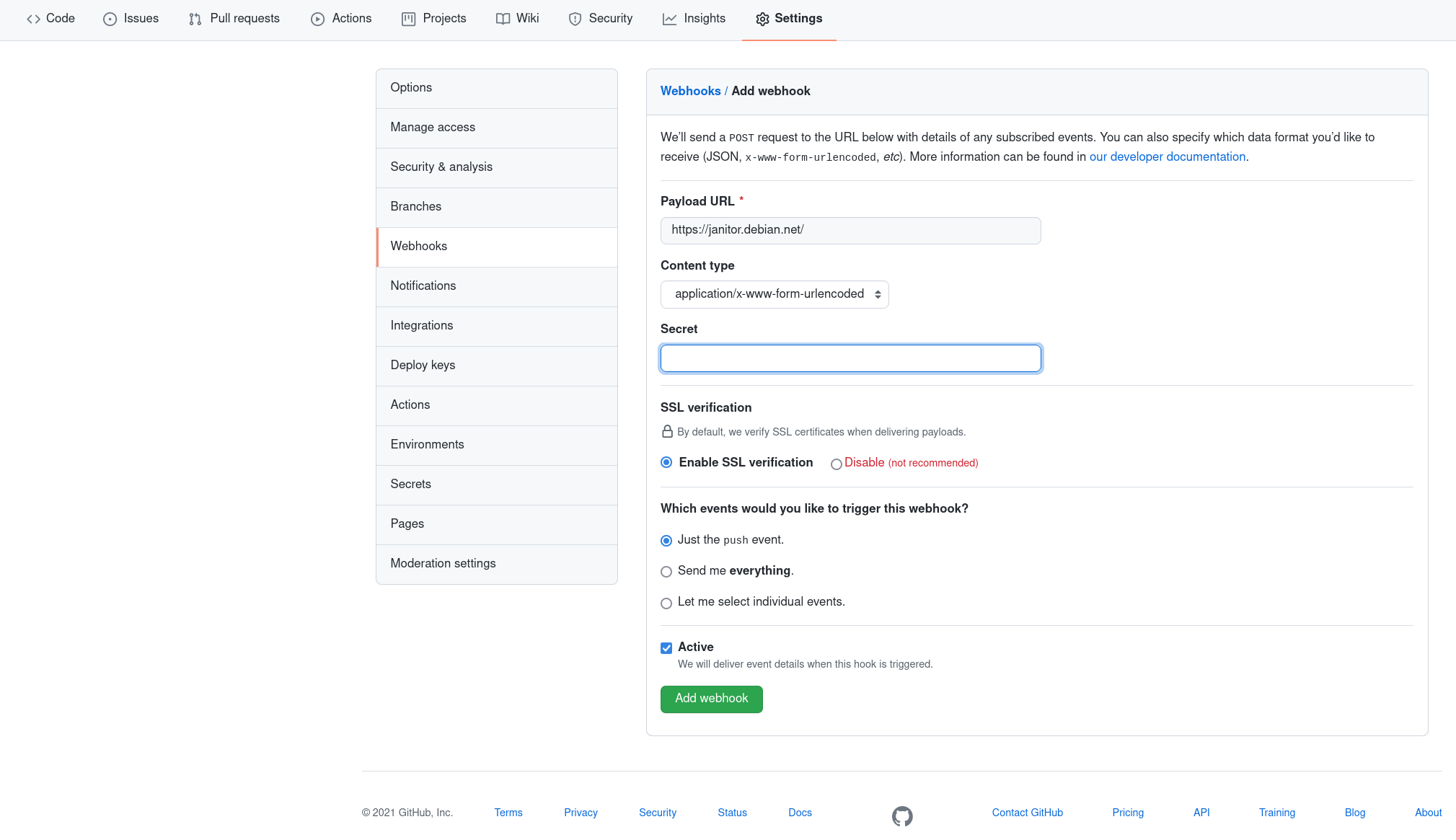








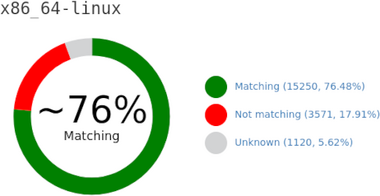




 A new release 0.4.13 of


 One of the technologies that was created by DFINITY as we built the Internet Computer is Candid. Candid is
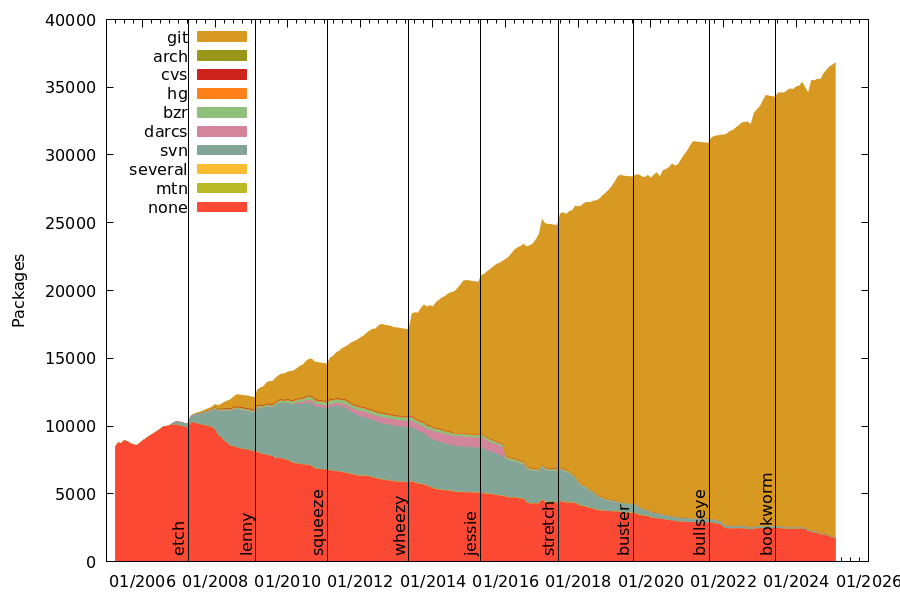
 The
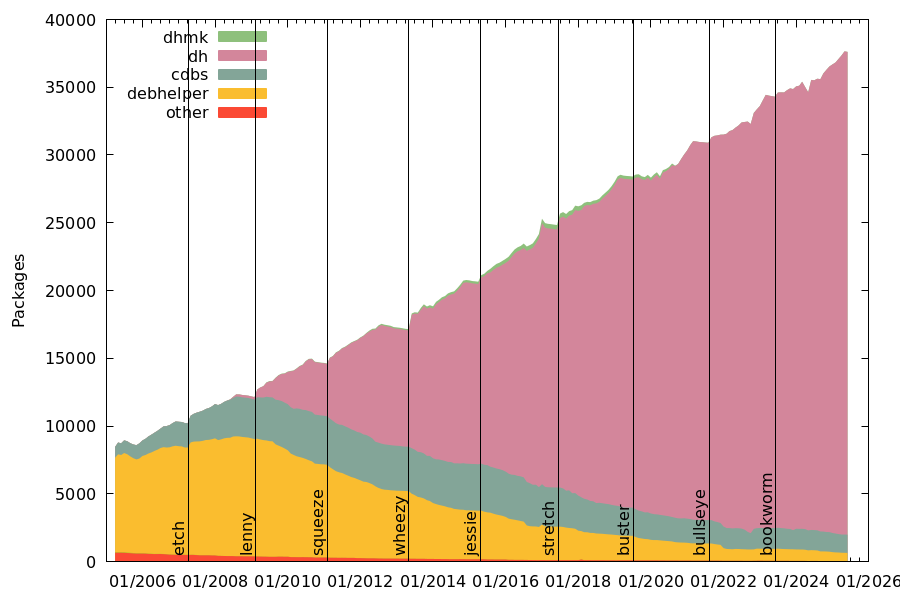
 That means about 2300 packages updated, and about 4000 unchanged.
 Or 5100 packages updated and 2100 for which there was nothing to do, i.e. no upstream commits since the last Debian upload.
As can be seen, this works for a surprising fraction of packages. It s possible to get the numbers up even higher, by both improving the tooling, the autopkgtests and the metadata that is provided by packages.

