Junichi Uekawa: Graph for my furusato tax.
 Graph for my furusato tax.
Exceeding 150-man will inevitably exceed 50-man limit for Ichiji-shotoku. So added some rough calculation there.
graph.
Graph for my furusato tax.
Exceeding 150-man will inevitably exceed 50-man limit for Ichiji-shotoku. So added some rough calculation there.
graph.
| Series: | Time of Iron #1 |
| Publisher: | Orbit |
| Copyright: | July 2024 |
| ISBN: | 0-316-56872-4 |
| Format: | Kindle |
| Pages: | 433 |
 Another short status update of what happened on my side last
month. The larger blocks are the Phosh 0.43
release, the initial file chooser portal, phosh-osk-stub now handling
digit, number, phone and PIN input purpose via special layouts as
well as Phoc mostly catching up with wlroots 0.18 and the current
development version targeting 0.19.
phosh
Recommend: for xdg-desktop-portal-phosh (MR)AdwDialog (MR, Screenshot)wlr_renderer_begin_with_buffer (MR)pubdate so it's clear the specs aren't stale (MR)
(got fixed in a different and better way, thanks Matthias!) Most of my Debian contributions this month were
sponsored by Freexian.
You can also support my work directly via
Liberapay.
Conferences
I attended MiniDebConf Toulouse
2024, and the
MiniDebCamp before it. Most of my time was spent with the Freexian folks
working on debusine; Stefano gave a
talk
about its current status with a live demo (frantically fixed up over the
previous couple of days, as is traditional) and with me and others helping
to answer questions at the end. I also caught up with some people I haven t
seen in ages, ate a variety of delicious cheeses, and generally had a good
time. Many thanks to the
organizers and
sponsors!
After the conference, Freexian collaborators spent a day and a half doing
some planning for next year, and then went for an afternoon visiting the
Cit de l espace.
Rust team
I upgraded these packages to new upstream versions, as part of upgrading
pydantic and rpds-py:
/ to /usr in iprutils
(#1087733).
I adjusted debconf to use the new /usr/lib/apt/apt-extracttemplates path
(#1087523).
I upgraded putty to
0.82.
Lots of travel and back to Tokyo. Then I got sick.
Trying to work on my bass piece, but it's really hard and I am having hard time getting to a reasonable shape.
Discussions on Debconf 2026 bid. Hoping it will materialize soon.
 Tracking library dependencies work in Debian to resolve from symbols usage to a library and add this to the list of dependencies.
That is working for years now.
The KDE community nowadays create more and more QML based applications.
Unfortunately QML is a interpreted language, this means missing QML dependencies will only be an issue at runtime.
To fix this I created
dh_qmldeps, that searches for QML dependencies at build time and will fail if it can't resolve the QML dependency.
Me didn't create an own QML interpreter, just using qmlimportscanner behind the scenes and process the output further to resolve the QML modules to Debian packages.
The workflow is like follows:
The package compiles normally and split to the binary packages.
Than dh_qmldeps scans through the package content to find QML content ( .qml files, or qmldirfor QML modules).
All founded files will be scanned by qmlimportscanner, the output is a list of depended QML modules.
As QML modules have a standardized file path, we can ask the Debian system, which packages ship this file path.
We end up with a list of Debian packages in the variable $ qml6:Depends .
This variable can be attached to the list of dependencies of the scanned package.
A maintainer can also lower some dependencies to Recommends or Suggest, if needed.
You can find the source code on salsa and usage documentation you can find on https://qt-kde-team.pages.debian.net/dh_qmldeps.html.
The last weeks I now enabled dh_qmldeps for newly every package, that creates a QML6 module package.
So the first bugs are solved and it should be usable for more packages.
By scanning with qmlimportscanner trough all code, I found several non-existing QML modules:
import QtQuick3DPrivate qt6-multimedia - no Private QML module QTBUG-131753.import QtQuickPrivate qt6-graphs - no Private QML module QTBUG-131754.import QtQuickTimeline qt6-quicktimeline - the correct QML name is QtQuick.Timeline QTBUG-131755.import QtQuickControls2 qt6-webengine - looks like a porting bug as the QML6 modules name is QtQuick.Controls QTBUG-131756.import QtGraphicalEffects kquickimageeditor - the correct name is for QML6 is qt5compat.graphicaleffects, properly as it is an example nobody checks it kquickimageeditor!7.dh_qmldeps scans currently all QML files inside the application source code.
 On the riscv64 port, the default boot method is UEFI, with U-Boot typically used as the firmware. This approach
aligns more closely with other architectures, which avoid developping riscv64
specific code. For advanced users, booting using U-Boot and extlinux is
possible, thanks to the kernel being built with
CONFIG_EFI_STUB=y.
The same applies to the Debian Installer, which is provided as ISO images in
various sizes and formats
like on other architectures. These images can be put on a USB drive or an
SD-card and booted directly from U-Boot in UEFI mode. Some users prefer to use
the netboot "image", which in practice consists of a Linux kernel, an initrd,
plus a set of Device Tree Blob (DTB) files.
However, booting this in UEFI mode is not straightforward, unless you use a
TFTP server, which is also not trivial. Less known to users, there is also a
corresponding mini.iso
image, which contains all the above plus a bootloader. This offers a simpler
alternative for installation, but depending on your (vendor) U-Boot version
this still requires to go through a media.
Systemd version 257-rc2
comes with a great new feature, the ability to include multiple DTB files in a
single UKI (Unified Kernel Image) file, with systemd-stub automatically
loading the appropriate one for the current hardware. A UKI file combines a
UEFI boot stub program, a Linux kernel image, an optional initrd, and further
resources in a single UEFI PE file. This finally solves the DTB problem in the
UEFI world for distributions, as a single image can work on multiple boards.
Building upon this, debian-installer on riscv64 now also creates a UEFI UKI
mini.efi
image, which contains systemd-stub, a Linux kernel, an initrd, plus a set of
Device Tree Blob (DTB) files. Using this image also ensures that the system is
booted in UEFI mode. Booting it with debian-installer is as simple as:
load mmc 0:1 mini.efo $kernel_addr_r # (can also be done using tftpboot, wget, etc.)
bootefi $kernel_addr_r
bootargs
environment variable. For instance, to boot in rescue mode:
setenv bootargs "rescue/enable=true"
 A new version of the RcppAPT
package arrived on CRAN earlier
today. RcppAPT
connects R to the C++ library behind the awesome
apt,
apt-get, apt-cache, commands (and their
cache) which powering Debian, Ubuntu and other derivative
distributions.
RcppAPT
allows you to query the (Debian or Ubuntu) package dependency graph at
will, with build-dependencies (if you have deb-src
entries), reverse dependencies, and all other goodies. See the vignette
and examples for illustrations.
This release moves the C++ compilation standard from C++11 to C++17.
I had removed the setting for C++11 last year as compilation by
compiler default worked well enough. But the version at CRAN still carried, which started
to lead to build failures on Debian unstable so it was time for an
update. And rather than implicitly relying on C++17 as selected
by the last two R releases, we made it explicit. Otherwise a few of the
regular package and repository updates have been made, but no new code
or features were added The NEWS entries follow.
Courtesy of my CRANberries, there is also a diffstat report for this release. A bit more information about the package is available here as well as at the GitHub repo. If you like this or other open-source work I do, you can now sponsor me at GitHub.Changes in version 0.0.10 (2024-11-29)
- Package maintenance updating continuous integration script versions as well as coverage link from README, and switching to Authors@R
- C++ compilation standards updated to C++17 to comply with libapt-pkg
This post by Dirk Eddelbuettel originated on his Thinking inside the box blog. Please report excessive re-aggregation in third-party for-profit settings.

 Debian continues participating in Outreachy, and we're excited to announce that
Debian has selected two interns for the Outreachy December 2024 - March 2025 round.
Patrick Noblet Appiah will work on Automatic Indi-3rd-party driver update,
mentored by Thorsten Alteholz.
Divine Attah-Ohiemi will work on Making the Debian main website more attractive by switching to HuGo as site generator,
mentored by Carsten Schoenert, Subin Siby and Thomas Lange.
Debian continues participating in Outreachy, and we're excited to announce that
Debian has selected two interns for the Outreachy December 2024 - March 2025 round.
Patrick Noblet Appiah will work on Automatic Indi-3rd-party driver update,
mentored by Thorsten Alteholz.
Divine Attah-Ohiemi will work on Making the Debian main website more attractive by switching to HuGo as site generator,
mentored by Carsten Schoenert, Subin Siby and Thomas Lange.
 Tryton is a FOSS software suite which is highly
modular and scalable. Tryton along with its standard modules can provide a
complete ERP solution or it can be used for specific functions of a business
like accounting, invoicing etc.
Debian packages for Tryton are being maintained by Mathias
Behrle. You can
follow him on Mastodon or get his help on
Tryton related projects through MBSolutions (his own
consulting company).
Freexian has been sponsoring Mathias s packaging work on Tryton for a
while, so that Debian
gets all the quarterly bug fix releases as well as the security release in a
timely manner.
The following contributors got their Debian Developer accounts in the last two
months:
You may have seen this toot
announcing OpenStreetMap's migration to Debian on their infrastructure.
After 18 years on Ubuntu, we've upgraded the @openstreetmap servers to Debian 12 (Bookworm). openstreetmap.org is now faster using Ruby 3.1. Onward to new mapping adventures! Thank you to the team for the smooth transition. #OpenStreetMap #DebianWe spoke with Grant Slater, the Senior Site Reliability Engineer for the OpenStreetMap Foundation. Grant shares: Why did you choose Debian?
There is a large overlap between OpenStreetMap mappers and the Debian community. Debian also has excellent coverage of OpenStreetMap tools and utilities, which helped with the decision to switch to Debian. The Debian package maintainers do an excellent job of maintaining their packages - e.g.: osm2pgsql, osmium-tool etc. Part of our reason to move to Debian was to get closer to the maintainers of the packages that we depend on. Debian maintainers appear to be heavily invested in the software packages that they support and we see critical bugs get fixed.What drove this decision to migrate?
OpenStreetMap.org is primarily run on actual physical hardware that our team manages. We attempt to squeeze as much performance from our systems as possible, with some services being particularly I/O bound. We ran into some severe I/O performance issues with kernels ~6.0 to < ~6.6 on systems with NVMe storage. This pushed us onto newer mainline kernels, which led us toward Debian. On Debian 12 we could simply install the backport kernel and the performance issues were solved.How was the transition managed?
Thankfully we manage our server setup nearly completely with code. We also use Test Kitchen with inspec to test this infrastructure code. Tests run locally using Podman or Docker containers, but also run as part of our git code pipeline. We added Debian as a test target platform and fixed up the infrastructure code until all the tests passed. The changes required were relatively small, simple package name or config filename changes mostly.What was your timeline of transition?
In August 2024 we moved the www.openstreetmap.org Ruby on Rails servers across to Debian. We haven't yet finished moving everything across to Debian, but we will upgrade the rest when it makes sense. Some systems may wait until the next hardware upgrade cycle. Our focus is to build a stable and reliable platform for OpenStreetMap mappers.How has the transition from another Linux distribution to Debian gone?
We are still in the process of fully migrating between Linux distributions, but we can share that we recently moved our frontend servers to Debian 12 (from Ubuntu 22.04) which bumped the Ruby version from 3.0 to 3.1 which allowed us to also upgrade the version of Ruby on Rails that we use for www.openstreetmap.org. We also changed our chef code for managing the network interfaces from using netplan (default in Ubuntu, made by Canonical) to directly using systemd-networkd to manage the network interfaces, to allow commonality between how we manage the interfaces in Ubuntu and our upcoming Debian systems. Over the years we've standardised our networking setup to use 802.3ad bonded interfaces for redundancy, with VLANs to segment traffic; this setup worked well with systemd-networkd. We use netboot.xyz for PXE networking booting OS installers for our systems and use IPMI for the out-of-band management. We remotely re-installed a test server to Debian 12, and fixed a few minor issues missed by our chef tests. We were pleasantly surprised how smoothly the migration to Debian went. In a few limited cases we've used Debian Backports for a few packages where we've absolutely had to have a newer feature. The Debian package maintainers are fantastic. What definitely helped us is our code is libre/free/open-source, with most of the core OpenStreetMap software like osm2pgsql already in Debian and well packaged. In some cases we do run pre-release or custom patches of OpenStreetMap software; with Ubuntu we used launchpad.net's Personal Package Archives (PPA) to build and host deb repositories for these custom packages. We were initially perplexed by the myriad of options in Debian (see this list - eeek!), but received some helpful guidance from a Debian contributor and we now manage our own deb repository using aptly. For the moment we're currently building deb packages locally and pushing to aptly; ideally we'd like to replace this with a git driven pipeline for building the custom packages in the future.Thank you for taking the time to share your experience with us.
Thank you to all the awesome people who make Debian!
In order to prepare for the Akademy I started some days before to give my Librem 5 ( an Open Hardware Phone) another try and ended up with a non starting Plasma 6.
Actually this issue was known already, but hasn't been addressed.
In the end I reached the Akademy with my Librem 5 having phosh installed (which is Gnome based), in order to have something working.
I met Bushan and Bart who took care and the issue was fixed two days later I could finally install Plasma 6 on it.
The last time I tested my Librem 5 with Plasma 5 it felt sluggish and not well working.
But this time I was impressed how well the system reacts.
Sure there are some things here and there, but in the bigger picture it is quite useable.
One annoying issue is that the camera is only working with one app and the other issue is the battery capacity, you have to charge it once a day.
Because of missing a QR reader that can use the camera, getting data to the phone was quite challenging.
Unfortunately the conference Wifi separated the devices and I couldn't use KDE Connect to transfer data.
In the end the only way to import data was taking five photos from the QR Code to import my D-Ticket to Itinerary.
With a device with Plasma Mobile, it directly was used for a experiment: How well does Dolphin works on a Plasma Mobile device.
Together with Felix Ernst we tried it out and were quite impressed, that Dolphin does work very well on Plasma Mobile, after some simple modifications on the UI.
That resulted in a patch to add a mobile UI for Dolphin !826.
With more time to play with my Librem 5 I also found an bug in KWeather, that is missing a Refresh option, when used in a Plasma Mobile environment #493656.
Akademy is a good place to identify and solve some issues.
It is always like that, you chat with someone and they can tell you who to ask to answer the concrete question and in the end you can solve things, that seems unsolvable in the beginning.
There was also time to look into the travelling app Itinerary.
A lot people are faced with a lot of real world issues, when not in their home town.
Itinerary is the best traveling apps I know about.
It can import nearly every ticket you have and can get location information from restaurant websites and allow routing to that place. It does add many useful information, while traveling like current delays, platform changes, live updates for elevator, weather information at the destination, a station map and all those features with strong focus on privacy.
In detail I found some small things to improve:
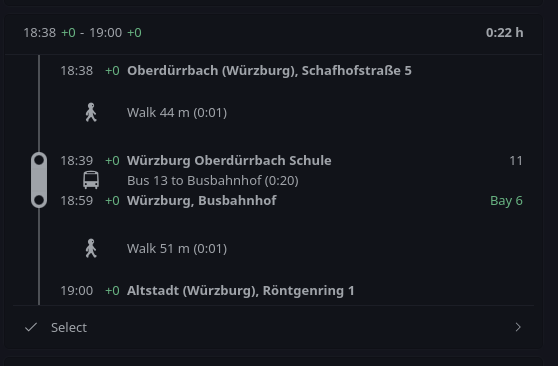
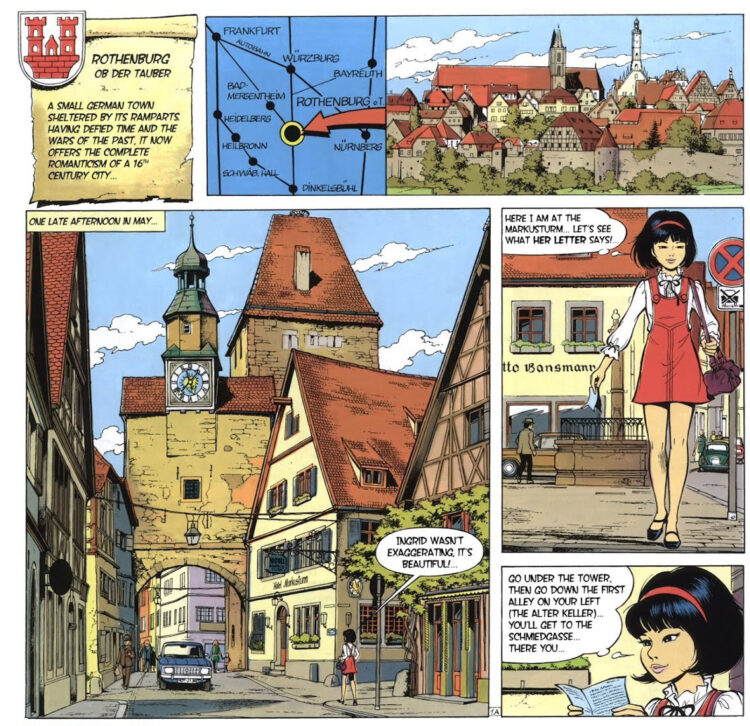 In order to not have a hard cut from Akademy to normal life, I had a lunch with Carlos, to discuss KDE Neon and how we can improve the interaction with Debian.
In the future this should have less friction and make both communities work together more smoothly.
Additionally as I used to develop on KDEPIM with the help of Docker images based on Neon I ask for a meta kf6 dev meta package.
That should help to get rid of most hand written lists of dev packages in the Docker file in order to make it more simple for new contributors to start hacking on KDEPIM.
The rest of the day I finally found time to do the normal tourist stuff: Going to the Wine bridge and having a walk to the castle of W rzburg.
Unfortunately you hear a lot of car noises up there, but I could finally relaxe in a Japanese designed garden.
Finally at Saturday I started my trip back.
The trains towards Eberswalde are broken and I needed to find alternative routing.
I got a little bit nervous, as it was the first time I travelled with my Librem 5 and Itinerary only and needed to reach the next train in less than two mins.
With the indoor maps provided, I could prepare my run through the train station so I reached successfully my next train.
By the way, also if you only only use KDE software, I would recommend everyone to join Akademy ;)
 My trek to Toulouse was seamless. I hopped on a bus from my home in Bristol to the airport, then took a short flight. I luxuriated in seat 1A, making me the first to disembark a mere ten minutes later, I was already on the bus heading to my hotel.


 Once settled, I wasted no time exploring the charms of Toulouse. Just a short stroll from my hotel, I found myself beside a tranquil canal, its waters mirroring the golden hues of the trees lining its banks. Autumn in Toulouse painted the city in warm oranges and reds, creating a picturesque backdrop that was a joy to wander through. Every corner of the street revealed more of the city's rich cultural tapestry and striking architecture. Known affectionately as 'La Ville Rose' (The Pink City) for its unique terracotta brickwork, Toulouse captivated me with its blend of historical allure and vibrant modern life.

 Prior to the main event, the MiniDebCamp provided two days of hacking at Artilect FabLab a space as creative as it was welcoming. It was a pleasure to reconnect with familiar faces and forge new friendships.
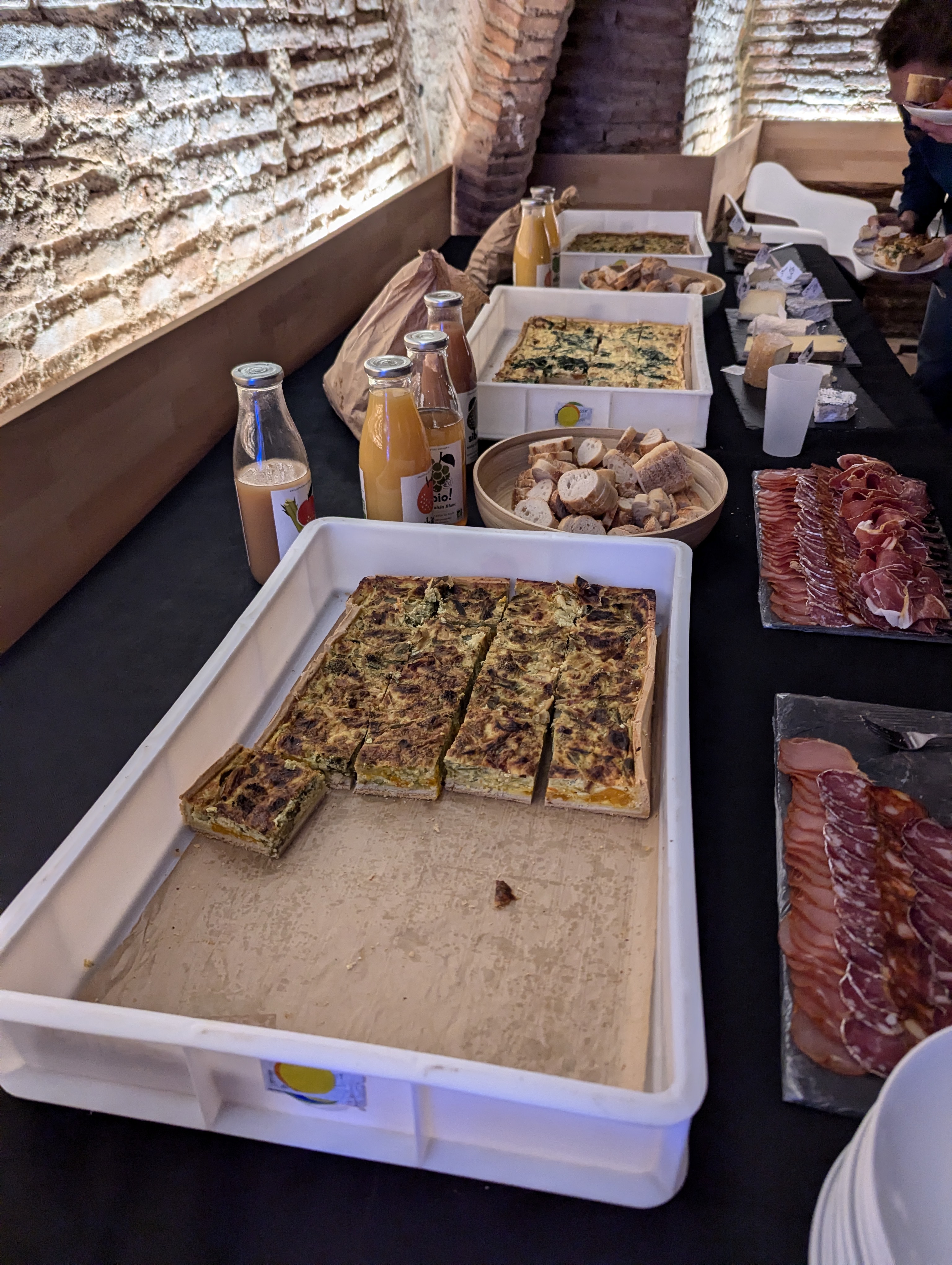


 The hospitality was exceptional. Our lunches boasted a delicious array of quiches, an enticing charcuterie board, and a superb selection of cheeses, all perfectly complemented by exquisite petite fours. Each item was not only a feast for the eyes but also a delight for the palate.
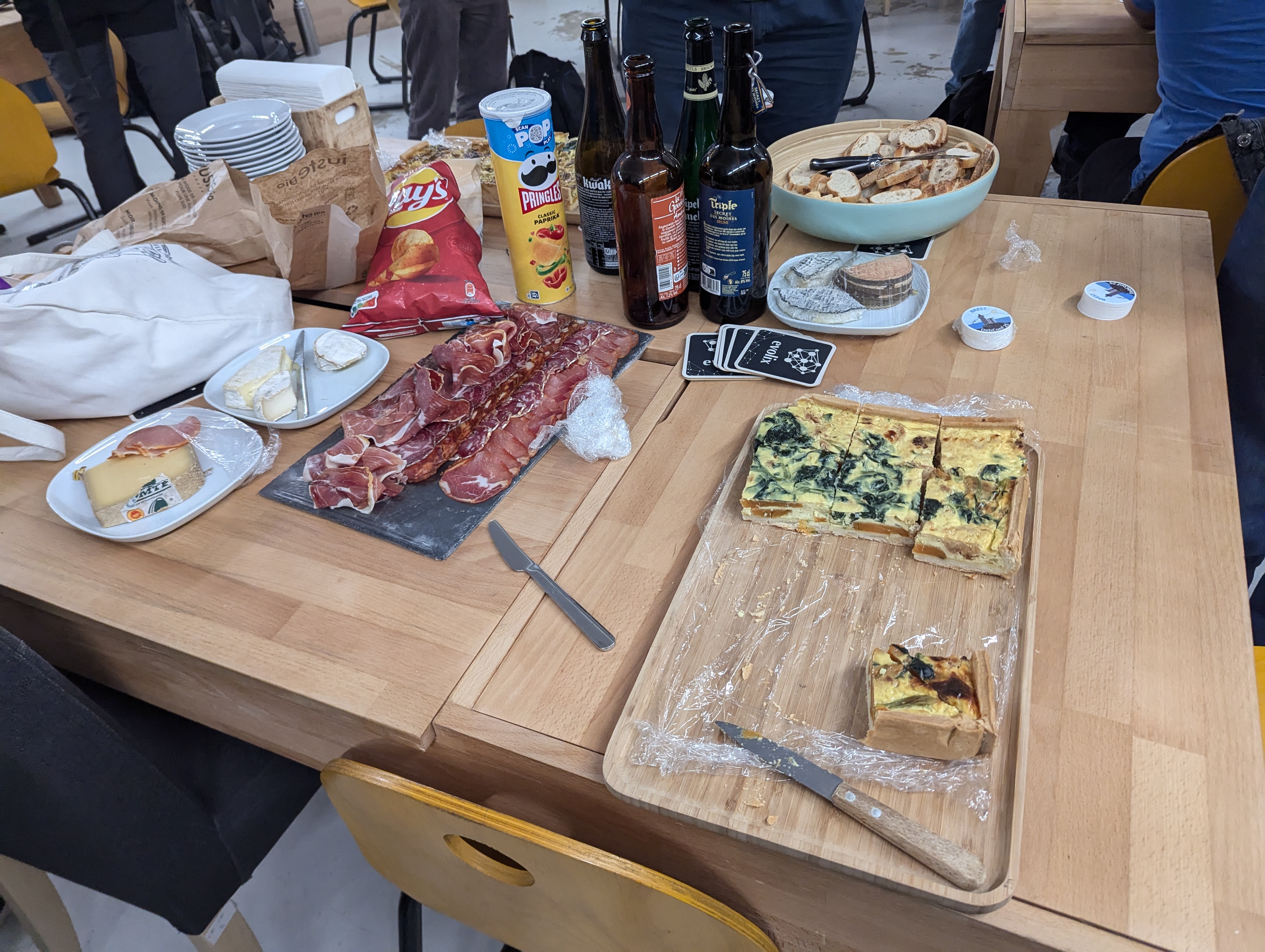
 Leftovers from these gourmet feasts fuelled our impromptu cheese and wine party on Thursday evening a highlight where informal chats blended seamlessly with serious software discussions.



 The enchantment of Toulouse doesn't dim with the setting sun; instead, it transforms. My evening strolls took me along the banks of the Garonne, under a sky just turning from twilight to velvet blue. The river, a dark mirror, perfectly reflected the illuminated grandeur of the city's architecture. Notably, the dome of the H pital de La Grave stood out, bathed in a warm glow against the night sky. This architectural gem, coupled with the soft lights of the bridge and the serene river, created a breathtaking scene that was both tranquil and awe-inspiring.
 The MiniDebConf itself, part of the larger Capitole du Libre event, was a fantastic immersion into the world of free software. Unlike the ticket-free FOSDEM, this conference required QR codes for entry and even had bag searches, adding an unusual layer of security for a software conference.
Highlights included the crepe-making by the organisers, reminiscent of street food scenes from larger festivals. The availability of crepes for MiniDebConf attendees and the presence of food trucks added a festive air, albeit with the inevitable long queues familiar to any festival-goer.

 The city's bike rental system was a boon easy to use with handy bike baskets perfect for casual city touring. I chose pedal power over electric, finding it a pleasant way to navigate the streets and absorb the city's vibrant atmosphere.

 Toulouse's markets were a delightful discovery. From a spontaneous visit to a market near my hotel upon arrival, to cycling past bustling marketplaces, each day presented new local flavours and crafts to explore.
The Za'atar flatbread from a Syrian stall was a particularly memorable lunch pick.


 Our conference wrapped up with a spontaneous gathering at La Brasserie Les Arcades in Place du Capitole. Finding a caf that could accommodate 30 of us on a Sunday evening without a booking felt like striking gold. What began with coffee and ice cream smoothly transitioned into dinner, where I enjoyed a delicious braised duck leg with green peppercorn sauce. This meal rounded off the trip with lively conversations and shared experiences.


 Returning from Toulouse, I found myself once again in seat 1A, offering the advantage of being the first off the plane, both on departure and arrival. My flight touched down in Bristol ahead of schedule, and within ten minutes, I was on the A1 bus, making my way back into the heart of Bristol.
 For the past decade-plus, every piece of software I write has had one of two release processes.
Software that gets deployed directly onto servers (websites, mostly, but also the infrastructure that runs Pwnedkeys, for example) is deployed with nothing more than
git push prod main.
I ll talk more about that some other day.
Today is about the release process for everything else I maintain Rust / Ruby libraries, standalone programs, and so forth.
To release those, I use the following, extremely intricate process:
git release in the repository.
git tag -a tagname will open up an editor window where you can enter your annotation, and git tag -a -m "some annotation" tagname will create the tag with the annotation some annotation .
Retrieving the annotation for a tag is straightforward, too: git show tagname will display the annotation along with all the other tag-related information.
Now that we know all about annotated tags, let s talk about how to use them to make software releases freaking awesome.
-a (or --annotate, if you enjoy typing) to your git tag command, and WHAM! annotation achieved.
Releases, though, typically have unique and ever-increasing version numbers, which we want to encode in the tag name.
Rather than having to look at the existing tags and figure out the next version number ourselves, we can have software do the hard work for us.
Enter: git-version-bump.
This straightforward program takes one mandatory argument: major, minor, or patch, and bumps the corresponding version number component in line with Semantic Versioning principles.
If you pass it -n, it opens an editor for you to enter the release notes, and when you save out, the tag is automagically created with the appropriate name.
Because the program is called git-version-bump, you can call it as a git command: git version-bump.
Also, because version-bump is long and unwieldy, I have it aliased to vb, with the following entry in my ~/.gitconfig:
[alias]
    vb = version-bump -n
Of course, you don t have to use git-version-bump if you don t want to (although why wouldn t you?).
The important thing is that the only step you take to go from here is our current codebase in main to everything as of this commit is version X.Y.Z of this software , is the creation of an annotated tag that records the version number being released, and the metadata that goes along with that release.
git release
As I said earlier, I ve been using this release process for over a decade now.
So long, in fact, that when I started, GitHub Actions didn t exist, and so a lot of the things you d delegate to a CI runner these days had to be done locally, or in a more ad-hoc manner on a server somewhere.
This is why step 2 in the release process is run git release .
It s because historically, you can t do everything in a CI run.
Nowadays, most of my repositories have this in the .git/config:
[alias]
    release = push --tags
Older repositories which, for one reason or another, haven t been updated to the new hawtness, have various other aliases defined, which run more specialised scripts (usually just rake release, for Ruby libraries), but they re slowly dying out.
The reason why I still have this alias, though, is that it standardises the release process.
Whether it s a Ruby gem, a Rust crate, a bunch of protobuf definitions, or whatever else, I run the same command to trigger a release going out.
It means I don t have to think about how I do it for this project, because every project does it exactly the same way.
It wasn t the button that was the problem. It was the miles of wiring, the hundreds of miles of cables, the circuits, the relays, the machinery. The engine was a massive, sprawling, complex, mind-bending nightmare of levers and dials and buttons and switches. You couldn t just slap a button on the wall and expect it to work. But there should be a button. A big, fat button that you could press and everything would be fine again. Just press it, and everything would be back to normal.Once you ve accepted that your release process should be as simple as creating an annotated tag and running one command, you do need to consider what happens afterwards. These days, with the near-universal availability of CI runners that can do anything you need in an isolated, reproducible environment, the work required to go from annotated tag to release artifacts can be scripted up and left to do its thing. What that looks like, of course, will probably vary greatly depending on what you re releasing. I can t really give universally-applicable guidance, since I don t know your situation. All I can do is provide some of my open source work as inspirational examples. For starters, let s look at a simple Rust crate I ve written, called
- Red Dwarf: Better Than Life
strong-box.
It s a straightforward crate, that provides ergonomic and secure cryptographic functionality inspired by the likes of NaCl.
As it s just a crate, its release script is very straightforward.
Most of the complexity is working around Cargo s inelegant mandate that crate version numbers are specified in a TOML file.
Apart from that, it s just a matter of building and uploading the crate.
Easy!
Slightly more complicated is action-validator.
This is a Rust CLI tool which validates GitHub Actions and Workflows (how very meta) against a published JSON schema, to make sure you haven t got any syntax or structural errors.
As not everyone has a Rust toolchain on their local box, the release process helpfully build binaries for several common OSes and CPU architectures that people can download if they choose.
The release process in this case is somewhat larger, but not particularly complicated.
Almost half of it is actually scaffolding to build an experimental WASM/NPM build of the code, because someone seemed rather keen on that.
Moving away from Rust, and stepping up the meta another notch, we can take a look at the release process for git-version-bump itself, my Ruby library and associated CLI tool which started me down the Just Tag It Already rabbit hole many years ago.
In this case, since gemspecs are very amenable to programmatic definition, the release process is practically trivial.
Remove the boilerplate and workarounds for GitHub Actions bugs, and you re left with about three lines of actual commands.
These approaches can certainly scale to larger, more complicated processes.
I ve recently implemented annotated-tag-based releases in a proprietary software product, that produces Debian/Ubuntu, RedHat, and Windows packages, as well as Docker images, and it takes all of the information it needs from the annotated tag.
I m confident that this approach will successfully serve them as they expand out to build AMIs, GCP machine images, and whatever else they need in their release processes in the future.
main becomes practically trivial.
This is mostly due to another fantastic and underused Git command: git describe.
How git describe works is, basically, that it finds the most recent commit that has an associated annotated tag, and then generates a string that contains that tag s name, plus the number of commits between that tag and the current commit, with the current commit s hash included, as a bonus.
That is, imagine that three commits ago, you created an annotated release tag named v4.2.0.
If you run git describe now, it will print out v4.2.0-3-g04f5a6f (assuming that the current commit s SHA starts with 04f5a6f).
You might be starting to see where this is going.
With a bit of light massaging (essentially, removing the leading v and replacing the -s with .s), that string can be converted into a version number which, in most sane environments, is considered newer than the official 4.2.0 release, but will be superceded by the next actual release (say, 4.2.1 or 4.3.0).
If you re already injecting version numbers into the release build process, injecting a slightly different version number is no work at all.
Then, you can easily build release artifacts for every commit to main, and make them available somewhere they won t get in the way of the official releases.
For example, in the proprietary product I mentioned previously, this involves uploading the Debian packages to a separate component (prerelease instead of main), so that users that want to opt-in to the prerelease channel simply modify their sources.list to change main to prerelease.
Management have been extremely pleased with the easy availability of pre-release packages; they ve been gleefully installing them willy-nilly for testing purposes since I rolled them out.
In fact, even while I ve been writing this article, I was asked to add some debug logging to help track down a particularly pernicious bug.
I added the few lines of code, committed, pushed, and went back to writing.
A few minutes later (next week s job is to cut that in-process time by at least half), the person who asked for the extra logging ran apt update; apt upgrade, which installed the newly-built package, and was able to progress in their debugging adventure.
Continuous Delivery: It s Not Just For Hipsters.
In my companion article, I made the bold claim that your release process should consist of no more than two steps:
gemspec files are actually executable Ruby code, so I call code (that s part of git-version-bump, as an aside) to calculate the version number from the git tags.
The Rust build tool, Cargo, uses a TOML file, which isn t as easy, but a small amount of release automation is used to take care of that.
debian/changelog file in the build directory.
Don t keep that file in revision control, though: build it at release time.
Everything you need to construct a Debian (or RPM) changelog is in the tag version numbers, dates, times, authors, release notes.
Use it for much good.
CHANGELOG file.
If it s maintained during the development process, it typically has an archive of all the release notes, under version numbers, with an Unreleased heading at the top.
It s one more place to remember to have to edit when making that preparing release X.Y.Z commit, and it is a gift to the Demon of Spurious Merge Conflicts if you follow the policy of every commit must add a changelog entry .
My solution: just burn it to the ground.
Add a line to the top with a link to wherever the contents of annotated tags get published (such as GitHub Releases, if that s your bag) and never open it ever again.
update hook, which can reject the tag push if it doesn t meet the requirements, and you re sorted.
vX.Y.Z, you use foo/vX.Y.Z, bar/vX.Y.Z, and baz/vX.Y.Z.
The release automation for each package just triggers on tags that match the pattern for that particular package, and limits itself to those tags when figuring out what the version number is.
vX.Y.Z.
It can be anything you want.
Relatedly, there is a (rare, but existent) need for packages that don t really have a conception of releases in the traditional sense.
The example I ve hit most often is automatically generated bindings packages, such as protobuf definitions.
The source of truth for these is a bunch of .proto files, but to be useful, they need to be packaged into code for the various language(s) you re using.
But those packages need versions, and while someone could manually make releases, the best option is to build new per-language packages automatically every time any of those definitions change.
The versions of those packages, then, can be datestamps (I like something like YYYY.MM.DD.N, where N starts at 0 each day and increments if there are multiple releases in a single day).
This process allows all the code that needs the definitions to declare the minimum version of the definitions that it relies on, and everything is kept in sync and tracked almost like magic.
It would be fantastic if all those AI companies dedicated some time to make
their web crawlers smarter (what about using AI?). Noawadays most of them still
stupidly follow every link on a Git frontend.
Hint: Changing the display options does not provide more training data!
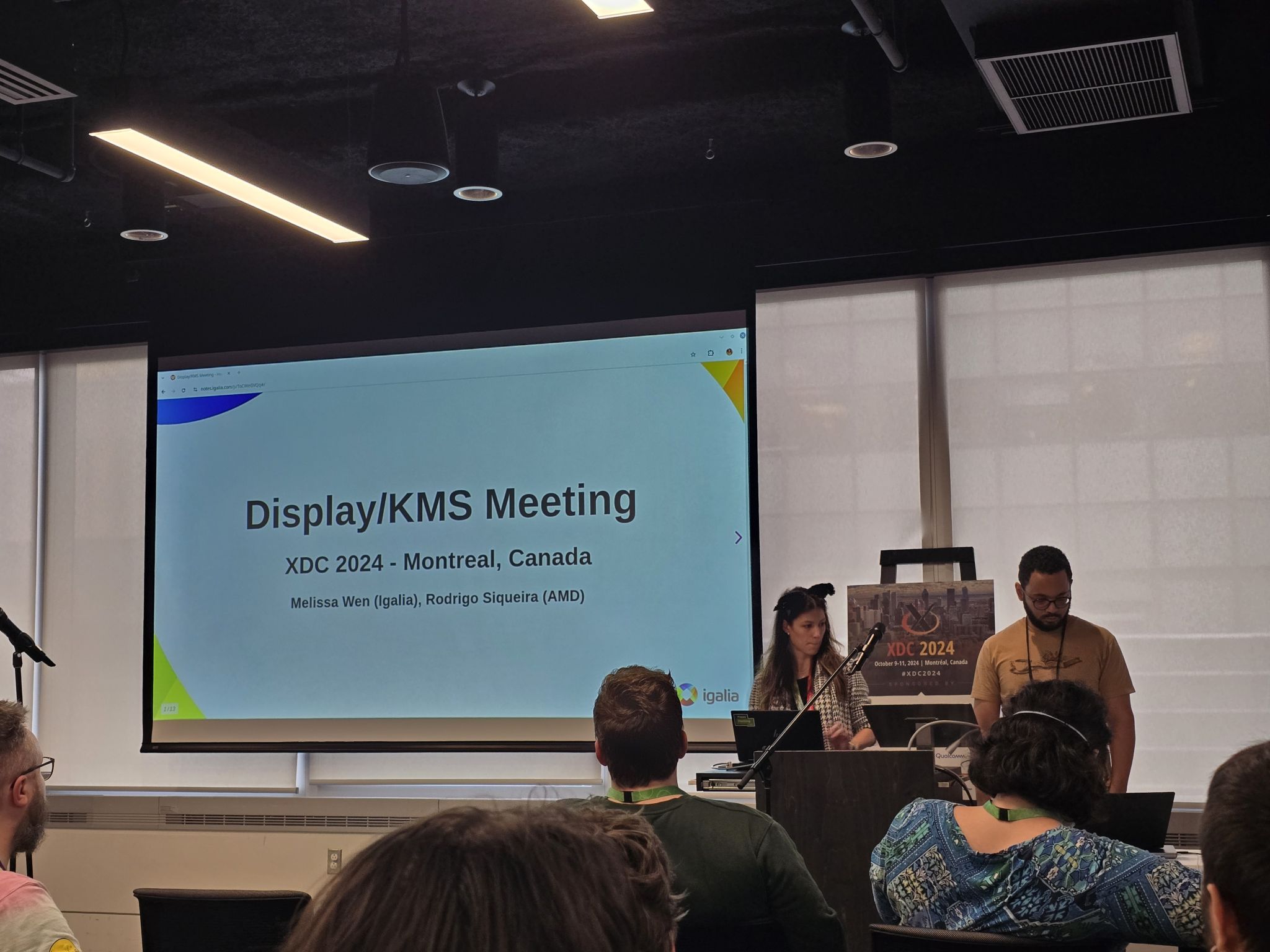
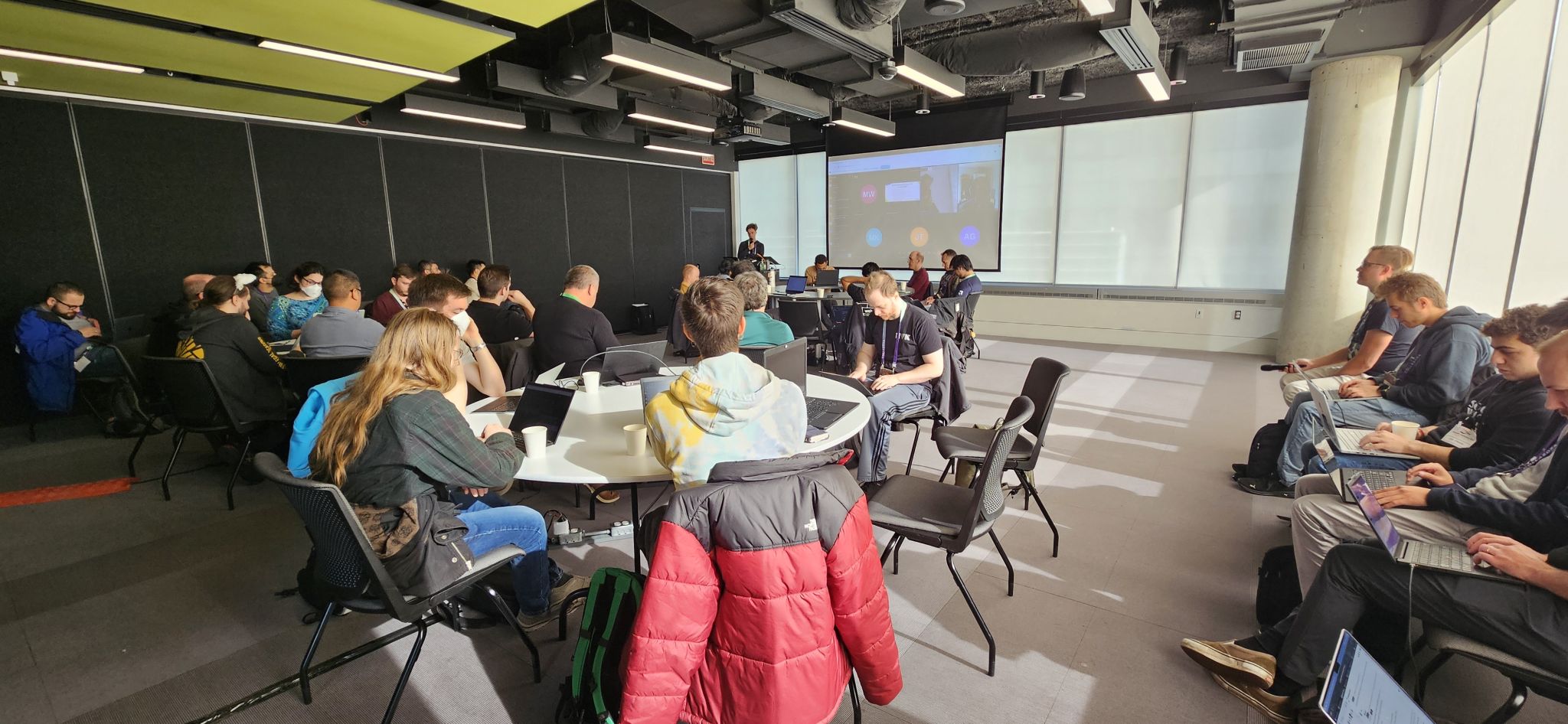 Speakers: Melissa Wen (Igalia) and Rodrigo Siqueira (AMD)
Link: https://indico.freedesktop.org/event/6/contributions/383/
Topics: Similar to the hackfest, the meeting agenda was built over the
first two days of the conference and mixed talks follow-up with new ideas and
ongoing community efforts.
The final agenda covered five topics in the scheduled order:
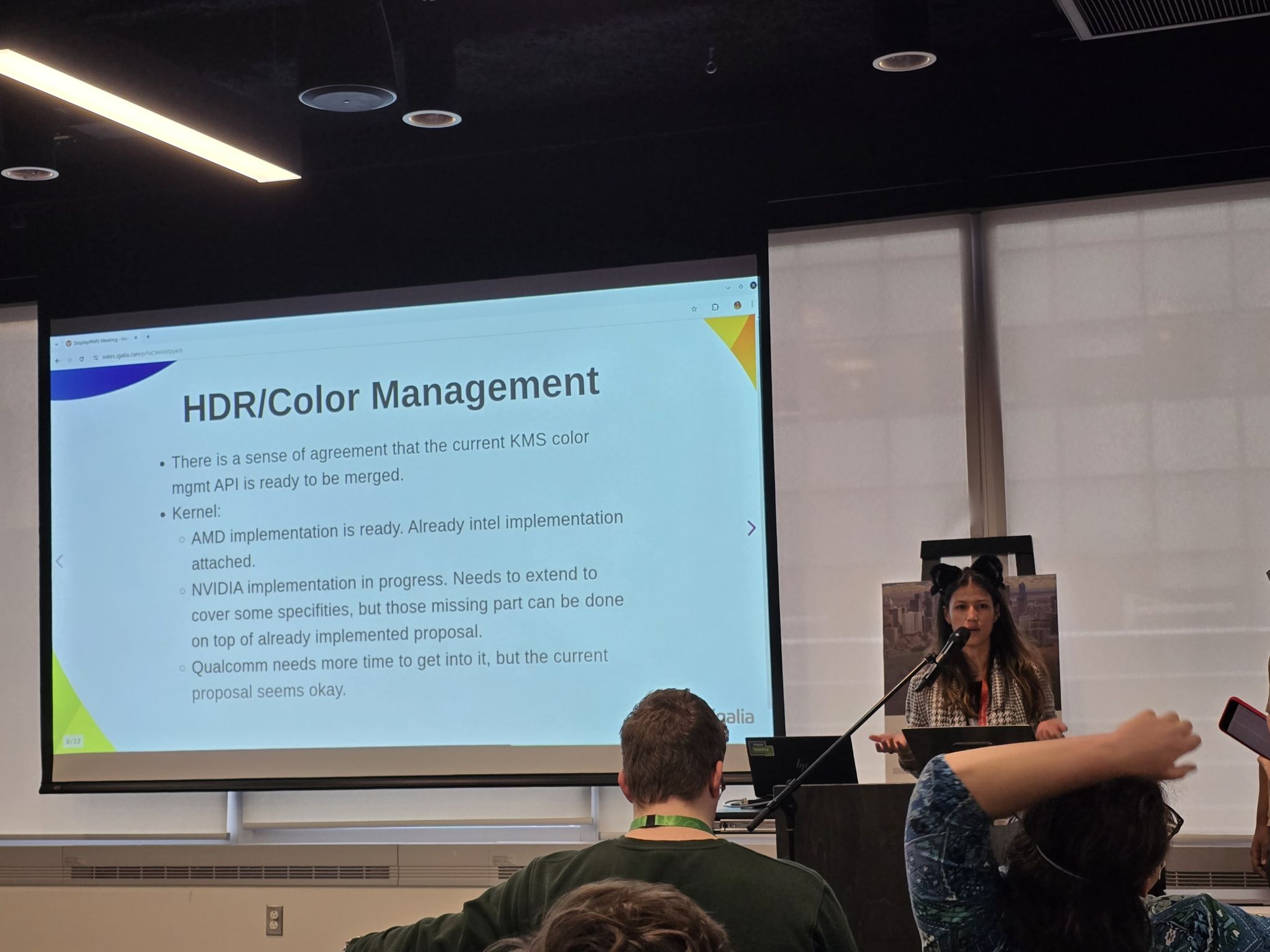
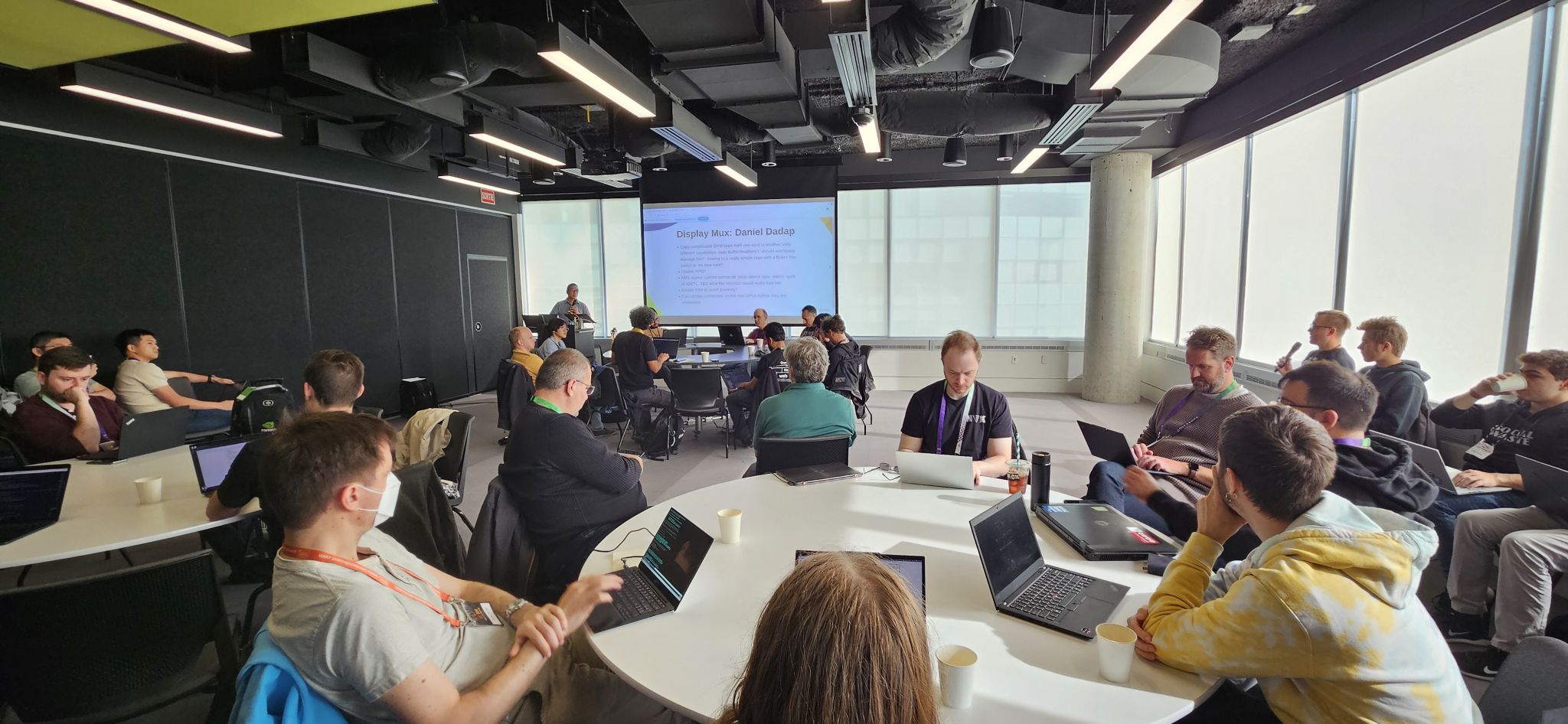
 From his notes, let s dive into the key discussions!
 Armadillo is a powerful
and expressive C++ template library for linear algebra and scientific
computing. It aims towards a good balance between speed and ease of use,
has a syntax deliberately close to Matlab, and is useful for algorithm
development directly in C++, or quick conversion of research code into
production environments. RcppArmadillo
integrates this library with the R environment and language and is
widely used by (currently) 1191 other packages on CRAN, downloaded 37.2 million
times (per the partial logs from the cloud mirrors of CRAN), and the CSDA paper (preprint
/ vignette) by Conrad and myself has been cited 603 times according
to Google Scholar.
Conrad released a minor
version 14.2.0 a few days ago after we spent about two weeks with
several runs of reverse-dependency checks covering corner cases. After a
short delay at CRAN due to a
false positive on a test, a package failing tests we also failed under
the previous version, and some concern over new deprecation warnings
_whem using the headers directly as _e.g. mlpack R package
does we are now on CRAN. I
noticed a missing feature under large 64bit word (for large
floating-point matrices) and added an exporter for
icube
going to double to support the 64-bit integer range (as we
already did, of course, for vectors and matrices). Changes since the
last CRAN release are
summarised below.
Courtesy of my CRANberries, there is a diffstat report relative to previous release. More detailed information is on the RcppArmadillo page. Questions, comments etc should go to the rcpp-devel mailing list off the Rcpp R-Forge page. If you like this or other open-source work I do, you can sponsor me at GitHub.Changes in RcppArmadillo version 14.2.0-1 (2024-11-16)
- Upgraded to Armadillo release 14.2.0 (Smooth Caffeine)
- Faster handling of symmetric matrices by
inv()andrcond()- Faster handling of hermitian matrices by
inv(),rcond(),cond(),pinv(),rank()- Added
solve_opts::force_symoption tosolve()to force the use of the symmetric solver- More efficient handling of compound expressions by
solve()- Added exporter specialisation for
icubefor theARMA_64BIT_WORDcase
This post by Dirk Eddelbuettel originated on his Thinking inside the box blog. Please report excessive re-aggregation in third-party for-profit settings.
Next.