Search Results: "Dirk Eddelbuettel"

2 May 2012

Dirk Eddelbuettel: Boston Marathon 2012

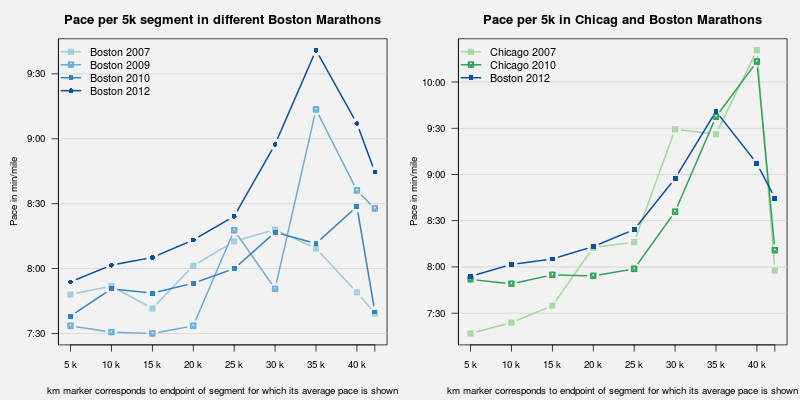
Two weeks ago I ran the 116th running of the Boston Marathon. Weather is often part of the story in Boston as e.g. my first one in 2007 happened after a storm-drenched and very wet weekend. This time, it was the opposite. Temperatures in the 60s in the morning before the start at 10:00am, which tempaeratures climbing well into the 80s for most of the race. The organizers had sent increasingly alarming email to us participants, warning about the weather conditions. And it was unpleasantly hot. Race support was great though: lots of locals had sprinklers pointed to the street; water stops were plenty and amply stocked and, being a nice summery day, lots of spectators made for lots of cheer. But heat makes for dreadful running conditions. I was pretty well trained, but I ended up running 3:43:55, or a tad slower than in Chicago 2007 (also record heat, with the race stopped around the four-hour mark) and Chicago 2009 (hot, though not that hot---but I was somewhat undertrained). Which makes this a personal worst. Oh well, stuff happens. And it was a pretty rough day---reports claimed that 2100 runners, or about 10%, were seeking some form of medical attention during or after the race which is a much higher proportion than under normal conditions. The chart below is an updated version of a chart which had appeared on my running page before. I regrouped my prior Bostons (2007, 2009 and 2010) on the left, and the Chicago runs 2007 and 2009 on the right---and each with the current Boston marathon. (Boston 2012 marathon in comparison to other Boston and Chicago marathons) So compared to the prior Boston races, I did indeed relatively poorly. Starting slower, and slowing down even more leading to about 1:45 for the first half and 1:58 for the second. Compared to the two poor Chicago races (put of the six times I have ran that race), things are not quite as bad as at least I didn't peak at over 10 min/mile. Weather will always remain a challenge. The previous marathon (which was last fall's Fox Valley 2011) was unseasonally cold and wet---making for a time fast enough to get me back to Boston. I am registered again for this one, so we will see what September brings this year.

20 April 2012

Dirk Eddelbuettel: RcppArmadillo 0.3.0.2 released and on CRAN

Earlier today, Conrad Sanderson released another bug-fix version 3.0.2 for the still fairly recent 3.0.0 version of his excellent Armadillo C++ template library for linear algebra. The new RcppArmadillo release 0.3.0.2 also appeared on CRAN this morning. Beside Conrad's bugfix in Armadillo itself, he also convinced us to unroll a change imposed by R: NDEBUG is now being defined unconditionally when compiling R packages. In Armadillo's case, this suppresses a number of useful things including bounds-checking. So we now undefine this symbol in the initial RcppArmadillo headers. Users can still set it manually, and/or define ARMA_NO_DEBUG. The short NEWS entry follows below.
0.3.0.2 2012-04-19
    o   Upgraded to Armadillo release 3.0.2
          * fixes for handling diagonal matrices
    o   Undefine NDEBUG if it has been set (as R does) as this prevents a
        number of useful debugging checks. Users can still define it or
        define ARMA_NO_DEBUG if they want a 'non-development' build
Courtesy of CRANberries, there is also a diffstat report for 0.3.0.2 relative to 0.3.0.1 As always, more detailed information is on the RcppArmadillo page. Questions, comments etc should go to the rcpp-devel mailing list off the R-Forge page.

13 April 2012

Dirk Eddelbuettel: RDieHarder 0.1.2

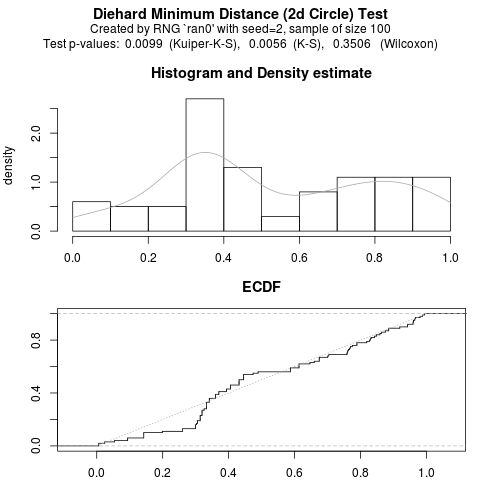
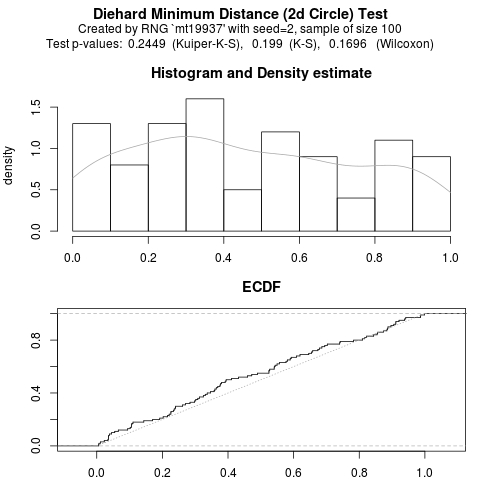
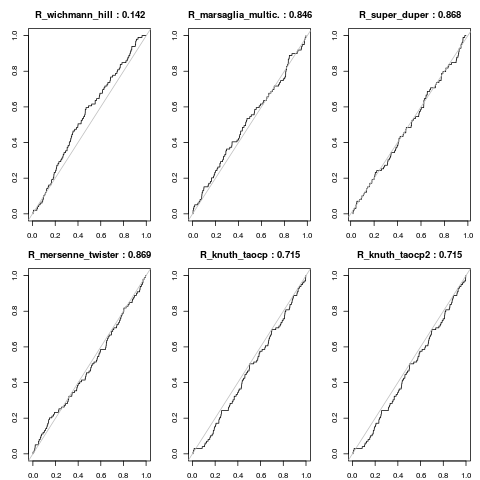
RDieHarder is an R package providing access to the DieHarder battery of tests for random number generators developed by Robert G. Brown and others. DieHarder had been updated to version 3.1.1 a while back, and I had been a little behind with updating RDieHarder. Version 0.1.2 rectifies this. The package still comes with a vignette describing both DieHarder and the RDieHarder package. And because pictures speak louder than a thousand (blogged) words, here is the first chart from the vignette: RDieHarder test of weak RNG RDieHarder test of stronger RNG On the left, we have a poor random-number generator (RNG), the older ran0 function. The histogram illustrating the distribution of test scores is somewhat uneven. An ideal (and asymptotic) outcode is a uniform distribution of p-values from the test. The empirical cumulative distribution function (ECDF) below indicates a somewhat pronounced departure from the diagonal. Informally speaking, this is what the (Kuiper-)Kolmogorov-Smirnov test quantifies, and we see (in the text in the chart) that the null of can be rejected an conventional levels. Based on this example (which had a short run-time with few samples) we would indeed mistrust this (known bad) RNG. On the right, we have a more recent and trusted RNG, the well-known Mersenne Twister. The ten histogram buckets are all closer to the expected value of one-tenth, the estimated density is closer to flat, the ECDF is closer to the diagonal and the tests don't reject---so no reason to mistrust this RNG based on this test alone. RDieHarder lets you run a battery of such tests against a boatload of known RNGs. Here is a second example, comparing the six RNGs built into R itself: RDieHarder test of RNGs in GNU R And these six look fine, as you'd expect. (And yes, the ECDF charts should each be on a square plot. Another time...) Courtesy of CRANberries, there is also a diffstat report for 0.1.2 relative to the older 0.1.1 release. More detailed information is on the RDieHarder page.

12 April 2012

Dirk Eddelbuettel: RcppArmadillo 0.3.0.1 released and on CRAN

Conrad Sanderson released a bug-fix version 3.0.1 following up on the very recent 3.0.0 version of his excellent Armadillo C++ template library for linear algebra. I made a new RcppArmadillo release 0.3.0.1 which just appeared on CRAN. The short NEWS entry follows below.
0.3.0.1 2012-04-12
    o   Upgraded to Armadillo release 3.0.1
          * fixes for compilation errors
          * fixes for potential aliasing issues
Courtesy of CRANberries, there is also a diffstat report for 0.3.0.1 relative to 0.3.0 As always, more detailed information is on the RcppArmadillo page. Questions, comments etc should go to the rcpp-devel mailing list off the R-Forge page.

11 April 2012

Dirk Eddelbuettel: RcppArmadillo 0.3.0 is now on CRAN

Conrad Sanderson has released a new major version 3.0.0 of his excellent Armadillo C++ template library for linear algebra. A corresponding new release 0.3.0 of RcppArmadillo is now on CRAN. This follows four pre-releases of Armadillo which we packaged as before, but for reasons detailed in another post did not send to CRAN. All that said, here are the NEWS entries for all release since the last non-test release:
0.3.0   2012-04-10
    o   Upgraded to Armadillo release 3.0.0 "Antarctic Chilli Ranch"
          * added non-contiguous submatrix views
          * added shorthand for inverse: .i()
          * added hist() and histc()
          * faster repmat()
          * faster handling of submatrix views with one row or column 
          * faster generation of random numbers
          * faster element access in fixed size matrices
          * better detection of vector expressions by sum(), cumsum(),
            prod(), min(), max(), mean(), median(), stddev(), var() 
          * expressions X=A.i()*B and X=inv(A)*B are automatically converted
            to X=solve(A,B) 
0.2.40  2012-04-04
    o   Upgraded to Armadillo release 2.99.4 "Antarctic Chilli Ranch (Beta 4)"
          * fixes for handling expressions with fixed size matrices
0.2.39  2012-04-02
    o   Upgraded to Armadillo release 2.99.3 "Antarctic Chilli Ranch (Beta 3)"
          * faster repmat()
          * workarounds for braindead compilers (eg. Visual Studio)
0.2.38  2012-03-28
    o   Upgraded to Armadillo release 2.99.2 "Antarctic Chilli Ranch (Beta 2)"
          * added .i()
          * much faster handling of .col() and .row()
          * expressions X=A.i()*B and X=inv(A)*B are automatically converted
            to X=solve(A,B) 
0.2.37  2012-03-19
    o   Upgraded to Armadillo release 2.99.1 "Antarctic Chilli Ranch (Beta 1)"
          * added non-contiguous submatrix views
          * added hist() and histc()
          * faster handling of submatrix views
          * faster generation of random numbers
          * faster element access in fixed size matrices
          * better detection of vector expressions by sum(), cumsum(),
            prod(), min(), max(), mean(), median(), stddev(), var() 
Courtesy of CRANberries, there is also a diffstat report for 0.3.0 relative to 0.2.36 As always, more detailed information is on the RcppArmadillo page. Questions, comments etc should go to the rcpp-devel mailing list off the R-Forge page.

10 April 2012

Dirk Eddelbuettel: RcppDE 0.1.1

The RcppDE package required a bug-fix release. One of the tests compared results to those from the DEoptim package this is based upon, and these are no longer equal, leading the tests to fail. While I was at it, I finally committed a few more things that had piled up. Below are the corresponding ChangeLog entries
2012-04-08  Dirk Eddelbuettel  <edd>
        * DESCRIPTION: Release 0.1.1
        * tests/compTest.R: With the just-release DEoptim 2.2.0, results are
        no longer identical so we commented-out the stopifnot() comparison to
        not break any automated tests (as requested by the CRAN maintainers)
        * .Rbuildignore: Added a few more files which R CMD check does not
        want to see in the tarball
2011-03-07  Dirk Eddelbuettel  <edd>
        * src/evaluate.h: Also reflect '...' argument from R function we pass
        in, with thanks to Josh Ulrich for the one-line patch
        * R/DEoptim.R: No longer pass environment 'env' down
        * man/DEoptim.Rd: No longer document now unused 'env'
        * src/deoptim.cpp: Minor tweak to RcppArmadillo object creation

28 March 2012

Dirk Eddelbuettel: RcppArmadillo 0.2.37 and 0.2.38 released, but not on CRAN

Conrad is readying his fabulous Armadillo C++ template library for linear algebra for a new 3.0.0 release, and started to make pre-releases. His version 2.99.1 came about a good week ago, it took us a few days to make a small required change in RcppArmadillo (which is our R package providing Armadillo to R via Rcpp) but our release 0.2.37 was ready last weekend. But then the good folks at CRAN did not want it. That is at the same time disappointing to us as developers / maintainers: work we do will not get pushed to largest number of users immediately. On the other hand, we do understand that CRAN is under a lot of strain. Years ago John Fox demonstrated exponential growth of packages at CRAN, the rate was then around 40% per year. Right now the number of packages exceeds 3600, and there are often several dozen daily updates (which you can follow with the CRANberries service for html and rss I had set up years ago). And the three CRAN maintainers all have full-time jobs as academics, and they also happen to be busy R Core members. Plus the new R version 2.15.0 is to be released at the end of the week, and this usually entails a number of package changes, putting extra strain on CRAN right now. For more on new or updated CRAN policies, see this long thread. Now, as I wrote on the rcpp-devel list, there is of course always install.packages("RcppArmadillo", repos="http://R-Forge.R-project.org") for a direct installation from R-Forge. But as I just put 0.2.38 there, it may take the running of the batch updates on the site so if you want it now, follow this link to my local Rcpp archive. All that said, here are the NEWS entries for these two last releases:
0.2.38  2012-03-28
    o   Upgraded to Armadillo release 2.99.2 "Antarctic Chilli Ranch (Beta 2)"
          * added .i()
          * much faster handling of .col() and .row()
          * expressions X=A.i()*B and X=inv(A)*B are automatically converted
            to X=solve(A,B) 
0.2.37  2012-03-19
    o   Upgraded to Armadillo release 2.99.1 "Antarctic Chilli Ranch (Beta 1)"
          * added non-contiguous submatrix views
          * added hist() and histc()
          * faster handling of submatrix views
          * faster generation of random numbers
          * faster element access in fixed size matrices
          * better detection of vector expressions by sum(), cumsum(),
            prod(), min(), max(), mean(), median(), stddev(), var() 
As always, more detailed information is on the RcppArmadillo page. Questions, comments etc should go to the rcpp-devel mailing list off the R-Forge page.

24 March 2012

Dirk Eddelbuettel: Initial release 0.1.0 of package RcppSMC

Hm, I realized that I announced this on Google+ (via Rcpp) as well as on Twitter, on the r-packages list, wrote a new and simple web page for it, but had not put it on my blog. So here is some catching up. Sequential Monte Carlo / Particle Filter is a (to quote the Wikipedia page I just linked to) sophisticated model estimation technique based on simulation. They are related to both Kalman Filters, and Markov Chain Monte Carlo methods. Adam Johansen has a rather nice set of C++ classes documentated in his 2009 paper in the Journal of Statistical Software (JSS). I started to play with these classes and realized that, once again, this would make perfect sense in an R extension built with the Rcpp package by Romain and myself (and in JSS too). So I put a first prototype onto R-Forge and emailed Adam who, to my pleasant surprise, was quite interested. And a couple of emails, and commits later, we are happy to present a very first release 0.1.0. I wrote a few words on a RcppSMC page on my website where you can find a few more details. But in short, we already have example functions demonstrating the backend classes by reproducing examples from
Johansen (2009)
and his example 5.1 via pfLineartBS() for a linear bootstrap example;
Doucet, Briers and Senecal (2006)
and their (optimal) block-sampling particle filter for a linear Gaussian model (serving as an illustration as the setup does of course have an analytical solution) via the function blockpfGaussianOpt()
Gordon, Salmond and Smith (1993)
and their ubiqitous nonlinear state space model via the function pfNonlinBS().
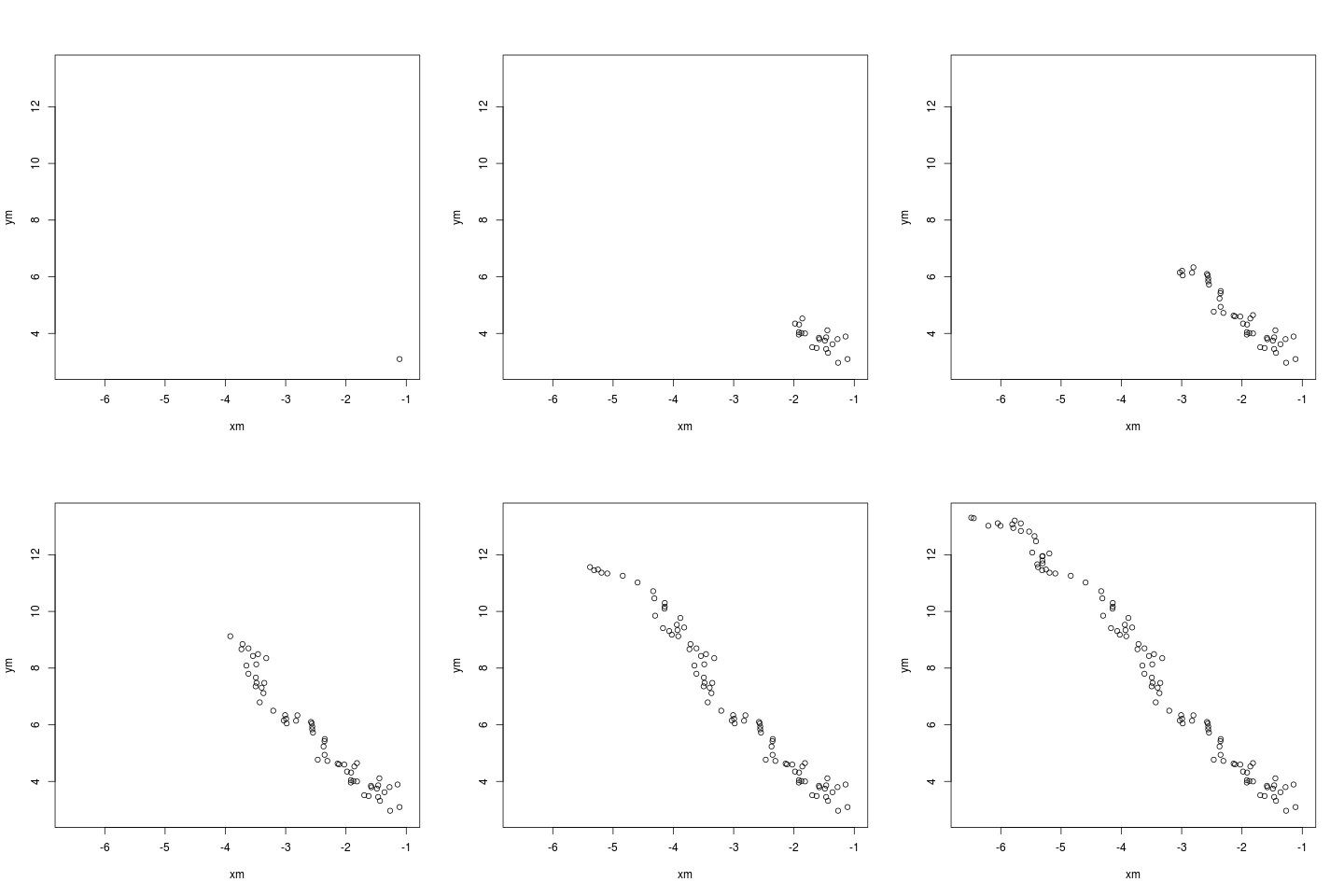
And to illustrate just why Rcpp is so cool for this, here is a little animation of a callback from the C++ code when doing the filtering on Adam's example 5.1. By passing a simple plotting function, written in R, to the C++ code, we can get a plot updated on every iteration. Here I cheated a little and used our old plot function with fixed ranges, the package now uses a more general function: Example of RcppSMC callback to R plot when estimation example 5.1 from Johansen (2009) The animation is of course due to ImageMagick glueing one hundred files into a single animated gif. More information about RcppSMC is on its page, and we intend to add more examples and extensions over time.

20 March 2012

Dirk Eddelbuettel: R / Finance 2012 Open for Registration

The annoucement below just went to the R-SIG-Finance list. More information is as usual the the R / Finance page:
Now open for registrations: R / Finance 2012: Applied Finance with R
May 11 and 12, 2012
Chicago, IL, USA
The registration for R/Finance 2012 -- which will take place May 11 and 12 in Chicago -- is NOW OPEN! Building on the success of the three previous conferences in 2009, 2010, and 2011, we expect more than 250 attendees from around the world. R users from industry, academia, and government will join 40+ presenters covering all areas of finance with R. This year's conference will start earlier in the day on Friday, to accommodate the tremendous line up of speakers for 2012, as well as to provide more time between talks for networking. We are very excited about the four keynotes by Paul Gilbert, Blair Hull, Rob McCulloch, and Simon Urbanek. The main agenda includes nineteen full presentations and eighteen shorter "lightning talks". We are also excited to offer six optional pre-conference seminars on Friday morning. Once again, we are hosting the R/Finance conference dinner on Friday evening, where you can continue conversations while dining and drinking atop a West Loop restaurant overlooking the Chicago skyline. More details of the agenda are available at:
http://www.RinFinance.com/agenda/
Registration information is available at
http://www.RinFinance.com/register/
and can also be directly accessed by going to
http://www.regonline.com/RFinance2012
On behalf of the committee and sponsors, we look forward to seeing you in Chicago!
Gib Bassett, Peter Carl, Dirk Eddelbuettel, Brian Peterson,
Dale Rosenthal, Jeffrey Ryan, Joshua Ulrich
Our 2012 Sponsors:
International Center for Futures and Derivatives at UIC Revolution Analytics
Sybase
MS-Computational Finance at University of Washington Google
lemnica
OpenGamma
OneTick
RStudio
Tick Data
See you in Chicago in May!!

16 March 2012

Dirk Eddelbuettel: digest 0.5.2

A new version of the digest package (which generates hash function summaries for arbitrary (and possibly nested) R objects using any of the standard md5, sha-1, sha-256 or crc32 algorithms) is now on CRAN. Murray Stokely noticed a corner case where a file that was inaccessible lead to a segmentation fault. Thanks to his patch, this is now caught and flagged. He even added a test for it and fixed another one of my idioms. Nice work, so keep the patches coming folks :) CRANberries provides the usual summary of changes to version 0.5.1. As usual, our package is available via the R-Forge page leading to svn and tarball access, my digest page and the local directory here.

7 March 2012

Dirk Eddelbuettel: RcppArmadillo 0.2.36

RcppArmadillo release 0..2.36 is now on CRAN. It contains just the changes from the new Armadillo release 2.4.4. The NEWS entry below summarises the changes.
0.2.36  2012-03-05
    o   Upgraded to Armadillo release 2.4.4
          * fixes for qr() and syl()
          * more portable wall_clock class
          * faster relational operators on submatrices
Courtesy of CRANberries, there is also a diffstat reports for 0.2.36 relative to 0.2.35 As always, more detailed information is on the RcppArmadillo page. Questions, comments etc should go to the rcpp-devel mailing list off the R-Forge page.

2 March 2012

Don Armstrong: Debian R Archive

For those of you were were in the various Debian infrastructure channels, you might have noticed that I was playing around with wanna-build, dak, sbuild, and buildd and friends. [Thanks to everyone who answered questions, btw.] Over the past week, I've been building most of CRAN, Bioconductor, and omegahat for unstable, amd64. I plan to build the same set of packages for i386, and will start a build shortly for stable as well. This effort builds on top of Charles Blundell and Dirk Eddelbuettel's cran2deb, which does most of the heavy lifting. If you're like me, and use lots of different R packages, or already use some of the R packages available on the previous build, you can simply point your sources.list to the [http://debian-r.debian.net] archive, load the appropriate GPG key, and away you go. I have a bit more information available here and I will try to keep that page updated as I build other architectures and build out for stable.

18 February 2012

Dirk Eddelbuettel: Using Rcout with Rcpp / RcppArmadillo to coordinate output with R

The new RcppArmadillo release 0.2.35 now supports the Rcpp::Rcout output stream device. Based on a contributed Rcpp patch by Jelper Ypma, the Rcpp::Rcout output stream gets redirected to R's buffered output. In other words, R's own output and that eminating from C++ code using Rcpp::Rcout are now both in sync. This avoids a stern warning from Section 5.6 in the Writing R Extensions manual:
Using C++ iostreams, as in this example, is best avoided. There is no guarantee that the output will appear in the R console, and indeed it will not on the R for Windows console. Use R code or the C entry points (*note Printing) for all I/O if at all possible.
and does in fact provide exactly what is recommended: the same entry points R itself uses. Below is a sample program, once again using the wonderful inline package to compile, load and link C++ code into R from a simple text variable submitted to the cxxfunction. What is shown in R code to load the package, the definition of the C++ code as assigned to a variable src and the creation of the dynamically-loadaded R function called fun which contains the code from we compiled, link and load via a single call to cxxfunction() given src.
library
library(inline)
src <- '
  Rcpp::Rcout << "Armadillo version: " << arma::arma_version::as_string() << std::endl;
  // directly specify the matrix size (elements are uninitialised)
  arma::mat A(2,3);
  // .n_rows = number of rows    (read only)
  // .n_cols = number of columns (read only)
  Rcpp::Rcout << "A.n_rows = " << A.n_rows << std::endl;
  Rcpp::Rcout << "A.n_cols = " << A.n_cols << std::endl;
  // directly access an element (indexing starts at 0)
  A(1,2) = 456.0;
  A.print("A:");
  // scalars are treated as a 1x1 matrix,
  // hence the code below will set A to have a size of 1x1
  A = 5.0;
  A.print("A:");
  // if you want a matrix with all elements set to a particular value
  // the .fill() member function can be used
  A.set_size(3,3);
  A.fill(5.0);
  A.print("A:");
  arma::mat B;
  // endr indicates "end of row"
  B << 0.555950 << 0.274690 << 0.540605 << 0.798938 << arma::endr
    << 0.108929 << 0.830123 << 0.891726 << 0.895283 << arma::endr
    << 0.948014 << 0.973234 << 0.216504 << 0.883152 << arma::endr
    << 0.023787 << 0.675382 << 0.231751 << 0.450332 << arma::endr;
  // print to the cout stream
  // with an optional string before the contents of the matrix
  B.print("B:");
  // the << operator can also be used to print the matrix
  // to an arbitrary stream (cout in this case)
  Rcpp::Rcout << "B:" << std::endl << B << std::endl;
  // save to disk
  B.save("B.txt", arma::raw_ascii);
  // load from disk
  arma::mat C;
  C.load("B.txt");
  C += 2.0 * B;
  C.print("C:");
  // submatrix types:
  //
  // .submat(first_row, first_column, last_row, last_column)
  // .row(row_number)
  // .col(column_number)
  // .cols(first_column, last_column)
  // .rows(first_row, last_row)
  Rcpp::Rcout << "C.submat(0,0,3,1) =" << std::endl;
  Rcpp::Rcout << C.submat(0,0,3,1) << std::endl;
  // generate the identity matrix
  arma::mat D = arma::eye<arma::mat>(4,4);
  D.submat(0,0,3,1) = C.cols(1,2);
  D.print("D:");
  // transpose
  Rcpp::Rcout << "trans(B) =" << std::endl;
  Rcpp::Rcout << trans(B) << std::endl;
  // maximum from each column (traverse along rows)
  Rcpp::Rcout << "max(B) =" << std::endl;
  Rcpp::Rcout << max(B) << std::endl;
  // maximum from each row (traverse along columns)
  Rcpp::Rcout << "max(B,1) =" << std::endl;
  Rcpp::Rcout << max(B,1) << std::endl;
  // maximum value in B
  Rcpp::Rcout << "max(max(B)) = " << max(max(B)) << std::endl;
  // sum of each column (traverse along rows)
  Rcpp::Rcout << "sum(B) =" << std::endl;
  Rcpp::Rcout << sum(B) << std::endl;
  // sum of each row (traverse along columns)
  Rcpp::Rcout << "sum(B,1) =" << std::endl;
  Rcpp::Rcout << sum(B,1) << std::endl;
  // sum of all elements
  Rcpp::Rcout << "sum(sum(B)) = " << sum(sum(B)) << std::endl;
  Rcpp::Rcout << "accu(B)     = " << accu(B) << std::endl;
  // trace = sum along diagonal
  Rcpp::Rcout << "trace(B)    = " << trace(B) << std::endl;
  Rcpp::Rcout << std::endl;
'
fun <- cxxfunction(signature(), body=src, plugin="RcppArmadillo")
setwd("/tmp")                           # adjust on other OSs
fun()                                   # output to stdout
sink("rcpparma.log.txt")                # start 'sink' to output to file
fun()                                   # no output to screen
sink()                                  # stop 'sink'
We then switch to a temporary directory (as the example code, taken from one of the two examples in Conrad's Armadillo sources, creates a temporary file) and run the new function. To demontrate how it does in fact now mesh perfectly with R, we create an output 'sink' (which catches all output) and re-run. This simple example demonstrated how we can use the new Rcout output stream from Rcpp to have dynamically-loaded C++ code cooperate more cleanly with the (buffered) R output. It also demontrated some of the nice features in Armadillo which we bring to R via RcppArmadillo.
17 February 2012

Dirk Eddelbuettel: RcppArmadillo 0.2.35

Now that Rcpp 0.9.10 is released and on CRAN, other packages can take advantage of a small change needed to make use of the quasi-output stream Rcpp::Rcout. So the new release 0.2.35 of RcppArmadillo does just that---and input/output from Armadillo, the wonderful linear algebra / math library for C++ written chiefly by Conrad Sanderson now comes through in a coordinated buffered fashion. As as std::cout is no longer used by default, the R CMD check no longer flags this. There are two more bugfixes in the releases for issues noticed by attentive RcppArmadillo users. Teo Guo Ci spotted a missing semicolon when C++0x code was activated, and Gershon Bialer suggested a fix for an issue plagueing users of the jurassic g++ 4.2.1 compiler which Apple forces on users of OS X. We thank Martin Renner for testing these fixes. The NEWS entry below summarises the changes.
0.2.35  2012-02-17
    o   Upgraded to Armadillo release 2.4.3
          * Support for ARMA_DEFAULT_OSTREAM using Rcpp::Rcout added
    o   Minor bug fix release improving corner cases affecting builds:
          * Missing semicolon added in Mat_meat (when in C++0x mode), with
            thanks to Teo Guo Ci 
          * Armadillo version vars now instantiated in RcppArmadillo.cpp
            which helps older g++ versions, with thanks to Gershon Bialer
          * Thanks also to Martin Renner for testing these changes
          * Unit tests output fallback directory changed per Brian Ripley's
            request to not ever use /tmp
          * Minor update to version numbers in RcppArmadillo-package.Rd
Courtesy of CRANberries, there is also a diffstat reports for 0.2.35 relative to 0.2.34 As always, more detailed information is on the RcppArmadillo page. Questions, comments etc should go to the rcpp-devel mailing list off the R-Forge page.

Dirk Eddelbuettel: Rcpp 0.9.10

A new release 0.9.10 of Rcpp is now on CRAN and in Debian. This is mostly internal release with a little bit of code reorgination (some of which will be used by a forthcoming RcppArmadillo release), some changes to make R CMD check happy, and one or two new features. The complete NEWS entry for 0.9.10 is below; more details are in the ChangeLog file in the package and on the Rcpp Changelog page.
0.9.10  2012-02-16
    o   Rearrange headers so that Rcpp::Rcout can be used by RcppArmadillo et al
    o   New Rcpp sugar function mapply (for limited to two or three input vectors)
    o   Added custom version of the Rcpp sugar diff function for numeric vectors
        skipping unncesserry checks for NA
    o   Some internal code changes to reflect changes and stricter requirements
        in R CMD check in the current R-devel versions
    
    o   Corrected fixed-value initialization for IntegerVector (with thanks to
        Gregor Kastner for spotting this)
    o   New Rcpp-FAQ entry on simple way to a set compiler option for cxxfunction
Thanks to CRANberries, you can also look at a diff to the previous release 0.9.9. As always, even fuller details are on the Rcpp Changelog page and the Rcpp page which also leads to the downloads, the browseable doxygen docs and zip files of doxygen output for the standard formats. A local directory has source and documentation too. Questions, comments etc should go to the rcpp-devel mailing list off the R-Forge page

15 February 2012

Dirk Eddelbuettel: Kurt Elling, Regina Carter and Anat Cohen at the CSO

Yesterday was Valentine's Day, and Kurt Elling came back to Chicago for a show at Symphony Center. He brought along guest stars Regina Carter (violin) and Anat Cohen (clarinet), as well as a small band led by Elling's long-time collaborator Laurence Hobgood on piano. The program was titled Passion World and featured songs from around the world. Quite impressively, Elling actually sang in French, Spanish, Portuguese, German and of cause English. The program lacked a little bit of cohesion at times, but it was still a most enjoyable and solid two-hour set. A similar concert will take place in Minneapolis on Saturday, so for those near the Twin Cities I would recommended looking for tickets.

13 January 2012

Dirk Eddelbuettel: RInside 0.2.6

A new version of RInside, now at 0.2.6, is now available via CRAN. RInside provides a set of convenience classes which facilitate embedding of R inside of C++ applications and programs, using the classes and functions provided by the Rcpp R and C++ integration package. This release has an additional fix for the Windows use case, adds cmake support files for the examples, switches to using the same RNG initialization of time and process id that R uses, and other minor fixes. All changes since the last release are summarized below:
2012-01-11  Dirk Eddelbuettel  <edd>
        * DESCRIPTION: Release 0.2.6
        * DESCRIPTION: Updated Description: text 
2012-01-08  Dirk Eddelbuettel  <edd>
        * src/RInside.cpp: Correct console writer on Windows to not use
        Rprintf (with thanks to both James Bates and John Brzustowski)
        * src/RInside.cpp: Update RNG seeding to same scheme now used by
        R which blends both (millisecond) time and process id
        * src/RInside.cpp: Replace fprintf(stderr,...) with Rf_error(...)
        * src/setenv/setenv.c: Idem
        
        * inst/examples/*: Added CMake build support for all example
        directories kindly provided by Peter Aberline; this helps when coding
        inside of IDEs such as Eclipse, KDevelop or Code::Blocks
        * inst/examples/standard/Makefile.win: Allow for an R_ARCH variable
        to be set to enforce either i386 or x64 builds
CRANberries also provides a short report with changes from the previous release. More information is on the RInside page. Questions, comments etc should go to the rcpp-devel mailing list off the Rcpp R-Forge page.

30 December 2011

Dirk Eddelbuettel: RcppExamples 0.1.3

A minor new release of the RcppExamples package is now on CRAN. RcppExamples contains a few illustrations of how to use Rcpp. It grew out of documentation for the classic API (now in its own package RcppClassic), and while we added a few more functions documenting how to do the same with the new API, the package is still nowhere near completion. The two ChangeLog entries since the last release are below. One new example was added, and some things were changed in order to make R CMD check (and the CRAN gate keepers) happy.
2011-12-28  Dirk Eddelbuettel  <edd>
        * DESCRIPTION: Release 0.1.3
        * src/newRcppDateExample.cpp: switch from std::cout to the new
        Rcpp::Rcout device available since Rcpp 0.9.8
        * src/classicRcppDateExample.cpp: idem
        * DESCRIPTION: Depends on Rcpp (>= 0.9.9) for Rcpp::Rcout
2011-04-08  Dirk Eddelbuettel  <edd>
        * R/RcppDataFrame.R: Added new example for Rcpp::DataFrame
        * src/RcppDataFrame.cpp: C++ source for new example
        * man/RcppDataFrame.Rd: Documentation
        * man/RcppParams.Rd: Small change to suppres a warning
Thanks to CRANberries, you can also look at a diff to the previous release 0.1.2. Questions, comments etc should go to the rcpp-devel mailing list off the R-Forge page

28 December 2011

Dirk Eddelbuettel: Rcpp 0.9.9

Release 0.9.9 of Rcpp is now on CRAN and getting into Debian too. This is mainly a bug fix release: our addition of int64 support in 0.9.8 came at the expense of support for long and unsigned long which broke some packages using Rcpp, and expecting those types. Ooops. The complete NEWS entry for 0.9.9; more details are in the ChangeLog file in the package and on the Rcpp Changelog page.
0.9.9   2012-12-25
    o   Reverting the 'int64' changes from release 0.9.8 which adversely
        affect packages using Rcpp: We will re-apply the 'int64' changes in a 
        way which should cooperate more easily with 'long' and 'unsigned long'.
    o   Unit test output directory fallback changed to use Rcpp.Rcheck
    o   Conditioned two unit tests to not run on Windows where they now break
        whereas they passed before, and continue to pass on other OSs
Thanks to CRANberries, you can also look at a diff to the previous release 0.9.8. As always, even fuller details are on the Rcpp Changelog page and the Rcpp page which also leads to the downloads, the browseable doxygen docs and zip files of doxygen output for the standard formats. A local directory has source and documentation too. Questions, comments etc should go to the rcpp-devel mailing list off the R-Forge page

22 December 2011

Dirk Eddelbuettel: Rcpp 0.9.8

A new release 0.9.8 of Rcpp is now on CRAN and will also get into Debian shortly (once I finish building R 2.14.1). This release contains a few incremental changes. Romain, sponsored by by the Open Source Programs Office at Google, had released a new package int64 bringing larger integers to R, and this is now supported by Rcpp as well. John Chambers contributed some code to have Reference Classes extend existing C++ classes (typically brought in via Rcpp Modules). Jelmer Ypma sent us a patch to add a Rcout device not unlike cout, but aligned with R's io buffering. We added some more unit tests, and made a few small fixes here or there. The complete NEWS entry is below; more details are in the ChangeLog file in the package and on the Rcpp Changelog page.
0.9.8   2011-12-21
    o   wrap now handles 64 bit integers (int64_t, uint64_t) and containers 
        of them, and Rcpp now depends on the int64 package (also on CRAN).
        This work has been sponsored by the Google Open Source Programs
        Office.
    o   Added setRcppClass() function to create extended reference classes 
        with an interface to a C++ class (typically via Rcpp Module) which
        can have R-based fields and methods in addition to those from the C++.
    o   Applied patch by Jelmer Ypma which adds an output stream class
        'Rcout' not unlike std::cout, but implemented via Rprintf to
        cooperate with R and its output buffering.
        
    o   New unit tests for pf(), pnf(), pchisq(), pnchisq() and pcauchy()
    o   XPtr constructor now checks for corresponding type in SEXP
    o   Updated vignettes for use with updated highlight package
    o   Update linking command for older fastLm() example using external 
        Armadillo
Thanks to CRANberries, you can also look at a diff to the previous release 0.9.7. As always, even fuller details are on the Rcpp Changelog page and the Rcpp page which also leads to the downloads, the browseable doxygen docs and zip files of doxygen output for the standard formats. A local directory has source and documentation too. Questions, comments etc should go to the rcpp-devel mailing list off the R-Forge page

Next.

Previous.