Search Results: "will"

25 May 2010

Russell Coker: Links May 2010

AdRevenge is an interesting concept to pay for Google Adsense adverts about how companies suck [1]. If a suitably large group of people pay to warn you about a company then it s a good signal that the company is actually doing the wrong thing. A guest post by Mili on Charles Stross blog has an interesting analysis of the economcs of Intellectual Property and concludes that content is a public good [2]. New Age Terrorists Develop Homeopathic Bomb [3], an amusing satire of medical fraud and security theatre. The sit has a lot of other good satire too. Mark Shuttleworth wrote an interesting post about new window management changes that will soon go into Ubuntu [4]. He points out that the bottom status bar in applications is a throw-back to Windows 3.1 and notes that a large part of the incentive for removing it (and using the title-bar for the status) is the work on the Netbook version of Ubuntu. This is really ironic given that the resolution of current Netbooks is quite similar to that of desktop systems that were current when Windows 3.1 came out. Omar Ahmad gave an insightful TED talk about the benefit of using a pen and paper to send a letter to a politician [5]. Sebastian Wernicke gave an amusing and informative TED talk about how to give a good TED talk [6]. His talk gives some useful ideas for public speaking that are worth considering. Catherine Mohr gave a brief and interesting TED talk about how to build an energy efficient house with low embodied energy [7]. Her blog at www.301monroe.com has the details. Stephen Wolfram (of Mathematica fame) gave an interesting TED talk [8]. He covers a lot of interesting things that can be done with computers, primarily based on the Wolfram Alpha [9] platform which allows natural language queries of a large data set. He also talks about the search for a Theory of Everything. Esther Duflo gave an interesting TED talk about using social experiments to fight poverty [10]. She describes how scientific tests have been used to determine the effectiveness of various ways of preventing disease and encouraging education in developing countries. One example of the effectiveness of such research is the DeWormTheWorld.org project which was founded after it was discovered that treating intestinal worms was the most cost effective way of getting African children to spend longer at school. David L. Rosenhan wrote an interesting research paper On Being Sane In Insane Places about pseudo-patients admitted to psychiatric hospitals [11]. It seems that psychiatric staff were totally unable to recognise a sane person who was admitted even though other patients could do so. It also documents how psychiatric patients were treated as sub-human. One would hope that things had improved since 1973, but it seems likely that many modern psychiatric hospitals are as bad as was typical in 1973. It s also worth considering the issue of the treatment in society of people who have been diagnosed with a mental illness, it seems likely that the way people are treated in the community would have similar bad results to that which was documented for treatment in psychiatric hospitals even the sanest people will act strangely if treated in an insane manner! Also it seems to me that there could be potential for using a panel of patients assembled via the Delphi Method as part of the psychiatric assessment process as it has been demonstrated that patients can sometimes assess other patients more accurately than psychiatrists! Simon Sinek gave an inspiring TED talk about how great leaders inspire action [12]. Of course the ideas he describes don t just apply to great leaders, they should apply to ordinary people who just want to convince others to adopt their ideas. Stephen Collins write a good article summarising the main reasons why the proposed great firewall of Australia is a bad idea [13]. Lenore Skenazy who is famous for letting her 9yo son catch the metro alone during broad daylight on a pre-planned route home has created a web site about Free Range Kids [14]. She seems to be starting a movement to oppose Helicopter Parenting and has already written a book about her ideas for parenting. The incidence of crime has been steadily increasing, as has the ability of the police to apprehend criminals and recover abducted children. There s no reason for children to be prevented from doing most of the things that children did when I was young!

Gunnar Wolf: One more fatal accident in my usual environment

I was about to close down a good day of hard work, a heavy but useful day... I had even decided to take some time off to listen to some good music, and was heading off to bed on a good mood... Until I decided to read my contacts' latest rants. And I found very sad news - again. A ten year old kid was killed while cycling in Calle Nezahualpilli, Colonia Ajusco. I happen to know quite well that precise area - I lived very close to that street for some months in 2008. I eat in a small restaurant (what we call either a cocina econ mica, comida corrida or fondita) on that street. One of my usual bycicle workshops is also on that street - In fact, I wanted to go today, as both of my bikes' rear tires are flat, but had no time to make it. Anyway... Colonia Ajusco and Colonia Santo Domingo ("colonia" is basically... a neighbourhood in es_MX) are two very popular, economically depressed areas, just North-East of the University. Probably hundreds or thousands of students live in rented rooms in the area, as UNAM with its 300,000 students does not have any dorms (due to political reasons leading all the way back to the 1960s). Santo Domingo and Ajusco are also the part where Mexico City's main valley finishes. The hills begin, not too abruptly (we have a ~150m difference in the ~2Km spanned by both colonias). And... When I lived there, I was amazed at the amount of people moving by bike. The streets are too slow for motorized transit to properly flow, and it's often annoying to have to cross the region. It is mostly safe for cyclists. Anyway, this kid was having a good time on the street, and was killed by a microbus driver fighting his fellow over more clients. The driver, yes, was caught (by his passengers and other bystanders, according to the note), and did not run away as they often do in cases such as this one. Still, the kid died almost instantly, so catching the driver serves very little consolation. This Friday we will have BiciUNAMonos second monthly meeting. It is too soon, and I don't think we will end up going there. But I do feel this accident falls squarely inside UNAM user's territory. We cannot ignore it just because it happened outside our University's gates.

John Goerzen: Free-Range Kids: A Parental Rant

There s a lot of unreasonable panic out there these days. Parents that don t want to let their kids even walk to the mailbox because of an irrational fear of abduction. (Children are more likely to die falling out of bed than be abducted, and before anyone panics, that s also exceptionally rare.) A woman that let her 11-year-old travel unaccompanied on the NYC subway he d been riding all his life unleashed a huge controversy. And there s also this maddening tendency for some parents to be so worried about wounding their children s self-esteem that they never want to say they ve done something wrong, and be so positive to them. Recent studies, as well as common sense, suggest that both attitudes are rather harmful. Terah and I are believers in letting children have cheap mistakes . If I see Jacob running through the kitchen about to trip over a toy he left out, I probably won t say anything. Him crashing to the floor after running on it won t even hurt him enough that he ll cry, but it will probably be far more effective at teaching safety than 20 days worth of me saying no running in the kitchen. Of course, we ll provide comfort for him when he s sad and be there to support him, but also give him more and more freedom to succeed or fail as he grows. This starts even younger. When he first started feeding himself, he got into this habit of throwing food on the floor. We had some natural consequences as a result. If his supper landed on the floor, then he would be all done eating. (Note: Jacob was always on the heavy side at that age anyway.) He couldn t reach his supper on the floor, and we weren t going to keep bending over to pick it up for him. Fixed that problem pretty quickly at least until he learned that he could wait until he was pretty full before throwing his food down on the floor (at which point we added a brief time-out). Or how about our reaction when he has mistakes. When he breaks something, whether accidentally or on purpose, we don t give him some sort of affirmation like Oh, that s OK, we can fix it or good try; you ll do better next time. It is NOT OK to rip the pull-up flaps out of a book or to stomp on those peas you dropped on the floor, and there will be predictable and reasonable consequences for doing so. As a result, when he does a good job, it ll mean more. He, at 3, has started sounding out letters, knows his alphabet, and can count to about 15 in English and about 3 in German. And those are things we give him a good job about. Two of the best things we can do for our children are: 1) be honest about their successes and failures; and 2) give them room to succeed and room to fail, so they can learn from both while the consequences mean a skinned knee or broken toy instead of a broken rib or foreclosure on a mortgage. The Free Range Kids FAQ makes excellent reading, and discusses how many of today s parents grew up enjoying this kind of freedom, and for various reasons are too scared to allow their children that today. Rather sad, really, especially given that today s world is safer.

24 May 2010

Neil Williams: HP laptop battery recall

From Planet Gnome - apologies if you read both planets but I hadn't seen this recall before it was posted by Richard Hughes. If you are affected, feedback the required metadata to upower using:
for i in /sys/class/power_supply/*/*; do echo $i; cat $i; done


My HP dv6000 laptop met the initial criteria but once I'd entered all the info, I got a message:

Your battery is not affected and is not part of this replacement program.
Thank you for your cooperation. ..... You may continue using your battery.


Which is nice.
:-)

Axel Beckert: Perfect Team: autossh and GNU Screen

SSH is definitely one of my most often used tools, not only for system administration at work but also on the road with my netbook, an EeePC 701 running Debian Sid. On the road, it often happens that I have a flaky WLAN or UMTS connection, so I often have to kill (via <Enter>~.) and reconnect my SSH session due to a changed IP address or so. First step against problems arising from using SSH over unreliable network connections is of course GNU Screen. Second step is use SSH keys and ssh-agent to not needing to type the password on every reconnect. But it s still very annoying to kill the SSH connection and call ssh again manually. For luck there is autossh, a wrapper around SSH which regularily checks via two tunnels connect to each other on the remote side if the connection is still alive, and if not, it kills the ssh and starts a new one with the same parameters (i.e. tunnels, port forwardings, commands to call, etc.). It s quite obvious that this is perfect to be combined with screen s -R and -d options (Reattach if a detached screen is around, else start a new screen; detach a currently attached screen), so I found myself very often typing (or fetching it from the commandline history :-):

autossh -t sym.noone.org 'screen -Rd'
-t is necessary to allocate a terminal device on the remote machine which is not done by default if you directly call a command via ssh. In comparision to OpenSSH, autossh needs the single quotes, because otherwise it would parse -Rd as options to parse to ssh and bail out. That s not a real problem, but when you re used to just type ssh -t sym.noone.org screen -Rd without any quotes, you ll run into this then and when. Update, 25-May-2010, 14:55: As Carsten Hey points out, autossh also supports the -- option to declare that all following options and parameters must be passed to ssh itself. (End of Update) Typing that often and mistyping it then and when cries for an shell alias or an shell function. So I came up with the following shell function:
asc()  
    autossh -x -a -t "$@" 'screen -RdU'
 
I used a function instead of an alias in case of autossh will in future regard all parameters given after the command as part of the command as ssh does. The additional options -x and -a disable X and SSH Agent forwarding which both don t work if you reattach to an already running screen. And if you re using Zsh as I do, you can even add some more format string magic to set the window title more or less to the expanded alias, eh, function:
function asc()  
    # Set the title to something more obvious, e.g. the expanded
    # alias, eh, function
    print -Pn "\e]0;%n@%m: autossh -t $* 'screen -RdU'\a";
    autossh -x -a -t "$@" 'screen -RdU'
 
compdef asc=ssh
Update, 25-May-2010, 14:59: As Hauke points out in a comment, Zsh users should also declare that asc should have the same tab completion as ssh itself. The example above has been updated accordingly. (End of Update) In the meanwhile on the EeePC I use asc on the commandline more often than ssh itself. And I nearly no more type autossh. (The most common exception here is autossh hostname tail -F /path/to/some/logfile.) Using that function you can also add common ssh options for tunneling, etc. I use it most often like this:
asc -D 1080 sym.noone.org
This opens a SOCKS proxy on localhost, port 1080 and that way I can surf via the host I m connecting to by SSH. There s one small drawback though: You didn t expect that I can just invent some new three letter command without a namespace clash, did you? There is a free game called Advanced Strategic Command whose binary (and Debian package) is named asc, too. If you have that game installed, you can always call it using its full path, e.g. /usr/games/asc on Debian. P.S.: My whole grml based .zshrc is also available via git at git.noone.org as well as on github.

Christine Spang: Christine Spang: out with the old, in with the new(er)

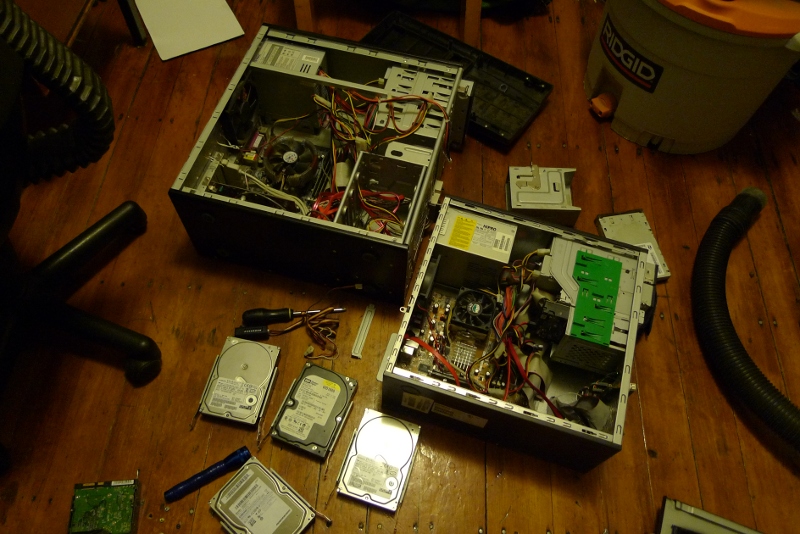
I just replaced my aging 2004-era PC with wait for it a 2005-era PC. A friend is moving across the country so I'm taking it off his hands. Swapping hardware between Freyja and Earlgrey The differences between the two are more than just the year of time, though: one was hand-built from parts, while the other was a commodity off-the-shelf Compaq. So the new machine, while not strictly faster by the clock, is 64-bit and is much more amenable to upgrades. While the added bulk is a bit annoying, the case has a lot more space in it up to 8 or so drive slots (I can't imagine ever needing that many), and 4 RAM slots which is a sure step up from the limitation of two drive slots and two RAM slots in my old machine. The most visibly shiny parts in the new desktop experience are 4G RAM versus 1G, and a nice ATI GPU. While I'm glad my OS allowed me to squeeze six years out of my main machine, I'll be happy to stop shaking my fist at Chromium for eating all my memory! The new machine will keep its old name: earlgrey.
Asheesh Laroia: Kat and Asheesh, on identity

Six months ago, I was talking with Kat. We were talking about talking. On imperfection Kat wrote:
<mindspillage> I think I have to be very very comfortable around someone to be able to be imperfect around them.
<mindspillage> (at least, without feeling horribly embarrassed about it)
<mindspillage> More so if what I'm doing is part of my identity.
It's safe to be bad at dancing, she explained; she doesn't consider herself a good dancer, so nothing's at risk. On flames I had recently written about diversity in free software. Kat showed me a piece she had written, but not yet published, on a similar topic. I thought she should simply publish the piece as-is. Instead, she worried:
<mindspillage> I feel like I have a hard time getting across what I think without coming across as antagonistic.
I've felt the same way. Years ago, I told my friend Venkatesh that had sent a flame to a mailing list we're both on. He retorted that my flames lack flame. So then I thought about why I might feel I've written a flame, even when no one else felt that way. I wrote to Kat:
<paulproteus> Expressing oneself is a frustrating experience.
<paulproteus> It may seem like you're taking this out on other people.
<paulproteus> In fact, you're just frustrated.
<paulproteus> And fighting (successfully) your own urges to just be quiet.
<paulproteus> So at the end you'll feel like you fought a battle, and that seems like you wrote something that others would feel is antagonistic.
Maybe for Kat's writing and my "flames", there was some sort of antagonistic process in which we fought ourselves. That fight doesn't have a lot to do with the resulting text, so it's invisible to the reader. I think this process might leave us vulnerable in another way: if our urges to stay quiet come from a sense of isolation, and we manage to stay quiet about that feeling, no one will sympathize with us. We'll appear to be healthy, active participants in a conversation where we express ourselves. Other people with a similar "process" for self-expression won't get a chance to empathize. (This is why I'm interested in putting together a Debian for Shy People caucus. I hope my Debconf proposal for a Birds of a Feather session is accepted!) On finding a way out We concluded on a happy note:
<mindspillage> I haven't been answering Wikimedia mail for a while. Then I figured out that I don't have to use my real name, so I don't have to answer as someone with responsibility, I can just be some random volunteer.
<mindspillage> Most of it is silly and trivial. But sometimes I am really able to address someone's concern or change someone's mind, and I forget how good that feels.
<mindspillage> (There are some real jerks too.)
<mindspillage> I got someone who was being snarky to apologize for being so rude. That was kind of awesome. Sometimes it doesn't take very much to make me happy.
P.S. A note from the archives Apparently, for me, speaking French is exempt from the above restrictions.

23 May 2010

Roland Mas: FusionForge news, May 2010

The usual semi-regular bits of news from the FusionForge project. We continue being quite active, with several hundred commits each month. The momentum doesn't seem to stop even after the 5.0 release last month. A large part of the activity stems from the Coclico project, which has several work-packages related to convergence of code across forges (mostly between FusionForge and Codendi). This convergence comes in three flavours: All in all, a fairly busy period for FusionForge. The current trunk is evolving rather fast, with some long-overdue rewrites being underway. Interesting times.

22 May 2010

Wouter Verhelst: Help!

Yes, there is something like an 'RFH', or 'Request For Help', in the WNPP in Debian, but I thought I'd go through this blog, first, since I believe many more people who will feel inclined to help here will read this blog. I've been maintaining the beid packages in Debian since, eh, quite a while now; and while it's not always been the package that I have spent the most time on, it's not a package that I want to give up. However, in recent times, I've had issues with the code. I've not really been able to get the 3.5.2 release to compile properly as a package, which means that for the moment, squeeze is still stuck with a 2.x release. This is a problem, since that old release isn't supported anymore upstream, and what's worse, it does not support newer-issued eID cards. So if your card is less than about two or three years old, you can't even use it anymore. For this reason, the beid packages really, really should be updated before squeeze releases. I've been trying to spend some time doing so, but real life kept intervening. And I haven't even been able to start looking for the 3.5.3 code that I'd heard rumours would exist. So, this is a request for help. If you want a more recent beid package to appear in Debian (and, by extension, Ubuntu) any time soon, and you can spare some extra time on maintaining a somewhat convoluted package, you'd be an ideal candidate for comaintainer of this package. You don't need to have any experience working on Debian, but you do need experience with build systems and Makefiles. If you don't have any experience in working on Debian, but would like to learn, this might be an interesting opportunity. If you do have experience working on Debian and are as interested as me in getting this to be up-to-date in the next Debian release, your help would be very much appreciated. Even if you only have time for a little while and would like me to take over once everything is going fine again, that's helpful. At any rate, if you want to help, contact me at wouter@debian.org. We'll work out the specifics then. Thanks in advance,

21 May 2010

John Goerzen: Bicycling in Rain and Mud

I recently posted here about bicycling in the mud and rain, and got some good suggestions (and also on the icebike mailing list). I eventually decided to replace my current bike (Trek 7.3FX) with a Specialized Tricross Sport Triple. As I mentioned in the bike store, it seems odd to spend this kind of money on a bike only to ride it through mud and sand. Another customer overheard and said, It sure does but don t worry, it ll be fine! But on the other hand, I figure that it is probably realistic for me to ride it around 3600 miles (5793 km) per year. At that rate, it will pay for itself in reduced car costs in about a year. I picked it up last Friday, and on Saturday moved my accessories (headlight mount, tail light, water bottle cage, etc.) to it. The Bontrager Back Rack I from the 7.3FX did not fit well, so I ordered the Specialized Tricross Rack Set, which did fit well (I m not using the front rack though). This has been a wet week. I rode Thursday when it had stopped raining about 20 minutes before I left in the morning, and we got more rain in the afternoon. Although both the Tricross and the 7.3FX have 700 32C tires, even the factory tires on the Tricross performed far better in mud than the 7.3FX ever did and I can still go much more wide if I feel it necessary. Actually, somewhat to my surprise, I didn t really have a problem with kicking up mud; my enemy turned out to be kicking up sand. It didn t really damage anything, and I had to try not to cringe as I saw the sand hitting the chain, etc. I rinse it off when I get to my destination, and clean/lubricate the chain frequently in these conditions. I haven t yet been on the bike during an active rain, but from what I ve done so far, I think it will be fine. So at this point, there s very little that will prevent me from riding.

Robert McQueen: VP8 rumblings

As you all know by now, exciting moves from Google on the WebM project have lead to them open-sourcing On2 s VP8 codec to provide a freely available video codec for HTML5 content. Collabora Multimedia worked with Entropy Wave to add support to GStreamer for the new codec from day 1, and I was really happy yesterday to update my Debian system and get the support installed locally too. Thanks to our and Igalia s fine work on GStreamer HTML5 support in WebKitGTK+, Gustavo Noronha found it worked out of the box with Epiphany too. Predictably, the MPEG-LA aren t too pleased with this, and are no doubt winding up their PR and industry allies at the moment, as well as this opening a new front on the Apple vs Google ongoing platform battle. But if your business model is collecting money through what is essentially a protection racket and spreading FUD about patent litigation, the VP8 license implicitly creating a zero-cost zero-revenue patent pool is not going to be good news for you (from the department of Google deleting your business model). The question is now whether the allure of Google s content will win over against the legal chest pounding of the patent trolls, and whether they start flipping switches to make YouTube only serve up WebM content after a while. Also in amazing and incredible news, Collabora s Telepathy/GStreamer/GNOME/Debian/general R&D guru and staunch Web 2.0 holdout Sjoerd Simons has actually now got a blog after a mere 3 years of us suggesting it to him since he joined Collabora as an intern. He s been hacking on some RTP payloader elements for VP8 so we can use it for video calling on the free desktop. All very exciting stuff, especially in conjunction with Muji (multi-user video calls over XMPP) support heading into Telepathy thanks to NLNet s ongoing support.

Gustavo Noronha Silva: Google s pacman doodle in Epiphany/Midori?

Google has had a very nice idea today, to celebrate Pacman s aniversary: they made their logo become a playable HTML5 pacman. If you re wondering why your WebKitGTK+ browser is not being able to play the game here s why: Google is doing User-Agent sniffing and denying you the fun, sending a static image that you can click to perform a search instead of the game. If you make Epiphany or Midori identify themselves as Chrome or Firefox, the game will work. I really don t get this User Agent sniffing bullshit coming from Google. If you go to gconf-editor, and under epiphany->general set the user_agent key to Mozilla/5.0 (X11; U; Linux; en-gb; rv:1.9.0.2) Gecko/2008092313 Firefox/3.8 it works. I m starting to seriously consider User Agent spoofing for *.google.com as a quirk on WebKitGTK+. Lame. Update: as a protest, I m making blog.kov.eti.br and kov.eti.br say Chrome/Chromium are not supported, by doing User Agent sniffing.

Update2: it s been pointed out to me that the game is not HTML5 - it s actually smart usage of divs, and flash *urgh* for the audio

20 May 2010

Bernd Zeimetz: merkaartor - countdown to 0.16

As announced on the Merkaartor mailing lists, version 0.16 is planned to be released on 6th June. Therefore I've uploaded a git snapshot to experimental today. Please give it a try and report all problems, either to the Debian BTS or directly in the upstream bug tracker. Merkaartor 0.16 screenshot Version 0.16 will contain a lot of new features and various bugfixes and enhancements. For me the most important additions are support for Walking Papers and support for OpenStreetBugs. Also Merkaartor uses libgps now, so it is able to connect to recent versions of gpsd. With thanks to Chris Browet, the upstream author of Merkaartor, the next version of gpsd will ship with libQgpsmm, a C++/QT library to connect to gpsd. It should be possible to compile libQgpsmm under most platforms which are supported by QT4, including windows. Merkaartor will use libQgpsmm when available, so even Windows users will be able to use a remote gpsd instance.

Martin Zobel-Helas: Brainstorming for DMUP 2.0

Now that we have released the slightly updated version of Debian's Machine Usage Policy (DMUP), I am thinking about a major rework for the next version. Maybe we should even start with a completely new text for it. I am currently doing a bit of brainstorming about how the new version could look.

Here are some of my ideas (completely unsorted):


Please note that this brain dump is my very personal opinion and does not reflect the opinion of the complete DSA team.

I would like to see a discussion on what the new DMUP should look like. Even though the final decision on which paragraphs make it into DMUP should stay with DSA, I think the Debian community should be involved in the evolution of this document.

Even though i am not attending DebConf10 (actually I think no one from DSA will make it), it might be a good idea if the conference could be used to do some further brainstorming. Maybe having a BoF on DMUP 2.0 might be a good idea.

Gustavo Noronha Silva: WebKitGTK+ and WebM

So you probably heard about WebM, right? It s the awesome new media format being pushed by Google and a large number of partners, including Collabora, following the release of the VP8 video codec free of royalties and patents, along with a Free Software implementation. It turns out that if you are a user or developer of applications that use the GStreamer framework, you can start taking advantage of all that freedom right away! Collabora Multimedia has developed, along with Entropy Wave GStreamer support for the new format, and the code has already landed in the public repositories, and is already being packaged for some distributions. I just couldn t wait the few days it will take for the support to be properly landed in Debian unstable, so I went ahead and downloaded all of the current packages from the pkg-gstreamer svn repository, built everything after having the libvpx-dev package installed, and went straight to a rather unknown, small video site called Youtube with my GStreamer-powered WebKitGTK+-based browser, Epiphany!:
Youtube showing a webm video in Epiphany
If you re running Debian unstable, or any of the other distributions which will be lucky to get the new codecs, and support packages soon, you should be able to get this working out of the box real soon now. Check the tips on WebM s web site on how to find WebM videos on youtube.

Michal &#268;iha&#345;: Playing with numbers and social networks

I'we just launched website (well it's quite pretentious name for few pages), which shows debts for politics when they were in government in Czech Republic. We're still not in situation like in Greece, but it can quite easily happen that we would be in few years and it's good to show some numbers describing what was happening in past. It took just few hours of coding yesterday evening using Django. Domain has been registered and it is online now. While doing such thing, I decided to make more fun for me and publish the link just on social networks (Identi.ca, Twitter, Facebook, LinkedIn) and follow if (and how) the link will spread. So no, you will not find link in this blog post :-).

Aigars Mahinovs: So, what is Microsoft Azure and how it compares to Amazon s AWS

We had a Microsoft salesperson stop at our offices today to tell people about wonders of cloud computing and Microsoft s Azure will save us all. The following is a short and non-exhaustive list of what Azure does not do according to their own experts: The Microsoft presenter also repeatedly engaged in shady tactics when presenting his information: So to summarize, Microsoft has build a cloud of Windows-like machines which can run your programs (as long as they are in .Net or Silverlight) and which does not have even a third of the features of such de-facto market leader as Amazon AWS. They try giving away their product for free and only get 14k applications in 6+ months. Note: Amazon has at least 300 000 public applications and God only knows how many more private ones. They will grow, due to companies locked-into Microsoft s way of thinking buying into their marketing, but if you have a head on your shoulders, you should avoid it as a trap, which it actually is. All that can be done on Azure, can also be done on Amazon. The opposite is not always true. In addition, if you will want have a mixed environment with both Windows and Linux servers, you will not be able to deploy Linux servers to Azure (or they will be very slow) and you ll have to put your Linux servers into Amazon (or another) cloud and pay double traffic fees for every byte of traffic between your own servers. Microsoft Azure prices are exactly the same as Amazon EC2 prices with Windows instances. However on Amazon you actually get fully capable Windows Server instances. And if you don t need Windows, you can get a much better price on Amazon. The only companies that can safely use Azure are companies that only have Windows servers AND plan to only have Windows servers for the foreseeable future. Knowing how dominant Linux is in the server market and how many Windows-only shops actually have a few Linux servers in the back room, there is very little future for Azure, until they wise up and make Linux instances first class citizens in their cloud. If not because their customers need them, then because their customers think that they at least might need them in the future. Update: Amazon now released a Reduced Redundancy storage for S3 that provides the exacts same level of storage guarantees that regular Microsoft Azure SLA (99.9%) for two thirds of the price, and also Amazons now explicitly says that their regular S3 is Designed for 99.999999999% Durability , which is worlds above what Microsoft provides. Now in this case Amazon again is cheaper than MS. Also Amazon bandwidth prices are 33% lower compared to Azure. In Azia the difference is simply staggering (0.45$ vs 0.19$ per Gb).

Dirk Eddelbuettel: RcppArmadillo 0.2.0 (and 0.2.1)

With the Rcpp 0.8.0 release on Monday, Romain, Doug and I were able to follow-up with a new RcppArmadillo release. RcppArmadillo uses Rcpp (and a few dozen lines of 'glue') to provide a transparent interface from R to Conrad Sanderson's impressive Armadillo library for linear algebra. This new release offers a number of key improvements: While we had tested this quite rigourously, the combination of some last minute changes that were meant to be stylistic-only, some troubles with the tests and builds at CRAN that were not apparent in all our tests (hint: do not yet use dynamic help features referencing other packages even if you have a Depends: on them) and an upcoming travel deadline meant that we missed a gotcha on Windows---so release 0.2.1 had to follow a few hours after the short-lived 0.2.0. More information is on the RcppArmadillo page. Questions, comments etc should go to the rcpp-devel mailing list off the R-Forge page.

19 May 2010

Dominique Dumont: Improve config upgrade Ep 02 Minimal model for OpenSsh s sshd_config

Hello Currently Config::Model can upgrade /etc/ssh/sshd_config file because Sshd model is complete. All 80 parameters mentioned in sshd_config man pages are described there. The whole model (including doc is about 1000 lines long). If one just want configuration upgrade capability, requiring a complete model is too much work. The aim of this GSoC project is to find a way to provide upgrades at a reasonable cost. Ep 01 focused on what feature was missing from Config::Model to provide a model that could handle unknown parameters in most cases to enable upgrades without a complete model. This covered the use case of an unmaintained model facing software evolution. Now, let s go on with the OpenSsh example and let s see what would be the minimal model that would enable upgrades from older sshd_config version to a more recent one. (Note that this blog is based on upgrade requirements mentioned in sshd_config man page). This will cover the use case of a maintained model targeted for upgrades. From last blog, we know that this minimal model must feature: Let s tackle the structure of this minimal model by re-using the current model structure. We will need 2 classes:
  1. Sshd: to handle all leaf parameters a the the Match parameter
  2. Sshd::MatchElement: to handle parameters within a Match block
Sshd::MatchElement will need to handle unknown leaf parameters (exceptd Match parameters), so its declaration should be like: 'Sshd::MatchElement' =>
accept =>
match_not => '/Match/i'' ,
type => 'leaf',
value_type => 'string'


Note that there s no element declaration. The accept structure means that Config::Model will accept any parameter that does not contain match in its name and will handle it as a string parameter. (Note that this feature is not yet implemented in Config::Model) Now, we must declare the main class: Sshd. It will feature the a wider accept statement and element declarations for the following parameters: Here we go: Any unknown parameter will be accepted by Sshd configuration class: accept =>
type => 'leaf',
value_type => 'string'
,
Here are the element that require a special treatment: Match just refer to the class declared above
Match =>
type => 'hash',
index_type => 'uniline',
cargo =>
type => 'node',
config_class_name => 'Sshd::MatchElement'
,
KeepAlive is the obsolete parameter. Parameter with status 'deprecated' are handled by Config::Model but will not be written back in the configuration file. Hence re-using the deprecated information elsewhere is more than recommended.
KeepAlive =>
type => 'leaf',
value_type => 'enum',
status => 'deprecated',
choice => [ 'no', 'yes' ]
,
Here's the new parameter. It's value is computed from KeepAlive.
TCPKeepAlive =>
type => 'leaf',
value_type => 'enum',
choice => [ 'no', 'yes' ],
migrate_from =>
formula => '$keep_alive',
variables => keep_alive => '- KeepAlive'
,
,
Now that we have the model, we must figure out how to read and write value with minimal coding efforts. Due to the mismatch between the syntax of the file (flat structure) and the actual structure (special Match parameter), a dumb parser/writer cannot be used. A parser that takes into account Match is required. Either dedicated Perl code (like the parser/writer delivered with Config::Model::OpenSsh) or use Augeas and its sshd lenses. In summary, we ve seen that the model required to perform upgrades is about 30 lines instead of the 1000 lines required for a complete model. On the other hand, the syntax of sshd_config makes the parser and writer harder to write. But, normally, this parser/writer should not evolve during the life of OpenSsh project. Now the question that I cannot answer is: Can a packager handle the extra work to maintain this minimal model ? Feedback is welcome here ;-) Next episode will study how upgrades based on Config::Model can be applied on files with other syntaxes. All the best

Daniel Kahn Gillmor: NYC SYEP still requires Microsoft Software

A year ago, i wrote about how New York City's Summer Youth Employment Program (SYEP) requires the use of Internet Explorer to apply online (and it even appears to require IE just to download the PDF of the application!) Sadly, the situation has not changed, a year later. Today, I'm writing to Dan Garodnick, Chair of The City Council's Committee on Technology (and the rest of the committee members), Carole Post, Commissioner of DoITT (the city's Department of Information Technology and Telecommunications), and Jeanne B. Mullgrav, Commissioner of DYCD (the Department of Youth and Community Development, which runs SYEP). Here's what i wrote:
For the last two years at least, the DYCD's Summer Youth Employment Program
(SYEP) has been only available to users of Internet Explorer:
 https://application.nycsyep.com/
Internet Explorer (IE) is only made by Microsoft, and is only available for
people running Microsoft operating systems.  Users of other operating systems,
such as GNU/Linux, Macintosh, or others cannot access the SYEP application
process.  Even users of Windows who care about their online security or simply
desire a different web browsing experience might prefer to avoid Internet
Explorer.
Not only is the online form inaccessible from browsers other than IE, even
retrieving a copy of the PDF to print out and fill in manually is unavailable
for web browsers other than IE.
What is the city's policy is on access to government sites?  Is it city policy
to mandate a single vendor's software for access to city resources?  Should NYC
youth be required to purchase software from Microsoft to be able to apply
for the Summer Youth Employment Program?
The sort of data collection needed by such an application is a mainstay of the
standards-based web, and has been so for over 15 years now.  There is no reason
to require particular client on an open platform.  I can point you toward
resources who would be happy to help you make the system functional for users
of *any* web browser, if you like.
I raised this issue over a year ago (see nyc.gov correspondence #1-1-473378926,
and a public weblog posted around the same time [0]), and got no effective
remedy.  It's worrisome to see that this is still a problem.
Please let me know what you plan to do to address the situation.
Regards,
	--dkg
[0] https://www.debian-administration.org/users/dkg/weblog/47
Feel free to send your own message to the folks above (especially helps if you live in or near NYC) Finally, Carole Post, the head of DoITT will also be present at a panel tonight in Soho, which i'm unfortunately be unable to attend. If you go there, you might ask her about the situation.Tags: policy

Next.

Previous.
