Search Results: "sto"

13 July 2008

Russell Coker: Logic and Pants

I just read an interesting post about proposed new laws in the US prohibiting exposing underpants [1]. This is not a new thing and is part of a debate that has been taking place in many countries since the trend of “hip hop” saggy pants. The first thing that occurs to me is to wonder what the difference really is between underpants and bathers. It seems to me that bathers are simply underpants that don’t turn transparent when they get wet (and which are made of materials that don’t degrade easily when exposed to sea water, UV light, and chlorinated water from swimming pools. So it seems that unless there is some clear legal difference between bathers and underpants such laws will not be effective. Could an underwear company produce products that are essentially the same as it’s regular products but which say “swimming attire” on the label to allow it’s customers to escape silly laws? In fact why not label all underwear as “swimming attire” just in case? Would the prudes who object to a glimpse of underwear want police to go checking the labels of underwear to determine if they are permitted to be seen? The fascist trend in first-world countries is already quite bad, I don’t think we want to add underpants inspection to the list of police powers. Also it should be noted that a small portion of the police officers are corrupt, the idea of corrupt cops inspecting underpants is really not appealing… It would be possible to define any clothes worn under other clothes as “underwear”, but this has problems too. For example when I was younger I used to often wear jeans over my bathers when on the way to/from a beach (often there were no adequate facilities for changing clothes near a beach). If I was to wear jeans over my bathers while walking to a beach could I get booked for showing a small section of my bathers over the top of my jeans - and then legally entirely display my bathers while swimming? Of course there are legal nude beaches in many localities, but blurring the distinction between a regular beach and a nude beach by permitting activity that would be “indecent exposure” on all beaches seems likely to have results that would not make the prudes happy. The next logical implication of laws against exposing underpants is that they encourage wearing smaller underpants. My experience is that it is impossible to wear boxer-shorts without them being exposed above the top of my jeans. Should I be essentially prohibited from wearing boxer shorts because of the risk that if my shirt is not tucked in then someone might catch a glimpse of my underwear? Now if “underwear” was defined to be “anything work beneath the outer layer of clothes” then what about the situation of having multiple layers of clothes? For example when an athlete who wears a track-suit over shorts, are those shorts “underwear”? If so do they cease being “underwear” once the track-suit is removed? Is there a race condition [2] where an athlete can wear shorts on the track, a track-suit on the bench, but they have to remove the track-suit as fast as possible because they are committing indecent exposure while removing the track-suit? If underwear is defined as being the innermost layer of clothing, then what of the practice of “free-balling” (the practice of a man wearing a track-suit with no underpants) and the Scottish tradition of “nothing is worn under the kilt”? Can a track-suit or kilt be defined as underwear? If so how would it be enforced, would police look up the kilts of all men to ensure that the kilt is not the underwear? As for “plumber’s crack” the only solution seems to be to compel plumbers to wear overalls. Of course then plumbers would increase their rates to cover the expense and inconvenience involved in a forced change of attire. I think that most people would prefer to hire a cheap plumber who shows some “crack” than an expensive plumber.

Christian Perrier: In Bruges

Good movie. Two great irish actors (Colin Farrell and Brendan Gleeson), a wonderful fuckin' city which is just like a fairy tale and a quite crazy story. A few hilarious moments, the best of which for me being that sentence (transcript from my understanding): "Bruges is not too crowded. Would it be elsewhere than in Belgium, it would be overcrowded". And the film even features the two actors facing 'The Last Judgement' by Hyeronymus Bosch, a triptych where I remember spending more than one full hour just watching, in Groeningue Museum (if you happen to go in Bruges, go there!).

Obey Arthur Liu: Back from Zurich

I finally got back from Switzerland. Google invited all the Summer of Code students to visit their offices. I chose to go to the Zurich one. It wasn’t the closest (London was) but it was the largest and it had more engineers than MBAs. img_0164medium It has been very interesting meeting other Summer of Code participants from all Europe and a lot of other people of the free software community. There were about 40 people overall for the meeting at Google, along with free beer, cake and nice food. img_0161medium I gave a talk about Aptitude, how it could be useful and how I worked so far. It was nice to see that nearly a third of the audience used Debian or a derivative. By the way, the proprietary Nvidia X driver seriously messed up with the projector. It just wouldn’t detect the external display at more than 640×480, which Impress didn’t like at all. I didn’t feel like hacking around my xorg.conf while on stage so I went without the slides (well, you could see about a half of each slide actually). I heard that it was because of my old GPU (GeForce 7400) that I had poor support and the impossibility of, for example, doing RandR correctly. I had to restart X and stuff… The talk went smoothly otherwise and Google staff graced some of us with a guided visit of the 6 stories building, complete with slides, cable-cars and 18th century-themed rooms. I had to sign a NDA over whatever secrets I may see and surender my DSLR, but you can find pretty pictures in this blog post from Valleywag.
025_f0
The Google office really lived up to the hype. I wondered: do people actually work in there ? I guess they must do, and very well.

12 July 2008

Petr Rockai: fast forward

Lucy left for England yesterday (OK, now it’s two days ago — last Friday). That means that I have unusual amount of free time at my hands, and yet even more things that could be done with it. But I suppose it’s time to update this little blog. It’s probably pointless to enumerate what happened, or what changed. Everything is fine and smooth over here — the wrinkles get worked out over time (with Lucy, without Lucy). Hobbies still take time and I still haven’t given up. My latest determination is to get myself a bassoon for next Christmas. (Now, that will be a year since we got Lucy a Marigaux 901, used, in great condition for a great price, lo and behold, on Austrian ebay. World is so weird sometimes…) And in the land of [LVM], I have finally started the process to merge code to improve LVM’s behaviour in presence of failed storage hardware (physical volumes gone missing). In the land of Adept, well… first things first. FOSSCamp I have visited Prague for the latest Ubuntu- (well, Canonical-) organised event, the FOSSCamp. I have met Johnatan (KUbuntu), Seli (KWin), Lidya (Amarok), Robert (Konsole), Jos (Strigi) and Inge (KOffice). See also Johnatan’s Blog (including a real blurry picture). So back to Adept — I had some hacking time over there in Prague, and I have almost brought Installer and Updater back to life for Adept 3. I unfortunately didn’t have as much time for it since then — but my current free time situation does open up some possibilities. First and foremost, I should really make a text interface to the underlying libraries for myself, maybe with fancy colourful UI, hopefully one that is comfortably close enough to apt-get and still offers advantages. Hmmmm… Intermezzo 1 Now zoom out and zoom in somewhere else, enough of coding matters. Our research group at the University had a (tool) paper accepted for ATVA 2008, meaning that I am not unlikely to visit Seoul, South Korea in October. Another piece of distant world to visit. FOSDEM Now, that reminds me… Since the last time, I have also been in Belgium — to visit FOSDEM — meeting Alasdair (of LVM) and Bart and Pino of Krita and Okular, respectively… although unfortunately, I didn’t spend nearly enough time with Pino… At least we have spend a day walking around Ghent with Bart (and Lucy, who visited Belgium with me, also having friends of her own there). Moreover, I have spent a lot of mostly productive time with Alasdair, discussing LVM2. And Belgium is nice and pretty, although I didn’t really get around to taste any beer. Maybe next time. And Antwerps were nice, too. Photos? Someday. LinuxTag And after that, I have visited Berlin again, for LinuxTag as usual — plus the accompanying LVM discussions, with Milan, Kabi and Mikul (Blek) of the Czech part of the team, and Heinz, John and of course Alasdair for the rest of the world… Also as usual, we walked around, had dinners, discussed non-work stuff, etc… a good event all in all. At LinuxTag, I have briefly seen Lidya again, as well as Ossi (whom I nearly didn’t recognise…) and Aaron who (for a change) didn’t recognise me (but to be fair, I didn’t quite stop by to chat and he’s been busy…) and Sebas, cordial as ever (and always a pleasure to meet)… reminds me of Paris two years ago, too. Intermezzo 2 Less than a month ago, I have finished my first semester of master’s study — two or three more to go (I have completed bachelor’s the semester before). Yes, I am a bachelor of computer science, or something like that, anyway, now. Or so I hope. I did not attend the whatever ceremony and I don’t really have the diploma (or maybe I do, but gods know where it is…). A short note on Debian with best intentions I am now sponsoring Trent Buck’s ?darcs packages, contributing a little on the go (making me wish that alpha buildd would make a little more progress…). With Enrico, we have uploaded new versions of wibble and libept, both of which I think make both of us fairly happy. (Although we again managed to hit a way strange compiler issue (only manifested on arm… what have I done that the gods punish me so?), as documented in Debian bug 487406…) I have packaged dzen2 and taken over haskell-mode (I am losing track of my own packages again — I really need to set up reliable watch files so I don’t miss out too many releases… apparently neither has new upstream versions, so I can sleep peacefully for a little longer). Intermezzo 3 I am not going to DebConf nor Akademy this year. That makes me a little sad, but it’s all my own fault (and laziness). Next time folks, next time. I haven’t seen K vin in aeons and he probably removed me from his memory by now… No matter, I’ll try a little harder next year, promise (oh, how many have I made to date?). Finale Nothing grandiose, just best wishes to everyone, I have to land in bed now it seems, as I am ever so sleepy. (Just So Stories, anyone?) There I go.

11 July 2008

Adam Jensen: 11 Jul 2008

Yesterday, 10 July, was the due date for the second milestone of my work on DebGraph. I am happy to report that we are roughly two weeks ahead of schedule, so meeting this milestone was not a cause for worry. We now have support for the following graph operators: The next milestone includes the development of a high-level language (or integration with an existing extension language) that streamlines the construction of complex queries using the operators listed above. We can build arbitrarily complex queries using the C++ operators, but dealing with the static typing and compiler toolchain can be very clunky. As such, I have spent the past week working on Lua bindings for DebGraph, which will enable us to query the graph of Debian packages from a clean, dynamically typed language. Lua has a powerful C API that exposes the Lua stack and lets us move DebGraph information to and from the Lua interpreter. I'm writing documentation that outlines how to use DebGraph from both C++ and Lua in order to make this work accessible to more folks. Sneak peak
As an example, we can utilize the FindCycles operator in Lua as follows:
libdg = package.loadlib("./libdebgraph.so",
"luaopen_libdebgraph")
libdg()
LoadPackages('cache')
-- 'g' is the main graph of unstable binary-arm packages
cycles = FindCycles(g)
print("Found " .. #fc .. " cycles")
for comp_key,comp in pairs(cycles) do
    comp_nodes = ""
    for node_key,node in pairs(comp) do
        prop = GetProperty(node, "Package")
        comp_nodes = comp_nodes .. prop .. " "
    end
    print("* " .. comp_nodes)
end
The above Lua script produces the following result:
reading cache/unstable/main/binary-arm/Packages
Found 61 cycles
* debconf-english debconf-i18n debconf
* perl-modules perl 
* cdebconf fontconfig-config fontconfig gsfonts-x11
libcairo2 libfontconfig1 libgtk2.0-0 libpango1.0-0
libpango1.0-common libxft2 ucf x11-utils xutils
[...]
These are the package names in the strongly connected components, shown in alphabetical order. There is still a lot of work to do before the Lua binding will achieve feature parity with the core library, but we have now laid the foundation (and a brick or two).

Martin-Éric Racine: Ah, the wonders of e-commerce!

After excruciatingly long months of waiting for all pieces of the puzzle to fall into place, I am pleased to announce that the dayjob finally rolled out its very first online shop! The process of putting this together has been quite an experience: I had to learn about the wonders of payment authorization gateways, different taxation jurisdictions, etc. For instance, we have to deal with 4 taxation jurisdictions:

  1. Estonian corporates and individuals: always add 18% VAT.
  2. Other EU individuals: always add 18% VAT.
  3. Other EU corporates: can be exempted from VAT, if their EU tax registration number is valid. Otherwise, add 18% VAT.
  4. Corporates and individuals from outside EU: always exempted from VAT.
As much as we looked around, we could not find any e-commerce site engine that can handle all the intricacies of dealing with EU corporate customers who may or may not have a valid EU taxation exemption number so, for now, our online shop only handles cases 1, 2 and 4 properly. What can you find on our online shop? Anyhow, I'm really happy to finally see this online shop deployed. So many people had wanted to purchase a ThinCan using a credit card or from countries for which shipping costs were difficult to determine and we unfortunately could not easily accommodate them. This is now resolved. Enjoy!

Decklin Foster: xmonad still makes me feel inadequate

I've seen this before, and I'm sure a million people have blogged it, but it never stops being funny: Lambdacats. (thanks to Nikolas Coukouma on Twitter)

Andrew Pollock: [life] She's unstoppable

Sarah just got her University results for semester 1. A distinction and a credit. That was starting the semester recovering from heart surgery. I'm very proud of her. She's doing three subjects next semester, and then she's finished first year. Pretty impressive progress really. I know I wouldn't stand a snowflake's chance in hell of doing well studying externally.

10 July 2008

Steve Kemp: He'll save every one of us!

So recently there have been a few posts by people discussing the idea of distributed bug reporting systems. This is topical, becuse I've been working on something vaguely related - a support system. Why is a support system, or ticketing system, related to a bug tracker? To answer that you must first clarify what you mean by a support system (or a bug tracker for that matter). There are two distinct types of support systems:

"Full"
This is a system which does "everything". Each submitted support, or bug, request has an associated status, severity, priority and work log. It might be assigned to multiple people through its lifetime, and it might be moved around various internal queues. Example: Request Tracker.
"Minimal"
A reported ticket is an email submission. A "ticket" from start to finish is nothing more than a collection of mails upon a particular topic - there is no assigned "owner", no "priority", no object-specific attributes at all.
I've neither the time, patience, or desire to create any system like the first one. But I've become increasingly dissatisfied with my current support system, roundup, for various reasons. So I need something new. Previously I ruled out several support systems and most of my objections still stand, although I admit I've not really looked again. I will certainly do so shortly. So what have I done? Well I figure I care very little about queues, priorities, reports, and all that stuff. (On the basis that priority is mostly in the ticket itself, and that I'm the sole recipient of the submissions. Previously I had a partner to share them, but these days just me.) I want something that is basically e-mail centric. That reduces the functionality of my support system to two distinct parts:
Ticket Submission
An email to sumbit@example.com should result in three actions:
  • A message being sent back to the submitter. "Hey got your ticket. We'll fix it. Love you long time.". (Set the reply-to address appropriately!)
  • A message to the site admin(s) saying "Hey, you've got a new ticket submission. Deal."
  • A new ticket being created/stored somewhere.
(There are additional nice things to have - such as SMS alerts outside 10:00-17:00, etc, but those are trivial bolt-ons.)
Ticket Updates
When a mail comes in to "ticket-XXXX@example.org" - which was setup in the submission process, or when a mail arrives with subject "[issueXXXX]" we need to append the correspondance to the existing ticket. If that ticket doesn't exist we report an error. If the ticket is closed we re-open it.
So, what do we have? A script that is conceptually simple, and can be invoked via a pipe transport of Exim4. A script that just reads the submitted email from STDIN and only has to decide a couple of things based pretty much on the contents of the "To:" and "Subject:" headers. Simple, no? OK it was actually amazingly simple once broken down. The amazing part is that it all works. I figured that I'd manage new tickets by writing them to mbox files - simple to do. Simple to understand. So the process goes: There are a couple of helper scripts: But basically one script and mutt does it all. So far it's been tested and it is rockin'! (Look at me, hangin' with the cool kids!) Obviously it is pretty Steve-specific, and there is only a toy CGI process for viewing history online, but I'm actually feeling pretty good about it. Once I've closed all my existing tickets I will probably migrate over to it. At least this handles (read: ignores) MIME - which makes it a clear winner of roundup, which just eats, bounces, or corrupts submitted multipart messages. ObQuote: Flash Gordon

John Goerzen: My DNS happiness is complete

I have been using Gandi as my preferred register for some years now. They have probably the most customer-friendly AUP out there, are reliable, and good decent folks. I have liked everything about them.

Except the fact that they don't have whois privacy. But now they do! Woohoo! They did have whois spam protection all along, but your address and phone number was visible to everyone.

Whois privacy services are something that you have to keep a close eye on. What you want is for your name to still show up in the public whois database, but just nothing else. Some whois privacy services put *their* name there, which means technically they own the domain. I wouldn't trust that. Gandi is better about it. Your name, their address and phone number.

Of course, you still have to give Gandi your real contact info, and there are some situations in which it will be revealed. But all in all, I am very happy to see them doing this.

I had looked at other registrars that provided whois privacy, and never liked them for various reasons. Many happened to also have quite restrictive terms of service (hello Dynadot), maybe were good people but had restrictive ToS and crappy interface (register4less), etc.

Now I get to stick with Gandi and get the features I want. I'm very happy with that.

9 July 2008

Decklin Foster: Cover an ox with a sheet

New Filco keyboard! Do want. (There is a good explanation of mechanical keyswitches at ErgoCanada. This is a "light tactile" board. Opinions, as they say, will vary.) I may be just a little too into this. My girlfriend laughed at me when I actually bit my lip upon determining firsthand that the ICA had aquired, for their iMac-populated computer lab, 20 or so of the out-of-production tactile version of another particular keyboard I'd been coveting. But I couldn't help it. (Don't worry. We laugh at each other a lot.)

Christian Perrier: Bug #490000

Max Stotsky reported bug #490000 on Wednesday July 9th. Yet another i18n-related bug for a round number mark: "apt-cache search and ddtp". As bug #480000 was reported as of May 7th 2008, we're still keeping nearly exactly the pace of 2 months for 10,000 bugs, so 60,000bugs a year. Bug #500000 should then be reported around Sept 9th 2008. As a consequence, the candidates for winning the 500000th bug contest are still Miguel Gea or Kartik Mistry. The probability that they win iw now indeed very high as our bug reporting pace is obviously very constant. I will therefore not win the contest (which many people already lost as they predicted dates that are now in the past) See you around September 9th for celebrating Debian having half a million bugs in 15 years.

Josselin Mouette: Securing use of GPG passphrases

Russel, GUI front-ends to GnuPG, at least the default one in the GNOME installation, can of course store passphrases and other sensitive information in a secure manner. Or, to be more precise, they could if the trivial fix to #472629 was applied by the PAM maintainers.

8 July 2008

Jonny Lamb: debexpo

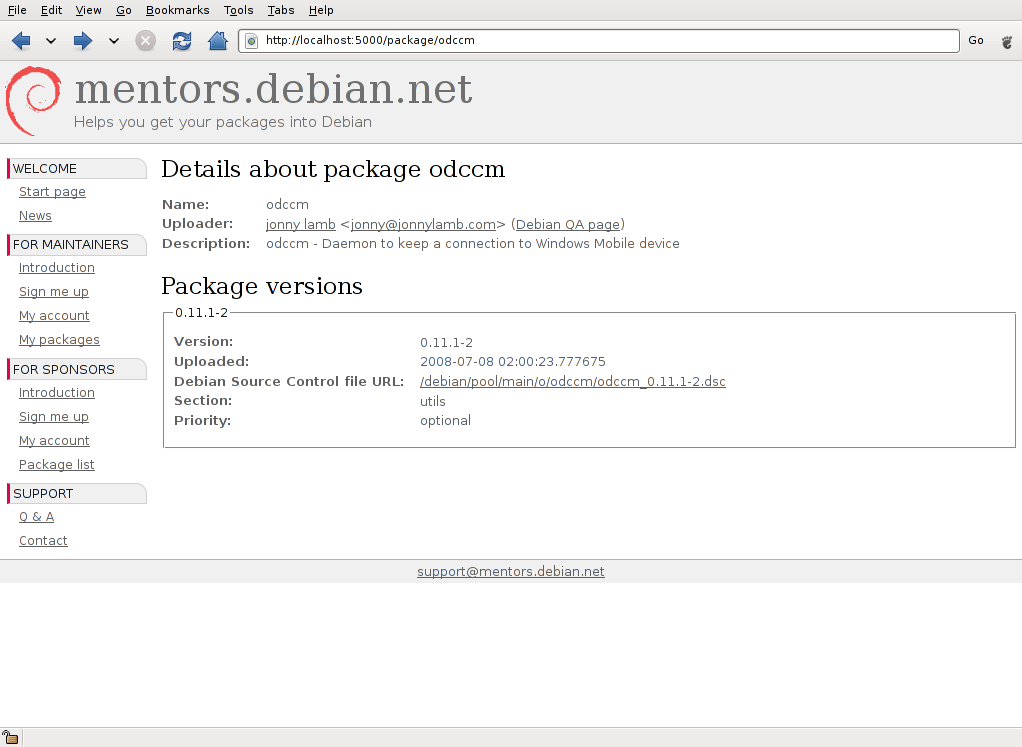
debexpo (Debian package exposition) is a web application that allows one to run a user-friendly public Debian package repository with social interaction that one may be used to from social networking sites. debexpo will be the basis for the mentors.debian.net site but will be useful for others as well. debexpo is the project I am working on for this year’s Summer of Code for Debian under the watch of Christoph Haas debexpo is more than just a web application though. It was based on suggestions by you, and therefore it has some nifty features: Development can be tracked through its Trac instance: http://debexpo.workaround.org/, where I invite you to submit tickets or even submit patches! Its Git repository is public: http://debexpo.workaround.org/debexpo.git (and mirrored here). Last but not least, the there is also a low-traffic mailing list. I invite you to try it out, and report bugs. Posting to the list is a great way to get in contact. There is little visible eye-candy in your browser to show for the work so far as nearly all the work so far has gone into the backend. A sneak peek at what it looks like at the moment is available though: As you can see, the theme is somewhat familiar. Hopefully, as the SoC program nears an end, this will be fixed. Oh, and hello: this is my first post to Planet Debian.

Russell Coker: Is a GPG pass-phrase Useful?

Does a GPG pass-phrase provide a real benefit to the majority of users? It seems that there will be the following categories of attack which result in stealing the secret-key data:

  1. User-space compromise of account (EG exploiting a bug in a web browser or IRC client).
  2. System compromise (EG compromising a local account and exploiting a kernel vulnerability to get root access).
  3. Theft of the computer system while powered down when the system was configured to not use swap or to encrypt the swap space with a random key at boot time.

  4. Theft of a computer system while running or that did not have encrypted swap.

  5. Theft of unencrypted backup media.

Category 1 will permit an attacker to monitor user processes and intercept one that asks for a GPG pass-phrase as well as to copy the secret key. Category 2 will do the same but for all users on the system. Category 3 will give the potential for stealing the private key (if it’s not encrypted) but no direct potential for getting the pass-phrase. Category 4 has the potential for copying a pass-phrase from memory or swap. I am inclined to trust Werner Koch (and anyone else who submitted code to the GPG project) to have written code to correctly lock memory and scrub pass-phrase data and decrypted private key data from memory after use. But I really doubt the ability of most people who write code to interface with GPG to do the same. So every time that a GUI program prompts for a GPG pass-phrase I think that there is the potential for it to be stored in swap or to remain indefinitely in RAM. Therefore stealing a machine that does not have it’s swap-space encrypted with a random key (which is the most practical way of encrypting swap) or stealing a running machine (as mentioned in a previous post [1]) can potentially grant a hostile party access to the pass-phrase. So it seems to me that out of all the possible ways of getting access to a GPG private key, the only ones where a pass-phrase ones is going to really do some good are categories 3 and 5. While it’s good to protect against those situations, it seems to me that the greatest risk to a GPG key is from category 1, with category 2 following close behind. I previously wrote about the slow progress towards using SE Linux and GPG code changes to make it more difficult to steal the secret key [2] - something that I’ve been occasionally working on over the last 6 years. Now it seems to me that the same benefits can and should be made available to people who don’t use SE Linux. If a system directory such as /var/spool/gpg was mode 1770 then gpg could be setgid to group “gpg” so that it could create and access secret keys for users under /var/spool/gpg while the users in question could not directly access them. Then the sys-admin would be responsible for backing up GPG keys. Of course it would probably be ideal to have an option as to whether a new secret key would be created in the system spool or in the user home directory, and migrating the key from the user home directory to the system spool would be supported (but not migrating it back). This would mean that an attacker who compromised a local user account (maybe through a vulnerability in a web browser or MUA) would not be able to get the GPG secret key. They could probably get the pass-phrase by ptracing the MUA (or some other GUI process that calls GPG) but without the secret key itself that would not do as much good - of course once they had the pass-phrase and local access they could use the machine so sign and decrypt data which would still be a bad thing. But it would not have the same scope as stealing the secret key and the pass-phrase. I look forward to reading comments on this post.

Steve Kemp: When I was your age, television was called books

There are few programs I use with so much combined love & loathing than GNU screen. Yesterday I spent a while adding another feature I've been wanting for so long, the unbindall primitive. In many cases I find myself using screen as a wrapper around other things. But usually I end up having to disable dangerous keybindings, to gain security or to protect users from themselves. Typically this leads to a screenrc file looking like this:
#
#  Disable these bindings.
#
bind :
bind s
bind S
bind Z
bind ^\
bind c
bind ^c
bind z
bind Z
bind B
...
Instead it would be better if I could just say:
#
#  Unbind *all* keystrokes
#
unbindall
#
#  Restore actions we need/want/love.
#
bind x quit
bind d detach
bind c screen
..
Anyway, thanks to a small patch I can now. ObQuote: The Princess Bride

Martin-Éric Racine: xf86-video-cyrix and xf86-video-nsc: it's dead, Jim

It had to happen sooner or later: The X.org drivers for the old GX1 variants of the Geode chips formerly made by Cyrix and NSC no longer build against the current X.org release. Given the imminent release of X.org 7.4 (server core 1.5), this essentially means that users of older Geodes will have a nasty surprise, the day they upgrade to Ubuntu/Intrepid, which ships with core 1.5. Soon after, the release immediately following Debian/Lenny will be affected too. There is a planned milestone to eventually reintegrate support for older GX1 products into the clean and up-to-date xf86-video-geode framework, but this will unfortunately come too late for those upgrading to Ubuntu/Intrepid, unless... ...unless someone volunteers to copy gx_* files inside xf86-video-geode and graft GX1 support into the resulting gx1_* files. If you have access to Cyrix/NSC GX1 + CS5530 or AMD SC hardware and a reasonable knowledge of the X.org codebase, your contribution would be most welcome.

Russell Coker: Label vs UUID vs Device

Someone asked on a mailing list about the issues related to whether to use a label, UUID, or device name for /etc/fstab. The first thing to consider is where the names come from. The UUID is assigned automatically by mkfs or mkswap, so you have to discover it after the filesystem or swap space has been made (or note it during the mkfs/mkswap process). For the ext2/3 filesystems the command “tune2fs -l DEVICE” will display the UUID and label (strangely mke2fs uses the term “label” while the output of tune2fs uses the term “volume name“). For a swap space I don’t know of any tool that can extract the UUID and name. On Debian (Etch and Unstable) the file command does not display the UUID for swap spaces or ext2/3 filesystems and does not display the label for ext2/3 filesystems. After I complete this blog post I will file a bug report. If you are using a version of Debian earlier than Lenny (or a version of Unstable with this bug fixed) then you will be able to easily determine the label and UUID of a filesystem or swap space. Other than that the inconvenience of determining the UUID and label will be a reason for not using them in /etc/fstab (keep in mind that sys-admin work sometimes needs to be done at 3AM). One problem with mounting by UUID or label is that it doesn’t work well with snapshots and block device backups. If you have a live filesystem on /dev/sdc and an image from a backup on /dev/sdd then there is a lot of potential for excitement when mounting by UUID or label. Snapshots can be made by a volume manager (such as LVM), a SAN, or an iSCSI server. Another problem is that if a file-based backup is made (IE tar or cpio) then you lose the UUID and label. tune2fs allows setting the UUID, but that seems like a potential recipe for disaster. So this means that if mounting by UUID then you would potentially need to change /etc/fstab after doing a full filesystem restore from a file-based backup, this is not impossible but might not be what you desire. Setting the label is not difficult, but it may be inconvenient. When using old-style IDE disks the device names were of the form /dev/hda for the first disk on the first controller (cable) and /dev/hdd for the second disk on the second controller. This was quite unambiguous, adding an extra disk was never going to change the naming. With SCSI disks the naming issue has always been more complex, and which device gets the name /dev/sda was determined by the order in which the SCSI HAs were discovered. So if a SCSI HA which had no disks attached suddenly had a disk installed then the naming of all the other disks would change on the next boot! To make things more exciting Fedora 9 is using the same naming scheme for IDE devices as for SCSI devices, I expect that other distributions will follow soon and then even with IDE disks permanent names will not be available. In this situation the use of UUIDs or LABELS is required for the use of partitions. However a common trend is towards using LVM for all storage, in this case LVM manages labels and UUIDs internally (with some excitement if you do a block device backup of an LVM PV). So LV names such as /dev/vg0/root then become persistent and there is no need for mounting via UUID or label. The most difficult problem then becomes the situation where a FC SAN has the ability to create snapshots and make them visible to the same machine. UUID or label based mounting won’t work unless you can change them when creating the snapshot (which is not impossible but is rather difficult when you use a Windows GUI to create snapshots on a FC SAN for use by Linux systems). I have had some interesting challenges with this in the past when using a FC based SAN with Linux blade servers, and I never devised a good solution. When using iSCSI I expect that it would be possible to force an association between SCSI disk naming and names on the server, but I’ve never had time to test it out. Update: I have submitted Debian bug #489865 with a suggested change to the magic database. Below are /etc/magic entries for displaying the UUID and label on swap spaces and ext2/3 filesystems:
The following magic entry will display the UUID of a swap space as well as displaying the label in the same manner as the mkswap program:
# according to man page of mkswap (8) March 1999
# volume label and UUID Russell Coker
# http://etbe.coker.com.au/2008/07/08/label-vs-uuid-vs-device/
4086 string SWAPSPACE2 Linux/i386 swap file (new style),
>0×400 long x version %d (4K pages),
>0×404 long x size %d pages,
>1052 string \0 no label,
>1052 string >\0 LABEL=%s,
>0×40c belong x UUID=%x
>0×410 beshort x \b-%x
>0×412 beshort x \b-%x
>0×414 beshort x \b-%x
>0×416 belong x \b-%x
>0×41a beshort x \b%x The following magic entry will display the UUID and label (AKA volume name) of an ext2/3/4 filesystem:
# ext2/ext3 filesystems - Andreas Dilger <adilger@dilger.ca>
# ext4 filesystem - Eric Sandeen <sandeen@sandeen.net>
# volume label and UUID Russell Coker
# http://etbe.coker.com.au/2008/07/08/label-vs-uuid-vs-device/
0×438 leshort 0xEF53 Linux
>0×44c lelong x rev %d
>0×43e leshort x \b.%d
# No journal? ext2
>0×45c lelong ^0×0000004 ext2 filesystem data
>>0×43a leshort ^0×0000001 (mounted or unclean)
# Has a journal? ext3 or ext4
>0×45c lelong &0×0000004
# and small INCOMPAT?
>>0×460 lelong <0×0000040
# and small RO_COMPAT?
>>>0×464 lelong <0×0000008 ext3 filesystem data
# else large RO_COMPAT?
>>>0×464 lelong >0×0000007 ext4 filesystem data
# else large INCOMPAT?
>>0×460 lelong >0×000003f ext4 filesystem data
>0×468 belong x \b, UUID=%x
>0×46c beshort x \b-%x
>0×46e beshort x \b-%x
>0×470 beshort x \b-%x
>0×472 belong x \b-%x
>0×476 beshort x \b%x
>0×478 string >0 \b, volume name "%s"
# General flags for any ext* fs
>0×460 lelong &0×0000004 (needs journal recovery)
>0×43a leshort &0×0000002 (errors)
# INCOMPAT flags
>0×460 lelong &0×0000001 (compressed)
#>0×460 lelong &0×0000002 (filetype)
#>0×460 lelong &0×0000010 (meta bg)
>0×460 lelong &0×0000040 (extents)
>0×460 lelong &0×0000080 (64bit)
#>0×460 lelong &0×0000100 (mmp)
#>0×460 lelong &0×0000200 (flex bg)
# RO_INCOMPAT flags
#>0×464 lelong &0×0000001 (sparse super)
>0×464 lelong &0×0000002 (large files)
>0×464 lelong &0×0000008 (huge files)
#>0×464 lelong &0×0000010 (gdt checksum)
#>0×464 lelong &0×0000020 (many subdirs)
#>0×463 lelong &0×0000040 (extra isize)

Neil Williams: Spammers Hall of Shame

Some time ago, I added a
Spammers Hall of Shame to my first website, codehelp.co.uk.

"... sites that send me unsolicited commercial email can expect a poison
response. If such companies are arrogant enough to not even read the
contents of this page, then I shall post details of their incompetence
here."

It's not often that I add a new one - generally when the spammer in question tries to claim that it is not spam and pretends to have taken an interest in the site when it is plainly obvious that the About page has been completely ignored. It takes a special kind of idiocy to get onto the list - something that motivates me to a noticeable level of annoyance. The vast majority of spam doesn't come anywhere close. It has to be something that has some indication of being supposedly "customised" for me and my website(s) yet equally takes absolutely no notice of the content of that website, specifically the content explicitly added to About that should have been noticed by anyone with half a brain.

Anyway, my latest poison pen is now available for everyone to see.

True, it gives their spam email a wider airing but it's not as if codehelp.co.uk is anything but a very quiet backwater of the internet so it's not going to affect traffic in any real way. I just get annoyed when idiots who claim to be professionals do not have the simple courtesy of reading.

In a similar tone:
http://qof-gen.sourceforge.net/#free

Philipp Kern: Debconf 8: ready, set...

I think I'm ready to go to Debconf 8 now. Just got the last missing vaccination of ones recommended for visitors of Argentina (link German, sorry). Also signed up for an insurance in case I get sick. Now I just need to prepare my stuff properly and restock some of the drugs I occassionally use, just in case. I still feel a bit inert, but I guess that it will be a nice trip and experience. Thanks to those who made it possible!

Next.

Previous.