Search Results: "tar"

2 May 2010

Dominique Dumont: Config-Model related project for GSoC 2010

Hello It s official: I m going to mentor a project related to config-model (without forgetting Augeas which might also be involved) this year:

Content-aware Config Files Upgrading
by Krzysztof Tyszecki, mentored by Dominique Dumont When a package deliver configuration files, the problem of merging user data with new configuration instructions will arise during package upgrades on users systems. Sometimes merging can be done with 3 way merge, but this process does not insure that the resulting file is correct or even legal. This project intends to create standards,
tools and heuristics to make the scary config file conflict resolution debconf prompt a thing of the past.
This project is hosted by Debian organization. Since this project might interest a lot of people, I will (try to) blog regularly on progress, issues, ideas.

From you people, I d like feedback and more importantly, I d like to get real life use cases.

What are the configuration upgrade scenario that bothered you ? What was your configuration file ? What was the setup done by package maintainer ? What result did you get ? What result did you expected to get ?

All the best


Julien Blache: forked-daapd: now with AirTunes v2 streaming

I ve been working on this for a few months now; it s taken quite some time because I wanted to do it right and deliver something better than what already existed in the OpenSource world as far as that particular technology was (not) concerned. So here it is:

AirTunes v2 UDP streaming forked-daapd can now do streaming to multiple AirTunes devices (as well as the local soundcard) and can be controlled from Remote (and, ideally, from anything that speaks DACP). I m releasing this early while the paint is still wet and not everything works on the DACP-side of things. Case in point, while playing a song or an album is supported, playing a playlist isn t. There s some work needed on this particular feature, and it ll get there eventually. There have been a couple of other changes in the codebase in recent weeks too; details after the jump. Implementing AirTunes v2 has been quite fun and, in addition to releasing the forked-daapd code today, I ve also taken the time to write down my findings about the protocol so others can experiment with it. This documentation is by no means exhaustive nor complete as far as the protocol goes; if you find out anything I haven t, let me know so I can update this document. Let s review the recent changes in the forked-daapd codebase over the past few weeks. AirTunes v2 You can now use Remote from your iSomething together with your AirTunes devices and forked-daapd to listen to your library. As mentioned above, playing a playlist is not supported; I have a few things to sort out before this can work and I suspect this will bring changes not only to the DACP interface but also to other parts of the code. So, stay tuned. forked-daapd supports synchronized playback to multiple AirTunes devices together with the local soundcard if so desired. You can expect the AirTunes devices to be in sync with each other, but the soundcard will usually run in circles around them. It looks like AirTunes plays sound a bit slower than 44.1 kHz; not a big deal, though, as AirTunes will catch up periodically and the desync, while it can be noticeable, isn t big (ie we re not talking seconds, not even one full second). Make sure your network can handle the load, as streaming to a single AirTunes device requires in excess of 1.6 Mbps (1.8 Mbps is actually closer to the real thing). Local audio output is supported via ALSA and OSS4, although note that the OSS4 code hasn t been very well tested. I intend to test and debug it fully at a later date, but feel free to beat me to it and send patches. Also note that, while there is code for FreeBSD in the player/streaming part of forked-daapd, it doesn t work well at all. The streaming code needs a timer with a higher resolution than kqueue/kevent has to offer, and I haven t found anything as capable as timerfd. So it s there, but it s broken. Read on about FreeBSD support. Metadata scanning Several fixes and enhancements have been made to the filescanner so it picks more and better metadata. Format-specific tagnames have been added to work around ffmpeg s limitations. Using a recent enough ffmpeg version (anything after mid-december 2009) will work best, especially for MP3 files. SQLite concurrency fixes The database code has been reworked to handle concurrency on the database. Issues with locked tables (or the whole database) were noticed pretty easily with big libraries when accessing forked-daapd during the library update after startup. On uniprocessor machines, this was even easier to hit. This, however, comes with new requirements for SQLite3: you ll now need SQLite3 v3.5.0 at least and it must be built with the unlock notify API enabled. Not all distributions ship SQLite3 with the unlock notify API enabled, so you may need to do a rebuild. Debian, for instance, doesn t; this is #579266. A word about FreeBSD support I m giving up on FreeBSD support. The streaming code doesn t work on FreeBSD due to timer issues, and I don t intend to fix it. I also don t intend to invest much time in porting future features to FreeBSD; if I can make it work, then fine, otherwise, too bad. Someone needs to step up if there s interest in having forked-daapd work on FreeBSD.

Russell Coker: Lexmark Supposedly Supports Linux

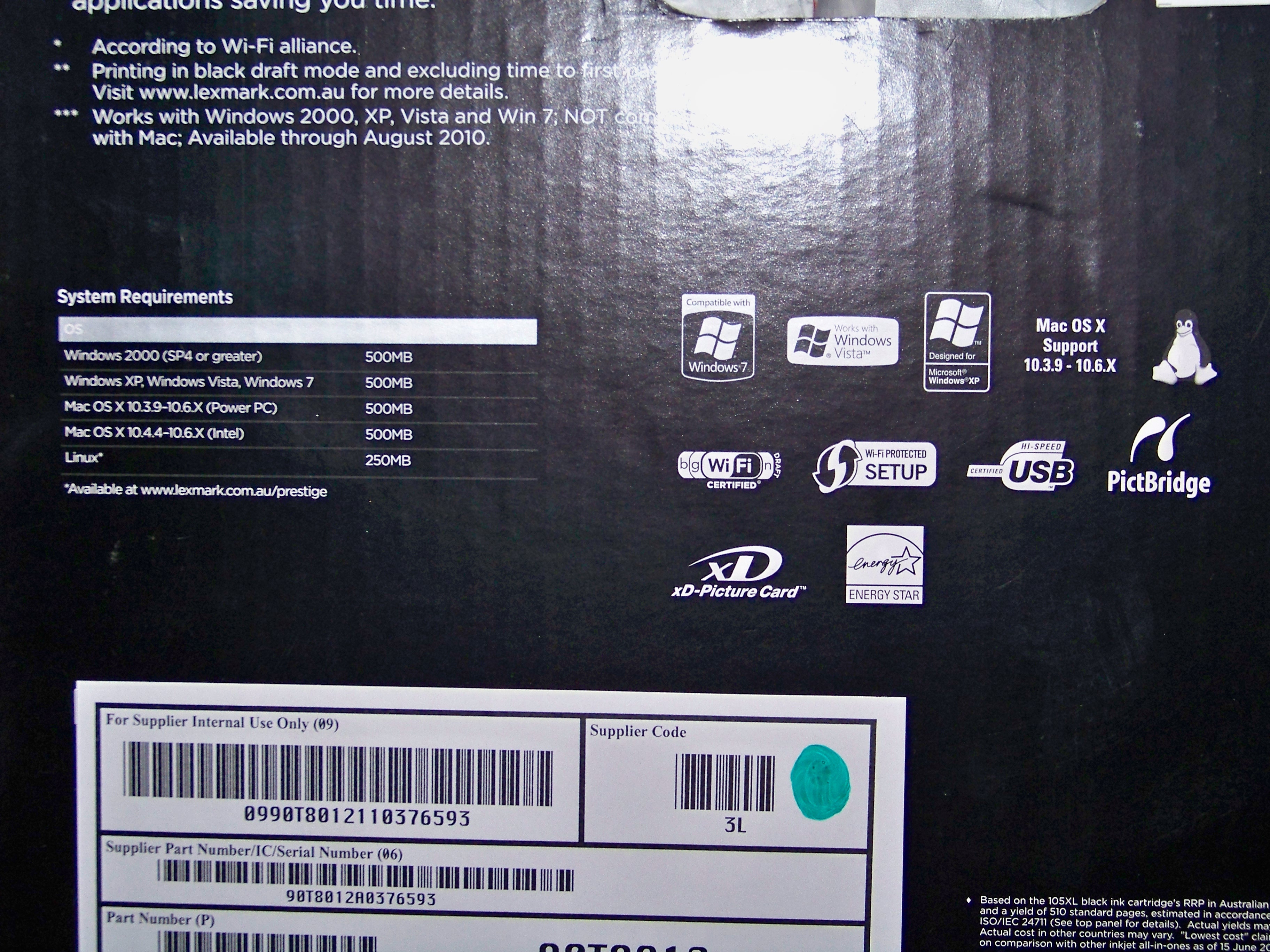
I wanted to get a Lexmark Prestige Pro805 printer to work under Linux, due to bad drivers from Lexmark and no driver support in Debian/Unstable I ve given up and advised the people who purchased it to return it for a refund. I recommend that Lexmark not be considered when purchasing a printer for use with Linux. The box advertises the URL http://www.lexmark.com.au/prestige for downloading Linux drivers. The driver file is named lexmark-inkjet-09-driver-1.5-1.i386_ts.deb.sh.tar.gz which makes anyone expect a tar.gz archive of a shell archive of a Debian package. But that s not what it is at all, in Lexmark-land deb is not the file name extension for a Debian package, but just a random bit of text to identify a file that is somewhat related to Debian, the fact that the Linux driver for Ubuntu/Debian Package Manager based distros doesn t use the string ubu in it s name is something that would lead a typical Linux user to believe that deb means a Debian package. Similarly the file named lexmark-inkjet-09-driver-1.5-1.i386_ts.rpm.sh.tar.gz and described as Linux driver for RedHat Package Manager based distros is not actually an RPM package or inherently for RPM based distros, it s just a shar archive that is built and tested for some unspecified version of some Red Hat distribution (RHEL? Fedora? SUSE?). Now when I execute lexmark-inkjet-09-driver-1.5-1.i386_ts.deb.sh on an AMD64 version of Linux it opens an X11 window, prompts for the root password, and then fails because an i386 Debian package that it somehow built couldn t be installed. When I ran the shar archive with the options --noexec --keep and examined the files it contained it has a few AMD64 executables so obviously the software they used to create the installer has some support for AMD64 but they just decided not to use it. It seems that the only way to buy an i386 system nowadays is to buy an embedded system or a NetBook, all Desktops, laptops, and servers run the AMD64 architecture, as most people do a Linux install that matches the full capabilities of their system (IE running AMD64 software on an AMD64 CPU) that means most systems sold in the last few years can t be used with a new Lexmark printer without an unreasonable amount of work. Sure it is possible to setup a chroot environment or KVM virtual machine for running printer drivers, but I don t really want to do that and a significant portion of the potential customers don t have the skill needed to do so. While technically their claims about having Linux driver support are correct (they support some distributions of Linux on i386), the majority of new systems won t work with it unless someone who has good skills spends some time and effort on it. Probably the majority of Linux Desktop and server systems that are in use today use AMD64 and are run by people who don t know how to setup a chroot so therefore for most real installations it s not supported. Even for i386 systems installation is unlikely to be trouble-free, when they support RPM based distributions (without identifying which of the many wildly different RPM systems they tested on) and Debian (without mentioning a version number) it seems that the incidence of people running a distribution that is supported is going to be quite low. Lexmark uses the Linux logo to claim compatibility Based on this experience I am not inclined to trust Lexmark in future, I will not trust any future claims of Linux support that they may make. The above picture of the Lexmark box shows Tux (the Linux logo), it doesn t mean support out of the box as you would hope, but instead means support for old systems with some effort.

1 May 2010

Filippo Giunchedi: how to ship spidermonkey in your autotools project

While working on freej we'd need to update spidermonkey/mozjs to the latest version and while doing that integrate it better with the rest of autoconf/automake. AFAICT spidermonkey/mozjs is distributed as part of XULRunner nowadays. The requirements are to make it easy to put a new version of spidermonkey into the tree and redistribute it with make dist and also to have a successful make distcheck. The first step is a trick explained in automake manual about third-party Makefiles so we're using a GNUMakefile.in (git) to "proxy" the targets down to the real Makefile or to ignore some targets called by autotools, e.g:
# otherwise linking static libmozjs.a with dynamic libfreej.so won't work
CFLAGS += -fPIC
# the makefile to proxy targets to
js_makefile = $(builddir)/Makefile
# proxy these targets to the real makefile
all export js-config clean libs tools:
  $(MAKE) -f $(js_makefile) $(AM_MAKEFLAGS) $@
# targets required by autotools but which we don't need at all
.PHONY: dvi pdf ps info html installcheck check install uninstall
dvi pdf ps info html installcheck check install uninstall:
This more or less fixes the make part, now for the autoconf part there's a similar tecnique in the autoconf manual involving running arbitrary configuration commands. I first tried to treat spidermonkey as a separate project via AC_CONFIG_SUBDIRS as expained in Configuring Other Packages in Subdirectories but it didn't work and I forgot exactly why. The configure.ac (git) snippet is something like this: (sorry no highlighting, highlight doesn't support m4 yet)
if test x$have_mozjs = xno   test x$static_mozjs = xyes; then
  dnl run lib/javascript/configure after freej's configure, building it static
  AC_CONFIG_COMMANDS([lib/javascript/.xulrunner-subdir],
    (cd lib/javascript &&
      CXXFLAGS="$GLOBAL_CFLAGS $CXXFLAGS -fPIC" \
      CFLAGS="$GLOBAL_CFLAGS $CFLAGS -fPIC" \
      $ac_srcdir/configure --enable-static \
        --enable-js-static-build --disable-jit)   exit $?
  ])
fi
This will run spidermonkey configure after the main configure, at this point config.status will also expand GNUmakefile.in into GNUmakefile with the correct variables. The final step after all this work is of course to add the spidermonkey directory to SUBDIRS (e.g. SUBDIRS += lib/javascript), after that make will hopefully recurse into lib/javascript and use our GNUmakefile. While this is nice it doesn't cater for the make dist family of autotools targets which build the real distribution tarball. To accomplish this I've used an explicit list of spidermonkey files that will end up in the tarball and made make distdir to copy only those files plus GNUmakefile.in and the list itself (.js-distfiles). Which is the second part of the GNUmakefile.in above, i.e. distdir/distfiles targets plus distclean to clean them up, see comments in the file as well. I hope this is somewhat useful to people who are trying to properly (autotools-wise) ship spidermonkey in their project, comments welcome as usual :)

Sean Finney: Nouveau, Gallium3D, and Compiz on Debian

update: 20100503: It's been brought to my attention that there might have been a regression in one of the libraries, mesa, maybe, so that master might not be as reliable a reference point for this guide. so, just in case, here are the commit hashes that were used from the different projects: for the non-git-savvy: git checkout -b mybranch <hash> we now return to your regular broadcasting... A week or two ago I figured it was about time that I took the plung and tried out the latest nouveau drivers from experimental on my laptop. Unfortunately, it meant bidding adieu to compiz (apart from the bling it does actually provide some pretty damned useful features). I thought I'd give it a shot at least for a while on principal, since I've always had to think of the nvidia drivers as a necessary evil, and their lack of proper xrandr support is really, really annoying. Since then I haven't noticed any problems, apart from the following message after every suspend/resume:
[  931.213239] Uhhuh. NMI received for unknown reason 80 on CPU 0.
[  931.213240] You have some hardware problem, likely on the PCI bus.
[  931.213242] Dazed and confused, but trying to continue

No idea what's causing it, but otherwise the system is stable and functional. If anyone knows what can be done about this, I'd appreciate hearing from you. My graphics card, by the way:
01:00.0 VGA compatible controller: nVidia Corporation G72M [Quadro NVS 110M/GeForce Go 7300] (rev a1)

In the time since then, the nouveau driver has made its way into unstable, and a lot of distros (ubuntu, fedora, ...) are even using it as the default driver. So before going any further with the 3d/compiz stuff, I highly recommend that you get the packaged version working first. This will not only make sure that the basic driver works, but it will also make recovery/rollback a lot easier. Since it's all packaged in the standard repositories, it's not much harder than installing a few packages and editing a few files... so come on give it a try :) Getting the 2d driver working in Debian sid Really, this is so easy it's hardly worth writing up, but i'm running with the -v flag this morning... Make sure you don't have any reference to nvidia in /etc/modules or other places that might cause it to be automatically loaded. Then remove the proprietary glx bindings, which would otherwise interfere with the nouveau driver.
sudo apt-get remove nvidia-glx

Next, you'll need to install a kernel that includes updated drm support. Normally this would require a kernel >= 2.6.33.1, but the debian kernel maintainers have graciously backported this code to the 2.6.32-4 kernel package. note this isn't the default kernel version in testing/unstable at the time of writing so you have to explicitly install it along with the nouveau driver.
sudo apt-get install linux-image-2.6.32-4-amd64 xserver-xorg-video-nouveau

If you are already running this kernel and using the proprietary nvidia drivers, via module-assistant or otherwise, you /might/ need to uninstall them first. On my system I left them installed in the old kernel version but did not install them on the new kernel version. Required xorg configuration I don't believe that nouveau is picked by default if available at the time of writing, so you have to have the following in your xorg.conf:
sudo sh -c "cat > /etc/X11/xorg.conf" << EOF
Section "Device"
    Identifier     "nVidia Corporation G72M [Quadro NVS 110M/GeForce Go 7300]"
    Driver         "nouveau"
EndSection
EOF

This was all I needed to do, apart from rebooting into the new kernel. For those who don't want to venture outside the packaging system, this is about as far as you can go for the time being. Though really, if you're bothering to read this far along, you're probably more interested in what comes next :) Getting 3d working (without voiding your distro warranty) So I thought I'd give the 3d-accelerated gallium a go. Their wiki page certainly makes one think twice, but at this point I was seriously fiending to get my bling back (well, the compiz scale plugin, anyway) and figured it wouldn't hurt too much to try. Via google and trawling around in various forums I found a number of how-to documents for getting Gallium3d on debian/ubuntu systems, but most of them recommended doing things in a way that wasn't easily reversible and that could totally hose your system in a not-so-hypothetical worst-case scenario. It's pretty hard to roll back a make install done into /usr, for example, and subsequent package upgrades can leave your system even worse off as they will probably clobber half of what you just did, leaving the other half totally broken. And if you have a laptop which requires the gui for networking (i.e. network-manager), then fixing/rolling-back the changes is not entirely trivial, since you'd likely have to re-download the various drm/mesa/xorg packages. So enter the tried and true unix utility stow (apt-get install stow, of course). stow is a utility that lets you install software into arbitrary folders, and then manage the system-wide installation of the software via a farm of symlinks pointing at the installed location. It's probably more well known among the sysadmin crowd than the desktop user crowd, but it's incredibly useful for the task at hand as it will let us easily install multiple copies of different software in a way that's very easy to update and/or roll-back. RTFM stow(1) for more information. So, on to the juicy stuff... Install needed software, remove problematic packages, setup, etc At least on my system, I had to remove libdrm-dev to keep things from accidentally linking against it instead of the updated version that we install later on below. There's probably a way to override this with CFLAGS but I figure this is simpler.
sudo apt-get remove libdrm-dev
sudo apt-get install stow build-essential xorg-dev git-core libtool mesa-common-dev automake autoconf 
mkdir ~/nouveau

Compile a linux-2.6.34 RC kernel
cd ~/nouveau
git clone git://git.kernel.org/pub/scm/linux/kernel/git/torvalds/linux-2.6.git
cd linux-2.6
git remote add -f nouveau git://anongit.freedesktop.org/nouveau/linux-2.6
git checkout -b nouveau-master nouveau/master
make menuconfig

Enable device drivers -> staging drivers -> nouveau. Make any other changes you might want to make (I just took defaults for everything else).
make deb-pkg

The linux-firmware-free debian package ships some of the same stuff from the generated linux-firmware-image package. I decided to opt for the upstream firmware, though I'm not sure that this is necessary:
sudo apt-get remove linux-firmware-free
sudo dpkg -i ~/nouveau/linux-image*.deb ~/nouveau/linux-firmware-image*.deb
sudo update-grub

Install a copy of dri2proto
cd ~/nouveau
git clone git://anongit.freedesktop.org/xorg/proto/dri2proto
cd dri2proto
./autogen.sh --prefix=/usr/local/stow/dri2proto-20100428
sudo mkdir -p /usr/local/stow/dri2proto-20100428
sudo make install
sudo stow -d /usr/local/stow dri2proto-20100428

Install a cutting-edge version of libdrm
cd ~/nouveau
git clone git://anongit.freedesktop.org/git/mesa/drm/
cd drm
./autogen.sh --prefix=/usr/local/stow/drm-20100428 --disable-intel --disable-radeon --enable-nouveau-experimental-api
make
sudo mkdir -p /usr/local/stow/drm-20100428
sudo make install
sudo stow  -d /usr/local/stow  drm-20100428

Likewise for mesa
cd ~/nouveau
git clone git://anongit.freedesktop.org/git/mesa/mesa
cd mesa
./autogen.sh --prefix=/usr/local/stow/mesa-20100428  --enable-debug --enable-glx-tls --disable-asm --with-dri-drivers= --enable-gallium-nouveau --disable-gallium-intel --disable-gallium-radeon --disable-gallium-svga --with-state-trackers=glx,dri --with-demos=xdemos,demos,trivial,tests
make
sudo mkdir -p /usr/local/stow/mesa-20100428 
sudo make install
sudo stow -d /usr/local/stow mesa-20100428

And now the xorg driver...
cd ~/nouveau
git clone git://anongit.freedesktop.org/git/nouveau/xf86-video-nouveau/
cd xf86-video-nouveau
./autogen.sh --prefix=/usr/local/stow/xf86-video-nouveau-20100428
make
sudo mkdir -p /usr/local/stow/xf86-video-nouveau-20100428
sudo make install
sudo stow -d /usr/local/stow xf86-video-nouveau-20100428

Configuration Configure xorg to look in alternate location for xorg modules and set up DRI
sudo sh -c "cat > /etc/X11/xorg.conf" << EOF
Section "Files"
    ModulePath "/usr/local/lib/xorg/modules,/usr/lib/xorg/modules"
EndSection
Section "ServerFlags"
    Option "GlxVisuals" "all"
Endsection
Section "Device"
    Identifier     "nVidia Corporation G72M [Quadro NVS 110M/GeForce Go 7300]"
    Driver         "nouveau"
EndSection
EOF

I've /heard/ that disabling TV out is a necessity on some cards, though I haven't seen this myself:
sudo sh -c "cat > /etc/modprobe.d/nouveau.conf" << EOF
# not entirely sure this is necessary, but heard it helped with vsync
options nouveau tv_disable=1
EOF

Finally, the one thing that can not be done in /usr/local is making the nouveau DRI driver available. From what I could tell the path that mesa uses to find the DRI libraries is hard-coded (corrections welcome). Since you won't already have this file (otherwise, why would you be following along here?), just drop in a symlink to the file in /usr/local:
sudo ln -s /usr/local/lib/dri/nouveau_dri.so /usr/lib/dri/

Finally, reboot, and hope for the best :) Riding the bleeding edge: how to upgrade later on Again, stow really shows its usefullness here. Using drm as an example case, upgrading an individual component would look something like:
cd ~/nouveau/drm
git clean -dfx
git pull
today= date +%Y%m%d 
./autogen.sh --prefix=/usr/local/stow/drm-$today --disable-intel --disable-radeon --enable-nouveau-experimental-api
make
sudo mkdir -p /usr/local/stow/drm-$today
sudo make install
sudo stow -d /usr/local/stow -D drm-20100428
sudo stow -d /usr/local/stow  drm-$today

Note how the old version is still installed, so you can switch components around pretty freely. Abort! Abort!: How to roll back changes In case your system becomes totally unusable, or you've decided that you just want to go back to the safe and cozy world of what's provided by the debian packages, simply do the following: Assuming that you're using the nouveau driver from unstable, this should be all that is necessary. Conclusion Overall impression I am very, very happy with the resulting setup. I was led to believe that this whole thing was much more unstable and unusable than it actually is! While there are certainly some glitches and missing features, I feel comfortable enough using it that I don't have plans to switch back. But if I find myself in a situation where I can't use the new setup, rolling back shouldn't be a problem either. I figure I'm happy with what I have now and it will only get better. What works, at least to a "kinda works" level. What still doesn't work Further reading, references Thanks A couple shoutouts to those who helped me with this on the way: Feedback / Corrections Unforunately, I've had to disable comments for the time being due to overwhelming quantities of spam. So please drop me a line via email or on IRC (seanius on oftc/freenode).

30 April 2010

Michael Banck: 30 Apr 2010

Science Track at Debconf10 This year's Debconf will probably have for the first time tracks pertaining to certain subjects. One of the proposed tracks will be "Math and Science and Debian" and I was asked to organize it. We have some talk proposals already, and we will have a panel discussion about Debian science packaging between the major contributors of the various packaging teams, but more talks are welome! Talks could be about science with/on Debian, or Debian development in scientific fields. Additionally, I would like to encourage contributions on three types of topics: Full length talks are not required, we could split up each topic among a number of people depending on interest and submissions. Talks can be officially submitted until the end of tomorrow (Saturday May 1st, 23h59 UTC), but even afterwards, if you plan to go to Debconf and would like to give a talk about Math, Science and Debian, please contact me and we will see what can be done. Especially contributions to the three topics above can be made later as the events will be registered already.

Erich Schubert: Oil spill: fortunately it was "just oil" - and not nuclear.

Face it: technology fails. Sometimes. Sooner or later.Statistics are a nice way to fool people, because they can't interpret the numbers properly. And usually this is done to make things sound less risky than they really are. But it's just too easy to lie with numbers. Say, they risk of a major incident at a plant is less than 1% (per year). Sounds good, doesn't it? But if you have 100 plants, that means it will happen about once a year. Make that 1000. Or even more.There are currently around 440 nuclear reactors in use for electricity. Probably some more the IAEA doesn't know about. There are definitely extra reactors in various military vehicles including unmaintained russian submarines. So make that 500. So looking forward to the next 200 years, we want to make sure things are not likely to happen at a rate of 0.001%. Unless our atomic plants are way more than 99.999% secure, we're likely to see a major nuclear accident sooner or later.Which brings us to a totally differnt scale when we look at photovoltaics or wind power. There are just so many more of these plants, that you can bet on some of them failing completely every day. The good news about these plants is that their damage potential is just so much lower. They might be as much as thousandfold more likely to fail than a nuclear plant. And there are probably a thousand more, too. But even if we completely underestimate the risk they just don't do as much damage even in the worst case. Much unlike a nuclear meltdown or such an oil spill. I bet noone would have thought of oil drilling being this risky. After all, it has been done for years.So how is your risk assessment of nuclear power? Is it less risky than oil drilling?

Asheesh Laroia: Mailing lists can wait

Most of my email comes to me via mailing lists. When someone asks a question or starts a discussion, I used to jump at the chance to be the first to reply with an answer. I don't want to unsubscribe; often, I know something that can move the conversation forward or help someone out. But I'm trying to allocate more time for myself away from computing these days. So now I let these discussions mature a little before I see them. All mailing list messages are delivered to a folder called OneDayDelayed. Every night, my server moves those messages to my INBOX. If someone else has already contributed what I would have, perfect! If not, I still have a chance to participate. Sometimes, if I have a long backlog of email, I disable that cron job, sometimes for up to two weeks. Being able to turn the cron job on and off really helps; when I have time to deal with mailing lists, I do. Otherwise, I know the messages will be there when I do have time. Since this OneDayDelayed change, I've gained have a sense of calmness and distance from them. I like that. (Note that if you add me to the CC: line of a mailing list thread, I will see your message immediately, for better or for worse.)

Russell Coker: Link Within

Good Things about LinkWithin For the last 10 weeks I ve been using the LinkWithin.com service to show links to other blog posts at the end of each post (the links are only shown to visitors of my blog not in the RSS feed, so people who read my posts through RSS syndication will miss this). The service shows excerpts of pictures from my blog at the bottom of each post to entice readers into reading other posts. When you click on a LinkWithin icon on my blog you visit a LinkWithin page that redirects you back to my page, so people who use that show up as new visitors being referred by LinkWithin. Currently this month LinkWithin is the fourth highest referrer to my blog, below Google, Reddit, and WebWombat.com.au so it is clearly doing some good in enticing people to read other posts that they might not otherwise read! Bad Things about LinkWithin The first problem with LinkWithin is that the Wordpress plugin was written by people who don t know much about Wordpress. Unlike every other plugin I use it doesn t support configuration options for the user in the database but instead has it hard coded in the PHP code! When you download a plugin from their web site it creates a custom zip that includes the PHP code automatically generated just for you! I have some friends using the same web server as me for running blogs, and I have to tell them you can install any plugin apart from LinkWithin it works for no-one but me . The next problem is that LinkWithin advertises that it will display related posts, it seems to be doing a poor job of that on my blog although admittedly only a minority of my blog posts have pictures so this limits what it has to work with. This has however inspired me to use more pictures in my posts. Another problem is that it produces web pages that are not valid XHTML, the following patch fixes this. --- /tmp/linkwithin.php 2010-02-22 02:09:47.000000000 +0000
+++ ./wp-content/plugins/linkwithin/linkwithin.php 2010-02-22 02:17:29.000000000 +0000
@@ -15,7 +15,7 @@
global $post, $wp_query, $linkwithin_code_start, $linkwithin_code_end; $permalink = get_permalink($post->ID);
- $content .= '<div class="linkwithin_hook" id="'.$permalink.'"></div>';
+ $content .= '<div class="linkwithin_hook" id="'.str_replace('/','-',$permalink).'"></div>';
$content = linkwithin_add_code($content);

return $content;
@@ -26,13 +26,13 @@
global $post, $wp_query, $linkwithin_code_start, $linkwithin_code_end; if ($wp_query->current_post + 1 == $wp_query->post_count)
- $embed_code = '<script>
+ $embed_code = '<script type="text/javascript">
<!-- //LinkWithinCodeStart
var linkwithin_site_id = 151382;
var linkwithin_div_class = "linkwithin_hook";
//LinkWithinCodeEnd -->
</script>
-<script src="http://www.linkwithin.com/widget.js"></script>
+<script src="http://www.linkwithin.com/widget.js" type="text/javascript"></script>
<a href="http://www.linkwithin.com/"><img src="http://www.linkwithin.com/pixel.png" alt="Related Posts with Thumbnails" style="border: 0" /></a>';
$content .= $embed_code;
Finally LinkWithin shows up badly on the FireBug analysis (see my previous post about using Firebug to speed up my blog) [1] see the below picture for details. As an aside, given that Google recommend Firebug it is rather ironic that Google Adsense related URLs cover the majority of the Firebug issues that are not caused by LinkWithin. demonstration of how Linkwithin lowers my page speed What Next? I ve sent email to the LinkWithin people about all these issues other than the FireBug problem reports, given that they haven t responded to some suggestions for over 10 weeks it seems hardly worth my effort in informing them of other issues. I m thinking of trying OutBrain.com again. 18 monthe ago I tried OutBrain but never got it working due to technical issues and then forgot about it. It has some similar features and may work better at least it has tech support people who respond to queries!

Matt Brubeck: Fennec on Android: user feedback and next steps

Last month I joined Mozilla as a UI engineer on the Fennec (Mobile Firefox) project. Firefox is already available for Nokia's Maemo platform, and now a group of Mozilla programmers are porting it to Google's Android OS. This Tuesday they made an early preview build available for public feedback. Until now, the only people working on Firefox for Android were platform developers getting the back-end code to build and run. This week was the first time most other people including me got to try it out. We front-end developers and designers are now starting to adapt the user interface to Android. (The preview build used the look and feel of Firefox for Maemo, designed for rather different hardware and software.) Because we are an open source project, we like to share our work and hear your feedback even at this early stage of development. While I wasn't directly involved in the Android development effort, I spent some of my spare time this week talking to users via Twitter and our Android feedback group. Here's what I heard, in rough order of importance to users, plus some information on our future plans.1 We don't have a regular schedule yet for releasing new builds on Android. Once we get the code merged and automated build servers configured, we'll publish nightly builds of Firefox for Android alongside our Maemo and desktop nightlies. Later this year we will have alpha and beta versions, and hopefully a stable release. Until then, you can follow @MozMobile or Vlad (@vvuk) to hear about any new previews.

  1. Please remember I am still new to the project, and cannot speak for the whole team. This is a personal blog, not a Firefox roadmap!

Russell Coker: CPL Still Sucks

I previously described my experience with Computers and Parts Land (CPL) [1] who gave me a product that didn t do what I wanted (because they thought that they knew better than me) and then gave me attitude when I returned it. As it s almost a year since that incident I had to buy something else from them to use the credit note as I decided that it s not worth making a Trade Practices Act (TPA) [2] issue out of it. Thanks Tim for the suggestion though. Firstly I went to their new store that is advertised on their web site. The people at the new store refused to honor the credit note (they probably hoped that I would just let it go and give them an extra $60 in profit). Claiming that I need to take a credit note back to the store it came from is bogus. Anyway I went back to the original store and bought a new 1.5TB SATA hard drive which seems to work well enough. The service was really slow, I was the only customer in the store and there were several employees not doing much but it still took them ages to print a receipt and give me the hard drive. It will be the last CPL purchase I ever make. In the unlikely situation that there is ever any new gear that is only sold by CPL then I will wait a year and buy it on ebay. It would be good if someone started working as a TPA complainant. They would take donations from dis-satisfied customers who want to pay for an investigation of a shonky company (I d pay $10 for an investigation of CPL). When enough donations were collected they would buy some stuff and make a video of every interaction with the employees and then launch a private legal action under the TPA if they do anything wrong. The TPA complainant would get to keep everything that they buy, any excess donation money after proving the case, and any money offered by the company to settle law suits. While it s not a good use of my time and money to go after CPL directly it would be good to give some money to someone who would then see them dealt with properly.

29 April 2010

David Welton: Erlang vs node.js

I've written about Erlang in the past, and my suspicion that, soon or later, other languages/systems will come along and "eat its lunch". Scala is one such potential contender. Another that has been gaining some visiblity lately is node.js, a simple framework for creating networked applications on top of Google's V8 Javascript engine. I should define what Erlang's lunch is a little bit better before we go on. Erlang does several things really, really well; better than many existing, mainstream systems:
  1. Concurrency - the Actor model that it uses is much easier and more pleasant than dealing with threads.
  2. Distributed systems - Erlang makes this fairly easy and pleasant as well.
  3. Fault tolerant systems - using its distributed powers, Erlang is good for writing things like telephone switches that can't spend any significant time down.
Of these, I think the big one is concurrency. Distributed systems are nice, but not a critical point for most people. Same goes with fault-tollerant: those who need it really need it, but the rest of us are willing to make some compromises. Our web applications are important, but generally not something where people's lives hang in the balance. How does Erlang do "concurrency"? The developer creates Erlang "processes" that interact with one another by passing messages. These are not real, OS level processes, though, and this is critical to how Erlang operates. Since these processes must all coexist within one real, system level process, it is absolutely essential that no operation that they perform hangs the entire system! The Erlang runtime system is built around this concept. Any Erlang process can do things like read and write to the disk or network, or have a "while (true) .... " loop (it doesn't actually look quite like that in Erlang, but that's the idea), and it won't wedge the system. This knowledge is also critical when you want to interface Erlang to the outside world: if your C library contains a routine that might block for a long time, you can't just call it from Erlang as it won't be a well-behaved part of Erlang's world (there are ways around this of course, but make life a bit more complicated for the developer). All this is done with Erlang's scheduler: each Erlang process gets a number of operations it can run before some other process gets to run, so even our while loop will only run for a bit before the system moves on to something else. IO is rigorously done with non-blocking calls internally in order to keep that from becoming an issue. No other system that I know of has such a focus on being non-blocking, and node.js is no exception: a while(true) loop is perfectly capable of wedging the system. Node.js works by passing functions (closures, in many cases) around so that work can be performed as needs be. However, the actual functions that run actually do block the system, and thus must be written in order to not run for too long. Also, and this is important, Node.js also does its best to make IO non-blocking by default, so that you don't have to worry about IO calls. Node.js isn't up to the level Erlang is at, because it requires more manual intervention and thinking about how to do things, but it's probably "good enough" for many tasks. How often do you really write code with so many calculations that it slows things down? Not often in my case - the real world problem I most often encounter is IO, and node.js does its best to make that non-blocking, so that it can be handled in the "background" or a bit at a time, without wedging the system. And if you really needed to write a long-running calculation (say you want to stream the digits of PI or something), you can break up your calculation manually, which may not be quite as elegant as Erlang, but is "good enough" for many people. "Good enough" concurrency, combined with a language that is at least an order of magnitude more popular than Erlang, and a fast runtime, combined with ease of use in general (it's way easier to get started with node.js than with most Erlang web stuff) make for a system that's likely to do fairly well in terms of diffusion and popularity, and is going to "eat some of Erlang's lunch". Or perhaps, rather than actually taking users away from Erlang, it's likely to attract people that might have otherwise gone to Erlang.

28 April 2010

John Goerzen: Download A Piece of Internet History

Back in the early 1990s, before there was a World Wide Web, there was the Internet Gopher. It was a distributed information system in the same sense as the web, but didn t use hypertext and was text-based. Gopher was popular back then, as it made it easy to hop from one server to the next in a way that FTP didn t. Gopher has hung on over the years, and is still clinging to life in a way. Back in 2007, I was disturbed at the number of old famous Gopher servers that had disappeared off the Internet without a trace. Some of these used to be known by most users of the Internet in the early 90s. To my knowledge, no archive of this data existed. Nobody like archive.org had ever attempted to save Gopherspace. So I decided I would. I wrote Gopherbot, a spidering archiver for Gopherspace. I ran it in June 2007, and saved off all the documents and sites it could find. That saved 40GB of data, or about 780,000 documents. Since that time, more servers have died. To my knowledge, this is the only comprehensive archive there is of what Gopherspace was like. (Another person is working on a new 2010 archive run, which I m guessing will find some new documents but turn up fewer overall than 2007 did.) When this was done, I compressed the archive with tar and bzip2 and split it out to 4 DVDs and mailed copies to a few people in the Gopher community. Recently, we ve noted that hard disk failures have hobbled a few actually maintained Gopher sites, so I read this archive back in and posted it on BitTorrent. If you d like to own a piece of Internet history, download the torrent file and go to town (and please stick around to seed if you can). This is 15GB compressed, and also includes a rare video interview with two of the founders of Gopher. There are some plans to potentially host this archive publicly in the manner of archive.org; we ll have to wait and see if anything comes of it. Finally, I have tried to find a place willing to be a permanent host of this data, and to date have struck out. If anybody knows of such a place, please get in touch. I regret that so many Gopher sites disappeared before 2007, but life is what it is, and this is the best snapshot of the old Gopherspace that I m aware of and would like to make sure that this piece of history is preserved.

Sam Hartman: Debconf 10 Enterprise Track

I ve been asked by the Debconf 10 talks team to coordinate a Debian Enterprise track at the upcoming Debconf 10 conference. I m really excited about this, and I could use your help. From my standpoint, this all started with a BOF proposal looking at better coordination and what is missing in Debian enterprise integration. The track will also include talks and other events on what exciting things are happening with Debian in the enterprise. I need your help in the form of suggestions for talks, panels and the like (especially if you would be willing to give the talk or coordinate an activity). We re under a fairly tight deadline; ideally proposals would be in by May 1, but if they are not, it s still definitely worth discussing with me. From my standpoint, topics include: Obviously, many other things could fit in and I d be interested in your ideas as well.

Jan Wagner: [bpo] Couple new packages uploaded

In the last days I uploaded several (new) packages to backports.org: A new haproxy 1.4.4-1~bpo50+1 package is in preparation and needs testing before uploading. You can find the package here.

Andrew Pollock: [life] 17 days

Getting close now. Sarah had another ultrasound yesterday, just to check things. Unfortunately I couldn't be there due to a self-inflicted scheduling screw up. Apparently you could see hair on the ultrasound, so I'm a bit bummed to have missed it. The baby has "dropped", so that's good. Her head's still down, and she's swallowing, so that's all good too. Weight-wise she's now in the 38th percentile. We're booked in for a C-section on the 14th, unless she comes of her own free will between now and then (which is what we'd prefer), in which case our OB will allow an attempt at a VBAC. Our OB is reluctant to allow the pregnancy to go past 39 weeks, given prior history and Sarah's heart, and they don't induce for VBACs, so it's going to require some planetary alignment to avoid a C-section. The whole heart thing still being an issue was only a fairly recent discovery for us. Sarah's cardiac surgeon had told us we could go forth and have as many kids as we wanted, but it turns out the fine print in that statement is that while the previous aneurysm has been repaired, she has an undiagnosed connective tissue disorder, so there's no telling what might happen with the rest of her aorta in the future. So her OB is just doing what a good high-risk OB should do, and being extra paranoid, on two fronts. So we've got a couple of weeks to try and convince our daughter to come more than a week and 2 days early. I don't think we have statistics on our side, unfortunately (although I had a surprisingly hard time finding concrete statistics on delivery dates relative to due dates for first-time deliveries versus subsequent deliveries).

27 April 2010

Ingo Juergensmann: Johan Schl ter: "Child pornography is great"

For many activists in net-politics it is apparent that the fight against child pornography is just an excuse for establishing a EU-wide content filtering infrastructure. This infrastructure for content filtering can be used to filter other content than child pornography as well. For example politicians in Germany already requested blocking gambling sites, Nazi sites, left extremistic political sites and others, when we had that kind of discussion last year over here. The proposal of a law putting up stop pages in front of child pronography sites by former minister for family Ursula "Zensursula" von der Leyen passed the parliament, but shortly after last years parliament elecetion all political parties didn't want that law anymore.
EU commissioner Cecilia "Censilia" Malmstr m introduced a similar proposal for a EU-wide blocking iinitiative a short while ago, as you might now. Christian Engstr m, member of the EU parliament of the swedish Pirate Party, wrote today on his blog that content right industry welcomes child pornography as a way to introduce content filter and blocking infrastructure:

Child pornography is great, the speaker at the podium declared enthusiastically. It is great because politicians understand child pornography. By playing that card, we can get them to act, and start blocking sites. And once they have done that, we can get them to start blocking file sharing sites .

The venue was a seminar organized by the American Chamber of Commerce in Stockholm on May 27, 2007, under the title Sweden A Safe Haven for Pirates? . The speaker was Johan Schl ter from the Danish Anti-Piracy Group, a lobby organization for the music and film industry associations, like IFPI and others.

[...]

Start with child porn, which everybody agrees is revolting, and find some politicians who want to appear like they are doing something. Never mind that the blocking as such is ridiculously easy to circumvent in less than 10 seconds. The purpose at this stage is only to get the politicians and the general public to accept the principle that censorship in the form of filters is okay. Once that principle has been established, it is easy to extend it to other areas, such as illegal file sharing. And once censorship of the Internet has been accepted in principle, they can start looking at ways to make it more technically difficult to circumvent.


If you already have not, then please act now and contact your local EU representive and kindly ask to refuse this directive of Malmstr m and enlighten them by supplying arguments such those MOGIS (MissbrauchsOpfer Gegen InternetSperren, abuse survivors against internet blocking) put up on their webpage (English and other languages).

The abuse of childs and the documentation of such abuse (child pornography is a bad term anyway) needs to be stopped! But access blocking is the wrong direction. Better take care of a more effective criminal prosecution. Documentation of child abuse needs to get removed from the web and the producers needs to get arrested.

So, please act now!

P.S.: there's a nice video on http://cleanternet.org/

Phil Hands: The rise of the Clan MacDebian

I've asked the weavers to start doing their job today, so with luck the tailors will still have time to make kilts ready to wear for DebConf10.If you've been wondering if you'd like some Debian Tartan, now's your chance. We've ordered a little over 16 yards more than we need, which will be enough to make about 2 extra kilts and a few ties (depending on exact details), so order early to avoid disappointment.Of course, kilts are not the only thing one can make out of tartan. The tailors make other things, but there's nothing stopping you from buying some cloth by the yard and being inventive (it costs about 25.00 GBP per yard). We'll also be making ties, so if you're interested in one of those, please add yourself to the relevant table on the wiki, and I'll get in touch with prices etc.Full details of this silliness are available on the wiki page -- send any questions to phil at hands dot comUpdate 16:00 UTC 27th: one 8-yard kilt snapped up already (numbers above updated)

Bdale Garbee: TeleMetrum in Stock

First, I was pleasantly surprised to discover that TeleMetrum is now the subject of a post on the Make magazine site. Very cool! As reported last week, I've been waiting for better GPS antennas to arrive, but heavy snow here in Colorado last Friday delayed delivery. They finally arrived, and as I hoped, they appear to completely solve our signal strength problem! So... [drum roll, please!]... I am very happy to announce that the first production build of TeleMetrum boards and starter kits are now "in stock" at the Garbee and Garbee web store, along with other products designed by the Altus Metrum community! Keith and I are still working on the new Java-based ground station software and user documentation for the system. Watch this space for updates. I hope we'll have both ready for download by the time customers actually receive hardware...

C.J. Adams-Collier: GSoC 2010

Earlier this month, I applied to the Mono Project (and the University of Washington, and Ubuntu, and Debian, and The Perl Foundation) requesting a mentor to get Perl6 hosted on the DLR. Last Tuesday, Miguel contacted me and asked that I chat with Michael Hutchinson about possibly taking up a different project. It seems that the group did not have any mentors who felt comfortable mentoring the Perl6 project. After a bit of consideration, I agreed to modify my application and take up a project to revive the regular expression compiler from 2.2. Today, the project was officially accepted, and I met with my mentor for the first time (hi Rodrigo!). I will also be working with Matthew Wilson (aka @diakopter), since he has purportedly implemented a number of regex-to-IL compilers ;) He also offered to mentor me if The Perl Foundation had accepted my application, and since he has already implemented a perl6 compiler in javascript, I have been looking forward to poking some code with him. Although the GSoC doesn t officially get started until 5/24, I m making a git-svn checkout now. I ve always committed the code directly to svn, but I ve enjoyed working with git, and it seems about time to start contributing via git-svn. It will be easier to have local branches this way, too. Anyway, I m looking forward to it ;)

Next.

Previous.