Search Results: "ed"

23 December 2014

Dirk Eddelbuettel: RcppEigen 0.3.2.3.0

A new release of RcppEigen is now on CRAN, and will get to Debian shortly. This is thanks to a fabulous pull request by Yixuan Qiu who single-handedly managed to upgrade to the new minor release of Eigen -- after having expanded the unit tests a few weeks earlier in another pull request. The NEWS file entry follows.
Changes in RcppEigen version 0.3.2.3.0 (2014-12-22)
  • Updated to version 3.2.3 of Eigen
  • Added a number of additional unit tests for wrap, transform and sparse
  • Updated one of the examples
Courtesy of CRANberries, there is also a diffstat report for the most recent release.

This post by Dirk Eddelbuettel originated on his Thinking inside the box blog. Please report excessive re-aggregation in third-party for-profit settings.

Ulrike Uhlig: How to contribute to the AppArmor upstream profiles

If you want to contribute to existing/upstream AppArmor profiles, you need to create an account on Canonical s launchpad. You ll also need to upload an SSH key to be able to push your changes. You will also need to install Canonical s version control system, called Bazaar:
apt-get install bzr
Go or create a repository where you want to checkout the changes:
mkdir apparmor-dev
cd apparmor-dev
bzr branch lp:apparmor-profiles master
ls master
Define your identity like this:
bzr whoami "My Name <my@email.com>"
Bazaar does not handle branches like Git does, unfortunately. It is a little bit weird in first place that you will need to create a directory where you would create a copy of the master branch. You would then work on this branch and later ask for a merge and pull into the master branch.
mkdir myname
bzr branch master myname/pidgin
ls myname/pidgin
Then, start modifying the profiles using a test editor and test them. Testing is done through dis/enabling the profile.
Once done, you can push the changes to your distant repository:
bzr push
Then, you need to connect to Launchpad s web interface. Go to your page, and look for the branch you just pushed. Click on change branch details and link the branch to apparmor-profiles. Then you will be able to do a merge request through the webinterface.

Ulrike Uhlig: How does my AppArmor profile get into Debian?

I have spent the last days trying to understand the relationship between AppArmor, the AppArmor profiles and Debian s AppArmor profiles. Let me try to briefly introduce you to this. First of all, let me emphasize that one needs to distinguish between AppArmor, the kernel module, and the AppArmor profiles, which define rules for application confinement. As stated on the project s wiki:
The AppArmor project source is split between the kernel module, available in the Linux kernel and git development tree and the user space tools available in launchpad.
So, we can find the upstream AppArmor profile development taking place at Canonical s launchpad. The profiles which are developed there serve as a basis for those included in Debian. It is thus useful to try to contribute to this upstream when updating a profile for Debian. Since AppArmor 2.9 has been introduced, the rules of a profiles which are not applicable for a system are ignored. Thus, collaboration between different Linux distributions shipping AppArmor will become much simpler. In the aforementioned Ubuntu repository you can find the profiles that are currently in development. Once tested and ready, they are removed from this repository and finally included into the corresponding package. For example, the profile for Evince, the GNOME PDF viewer, is available in the evince package. In Debian on the contrary, there are only some packages which ship their own profiles. This concernes for example bind, clamav, cups, tor.
But many profiles are not yet included with their package, but instead delivered through the apparmor-profiles and apparmor-profiles-extra packages. These are maintained by the the Debian AppArmor packaging team. The team takes care of merging changes from the upstream profiles into Debian. Today, the relationship between Upstream and Debian looks like this:

Upstream/bzr

Debian source package

Debian binary package

Ubuntu source package

Ubuntu binary package

apparmor

apparmor

apparmor-profiles

-

-

apparmor-profiles

apparmor-profiles-extra

apparmor-profiles-extra

-

-

ubuntu-evince

apparmor-profiles-extra

apparmor-profiles-extra

evince

evince

In the future, this should change. It would indeed be desirable that package maintainers include profiles with the packages they maintain and take care of updating them accordingly when the package itself is updated. It is much more logical to to it that way, as changes in a package like Pidgin or Evince can occur at a different point in time then when the apparmor-profiles-extra package is updated. I started working on a documentation for Debian Package Maintainers which describes how to do this.

Vincent Bernat: Eudyptula Challenge: superfast Linux kernel booting

The Eudyptula Challenge is a series of programming exercises for the Linux kernel, that start from a very basic Hello world kernel module, moving on up in complexity to getting patches accepted into the main Linux kernel source tree.
One of the first tasks of this quite interesting challenge is to compile and boot your own kernel. eudyptula-boot is a self-contained shell script to boot any kernel image to a shell. It is packed with the following features: In the following video, eudyptula-boot is used to boot the host kernel and execute a few commands:
In the next one, we use it to boot a custom kernel with an additional system call. This is the fifteenth task of the Eudyptula Challenge. A test program is used to check that the system call is working as expected. Additionaly, we demonstrate how to attach a debugger to the running kernel.
While this hack could be used to run containers3 with an increased isolation, the performance of the 9p filesystem is unfortunately quite poor.

  1. The only requirement is to have 9p virtio support enabled. This can easily be enabled with make kvmconfig.
  2. Only udev is started.
  3. A good way to start a container is to combine --root, --force and --exec parameters. Add --readwrite to the mix if you want to keep the modifications.

Michael Stapelberg: Debian Code Search: taming the latency tail

It s been a couple of weeks since I ve launched Debian Code Search Instant, so people have had the chance to use it for a while and that gives me plenty of data points to look at :-). For every query, I log the search term itself as well as the duration the query took to execute. That way, I can easily identify queries that take a long time and see why that is. There is a class of queries for which Debian Code Search (DCS) doesn t perform so well, and that s queries that consist of trigrams which are extremely common. Whenever DCS receives such a query, it needs to search through a lot of files. Note that it doesn t really matter if there are plenty of results or not it s the number of files that potentially contain a result which matters. One such query is arse (we get a lot of curse words). It consists of only two trigrams ( ars and rse ), which are extremely common in program source code. As a couple of examples, the terms parse , sparse , charset and coarse are all matched by that. As an aside, if you really want to search for just arse , use word boundaries, i.e. \barse\b , which also makes the query significantly faster. Fixing the overloaded frontend When DCS first received the query, arse would lead to our frontend server crashing. That was due to (intentionally) unoptimized code we were aggregating all search results from all 6 source backends in memory, sorted them, and then wrote them out to disk. I addressed this in commit d2922fe92 with the following measures:
  1. Instead of keeping the entire result in memory, just write the result to a temporary file on disk ( unsorted.json ) and store pointers into that file in memory, i.e. (offset, length) tuples. In order to sort the results, we also need to store the ranking and the path (to resolve ties and thereby guarantee a stable result order over multiple search queries). For grouping the results by source package, we need to keep the package name.
  2. If you think about it, you don t need the entire path in order to break a tie the hash is enough, as it defines an ordering. That ordering may be different, but any ordering is good enough for the purpose of merely breaking a tie in a deterministic way. I m using Go s hash/fnv, the only non-cryptographic (fast!) hash function that is included in Go s standard library.
  3. Since this was still leading to Out Of Memory errors, I decided to not store a copy of the package name in each search result, but rather use a pointer into a string pool containing all package names. The number of source package names is relatively small, in the order of 20,000, whereas the number of search results can be in the millions. Using the stringpool is a clear win the overhead in the case where #results < #srcpackages is negligible, but as soon as #results > #srcpackages, you save memory.
With all of that fixed, the query became at all possible, albeit with a runtime of around 20 minutes. Double Writing When running such a long-running query, I noticed that the query ran smooth for a while, but then it took multiple seconds without any visible progress at the end of the query before the results appeared. This was due to the frontend ranking the results and then converting unsorted.json into actual result pages. Since we provide results ordered by ranking, but also results grouped by source packages, it was writing every result twice to disk. What s even worse is that due to re-ordering, every read was essentially random (as opposed to sequential reads). What s even worse is that nobody will ever click through all the hundreds of thousands of result pages, so they are prepared entirely in vain. Therefore, with commit c744b236e I made the frontend generate these result pages on demand. This cut down the time for the ranking phase at the end of each query from 20-30 seconds (for big queries) to typically less than one second. Profiling/Monitoring After adding monitoring to each of the source-backends, I realized that during these long-running queries, the disk I/O and network I/O was nowhere near my expectations: each source-backend was sending only a low single-digit number of megabytes per second back to the frontend (typically somewhere between 1 MB/s and 3 MB/s). This didn t match up at all with the bandwidth I observed in earlier performance tests, so I used wget -O /dev/null to send a query and discard the result in order to get some theoretical performance numbers. Suddenly, I was getting more than 10 MB/s worth of results, maxing out the disks with a read rate of about 200 MB/s. So where is the bottleneck? I double-checked that neither the CPU on any of our VMs, nor the network between them was saturated. Note that as of this point, the CPU of the frontend was at roughly 70% (of one core), which didn t seem a lot to me. Then, I followed this excellent tutorial on profiling Go programs to see where the frontend is spending its time. Turns out, the biggest consumer of CPU time was the encoding/json Go package, which is used for deserializing results received from the backend and serializing them again before sending them to the client. Since I was curious about it for a while already, I decided to give cap n proto a try to replace JSON as serialization mechanism for communication between the source backends and the frontend. Switching to it (commit 8efd3b41) brought down the CPU load immensely, and made the query a bit faster. In addition, I killed the next biggest consumer: the lseek(2) syscall, which we used to call with SEEK_CUR and an offset of 0 so that it would tell us the current position. This was necessary in the first place because we don t know in advance how many bytes we re going to write when serializing a result to disk. The replacement is a neat little trick:
type countingWriter int64
func (c *countingWriter) Write(p []byte) (n int, err error)  
    *c += countingWriter(len(p))
    return len(p), nil
 
// [ ]
// Then, use an io.MultiWriter like this:
var written countingWriter
w := io.MultiWriter(s.tempFiles[backendidx], &written)
result.WriteJSON(w)
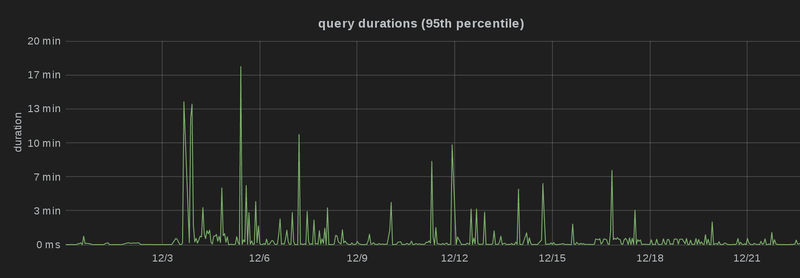
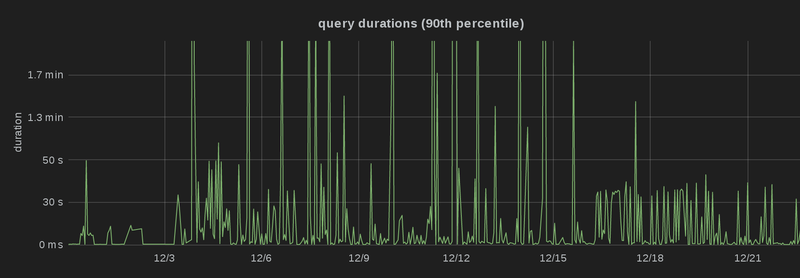
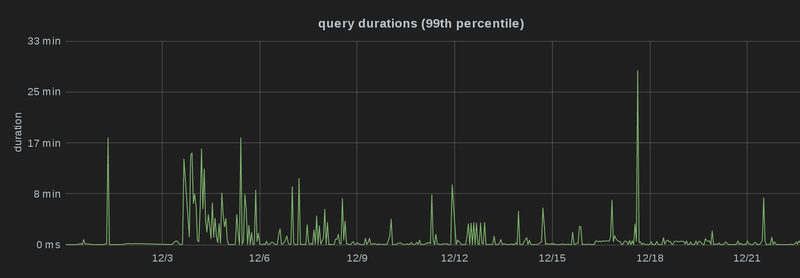
With some more profiling, the new bottleneck was suddenly the read(2) syscall, issued by the cap n proto deserialization, operating directly on the network connection buffer. strace revealed that crunching through the results of one source backend for a long query, read(2) was called about 250,000 times. By simply using a buffered reader (commit 684467ae), I could reduce that to about 2,000 times. Another bottleneck was the fact that for every processed result, the frontend needed to update the query state, which is shared amongst all goroutines (there is one goroutine for each source backend). All that parallelism isn t very effective if you need to synchronize the state updates in the end. So with commit 5d46a572, I refactored the state to be per-backend, so that locking is only necessary for the first couple of results, and the vast vast majority of results can be processed entirely without locking. This brought down the query time from 20 minutes to about 5 minutes, but I still wasn t happy with the bandwidth: the frontend was doing a bit over 10 MB/s of reads from all source backends combined, whereas with wget I could get around 40 MB/s with the same query. At this point, the CPU utilization was around 7% of one core on the frontend, and profiling didn t immediately reveal an obvious culprit. After a bit of experimenting (by commenting out code here and there ;-)), I figured out that the problem was that the frontend was still converting these results from capnproto buffers to JSON. While that doesn t take a lot of CPU time, it delays the network stream from the source-backend: once the local and remote TCP buffers are full, the source-backend will (intentionally!) not continue with its search, so that it doesn t run out of memory. I m still convinced that s a good idea, and in fact I was able to solve the problem in an elegant way: instead of writing JSON to disk and generating result pages on demand, we now write capnproto directly to disk (commit 466b7f3e) and convert it to JSON only before sending out the result pages. That decreases the overall CPU time since we only need to convert a small fraction of the results to JSON, but most importantly, the frontend is now not in the critical path anymore. It can directly pass the data through, and in fact it uses an io.TeeReader to do exactly that. Conclusion With all of these optimizations, we re now down to about 2.5 minutes for the search query arse , and the architecture of the system actually got simpler to reason about. Most importantly, though, the optimizations don t only play out for a single query, but for many different queries. I ve deployed the optimized version at the 15th of December 2014, and you can see that the 99th, 95th and 90th percentile latency dropped significantly, i.e. there are a lot fewer spikes than before, and more queries are processed faster, which is particularly obvious in the third graph (which is capped at 2 minutes):

Russ Allbery: Review: Wakulla Springs

Review: Wakulla Springs, by Andy Duncan & Ellen Klages
Publisher: Tor
Copyright: October, 2013
ASIN: B00EWZDPH4
Format: Kindle
Pages: 99
This is another nominee for the 2014 Hugo Awards (for works published in 2013), this time in the novella category. In this case, though, I read the free ebook version from Tor (Macmillan) rather than the version from the voter packet, since I usually grab all the free ebooks of Tor.com stories. (Even if I'm quite behind in reading them, since I don't read much short fiction.) As an independently-published novella, it gets its own review in the book category. Wakulla Springs is the story of three generations (and four protagonists) who lived near or visited Wakulla Springs in the Florida panhandle. This is a real place: a huge freshwater springs and underwater cave system, now protected as a national park. Two of the four episodes in this story revolve around the filming of movies: a Tarzan movie and Creature from the Black Lagoon. This actually happened as well, although of course the story takes liberties with the details. This is also the story of race relations in the American deep south: the tense and uncertain interactions between black locals and rich white people, both locals and people from the film industry who came for a brief time and then left again. It's also a story about water, swimming, and the sense of being part of the water and knowing it well. This story doesn't develop any particular point; rather, it's more of a collection of character sketches, grabbing moments in time, glimpsing what it's like to cross racial barriers and to feel at home with one's choices. It's also, in a nicely subtle way, about encountering mythical creatures that are not part of one's world. To the locals, the film stars who visit Wakulla Springs are as wild and strange as the imagined creatures of the swamp, and in their way even more foreign. What this is not, though, is science fiction, or even fantasy. One of the complaints I'd heard about Wakulla Springs in the context of the Hugos was that it didn't qualify as a genre story. I'm usually inclined to dismiss these sorts of complaints, since they're often put forth by people with a far narrower definition of genre than mine. But, having read this story, I have to concur. It's very well-written and engaging, but it's not genre in any sense that I'd define it. There are some rare mentions of mythical creatures, but only in ways that are part of the setting, and which are no more fantastic than I'd expect from many mainstream stories. I'm a bit baffled why an SFF publisher would have bought it for an explicitly SFF forum; I have to assume that it's just because it's well-written and the authors have both written SFF. That said, even though this is not the sort of story I'd normally seek out, I'm still glad I read it. I thought the best part of the story was the first, which follows a black woman who takes a job at the Wakulla Springs resort during the filming of a Tarzan movie. The color lines are simply taken for granted by everyone, but Johnny Weissmuller comes off very well in his fictional representation and adds an enthusiastic energy that plays off well against the thoughtful care of the protagonist. The second part echoes this with a boy as the protagonist, but shifts a generation later. This means the color line is fought instead of simply assumed, although with limited success. I thought this part of the story had the best descriptions of the joy of swimming, and once again the movie folks bring a disruptive and positive change to the tightly-drawn lines of local roles and politics. The third and fourth parts I found slighter, elaborating on the story by showing the reader glimpses of the later life of the first two protagonists, but not, I thought, adding anything fundamental to the story. I'm not sure this would be satisfying if you were looking for a science fiction or fantasy story, but it's a solid mainstream story about race, class, and the joy of knowing and feeling a place. It captures an angle of Hollywood that I've rarely seen in movies: a disruptive and almost subversive playfulness and energy that doesn't fix problems but that does provide moments of escape from the realities of the world, even outside of the film. Worth reading, particularly since it's free. Rating: 7 out of 10

Russell Coker: wp-spamshield

Yesterday I installed the wp-spamshield plugin for WordPress [1]. It blocks automated comment spam systems by using JavaScript and cookies, apparently most spammers can t handle that. Before I installed it I was getting hundreds of spam comments per day even with the block spam by math plugin enabled. Now I ve had it running for 24 hours without any spam. The real advantage of this is that now when a legitimate comment gets flagged as spam I ll notice it, previously I was deleting hundreds or thousands of comments at a time without reading them. deb http://www.coker.com.au wheezy wordpress The above repository has the wordpress-wp-spamshield package for Debian/Wheezy. I have no immediate plans for uploading it to Debian because the security support for WordPress plugins doesn t fit in with the Debian model. I am prepared to negotiate about this if someone has good reasons for including it or any of the other WordPress plugins I ve packages. My packaging work is under the GPL (of course) so any DD who disagrees with me could just rebuild the package and upload it. Within Debian there is no rule taking another DD s GPL d code that they decided not to upload and then uploading it. There is a consensus that such things are not appropriate without permission, but anyone who wishes can take this blog post as permission.

22 December 2014

Erich Schubert: Java sum-of-array comparisons

This is a follow-up to the post by Daniel Lemire on a close topic.
Daniel Lemire hat experimented with boxing a primitive array in an interface, and has been trying to measure the cost.
I must admit I was a bit sceptical about his results, because I have seen Java successfully inlining code in various situations.
For an experimental library I occasionally work on, I had been spending quite a bit of time on benchmarking. Previously, I had used Google Caliper for it (I even wrote an evaluation tool for it to produce better statistics). However, Caliper hasn't seen much updates recently, and there is a very attractive similar tool at openJDK now, too: Java Microbenchmarking Harness (actually it can be used for benchmarking at other scale, too).
Now that I have experience in both, I must say I consider JMH superior, and I have switched over my microbenchmarks to it. One of the nice things is that it doesn't make this distinction of micro vs. macrobenchmarks, and the runtime of your benchmarks is easier to control.
I largely recreated his task using JMH. The benchmark task is easy: compute the sum of an array; the question is how much the cost is when allowing different data structures than double[].
My results, however, are quite different. And the statistics of JMH indicate the differences may be not significant, and thus indicating that Java manages to inline the code properly.
adapterFor       1000000  thrpt  50  836,898   13,223  ops/s
adapterForL      1000000  thrpt  50  842,464   11,008  ops/s
adapterForR      1000000  thrpt  50  810,343    9,961  ops/s
adapterWhile     1000000  thrpt  50  839,369   11,705  ops/s
adapterWhileL    1000000  thrpt  50  842,531    9,276  ops/s
boxedFor         1000000  thrpt  50  848,081    7,562  ops/s
boxedForL        1000000  thrpt  50  840,156   12,985  ops/s
boxedForR        1000000  thrpt  50  817,666    9,706  ops/s
boxedWhile       1000000  thrpt  50  845,379   12,761  ops/s
boxedWhileL      1000000  thrpt  50  851,212    7,645  ops/s
forSum           1000000  thrpt  50  845,140   12,500  ops/s
forSumL          1000000  thrpt  50  847,134    9,479  ops/s
forSumL2         1000000  thrpt  50  846,306   13,654  ops/s
forSumR          1000000  thrpt  50  831,139   13,519  ops/s
foreachSum       1000000  thrpt  50  843,023   13,397  ops/s
whileSum         1000000  thrpt  50  848,666   10,723  ops/s
whileSumL        1000000  thrpt  50  847,756   11,191  ops/s
The postfix is the iteration type: sum using for loops, with local variable for the length (L), or in reverse order (R); while loops (again with local variable for the length). The prefix is the data layout: the primitive array, the array using a static adapter (which is the approach I have been using in many implementations in cervidae) and using a "boxed" wrapper class around the array (roughly the approach that Daniel Lemire has been investigating. On the primitive array, I also included the foreach loop approach (for(double v:array) ).
If you look at the standard deviations, the results are pretty much identical, except for reverse loops. This is not surprising, given the strong inlining capabilities of Java - all of these codes will lead to next to the same CPU code after warmup and hotspot optimization.
I do not have a full explanation of the differences the others have been seeing. There is no "polymorphism" occurring here (at runtime) - there is only a single Array implementation in use; but this was the same with his benchmark.
Here is a visualization of the results (sorted by average):
Result boxplots
As you can see, most results are indiscernible. The measurement standard deviation is higher than the individual differences. If you run the same benchmark again, you will likely get a different ranking.
Note that performance may - drastically - drop once you use multiple adapters or boxing classes in the same hot codepath. Java Hotspot keeps statistics on the classes it sees, and as long as it only sees 1-2 different types, it performs quite aggressive optimizations instead of doing "virtual" method calls.

Michael Prokop: Ten years of Grml

* On 22nd of October 2004 an event called OS04 took place in Seifenfabrik Graz/Austria and it marked the first official release of the Grml project. Grml was initially started by myself in 2003 I registered the domain on September 16, 2003 (so technically it would be 11 years already :)). It started with a boot-disk, first created by hand and then based on yard. On 4th of October 2004 we had a first presentation of grml 0.09 Codename Bughunter at Kunstlabor in Graz. I managed to talk a good friend and fellow student Martin Hecher into joining me. Soon after Michael Gebetsroither and Andreas Gredler joined and throughout the upcoming years further team members (Nico Golde, Daniel K. Gebhart, Mario Lang, Gerfried Fuchs, Matthias Kopfermann, Wolfgang Scheicher, Julius Plenz, Tobias Klauser, Marcel Wichern, Alexander Wirt, Timo Boettcher, Ulrich Dangel, Frank Terbeck, Alexander Steinb ck, Christian Hofstaedtler) and contributors (Hermann Thomas, Andreas Krennmair, Sven Guckes, Jogi Hofm ller, Moritz Augsburger, ) joined our efforts. Back in those days most efforts went into hardware detection, loading and setting up the according drivers and configurations, packaging software and fighting bugs with lots of reboots (working on our custom /linuxrc for the initrd wasn t always fun). Throughout the years virtualization became more broadly available, which is especially great for most of the testing you need to do when working on your own (meta) distribution. Once upon a time udev became available and solved most of the hardware detection issues for us. Nowadays X.org doesn t even need a xorg.conf file anymore (at least by default). We have to acknowledge that Linux grew up over the years quite a bit (and I m wondering how we ll look back at the systemd discussions in a few years). By having Debian Developers within the team we managed to push quite some work of us back to Debian (the distribution Grml was and still is based on), years before the Debian Derivatives initiative appeared. We never stopped contributing to Debian though and we also still benefit from the Debian Derivatives initiative, like sharing issues and ideas on DebConf meetings. On 28th of May 2009 I myself became an official Debian Developer. Over the years we moved from private self-hosted infrastructure to company-sponsored systems, migrated from Subversion (brr) to Mercurial (2006) to Git (2008). Our Zsh-related work became widely known as grml-zshrc. jenkins.grml.org managed to become a continuous integration/deployment/delivery home e.g. for the dpkg, fai, initramfs-tools, screen and zsh Debian packages. The underlying software for creating Debian packages in a CI/CD way became its own project known as jenkins-debian-glue in August 2011. In 2006 I started grml-debootstrap, which grew into a reliable method for installing plain Debian (nowadays even supporting installation as VM, and one of my customers does tens of deployments per day with grml-debootstrap in a fully automated fashion). So one of the biggest achievements of Grml is from my point of view that it managed to grow several active and successful sub-projects under its umbrella. Nowadays the Grml team consists of 3 Debian Developers Alexander Wirt (formorer), Evgeni Golov (Zhenech) and myself. We couldn t talk Frank Terbeck (ft) into becoming a DM/DD (yet?), but he s an active part of our Grml team nonetheless and does a terrific job with maintaining grml-zshrc as well as helping out in Debian s Zsh packaging (and being a Zsh upstream committer at the same time makes all of that even better :)). My personal conclusion for 10 years of Grml? Back in the days when I was a student Grml was my main personal pet and hobby. Grml grew into an open source project which wasn t known just in Graz/Austria, but especially throughout the German system administration scene. Since 2008 I m working self-employed and mainly working on open source stuff, so I m kind of living a dream, which I didn t even have when I started with Grml in 2003. Nowadays with running my own business and having my own family it s getting harder for me to consider it still a hobby though, instead it s more integrated and part of my business which I personally consider both good and bad at the same time (for various reasons). Thanks so much to anyone of you, who was (and possibly still is) part of the Grml journey! Let s hope for another 10 successful years! Thanks to Max Amanshauser and Christian Hofstaedtler for reading drafts of this.

Jonathan Dowland: Blade Runner: Alien Easter Egg?

A few weeks ago I went to see Blade Runner: The Final Cut in a one-off showing at the Tyneside Cinema. I've only watched the Final Cut once and that viewing was a bit compromised, so it was nice to see it properly, and on a massive screen with decent surround sound too. Whilst watching it I saw something that I thought might potentially have been a visual reference to Scott's earlier movie, Alien. When Deckard is climbing onto the roof of the Bradbury building, there's a decorative motif that to me, looks very Giger-esque, biomechanical, a bit like a chest-burster.

click for full frame click for full frame
I went back and took a screenshot from the Blu Ray at the same point. What do you think? As it happens, whilst the inner regions of the building in the movie are the Bradbury building (or at least the entrance hall), I don't think the upper exterior shots are.
Purge Purge
There are a few other, well-known references to Alien in Blade Runner, although they are likely simply re-used effects rather than explicitly easter eggs. The display screen in Gaff's Spinner is re-used from the Narcissus (here's a comparison) and the ambience in Deckard's apartment also featured in the Nostromo's medical bay. Some enterprising person has put together a 12 hour session of that particular sound effect looping. There's a number of other comparisons and spots at this propsummit.com thread.

Dirk Eddelbuettel: BH release 1.55.0-1

A new release of BH, our package providing (a large part of the) Boost C++ libraries as a set of template headers for use by R, is now on CRAN. There are two changes. First, we upgraded to Boost 1.55. While Boost 1.57 is now current, I am playing it somewhat safe and conservative here by relying on what is the current version in Debian (and Ubuntu). I even started from the Debian tarball. This ensures we include nothing not in accordance with the Debian Free Software Guidelines (as they are a good proxy for what is acceptable to CRAN). The second change was the addition of Boost.Geometry as requested in issue ticket 5. This may be a good time to recall that best way to get in touch for desired additions in BH are the mailing list or the issue tracker at the GitHub repo. A brief summary of changes from the NEWS file (which we failed to update for the release; the text below is however now in the repo):
Changes in version 1.55.0-1 (2014-12-21)
Courtesy of CRANberries, there is also a (very long!) diffstat report for the most recent release. Comments and suggestions are welcome via the mailing list or the issue tracker at the GitHubGitHub repo.

This post by Dirk Eddelbuettel originated on his Thinking inside the box blog. Please report excessive re-aggregation in third-party for-profit settings.

Craig Small: Mudlet 3 beta

A break from wordpress, I was trying to get the beta version of mudlet 3.0 compiling. On the surface the program looks a lot like the existing v2.0 that is currently within Debian. The developers have switched from qt4 to qt5 which means a lot of dependency fun for me but I got there in the end. As it is only a beta and not their final release, the package is located within the Debian experimental release. Once 3.0 hits a final release, I ll switch it to sid. If you do use the current mudlet, give 3.0 a try. I d be interested to know what you think. For people that have not heard of mudlet before, it is a mud client. mud stands for Multi User Dungeon, which is a multiplayer text-only game. While you can use something as simple as telnet to connect to a mud server, most people use some sort of specialised client. The advantages are you can display extra information (such a health stats) in a different window as well as aliases (macros or special commands, basically the same idea as a bash alias) and triggers (commands that are run depending on what the mud server sends you). The triggers take away some of the repeated things you may have to do, such as sipping a health tonic when your health level drops below some limit. One thing you might notice in the experimental 3.0 beta is that the icon is missing. lintian picked up that the license was wrong; it was by-nc which meant it can t go into main. I ve removed the icon until upstream sorts it out.

21 December 2014

Gregor Herrmann: GDAC 2014/21

today I got two private mails from fellow DDs; both were personal messages & a pleasure to read. but what I also realized is that both emails were encrypted. which reminded me how hard it is to communicate securely with most people, & how easy it is with debian people. & this is something we can be proud of!
this posting is part of GDAC (gregoa's debian advent calendar), a project to show the bright side of debian & why it's fun for me to contribute.

Russ Allbery: Review: 2014 Hugos: Novelettes

Review: 2014 Hugos: Novelettes, edited by Loncon 3
Publisher: Loncon 3
Copyright: 2014
Format: Kindle
This is another weird "book review" covering the Hugo-nominated novelettes for the 2014 Hugos (given for works published in 2014) at Loncon 3, the 2014 Worldcon. The "editor" is the pool of attendees and supporting members who chose to nominate works, all of which had been previously edited by other editors in their original publication. I received all of these as part of the Hugo voter's packet for being a supporting member, but they all appear to be available for free on the Internet (at least at the time of this writing). "The Exchange Officers" by Brad Torgersen: An okay, if not particularly ground-breaking, military SF story, ruined for me by the ham-handed introduction of superficial jingoism. The protagonists are doing a tour as remote operators of humanoid battle suits in orbit: not a new premise, but a servicable one. Since this is military SF, they predictably have to defend a space installation against attackers. So we get a bit of drama, a bit of zero-g combat, and the fun of people learning how to remotely operate suits. You've probably read this before, but it passes the time reasonably well. Unfortunately, Torgersen decided to make the villains the Chinese military for no adequately-explained reason. (Well, I'm being kind; I suspect the reason is the standard yellow peril nonsense, but that's less generous.) So there is snide commentary about how only the military understand the Chinese threat and a fair bit of old-fashioned jingoism mixed in to the story, to its detriment. If you like this sort of thing, it's a typical example, although it escapes me why people thought it was exceptional enough to warrant nomination. (5) "The Lady Astronaut of Mars" by Mary Robinette Kowal: Once again, my clear favorite among the stories also won, which is a lovely pattern. Elma was the female astronaut in an alternate history in which manned space exploration continued to grow, leading to permanent settlement on Mars. She spent lots of time being photographed, being the smiling face of the space program, while her husband worked on the math and engineering of the launches. Now, she's an old woman, taking care of her failing and frail husband, her career behind her. Or so she thinks, before an offer that forces an impossible choice between space and staying with her husband for his final days. This is indeed the tear-jerker that it sounds like, but it's not as maudlin as it might sound. Kowal does an excellent job with Elma's characterization: she's no-nonsense, old enough to be confident in her opinions, and knows how to navigate through the world. The story is mixed with nostalgia and memories, including a reminder of just what Elma meant to others. It touches on heroism, symbolism, and the horrible choices around dying loved ones, but I thought it did so deftly and with grace. I was expecting the story to be too obvious, but I found I enjoyed the quotidian feel. It's not a story to read if you want to be surprised, but I loved the small touches. (9) "Opera Vita Aeterna" by Vox Day: Before the review, a note that I consider obligatory. The author of this story is an aggressively misogynistic white supremacist, well-known online for referring to black people as savages and arguing women should not be allowed to vote. To what extent you choose to take that into account when judging his fiction is up to you, but I don't think it should go unsaid. "Opera Vita Aeterna" is the story of a monastery in a typical fantasy world (at least as far as one can tell from this story; readers of Vox Day's fantasy series will probably know more background). At the start of the story, it gets an unexpected visit from an elf. Not just any elf, either, but one of the most powerful magicians of his society. He comes to the monastery out of curiousity about the god that the monks worship and stays for a project of illuminating their scriptures, while having theological debates with the abbot. This story is certainly not the offensive tirade that you might expect from its author. Its biggest problem is that nothing of substance happens in the story, either theologically or via more conventional action. It's a lot of description, a lot of talking, a lot of warmed-over Christian apologetics that dodges most of the hard problems, and a lot of assertions that the elf finds something of interest in this monastery. I can believe this could be the case, but Vox Day doesn't really show why. There is, at the end of the story, some actual drama, but I found it disappointing and pointless. It leads nowhere. The theology has the same problem: elves supposedly have no souls, which is should be the heart of a theological question or conflict Vox Day is constructing, but that conflict dies without any resolution. We know nothing more about the theology of this world at the end of the story than we do at the beginning. Some of the descriptions here aren't bad, and the atmosphere seems to want to develop into a story. But that development never happens, leaving the whole work feeling fundamentally pointless. (4) "The Truth of Fact, the Truth of Feelng" by Ted Chiang: This is another oddly-constructed story, although I think a bit more successful. It's a story in two interwoven parts. One is a fictional essay, told in a non-fiction style, about a man living in a future world with ubiquitous life recording and very efficient search software. Any part of one's life can be easily found and reviewed. The other is the story of a boy from a tribal culture during European colonialism. He learns to read and write, and from that a respect for written records, which come into conflict with the stories that the tribe elders tell about the past. The purpose of both of these stories is to question both the value and the implications of recording everything in a way that preserves and guarantees the facts instead of individual interpretations. The boy's story calls this into question; the narrator's story offers ambiguous support for its value and a deeper plea for giving people space to change. I found the style a bit difficult to get used to, since much of it did not feel like a story. But it grew on me as I read it, and the questions Chiang raises have stuck with me since. The problem of how and when to allow for change in others when we have perfect (or at least vastly improved) memory is both important and complicated, and this is one of the better presentations of the problem that I've seen. It's more of a think-y piece, and closer to non-fiction than a story, but I thought it was worth reading. (8) "The Waiting Stars" by Aliette de Bodard: I keep wanting to like de Bodard's space opera world of AIs and living ships, but it never quite works for me. I've read several stories set in this universe now, and it has some neat ideas, but I always struggle with the characters. This story at least doesn't have quite as much gruesome pregnancy as the previous ones (although there's still some). "The Waiting Stars" opens with a raid on a ship graveyard, an attempt to rescue and "reboot" an AI starship under the guidance of another Mind. This is intermixed with another story about a woman who was apparently rescued in childhood from birthing ship Minds and raised in a sort of foster institution. This feels like a flashback at first, but its interaction with the rest of the story is something more complicated. The conceptual trick de Bodard pulls here is thought-provoking, but once again I struggled to care about all of the characters. I also found the ending discouraging and unsatisfying, which didn't help. Someone who isn't me might really like this story, but it wasn't my thing. (6) Rating: 6 out of 10

Dirk Eddelbuettel: If only there was a Romeo somewhere ...

Attention: rant coming. You have been warned, and may want to tune out now. So the top of my Twitter timeline just had a re-tweet posting to this marvel on the state of Julia. I should have known better than to glance at it as it comes from someone providing (as per the side-bar) Thought leadership in Big Data, systems architecture and more. Reading something like this violates the first rule of airport book stores: never touch anything from the business school section, especially on (wait for it) leadership or, worse yet, thought leadership. But it is Sunday, my first cup of coffee still warm (after finalising two R package updates on GitHub, and one upload to CRAN) and so I read on. Only to be mildly appalled by the usual comparison to R based on the same old Fibonacci sequence. Look, I am as guilty as anyone of using it (for example all over chapter one of my Rcpp book), but at least I try to stress each and every time that this is kicking R where it is down as its (fairly) poor performance on functions calls (that is well-known and documented) obviously gets aggravated by recursive calls. But hey, for the record, let me restate those results. So Julia beats R by a factor of 385. But let's take a closer look. For n=25, I get R to take 241 milliseconds---as opposed to his 6905 milliseconds---simply by using the same function I use in every workshop, eg last used at Penn in November, which does not use the dreaded ifelse operator:
fibR <- function(n)  
  if (n < 2) return(n)
  return(fibR(n-1) + fibR(n-2))
 
Switching that to the standard C++ three-liner using Rcpp
library(Rcpp)
cppFunction('int fibCpp(int n)   
  if (n < 2) return(n);  
  return(fibCpp(n-1) + fibCpp(n-2));  
   ')
and running a standard benchmark suite gets us the usual result of
R> library(rbenchmark)
R> benchmark(fibR(25),fibCpp(25),order="relative")[,1:4]
        test replications elapsed relative
2 fibCpp(25)          100   0.048    1.000
1   fibR(25)          100  24.674  514.042
R> 
So for the record as we need this later: that is 48 milliseconds for 100 replications, or about 0.48 milliseconds per run. Now Julia. And of my standard Ubuntu server running the current release 14.10:
edd@max:~$ julia
ERROR: could not open file /home/edd//home/edd//etc/julia/juliarc.jl
 in include at boot.jl:238
edd@max:~$ 
So wait, what? You guys can't even ensure a working release on what is probably the most popular and common Linux installation? And I get to that after reading a post on the importance of "Community, Community, Community" and you can't even make sure this works on Ubuntu? Really? So a little bit of googling later, I see that julia -f is my friend for this flawed release, and I can try to replicate the original timing
edd@max:~$ julia -f
               _
   _       _ _(_)_        A fresh approach to technical computing
  (_)       (_) (_)       Documentation: http://docs.julialang.org
   _ _   _   _  __ _      Type "help()" to list help topics
               / _      
       _        (_        Version 0.2.1 (2014-02-11 06:30 UTC)
 _/  \__'_ _ _ \__'_      
 __/                      x86_64-linux-gnu
julia> fib(n) = n < 2 ? n : fib(n - 1) + fib(n - 2)
fib (generic function with 1 method)
julia> @elapsed fib(25)
0.002299559
julia> 
Interestingly the posts author claims 18 milliseconds. I see 2.3 milliseconds here. Maybe someone is having a hard time comparing things to the right of the decimal point. Or maybe his computer is an order of magnitude slower than mine. The more important thing is that Julia is of course faster than R (no surprise: LLVM at work) but also still a lot slower than a (trivial to write and deploy) C++ function. Nothing new here. So let's recap. Comparison to R was based on a flawed version of a function we only use when we deliberately want to put R down, can be improved significantly when using a better implementation, results are still off by order of magnitude to what was reported ("math is hard"), and the standard C / C++ way of doing things is still several times faster than our new saviour language---which I can't even launch on the current version of one of the more common free operating systems. Ok then. Someone please wake me up in a few years and I will try again. Now, coming to the end of the rant I should really stress that of course I too hope that Julia succeeds. Every user pulled away from Matlab is a win for all us. We're in this together and the endless navel gazing between ourselves is so tiresome and irrelevant. And as I argue here, even more so when we among ourselves stick to unfair comparisons as well as badly chosen implementation details. What matters are wins against the likes of Matlab, Excel, SAS and so on. Let's build on our joint strength. I am sure I will use Julia one day, and I am grateful for everyone helping with it---as a lot of help seems to be needed. In the meantime, and with CRAN at 6130 packages that just work I'll continue to make use of this amazing community and trying my bit to help it grow and prosper. As part of our joint community.

Steve McIntyre: UEFI Debian installer work for Jessie, part 2

A month ago , I wrote about my plans for improved (U)EFI support in Jessie. It's about time I gave an update on progress! I spoke about adding support for installing grub-efi into the removable media path (#746662). That went into Debian's grub packages already, but there were a couple of bugs. First of all, the code could end up prompting people about EFI questions even when they didn't have any grub-efi packages installed. Doh! (#773004). Then there was an unexpected bug with case-insensitive file name handling on FAT/VFAT filesystems (#773092). I've posted (and tested!) patches to fix both, hopefully in an upload any day now. Next, I mentioned getting i386 UEFI support going again. This is a major feature that a lot of people have been asking for. It's also going to involve quite a bit of effort... Our existing (amd64) UEFI-capable images in Debian use the standard x86 El Torito CD boot method, with two boot images provided. One of these images gives us the traditional isolinux BIOS-boot support. The second option is an alternate El Torito image, including at a 64-bit version of grub-efi. For most machines, this works just fine - the BIOS or UEFI firmware will automatically pick the correct image and everybody's happy. This even works on our multi-arch i386/amd64 CDs and DVDs - isolinux will boot either kernel from the first El Torito image, or the alternate UEFI image is amd64 only. However, I can now see that there's been a long-standing issue with those multi-arch images, and it's to do with Macs. On the advice of Matthew Garrett, I've borrowed an old 32-bit Intel Mac to help testing, and it's quite instructive in terms of buggy firmware! The firmware on older 32-bit Intel Macs crashes hard when it detects more than one El Torito boot image, and I've now seen this happen myself. I've not had any bug reports about this, so I can only assume that we haven't had many users try that image. As far as I can tell, they've been using the normal i386 images in BIOS boot mode, and then struggling to get bootloaders working afterwards. There are a number of different posts on the net explaining how to do that. That's OK, but... If I now start adding 32-bit UEFI support to our standard set of i386 images, this will prevent users of old Macs from installing Debian. I could just say "screw it" and decide to not support those users at all, but that's not a very nice thing to do. If we want to continue to support them and add 32-bit UEFI support, I'll have to add another flavour of i386 image, either a "Mac special" or a "32-bit UEFI special". I'm not keen on doing that if I could avoid it, but the two options are mutually exclusive. Given the Mac problem is only on older hardware which (hopefully!) will be dying out, I'll probably pick that one as the special-case CD, and I'll make an extra netinst flavour only for those users to boot off. So, I've started playing with i386 UEFI stuff in the last couple of weeks too. I almost immediately found some showstopper behaviour bugs in the i386 versions of efivar and efibootmgr (#773412 and #773007), but I've debugged these with our Debian maintainer (Jared Dominguez) and the upstream developer (Peter Jones) and fixes should be in Jessie very soon. As I mentioned last month, the machines that most people have been requesting support for are the latest Bay Trail-based laptops and tablets. There are using 64-bit Intel Atom CPUs, but crippled with 32-bit UEFI firmware with no BIOS compatibility mode. This makes for some interesting issues. It's probably impossible to get a true answer why these machines are so broken by design, but there are several rumours. As far as I can see, most of these machines seem to ship with a limited version of 32-bit Windows 8.1. 32-bit Windows is smaller than 64-bit Windows, so fits much better in limited on-board storage space. But 32-bit Windows won't boot from 64-bit UEFI, so the firmware needed buggering to match. Ugh! To support these Bay Trail machines properly, we'll want to add a 32-bit UEFI installation option to our 64-bit images. I can tweak our CDs so that both 32-bit and 64-bit versions of grub-efi are included, and the on-board UEFI will load the right one needed. Then I'll need to make sure that all the 64-bit images also include grub-efi-ia32-bin from now on. With some extra logic, we'll need to remember that these new machines need that package installing instead of grub-efi-amd64-bin. It shouldn't be too hard, but let's see! :-) So, I've been out and bought one of these machines, an Asus X205TA. Lucas agreed that Debian will reimburse me (thanks!), so I'm not stuck with spending my own money on an otherwise unwanted machine! I can see via Google that none of the mainstream Linux distros support the Bay Trail machines fully yet, so there's not a lot of documentation yet. Initial boot on the new machine was easy using a quick-hack i386 UEFI image on USB, but from there everything went downhill quickly. I'll need to investigate some more, but the laptop's own keyboard and trackpad are not detected by the installer system. Neither is its built-in WiFi. Yay! I had to go and dig out a USB hub to connect the installer image USB key, a keyboard, mouse and a USB hard drive to the machine, as it only has 2 USB ports. I've taken a complete backup of the on-board 32GB flash before I start experimenting, so I can restore the machine back to its virgin state for future testing. I guess I now have a project to keep me busy over Christmas...! In other news, we've been continuing work on UEFI support for and within the new arm64 port. My ARM/Linaro colleague Leif Lindholm has been back-porting upstream kernel features and bug fixes to make d-i work, and filing Debian bugs when silly things break on arm64 because people don't think about other architectures (e.g #773311, doh!). As there are more and more people interested in (U)EFI support these days, I've also proposed that we create a new debian-efi mailing list to help focus discussion. See #773327 and follow up there if you think you'd use the list too! You can help! Same as 2 years ago, I'll need help testing some of these images. For the 32-bit UEFI support, I now have some relevant hardware myself, but testing on other machines too will be very important! I'll start pushing unofficial Jessie EFI test images shortly - watch this space.

20 December 2014

Gregor Herrmann: GDAC 2014/20

today seen on IRC: a maintainer was surprised & happy that their package had migrated to testing without having filed an unblock request. once again an example of the awesome work of the release team which pro-actively unblocked the package. a big thank you to the members of the release team!
this posting is part of GDAC (gregoa's debian advent calendar), a project to show the bright side of debian & why it's fun for me to contribute.

Mark Brown: Adventures with ARM server

I recently got a CubieTruck with a terabyte SSD to use as a general always on server. This being an ARM board rather than a PC (with a rather nice form factor it s basically the same size as a SSD) you d normally expect a blog post about it to include instructions for kernels and patches and so on but with these systems and current Debian testing there s no need Debian works out of the box (including our standard kernel) on it, the instructions worked easily and I now have a new machine sitting quietly in the corner serving away. Sadly it being a dual core A7 it s not got the grunt to replace my kernel build test system, an ARM allmodconfig takes eleven and a bit hours as opposed to a little less than twenty minutes on my desktop (which does draw well over an order of magnitude more power doing it), but otherwise you d never notice the difference when using the system. The upshot of all this is that actually there s no real adventure at all; for systems like these where the system vendors and the communities around them are doing the right things and working well with upstream things just work as you d expect with minimal effort. The one thing that s noticeably different from installing on a PC and really could do with improving is that instead of being shipped as part of the board the boot firmware has to be written to a SD card, something that could be addressed as easily as simply shipping a suitably programmed SD card in the box even without any other modification of the hardware, though on board flash would be even nicer.

Dirk Eddelbuettel: digest 0.6.7

Release 0.6.7 of digest package is now on CRAN and in Debian. Jim Hester was at it again and added murmurHash. I cleaned up several sets of pedantic warnings in some of the source files, updated the test reference out, and that forms version 0.6.7. CRANberries provides the usual summary of changes to the previous version.

This post by Dirk Eddelbuettel originated on his Thinking inside the box blog. Please report excessive re-aggregation in third-party for-profit settings.

Rudy Godoy: Apache Phoenix for Cloudera CDH

Apache Phoenix is a relational database layer over HBase delivered as a client-embedded JDBC driver targeting low latency queries over HBase data. Apache Phoenix takes your SQL query, compiles it into a series of HBase scans, and orchestrates the running of those scans to produce regular JDBC result sets. What the above statement means for developers or data scientists is that you can talk SQL to your HBase cluster. Sounds good right? Setting up Phoenix on Cloudera CDH can be really frustrating and time-consuming. I wrapped-up references from across the web with my own findings to have both play nice. Building Apache Phoenix Because of dependency mismatch for the pre-built binaries, supporting Cloudera s CDH requires to build Phoenix using the versions that match the CDH deployment. The CDH version I used is CDH4.7.0. This guide applies for any version of CDH4+. Note: You can find CDH components version in the CDH Packaging and Tarball Information section for the Cloudera Release Guide . Current release information (CDH5.2.1) is available in this link. Preparing Phoenix build environment Phoenix can be built using maven or gradle. General instructions can be found in the Building Phoenix Project webpage. Before building Phoenix you need to have: Checkout correct Phoenix branch Phoenix has two major release versions: Clone the Phoenix git repository
git clone https://github.com/apache/phoenix.git
Work with the correct branch
git fetch origin
git checkout 3.2
Modify dependencies to match CDH Before building Phoenix, you will need to modify the dependencies to match the version of CDH you are trying to support. Edit phoenix/pom.xml and do the following changes: Add Cloudera s Maven repository
+  <repository>
+  <id>cloudera</id>
+  https://repository.cloudera.com/artifactory/cloudera-repos/
+  </repository>
Change component versions to match CDH s.
  
-  <hadoop-one.version>1.0.4</hadoop-one.version>
-  <hadoop-two.version>2.0.4-alpha</hadoop-two.version>
+  <hadoop-one.version>2.0.0-mr1-cdh4.7.0</hadoop-one.version>
+  <hadoop-two.version>2.0.0-cdh4.7.0</hadoop-two.version>
  <!-- Dependency versions -->
-  <hbase.version>0.94.19
+  <hbase.version>0.94.15-cdh4.7.0
  <commons-cli.version>1.2</commons-cli.version>
-  <hadoop.version>1.0.4
+  <hadoop.version>2.0.0-cdh4.7.0
  <pig.version>0.12.0</pig.version>
  <jackson.version>1.8.8</jackson.version>
  <antlr.version>3.5</antlr.version>
  <log4j.version>1.2.16</log4j.version>
  <slf4j-api.version>1.4.3.jar</slf4j-api.version>
  <slf4j-log4j.version>1.4.3</slf4j-log4j.version>
-  <protobuf-java.version>2.4.0</protobuf-java.version>
+  <protobuf-java.version>2.4.0a</protobuf-java.version>
  <commons-configuration.version>1.6</commons-configuration.version>
  <commons-io.version>2.1</commons-io.version>
  <commons-lang.version>2.5</commons-lang.version>
Change target version, only if you are building for Java 6. CDH4 is built for JRE 6.
  <artifactId>maven-compiler-plugin</artifactId>
  <version>3.0</version>
  <configuration>
-  <source>1.7</source>
-  <target>1.7</target>
+  <source>1.6</source>
+  <target>1.6</target>
  </configuration>
Phoenix building Once, you have made the changes you are set to build Phoenix. Our CDH4.7.0 cluster uses Hadoop 2, so make sure to activate the hadoop2 profile.
mvn package -DskipTests -Dhadoop.profile=2
If everything goes well, you should see the following result:
[INFO] ------------------------------------------------------------------------
[INFO] Reactor Summary:
[INFO]
[INFO] Apache Phoenix .................................... SUCCESS [2.729s]
[INFO] Phoenix Hadoop Compatibility ...................... SUCCESS [0.882s]
[INFO] Phoenix Core ...................................... SUCCESS [24.040s]
[INFO] Phoenix - Flume ................................... SUCCESS [1.679s]
[INFO] Phoenix - Pig ..................................... SUCCESS [1.741s]
[INFO] Phoenix Hadoop2 Compatibility ..................... SUCCESS [0.200s]
[INFO] Phoenix Assembly .................................. SUCCESS [30.176s]
[INFO] ------------------------------------------------------------------------
[INFO] BUILD SUCCESS
[INFO] ------------------------------------------------------------------------
[INFO] Total time: 1:02.186s
[INFO] Finished at: Mon Dec 15 13:18:48 PET 2014
[INFO] Final Memory: 45M/1330M
[INFO] ------------------------------------------------------------------------
Phoenix Server component deployment Since Phoenix is a JDBC layer on top of HBase a server component has to be deployed on every HBase node. The goal is to have Phoenix server component added to HBase classpath. You can achieve this goal either by copying the server component directly to HBase s lib directory, or copy the component to an alternative path then modify HBase classpath definition. For the first approach, do:
cp phoenix-assembly/target/phoenix-3.2.3-SNAPSHOT-server.jar /opt/cloudera/parcels/CDH/lib/hbase/lib/
Note: In this case CDH is a synlink to the current active CDH version. For the second approach, do:
cp phoenix-assembly/target/phoenix-3.2.3-SNAPSHOT-server.jar /opt/phoenix/
Then add the following line to /etc/hbase/conf/hbase-env.sh
/etc/hbase/conf/hbase-env.sh
export HBASE_CLASSPATH_PREFIX=/opt/phoenix/phoenix-3.2.3-SNAPSHOT-server.jar
Wether you ve used any of the methods, you have to restart HBase. If you are using Cloudera Manager, restart the HBase service. To validate that Phoenix is on HBase class path, do:
sudo -u hbase hbase classpath   tr ':' '\n'   grep phoenix
Phoenix server validation Phoenix provides a set of client tools that you can use to validate the server component functioning. However, since we are supporting CDH4.7.0 we ll need to make few changes to such utilities so they use the correct dependencies. phoenix/bin/sqlline.py: sqlline.py is a wrapper for the JDBC client, it provides a SQL console interface to HBase through Phoenix.
index f48e527..bf06148 100755
--- a/bin/sqlline.py
+++ b/bin/sqlline.py
@@ -53,7 +53,8 @@ colorSetting = "true"
 if os.name == 'nt':
  colorSetting = "false"
-java_cmd = 'java -cp "' + phoenix_utils.hbase_conf_path + os.pathsep + phoenix_utils.phoenix_client_jar + \
+extrajars="/opt/cloudera/parcels/CDH/lib/hadoop/lib/commons-collections-3.2.1.jar:/opt/cloudera/parcels/CDH/lib/hadoop/hadoop-auth-2.0.0-cdh4.7.0.jar:/opt/cloudera/parcels/CDH/lib/hadoop/hadoop-common-2.0.0-cdh4.7.0.jar:/opt/cloudera/parcerls/CDH/lib/oozie/libserver/hbase-0.94.15-cdh4.7.0.jar"
+java_cmd = 'java -cp ".' + os.pathsep + extrajars + os.pathsep + phoenix_utils.hbase_conf_path + os.pathsep + phoenix_utils.phoenix_client_jar + \
  '" -Dlog4j.configuration=file:' + \
  os.path.join(phoenix_utils.current_dir, "log4j.properties") + \
  " sqlline.SqlLine -d org.apache.phoenix.jdbc.PhoenixDriver \
phoenix/bin/psql.py: psql.py is a wrapper tool that can be used to create and populate HBase tables.
index 34a95df..b61fde4 100755
--- a/bin/psql.py
+++ b/bin/psql.py
@@ -34,7 +34,8 @@ else:
 # HBase configuration folder path (where hbase-site.xml reside) for
 # HBase/Phoenix client side property override
-java_cmd = 'java -cp "' + phoenix_utils.hbase_conf_path + os.pathsep + phoenix_utils.phoenix_client_jar + \
+extrajars="/opt/cloudera/parcels/CDH/lib/hadoop/lib/commons-collections-3.2.1.jar:/opt/cloudera/parcels/CDH/lib/hadoop/hadoop-auth-2.0.0-cdh4.7.0.jar:/opt/cloudera/parcels/CDH/lib/hadoop/hadoop-common-2.0.0-cdh4.7.0.jar:/opt/cloudera/parcerls/CDH/lib/oozie/libserver/hbase-0.94.15-cdh4.7.0.jar"
+java_cmd = 'java -cp ".' + os.pathsep + extrajars + os.pathsep + phoenix_utils.hbase_conf_path + os.pathsep + phoenix_utils.phoenix_client_jar + \
  '" -Dlog4j.configuration=file:' + \
  os.path.join(phoenix_utils.current_dir, "log4j.properties") + \
  " org.apache.phoenix.util.PhoenixRuntime " + args
After you have done such changes you can test connectivity by issuing the following commands:
./bin/sqlline.py zookeeper.local
Setting property: [isolation, TRANSACTION_READ_COMMITTED]
issuing: !connect jdbc:phoenix:zookeeper.local none none org.apache.phoenix.jdbc.PhoenixDriver
Connecting to jdbc:phoenix:zookeeper.local
14/12/16 19:26:10 WARN conf.Configuration: dfs.df.interval is deprecated. Instead, use fs.df.interval
14/12/16 19:26:10 WARN conf.Configuration: hadoop.native.lib is deprecated. Instead, use io.native.lib.available
14/12/16 19:26:10 WARN conf.Configuration: fs.default.name is deprecated. Instead, use fs.defaultFS
14/12/16 19:26:10 WARN conf.Configuration: topology.script.number.args is deprecated. Instead, use net.topology.script.number.args
14/12/16 19:26:10 WARN conf.Configuration: dfs.umaskmode is deprecated. Instead, use fs.permissions.umask-mode
14/12/16 19:26:10 WARN conf.Configuration: topology.node.switch.mapping.impl is deprecated. Instead, use net.topology.node.switch.mapping.impl
14/12/16 19:26:11 WARN conf.Configuration: fs.default.name is deprecated. Instead, use fs.defaultFS
14/12/16 19:26:11 WARN util.NativeCodeLoader: Unable to load native-hadoop library for your platform... using builtin-java classes where applicable
14/12/16 19:26:12 WARN conf.Configuration: fs.default.name is deprecated. Instead, use fs.defaultFS
Connected to: Phoenix (version 3.2)
Driver: PhoenixEmbeddedDriver (version 3.2)
Autocommit status: true
Transaction isolation: TRANSACTION_READ_COMMITTED
Building list of tables and columns for tab-completion (set fastconnect to true to skip)...
77/77 (100%) Done
Done
sqlline version 1.1.2
0: jdbc:phoenix:zookeeper.local>
Then, you can either issue SQL-commands or Phoenix-commands.
0: jdbc:phoenix:zookeeper.local> !tables
+------------------------------------------+------------------------------------------+------------------------------------------+---------------------------+
  TABLE_CAT    TABLE_SCHEM    TABLE_NAME    TABLE_TYPE  
+------------------------------------------+------------------------------------------+------------------------------------------+---------------------------+
  null    SYSTEM    CATALOG    SYSTEM TABLE   
  null    SYSTEM    SEQUENCE    SYSTEM TABLE   
  null    SYSTEM    STATS    SYSTEM TABLE   
  null    null    STOCK_SYMBOL    TABLE   
  null    null    WEB_STAT    TABLE   
+------------------------------------------+------------------------------------------+------------------------------------------+---------------------------+

Next.

Previous.