Russell Coker: DNSSEC
reason= verification failed; insecure key
I ve recently noticed OpenDKIM on systems I run giving the above message when trying to verify a DKIM message from my own domain. According to Google searches this is due to DNSSEC not being enabled. I m not certain that I really need DNSSEC for this reason (I can probably make DKIM work without it), but the lack of it does decrease the utility of DKIM and DNSSEC is generally a good thing to have.
Client (Recursive) Configuration
The Debian Wiki page about DNSSEC is really good for setting up recursive resolvers [1]. Basically if you install the bind9 package on Debian/Wheezy (current stable) it will work by default. If you have upgraded from an older release then it might not work (IE if you modified the BIND configuration and didn t allow the upgrade to overwrite your changes). The Debian Wiki page is also quite useful if you aren t using Debian, most of it is more Linux specific than Debian specific.
dig +short test.dnssec-or-not.net TXT tail -1
After you have enabled DNSSEC on a recursive resolver the above command should return Yes, you are using DNSSEC .
dig +noall +comments dnssec-failed.org
The above command queries a zone that s deliberately misconfigured, it will fail if DNSSEC is working correctly.
Signing a Zone
Digital Ocean has a reasonable tutorial on signing a zone [2].
dnssec-keygen -a NSEC3RSASHA1 -b 2048 -n ZONE example.com
The above command creates a Zone Signing Key.
dnssec-keygen -f KSK -a NSEC3RSASHA1 -b 4096 -n ZONE example.com
The above command creates a Key Signing Key. This will take a very long time if you don t have a good entropy source, on my systems it took a couple of days. Run this from screen or tmux.
$INCLUDE ksk/Kexample.com.+123+12345.key
$INCLUDE zsk/Kexample.com.+123+34567.key When you have created the ZSK and KSK you need to add something like the above to your zone file to include the DNSKEY records. all: example.com.signed %.signed: %
dnssec-signzone -A -3 $(shell head -c 100 /dev/random sha1sum cut -b 1-16) -k $(shell echo ksk/K$<*.key) -N INCREMENT -o $< -t $< $(shell echo zsk/K$<*.key)
rndc reload Every time you change your signed zone you need to create a new signed zone file. Above is the Makefile I m currently using to generate the signed file. This relies on storing the KSK files in a directory named ksk/ and the ZSK files in a directory named zsk/. Then BIND needs to be configured to use example.com.signed instead of example.com. The Registrar Every time you sign the zone a file with a name like dsset-example.com. will be created, it will have the same contents every time which are the DS entries you send to the registrar to have your zone publicly known as being signed. Many registrars don t support DNSSEC, if you use such a registrar (as I do) then you need to transfer your zone before you can productively use DNSSEC. Without the DS entries being signed by a registrar and included in the TLD no-one will recognise your signatures on zone data. ICANN has a list of registrars that support DNSSEC [3]. My next task is to move some of my domains to such registrars, unfortunately they cost more so I probably won t transfer all my zones. Some of my zones don t do anything that s important enough to need DNSSEC.
$INCLUDE zsk/Kexample.com.+123+34567.key When you have created the ZSK and KSK you need to add something like the above to your zone file to include the DNSKEY records. all: example.com.signed %.signed: %
dnssec-signzone -A -3 $(shell head -c 100 /dev/random sha1sum cut -b 1-16) -k $(shell echo ksk/K$<*.key) -N INCREMENT -o $< -t $< $(shell echo zsk/K$<*.key)
rndc reload Every time you change your signed zone you need to create a new signed zone file. Above is the Makefile I m currently using to generate the signed file. This relies on storing the KSK files in a directory named ksk/ and the ZSK files in a directory named zsk/. Then BIND needs to be configured to use example.com.signed instead of example.com. The Registrar Every time you sign the zone a file with a name like dsset-example.com. will be created, it will have the same contents every time which are the DS entries you send to the registrar to have your zone publicly known as being signed. Many registrars don t support DNSSEC, if you use such a registrar (as I do) then you need to transfer your zone before you can productively use DNSSEC. Without the DS entries being signed by a registrar and included in the TLD no-one will recognise your signatures on zone data. ICANN has a list of registrars that support DNSSEC [3]. My next task is to move some of my domains to such registrars, unfortunately they cost more so I probably won t transfer all my zones. Some of my zones don t do anything that s important enough to need DNSSEC.

 Happy New Year! 2015 is the year of DebConf15 in Heidelberg. We are working hard on another awesome Debian Conference. How about making a new year s resolution to join us?
You can think about giving a talk: expect the call for papers soon! Or convince somebody to present one (it s always nice to see new speakers!). What about joining any of the
 Time for another update on my work
for

 Having just blogged about
 In lack of some New-Years-Charms, this is our attempt at creating something by ourselves:
Step 1
Make some pigs (Pigs being a symbol of luck!)

 (Closeup, probably NSFW :-) )
Step 2
Make some pie. We made a simple, two layeres chocolate pie, topped with some jam to prevent that is all gets very dry.
We then made the pond "walls" by sticking KitKat on the side of the pie. We used molten chocolate as "glue".
 Step 3
Add some more chocolate and add the pigs!

 (Piggy relaxing in liquid chocolate! :-)
Step 4
Enjoy! Happy 2015!
 Each software tool exists to solve some problem. For each problem,
there are many possible solutions. Even when different programs
basically do the same thing, they can have quite different shapes.
As an example, this morning I was wondering if it would be possible
for me to use


 Was lent a 15-course baroque lute.
February
 Grandpa's funeral. In December he was posthumously awarded the
 A lot of triathlon training but also got back into cooking.
April
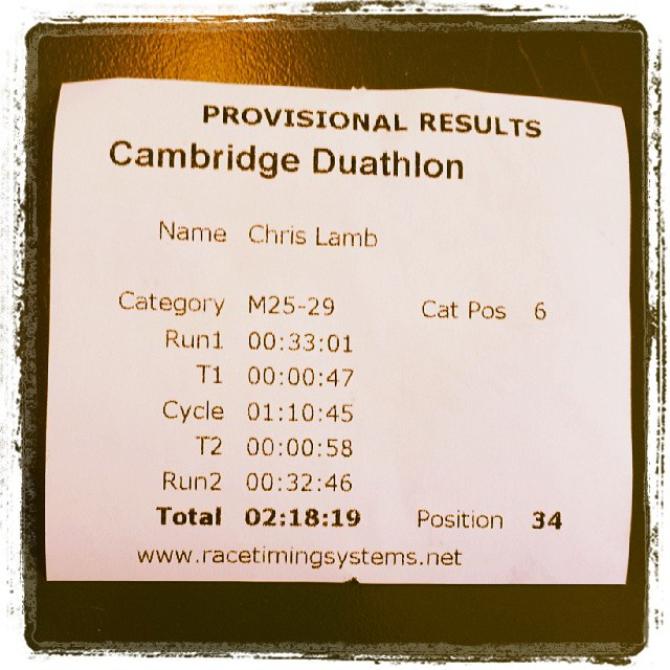 Returned to the
 Raced 50 and 100 mile cycling time trials & visited the Stratford Olympic pool (pictured).
June

 Paced my sister at the Downtow-Upflow Half-marathon. Also released the first version of the
 Visited Cornwall for my cousin's wedding (pictured). Another month for sport including my first ultramarathon and my first sub-20 minute 5k.
September
 Entered a London Oxford London cycling

 Performed Handel's Messiah in Kettering.
December
 Left
 I just watched