Search Results: freedom

2 June 2006

Evan Prodromou: 14 Prairial CCXIV

Registering for the Mesh Conference this year, I was a little dismayed to see so little French content on their Web site. This opened my eyes to the lack of French language text on a lot of grass-roots and community-oriented Web sites in Canada. I think that the large (~25%) portion of the Canadian population that's lost by not having French text and community input in a site can be really damaging to a community effort. Especially for issues that are dealt with at a federal level (like information rights, open content, open source software, freedom, privacy) it's vital to get a cross-Canadian site developed. So I've written an essay (yes, again) about Bilingual Web sites in Canada and how they could be improved.

30 May 2006

Uwe Hermann: Irrepressible.info - an Amnesty International campaign against Internet censorship

Let me take a quick break from all the technical posts to turn to a more political topic for a minute. Amnesty International has recently started the Irrepressible.info campaign against Internet censorship, which promotes freedom of information and expression, as well as human rights:
Chat rooms monitored. Blogs deleted. Websites blocked. Search engines restricted. People imprisoned for simply posting and sharing information.
The Internet is a new frontier in the struggle for human rights. Governments with the help of some of the biggest IT companies in the world are cracking down on freedom of expression. Amnesty International, with the support of The Observer, is launching a campaign to show that online or offline the human voice and human rights are impossible to repress.
There are many ways you can help, e.g. by Btw, the OpenNet Initiative (ONI) has an interesting (Flash-based) Internet Filtering Map, showing where in the world information is filtered/censored at which level... Fore more information, you might also want to read this BBC NEWS article. And finally, here's the whole text of the pledge. Repeat after me:
I believe the Internet should be a force for
political freedom, not repression. People have
the right to seek and receive information and to
express their peaceful beliefs online without
fear or interference.
I call on governments to stop the unwarranted
restriction of freedom of expression on the
Internet and on companies to stop helping them do it.

18 May 2006

Jeff Bailey: Savage Love

Dan Savage writes in his column this week,


The American Taliban doesn't think married heterosexual couples should be able to use birth control. If you care about your own freedom - not just your right to have premarital sex, but your right to decide whether, when, and how many children you're going to have you need to read "The War On Contraception."


I have trouble imagining what people are thinking. A world where couples don't have sex? Can you imagine how much fighting there would be?

Okay, okay, so that's not the point. But with articles like Chicago economist links abortion to falling crime rates, it's incredibly distressing to see another attempt at taking away freedoms. While things like birth control and abortion are not in immediate risk here in Canada, it's hard to predict how long it would take for our our current Conservative leadership to start entertaining those thoughts.

I'm all for a principled discussion on sex and sexuality. But why don't people ever consider the concept that providing more tools to people is better than providing fewer?

17 May 2006

Wouter Verhelst: Linux: a means of circumventing valuable copyrights and patents.

At least according to this clueless republican:
Like all the greatest American engineering, it's an example of innovation that makes a growing group of European and Chinese hackers jealous. They hate our lead in computing technology and will stop at nothing until they have control of all our computers.
Hah. Let me tell you, Shelley, I am not jealous of anything. The only thing I feel about people using Windows is pity; you are giving away your freedom in return for some Pride.
If you see a company using Linux, it may be that they have not paid for this software. Report them to the Business Software Alliance who have the legal authority to inspect any company's computers for illegal programs like Linux.
Rotfl. First, the BSA has the legal authority to do absolutely zilch. Second, using Linux is anything but illegal. Get a life. No, really. Update: While I was sleeping, I received no less than 24 comments that the site is not real. I get the picture. Get off my back. :-)

16 May 2006

Wouter Verhelst: Linux: a means of circumventing valuable copyrights and patents.

At least according to this clueless republican:
Like all the greatest American engineering, it's an example of innovation that makes a growing group of European and Chinese hackers jealous. They hate our lead in computing technology and will stop at nothing until they have control of all our computers.
Hah. Let me tell you, Shelley, I am not jealous of anything. The only thing I feel about people using Windows is pity; you are giving away your freedom in return for some Pride.
If you see a company using Linux, it may be that they have not paid for this software. Report them to the Business Software Alliance who have the legal authority to inspect any company's computers for illegal programs like Linux.
Rotfl. First, the BSA has the legal authority to do absolutely zilch. Second, using Linux is anything but illegal. Get a life. No, really.

3 May 2006

David Moreno Garza: Enemies of your freedom

It depends how you see it.

1 May 2006

Daniel Baumann: Re: On non-free RFC documents

Andrew, I beg to differ. I think, we have at least one general consens in Debian: deviding the archive into a free (main/contrib) and a non-free part is good thing. It's a reasonable mechanism to guarantie our users, that they can actively use their freedom defined in the DFSG for every single part in the free sections. Something which not all of us may agree is, that we ask for the very same basic freedom for documentation as we ask them for software. This means, basically: If the license of a document does not at least permit this very basic freedom, it's declared non-free. What do we gain if we would allow non-free documents to accompany free software within the same package?
Assumed that the documents are worthwhile to be distributed, we save a separate upload of the documentation to non-free and some administrative overhead for the package maintenance. What do we lose if we would allow non-free documents to accompany free software within the same package?
We loose the integrity and consistency of our archive, the good reputation and trust the users put into Debian. Would this little bit of more comfort for the package maintainer justify that? I don't think so. IMHO, "convenience" can never be an argument to give up freedom. BTW: I don't think that distributing RFCs in numerous packages makes sense at all (sometimes, even the very same RFCs are added again and again). I'm adopting doc-rfc which will be nicely html'ed soon. If you have a RFC in your package (even if the package is in non-free), replace it with a pointer to rfc-editor.org or to doc-rfc. This way, it's made sure that the RFC is always at the lastest revision. Isn't that convenient? ;)

Andrew Pollock: [debian] On non-free RFC documents

So a release-critical bug was filed against dhcp3, of which I am the only active maintainer at present. I dutifully stripped the RFCs and IETF draft documents from dhcp3-common, and made an upload, however the bug was reopened. Seems I should have read this. So it looks like I need to strip them out of the source tarball as well. Goody. I'm no fan of debian-legal, and I don't personally subscribe to the non-freeness of RFCs, using my personal DFSG-o-meter, but #199810 makes for an interesting read. It's motivated me beyond raising my middle finger to debian-legal to actually bothering to repack the tarball sans the RFCs, but it's going to be a bit of PITA to do that for every new release. I mailed the dhcp-workers mailing list to ask the upstream maintainer what he thought about removing the RFCs from the source tarball. So far he hasn't replied yet, but I have had one interesting reply:
In general, I applaud the DFSG. But in this case, I think Debian is being unreasonable. While the RFC licenses do not permit creation of derivative works, they may be copied verbatim. It's marginally useful to users of the code to have the RFCs handy, and it's probably quite helpful for people trying to find and fix bugs. I'm in favor of being careful about licenses. I've asked people on my project at work not to use the Sun JDK (but did not ask them not to write in Java) because Sun's implementation is non-Free, and therefore non-portable. But objecting to RFCs really seems to be going overboard. If the RFC were used to build the program, I could see the point of needing to have the software freedom to modify it. But it's merely bundled. So I would suggest that Debian reconsider their position, and apply DFSG to software, and adopt Debian Free Documentation Guidelines for docs, and Debian Free Standards Guidelines for standards. DFStG should allow the ISOC copyright license - the purpose of allowing standards is to have them easily available as a reference.

25 April 2006

Zak B. Elep: On Pedagogies

I feel a bit sad. Is FOSS really just going to be an alternative forever? Or can it break out of the trappings of alternatives, and make a world a better place? =) Instead of posting this to BiOS, I felt that it would be better posting it here; feel free to comment, feel free to ignore ;-)
Get a grip on reality. Even windows is an alternative to us FOSS loving peeps. Saying that FOSS is an alternative IMHO is a good marketing/advocacy tactic to get potential new users to get their feet wet on FOSS.
And now you are risking yourself to sounding hostile. At the risk of sounding like a bad guy, I have been shifting in between the planes of Ubuntu and Windows via cold water over the past few weeks; wala lang, I just wanted to be reminded of how it feels to be shackled’, so to speak. But really, I’m doing this because I can, and as a result I’m having a rocking time appreciating the subtleties of both Windows and Ubuntu ;-) So I guess I’m not so far removed from reality as you seem to portray. Now, let me play the simpleton, who’s really an astute participant. If a FOSS desktop, say Ubuntu’s Gnome, is supposed to be as easy as Windows, then why should I bother learning it at all, when I can simply transfer my old Windows skills to Ubuntu without much a problem? Another question: why should I be motivated to switch to FOSS at all? Perhaps you can dismiss this as FUD, but you are none the wiser when your reasons for switching to FOSS is only because that it is an alternative, that it is cheap (hard to get cheaper being free), and that its mandated by the local government. Among other things petty and cruel. Indeed, these are the questions people ask to us FOSS people, even long after the good shows (OSForum, SFD, LinuxWorld, etc.) have their run. As a matter of fact, I keep asking this to myself everyday, for the past 3 years of using GNU/Linux everyday. And every single day ends with an answer: “I use FOSS because it empowers me to surf,chat,email,program with relish.” For many other people, unfortunately, they don’t even get around to use a FOSS system, much more a CLI; thence they just make do with “I use Windows because that’s just what I have.” But I don’t want to force people to switch (or even just use) FOSS because of those reasons. I want them to use FOSS exactly because it empowers them, allowing them to get their jobs done effectively and efficiently. FOSS isn’t out there to deceive, as you so imply, maybe unwittingly. Well, perhaps, sometimes it is, but more often than not, its there so as to convey a deeper truth: that you can do things with it, while at the same time feel empowered, and FREE, with it.
Once they get their feet wet, it would likely be a natural progression for these users to realize the benefits that FOSS can offer (full-fledged, stand-alone and yet cooperative at the same time, approach to solving real problems). The key here is to just even entice the user to try, to take it for a spin, that would be a big step towards FOSS land.
Yes, getting feet wet is a good thing, it has its purpose, namely, for a person to acknowledge that he’s stepping on water, and preparing for a plane shift ;-) But from the point of view of a swimming instructor, getting feet wet is not good enough; it is better to get a person wet his head into the water, because that’s the time you know that he’s ready to learn how to swim, even if he doesn’t feel he’s ready. The same is true for newbies wanting to dive in like in that Linux Crash Course. It is not good enough that a newbie be exposed only to just one interface, just one true way (yeah, that coming from an Emacs guy ;-) I do not want them to slave away moving the mouse to and fro, doing some stuff under a GUI when they can just do the same thing in less time by just a few keystrokes. Perhaps, most wouldn’t be ready to use a CLI immediately to do some hand-hacking, but, like air in the planet, its always there, even when you don’t have an immediate need for it (air, however, is something we always have an immediate need for ;-) And neither do I recommend learning the intricacies of the shell, whether be it Bourne, Korn, or Peanut shell. Indeed, there’s nothing wrong about being at least bilingual; I want my audience to learn just a little bit of everything ;-) I want them to be aware, that there’s more to FOSS than what we’re just showing them. I don’t want them to deny the freedom and potential of looking what’s within a GNU/Linux system, unlike the usual situation of getting a brand-new PC with just Windows in it, with not a clue as to how things work within it. It’s like showing what’s under the hood of a car, but unlike the casual driver who only knows just how to drive it, the FOSS user is much more free to tweak whatever pleases; yeah, the danger of overheating is there, but with care, that could be addressed. In short: I don’t like this kind of false FOSS advocacy, when you’re effectively denying the chance for other people to improve and empower themselves, just so because CLIs seem to be so complicated to be taught in a single day :( No; I don’t think a shell has to be complicated and convoluted and inscrutable, like governments, among other things; rather, they are their own kind of fun, like finding a sleuth solving a case in a whodunit, or winning the World Cup. I’m no longer wanting to be in the business of long, impassioned, flamewars (is this thread one?) so I’m stopping here. Like I said earlier, it’s a speaker’s call to make adjustments on his presentations so that it reaches its target audience effectively and efficiently, just as it is a call for a FOSS user to use a GUI or the CLI to solve a problem. Besides, I have a swimming class to teach tomorrow ;-) Dive in!

23 April 2006

Zak B. Elep: Aren t I free to blog, or what?

It begins like this:
  1. Charo posts; gets syndicated on Planet Ubuntu-PH
  2. Some bloke notices it, and eventually gets into rant mode talking about freedom of choice’.
  3. Same bloke posts something really stupid:
you’ve completely diverged from the topic. the original question is why this individual is advocating non-free and proprietary toolchain in a group that is supposed to advocate free software. Freedom is subjective and we will not be able to end up this topic when we go to technicalities and social relevance.
Um, I’m having a difficult time parsing this. See below:
I guess what the Geekette should do next time is fix her drupal to categorize her blog and have only those free stuff aggregated to the community site then let her non-free stuff just stay here and its case closed.
Or get a better feed reader that filters out what you want to filter out. Be as persnickety as you can be. Go figure. You’re free to do the above, just as the Geekette is free to blog what she wants to blog, in whatever category she feels like posting in. After all, its her blog, and definitely not yours (or mine either.) Which is why I chose to post this as my post, not as a comment. Feel free to be an ignoramus. Planets, for those of you playing at home, can be thought ouf as just fancy RSS aggregators on the Web, especially for those who don’t have the luxury of a good RSS reader (or those who choose not to read via RSS, like me.) The Ubuntu-PH administrators could in theory impose some Draconian criteria for selecting which blog posts from persons to show, but in practice, they just don’t, probably because they feel that contributors are smart enough to be able to judge for themselves what they want to blog. I can understand this bloke’s pain, since our Planet is, after all, a “window into the world, work and lives of Ubuntu Team Philippines community members.” However it should also be obvious that the world is not so perfect, since even if we do get to use Ubuntu freely, we also get to have the choice to use some shackled software for some end. Freedom may be subjective, but it is definitely also self-referential too; you may have the freedom to not have a particular freedom to do something, and vice versa. A little Matrix philosophy is in order, care of the Oracle: “You’re not here to make a choice, for you have already made the choice. You are here now to understand the choice.” Now, figure me as stupid. I’ll just move along DhIconCacheChanges, help my fellow cadet in the X-SWAT, fix Debian Bug#360950 (despite lacking an amd64; readers, care to donate one? ;-) and continue to give my love for FOSS…

12 April 2006

Eric Dorland: The Pain of the GFDL GR and the DPL throws down

(aside: I love acronyms) The GFDL GR is particularly painful for packagers of GNU software like, say, automake. While I voted for it, and I think it was the right thing, it's almost physically painful to have to split my package apart for such ridiculously trivial 3 lines of Front and Back Cover Text:
     Permission is granted to copy, distribute and/or modify this
     document under the terms of the GNU Free Documentation License,
     Version 1.2 or any later version published by the Free Software
     Foundation; with no Invariant Sections, with the Front-Cover texts
     being "A GNU Manual," and with the Back-Cover Texts as in (a)
     below.  A copy of the license is included in the section entitled
     "GNU Free Documentation License."
     (a) The FSF's Back-Cover Text is: "You have freedom to copy and
     modify this GNU Manual, like GNU software.  Copies published by
     the Free Software Foundation raise funds for GNU development."

New DPL Anthony Towns has started his term, guns blazing. I like his idea. Making it easier to contribute to Debian can only really be a net win. The obvious objection is that this will allow untrusted people to upload to Debian. But does the current New Maintainer process really guarantee that an applicant is not malicious? I don't think so. It only weeds out impatient attackers, not determined ones. Now, if we really do believe that it is too dangerous to allow these "Debian Maintainers" direct upload, their uploads could go into their own queue. A queue that would be viewable by any "Debian Developer" to vet the package and approve it. I believe the Fedora Extras project does something similar.

28 March 2006

Uwe Hermann: People should not be afraid of their governments. Governments should be afraid of their people.


Voil ! In                                                       view, a humble
 vaudevillian                                                  veteran, cast 
  vicariously as both                                         victim and
   villain by the                                            vicissitudes of Fate. This 
    visage, no mere                                         veneer of
     vanity, is a                                          vestige of the
      vox populi, now                                     vacant,
       vanished, as the once                             vital
        voice of the                                    verisimilitude now
         venerates what they once                      vilified. However, this 
          valorous                                    visitation of a bygone
           vexation stands                           vivified, and has
            vowed to                                vanquish these 
             venal and                             virulent                   Remember, remember the 5th of November
              vermin                              vanguarding
               vice and                          vouchsafing the
                violently                       vicious and
                 voracious                     violation of
                  volition. The only          verdict is 
                   vengeance; a              vendetta held as a 
                    votive, not in          vain, for the
                     value and             veracity of such shall one day
                      vindicate the       vigilant and the
                       virtuous.         Verily, this 
                        vichyssoise of  verbiage 
                         veers most    verbose
                          vis- -vis an introduction,
                           and so it is my
                            very good honor
                             to meet you
                              and you may
                               call me
                                  V.
Yes, I've seen V for Vendetta today. Very impressing movie, highly recommended! Makes you start to think...

22 March 2006

Adam Rosi-Kessel: Ed Felten on Network Discrimination

Ed Felten is writing an excellent series of series of blog entries on network discrimination (Part 1, Part 2, Part 3), focusing on the nuts and bolts of how Internet Service Providers can (and do) discriminate between network traffic they like for various reasons (commercial, legal, etc.), and network traffic they do not like. Today’s entry focuses on encryption. Felten points out something that had never occurred to me: even if the user encrypts network traffic so that the ISP can’t see what he’s doing (or even tell the traffic in question apart from the standard website traffic), the ISP can still implement methods that selectively prefer certain types of traffic over others:
But the ISP may have a different and more effective strategy. If the ISP wants to hamper a particular application, and there is a way to manipulate the user’s traffic that affects that application much more than it does other applications, then the ISP has a way to punish the targeted application. Recall my previous discussion of how VoIP is especially sensitive to jitter (unpredictable changes in delay), but most other applications can tolerate jitter without much trouble. If the ISP imposes jitter on all of the user.s packets, the result will be a big problem for VoIP apps, but not much impact on other apps. So it turns out that even using a VPN, and encrypting everything in sight, isn’t necessarily enough to shield a user from network discrimination. Discrimination can work in subtle ways.

15 March 2006

David Welton: Implementation of Hecl

I wrote an article about the implementation of Hecl, posted here: http://www.dedasys.com/articles/hecl_implementation.html Originally it was for a magazine, but I decided that for the amount of money they could pay, I'd rather just have the freedom to post the article as widely as possible. I think it might be of interest because Hecl is still a simple language, so those who don't have the time or inclination to delve into the internals of a language like Tcl, Ruby or Erlang can still find out what goes into the making of an interpreter.

11 March 2006

Clint Adams: Everyone loves Magical Trevor

All this niggling about delegations disturbs me. You would have thought that Ian Jackson would have cleared this up but he seems to have confounded the issue by paragraphs of equivocation after a firm and sensible statement. For someone used to nearly-nonexistent labor protections, the idea of not being able to fire someone without due process is one step away from a totalitarian dystopia. Americans look at European employment laws with amazement and horror. The employees might see the added job security as comforting, but the knowledge that one can quit on 5 minutes' notice is comforting as well, and it is not a freedom that most would sacrifice. Employers see the added security as a potential nicety, but also as a terrible burden. Not only do we have to keep paying them after we fire them, we have to give them places to sit! It's tantamount to Evil Communism. I'm sure you can guess what Europeans think of American labor laws. Anyway, having anyone with augmented privileges not be fireable at the drop of a hat seems like madness to me. So I'll continue to believe that we can can anyone on the org chart any time we damn well please. Any other situation would mean that they have too much power.

10 March 2006

Simon Richter: Last call for votes

I voted 1342. In my opinion, Debian should not compromise on its principles just because it is the free software foundation that is asking us to. Their stance on the whole issue appears to be "not our problem", which indeed it isn't, because they hold the copyright and needn't care about licenses on their software. Users need to, and Debian's role so far has been to check licenses against the DFSG so the user can rely on the basic freedoms to be there. By ignoring the problems, we are not doing our users a favour, because now they need to check the licenses on all packages they install. The most evil thing is the binutils build, which generates documentation from source and relicenses it while doing that.

1 March 2006

Jordi Mallach: He's Welcome in Pakistan

I would have thought that three years after the start of the war, Iraq would be yet another forgotten war, as it tends to happen when murder, bombings, famine and corruption become the routine in some country or area. It's been nearly three years since the holy coalition made up of United States and the UK, with a selected group of allies which included the Spain of our beloved Aznar, invaded the country to save the poor iraqi people from the fierce Sadam. After a few months of hard fight against the bloody dictator, Iraq would finally be able to live in peace and Democracy, and the world would understand the goodness behind the reasoning that made the superpowers start the second war in Iraq, against the opinion of the UN security council and an overwhelming majority of the people in the planet. Today, after years of bloodbaths in different parts of Iraq, we're witnessing the start of a civil war. I hope the mass media stop talking about "the terrorists" now, because what's been going on for the last week is random people against random people. It makes me sick to think how bad the near future looks in Iraq. All of this happened in the name of freedom, or so they said. And then, it was in the name of the War on Terror , because Iraq was infested with terrorists (they never told us how they planned to stop that from happening). In the meanwhile, little they talk about the most wanted man on earth, uncle Osama. Today's edition of EL PAIS includes a translation of an article by Ahmed Rashid in The Washington Post's edition of February 26, apropos of George Bush's visit to Pakistan and Afghanistan this week. He's Welcome In Pakistan is surely worth a read; I'm sure Miguel will enjoy.

25 February 2006

Guido Trotter: The Rosetta Stone (and the failure of watermarking)

An interesting article on why watermarking tecniques for DRM are not likely to succeed!

24 February 2006

Pierre Habouzit: GFDL the license that s**ks

Dato[1] has blogged about his reaction about the current positions agains GFDL in debian currently. My concern wrt GFDL is simple : As a KDE packager, I would feel really sorry to have to prune any application manual, even ones without Invariants Sections. I'd like to remind some DD's that for some manuals, authors are not going to be found because they are not interested in Free Software anymore, or simply because they are dead. I know that discussions with the FSF are really going nowhere (at least not fast enough). But still, I really think there is some possibility to have a new version of the GFDL where the DRM and transparent copies problems would be gone. If we can have that, then since a lot of Authors use the classical licensed under the GFDL version 1.2 or (at your option) any later version we could accept in main any documentation that has no Invariant parts. Free Software is about giving to *every* users more freedom. This GFDL story looks like taking documentation away from the users that needs it the most. It's : It's not about a firmware here, or any hardware driver problem that you can work around by buying supported hardware. it's about having or having no documentation at all.
Notes [1] I of course have seconded his proposal [2] and if we have a question on an application, our question is unlikely to be answered in the doc, and we strace/read the sources of the application to be answered [3] yeah, I got it, this GR is not compliant with the DFSG!</bad joke></bitterness>

23 February 2006

Simon Law: CodeCon 2006, Day 2


House
Originally uploaded by sfllaw.
I woke up to a breakfast of pancakes, cooked by the wonderful [info]riseorbleed. I don't know about you but waking up to a hot breakfast is heavenly. After some morning ablutions, we hailed a cab and along the way we chatted with the cabbie as I looked out the window. Luxor cabbies are really nice, every time I travelled with them, they had some interesting story to tell and big, broad smiles. Smiling is the way to fatter tips! The weather in San Francisco is supposed to be rather variable. You know how that is, rain one minute and then sun the next. Well, the entire time I was there, it was bright and sunny and gorgeous. San Francisco really put on her best to charm me and she really succeeded. I didn't think that postcard-perfect pictures were possible, but I saw them everywhere. I was happy to walk around without needing a winter coat. And everyone else smirked at how happy I was. Daniel seemed to have recovered from the previous night's revelry. His talk on delta was excellent because he's a very good public speaker. Which is good, because he gave two presentations at CodeCon. When I talked to him on Thursday night, he seemed a little embarassed at how successful delta had become since it such a simple piece of software. But people like GCC use it to fare down their bug reports to the lines of code that reproduce its bugs. Rob and Tristan sidled up to my bar and asked me if I could get them some juice. For their laptops. They were working on their presentation all the way until the last minute, which involved a drunken Tristan stumbling around on stage. Except that Tristan doesn't drink, so his imitation was quite poor. They were presenting Djinni, which is their implementation of a fast simulated-annealing algorithm that takes also pressure into account. Sadly, they didn't explain their algorithm but their talk was entertaining nevertheless.

Shoes
Originally uploaded by sfllaw.
At lunch, Spider snuck me out of the building and she showed me around San Francisco. She pointed out the Eagle Tavern with a glimmer in her eye. I think she's trying to corrupt me. Or she's trying to pimp me out. Then we went to Stompers where she tried on some boots. We were stymied, however, by the fact that a very annoying woman and her husband were trying on every single pair of boots in the entire store. iGlance is a real-world video-conferencing and screen-sharing application that has some fairly good usability built into it. It also has a fairly sensible privacy model and does some NAT punching to boot. Although it's only got a Win32 port for now, it's free software so someone will fix it up. Sometime in the afternoon, the beautiful and fair [info]wealhtheow came behind the bar and surprised me with a hug and a sandwich! I was happy with the random hug from a new friend, but the sandwich was wonderful. I had not eaten lunch on Friday so I was very grateful. She put a huge smile on my face. I munched on the sandwich while listening to the OASIS talk. This technology is a locality-aware server-selection resolver, which is pretty good for distributing servers around the world and finding the fastest one. They implement this as a DNS redirector so that lookups are transparent to normal Internet software. This made me feel a little bad for [info]holdenk, whose SelfDirectedProject happens to be on a very similar topic. It does, however, validate his approach. [info]maradydd's presentation about Query by Example was up next. She did a very good introduction to data-mining, which segued into her hack on PostgreSQL where you can specify examples of things you want to search for. That is not how SQL normally works, where you specify constraints. With QBE, you just specify things similiar to what you want, and things similar to what you don't want.

Proposal
Originally uploaded by sfllaw.
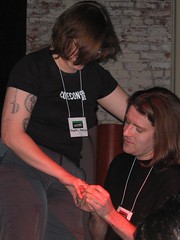
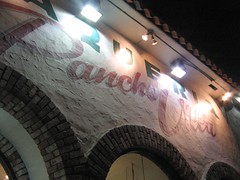
I was chatting with Rob Pascual when I noticed Len lining up in the Q&A; queue. Suddenly, my ears perked up as I sensed something important was going to happen. So I pulled out my camera, stepped on some toes, and got into position. When it was his turn at the microphone, he started saying random stuff that wasn't question at all! Something cheesy like how Meredith had changed his life and how he wanted to be with her. Then he got up on stage and asked The Question. It was beautiful. The audience broke out into cheers and applause, except for the heartless bastards beside me. But who cares about them? This was such an awesome occurance that an interview was taped. After teardown, some people were going to head to a franchise Mexican restaurant. Spider insisted that I get real food, so we walked down to the Mission. We made a detour to Good Vibrations which is a San Francisco landmark if ever there was one. I swear that she's trying to corrupt me. Anyway, as we were walking out, I must have mentioned that I was from Canada. Because Cohen, a Torontonian, came out of nowhere and introduced himself to us. Well, what was I to do but to invite my fellow countryman to dinner? So we set off to find a Taqueria that served nopales. This failed since Californians don't seem to like eating cactus. Instead, we went to Pancho Villa where I ate enchiladas and salsa verde and guacamole and churros and I was so very happy! We bid farewell to Cohen after exchanging contact information and tried to find everyone else. Unfortunately, we couldn't reach anyone by cellphone, so we sat around dejected for a while. Then we realised that we could go to Annie's Social Club where an event was happening. This turned out to be a good and a bad idea.

Taqueria
Originally uploaded by sfllaw.
It was a good idea because we found everyone at CodeCon. It was a bad idea because Annie's Social Club double-booked us with bad karaoke! And then were quite rude when we complained. And then kicked out John Gilmore. So I just want to say that Annie's Social Club hates geeks and freedom. So Len hailed a black stretch limousine, we all climbed into it, invited some reporters along and moved the entire party to the XYZ bar. The XYZ staff were very awesome, accommodating an extra hundred patrons and getting an extra bartender. And they were very nice about it. Unfortunately, the bar was full, so I had to lead a bunch of introverts in the fine art of taking over an establishment. We walked in, started talking, I encouraged people to sit down in empty spots on the couches. They did a very admirable job of taking over the back. I got the stunningly adorable [info]akashayi a seat and a drink, before I taked to the people sitting with us. They were a couple who had moved from Florida to San Francisco, and a man from New York who was quite the boor. The man in the couple knew the New Yorker and seemed quite embarassed about him. After twenty minutes of conversation, they excused themselves and bid us good night. This gave us plenty of seating space to talk about geeky things until the manager kindly kicked us out. I made sure Akasha got safely to her hostel and then took a taxi back to the guest room. It was quite the challenge to direct the cab driver, since I had lost the directions back, but I managed!

Next.

Previous.