Search Results: "tg"

23 June 2011

Philipp Kern: I'm going to DebConf 11

I finally got around to book my (train) trip back from Zagreb. The hotline of Deutsche Bahn was interesting. The booking system crashed and I was called back. But in the end it worked and I can print it the next time I get near a vending machine.

I'm worried how I manage to get there from Banja Luka on my own. And the travel to Zagreb together with Joachim Breitner won't be as comfortable as it should be. But meh, I'm going to DebConf again! \o/

Evgeni Golov: monitoring Adaptec RAID controllers in Debian

So I got my hands on that new machine, somewhere, somehow, and I had to make myself comfortable on it. The biggest difference in that machine and the ones I used before is the RAID controller, an Adaptec 5405, instead of the 3ware ones I used to have before. That means getting used to new tools, messages and all these things which I ll try to document here.Step 1: does vendor deliver?Well, yes, mostly. There is (mainline) kernel support for the controller, Squeeze s kernel will boot up just fine and I just throw my junk into /dev/sda and it will handle the whole raidy thingy itself. But what is when I want to check the health of the disks, to add a spare or modify the caching? Ask the mighty vendor and it will answer Yes, you can! .So I downloaded that asm_debian_x86_x64_v6_50_18570.tgz, unpacked and faced two debs, one i368 and one amd64. Yes, you could have saved half of the bandwidth if someone would have asked for the arch before, but who cares for some additional 60MiB today? So let s see what it does. Oh no, wait, there is a README ASM_IUG_for_Debian_and_Ubuntu.txt:
1. Make sure to be in root level access.
2. Install the ASM storman .deb package. For example, if the package is storman_6.50-18570_i386.deb,
   then install it using the following command dpkg -i storman_6.50-18570_i386.deb
3. Adaptec Storage Manager will get installed at /usr/StorMan
4. Add the line /usr/StorMan to /etc/ld.so.conf. Then run "ldconfig". This is needed for the arcconf
   utility to find the path of the libstdc++.so.5 library
Well, 1 is obvious, so is 2.
For 3: hum, /usr/StorMan? Ever heard of FHS? Don t think so.
For 4: WTF?! I prefer to get libstdc++5 from my local Debian mirror instead.But at least they provide a .deb, right? Uhm, no, it s an RPM converted via alien :( And don t dare to look at preinst, postinst and postrm (it extracts an own copy of Sun JRE 1.6u16, chmods around wildly on install and does rm -rf something on uninstall, did I see that some days ago on the webs?). Let s get rid of that package as soon as possible, I decided, and just keep arcconf (which will be described later), esp because StorMan itself seems to include some call-home functionality which I d like not to have:
cp -a /usr/StorMan/arcconf /usr/local/sbin/
apt-get remove --purge storman
Step 2: does community deliver?You can, by the way, get (better) packages at http://hwraid.le-vert.net/wiki/DebianPackages from Adam C cile (Le_Vert). I didn t test those much, but I currently use the arcconf package from there, which seems to be exactly what I need: proper dependencies and just the arcconf binary, no Java sh*t.Step 3: monitor the controllerAs this post is about monitoring, not ranting, let s continue. As mentioned before, I only have arcconf installed, which is just a cli to do stuff with the controller. If I understood the docs right, the actual StorMan is able to send notification mails when a disk dies or the controller gets eaten by aliens, but as I don t have StorMan, I have to do things myself.Adam has a aacraid-status package in his repository, which includes some minimalistic shell-daemon to monitor the output of arcconf. It didn t perfectly fit my needs (and had some hickups with my disks which refuse to report a vendor, whyever), so I decided to write something myself (slightly based on what Adam has done in aacraid-status, though).The result is on GitHub: https://github.com/evgeni/aacraidAs you can see the code contains (at the time of writing) exactly ZERO comments and there is no README either, but it s actually quite usable already.I am now running aacraidd and get happy mails when something breaks :) [running = running from /etc/rc.local, no init script yet :)]Step 4: monitor the disks via smartmontoolsThere is one little problem I have with arcconf: it s closed source and does magic to the controller.With the old 3ware controller I was able to monitor the disks with smartmontools/smartd using something like this:
/dev/twa0 -d 3ware,0 -a -s L/../../2/01 -m root
/dev/twa0 -d 3ware,1 -a -s L/../../2/03
This is possible with Adaptect controllers too (not through /dev/twaX obviously). You have to have the sg module loaded, which will result in /dev/sg[012] on my machine, with sg0 being the controller itself and sg1/sg2 the both disks attached to it. Having sg loaded, one can now use smartd with:
/dev/sg1 -d sat -a -s L/../../7/01 -m root
/dev/sg2 -d sat -a -s L/../../7/02 -m root
(-d sat is the important option here!)Thanks to Thomas Krenn Wiki: Smartmontools mit Adaptec RAID Controller for the basic info and ostlogd.spenneberg.net: Adaptec-Raid-Controller S.M.A.R.T.-Healthstatus monitoren for the pointer to the sg module!Step 5: relaxYupp, 4 steps are enough, go relax until the next disk dies (you will be doing something REALLY important that moment according to Murphy).

14 June 2011

Gerfried Fuchs: Debian/Ubuntu packages for pgadmin3 1.14.0 Beta 1

Martin Pitt announced packages of PostgreSQL 9.1 Beta 2 in his blog. Following this, I am hereby announcing the availability of pgadmin3 version 1.14.0 Beta 1 which amongst other things has added support for PG 9.1. You can find it in Debian experimental and backports for Ubuntu 10.04 LTS, 10.10 and 11.04 in my pgadmin3 backports for stable Ubuntu releases PPA. Enjoy!

/debian permanent link Comments: 0 Flattr this

Martin Pitt: Debian/Ubuntu packages for PostgreSQL 9.1 Beta 2

Hot on the heels of the Announcement of the second 9.1 Beta release there are now packages for it in Debian experimental and backports for Ubuntu 10.04 LTS, 10.10. and 11.04 in my PostgreSQL backports for stable Ubuntu releases PPA. Warning for upgrades from Beta 1: The on-disk database format changed since Beta-1. So if you already have the beta-1 packages installed, you need to pg_dumpall your 9.1 clusters (if you still need them), and pg_dropcluster all 9.1 clusters before the upgrade. I added a check to the pre-install script to make the postgresql-9.1 package fail early to upgrade if you still have existing 9.1 clusters to avoid data loss.

6 June 2011

Thorsten Glaser: synchronise environment between two shells

(First posting to Pl net Commandline! Tag: pcli) Vutral asked in IRC how to synchronise two shells environment while they re running. As you may know, POSIX systems cannot change a process environment vector after it has been started, only the process itself can. Well, the shell can, and we ll use a variety of things for this. This trick assumes you have $HISTFILE set to the same pathname in both shells (obviously, they run under the same user). It uses export -p to render the current list of exported variables, then transforms the list from newline-separated to a single big one-line export statement.
Then it transforms all remaining newlines (which will be part of a single-quoted string, since that s mksh(1) s export format) into the sequence '$'\n'' which means: terminate current single-quoted string, append $'\n' and open up a new single-quoted string immediately; concatenate these three.
Now, $'\n' is just a fancy way of saying newline, and part of mksh because David Korn (yes, the Korn in Korn Shell) strongly suggested to me that this functionality be included but, as we can see here, it pays off.
Finally, the so transformed string is prepended by unset \$(export); which, when executed, will cause the shell to unset (and unexport) all currently exported variables. The shell parameters that are not exported, i.e. not in the environment, are not affected by this code (except for $x and $nl, but whatever).
This string is then passed to read -s (plus -r and clearing IFS to enable raw mode), which means, read into the parameter $REPLY (which we conveniently don t use but it s trashed too, thus) but store into history at the same time. Ah hah! Now, the persistent history feature comes into effect! After running the below statement in the source shell, switch into the terminal running the destination shell, press Enter once on the empty line (Ctrl-U to empty it if it wasn t), then Cursor-Up ( ) to recall voil , an insanely large line with the previously created string sorta expanded and press Enter again to run it. Now your set of exported parameters is the exact same (minus if you exported IFS, nl, x or REPLY) as in the source shell.

I ve added extra spaces and a linewrap below, this is really just one big line:

nl=$'\n'; x=$(export -p); x=$ x//$ nl export/ ; IFS= read -rs <<<"unset \\\$(export);$ x//$nl/\'\$\'\\\\n\'\' "

Of course, this makes a nice function, for your ~/.mkshrc or somesuch.

2 June 2011

Craig Small: What happens without software testing

New TurboGears logo

Image via Wikipedia

Well jffnms 0.9.0 was a, well, its a good example of what can go wrong without adequate testing. Having it written in PHP makes it difficult to test, because you can have entire globs of code that are completely wrong but are not activated (because the if statement proves false for example) and you won t get an error. It also had some database migration problems. This is the most difficult and annoying part of releasing versions of JFFNMS. There are so many things to check, like: I ve been looking at sqlalchemy which is part of turbogears. It s a pretty impressive setup and lets you get on with writing your application and not mucking around with the low-level stuff. It s a bit of a steep learning curve learning python AND sqlalchemy AND turbogears but I ve got some rudimentary code running ok and its certainly worth it (python erroring on un-assigned varables but not forcing you to define them is a great compromise). The best thing is that you can develop on a sqlite database but deploy using mysql or postgresql with a minor change. Python and turbogears both emphasise automatic testing. Ideally the testing should cover all the code you write. The authors even suggest you write the test first then implement the feature. After chasing down several bugs, some of which I introduced fixing other bugs, automatic testing would make my life a lot easier and perhaps I wouldn t dread the release cycle so often.

Joey Hess: managing network effects through parasitism

Network effects are such a pernicious thing. They give us the internet, but they also give us an internet full of monopolistic worse-is-better players that use network effects to stifle improvements and competition. Sometimes the best you can manage is to be a parasite. facebook So I'm back on facebook ... sort of. a nearly empty facebook profile encouraging use of email or blog My strategy for facebook is to be as near to a featureless datapoint as I can. I won't post anything. I entered as bad quality information as I could get away with. I turned all privacy controls off, on the theory that this way I don't have to worry about facebook eroding privacy since everything about me on facebook is aggressively public. By never posting anything to facebook, I am trying to fight the network effect; trying to avoid increasing the value of facebook due to me being on it. I've adblocked the text entry field on facebook just to avoid the temptation. I want to erase the Like buttons too. Technologically, I think a good approach would be a browser plugin that does these things while extracting all available content and optionally sending it to a RECAP-type system. I only friend people who I need to keep up with and who have little or no other internet presence. This is because I am aware that each person I friend still propels facebook's network effect a little bit; even though they'll never see any useful information from me, they will know that they are able to talk to me via facebook. I only log into facebook once a week or so (this is easy when you're not interacting with it anyway), and read whatever sample of farmville and other posts facebook selects as "important" (worse than usual probably since I never give it feedback). So people I friend can't rely on me reading everything they do, which reduces the value a little more. I will probably delete this account occasionally, and then re-add it later. Just often enough to be really annoying. twitter Similarly, I no longer gate my identi.ca account to twitter, and have deleted as many tweets as I could stand to (one click and one keypress per tweet; no mass-delete; ugh!), and protected my account to avoid accidential new tweets leaking out. Since twitter is not quite as evil as facebook I feel slightly less bad about exposing more of my social graph there. Only the folks who are too lame to get on an OpenMicroBlogging site like identi.ca. phone Of course there was a network effect with the telephone as well, and while it got deregulated it's still pretty bad, and also a technology that I mostly dislike using. Oddly my phone behavior is backwards to the other two networks; I only make outgoing phone calls, never answering the phone (unless real life intervenes very severely). I listen to some random fraction of my voice mail and read whatever ones manage to get machine-transcribed.

30 May 2011

Francois Marier: Code reviews with Gerrit and Gitorious

The Mahara project has just moved to mandatory code reviews for every commit that gets applied to core code.

Here is a description of how Gerrit Code Review, the peer-review system used by Android, was retrofitted into our existing git repository on Gitorious.

(If you want to know more about Gerrit, listen to this FLOSS Weekly interview.)

Replacing existing Gitorious committers with a robotThe first thing to do was to log into Gitorious and remove commit rights from everyone in the main repository. Then I created a new maharabot account with a password-less SSH key (stored under /home/gerrit/.ssh/) and made that new account the sole committer.

This is to ensure that nobody pushes to the repository by mistake since all of these changes would be overwritten by Gerrit.

Basic Gerrit installationAfter going through the installation instructions, I logged into the Gerrit admin interface and created a new "mahara" project.

I picked the "merge if necessary" submit action because "cherry-pick" would disable dependency tracking which is quite a handy feature.

Reverse proxy using NginxSince we wanted to offer Gerrit over HTTPS, I decided to run it behind an Nginx proxy. This is the Nginx configuration I ended up with:
server  
listen 443;
server_name reviews.mahara.org;
add_header Strict-Transport-Security max-age=15768000;

ssl on;
ssl_certificate /etc/ssl/certs/reviews.mahara.org.crt;
ssl_certificate_key /etc/ssl/certs/reviews.mahara.org.pem;

ssl_session_timeout 5m;
ssl_session_cache shared:SSL:1m;

ssl_protocols TLSv1;
ssl_ciphers HIGH:!ADH;
ssl_prefer_server_ciphers on;

location /
proxy_pass http://127.0.0.1:8081;
proxy_set_header X-Forwarded-For $remote_addr;
proxy_set_header Host $host;


Things to note:
Mail setupTo enable Gerrit to email reviewers and committers, I installed Postfix and used "reviews.mahara.org" as the "System mail name".

Then I added the following to /home/gerrit/mahara_reviews/etc/gerrit.config:
[user]
email = "gerrit@reviews.mahara.org"
to fix the From address in outgoing emails.

Init script and cronFollowing the installation instructions, I created these symlinks:
ln -s /home/gerrit/mahara_reviews/bin/gerrit.sh /etc/init.d/gerrit
cd /etc/rc2.d && ln -s ../init.d/gerrit S19gerrit
cd /etc/rc3.d && ln -s ../init.d/gerrit S19gerrit
cd /etc/rc4.d && ln -s ../init.d/gerrit S19gerrit
cd /etc/rc5.d && ln -s ../init.d/gerrit S19gerrit
cd /etc/rc0.d && ln -s ../init.d/gerrit K21gerrit
cd /etc/rc1.d && ln -s ../init.d/gerrit K21gerrit
cd /etc/rc6.d && ln -s ../init.d/gerrit K21gerrit
and put the following settings into /etc/default/gerritcodereview:
GERRIT_SITE=/home/gerrit/mahara_reviews
GERRIT_USER=gerrit
GERRIT_WAR=/home/gerrit/gerrit.war
to automatically start and stop Gerrit.

I also added a cron job in /etc/cron.d/gitcleanup to ensure that the built-in git repository doesn't get bloated:
MAILTO=admin@example.com
20 4 * * * gerrit GIT_DIR=/home/gerrit/mahara_reviews/git/mahara.git git gc --quiet

Configuration enhancementsTo allow images in change requests to be displayed inside the browser, I marked them as safe in /home/gerrit/mahara_reviews/etc/gerrit.config:
[mimetype "image/*"]
safe = true

Another thing I did to enhance the review experience was to enable the gitweb repository browser:
apt-get install gitweb

and to make checkouts faster by enabling anonymous Git access:
[gerrit]
canonicalGitUrl = git://reviews.mahara.org/git/
[download]
scheme = ssh
scheme = anon_http
scheme = anon_git

which requires that you have a git daemon running and listening on port 9418:
apt-get install git-daemon-run
ln -s /home/gerrit/mahara_reviews/git/mahara.git /var/cache/git/
touch /home/gerrit/mahara_reviews/git/mahara.git/git-daemon-export-ok

Finally, I included the Mahara branding in the header and footer of each page by providing valid XHTML fragments in /home/gerrit/mahara_reviews/etc/GerritSiteHeader.html and GerritSiteFooter.html.

Initial import and replicationOnce Gerrit was fully working, I performed the initial code import by using my administrator account to push the exiting Gitorious branches to the internal git repository:
git remote add gerrit ssh://username@reviews.mahara.org:29418/mahara
git push gerrit 1.2_STABLE
git push gerrit 1.3_STABLE
git push gerrit master
Note that I had to temporarily disable "Require Change IDs" in the project settings in order to import the old commits which didn't have these.

To replicate the internal Gerrit repository back to Gitorious, I created a new /home/gerrit/mahara_reviews/etc/replication.config file:
[remote "gitorious"]
url = gitorious.org:mahara/$ name .git
push = +refs/heads/*:refs/heads/*
push = +refs/tags/*:refs/tags/*
(The $ name variable is required even when you have a single project.)

Contributor instructionsThis is how developers can get a working checkout of our code now:
git clone git://gitorious.org/mahara/mahara.git
cd mahara
git remote add gerrit ssh://username@reviews.mahara.org:29418/mahara
git fetch gerrit
scp -p -P 29418 reviews.mahara.org:hooks/commit-msg .git/hooks/
and this is how they can submit local changes to Gerrit:
git push gerrit HEAD:refs/for/master

Anybody can submit change requests or comment on them but make sure you do not have the Cookie Pie Firefox extension installed or you will be unable to log into Gerrit.

26 May 2011

Dirk Eddelbuettel: RcppArmadillo 0.2.20

Conrad Sanderson is preparing version 2.0.0 of his Armadillo templated C++ library for linear algebra and has released a first public beta version 1.99.2. This has been folded into a new release of the RcppArmadillo wrapper for R based on our Rcpp library. Also added in this version is a new example of a simulation of a vector autoregression process which I had blogged about earlier. The example had been prepared for the Rcpp workshop / class at last month's R/Finance conference, and demonstrates a rather nice speed gain from using Rcpp and RcppArmadillo. The short NEWS file extract follows below.
0.2.20  2011-05-25
    o   Upgraded to Armadillo release 1.99.2 "v2.0 beta 2" (and 1.99.1 before)
          * faster inverse of symmetric matrices
          * faster element access for fixed size matrices
          * faster multiplication of tiny matrices (eg. 4x4)
          * faster compund expressions containing submatrices
          * added handling of arbitrarily sized empty matrices (eg. 5x0)
          * added syl()
          * added strans()
          * added symmatu()/symmatl()
          * added submatrices of submatrices
          * htrans() has been deprecated; use trans() instead
          * trans() now takes the complex conjugate when transposing a
            complex matrix
          * .is_vec() now outputs true for empty matrices
          * most functions with matrix inputs no longer throw exceptions when
            given empty matrices (eg. 5x0)
    o   Added a new subdirectory examples/ seeded with a nice Vector
        Autoregression simulation simulation example by Lance Bachmeier
    o   Rewrote armadillo_version as to no longer require an instance 
        of arma::arma_version, with tanks to Conrad for the suggestion
And courtesy of CRANberries, here is the diff to the previous release.
Diff between RcppArmadillo versions 0.2.19 dated 2011-04-24 and 0.2.20 dated 2011-05-26
 RcppArmadillo-0.2.19/RcppArmadillo/inst/include/armadillo_bits/Col_proto.hpp               only
 RcppArmadillo-0.2.19/RcppArmadillo/inst/include/armadillo_bits/Cube_proto.hpp              only
 RcppArmadillo-0.2.19/RcppArmadillo/inst/include/armadillo_bits/GlueCube_proto.hpp          only
 RcppArmadillo-0.2.19/RcppArmadillo/inst/include/armadillo_bits/Glue_proto.hpp              only
 RcppArmadillo-0.2.19/RcppArmadillo/inst/include/armadillo_bits/Mat_proto.hpp               only
 RcppArmadillo-0.2.19/RcppArmadillo/inst/include/armadillo_bits/OpCube_proto.hpp            only
 RcppArmadillo-0.2.19/RcppArmadillo/inst/include/armadillo_bits/Op_proto.hpp                only
 RcppArmadillo-0.2.19/RcppArmadillo/inst/include/armadillo_bits/Row_proto.hpp               only
 RcppArmadillo-0.2.19/RcppArmadillo/inst/include/armadillo_bits/arma_ostream_proto.hpp      only
 RcppArmadillo-0.2.19/RcppArmadillo/inst/include/armadillo_bits/arrayops_proto.hpp          only
 RcppArmadillo-0.2.19/RcppArmadillo/inst/include/armadillo_bits/atlas_proto.hpp             only
 RcppArmadillo-0.2.19/RcppArmadillo/inst/include/armadillo_bits/auxlib_proto.hpp            only
 RcppArmadillo-0.2.19/RcppArmadillo/inst/include/armadillo_bits/blas_proto.hpp              only
 RcppArmadillo-0.2.19/RcppArmadillo/inst/include/armadillo_bits/diagview_proto.hpp          only
 RcppArmadillo-0.2.19/RcppArmadillo/inst/include/armadillo_bits/diskio_proto.hpp            only
 RcppArmadillo-0.2.19/RcppArmadillo/inst/include/armadillo_bits/eGlueCube_proto.hpp         only
 RcppArmadillo-0.2.19/RcppArmadillo/inst/include/armadillo_bits/eGlue_proto.hpp             only
 RcppArmadillo-0.2.19/RcppArmadillo/inst/include/armadillo_bits/eOpCube_proto.hpp           only
 RcppArmadillo-0.2.19/RcppArmadillo/inst/include/armadillo_bits/eOp_proto.hpp               only
 RcppArmadillo-0.2.19/RcppArmadillo/inst/include/armadillo_bits/eglue_core_proto.hpp        only
 RcppArmadillo-0.2.19/RcppArmadillo/inst/include/armadillo_bits/eop_core_proto.hpp          only
 RcppArmadillo-0.2.19/RcppArmadillo/inst/include/armadillo_bits/field_proto.hpp             only
 RcppArmadillo-0.2.19/RcppArmadillo/inst/include/armadillo_bits/fn_htrans.hpp               only
 RcppArmadillo-0.2.19/RcppArmadillo/inst/include/armadillo_bits/forward_proto.hpp           only
 RcppArmadillo-0.2.19/RcppArmadillo/inst/include/armadillo_bits/glue_conv_proto.hpp         only
 RcppArmadillo-0.2.19/RcppArmadillo/inst/include/armadillo_bits/glue_cor_proto.hpp          only
 RcppArmadillo-0.2.19/RcppArmadillo/inst/include/armadillo_bits/glue_cov_proto.hpp          only
 RcppArmadillo-0.2.19/RcppArmadillo/inst/include/armadillo_bits/glue_cross_proto.hpp        only
 RcppArmadillo-0.2.19/RcppArmadillo/inst/include/armadillo_bits/glue_join_proto.hpp         only
 RcppArmadillo-0.2.19/RcppArmadillo/inst/include/armadillo_bits/glue_kron_proto.hpp         only
 RcppArmadillo-0.2.19/RcppArmadillo/inst/include/armadillo_bits/glue_mixed_proto.hpp        only
 RcppArmadillo-0.2.19/RcppArmadillo/inst/include/armadillo_bits/glue_relational_proto.hpp   only
 RcppArmadillo-0.2.19/RcppArmadillo/inst/include/armadillo_bits/glue_solve_proto.hpp        only
 RcppArmadillo-0.2.19/RcppArmadillo/inst/include/armadillo_bits/glue_times_proto.hpp        only
 RcppArmadillo-0.2.19/RcppArmadillo/inst/include/armadillo_bits/glue_toeplitz_proto.hpp     only
 RcppArmadillo-0.2.19/RcppArmadillo/inst/include/armadillo_bits/injector_proto.hpp          only
 RcppArmadillo-0.2.19/RcppArmadillo/inst/include/armadillo_bits/lapack_proto.hpp            only
 RcppArmadillo-0.2.19/RcppArmadillo/inst/include/armadillo_bits/mtGlueCube_proto.hpp        only
 RcppArmadillo-0.2.19/RcppArmadillo/inst/include/armadillo_bits/mtGlue_proto.hpp            only
 RcppArmadillo-0.2.19/RcppArmadillo/inst/include/armadillo_bits/mtOpCube_proto.hpp          only
 RcppArmadillo-0.2.19/RcppArmadillo/inst/include/armadillo_bits/mtOp_proto.hpp              only
 RcppArmadillo-0.2.19/RcppArmadillo/inst/include/armadillo_bits/op_chol_proto.hpp           only
 RcppArmadillo-0.2.19/RcppArmadillo/inst/include/armadillo_bits/op_cor_proto.hpp            only
 RcppArmadillo-0.2.19/RcppArmadillo/inst/include/armadillo_bits/op_cov_proto.hpp            only
 RcppArmadillo-0.2.19/RcppArmadillo/inst/include/armadillo_bits/op_cumsum_proto.hpp         only
 RcppArmadillo-0.2.19/RcppArmadillo/inst/include/armadillo_bits/op_cx_scalar_proto.hpp      only
 RcppArmadillo-0.2.19/RcppArmadillo/inst/include/armadillo_bits/op_diagmat_proto.hpp        only
 RcppArmadillo-0.2.19/RcppArmadillo/inst/include/armadillo_bits/op_diagvec_proto.hpp        only
 RcppArmadillo-0.2.19/RcppArmadillo/inst/include/armadillo_bits/op_dot_proto.hpp            only
 RcppArmadillo-0.2.19/RcppArmadillo/inst/include/armadillo_bits/op_dotext_proto.hpp         only
 RcppArmadillo-0.2.19/RcppArmadillo/inst/include/armadillo_bits/op_find_proto.hpp           only
 RcppArmadillo-0.2.19/RcppArmadillo/inst/include/armadillo_bits/op_flip_proto.hpp           only
 RcppArmadillo-0.2.19/RcppArmadillo/inst/include/armadillo_bits/op_htrans_proto.hpp         only
 RcppArmadillo-0.2.19/RcppArmadillo/inst/include/armadillo_bits/op_inv_proto.hpp            only
 RcppArmadillo-0.2.19/RcppArmadillo/inst/include/armadillo_bits/op_max_proto.hpp            only
 RcppArmadillo-0.2.19/RcppArmadillo/inst/include/armadillo_bits/op_mean_proto.hpp           only
 RcppArmadillo-0.2.19/RcppArmadillo/inst/include/armadillo_bits/op_median_proto.hpp         only
 RcppArmadillo-0.2.19/RcppArmadillo/inst/include/armadillo_bits/op_min_proto.hpp            only
 RcppArmadillo-0.2.19/RcppArmadillo/inst/include/armadillo_bits/op_misc_proto.hpp           only
 RcppArmadillo-0.2.19/RcppArmadillo/inst/include/armadillo_bits/op_pinv_proto.hpp           only
 RcppArmadillo-0.2.19/RcppArmadillo/inst/include/armadillo_bits/op_princomp_cov_proto.hpp   only
 RcppArmadillo-0.2.19/RcppArmadillo/inst/include/armadillo_bits/op_princomp_proto.hpp       only
 RcppArmadillo-0.2.19/RcppArmadillo/inst/include/armadillo_bits/op_prod_proto.hpp           only
 RcppArmadillo-0.2.19/RcppArmadillo/inst/include/armadillo_bits/op_relational_proto.hpp     only
 RcppArmadillo-0.2.19/RcppArmadillo/inst/include/armadillo_bits/op_repmat_proto.hpp         only
 RcppArmadillo-0.2.19/RcppArmadillo/inst/include/armadillo_bits/op_reshape_proto.hpp        only
 RcppArmadillo-0.2.19/RcppArmadillo/inst/include/armadillo_bits/op_shuffle_proto.hpp        only
 RcppArmadillo-0.2.19/RcppArmadillo/inst/include/armadillo_bits/op_sort_proto.hpp           only
 RcppArmadillo-0.2.19/RcppArmadillo/inst/include/armadillo_bits/op_stddev_proto.hpp         only
 RcppArmadillo-0.2.19/RcppArmadillo/inst/include/armadillo_bits/op_sum_proto.hpp            only
 RcppArmadillo-0.2.19/RcppArmadillo/inst/include/armadillo_bits/op_trans_meat.hpp           only
 RcppArmadillo-0.2.19/RcppArmadillo/inst/include/armadillo_bits/op_trans_proto.hpp          only
 RcppArmadillo-0.2.19/RcppArmadillo/inst/include/armadillo_bits/op_trimat_proto.hpp         only
 RcppArmadillo-0.2.19/RcppArmadillo/inst/include/armadillo_bits/op_var_proto.hpp            only
 RcppArmadillo-0.2.19/RcppArmadillo/inst/include/armadillo_bits/podarray_proto.hpp          only
 RcppArmadillo-0.2.19/RcppArmadillo/inst/include/armadillo_bits/running_stat_proto.hpp      only
 RcppArmadillo-0.2.19/RcppArmadillo/inst/include/armadillo_bits/running_stat_vec_proto.hpp  only
 RcppArmadillo-0.2.19/RcppArmadillo/inst/include/armadillo_bits/subview_cube_proto.hpp      only
 RcppArmadillo-0.2.19/RcppArmadillo/inst/include/armadillo_bits/subview_elem1_proto.hpp     only
 RcppArmadillo-0.2.19/RcppArmadillo/inst/include/armadillo_bits/subview_field_proto.hpp     only
 RcppArmadillo-0.2.19/RcppArmadillo/inst/include/armadillo_bits/subview_proto.hpp           only
 RcppArmadillo-0.2.19/RcppArmadillo/inst/include/armadillo_bits/wall_clock_proto.hpp        only
 RcppArmadillo-0.2.20/RcppArmadillo/ChangeLog                                                  20 
 RcppArmadillo-0.2.20/RcppArmadillo/DESCRIPTION                                                10 
 RcppArmadillo-0.2.20/RcppArmadillo/inst/NEWS                                                  26 
 RcppArmadillo-0.2.20/RcppArmadillo/inst/examples                                           only
 RcppArmadillo-0.2.20/RcppArmadillo/inst/include/RcppArmadillo/Mat_meat.h                       8 
 RcppArmadillo-0.2.20/RcppArmadillo/inst/include/armadillo                                    199 -
 RcppArmadillo-0.2.20/RcppArmadillo/inst/include/armadillo_bits/Col_bones.hpp               only
 RcppArmadillo-0.2.20/RcppArmadillo/inst/include/armadillo_bits/Col_meat.hpp                  519 +++
 RcppArmadillo-0.2.20/RcppArmadillo/inst/include/armadillo_bits/Cube_bones.hpp              only
 RcppArmadillo-0.2.20/RcppArmadillo/inst/include/armadillo_bits/Cube_meat.hpp                  96 
 RcppArmadillo-0.2.20/RcppArmadillo/inst/include/armadillo_bits/GlueCube_bones.hpp          only
 RcppArmadillo-0.2.20/RcppArmadillo/inst/include/armadillo_bits/Glue_bones.hpp              only
 RcppArmadillo-0.2.20/RcppArmadillo/inst/include/armadillo_bits/Mat_bones.hpp               only
 RcppArmadillo-0.2.20/RcppArmadillo/inst/include/armadillo_bits/Mat_meat.hpp                  673 +++-
 RcppArmadillo-0.2.20/RcppArmadillo/inst/include/armadillo_bits/OpCube_bones.hpp            only
 RcppArmadillo-0.2.20/RcppArmadillo/inst/include/armadillo_bits/Op_bones.hpp                only
 RcppArmadillo-0.2.20/RcppArmadillo/inst/include/armadillo_bits/Proxy.hpp                      28 
 RcppArmadillo-0.2.20/RcppArmadillo/inst/include/armadillo_bits/ProxyCube.hpp                  20 
 RcppArmadillo-0.2.20/RcppArmadillo/inst/include/armadillo_bits/Row_bones.hpp               only
 RcppArmadillo-0.2.20/RcppArmadillo/inst/include/armadillo_bits/Row_meat.hpp                  491 +++
 RcppArmadillo-0.2.20/RcppArmadillo/inst/include/armadillo_bits/arma_ostream_bones.hpp      only
 RcppArmadillo-0.2.20/RcppArmadillo/inst/include/armadillo_bits/arma_ostream_meat.hpp          87 
 RcppArmadillo-0.2.20/RcppArmadillo/inst/include/armadillo_bits/arma_static_assert.hpp         31 
 RcppArmadillo-0.2.20/RcppArmadillo/inst/include/armadillo_bits/arma_version.hpp                6 
 RcppArmadillo-0.2.20/RcppArmadillo/inst/include/armadillo_bits/arrayops_bones.hpp          only
 RcppArmadillo-0.2.20/RcppArmadillo/inst/include/armadillo_bits/arrayops_meat.hpp             143 -
 RcppArmadillo-0.2.20/RcppArmadillo/inst/include/armadillo_bits/atlas_bones.hpp             only
 RcppArmadillo-0.2.20/RcppArmadillo/inst/include/armadillo_bits/auxlib_bones.hpp            only
 RcppArmadillo-0.2.20/RcppArmadillo/inst/include/armadillo_bits/auxlib_meat.hpp               772 ++++-
 RcppArmadillo-0.2.20/RcppArmadillo/inst/include/armadillo_bits/blas_bones.hpp              only
 RcppArmadillo-0.2.20/RcppArmadillo/inst/include/armadillo_bits/compiler_setup.hpp             17 
 RcppArmadillo-0.2.20/RcppArmadillo/inst/include/armadillo_bits/debug.hpp                      24 
 RcppArmadillo-0.2.20/RcppArmadillo/inst/include/armadillo_bits/diagmat_proxy.hpp              93 
 RcppArmadillo-0.2.20/RcppArmadillo/inst/include/armadillo_bits/diagview_bones.hpp          only
 RcppArmadillo-0.2.20/RcppArmadillo/inst/include/armadillo_bits/diagview_meat.hpp             128 
 RcppArmadillo-0.2.20/RcppArmadillo/inst/include/armadillo_bits/diskio_bones.hpp            only
 RcppArmadillo-0.2.20/RcppArmadillo/inst/include/armadillo_bits/diskio_meat.hpp               104 
 RcppArmadillo-0.2.20/RcppArmadillo/inst/include/armadillo_bits/eGlueCube_bones.hpp         only
 RcppArmadillo-0.2.20/RcppArmadillo/inst/include/armadillo_bits/eGlueCube_meat.hpp             14 
 RcppArmadillo-0.2.20/RcppArmadillo/inst/include/armadillo_bits/eGlue_bones.hpp             only
 RcppArmadillo-0.2.20/RcppArmadillo/inst/include/armadillo_bits/eGlue_meat.hpp                 14 
 RcppArmadillo-0.2.20/RcppArmadillo/inst/include/armadillo_bits/eOpCube_bones.hpp           only
 RcppArmadillo-0.2.20/RcppArmadillo/inst/include/armadillo_bits/eOp_bones.hpp               only
 RcppArmadillo-0.2.20/RcppArmadillo/inst/include/armadillo_bits/eglue_core_bones.hpp        only
 RcppArmadillo-0.2.20/RcppArmadillo/inst/include/armadillo_bits/eglue_core_meat.hpp           519 ++-
 RcppArmadillo-0.2.20/RcppArmadillo/inst/include/armadillo_bits/eop_core_bones.hpp          only
 RcppArmadillo-0.2.20/RcppArmadillo/inst/include/armadillo_bits/eop_core_meat.hpp             327 +-
 RcppArmadillo-0.2.20/RcppArmadillo/inst/include/armadillo_bits/field_bones.hpp             only
 RcppArmadillo-0.2.20/RcppArmadillo/inst/include/armadillo_bits/fn_accu.hpp                    40 
 RcppArmadillo-0.2.20/RcppArmadillo/inst/include/armadillo_bits/fn_det.hpp                      7 
 RcppArmadillo-0.2.20/RcppArmadillo/inst/include/armadillo_bits/fn_diagmat.hpp                  7 
 RcppArmadillo-0.2.20/RcppArmadillo/inst/include/armadillo_bits/fn_elem.hpp                    62 
 RcppArmadillo-0.2.20/RcppArmadillo/inst/include/armadillo_bits/fn_eye.hpp                  only
 RcppArmadillo-0.2.20/RcppArmadillo/inst/include/armadillo_bits/fn_inv.hpp                     18 
 RcppArmadillo-0.2.20/RcppArmadillo/inst/include/armadillo_bits/fn_log_det.hpp                  8 
 RcppArmadillo-0.2.20/RcppArmadillo/inst/include/armadillo_bits/fn_max.hpp                     38 
 RcppArmadillo-0.2.20/RcppArmadillo/inst/include/armadillo_bits/fn_mean.hpp                    42 
 RcppArmadillo-0.2.20/RcppArmadillo/inst/include/armadillo_bits/fn_median.hpp                  53 
 RcppArmadillo-0.2.20/RcppArmadillo/inst/include/armadillo_bits/fn_min.hpp                     38 
 RcppArmadillo-0.2.20/RcppArmadillo/inst/include/armadillo_bits/fn_ones.hpp                    45 
 RcppArmadillo-0.2.20/RcppArmadillo/inst/include/armadillo_bits/fn_prod.hpp                    20 
 RcppArmadillo-0.2.20/RcppArmadillo/inst/include/armadillo_bits/fn_randn.hpp                   10 
 RcppArmadillo-0.2.20/RcppArmadillo/inst/include/armadillo_bits/fn_randu.hpp                   12 
 RcppArmadillo-0.2.20/RcppArmadillo/inst/include/armadillo_bits/fn_stddev.hpp                  20 
 RcppArmadillo-0.2.20/RcppArmadillo/inst/include/armadillo_bits/fn_strans.hpp               only
 RcppArmadillo-0.2.20/RcppArmadillo/inst/include/armadillo_bits/fn_syl_lyap.hpp             only
 RcppArmadillo-0.2.20/RcppArmadillo/inst/include/armadillo_bits/fn_symmat.hpp               only
 RcppArmadillo-0.2.20/RcppArmadillo/inst/include/armadillo_bits/fn_trans.hpp                   35 
 RcppArmadillo-0.2.20/RcppArmadillo/inst/include/armadillo_bits/fn_var.hpp                     20 
 RcppArmadillo-0.2.20/RcppArmadillo/inst/include/armadillo_bits/fn_zeros.hpp                   12 
 RcppArmadillo-0.2.20/RcppArmadillo/inst/include/armadillo_bits/forward_bones.hpp           only
 RcppArmadillo-0.2.20/RcppArmadillo/inst/include/armadillo_bits/gemm.hpp                      337 --
 RcppArmadillo-0.2.20/RcppArmadillo/inst/include/armadillo_bits/gemm_mixed.hpp                 59 
 RcppArmadillo-0.2.20/RcppArmadillo/inst/include/armadillo_bits/gemv.hpp                      208 +
 RcppArmadillo-0.2.20/RcppArmadillo/inst/include/armadillo_bits/glue_conv_bones.hpp         only
 RcppArmadillo-0.2.20/RcppArmadillo/inst/include/armadillo_bits/glue_conv_meat.hpp             16 
 RcppArmadillo-0.2.20/RcppArmadillo/inst/include/armadillo_bits/glue_cor_bones.hpp          only
 RcppArmadillo-0.2.20/RcppArmadillo/inst/include/armadillo_bits/glue_cor_meat.hpp              12 
 RcppArmadillo-0.2.20/RcppArmadillo/inst/include/armadillo_bits/glue_cov_bones.hpp          only
 RcppArmadillo-0.2.20/RcppArmadillo/inst/include/armadillo_bits/glue_cross_bones.hpp        only
 RcppArmadillo-0.2.20/RcppArmadillo/inst/include/armadillo_bits/glue_cross_meat.hpp            47 
 RcppArmadillo-0.2.20/RcppArmadillo/inst/include/armadillo_bits/glue_join_bones.hpp         only
 RcppArmadillo-0.2.20/RcppArmadillo/inst/include/armadillo_bits/glue_join_meat.hpp             46 
 RcppArmadillo-0.2.20/RcppArmadillo/inst/include/armadillo_bits/glue_kron_bones.hpp         only
 RcppArmadillo-0.2.20/RcppArmadillo/inst/include/armadillo_bits/glue_mixed_bones.hpp        only
 RcppArmadillo-0.2.20/RcppArmadillo/inst/include/armadillo_bits/glue_relational_bones.hpp   only
 RcppArmadillo-0.2.20/RcppArmadillo/inst/include/armadillo_bits/glue_solve_bones.hpp        only
 RcppArmadillo-0.2.20/RcppArmadillo/inst/include/armadillo_bits/glue_times_bones.hpp        only
 RcppArmadillo-0.2.20/RcppArmadillo/inst/include/armadillo_bits/glue_times_meat.hpp           493 +--
 RcppArmadillo-0.2.20/RcppArmadillo/inst/include/armadillo_bits/glue_toeplitz_bones.hpp     only
 RcppArmadillo-0.2.20/RcppArmadillo/inst/include/armadillo_bits/glue_toeplitz_meat.hpp          5 
 RcppArmadillo-0.2.20/RcppArmadillo/inst/include/armadillo_bits/injector_bones.hpp          only
 RcppArmadillo-0.2.20/RcppArmadillo/inst/include/armadillo_bits/lapack_bones.hpp            only
 RcppArmadillo-0.2.20/RcppArmadillo/inst/include/armadillo_bits/mtGlueCube_bones.hpp        only
 RcppArmadillo-0.2.20/RcppArmadillo/inst/include/armadillo_bits/mtGlue_bones.hpp            only
 RcppArmadillo-0.2.20/RcppArmadillo/inst/include/armadillo_bits/mtOpCube_bones.hpp          only
 RcppArmadillo-0.2.20/RcppArmadillo/inst/include/armadillo_bits/mtOp_bones.hpp              only
 RcppArmadillo-0.2.20/RcppArmadillo/inst/include/armadillo_bits/op_chol_bones.hpp           only
 RcppArmadillo-0.2.20/RcppArmadillo/inst/include/armadillo_bits/op_cor_bones.hpp            only
 RcppArmadillo-0.2.20/RcppArmadillo/inst/include/armadillo_bits/op_cor_meat.hpp                14 
 RcppArmadillo-0.2.20/RcppArmadillo/inst/include/armadillo_bits/op_cov_bones.hpp            only
 RcppArmadillo-0.2.20/RcppArmadillo/inst/include/armadillo_bits/op_cumsum_bones.hpp         only
 RcppArmadillo-0.2.20/RcppArmadillo/inst/include/armadillo_bits/op_cumsum_meat.hpp              9 
 RcppArmadillo-0.2.20/RcppArmadillo/inst/include/armadillo_bits/op_cx_scalar_bones.hpp      only
 RcppArmadillo-0.2.20/RcppArmadillo/inst/include/armadillo_bits/op_diagmat_bones.hpp        only
 RcppArmadillo-0.2.20/RcppArmadillo/inst/include/armadillo_bits/op_diagmat_meat.hpp            10 
 RcppArmadillo-0.2.20/RcppArmadillo/inst/include/armadillo_bits/op_diagvec_bones.hpp        only
 RcppArmadillo-0.2.20/RcppArmadillo/inst/include/armadillo_bits/op_dot_bones.hpp            only
 RcppArmadillo-0.2.20/RcppArmadillo/inst/include/armadillo_bits/op_dotext_bones.hpp         only
 RcppArmadillo-0.2.20/RcppArmadillo/inst/include/armadillo_bits/op_find_bones.hpp           only
 RcppArmadillo-0.2.20/RcppArmadillo/inst/include/armadillo_bits/op_flip_bones.hpp           only
 RcppArmadillo-0.2.20/RcppArmadillo/inst/include/armadillo_bits/op_htrans_bones.hpp         only
 RcppArmadillo-0.2.20/RcppArmadillo/inst/include/armadillo_bits/op_htrans_meat.hpp             98 
 RcppArmadillo-0.2.20/RcppArmadillo/inst/include/armadillo_bits/op_inv_bones.hpp            only
 RcppArmadillo-0.2.20/RcppArmadillo/inst/include/armadillo_bits/op_inv_meat.hpp                13 
 RcppArmadillo-0.2.20/RcppArmadillo/inst/include/armadillo_bits/op_max_bones.hpp            only
 RcppArmadillo-0.2.20/RcppArmadillo/inst/include/armadillo_bits/op_max_meat.hpp                57 
 RcppArmadillo-0.2.20/RcppArmadillo/inst/include/armadillo_bits/op_mean_bones.hpp           only
 RcppArmadillo-0.2.20/RcppArmadillo/inst/include/armadillo_bits/op_mean_meat.hpp               34 
 RcppArmadillo-0.2.20/RcppArmadillo/inst/include/armadillo_bits/op_median_bones.hpp         only
 RcppArmadillo-0.2.20/RcppArmadillo/inst/include/armadillo_bits/op_median_meat.hpp            214 -
 RcppArmadillo-0.2.20/RcppArmadillo/inst/include/armadillo_bits/op_min_bones.hpp            only
 RcppArmadillo-0.2.20/RcppArmadillo/inst/include/armadillo_bits/op_min_meat.hpp                33 
 RcppArmadillo-0.2.20/RcppArmadillo/inst/include/armadillo_bits/op_misc_bones.hpp           only
 RcppArmadillo-0.2.20/RcppArmadillo/inst/include/armadillo_bits/op_pinv_bones.hpp           only
 RcppArmadillo-0.2.20/RcppArmadillo/inst/include/armadillo_bits/op_pinv_meat.hpp               10 
 RcppArmadillo-0.2.20/RcppArmadillo/inst/include/armadillo_bits/op_princomp_bones.hpp       only
 RcppArmadillo-0.2.20/RcppArmadillo/inst/include/armadillo_bits/op_princomp_cov_bones.hpp   only
 RcppArmadillo-0.2.20/RcppArmadillo/inst/include/armadillo_bits/op_prod_bones.hpp           only
 RcppArmadillo-0.2.20/RcppArmadillo/inst/include/armadillo_bits/op_prod_meat.hpp               34 
 RcppArmadillo-0.2.20/RcppArmadillo/inst/include/armadillo_bits/op_relational_bones.hpp     only
 RcppArmadillo-0.2.20/RcppArmadillo/inst/include/armadillo_bits/op_repmat_bones.hpp         only
 RcppArmadillo-0.2.20/RcppArmadillo/inst/include/armadillo_bits/op_repmat_meat.hpp             29 
 RcppArmadillo-0.2.20/RcppArmadillo/inst/include/armadillo_bits/op_reshape_bones.hpp        only
 RcppArmadillo-0.2.20/RcppArmadillo/inst/include/armadillo_bits/op_reshape_meat.hpp            32 
 RcppArmadillo-0.2.20/RcppArmadillo/inst/include/armadillo_bits/op_shuffle_bones.hpp        only
 RcppArmadillo-0.2.20/RcppArmadillo/inst/include/armadillo_bits/op_shuffle_meat.hpp            10 
 RcppArmadillo-0.2.20/RcppArmadillo/inst/include/armadillo_bits/op_sort_bones.hpp           only
 RcppArmadillo-0.2.20/RcppArmadillo/inst/include/armadillo_bits/op_stddev_bones.hpp         only
 RcppArmadillo-0.2.20/RcppArmadillo/inst/include/armadillo_bits/op_stddev_meat.hpp             34 
 RcppArmadillo-0.2.20/RcppArmadillo/inst/include/armadillo_bits/op_strans_bones.hpp         only
 RcppArmadillo-0.2.20/RcppArmadillo/inst/include/armadillo_bits/op_strans_meat.hpp          only
 RcppArmadillo-0.2.20/RcppArmadillo/inst/include/armadillo_bits/op_sum_bones.hpp            only
 RcppArmadillo-0.2.20/RcppArmadillo/inst/include/armadillo_bits/op_sum_meat.hpp                38 
 RcppArmadillo-0.2.20/RcppArmadillo/inst/include/armadillo_bits/op_symmat_bones.hpp         only
 RcppArmadillo-0.2.20/RcppArmadillo/inst/include/armadillo_bits/op_symmat_meat.hpp          only
 RcppArmadillo-0.2.20/RcppArmadillo/inst/include/armadillo_bits/op_trimat_bones.hpp         only
 RcppArmadillo-0.2.20/RcppArmadillo/inst/include/armadillo_bits/op_trimat_meat.hpp            190 +
 RcppArmadillo-0.2.20/RcppArmadillo/inst/include/armadillo_bits/op_var_bones.hpp            only
 RcppArmadillo-0.2.20/RcppArmadillo/inst/include/armadillo_bits/op_var_meat.hpp                37 
 RcppArmadillo-0.2.20/RcppArmadillo/inst/include/armadillo_bits/operator_times.hpp             12 
 RcppArmadillo-0.2.20/RcppArmadillo/inst/include/armadillo_bits/podarray_bones.hpp          only
 RcppArmadillo-0.2.20/RcppArmadillo/inst/include/armadillo_bits/podarray_meat.hpp              57 
 RcppArmadillo-0.2.20/RcppArmadillo/inst/include/armadillo_bits/promote_type.hpp               18 
 RcppArmadillo-0.2.20/RcppArmadillo/inst/include/armadillo_bits/running_stat_bones.hpp      only
 RcppArmadillo-0.2.20/RcppArmadillo/inst/include/armadillo_bits/running_stat_meat.hpp           2 
 RcppArmadillo-0.2.20/RcppArmadillo/inst/include/armadillo_bits/running_stat_vec_bones.hpp  only
 RcppArmadillo-0.2.20/RcppArmadillo/inst/include/armadillo_bits/subview_bones.hpp           only
 RcppArmadillo-0.2.20/RcppArmadillo/inst/include/armadillo_bits/subview_cube_bones.hpp      only
 RcppArmadillo-0.2.20/RcppArmadillo/inst/include/armadillo_bits/subview_cube_meat.hpp          50 
 RcppArmadillo-0.2.20/RcppArmadillo/inst/include/armadillo_bits/subview_elem1_bones.hpp     only
 RcppArmadillo-0.2.20/RcppArmadillo/inst/include/armadillo_bits/subview_elem1_meat.hpp         24 
 RcppArmadillo-0.2.20/RcppArmadillo/inst/include/armadillo_bits/subview_field_bones.hpp     only
 RcppArmadillo-0.2.20/RcppArmadillo/inst/include/armadillo_bits/subview_field_meat.hpp         37 
 RcppArmadillo-0.2.20/RcppArmadillo/inst/include/armadillo_bits/subview_meat.hpp             1423 +++++++++-
 RcppArmadillo-0.2.20/RcppArmadillo/inst/include/armadillo_bits/traits.hpp                     69 
 RcppArmadillo-0.2.20/RcppArmadillo/inst/include/armadillo_bits/typedef_u64.hpp             only
 RcppArmadillo-0.2.20/RcppArmadillo/inst/include/armadillo_bits/undefine_conflicts.hpp      only
 RcppArmadillo-0.2.20/RcppArmadillo/inst/include/armadillo_bits/unwrap.hpp                     64 
 RcppArmadillo-0.2.20/RcppArmadillo/inst/include/armadillo_bits/wall_clock_bones.hpp        only
 RcppArmadillo-0.2.20/RcppArmadillo/src/RcppArmadillo.cpp                                      27 
 253 files changed, 6400 insertions(+), 2358 deletions(-)
More information is on the RcppArmadillo page. Questions, comments etc should go to the rcpp-devel mailing list off the R-Forge page.

23 May 2011

Ben Hutchings: Testing new hardware support for Debian 6.0.2

The Debian kernel team regularly backports driver updates to the Linux kernel in stable releases to add support for new hardware, and I've prepared several updates intended for point release 6.0.2. Since the kernel team does not have a large collection of hardware on which to test driver changes, we would appreciate test reports from users. It is important to test not just that new devices are supported properly, but that there are no regressions in support for older devices. Changes I have updated these drivers to the versions found in Linux 2.6.38, modulo driver API changes: I have also cherry-picked some small changes: There are more drivers that I think should be added or updated (see #624794) but they will probably have to wait for release 6.0.3. Packages The source package and binary packages for i386 and amd64 are available on people.debian.org. They can be verified by the checksums in the signed changes file. The current packages are version 2.6.32-35~test1, but there may be further test versions before an official stable update. How to test For network drivers, I suggest the following regression tests:
  1. If the driver tries to load firmware (only required for some chips), does this work once the firmware file(s) are installed?
  2. Can you receive and transmit VLAN-tagged frames after creating a VLAN interface?
  3. Does the interface work after suspend and resume?
  4. Does the interface work after removing the cable for 10 seconds and reinserting it?
  5. Does multicast configuration work? (IPv6 autoconfiguration or mDNS will cover this.)
  6. Can the interface send and receive TCP/IP across a LAN at the same speed, before and after these changes? (Use e.g. netperf to test this, but don't forget to remove the netperf package after use.)
  7. Are any warnings or errors logged by the kernel during the preceding tests?
For storage drivers, unfortunately I don't have a good idea of what tests would be suitable. In any case, please don't test on disks storing valuable data! Please send test reports to the bug reports linked above, stating the driver name, the PCI ID for the device you tested (from lspci -n) and any other device identification that the kernel log (for example, r8169 logs the 'XID' of the device).

21 May 2011

Craig Small: JFFNMS 0.9.0 Released

After 3 release candidates jffnms is now at version 0.9.0. Both the web frontend and backend (engines) have had extensive re-work done to them to cleanup and tighten up the code. There should be a lot less warnings and errors from PHP when you set to a higher error level.

17 May 2011

Christoph Egger: Quick notes about PostgreSQL

Imagine you have a old postgresql database. Further imagine it has it's encoding set to something like LATIN-1 but some PHP web application has put in UTF-8 strings. Now what would you do if you have some python application actually respecting the encoding and recoding the db content from latin-1 to UTF-8 giving you garbage. Seems you can easily trick postgresql to now believe it is UTF-8:
UPDATE pg_database SET encoding = 6 WHERE datname = 'foo';
For a summary of these magic numbers the PostgreSQL Manual is usefull.

15 May 2011

Steve Kemp: Images transitioned, and mysql solications.

Images Moved
So I've retired my old picture hosting sub-domain, and moved all the files which were hosted by the dynamic system into a large web-root. This means no more uploads are possible, but each link continues to work. For example: Happily the system generated "random" links, and it was just a matter of moving each uploaded file into that static location, then removing the CGI application. The code for the new site has now been made public, although I suspect there will need to be some email-pong if anybody wishes to use it. Comments welcome.
MySQL replacements?
Lets pretend I work for a company which has dealings with many MySQL users. Lets pretend that, even though it is true, such that I don't have to get into specifics. Let us pretend that we have many many hundreds of users who are very happy with MySQL, but that we have a few users who have "issues". That might be:
  • mysqld segfaulting every few months, with no real idea why.
    • Transactions are involved. So are stored proceedures.
    • MySQL paid support might have been perfect, or it might have lead to "yup, its a bug. good luck rebuilding with this patch. let us know how it turns out kthxbai."
    • Alternatively it might not have been re-producable.
  • Master-Master and Master-Slave setups being "unreliable" such that data inconsistencies arise despite MySQL regarding them as being in sync.
    • Good luck resolving that when you have two almost-identical "mysqldump" outputs which are 6Gb each and which cause "diff" to exit with "out of memory" even on a 64Gb host.
    • Is it possible to view differences in table-data, via the binary records? That'd be a fun project .. for a masochist.
  • Poor usage of resources.
  • Heavy concurrancy caused by poorly developed applications in a load-balanced environment, leading to stalling queries. (Wordpress + Poor wordpress plugins I'm looking at you; you're next on my killfile).
To compound this problem some of these installations may or may not be running Etch. let us pretend they are not, just to simplify things. (They mostly arent' these days, but I'm sure I could think of one or two if I tried) So, in this hypothetical situation what would you recommend? I know there are new forks aplenty of MySQL. Drizzle et al. I suspect most of the forks will be short-lived - lots of this stuff is hard and non-sexy. I suspect the long-lived forks are probably concentrating on edge-cases we've not hit (yet), or on sexy exciting things like new storage engines and going nosql like all the cool kids. Realistically going down the postgresql road is liable to lead to wholly different sets of problems, and a significant re-engineering of several sites, applications and tools with no proof of stability. Without wanting to jump ship entirely, what, if any, are our options?
PS. MySQL I still mostly love you, but my two most recent applications were written to use redis instead. Just a coincidence... I swear. No, put down that axe. Please can't we just talk about it?/p> ObQoote: "I've calculated your chance of survival, but I don't think you'll like it. " - Hitchhikers Film.

13 May 2011

Pietro Abate: Eating you own dog food - mpm

After a bit of work, today I decided to start using mpm, the mancoosi package manager, to upgrade my laptop. My first use of it on a production system - until now I run all my experiments in throw-away virtual machines - and it works ! Not rocket science here. During the last month David Kalnischkies (of APT fame) visited our offices in Paris and together with zack worked out a communication protocol between apt-get and the mancoosi cudf solvers (EDSP). I guess somebody is going to announce all details about this endeavor soon. This cooperation enabled us to advance in the integration of apt-get and the mancoosi technology. Reusing the same protocol and backend I developed to translate the apt problem to cudf (and to call a suitable solver), I've re-wrote large part of mpm and added the possibility to generate the installation plan before calling dpkg and really installing the selected packages. Below notice the intermediate calls as Inject Model , Simulate, Compare Models . These are at the moment stubs that are going to call the simulation framework developed at mancoosi. The food :
abate@zed.fr:~/Projects/git-svn-repos/mpm$sudo ./mpm.py -c mpm.conf update
Reading package lists... Done
Building dependency tree
Reading state information... Done
Inject Model ...


abate@zed.fr:~/Projects/git-svn-repos/mpm$sudo ./mpm.py -c mpm.conf upgrade
Reading package lists... Done
Building dependency tree
Reading state information... Done
The following new packages will be installed:
libtracker-client-0.8-0 libnet-ip-perl libio-socket-ssl-perl libasyncns0 libapr1
5 to install
Simulate
Proceed ? yes/[no]
yes
Reading package fields... Done
Reading package status... Done
Retrieving bug reports... Done
Parsing Found/Fixed information... Done
Reading changelogs... Done
apt-listchanges: Mailing root: apt-listchanges: changelogs for zed
Reading package fields... Done
Reading package status... Done
Retrieving bug reports... Done
Parsing Found/Fixed information... Done
Reading changelogs... Done
apt-listchanges: Mailing root: apt-listchanges: changelogs for zed
(Reading database ... 179534 files and directories currently installed.)
Preparing to replace libapr1 1.4.2-8 (using .../libapr1_1.4.4-1_amd64.deb) ...
Unpacking replacement libapr1 ...
Preparing to replace libasyncns0 0.8-1 (using .../libasyncns0_0.8-2_amd64.deb) ...
Unpacking replacement libasyncns0 ...
Preparing to replace libio-socket-ssl-perl 1.40-1 (using .../libio-socket-ssl-perl_1.43-1_all.deb) ...
Unpacking replacement libio-socket-ssl-perl ...
Preparing to replace libnet-ip-perl 1.25-2 (using .../libnet-ip-perl_1.25-3_all.deb) ...
Unpacking replacement libnet-ip-perl ...
Preparing to replace libtracker-client-0.8-0 0.8.17-2 (using .../libtracker-client-0.8-0_0.8.18-1_amd64.deb) ...
Unpacking replacement libtracker-client-0.8-0 ...
Processing triggers for man-db ...
Setting up libapr1 (1.4.4-1) ...
Setting up libasyncns0 (0.8-2) ...
Setting up libio-socket-ssl-perl (1.43-1) ...
Setting up libnet-ip-perl (1.25-3) ...
Setting up libtracker-client-0.8-0 (0.8.18-1) ...
localepurge: Disk space freed in /usr/share/locale: 0 KiB
localepurge: Disk space freed in /usr/share/man: 0 KiB
localepurge: Disk space freed in /usr/share/gnome/help: 0 KiB
localepurge: Disk space freed in /usr/share/omf: 0 KiB

Total disk space freed by localepurge: 0 KiB

localepurge: Disk space freed in /usr/share/locale: 0 KiB
localepurge: Disk space freed in /usr/share/man: 0 KiB
localepurge: Disk space freed in /usr/share/gnome/help: 0 KiB
localepurge: Disk space freed in /usr/share/omf: 0 KiB

Total disk space freed by localepurge: 0 KiB

Inject Model ...
Compare Models ...
abate@zed.fr:~/Projects/git-svn-repos/mpm$
Reg the installation plan, this is an xml file that will be passed to a simulator developed by the university of L'Aquila to make sure that the installation script (well, a model of them), will not cause any problem during the installation. The format is a very simple xml file as follows :
<selectionStates>
<selectionState type="Install">
<param name="package" value="libapr1" />
<param name="version" value="1.4.4-1" />
<param name="architecture" value="amd64" />
</selectionState>
<selectionState type="Install">
<param name="package" value="libasyncns0" />
<param name="version" value="0.8-2" />
<param name="architecture" value="amd64" />
</selectionState>
<selectionState type="Install">
<param name="package" value="libio-socket-ssl-perl" />
<param name="version" value="1.43-1" />
<param name="architecture" value="all" />
</selectionState>
[...]
Soon APT will ship a patch to use the very same infrastructure of mpm (yeii !!!). This will on one hand make mpm useless as package manager on its own. It is a simple hack in python and I never tough to compete with its big brothers. On the other hand I think it will stand as a nice workbench to experiment with new ideas, to prototype new features and to make it easier for poeple that are not c++ experts to play with the APT library (thanks to python-apt) in a semi structured environment. The code is in the mancoosi svn if you want to have a look.

Pietro Abate: Eating my own dog food - mpm

After a bit of work, today I decided to start using mpm, the mancoosi package manager, to upgrade my laptop. My first use of it on a production system - until now I run all my experiments in throw-away virtual machines - and it works ! Not rocket science here. During the last month David Kalnischkies (of APT fame) visited our offices in Paris and together with zack worked out a communication protocol between apt-get and the mancoosi cudf solvers (EDSP). I guess somebody is going to announce all details about this endeavor soon. This cooperation enabled us to advance in the integration of apt-get and the mancoosi technology. Reusing the same protocol, and backend I developed to translate the apt problem to cudf (and to call a suitable solver), I've re-wrote large part of mpm and added the possibility to generate the installation plan before calling dpkg and really installing the selected packages. Below notice the intermediate calls as Inject Model , Simulate, Compare Models . These are at the moment stubs that are going to call the simulation framework developed at mancoosi. The food :
abate@zed.fr:~/Projects/git-svn-repos/mpm$sudo ./mpm.py -c mpm.conf update
Reading package lists... Done
Building dependency tree
Reading state information... Done
Inject Model ...


abate@zed.fr:~/Projects/git-svn-repos/mpm$sudo ./mpm.py -c mpm.conf upgrade
Reading package lists... Done
Building dependency tree
Reading state information... Done
The following new packages will be installed:
libtracker-client-0.8-0 libnet-ip-perl libio-socket-ssl-perl libasyncns0 libapr1
5 to install
Simulate
Proceed ? yes/[no]
yes
Reading package fields... Done
Reading package status... Done
Retrieving bug reports... Done
Parsing Found/Fixed information... Done
Reading changelogs... Done
apt-listchanges: Mailing root: apt-listchanges: changelogs for zed
Reading package fields... Done
Reading package status... Done
Retrieving bug reports... Done
Parsing Found/Fixed information... Done
Reading changelogs... Done
apt-listchanges: Mailing root: apt-listchanges: changelogs for zed
(Reading database ... 179534 files and directories currently installed.)
Preparing to replace libapr1 1.4.2-8 (using .../libapr1_1.4.4-1_amd64.deb) ...
Unpacking replacement libapr1 ...
Preparing to replace libasyncns0 0.8-1 (using .../libasyncns0_0.8-2_amd64.deb) ...
Unpacking replacement libasyncns0 ...
Preparing to replace libio-socket-ssl-perl 1.40-1 (using .../libio-socket-ssl-perl_1.43-1_all.deb) ...
Unpacking replacement libio-socket-ssl-perl ...
Preparing to replace libnet-ip-perl 1.25-2 (using .../libnet-ip-perl_1.25-3_all.deb) ...
Unpacking replacement libnet-ip-perl ...
Preparing to replace libtracker-client-0.8-0 0.8.17-2 (using .../libtracker-client-0.8-0_0.8.18-1_amd64.deb) ...
Unpacking replacement libtracker-client-0.8-0 ...
Processing triggers for man-db ...
Setting up libapr1 (1.4.4-1) ...
Setting up libasyncns0 (0.8-2) ...
Setting up libio-socket-ssl-perl (1.43-1) ...
Setting up libnet-ip-perl (1.25-3) ...
Setting up libtracker-client-0.8-0 (0.8.18-1) ...
localepurge: Disk space freed in /usr/share/locale: 0 KiB
localepurge: Disk space freed in /usr/share/man: 0 KiB
localepurge: Disk space freed in /usr/share/gnome/help: 0 KiB
localepurge: Disk space freed in /usr/share/omf: 0 KiB

Total disk space freed by localepurge: 0 KiB

localepurge: Disk space freed in /usr/share/locale: 0 KiB
localepurge: Disk space freed in /usr/share/man: 0 KiB
localepurge: Disk space freed in /usr/share/gnome/help: 0 KiB
localepurge: Disk space freed in /usr/share/omf: 0 KiB

Total disk space freed by localepurge: 0 KiB

Inject Model ...
Compare Models ...
abate@zed.fr:~/Projects/git-svn-repos/mpm$
Reg the installation plan, this is an xml file that will be passed to a simulator developed by the university of L'Aquila to make sure that the installation script (well, a model of them), will not cause any problem during the installation. The format is a very simple xml file as follows :
<selectionStates>
<selectionState type="Install">
<param name="package" value="libapr1" />
<param name="version" value="1.4.4-1" />
<param name="architecture" value="amd64" />
</selectionState>
<selectionState type="Install">
<param name="package" value="libasyncns0" />
<param name="version" value="0.8-2" />
<param name="architecture" value="amd64" />
</selectionState>
<selectionState type="Install">
<param name="package" value="libio-socket-ssl-perl" />
<param name="version" value="1.43-1" />
<param name="architecture" value="all" />
</selectionState>
[...]
Soon APT will ship a patch to use the very same infrastructure of mpm (yeii !!!). This will on one hand make mpm useless as package manager on its own. It is a simple hack in python and I never tough to compete with its big brothers. On the other hand I think it will stand as a nice workbench to experiment with new ideas, to prototype new features and to make it easier for poeple that are not c++ experts to play with the APT library (thanks to python-apt) in a semi structured environment. The code is in the mancoosi svn if you want to have a look.

11 May 2011

Martin Pitt: Packages for PostgreSQL 9.1 Beta 1 now available

Two weeks ago, PostgreSQL announced the first beta version of the new major 9.1 version, with a lot of anticipated new features like synchronous replication or better support for multilingual databases. Please see the release announcement for details. Due to my recent moving and the Ubuntu Developer Summit it took me a bit to package them for Debian and Ubuntu, but here they are at last. I uploaded postgresql-9.1 to Debian experimental; currently they are sitting in the NEW queue, but I m sure our restless Debian archive admins will get to it in a few days. I also provided builds for Ubuntu 10.04 LTS, 10.10. and 11.04 in my PostgreSQL backports for stable Ubuntu releases PPA. I provided full postgresql-common integration, i. e. you can use all the usual tools like pg_createcluster, pg_upgradecluster etc. to install 9.1 side by side with your 8.4/9.0 instances, attempt an upgrade of your existing instances to 9.1 without endangering the running clusters, etc. Fortunately this time there were no deprecated configuration options, so pg_upgradecluster does not actually have to touch your postgresql.conf for the 9.0 9.1 upgrade. They pass upstream s and postgresql-common s integration test suite, so should be reasonably working. But please let me know about everything that doesn t, so that we can get them in perfect shape in time for the final release. I anticipate that 9.1 will be the default (and only supported) version in the next Debian release (wheezy), and will most likely be the one shipped in the next Ubuntu LTS (in 12.04). It might be that the next Ubuntu release 11.10 will still ship with 9.0, but that pretty much depends on how many extensions get ported to 9.1 by feature freeze.

10 May 2011

Ian Wienand: PLT and GOT - the key to code sharing and dynamic libraries

(this post was going to be about something else, but after getting this far, I think it stands on its own as an introduction to dynamic linking) The shared library is an integral part of a modern system, but often the mechanisms behind the implementation are less well understood. There are, of course, many guides to this sort of thing. Hopefully this adds another perspective that resonates with someone. Let's start at the beginning - relocations are entries in binaries that are left to be filled in later -- at link time by the toolchain linker or at runtime by the dynamic linker. A relocation in a binary is a descriptor which essentially says "determine the value of X, and put that value into the binary at offset Y" each relocation has a specific type, defined in the ABI documentation, which describes exactly how "determine the value of" is actually determined. Here's the simplest example:
$ cat a.c
extern int foo;
int function(void)  
    return foo;
 
$ gcc -c a.c 
$ readelf --relocs ./a.o  
Relocation section '.rel.text' at offset 0x2dc contains 1 entries:
 Offset     Info    Type            Sym.Value  Sym. Name
00000004  00000801 R_386_32          00000000   foo
The value of foo is not known at the time you make a.o, so the compiler leaves behind a relocation (of type R_386_32) which is saying "in the final binary, patch the value at offset 0x4 in this object file with the address of symbol foo". If you take a look at the output, you can see at offset 0x4 there are 4-bytes of zeros just waiting for a real address:
$ objdump --disassemble ./a.o
./a.o:     file format elf32-i386
Disassembly of section .text:
00000000 <function>:
   0:	 55			push   %ebp
   1:	 89 e5                	mov    %esp,%ebp
   3:	 a1 00 00 00 00       	mov    0x0,%eax
   8:	 5d                   	pop    %ebp
   9:	 c3                   	ret    
That's link time; if you build another object file with a value of foo and build that into a final executable, the relocation can go away. But there is a whole bunch of stuff for a fully linked executable or shared-library that just can't be resolved until runtime. The major reason, as I shall try to explain, is position-independent code (PIC). When you look at an executable file, you'll notice it has a fixed load address
$ readelf --headers /bin/ls
[...]
ELF Header:
[...]
  Entry point address:               0x8049bb0
Program Headers:
  Type           Offset   VirtAddr   PhysAddr   FileSiz MemSiz  Flg Align
[...]
  LOAD           0x000000 0x08048000 0x08048000 0x16f88 0x16f88 R E 0x1000
  LOAD           0x016f88 0x0805ff88 0x0805ff88 0x01543 0x01543 RW  0x1000
This is not position-independent. The code section (with permissions R E; i.e. read and execute) must be loaded at virtual address 0x08048000, and the data section (RW) must be loaded above that at exactly 0x0805ff88. This is fine for an executable, because each time you start a new process (fork and exec) you have your own fresh address space. Thus it is a considerable time saving to pre-calculate addresses from and have them fixed in the final output (you can make position-independent executables, but that's another story). This is not fine for a shared library (.so). The whole point of a shared library is that applications pick-and-choose random permutations of libraries to achieve what they want. If your shared library is built to only work when loaded at one particular address everything may be fine until another library comes along that was built also using that address. The problem is actually somewhat tractable you can just enumerate every single shared library on the system and assign them all unique address ranges, ensuring that whatever combinations of library are loaded they never overlap. This is essentially what prelinking does (although that is a hint, rather than a fixed, required address base). Apart from being a maintenance nightmare, with 32-bit systems you rapidly start to run out of address-space if you try to give every possible library a unique location. Thus when you examine a shared library, they do not specify a particular base address to be loaded at:
$ readelf --headers /lib/libc.so.6
Program Headers:
  Type           Offset   VirtAddr   PhysAddr   FileSiz MemSiz  Flg Align
[...]
  LOAD           0x000000 0x00000000 0x00000000 0x236ac 0x236ac R E 0x1000
  LOAD           0x023edc 0x00024edc 0x00024edc 0x0015c 0x001a4 RW  0x1000
Shared libraries also have a second goal code sharing. If a hundred processes use a shared library, it makes no sense to have 100 copies of the code in memory taking up space. If the code is completely read-only, and hence never, ever, modified, then every process can share the same code. However, we have the constraint that the shared library must still have a unqiue data instance in each process. While it would be possible to put the library data anywhere we want at runtime, this would require leaving behind relocations to patch the code and inform it where to actually find the data destroying the always read-only property of the code and thus sharability. As you can see from the above headers, the solution is that the read-write data section is always put at a known offset from the code section of the library. This way, via the magic of virtual-memory, every process sees its own data section but can share the unmodified code. All that is needed to access data is some simple maths; address of thing I want = my current address + known fixed offset. Well, simple maths is all relative! "My current address" may or may not be easy to find. Consider the following:
$ cat test.c
static int foo = 100;
int function(void)  
    return foo;
 
$ gcc -fPIC -shared -o libtest.so test.c
So foo will be in data, at a fixed offset from the code in function, and all we need to do is find it! On amd64, this is quite easy, check the disassembly:
000000000000056c <function>:
 56c:		 55			push   %rbp
 56d:		 48 89 e5             	mov    %rsp,%rbp
 570:		 8b 05 b2 02 20 00    	mov    0x2002b2(%rip),%eax        # 200828 <foo>
 576:		 5d                   	pop    %rbp
This says "put the value at offset 0x2002b2 from the current instruction pointer (%rip) into %eax. That's it we know the data is at that fixed offset so we're done. i386, on the other hand, doesn't have the ability to offset from the current instruction pointer. Some trickery is required there:
0000040c <function>:
 40c:	 55			push   %ebp
 40d:	 89 e5                	mov    %esp,%ebp
 40f:	 e8 0e 00 00 00       	call   422 <__i686.get_pc_thunk.cx>
 414:	 81 c1 5c 11 00 00    	add    $0x115c,%ecx
 41a:	 8b 81 18 00 00 00    	mov    0x18(%ecx),%eax
 420:	 5d                   	pop    %ebp
 421:	 c3                   	ret    
00000422 <__i686.get_pc_thunk.cx>:
 422:	 8b 0c 24		mov    (%esp),%ecx
 425:	 c3                   	ret    
The magic here is __i686.get_pc_thunk.cx. The architecture does not let us get the current instruction address, but we can get a known fixed address the value __i686.get_pc_thunk.cx pushes into cx is the return value from the call, i.e in this case 0x414. Then we can do the maths for the add instruction; 0x115c + 0x414 = 0x1570, the final move goes 0x18 bytes past that to 0x1588 ... checking the disassembly
00001588 <global>:
    1588:       64 00 00                add    %al,%fs:(%eax)
i.e., the value 100 in decimal, stored in the data section. We are getting closer, but there are still some issues to deal with. If a shared library can be loaded at any address, then how does an executable, or other shared library, know how to access data or call functions in it? We could, theoretically, load the library and patch up any data references or calls into that library; however as just described this would destroy code-sharability. As we know, all problems can be solved with a layer of indirection, in this case called global offset table or GOT. Consider the following library:
$ cat test.c
extern int foo;
int function(void)  
    return foo;
 
$ gcc -shared -fPIC -o libtest.so test.c
Note this looks exactly like before, but in this case the foo is extern; presumably provided by some other library. Let's take a closer look at how this works, on amd64:
$ objdump --disassemble libtest.so
[...]
00000000000005ac <function>:
 5ac:		 55			push   %rbp
 5ad:		 48 89 e5             	mov    %rsp,%rbp
 5b0:		 48 8b 05 71 02 20 00 	mov    0x200271(%rip),%rax        # 200828 <_DYNAMIC+0x1a0>
 5b7:		 8b 00                	mov    (%rax),%eax
 5b9:		 5d                   	pop    %rbp
 5ba:		 c3                   	retq   
$ readelf --sections libtest.so
Section Headers:
  [Nr] Name              Type             Address           Offset
       Size              EntSize          Flags  Link  Info  Align
[...]
  [20] .got              PROGBITS         0000000000200818  00000818
       0000000000000020  0000000000000008  WA       0     0     8
$ readelf --relocs libtest.so
Relocation section '.rela.dyn' at offset 0x418 contains 5 entries:
  Offset          Info           Type           Sym. Value    Sym. Name + Addend
[...]
000000200828  000400000006 R_X86_64_GLOB_DAT 0000000000000000 foo + 0
The disassembly shows that the value to be returned is loaded from an offset of 0x200271 from the current %rip; i.e. 0x0200828. Looking at the section headers, we see that this is part of the .got section. When we examine the relocations, we see a R_X86_64_GLOB_DAT relocation that says "find the value of symbol foo and put it into address 0x200828. So, when this library is loaded, the dynamic loader will examine the relocation, go and find the value of foo and patch the .got entry as required. When it comes time for the code loads to load that value, it will point to the right place and everything just works; without having to modify any code values and thus destroy code sharability. This handles data, but what about function calls? The indirection used here is called a procedure linkage table or PLT. Code does not call an external function directly, but only via a PLT stub. Let's examine this:
$ cat test.c
int foo(void);
int function(void)  
    return foo();
 
$ gcc -shared -fPIC -o libtest.so test.c
$ objdump --disassemble libtest.so
[...]
00000000000005bc <function>:
 5bc:		 55			push   %rbp
 5bd:		 48 89 e5             	mov    %rsp,%rbp
 5c0:		 e8 0b ff ff ff       	callq  4d0 <foo@plt>
 5c5:		 5d                   	pop    %rbp
$ objdump --disassemble-all libtest.so
00000000000004d0 <foo@plt>:
 4d0:   ff 25 82 03 20 00       jmpq   *0x200382(%rip)        # 200858 <_GLOBAL_OFFSET_TABLE_+0x18>
 4d6:   68 00 00 00 00          pushq  $0x0
 4db:   e9 e0 ff ff ff          jmpq   4c0 <_init+0x18>
$ readelf --relocs libtest.so
Relocation section '.rela.plt' at offset 0x478 contains 2 entries:
  Offset          Info           Type           Sym. Value    Sym. Name + Addend
000000200858  000400000007 R_X86_64_JUMP_SLO 0000000000000000 foo + 0
So, we see that function makes a call to code at 0x4d0. Disassembling this, we see an interesting call, we jump to the value stored in 0x200382 past the current %rip (i.e. 0x200858), which we can then see the relocation for the symbol foo. It is interesting to keep following this through; let's look at the initial value that is jumped to:
$ objdump --disassemble-all libtest.so
Disassembly of section .got.plt:
0000000000200840 <.got.plt>:
  200840:       98                      cwtl   
  200841:       06                      (bad)  
  200842:       20 00                   and    %al,(%rax)
        ...
  200858:       d6                      (bad)  
  200859:       04 00                   add    $0x0,%al
  20085b:       00 00                   add    %al,(%rax)
  20085d:       00 00                   add    %al,(%rax)
  20085f:       00 e6                   add    %ah,%dh
  200861:       04 00                   add    $0x0,%al
  200863:       00 00                   add    %al,(%rax)
  200865:       00 00                   add    %al,(%rax)
        ...
Unscrambling 0x200858 we see its initial value is 0x4d6 i.e. the next instruction! Which then pushes the value 0 and jumps to 0x4c0. Looking at that code we can see it pushes a value from the GOT, and then jumps to a second value in the GOT:
00000000000004c0 <foo@plt-0x10>:
 4c0:   ff 35 82 03 20 00       pushq  0x200382(%rip)        # 200848 <_GLOBAL_OFFSET_TABLE_+0x8>
 4c6:   ff 25 84 03 20 00       jmpq   *0x200384(%rip)        # 200850 <_GLOBAL_OFFSET_TABLE_+0x10>
 4cc:   0f 1f 40 00             nopl   0x0(%rax)
What's going on here? What's actually happening is lazy binding by convention when the dynamic linker loads a library, it will put an identifier and resolution function into known places in the GOT. Therefore, what happens is roughly this: on the first call of a function, it falls through to call the default stub, which loads the identifier and calls into the dynamic linker, which at that point has enough information to figure out "hey, this libtest.so is trying to find the function foo". It will go ahead and find it, and then patch the address into the GOT such that the next time the original PLT entry is called, it will load the actual address of the function, rather than the lookup stub. Ingenious! Out of this indirection falls another handy thing the ability to modify the symbol binding order. LD_PRELOAD, for example, simply tells the dynamic loader it should insert a library as first to be looked-up for symbols; therefore when the above binding happens if the preloaded library declares a foo, it will be chosen over any other one provided. In summary code should be read-only always, and to make it so that you can still access data from other libraries and call external functions these accesses are indirected through a GOT and PLT which live at compile-time known offsets. In a future post I'll discuss some of the security issues around this implementation, but that post won't make sense unless I can refer back to this one :)

3 May 2011

Pietro Abate: On the apt-get installation plan

One important aspect of the mancoosi project is to build a model of the installation process in order to simulate packages upgrades before committing the changes on the machine. This work described here and here (and in upcoming publications) relays on the availability installation plan of the meta-installer (the exact order in which packages will be installed, configured and removed ) to run a simulation of maintainers scripts and check for potential problems accordingly to the model. Thanks to the help of Julian Andres Klode upstream and maintainer of the python-apt bindings it is now possible to extract the installation plan from apt-get without resorting to debug printout or other hacks. A forthcoming integration with mpm (Mancoosi-Package-Manager, our testbed meta-installer) will give us the possibility to hook the model checker to the meta-installer and to run it before every upgrade. The two important changes in the python-apt bindings that will make this possible are the new bindings to the class OrderList and the sub-classing of the class package manager. PackageManager . Regarding the latter, this is a small example (thanks again Julien !) that you can use to get the installation plan as computed by apt-get. In theory, this will also allow to experiment with different back-ends (like rpm - blah ! :) ) easily without the need to hack the c++ code.
import apt_pkg, sys
import apt

class PkgManager(apt_pkg.PackageManager):

parent = apt_pkg.PackageManager
depcache = apt_pkg.DepCache(apt_pkg.Cache())
installionplan = []

def install(self, pkg, file):
#print "Installing", pkg.get_fullname(True)
self.installionplan.append((pkg,"Inst"))
return True

def configure(self, pkg):
#print "Configuring", pkg.get_fullname(True)
self.installionplan.append((pkg,"Conf"))
return True

def remove(self, pkg, purge):
#print "Removing", pkg.get_fullname(True)
self.installionplan.append((pkg,"Rem"))
return True

def go(self, fd):
for (p,a) in self.installionplan :
if a == "Inst" or a == "Conf" :
ver = self.depcache.get_candidate_ver(p)
else :
ver = p.current_ver
print a, p.name, ver.ver_str, ver.arch

return True

apt_pkg.PackageManager = PkgManager


cache = apt.Cache()
pkg = cache["python"]
if pkg.is_installed:
pkg.mark_delete()
else:
pkg.mark_install()

apt_pkg.config.set("APT::Get::Simulate","true")
apt_pkg.config.set("dir::cache","/tmp")

print "COMMIT"
cache.commit(install_progress=apt.progress.base.InstallProgress())
And this is the result on my machine :
abate@zed.fr:~$python pkgmanager-test.py
Reading package lists... Done
Building dependency tree
Reading state information... Done
COMMIT
Rem alacarte 0.13.2-1 all
Rem apt-listchanges 2.85.7 all
Rem apt-xapian-index 0.41 all
Rem gnome-accessibility 1:2.30+7 all
Rem gok 2.30.0-1 amd64
Rem dasher 4.11-1 amd64
Rem gnome-orca 2.30.2-2 all
Rem python-pyatspi 1.30.1-3 all
Rem at-spi 1.30.1-3 amd64
Rem bluetooth 4.91-1 all
Rem gnome-bluetooth 2.30.0-2 amd64
Rem bluez 4.91-1 amd64
Rem brasero 2.30.3-2 amd64
Rem gthumb 3:2.13.1-1 amd64
Rem libbrasero-media0 2.30.3-2 amd64
Rem brasero-common 2.30.3-2 all
Rem bzr 2.3.1-2 all
Rem gnome-core 1:2.30+7 amd64
Rem gnome-control-center 1:2.30.1-3 amd64
Rem capplets-data 1:2.30.1-3 all
Rem cheese 2.30.1-2 amd64
Rem cheese-common 2.30.1-2 all
Rem cython 0.14.1-5 amd64
Rem dasher-data 4.11-1 all
Rem deluge 1.3.1-1 all
Rem deluge-gtk 1.3.1-1 all
Rem deluge-common 1.3.1-1 all
Rem deskbar-applet 2.32.0-1+b1 amd64
Rem dia 0.97.1-8 amd64
Rem dia-common 0.97.1-8 all
Rem doxygen 1.7.4-1 amd64
Rem doxygen-latex 1.7.4-1 all
Rem dput 0.9.6.2 all
Rem duply 1.5.4.2-1 all
Rem duplicity 0.6.13-1 amd64
Rem edos-debcheck 1.0-9 all
Rem edos-distcheck 1.4.2-12 amd64
Rem eog 2.30.2-1 amd64
Inst libxp6 1:1.0.1-1 amd64
Inst lesstif2 1:0.95.2-1 amd64
Inst xpdf 3.02-12 amd64
Conf libxp6 1:1.0.1-1 amd64
Conf lesstif2 1:0.95.2-1 amd64
Conf xpdf 3.02-12 amd64
[ ... ]

30 April 2011

Thomas Girard: ACE+TAO Debian packaging moved to git

We recently converted Debian ACE+TAO package repository from Subversion to git. This was a long and interesting process; I learned a lot on git in the course. I had been using git for a while for other packages: BOUML, dwarves and GNU Smalltalk. But I did not really get it. A preliminary study led by Pau[1] showed that out of the following three tools: the last one was giving results that look better.
The conversion svn-all-fast-export requires physical access to the repo, so the Alioth SVN repo was copied on my machine svn-pkg-ace/ before running the tool:
svn-all-fast-export --identity-map authors.txt --rules pkg-ace.rules svn-pkg-ace
Here's the content of the pkg-ace.rules configuration file that was used:
create repository pkg-ace
end repository
match /trunk/
  repository pkg-ace
  branch master
end match
match /(branches tags)/([^/]+)/
  repository pkg-ace
  branch \2
end match
The author mapping file authors.txt being:
markos = Konstantinos Margaritis <email-hidden>
mbrudka-guest = Marek Brudka <email-hidden>
pgquiles-guest = Pau Garcia i Quiles <email-hidden>
tgg = Thomas Girard <email-hidden>
tgg-guest = Thomas Girard <email-hidden>
The tool sample configuration file merged-branches-tags.rules recommends to post-process tags, which are just a branch in SVN. That's why the configuration file above treats branches as tags. The conversion was indeed fast: less than 1 minute.
Post-conversion observations Invoking gitk --all in the converted repo revealed different kind of issues:
  • svn tags as branches: http://thomas.g.girard.free.fr/ACE/tags-as-branches.png Branches are marked with green rectangles, and tags with yellow arrows. What we have here (expected given our configuration of the tool) are branches (e.g. 5.4.7-5) corresponding to tags, and tags matching the SVN tagging commit (e.g. backups/5.4.7-5@224). We'll review and fix this.

  • merged code that did not appear as such: http://thomas.g.girard.free.fr/ACE/missing-merge-metadata.png Branches that were not merged using svn merge look like they were not merged at all.

  • commits with wrong author: http://thomas.g.girard.free.fr/ACE/wrong-author.png Before being in SVN, the repository was stored in CVS. When it was imported into SVN, no special attention was given to the commit author. Hence I got credited for changes I did not write.
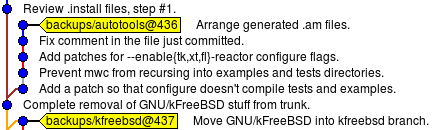
  • obsolete branches: http://thomas.g.girard.free.fr/ACE/obsolete-branches.png The tool leaves all branches, including removed ones (with tag on their end) so that you can decide what to do with them.

  • missing merges: http://thomas.g.girard.free.fr/ACE/missing-merge.png The branch 5.4.7-12 was never merged into the trunk!

Learning git Based on observations above, I realized my limited knowledge won't do to complete the conversion and clean the repository. There are tons of documentation on git out there, and you can find a lot of links from the git documentation page. Here's the one I've used:
The Git Object Model It's described with pictures here. You really need to understand this if you haven't already. Once you do, you understand that git is built bottom-up: the plumbing then the porcelain. If you can't find the tool you need, it's easy to write it.
git fast-import The Migrating to Git chapter explains how you can use the git fast-import tool to manually import anything into git. I've used it to create tags with dates in the past, slightly changing the Custom Importer example in the book:
#!/usr/bin/env ruby
#
# retag.rb
#
# Small script to create an annotated tag, specifying commiter as well as
# date, and tag comment.
#
# Based on Scott Chacon "Custom Importer" example.
#
# Arguments:
#  $1 -- tag name
#  $2 -- sha-1 revision to tag
#  $3 -- committer in the form First Last <email>
#  $4 -- date to use in the form YYYY/MM/DD_HH:MM:SS

def help
  puts "Usage: retag <tag> <sha1sum> <committer> <date> <comment>"
  puts "Creates a annotated tag with name <tag> for commit <sha1sum>, using "
  puts "given <committer>, <date> and <comment>"
  puts "The output should be piped to git fast-import"
end
def to_date(datetime)
  (date, time) = datetime.split('_')
  (year, month, day) = date.split('/')
  (hour, minute, second) = time.split(':')
  return Time.local(year, month, day, hour, minute, second).to_i
end
def generate_tag(tag, sha1hash, committer, date, message)
  puts "tag # tag "
  puts "from # sha1hash "
  puts "tagger # committer  # date  +0000"
  print "data # message.size \n# message "
end
if ARGV.length != 5
  help
  exit 1
else
  (tag, sha1sum, committer, date, message) = ARGV
  generate_tag(tag, sha1sum, committer, to_date(date), message)
end
graft points (graft means greffe in French) Because of missing svn:mergeinfo some changes appear unmerged. To fix this there are graft points: they override git idea of parents of a commit. To create a graft point, assuming 6a6d48814d0746fa4c9f6869bd8d5c3bc3af8242 is the commit you want to change, currently with a single parent 898ad49b61d4d8d5dc4072351037e2c8ade1ab68, but containing changes from commit 11cf74d4aa996ffed7c07157fe0780ec2224c73e:
me@mymachine$ echo 6a6d48814d0746fa4c9f6869bd8d5c3bc3af8242 11cf74d4aa996ffed7c07157fe0780ec2224c73e 898ad49b61d4d8d5dc4072351037e2c8ade1ab68 >> .git/info/grafts
git filter-branch git filter-branch allows you to completely rewrite history of a git branch, changing or dropping commits while traversing the branch. As an additional benefit, this tool use graft points and make them permanent. In other words: after running git filter-branch you can remove .git/info/grafts file. I've used it to rewrite author of a given set of commits, using a hack on top of Chris Johnsen script:
#!/bin/sh

br="HEAD"
TARG_NAME="Raphael Bossek"
TARG_EMAIL="hidden"
export TARG_NAME TARG_EMAIL
filt='
    if test "$GIT_COMMIT" = 546db1966133737930350a098057c4d563b1acdf -o \
            "$GIT_COMMIT" = 23419dde50662852cfbd2edde9468beb29a9ddcc; then
        if test -n "$TARG_EMAIL"; then
            GIT_AUTHOR_EMAIL="$TARG_EMAIL"
            export GIT_AUTHOR_EMAIL
        else
            unset GIT_AUTHOR_EMAIL
        fi
        if test -n "$TARG_NAME"; then
            GIT_AUTHOR_NAME="$TARG_NAME"
            export GIT_AUTHOR_NAME
        else
            unset GIT_AUTHOR_NAME
        fi
    fi
'
git filter-branch $force --tag-name-filter cat --env-filter "$filt" -- $br
(Script edited here; there were much more commits written by Raphael.)

Important

It's important to realize that the whole selected branch history is rewritten, so all objects id will change. You should not do this if you already published your repository.

The --tag-name-filter cat argument ensures our tags are copied during the traversal; otherwise they would be untouched, and hence not available in the new history.

Hint

Once git filter-branch completes you get a new history, as well as a new original ref to ease comparison. It is highly recommended to check the result of the rewrite before removing original. To shrink the repo after this, git clone the rewritten repo with file:// syntax -- git-filter-branch says it all.

Cleaning up the repo To recap, here's how the ACE+TAO git repo was changed after conversion:
  1. Add graft points where needed.

  2. Clean tags and branches. Using git tag -d, git branch -d and the Ruby script above it was possible to recreate tags. During this I was also able to add missing tags, and remove some SVN errors I did -- like committing in a branch created under tags/.

  3. Remove obsolete branches.

  4. Merge missing pieces. There were just two missing debian/changelog entries. I did this before git filter-branch because I did not find a way to use the tool correctly with multiple heads.

  5. Fix commit author where needed. Using the shell script above Raphael is now correctly credited for his work.

That's it. The ACE+TAO git repository for Debian packages is alive at http://git.debian.org/?p=pkg-ace/pkg-ace.git;a=summary.
[1]http://lists.alioth.debian.org/pipermail/pkg-ace-devel/2011-March/002421.html
[2]available in Debian as svn-all-fast-export

21 April 2011

Timo Jyrinki: Tuning an old but free phone video now available

It was good that I didn't hold up my blog post in November until the videos from FSCONS 2010 (Free Society Conference and Nordic Summit) are out, but now they finally are:


Timo Jyrinki - Tuning an old but free phone (pt 1/2)
Timo Jyrinki - Tuning an old but free phone (pt 2/2)

Definitely see also all videos and since Vimeo doesn't work in Gnash, use a script to download.

ps. As a related item to the talk's future oriented aspects, while waiting for GTA04A3 boards to arrive, GTA04A2 has been patched to run Debian/LXDE.

Next.

Previous.



