Search Results: "sf"

14 February 2021

Bits from Debian: I love Free Software Day 2021: Show your love for Free Software

ILoveFS banner On this day February 14th, Debian joins the Free Software Foundation Europe in celebration of "I Love Free Software" day. This day takes the time to appreciate and applaud all those who contribute to the many areas of Free Software. Debian sends all of our love and a giant Thank you to the upstream and downstream creators and maintainers, hosting providers, partners, and of course all of the Debian Developers and Contributors. Thank you for all that you do in making Debian truly the Universal Operating System and for keeping and making Free Software Free! Send some love and show some appreciation for Free Software by spreading the message and appreciation around the world, if you share in social media the hashtag used is: #ilovefs.

9 February 2021

Molly de Blanc: Proprietary (definition)

I recently had the occasion to try and find a definition of proprietary in terms of software that is not on Wikipedia. Most of the discussion on the issue I found was focused on what free and open source software is, and that anything that isn t FOSS is proprietary. I don t think the debate is as simple as this, especially if you want to get into conversations about nuance around things like Open Core. The problem with defining proprietary software by what it isn t, or at least that it isn t FOSS, means that we cannot concisely communicate what makes something proprietary. Instead, we leave it up to the people we re trying to communicate with to dig through a history of rhetoric, copyright law, and licensing in order to understand what it actually means for something to be FOSS, and what it means for something to be anything else. It is also just less satisfying, in my opinion, to define something by what it lacks rather than by what it is. I ll start by proposing the following definition: Proprietary software is software that comes with restrictions on what users can do with the software and the source code that constitutes said software. I think the most controversial part of this sentence is the wording software that comes with restrictions. In earlier attempts of this I wrote software that restricts. This sort of active wording, which I used for years in my capacity at work, is misleading. In the case of proprietary software, it is the licensing and laws around it that restrict what you can do. For software to restrict you, it must be that the way the software is being implemented or used restricts you. To be clear, this is my first proposal. I look forward to discussing this further!

8 February 2021

Russ Allbery: Review: The Future of Another Timeline

Review: The Future of Another Timeline, by Annalee Newitz
Publisher: Tor
Copyright: September 2019
ISBN: 0-7653-9212-7
Format: Kindle
Pages: 350
Tess is a time traveler from 2022, a member of the semi-secret Daughters of Harriet who are, under the cover of an academic research project, attempting to modify the timeline to improve women's rights in the United States. Beth is a teenager in suburban Irvine in Alta California, with an abusive father, a tight-knit group of friends, and a love of feminist punk rock. The story opens with both of them at a Grape Ape concert in 1992. Beth is hanging out with her friends, and Tess is looking for signs of a conspiracy to alter the timeline to further restrict the rights of women. The Future of Another Timeline has a great science fiction premise. There are time machines buried in geologically-stable bedrock that have been there since before any current species evolved. The first was discovered by humans thousands of years before the start of the story. They can be controlled with vibrations in the rock and therefore don't need any modern technology to operate. Humanity has therefore lived with time travel for much of recorded history, albeit with a set of rules strictly imposed by these mysterious machines: individuals can only travel to their own time or earlier, and cannot carry any equipment with them. The timeline at the start of the book is already not ours, and it shifts further over the course of the plot. Time travel has a potentially devastating effect on the foundations of narrative, so most SF novels that let the genie of time travel out of the bottle immediately start trying to stuff it back in again. Newitz does not, which is a refreshing change. The past is not immutable, there is no scientific or magical force that prevents history from changing, and people do not manage to keep something with a history of thousands of years either secret or well-controlled. It's not a free-for-all: There is a Chronology Academy that sets some rules for time travelers, the Machines themselves have rules that prevent time travel from being too casual, and most countries have laws about what time travelers are allowed to do. But it's also not horribly difficult to travel in time, not horribly uncommon to come across someone from the future, and most of the rules are not strictly enforced. This does mean there are some things that one has to agree to not think about. (To take the most obvious example, the lack of government and military involvement in time travel is not believable, even given its constraints. One has to accept this as a story premise.) But it removes the claustrophobic rules-lawyering that's so common in time travel stories and lets Newitz tell a more interesting political story about the difficulty of achieving lasting social change. Unfortunately, this is also one of those science fiction novels that is much less interested in its premise and machinery than I was as a reader. The Machines are fascinating objects: ancient, mysterious, and as we learn more about them over the course of the story, rich with intriguing detail. After reading this summary, you're probably curious where they came from, what they can do, and how they work. So am I, after reading the book. The Future of Another Timeline is completely uninterested in that or any related question. About halfway through the book, a time traveler from the future demonstrates interfaces in the time machines that no one knew existed, the characters express some surprise, and then no one asks any meaningful questions for the rest of the book. At another point, the characters have the opportunity to see a Machine in something closer to its original form before aspects of its interface have eroded away. They learn just enough to solve their immediate plot problem and show no further curiosity. I found this immensely frustrating, in part due to the mixed signaling. Normally if an author is going to use a science fiction idea as pure plot device, they avoid spending much time on it, implicitly warning the reader that this isn't where the story is going. Newitz instead provides the little details and new revelations that normally signal that understanding these objects will be a key to the plot, and then shrugs and walks away, leaving every question unanswered. Given how many people enjoyed Rendezvous with Rama, this apparently doesn't bother other readers as much as it bothers me. If you are like me, though, be warned. But, fine, this is a character story built around a plot device rather than a technology story. That's a wholly valid mode of science fiction, and that part of the book has heft. It reminded me of the second-wave feminist science fiction of authors like Russ and Charnas, except updated to modern politics. The villains are a projection forward of the modern on-line misogynists (incels, specifically), but Newitz makes the unusual choice of not focusing on their motives or interior lives. They simply exist as a malevolent hostile force, much the way that women experience them today on-line. They have to be defeated, the characters of the book set out to defeat them, and this is done without melodrama, hand-wringing, or psychoanalysis. It's refreshingly straightforward and unambiguous, and it keeps the focus on the people trying to make the world a better place rather than on the redemption arc of some screaming asshole. The part I was less enamored of is that these are two of the least introspective first-person protagonists that I've seen in a book. Normally, first-person perspective is used to provide a rich internal monologue about external events, but both Tess and Beth tell their stories as mostly-dry sequences of facts. Sometimes this includes a bit of what they're feeling, but neither character delves much into the why or how. This improves somewhat towards the end of the book, but I found the first two-thirds of the story oddly flat and had a hard time generating much interest in or sympathy for the characters. There are good in-story reasons for both Tess and Beth to heavily suppress their emotions, so I will not argue this is unrealistic, but character stories work better for me with more of an emotional hook. Hand-in-hand with that is the problem that the ending didn't provide the catharsis that I was hoping for. Beth goes through absolute hell over the course of the book, and while that does reach a resolution that I know intellectually is the best type of resolution that her story can hope for, it felt wholly insufficient. Tess's story reaches a somewhat more satisfying conclusion, but one that reverses an earlier moral imperative in a way that I found overly sudden. And everything about this book is highly contingent and temporary in a way that is true to its theme and political statement but that left me feeling more weary than satisfied. That type of ending is a valid authorial choice, and to some extent my complaint is only that this wasn't the book for me at the time I read it. But I have read other books with similarly conditional endings and withdrawn characters that still carried me along with the force and power of the writing (Daughters of the North comes to mind). The Future of Another Timeline is not poorly written, but neither do I think it achieves that level of skill. The writing is a bit wooden, the flow of sentences is a touch cliched and predictable, and the characters are a bit thin. It's serviceable writing had there been something else (such as a setting-as-character exploration of the origins and purpose of the Machines) to grab my attention and pull me along. But if the weight of the story has to be born by the quality of the writing, I don't think it was quite up to the task. Overall, I think The Future of Another Timeline has a great premise that it treats with frustrating indifference, a satisfyingly different take on time travel with some obvious holes, some solid political ideas reminiscent of an earlier age of feminist SF, a refreshing unwillingness to center evil on its own terms, characters that took more than half the book to develop much depth, and a suitable but frustrating ending. I can see why other people liked it more than I did, but I can't recommend it. Content warning: Rape, graphic violence, child abuse, gaslighting, graphic medical procedure, suicide, extreme misogyny, and mutilation, and this is spread throughout the book, not concentrated in one scene. I'm not very squeamish about non-horror fiction and it was still rather a lot, so please read with care. Rating: 6 out of 10

29 January 2021

Jonathan McDowell: Working better with an online whiteboard

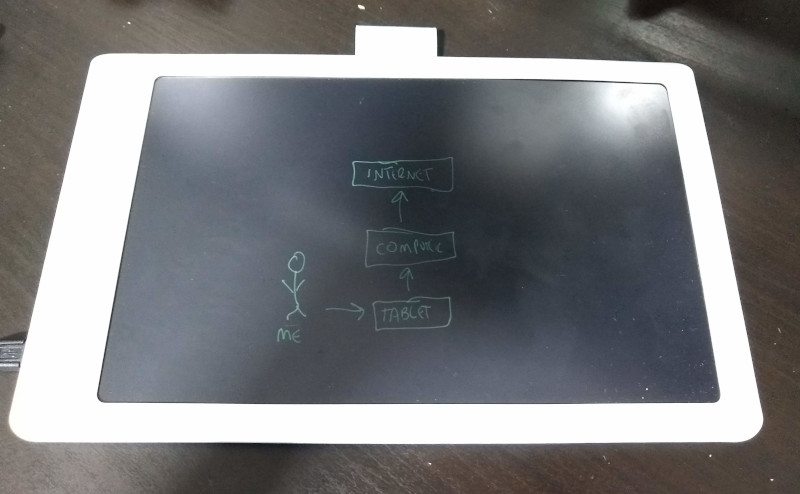
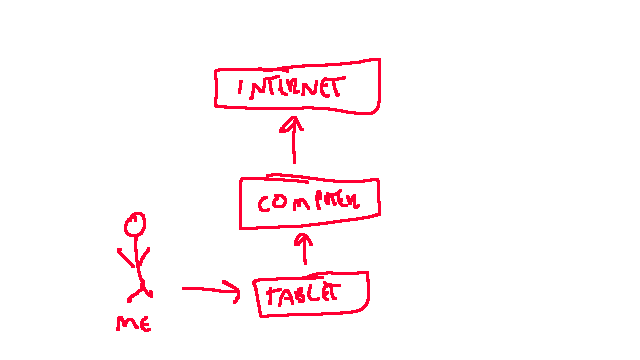
LCD Writing Tablet One of the challenges I find about being fully remote is that one of the ways I think while I explain things is I draw diagrams. I m not artistic in any manner (my brothers got that skillset), but a set of boxes and lines and some text scribbled as I talk really helps. I do think even for myself, which is obviously as easy to replicate at home as in the office; I have plenty of paper and a whiteboard in my study. It s not so easy when having a design discussion with someone remotely. Doodling with a mouse doesn t quite work; my art skills are bad enough without then factoring in the fact it s not a pen-like device I m using to do it. I ve previously tried a proper graphics tablet, but there s a disconnect between where you are writing and where the output appears. That makes doing things like labelling within a diagram, or going back to draw an update, quite difficult. Or it does if you re me anyway. The modern solution is probably a laptop with a stylus capable touchscreen, but I ve shied away from such things because I don t want fingerprints all over my screen and don t want to pay extra for something I haven t previously thought I d use. An alternative is a tablet with a stylus capable screen, but those turn out to be premium models these days (remember when resistive was the cheap option because no one wanted to use the stylus?) and mine doesn t support it. You can get capacitive styli (styluses?) but then when you lean on the tablet it all gets confused. When I m due a technology refresh of my laptop or tablet I ll perhaps factor such things in, but what to do now, when I m not entirely sure how much usage I ll get out of such a device and thus can t justify a major expense on it? Buy a random thing from the internet, of course! It turns out there are a range of LCD writing tablets out there, which let you scribble on a screen and then erase it at the press of a button. An electronic etch-a-sketch, as it were. Most of them don t count as smart , with power only needed for the erase, but there appears to have been a device called the Boogie Board Sync in the past which offered some ability to save things. Searching around I found the NEWYES 10 Bluetooth Archive Writing Tablet from BangGood. Which looked like it had enough smarts to be able to send the images over bluetooth and therefore might be hackable in some manner. At 45 it seemed a reasonable punt, so I ordered one. It arrived within 2 weeks and I was surprised to find that when plugged in as a USB device it actually presented as a tablet. So much for a hackery requirement! It was detected by the kernel fine:
kernel dmesg output
usb 1-1.2: new full-speed USB device number 19 using xhci_hcd
usb 1-1.2: New USB device found, idVendor=6161, idProduct=4d15, bcdDevice=30.00
usb 1-1.2: New USB device strings: Mfr=5, Product=6, SerialNumber=0
usb 1-1.2: Product: LetSketch
usb 1-1.2: Manufacturer: LetSketch
hid-generic 0003:6161:4D15.0010: hiddev0,hidraw4: USB HID v1.11 Device [LetSketch LetSketch] on usb-0000:00:14.0-1.2/input0
input: LetSketch LetSketch as /devices/pci0000:00/0000:00:14.0/usb1/1-1/1-1.2/1-1.2:1.1/0003:6161:4D15.0011/input/input35
hid-generic 0003:6161:4D15.0011: input,hidraw5: USB HID v1.11 Device [LetSketch LetSketch] on usb-0000:00:14.0-1.2/input1
lsusb output
Bus 001 Device 016: ID 6161:4d15  
Device Descriptor:
  bLength                18
  bDescriptorType         1
  bcdUSB               1.00
  bDeviceClass            0 
  bDeviceSubClass         0 
  bDeviceProtocol         0 
  bMaxPacketSize0        64
  idVendor           0x6161 
  idProduct          0x4d15 
  bcdDevice           30.00
  iManufacturer           5 LetSketch
  iProduct                6 LetSketch
  iSerial                 0 
  bNumConfigurations      1
  Configuration Descriptor:
    bLength                 9
    bDescriptorType         2
    wTotalLength       0x003b
    bNumInterfaces          2
    bConfigurationValue     1
    iConfiguration          0 
    bmAttributes         0xa0
      (Bus Powered)
      Remote Wakeup
    MaxPower              480mA
    Interface Descriptor:
      bLength                 9
      bDescriptorType         4
      bInterfaceNumber        0
      bAlternateSetting       0
      bNumEndpoints           1
      bInterfaceClass         3 Human Interface Device
      bInterfaceSubClass      1 Boot Interface Subclass
      bInterfaceProtocol      2 Mouse
      iInterface              0 
        HID Device Descriptor:
          bLength                 9
          bDescriptorType        33
          bcdHID               1.11
          bCountryCode            0 Not supported
          bNumDescriptors         1
          bDescriptorType        34 Report
          wDescriptorLength      18
         Report Descriptors: 
           ** UNAVAILABLE **
      Endpoint Descriptor:
        bLength                 7
        bDescriptorType         5
        bEndpointAddress     0x81  EP 1 IN
        bmAttributes            3
          Transfer Type            Interrupt
          Synch Type               None
          Usage Type               Data
        wMaxPacketSize     0x0010  1x 16 bytes
        bInterval               2
    Interface Descriptor:
      bLength                 9
      bDescriptorType         4
      bInterfaceNumber        1
      bAlternateSetting       0
      bNumEndpoints           1
      bInterfaceClass         3 Human Interface Device
      bInterfaceSubClass      1 Boot Interface Subclass
      bInterfaceProtocol      2 Mouse
      iInterface              0 
        HID Device Descriptor:
          bLength                 9
          bDescriptorType        33
          bcdHID               1.11
          bCountryCode            0 Not supported
          bNumDescriptors         1
          bDescriptorType        34 Report
          wDescriptorLength      83
         Report Descriptors: 
           ** UNAVAILABLE **
      Endpoint Descriptor:
        bLength                 7
        bDescriptorType         5
        bEndpointAddress     0x82  EP 2 IN
        bmAttributes            3
          Transfer Type            Interrupt
          Synch Type               None
          Usage Type               Data
        wMaxPacketSize     0x0010  1x 16 bytes
        bInterval               2
Device Status:     0x0003
  Self Powered
  Remote Wakeup Enabled
Nice. X wasn t happy though:
non-working Xorg log
(II) config/udev: Adding input device LetSketch LetSketch (/dev/input/event8)
(**) LetSketch LetSketch: Applying InputClass "libinput tablet catchall"
(II) Using input driver 'libinput' for 'LetSketch LetSketch'
(II) systemd-logind: got fd for /dev/input/event8 13:72 fd 34 paused 0
(**) LetSketch LetSketch: always reports core events
(**) Option "Device" "/dev/input/event8"
(**) Option "_source" "server/udev"
(II) event8  - LetSketch LetSketch: is tagged by udev as: Tablet
(EE) event8  - LetSketch LetSketch: libinput bug: missing tablet capabilities: resolution. Ignoring this device.
(II) event8  - LetSketch LetSketch: device is a tablet
(II) event8  - failed to create input device '/dev/input/event8'.
(EE) libinput: LetSketch LetSketch: Failed to create a device for /dev/input/event8
(EE) PreInit returned 2 for "LetSketch LetSketch"
(II) UnloadModule: "libinput"
I ended up digging into the libinput source to figure out what was going on here, and it turned out to be the fact there was no report of the physical size of the tablet, so no indication of what the resolution was. That s solvable with an entry in the udev hwdb for evdev devices, so I sent a patch upstream and with that applied (or just dropped into /etc/udev/hwdb.d/61-evdev-local.hwdb and then running systemd-hwdb update and replugging the device) everything looks much happier:
working Xorg log
(II) config/udev: Adding input device LetSketch LetSketch (/dev/input/event8)
(**) LetSketch LetSketch: Applying InputClass "libinput tablet catchall"
(II) Using input driver 'libinput' for 'LetSketch LetSketch'
(II) systemd-logind: got fd for /dev/input/event8 13:72 fd 86 paused 0
(**) LetSketch LetSketch: always reports core events
(**) Option "Device" "/dev/input/event8"
(**) Option "_source" "server/udev"
(II) event8  - LetSketch LetSketch: is tagged by udev as: Tablet
(II) event8  - LetSketch LetSketch: tablet 'LetSketch LetSketch' unknown to libwacom
(II) event8  - LetSketch LetSketch: device is a tablet
(II) event8  - LetSketch LetSketch: device removed
(**) Option "config_info" "udev:/sys/devices/pci0000:00/0000:00:08.1/0000:04:00.3/usb1/1-1/1-1.2/1-1.2:1.1/0003:6161:4D15.000A/input/input24/event8"
(II) XINPUT: Adding extended input device "LetSketch LetSketch" (type: TABLET, id 20)
(II) event8  - LetSketch LetSketch: is tagged by udev as: Tablet
(II) event8  - LetSketch LetSketch: tablet 'LetSketch LetSketch' unknown to libwacom
(II) event8  - LetSketch LetSketch: device is a tablet
(II) libinput: LetSketch LetSketch: needs a virtual subdevice
(**) LetSketch LetSketch Pen (0): Applying InputClass "libinput tablet catchall"
(II) Using input driver 'libinput' for 'LetSketch LetSketch Pen (0)'
(II) systemd-logind: returning pre-existing fd for /dev/input/event8 13:72
(**) LetSketch LetSketch Pen (0): always reports core events
(**) Option "Device" "/dev/input/event8"
(**) Option "_source" "_driver/libinput"
(II) libinput: LetSketch LetSketch Pen (0): is a virtual subdevice
(**) Option "config_info" "udev:/sys/devices/pci0000:00/0000:00:08.1/0000:04:00.3/usb1/1-1/1-1.2/1-1.2:1.1/0003:6161:4D15.000A/input/input24/event8"
(II) XINPUT: Adding extended input device "LetSketch LetSketch Pen (0)" (type: STYLUS, id 21)
(**) Option "AccelerationScheme" "none"
(**) LetSketch LetSketch Pen (0): (accel) selected scheme none/0
(**) LetSketch LetSketch Pen (0): (accel) acceleration factor: 2.000
(**) LetSketch LetSketch Pen (0): (accel) acceleration threshold: 4
The only additional piece I ve done is tie the tablet to a single screen, so I can then full screen whichever whiteboard system I m using on that screen and have it map to the tablet - haven t worked out how to tie it to just the application window yet, but the fullscreen approach works fine, using my smaller laptop screen. To do that I use xinput list to figure out the ID of the tablet and then xinput map-to-output 23 eDP-1 to map it to the eDP-1 output (the internal laptop screen), assuming the ID that comes out of the list is 23. But is it any good? Well, the quality of the screen isn t fantastic - no fine art or anything here - but the tablet part seems fine (complete with some pressure sensitivity) and the fact I can see what I ve drawn where I m trying to draw something new makes it a lot more useful for me. I ve had a play with just screen sharing the GIMP and doodling in that, but equally work has an O365 subscription and the Microsoft Whiteboard turns out to be pretty good without anyone I m sharing with needing to install anything. Of course my artistic skills are still dreadful, but I have actually managed to use it for drawing out a couple of things while discussing them, so I m considering that a win. Saved Tablet image

27 January 2021

Jonathan Dowland: 2020 in Fiction

Cover for Susanna Clarke's Piranesi
Cover for Emily St. John Mandel's Station 11
I managed to read 31 "books" in 2020. I'm happy with that. I thought the Pandemic would prevent me reaching my goal (30), since I did most of my reading on the commute to the Newcastle office, pre-pandemic. Somehow I've managed to compensate. I started setting a goal for books read per year in 2012 when I started to use goodreads. Doing so started to influence the type of reading I do (which is the reason I stopped my Interzone subscription in 2014, although I resumed it again sometime afterwards). Once I realised that I've been a bit more careful to ensure setting a goal was a worthwhile thing to do and not just another source of stress in my life. Two books I read were published in 2020. The first was Robert Galbraith's (a.k.a. J K Rowling's) Troubled Blood, the fifth (and largest) in the series of crime novels featuring Cormoran Strike (and the equally important Robin Ellacott). Nowadays Rowling is a controversial figure, but I'm not writing about that today, or the book itself, in much detail: briefly, it exceeded expectations, and my wife and I really enjoyed it. The other was Susanna Clarke's Piranesi: an utterly fantastic modern-fantasy story, quite short, completely different to her successful debut novel Jonathan Strange & Mr Norrell. I really loved this book, partly because it appeals to my love of fantasy geography, but also because it is very well put together, with a strong sense of the value of people's lives. A couple of the other books I read were quite Pandemic-appropriate. I tore through Josh Malerman's Bird Box, a fast-paced post-apocalyptic style horror/suspense story. The appeal was mostly in the construction and delivery: the story itself was strong enough to support the book at the length that it is, but I don't really feel it could have lasted much longer, and so I've no idea how the new sequel (Malorie) will work. The other was Station Eleven by Emily St. John Mandel. This was a story about a group of travelling musicians in a post-apocalyptic (post-pandemic) North America. A cast of characters all revolve around their relationship (or six degrees of separation) to an actor who died just prior to the Pandemic. The world-building in this book was really strong, and I felt sufficiently invested in the characters that I would love to read more about them in another book. However, I think that (although I'm largely just guessing here), in common with Bird Box, the setting was there to support the novel and the ideas that the author wanted to get across, and so I (sadly) doubt she will return to it. Finally I read a lot of short fiction. I'll write more about that in a separate blog post.

Russ Allbery: Review: A Deadly Education

Review: A Deadly Education, by Naomi Novik
Series: The Scholomance #1
Publisher: Del Rey
Copyright: 2020
ISBN: 0-593-12849-4
Format: Kindle
Pages: 319
Some children are born with magic, which grows as they mature. Magic attracts maleficaria: extremely deadly magical beasts that want to feast on that magic. Having innate magical ability is therefore a recipe for endless attacks from monsters and a death at a young age. This was true even for the enclaves, which are the rich, gated communities of the magical world. Hence, the Scholomance. This is a boarding school for magic users placed in the Void and protected against maleficaria as completely as possible while still letting the students graduate and leave after their senior year. Students are sent there via a teleportation spell with a weight allowance, taught magic by automated systems and magical artifacts, and left on their own to make alliances and survive. Or not survive; protected as well as possible still means that there are maleficaria everywhere, sneaking past the wards of the graduation hall and looking for snacks. The school sends cleansing fire through the halls at certain times; the rest of the time, the students either learn enough magic to defeat maleficaria themselves, form alliances with those who can, or die to feed the magic of the school. Enter Galadriel, or El as she prefers. She's not an enclave kid; she's the grumpy, misfit daughter of a hippie mother whose open-hearted devotion to healing and giving away her abilities make her the opposite of the jealously guarded power structures of the enclaves. El has no resources other than what she can muster on her own. She also has her mother's ethics, which means that although she has an innate talent for malia, drawing magic from the death of other living things, she forces herself to build her mana through rigorously ethical means. Like push-ups. Or, worse, crochet. At the start of the book, El is in her third year of four, and significantly more of her classmates are alive than normally would be. That's because of her classmate, Orion Lake, who has made a full-time hobby of saving everyone from maleficaria. His unique magical ability frees him from the constraints of mana or malia that everyone else is subject to, and he uses that to be a hero, surrounded by adoring fans. And El is thoroughly sick of it. This book is so good in so many different ways that I don't know where to start. Obviously, A Deadly Education is a twist on the boarding school novel, both the traditional and the magical kind. This is not a genre in which I'm that well-read, but even with my lack of familiarity, I noticed so many things Novik does to improve the genre tropes, starting with not making the heroic character with the special powers the protagonist. And getting rid of all the adults, which leaves way more space for rich social dynamics between the kids (complex and interesting ones that are entangled with the social dynamics outside of the school, not some simplistic Lord of the Flies take). Going alone anywhere in the school is dangerous, as is sitting at the bad tables in the cafeteria, so social cliques become a matter of literal life and death. And the students aren't just trying to survive; the ones who aren't part of enclaves are jockeying for invitations or trying to build the power to help their family and allies form their own. El is the first-person narrator of the story and she's wonderful. She's grumpy, cynical, and sarcastic, which is often good for first-person narrators, but she also has a core of ethics from her mother, and from her own decisions, that gives her so much depth. She is the type of person who knows exactly how much an ethical choice will cost her and how objectively stupid it is, and then will make it anyway out of sheer stubbornness and refuse to take credit for it. I will happily read books about characters like El until the end of time. Her mother never appears in this book, and yet she's such a strong presence because El's relationship with her matters, to both El and to the book. El could not be more unlike her mother in both personality and in magical focus, and she's exasperated by the sheer impracticality of some of her mother's ideals. And yet there's a core of love and understanding beneath that, a level at which El completely understands her mother's goals, and El relies on it even when she doesn't realize she's doing so. I don't think I've ever read a portrayal of a mother-daughter relationship this good where one of the parties isn't even present. And I haven't even gotten to the world-building, and the level to which Novik chases down and explores all the implications of this ridiculous murder machine of a school. I will offer this caveat: If you poke at the justification for creating this school in the way it was built, it's going to teeter a lot. That society thought this school was the best solution to its child mortality problem is just something you have to roll with. But once you accept that, the implications are handled so very well. The school is an inhuman character in its own right, with exasperating rules that the students learn and warn each other about. It tries to distract you with rare spellbooks or artifact materials because it's trying to kill you. The language tapes whisper horrific stories of your death. The back wall of your room is a window to the Void, from which you can demand spellbooks. You'll even get them in languages that you understand, for a generous definition of understand that may have involved glancing at one page of text, so be careful not to do that! The school replaces all of the adult teachers in the typical boarding school novel and is so much more interesting than any of them because it adds the science fiction thrill of setting as character. The world-building does mean a lot of infodumping, so be prepared for that. El likes to explain things, tell stories, and over-analyze her life, and reading this book is a bit like reading the journal of a teenage girl. For me, El's voice is so strong, authentic, stubborn, and sarcastically funny that I scarcely noticed the digressions into background material. And the relationships! Some of the turns will be predictable, since of course El's stubborn ethics will be (eventually) rewarded by the story, but the dynamic that develops between El and Orion is something special. It takes a lot to make me have sympathy with the chosen one boy hero, but Novik pulls it off without ever losing sight of the dynamics of class and privilege that are also in play. And the friendships El develops almost accidentally by being stubbornly herself are just wonderful, and the way she navigates them made me respect her even more. The one negative thing I will say about this book is that I don't think Novik quite nailed the climax. Some of this is probably because this is the first book of a series and Novik wanted to hold some social developments in reserve, but I thought El got a bit sidelined and ended up along for the ride in an action-movie sequence. Still, it's a minor quibble, and it's clear from the very end of the book that El is going to get more attention and end up in a different social position in the next book. This was a wholly engrossing and enjoyable story with a satisfying climax and only the barb of a cliffhanger in the very last line. It's the best SFF novel published in 2020 that I've read so far (yes, even better than Network Effect). Highly recommended, and I hope it gets award recognition this year. Followed by The Last Graduate (not yet published at the time of this review). Rating: 9 out of 10

26 January 2021

Ingo Juergensmann: Migrating from Drupal to WordPress

If you can read this on planet.debian.org then migrating my blog from Drupal to WordPress was successful and the feed has been successfully changed by the Debian Planet Maintainers (thanks!). I ve been a long term Drupal user. I think I started to use Drupal since it was included in Debian. At some point Drupal was removed from Debian and I started to use Serendipity instead. Later Drupal was included in Debian again and I moved back to Drupal. I think this must have been around Drupal 4 or Drupal 5. No idea. I even became active in the Drupal community and went to one of the first Drupal barcamps in Germany, namely in Cologne. This was shortly before Dries Buytaert started a business off of Drupal and went to the USA. I met with many devs of Drupal in Cologne and enjoyed the community and started with others a local Drupal User Group in Rostock. In 2011 we organized a Drupal Barcamp in Rostock, which was quite successful. But at that time it was already apparent that Drupal became more and more complex. It was far away from its original idea of providing a simple to use website and blogging site. Now I m still on Drupal 7 and this is some sort of a showstopper. Older major version upgrades had a upgrade path, like from Drupal 5 to Drupal 6 to Drupal 7. But for Drupal 8 there is no easy upgrade path. There are some ways to upgrade, but nothing as smooth as the prior major upgrades. In fact the upgrade from 6 to 7 was already painful. My impression of Drupal today is that it is a framework suitable for agencies to built complex websites for their customers. It s too much of a hassle to use it for your hobbyist websites. So, after all the years my Drupal journey will come to an end. It was a long time with you. Sometimes joyful, sometimes painful. I wish you all the best, Drupal! Maybe I stay with WordPress, maybe I ll use Hugo in the future. Having a static website is very appealing, though

Russ Allbery: Review: The City We Became

Review: The City We Became, by N.K. Jemisin
Series: The Great Cities Trilogy #1
Publisher: Orbit
Copyright: March 2020
ISBN: 0-316-50985-X
Format: Kindle
Pages: 449
At an unpredictable point after a city has accumulated enough history, character, and sense of itself, it is born as a living creature. It selects an avatar who both embodies the city and helps it be born. But in that moment of birth, a city is at its most vulnerable, and that is when the Enemy attacks. The birth of cities and the Enemy attacks have happened for millennia, so the cities that have survived the process have developed a system. The most recently born goes to assist the avatar with the birthing process and help fight off Enemy attacks. But the process has become riskier and the last two cities have failed to be born, snuffed out in natural disasters despite that support. Now, it's New York City's turn. It selects its avatar and survives the initial assault with the help of S o Paulo. But something still goes wrong, and it is severely injured in the process. Complicating matters, now there are five more avatars, one for each borough, who will have to unite to fight off the Enemy. And, for the first time, the Enemy has taken human form and is attacking with reason and manipulation and intelligence, not just force. The City We Became has a great premise: take the unique sense of place that defines a city and turn it into a literalized character in a fantasy novel. The avatars are people who retain their own lives and understanding (with one exception that I'll get to in a moment), but gain an awareness of the city they represent. They can fight and repair their city through sympathetic magic and metaphor made real. The prelude that introduces this concept (adapted from Jemisin's earlier short story "The City Born Great") got too gonzo for me, but once Jemisin settles into the main story and introduces avatars with a bit more distance from the city they represent, the premise clicked. The execution, on the other hand, I thought was strained. The biggest problem is that the premise requires an ensemble cast of five borough avatars, the primary avatar, S o Paulo, and the Enemy. That's already a lot, but for the story to work each avatar has to be firmly grounded in their own unique experience of New York, which adds family members, colleagues, and roommates. That's too much to stuff into one novel, which means characters get short shrift. For example, Padmini, the avatar of Queens, gets a great introductory scene and a beautiful bit of characterization that made her one of my favorite characters, but then all but disappears for the remainder of the book. She's in the scenes, but not in a way that matters. Brooklyn and Aislyn get moments of deep characterization, but there's so much else going on that they felt rushed. And what ever happened to Manny's roommate? The bulk of the characterization in this book goes to Broncha, the Bronx avatar, a Lenape woman and a tough-as-nails administrator of a community art museum and maker space. The dynamics between her and her co-workers, her mentorship of Veneza, and her early encounters with the Woman in White are my favorite parts of the book. I thought she and Brooklyn were a useful contrast: two very different ways of finding a base of power in the city without letting go of one's ideals. But before we get to Broncha, we first meet Manny, the Manhattan avatar. Thematically, I thought what Jemisin did here was extremely clever. Manny's past is essentially erased at the start of the book, so he's making sense of this world in the same way the reader is. It makes him a useful reader insert character and parallels the typical tourist experience of arriving in Manhattan and trying to use it to make sense of New York. He's disconnected from the rest of the city because he's the dangerous newcomer with power but not a lot of understanding, which works with my model of the political dynamics of Manhattan. Unfortunately, he's not an interesting person. I appreciated what was happening at the metaphorical layer, but Manny veers between action hero and exposition prompt, and his amnesia meant I never got enough sense of him as a character to care that much about what happened to him. I thought his confrontation with the Woman in White near the start of the book, which establishes the major villain of the book, felt clunky and forced compared to her later encounters with the other characters. The Woman in White, though, is a great villain. It's clear from earlier on that the Enemy is Lovecraftian, but the Woman in White mixes mad scientist glee, manic enthusiasm, and a child-like amusement at the weirdness of humanity into the more typical tropes of tentacles, corruption, and horrific creatures. One of my qualms about reading this book is that I'm not a horror fan and don't enjoy the mental images of unspeakable monsters, but the Woman in White puts such a fascinating spin on them that I enjoyed the scenes in which she appeared. I think the book was at its best when she was trying to psychologically manipulate the characters or attack them with corrupted but pre-existing power structures. I was less interested when it turned into an action-movie fight against animated monsters. The other place Jemisin caught me by surprise is too much of a spoiler to describe in detail (and skip the next paragraph in its entirety if you want to avoid all spoilers): Jemisin didn't take the moral conflict of the book in the direction I was expecting. This book is more interested in supporting the people who are already acting ethically than in redeeming people who make bad choices. That produces a deus ex machina ending that's a bit abrupt, but I appreciated the ethical stance. Overall, I thought the premise was great but the execution was unsteady and a bit overstuffed. There are some great characters and some great scenes, but to me they felt disjointed and occasionally rushed. You also need to enjoy characters taking deep pride in the feel of a specific place and advocating for it with the vigor of a sports rivalry, along with loving descriptions of metaphors turned into magical waves of force. But, if you can roll with that, there are moments of real awe. Jemisin captured for me the joy that comes from a deeply grounded sense of connection to a place. Recommended, albeit with caveats, if you're in the mood for reading about people who love the city they live in. This is the first book of a planned trilogy and doesn't resolve the main conflict, but it reaches a satisfying conclusion. The title of the next book has not yet been announced at the time of this review. Rating: 7 out of 10

22 January 2021

Robert McQueen: Launching Endless OS Foundation

Passion Led Us Here

How our for-profit company became a nonprofit, to better tackle the digital divide. Originally posted on the Endless OS Foundation blog.

An 8-year journey to a nonprofit On the 1st of April 2020, our for-profit Endless Mobile officially became a nonprofit as the Endless OS Foundation. Our launch as a nonprofit just as the global pandemic took hold was, predictably, hardly noticed, but for us the timing was incredible: as the world collectively asked What can we do to help others in need? , we framed our mission statement and launched our .org with the same very important question in mind. Endless always had a social impact mission at its heart, and the challenges related to students, families, and communities falling further into the digital divide during COVID-19 brought new urgency and purpose to our team s decision to officially step in the social welfare space.
On April 1st 2020, our for-profit Endless Mobile officially became a nonprofit as the Endless OS Foundation, focused on the #DigitalDivide.
Our updated status was a long time coming: we began our transformation to a nonprofit organization in late 2019 with the realization that the true charter and passions of our team would be greatly accelerated without the constraints of for-profit goals, investors and sales strategies standing in the way of our mission of digital access and equity for all. But for 8 years we made a go of it commercially, headquartered in Silicon Valley and framing ourselves as a tech startup with access to the venture capital and partnerships on our doorstep. We believed that a successful commercial channel would be the most efficient way to scale the impact of bringing computer devices and access to communities in need. We still believe this we ve just learned through our experience that we don t have the funding to enter the computer and OS marketplace head-on. With the social impact goal first, and the hope of any revenue a secondary goal, we have had many successes in those 8 years bridging the digital divide throughout the world, from Brazil, to Kenya, and the USA. We ve learned a huge amount which will go on to inform our strategy as a nonprofit.
Endless always had a social impact mission at its heart. COVID-19 brought new urgency and purpose to our team s decision to officially step in the social welfare space.
Our unique perspective One thing we learned as a for-profit is that the OS and technology we ve built has some unique properties which are hugely impactful as a working solution to digital equity barriers. And our experience deploying in the field around the world for 8 years has left us uniquely informed via many iterations and incremental improvements.
Endless OS designer in discussion with prospective user
With this knowledge in-hand, we ve been refining our strategy throughout 2020 and now starting to focus on what it really means to become an effective nonprofit and make that impact. In many ways it is liberating to abandon the goals and constraints of being a for-profit entity, and in other ways it s been a challenging journey for me and the team to adjust our way of thinking and let these for-profit notions and models go. Previously we exclusively built and sold a product that defined our success; and any impact we achieved was a secondary consequence of that success and seen through that lens. Now our success is defined purely in terms of social impact, and through our actions, those positive impacts can be made with or without our product . That means that we may develop and introduce technology to solve a problem, but it is equally as valid to find another organization s existing offering and design a way to increase that positive impact and scale.
We develop technology to solve access equity issues, but it s equally as valid to find another organization s offering and partner in a way that increases their positive impact.
The analogy to Free and Open Source Software is very strong while Endless has always used and contributed to a wide variety of FOSS projects, we ve also had a tension where we ve been trying to hold some pieces back and capture value such as our own application or content ecosystem, our own hardware platform necessarily making us competitors to other organisations even though they were hoping to achieve the same things as us. As a nonprofit we can let these ideas go and just pick the best partners and technologies to help the people we re trying to reach.
School kids writing on paper
Digital equity 4 barriers we need to overcome In future, our decisions around which projects to build or engage with will revolve around 4 barriers to digital equity, and how our Endless OS, Endless projects, or our partners offerings can help to solve them. We define these 4 equity barriers as: barriers to devices, barriers to connectivity, barriers to literacy in terms of your ability to use the technology, and barriers to engagement in terms of whether using the system is rewarding and worthwhile.
We define the 4 digital equity barriers we exist to impact as:
1. barriers to devices
2. barriers to connectivity
3. barriers to literacy
4. barriers to engagement
It doesn t matter who makes the solutions that break these barriers; what matters is how we assist in enabling people to use technology to gain access to the education and opportunities these barriers block. Our goal therefore is to simply ensure that solutions exist building them ourselves and with partners such as the FOSS community and other nonprofits proving them with real-world deployments, and sharing our results as widely as possible to allow for better adoption globally. If we define our goal purely in terms of whether people are using Endless OS, we are effectively restricting the reach and scale of our solutions to the audience we can reach directly with Endless OS downloads, installs and propagation. Conversely, partnerships that scale impact are a win-win-win for us, our partners, and the communities we all serve. Engineering impact Our Endless engineering roots and capabilities feed our unique ability to build and deploy all of our solutions, and the practical experience of deploying them gives us evidence and credibility as we advocate for their use. Either activity would be weaker without the other.
Our engineering roots and capabilities feed our unique ability to build and deploy digital divide solutions.
Our partners in various engineering communities will have already seen our change in approach. Particularly, with GNOME we are working hard to invest in upstream and reconcile the long-standing differences between our experience and GNOME. If successful, many more people can benefit from our work than just users of Endless OS. We re working with Learning Equality on Kolibri to build a better app experience for Linux desktop users and bring content publishers into our ecosystem for the first time, and we ve also taken our very own Hack, the immersive and fun destination for kids learning to code, released it for non-Endless systems on Flathub, and made it fully open-source.
Planning tasks with sticky notes on a whiteboard
What s next for our OS? What then is in store for the future of Endless OS, the place where we have invested so much time and planning through years of iterations? For the immediate future, we need the capacity to deploy everything we ve built all at once, to our partners. We built an OS that we feel is very unique and valuable, containing a number of world-firsts: first production OS shipped with OSTree, first Flatpak-only desktop, built-in support for updating OS and apps from USBs, while still providing a great deal of reliability and convenience for deployments in offline and educational-safe environments with great apps and content loaded on every system. However, we need to find a way to deliver this Linux-based experience in a more efficient way, and we d love to talk if you have ideas about how we can do this, perhaps as partners. Can the idea of Endless OS evolve to become a spec that is provided by different platforms in the future, maybe remixes of Debian, Fedora, openSUSE or Ubuntu? Build, Validate, Advocate Beyond the OS, the Endless OS Foundation has identified multiple programs to help underserved communities, and in each case we are adopting our build, validate, advocate strategy. This approach underpins all of our projects: can we build the technology (or assist in the making), will a community in-need validate it by adoption, and can we inspire others by telling the story and advocating for its wider use?
We are adopting a build, validate, advocate strategy.
1. build the technology (or assist in the making)
2. validate by community adoption
3. advocate for its wider use
As examples, we have just launched the Endless Key (link) as an offline solution for students during the COVID-19 at-home distance learning challenges. This project is also establishing a first-ever partnership of well-known online educational brands to reach an underserved offline audience with valuable learning resources. We are developing a pay-as-you-go platform and new partnerships that will allow families to own laptops via micro-payments that are built directly into the operating system, even if they cannot qualify for standard retail financing. And during the pandemic, we ve partnered with Teach For America to focus on very practical digital equity needs in the USA s urban and rural communities. One part of the world-wide digital divide solution We are one solution provider for the complex matrix of issues known collectively as the #DigitalDivide, and these issues will not disappear after the pandemic. Digital equity was an issue long before COVID-19, and we are not so naive to think it can be solved by any single institution, or by the time the pandemic recedes. It will take time and a coalition of partnerships to win. We are in for the long-haul and we are always looking for partners, especially now as we are finding our feet in the nonprofit world. We d love to hear from you, so please feel free to reach out to me I m ramcq on IRC, RocketChat, Twitter, LinkedIn or rob@endlessos.org.

17 January 2021

Wouter Verhelst: Software available through Extrepo

Just over 7 months ago, I blogged about extrepo, my answer to the "how do you safely install software on Debian without downloading random scripts off the Internet and running them as root" question. I also held a talk during the recent "MiniDebConf Online" that was held, well, online. The most important part of extrepo is "what can you install through it". If the number of available repositories is too low, there's really no reason to use it. So, I thought, let's look what we have after 7 months... To cut to the chase, there's a bunch of interesting content there, although not all of it has a "main" policy. Each of these can be enabled by installing extrepo, and then running extrepo enable <reponame>, where <reponame> is the name of the repository. Note that the list is not exhaustive, but I intend to show that even though we're nowhere near complete, extrepo is already quite useful in its current state:

Free software
  • The debian_official, debian_backports, and debian_experimental repositories contain Debian's official, backports, and experimental repositories, respectively. These shouldn't have to be managed through extrepo, but then again it might be useful for someone, so I decided to just add them anyway. The config here uses the deb.debian.org alias for CDN-backed package mirrors.
  • The belgium_eid repository contains the Belgian eID software. Obviously this is added, since I'm upstream for eID, and as such it was a large motivating factor for me to actually write extrepo in the first place.
  • elastic: the elasticsearch software.
  • Some repositories, such as dovecot, winehq and bareos contain upstream versions of their respective software. These two repositories contain software that is available in Debian, too; but their upstreams package their most recent release independently, and some people might prefer to run those instead.
  • The sury, fai, and postgresql repositories, as well as a number of repositories such as openstack_rocky, openstack_train, haproxy-1.5 and haproxy-2.0 (there are more) contain more recent versions of software packaged in Debian already by the same maintainer of that package repository. For the sury repository, that is PHP; for the others, the name should give it away. The difference between these repositories and the ones above is that it is the official Debian maintainer for the same software who maintains the repository, which is not the case for the others.
  • The vscodium repository contains the unencumbered version of Microsoft's Visual Studio Code; i.e., the codium version of Visual Studio Code is to code as the chromium browser is to chrome: it is a build of the same softare, but without the non-free bits that make code not entirely Free Software.
  • While Debian ships with at least two browsers (Firefox and Chromium), additional browsers are available through extrepo, too. The iridiumbrowser repository contains a Chromium-based browser that focuses on privacy.
  • Speaking of privacy, perhaps you might want to try out the torproject repository.
  • For those who want to do Cloud Computing on Debian in ways that isn't covered by Openstack, there is a kubernetes repository that contains the Kubernetes stack, the as well as the google_cloud one containing the Google Cloud SDK.

Non-free software While these are available to be installed through extrepo, please note that non-free and contrib repositories are disabled by default. In order to enable these repositories, you must first enable them; this can be accomplished through /etc/extrepo/config.yaml.
  • In case you don't care about freedom and want the official build of Visual Studio Code, the vscode repository contains it.
  • While we're on the subject of Microsoft, there's also Microsoft Teams available in the msteams repository. And, hey, skype.
  • For those who are not satisfied with the free browsers in Debian or any of the free repositories, there's opera and google_chrome.
  • The docker-ce repository contains the official build of Docker CE. While this is the free "community edition" that should have free licenses, I could not find a licensing statement anywhere, and therefore I'm not 100% sure whether this repository is actually free software. For that reason, it is currently marked as a non-free one. Merge Requests for rectifying that from someone with more information on the actual licensing situation of Docker CE would be welcome...
  • For gamers, there's Valve's steam repository.
Again, the above lists are not meant to be exhaustive. Special thanks go out to Russ Allbery, Kim Alvefur, Vincent Bernat, Nick Black, Arnaud Ferraris, Thorsten Glaser, Thomas Goirand, Juri Grabowski, Paolo Greppi, and Josh Triplett, for helping me build the current list of repositories. Is your favourite repository not listed? Create a configuration based on template.yaml, and file a merge request!

16 January 2021

Christian Kastner: Keeping your Workstation Silent

I require moderately powerful boxes for my work. Moderately powerful boxes generate a non-negligible amount of heat, and therefore require appropriate cooling. Most cooling solutions involve a certain degree of noise, which I dislike. Water-cooling is supposed to be the most effective solution for noise reduction, but it always felt like too much of a hassle to try to me. Considering the various solutions I've tried in the past years, two observations I've made really stick out:
  1. Noctua's reputation for CPU cooling is well-earned.
  2. A "silent" (meaning sound-proofed) case, isn't. At least, not anymore.
I've tried numerous coolers in the past, some of monstrous proportions (always thinking that more mass must be better, and reputable brands are equally good), but I was never really satisfied; hence, I was doubtful that trying yet another cooler would make a difference. I'm glad I tried the Noctua NH-D15 anyway. With some tweaking to the fan profile in the BIOS, it's totally inaudible at normal to medium workloads, and just a very gentle hum at full load subtle enough to disappear in the background. For the past decade, I've also regularly purchased sound-proofed cases, but this habit appears anachronistic now. Years ago, sound-proofed cases helped contain the noise of a few HDDs. However, all of my boxes now contain NVMe drives (which, to me, are the biggest improvement to computing since CPUs going multi-core). On the other hand, some of my boxes now contain powerful GPUs used for GPGPU computing, and with the recent higher-end Nvidia and AMD cards all pulling in over 300W, there is a lot of heat to manage. The best way to quickly dump heat is with good airflow. Sound-proofing works against that. Its insulation restricts airflow, which ultimately causes even more noise, as the GPU's fans need to spin at very high RPMs. This is, of course, totally obvious in hindsight. I removed the front cover from a new GPU box, and the noise went down from almost-hair-dryer to acceptable-whoosh levels. I'm wondering whether a completely open box might not be even more effective.

13 January 2021

Vincent Fourmond: Taking advantage of Ruby in QSoas

First of all, let me all wish you a happy new year, with all my wishes of health and succes. I sincerely hope this year will be simpler for most people as last year ! For the first post of the year, I wanted to show you how to take advantage of Ruby, the programming language embedded in QSoas, to make various things, like:

Summing the values in a column When using commands that take formulas (Ruby code), like apply-formula, the code is run for every single point, for which all the values are updated. In particulier, the state of the previous point is not known. However, it is possible to store values in what is called global variables, whose name start with an $ sign. Using this, we can keep track of the previous values. For instance, to create a new column with the sum of the y values, one can use the following approach:
QSoas> eval $sum=0
QSoas> apply-formula /extra-columns=1 $sum+=y;y2=$sum
The first line initializes the variable to 0, before we start summing, and the code in the second line is run for each dataset row, in order. For the first row, for instance, $sum is initially 0 (from the eval line); after the execution of the code, it is now the first value of y. After the second row, the second value of y is added, and so on. The image below shows the resulting y2 when used on:
QSoas> generate-dataset -1 1 x


Extending values in a column Another use of the global variables is to add "missing" data. For instance, let's imagine that a files given the variation of current over time as the potential is changed, but the potential is only changed stepwise and only indicated when it changes:
## time	current	potential
0	0.1	0.5
1	0.2
2	0.3
3	0.2
4	1.2	0.6
5	1.3
...
If you need to have the values everywhere, for instance if you need to split on their values, you could also use a global variable, taking advantage of the fact that missing values are represented by QSoas using "Not A Number" values, which can be detected using the Ruby function nan?:
QSoas> apply-formula "if y2.nan?; then y2=$value; else $value=y2;end"
Note the need of quotes because there are spaces in the ruby code. If the value of y2 is NaN, that is it is missing, then it is taken from the global variable $value else $value is set the current value of y2. Hence, the values are propagated down:
## time	current	potential
0	0.1	0.5
1	0.2	0.5
2	0.3	0.5
3	0.2	0.5
4	1.2	0.6
5	1.3	0.6
...
Of course, this doesn't work if the first value of y2 is missing.

Renaming using a pattern The command save-datasets can be used to save a whole series of datasets to the disk. It can also rename them on the fly, and, using the /mode=rename option, does only the renaming part, without saving. You can make full use of meta-data (see also a first post here)for renaming. The full power is unlocked using the /expression= option. For instance, for renaming the last 5 datasets (so numbers 0 to 4) using a scheme based on the value of their pH meta-data, you can use the following code:
QSoas> save-datasets /mode=rename /expression='"dataset-# $meta.pH "' 0..4
The double quotes are cumbersome but necessary, since the outer quotes (') prevent the inner ones (") to be removed and the inner quotes are here to indicate to Ruby that we are dealing with text. The bit inside # ... is interpreted by Ruby as Ruby code; here it is $meta.pH, the value of the "pH" meta-data. Finally the 0..4 specifies the datasets to work with. So theses datasets will change name to become dataset-7 for pH 7, etc...

About QSoas QSoas is a powerful open source data analysis program that focuses on flexibility and powerful fitting capacities. It is released under the GNU General Public License. It is described in Fourmond, Anal. Chem., 2016, 88 (10), pp 5050 5052. Current version is 3.0. You can download its source code there (or clone from the GitHub repository) and compile it yourself, or buy precompiled versions for MacOS and Windows there.

12 January 2021

Molly de Blanc: 1028 Words on Free Software

The promise of free software is a near-future utopia, built on democratized technology. This future is just and it is beautiful, full of opportunity and fulfillment for everyone everywhere. We can create the things we dream about when we let our minds wander into the places they want to. We can be with the people we want and need to be, when we want and need to. This is currently possible with the technology we have today, but it s availability is limited by the reality of the world we live in the injustice, the inequity, the inequality. Technology runs the world, but it does not serve the interests of most of us. In order to create a better world, our technology must be transparent, accountable, trustworthy. It must be just. It must be free. The job of the free software movement is to demonstrate that this world is possible by living its values now: justice, equity, equality. We build them into our technology, and we build technology that make it possible for these values to exist in the world. At the Free Software Foundation, we liked to say that we used all free software because it was important to show that we could. You can do anything with free software, so we did everything with it. We demonstrated the importance of unions for tech workers and non-profit workers by having one. We organized collectively and protected our rights for the sake of ourselves and one another. We had non-negotiable salaries, based on responsibility level and position. That didn t mean we worked in an office free from the systemic problems that plague workplaces everywhere, but we were able to think about them differently. Things were this way because of Richard Stallman but I view his influence on these things as negative rather than positive. He was a cause that forced these outcomes, rather than being supportive of the desires and needs of others. Rather than indulge in gossip or stories, I would like to jump to the idea that he was supposed to have been deplatformed in October 2019. In resigning from his position as president of the FSF, he certainly lost some of his ability to reach audiences. However, Richard still gives talks. The FSF continues to use his image and rhetoric in their own messaging and materials. They gave him time to speak at their annual conference in 2020. He maintains leadership in the GNU project and otherwise within the FSF sphere. The people who empowered him for so many years are still in charge. Richard, and the continued respect and space he is given, is not the only problem. It represents a bigger problem. Sexism and racism (among others) run rampant in the community. This happens because of bad actors and, more significantly, by the complacency of organizations, projects, and individuals afraid of losing contributors, respect, or funding. In a sector that has so much money and so many resources, women are still being paid less than men; we deny people opportunities to learn and grow in the name of immediate results; people who aren t men, who aren t white, are abused and harassed; people are mentally and emotionally taken advantage of, and we are coerced into burn out and giving up our lives for these companies and projects and we are paid for tolerating all of this by being told we re doing a good job or making a difference. But we re not making a difference. We re perpetuating the worst of the status quo that we should be fighting against. We must not continue. We cannot. We need to live our ideals as they are, and take the natural next steps in their evolution. We cannot have a world of just technology when we live in a world of exclusion; we cannot have free software if we continue to allow, tolerate, and laud the worst of us. I ve been in and around free software for seventeen years. Nearly every part of it I ve participated in has members and leadership that benefit from allowing and encouraging the continuation of maleficence and systemic oppression. We must purge ourselves of these things of sexism, racism, injustice, and the people who continue and enable it. There is no space to argue over whether a comment was transphobic if it hurt a trans person then it is transphobic and it is unacceptable. Racism is a global problem and we must be anti-racist or we are complicit. Sexism is present and all men benefit from it, even if they don t want to. These are free software issues. These are things that plague software, and these are things software reinforces within our societies. If a technology is exclusionary, it does not work. If a community is exclusionary, it must be fixed or thrown away. There is no middle ground here. There is no compromise. Without doing this, without taking the hard, painful steps to actually live the promise of user freedom and everything it requires and entails, our work is pointless and free software will fail. I don t think it s too late for there to be a radical change the radical change that allows us to create the utopia we want to see in the world. We must do that by acknowledging that just technology leads to a just society, and that a just society allows us to make just technology. We must do that by living within the principles that guide this future now. I don t know what will happen if things don t change soon. I recently saw someone comment that change doesn t happens unless one person is willing to sacrifice everything to make that change, to lead and inspire others to play small parts. This is unreasonable to ask of or expect from someone. I ve been burning myself out to meet other people s expectations for seventeen years, and I can t keep doing it. Of course I am not alone, and I am not the only one working on and occupied by these problems. More people must step up, not just for my sake, but for the sake of all of us, the work free software needs to do, and the future I dream about.

Russell Coker: RISC-V and Qemu

RISC-V is the latest RISC architecture that s become popular. It is the 5th RISC architecture from the University of California Berkeley. It seems to be a competitor to ARM due to not having license fees or restrictions on alterations to the architecture (something you have to pay extra for when using ARM). RISC-V seems the most popular architecture to implement in FPGA. When I first tried to run RISC-V under QEMU it didn t work, which was probably due to running Debian/Unstable on my QEMU/KVM system and there being QEMU bugs in Unstable at the time. I have just tried it again and got it working. The Debian Wiki page about RISC-V is pretty good [1]. The instructions there got it going for me. One thing I wasted some time on before reading that page was trying to get a netinst CD image, which is what I usually do for setting up a VM. Apparently there isn t RISC-V hardware that boots from a CD/DVD so there isn t a Debian netinst CD image. But debootstrap can install directly from the Debian web server (something I ve never wanted to do in the past) and that gave me a successful installation. Here are the commands I used to setup the base image:
apt-get install debootstrap qemu-user-static binfmt-support debian-ports-archive-keyring
debootstrap --arch=riscv64 --keyring /usr/share/keyrings/debian-ports-archive-keyring.gpg --include=debian-ports-archive-keyring unstable /mnt/tmp http://deb.debian.org/debian-ports
I first tried running RISC-V Qemu on Buster, but even ls didn t work properly and the installation failed.
chroot /mnt/tmp bin/bash
# ls -ld .
/usr/bin/ls: cannot access '.': Function not implemented
When I ran it on Unstable ls works but strace doesn t work in a chroot, this gave enough functionality to complete the installation.
chroot /mnt/tmp bin/bash
# strace ls -l
/usr/bin/strace: test_ptrace_get_syscall_info: PTRACE_TRACEME: Function not implemented
/usr/bin/strace: ptrace(PTRACE_TRACEME, ...): Function not implemented
/usr/bin/strace: PTRACE_SETOPTIONS: Function not implemented
/usr/bin/strace: detach: waitpid(1602629): No child processes
/usr/bin/strace: Process 1602629 detached
When running the VM the operation was noticably slower than the emulation of PPC64 and S/390x which both ran at an apparently normal speed. When running on a server with equivalent speed CPU a ssh login was obviously slower due to the CPU time taken for encryption, a ssh connection from a system on the same LAN took 6 seconds to connect. I presume that because RISC-V is a newer architecture there hasn t been as much effort made on optimising the Qemu emulation and that a future version of Qemu will be faster. But I don t think that Debian/Bullseye will give good Qemu performance for RISC-V, probably more changes are needed than can happen before the freeze. Maybe a version of Qemu with better RISC-V performance can be uploaded to backports some time after Bullseye is released. Here s the Qemu command I use to run RISC-V emulation:
qemu-system-riscv64 -machine virt -device virtio-blk-device,drive=hd0 -drive file=/vmstore/riscv,format=raw,id=hd0 -device virtio-blk-device,drive=hd1 -drive file=/vmswap/riscv,format=raw,id=hd1 -m 1024 -kernel /boot/riscv/vmlinux-5.10.0-1-riscv64 -initrd /boot/riscv/initrd.img-5.10.0-1-riscv64 -nographic -append net.ifnames=0 noresume security=selinux root=/dev/vda ro -object rng-random,filename=/dev/urandom,id=rng0 -device virtio-rng-device,rng=rng0 -device virtio-net-device,netdev=net0,mac=02:02:00:00:01:03 -netdev tap,id=net0,helper=/usr/lib/qemu/qemu-bridge-helper
Currently the program /usr/sbin/sefcontext_compile from the selinux-utils package needs execmem access on RISC-V while it doesn t on any other architecture I have tested. I don t know why and support for debugging such things seems to be in early stages of development, for example the execstack program doesn t work on RISC-V now. RISC-V emulation in Unstable seems adequate for people who are serious about RISC-V development. But if you want to just try a different architecture then PPC64 and S/390 will work better.

10 January 2021

Kentaro Hayashi: Use external E-mail server for debian.net subdomain with Sakura Mailbox service

If you want to set up debian.net subdomain, you may setup E-mail server on your own. But if there is not afford to setup it by yourself, you need external E-mail server. In this article, I'll explain how to use external mailbox service - Sakura Mailbox service. Prerequisite www.sakura.ne.jp I've chosen Sakura mailbox service because of maintainance cost (87yen/month) Configure dnsZoneEntry Set dnZoneEntry, it means that gpg --clearsign and send to changes@db.debian.org. Here is an example for fabre.debian.net.
fabre IN A 140.227.125.189
mail.fabre IN A 49.212.207.226
fabre IN MX 10 mail.fabre.debian.net.
140.227.125.189 is Web server (https://fabre.debian.net) and 49.212.207.226 is E-mail server (Sakura mailbox service) for my case. Note that It varies for your case. DebianDotNet - Debian Wiki Configure Sakura mailbox service Set fabre.debian.net subdomain without transfer in Domain/SSL menu. Then create each account for @fabre.debian.net. After a while, you can use xxx@fabre.debian.net E-mail account. Yay!

9 January 2021

Jonathan McDowell: Free Software Activities for 2020

As a reader of Planet Debian I see a bunch of updates at the start of each month about what people are up to in terms of their Free Software activities. I m not generally active enough in the Free Software world to justify a monthly report, but I did a report of my Free Software Activities for 2019 and thought I d do another for 2020. I ended up not doing as much as last year; I put a lot of that down to fatigue about the state of the world and generally not wanting to spend time on the computer at the end of the working day.

Conferences 2020 was unsurprisingly not a great year for conference attendance. I was fortunate enough to make it to FOSDEM and CopyleftConf 2020 - I didn t speak at either, but had plenty of interesting hallway track conversations as well as seeing some good talks. I hadn t been planning to attend DebConf20 due to time constraints, but its move to an entirely online conference meant I was able to attend a few talks at least. I have to say I don t like virtual conferences as much as the real thing; it s not as easy to have the casual chats at them, and it s also harder to carve out the exclusive time when you re at home. That said I spoke at NIDevConf this year, which was also fully virtual. It s not a Free Software focussed conference, but there s a lot of crossover in terms of technologies and I spoke on my experiences with Go, some of which are influenced by my packaging experiences within Debian.

Debian Most of my contributions to Free software happen within Debian. As part of the Data Protection Team I responded to various inbound queries to that team. Some of this involved chasing up other project teams who had been slow to respond - folks, if you re running a service that stores personal data about people then you need to be responsive to requests about it. The Debian Keyring was possibly my largest single point of contribution. We re in a roughly 3 month rotation of who handles the keyring updates, and I handled 2020.02.02, 2020.03.24, 2020.06.24, 2020.09.24 + 2020.12.24 For Debian New Members I m mostly inactive as an application manager - we generally seem to have enough available recently. If that changes I ll look at stepping in to help, but I don t see that happening. I continue to be involved in Front Desk, having various conversations throughout the year with the rest of the team, but there s no doubt Mattia and Pierre-Elliott are the real doers at present. In terms of package uploads I continued to work on gcc-xtensa-lx106, largely doing uploads to deal with updates to the GCC version or packaging (5, 6 + 7). sigrok had a few minor updates, libsigkrok 0.5.2-2, libsigrokdecode 0.5.3-2 as well as a new upstream release of Pulseview 0.4.2-1 and a fix to cope with change to QT 0.4.2-2. Due to the sigrok-firmware requirement on sdcc I also continued to help out there, updating to 4.0.0+dfsg-1 and doing some fixups in 4.0.0+dfsg-2. Despite still not writing an VHDL these days I continue to try and make sure ghdl is ok, because I found it a useful tool in the past. In 2020 that meant a new upstream release, 0.37+dfsg-1 along with a couple of more minor updates (0.37+dfsg-2 + 0.37+dfsg-3. libcli had a new upstream release, 1.10.4-1, and I did a long overdue update to sendip to the latest upstream release, 2.6-1 having been poked about an outstanding bug by the Reproducible Builds folk. OpenOCD is coming up to 4 years since its last stable release, but I did a snapshot upload to Debian experimental (0.10.0+g20200530-1) and a subsequent one to unstable (0.10.0+g20200819-1). There are also moves to produce a 0.11.0 release and I uploaded 0.11.0~rc1-1 as a result. libjaylink got a bump as a result (0.2.0-1) after some discussion with upstream.

OpenOCD On the subject of OpenOCD I ve tried to be a bit more involved upstream. I m not familiar enough with the intricacies of JTAG/SWD/the various architectures supported to contribute to the core, but I pushed the config for my HIE JTAG adapter upstream and try and review patches that don t require in depth hardware knowledge.

Linux I ve been contributing to the Linux kernel for a number of years now, mostly just minor bits here and there for issues I hit. This year I spent a lot of time getting support for the MikoTik RB3011 router upstreamed. That included the basic DTS addition, fixing up QCA8K to support SGMII CPU connections, adding proper 802.1q VLAN support to QCA8K and cleaning up an existing QCOM ADM driver that s required for the NAND. There were a number of associated bugfixes/minor changes found along the way too. It can be a little frustrating at times going round the review loop with submitting things upstream, but I do find it quite satisfying when it all comes together and I have no interest in weird vendor trees that just bitrot over time.

Software in the Public Interest I haven t sat on the board of SPI since 2015 but I was still acting as the primary maintainer of the membership website (with Martin Michlmayr as the other active contributor) and hosting it on my own machine. I managed to finally extricate myself from this role in August. I remain a contributing member.

Personal projects 2020 finally saw another release (0.6.0, followed swiftly by 0.6.1 to allow the upload of 0.6.1-1 to Debian) of onak. This release finally adds various improvements to deal with the hostility shown to the OpenPGP keyserver network in recent years, including full signature verification as an option. I fixed an oversight in my Digoo/1-wire temperature decoder and a bug that turned up on ARM but not MIPS in my mqtt-arp code. I should probably package it for Debian (even if I don t upload it), as I m running it on my RB3011 now.

Thorsten Alteholz: My Debian Activities in December 2020

FTP master This month I only accepted 8 packages and like last month rejected 0. Despite the holidays 293 packages got accepted. Debian LTS This was my seventy-eighth month that I did some work for the Debian LTS initiative, started by Raphael Hertzog at Freexian. This month my all in all workload has been 26h. During that time I did LTS uploads of: Unfortunately package slirp has the same version in Stretch and Buster. So I first had to upload slirp/1:1.0.17-11 to unstable, in order to be allowed to fix the CVE in Buster and to finally upload a new version to Stretch. Meanwhile the fix for Buster has been approved by the Release Team and I am waiting for the next point release now. I also prepared a debdiff for influxdb, which will result in DSA-4823-1 in January. As there appeared new CVEs for openjpeg2, I did not do an upload yet. This is planned for January now. Last but not least I did some days of frontdesk duties. Debian ELTS This month was the thirtieth ELTS month. During my allocated time I uploaded: As well as for LTS, I did not finish work on all CVEs of openjpeg2, so the upload is postponed to January. Last but not least I did some days of frontdesk duties. Unfortunately I also had to give back some hours. Other stuff This month I uploaded new upstream versions of: I fixed one or two bugs in: I improved packaging of: Some packages just needed a source upload: and there have been even some new packages: With these uploads I finished the libosmocom- and libctl-transitions. The Debian Med Advent Calendar was again really successful this year. There was no new record, but with 109, the second most number of bugs has been closed.
year number of bugs closed
2011 63
2012 28
2013 73
2014 5
2015 150
2016 95
2017 105
2018 81
2019 104
2020 109
Well done everybody who participated. It is really nice to see that Andreas is no longer a lone wolf.

7 January 2021

John Goerzen: This Is How Tyrants Go: Alone

I remember reading an essay a month or so ago sadly I forget where talking about how things end for tyrants. If I were to sum it up, it would be with the word alone. Their power fading, they find that they had few true friends or believers; just others that were greedy for power or riches and, finding those no longer to be had, depart the sinking ship. The article looked back at examples like Nixon and examples from the 20th century in Europe and around the world. Today we saw images of a failed coup attempt. But we also saw hope. Already senior staff in the White House are resigning. Ones that had been ardent supporters. In the end, just 6 senators supported the objection to the legitimate electors. Six. Lindsay Graham, Mike Pence, and Mitch McConnel all deserted Trump. CNN reports that there are serious conversations about invoking the 25th amendment and removing him from office, because even Republicans are to the point of believing that America should not have two more weeks of this man. Whether those efforts are successful or not, I don t know. What I do know is that these actions have awakened many people, in a way that nothing else could for four years, to the dangers of Trump and, in the end, have bolstered the cause of democracy. Hard work will remain but today, Donald Trump is in the White House alone, abandoned by allies and blocked by Twitter. And we know that within two weeks, he won t be there at all. We will get through this.

5 January 2021

Russ Allbery: New year haul

For once, I've already read and reviewed quite a few of these books. Elizabeth Bear Machine (sff)
Timothy Caulfield Your Day, Your Way (non-fiction)
S.A. Chakraborty The City of Brass (sff)
John Dickerson The Hardest Job in the World (non-fiction)
Tracy Deonn Legendborn (sff)
Lindsay Ellis Axiom's End (sff)
Alix E. Harrow The Once and Future Witches (sff)
TJ Klune The House in the Cerulean Sea (sff)
Maria Konnikova The Biggest Bluff (non-fiction)
Talia Levin Culture Warlords (non-fiction)
Yoon Ha Lee Phoenix Extravagent (sff)
Yoon Ha Lee, et al. The Vela (sff)
Michael Lewis Flash Boys (non-fiction)
Michael Lewis Losers (non-fiction)
Michael Lewis The Undoing Project (non-fiction)
Megan Lindholm Wizard of the Pigeons (sff)
Nathan Lowell Quarter Share (sff)
Adrienne Martini Somebody's Gotta Do It (non-fiction)
Tamsyn Muir Princess Florinda and the Forty-Flight Tower (sff)
Naomi Novik A Deadly Education (sff)
Margaret Owen The Merciful Crow (sff)
Anne Helen Peterson Can't Even (non-fiction)
Devon Price Laziness Does Not Exist (non-fiction)
The Secret Barrister The Secret Barrister (non-fiction)
Studs Terkel Working (non-fiction)
Kathi Weeks The Problem with Work (non-fiction)
Reeves Wiedeman Billion Dollar Loser (non-fiction) Rather a lot of non-fiction in this batch, much more than usual. I've been in a non-fiction mood lately. So many good things to read!

4 January 2021

John Goerzen: More Topics on Store-And-Forward (Possibly Airgapped) ZFS and Non-ZFS Backups with NNCP

Note: this is another article in my series on asynchronous communication in Linux with UUCP and NNCP. In my previous post, I introduced a way to use ZFS backups over NNCP. In this post, I ll expand on that and also explore non-ZFS backups. Use of nncp-file instead of nncp-exec The previous example used nncp-exec (like UUCP s uux), which lets you pipe stdin in, then queues up a request to run a given command with that input on a remote. I discussed that NNCP doesn t guarantee order of execution, but that for the ZFS use case, that was fine since zfs receive would just fail (causing NNCP to try again later). At present, nncp-exec stores the data piped to it in RAM before generating the outbound packet (the author plans to fix this shortly). That made it unusable for some of my backups, so I set it up another way: with nncp-file, the tool to transfer files to a remote machine. A cron job then picks them up and processes them. On the machine being backed up, we have to find a way to encode the dataset to be received. I chose to do that as part of the filename, so the updated simplesnap-queue could look like this:
#!/bin/bash
set -e
set -o pipefail
DEST=" echo $1   sed 's,^tank/simplesnap/,,' "
FILE="bakfsfmt2- date "+%s.%N".$$ _ echo "$DEST"   sed 's,/,@,g' "
echo "Processing $DEST to $FILE" >&2
# stdin piped to this
zstd -8 - \
    gpg --compress-algo none --cipher-algo AES256 -e -r 012345...  \
    su nncp -c "/usr/local/nncp/bin/nncp-file -nice B -noprogress - 'backupsvr:$FILE'" >&2
echo "Queued $DEST to $FILE" >&2
I ve added compression and encryption here as well; more on that below. On the backup server, we would define a different incoming directory for each node in nncp.hjson. For instance:
host1:  
...
   incoming: "/var/local/nncp-bakcups-incoming/host1"
 
host2:  
...
   incoming: "/var/local/nncp-backups-incoming/host2"
 
I ll present the scanning script in a bit. Offsite Backup Rotation Most of the time, you don t want just a single drive to store the backups. You d like to have a set. At minimum, one wouldn t be plugged in so lightning wouldn t ruin all your backups. But maybe you d store a second drive at some other location you have access to (friend s house, bank box, etc.) There are several ways you could solve this: The third option can be helped with NNCP, too. One way is to create separate NNCP installations for each of the drives that you store data on. Then, whenever one is plugged in, the appropriate NNCP config will be loaded and appropriate packets received and processed. The neighbor machine the spooler would just store up packets for the offsite drive until it comes back onsite (or, perhaps, your airgapped USB transport would do this). Then when it s back onsite, all the queued up ZFS sends get replayed and the backups replicated. Now, how might you handle this with NNCP? The simple way would be to have each system generating backups send them to two destinations. For instance:
zstd -8 -   gpg --compress-algo none --cipher-algo AES256 -e -r 07D5794CD900FAF1D30B03AC3D13151E5039C9D5 \
    tee >(su nncp -c "/usr/local/nncp/bin/nncp-file -nice B+5 -noprogress - 'backupdisk1:$FILE'") \
        >(su nncp -c "/usr/local/nncp/bin/nncp-file -nice B+5 -noprogress - 'backupdisk2:$FILE'") \
   > /dev/null
You could probably also more safely use pee(1) (from moreutils) to do this. This has an unfortunate result of doubling the network traffic from every machine being backed up. So an alternative option would be to queue the packets to the spooling machine, and run a distribution script from it; something like this, in part:
INCOMINGDIR="/var/local/nncp-bakfs-incoming"
LOCKFILE="$INCOMINGDIR/.lock"
printf -v EVAL_SAFE_LOCKFILE '%q' "$LOCKFILE"
if dotlockfile -r 0 -l -p "$ LOCKFILE "; then
  logit "Lock obtained at $ LOCKFILE  with dotlockfile"
  trap 'ECODE=$?; dotlockfile -u '"$ EVAL_SAFE_LOCKFILE "'; exit $ECODE' EXIT INT TERM
else
  logit "Could not obtain lock at $LOCKFILE; $0 likely already running."
  exit 0
fi
logit "Scanning queue directory..."
cd "$INCOMINGDIR"
for HOST in *; do
   cd "$INCOMINGDIR/$HOST"
   for FILE in bakfsfmt2-*; do
           if [ -f "$FILE" ]; then
                   for BAKFS in backupdisk1 backupdisk2; do
                           runcommand nncp-file -nice B+5 -noprogress "$FILE" "$BAKFS:$HOST/$FILE"
                   done
                   runcommand rm "$FILE"
           else
                   logit "$HOST: Skipping $FILE since it doesn't exist"
           fi
   done
done
logit "Scan complete."
Security Considerations You ll notice that in my example above, the encryption happens as the root user, but nncp is called under su. This means that even if there is a vulnerability in NNCP, the data would still be protected by GPG. I ll also note here that many sites run ssh as root unnecessarily; the same principles should apply there. (ssh has had vulnerabilities in the past as well). I could have used gpg s built-in compression, but zstd is faster and better, so we can get good performance by using fast compression and piping that to an algorithm that can use hardware acceleration for encryption. I strongly encourage considering transport, whether ssh or NNCP or UUCP, to be untrusted. Don t run it as root if you can avoid it. In my example, the nncp user, which all NNCP commands are run as, has no access to the backup data at all. So even if NNCP were compromised, my backup data wouldn t be. For even more security, I could also sign the backup stream with gpg and validate that on the receiving end. I should note, however, that this conversation assumes that a network- or USB-facing ssh or NNCP is more likely to have an exploitable vulnerability than is gpg (which here is just processing a stream). This is probably a safe assumption in general. If you believe gpg is more likely to have an exploitable vulnerability than ssh or NNCP, then obviously you wouldn t take this particular approach. On the zfs side, the use of -F with zfs receive is avoided; this could lead to a compromised backed-up machine generating a malicious rollback on the destination. Backup zpools should be imported with -R or -N to ensure that a malicious mountpoint property couldn t be used to cause an attack. I choose to use zfs receive -u -o readonly=on which is compatible with both unmounted backup datasets and zpools imported with -R (or both). To access the data in a backup dataset, you would normally clone it and access it there. The processing script So, put this all together and look at an example of a processing script that would run from cron as root and process the incoming ZFS data.
#!/bin/bash
set -e
set -o pipefail
# Log a message
logit ()  
   logger -p info -t " basename "$0" [$$]" "$1"
 
# Log an error message
logerror ()  
   logger -p err -t " basename "$0" [$$]" "$1"
 
# Log stdin with the given code.  Used normally to log stderr.
logstdin ()  
   logger -p info -t " basename "$0" [$$/$1]"
 
# Run command, logging stderr and exit code
runcommand ()  
   logit "Running $*"
   if "$@" 2> >(logstdin "$1") ; then
      logit "$1 exited successfully"
      return 0
   else
       RETVAL="$?"
       logerror "$1 exited with error $RETVAL"
       return "$RETVAL"
   fi
 
STORE=backups/simplesnap
INCOMINGDIR=/backups/nncp/incoming
if ! [ -d "$INCOMINGDIR" ]; then
        logerror "$INCOMINGDIR doesn't exist"
        exit 0
fi
LOCKFILE="/backups/nncp/.nncp-backups-zfs-scan.lock"
printf -v EVAL_SAFE_LOCKFILE '%q' "$LOCKFILE"
if dotlockfile -r 0 -l -p "$ LOCKFILE "; then
  logit "Lock obtained at $ LOCKFILE  with dotlockfile"
  trap 'ECODE=$?; dotlockfile -u '"$ EVAL_SAFE_LOCKFILE "'; exit $ECODE' EXIT INT TERM
else
  logit "Could not obtain lock at $LOCKFILE; $0 likely already running."
  exit 0
fi
EXITCODE=0
cd "$INCOMINGDIR"
logit "Scanning queue directory..."
for HOST in *; do
    HOSTPATH="$INCOMINGDIR/$HOST"
    # files like backupsfmt2-134.13134_dest
    for FILE in "$HOSTPATH"/backupsfmt2-[0-9]*_?*; do
        if [ ! -f "$FILE" ]; then
            logit "Skipping non-existent $FILE"
            continue
        fi
        # Now, $DEST will be HOST/DEST.  Strip off the @ also.
        DEST=" echo "$FILE"   sed -e 's/^.*backupsfmt2[^_]*_//' -e 's,@,/,g' "
        if [ -z "$DEST" ]; then
            logerror "Malformed dest in $FILE"
            continue
        fi
        HOST2=" echo "$DEST"   sed 's,/.*,,g' "
        if [ -z "$HOST2" ]; then
            logerror "Malformed DEST $DEST in $FILE"
            continue
        fi
        if [ ! "$HOST" = "$HOST2" ]; then
            logerror "$DIR: $HOST doesn't match $HOST2"
            continue
        fi
        logit "Processing $FILE to $STORE/$DEST"
            if runcommand gpg -q -d < "$FILE"   runcommand zstdcat   runcommand zfs receive -u -o readonly=on "$STORE/$DEST"; then
                logit "Successfully processed $FILE to $STORE/$DEST"
                runcommand rm "$FILE"
        else
                logerror "FAILED to process $FILE to $STORE/$DEST"
                EXITCODE=15
        fi
Applying These Ideas to Non-ZFS Backups ZFS backups made our job easier in a lot of ways: Some of these benefits you just won't get without ZFS (or something similar like btrfs), but let's see how we could apply these ideas to non-ZFS backups. I will explore the implementation of them in a future post. When I say "non ZFS", I am being a bit vague as to whether the source, the destination, or both systems are running a non-ZFS filesystem. In general I'll assume that neither are ZFS. The first and most obvious answer is to just tar up the whole system and send that every day. This is, of course, only suitable for small datasets on a fast network. These tarballs could be unpacked on the destination and stored more efficiently via any number of methods (hardlink trees, a block-level deduplicator like borg or rdedup, or even just simply compressed tarballs). To make the network trip more efficient, something like rdiff or xdelta could be used. A signature file could be stored on the machine being backed up (generated via tee/pee at stream time), and the next run could simply send an rdiff delta over NNCP. This would be quite network-efficient, but still would require reading every byte of every file on every backup, and would also require quite a bit of temporary space on the receiving end (to apply the delta to the previous tarball and generate a new one). Alternatively, a program that generates incremental backup files such as rdup could be used. These could be transmitted over NNCP to the backup server, and unpacked there. While perhaps less efficient on the network -- every file with at least one modified byte would be retransmitted in its entirety -- it avoids the need to read every byte of unmodified files or to have enormous temporary space. I should note here that GNU tar claims to have an incremental mode, but it has a potential data loss bug. There are also some tools with algorithms that may apply well in this use care: syrep and fssync being the two most prominent examples, though rdedup (mentioned above) and the nascent asuran project may also be combinable with other tools to achieve this effect. I should, of course, conclude this section by mentioning btrfs. Every time I've tried it, I've run into serious bugs, and its status page indicates that only some of them have been resolved. I would not consider using it for something as important as backups. However, if you are comfortable with it, it is likely to be able to run in more constrained environments than ZFS and could probably be processed in much the same way as zfs streams.


Next.

Previous.