Search Results: "gio"

14 August 2008

Sergio Talens-Oliag: Summertime, change times

After less than a week of vacation I've decided it was time to write a short blog entry, as I plan to write at least another one in some days, as we are waiting the arrival of Marc, our second son, for this week or the next one. In the last months I haven't done what I said in my last posts, I'm quite busy with the rest of my life and blogging or keeping my home computing infrastructure is not on the top list. Anyway I still have managed to do some things like giving a talk about virtualization on the VII Jornades de Programari Lliure, not going to Debconf8 (next year should be the one, the conference is in Spain and I have enough time to prepare it, including a possible trip with all the family) or do a partial server migration at home, leaving two machines to do the work of one. My plan for the migration has changed and if time permits I'll try to do it in the next couple of weeks; now I plan to move my current servers to an ASUS EeePC with 2GB of RAM and an external USB disk (it is a lot smaller and the hardware is still faster than my old server) and I'll use OpenVZ instead of Linux-Vserver for virtualization (OpenVZ enabled kernels are available for Lenny).

12 August 2008

Wouter Verhelst: Picture retouching

Last month, the dutch-languaged C'T featured an article about retouching pictures with The Gimp, amongst others. Great timing, of course, since everyone goes on holiday during summer, right? Right. It's amazing what you can do with The Gimp and a bit of basic knowledge. Take this picture, for example, which I took at this year's FOSDEM: a
picture I kindof like it, but the colors are a bit blend. Too much of a red tint over everything. So, what we need to do, is change the curve: the blue
curve Pardon my, eh, Dutch. The trick is to remember that there are only so many colors which can be represented in a (JPEG) photo. The histogram on the background represents that; and by modifying the curve that is above the picture, you can effectively change the colorspace that is available for any peaks. If there's a lot of the darker blue in the picture, but less so in the lighter regions of the blue (as in this case), you just give the picture more space in the blue regions so that the blue that actually exists in the picture can be better represented. We do this by lowering the curve right before the peak, and by raising it afterwards, as the above screenshot shows. After doing so for red, green, and blue, this is the result: a better
picture Looks much better, right? Way more contrast, and the colors look much more natural. And that only took me like 10 seconds to do. Do watch out, though -- it's easy to overshoot, resulting in an ugly picture; and you wouldn't necessarily want that. Also, if your camera has a RAW mode, you're going to be able to do a lot more of this kind of retouching with that than you would be using JPEG files. Then again, my camera has RAW too, but I don't use it most of the time...

6 August 2008

Clint Adams: NM teaches shameful doublespeak for non-free

The worst thing an idealist can be is practical. I see this problem nearly every day when people are trying to comply with laws, rules, regulations, standards, or what-have-you. You fail to meet the objective, so you smudge reality and make compromises. Well, we cannot reasonably drive under the speed limit so let's arbitrarily make up our own limit (10 mph over) and stick to that. That way we endure the hardship of having to comply with something but not the extreme and unattainable hardship of complying with the real thing. Nevermind that some people actually obey the speed limit; that's just anecdotal evidence or a fluke or some other excuse you can use to disregard the fact that what you are claiming is impossible is actually possible. That's an example of a rule mandated by an external power (the oppressor you theoretically owe your allegiance to or the oppressor you are on loan to). Where idealism really comes into play is when people choose their own oppression, be that a formal religion, moral code that they got from a pamphlet somebody was handing out on the sidewalk, or other voluntarily-adopted standards of behavior. Then you end up with raw-food vegans who eat pepperoni pizza twice a week, environmentalists who drive cars, PETA members who keep pets, feminists who are lapsitters, Christians who sin, people who claim that things are best-effort, and people who claim that things that are obviously part of other things are not really part of those things.

Pablo Lorenzzoni: 100-thousand and counting

For those of you wondering how is the battle against the Brazilian Internet Surveillance Bill, I have to report we already got more than 100-thousand people to sign the petition. You can check the current count in the image on the right. I am updating it every 15 minutes, so you can even use its URL in another place (as are some people doing already). The bill will be voted by the Chamber-of-Deputies any time now We heard it would be on yesterday, but apparently it was not even enlisted for this week. This doesn t mean much, since the Deputies can hold an out-of-list voting we ll be watching. Meanwhile, I read an article by S rgio Amadeu that summarizes some of our feeling about that bill. Are we in the Western World (allegedly freedom lovers) turning into control-freaks? A whole lot of people I know are not even offended by this bill! These are the same people that don t think it s weird that USA claimed the right to seize any storage device entering their borders, for any time they want, with no warranted privacy. Are we in a middle of a paradigm shift? Are we accepting less freedom? What would George Orwell think of that? Maybe we got in a wormhole and ended up in 1984

1 August 2008

Peter Van Eynde: wireless in 2.6.26 considered bad for europeans

After upgrading to 2.6.26 I could not associate with my AP anymore. After searching I noticed that the amount of channels reported by iwlist wlan0 channel had changed. And the channel that my AP was using (13) just disappeared.

I openeded a bug with the iwl people and the end result is: in 2.6.25 the card selected the region for the wireless, in 2.6.26 the cfg80211 system is doing so and the default is 'US'.

So if you are in Europe you need to add a file /etc/modprobe.d/cfg80211-region with as contents:

options cfg80211 ieee80211_regdom=EU

26 July 2008

Matthew Garrett: Further Foxconn fun

Ryan kindly sent me a copy of the ACPI tables for his motherboard, so I've had the opportunity to look at them in a little more detail. There's nothing especially surprising. The first method of interest is OSFL, which I've annotated below:
   Method (OSFL, 0, NotSerialized)
     
        If (LNotEqual (OSVR, Ones))
         
            Return (OSVR)
         
This block simply skips the checks if they've already been evaluated and returns the cached value
        If (LEqual (PICM, Zero))
         
            Store (0xAC, DBG8)
         
If the programmable interrupt controller has been set up in PIC mode rather than APIC mode, 0xAC is written to i/o port 0x80. This would then show up on a plug-in card if one were attached. Simply debug code
        Store (One, OSVR)
Set OSVR to 1, which in this case clearly means "Unknown OS"
        If (CondRefOf (_OSI, Local1))
This checks whether the OS supports the _OSI method. If it does, the following block is executed. If not, the older _OS method is used to detect the OS
         
            If (_OSI ("Windows 2000"))
             
                Store (0x04, OSVR)
             
Newer versions of Windows will also claim to support the interfaces defined in older versions, so this set of checks is done in release order
            If (_OSI ("Windows 2001"))
             
                Store (Zero, OSVR)
             
            If (_OSI ("Windows 2001 SP1"))
             
                Store (Zero, OSVR)
             
            If (_OSI ("Windows 2001 SP2"))
             
                Store (Zero, OSVR)
             
            If (_OSI ("Windows 2001.1"))
             
                Store (Zero, OSVR)
             
            If (_OSI ("Windows 2001.1 SP1"))
             
                Store (Zero, OSVR)
             
            If (_OSI ("Windows 2006"))
             
                Store (Zero, OSVR)
             
If we've got this far, OSVR is now set to 0. Linux will claim to support all of these interfaces, and so OSVR should be 0 on Linux systems. Note that there is no _OSI check for Linux - the 2.6.24 change to remove Linux from the set of claimed interfaces is therefore irrelevant
         
        Else
         
Linux supports _OSI, so we should never be here. But if we somehow are...
            If (MCTH (_OS, "Microsoft Windows NT"))
             
                Store (0x04, OSVR)
             
Linux has responded to _OS with "Microsoft Windows NT" since 2.6.9. MCTH is simply a string matching routine defined elsewhere in the DSDT. So, worst case here is that OSVR is 4
            Else
             
                If (MCTH (_OS, "Microsoft WindowsME: Millennium Edition"))
                 
                    Store (0x02, OSVR)
                 
                If (MCTH (_OS, "Linux"))
                 
                    Store (0x03, OSVR)
                 
..because this could never be true unless you're running 2.6.8.1 or earlier. But even so, getting here would still indicate failure - we've supported _OSI since before then, and so should never come anywhere near this code block.
             
         
        Return (OSVR)
     
In summary, we end up with the following values:
ValueOS
0Windows XP, 2003 or Vista. Linux (assuming absence of bugs)
1Unknown OS
2Windows ME
3A version of Linux that doesn't implement _OSI and is from before 2.6.9
4Windows NT 4 and 2000. A version of Linux that doesn't implement _OSI and is 2.6.9 or later (I don't believe any such version exists

Now, where is this used? The majority of the OSFL checks only check whether the return value is 1 or 2, which will only be true for an OS that (a) doesn't claim to be Windows or (b) is Windows ME. Linux doesn't fall into either of these categories, so we can ignore them. The first interesting hit we have is in the HPET code, where _STA will return 0xf (device present and working) if OSFL is 0 and 0xb (device present and working, but should not be shown in the UI) otherwise. This is just to keep the HPET from showing up in versions of Windows that don't know what it is. The only other interesting hit is the following code from the PCI bus initialisation pathway:
 
                               If (LEqual (OSFL (), Zero))
                                 
                                    Store (0x59, SMIC)
                                 
                                Else
                                 
                                    If (LEqual (OSFL (), 0x04))
                                     
                                        Store (0x5A, SMIC)
                                     
                                    Else
                                     
                                        Store (0x58, SMIC)
                                     
                                 
This writes different values to SMIC (which turns out to be i/o port 0xb2) depending on the OS. 0xb2 is the standard(ish) way to trigger a system management interrupt, which causes the CPU to execute some code from a memory region that can't be accessed by the OS. This isn't that unusual, but it's a little weird. In any case, note that there's no check for whether OSFL is 3 here (which would be true if the _OS call returned Linux), and so Linux is being treated identically to Windows ME and any unknown OS. In reality, Linux will be treated identically to either Vista or 2000. This block provides no evidence of conspiracy. Finally, the OS version flag is written to a region of memory before suspend and read back afterwards. Nothing appears to be done with this information - it's conceivable that the low-level resume code in the BIOS has conditionals based on this, but I suspect that it's just boilerplate code that's ignored.

To summarise:What's the problem, then? I've no idea. The only "significant" issue is that the OEMB table provided by the BIOS has an incorrect checksum. Given that the OEMB table is never used by Linux (it's a vendor extension of some kind, with the best hint I've been able to find being that it can be used to pass information from the BIOS to the OS - kind of like the rest of ACPI, then...), this is pretty unimportant. And given that the OEMB table isn't part of the ACPI spec, it's certainly entirely irrelevant when it comes to determining whether the system is ACPI compliant or not.

Are there ACPI issues with Ryan's system? It sounds like it. The "Error attaching device data" complaints indicate some kind of failure on the part of the kernel to work out how the devices correspond to the ACPI namespace, but I strongly suspect that this is a Linux bug. Failure to reboot after suspend? Could be anything (I'd need direct access to the hardware to figure it out properly), but again it's almost certainly a Linux bug. The standard way Linux reboots systems is to bang the keyboard controller, and it's conceivable that something we're doing on resume is leaving the keyboard controller in a slightly confused state. We're clearly doing something wrong there, given that my Dell comes up without a keyboard about one resume in twenty - I just haven't had time to look into it yet.

The only remaining thing is the mutex handwaving. I've got no clue what's going on there. Ryan's suggested change (from Acquire (MUTE, 0x03E8) to Acquire (MUTE, 0xFFFF)) simply means that the OS will wait forever until it acquires the mutex - in the past it would only wait a second. The reason the compiler generates a warning here is that the firmware never checks whether it acquired the mutex or not! Bumping the timeout to infinity obviously fixes this warning (there's no need to check the return code if you're happy to wait forever rather than failing), but the original code is merely stupid as opposed to a spec violation.

Take home messages? There's no evidence whatsoever that the BIOS is deliberately targeting Linux. There's also no obvious spec violations, but some further investigation would be required to determine for sure whether the runtime errors are due to a Linux bug or a firmware bug. Ryan's modifications should result in precisely no reasonable functional change to the firmware (if it's ever hitting the mutex timeout, something has already gone horribly wrong), and if they do then it's because Linux isn't working as it's intended to. I can't find any way in which the code Foxconn are shipping is worse than any other typical vendor. This entire controversy is entirely unjustified.

Matthew Garrett

As an update to this, it turns out that I can't read and talking about _OSI isn't very helpful when the DSDT in question is calling _OS, but it does leave me somewhat more confused - Linux has claimed to be Windows NT since approximately forever. Without the original DSDT I've got absolutely no clue what's going on, but comments like:

Find and replace all seven occurences of Acquire (MUTE, 0x03E8) and replace with Acquire (MUTE, 0xFFFF), it appears they're trying to crash the kernel by locking a region of memory that shouldn't be locked, but without access to their source code comments, I can only speculate, this tells it to lock a memory address that is always reserved instead. ;)

don't give me a lot of confidence in any of this being a correct diagnosis given that the second argument to Acquire is a timeout and not an address (0x03e8 gives a timeout of a second, while 0xffff is "Block on acquiring this mutex forever").

In any case, it's highly unlikely that this is any attempt by Foxconn to prevent Linux from working. The majority of checks for Linux in ACPI tables are copy and pasted from reference tables that Intel (and other manufacturers) have provided at various points - even the Intel Macs attempt to check for Linux! Most vendors will never attempt to boot Linux on their boards or validate them appropriately, so it's entirely conceivable that they'll end up screwing things up in such a way that the only tested paths are the ones that are run by Windows. This is why we now attempt to ensure that Linux reports itself as Windows. If we're running Linux-specific code in the DSDT, then that's a bug in Linux.

Anyway. Accusing companies of conspiring against us when the most likely explanation is simply that they don't care is a fucking ridiculous thing to do and does nothing to get rid of the impression that Linux users are a bunch of whining childish hatemongers. Next time, try talking to someone who actually understands this stuff first?

MJ Ray: Good Tour for Software and Cooperatives Enters Final Weekend

This weekend, I will be mostly watching the Tour de France. It’s been a very good tour for software and cooperatives. Look at the current leaderboards:-

Teams
  1. Carlos Sastre Candil (also 2nd in King of Mountains) Team Computer Sciences Corporation - Saxo Bank
  2. Frank Schleck (3rd KoM) Team CSC - Saxo Bank
  3. Bernhard Kohl (1st KoM) Gerolsteiner bottled water - OK, not related
  4. Cadel Evans, Silence anti-snoring product - Lotto Belgium - also unrelated
  5. Denis Menchov, Rabobank cooperative
Points
  1. Oscar Freire Gomez, Rabobank
  2. Erik Zabel, Team Milram, a brand of Nordmilch cooperative
  3. Thor Hushovd, Cr dit Agricole cooperative banks
Teams
  1. Team CSC Saxo Bank
  2. AG2R-La Mondiale insurance mutuals
  3. Rabobank
  4. Euskaltel - Euskadi - privately-owned telco and a government
  5. Caisse d’Epargne cooperative bank
So however it finishes, I think it probably will have been a much better race for software and cooperatives than last year’s tour, likely to take 4 of the top 5 team positions and 1-2-3 in the green jersey contest… even the doping scandals have been for other teams this year, I think. One day, one of my companies will sponsor pro-cycling. I hope. Anyway, if you’d like to cheer on other Software and Cooperative firm teams until then, European TV coverage details are on another site of mine and Saturday’s time trial start times are posted on a sister site.

23 July 2008

Pablo Lorenzzoni: The new Brazilian Internet surveillance

Here I am writing today to tell something that might not be known outside Brazil at least, I haven t read much in English about it the attempt to turn the Internet into a government surveillance device. This story goes back to 2006 (and even back), when we first successfully blocked the approval of a bill that would, in effect, turn the Brazilian Internet into a giant Big Brother. This bill was introduced by Senator Eduardo Azeredo as a replacement to a series of other similar bills that were attempted before and was followed by a strong resistance by civil organizations, one of those being ASL, of which I am proud of being one of the founders. By that time we ended having it postponed for more debate. It happened that the bill made a come back last weeks, and was pushed into approval by a subcommittee of the Senate (one that was suppose to deal with the constitutionality of bills) and now is heading to the Chamber of Deputies for appreciation. Apart from the first debates back in 2006, nothing happened between then and the approval. The bill have changed a little bit, but not much as to change its effects. In Brazil, we have two legislative houses, Federal Senate and Chamber of Deputies. If a Law Project is proposed by one, is revised by the other. So we have already lost 50% of the fight. Ronaldo Lemos, professor of Funda o Get lio Vargas (think about a Brazilian version of Harvard Law School ) have already stated how dangerous such a Law can be, once approved. In his own words: The wording of the law is too broad, and can be applied in several cases. The interpretation of what is a crime or not will be done by a criminal judge, who is used to deal with homicides and not with technology . Since its approval in Senate, several people have been putting together a resistance. Central to it is a Petition, hosted at Petition Online, that already holds 64-thousand signatures. One of the writers of that petition, Andr Lemos, a university professor and researcher, have said that the regular user will have the feeling of being watched, and not knowing if what he s doing in legal or not: For instance, if I disseminate a virus without knowing, will I be arrested? Can I exchange my files in P2P networks (my pictures, my musics, my text files) without asking for permission? How will the ISPs interpretate these exchanges? Can I copy a part of a text from a blog and paste it into mine? This law creates a feeling of insecurity and generalized fear . FGV s Center for Society and Technology have published an analysis of the Law Project, and have spotted a lot of problems in it. For instance: Thinking of how I can help, after sending an email to every Deputy whose email address I was able to get, I decided to translate the law into English (I also uploaded a version with indentation, since it s pretty hard to understand the whole law without it, if you re not used to), so the World can be made aware of what s going on in Brazil. I also just sent an email with it to EFF, asking for their help. Not that I think they can do much, but they surely will know one or two strings to pull in order to put more pressure on the Brazilian government. I also hope that, once this post reaches Planet Debian, even more people become aware of the issue. In a sense, this is an appeal for all the Freedom Culture lovers out there to take any actions they can to help us prevent this Law Project to become a Law. (In time, I d like to thank Alexandre Oliva, who revised the translation). Update (2008-07-23 11:50): Steve Langasek also revised the translation of the Law Project and I ve made a cherry-pick merge , which resulted in the version currently linked in the text above. Older version of the plain and the indented documents are still available. Thanks Steve!

22 July 2008

Russell Coker: Bad Telstra

77020 packets transmitted, 18029 received, 76% packet loss, time 77049435ms
rtt min/avg/max/mdev = 20.026/130.848/2245.752/287.550 ms, pipe 3 Above are the ping results from pinging my server (hosted on a business DSL connection). Telstra stuffed up and appear to have entirely disconnected DSL for a few suburbs (based on reports from a client who has several clients in that region that all went offline simultaneously). It’s affected at least two ISPs (every DSL service uses Telstra’s backbone). The above ping results show almost 17 hours of outage, but it was really more like 18 (I didn’t start pinging until I realised it was down). Telstra’s response to the problem reports (which my client raised via two ISPs) was that it would take until the end of the next business day. The problem was reported at 10AM, so Telstra was apparently happy with two entire business days of outage. I think that the root cause of such problems is the terrible performance of Sol Trujillo [1] (or “Telstra’s Sole True Hero” as suggested in Crikey [2]). Under Sol’s leadership Telstra stock has not performed well (it’s a monopoly - it’s supposed to reap money), it’s lost market share in every area where competition is permitted and it hasn’t made it’s customers happy. Sol is taking an approach to business that works well for some big companies in the US (and for the mining and automative industries in Australia). He has been trying to force the government to extend the Telstra monopoly with the Fibre To The Node (FTTN) plan [3]. His idea was to have small Telstra boxes (nodes) spread around the suburbs with short copper runs to each home, each node would have absolutely no spare space for other ISP equipment and therefore the other ISPs would not be able to provide a service. The claim was that FTTN was needed for decent performance but ADSL2+ has been shown to work well in the areas where FTTN was proposed. Telstra even sent out brochures to stock-holders encouraging them to lobby members of Parliament on behalf of Telstra’s rent seeking [4]. However Australia is not like the US and this didn’t work, they couldn’t even get Telstra stock holders to support such plans. Speaking for myself, my interests as a Telstra stock-holder (and I own more Telstra shares than the median stock holder) are vastly outweighed by my interests as a consumer of telecommunications services. I would like to see the government nationalise the local loop and the exchange buildings and then provide fair and equal access to all telephone companies and ISPs (including Telstra). Then we can have true competition in this market and the companies that provide the best services will win. Currently Telstra resembles one of those inefficient Soviet monopolies. We need some capitalism in the telco industry!

20 July 2008

Christian Perrier: D-I (and related stuff) l10n completion

Last news I gave for D-I and related stuff l10n completion was on June 15th. We're now one month later, so let's see what happened since then. D-I "level 1" (ie the core D-I) had several templates changes which bringed the translation ratio from 100% to 99% and below several times, for all languages. Several teams have still been able to cope with that. Other levels had no changes and I therefore spent some time nagging them to complete the missing bits here and there. The current status is: Changes are still planned for level 1: D-I developers are really active these days, particularly with the great "come back" of J r my Bobbio and the constant QA work by Frans Pop. I also tried to merge in some work done in Ubuntu's Rosetta and then interest those people who translate there to collaborate to D-I "upstream". This lead me to merge updates for Icelandic, Kazakh, Afrikaans, Malay, Welsh and Serbian. Contacts were made with the relevant translators: My conclusion about all this is mitigated: I'm somewhat sorry to see some work happening in Rosetta, still without any connection with "upstream" work, with people apparently working without even some internal coordination and quite anonymously. I wonder if these people know that their work has few chances to end up anywhere, except in Ubuntu (for D-I translation, I even doubt it ends up somewhere: this is just unused work....until I grab it for D-I "suptream").

14 July 2008

Joey Hess: awesome

After many years with ion, I've switched to using the Awesome window manager. This took three tries; the latest try seems to have stuck. I wish I had a good analogy to explain to my nontechnical readers what changing to a new window manager is about. One way to think about it is that it's like driving a car down the road, and suddenly swapping the steering wheel and brakes out for a tiller and gear shifter. And having to downshift for braking until you learn that the brakes moved to the turn indicator lever. By trial and error. But that's really only part of it. Another way to look at it is adopting a new philosophy. Or, in some cases a cult. (In some cases, with crazy cult leaders.) Whether they use Windows or a Mac, or Linux, most computer users are members of a big established religion, with some implicit assumptions, like "thy windows shall be overlapping, like papers on the desktop, and thou shalt move them with thy mouse". So, changing to a new window manager is a process of being dumped into a different environment, where nothing works like you've come to expect, and trying to construct a mental model that you can use to make sense of it. But it's also a process of modifying that environment to behave the way you like. And when done whole-heartedly, this doesn't just mean trying to make it like the environment you were used to before. It means trying to absorb the underlying philosopy of the window manager, and think up new ways of doing things, inspired by that philosopy, and modify the environment to allow doing those things. So ideally, "I switched to a new window manager" doesh't mean "my screen has some different widgets on it now". It means "I'm looking at the screen with new eyes."

Neil Williams: State of play in Emdebian ARM

Autobuilder Summary:
138 packages built successfully. 19 packages failed to cross build. 2 packages are tagged for a manual upload. (Dependency issues - rather than break the archive, these packages will not be uploaded until relevant dependencies have been fixed and uploaded.)
Stats
87% built OK
12% failed
Notes:
  1. All these packages built previously and fail at the latest versions in Debian Sid. Many could be upstream errors. All exist in Emdebian at
    previous versions (only 1 failure is known to contain bugs in the current versions in Emdebian and this only affects GUI installations. Two other GUI packages contains bugs but build OK.).
  2. Some of the packages in the repository (including some of the failures) are not used in *any* of the default emsandbox configurations. Two need to be removed from the repository completely.
  3. Some fixes are waiting for updates in Debian, either new uploads migrating to mirrors or pending fixes awaiting upload by me. (Probably tomorrow.)
  4. The history of each package is now available via the Emdebian Autobuilder Report. The package name links to the history of previous build attempts for this package. The version string links to the repository data for the current version in Emdebian. The result of the build links to the build log.
  5. A comparison with Debian unstable is constantly updated.
  6. 254 source packages exist in Emdebian but only 137 are currently built by the autobuilder. The rest will be built when new versions are uploaded to Debian (in some cases, that won't be until after Lenny). If I get time, I'll add build logs for these packages.
  7. The repository contains a fair number of packages that we don't currently use. This is a reflection of the problems of determining the "path" through the dependencies when starting at the bottom (glibc uClibc etc.). Bear this in mind when considering new architectures and new package sets. The process involves a lot of trial and error, particularly as cross-building potentially alters the dependency path at each iteration.

Problems
  1. libselinux and libsepol have just been uploaded with a bug fix that is needed for e2fsprogs and file cross-builds, amongst others. Waiting
    for the ARM mirror to receive the new builds, hopefully tomorrow.
  2. gtk+2.0 fails to cross-build because the patches now try to build the udeb which comes up against a bug in dpkg-cross. I'll be uploading the new version (including a couple of other bug fixes) tonight. (Final testing currently in progress.). The Gtk package also needs some work to run /usr/lib/libgtk2.0-0/update-gdkpixbuf-loaders so that the icons can be read in the GUI.
  3. pango1.0 also needs a fix to update the pango modules. This is usually done at build time but it means running a cross-built binary. It is a minor task and not CPU intensive so I plan to do this in postinst. Without this fix, no text is rendered in the GUI, only empty glyphs.
  4. xfonts-base is way too large still. More work is needed here to optimise just what is meant by the 'fixed' font for X, precisely which font files can be removed, which might be needed outside C or English locales etc.
  5. Other packages not currently cross-building include: (NOTE: Some of these build logs are VERY large.)
    • adduser - needs to be removed from the repository, it is perl and we implement it via busybox.
    • cups cupsys - /usr/include/pthread.h:653: warning: '__regparm__' attribute directive ignored.
    • gcc-4.2 - needs to be removed from the repository, it no longer builds libgcc1 which was the main reason for cross-building it.
    • glib2.0 - more generated content: /bin/sh: line 2: /usr/bin/glib-genmarshal: No such file or directory
    • gnomevfs - hasn't built for ages and isn't usable anyway due to dependency issues. Currently preventing the use of gpe-filemanager. Due to be replaced by GIO in Debian.
    • libusb - build failure, so far resistant to usual fixes.
    • ncurses - build failure - uses gcc in wide char support build.
    • ntp - build failure - assembly error. authkeys.c:445: error: invalid 'asm': invalid operand for code 'w'
    • pcre3 - build failure - apparently simply unresolved symbols resistant to usual fixes.

    • slang2 - possibly needs a patch update, tries to build -pic archives and then fails.
    • xorg-server - build failure: make[4]: *** No rule to make target -L/usr/arm-linux-gnu/lib', needed by Xprt'. Stop.


Of the problems above, only problems 2, 3 and 4 (gtk, pango and xfonts-base) are "critical" as these are the only ones where the current packages are sufficiently broken that the new version is essential before Emdebian can make a "release" of a series of three root filesystems for ARM. Sizes are still larger than desired - a fix for that requires changes in glibc which I hope to investigate during DebConf.

Any help on the above issues is appreciated.

Problem-solving:
$ emsource -c $package
$ cd /path/to/$package
$ emdebuild

If you have SVN access, use 'emdebuild --svn-only' to commit your changes (even if your changes don't solve all the problems).

Without SVN access, post the result of 'svn diff ../emdebian*' to this list (or 'svn diff ../debian*' if you have added a patch for the upstream code to debian/patches/).

Platforms:
All the above is based solely on Emdebian ARM for balloon3:
Linux balloon 2.6.25.2-pxa270 #1 Sun May 18 22:38:11 BST 2008 armv5tel unknown
balloon3 in CUED case
http://balloonboard.org/gallery/300/balloon3-0v1-fpga.jpg

AFAICT no other ARM platforms have been tested. :-(

I have a few fixes for the balloon3-config package that also needs an update in Emdebian - I've had some feedback from the touchscreen driver
upstream that we might be trying to use the wrong device (/dev/input/mice is the wrong target for the symlink, we can set whatever device we want in /etc/X11/xorg.conf and the driver will use that in preference to /dev/event0). As this is device-specific, /etc/X11/xorg.conf will be put into balloon3-config which is available via Emdebian SVN.

13 July 2008

Christian Perrier: Churro as production server

'churro' is the name of the Debian i18n server (i18n.debian.net), hosted by the Extremadura region in Merida (IIRC). That server was setup back in september 2006, during the first Extremadura i18n meeting. Since then, a lot of hidden work happened on it, mostly moving all scripts that build statistics pages from Debian localization data, for instance the Central Debian translation statistics. Thomas Huriaux, then Nicolas Fran ois, have been the people building all this, with the help of Felipe Augusto van de Wiel for the system administration. Churro for instance has neat statistics pages, built by Nicolas Fran ois. These would just need to be packaged with nice web pages to give a great website for stats junkies(See that example showing how Swedish decreased over time, then revived recently....or that other one showing German reaching the 100% Grail). The DDTP also uses churro as server which is an important brick for having translated package descriptions (which is now an achieved lenny release goal). And now, since this week-end, I think we can say that Pootle is partly in production. The Pootle server is now hooked directly to the VCS of some parts of Debian-Installer related packages (including the core D-I itself) and, since last night, I am not the only one using it...:-) That small bit:
Author: pootle-guest
Date: Sun Jul 13 20:48:15 2008
New Revision: 54294
Log:
Commit from Debian/Pootle l10n server by user pi. 413 of 413 messages translated (0 fuzzy).
Modified:
   trunk/packages/po/sublevel3/eu.po
... indeed shows that Piarres Beobide Ega a, the Basque team coordinator, just committed an update to D-I SVN, through Pootle. We're still working on organizing all that scattered stuff, to finally turn churro into the central point for Debian localization and internationalization work but I think that the i18n team can really be proud of the achieved work, already. PS: as churro turned out to be hard to pronounce for German mouths, please note that it is also called 'spaetzle' :-)

4 July 2008

Daniel Burrows: CWidget tutoral 1: 'Hello, world!'

Late last year, I spent some time disentangling aptitude's internal UI library and packaging it as a separate library, which I named cwidget. This article is the first in what will hopefully become a series describing the basic concepts and APIs of cwidget. It applies to the versions of cwidget currently available in Debian sid and lenny, 0.5.11-1 and 0.5.12-1. Autogenerated documentation of cwidget can be found here (but beware that as of this writing it is somewhat incomplete).
In this tutorial, I will walk through a simple program (hello.cc) that initializes cwidget, displays a simple message box, and then terminates the program when the user confirms the message. I assume a basic familiarity with C++. Screenshot of the 'Hello, World' program The first thing to do is to include the portions of cwidget that our program will use. Most importantly, we need the top level cwidget routines. These are the global routines that initialize cwidget, shut it down, and control its main loop (among other things).
#include <cwidget/toplevel.h>
cwidget comes with a collection of stock dialog boxes for things like displaying messages to the user. To access the routines that build these dialogs, we write:
#include <cwidget/dialogs.h>
All the symbols provided by the cwidget library are in the cwidget namespace. Using the full library name means that there's a reasonable chance that its names will not conflict with the names provided by other libraries; however, it's a real pain to type cwidget over and over. Since this is the only namespaced library we are using in this program, it's handy to define cw as an alias for cwidget:
namespace cw = cwidget;
Now we're ready to write the main routine. The first interaction of client code with the cwidget library is to initialize it. This will initialize the ncurses library and put the terminal into a mode suitable for a full-screen curses program.
cw::toplevel::init();
Next, we create a dialog box that will be displayed to the user. There are two things to note about this code:
  1. cwidget is Unicode-aware and the ok() routine expects the message string to be a wide-character string. In this case, that means that we need to pass in a wide-character string (indicated by typing L in front of the string).
  2. The second argument tells cwidget what to do when the ok button is pressed. The expression
      sigc::ptr_fun(cw::toplevel::exitmain);
    
    creates a slot using libsigc++. Briefly, a slot is a reference to a function or to a method of a class instance. When invoked, this particular slot will call cwidget::toplevel::exitmain(), which causes the main cwidget loop to exit. The slot is wrapped in cwidget::util::arg, a utility function that handles passing slots as optional arguments.
cw::widgets::widget_ref dialog =
    cw::dialogs::ok(L"Hello, world!",
                    cw::util::arg(sigc::ptr_fun(cw::toplevel::exitmain)));
Now that we have a widget, the next step is to arrange for it to appear on the terminal. In cwidget, control of the terminal is assigned to a single top-level widget: whatever it displays is what gets displayed on the terminal, and all user input is passed directly to it. In a real program this widget will typically manage a collection of sub-widgets and assign each one a screen region, but for now let's just display the dialog box we created:
cw::toplevel::settoplevel(dialog);
With everything initialized, we're ready to start the main loop. mainloop() will keep the display up-to-date and dispatch incoming events (for instance, keystrokes and mouse presses) until exitmain() is invoked.
cw::toplevel::mainloop();
When the user presses Enter or clicks on the Ok button in the dialog, exitmain() will be invoked by the binding that we set up earlier. Once this happens, we need to shut down cwidget in order to restore the terminal to its original state. If you skip this step, the terminal will be garbled and will not work properly when your program exits.
cw::toplevel::shutdown();
And that's it! To compile the program, change to the directory containing hello.cc and run:
$ g++ -o hello hello.cc $(pkg-config --cflags --libs cwidget)
Of course, you'll need to have the g++ and libcwidget-dev packages installed for this to work!

3 July 2008

Craig Sanders: Introduction to Linux Signals 101

or ^C doesn’t kill processes, SIGINT does On the LUV mailing list recently, the perils of tty handling when booting with “init=/bin/bash” came up, and somebody asked why running ‘ping’ (without remembering to run stty or openvt first) will result in you having to reboot. i.e. “why doesn’t ^C work in emergency mode”? I wrote a fairly detailed, but comprehensible to a novice, answer and a friend suggested i should have written it as a blog post - which was the point of me setting up a blog in the first place. So here’s a slightly edited version of it: > Couldn’t you just open another console, run “top” and find the PID for
> ping and kill it? Or ps aux grep ping and kill it? Is a reboot the
> only way to kill a ping where ^C is not available? there’s nothing special about ^C except that by long convention it is mapped to the interrupt signal aka intr aka SIGINT. So, ^C itself doesn’t kill a program, the fact that it generates an interrupt signal does. If you’ve rebooted for emergency maintenance (e.g. “init=/bin/bash” on the LILO or GRUB command line) then all you get is ONE instance of /bin/bash. Nothing else is running and nothing else has been run (because you’ve overriden the usual init with /bin/bash). No setup has been done on the terminal, and no other virtual terminals have been opened. The emergency environment is minimal (and deliberately so - you asked for it, you got it). It’s up to you to do whatever is needed to set up the environment so that you can do the required maintenance/repair work. So if you run ping *before* remembering to set up the terminal (’stty sane’) then ^C doesn’t work because ^C doesn’t generate SIGINT so there’s no way of telling ping to quit, and if you haven’t opened another virtual terminal with openvt (aka “open” - it got renamed some time ago) then there is no other shell available to run top or ps or kill. BTW, it’s not just ping. You’ll see the same problem in the same environment with ANY program that runs continuously until it gets a signal to terminate it. ping’s just the most obvious and common example. Most programs, especially simple programs like ping, don’t have a ^C handler. They don’t need one. They have a signal handler which, amongst other things, handles SIGINT however it’s generated - it can be generated by pressing ^C in a normal tty environment, or by sending the program a SIGINT (e.g. “kill -2″). That, BTW, is a core difference between a SIGTERM (just plain ‘kill’ or ‘kill -15′) and SIGKILL (’kill -9′). SIGTERM is usually handled by the program by setting up a signal handler for it, and it voluntarily terminates when it receives the signal (usually cleaning up, closing files, etc before it does so). If the program hasn’t set up a handler for SIGTERM then the default action is to just terminate. A program can set up a handler which does nothing on SIGTERM, which effectively just ignores the signal. SIGKILL is handled by the kernel and it just kills the process immediately - it can not be blocked or intercepted by the program. (By common convention, SIGHUP or ‘kill -1′ tells a long running daemon process to just reload it’s config files. It’s also generated when the tty that the program is running on is terminated - e.g. you log out or the modem hangs up or the ssh session dies, hence the name “HUP” aka “HANGUP”. That’s why you need to use something like nohup or screen if you want a program to continue running after you log out) In a way, ‘kill’ is a bit of a misnomer. It’s actually a generic tool for sending signals to running processes, but the default action for most of those signals is to terminate the program. Here’s a list of the signals which can be sent.
$ kill -l
 1) SIGHUP	 2) SIGINT	 3) SIGQUIT	 4) SIGILL
 5) SIGTRAP	 6) SIGABRT	 7) SIGBUS	 8) SIGFPE
 9) SIGKILL	10) SIGUSR1	11) SIGSEGV	12) SIGUSR2
13) SIGPIPE	14) SIGALRM	15) SIGTERM	16) SIGSTKFLT
17) SIGCHLD	18) SIGCONT	19) SIGSTOP	20) SIGTSTP
21) SIGTTIN	22) SIGTTOU	23) SIGURG	24) SIGXCPU
25) SIGXFSZ	26) SIGVTALRM	27) SIGPROF	28) SIGWINCH
29) SIGIO	30) SIGPWR	31) SIGSYS	34) SIGRTMIN
35) SIGRTMIN+1	36) SIGRTMIN+2	37) SIGRTMIN+3	38) SIGRTMIN+4
39) SIGRTMIN+5	40) SIGRTMIN+6	41) SIGRTMIN+7	42) SIGRTMIN+8
43) SIGRTMIN+9	44) SIGRTMIN+10	45) SIGRTMIN+11	46) SIGRTMIN+12
47) SIGRTMIN+13	48) SIGRTMIN+14	49) SIGRTMIN+15	50) SIGRTMAX-14
51) SIGRTMAX-13	52) SIGRTMAX-12	53) SIGRTMAX-11	54) SIGRTMAX-10
55) SIGRTMAX-9	56) SIGRTMAX-8	57) SIGRTMAX-7	58) SIGRTMAX-6
59) SIGRTMAX-5	60) SIGRTMAX-4	61) SIGRTMAX-3	62) SIGRTMAX-2
63) SIGRTMAX-1	64) SIGRTMAX
See the man pages for init(8), kill(1), and especially signal(7) for more info on this topic. Syndicated from Craig Sanders' Errata: Tech Notes and Miscellaneous Thoughts Introduction to Linux Signals 101

30 June 2008

Stefano Zacchiroli: fancy bibliography entry

sooner or later in a bibliography I should add ... Quoting from the bibliography of a paper from the ACM SIGMOD conference:
[11] Sergio Leone, Clint Eastwood, Eli Wallach, and Lee Van
     Cleef. The Good, the Bad and the Ugly / Il Buono, il Brutto,
     Il Cattivo (The Man with No Name). Produzioni Europee
     Associate (Italy) Production, Distributed by United Artists
     (USA) 1966.

... one of the things I would have killed for having written by myself.

28 June 2008

John Goerzen: A response to "7 Ways Religion is Detrimental to Science"

I read 7 Ways Religion is Detrimental to Science, and thought it would be an interesting read. It was, but I don't think it really made sense. Let's look at the 7 ways they highlighted:

1. Faith and the Scientific Method are Opposites

The article states:

Faith is a belief in an idea regardless of the evidence for or against it.


Actually, that's not true at all, at least for traditional Christianity. (Note that traditional Christianity is not the same as fundamentalism). Marcus J. Borg describes faith in four ways:

Fiducia -- trusting in God. Borg says, "Faith . . . [means] we trust in God as the one upon whom we rely, as our support and foundation and ground, as our safe place."

Fidelitas -- loyalty, or "the comment of the self at its deepest level, the commitment of the 'heart'. Faith as fidelitas does not mean faithfulness to statements about God. . . Fidelitas refers to a radical centering in God."

Visio -- a way of seeing -- "a way of seeing the whole, a way of seeing 'what is'. . . the ability to love and to be present to the moment. It generates a 'willingness to spend and be spent' for the sake of a vision that goes beyond ourselves."

Assensus -- perhaps the closest to what the author meant, is "faith as belief." Borg goes on to add:

The notion that Christian faith is primarily . . . about belief, about a "head" matter, is recent. . . For many, Christian faith began to mean believing questionable things to be true. . . this is the most widespread contemporary understanding of "belief".

This is very different from what faith as assensus meant. . . A deep but humble (and therefore imprecise) understanding of Christian faith as assensus, as involving affirmation of the centrality of God as known in the Bible and Jesus, is very close to faith as vision. It is a way of seeing reality.


As a Christian, I do not find the scientific method to be a problem. I find it to be enlightening in all sorts of matters, including even the history of religion in some instances. Christian faith is not about believing in certain ideas (such as the world being created in 6 literal 24-hour days), though there are those that distort it to be so. Rather, Christian faith is about living your life a certain way, about the meaning of life, about our duties to make the world a better place.

2. People Vote Base on Religious Ideas

The author says that "Stem Cells weren t the first time a body of research didn t get proper funding because some religious wack-jobs." Well, I agree that that was a problem. Non-religious people can vote in odd ways too. I argue that the rejection of stem-cell research goes against Christian teaching; after all, we are to help the least among us, and do not people with Alzheimer's qualify?

I think the author's point should have been "exremists have odd views." Extremists can be atheist, Christian, Muslim, Buddhist, or other religions. Religion does not have a monopoly on them.

3. Religion Removes the Need For Science

The author says:

When people are content to believe in something that explains why they are here, even if it is wrong, they become less interested in other ideas. Religion often leads people to believe that they have all the answers. Science is self-correcting in that nobody assumes they are absolutely correct.


That is incorrect on several levels. First, science cannot explain why we are here. It can explain some of the mechanics. As an example, let us take for granted that modern scientific thought on the origin of humanity is correct: that there was a Big Bang, that single-celled creatures evolved on earth, and that human life eventually evolved through a complex process of evolution and natural selection. Fine; this does not contradict religion in any way. Science and religion answer different questions. Science answers "how". Religion answers "why". Science cannot answer the question "Why was there a big bang?" or "Did the evolution of humanity serve a larger purpose?"

Moreover, religion should not assume that they have all the answers, either. The canonical Christian Bible was mostly fixed within a few centuries AD. Life in 200AD was a lot different from life today. Part of the reason there are many different groups of Christians is the complexity of applying the stories in the Bible to modern life. The ideas in any given denomination evolve over time, too. I think it would be the height of hubris for anyone, religious or not, to claim that he or she had all the answers. Again, I know that some religious people act that way, but then so do some atheists or agnostics.

4. People Lean on Religion, When They Could Benefit From Science

The author of "7 Ways" cites the quite rare case where a child dies of a curable disease while his/her parents pray, refusing medical care. This is an extreme position that is not shared by the vast majority of religious people. Most religious people are perfectly content to use the latest medical care.

Meditation or prayer does not replace medical care; it supplements it. Scientific studies have even demonstrated its effectiveness.

5. The Church Takes Up Natural Resources

The original author states that "The land that churches take up around the world could be used to build schools, homes, recreational buildings and commercial operations." This is perhaps the most frivolous of arguments. Putting aside the fact that many churches operate schools, churches are often one of the few ways that modern city dwellers have to form a sense of community. They are not just places to engage in religion. They are places to meditate, to get away from it all, to meet your neighbors, to vote.

6. The Church Takes Up Monetary Resources

The original author says "if people donated to scientific advancement like they did to the church, imagine where we would be today." It's not a pleasant picture. Religion, and institutions supported primarily because of the teaching of religion, are the people that feed the hungry after natural disasters, that operate food pantries (our church operates the only one in our community, and it's open to anyone without any questions or talk about religion), that operate schools in disadvantaged areas, that have spread the whole idea of fair trade for third-world artisans, etc.

It is true that acts of evil have been committed in the name of the church, too. It is also unquestionably true that some church groups spend money more carefully than others. As with any donation, people should be careful where they give. Government-operated research studies are not necessarily a good use of money, either.

7. Religion is A Strong Meme

The author of the original story seems to be responding to a particular brand of Christianity: what Borg calls "literal-factual" religion. There are quite a few people that take that stand. They are sometimes inaccurately referred to as "evangelicals" or the "religious right"; while there is some overlap between the groups, they are not one and the same. The people with the literal-factual view are not representative of the whole.

More interestingly, Borg points out that the literal-factual view was actually a response to the development of the scientific method during the Enlightenment. As the modern idea of truth moved to literal, factual, provable truth, some Christians grew defensive about their faith, and started to look for "scientific" ways to prove that the world was created in 6 days, etc. in an attempt to show the world that Christianity fit their new notion of truth.

That makes a compelling argument that the scientific method is the stronger meme in today's Western world -- so strong that the author of the rant against religion has apparently forgotten the more prevalant -- both throughout history and today -- view of Christianity that is "more than" Science, not at odds with science.

27 June 2008

Russell Coker: The New DNS Mess

The Age has an interesting article about proposed DNS changes [1]. Apparently ICANN is going to sell top level DNS names and a prediction has been made that they will cost more than $100,000 each. A suggestion for a potential use of this would be to have cities as top level names (a .paris TLD was given as an example). The problem with this is that they are not unique. Countries that were colonised in recent times (such as the US and Australia) have many names copied from Europe. It will be interesting to see how they plan to determine which of the cities registers names, for the .paris example I’m sure that the council of Paris Illinois [2] would love to register it. Does the oldest city win an international trademark dispute over a TLD? The current situation is that French law unambiguously determines who gets to register paris.fr and someone who sees the URL will have no confusion as to what it means (providing that they know that fr is the ISO country code for France). As well as city names there are region names which are used for products. Australian vineyards produce a lot of sparkling wine that they like to call Champagne and a lot of fortified wine that they like to call Port. There are ongoing battles about how these names can be used and it seems likely to me that the Australian wine industry will change to other terms. But in the mean-time it would be interesting if .champagne and .port were registered by Australian companies. The fuss that would surely cause would probably give enough free publicity to the Australian wine industry to justify an investment of $200,000 on TLDs. The concern that is cited by business people (including the client who forwarded me the URL and requested my comments) is that of the expense of protecting a brand. Currently if you have a company named “Example” you can register example.com, example.net, and example.org if you are feeling enthusiastic. Then if you have a significant presence in any country you could register your name in the DNS hierarchy for that country (large companies try to register their name in every country - for a multinational registering ~200 domains is not really difficult or expensive). But if anyone can create a new TLD (and therefore if new ones are liable to be created at any time) it becomes much more difficult. For example if a new TLD was created every day then a multi-national corporation would need to assign an employee to work full-time on investigating the new TLDs and deciding which ones to use. A small company that has an international presence (IE an Internet company) would just lose a significant amount of control over their name. I don’t believe that this is as much of a concern as some people (such as my client) do. Currently I could register a phone line with a listed name indicating that it belongs to the Melbourne branch of a multi-national corporation. I don’t expect that Telstra would stop me, but the benefit from doing this would be minimal (probably someone who attempted fraud using such means would not gain much and would get shut down quickly). I don’t think that a DNS name registered under a .melbourne TLD would cause much more harm than a phone number listed in the Melbourne phone book. Incidentally for readers from the US, I’m thinking of Melbourne in Australia not a city of the same name in the US - yet another example of a name conflict. Now I believe that it would be better if small companies didn’t use .com domains. The use of country specific names relevant to where they work are more appropriate and technically easier to implement. I don’t regret registering coker.com.au instead of some name in another country or in the .com hierarchy. Things would probably be working better right now if a .com domain name had always cost $100,000 and there were only a few dozen companies that had registered them. But we have to go with the flow sometimes, so I have registered RussellCoker.com. Now when considering the merit of an idea we should consider who benefits and who (if anyone) loses. Ideally we would choose options that provide benefits for many people and losses for few (or none). In this case it seems that the suggested changes would be a loss for corporations that want to protect their brand, a loss for end-users who just want to find something without confusion, and provide more benefits for domain-squatters than anyone else. Maybe I should register icann.port and icann.champagne if those TLDs are registered in Australia and impersonate ICANN. ;)

25 June 2008

Gunnar Wolf: Firefox suckyness

I have to agree with Wouter regarding Firefox Iceweasel 3's suckyness. It might be a superior product in many fronts (I prefer it overall to its predecesor), but were it not for the usefulness of its many available extensions (most notably Web Developer, which has become an integral part of my everyday life), I'd have jumped ship for basically any other browser.
I'm just... adding an <AOL>ME TOO!</AOL> on Wouter's comments... WTF, just go to about:config...

So... Are you telling me that Firefox (even if it were the original, Mozilla-blessed version) has a warranty? No? Didn't think so... Go to about:license. You will see the very familiar and expected:
7. Disclaimer of warranty
Covered code is provided under this license on an "as is" basis, without warranty of any kind, either expressed or implied, including, without limitation, warranties that the covered code is free of defects (...)
Other than this downright stupid issue (which by and large goes against the regular Free Software culture), my main gripe is the number of active regions in the location-entry boxes - Yes, I can jump straight to the search box with Ctrl-K and to the location bar with Ctrl-L, but if I happen to try to move between them with good ol' Tab, why must it be inconsistent?
What do I mean? Go to the search field, press Tab. As expected, you are in the Location entry. Now, press Shift-Tab. For 5 points, where are you now? Bzzzt, no, you are not back where you began - You are in a stupid button which looks like your favicon giving you the identity information about the page you are looking at.
Having this button is a great idea - but why does it have to sit in the way of my tabulation? Were it because, in an inspired moment, the Firefox interface designers decided that buttons should be keyboard-accessible, I'd be most happy (it is by far my most mouse-intensive application, and I hate that... But it's just a button embedded in what should be a clean text-entry box.
And for that matter, it is not even a consistent button - Shift-tabbing from the search field will not get you to the search engine selector. And no key combination will lead you to the noisy (and also, mutually inconsistent) iconic buttons at the far right of both fields... Which, again, have no reason to be inside a text entry field!
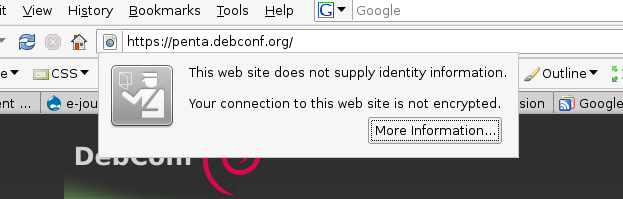
Oh, and I found another pretty little jewel: Go to any site which has a self-signed SSL certificate. Of course, Firefox will go to great lengths to make sure you understand how unsafe is it for you to trust anybody who didn't pay big bucks to Verisign... But this is enough reason for me to send a bug report:

I am connecting through a crypted HTTPS connection. The site is providing identity information - not certified, right, but it does provide something. And the connection is crypted. Firefox/Iceweasel 2 showed me the URL in a light-yellow background showing the connection was secure - Now it just denies penta.debconf.org the right to call itself secure.
(Yes, I am not an interface designer... But it seems neither are they)
[update]Bug filed. Any comments will be welcome in Bugzilla. The bug with the Debconf site (and I do regard it as a bug) is that Iceweasel displays that Your connection to this web site is not encrypted because some of the elements (i.e. the CSS, images..) are sent in the clear - Even though the real information is crypted. Ever heard of data/visualization decoupling?

Next.

Previous.