John Goerzen: 98.9% of Kansas may die next month
My subject line is a little over-dramatic, but only a little.
Like many states, Kansas is facing a severe budget problem. Last year, the state cut many programs to the bone and beyond. Nursing homes, schools, universities, and charities have all been hard-hit. A 10% cut in Medicaid reimbursement rates and similar cuts to education have been devastating. Institutions are wondering how they can survive.
Here s the thing: in rural communities, the very survival of the community is often dependent upon the survival of its schools, nursing home, hospital, or college. Take any one of those things away and the community begins a slow and painful death. This has happened over and over, and right now the Kansas legislature has a simple choice: Do they make a temporary 1% increase in sales tax, and also some increases in tobacco/alcohol taxes, or not?
If they do, they can get funding back to normal levels. If they do not, funding will be cut even further, which will certainly cripple many institutions.
There are a lot of people opposed to this tax. I m not one of them; I think it s key to the survival of our rural communities and the competitiveness of the state as a whole.
98.9% of Kansas is rural.
See the gravity of the situation?
Please, if you are a Kansas resident, write your representatives and leave a comment here saying you did (and what you wrote, if you like). The easiest way to find your state senator and representative is to go to a state website, then scroll down to information by county , click on your county, and then click on the districts to see a map if you need one. (The find by address feature seems to be hopelessly broken.)
Here s what I wrote:
Subject: Please raise my taxes
I write with a request I don t make lightly: please raise my taxes, and support the 1% sales tax increase with the 3-year sunset provision.
The consequences of failing to do so are terrible. Losing nursing homes or schools would mean the long-term death of many rural communities. Our community leaders are fearing not just for nursing homes being gone; there is a real threat of entire communities facing a slow extinction.
The 10% Medicaid cuts already made are having a devastating impact on many quality institutions, and if left in place for any length of time could result in quality organizations closing, or refusing to accept Medicaid. And even deeper cuts are being contemplated. Even for those that plan well and have long term care insurance would be harmed if the nursing homes they might contemplate living in one day have closed due to today s Medicare cuts.
I fear for our schools as well. Our two boys will be of school age
soon, and we live in a district that is of one of Kansas exceptionally strong rural schools. So far, our school is coping, but I am concerned about the drive to consolidate our rural schools, which would result in unreasonable travel distances and would be unlikely to duplicate the excellence of the schools we have now. I fear for our early childhood and university systems; without a good beginning in life, Kansas will face higher costs later. Without an affordable university system, Kansas will be less competitive. If small communities lose their schools, nursing homes, college students, or hospitals, some of them won t survive as towns. This hurts everyone in the state. When my wife and I moved from Indianapolis to rural Kansas in 2002, we, like many homebuyers, carefully studied the quality of schools and medical facilities available. If Kansas wants to be able to attract residents and the businesses that want a qualified labor pool, it must remain competitive. Forcing our best institutions to close a permanent problem over a short-term budget problem isn t going to help with that at all. It will hurt all of Kansas, rural and urban alike, if vast portions of our state become less attractive due to these problems. We likely would not have moved to the state at all if its rural communities were dead or dying. How many taxpaying Kansans will we lose if we let their communities suffer? Americans these days have plenty of choices where to live. I don t see many people choosing where to live based on a 1% difference in sales tax. I do see plenty of people making decisions based on quality of schools, hospitals, universities, roads, and even nursing homes. Please help save our rural communities and keep Kansas all of it competitive.
soon, and we live in a district that is of one of Kansas exceptionally strong rural schools. So far, our school is coping, but I am concerned about the drive to consolidate our rural schools, which would result in unreasonable travel distances and would be unlikely to duplicate the excellence of the schools we have now. I fear for our early childhood and university systems; without a good beginning in life, Kansas will face higher costs later. Without an affordable university system, Kansas will be less competitive. If small communities lose their schools, nursing homes, college students, or hospitals, some of them won t survive as towns. This hurts everyone in the state. When my wife and I moved from Indianapolis to rural Kansas in 2002, we, like many homebuyers, carefully studied the quality of schools and medical facilities available. If Kansas wants to be able to attract residents and the businesses that want a qualified labor pool, it must remain competitive. Forcing our best institutions to close a permanent problem over a short-term budget problem isn t going to help with that at all. It will hurt all of Kansas, rural and urban alike, if vast portions of our state become less attractive due to these problems. We likely would not have moved to the state at all if its rural communities were dead or dying. How many taxpaying Kansans will we lose if we let their communities suffer? Americans these days have plenty of choices where to live. I don t see many people choosing where to live based on a 1% difference in sales tax. I do see plenty of people making decisions based on quality of schools, hospitals, universities, roads, and even nursing homes. Please help save our rural communities and keep Kansas all of it competitive.
 This is the story of a weirdly unfriendly/non-compliant IMAP server, and some nice interactions that arose from a debugging session around it. Over the holidays, i got to do some computer/network debugging for friends and family. One old friend (I'll call him
 . As usual grab the video
 . Patents are GPL incompatible, but fine with BSD/MIT. The Tom Tom is the first direct attack using MS s patent portfolio. This undermines all the outreach work done by the MS Open Source team which Jeremy tells us are true believers in open source, trying to change MS from the inside. Look for MS pushing RAND patented standards: such things lock us out.
Netbooks are identified as a key point for MS to fight on lose that and the desktop position is massively weakened.
We should:


 Five out of six experts agree:

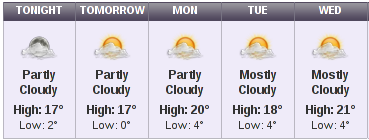 And while the difference appears to be small, what about Magdalena Contreras, ~200m higher, where many people dear to me live (and have even a window pending to be installed)?
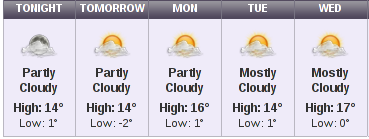 People say this cold wave is the strongest in 120 years, since records are being taken. Every year people get excited, expecting that this time we will get snow. This has only happened once in at least a century, in 1966 AFAIR. I do not think this year to be atypical.
Still, I have a reputation for being insensible to cold weather. Everybody wears heavy jackets while I still go to work with my usual long-sleeved shirt and that's it. But the last two days, I have been using jacket and scarf...
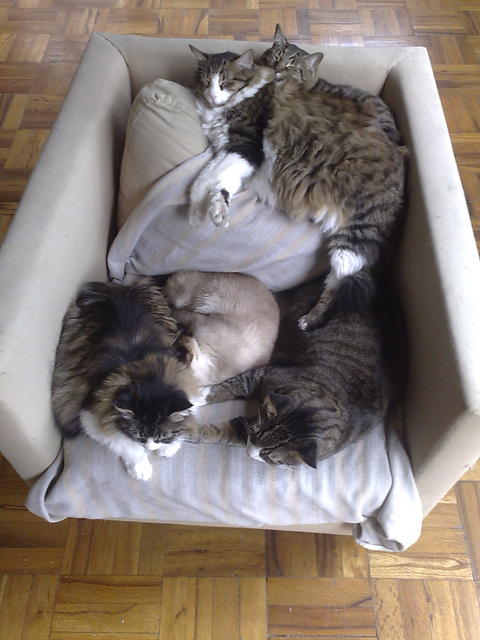
But, of course, I don't look as gratious or cute as my cats :-
 It's quite some time since I gave news about my running junkiness. So
here they are. Apparently, my last blog entry was about
 Some quotes are in for professional SMT assembly of TeleMetrum v0.2,
and I've had to reset my expectations. The shop I thought would be
my first choice came in with a quote much higher than I
expected. Another shop we've heard good things about gave us a much
more reasonable quote, but can't get any made before LCA. So...
This morning, I ordered some bare circuit boards and a paste stencil
from the places I used quite successfully for v0.1. With any luck,
they'll be in my hands in time to load a few boards before leaving
for
 On the train to my parents' house for Christmas I finished up a wild run
through the book
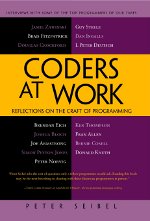 The book is a collection of interviews with 15 great programmers of our time,
starting with Jamie Zawinsky and ending with Donald Knuth. It's written in an
interview style each interview starts with a brief introduction to the
person being interviewed, summarizing what the person is known for and what he
or she has accomplished and a few of the highlights of the interview, and then
a transcript of the interview follows, with the author/editor, Peter Siebel,
will saying something or asking a question, and the interviewee responding. I
was skeptical about this format at first because I feel like it can be an easy
way out of good editing and make the reader have to do the work of the editor,
but on finishing I think that Siebel uses the format to his advantage in this
case.
For one, the speech format allows the reader to really form a picture of how
the person being interviewed speaks and would act in a conversation. Jamie is
somewhat bitter and pretty informal. Brad Fitzpatrick is flippant and
energetic, his speech littered with profanity and colloquialisms. Others seem
more stately and verbose Joe Armstrong's responses can go on for a page or
more. In this way, not only do readers learn something about what these greats
have learned about programming, but we also feel a bit more like we've met or
know them, and can connect to them more as people.
I always have this problem where I want to read computer books, but often
computer books seem inextricably tied to the computer, so there's this dynamic
of reading a bit and then wanting to get on a machine and try something out,
write some code, play around especially with books focused on a specific
language. Coders at Work retains some of this computer-book dynamic in that I
constantly encountered things that I want to investigate or play around with
more: Erlang, OCaml, various papers and essays, Knuth's literate programs, and
books such as Higher Order Perl and others. Siebel makes a point to ask each
person what her short-list of books and papers programmers should read are, so
this book is a great source of pointers to other reading material. Unlike a
more specific book, however, keeping a list in a notebook was enough to settle
the mind to read away-from-a-computer for chapters at a time.
It's obvious that despite the interview format, Siebel has done some serious
editing. None of the prose is boring to read, and I can't imagine that the text
is a straight transcript of how the interviews went. He also has arranged the
interviews in an order such that different interviews play off each other. In
Branden Eich's interview, for example, he disparages the book
Design Patterns:
 Over the summer, there was a bit of a tussle at the highest level of
Ubuntu governance over whether or not
 A customer called me a while back.
They have a pretty high-end NAS (2U server with external disk
enclosure) that they use for most of their needs: both document and
other storage for management types, as well as storage for their EDA
cluster. People familiar with EDA tools will know that they are pretty
disk intensive. They tend to require shitloads of diskspace, preferably
at high performance.
The problem was that extending the storage space of this high-end NAS
device is rather expensive. Supported disks only come at 300G units with
prices that are higher than the cheap TB disks available today for the
desktop market; and while the price and performance of those disks is
worth it for the EDA requirements, the number of people storing
documents and similar on the same device is not so high that performance
would be an issue.
Thus, what they wanted was a cheap solution to augment, rather than
replace, their current storage solution, with the focus being on low
cost at the possible expense of performance and, since bacula runs well
there, reliability.
They were quite surprised when I offered them a solution based around
a QNAP device; they had expected a price, without hard disks, of about
three to four times the price of the QNAP, and therefore were very happy
with this suggestion. Unfortunately, the devices produced by this
manufacturer that are supported by Lenny, the current Debian stable
release, were EOL'd just before we
placed the order; however, their replacements will be supported by
Squeeze, the next release, and with a bit of help from Martin Michlmayr,
we were able to install Lenny with a somewhat more recent kernel. This
drove the price up somewhat, both because the newer devices are a few
tens of euros more expensive, and because we agreed to pay Martin to
prioritize work on the specific device that we'd need, so that we
wouldn't have to wait for him to get around to it.
As of this Thursday, the device, which had finally arrived after some
initial delays, has been installed. Unfortunately, one of the disks that
they'd bought was DOA; but they had
the foresight to buy five, rather than four, disks, so that was not a
major problem. In fact, the only real issues that I ran into were this
one


 I have an imaginary automobile. It is the finest hybrid
of German and Japanese engineering. It has a peppy little
engine and a turning radius so small it would make a baby
camel cry, and a six-speed manual transmission, and it is
powered by the urine of vegan bears.
My imaginary father asked me why I would possibly want to
buy an imaginary car with a manual transmission. Obviously,
whichever marketing campaign brainwashed him in the first
place wasn't strong enough on the memetics, because after
borrowing my imaginary car, he shut the hell up. You see,
it's considerably more fun to drive than an automatic.
There are other benefits as well, of course. The primary
one is that the transmission does what I want.
An automatic transmission is configured for maximum comfort ,
so it wastes a lot of power when shifting. With a manual,
you can slip from gear to gear with minimal clutch time, or
in some cases, if you're feeling sassy, without using the
clutch at all. You can control your engine speed so that
your shift will be just as smooth as an automatic without
the egregiously long clutch disengagement or shift overlap.
You also can see the road in front of you, so you're always
going to be smarter than an automatic transmission, unless
you don't understand how slopes work or what collisions with
other cars mean to your well-being.
Now some NRA member is going to point out that you can get
a shift kit and tweak your automatic to be less awful.
While spending money on this type of thing sounds like
a great idea, a shift kit is not going to bring an
automatic into the same league as my car. I can still
start the car when the battery's dead. I can get higher
fuel efficiency (vegan bears don't exactly urinate for
free). I can shift into fifth gear, and coming from a
full stop, drive up a hill without stalling (this is
particularly useful when a squirrel has gnawed the teeth
off of all your other gears). Furthermore, shift kit
or not, an automatic is absolutely no fun.
Someday, when transmissions have advanced into the realm
of liquid hyperspace buckminsterfullerene cones that
commune with the unicorns, and they'll have cameras and
radar feeding the car's computer with useful information
about its surroundings so it can make intelligent shift
decisions faster than a human. Then I'll have to choose
between saner and more fun. That era has not yet arrived.
This is a lousy metaphor for debhelper.
