Search Results: "eric"

24 February 2013

Gunnar Wolf: International Open Data Day - #OpenData / #DatosAbiertos

I just got this message through my University, and the least I can do (given I'm still, although barely, in time) is to repost it here, hoping it helps to spread the activity we have on this regard in Latin America:
Saturday, February 23 is the International Day of Open Data. Following its policy of promoting free, open and unrestricted access to the results of research funded with public money, CLACSO calls research centers and individual researchers to free their public data so they are available for other researchers and, most importantly, for the community as a whole. That's the reason CLACSO invites researchers and institutions to announce in social networks, mentioning "#DatosAbiertos #OpenData", which are their freed public documents, pointing to the web pages where they can be found. The International Open Data Day is an effort to:
  • Spread the concept of Open Data
  • Debate on the why of Open Data
  • Publish analysis done using open public data
  • Find out how more local and national (not reserved) open data can be published (i.e. Brazil)
  • Call towards using open data in research
  • Find which applications have been developed to handle and visualize open data
  • Organize events for the International Open Data Day (i.e. Monterrey
  • Call towards adding data catalogs in Latin America and the Caribbeanin the Data catalogs directory, in Datacatalogs.org, and in Open data census.
For further information on how to spread research and/or archives in digital repositories and in the CLACSO Digital Repository, please mail biblioteca@clacso.edu.ar We can between all contribute for the Latin American and Caribbean open data community to grow, democratizing access to public data about our societies.
So, what do I consider worthy of adding to a list of resources I can point to?

23 February 2013

Dirk Eddelbuettel: Two papers about RcppEigen and RcppArmadillo published

Two papers got published recently. The first one is Bates and Eddelbuettel (2013). It is titled Fast and Elegant Numerical Linear Algebra Using the RcppEigen Package, and provides a pretty thorough introduction to our RcppEigen package which uses Rcpp to provide access to the Eigen C++ template library from GNU R. The paper is out as Volume 50, Issue 5 at the (all electronic, open, and generally awesome) Journal of Statistical Software. A bibtex entry is available. The second paper is Eddelbuettel and Sanderson (2013). This one is titled RcppArmadillo: Accelerating R with high-performance C++ linear algebra and introduces the RcppArmadillo package which brings Conrad Sanderson's Armadillo C++ template library to GNU R by deploying Rcpp. The paper is currently "in press" at Computational Statistics & Data Analysis but the DOI 10.1016/j.csda.2013.02.005 will remain once a volume and issue is assigned by CSDA. Preprints of both papers are available via my papers page, and as vignettes in the corresponding packages. The upcoming Rcpp class in New York will feature Rcpp, RcppArmadillo and RcppEigen. Space is still available.

22 February 2013

Richard Hartmann: Finland I

Finland. Helsinki, Lahti, streets Arriving at Helsinki airport, we filed a claim with Lufthansa as a hard shell suitcase had a splintered corner. We were surprised that so many Finns arrived from Munich with skis, more on that later. We picked up our car and started on our way towards Koli; driving with a top speed of 100 km/h and often being limited to 80 km/h or even 60 km/h is... unusual... Finnish police/authorities seem to be obsessed with enforcing those speed limits as there are a lot of speed cameras along the way. Finnish people seem to be similarly obsessed with slot machines; there is an incredible amount of them at gas stations and a constant stream of people playing them. From an outsider's perspective, it's weird that a country as strict about one form of addiction, alcohol, and working against it vigorously, by means of taxes, would allow another form of addiction, gambling, run as freely and this allow so many slot machines. Speaking of taxes on alcohol: a single 0.33 l bottle of beer is more expensive in a Finnish supermarket than 0.5 l of beer in a German restaurant. Which also explains why supermarkets tend to have a rather large section with relatively cheap alcohol free beer. Anyway, coming back to streets: Highway intersections don't have continuous on/off ramps from which you change from one highway to another; you drive off of the highway, stop at a traffic light, and then continue onto the other highway. Weird system, but given the amount of traffic we witnessed, it's probably Good Enough (tm). Stopping for a short time in Lohti simply because it's apparently famous for winter sports competitions, we arrived at Future Freetime in Koli national park after about five to six gruelling hours of net driving through somewhat bad weather and behind slow drivers. Koli Hiking up to Ukko-Koli and its sister peaks proved to be rather exhausting as we kept on breaking through the snow cover to our knees and sometimes even our hips. Once we were up there, we realized that even though you couldn't see it in between the trees, there was fog all over the plains so we couldn't see anything. Still, it was a nice hike even if somewhat short. Note to self: Even when a trail is marked locally, if OpenStreetMap does not know about it... don't walk along it. Especially not when the going's rough already. And if there's a sign suggesting you wear snow shoes... wear snow shoes. Returning to Koli Hotel and the museum next to it, we walked over to the ski slope. The highest peak within Koli,Ukko-Koli, is 347 meters high, the local ski slope starts a good way below that. This would explain why a lot of Finns came back from Munich with their skis... Afterwards, we rented a snow mobile, without guide or supervision, and drove from Loma-Koli over lake Pielien towards Purnuniemi and in a large circle down towards lake Ryyn skyl where we turned around and went back the same way. If we thought Finnish streets don't have a lot of signs we soon realized that snow mobile tracks have even less. There are at most two or three signs pointing you in the right direction, but on the plus side, there are no posted speed limits for snow mobiles, either. In somewhat related news, snow mobiles can go at least 95 km/h. At that point, the scratched and dirty visor of your rental helmet will keep slamming down, forcing you to take one hand off the handle and thus stop accelerating to maintain stability. To round off the day, we heated up the sauna built into our little wooden hut. Running outside three times to rub myself off with snow from head to toes, I almost slipped and fell while standing still. When your feet are too hot for the snowy ground, you'll start to melt your own little pools of slippery water/snow mush within seconds. File that one under "I would never have guessed unless I had experienced it myself". Generic The MarkDown source of this blog post is not even 5 kiB in size; even in a worst case scenario, pushing this to my ikiwiki instance via git will eat up less 10 kiB of mobile data. Which is good because I have 78 MiB of international data left on this plan. This is also the reason why there are no links in this blog post: I am writing everything off line and don't want to search for the correct URLs to link to. I really wish EU regulators would start to tackle data roaming now that SMS and voice calls are being forced down into somewhat sane pricing regions by regulations. PS:
-rw-r--r-- 1 richih richih 4.6K Feb 11 22:55 11-Finland-I.mdwn
[...]
Writing objects: 100% (7/7), 2.79 KiB, done.

21 February 2013

Daniel Pocock: US military may need Lumicall

In a remarkable report in Wired Magazine, it has been revealed that US stealth bombers have to communicate with their British allies using conventional radio. What that means in practice is that it would be child's play for the enemy to use basic techniques like triangulation to locate these otherwise invisible aircraft. While the thought of an ineffective multi-billion-dollar stealth bomber program seems preposterous, some may argue that the military has bigger problems maintaining discretion when even the CIA director is busted having an affair via Gmail. After all, it costs nothing to download GnuPG So what could the Americans and British do to put the stealth back into stealth bomber? Maybe it is time that pilots were issued with smartphones running Lumicall - with the built-in encryption features, could it make all their worries go away? At the very least, this issue demonstrates in a remarkable manner the reasons to stick with open standards like XMPP and SIP for building interoperable communications systems. If they missed our talk on Free, open, secure and convenient communications at FOSDEM, that may also be an interesting place to start searching for answers, as the idea of federated real-time communications is just as valuable in the air as it is for business or private purposes on the ground. The video is available now for those who missed it, and my earlier FOSDEM wrap-up provides more food for thought about the relevance of private communications for maintaining individual freedom (with or without the help of airborne supremecy). FOSDEM video: <video controls="controls" preload="none">
<source src="http://video.fosdem.org/2013/maintracks/Janson/Free,_open,_secure_and_convenient_communications.webm" type="video/webm; codecs="vp8, vorbis""></source></video> <object data="http://releases.flowplayer.org/swf/flowplayer-3.2.15.swf" type="application/x-shockwave-flash"> <param name="movie" value="http://releases.flowplayer.org/swf/flowplayer-3.2.15.swf"><param name="allowfullscreen" value="true"><param name="flashvars" value="config= 'clip': 'url': 'http://video.fosdem.org/2013/maintracks/Janson/Free,_open,_secure_and_convenient_communications.webm', 'autoPlay':false, 'autoBuffering':false ">Video tag not supported. Download the video here. </object>

20 February 2013

Daniel Pocock: Automatically mirroring SVN repositories to git and github

Updated 21 February 2013: the scripts below have now been adapted to run conveniently from cron and mirror multiple repositories. You can find full scripts and documentation on github There are a number of scripts around, including an earlier blog post of my own, for making a once-off conversion of an SVN repository to a Git repository. However, what if the project team is not yet ready for a full move to git? You may want to start benefiting from git (e.g. using the project as a submodule of another git project, or using Travis-CI.org for automated builds) while development officially continues to take place in SVN. If you don't need to make commits into git just now, you can set up a mirror and refresh it periodically from SVN. This process can be used with various SVN repositories, including Sourceforge and Google Code SVN repositories. Process overview
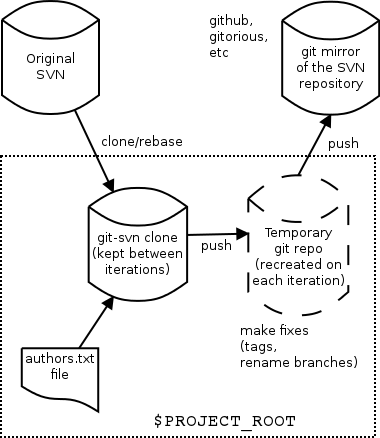
  • An authors.txt file is created manually before the first run.
  • A git-svn clone of the SVN repository is created. This clone needs to be retained between replication runs.
  • On each run, a temporary git repository is created. The svn-clone is rebased and pushed to the fresh git repository.
  • Fixes (e.g. branch renames and tagging) are made in the temporary git repository.
  • The final results are then pushed from the temporary repository to the real git mirror that is being maintained.
  • Finally, the temporary git repository is deleted, but the svn-clone is kept.
Here is a diagram of the workflow: Config file Here is a sample config file for the script, it mirrors the rather complicated reSIProcate repository with 10,000 commits:
PROJECT_ROOT=/home/daniel/svn-mirror/resiprocate
AUTHORS_FILE=$ PROJECT_ROOT /authors.txt
SVN_REPO=https://svn.resiprocate.org/rep/resiprocate
SVN_LAYOUT="--trunk=main --branches=branches --tags=tags"
GIT_REPO=git@github.com:resiprocate/resiprocate.git
Of particular note here:
  • The $PROJECT_ROOT is where the svn-clone and the temporary repositories will be created
  • $GIT_REPO is the final destination repository. For testing, it could just be a local directory initialised with git init --bare .
  • In this repository, our trunk is actually called main, hence we have the layout argument --trunk=main. Many projects would just use --trunk=trunk
The script The script itself is below. I'd suggest running it manually a few times first and observing how it behaves, disk space requirements, etc.
#!/bin/bash
set -e
if [ ! $# -eq 1 ];
then
  echo "Usage:"
  echo "$0 <config-file>"
  exit 1
fi
CONFIG_FILE="$1"
. "$ CONFIG_FILE "   exit 1
SVN_CLONE="$ PROJECT_ROOT /svn-clone"
GIT_BARE="$ PROJECT_ROOT /git-bare-tmp"
if [ ! -d "$ PROJECT_ROOT " ];
then
  mkdir -p "$ PROJECT_ROOT "
fi
cd "$ PROJECT_ROOT "
if [ ! -d "$ SVN_CLONE " ];
then
  git svn clone \
    "$ SVN_REPO " \
    -A "$ AUTHORS_FILE " \
    $ SVN_LAYOUT  \
    "$ SVN_CLONE "
  cd "$ SVN_CLONE "
else
  cd "$ SVN_CLONE "
  git remote rm bare   echo "failed to delete remote:bare, proceeding anyway"
  git svn rebase \
    --fetch-all \
    -A "$ AUTHORS_FILE "
fi
git remote add bare "$ GIT_BARE "
git config remote.bare.push 'refs/remotes/*:refs/heads/*'
if [ -d "$ GIT_BARE " ];
then
  rm -rf "$ GIT_BARE "
fi
mkdir -p "$ GIT_BARE "
cd "$ GIT_BARE "
git init --bare .
git symbolic-ref HEAD refs/heads/trunk
cd "$ SVN_CLONE "
git push bare
cd "$ GIT_BARE "
git branch -m trunk master
git for-each-ref --format='%(refname)' refs/heads/tags   \
   cut -d / -f 4   \
   while read ref;
   do
      git tag "$ref" "refs/heads/tags/$ref"
      git branch -D "tags/$ref"
   done
git remote add origin "$ GIT_REPO "
git config branch.master.remote origin
git config branch.master.merge refs/heads/master
git push --tags origin master
git push --all
rm -rf "$ GIT_BARE "
</config-file>
AttachmentSize
svn-mirror.png32.65 KB

Daniel Pocock: Automatically mirroring SVN repositories to git and github

Updated 21 February 2013: the scripts below have now been adapted to run conveniently from cron and mirror multiple repositories. You can find full scripts and documentation on github There are a number of scripts around, including an earlier blog post of my own, for making a once-off conversion of an SVN repository to a Git repository. However, what if the project team is not yet ready for a full move to git? You may want to start benefiting from git (e.g. using the project as a submodule of another git project, or using Travis-CI.org for automated builds) while development officially continues to take place in SVN. If you don't need to make commits into git just now, you can set up a mirror and refresh it periodically from SVN. This process can be used with various SVN repositories, including Sourceforge and Google Code SVN repositories. Process overview
  • An authors.txt file is created manually before the first run - see my other blog entry for convenient scripts to help generate authors.txt
  • A git-svn clone of the SVN repository is created. This clone needs to be retained between replication runs.
  • On each run, a temporary git repository is created. The svn-clone is rebased and pushed to the fresh git repository.
  • Fixes (e.g. branch renames and tagging) are made in the temporary git repository.
  • The final results are then pushed from the temporary repository to the real git mirror that is being maintained.
  • Finally, the temporary git repository is deleted, but the svn-clone is kept.
Here is a diagram of the workflow: Config file Here is a sample config file for the script, it mirrors the rather complicated reSIProcate repository with 10,000 commits:
PROJECT_ROOT=/home/daniel/svn-mirror/resiprocate
AUTHORS_FILE=$ PROJECT_ROOT /authors.txt
SVN_REPO=https://svn.resiprocate.org/rep/resiprocate
SVN_LAYOUT="--trunk=main --branches=branches --tags=tags"
GIT_REPO=git@github.com:resiprocate/resiprocate.git
Of particular note here:
  • The $PROJECT_ROOT is where the svn-clone and the temporary repositories will be created
  • $GIT_REPO is the final destination repository. For testing, it could just be a local directory initialised with git init --bare .
  • In this repository, our trunk is actually called main, hence we have the layout argument --trunk=main. Many projects would just use --trunk=trunk
The script The script itself is below. I'd suggest running it manually a few times first and observing how it behaves, disk space requirements, etc.
#!/bin/bash
set -e
if [ ! $# -eq 1 ];
then
  echo "Usage:"
  echo "$0 <config-file>"
  exit 1
fi
CONFIG_FILE="$1"
. "$ CONFIG_FILE "   exit 1
SVN_CLONE="$ PROJECT_ROOT /svn-clone"
GIT_BARE="$ PROJECT_ROOT /git-bare-tmp"
if [ ! -d "$ PROJECT_ROOT " ];
then
  mkdir -p "$ PROJECT_ROOT "
fi
cd "$ PROJECT_ROOT "
if [ ! -d "$ SVN_CLONE " ];
then
  git svn clone \
    "$ SVN_REPO " \
    -A "$ AUTHORS_FILE " \
    $ SVN_LAYOUT  \
    "$ SVN_CLONE "
  cd "$ SVN_CLONE "
else
  cd "$ SVN_CLONE "
  git remote rm bare   echo "failed to delete remote:bare, proceeding anyway"
  git svn rebase \
    --fetch-all \
    -A "$ AUTHORS_FILE "
fi
git remote add bare "$ GIT_BARE "
git config remote.bare.push 'refs/remotes/*:refs/heads/*'
if [ -d "$ GIT_BARE " ];
then
  rm -rf "$ GIT_BARE "
fi
mkdir -p "$ GIT_BARE "
cd "$ GIT_BARE "
git init --bare .
git symbolic-ref HEAD refs/heads/trunk
cd "$ SVN_CLONE "
git push bare
cd "$ GIT_BARE "
git branch -m trunk master
git for-each-ref --format='%(refname)' refs/heads/tags   \
   cut -d / -f 4   \
   while read ref;
   do
      git tag "$ref" "refs/heads/tags/$ref"
      git branch -D "tags/$ref"
   done
git remote add origin "$ GIT_REPO "
git config branch.master.remote origin
git config branch.master.merge refs/heads/master
git push --tags origin master
git push --all
rm -rf "$ GIT_BARE "
</config-file>
AttachmentSize
svn-mirror.png32.65 KB

Keith Packard: DRI3000

DRI3000 Even Better Direct Rendering This all started with the presentation that Eric Anholt and I did at the 2012 X developers conference, and subsequently wrote about in my DRI-Next posting. That discussion sketched out the goals of changing the existing DRI2-based direct rendering infrastructure. Last month, I gave a more detailed presentation at Linux.conf.au 2013 (the best free software conference in the world). That presentation was recorded, so you can watch it online. Or, you can read Nathan Willis summary at lwn.net. That presentation contained a lot more details about the specific techniques that will be used to implement the new system, in particular it included some initial indications of what kind of performance benefits the overall system might be able to produce. I sat down today and wrote down an initial protocol definition for two new extensions (because two extensions are always better than one). Together, these are designed to provide complete support for direct rendering APIs like OpenGL and offer a better alternative to DRI2. The DRI3 extension Dave Airlie and Eric Anholt refused to let me call either actual extension DRI3000, so the new direct rendering extension is called DRI3. It uses POSIX file descriptor passing to share kernel objects between the X server and the application. DRI3 is a very small extension in three requests:
  1. Open. Returns a file descriptor for a direct rendering device along with the name of the driver for a particular API (OpenGL, Video, etc).
  2. PixmapFromBuffer. Takes a kernel buffer object (Linux uses DMA-BUF) and creates a pixmap that references it. Any place a Pixmap can be used in the X protocol, you can now talk about a DMA-BUF object. This allows an application to do direct rendering, and then pass a reference to those results directly to the X server.
  3. BufferFromPixmap. This takes an existing pixmap and returns a file descriptor for the underlying kernel buffer object. This is needed for the GL Texture from Pixmap extension.
For OpenGL, the plan is to create all of the buffer objects on the client side, then pass the back buffer to the X server for display on the screen. By creating pixmaps, we avoid needing new object types in the X server and can use existing X apis that take pixmaps for these objects. The Swap extension Once you ve got direct rendered content in a Pixmap, you ll want to display it on the screen. You could simply use CopyArea from the pixmap to a window, but that isn t synchronzied to the vertical retrace signal. And, the semantics of the CopyArea operation precludes us from swapping the underlying buffers around, making it more expensive than strictly necessary. The Swap extension fills those needs. Because the DRI3 extension provides an X pixmap reference to the direct rendered content, the Swap extension doesn t need any new object types for its operation. Instead, it talks strictly about core X objects, using X pixmaps as the source of the new data and X drawables as the destination. The core of the Swap extension is one request SwapRegion. This request moves pixels from a pixmap to a drawable. It uses an X fixes Region object to specify the area of the destination being painted, and an offset within the source pixmap to align the two areas. A bunch of data are included in the reply from the SwapRegion request. First, you get a 64-bit sequence number identifying the swap itself. Then, you get a suggested geometry for the next source pixmap. Using the suggested geometry may result in performance improvements from the techniques described in the LCA talk above. The last bit of data included in the SwapRegion reply is a list of pixmaps which were used as source operands to earlier SwapRegion requests to the same drawable. Each pixmap is listed along with the 64-bit sequence number associated with an earlier SwapRegion operation which resulted in the contents which the pixmap now contains. Ok, so that sounds really confusing. Some examples are probably necessary. I m hoping you ll be able to tell that in both cases, the idle swap count tries to name the swap sequence at which time the destination drawable contained the contents currently in the pixmap. Note that even if the SwapRegion is implemented as a Copy operation, the provided source pixmap may not be included in the idle list as the copy may be delayed to meet the synchronization requirements specfied by the client. Finally, if you want to throttle rendering based upon when frames appear on the screen, Swap offers an event that can be delivered to the drawable after the operation actually takes place. Because the Swap extension needs to supply all of the OpenGL SwapBuffers semantics (including a multiplicity of OpenGL extensions related to that), I ve stolen a handful of DRI2 requests to provide the necessary bits for that:
  1. SwapGetMSC
  2. SwapWaitMSC
  3. SwapWaitSBC
These work just like the DRI2 requests of the same names. Current State of the Extensions Both of these extensions have an initial protocol specification written down and stored in git:
  1. DRI3 protocol
  2. Swap protocol

19 February 2013

Mike Hommey: Ten years

Ten years ago, this very day, my first Debian package entered the Debian unstable repository. It was an addon for Mozilla Composer, Daniel Glazman s Cascades. On the same day, my second Debian package entered the Debian unstable repository as well. It was an addon for Mozilla Browser, Checky. A few days later, my third Debian package entered Debian unstable. It was an addon for Mozilla Browser, Diggler. Do you see a pattern? They are now abandoned software, although I made Checky and Diggler live a little longer (and I m actually considering reviving Diggler) but they had their importance in my journey, and are part of the reason why I am where I am now. My journey on the web started with NCSA Mosaic on VAX/VMS, then continued with Netscape Navigator, Netscape Communicator and Mozilla Suite on Linux. That s where I was ten years ago, sailing between Galeon (a browser using the Mozilla engine) and Mozilla Suite, and filing some layout bugs. Ten years ago, there was a new kid on the block. It used to be called Phoenix, it had just changed its name to Firebird. Eventually, it changed again for Firefox. You may have heard about it. Because Firebird was so much nicer than the browser in the Mozilla Suite, I started using its Debian package, and wanted my packaged addons to work with it. So I contacted Eric Dorland, Phoenix/Firebird package maintainer at the time, and got the addons working. I then ended up fixing a bunch of packaging issues. This is how I got involved in Firefox packaging for Debian, and what eventually led me to work for Mozilla.

18 February 2013

Dirk Eddelbuettel: RQuantLib 0.3.10

A new minor release RQuantLib 0.3.10 is now on CRAN and in Debian. RQuantLib combines (some of) the quantitative analytics of QuantLib with the R statistical computing environment and language. The discount curve building code in QuantLib has shown some overly large numerical instabilities. We have used the same example parameters (taken from the Swap example in QuantLib) for years; it currently fails to solve for a rate at some term further out the curve. So I made the decistion to disable this just in the examples in order to not upset the CRAN testing framework. The examples now use a flat curve instead. I also updated one function to silence some new warnings from R-devel about symbols from another packages's namespace (in this case rgl, and it is just for surface plots, a purely cosmetic function). Thanks to CRANberries, there is also a diff to the previous release 0.3.9. Full changelog details, examples and more details about this package are at my RQuantLib page.

16 February 2013

Daniel Pocock: Adapting the Swisscom Piccolo (Motorola 7640-47) Router for bridging and other ISPs

Background The Piccolo is actually quite a powerful router. Unfortunately, Swisscom has crippled it, removing fundamental configuration options from the web management interface, and even worse, breaking some of the (undocumented) command line configuration options. At a bare minimum, the router can be turned into a bridge/modem, enabling more powerful functionality to be implemented using a wifi router with OpenWRT or a similar solution. Documentation for the Motorola generic version of this device provides some helpful clues about the configuration and may be a useful resource for anybody adapting it. The undocumented telnet interface The username and password for the web interface also allow telnet access to administer the router. The telnet interface actually has quite a lot of features, many more than the web interface. The normal username is admin. If the admin password is not known it can be reset to 1234 using the factory reset button on the back of the router.
$ telnet 192.168.1.1
Trying 192.168.1.1...
Connected to 192.168.1.1.
Escape character is '^]'.
login: admin
Password: (default 1234)
Terminal shell v1.0
Copyright (C) 2011 Motorola, Inc. All rights reserved.
Motorola Netopia Model 7640-47 Annex A VDSL2 IAD
Running Netopia SOC OS version 9.0.10 (build h2d8)
ADSL/VDSL capable
(admin completed login: Admin account with read/write access.)
Removing the Swisscom backdoor The first step for any Piccolo owner is to remove the backdoor from Swisscom. Swisscom links the routers to a management platform that allows them to change configuration remotely, or even push out firmware updates. Allowing an external party such as your ISP to push updates to your router is a major risk. Just imagine if Swisscom decides to update firmware while you are making an online purchase or checking in to a flight - your router reboots itself and your transaction is hosed. Let's have a look at the default configuration of the router, notice these cwmp settings:
Centro_piccolo> show conf
.
.
.
set management cwmp enable on
set management cwmp acs-url "https://rms.bluewin.ch/cwmpWeb/WGCPEMgt"
set management cwmp acs-username "bluewincustomer"
set management cwmp acs-password "***************"
.
.
.
If you didn't already know that was there, you might be quite unpleasantly surprised right now. Removing it is easy:
Centro_piccolo> conf
Config Mode v1.3
Centro_piccolo (top)>> management
Centro_piccolo (management)>> cwmp enable
Centro_piccolo (management cwmp enable)>> set
      enable (on) [ off   on ]: off
Centro_piccolo (management cwmp enable)>> up
Centro_piccolo (management cwmp)>> up
Centro_piccolo (management)>> up
Centro_piccolo (top)>> save
Configuration data saved.
Centro_piccolo (top)>> exit
Notice that after you make a change, you must type the save command to persist the change. Disable the Piccolo's DHCP server If using a more powerful router (e.g. a TP-Link or Buffalo running OpenWRT) then the DHCP server in the Piccolo is not needed. Furthermore, if bridging from a provider that uses the DHCP (as opposed to PPPoE) mechanism to give you your real-world IP address, then the Piccolo's DHCP server will answer the DHCP requests from your other router, and it will never get the proper IP address from the ISP. This scenario must be avoided by disabling the DHCP server in the Piccolo.
Centro_piccolo (top)>> conn name LAN
Centro_piccolo (conn name "LAN")>> dhcp-server-enable
Centro_piccolo (conn name "LAN" dhcp-server-enable)>> set off
Centro_piccolo (conn name "LAN" dhcp-server-enable)>> save
Now, when you want to administer the Piccolo, you need to manually configure an IP address (e.g. 192.168.1.2/24) on the PC that is connecting to the Piccolo. Putting the router into bridge mode When I purchased the router, I was using it with Swisscom. Their own network operates ethernet over ATM and the router obtains an IP address using DHCP. I subsequently changed my ISP to Init7, an independent ISP. Init7, like most third-party ISPs in Switzerland, uses PPPoE rather than the bridged mode. For either mode of operation, the router can bridge the DHCP or PPPoE packets to a more flexible router, such as a TP Link WR-1043ND running OpenWRT or even a Linux server. In the normal configuration, I discovered two bridges in the router:
Centro_piccolo> show bridge interfaces
Bridge interfaces:
bridge name     bridge id               STP enabled     interfaces
br1             8000.0024c94dfcf0       no              eth0.16
                                                        eth1.16
br2             8000.0024c94dfcf1       no              ptm0
                                                        atm1
Clearly, bridging is possible. The Motorola/Netopia manuals refer to various bridge configuration options that just don't seem to exist on this unit. Nonetheless, it is possible to join those two bridges into one:
Centro_piccolo> conf
Config Mode v1.3
Centro_piccolo (top)>> link name LAN
Centro_piccolo (link name "LAN")>> port-vlan
Centro_piccolo (link name "LAN" port-vlan)>> ports
Centro_piccolo (link name "LAN" port-vlan ports)>> set
        ports ("lan-1 lan-2") [ lan-1, lan-2, ptm, vc-1 ]: "lan-1 lan-2 ptm vc-1"
Centro_piccolo (link name "LAN" port-vlan ports)>> up
Centro_piccolo (link name "LAN" port-vlan)>> up
Centro_piccolo (link name "LAN")>> up
Centro_piccolo (link)>> name WAN
Centro_piccolo (link name "WAN")>> port
Centro_piccolo (link name "WAN" port-vlan)>> view
      port-vlan
        ports "ptm vc-1"
        priority 0
Centro_piccolo (link name "WAN" port-vlan)>> ports
Centro_piccolo (link name "WAN" port-vlan ports)>> set
        ports ("ptm vc-1") [ lan-1, lan-2, ptm, vc-1 ]: ""
Centro_piccolo (link name "WAN" port-vlan ports)>> view
        ports ""
Centro_piccolo (link name "WAN" port-vlan ports)>> up
Centro_piccolo (link name "WAN" port-vlan)>> up
Centro_piccolo (link name "WAN")>> up
Centro_piccolo (link)>> save
Configuration data saved.
Centro_piccolo (conn name "WAN" link-oid)>> exit
and now let's check the results:
Centro_piccolo> show bridge interfaces
 Bridge interfaces:
bridge name     bridge id               STP enabled     interfaces
br1             8000.0024c94dfcf0       no              eth0.16
                                                        eth1.16
                                                        ptm0
                                                        atm1
Any WAN connection parameters (PPPoE or DHCP) should now be ignored by the router, and it should just be bridging PPPoE or DHCP traffic from the ISP to the other router. The Piccolo is now behaving like a modem/bridge.

14 February 2013

Russell Coker: Conversion of Video Files

To convert video files between formats I use Makefiles, this means I can run make -j2 on my dual-core server to get both cores going at once. avconv uses 8 threads for it s computation and I ve seen it take up to 190% CPU time for brief periods of time, but overall it seems to average a lot less, if nothing else then running two copies at once allows one to calculate while the other is waiting for disk IO. Here is a basic Makefile to generate a subdirectory full of mp4 files from a directory full of flv files. I used to use this to convert my Youtube music archive for my Android devices until I installed MX Player which can play every type of video file you can imagine [1]. I ll probably encounter some situation where this script becomes necessary again so I keep it around. It s also a very simple example of how to run a batch conversion of video files. MP4S:=$(shell for n in *.flv ; do echo $$n sed -e s/^/mp4\\// -e s/flv$$/mp4/ ; done)

all: $(MP4S)

mp4/%.mp4: %.flv
avconv -i $< -strict experimental -b $$(~/bin/video-encoding-rate $<) $@ > /dev/null Here is a more complex Makefile. I use it on my directory of big videos (more than 1280*720 resolution) and scales them down for my favorite Android devices (Samsung Galaxy S3, Samsung Galaxy S, and Sony Ericsson Xperia X10). My Galaxy S3 can t play a FullHD version of Gangnam Style without going slow so I need to do this even for the fastest phones. This makefile generates three subdirectories of mp4 files for the three devices. S3MP4S:=$(shell for n in *.mp4 ; do echo $$n sed -e s/^/s3\\// -e s/.mp4$$/-s3.mp4/ -e s/.flv$$/-s3.mp4/; done)
XPERIAMP4S:=$(shell for n in *.mp4 ; do echo $$n sed -e s/^/xperiax10\\// -e s/.mp4$$/-xperiax10.mp4/ -e s/.flv$$/-xperiax10.mp4/; done)
SMP4S:=$(shell for n in *.mp4 ; do echo $$n sed -e s/^/galaxys\\// -e s/.mp4$$/-galaxys.mp4/ -e s/.flv$$/-galaxys.mp4/; done)

all: $(S3MP4S) $(XPERIAMP4S) $(SMP4S)

s3/%-s3.mp4: %.mp4
avconv -i $< -strict experimental -s $(shell ~/bin/video-scale-resolution 1280 720 $<) $@ > /dev/null

galaxys/%-galaxys.mp4: %.mp4
echo avconv -i $< -strict experimental -s $(shell ~/bin/video-scale-resolution 800 480 $<) $@ > /dev/null

xperiax10/%-xperiax10.mp4: %.mp4
echo avconv -i $< -strict experimental -s $(shell ~/bin/video-scale-resolution 854 480 $<) $@ > /dev/null The following script is used by the above Makefile to determine the resolution to use. Some Youtube videos have unusual combinations of width and height (Linkin Park seems to like doing this) so I scale them down so it fits the phone in one dimension and the other dimension is scaled appropriately. This requires a script from the Mplayer package and expects it to be in the location that it s used in the Debian package, for distributions other than Debian a minor change will be required. #!/bin/bash
set -e
OUT_VIDEO_WIDTH=$1
OUT_VIDEO_HEIGHT=$2

eval $(/usr/share/mplayer/midentify.sh $3)
XMULT=$(echo $ID_VIDEO_WIDTH*100/$OUT_VIDEO_WIDTH bc)
YMULT=$(echo $ID_VIDEO_HEIGHT*100/$OUT_VIDEO_HEIGHT bc)
if [ $XMULT -gt $YMULT ]; then
NEWX=$OUT_VIDEO_WIDTH
NEWY=$(echo $OUT_VIDEO_WIDTH*$ID_VIDEO_HEIGHT/$ID_VIDEO_WIDTH/2*2 bc)
else
NEWX=$(echo $OUT_VIDEO_HEIGHT*$ID_VIDEO_WIDTH/$ID_VIDEO_HEIGHT/2*2 bc)
NEWY=$OUT_VIDEO_HEIGHT
fi
echo $ NEWX x$ NEWY Note that I can t preserve TAB characters in a blog post. So those Makefiles won t work until you replace strings of 8 spaces with a TAB character.

12 February 2013

Martin Pitt: umockdev: record and mock hardware for debugging and testing

What is this? umockdev is a set of tools and a library to mock hardware devices for programs that handle Linux hardware devices. It also provides tools to record the properties and behaviour of particular devices, and to run a program or test suite under a test bed with the previously recorded devices loaded. This allows developers of software like gphoto or libmtp to receive these records in bug reports and recreate the problem on their system without having access to the affected hardware, as well as writing regression tests for those that do not need any particular privileges and thus are capable of running in standard make check. After working on it for several weeks and lots of rumbling on G+, it s now useful and documented enough for the first release 0.1! Component overview umockdev consists of the following parts: Example: Record and replay PtP/MTP USB devices So how do you use umockdev? For the debug a problem use case you usually don t want to write a program that uses libumockdev, but just use the command line tools. Let s capture some runs from libmtp tools, and replay them in a mock environment: Example: using the library to fake a battery If you want to write regression tests, it s usually more flexible to use the library instead of calling everything through umockdev-run. As a simple example, let s pretend we want to write tests for upower. Batteries, and power supplies in general, are simple devices in the sense that userspace programs such as upower only communicate with them through sysfs and uevents. No /dev nor ioctls are necessary. docs/examples/ has two example programs how to use libumockdev to create a fake battery device, change it to low charge, sending an uevent, and running upower on a local test system D-BUS in the testbed, with watching what happens with upower --monitor-detail. battery.c shows how to do that with plain GObject in C, battery.py is the equivalent program in Python that uses the GI binding. You can just run the latter like this:
  umockdev-wrapper python3 docs/examples/battery.py
and you will see that upowerd (which runs on a temporary local system D-BUS in the test bed) will report a single battery with 75% charge, which gets down to 2.5% a second later. The gist of it is that you create a test bed with
  UMockdevTestbed *testbed = umockdev_testbed_new ();
and add a device with certain sysfs attributes and udev properties with
    gchar *sys_bat = umockdev_testbed_add_device (
            testbed, "power_supply", "fakeBAT0", NULL,
            /* attributes */
            "type", "Battery",
            "present", "1",
            "status", "Discharging",
            "energy_full", "60000000",
            "energy_full_design", "80000000",
            "energy_now", "48000000",
            "voltage_now", "12000000",
            NULL,
            /* properties */
            "POWER_SUPPLY_ONLINE", "1",
            NULL);
You can then e. g. change an attribute and synthesize a change uevent with
  umockdev_testbed_set_attribute (testbed, sys_bat, "energy_now", "1500000");
  umockdev_testbed_uevent (testbed, sys_bat, "change");
With Python or other introspected languages, or in Vala it works the same way, except that it looks a bit leaner due to proper object semantics. Packages I have a packaging branch for Ubuntu and a recipe to do daily builds with the latest upstream code into my daily builds PPA (for 12.10 and raring). I will soon upload it to Raring proper, too. What s next? The current set of features should already get you quite far for a range of devices. I d love to get feedback from you if you use this for anything useful, in particular how to improve the API, the command line tools, or the text dump format. I m not really happy with the split between umockdev (sys/dev) and ioctl files and the relatively complicated CLI syntax of umockdev-record, so any suggestion is welcome. One use case that I have for myself is to extend the coverage of ioctls for input devices such as touch screens and wacom tablets, so that we can write some tests for gnome-settings-daemon plugins. I also want to find a way to pass ioctls back to the test suite/calling program instead of having to handle them all in the preload library, which would make it a lot more flexible. However, due to the nature of the ioctl ABI this is not easy. Where to go to The code is hosted on github in the umockdev project; this started out as a systemd branch to add this functionality to libudev, but after a discussion with Kay we decided to keep it separate. But I kept it in git anyway, given how popular it is today. For the bzr lovers, Launchpad has an import at lp:umockdev. Release tarballs will be on Launchpad as well. Please file bugs and enhancement requests in the git hub tracker. Finally, if you have questions or want to discuss something, you can always find me on IRC (pitti on Freenode or GNOME). Thanks for your attention and happy testing!

11 February 2013

Russell Coker: Phone/Tablet Sizes

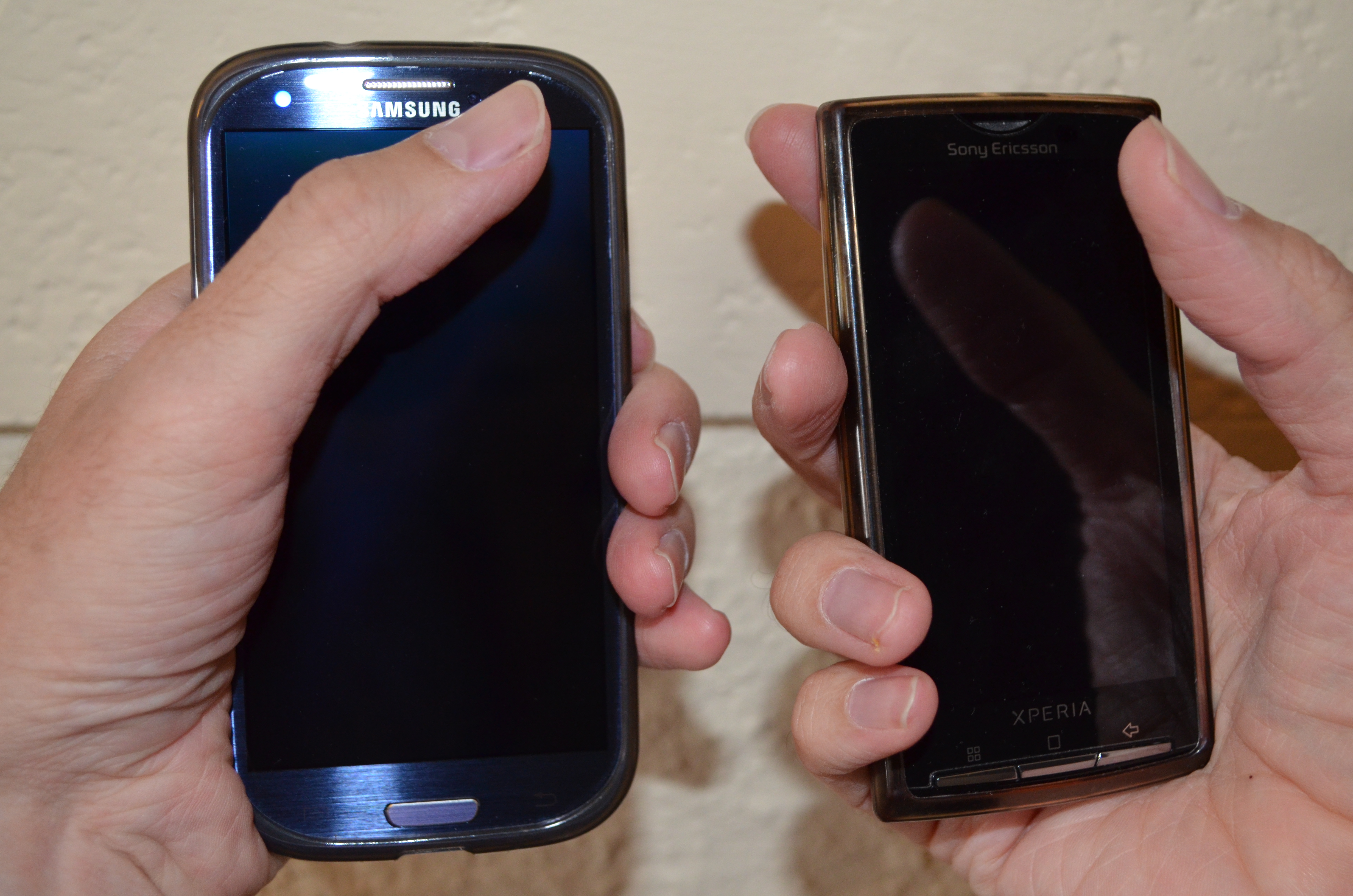
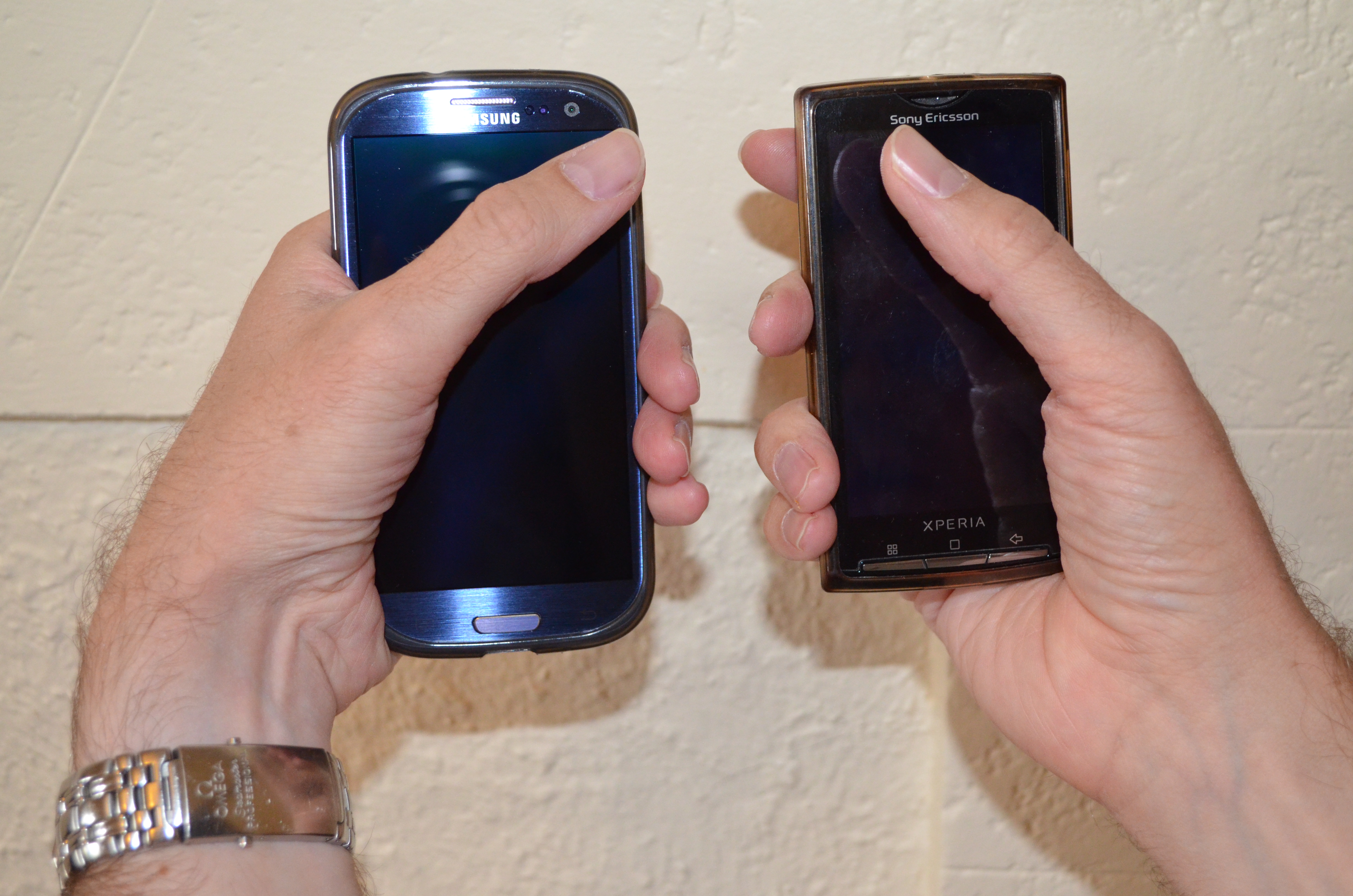
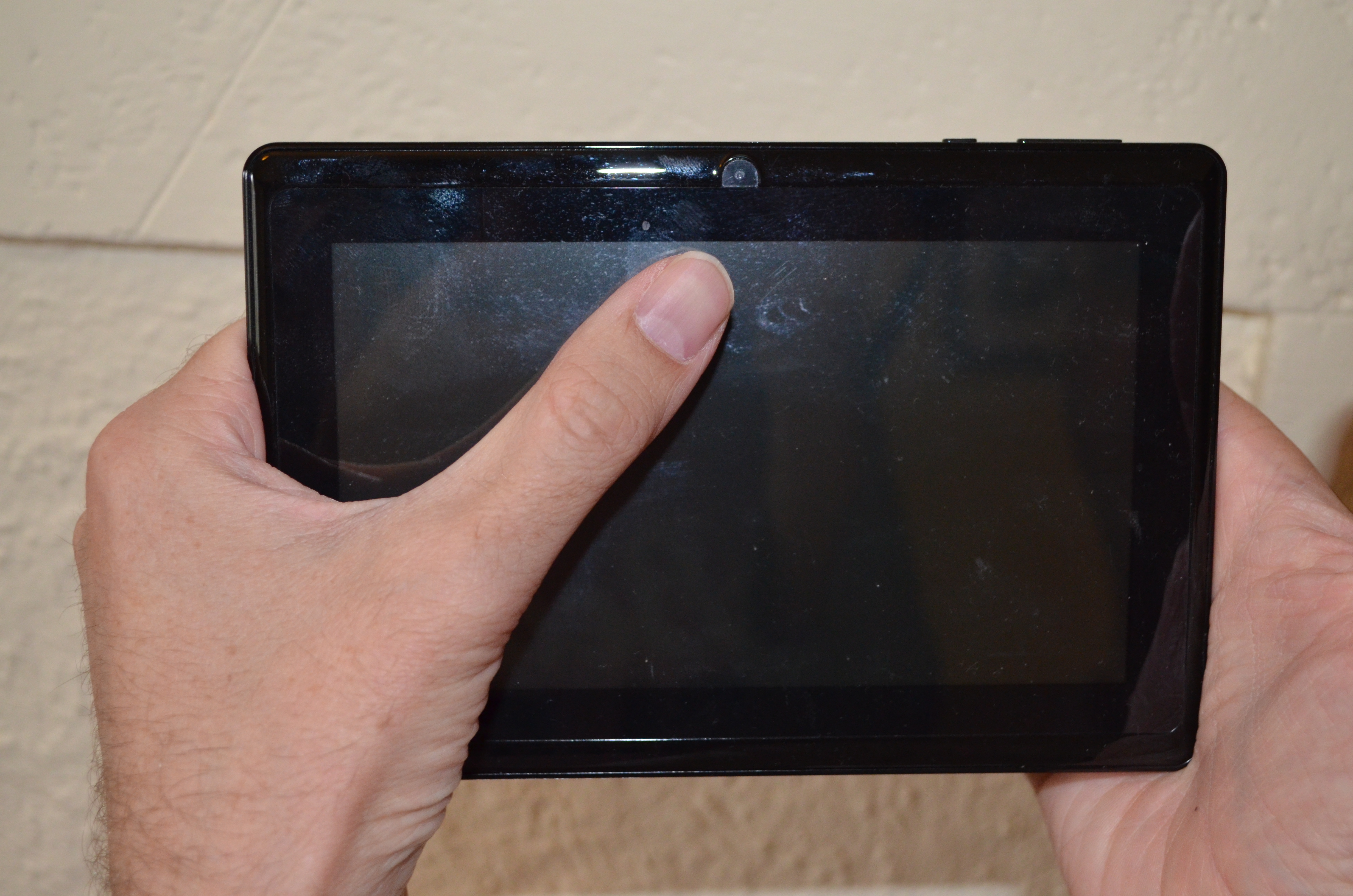
Galaxy S3 vs Xperia X10 1/2Galaxy S3 vs Xperia X10 2/2 The above two pictures show me holding a Samsung Galaxy S3 which has a 4.8 display in my left hand and a Sony Ericsson Xperia X10 which has a 4.0 display in my right hand. I am holding both phones in a manner that allows me to touch the top opposite corner with my thumb the position I need for one-handed phone use. The Xperia X10 can be completely enclosed by my hand, when I have a bottom corner resting in my palm it won t slide down while the Galaxy S3 can slide. Also one thing I didn t realise before having the pictures taken is that my posture is quite different when using the two phones. With the Galaxy S3 my wrist is clearly bent and this seems more likely to cause me to have more problems with Carpal Tunnel Syndrome [1]. I haven t had any serious problems with CTS for the last 2.5 years but I have had minor problems that suggest that I will have to be careful about my posture for the rest of my life. So it seems that a 4.8 phone is just too big for ideal one-handed use (grasping the vertical phone from the bottom). As I had CTS problems with my left hand I will try to use my new phone with my right hand as much as possible. Also I can reach further than the width of the phone screen when I grasp it from the side, so for me a size of about 5.2 would be better than the 4.8 of the Galaxy S3. It s quite likely that the Samsung Galaxy Note with it s 5.3 screen would be a better device for me to grasp from the side. But the Galaxy Note 2 might be a little too large for me. Note that I am only considering ways of holding the device that permit full operation. Anything that involves changing position for different uses or occasionally using two hands for a mostly one-hand operation doesn t count. 7 inch tablet The above picture is of me holding a 7 Android tablet (which I have just returned to Aldi [2]). When holding it from the sides I can reach more than half the screen with one hand so it seems that the ideal size for a tablet to be held in two hands for me would be 8 or even a little larger. A tablet larger than that could only be properly used if resting on my lap or a desk so for me 8 is the size that differentiates things which can be strictly used as tablets (holding with two hands and using thumbs for input) and things which are more like Netbooks (on desk typing). Ideal Device Sizes for people based on Height I am about 190cm tall. If we assume that height and hand size are strongly correlated then we can look at median heights of various age groups and determine what might be a good device size. I am also assuming that everyone wants to have the largest possible device, but some people have other criteria such as the size of their pockets. For me it s 8 tablet, 5.2 side-grip phone, and 4 bottom-grip phone. I used data from a chart of the average heights of American boys [3] and a chart of the average heights of American girls [4] to determine what size devices might suit children of various ages. Note that before the age of 12 the height of boys and girls is near enough to identical.
Device Two Hand Tablet Use Phone Grasp from Side Phone Grasp from Below
7 tablet 14yo boy or 17yo girl noone noone
Galaxy Note 5.3 10yo 95th percentile 17yo boy noone
Galaxy S3 4.8 6yo 17yo boy or 95th percentile 17yo girl almost noone
Galaxy S and iPhone 5 4.0 3yo 10yo 95th percentile 17yo boy
iPhone 4 3.5 noone 8yo 14yo boy or 16yo girl
One thing that particularly interests me is the educational use of Android devices for children. As few people buy new phones and tablets for young children that largely means that children borrow devices from their parents or are given older phones when relatives no longer need them. So it seems that if all other things are equal then an adult might choose a phone with a 4.8 display to allow it to be used as a tablet by children in the 6-10 age range. Conclusion It seems that the iPhone 4 is a good size for one-handed use by women of average height. By the standards of the people who don t regard gripping a phone from below as a significant feature the iPhone 4 would be designed for the hand of an 8yo. By any standards all iPhones other than the iPhone 5 were not the ideal size for most adults to use maybe they are well designed to fit in a pocket while unused. Charles Stross criticised the iPhone because it s too small to be seen well by people with poor vision [5], he also makes many other interesting points about the use of phones and I recommend reading his article (and the rest of his blog). The common tablet size of 7 seems like it might be ideal for women to hold with both hands, but for men of average height a 7.5 tablet might be better suited, it sounds like a small difference but it changes button size (good for people with thicker fingers) and allows displaying more data at once (15% greater screen area). Of course if you want to use a tablet on a desk then something much bigger would be better, maybe 12 or 14 . I think that there is a real market for 14 tablets that are designed to be carried around the home or office and then used on a table or lap which differs from the tablets that are designed to be more portable. There is also the use case of holding the phone in one hand while typing with the other which I haven t considered in this post. I don t think it s interesting because in that case almost everyone will find that the limitation is the size of their pockets and the size of an object that can be held to one s face for a phone call not the size of their hands. I ve previously written about my search for Geeky jeans and the ability to put a 7 tablet in my jeans pocket [6]. So I think that pocket size isn t a phone selection issue for men. The fact that women s clothing tends to have tiny pockets is another issue, if someone knows of a good analysis of phone size vs pockets in women s clothes then please let me know.

Andrew Pollock: [life/americania] Final tally of states visited

As my time in the US is rapidly drawing to a close, I thought I should capture the final count of US states that I've visited in the 7 years I've been here. I didn't realise it's been so long since I last did this. US states I've visited as of February 2013 22 states. Not too bad. I'd have liked to have visited Hawaii and Florida. Maybe in my next life. Update: I omitted Illinois.
10 February 2013

Andrew Pollock: [life/americania] Final tally of states visited

As my time in the US is rapidly drawing to a close, I thought I should capture the final count of US states that I've visited in the 7 years I've been here. I didn't realise it's been so long since I last did this. US states I've visited as of February 2013 21 states. Not too bad. I'd have liked to have visited Hawaii and Florida. Maybe in my next life.

7 February 2013

Russell Coker: Links February 2013

Aaron on Software wrote an interesting series of blog posts about psychology and personal development collectively Titled Raw Nerve , here s a link to part 2 [1]. The best sections IMHO are 2, 3, and 7. The Atlantic has an insightful article by Thomas E. Ricks about the failures in leadership in the US military that made the problems in Afghanistan and Iraq a lot worse than they needed to be [2] Kent Larson gave an interesting TED talk about how to fit more people in cities [3]. He covers issues of power use, transport, space use, and sharing. I particularly liked the apartments that transform and the design for autonomous vehicles that make eye contact with pedestrians. Andrew McAfee gave an interesting TED talk titled Are Droids Taking Our Jobs [4]. I don t think he adequately supported his conclusion that computers and robots are making things better for everyone (he also presented evidence that things are getting worse for many people), but it was an interesting talk anyway. I Psychopath is an interesting documentary about Sam Vaknin who is the world s most famous narcissist [5]. The entire documentary is available from Youtube and it s really worth watching. The movie Toy Story has been recreated in live action by a couple of teenagers [6]. That s a huge amount of work. Rory Stewart gave an interesting TED talk about how to rebuild democracy [7]. I think that his arguments against using the consequences to argue for democracy and freedom (he suggests not using the torture doesn t work and women s equality doubles the workforce arguments) are weak, but he made interesting points all through his talk. Ernesto Sirolli gave an interesting TED talk about aid work and development work which had a theme of Want to help someone? Shut up and listen! [8]. That made me think of Mary Gardiner s much quoted line from the comments section of her Wikimania talk which was also shut up and listen . Waterloo Labs has some really good engineering Youtube videos [9]. The real life Mario Kart game has just gone viral but there are lots of other good things like the iPhone controlled car and eye controlled Mario Brothers. Robin Chase of Zipcar gave an interesting TED talk about various car sharing systems (Zipcar among others), congestion taxes, the environmental damage that s caused by cars, mesh networks, and other things [10]. She has a vision of a future where most cars are shared and act as nodes in a giant mesh network. Madeleine Albright gave an interesting TED talk about being a female diplomat [11]. She s an amazing speaker. Ron Englash gave an interesting TED talk about the traditional African use of fractals [12]. Among the many interesting anecdotes concerning his research in Africa he was initiated as a priest after explaining Georg Cantor s set theories. Racialicious has an insightful article about the low expectations that members of marginalised groups have of members of the privileged groups [13]. Rick Falkvinge has a radical proposal for reforming copyrights with a declared value system [14]. I don t think that this will ever get legislative support, but if it did I think it would work well for books and songs. I think that some thought should be given to how this would work for Blogs and other sources of periodical content. Obviously filing for every blog post would be an unreasonable burden. Maybe aggregating a year of posts into one copyright assignment block would work. Scott Fraser gave an interesting TED talk about the problem with eyewitness testimony [15]. He gave a real-world example of what had to be done to get an innocent man acquitted, it s quite amazing. Sarah Kendzior wrote an interesting article for al Jazeera about the common practice in American universities to pay Adjunct Professors wages that are below the poverty line [16]. That s just crazy, when students pay record tuition fees there s more than enough money to pay academics decent wages, where does all the money go to anyway?

2 February 2013

Russ Allbery: First 2013 Powell's haul

I lost my will roll against placing another book order a couple of weeks ago. There are just too many people writing too many fascinating things that I want to read! Elizabeth Bear Shoggoths in Bloom (collection)
David Graeber Debt: The First 5,000 Years (non-fiction)
Eric Hobsbawm The Age of Revolution 1789 1848 (non-fiction)
China Mi ville Kraken (sff)
John McPhee Annals of the Former World (non-fiction)
C.E. Murphy The Queen's Bastard (sff)
C.E. Murphy The Pretender's Crown (sff)
Steven Pinker Words and Rules (non-fiction)
David Roodman Due Diligence (non-fiction)
Rebecca Skloot The Immortal Life of Henrietta Lacks (non-fiction)
Richard G. Wilkinson & Kate Pickett The Spirit Level (non-fiction)
Fumi Yoshinaga oku: The Inner Chambers #1 (graphic novel) As you can see, mostly non-fiction. Which is, of course, the type of book that takes the longest to read. I'm so smart about managing a backlog. The Pinker was recommended by one of my favorite Teaching Company courses (Myths, Lies, and Half-Truths of Language Usage by John McWhorter), and I was interested enough in linguistics to want to read something a bit more intensive. John McPhee's Annals of the Former World is about geology, something I've wanted to know more about for a while, and won the Pulitzer for general non-fiction. It's also huge. It might take me a while to get to that. Of the fiction, I read the first Murphy a long time back, but it was a borrowed copy, and I want to re-read it before reading the second volume in the duology. I remember really enjoying it, but don't remember anything about what happened. oku is manga that won the Tiptree award, so that sounded too interesting to pass up. And since I own just about everything else Elizabeth Bear has published, I figured I should keep the streak alive, even if I'm a bit behind on reading it.

1 February 2013

Russ Allbery: WebAuth 4.4.1

WebAuth is the site-wide web authentication software that we use at Stanford. We're about to start another round of intensive development on multifactor authentication support, so I wanted to get a minor release out with the other things that have accumulated in the past month and a half. The main feature change in this release is to add support for another WebLogin configuration callback. This one is run whenever WebLogin is attempting to establish the user's identity and can return any identity it wishes, so it's available as a generic callback to determine identity information from the environment. The most likely use will be to inspect the results of client-side certificate authentication (which Apache puts in various environment variables) and interpret them in a site-specific way. Also in this release I refactored the WebLogin scripts so that they use FastCGI more correctly. The application objects are now instantiated only once and then reused for the lifetime of the FastCGI script, rather than torn down and set up for each new request. This is primarily of interest to those using the new features that require a memcached connection, since that connection will no longer be constantly set up and torn down, but it should help with speed in other situations. This is the riskiest change, since if I didn't get it exactly right it would be possible for information to leak from one request to the next. I've audited it fairly carefully, though, and think I've gotten everything. Finally, besides some documentation updates, I've switched the Perl build to Module::Build from ExtUtils::MakeMaker. This should mostly be transparent, but it means some additional Perl modules from CPAN will be required to build the distribution with --enable-webkdc for versions of Perl older than 5.10. (5.10 is fairly old, so I doubt this will be a serious issue.) You can get the latest release from the official WebAuth distribution site or from my WebAuth distribution pages.

23 January 2013

Russ Allbery: Log parsing and infinite streams

I have a problem I have to solve for work that involves correlating Apache access and error logs. Part of WebAuth logs successful authentications to the Apache error log, and I want to correlate User-Agent strings with users so that we can figure out what devices our users are using by percentage of users rather than percentage of hits. The problem, as those who have tried to do this prior to Apache 2.4 know, is that Apache doesn't provide any easy way to correlate access and error log entries (made even more complex because two separate components are involved). I could have just hacked something together, but I've written way too many ad hoc log parsers, and, see, I was reading this book.... The book in question is Mark Jason Dominus's Higher Order Perl. I'm not quite done with it, and will post a full review when I am. I have some problems with it, mostly around the author's choice of example problems. But there is one chapter on infinite streams, and the moment I read that chapter on the train, it struck me as the perfect solution to log parsing problems. I'm not much of a functional programming person (which is where Dominus is drawing most of the material for this book), so I don't know if this terminology is standard or somewhat unique to the book. An infinite stream in this context is basically a variation on an interator that lets you look at the next item without consuming it. The power comes from putting this modified iterator in front of a generator and use it to consume one element at a time, and then compose this with transformation and filtering functions. That gives you all the power of the iterator to store state and lets you process one logical element from the stream at a time, without inverting your flow of control. Dominus provides code in the book for a very nice functional implementation of this that's about as close as you're probably going to get to writing Haskell in Perl. Unfortunately, his publisher decided to write their own free software license, so the license is kind of weird and doesn't explicitly permit redistribution of modified code. It's probably fine, but I didn't feel like dealing with it, and I'm more comfortable with writing object-oriented code at the moment (at least in Perl), so I decided to write an object-oriented version of the same code specific for log parsing. That's what I've been doing since shortly after lunch, and I can't remember the last time I've had this much fun writing code. I have a reasonable first cut at a (fully tested and fully test-driven) log parsing framework built on top of a reasonably generic implementation of the core ideas behind infinite streams. I also used this as an opportunity to experiment with Module::Build, and have discovered that the things I most disliked about it have apparently all been fixed. And I'm also using Perl 5.10 features. (I was tempted to start using some things from 5.12, but I do actually need to run this on Debian stable.) It's rather satisfying to write a thoroughly modern Perl module. There are some definite drawbacks to writing this in an object-oriented fashion. There's rather more machinery and glue that has to be set up, it's probably a bit slower, and it tends to accumulate layers of calls. One of the advantages of the method with standalone functions and a very simple, transparent data structure is that it's easier to eliminate unnecessary call nesting. But I suspect the object-oriented version will do what I want without any difficulties, and if I feel very inspired, I can always fiddle with it later. Maybe I'll eventually use this as a project to experiment with Moose as well. I'm surprised that no one else has done this, but I poked around on CPAN a fair bit and couldn't find anything. This will all show up on CPAN (as Log::Stream) as soon as I've finished enough of it to implement my sample application. And then I'll hopefully find some time to rewrite our metrics system using it, which should simplify it considerably....

Next.

Previous.