Search Results: "bab"

13 December 2020

Junichi Uekawa: What's your config for sharing emacs ?

What's your config for sharing emacs ? In a remote-primary world coding with peers I share my emacs a lot; I think most of the video streams are optimized for 720p which is 1280x720; and tuning emacs config; probably fonts with 10 pixels width each is about right. A frame with 160x50 or 128x40 is probably reasonable.

12 December 2020

Junichi Uekawa: Added multiple windows and a camera angle.

Added multiple windows and a camera angle. Maybe when I am talking and slides haven't started I want to show my face. I probably have a terminal and presentation to show off. So added a way to toggle between the sources. here.

11 December 2020

Evgeni Golov: systemd + SELinux =

Okay, getting a title that will ensure clicks for this post was easy. Now comes the hard part: content! When you deploy The Foreman, you want a secure setup by default. That's why we ship (and enable) a SELinux policy which allows you to run the involved daemons in confined mode. We have recently switched our default Ruby application server from Passenger (running via mod_passenger inside Apache httpd) to Puma (running standalone and Apache just being a reverse proxy). While doing so, we initially deployed Puma listening on localhost:3000 and while localhost is pretty safe, a local user could still turn out evil and talk directly to Puma, pretending to be authenticated by Apache (think Kerberos or X.509 cert auth). Obviously, this is not optimal, so the next task was to switch Puma to listen on an UNIX socket and only allow Apache to talk to said socket. This doesn't sound overly complicated, and indeed it wasn't. The most time/thought was spent on doing that in a way that doesn't break existing setups and still allows binding to a TCP socket for setups where users explicitly want that. We also made a change to the SELinux policy to properly label the newly created socket and allow httpd to access it. The whole change was carefully tested on CentOS 7 and worked like a charm. So we merged it, and it broke. Only on CentOS 8, but broken is broken, right? This is the start of my Thanksgiving story "learn how to debug SELinux issues" ;) From the logs of our integration test I knew the issue was Apache not being able to talk to that new socket (we archive sos reports as part of the tests, and those clearly had it in the auditd logs). But I also knew we did prepare our policy for that change, so either our preparation was not sufficient or the policy wasn't properly loaded. The same sos report also contained the output of semanage fcontext --list which stated that all regular files called /run/foreman.sock would get the foreman_var_run_t type assigned. Wait a moment, all regular files?! A socket is not a regular file! Let's quickly make that truly all files. That clearly changed the semanage fcontext --list output, but the socket was still created as var_run_t?! It was time to actually boot a CentOS 8 VM and try more things out. Interestingly, you actually can't add a rule for /run/something, as /run is an alias (equivalency in SELinux speak) for /var/run:
# semanage fcontext --add -t foreman_var_run_t /run/foreman.sock
ValueError: File spec /run/foreman.sock conflicts with equivalency rule '/run /var/run'; Try adding '/var/run/foreman.sock' instead
I have no idea how the list output in the report got that /run rule, but okay, let's match /var/run/foreman.sock. Did that solve the issue? Of course not! And you knew it, as I didn't get to the juciest part of the headline yet: systemd! We use systemd to create the socket, as it is both convenient and useful (no more clients connecting before Rails has finished booting). But why is it wrongly labeling our freshly created socket?! A quick check with touch shows that the policy is correct now, the touched file gets the right type assigned. So it must be something with systemd A bit of poking (and good guesswork based on prior experience with a similar issue in Puppet: PUP-2169 and PUP-10548) led to the realization that a systemctl daemon-reexec after adding the file context rule "fixes" the issue. Moving the poking to Google, you quickly end up at systemd issue #9997 which is fixed in v245, but that's in no EL release yet. And indeed, the issue seems fixed on my Fedora 33 with systemd 246, but I still need it to work on CentOS 7 and 8 Well, maybe that reexec isn't that bad after all? At least the socket is now properly labeled and httpd can connect to it on CentOS 8. Btw, no idea why the connection worked on CentOS 7, as there the socket was also wrongly labeled, but SELinux didn't deny httpd to open it. Big shout out to lzap and ewoud for helping me with this beast!

10 December 2020

John Goerzen: How the Attention Economy Hurts You via Social Media Sites like Facebook

There is a whole science to manipulating our attention. And because there is a lot of money to be made by doing this well, it means we all encounter attempts to manipulate what we pay attention to each day. What is this, and how is it harmful? This post will be the first on a series on the topic. Why is attention so important? When people use Facebook, they use it for free. Facebook generally doesn t even try to sell them anything, yet has billions in revenues. What, then, is Facebook s product? Well, really, it s you. Or, more specifically, your attention. Facebook sells your attention to advertisers. Everything they do is in service to that. They want you to spend more time on the site so they can show you more ads. (I should say here that I m using Facebook as an example, but this applies to other social media companies too.) Seeking to maximize attention So if your attention is so important to their profit, it follows naturally that they would seek ways to get people to spend more time on their site. And they do. They track all sorts of metrics, including engagement (if you click like , comment, share, or otherwise interact with content). They know which sorts of things are likely to capture your (and I mean you in specific!) attention and show you that. Your neighbor may have different interests and Facebook judges different things are likely to capture their attention. Manipulating your attention Attention turning into money isn t unique for social media. In fact, in the article If It Bleeds, It Leads: Understanding Fear-Based Media, Psychology Today writes:
In previous decades, the journalistic mission was to report the news as it actually happened, with fairness, balance, and integrity. However, capitalistic motives associated with journalism have forced much of today s television news to look to the spectacular, the stirring, and the controversial as news stories. It s no longer a race to break the story first or get the facts right. Instead, it s to acquire good ratings in order to get advertisers, so that profits soar. News programming uses a hierarchy of if it bleeds, it leads. Fear-based news programming has two aims. The first is to grab the viewer s attention. In the news media, this is called the teaser. The second aim is to persuade the viewer that the solution for reducing the identified fear will be in the news story. If a teaser asks, What s in your tap water that YOU need to know about? a viewer will likely tune in to get the up-to-date information to ensure safety.
You ve probably seen fear-based messages a lot on Facebook. They will highlight messages to liberals about being afraid of what Trump is doing, and to conservatives about being afraid of what Biden is doing. They may or may not even intentionally be doing this; it is their algorithm predicts that those would maximize time and engagement for certain people, so that s what they see. Fear leads to controversy It s not just fear, though. Social media also loves controversy. There s nothing that makes people really want to stay on Facebook like anger. See something controversial and you ll see hundreds or thousands of people are there arguing about it and in the process, giving Facebook their attention. A quick Internet search will show you numerous articles on how marketing companes can leverage controvery to get attention and engagement with their campaigns. Consequences of maximizing fear and controversy What does it mean to society at large and to you personally that large companies make a lot of money by maximizing fear and controversy? The most obvious way is it leads to less common ground. If the posts and reactions that show common ground are never seen because they don t drive engagement, it poisons the well; left and right hate each other with ever more vigor a profitable outcome to Facebook, but a poisonous one to all of us. I have had several friendships lost because I a liberal in agreement with these friends on political matters still talk to Trump voters. On the other side, we ve seen people storm the Michigan statehouse with weapons. How did that level of disagreement and even fear behind it get so firmly embedded in our society? Surely the fact that social media shows us things designed to stimulate fear and anger must play a role. What does it do to our ability to have empathy for, and understand, others? The Facebook groups I ve been in for like-minded people have largely been flooded with memes calling the President rump and other things clearly designed to make people angry or fearful. It s a worthless experience, and not just that, but it s a harmful experience. When our major media TV and social networks all are optimizing for fear, anger, and controvesry, we have a society beholden to fear, anger, and controvesy. In my next installment, I m going to talk about what to do about this, including the decentralized social networks of the Fediverse that are specifically designed to put you back in charge of your attention. Update 2020-12-16: There are two followup articles for this: how to join the Fediverse and non-creepy technology purchasing and gifting guides. The latter references the FSF s page on software manipulation towards addiction, which is particularly relevant to this topic.

Jonathan Carter: CentOS Stream, or Debian?

It s the end of CentOS as we know it Earlier this week, the CentOS project announced the shift to CentOS stream. In a nutshell, this means that they will discontinue being a close clone of RHEL along with security updates, and instead it will serve as a development branch of RHEL. As you can probably imagine (or gleam from the comments in that post I referenced), a lot of people are unhappy about this. One particular quote got my attention this morning while catching up on this week s edition of Linux Weekly News, under the distributions quotes section:

I have been doing this for 17 years and CentOS is basically my life s work. This was (for me personally) a heart wrenching decision. However, i see no other decision as a possibility. If there was, it would have been made.Johnny Hughes
I feel really sorry for this person and can empathize, I ve been in similar situations in my life before where I ve poured all my love and energy into something and then due to some corporate or organisational decisions (and usually poor ones), the project got discontinued and all that work that went into it vanishes into the ether. Also, 17 years is really long to be contributing to any one project so I can imagine that this must have been especially gutting.

Throw me a freakin bone here I m also somewhat skeptical of how successful CentOS Stream will really be in any form of a community project. It seems that Red Hat is expecting that volunteers should contribute to their product development for free, and then when these contributors actually want to use that resulting product, they re expected to pay a corporate subscription fee to do so. This seems like a very lop-sided relationship to me, and I m not sure it will be sustainable in the long term. In Red Hat s announcement of CentOS Stream, they kind of throw the community a bone by saying In the first half of 2021, we plan to introduce low- or no-cost programs for a variety of use cases - it seems likely that this will just be for experimental purposes similar to the Windows Insider program and won t be of much use for production users at all. Red Hat does point out that their Universal Base Image (UBI) is free to use and that users could just use that on any system in a container, but this doesn t add much comfort to the individuals and organisations who have contributed huge amounts of time and effort to CentOS over the years who rely on a stable, general-purpose Linux system that can be installed on bare metal.

Way forward for CentOS users Where to from here? I suppose CentOS users could start coughing up for RHEL subscriptions. For many CentOS use cases that won t make much sense. They could move to another distribution, or fork/restart CentOS. The latter is already happening. One of the original founders of the CentOS project, Gregory Kurtzer, is now working on Rocky Linux, which aims to be a new free system built from the RHEL sources. Some people from Red Hat and Canonical are often a bit surprised or skeptical when I point out to them that binary licenses are also important. This whole saga is yet another data point, but it proves that yet again. If Red Hat had from the beginning released RHEL with free sources and unobfuscated patches, then none of this would ve been necessary in the first place. And while I wish Rocky Linux all the success it aims to achieve, I do not think that working for free on a system that ultimately supports Red Hat s selfish eco-system is really productive or helpful. The fact is, Debian is already a free enterprise-scale system already used by huge organisations like Google and many others, which has stable releases, LTS support and ELTS offerings from external organisations if someone really needs it. And while RHEL clones have come and gone through the years, Debian s mission and contract to its users is something that stays consistent and I believe Debian and its ideals will be around for as long as people need Unixy operating systems to run anywhere (i.e. a very long time). While we sometimes fall short of some of our technical goals in Debian, and while we don t always agree on everything, we do tend to make great long-term progress, and usually in the right direction. We ve proved that our method of building a system together is sustainable, that we can do so reliably and timely and that we can collectively support it. From there on it can only get even better when we join forces and work together, because when either individuals or organisations contribute to Debian, they can use the end result for both private or commercial purposes without having to pay any fee or be encumbered by legal gotchas. Don t get caught by greedy corporate motivations that will result in you losing years of your life s work for absolutely no good reason. Make your time and effort count and either contribute to Debian or give your employees time to do so on company time. Many already do and reap the rewards of this, and don t look back. While Debian is a very container and virtualization friendly system, we ve managed to remain a good general-purpose operating system that manages to span use cases so vast that I d have to use a blog post longer than this one just to cover them. And while learning a whole new set of package build chain, package manager and new organisational culture and so on can be uhm, really rocky at the start, I d say that it s a good investment with Debian and unlikely to be time that you ll ever felt was wasted. As Debian project leader, I m personally available to help answer any questions that someone might have if they are interested in coming over to Debian. Feel free to mail leader_AT_debian.org (replace _AT_ with @) or find me on the oftc IRC network with the nick highvoltage. I believe that together, we can make Debian the de facto free enterprise system, and that it would be to the benefit of all its corporate users, instead of tilting all the benefit to just one or two corporations who certainly don t have your best interests in mind.

9 December 2020

Shirish Agarwal: Farm Laws and Too much Democracy

Issues with Farm Laws While I have written about the farm laws a bit sometime back. The issue is still in the nation s eye and that is due to the policies which have been done. I have been reading up on it quite a bit and also have been seeing what has been happening in here and now. The problems are with the three bills themselves which I have shared as below Click to access farmers-produce-trade-and-commerce-promotion-and-facilation-bill.pdf Click to access farmers-empowerment-and-protection-bill.pdf Click to access essential-commodities-bill-2020.pdf Biggest issue with the laws While there are many issues with the laws themselves but for me the biggest issue is that the fundamental right of the farmer to get justice via civil courts has been railroaded. From the laws itself. Standard disclaimer not a lawyer, please consult one for any issues per-se.

Farmers-produce-trade-and-commerce (promotion and facilitation-bill) 2020 Page 4 Chapter 3 Section 8 (1)8. (1) In case of any dispute arising out of a transaction between the farmer and a trader under section 4, the parties may seek a mutually acceptable solution through conciliation by filing an application to the Sub-Divisional Magistrate who shall refer such dispute to a Conciliation Board to be appointed by him for facilitating the binding settlement of the dispute. (2) Every Board of Conciliation appointed by the Sub-Divisional Magistrate under sub-section (1), shall consist of a chairperson and such members not less than two and not more than four, as the Sub-Divisional Magistrate may deem fit.10 (5) If the parties to the transaction under sub-section (1) are unable to resolve the dispute within thirty days in the manner set out under this section, they may approach the Sub-Divisional Magistrate concerned who shall be the Sub-Divisional Authority for settlement of such dispute. (8) Any party aggrieved by the order of the Sub-Divisional Authority may prefer an appeal before the Appellate Authority (Collector or Additional Collector nominated by the Collector) within thirty days of such order who shall dispose of the appeal within thirty days from the date of filing of such appeal. 10. (1) Any person aggrieved by an order under section 9 may, prefer an appeal within sixty days from the date of such order, to an officer not below the rank of Joint Secretary to the Government of India to be nominated by the Central Government for this purpose: Page 6 of the bill. 13. No suit, prosecution or other legal proceedings shall lie against the Central Government or the State Government, or any officer of the Central Government or the State Government or any other person in respect of anything which is in good faith done or intended to be done under this Act or of any rules or orders made thereunder. Page 7 of the bill, 15. No civil court shall have jurisdiction to entertain any suit or proceedings in respect of any matter, the cognizance of which can be taken and disposed of by any authority empowered by or under this Act or the rules made thereunder. Now the same laws have been reiterated for the farmers (Empowerment and Protection) Agreement on Price Assurance and Farm Services Bill, 2020. The problem is that too much power is being put into the hands of the executive. All the three, whether it is SDM (Sub-Divisional Magistrate) , the Appellate Authority or the Government Secretary directly are subservient to the whims and fancies of the Central Govt. They after all get their salaries from the Govt. itself. So there will be no independent oversight to any injustices done to the farmer. The third bill i.e. the Essential Commodities Bill, 2020 does away with stock limits on traders and big players like Adani and Ambani. This means that both these players can take and keep produce at their end thereby forcing consumers like you and me who at the retail end would have to pay higher prices for fruits and vegetables while from the producer they will take at the lowest price possible. While I have shared is just one of the points. That is the reason why even the Supreme Court bar association which almost never takes part in politics has been forced to take sides with the farmers. In many ways, one is forced to remember the Emergency  Update 11/12/20 Came across this article on the wire which tells how everybody s rights, not just the farmer s rights are being shod over. I think it depicts correctly the signs of time to come. While arguing on SM, also came to know about Article 300 (1), thanks to Sachin Kumar which shows multiple instances where Government was sued because somebody was working in official capacity and did mistakes, malafide or otherwise and it was the state who was made to pay. FWIW, today farmers from Maharashtra, my state arrived at Delhi border where they were also kept at bay. I did come across an infographic which shows how the various states have fared. Most tellingly, is the state of Bihar. It was in 2006 (one of the most backward states) where APMC was taken off. While others have tried to paint a flattering picture of Bihar, they have failed to share that in the interim 15 odd years, there hasn t been any sort of infrastructure created for farmers which is the reason it is still the lowest earner. These are the last available figures we have about the farmer s income. From 2014 to 2020 there hasn t been any update.
Situation Assessment Survey of Agricultural Household 2013 Copyright GOI,
This concludes just one portion of the bill. I will take other parts of the bill. I may dwell on some other parts as and when I have the time. A cartoon which depicts the current issue
I stand with farmers Copyright Sanitary Panels
Too much democracy Amitabh Kant Yesterday, the Niti Aayog chief Amitabh Kant remarked that we are too much of a democracy at an event called for Atmanirbhar Bharat which is basically a coinage for import substitution. Whether this is desirable or not I have argued and if needed will re-argue the same later as well. What is and was interesting were the gentleman s context, the media reactions and our overall Democracy Index which has been going downhill for quite some years. Now the gentleman who is the Niti Aayog chief and who is supposed to have the ear of the Prime Minister had opined it in an event organized by Swarajya Magazine (a far-right magazine) known to be Islamophobic and all things undemocratic. It has been a target of defundthehate campaign and with good reason. But that s a different story altogether. His full statement was as below

Tough reforms are very difficult in the Indian context, as we are too much of a democracy but the government has shown courage and determination in pushing such reforms across sectors, including mining, coal, labour and agriculture. Niti Aayog chief. The upper quotation remarks and the statement has been from the article in Indian Express which I have linked to. I have archived it as a pdf just in case the link goes dead. Yesterday, after the statement became viraled, tweets of media houses which shared the tweet suddenly become unavailable. Seems too much democracy, became too little democracy all of a sudden. I think Mr. Amitabh Kant didn t visualize as the opposition as well as most people who are on Twitter to share their opinion on the same. Few examples
Too much Democracy copyright Satish Acharya
Too much democracy Illustration and Copyright Alok
Sterlite protest 13 dead, 100 injured Copyright Business Standard too much democracy
Erosion of Democracy V-dem institute Copyright The Hindu Web Team
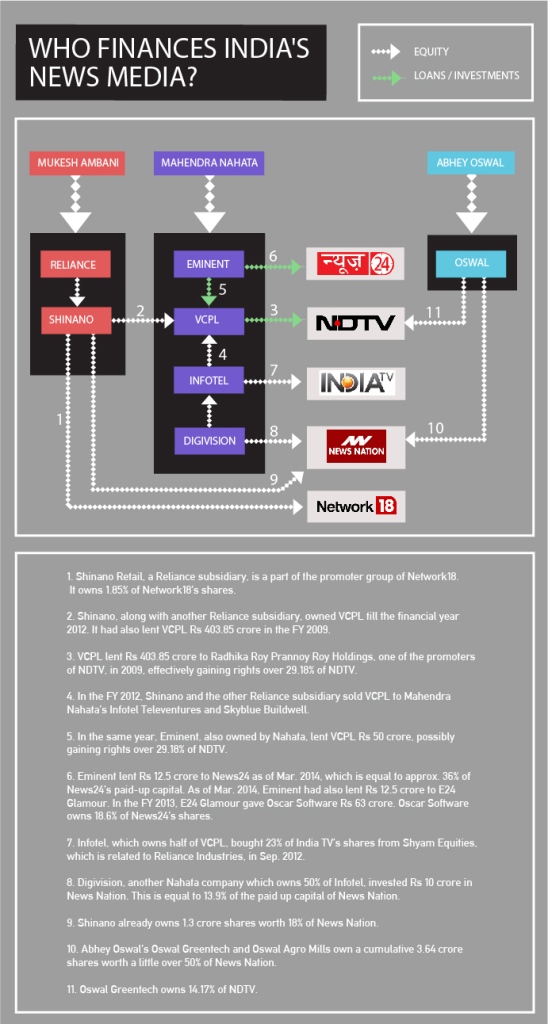
The last one requires a bit more information. This comes from V-Dem Institute which is an independent research institute based out of Department of Political Science, University of Gothenburg, Sweden. I am gonna leave the methods they use for another day as the blog post itself has become rather big/large. Apart from that is the Economists own Democracy Index -2019 Click to access democracy-index-2019.pdf Now for many people, both the V-Dem report and the Economist Index are some sort of attack against India. Doesn t matter that in V-Dem 200+ countries have been taken a variety of indicators and data or the Economist which has data from 150+- countries. Somehow India is supposed to be bigger than all these countries, they do think that other countries data specifically our neighbor China or any other neighbor, those are all accurate. How the dissonance is, has to be gauged from statements of various people. Update 11/12/20 Sadly, the newest V-Dem report marks India as getting into authoritarianism. Gag on Press and Media owners I had shared about the gag on the press especially with respect to western media or reports or anything. This news made its way to straitstimes which normally covers a wide-range of stories covering East Asia vis-a-vis India/South-East Asia. What has also been a big worry that most of the media has been in the hands of a few people. Caravan ran a story on the same in 2016, it has been four years, god only knows what the current situation might be. Any wonder that there is dearth of investigative journalism in India.
India media ownership 2016 Copyright Caravan
Incidentally, a reporter called Akarshan Uppal, who is a reporter on a channel called IBN24 had showecased just few days back how Adani has got land which was shot down for land change use in 2017 to 2020 around 100 acres. There seem to be very less details as to how the land was acquired, whose land it was etc. etc. The reporter was supposedly following a story on drugs on which he was attacked and is now lying in hospital.
Akarshan Uppal Reporter, IBN24 Copyright IBN24
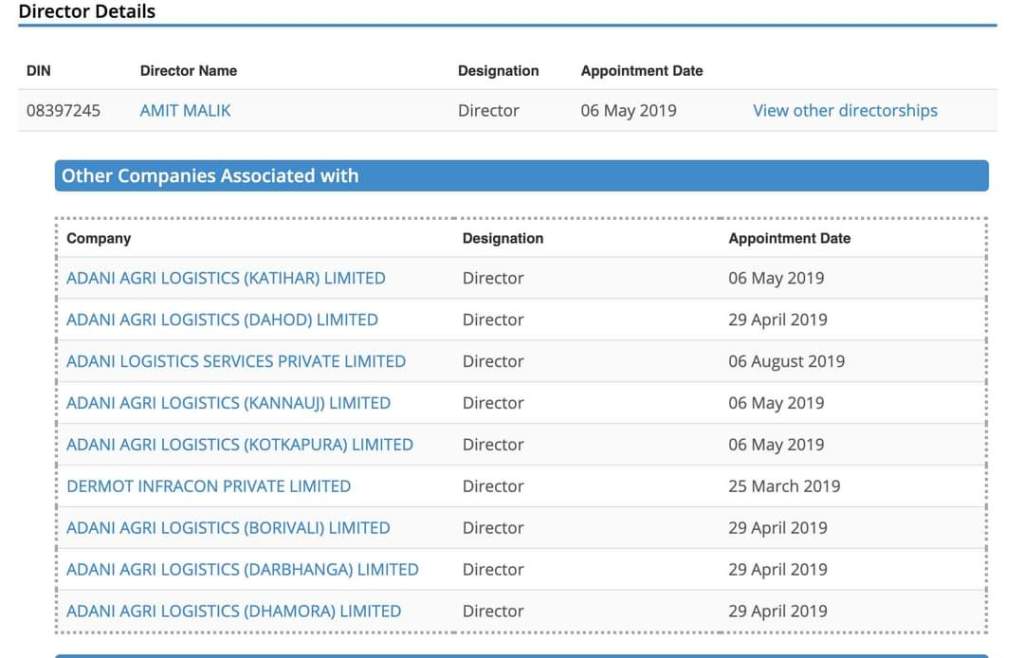
While it would take a whole article/blog post to talk about either Adani or Ambani, in the recent case, the land that has been taken over by Adani is 100 acres and there are private rail lines. And all of this was secret till few days back. The place where these massive godowns/silos have been made are Panipat s Jondhan Kalan and Naultha villages in Haryana. This is Adani AgiLogistics. Almost 7 odd companies have registered and come up in the last couple of years. As can be seen, almost all have come up within the last 2-3 years. Seems to be a lot of coincidence, isn t it?
Personal Anecdote on Data Collection and child marriages in India.

Around 1995 -96 when Internet had started to become a thing in India, there had been quite a few non-profits which were working on various issues. One of those which I initially came in contact with and which I found to be a bit absurd was non-profit which was working in the field of women against Violence. Now it is and was not the concept or the idea which was absurd to me, it was what these women were doing. Instead of the traditional ways in which you counsel women and try and figure out issues, these women were collecting data points from newspapers and magazines. This was way way before data science became a thing in India. They had their own structure where a story about violence against women which would be above the fold would be 5 points, the one below 2.5 points, in inner pages, it would be less and less. Patriarchy at that time was so strong, even today is but at that time it was such, that it felt a waste of time. I did consult them but never said that but did privately feel the above. In hindsight, they were doing the right thing and yet even today crimes against women goes unreported and is suppressed by both State and Central Governments as well as NCRB (National Crime Records Bureau). Interestingly, just few days back, the case against M.J. Akbar by Priya Ramani had taken a back seat and the defamation case by M.J. Akbar was taken forward. Even then, Priya Ramani s counsel s arguments were such that the court wound up in half an hour when they were expecting to do a whole day hearing. The next hearing would be happening today which I will look at in few hours from now. Why Priya Ramani was singled out rather than other tweets may probably be because she is an NRI and most NRI s usually do not want to be part of the bureaucratic Indian court system. This is also the reason that most companies from outside India especially those who are into startups prefer to change ownership, IPR etc. to their own or any country outside India which does make a loss to the exchequer. But this again is a story for another day. At the end, while I did not want to end on a negative note, it seems in many ways status-quo remains. For e.g. 2 years back, a BJP candidate (part of the ruling dispensation) had made a controversy saying that if they win the police won t interfere in child marriages. This is and was in Rajasthan where they have been trying to eradicate it forever. Till date, neither the NHRC (National Human Rights Commission) nor NCW (National Commission for Women) has taken cognizance of the statement. This is our state of democracy.

4 December 2020

Jonathan Dowland: Toronto

selfie skating at night
Nathan Phillips Square rink at night
view over Nathan Phillips Square rink
skaters by day
This time a year ago, I visited Toronto, Canada for my first (and hopefully not last) time, for the Red Hat Java team's face-to-face meetings. The hotel we were staying in was right next to Nathan Phillip's Square, which is an open-air Ice Rink for the winter months. I love Ice Skating and rarely took opportunities to do it (even before Covid-19) so I decided to take full advantage of the locality. Skating was free, but boot rental was not, so I bought some new skates. That meant an interesting problem getting them home on the plane. I think I got out there about 5 times over 5 days. It was busy during the day and very quiet at other times. 8am worked pretty well. My local Ice Rink has been intermittently open over the year as and when the Lockdown rules have allowed it, but the combination of cold air, indoor circulation and strenuous activity seem to me to be very unsafe, so I won't risk it. In Newcastle, the Centre for Life usually puts an outdoor rink on around Christmas, which is very expensive to skate on. Unfortunately they've decided against it this year. Toronto was great for more than just Ice Skating! I had a fantastic time meeting my team members; good food, good drink (especially Ice Wine); The CN Tower; a funky music instrument shop, and the first Teenage Engineering OP-1 I've ever seen in the flesh; not much Maple syrup, which surprised me. Good coffee. A comfortable-feeling city. It'll probably be a long while before I travel for work (or anything else) quite like this again. I'm glad to have made the most of it, whilst I could!
me, covered in snow

3 December 2020

Alberto Garc a: Subcluster allocation for qcow2 images

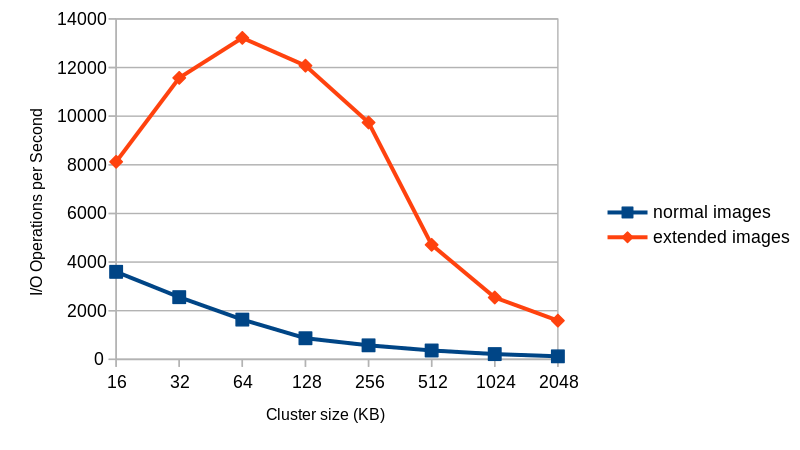
In previous blog posts I talked about QEMU s qcow2 file format and how to make it faster. This post gives an overview of how the data is structured inside the image and how that affects performance, and this presentation at KVM Forum 2017 goes further into the topic. This time I will talk about a new extension to the qcow2 format that seeks to improve its performance and reduce its memory requirements. Let s start by describing the problem. Limitations of qcow2 One of the most important parameters when creating a new qcow2 image is the cluster size. Much like a filesystem s block size, the qcow2 cluster size indicates the minimum unit of allocation. One difference however is that while filesystems tend to use small blocks (4 KB is a common size in ext4, ntfs or hfs+) the standard qcow2 cluster size is 64 KB. This adds some overhead because QEMU always needs to write complete clusters so it often ends up doing copy-on-write and writing to the qcow2 image more data than what the virtual machine requested. This gets worse if the image has a backing file because then QEMU needs to copy data from there, so a write request not only becomes larger but it also involves additional read requests from the backing file(s). Because of that qcow2 images with larger cluster sizes tend to: Unfortunately, reducing the cluster size is in general not an option because it also has an impact on the amount of metadata used internally by qcow2 (reference counts, guest-to-host cluster mapping). Decreasing the cluster size increases the number of clusters and the amount of necessary metadata. This has direct negative impact on I/O performance, which can be mitigated by caching it in RAM, therefore increasing the memory requirements (the aforementioned post covers this in more detail). Subcluster allocation The problems described in the previous section are well-known consequences of the design of the qcow2 format and they have been discussed over the years. I have been working on a way to improve the situation and the work is now finished and available in QEMU 5.2 as a new extension to the qcow2 format called extended L2 entries. The so-called L2 tables are used to map guest addresses to data clusters. With extended L2 entries we can store more information about the status of each data cluster, and this allows us to have allocation at the subcluster level. The basic idea is that data clusters are now divided into 32 subclusters of the same size, and each one of them can be allocated separately. This allows combining the benefits of larger cluster sizes (less metadata and RAM requirements) with the benefits of smaller units of allocation (less copy-on-write, smaller images). If the subcluster size matches the block size of the filesystem used inside the virtual machine then we can eliminate the need for copy-on-write entirely. So with subcluster allocation we get: This figure shows the average number of I/O operations per second that I get with 4KB random write requests to an empty 40GB image with a fully populated backing file.
I/O performance comparison between traditional and extended qcow2 images
Things to take into account: How to use this? Extended L2 entries are available starting from QEMU 5.2. Due to the nature of the changes it is unlikely that this feature will be backported to an earlier version of QEMU. In order to test this you simply need to create an image with extended_l2=on, and you also probably want to use a larger cluster size (the default is 64 KB, remember that every cluster has 32 subclusters). Here is an example:
$ qemu-img create -f qcow2 -o extended_l2=on,cluster_size=128k img.qcow2 1T
And that s all you need to do. Once the image is created all allocations will happen at the subcluster level. More information This work was presented at the 2020 edition of the KVM Forum. Here is the video recording of the presentation, where I cover all this in more detail: You can also find the slides here. Acknowledgments This work has been possible thanks to Outscale, who have been sponsoring Igalia and my work in QEMU.
Igalia and Outscale
And thanks of course to the rest of the QEMU development team for their feedback and help with this!

2 December 2020

Norbert Preining: Debian KDE/Plasma Status 2020-12-02

Another month worth of updates on KDE/Plasma in Debian has accumulated, so here we go. The highlights are: Plasma 5.19.5 based on Qt 5.15 is in Debian/unstable and testing, Plasma 5.20.4 is waiting to be uploaded soon to experimental, and my own builds at OBS have been updated to Plasma 5.20.4, Frameworks 5.76, Apps 20.08.3. OBS packages The OBS packages as usual follow the latest release, and currently ship KDE Frameworks 5.76, KDE Apps 20.08.3, and new, Plasma 5.20.4. The package sources are as usual (only the other-dep has disappeared, these packages are now all in Debian proper), for Debian/unstable:
deb https://download.opensuse.org/repositories/home:/npreining:/debian-kde:/frameworks/Debian_Unstable/ ./
deb https://download.opensuse.org/repositories/home:/npreining:/debian-kde:/plasma520/Debian_Unstable/ ./
deb https://download.opensuse.org/repositories/home:/npreining:/debian-kde:/apps2008/Debian_Unstable/ ./
deb https://download.opensuse.org/repositories/home:/npreining:/debian-kde:/other/Debian_Unstable/ ./
and the same with Testing instead of Unstable for Debian/testing. The latest update to 5.20.4 will probably need one or two install cycles due to missing Replaces. The reason is that the packages in OBS have been synced with the work we have done for the official Debian packages, and thus some files have moved between packages. Debian main packages After a few hiccups, the whole Plasma 5.19.5 stack has landed in Debian/testing, and we are working on an upload of 5.20.4 to Debian/experimental. This takes a bit, because we want to add infrastructure to automatically force all packages to be upgraded only together, so that there is no mix between old and new packages. This has shown quite some problems during the upgrade from 5.17 to 5.19 in testing. Also, I don t think Debian needs to do something else than everybody else by allowing to mix Plasma released. That said, I hope that we have an upload of 5.20 to experimental soon, followed by testing and an upload to unstable, so that it can migrate to testing in time for the freeze of Bullseye. Getting 5.20.5 into Bullseye is possible, but not guaranteed, not too much time between the release of 5.20.5 and proper freeze in Debian. But we will see. Enjoy.

1 December 2020

Junichi Uekawa: Been implementing something for pair programming.

Been implementing something for pair programming. Sharing the display is probably the most core part and the rest are minor improvements.

Shirish Agarwal: The Constitution of Knowledge

Truth, Untruths and Education in India. I read this somewhat disturbing and yet pretty raw truth from foreign affairs. It took me quite a few days to not only digest but also say yes and see the same situation playing out in India. I have been seeing the discourse on Twitter and while a part of it is the equivalent of road rage, a huge part is a disconnect to not acknowledge and be civil. We may come to different conclusions from the same data but being civil seems to be difficult for a lot of people. One part is of course ego, where nobody wants to lose, but more than that are the plain comprehension issues. Most of the literature, good literature is unfortunately based in English.

And while we can have differing opinions of what constitutes good literature, for me it s books like Battle of Belonging,The:On Nationalism, Patriotism, and What it Means Shashi Tharoor. From what little I have understood, the book makes the case of civic nationalism which is far more inclusive than the narrow confines of patriotism. Now this begs the question when you have such books and many books which do tell you about different aspects of social, political and knowledge, why are so many people prone to disinformation in India similar to U.S. and probably other countries as well. One of the biggest reasons per-se is lack of education and quality education. When the number of graduates is less than five percent how do you expect that population to be able to take decisions in their economic self-interest? So sadly the understanding is ingrained from WhatsApp and there is no need to check from alternate sources. And just like Mr. Trump followers, they believe those versions to be the unvarnished truth. I do understand that no truth is immutable except for life and death. All others are imperfect unless it is validated by some sort of scientific validation behind it. At the same time, these truths may themselves be invalidated if a stronger scientific evidence establishes itself. This is the reason why hypothesis and facts themselves are challenged again and again. Sharing couple of examples below.

Nationalization of Banking, RERA and RCEP Most of the people want freedom of the banks i.e. private banking don t really know that private banking existed at a time in free India before they were nationalized and these banks failed at surprisingly regular intervals. Now it isn t as if this fact is hidden but it is not as popular as maybe some other facts or ideas. Now the Government in the center obviously doesn t want to share these facts as they want corporates in banking. And if that fact is known by many people it will be a huge setback to their plans. RBI failures have been to many to count. Even recent legislations like RERA and others which were supposed to bring relief to millions of potential homeowners has become a pawn in the hands of builders and this has been known. One of the interesting points of RCEP which is not so much in public domain is that RCEP would have a mere 4.5% duty on most products which will go down to 1.5% over a 20 year period. Now with India staying out of it, we have done two things. We have said that we will not be competitive even after 20 years of this which is the more damning part. And we will not take part in the growth that other countries will have due to this. Contempt Proceedings against Comic Artist because she has an opinion on SC The fall in SC and constitutional values grows day by day. The AG today consented to have contempt proceedings against a comic artist saying she insulted the SC. Gone are the days when an artist made fun of the PM, and she gave him a Padam Shri (one of the highest civilian honors) for his contributions. Then, even dissent or being cynical was looked as being a contribution to the national effort rather than today. This is the reason why India has been continuously falling in the Global Freedom of Expression Index. I have seen censoring many a time here. I, myself has been locked out of Wikipedia many times. Can you imagine, being locked out of Wikipedia which is perhaps one of the more neutral sites on the web. And then there was this wikibio thing, such a sad thing to happen. Guessing this is the future of the Indian interweb.
Stick figure by Sanitary Panels on SC

28 November 2020

Russ Allbery: Review: Nine Goblins

Review: Nine Goblins, by T. Kingfisher
Publisher: Red Wombat Tea Company
Copyright: 2013
ASIN: B00G9GSEXO
Format: Kindle
Pages: 140
The goblins are at war, a messy multi-sided war also involving humans, elves, and orcs. The war was not exactly their idea, although the humans would claim otherwise. Goblins kept moving farther and farther into the wilderness to avoid human settlements, and then they ran out of wilderness, and it wasn't clear what else to do. For the Nineteenth Infantry, the war is a confusing business, full of boredom and screaming and being miserable and following inexplicable orders. And then they run into a wizard. Wizards in this world are not right in the head, and by not right I mean completely psychotic. That's the only way that you get magical powers. Wizards are therefore incredibly dangerous and scarily unpredictable, so when the Whinin' Nineteenth run into a human wizard who shoots blue out of his mouth, making him stop shooting blue out of his mouth becomes a high priority. Goblins have only one effective way of stopping things: charge at them and hit them with something until they stop. Wizards have things like emergency escape portals. And that's how the entire troop of nine goblins ended up far, far behind enemy lines. Sings-to-Trees's problems, in contrast, are rather more domestic. At the start of the book, they involve, well:
Sings-to-Trees had hair the color of sunlight and ashes, delicately pointed ears, and eyes the translucent green of new leaves. His shirt was off, he had the sort of tanned muscle acquired from years of healthy outdoor living, and you could have sharpened a sword on his cheekbones. He was saved from being a young maiden's fantasy unless she was a very peculiar young maiden by the fact that he was buried up to the shoulder in the unpleasant end of a heavily pregnant unicorn.
Sings-to-Trees is the sort of elf who lives by himself, has a healthy appreciation for what nursing wild animals involves, and does it anyway because he truly loves animals. Despite that, he was not entirely prepared to deal with a skeleton deer with a broken limb, or at least with the implications of injured skeleton deer who are attracted by magical disturbances showing up in his yard. As one might expect, Sings-to-Trees and the goblins run into each other while having to sort out some problems that are even more dangerous than the war the goblins were unexpectedly removed from. But the point of this novella is not a deep or complex plot. It pushes together a bunch of delightfully weird and occasionally grumpy characters, throws a challenge at them, and gives them space to act like fundamentally decent people working within their constraints and preconceptions. It is, in other words, an excellent vehicle for Ursula Vernon (writing as T. Kingfisher) to describe exasperated good-heartedness and stubbornly determined decency.
Sings-to-Trees gazed off in the middle distance with a vague, pleasant expression, the way that most people do when present at other people's minor domestic disputes, and after a moment, the stag had stopped rattling, and the doe had turned back and rested her chin trustingly on Sings-to-Trees' shoulder. This would have been a touching gesture, if her chin hadn't been made of painfully pointy blades of bone. It was like being snuggled by an affectionate plow.
It's not a book you read for the twists and revelations (the resolution is a bit of an anti-climax). It's strength is in the side moments of characterization, in the author's light-hearted style, and in descriptions like the above. Sings-to-Trees is among my favorite characters in all of Vernon's books, surpassed only by gnoles and a few characters in Digger. The Kingfisher books I've read recently have involved humans and magic and romance and more standard fantasy plots. This book is from seven years ago and reminds me more of Digger. There is less expected plot machinery, more random asides, more narrator presence, inhuman characters, no romance, and a lot more focus on characters deciding moment to moment how to tackle the problem directly in front of them. I wouldn't call it a children's book (all of the characters are adults), but it has a bit of that simplicity and descriptive focus. If you like Kingfisher in descriptive mode, or enjoy Vernon's descriptions of D&D campaigns on Twitter, you are probably going to like this. If you don't, you may not. I thought it was slight but perfect for my mood at the time. Rating: 7 out of 10

27 November 2020

Arturo Borrero Gonz lez: Netfilter virtual workshop 2020 summary

Netfilter logo Once a year folks interested in Netfilter technologies gather together to discuss past, ongoing and future works. The Netfilter Workshop is an opportunity to share and discuss new ideas, the state of the project, bring people together to work & hack and to put faces to people who otherwise are just email names. This is an event that has been happening since at least 2001, so we are talking about a genuine community thing here. It was decided there would be an online format, split in 3 short meetings, once per week on Fridays. I was unable to attend the first session on 2020-11-06 due to scheduling conflict, but I made it to the sessions on 2020-11-13 and 2020-11-20. I would say the sessions were joined by about 8 to 10 people, depending on the day. This post is a summary with some notes on what happened in this edition, with no special order. Pablo did the classical review of all the changes and updates that happened in all the Netfilter project software components since last workshop. I was unable to watch this presentation, so I have nothing special to comment. However, I ve been following the development of the project very closely, and there are several interesting things going on, some of them commented below. Florian Westphal brought to the table status on some open/pending work for mptcp option matching, systemd integration and finally interfacing from nft with cgroupv2. I was unable to participate in the talk for the first two items, so I cannot comment a lot more. On the cgroupv2 side, several options were evaluated to how to match them, identification methods, the hierarchical tree that cgroups present, etc. We will have to wait a bit more to see how the final implementation looks like. Also, Florian presented his concerns on conntrack hash collisions. There are no real-world known issues at the moment, but there is an old paper that suggests we should keep and eye on this and introduce improvements to prevent future DoS attack vectors. Florian mentioned these attacks are not practical at the moment, but who knows in a few years. He wants to explore introducing RB trees for conntrack. It will probably be a rbtree structure of hash tables in order to keep supporting parallel insertions. He was encouraged by others to go ahead and play/explore with this. Phil Sutter shared his past and future iptables development efforts. He highlighted fixed bugs and his short/midterm TODO list. I know Phil has been busy lately fixing iptables-legacy/iptables-nft incompatibilities. Basically addressing annoying bugs discovered by all ruleset managers out there (kubernetes, docker, openstack neutron, etc). Lots of work has been done to improve the situation; moreover I myself reported, or forwarded from the Debian bug tracker, several bugs. Anyway I was unable to attend this talk, only learnt a few bits in the following sessions, so I don t have a lot to comment here. But when I was fully present, I was asked by Phil about the status of netfilter components in Debian, and future plans. I shared my information. The idea for the next Debian stable release is to don t include iptables in the installer, and include nftables instead. Since Debian Buster, nftables is the default firewalling tool anyway. He shared the plans for the RedHat-related ecosystem, and we were able to confirm that we are basically in sync. Pablo commented on the latest Netfilter flowtable enhancements happening. Using the flowtable infrastructure, one can create kernel network bypasses to speed up packet throughput. The latest changes are aimed for bridge and VLAN enabled setups. The flowtable component will now know how to bypass in these 2 network architectures as well as the previously supported ingress hook. This is basically aimed for virtual machines and containers scenarios. There was some debate on use cases and supported setups. I commented that a bunch of virtual machines connected to a classic linux bridge and then doing NAT is basically what Openstack Neutron does, specifically in DVR setups. Same can be found in some container-based environments. Early/simple benchmarks done by Pablo suggest there could be huge performance improvements for those use cases. There was some inevitable comparison of this approach to what others, like DPDK/XDP can do. A point was raised about this being a more generic and operating system-integrated solution, which should make it more extensible and easier to use. flowtable for bridges Stefano Bravio commented on several open topics for nftables that he is interested on working on. One of them, issues related to concatenations + vmap issues. He also addressed concerns with people s expectations when migrating from ipset to nftables. There are several corner features in ipset that aren t currently supported in nftables, and we should document them. Stefano is also wondering about some tools to help in the migration. A translation layer like there is in place for iptables. Eric Gaver commented there are a couple of semantics that will not be suitable for translation, such as global sets, or sets of sets. But ipset is way simpler than iptables, so a translation mechanism should probably be created. In any case, there was agreement that anything that helps people migrate is more than welcome, even if it doesn t support 100% of the use cases. Stefano is planning to write documentation in the nftables wiki on how the pipapo algorithm works and the supported use cases. Other plans by Stefano include to work on some optimisations for faster matches. He mentioned using architecture specific instruction to speed up sets operations, like lookups. Finally, he commented that some folks working with eBPF have showed interest in reusing some parts of the nftables sets infrastructure (pipapo) because they have detected performance issues in their own data structures in some cases. It is not clear how to best achieve it, how to better bridge the two things together. Probably the ideal is to generalize the pipapo data structures and integrate it into the generic bitmap library or something which can be used by anyone. Anyway, he hopes to get some more time to focus on Netfilter stuff begining with the next year, in a couple of months. Moving a bit away from the pure software development topics, Pablo commented on the netfilter.org infrastructure. Right now the servers are running on gandi.net, on virtual machines that are being basically donated to us. He pointed that the plan is to simplify the infrastructure. For that reason, for example, FTP services has been shut down. Rsync services have been shut down as well, so basically we no longer have a mirrors infrastructure. The bugzilla and wikis we have need some attention, given they are old software pieces, and we need to migrate them to be more modern. Finally, the new logo that was created was presented. Later on, we spent a good chunk of the meeting discussing options on how to address the inevitable iptables deprecation situation. There are some open questions, and we discussed several approaches. From doing nothing at all, which means keeping the current status-quo, to setting a deadline date for the deprecation like the python community did with python2. I personally like this deadline idea, but it is perceived like a negative push by other. We all agree that the current do nothing approach is not sustainable either. Probably the way to go is basically to be more informative. We need to clearly communicate that choosing iptables for anything in 2020 is a bad idea. There are additional initiatives to help on this topic, without being too aggressive. A FAQ will probably be introduced. Eric Garver suggested we should bring nftables front and center. Given the website still mentions iptables everywhere, we will probably refresh the web content, introduce additional informative banners and similar things. There was an interesting talk on the topic of nft table ownership. The idea is to attach a table, and all the child objects, to a process. Then, we prevent any modifications to the table or the child objects by external entities. Basically, allocating and locking a table for a certain netlink socket. This is a nice way for ruleset managers, like firewalld, to ensure they have full control of what s happening to their ruleset, reducing the chances for ending with an inconsistent configuration. There is a proof-of-concept patch by Pablo to support this, and Eric mentioned he is pretty much interested in any improvements to support this use case. The final time block in the final session day was dedicated to talk about the next workshop. We are all very happy we could meet. Meeting virtually is way easier (and cheaper) than in person. Perhaps we can make it online every 3 or 6 months instead of, or in addition to, one big annual physical event. We will see what happens next year. That s all on my side!

23 November 2020

Shirish Agarwal: White Hat Senior and Education

I had been thinking of doing a blog post on RCEP which China signed with 14 countries a week and a day back but this new story has broken and is being viraled a bit on the interwebs, especially twitter and is pretty much in our domain so thought would be better to do a blog post about it. Also, there is quite a lot packed so quite a bit of unpacking to do.

Whitehat, Greyhat and Blackhat For those of you who may not, there are actually three terms especially in computer science that one comes across. Those are white hats, grey hats and black hats. Now clinically white hats are like the fiery angels or the good guys who basically take permissions to try and find out weakness in an application, program, website, organization and so on and so forth. A somewhat dated reference to hacker could be Sandra Bullock (The Net 1995) , Sneakers (1992), Live Free or Die Hard (2007) . Of the three one could argue that Sandra was actually into viruses which are part of computer security but still she showed some bad-ass skills, but then that is what actors are paid to do  Sneakers was much more interesting for me because in that you got the best key which can unlock any lock, something like quantum computing is supposed to do. One could equate both the first movies in either as a White hat or a Grey hat . A Grey hat is more flexible in his/her moral values, and they are plenty of such people. For e.g. Julius Assange could be described as a Grey hat, but as you can see and understand those are moral issues.

A black hat on the other hand is one who does things for profit even if it harms the others. The easiest fictitious examples are all Die Hard series, all of them except the 4th one, all had bad guys or black hats. The 4th also had but is the odd one out as it had Matthew Farell (Justin Long) as a Grey hat hacker. In real life Kevin Mitnick, Kevin Poulsen, Robert Tappan Morris, George Hotz, Gary McKinnon are some examples of hackers, most of whom were black hats, most of them reformed into white hats and security specialists. There are many other groups and names but that perhaps is best for another day altogether. Now why am I sharing this. Because in all of the above, the people who are using and working with the systems have better than average understanding of systems and they arguably would be better than most people at securing their networks, systems etc. but as we shall see in this case there has been lots of issues in the company.

WhiteHat Jr. and 300 Million Dollars Before I start this, I would like to share that for me this suit in many ways seems to be similar to the suit filed against Krishnaraj Rao . Although the difference is that Krishnaraj Rao s case/suit is that it was in real estate while this one is in education although many things are similar to those cases but also differ in some obvious ways. For e.g. in the suit against Krishnaraj Rao, the plaintiff s first approached the High Court and then the Supreme Court. Of course Krishnaraj Rao won in the High Court and then in the SC plaintiff s agreed to Krishnaraj Rao s demands as they knew they could not win in SC. In that case, a compromise was reached by the plaintiff just before judgement was to be delivered. In this case, the plaintiff have directly approached the Delhi High Court. The charges against Mr. Poonia (the defendant in this case) are very much similar to those which were made in Krishnaraj Rao s suit hence won t be going into those details. They have claimed defamation and filed a 20 crore suit. The idea is basically to silence any whistle-blowers.

Fictional Character Wolf Gupta The first issue in this case or perhaps one of the most famous or infamous character is an unknown. While he has been reportedly hired by Google India, BJYU, Chandigarh. This has been reported by Yahoo News. I did a cursory search on LinkedIn to see if there indeed is a wolf gupta but wasn t able to find any person with such a name. I am not even talking the amount of money/salary the fictitious gentleman is supposed to have got and the various variations on the salary figures at different times and the different ads.

If I wanted to, I could have asked few of the kind souls whom I know are working in Google to see if they can find such a person using their own credentials but it probably would have been a waste of time. When you show a LinkedIn profile in your social media, it should come up in the results, in this case it doesn t. I also tried to find out if somehow BJYU was a partner to Google and came up empty there as well. There is another story done by Kan India but as I m not a subscriber, I don t know what they have written but the beginning of the story itself does not bode well. While I can understand marketing, there is a line between marketing something and being misleading. At least to me, all of the references shared seems misleading at least to me.

Taking down dissent One of the big no-nos at least from what I perceive, you cannot and should not take down dissent or critique. Indians, like most people elsewhere around the world, critique and criticize day and night. Social media like twitter, mastodon and many others would not exist in the place if criticisms are not there. In fact, one could argue that Twitter and most social media is used to drive engagements to a person, brand etc. It is even an official policy in Twitter. Now you can t drive engagements without also being open to critique and this is true of all the web, including of WordPress and me  . What has been happening is that whitehatjr with help of bjyu have been taking out content of people citing copyright violation which seems laughable. When citizens critique anything, we are obviously going to take the name of the product otherwise people would have to start using new names similar to how Tom Riddle was known as Dark Lord , Voldemort and He who shall not be named . There have been quite a few takedowns, I just provide one for reference, the rest of the takedowns would probably come in the ongoing suit/case.
Whitehat Jr. ad showing investors fighting

Now a brief synopsis of what the ad. is about. The ad is about a kid named Chintu who makes an app. The app. Is so good that investors come to his house and right in the lawn and start fighting each other. The parents are enjoying looking at the fight and to add to the whole thing there is also a nosy neighbor who has his own observations. Simply speaking, it is a juvenile ad but it works as most parents in India, as elsewhere are insecure.
Jihan critiquing the whitehatjr ad
Before starting, let me assure that I asked Jihan s parents if it s ok to share his ad on my blog and they agreed. What he has done is broken down the ad and showed how juvenile the ad is and using logic and humor as a template for the same. He does make sure to state that he does not know how the product is as he hasn t used it. His critique was about the ad and not the product as he hasn t used that.

The Website If you look at the website, sadly, most of the site only talks about itself rather than giving examples that people can look in detail. For e.g. they say they have few apps. on Google play-store but no link to confirm the same. The same is true of quite a few other things. In another ad a Paralympic star says don t get into sports and get into coding. Which athlete in their right mind would say that? And it isn t that we (India) are brimming with athletes at the international level. In the last outing which was had in 2016, India sent a stunning 117 athletes but that was an exception as we had the women s hockey squad which was of 16 women, and even then they were overshadowed in numbers by the bureaucratic and support staff. There was criticism about the staff bit but that is probably a story for another date. Most of the site doesn t really give much value and the point seems to be driving sales to their courses. This is pressurizing small kids as well as teenagers and better who are in the second and third year science-engineering whose parents don t get that it is advertising and it is fake and think that their kids are incompetent. So this pressurizes both small kids as well as those who are learning, doing in whatever college or educational institution . The teenagers more often than not are unable to tell/share with them that this is advertising and fake. Also most of us have been on a a good diet of ads. Fair and lovely still sells even though we know it doesn t work. This does remind me of a similar fake academy which used very much similar symptoms and now nobody remembers them today. There used to be an academy called Wings Academy or some similar name. They used to advertise that you come to us and we will make you into a pilot or an airhostess and it was only much later that it was found out that most kids were doing laundry work in hotels and other such work. Many had taken loans, went bankrupt and even committed suicide because they were unable to pay off the loans due to the dreams given by the company and the harsh realities that awaited them. They were sued in court but dunno what happened but soon they were off the radar so we never came to know what happened to those million of kids whose life dreams were shattered.

Security Now comes the security part. They have alleged that Mr. Poonia broke into their systems. While this may be true, what I find funny is that with the name Whitehat, how can they justify it? If you are saying you are white hat you are supposed to be much better than this. And while I have not tried to penetrate their systems, I did find it laughable that the site is using an expired https:// certificate. I could have tried further to figure out the systems but I chose not to. How they could not have an automated script to get the certificate fixed is beyond me, this is known as certificate outage and is very well understood in the industry. There are tools like Let s Encrypt and Certbot (both EFF) and many others. But that is their concern, not mine.

Comparison A similar offering would be unacademy but as can be seen they neither try to push you in any way and nor do they make any ridiculous claims. In fact how genuine unacademy is can be gauged from the fact that many of its learning resources are available to people to see on YT and if they have tools they can also download it. Now, does this mean that every educational website should have their content for free, of course not. But when a channel has 80% 90% of it YT content as ads and testimonials then they surely should give a reason to pause both for parents and students alike. But if parents had done that much research, then things would not be where they are now.

Allegations Just to complete, there are allegations by Mr. Poonia with some screenshots which show the company has been doing a lot of bad things. For e.g. they were harassing an employee at night 2 a.m. who was frustrated and working in the company at the time. Many of the company staff routinely made sexist and offensive, sexual abusive remarks privately between themselves for prospective women who came to interview via webcam (due to the pandemic). There also seems to be a bit of porn on the web/mobile server of the company as well. There also have been allegations that while the company says refund is done next day, many parents who have demanded those refunds have not got it. Now while Mr. Poonia has shared some quotations of the staff while hiding the identities of both the victims and the perpetrators, the language being used in itself tells a lot. I am in two minds whether to share those photos or not hence atm choosing not to. Poonia has also contended that all teachers do not know programming, and they are given scripts to share. There have been some people who did share that experience with him
Suruchi Sethi
From the company s side they are alleging he has hacked the company servers and would probably be using the Fruit of the poisonous tree argument which we have seen have been used in many arguments.

Conclusion Now that lies in the eyes of the Court whether the single bench chooses the literal meaning or use the spirit of the law or the genuine concerns of the people concerned. While in today s hearing while the company asked for a complete sweeping injunction they were unable to get it. Whatever may happen, we may hope to see some fireworks in the second hearing which is slated to be on 6.01.2021 where all of this plays out. Till later.

19 November 2020

Molly de Blanc: Transparency

Technology must be transparent in order to be knowable. Technology must be knowable in order for us to be able to consent to it in good faith. Good faith informed consent is necessary to preserving our (digital) autonomy. Let s now look at this in reverse, considering first why informed consent is necessary to our digital autonomy. Let s take the concept of our digital autonomy as being one of the highest goods. It is necessary to preserve and respect the value of each individual, and the collectives we choose to form. It is a right to which we are entitled by our very nature, and a prerequisite for building the lives we want, that fulfill us. This is something that we have generally agreed on as important or even sacred. Our autonomy, in whatever form it takes, in whatever part of our life it governs, is necessary and must be protected. One of the things we must do in order to accomplish this is to build a practice and culture of consent. Giving consent saying yes is not enough. This consent must come from a place of understand to that which one is consenting. Informed consent is consenting to the unknowable. (1) Looking at sexual consent as a parallel, even when we have a partner who discloses their sexual history and activities, we cannot know whether they are being truthful and complete. Let s even say they are and that we can trust this, there is a limit to how much even they know about their body, health, and experience. They might not know the extent of their other partners experience. They might be carrying HPV without symptoms; we rarely test for herpes. Arguably, we have more potential to definitely know what is occurring when it comes to technological consent. Technology can be broken apart. We can share and examine code, schematics, and design documentation. Certainly, lots of information is being hidden from us a lot of code is proprietary, technical documentation unavailable, and the skills to process these things is treated as special, arcane, and even magical. Tracing the resource pipelines for the minerals and metals essential to building circuit boards is not possible for the average person. Knowing the labor practices of each step of this process, and understanding what those imply for individuals, societies, and the environments they exist in seems improbable at best. Even though true informed consent might not be possible, it is an ideal towards which we must strive. We must work with what we have, and we must be provided as much as possible. A periodic conversation that arises in the consideration of technology rights is whether companies should build backdoors into technology for the purpose of government exploitation. A backdoor is a hidden vulnerability in a piece of technology that, when used, would afford someone else access to your device or work or cloud storage or whatever. As long as the source code that powers computing technology is proprietary and opaque, we cannot truly know whether backdoors exist and how secure we are in our digital spaces and even our own computers, phones, and other mobile devices. We must commit wholly to transparency and openness in order to create the possibility of as-informed-as-possible consent in order to protect our digital autonomy. We cannot exist in a vacuum and practical autonomy relies on networks of truth in order to provide the opportunity for the ideal of informed consent. These networks of truth are created through the open availability and sharing of information, relating to how and why technology works the way it does. (1) Heintzman, Kit. 2020.

Daniel Silverstone: Withdrawing Gitano from support

Unfortunately, in Debian in particular, libgit2 is undergoing a transition which is blocked by gall. Despite having had over a month to deal with this, I've not managed to summon the tuits to update Gall to the new libgit2 which means, nominally, I ought to withdraw it from testing and possibly even from unstable given that I'm not really prepared to look after Gitano and friends in Debian any longer. However, I'd love for Gitano to remain in Debian if it's useful to people. Gall isn't exactly a large piece of C code, and so probably won't be a huge job to do the port, I simply don't have the desire/energy to do it myself. If someone wanted to do the work and provide a patch / "pull request" to me, then I'd happily take on the change and upload a new package, or if someone wanted to NMU the gall package in Debian I'll take the change they make and import it into upstream. I just don't have the energy to reload all that context and do the change myself. If you want to do this, email me and let me know, so I can support you and take on the change when it's done. Otherwise I probably will go down the lines of requesting Gitano's removal from Debian in the next week or so.

17 November 2020

Raphaël Hertzog: Freexian s report about Debian Long Term Support, October 2020

A Debian LTS logo Like each month, here comes a report about the work of paid contributors to Debian LTS. Individual reports In October, 221.50 work hours have been dispatched among 13 paid contributors. Their reports are available: Evolution of the situation October was a regular LTS month with a LTS team meeting done via video chat thus there s no log to be shared. After more than five years of contributing to LTS (and ELTS), Mike Gabriel announced that he founded a new company called Frei(e) Software GmbH and thus would leave us to concentrate on this new endeavor. Best of luck with that, Mike! So, once again, this is a good moment to remind that we are constantly looking for new contributors. Please contact Holger if you are interested! The security tracker currently lists 42 packages with a known CVE and the dla-needed.txt file has 39 packages needing an update. Thanks to our sponsors Sponsors that joined recently are in bold.

No comment Liked this article? Click here. My blog is Flattr-enabled.

15 November 2020

Jamie McClelland: Being your own Certificate Authority

There are many blogs and tutorials with nice shortcuts providing the necessary openssl commands to create and sign x509 certficates. However, there is precious few instructions for how to easily create your own certificate authority. You probably never want to do this in a production environment, but in a development environment it will make your life signficantly easier. Create the certificate authority Create the key and certificate Pick a directory to store things in. Then, make your certificate authority key and certificate:
openssl genrsa -out cakey.pem 2048
openssl req -x509 -new -nodes -key cakey.pem -sha256 -days 1024 -out cacert.pem
Some tips: Want to review what you created?
openssl x509 -text -noout -in cacert.pem 
Prepare your directory You can create your own /etc/ssl/openssl.cnf file and really customize things. But I find it safer to use your distribution's default file so you can benefit from changes to it every time you upgrade. If you do take the default file, you may have the dir option coded to demoCA (in Debian at least, maybe it's the upstream default too). So, to avoid changing any configuration files, let's just use this value. Which means... you'll need to create that directory. The setting is relative - so you can create this directory in the same directory you have your keys.
mkdir demoCA
Lastly, you have to have a file that keeps track of your certificates. If it doesn't exist, you get an error:
touch demoCA/index.txt
That's it! Your certificate authority is ready to go. Create a key and ceritificate signing request First, pick your domain names (aka "common" names). For example, example.org and www.example.org. Set those values in an environment variable. If you just have one:
export subjectAltName=DNS:example.org
If you have more then one:
export subjectAltName=DNS:example.org,DNS:www.example.org
Next, create a key and a certificate signing request:
openssl req -new -nodes -out new.csr -keyout new.key
Again, you will be prompted for some values (country, state, etc) - be sure to choose the same values you used with your certficiate authority! I honestly don't understand why this is necessary (when I set different values I get an error on the signing request step below). Maybe someone can add a comment to this post explaining why these values have to match? Also, you must provide a common name for your certificate - you can choose the same name as the altSubjectNames value you set above (but just one domain). Want to review what you created?
openssl req -in new.csr -text -noout 
Sign it! At last the momenet we have been waiting for.
openssl ca -keyfile cakey.pem -cert cacert.pem -out new.crt -outdir . -rand_serial -infiles new.csr
Now yu have a new.crt and new.csr that you can install via your web browser, mail server, etc specification. Sanity check it This command will confirm that the certificate is trusted by your certificate authority.
openssl verify -no-CApath -CAfile cacert.pem new.crt 
But wait, there's still a question of trust You probably want to tell your computer or browser that you want to trust your certificate signing authority. Command line tools Most tools in linux by default will trust all the certificates in /etc/ssl/certs/ca-certificates.crt. (If that file doesn't exist, try installing the ca-certificates package). If you want to add your certificate to that file:
cp cacert.pem /usr/local/share/ca-certificates/cacert.crt
sudo dpkg-reconfigure ca-certificates
Want to know what's funny? Ok, not really funny. If the certificate name ends with .pem the command above won't work. Seriously. Once your certificate is installed with your web server you can now test to make sure it's all working with:
gnutls-cli --print-cert $domainName
Want a second opinion?
curl https://$domainName
wget https://$domainName -O-
Both will report errors if the certificate can't be verified by a system certificate. If you really want to narrow down the cause of error (maybe reconfiguring ca-certificates didn't work)?
curl --cacert /path/to/your/cacert.pem --capath /tmp
Those arguments tell curl to use your certificate authority file and not to load any other certificate authority files (well, unless you have some installed in the temp directory). Web browsers Firefox and Chrome have their own store of trusted certificates - you'll have to import your cacert.pem file into each browser that you want to trust your key.

14 November 2020

Junichi Uekawa: Rewrote my build system in C++.

Rewrote my build system in C++. I used to write build rules in Nodejs, but I figured if my projects are mostly C++ I should probably write them in C++. I wanted to make it a bit more like BUILD files but couldn't really and ended up looking more C++ than I wanted to. Seems like key-value struct initialization isn't available until C++20.

9 November 2020

Joachim Breitner: Distributing Haskell programs in a multi-platform zip file

My maybe most impactful piece of code is tttool and the surrounding project, which allows you to create your own content for the Ravensburger Tiptoi platform. The program itself is a command line tool, and in this blog post I want to show how I go about building that program for Linux (both normal and static builds), Windows (cross-compiled from Linux), OSX (only on CI), all combined into and released as a single zip file. Maybe some of it is useful or inspiring to my readers, or can even serve as a template. This being a blob post, though, note that it may become obsolete or outdated.

Ingredients I am building on the these components: Without the nix build system and package manger I probably woudn t even attempt to pull of complex tasks that may, say, require a patched ghc. For many years I resisted learning about nix, but when I eventually had to, I didn t want to go back. This project provides an alternative Haskell build infrastructure for nix. While this is not crucial for tttool, it helps that they tend to have some cross-compilation-related patches more than the official nixpkgs. I also like that it more closely follows the cabal build work-flow, where cabal calculates a build plan based on your projects dependencies. It even has decent documentation (which is a new thing compared to two years ago). Niv is a neat little tool to keep track of your dependencies. You can quickly update them with, say niv update nixpkgs. But what s really great is to temporarily replace one of your dependencies with a local checkout, e.g. via NIV_OVERRIDE_haskellNix=$HOME/build/haskell/haskell.nix nix-instantiate -A osx-exe-bundle There is a Github action that will keep your niv-managed dependencies up-to-date. This service (proprietary, but free to public stuff up to 10GB) gives your project its own nix cache. This means that build artifacts can be cached between CI builds or even build steps, and your contributors. A cache like this is a must if you want to use nix in more interesting ways where you may end up using, say, a changed GHC compiler. Comes with GitHub actions integration.
  • CI via Github actions
Until recently, I was using Travis, but Github actions are just a tad easier to set up and, maybe more important here, the job times are high enough that you can rebuild GHC if you have to, and even if your build gets canceled or times out, cleanup CI steps still happen, so that any new nix build products will still reach your nix cache.

The repository setup All files discussed in the following are reflected at https://github.com/entropia/tip-toi-reveng/tree/7020cde7da103a5c33f1918f3bf59835cbc25b0c. We are starting with a fairly normal Haskell project, with a single .cabal file (but multi-package projects should work just fine). To make things more interesting, I also have a cabal.project which configures one dependency to be fetched via git from a specific fork. To start building the nix infrastructure, we can initialize niv and configure it to use the haskell.nix repo:
niv init
niv add input-output-hk/haskell.nix -n haskellNix
This creates nix/sources.json (which you can also edit by hand) and nix/sources.nix (which you can treat like a black box). Now we can start writing the all-important default.nix file, which defines almost everything of interest here. I will just go through it line by line, and explain what I am doing here.
  checkMaterialization ? false  :
This defines a flag that we can later set when using nix-build, by passing --arg checkMaterialization true, and which is off by default. I ll get to that flag later.
let
  sources = import nix/sources.nix;
  haskellNix = import sources.haskellNix  ;
This imports the sources as defined niv/sources.json, and loads the pinned revision of the haskell.nix repository.
  # windows crossbuilding with ghc-8.10 needs at least 20.09.
  # A peek at https://github.com/input-output-hk/haskell.nix/blob/master/ci.nix can help
  nixpkgsSrc = haskellNix.sources.nixpkgs-2009;
  nixpkgsArgs = haskellNix.nixpkgsArgs;
  pkgs = import nixpkgsSrc nixpkgsArgs;
Now we can define pkgs, which is our version of the nixpkgs package set, extended with the haskell.nix machinery. We rely on haskell.nix to pin of a suitable revision of the nixpkgs set (see how we are using their niv setup). Here we could our own configuration, overlays, etc to nixpkgsArgs. In fact, we do in
  pkgs-osx = import nixpkgsSrc (nixpkgsArgs //   system = "x86_64-darwin";  );
to get the nixpkgs package set of an OSX machine.
  # a nicer filterSource
  sourceByRegex =
    src: regexes: builtins.filterSource (path: type:
      let relPath = pkgs.lib.removePrefix (toString src + "/") (toString path); in
      let match = builtins.match (pkgs.lib.strings.concatStringsSep " " regexes); in
      ( type == "directory"  && match (relPath + "/") != null
        match relPath != null)) src;
Next I define a little helper that I have been copying between projects, and which allows me to define the input to a nix derivation (i.e. a nix build job) with a set of regexes. I ll use that soon.
  tttool-exe = pkgs: sha256:
    (pkgs.haskell-nix.cabalProject  
The cabalProject function takes a cabal project and turns it into a nix project, running cabal v2-configure under the hood to let cabal figure out a suitable build plan. Since we want to have multiple variants of the tttool, this is so far just a function of two arguments pkgs and sha256, which will be explained in a bit.
      src = sourceByRegex ./. [
          "cabal.project"
          "src/"
          "src/.*/"
          "src/.*.hs"
          ".*.cabal"
          "LICENSE"
        ];
The cabalProject function wants to know the source of the Haskell projects. There are different ways of specifying this; in this case I went for a simple whitelist approach. Note that cabal.project.freze (which exists in the directory) is not included.
      # Pinning the input to the constraint solver
      compiler-nix-name = "ghc8102";
The cabal solver doesn t find out which version of ghc to use, that is still my choice. I am using GHC-8.10.2 here. It may require a bit of experimentation to see which version works for your project, especially when cross-compiling to odd targets.
      index-state = "2020-11-08T00:00:00Z";
I want the build to be deterministic, and not let cabal suddenly pick different package versions just because something got uploaded. Therefore I specify which snapshot of the Hackage package index it should consider.
      plan-sha256 = sha256;
      inherit checkMaterialization;
Here we use the second parameter, but I ll defer the explanation for a bit.
      modules = [ 
        # smaller files
        packages.tttool.dontStrip = false;
       ] ++
These modules are essentially configuration data that is merged in a structural way. Here we say that we want the tttool binary to be stripped (saves a few megabyte).
      pkgs.lib.optional pkgs.hostPlatform.isMusl  
        packages.tttool.configureFlags = [ "--ghc-option=-static" ];
Also, when we are building on the musl platform, that s when we want to produce a static build, so let s pass -static to GHC. This seems to be enough in terms of flags to produce static binaries. It helps that my project is using mostly pure Haskell libraries; if you link against C libraries you might have to jump through additional hoops to get static linking going. The haskell.nix documentation has a section on static building with some flags to cargo-cult.
        # terminfo is disabled on musl by haskell.nix, but still the flag
        # is set in the package plan, so override this
        packages.haskeline.flags.terminfo = false;
       ;
This (again only used when the platform is musl) seems to be necessary to workaround what might be a big in haskell.nix.
     ).tttool.components.exes.tttool;
The cabalProject function returns a data structure with all Haskell packages of the project, and for each package the different components (libraries, tests, benchmarks and of course executables). We only care about the tttool executable, so let s project that out.
  osx-bundler = pkgs: tttool:
   pkgs.stdenv.mkDerivation  
      name = "tttool-bundle";
      buildInputs = [ pkgs.macdylibbundler ];
      builder = pkgs.writeScript "tttool-osx-bundler.sh" ''
        source $ pkgs.stdenv /setup
        mkdir -p $out/bin/osx
        cp $ tttool /bin/tttool $out/bin/osx
        chmod u+w $out/bin/osx/tttool
        dylibbundler \
          -b \
          -x $out/bin/osx/tttool \
          -d $out/bin/osx \
          -p '@executable_path' \
          -i /usr/lib/system \
          -i $ pkgs.darwin.Libsystem /lib
      '';
     ;
This function, only to be used on OSX, takes a fully build tttool, finds all the system libraries it is linking against, and copies them next to the executable, using the nice macdylibbundler. This way we can get a self-contained executable. A nix expert will notice that this probably should be written with pkgs.runCommandNoCC, but then dylibbundler fails because it lacks otool. This should work eventually, though.
in rec  
  linux-exe      = tttool-exe pkgs
     "0rnn4q0gx670nzb5zp7xpj7kmgqjmxcj2zjl9jqqz8czzlbgzmkh";
  windows-exe    = tttool-exe pkgs.pkgsCross.mingwW64
     "01js5rp6y29m7aif6bsb0qplkh2az0l15nkrrb6m3rz7jrrbcckh";
  static-exe     = tttool-exe pkgs.pkgsCross.musl64
     "0gbkyg8max4mhzzsm9yihsp8n73zw86m3pwvlw8170c75p3vbadv";
  osx-exe        = tttool-exe pkgs-osx
     "0rnn4q0gx670nzb5zp7xpj7kmgqjmxcj2zjl9jqqz8czzlbgzmkh";
Time to create the four versions of tttool. In each case we use the tttool-exe function from above, passing the package set (pkgs, ) and a SHA256 hash. The package set is either the normal one, or it is one of those configured for cross compilation, building either for Windows or for Linux using musl, or it is the OSX package set that we instantiated earlier. The SHA256 hash describes the result of the cabal plan calculation that happens as part of cabalProject. By noting down the expected result, nix can skip that calculation, or fetch it from the nix cache etc. How do we know what number to put there, and when to change it? That s when the --arg checkMaterialization true flag comes into play: When that is set, cabalProject will not blindly trust these hashes, but rather re-calculate them, and tell you when they need to be updated. We ll make sure that CI checks them.
  osx-exe-bundle = osx-bundler pkgs-osx osx-exe;
For OSX, I then run the output through osx-bundler defined above, to make it independent of any library paths in /nix/store. This is already good enough to build the tool for the various systems! The rest of the the file is related to packaging up the binaries, to tests, and various other things, but nothing too essentially. So if you got bored, you can more or less stop now.
  static-files = sourceByRegex ./. [
    "README.md"
    "Changelog.md"
    "oid-decoder.html"
    "example/.*"
    "Debug.yaml"
    "templates/"
    "templates/.*\.md"
    "templates/.*\.yaml"
    "Audio/"
    "Audio/digits/"
    "Audio/digits/.*\.ogg"
  ];
  contrib = ./contrib;
The final zip file that I want to serve to my users contains a bunch of files from throughout my repository; I collect them here.
  book =  ;
The project comes with documentation in the form of a Sphinx project, which we build here. I ll omit the details, because they are not relevant for this post (but of course you can peek if you are curious).
  os-switch = pkgs.writeScript "tttool-os-switch.sh" ''
    #!/usr/bin/env bash
    case "$OSTYPE" in
      linux*)   exec "$(dirname "''$ BASH_SOURCE[0] ")/linux/tttool" "$@" ;;
      darwin*)  exec "$(dirname "''$ BASH_SOURCE[0] ")/osx/tttool" "$@" ;;
      msys*)    exec "$(dirname "''$ BASH_SOURCE[0] ")/tttool.exe" "$@" ;;
      cygwin*)  exec "$(dirname "''$ BASH_SOURCE[0] ")/tttool.exe" "$@" ;;
      *)        echo "unsupported operating system $OSTYPE" ;;
    esac
  '';
The zipfile should provide a tttool command that works on all systems. To that end, I implement a simple platform switch using bash. I use pks.writeScript so that I can include that file directly in default.nix, but it would have been equally reasonable to just save it into nix/tttool-os-switch.sh and include it from there.
  release = pkgs.runCommandNoCC "tttool-release"  
    buildInputs = [ pkgs.perl ];
    ''
    # check version
    version=$($ static-exe /bin/tttool --help perl -ne 'print $1 if /tttool-(.*) -- The swiss army knife/')
    doc_version=$(perl -ne "print \$1 if /VERSION: '(.*)'/" $ book /book.html/_static/documentation_options.js)
    if [ "$version" != "$doc_version" ]
    then
      echo "Mismatch between tttool version \"$version\" and book version \"$doc_version\""
      exit 1
    fi
Now the derivation that builds the content of the release zip file. First I double check that the version number in the code and in the documentation matches. Note how $ static-exe refers to a path with the built static Linux build, and $ book the output of the book building process.
    mkdir -p $out/
    cp -vsr $ static-files /* $out
    mkdir $out/linux
    cp -vs $ static-exe /bin/tttool $out/linux
    cp -vs $ windows-exe /bin/* $out/
    mkdir $out/osx
    cp -vsr $ osx-exe-bundle /bin/osx/* $out/osx
    cp -vs $ os-switch  $out/tttool
    mkdir $out/contrib
    cp -vsr $ contrib /* $out/contrib/
    cp -vsr $ book /* $out
  '';
The rest of the release script just copies files from various build outputs that we have defined so far. Note that this is using both static-exe (built on Linux) and osx-exe-bundle (built on Mac)! This means you can only build the release if you either have setup a remote osx builder (a pretty nifty feature of nix, which I unfortunately can t use, since I don't have access to a Mac), or the build product must be available in a nix cache (which it is in my case, as I will explain later). The output of this derivation is a directory with all the files I want to put in the release.
  release-zip = pkgs.runCommandNoCC "tttool-release.zip"  
    buildInputs = with pkgs; [ perl zip ];
    ''
    version=$(bash $ release /tttool --help perl -ne 'print $1 if /tttool-(.*) -- The swiss army knife/')
    base="tttool-$version"
    echo "Zipping tttool version $version"
    mkdir -p $out/$base
    cd $out
    cp -r $ release /* $base/
    chmod u+w -R $base
    zip -r $base.zip $base
    rm -rf $base
  '';
And now these files are zipped up. Note that this automatically determines the right directory name and basename for the zipfile. This concludes the step necessary for a release.
  gme-downloads =  ;
  tests =  ;
These two definitions in default.nix are related to some simple testing, and again not relevant for this post.
  cabal-freeze = pkgs.stdenv.mkDerivation  
    name = "cabal-freeze";
    src = linux-exe.src;
    buildInputs = [ pkgs.cabal-install linux-exe.env ];
    buildPhase = ''
      mkdir .cabal
      touch .cabal/config
      rm cabal.project # so that cabal new-freeze does not try to use HPDF via git
      HOME=$PWD cabal new-freeze --offline --enable-tests   true
    '';
    installPhase = ''
      mkdir -p $out
      echo "-- Run nix-shell -A check-cabal-freeze to update this file" > $out/cabal.project.freeze
      cat cabal.project.freeze >> $out/cabal.project.freeze
    '';
   ;
Above I mentioned that I still would like to be able to just run cabal, and ideally it should take the same library versions that the nix-based build does. But pinning the version of ghc in cabal.project is not sufficient, I also need to pin the precise versions of the dependencies. This is best done with a cabal.project.freeze file. The above derivation runs cabal new-freeze in the environment set up by haskell.nix and grabs the resulting cabal.project.freeze. With this I can run nix-build -A cabal-freeze and fetch the file from result/cabal.project.freeze and add it to the repository.
  check-cabal-freeze = pkgs.runCommandNoCC "check-cabal-freeze"  
      nativeBuildInputs = [ pkgs.diffutils ];
      expected = cabal-freeze + /cabal.project.freeze;
      actual = ./cabal.project.freeze;
      cmd = "nix-shell -A check-cabal-freeze";
      shellHook = ''
        dest=$ toString ./cabal.project.freeze 
        rm -f $dest
        cp -v $expected $dest
        chmod u-w $dest
        exit 0
      '';
      ''
      diff -r -U 3 $actual $expected  
          echo "To update, please run"; echo "nix-shell -A check-cabal-freeze"; exit 1;  
      touch $out
    '';
But generated files in repositories are bad, so if that cannot be avoided, at least I want a CI job that checks if they are up to date. This job does that. What s more, it is set up so that if I run nix-shell -A check-cabal-freeze it will update the file in the repository automatically, which is much more convenient than manually copying. Lately, I have been using this pattern regularly when adding generated files to a repository: * Create one nix derivation that creates the files * Create a second derivation that compares the output of that derivation against the file in the repo * Create a derivation that, when run in nix-shell, updates that file. Sometimes that derivation is its own file (so that I can just run nix-shell nix/generate.nix), or it is merged into one of the other two. This concludes the tour of default.nix.

The CI setup The next interesting bit is the file .github/workflows/build.yml, which tells Github Actions what to do:
name: "Build and package"
on:
  pull_request:
  push:
Standard prelude: Run the jobs in this file upon all pushes to the repository, and also on all pull requests. Annoying downside: If you open a PR within your repository, everything gets built twice. Oh well.
jobs:
  build:
    strategy:
      fail-fast: false
      matrix:
        include:
        - target: linux-exe
          os: ubuntu-latest
        - target: windows-exe
          os: ubuntu-latest
        - target: static-exe
          os: ubuntu-latest
        - target: osx-exe-bundle
          os: macos-latest
    runs-on: $  matrix.os  
The build job is a matrix job, i.e. there are four variants, one for each of the different tttool builds, together with an indication of what kind of machine to run this on.
    - uses: actions/checkout@v2
    - uses: cachix/install-nix-action@v12
We begin by checking out the code and installing nix via the install-nix-action.
    - name: "Cachix: tttool"
      uses: cachix/cachix-action@v7
      with:
        name: tttool
        signingKey: '$  secrets.CACHIX_SIGNING_KEY  '
Then we configure our Cachix cache. This means that this job will use build products from the cache if possible, and it will also push new builds to the cache. This requires a secret key, which you get when setting up your Cachix cache. See the nix and Cachix tutorial for good instructions.
    - run: nix-build --arg checkMaterialization true -A $  matrix.target  
Now we can actually run the build. We set checkMaterialization to true so that CI will tell us if we need to update these hashes.
    # work around https://github.com/actions/upload-artifact/issues/92
    - run: cp -RvL result upload
    - uses: actions/upload-artifact@v2
      with:
        name: tttool ($  matrix.target  )
        path: upload/
For convenient access to build products, e.g. from pull requests, we store them as Github artifacts. They can then be downloaded from Github s CI status page.
  test:
    runs-on: ubuntu-latest
    needs: build
    steps:
    - uses: actions/checkout@v2
    - uses: cachix/install-nix-action@v12
    - name: "Cachix: tttool"
      uses: cachix/cachix-action@v7
      with:
        name: tttool
        signingKey: '$  secrets.CACHIX_SIGNING_KEY  '
    - run: nix-build -A tests
The next job repeats the setup, but now runs the tests. Because of needs: build it will not start before the builds job has completed. This also means that it should get the actual tttool executable to test from our nix cache.
  check-cabal-freeze:
    runs-on: ubuntu-latest
    steps:
    - uses: actions/checkout@v2
    - uses: cachix/install-nix-action@v12
    - name: "Cachix: tttool"
      uses: cachix/cachix-action@v7
      with:
        name: tttool
        signingKey: '$  secrets.CACHIX_SIGNING_KEY  '
    - run: nix-build -A check-cabal-freeze
The same, but now running the check-cabal-freeze test mentioned above. Quite annoying to repeat the setup instructions for each job
  package:
    runs-on: ubuntu-latest
    needs: build
    steps:
    - uses: actions/checkout@v2
    - uses: cachix/install-nix-action@v12
    - name: "Cachix: tttool"
      uses: cachix/cachix-action@v7
      with:
        name: tttool
        signingKey: '$  secrets.CACHIX_SIGNING_KEY  '
    - run: nix-build -A release-zip
    - run: unzip -d upload ./result/*.zip
    - uses: actions/upload-artifact@v2
      with:
        name: Release zip file
        path: upload
Finally, with the same setup, but slightly different artifact upload, we build the release zip file. Again, we wait for build to finish so that the built programs are in the nix cache. This is especially important since this runs on linux, so it cannot build the OSX binary and has to rely on the cache. Note that we don t need to checkMaterialization again. Annoyingly, the upload-artifact action insists on zipping the files you hand to it. A zip file that contains just a zipfile is kinda annoying, so I unpack the zipfile here before uploading the contents.

Conclusion With this setup, when I do a release of tttool, I just bump the version numbers, wait for CI to finish building, run nix-build -A release-zip and upload result/tttool-n.m.zip. A single file that works on all target platforms. I have not yet automated making the actual release, but with one release per year this is fine. Also, when trying out a new feature, I can easily create a branch or PR for that and grab the build products from Github s CI, or ask people to try them out (e.g. to see if they fixed their bugs). Note, though, that you have to sign into Github before being able to download these artifacts. One might think that this is a fairly hairy setup finding the right combinations of various repertories so that cross-compilation works as intended. But thanks to nix s value propositions, this does work! The setup presented here was a remake of a setup I did two years ago, with a much less mature haskell.nix. Back then, I committed a fair number of generated files to git, and juggled more complex files but once it worked, it kept working for two years. I was indeed insulated from upstream changes. I expect that this setup will also continue to work reliably, until I choose to upgrade it again. Hopefully, then things are even more simple, and require less work-around or manual intervention.

Next.

Previous.