Search Results: "agi"

15 November 2021

Vincent Bernat: Git as a source of truth for network automation

The first step when automating a network is to build the source of truth. A source of truth is a repository of data that provides the intended state: the list of devices, the IP addresses, the network protocols settings, the time servers, etc. A popular choice is NetBox. Its documentation highlights its usage as a source of truth:
NetBox intends to represent the desired state of a network versus its operational state. As such, automated import of live network state is strongly discouraged. All data created in NetBox should first be vetted by a human to ensure its integrity. NetBox can then be used to populate monitoring and provisioning systems with a high degree of confidence.
When introducing Jerikan, a common feedback we got was: you should use NetBox for this. Indeed, Jerikan s source of truth is a bunch of YAML files versioned with Git.

Why Git? If we look at how things are done with servers and services, in a datacenter or in the cloud, we are likely to find users of Terraform, a tool turning declarative configuration files into infrastructure. Declarative configuration management tools like Salt, Puppet,1 or Ansible take care of server configuration. NixOS is an alternative: it combines package management and configuration management with a functional language to build virtual machines and containers. When using a Kubernetes cluster, people use Kustomize or Helm, two other declarative configuration management tools. Tapped together, these tools implement the infrastructure as code paradigm.
Infrastructure as code is an approach to infrastructure automation based on practices from software development. It emphasizes consistent, repeatable routines for provisioning and changing systems and their configuration. You make changes to code, then use automation to test and apply those changes to your systems. Kief Morris, Infrastructure as Code, O Reilly.
A version control system is a central tool for infrastructure as code. The usual candidate is Git with a source code management system like GitLab or GitHub. You get:
Traceability and visibility
Git keeps a log of all changes: what, who, why, and when. With a bit of discipline, each change is explained and self-contained. It becomes part of the infrastructure documentation. When the support team complains about a degraded experience for some customers over the last two months or so, you quickly discover this may be related to a change to an incoming policy in New York.
Rolling back
If a change is defective, it can be reverted quickly, safely, and without much effort, even if other changes happened in the meantime. The policy change at the origin of the problem spanned over three routers. Reverting this specific change and deploying the configuration let you solve the situation until you find a better fix.
Branching, reviewing, merging
When working on a new feature or refactoring some part of the infrastructure, a team member creates a branch and works on their change without interfering with the work of other members. Once the branch is ready, a pull request is created and the change is ready to be reviewed by the other team members before merging. You discover the issue was related to diverting traffic through an IX where one ISP was connected without enough capacity. You propose and discuss a fix that includes a change of the schema and the templates used to declare policies to be able to handle this case.
Continuous integration
For each change, automated tests are triggered. They can detect problems and give more details on the effect of a change. Branches can be deployed to a test infrastructure where regression tests are executed. The results can be synthesized as a comment in the pull request to help the review. You check your proposed change does not modify the other existing policies.

Why not NetBox? NetBox does not share these features. It is a database with a REST and a GraphQL API. Traceability is limited: changes are not grouped into a transaction and they are not documented. You cannot fork the database. Usually, there is one staging database to test modifications before applying them to the production database. It does not scale well and reviews are difficult. Applying the same change to the production database can be hazardous. Rolling back a change is non-trivial.

Update (2021-11) Nautobot, a fork of NetBox, will soon address this point by using Dolt, an SQL database engine allowing you to clone, branch, and merge, like a Git repository. Dolt is compatible with MySQL clients. See Nautobots, Roll Back! for a preview of this feature.

Moreover, NetBox is not usually the single source of truth. It contains your hardware inventory, the IP addresses, and some topology information. However, this is not the place you put authorized SSH keys, syslog servers, or the BGP configuration. If you also use Ansible, this information ends in its inventory. The source of truth is therefore fragmented between several tools with different workflows. Since NetBox 2.7, you can append additional data with configuration contexts. This mitigates this point. The data is arranged hierarchically but the hierarchy cannot be customized.2 Nautobot can manage configuration contexts in a Git repository, while still allowing to use of the API to fetch them. You get some additional perks, thanks to Git, but the remaining data is still in a database with a different lifecycle. Lastly, the schema used by NetBox may not fit your needs and you cannot tweak it. For example, you may have a rule to compute the IPv6 address from the IPv4 address for dual-stack interfaces. Such a relationship cannot be easily expressed and enforced in NetBox. When changing the IPv4 address, you may forget the IPv6 address. The source of truth should only contain the IPv4 address but you also want the IPv6 address in NetBox because this is your IPAM and you need it to update your DNS entries.

Why not Git? There are some limitations when putting your source of truth in Git:
  1. If you want to expose a web interface to allow an external team to request a change, it is more difficult to do it with Git than with a database. Out-of-the-box, NetBox provides a nice web interface and a permission system. You can also write your own web interface and interact with NetBox through its API.
  2. YAML files are more difficult to query in different ways. For example, looking for a free IP address is complex if they are scattered in multiple places.
In my opinion, in most cases, you are better off putting the source of truth in Git instead of NetBox. You get a lot of perks by doing that and you can still use NetBox as a read-only view, usable by other tools. We do that with an Ansible module. In the remaining cases, Git could still fit the bill. Read-only access control can be done through submodules. Pull requests can restrict write access: a bot can check the changes only modify allowed files before auto-merging. This still requires some Git knowledge, but many teams are now comfortable using Git, thanks to its ubiquity.

  1. Wikimedia manages its infrastructure with Puppet. They publish everything on GitHub. Creative Commons uses Salt. They also publish everything on GitHub. Thanks to them for doing that! I wish I could provide more real-life examples.
  2. Being able to customize the hierarchy is key to avoiding repetition in the data. For example, if switches are paired together, some data should be attached to them as a group and not duplicated on each of them. Tags can be used to partially work around this issue but you lose the hierarchical aspect.


14 November 2021

Russ Allbery: Review: The Last Graduate

Review: The Last Graduate, by Naomi Novik
Series: The Scholomance #2
Publisher: Del Rey
Copyright: 2021
ISBN: 0-593-12887-7
Format: Kindle
Pages: 388
This is a direct sequel to A Deadly Education, by which I mean it starts in the same minute at which A Deadly Education ends (and let me say how grateful I am for a sequel that doesn't drop days, months, or years between books). You do not want to read this series out of order. This book is also very difficult to review without spoiling either it or the previous book, so please bear with me if I'm elliptical in my ravings. Because The Last Graduate is so good. So good, not only as a piece of writing, but as a combination of two of my favorite tropes in fiction, one of which I can't talk about because of spoilers. I adored this book in a way that is not entirely rational. I will attempt a review below anyway, but if you liked the first book, just stop reading here and go read the second one. It's more of everything I loved in the first book except even better, it did some things I was expecting and some things I didn't expect at all, and it's just so ridiculously good. Just be aware that it has another final-line cliffhanger. The third book is coming in (hopefully) 2022. Novik handles the cliffhanger at the end of the previous book beautifully, which is worth noting because there were so many ways in which it could have gone poorly. One of the best things about this series is Novik's skill at writing El's relationship with her mother, even though her mother has not appeared in the series so far. El argues with her mother's voice in her head, tells stories about her, wonders what her mother would think of her classmates (or in some cases knows exactly what her mother would think of her classmates), and sometimes makes the explicit decision to not be her mother. The relationship has the sort of messy complexity, shared history, and underlying respect that many people experience in life but that I've rarely seen portrayed this well in a fantasy novel. Novik's presentation of that relationship works because El's voice is so strong. Within fifteen minutes of starting The Last Graduate, I was already muttering "I love this book" to myself, mostly because of how much I enjoy El's sarcastic, self-deprecating internal commentary. Novik strikes a balance between self-awareness, snark, humor, and real character growth that rivals Murderbot in its effectiveness of first-person perspective. It carries the story over a few weak points, such as a romance that didn't do much for me. Even when I didn't care about part of the plot, I cared about El's opinion of the plot and what it said about El's growing understanding of how to navigate the world. A Deadly Education was scene and character establishment. El insisted on being herself and following her own morals and social rules, and through that found some allies. The Last Graduate gives El enough breathing space to make more nuanced decisions. This is the part of growing up where one realizes the limitations of one's knee-jerk reactions and innate moral judgment. It's also when it becomes hard to trust success that is entirely outside of one's previous experience. El was not a kid who had friends, so she doesn't know what to do with them now that she has them. She's barely able to convince herself that they are friends. This is one of the two fictional tropes I mentioned, the one that I can talk about (at least briefly) without major spoilers. I have such a soft spot for stubborn, sarcastic, principled characters who refuse to play by the social rules that they think are required to make friends and who then find friends who like them for themselves. The moment when they start realizing this has happened and have no idea how to deal with it or how to be a person who has friends is one I will happily read over and over again. I enjoyed this book from the beginning, but there were two points when it grabbed my heart and I was all in. The first one is a huge spoiler that I can't talk about. The second was this paragraph:
[She] came round to me and put her arm around my waist and said under her breath, "Hey, she can be taught," with a tease in her voice that wobbled a little, and when I looked at her, her eyes were bright and wet, and I put my arm around her shoulders and hugged her.
You'll know it when you get there. The Last Graduate also gives the characters other than El and Orion more room, which is part of how it handles the chosen one trope. It's been obvious since early in the first book that Orion is a sort of chosen one, and it becomes obvious to the reader that El may be as well. But Novik doesn't let the plot focus only on them; instead, she uses that trope to look at how alliances and collective action happen, and how no one can carry the weight by themselves. As El learns more and gains power, she also becomes less central to the plot resolution and has to learn how to be less self-reliant. This is not a book where one character is trained to save the world. It's a book where she manages to enlist the support of a kick-ass project manager and becomes part of a team. Middle books of a trilogy are notoriously challenging. Often they're travel books: the first book sets up a problem, the second book moves the characters both physically and emotionally into a position to solve the problem, and the third book is the payoff. Travel books often sag. They can feel obligatory but somewhat boring, like a chore on the way to the third-book climax. The Last Graduate is not a travel book; it is, instead, a pivot book, which is my favorite form of trilogy. It's a book that rewrites the problem the first book set up, both resolving it and expanding the scope beyond what the reader had expected. This is immensely satisfying when done well, and Novik does it extremely well. This is not a flawless book. There are some pacing hiccups, there is a romance angle that didn't work for me (although it does arrive at some character insights that I thought were spot on), and although I think Novik is doing something interesting with the trope, there is a lot of chosen one power escalation happening here. It's not the sort of book that I can claim is perfectly written. Instead, it's the sort of book that uses some of my favorite plot elements and emotional beats in such an effective way and with such a memorable character that I do not have it in me to care about any of the flaws. Your mileage may therefore vary, but I would be happy to read books like this until the end of time. As mentioned above, The Last Graduate ends on another cliffhanger. This time I was worried that Novik might have ended the series there, since there's enough of an internal climax that I could imagine some literary fiction (which often seems allergic to endings) would have stopped here. Thankfully, Novik's web site says this is not the case. The next year is going to be a difficult wait. The third book of this series is going to be incredibly difficult to write, and I hope Novik is up to the challenge she's made for herself. But she handled the transition between the first and second book so well, and this book is so good that I have a lot of hope. If the third book is half as good as I'm hoping, this is going to be one of my favorite fantasy series of all time. Followed by an as-yet-untitled third book. Rating: 10 out of 10

Ruby Team: Ruby transition and packaging hints #2 - Gemfile.lock created by bundler/setup with Ruby 2.7 preventing successful test with Ruby 3.0

We currently face an issue in all packages requiring bunlder/setup and trying to run the tests for Ruby 2.7 and 3.0. The problem is that the first tests will create Gemfile.lock (or gemfile/gemfile-*.lock) using Ruby 2.7 and the next run for Ruby 3 will report e.g.:
Failure/Error: require 'bundler/setup' # Set up gems listed in the Gemfile.
Bundler::GemNotFound:
  Could not find racc-1.4.16 in any of the sources
or
/usr/share/rubygems-integration/all/gems/bundler-2.2.27/lib/bundler/definition.rb:496:in  materialize':
  Could not find rexml-3.2.3.1 in any of the sources (Bundler::GemNotFound)
Both bugs #996207 and #996302 are incarnations of this issue. The fix is as easy as making sure that the .lock files are removed before each run. This can be done in e.g. debian/ruby-tests.rake as very first task:
File.delete("Gemfile.lock") if File.exist?("Gemfile.lock")
In another case the .lock file is created by the tests in gemfiles/. While the first examples could actually be solved by gem2deb removing Gemfile.lock on its own, I m not quite sure how to handle the last case using packaging tools. The interesting part is that we will unlikely be confronted with this issue anytime soon again. It seems very specific to the Ruby 3.0 transition.

Update After talking to Antonio he added some code to gem2deb-test-runner to moving Gemfile.lock files out of the way. The tool already did this in an autopkgtest environment. In the upcoming 1.7 release it will do it in general and this will fix some more FTBFSes, e.g. #998497 and #996141 - originally reported against ruby-voight-kampff and ruby-bootsnap.

13 November 2021

Ruby Team: Ruby transition and packaging hints #1 - Adjusting Ruby version in commands

This is the first part of a series of short posts about issues that came up during the Ruby 3.0 transition and how to fix them. Hopefully more team members will join in and add their input. During the Ruby 3.0 transition there are essentially two different Ruby versions with two different binaries available, /usr/bin/ruby2.7 and /usr/bin/ruby3.0, while /usr/bin/ruby points to the current default version, which is Ruby 2.7. In some cases the tests shipped by the source packages will use shell commands to run scripts or Ruby code. It is imparative that in these cases the Ruby executable is not invoked by /usr/bin/ruby or ruby, because this will point to Ruby 2.7 only and fail if the tests are invoked with Ruby version 3. The fix is to rely on RbConfig.ruby which will point to the absolute pathname of the ruby command for the current Ruby environment, e.g.
cmd = "# RbConfig.ruby  ..."
This issue appeard for example in ruby-byebug and ruby-backports.

John Goerzen: Managing an External Display on Linux Shouldn t Be This Hard

I first started using Linux and FreeBSD on laptops in the late 1990s. Back then, there were all sorts of hassles and problems, from hangs on suspend to pure failure to boot. I still worry a bit about suspend on unknown hardware, but by and large, the picture of Linux on laptops has dramatically improved over the last years. So much so that now I can complain about what would once have been a minor nit: dealing with external monitors. I have a USB-C dock that provides both power and a Thunderbolt display output over the single cable to the laptop. I think I am similar to most people in wanting the following behavior from the laptop: This sounds so simple. But somehow on Linux we ve split up these things into a dozen tiny bits: Problems I ve Seen My problems don t even begin with laptops, but with my desktop, running XFCE with xmonad and lightdm. My desktop is hooked to a display that has multiple inputs. This scenario (reproducible in both buster and bullseye) causes the display to be unusable until a reboot on the desktop:
  1. Be logged in and using the desktop
  2. Without locking the desktop screen, switch the display input to another device
  3. Keep the display input on another device long enough for the desktop screen to auto-lock
  4. At this point, it is impossible to re-awaken the desktop screen.
I should not here that the problems aren t limited to Debian, but also extend to Ubuntu and various hardware. Lightdm: which greeter? At some point while troubleshooting things after upgrading my laptop to bullseye, I noticed that while both were running lightdm, I had different settings and a different appearance between the two. Upon further investigation, I realized that one hat slick-greeter and lightdm-settings installed, while the other had lightdm-gtk-greeter and lightdm-gtk-greeter-settings installed. Very strange. XFCE: giving up I eventually gave up on making lightdm work. No combination of settings or greeters would make things work reliably when changing screen configurations. I installed xscreensaver. It doesn t hang, but it does sometimes take a few tries before it figures out what device to display on. Worse, since updating from buster to bullseye, XFCE no longer automatically switches audio output when the docking station is plugged in, and there seems to be no easy way to convince Pulseaudio to do this. X-Based Gnome and derivatives sigh. I also tried Gnome, Mate, and Cinnamon, and all of them had various inabilities to configure things to act the way I laid out above. I ve long not been a fan of Gnome s way of hiding things from the user. It now has a Windows-like situation of three distinct settings programs (settings, tweaks, and dconf editor), which overlap in strange ways and interact with systemd in even stranger ways. Gnome 3 make it quite non-intuitive to make app icons from various programs work, and so forth. Trying Wayland I recently decided to set up an older laptop that I hadn t used in awhile. After reading up on Wayland, I decided to try Gnome 3 under Wayland. Both the Debian and Arch wikis note that KDE is buggy on Wayland. Gnome is the only desktop environment that supports it then, unless I want to go with Sway. There s some appeal to Sway to this xmonad user, but I ve read of incompatibilities of Wayland software when Gnome s not available, so I opted to try Gnome. Well, it s better. Not perfect, but better. After finding settings buried in a ton of different Settings and Tweaks boxes, I had it mostly working, except gdm3 would never shut off power to the external display. Eventually I found /etc/gdm3/greeter.dconf-defaults, and aadded:
sleep-inactive-ac-timeout=60
sleep-inactive-ac-type='blank'
sleep-inactive-battery-timeout=120
sleep-inactive-battery-type='suspend'
Of course, these overlap with but are distinct from the same kinds of things in Gnome settings. Sway? Running without Gnome seems like a challenge; Gnome is switching audio output appropriately, for instance. I am looking at some of the Gnome Shell tiling window manager extensions and hope that some of them may work for me.

10 November 2021

Jonathan Dowland: LEGO Princess Castle-books

The set The set
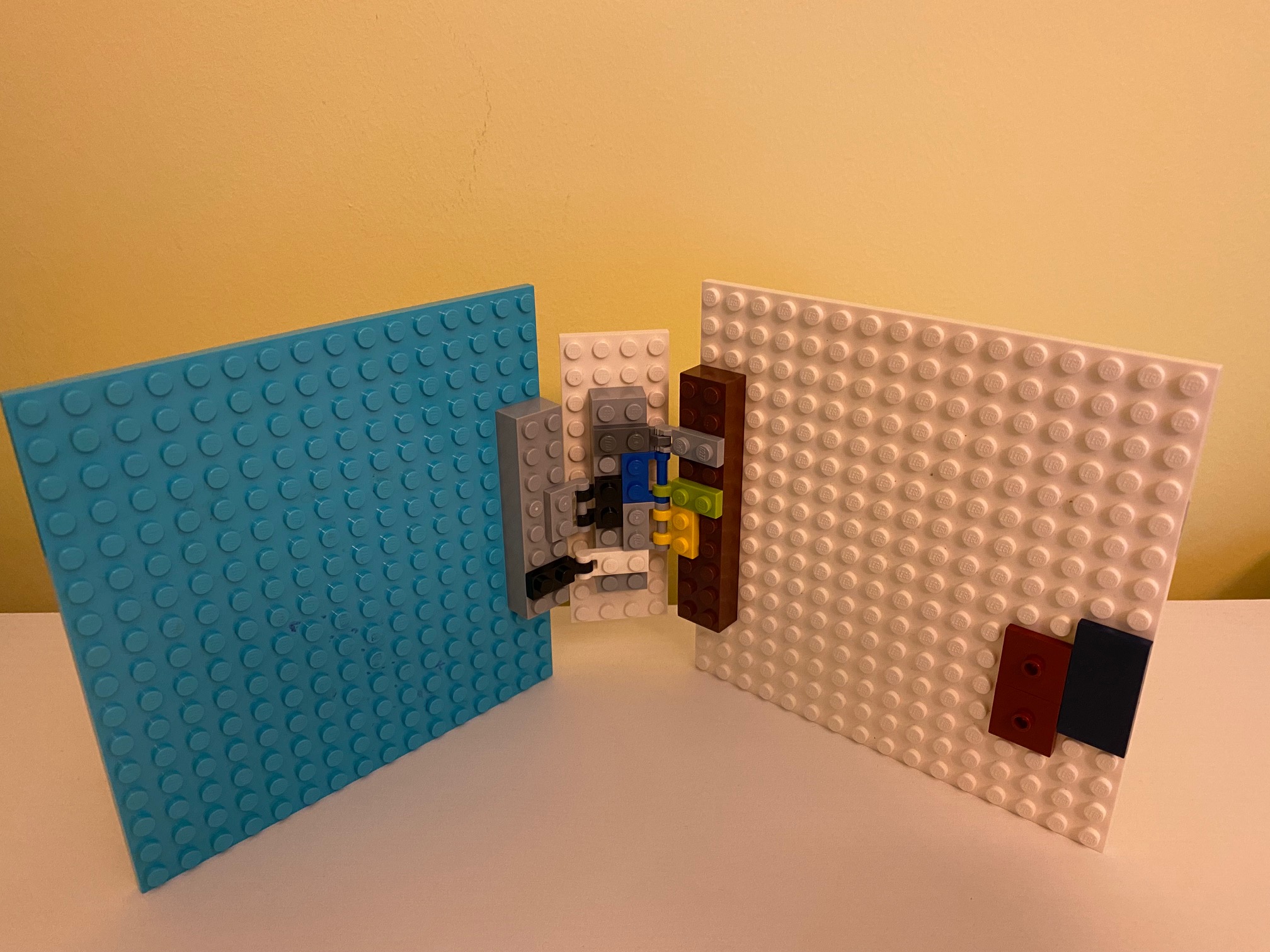
My eldest daughter and I visited a LEGO shop recently and I wanted to buy her a gift. The catch was that we were going to be flying on an airplane the next day, so I wanted to find something with the lowest risk of losing parts on the plane. We settled on Ariel, Belle, Cinderella and Tiana's Storybook Adventures which had a number of things going for it: It was reasonably priced at under 20, for the size of the set; it included four human minifigs (albeit in a sub-minifig size, some kind of munchkin size, but that did not seem to matter) and an assortment of animal accompaniments; but mostly, it folded up into a self-contained mock fairytail "book", and opened up into an enclosed "tray" play area, minimising the risk of losses on the flight.
The set in its resting state The set in its resting state
Lego have done a few of these styles of sets, all Disney princess themed, and it looks like they have a few more on their product roadmap. The newer ones incorporate a locking mechanism with a cute Lego key. I love the concept and think it should be extended to other themes/properties. I can imagine a Lego Star Wars-themed version with a little Death Star trench in the middle, or even an original IP like Classic Space, or Medieval.
Exploring a DIY Lego book frame Exploring a DIY Lego book frame
I really liked the Book device which reminded me of hollow books as a child. The cover and spine pieces are bespoke Lego bricks made for purpose, but I thought you could create something similar with generic parts. Holly and I had a go at the concept with what bricks we had to hand. It's definitely viable (and you could do a lot better with a wider selection of bricks / more skilled builders) and it will be fun to pick something to try and build on the spine.

9 November 2021

Joachim Breitner: How to audit an Internet Computer canister

I was recently called upon by Origyn to audit the source code of some of their Internet Computer canisters ( canisters are services or smart contracts on the Internet Computer), which were written in the Motoko programming language. Both the application model of the Internet Computer as well as Motoko bring with them their own particular pitfalls and possible sources for bugs. So given that I was involved in the creation of both, they reached out to me. In the course of that audit work I collected a list of things to watch out for, and general advice around them. Origyn generously allowed me to share that list here, in the hope that it will be helpful to the wider community.

Inter-canister calls The Internet Computer system provides inter-canister communication that follows the actor model: Inter-canister calls are implemented via two asynchronous messages, one to initiate the call, and one to return the response. Canisters process messages atomically (and roll back upon certain error conditions), but not complete calls. This makes programming with inter-canister calls error-prone. Possible common sources for bugs, vulnerabilities or simply unexpected behavior are:
  • Reading global state before issuing an inter-canister call, and assuming it to still hold when the call comes back.
  • Changing global state before issuing an inter-canister call, changing it again in the response handler, but assuming nothing else changes the state in between (reentrancy).
  • Changing global state before issuing an inter-canister call, and not handling failures correctly, e.g. when the code handling the callback rolls backs.
If you find such pattern in your code, you should analyze if a malicious party can trigger them, and assess the severity that effect These issues apply to all canisters, and are not Motoko-specific.

Rollbacks Even in the absence of inter-canister calls the behavior of rollbacks can be surprising. In particular, rejecting (i.e. throw) does not rollback state changes done before, while trapping (e.g. Debug.trap, assert , out of cycle conditions) does. Therefore, one should check all public update call entry points for unwanted state changes or unwanted rollbacks. In particular, look for methods (or rather, messages, i.e. the code between commit points) where a state change is followed by a throw. This issues apply to all canisters, and are not Motoko-specific, although other CDKs may not turn exceptions into rejects (which don t roll back).

Talking to malicious canisters Talking to untrustworthy canisters can be risky, for the following (likely incomplete) reasons:
  • The other canister can withhold a response. Although the bidirectional messaging paradigm of the Internet Computer was designed to guarantee a response eventually, the other party can busy-loop for as long as they are willing to pay for before responding. Worse, there are ways to deadlock a canister.
  • The other canister can respond with invalidly encoded Candid. This will cause a Motoko-implemented canister to trap in the reply handler, with no easy way to recover. Other CDKs may give you better ways to handle invalid Candid, but even then you will have to worry about Candid cycle bombs that will cause your reply handler to trap.
Many canisters do not even do inter-canister calls, or only call other trustwothy canisters. For the others, the impact of this needs to be carefully assessed.

Canister upgrade: overview For most services it is crucial that canisters can be upgraded reliably. This can be broken down into the following aspects:
  1. Can the canister be upgraded at all?
  2. Will the canister upgrade retain all data?
  3. Can the canister be upgraded promptly?
  4. Is three a recovery plan for when upgrading is not possible?

Canister upgradeability A canister that traps, for whatever reason, in its canister_preupgrade system method is no longer upgradeable. This is a major risk. The canister_preupgrade method of a Motoko canister consists of the developer-written code in any system func preupgrade() block, followed by the system-generated code that serializes the content of any stable var into a binary format, and then copies that to stable memory. Since the Motoko-internal serialization code will first serialize into a scratch space in the main heap, and then copy that to stable memory, canisters with more than 2GB of live data will likely be unupgradeable. But this is unlikely the first limit: The system imposes an instruction limit on upgrading a canister (spanning both canister_preupgrade and canister_postupgrade). This limit is a subnet configuration value, and sepearate (and likely higher) than the normal per-message limit, and not easily determined. If the canister s live data becomes too large to be serialized within this limit, the canister becomes non-upgradeable. This risk cannot be eliminated completely, as long as Motoko and Stable Variables are used. It can be mitigated by appropriate load testing: Install a canister, fill it up with live data, and exercise the upgrade. If this succeeds with a live data set exceeding the expected amount of data by a margin, this risk is probably acceptable. Bonus points for adding functionality that will prevent the canister s live data to increase above a certain size. If this testing is to be done on a local replica, extra care needs to be taken to make sure the local replica actually performs instruction counting and has the same resource limits as the production subnet. An alternative mitigation is to avoid canister_pre_upgrade as much as possible. This means no use of stable var (or restricted to small, fixed-size configuration data). All other data could be
  • mirrored off the canister (possibly off chain), and manually re-hydrated after an upgrade.
  • stored in stable memory manually, during each update call, using the ExperimentalStableMemory API. While this matches what high-assurance Rust canisters (e.g. the Internet Identity) do, This requires manual binary encoding of the data, and is marked experimental, so I cannot recommend this at the moment.
  • not put into a Motoko canister until Motoko has a scalable solution for stable variable (for example keeping them in stable memory permanently, with smart caching in main memory, and thus obliterating the need for pre-upgrade code.)

Data retention on upgrades Obviously, all live data ought to be retained during upgrades. Motoko automatically ensures this for stable var data. But often canisters want to work with their data in a different format (e.g. in objects that are not shared and thus cannot be put in stable vars, such as HashMap or Buffer objects), and thus may follow following idiom:
stable var fooStable =  ;
var foo = fooFromStable(fooStable);
system func preupgrade()   fooStable := fooToStable(foo);  )
system func postupgrade()   fooStable := (empty);  )
In this case, it is important to check that
  • All non-stable global vars, or global lets with mutable values, have a stable companion.
  • The assignments to foo and fooStable are not forgotten.
  • The fooToStable and fooFromStable form bijections.
An example would be HashMaps stored as arrays via Iter.toArray( .entries()) and HashMap.fromIter( .vals()). It is worth pointiong out that a code view will only look at a single version of the code, but cannot check whether code changes will preserve data on upgrade. This can easily go wrong if the names and types of stable variables are changed in incompatible way. The upgrade may fail loudly in this cases, but in bad cases, the upgrade may even succeed, losing data along the way. This risk needs to be mitigated by thorough testing, and possibly backups (see below).

Prompt upgrades Motoko and Rust canisters cannot be safely upgraded when they are still waiting for responses to inter-canister calls (the callback would eventually reach the new instance, and because of infelicities of the IC s System API, could possibly call arbitrary internal functions). Therefore, the canister needs to be stopped before upgrading, and started again. If the inter-canister calls take a long time, this mean that upgrading may take a long time, which may be undesirable. Again, this risk is reduced if all calls are made to trustworthy canisters, and elevated when possibly untrustworthy canisters are called, directly or indirectly.

Backup and recovery Because of the above risk around upgrades it is advisable to have a disaster recovery strategy. This could involve off-chain backups of all relevant data, so that it is possible to reinstall (not upgrade) the canister and re-upload all data. Note that reinstall has the same issue as upgrade described above in prompt upgrades : It ought to be stopped first to be safe. Note that the instruction limit for messages, as well as the message size limit, limit the amount of data returned. If the canister needs to hold more data than that, the backup query method might have to return chunks or deltas, with all the extra complexity that entails, e.g. state changes between downloading chunks. If large data load testing is performed (as Irecommend anyways to test upgradeability), one can test whether the backup query method works within the resource limits.

Time is not strictly monotonic The timestamps for current time that the Internet Computer provides to its canisters is guaranteed to be monotonic, but not strictly monotonic. It can return the same values, even in the same messages, as long as they are processed in the same block. It should therefore not be used to detect happens-before relations. Instead of using and comparing time stamps to check whether Y has been performed after X happened last, introduce an explicit var y_done : Bool state, which is set to False by X and then to True by Y. When things become more complex, it will be easier to model that state via an enumeration with speaking tag names, and update this state machine along the way. Another solution to this problem is to introduce a var v : Nat counter that you bump in every update method, and after each await. Now v is your canister s state counter, and can be used like a timestamp in many ways. While we are talking about time: The system time (typically) changes across an await. So if you do let now = Time.now() and then await, the value in now may no longer be what you want.

Wrapping arithmetic The Nat64 data type, and the other fixed-width numeric types provide opt-in wrapping arithmetic (e.g. +%, fromIntWrap). Unless explicitly required by the current application, this should be avoided, as usually a too large or negatie value is a serious, unrecoverable logic error, and trapping is the best one can do.

Cycle balance drain attacks Because of the IC s canister pays model, all canisters are prone to DoS attacks by draining their cycle balance, and this risk needs to be taken into account. The most elementary mitigation strategy is to monitor the cycle balance of canisters and keep it far from the (configurable) freezing threshold. On the raw IC-level, further mitigation strategies are possible:
  • If all update calls are authenticated, perform this authentication as quickly as possible, possibly before decoding the caller s argument. This way, a cycle drain attack by an unauthenticated attacker is less effective (but still possible).
  • Additionally, implementing the canister_inspect_message system method allows the above checks to be performed before the message even is accepted by the Internet Computer. But it does not defend against inter-canister messages and is therefore not a complete solution.
  • If an attack from an authenticated user (e.g. a stakeholder) is to be expected, the above methods are not effective, and an effective defense might require relatively involved additional program logic (e.g. per-caller statistics) to detect such an attack, and react (e.g. rate-limiting).
  • Such defenses are pointless if there is only a single method where they do not apply (e.g. an unauthenticated user registration method). If the application is inherently attackable this way, it is not worth the bother to raise defenses for other methods.
Related: A justification why the Internet Identity does not use canister_inspect_message) A motoko-implemented canister currently cannot perform most of these defenses: Argument decoding happens unconditionally before any user code that may reject a message based on the caller, and canister_inspect_message is not supported. Furthermore, Candid decoding is not very cycle defensive, and one should assume that it is possible to construct Candid messages that require many instructions to decode, even for simple argument type signatures. The conclusion for the audited canisters is to rely on monitoring to keep the cycle blance up, even during an attack, if the expense can be born, and maybe pray for IC-level DoS protections to kick in.

Large data attacks Another DoS attack vector exists if public methods allow untrustworthy users to send data of unlimited size that is persisted in the canister memory. Because of the translation of async-await code into multiple message handlers, this applies not only to data that is obviously stored in global state, but also local data that is live across an await point. The effectiveness of such attacks is limited by the Internet Computer s message size limit, which is in the order of a few megabytes, but many of those also add up. The problem becomes much worse if a method has an argument type that allows a Candid space bomb: It is possible to encode very large vectors with all values null in Candid, so if any method has an argument of type [Null] or [?t], a small message will expand to a large value in the Motoko heap. Other types to watch out:
  • Nat and Int: This is an unbounded natural number, and thus can be arbitrarily large. The Motoko representation will however not be much larger than the Candid encoding (so this does not qualify as a space bomb).
It is still advisable to check if the number is reasonable in size before storing it or doing an await. For example, when it denotes an index in an array, throw early if it exceeds the size of the array; if it denotes a token amount to transfer, check it against the available balance, if it denotes time, check it against reasonable bounds.
  • Principal: A Principal is effectively a Blob. The Interface specification says that principals are at most 29 bytes in length, but the Motoko Candid decoder does not check that currently (fixed in the next version of Motoko). Until then, a Principal passed as an argument can be large (the principal in msg.caller is system-provided and thus safe). If you cannot wait for the fix to reach you, manually check the size of the princial (via Principal.toBlob) before doing the await.

Shadowing of msg or caller Don t use the same name for the message context of the enclosing actor and the methods of the canister: It is dangerous to write shared(msg) actor, because now msg is in scope across all public methods. As long as these also use public shared(msg) func , and thus shadow the outer msg, it is correct, but it if one accidentially omits or mis-types the msg, no compiler error would occur, but suddenly msg.caller would now be the original controller, likely defeating an important authorization step. Instead, write shared(init_msg) actor or shared( caller = controller ) actor to avoid using msg.

Conclusion If you write a serious canister, whether in Motoko or not, it is worth to go through the code and watch out for these patterns. Or better, have someone else review your code, as it may be hard to spot issues in your own code. Unfortunately, such a list is never complete, and there are surely more ways to screw up your code in addition to all the non-IC-specific ways in which code can be wrong. Still, things get done out there, so best of luck!

8 November 2021

Enrico Zini: An educational debugging session

This morning we realised that a test case failed on Fedora 34 only (the link is in Italian) and we set to debugging. The initial analysis This is the initial reproducer:
$ PROJ_DEBUG=3 python setup.py test
test_recipe (tests.test_litota3.TestLITOTA3NordArkimetIFS) ... pj_open_lib(proj.db): call fopen(/lib64/../share/proj/proj.db) - succeeded
proj_create: Open of /lib64/../share/proj/proj.db failed
pj_open_lib(proj.db): call fopen(/lib64/../share/proj/proj.db) - succeeded
proj_create: no database context specified
Cannot instantiate source_crs
EXCEPTION in py_coast(): ProjP: cannot create crs to crs from [EPSG:4326] to [+proj=merc +lon_0=0 +k=1 +x_0=0 +y_0=0 +ellps=WGS84 +datum=WGS84 +over +units=m +no_defs]
ERROR
Note that opening /lib64/../share/proj/proj.db sometimes succeeds, sometimes fails. It's some kind of Schr dinger path, which works or not depending on how you observe it:
# ls -lad /lib64
lrwxrwxrwx 1 1000 1000 9 Jan 26  2021 /lib64 -> usr/lib64
$ ls -la /lib64/../share/proj/proj.db
-rw-r--r-- 1 root root 8925184 Jan 28  2021 /lib64/../share/proj/proj.db
$ cd /lib64/../share/proj/
$ cd /lib64
$ cd ..
$ cd share
-bash: cd: share: No such file or directory
And indeed, stat(2) finds it, and sqlite doesn't (the file is a sqlite database):
$ stat /lib64/../share/proj/proj.db
  File: /lib64/../share/proj/proj.db
  Size: 8925184     Blocks: 17432      IO Block: 4096   regular file
Device: 33h/51d Inode: 56907       Links: 1
Access: (0644/-rw-r--r--)  Uid: (    0/    root)   Gid: (    0/    root)
Access: 2021-11-08 14:09:12.334350779 +0100
Modify: 2021-01-28 05:38:11.000000000 +0100
Change: 2021-11-08 13:42:51.758874327 +0100
 Birth: 2021-11-08 13:42:51.710874051 +0100
$ sqlite3 /lib64/../share/proj/proj.db
Error: unable to open database "/lib64/../share/proj/proj.db": unable to open database file
A minimal reproducer Later on we started stripping layers of code towards a minimal reproducer: here it is. It works or doesn't work depending on whether proj is linked explicitly, or via MagPlus:
$ cat tc.cc
#include <magics/ProjP.h>
int main()  
    magics::ProjP p("EPSG:4326", "+proj=merc +lon_0=0 +k=1 +x_0=0 +y_0=0 +ellps=WGS84 +datum=WGS84 +over +units=m +no_defs");
    return 0;
 
$ g++ -o tc  tc.cc -I/usr/include/magics  -lMagPlus
$ ./tc
proj_create: Open of /lib64/../share/proj/proj.db failed
proj_create: no database context specified
terminate called after throwing an instance of 'magics::MagicsException'
  what():  ProjP: cannot create crs to crs from [EPSG:4326] to [+proj=merc +lon_0=0 +k=1 +x_0=0 +y_0=0 +ellps=WGS84 +datum=WGS84 +over +units=m +no_defs]
Aborted (core dumped)
$ g++ -o tc  tc.cc -I/usr/include/magics -lproj  -lMagPlus
$ ./tc
What is going on here? A difference between the two is the path used to link to libproj.so:
$ ldd ./tc   grep proj
    libproj.so.19 => /lib64/libproj.so.19 (0x00007fd4919fb000)
$ g++ -o tc  tc.cc -I/usr/include/magics   -lMagPlus
$ ldd ./tc   grep proj
    libproj.so.19 => /lib64/../lib64/libproj.so.19 (0x00007f6d1051b000)
Common sense screams that this should not matter, but we chased an intuition and found that one of the ways proj looks for its database is relative to its shared library. Indeed, gdb in hand, that dladdr call returns /lib64/../lib64/libproj.so.19. From /lib64/../lib64/libproj.so.19, proj strips two paths from the end, presumably to pass from something like /something/usr/lib/libproj.so to /something/usr. So, dladdr returns /lib64/../lib64/libproj.so.19, which becomes /lib64/../, which becomes /lib64/../share/proj/proj.db, which exists on the file system and is used as a path to the database. But depending how you look at it, that path might or might not be valid: it passes the stat(2) check that stops the lookup for candidate paths, but sqlite is unable to open it. Why does the other path work? By linking libproj.so in the other way, dladdr returns /lib64/libproj.so.19, which becomes /share/proj/proj.db, which doesn't exist, which triggers a fallback to a PROJ_LIB constant defined at compile time, which is a path that works no matter how you look at it. Why that weird path with libMagPlus? To complete the picture, we found that libMagPlus.so is packaged with a rpath set, which is known to cause trouble
# readelf -d /usr/lib64/libMagPlus.so grep rpath
 0x000000000000000f (RPATH)              Library rpath: [$ORIGIN/../lib64]
The workaround We found that one can set PROJ_LIB in the environment to override the normal proj database lookup. Building on that, we came up with a simple way to override it on Fedora 34 only:
    if distro is not None and distro.linux_distribution()[:2] == ("Fedora", "34") and "PROJ_LIB" not in os.environ:
         self.env_overrides["PROJ_LIB"] = "/usr/share/proj/"
This has been a most edifying and educational debugging session, with only the necessary modicum of curses and swearwords. Working in a team of excellent people really helps.

Russell Coker: Installing NextCloud

NextCloud and OwnCloud History Some time ago I tried OwnCloud, it wasn t a positive experience for me. Since that time I ve got a server with a much faster CPU, a faster Internet connection, and the NextCloud code is newer and running on a newer version of PHP, I didn t make good notes so I m not sure which factors were most responsible for having a better experience this time. According to the NextCloud Wikipedia page [1] the fork of NextCloud from the OpenCloud base happened in 2016 so it s obviously been a while since I tried it, it was probably long before 2016. Recently the BBC published an interesting article on Turnover contagion which is when one resignation can trigger many more [2] which is interesting to read in the context of OwnCloud losing critical staff failing after one key developer resigned. I mentioned OwnCloud in a 2012 blog post about Liberty and Mobile Phones [3], since then I haven t done well at achieving those goals. A few days ago I decided to try NextCloud and found it a much better experience than I recall OwnCloud being in the past. Installation I installed OwnCloud on an Oracle Cloud ARM VM (see my previous blog post about the Oracle Cloud Free Tier [4]). This CloudCone article on installing NextCloud on Debian 10 (Buster) covers the basics well [5]. Here is the NextCloud URL for downloading the PHP files (a large ZIP archive) [6]. You have to extract to where Apache is configured to have it s webroot and then run chown -R www-data nextcloud/lib/private/Log nextcloud/config nextcloud/apps (or if you use php-fpm then chown it to the user for that). NextCloud recommend having all of the NextCloud files owned by www-data, but that s just a bad idea, allowing it to rewrite some of it s program files is bad, allowing it to rewrite all of them is worse. For my installation I used the Apache modiles macro, rewrite, ssl, php7.4, and headers (this is more about how I configure Apache than about NextCloud). Also I edited /etc/php/7.4/apache2/php.ini and changed memory_limit to 512M (the default of 128M is not enough). I m currently only testing it, for a production use I would use php-fpm and run it under it s own UID so that it can t interact with other PHP apps. After that it was just a matter of visiting the configuration URL and giving it the details of the database etc. After setting it up the command php -d memory_limit=512M occ app:install richdocumentscode_arm64 when run from the root of the OwnCloud installation installs the Cloudera components for editing LibreOffice documents in OwnCloud, this is the command for ARM64 architecture, I presume the command for other architectures is similar. Conclusion OwnCloud is very usable, it has a decent feature set built in and the option to download modules such as the components for editing LibreOffice files on the web is useful. But I am hesitant to install things that require the sort of access it requires. I think it would be better if there was a documented and supported way of installing things and then locking them down so that at runtime it can only write to data files not any program files or configuration files. It would also be better if it was packaged for Debian and had the Debian update process for security fixes. I can imagine many people installing it, forgetting to update it, and ending up with insecure systems.

6 November 2021

Reproducible Builds: Reproducible Builds in October 2021

Welcome to the October 2021 report from the Reproducible Builds project!
This month Samanta Navarro posted to the oss-security security mailing on a novel category of exploit in the .tar archive format, where a single .tar file contains different contents depending on the tar utility being used. Naturally, this has consequences for reproducible builds as Samanta goes onto reply:

Arch Linux uses libarchive (bsdtar) in its build environment. The default tar program installed is GNU tar. It is possible to create a source distribution which leads to different files seen by the build environment than compared to a careful reviewer and other Linux distributions.
Samanta notes that addressing the tar utilities themselves will not be a sufficient fix:
I have submitted bug reports and patches to some projects but eventually I had to conclude that the problem itself cannot be fixed by these implementations alone. The best choice for these tools would be to only allow archives which are fully compatible to standards but this in turn would render a lot of archives broken.
Reproducible builds, with its twin ideas of reaching consensus on the build outputs as well as precisely recording and describing the build environment, would help address this problem at a higher level.
Codethink announced that they had achieved ISO-26262 ASIL D Tool Certification, a way of determining specific safety standards for software. Codethink used open source tooling to achieve this, but they also leverage:
Reproducibility, repeatability and traceability of builds, drawing heavily on best-practices championed by the Reproducible Builds project.

Elsewhere on the internet, according to a comment on Hacker News, Microsoft are now comparing NPM Javascript packages with their original source repositories:
I got a PR in my repository a few days ago leading back to a team trying to make it easier for packages to be reproducible from source.

Lastly, Martin Monperrus started an interesting thread on our mailing list about Github, specifically that their autogenerated release tarballs are not deterministic . The thread generated a significant number of replies that are worth reading.

Events and presentations

Community news On our mailing list this month:
There were quite a few changes to the Reproducible Builds website and documentation this month as well, including Feng Chai updating some links on our publications page [ ] and marco updated our project metadata around the Bitcoin Core building guide [ ].
Lastly, we ran another productive meeting on IRC during October. A full set of notes from the meeting is available to view.

Distribution work Qubes was heavily featured in the latest edition of Linux Weekly News, and a significant section was dedicated to discussing reproducibility. For example, it was mentioned that the Qubes project has been working on incorporating reproducible builds into its continuous integration (CI) infrastructure . But the LWN article goes on to describe that:
The current goal is to be able to build the Qubes OS Debian templates solely from packages that can be built reproducibly. Templates in Qubes OS are VM images that can be used to start an application qube quickly based on the template. The qube will have read-only access to the root filesystem of the template, so that the same root filesystem can be shared with multiple application qubes. There are official templates for several variants of both Fedora and Debian, as well as community maintained templates for several other distributions.
You can view the whole article on LWN, and Fr d ric also published a lengthy summary about their work on reproducible builds in Qubes as well for those wishing to learn more.
In Debian this month, 133 reviews of Debian packages were added, 81 were updated and 24 were removed this month, adding to Debian s ever-growing knowledge about identified issues. A number of issues were categorised and added by Chris Lamb and Vagrant Cascadian too [ ][ ][ ]. In addition, work on alternative snapshot service has made progress by Fr d ric Pierret and Holger Levsen this month, including moving from the existing host (snapshot.notset.fr) to snapshot.reproducible-builds.org (more info) thanks to OSUOSL for the machine and hosting and Debian for the disks.
Finally, Bernhard M. Wiedemann posted his monthly reproducible builds status report.

diffoscope diffoscope is our in-depth and content-aware diff utility. Not only can it locate and diagnose reproducibility issues, it can provide human-readable diffs from many kinds of binary formats. This month, Chris Lamb made the following changes, including preparing and uploading versions 186, 187, 188 and 189 to Debian
  • New features:
    • Add support for Python Sphinx inventory files (usually named objects.inv on-disk). [ ]
    • Add support for comparing .pyc files. Thanks to Sergei Trofimovich for the inspiration. [ ]
    • Try some alternative suffixes (e.g. .py) to support distributions that strip or retain them. [ ][ ]
  • Bug fixes:
    • Fix Python decompilation tests under Python 3.10+ [ ] and for Python 3.7 [ ].
    • Don t raise a traceback if we cannot unmarshal Python bytecode. This is in order to support Python 3.7 failing to load .pyc files generated with newer versions of Python. [ ]
    • Skip Python bytecode testing where we do not have an expected diff. [ ]
  • Codebase improvements:
    • Use our file_version_is_lt utility instead of accepting both versions of uImage expected diff. [ ]
    • Split out a custom call to assert_diff for a .startswith equivalent. [ ]
    • Use skipif instead of manual conditionals in some tests. [ ]
In addition, Jelle van der Waa added external tool references for Arch Linux for ocamlobjinfo, openssl and ffmpeg [ ][ ][ ] and added Arch Linux as a Continuous Integration (CI) test target. [ ] and Vagrant Cascadian updated the testsuite to skip Python bytecode comparisons when file(1) is older than 5.39. [ ] as well as added external tool references for the Guix distribution for dumppdf and ppudump. [ ][ ]. Vagrant Cascadian also updated the diffoscope package in GNU Guix [ ][ ]. Lastly, Guangyuan Yang updated the FreeBSD package name on the website [ ], Mattia Rizzolo made a change to override a new Lintian warning due to the new test files [ ], Roland Clobus added support to detect and log if the GNU_BUILD_ID field in an ELF binary been modified [ ], Sandro J ckel updated a number of helpful links on the website [ ] and Sergei Trofimovich made the uImage test output support file() version 5.41 [ ].

reprotest reprotest is the Reproducible Build s project end-user tool to build same source code twice in widely differing environments, checking the binaries produced by the builds for any differences. This month, reprotest version 0.7.18 was uploaded to Debian unstable by Holger Levsen, which also included a change by Holger to clarify that Python 3.9 is used nowadays [ ], but it also included two changes by Vasyl Gello to implement realistic CPU architecture shuffling [ ] and to log the selected variations when the verbosity is configured at a sufficiently high level [ ]. Finally, Vagrant Cascadian updated reprotest to version 0.7.18 in GNU Guix.

Upstream patches The Reproducible Builds project detects, dissects and attempts to fix unreproducible packages. We try to send all of our patches upstream where appropriate. We authored a large number of such patches this month, including:

Testing framework The Reproducible Builds project runs a testing framework at tests.reproducible-builds.org, to check packages and other artifacts for reproducibility. This month, the following changes were made:
  • Holger Levsen:
    • Debian-related changes:
      • Incorporate a fix from bremner into builtin-pho related to binary-NMUs. [ ]
      • Keep bullseye environments around longer, in an attempt to fix a Jenkins issue. [ ]
      • Improve the documentation of buildinfos.debian.net. [ ]
      • Improve documentation for the builtin-pho setup. [ ][ ]
    • OpenWrt-related changes:
      • Also use -j1 for better debugging. [ ]
      • Document that that Python 3.x is now used. [ ]
      • Enable further debugging for the toolchain build. [ ]
    • New snapshot.reproducible-builds.org service:
      • Actually add new node. [ ][ ]
      • Install xfsprogs on snapshot.reproducible-builds.org. [ ]
      • Create account for fpierret on new node. [ ]
      • Run node_health_check job on new node too. [ ]
  • Mattia Rizzolo:
    • Debian-related changes:
      • Handle schroot errors when invoking diffoscope instead of masking them. [ ][ ]
      • Declare and define some variables separately to avoid masking the subshell return code. [ ]
      • Fix variable name. [ ]
      • Improve log reporting. [ ]
      • Execute apt-get update with the -q argument to get more decent logs. [ ]
      • Set the Debian HTTP mirror and proxy for snapshot.reproducible-builds.org. [ ]
      • Install the libarchive-tools package (instead of bsdtar) when updating Jenkins nodes. [ ]
    • Be stricter about errors when starting the node agent [ ] and don t overwrite NODE_NAME so that we can expect Jenkins to properly set for us [ ].
    • Explicitly warn if the NODE_NAME is not a fully-qualified domain name (FQDN). [ ]
    • Document whether a node runs in the future. [ ]
    • Disable postgresql_autodoc as it not available in bullseye. [ ]
    • Don t be so eager when deleting schroot internals, call to schroot -e to terminate the schroots instead. [ ]
    • Only consider schroot underlays for deletion that are over a month old. [ ][ ]
    • Only try to unmount /proc if it s actually mounted. [ ]
    • Move the db_backup task to its own Jenkins job. [ ]
Lastly, Vasyl Gello added usage information to the reproducible_build.sh script [ ].

Contributing If you are interested in contributing to the Reproducible Builds project, please visit our Contribute page on our website. However, you can get in touch with us via:

4 November 2021

Antoine Beaupr : A Python contextmanager gotcha

Dear lazy web... I've had this code sitting around as a wtf.py for a while. I've been meaning to understand what's going on and write a blog post about it for a while, but I'm lacking the time. Now that I have a few minutes, I actually sat down to look at it and I think I figured it out:
from contextlib import contextmanager
@contextmanager
def bad():
    print(&aposin the context manager&apos)
    try:
        print("yielding value")
        yield &aposvalue&apos
    finally:
        return print(&aposcleaning up&apos)
@contextmanager
def good():
    print(&aposin the context manager&apos)
    try:
        print("yielding value")
        yield &aposvalue&apos
    finally:
        print(&aposcleaning up&apos)
with bad() as v:
    print(&aposgot v = %s&apos % v)
    raise Exception(&aposexception not raised!&apos)  # SILENCED!
print("this code is reached")
with good() as v:
    print(&aposgot v = %s&apos % v)
    raise Exception(&aposexpection normally raised&apos)
print("NOT REACHED (expected)")
For those, like me, who need a walkthrough, here's what the above does:
  1. define a bad context manager (the things you use with with statements) with contextlib.contextmanager) which:
    1. prints a debug statement
    2. return a value
    3. then returns and prints a debug statement
  2. define a good context manager in much the same way, except it doesn't return, it just prints statement
  3. use the bad context manager to show how it bypasses an exception
  4. use the good context manager to show how it correctly raises the exception
The output of this code (in Debian 11 bullseye, Python 3.9.2) is:
in the context manager
yielding value
got v = value
cleaning up
this code is reached
in the context manager
yielding value
got v = value
cleaning up
Traceback (most recent call last):
  File "/home/anarcat/wikis/anarc.at/wtf.py", line 31, in <module>
    raise Exception('expection normally raised')
Exception: expection normally raised
What is surprising to me, with this code, is not only does the exception not get raised, but also the return statement doesn't seem to actually execute, or at least not in the parent scope: if it would, this code is reached wouldn't be printed and the rest of the code wouldn't run either. So what's going on here? Now I know that I should be careful with return in my context manager, but why? And why is it silencing the exception? The reason why it's being silenced is this little chunk in the with documentation:
If the suite was exited due to an exception, and the return value from the exit() method was false, the exception is reraised. If the return value was true, the exception is suppressed, and execution continues with the statement following the with statement.
This feels a little too magic. If you write a context manager with __exit__(), you're kind of forced to lookup again what that API is. But the contextmanager decorator hides that away and it's easy to make that mistake... Credits to the Python tips book for teaching me about that trick in the first place.

1 November 2021

Thorsten Alteholz: My Debian Activities in October 2021

FTP master This month I accepted 341 and rejected 46 packages. The rejection is as high as last month. I hope everybody is aware that pressing just one key when accepting a package is much faster than writing an explanation why a package has to be rejected. Anyway, the overall number of packages that got accepted was 355. Debian LTS This was my eighty-eighth month that I did some work for the Debian LTS initiative, started by Raphael Hertzog at Freexian. This month my all in all workload has been 28.5h. During that time I did LTS and normal security uploads of: I also continued to work on exiv2. Last but not least I did some days of frontdesk duties. Debian ELTS This month was the fortieth ELTS month. During my allocated time I uploaded: Last but not least I did some days of frontdesk duties. Debian Printing I improved packaging or fixed bugs or uploaded a new version of: Last but not least I looked at some old bugs and checked whether they could be closed. Debian Astro Though being a silent member of Debian Astro for a long time, I am now going to be more active now. Most of the time I will be focused on packages for telescope control, but of course I won t stay away from other topics. So I uploaded: If you know of other missing packages, don t hesitate to tell me! Other stuff On my neverending golang challenge I again uploaded some packages either for NEW or as source upload. I uploaded new upstream versions of: I improved packaging or fixed bugs of:

31 October 2021

Russ Allbery: Review: Shadow Scale

Review: Shadow Scale, by Rachel Hartman
Series: Seraphina #2
Publisher: Ember
Copyright: 2015
ISBN: 0-375-89659-7
Format: Kindle
Pages: 458
Shadow Scale, despite confusing publisher marketing that calls it a "companion" to Seraphina, is a direct sequel. It picks up shortly after Seraphina and resolves most of the loose ends of the previous book. This is a book for which my completionist tendencies did me no favors. The book I was intending to read, when I started on Hartman's work, is Tess of the Road, but I hate starting series in the middle and it was clear that Tess was set after Seraphina. (I have been repeatedly assured that this doesn't matter and that one can start with Tess. Such reassurances rarely work on me; do as I say, not as I do.) For Seraphina itself, this turned out fine; I'm mildly surprised by the book's Andre Norton award nomination, but it was enjoyable enough and I liked the first-person protagonist. Shadow Scale I approached with a bit more trepidation. I hadn't heard much about it and the few reviews I saw were lukewarm. Unfortunately, there's a reason for that. Seraphina left obvious room for a sequel, including a brewing war, significant unresolved interpersonal relationships, and Seraphina's own newfound understanding of the nature of her internal menagerie. Alas, the start of the book uses the war primarily as plot device (and introduces a brand-new bit of magic that I never found interesting), largely ignores the relationship, and focuses on that third plot element. And by focuses, I mean Seraphina is sent out of the country of Goredd on a journey of map exploration to collect plot coupons. The best description I have for the middle of this book is tedious and depressing. Like a lot of novels, it has a U-shaped plot: things get worse and worse until a crisis, and then start getting better. This plot can work, but the reader has to have a good reason to stick through the depressing bits. One of the better reasons is if the plot allows the main character some small triumphs, maintaining their agency throughout even if larger events are spiraling out of control. This is not one of those books. After some early successes tracking down some objects of her search, Seraphina encounters an antagonist from her own past (barely hinted at in the first book) who can systematically corrupt everything she is trying to do. She spends most of the book feeling like what she's doing is futile, or hoping for things the reader knows aren't going to happen. Given that this is happening during plodding map exploration fantasy through largely indistinguishable faux-medieval countries, or (later) somewhat more interesting but obviously irrelevant local politics in a remote trading city, it's hard to avoid sharing that sense of futility. The other structural problem with Shadow Scale is that the plot coupons are people, which means this book has an excessive cast size problem. Seraphina collects too many people for me to even keep straight, let alone care about. Critical developments (usually for the worst) in the lives of one of these characters were frequently met with reader mutterings like, "Now which one was Brasidas again, was he the plague doctor?" This tends to undermine the emotional impact. It didn't help that the plot was enough of a slog that I kept putting the book aside for a few days. This does get better, but not enough better to redeem the middle of the book, and one has to put up with a lot of helpless despair to get there. Shadow Scale is one of those stories where the protagonist has the innate power to resolve the plot, is told cryptically by various people that this is the case, but has absolutely no idea how to use it and her supposed mentors are essentially useless. The result is that she feels both hopeless and guilty, which was not the reading experience I wanted. I did enjoy the moment when she finally figures it out, and I thought Hartman's idea was reasonably clever, but it would have been better if that had happened faster. Like, 200 pages faster. At least. The major world-building in Seraphina was the dragons. The dragons also show up in this book (and feel less like autism spectrum archetypes, which I appreciated), and in theory are central to the plot, but I'm not entirely sure why? It was an odd reading experience. I think Hartman was attempting to set up dual villains posing different threats, but the dragon one is off-screen for nearly the entire book and never developed, so it feels perfunctory. Near the end of the book, Hartman abruptly picks up the dragons again, but that whole section felt oddly disconnected from the rest of the plot and is only barely relevant to the resolution. At least for me, the plot structure didn't cohere. Shadow Scale does go up a whole point in rating for me because of the romance plot and how Hartman resolves it, which I will not spoil but which I loved. The process of getting there is immensely frustrating because it feels like Hartman is forcing the characters into a corner where only stupid resolutions are possible, but in this case the U-shaped emotional structure worked on me. The ending is completely true to the characters in a way that I thought Hartman had made impossible (and which does a lovely bit of undermining of traditional roles), so full credit there. It helped that the relationship is put on ice for most of the book and only appears at the end (which is also the best part of the book), so it didn't drag on like the other parts of the plot. Overall, though, I tentatively agree with the general advice to skip this one, and suspect that advice will become less tentative once I read Tess of the Road. It's a largely unpleasant slog. There are some mildly interesting world-building revelations that fill in the background of Seraphina, the ending was reasonably good, and the relationships were much better than I was expecting through most of the book, but the amount of time and patience required to get there was not a good trade-off for me. Followed (in the sense that it's set in the same universe but is not a sequel and I suspect does not depend heavily on this plot) by Tess of the Road. Rating: 4 out of 10

24 October 2021

Petter Reinholdtsen: Debian still an excellent choice for Lego builders

The Debian Lego team saw a lot of activity the last few weeks. All the packages under the team umbrella has been updated to fix packaging, lintian issues and BTS reports. In addition, a new and inspiring team member appeared on both the debian-lego-team Team mailing list and IRC channel #debian-lego. If you are interested in Lego CAD design and LEGO Minestorms programming, check out the team wiki page to see what Debian can offer the Lego enthusiast. Patches has been sent upstream, causing new upstream releases, one even the first one in more than ten years, and old upstreams was released with new ones. There are still a lot of work left, and the team welcome more members to help us make sure Debian is the Linux distribution of choice for Lego builders. If you want to contribute, join us in the IRC channel and become part of the team on Salsa. As usual, if you use Bitcoin and want to show your support of my activities, please send Bitcoin donations to my address 15oWEoG9dUPovwmUL9KWAnYRtNJEkP1u1b.

23 October 2021

Antoine Beaupr : The Neo-Colonial Internet

I grew up with the Internet and its ethics and politics have always been important in my life. But I have also been involved at other levels, against police brutality, for Food, Not Bombs, worker autonomy, software freedom, etc. For a long time, that all seemed coherent. But the more I look at the modern Internet -- and the mega-corporations that control it -- and the less confidence I have in my original political analysis of the liberating potential of technology. I have come to believe that most of our technological development is harmful to the large majority of the population of the planet, and of course the rest of the biosphere. And now I feel this is not a new problem. This is because the Internet is a neo-colonial device, and has been from the start. Let me explain.

What is Neo-Colonialism? The term "neo-colonialism" was coined by Kwame Nkrumah, first president of Ghana. In Neo-Colonialism, the Last Stage of Imperialism (1965), he wrote:
In place of colonialism, as the main instrument of imperialism, we have today neo-colonialism ... [which] like colonialism, is an attempt to export the social conflicts of the capitalist countries. ... The result of neo-colonialism is that foreign capital is used for the exploitation rather than for the development of the less developed parts of the world. Investment, under neo-colonialism, increases, rather than decreases, the gap between the rich and the poor countries of the world.
So basically, if colonialism is Europeans bringing genocide, war, and its religion to the Africa, Asia, and the Americas, neo-colonialism is the Americans (note the "n") bringing capitalism to the world. Before we see how this applies to the Internet, we must therefore make a detour into US history. This matters, because anyone would be hard-pressed to decouple neo-colonialism from the empire under which it evolves, and here we can only name the United States of America.

US Declaration of Independence Let's start with the United States declaration of independence (1776). Many Americans may roll their eyes at this, possibly because that declaration is not actually part of the US constitution and therefore may have questionable legal standing. Still, it was obviously a driving philosophical force in the founding of the nation. As its author, Thomas Jefferson, stated:
it was intended to be an expression of the American mind, and to give to that expression the proper tone and spirit called for by the occasion
In that aging document, we find the following pearl:
We hold these truths to be self-evident, that all men are created equal, that they are endowed by their Creator with certain unalienable Rights, that among these are Life, Liberty and the pursuit of Happiness.
As a founding document, the Declaration still has an impact in the sense that the above quote has been called an:
"immortal declaration", and "perhaps [the] single phrase" of the American Revolutionary period with the greatest "continuing importance." (Wikipedia)
Let's read that "immortal declaration" again: "all men are created equal". "Men", in that context, is limited to a certain number of people, namely "property-owning or tax-paying white males, or about 6% of the population". Back when this was written, women didn't have the right to vote, and slavery was legal. Jefferson himself owned hundreds of slaves. The declaration was aimed at the King and was a list of grievances. A concern of the colonists was that the King:
has excited domestic insurrections amongst us, and has endeavoured to bring on the inhabitants of our frontiers, the merciless Indian Savages whose known rule of warfare, is an undistinguished destruction of all ages, sexes and conditions.
This is a clear mark of the frontier myth which paved the way for the US to exterminate and colonize the territory some now call the United States of America. The declaration of independence is obviously a colonial document, having being written by colonists. None of this is particularly surprising, historically, but I figured it serves as a good reminder of where the Internet is coming from, since it was born in the US.

A Declaration of the Independence of Cyberspace Two hundred and twenty years later, in 1996, John Perry Barlow wrote a declaration of independence of cyberspace. At this point, (almost) everyone has a right to vote (including women), slavery was abolished (although some argue it still exists in the form of the prison system); the US has made tremendous progress. Surely this text will have aged better than the previous declaration it is obviously derived from. Let's see how it reads today and how it maps to how the Internet is actually built now.

Borders of Independence One of the key ideas that Barlow brings up is that "cyberspace does not lie within your borders". In that sense, cyberspace is the final frontier: having failed to colonize the moon, Americans turn inwards, deeper into technology, but still in the frontier ideology. And indeed, Barlow is one of the co-founder of the Electronic Frontier Foundation (the beloved EFF), founded six years prior. But there are other problems with this idea. As Wikipedia quotes:
The declaration has been criticized for internal inconsistencies.[9] The declaration's assertion that 'cyberspace' is a place removed from the physical world has also been challenged by people who point to the fact that the Internet is always linked to its underlying geography.[10]
And indeed, the Internet is definitely a physical object. First controlled and severely restricted by "telcos" like AT&T, it was somewhat "liberated" from that monopoly in 1982 when an anti-trust lawsuit broke up the monopoly, a key historical event that, one could argue, made the Internet possible. (From there on, "backbone" providers could start competing and emerge, and eventually coalesce into new monopolies: Google has a monopoly on search and advertisement, Facebook on communications for a few generations, Amazon on storage and computing, Microsoft on hardware, etc. Even AT&T is now pretty much as consolidated as it was before.) The point is: all those companies have gigantic data centers and intercontinental cables. And those are definitely prioritizing the western world, the heart of the empire. Take for example Google's latest 3,900 mile undersea cable: it does not connect Argentina to South Africa or New Zealand, it connects the US to UK and Spain. Hardly a revolutionary prospect.

Private Internet But back to the Declaration:
Do not think that you can build it, as though it were a public construction project. You cannot. It is an act of nature and it grows itself through our collective actions.
In Barlow's mind, the "public" is bad, and private is good, natural. Or, in other words, a "public construction project" is unnatural. And indeed, the modern "nature" of development is private: most of the Internet is now privately owned and operated. I must admit that, as an anarchist, I loved that sentence when I read it. I was rooting for "us", the underdogs, the revolutionaries. And, in a way, I still do: I am on the board of Koumbit and work for a non-profit that has pivoted towards censorship and surveillance evasion. Yet I cannot help but think that, as a whole, we have failed to establish that independence and put too much trust in private companies. It is obvious in retrospect, but it was not, 30 years ago. Now, the infrastructure of the Internet has zero accountability to traditional political entities supposedly representing the people, or even its users. The situation is actually worse than when the US was founded (e.g. "6% of the population can vote"), because the owners of the tech giants are only a handful of people who can override any decision. There's only one Amazon CEO, he's called Jeff Bezos, and he has total control. (Update: Bezos actually ceded the CEO role to Andy Jassy, AWS and Amazon music founder, while remaining executive chairman. I would argue that, as the founder and the richest man on earth, he still has strong control over Amazon.)

Social Contract Here's another claim of the Declaration:
We are forming our own Social Contract.
I remember the early days, back when "netiquette" was a word, it did feel we had some sort of a contract. Not written in standards of course -- or barely (see RFC1855) -- but as a tacit agreement. How wrong we were. One just needs to look at Facebook to see how problematic that idea is on a global network. Facebook is the quintessential "hacker" ideology put in practice. Mark Zuckerberg explicitly refused to be "arbiter of truth" which implicitly means he will let lies take over its platforms. He also sees Facebook as place where everyone is equal, something that echoes the Declaration:
We are creating a world that all may enter without privilege or prejudice accorded by race, economic power, military force, or station of birth.
(We note, in passing, the omission of gender in that list, also mirroring the infamous "All men are created equal" claim of the US declaration.) As the Wall Street Journal's (WSJ) Facebook files later shown, both of those "contracts" have serious limitations inside Facebook. There are VIPs who systematically bypass moderation systems including fascists and rapists. Drug cartels and human traffickers thrive on the platform. Even when Zuckerberg himself tried to tame the platform -- to get people vaccinated or to make it healthier -- he failed: "vaxxer" conspiracies multiplied and Facebook got angrier. This is because the "social contract" behind Facebook and those large companies is a lie: their concern is profit and that means advertising, "engagement" with the platform, which causes increased anxiety and depression in teens, for example. Facebook's response to this is that they are working really hard on moderation. But the truth is that even that system is severely skewed. The WSJ showed that Facebook has translators for only 50 languages. It's a surprisingly hard to count human languages but estimates range the number of distinct languages between 2500 and 7000. So while 50 languages seems big at first, it's actually a tiny fraction of the human population using Facebook. Taking the first 50 of the Wikipedia list of languages by native speakers we omit languages like Dutch (52), Greek (74), and Hungarian (78), and that's just a few random nations picks from Europe. As an example, Facebook has trouble moderating even a major language like Arabic. It censored content from legitimate Arab news sources when they mentioned the word al-Aqsa because Facebook associates it with the al-Aqsa Martyrs' Brigades when they were talking about the Al-Aqsa Mosque... This bias against Arabs also shows how Facebook reproduces the American colonizer politics. The WSJ also pointed out that Facebook spends only 13% of its moderation efforts outside of the US, even if that represents 90% of its users. Facebook spends three more times moderating on "brand safety", which shows its priority is not the safety of its users, but of the advertisers.

Military Internet Sergey Brin and Larry Page are the Lewis and Clark of our generation. Just like the latter were sent by Jefferson (the same) to declare sovereignty over the entire US west coast, Google declared sovereignty over all human knowledge, with its mission statement "to organize the world's information and make it universally accessible and useful". (It should be noted that Page somewhat questioned that mission but only because it was not ambitious enough, Google having "outgrown" it.) The Lewis and Clark expedition, just like Google, had a scientific pretext, because that is what you do to colonize a world, presumably. Yet both men were military and had to receive scientific training before they left. The Corps of Discovery was made up of a few dozen enlisted men and a dozen civilians, including York an African American slave owned by Clark and sold after the expedition, with his final fate lost in history. And just like Lewis and Clark, Google has a strong military component. For example, Google Earth was not originally built at Google but is the acquisition of a company called Keyhole which had ties with the CIA. Those ties were brought inside Google during the acquisition. Google's increasing investment inside the military-industrial complex eventually led Google to workers organizing a revolt although it is currently unclear to me how much Google is involved in the military apparatus. Other companies, obviously, do not have such reserve, with Microsoft, Amazon, and plenty of others happily bidding on military contracts all the time.

Spreading the Internet I am obviously not the first to identify colonial structures in the Internet. In an article titled The Internet as an Extension of Colonialism, Heather McDonald correctly identifies fundamental problems with the "development" of new "markets" of Internet "consumers", primarily arguing that it creates a digital divide which creates a "lack of agency and individual freedom":
Many African people have gained access to these technologies but not the freedom to develop content such as web pages or social media platforms in their own way. Digital natives have much more power and therefore use this to create their own space with their own norms, shaping their online world according to their own outlook.
But the digital divide is certainly not the worst problem we have to deal with on the Internet today. Going back to the Declaration, we originally believed we were creating an entirely new world:
This governance will arise according to the conditions of our world, not yours. Our world is different.
How I dearly wished that was true. Unfortunately, the Internet is not that different from the offline world. Or, to be more accurate, the values we have embedded in the Internet, particularly of free speech absolutism, sexism, corporatism, and exploitation, are now exploding outside of the Internet, into the "real" world. The Internet was built with free software which, fundamentally, was based on quasi-volunteer labour of an elite force of white men with obviously too much time on their hands (and also: no children). The mythical writing of GCC and Emacs by Richard Stallman is a good example of this, but the entirety of the Internet now seems to be running on random bits and pieces built by hit-and-run programmers working on their copious free time. Whenever any of those fails, it can compromise or bring down entire systems. (Heck, I wrote this article on my day off...) This model of what is fundamentally "cheap labour" is spreading out from the Internet. Delivery workers are being exploited to the bone by apps like Uber -- although it should be noted that workers organise and fight back. Amazon workers are similarly exploited beyond belief, forbidden to take breaks until they pee in bottles, with ambulances nearby to carry out the bodies. During peak of the pandemic, workers were being dangerously exposed to the virus in warehouses. All this while Amazon is basically taking over the entire economy. The Declaration culminates with this prophecy:
We will spread ourselves across the Planet so that no one can arrest our thoughts.
This prediction, which first felt revolutionary, is now chilling.

Colonial Internet The Internet is, if not neo-colonial, plain colonial. The US colonies had cotton fields and slaves, we have disposable cell phones and Foxconn workers. Canada has its cultural genocide, Facebook has his own genocides in Ethiopia, Myanmar, and mob violence in India. Apple is at least implicitly accepting the Uyghur genocide. And just like the slaves of the colony, those atrocities are what makes the empire run. The Declaration actually ends like this, a quote which I have in my fortune cookies file:
We will create a civilization of the Mind in Cyberspace. May it be more humane and fair than the world your governments have made before.
That is still inspiring to me. But if we want to make "cyberspace" more humane, we need to decolonize it. Work on cyberpeace instead of cyberwar. Establish clear code of conduct, discuss ethics, and question your own privileges, biases, and culture. For me the first step in decolonizing my own mind is writing this article. Breaking up tech monopolies might be an important step, but it won't be enough: we have to do a culture shift as well, and that's the hard part.

Appendix: an apology to Barlow I kind of feel bad going through Barlow's declaration like this, point by point. It is somewhat unfair, especially since Barlow passed away a few years ago and cannot mount a response (even humbly assuming that he might read this). But then again, he himself recognized he was a bit too "optimistic" in 2009, saying: "we all get older and smarter":
I'm an optimist. In order to be libertarian, you have to be an optimist. You have to have a benign view of human nature, to believe that human beings left to their own devices are basically good. But I'm not so sure about human institutions, and I think the real point of argument here is whether or not large corporations are human institutions or some other entity we need to be thinking about curtailing. Most libertarians are worried about government but not worried about business. I think we need to be worrying about business in exactly the same way we are worrying about government.
And, in a sense, it was a little naive to expect Barlow to not be a colonist. Barlow is, among many things, a cattle rancher who grew up on a colonial ranch in Wyoming. The ranch was founded in 1907 by his great uncle, 17 years after the state joined the Union, and only a generation or two after the Powder River War (1866-1868) and Black Hills War (1876-1877) during which the US took over lands occupied by Lakota, Cheyenne, Arapaho, and other native American nations, in some of the last major First Nations Wars.

Appendix: further reading There is another article that almost has the same title as this one: Facebook and the New Colonialism. (Interestingly, the <title> tag on the article is actually "Facebook the Colonial Empire" which I also find appropriate.) The article is worth reading in full, but I loved this quote so much that I couldn't resist reproducing it here:
Representations of colonialism have long been present in digital landscapes. ( Even Super Mario Brothers, the video game designer Steven Fox told me last year. You run through the landscape, stomp on everything, and raise your flag at the end. ) But web-based colonialism is not an abstraction. The online forces that shape a new kind of imperialism go beyond Facebook.
It goes on:
Consider, for example, digitization projects that focus primarily on English-language literature. If the web is meant to be humanity s new Library of Alexandria, a living repository for all of humanity s knowledge, this is a problem. So is the fact that the vast majority of Wikipedia pages are about a relatively tiny square of the planet. For instance, 14 percent of the world s population lives in Africa, but less than 3 percent of the world s geotagged Wikipedia articles originate there, according to a 2014 Oxford Internet Institute report.
And they introduce another definition of Neo-colonialism, while warning about abusing the word like I am sort of doing here:
I m loath to toss around words like colonialism but it s hard to ignore the family resemblances and recognizable DNA, to wit, said Deepika Bahri, an English professor at Emory University who focuses on postcolonial studies. In an email, Bahri summed up those similarities in list form:
  1. ride in like the savior
  2. bandy about words like equality, democracy, basic rights
  3. mask the long-term profit motive (see 2 above)
  4. justify the logic of partial dissemination as better than nothing
  5. partner with local elites and vested interests
  6. accuse the critics of ingratitude
In the end, she told me, if it isn t a duck, it shouldn t quack like a duck.
Another good read is the classic Code and other laws of cyberspace (1999, free PDF) which is also critical of Barlow's Declaration. In "Code is law", Lawrence Lessig argues that:
computer code (or "West Coast Code", referring to Silicon Valley) regulates conduct in much the same way that legal code (or "East Coast Code", referring to Washington, D.C.) does (Wikipedia)
And now it feels like the west coast has won over the east coast, or maybe it recolonized it. In any case, Internet now christens emperors.

Arthur Diniz: Dropdown for GitHub workflows input parameters

Dropdown for GitHub workflows input parameters Sometimes when we look at CI/CD tools embedded within git-based software repository manager like GitHub, GitLab or Bitbucket, we ran into a lack of some features. This time me and my DevOps/SRE team were facing a pain of not being able to have the option to create drop-downs within GitHub workflows using input parameters. Although this functionality is already available on other platforms such as Bitbucket, the specific client we were working on stored the code inside GitHub. At first I thought that someone has already solved this problem somehow, but doing an extensive search on the internet I found several angry GitHub users opening requests within the Support Community and even in the stack overflow. comment-1 comment-2 comment-3 comment-5 comment-4 So I decided to create a solution for this, always thinking about simplicity and in a way that makes it easy to get this missing functionality. I started by creating an input array pattern using commas and using a tag (the selector) e.g brackets as the default value marker. Here is an example of what an input string would look like:
name: gh-action-dropdown-list-input
on:
  workflow_dispatch:
    inputs:
      environment:
        description: 'Environment'
        required: true
        default: 'dev,staging,[uat],prod'
Now the final question that would turn out to be the most complicated to deal with. How can I change the GitHub Actions interface to replace the input pattern we created earlier to a dropdown? The simplest answer I thought was to create a chrome and firefox extension that would do all this logic behind the scenes and replace the HTML input element with the selected tag containing the array values and leaving the tag value (selector) always as the default. All code was developed in pure JavaScript, open-source licensed under Apache 2.0 and available at https://github.com/arthurbdiniz/gh-action-dropdown-list-input.

Install extension Once installed, the extension is ready to use and the final result we see is the Actions interface with drop-downs. :) showcase-1 showcase-2

Configuring selectors Go to the top right corner of the browser you are using and click on the extension logo. A screen will popup with tag options. Choose the right tags for you and save it.
This action might require reloading the GitHub workflow tab. config

Have fun using drop-downs inside GitHub. If you liked this project please share this post and if possible star within the repository. Also feel free to connect with me on LinkedIn: https://www.linkedin.com/in/arthurbdiniz

References
  • https://github.community/t/can-workflow-dispatch-input-be-option-list/127338
  • https://stackoverflow.com/questions/69296314/dropdown-for-github-workflows-input-parameters

20 October 2021

Arturo Borrero Gonz lez: Iterating on how we do NFS at Wikimedia Cloud Services

Logos This post was originally published in the Wikimedia Tech blog, authored by Arturo Borrero Gonzalez. NFS is a central piece of infrastructure that is essential to services like Toolforge. Recently, the Cloud Services team at Wikimedia had been reviewing how we do NFS. The current situation NFS is a central piece of technology for some of the services that the Wikimedia Cloud Services team offers to the community. We have several shares that power different use cases: Toolforge user home directories live on NFS, and Cloud VPS users can also access dumps using this protocol. The current setup involves several physical hardware servers, with about 20TB of storage, offering shares over 10G links to the cloud. For the system to be more fault-tolerant, we duplicate each share for redundancy using DRBD. Running NFS on dedicated hardware servers has traditionally offered us advantages: mostly on the performance and the capacity fields. As time has passed, we have been enumerating more and more reasons to review how we do NFS. For one, the current setup is in violation of some of our internal rules regarding realm separation. Additionally, we had been longing for additional flexibility managing our servers: we wanted to use virtual machines managed by Openstack Nova. The DRBD-based high-availability system required mostly a hand-crafted procedure for failover/failback. There s also some scalability concerns as NFS is easy to grow up, but not to grow horizontally, and of course, we have to be able to keep the tenancy setup while doing so, something that NFS does by using LDAP/Unix users and may get complicated too when growing. In general, the servers have become too big to fail , clearly technical debt, and it has taken us years to decide on taking on the task to rethink the architecture. It s worth mentioning that in an ideal world, we wouldn t depend on NFS, but the truth is that it will still be a central piece of infrastructure for years to come in services like Toolforge. Over a series of brainstorming meetings, the WMCS team evaluated the situation and sorted out the many moving parts. The team managed to boil down the potential service future to two competing options: Then we decided to research both options in parallel. For a number of reasons, the evaluation was timeboxed to three weeks. Both ideas had a couple of points in common: the NFS data would be stored on our Ceph farm via Cinder volumes, and we would rely on Ceph reliability to avoid using DRBD. Another open topic was how to back up data from Ceph, to store our important bits in more than one basket. We will get to the back up topic later. The manila experiment The Wikimedia Foundation was an early adopter of some Openstack components (Nova, Glance, Designate, Horizon), but Manila was never evaluated for usage until now. Our approach for this experiment was to closely follow the upstream guidelines. We read the documentation and tried to understand the different setups you can build with Manila. As we often feel with other Openstack components, the documentation doesn t perfectly describe how to introduce a given component in your particular local setup. Here we use an admin-controller flat-topology Neutron network. This network is shared by all tenants (or projects) in our Openstack deployment. Also, Manila can use many different driver backends, for things like NetApps or CephFS that we don t use , yet. After some research, the generic driver was the one that seemed to better fit our use case. The generic driver leverages Nova virtual machines instances plus Cinder volume to create and manage the shares. In general, Manila supports two operational modes, whether it should create/destroy the share servers (i.e, the virtual machine instances) or not. This option is called driver_handles_share_server (or DHSS) and takes a boolean value. We were interested in trying with DHSS=true, to really benefit from the potential of the setup. Manila diagram NFS idea 6, original image in Wikitech So, after sorting all these variables, we moved on with our initial testing. We built a PoC setup as depicted in the diagram above, with the manila-share component running in a virtual machine inside the cloud. The PoC led to us reporting several bugs upstream: In some cases we tried to address these bugs ourselves: It s worth mentioning that the upstream community was extra-welcoming to us, and we re thankful for that. However, at the end of our three-week period, our Manila setup still wasn t working as expected. Your experience may change with other drivers perhaps the ZFSonLinux or the CephFS ones. In general, we were having trouble making the setup work as expected, so we decided to abandon this approach in favor of the other option we were considering at the beginning. Simple virtual machine serving NFS The alternative was to create a Nova virtual machine instance by hand and to configure it using puppet. We have been investing in an automation framework lately, so the idea is to not actually create the server by hand. Anyway, the data would be decoupled from the instance into Cinder volumes, which led us to the question we left for later: How should we back up those terabytes of important information? Just to be clear, the backup problem was independent of the above options; with Manila we would still have had to solve the same challenge. We would like to see our data be backed up somewhere else other than in Ceph. And that s exactly where we are at right now. We ve been exploring different backup strategies and will finally use the Cinder backup API. Conclusion The iteration will end with the dedicated NFS hardware servers being stopped, and the shares being served from within the cloud. The migration will take some time to happen because we will check and double-check that everything works as expected (including from the performance point of view) before making definitive changes. We already have some plans to make sure our users experience as little service impact as possible. The most troublesome shares will be those related to Toolforge. At some point we will need to disallow writes to the NFS share, rsync the data out of the hardware servers into the Cinder volumes, point the NFS clients to the new virtual machines, and then enable writes again. The main Toolforge share has about 8TB of data, so this will take a while. We will have more updates in the future. Who knows, perhaps our next-next iteration, in a couple of years, will see us adopting Openstack Manila for good. Featured image credit: File:(from break water) Manila Skyline panoramio.jpg, ewol, CC BY-SA 3.0 This post was originally published in the Wikimedia Tech blog, authored by Arturo Borrero Gonzalez.
17 October 2021

Russ Allbery: pam-krb5 4.11

The primary change in this release of my Kerberos PAM module is support for calling pam_end with PAM_DATA_SILENT. I had not known that the intent of this flag was to signal that only process resources were being cleaned up and external resources should not be (in part because an older version of the man page doesn't make this clear). This flag is used when a proces forks with an open PAM library handle and wants to clean it up in the child process. In previous versions, this would delete the user's ticket cache, which is not the desired behavior. This version correctly leaves the ticket cache alone. The implementation required some improvements to the PAM testing framework to support this case as well. The other significant change in this release is that the build system no longer attempts to guess the correct PAM module installation path and instead documents that to install the module in a Linux system PAM module path, you will probably need to set --libdir explicitly. The logic used to decide between Debian and Red Hat multiarch paths broke in the presence of Debian usrmerge systems and was incredibly fragile even before that, so I've now dropped it completely. You can get the latest version from the pam-krb5 distribution page.

15 October 2021

Sven Hoexter: ThinkPad P15v Gen1, Xorg and a Samsung QHD Display

Wasted quite some hours until I found a working Modeline in this stack exchange post so the ThinkPad works with a HDMI attached Samsung QHD display. Internal display of the ThinkPad is a FHD display detected as eDP-1, the external one is DP-3 and according to the packaging known by Samsung as S24A600NWU. The auto deteced EDID modes for QHD - 2560x1440 - did not work at all, the display simply stays dark. After a lot of back and forth with the i915 driver vs nouveau vs nvidia/nvidia-drm with and without modesetting, the following Modeline did the magic:
xrandr --newmode 2560x1440_54.97  221.00  2560 2608 2640 2720  1440 1443 1447 1478  +HSync -VSync
xrandr --addmode DP-3 2560x1440_54.97
xrandr --output DP-3 --mode 2560x1440_54.97 --right-of eDP-1 --primary
Modelines for 50Hz and 60Hz generated with cvt 2560 1440 60 did not work, neither did the one extracted with edid-decode -X from the hex blob found in .local/share/xorg/Xorg.0.log. From the auto-detected Modelines FHD - 1920x1080 - did work. In case someone struggles with a similar setup, that might be a starting point. Fun part, if I attach my several years old Dell E7470 everything is just fine out of the box. But that one just has an Intel GPU and not the unholy combination I've here:
$ lspci grep -E "VGA 3D"
00:02.0 VGA compatible controller: Intel Corporation CometLake-H GT2 [UHD Graphics] (rev 05)
01:00.0 3D controller: NVIDIA Corporation GP107GLM [Quadro P620] (rev ff)

12 October 2021

Antonio Terceiro: Triaging Debian build failure logs with collab-qa-tools

The Ruby team is working now on transitioning to ruby 3.0. Even though most packages will work just fine, there is substantial amount of packages that require some work to adapt. We have been doing test rebuilds for a while during transitions, but usually triaged the problems manually. This time I decided to try collab-qa-tools, a set of scripts Lucas Nussbaum uses when he does archive-wide rebuilds. I'm really glad that I did, because those tols save a lot of time when processing a large number of build failures. In this post, I will go through how to triage a set of build logs using collab-qa-tools. I have some some improvements to the code. Given my last merge request is very new and was not merged yet, a few of the things I mention here may apply only to my own ruby3.0 branch. collab-qa-tools also contains a few tools do perform the builds in the cloud, but since we already had the builds done, I will not be mentioning that part and will write exclusively about the triaging tools. Installing collab-qa-tools The first step is to clone the git repository. Make sure you have the dependencies from debian/control installed (a few Ruby libraries). One of the patches I sent, and was already accepted, is the ability to run it without the need to install:
source /path/to/collab-qa-tools/activate.sh
This will add the tools to your $PATH. Preparation The first think you need to do is getting all your build logs in a directory. The tools assume .log file extension, and they can be named $ PACKAGE _*.log or just $ PACKAGE .log. Creating a TODO file
cqa-scanlogs   grep -v OK > todo
todo will contain one line for each log with a summary of the failure, if it's able to find one. collab-qa-tools has a large set of regular expressions for finding errors in the build logs It's a good idea to split the TODO file in multiple ones. This can easily be done with split(1), and can be used to delimit triaging sessions, and/or to split the triaging between multiple people. For example this will create todo into todo00, todo01, ..., each containing 30 lines:
split --lines=30 --numeric-suffixes todo todo
Triaging You can now do the triaging. Let's say we split the TODO files, and will start with todo01. The first step is calling cqa-fetchbugs (it does what it says on the tin):
cqa-fetchbugs --TODO=todo01
Then, cqa-annotate will guide you through the logs and allow you to report bugs:
cqa-annotate --TODO=todo01
I wrote myself a process.sh wrapper script for cqa-fetchbugs and cqa-annotate that looks like this:
#!/bin/sh
set -eu
for todo in $@; do
  # force downloading bugs
  awk ' print(".bugs." $1) ' "$ todo "   xargs rm -f
  cqa-fetchbugs --TODO="$ todo "
  cqa-annotate \
    --template=template.txt.jinja2 \
    --TODO="$ todo "
done
The --template option is a recent contribution of mine. This is a template for the bug reports you will be sending. It uses Liquid templates, which is very similar to Jinja2 for Python. You will notice that I am even pretending it is Jinja2 to trick vim into doing syntax highlighting for me. The template I'm using looks like this:
From:   fullname   <  email  >
To: submit@bugs.debian.org
Subject:   package  : FTBFS with ruby3.0:   summary  
Source:   package  
Version:   version   split:'+rebuild'   first  
Severity: serious
Justification: FTBFS
Tags: bookworm sid ftbfs
User: debian-ruby@lists.debian.org
Usertags: ruby3.0
Hi,
We are about to enable building against ruby3.0 on unstable. During a test
rebuild,   package   was found to fail to build in that situation.
To reproduce this locally, you need to install ruby-all-dev from experimental
on an unstable system or build chroot.
Relevant part (hopefully):
 % for line in extract % >   line  
 % endfor % 
The full build log is available at
https://people.debian.org/~kanashiro/ruby3.0/round2/builds/3/  package  /  filename   replace:".log",".build.txt"  
The cqa-annotate loop cqa-annotate will parse each log file, display an extract of what it found as possibly being the relevant part, and wait for your input:
######## ruby-cocaine_0.5.8-1.1+rebuild1633376733_amd64.log ########
--------- Error:
     Failure/Error: undef_method :exitstatus
     FrozenError:
       can't modify frozen object: pid 2351759 exit 0
     # ./spec/support/unsetting_exitstatus.rb:4:in  undef_method'
     # ./spec/support/unsetting_exitstatus.rb:4:in  singleton class'
     # ./spec/support/unsetting_exitstatus.rb:3:in  assuming_no_processes_have_been_run'
     # ./spec/cocaine/errors_spec.rb:55:in  block (2 levels) in <top (required)>'
Deprecation Warnings:
Using  should  from rspec-expectations' old  :should  syntax without explicitly enabling the syntax is deprecated. Use the new  :expect  syntax or explicitly enable  :should  with  config.expect_with(:rspec)    c  c.syntax = :should   instead. Called from /<<PKGBUILDDIR>>/spec/cocaine/command_line/runners/backticks_runner_spec.rb:19:in  block (2 levels) in <top (required)>'.
If you need more of the backtrace for any of these deprecations to
identify where to make the necessary changes, you can configure
 config.raise_errors_for_deprecations! , and it will turn the
deprecation warnings into errors, giving you the full backtrace.
1 deprecation warning total
Finished in 6.87 seconds (files took 2.68 seconds to load)
67 examples, 1 failure
Failed examples:
rspec ./spec/cocaine/errors_spec.rb:54 # When an error happens does not blow up if running the command errored before execution
/usr/bin/ruby3.0 -I/usr/share/rubygems-integration/all/gems/rspec-support-3.9.3/lib:/usr/share/rubygems-integration/all/gems/rspec-core-3.9.2/lib /usr/share/rubygems-integration/all/gems/rspec-core-3.9.2/exe/rspec --pattern ./spec/\*\*/\*_spec.rb --format documentation failed
ERROR: Test "ruby3.0" failed:
----------------
ERROR: Test "ruby3.0" failed:      Failure/Error: undef_method :exitstatus
----------------
package: ruby-cocaine
lines: 30
------------------------------------------------------------------------
s: skip
i: ignore this package permanently
r: report new bug
f: view full log
------------------------------------------------------------------------
Action [s i r f]:
You can then choose one of the options: When there are existing bugs in the package, cqa-annotate will list them among the options. If you choose a bug number, the TODO file will be annotated with that bug number and new runs of cqa-annotate will not ask about that package anymore. For example after I reported a bug for ruby-cocaine for the issue listed above, I aborted with a ctrl-c, and when I run my process.sh script again I then get this prompt:
----------------
ERROR: Test "ruby3.0" failed:      Failure/Error: undef_method :exitstatus
----------------
package: ruby-cocaine
lines: 30
------------------------------------------------------------------------
s: skip
i: ignore this package permanently
1: 996206 serious ruby-cocaine: FTBFS with ruby3.0: ERROR: Test "ruby3.0" failed:      Failure/Error: undef_method :exitstatus  
r: report new bug
f: view full log
------------------------------------------------------------------------
Action [s i 1 r f]:
Chosing 1 will annotate the TODO file with the bug number, and I'm done with this package. Only a few other hundreds to go.

Next.

Previous.