Search Results: "Dirk Eddelbuettel"

11 August 2012

Dirk Eddelbuettel: RcppExamples 0.1.4

An updated version 0.1.4 of the RcppExamples package is now on on CRAN. RcppExamples contains a few illustrations of how to use Rcpp. The NEWS entry is below: a new example was added illustrating use of the (vectorised) random-number generators for three of the different distributions --- and showing how it perfectly reproduces the values one gets in R.
Changes in RcppExamples version 0.1.4 (2012-08-09)
  • Added new example for Rcpp sugar and vectorised draws of RNGs
  • Minor updates to reflect newer CRAN Policy
Thanks to CRANberries, you can also look at a diff to the previous release 0.1.3. Questions, comments etc should go to the rcpp-devel mailing list off the R-Forge page

10 August 2012

Dirk Eddelbuettel: RProtoBuf 0.2.5

A new release 0.2.5 of RProtoBuf is now on CRAN. RProtoBuf provides GNU R bindings for the Google Protobuf data encoding library used and released by Google. This release once again contains a number of patches kindly contributed by Murray Stokely, as well as some updates to conform to CRAN Policy changes. The NEWS file entry follows below:
Changes in version 0.2.5 (2012-08-08)
  • Applied patches by Murray to
    • correctly deal with nested Protocol Buffer definitions, and also add new unit test for this
    • test a a protocol buffer for missing required fields before serializing it, also add a unit test
    • add a small stylistic fix and examples to the 'add.Rd' manual page
  • Moved inst/doc/ to vignettes/ per newer CRAN Policy
CRANberries also provides a diff to the previous release 0.243. More information is at the RProtoBuf page which has a draft package vignette, a 'quick' overview vignette and a unit test summary vignette. Questions, comments etc should go to the rprotobuf mailing list off the RProtoBuf page at R-Forge.

9 August 2012

Dirk Eddelbuettel: RcppBDT 0.2.1

A new bug-fix release of the RcppBDT package appeared on CRAN earlier today. David Reiner noticed that the functions getEndOfMonth and getEndOfBizWeek were not working right. These are convenience wrappers around the real functionality provided as a member function to the reference class built by Rcpp modules---which works off a reference instance of the class, and these two convenience functions were not updating the date. This is now fixed. The complete NEWS entry is below:
Changes in version 0.2.1 (2012-08-08)
  • Bug for getEndOfBizWeek() and getEndOfMonth() who were lacking a call to fromDate(date) to actually pass the date for which the functions are computing the end of business week or month.
Courtesy of CRANberries, there is also a diffstat report for 0.2.1 relative to 0.2.0. As always, feedback is welcome and the rcpp-devel mailing list off the R-Forge page for Rcpp is the best place to start a discussion.

5 August 2012

Dirk Eddelbuettel: Counting CRAN Package Depends, Imports and LinkingTo

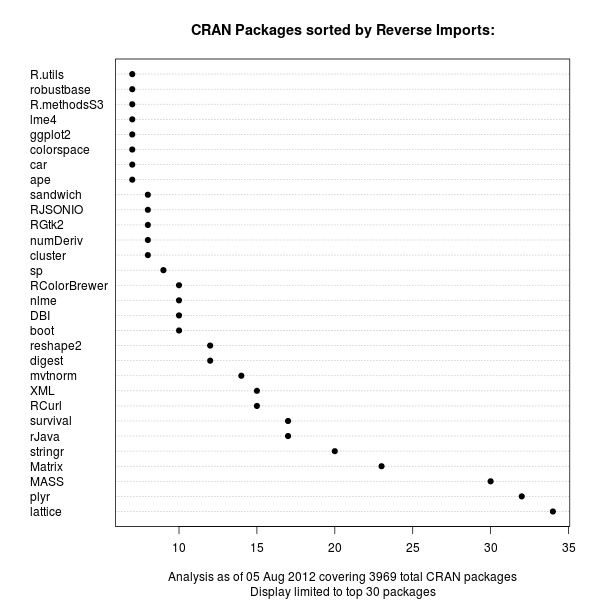
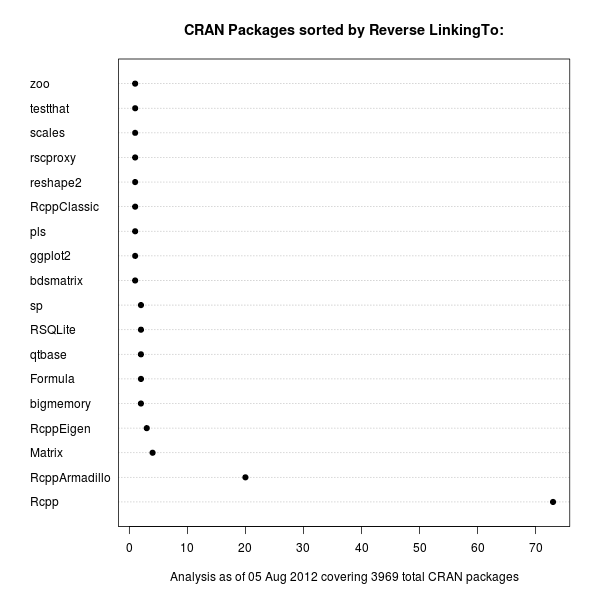
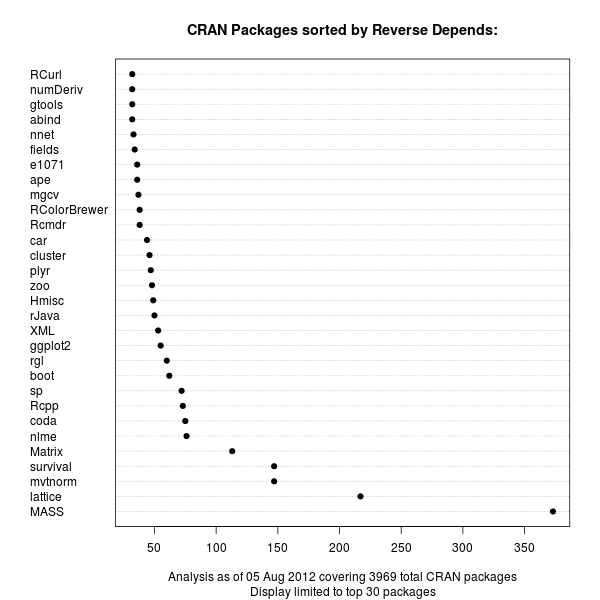
The recent update by S ren H jsgaard's to his gRbase package for graphical models made it the 75th package to depend on our Rcpp package for R and C++ integration. So in a lighthearted weekend moment, I tweeted about gRbase being number 75 for Rcpp to which Hadley replied, asking if Rcpp was in fact number one among R package Depends. Far from it, and I immediately replied listing lattice and Matrix as packages with way more other packages depending upon them. But as the question seemed deserving of a bit more analysis, I spent a few minutes on this and prepared three charts listing package in order of reverse Depends, reverse Imports and reverse LinkingTo. First off, the reverse Depends:. This is the standard means of declaring a dependence of one package upon another. CRAN package chart of Reverse Depends relations Unsurprisingly, the MASS package from the classic Venables and Ripley book comes first, with Deepayan Sarkar's powerful lattice package (also covered in a book) coming second. These are both recommended packages which are commonly distributed with R itself. Next are mvtnorm and survival. Our Rcpp is up there in the top-ten, but not a frontrunner. With the advent of namespaces a few R releases ago, it became possible to import functions from other packages. So the Imports: statement now provides an alternative to the (older) Depends:. The next chart displays the same relationship for Imports:: CRAN package chart of Reverse Imports relations Now lattice still leads, but Hadleys's plyr package grabbed the second spot just before MASS and Matrix. It is interesting to see that the sheer number of Imports: is still not where the Depends: are. On the other hand, we see a number of more recent packages popping up in the second chart. This may reflect more recent coding practices. It will be interesting to see how this stacks up over time when we revisit this chart. Lastly, we can also look at LinkingTo:, a declaration used to provide a C/C++-level dependency at the source code level. We use this in the Rcpp family to provide automatic resolution of the header files needed to compile against our packages. And unsurprisingly, because packages using Rcpp actually use its API (rather than R functions), the package is a little ahead of others. In the package we find three more packages of the Rcpp family, but only a limited number of other packages as C/C++-level dependencies are still somewhat rare in the R universe. There are also fewer packages overall making use of this mechanism. CRAN package chart of Reverse LinkingTo relations One could of course take this one level further and sum up dependencies in a recursive manner, or visualize the relationship differently. But these dotchart graphs provide a first visual description of the magnitude of Depends, Imports and LinkingTo among CRAN packages for R.

1 August 2012

Dirk Eddelbuettel: RcppCNPy 0.2.0

Version 0.2.0 of the recently introduced RcppCNPy package for reading/writing NumPy data in R arrived on CRAN earlier today. The main change are the added ability to also write gzip-ed npy files, to suppress an automatic transposition as well as the correction of one memory leak on data read. The NEWS file entry is below:
Changes in version 0.2.0 (2012-07-30)
  • Support for writing of gzip-ed npy files has been added.
  • A new option dotranspose has been added to npyLoad() to support data sets that do not need to be transposed to be used in R.
  • A memory leak in reading files has been corrected.
CRANberries also provides a diffstat report for 0.2.0 relative to 0.1.0. As always, feedback is welcome and the rcpp-devel mailing list off the R-Forge page for Rcpp is the best place to start a discussion.

25 July 2012

Dirk Eddelbuettel: RcppClassic 0.9.2

Similar to yesterday's post about RcppGSL, we have another pure maintenance release to announce, this time of RcppClassic, the package supporting the deprecated older classic Rcpp API defined in the earlier 2005 to 2006 releases, is now on CRAN. There is no new code, as the only changes were made to accomodate CRAN Policy updates. Courtesy of CRANberries, here is a link to the changes relative to the previous release 0.9.1. Questions, comments etc should go to the rcpp-devel mailing list off the R-Forge page.

24 July 2012

Dirk Eddelbuettel: RcppGSL 0.2.0

Earlier today, a minor update / maintenance release of RcppGSL---our interface package between R and the GNU GSL using our Rcpp package for seamless R and C++ integration---arrived on on CRAN. It contains a number of minor changes to accomodate changes in the CRAN Policies, as well as a few extension to the main example fastLm, a faster replacement for the standard lm function. The summary methods now provide more information, and we added a number of new regression tests. The NEWS file entry follows below:
Changes in version 0.2.0 (2012-07-22)
  • summary() for fastLm() now displays more information
  • fastLmPure() now uses same argument order as R's lm.fit()
  • Added more unit tests for fastLm() and related functions
  • Export and document S3 methods in NAMESPACE and manual page as such
  • Vignettes have been moved to the vignettes/ directory
  • Main vignette renamed to RcppGSL-intro.pdf to use a filename different from the package reference manual
  • NEWS file converted to .Rd format
  • inline support function no longer uses assignInNamespace
And courtesy of CRANberries, a summary of the changes to the previous release 0.1.1 is available too. More information is on the RcppGSL page. Questions, comments etc should go to the rcpp-devel mailing list off the R-Forge page.

13 July 2012

Dirk Eddelbuettel: RcppArmadillo 0.3.2.4

Conrad released version 3.2.4 of Armadillo yesterday. It contains a workaround for g++ 4.7.0 and 4.7.1 which have a regression triggered by the Armadillo codebase for small fixed-sized matrices. The corresponding RcppArmadillo package 0.3.2.4 arrived on CRAN earlier today. The short NEWS entry follows below.
0.3.2.4  2012-07-11
    o   Upgraded to Armadillo release 3.2.4
          * workaround for a regression (bug) in GCC 4.7.0 and 4.7.1
Courtesy of CRANberries, there is also a diffstat report for 0.3.2.4 relative to 0.3.2.3 As always, more detailed information is on the RcppArmadillo page. Questions, comments etc should go to the rcpp-devel mailing list off the R-Forge page.

11 July 2012

Dirk Eddelbuettel: Getting numpy data into R -- Take Two

A couple of days ago, I had posted a short Python script to convert numpy files into a simple binary format which R can read quickly. Nice, but still needing an extra file. Shortly thereafter, I found Carl Rogers cnpy library which makes reading and writing numpy files from C++ a breeze, and I quickly wrapped this up into a new package RcppCNPy which was released a few days ago. This post will show a quick example, also summarized in the short pdf vignette describing the package, and provided as a demo within the package.
R> library(RcppCNPy)
Loading required package: Rcpp
R> library(rbenchmark)
R> 
R> n <- 1e5
R> k <- 50
R> 
R> M <- matrix(seq(1.0, n*k, by=1.0), n, k)
R> 
R> txtfile <- tempfile(fileext=".txt")
R> write.table(M, file=txtfile)
R> 
R> pyfile <- tempfile(fileext=".py")
R> npySave(pyfile, M)
R> 
R> pygzfile <- tempfile(fileext=".py")
R> npySave(pygzfile, M)
R> system(paste("gzip -9", pygzfile))
R> pygzfile <- paste(pygzfile, ".gz", sep="")
R> 
R> 
We first load the new package (as well as the rbenchmark package used for the benchmarking example) into R. We then create a large matrix of 100,000 rows and 50 columns. Not quite big data by any stretch, but large enough for ascii reading to be painfully slow. We also write two npy files and compress the second one. Next, we use the benchmark function to time the three approaches:
R> res <- benchmark(read.table(txtfile),
+                  npyLoad(pyfile),
+                  npyLoad(pygzfile),
+                  order="relative",
+                  columns=c("test", "replications", "elapsed", "relative"),
+                  replications=10)
R> print(res)
                 test replications elapsed relative
2     npyLoad(pyfile)           10   1.241  1.00000
3   npyLoad(pygzfile)           10   3.098  2.49637
1 read.table(txtfile)           10  96.744 77.95649
R> 
As shown by this example, loading a numpy file directly beats the pants off reading the data from ascii: it is about 78 times faster. Reading a compressed file is somewhat slower as the data stream has to be passed through the uncompressor provide by the zlib library. So instead of reading a binary blob in one go (once the file header has been parsed) we have to operate piecemeal---which is bound to be slower. It does however save in storage space (and users can make this tradeoff between speed and size) and is still orders of magnitude faster than parsing the ascii file. Finally, and not shown here, we unlink the temporary files. Summing up, this post demonstrated how the RcppCNPy package can be a useful to access data in numpy files (which may even be compressed). Data can also be written from R to be accessed later by numpy.

8 July 2012

Dirk Eddelbuettel: New package RcppCNPy with release 0.1.0 (and 0.0.1 earlier last week)

A few days ago I had blogged about getting NumPy data in R by using a simple converter script. That works fine, but it is a little annoying to have to write an entire file only to read from it again. So I kept looking around for a better solution---and soon found the cnpy library by Carl Rogers which provides simple C++ functions to read and write NumPy files. Bringing such a C++ library to R is done very easily via Rcpp modules. The resulting package contains a single R file with a single line: loadModule("cnpy", TRUE). And it relies on the following module declarations in the a C++ file:
RCPP_MODULE(cnpy) 
    using namespace Rcpp;
    function("npyLoad",                         // name of the identifier at the R level
             &npyLoad,                          // function pointer to helper function defined above
             List::create( Named("filename"),   // function arguments including default value
                           Named("type") = "numeric"),
             "read an npy file into a numeric or integer vector or matrix");
    function("npySave",                         // name of the identifier at the R level
             &npySave,                          // function pointer to helper function defined above
             List::create( Named("filename"),   // function arguments including default value
                           Named("object"), 
                           Named("mode") = "w"),
             "save an R object (vector or matrix of type integer or numeric) to an npy file");
 
which give us at the R prompt
R> library(RcppCNPy)
Loading required package: Rcpp
R> npyLoad
internal C++ function <0x243af70>
    docstring : read an npy file into a numeric or integer vector or matrix
    signature : Rcpp::RObject npyLoad(std::string, std::string)
R> npySave
internal C++ function <0x23033e0>
    docstring : save an R object (vector or matrix of type integer or numeric) to an npy file
    signature : void npySave(std::string, Rcpp::RObject, std::string)
R> 
these two functions (and their docstrings) defined above. That's all! Well there are about one hundred more lines dealing with whether we have integer or numeric data, and whether we use a vector or a matrix. But all in all pretty simple... So version 0.1.0 of this new package RcppCNPy completes the initial release 0.0.1 from earlier in the week by adding The NEWS entry for this release (as well as the initial one) follow:
News for Package RcppCNPy Changes in version 0.1.0 (2012-07-07)
  • Added automatic use of transpose to automagically account for Fortran-vs-C major storage defaults between Python and R.
  • Support for integer types in dependent on the int64_t type which is available only when the -std=c++0x switch is used at build-time (and CRAN still discourages use of it)
  • Added support for reading gzip'ed files ending in ".npy.gz"
  • Added regression tests in directory tests/
  • Added a vignette describing the package
  • Added a timing benchmark in demo/timings.R
Changes in version 0.0.1 (2012-07-04)
  • Initial version, as a straightforward Rcpp modules wrap around the cpny library by Carl Rogers (on github under a MIT license).
  • At present, npy files can be read and written for vectors and matrices of either numeric or integer type. Note however that matrices are currently transposed because of the default Fortran ordering done by numpy.
I will follow up with a little usage example later. CRANberries also provides a diffstat report for 0.1.0 relative to 0.0.1. As always, feedback is welcome and the rcpp-devel mailing list off the R-Forge page for Rcpp is the best place to start a discussion.

4 July 2012

Dirk Eddelbuettel: RcppBDT 0.2.0

A new release of the RcppBDT package appeared on CRAN earlier today. RcppBDT uses Rcpp, and in particular the nifty Rcpp modules feature of wrapping C++ code for R just by declaring the (class or function) interfaces. It uses this to bring in some useful functions from Boost Date.Time to R so that one can do things like
R> library(RcppBDT)
R> sapply(2012:2016, function(year)
+         format(getNthDayOfWeek(first, Mon, Sep, year)))
[1] "2012-09-03" "2013-09-02" "2014-09-01" "2015-09-07" "2016-09-05"
R> 
to compute the next five Labor Day dates in the US, given the year and the first Monday of September requirement. More examples are e.g. on the earlier blog post announcing version 0.1.0. Changes are mostly internal. R 2.15.1 brough a better / easier way to load such 'modules' into R, and Rcpp 0.9.13 allows us to use this. So RcppBDT continues to be useful as an example package for Rcpp modules. I also streamlines the interface a little: identifiers are now directly accessible in the package's NAMESPACE rather than just via the an instantiated object. I also added a NEWS file, using the .Rd format so that we can import the marked-up text:
News for Package RcppBDT Changes in version 0.2.0 (2012-07-02)
  • The core module, which wraps what in C++ is boost::gregorian::date, is now exposed as an Rcpp module bdtDate. As all example and demos operated off a (package-global) variable 'bdt', no user visible change was needed outside of the code instantiating at package load.
  • Updated package instantiation to the new facilities offered by the current versions R 2.15.1 and Rcpp 0.9.13 which make Rcpp module initialization easier and more streamlined.
Changes in version 0.1.0 (2011-01-17)
  • First CRAN upload (and see ChangeLog for more granular details) bug fix in svm cross validation
Courtesy of CRANberries, there is also a diffstat report for 0.2.0 relative to 0.1.0. As always, feedback is welcome and the rcpp-devel mailing list off the R-Forge page for Rcpp is the best place to start a discussion.

3 July 2012

Dirk Eddelbuettel: RcppArmadillo 0.3.2.3

Conrad releaser version 3.2.3 of Armadillo a few days ago, and the corresponding RcppArmadillo package 0.3.2.3 is now CRAN. (For these keeping score 3.2.1 never was a full release, and 3.2.2 containing fixes for a build issue that did not affect the R package build so we skipped it.) The short NEWS entry follows below. This version fixes some issues related to g++ 4.7; however the current Debian testing version of g++-4.7.1 required that I rolled back three header files to the version from the previous release. Conrad has been in contact with the gcc upstream maintainers and a fix may appear in time for g++-4.7.2. This release also contains a new introductory pdf vignette based on a paper Conrad and I just submitted. It introduces Armadillo to R programmers and demonstrates with a simple Kalman filtering example how the code can be written in the same concise matrix-oriented style, yet runs orders of magnitude faster.
0.3.2.3  2012-07-01
    o   Upgraded to Armadillo release 3.2.3 
          * minor correction for declaration of fixed size vectors and
            matrices
    o   Reverted three header files  Mat,Row,Col _bones.hpp back to previous
        release due to compilation failures under g++-4.7
    o   Added new vignette 'RcppArmadillo-intro' based on a just-submitted
        introductory paper (by Eddelbuettel and Sanderson) about RcppArmadillo 
    o   Change from release 3.2.2 which we skipped as it did not really affect
        builds under R:
          * minor fix for compiling without debugging enabled (aka release
            mode)
          * better detection of ATLAS during installation on Fedora and Red
            Hat systems
    o   Small enhancement to fastLm 
Courtesy of CRANberries, there is also a diffstat report for 0.3.2.3 relative to 0.3.2.0 As always, more detailed information is on the RcppArmadillo page. Questions, comments etc should go to the rcpp-devel mailing list off the R-Forge page.

1 July 2012

Dirk Eddelbuettel: Getting numpy data into R

The other day, I found myself confronted with a large number of large files. Which were presented in (gzip-)compressed ascii format---which R reads directly via gzfile() connections---as well as (compressed) numpy files. The numpy can be read very efficiently into Python. We can do the same in R via save() and load(), of course. But the trouble is that you need to read them first. And reading hundreds of megabytes from ascii is slow, no matter which language you use. Concerning R, I poked aound scan(), played with the colClasses argument and looked at the recent LaF package written just for this purpose. And all these solutions were still orders of magnitude slower than reading numpy. Which is no surprise as it is really hard to beat binary formats when you have to parse countless ascii tokens. So the obvious next idea was to read the numpy file in Python, and to write a simple binary format. One helpful feature with this data set was that it contained only regular (rectangular) matrices of floats. So we could just store two integers for the dimensions, followed by the total data in either one large binary blob, or a sequence of column vectors. But one minor trouble was that the Intertubes lead to no easy solution to unpack the numpy format. StackOverflow had plenty of question around this topic converned with, say, how to serialize in language-independent way. But no converters. And nobody local knew how to undo the "pickle" format underlying numpy. But a remote friend did: Laurent, well-known for his Rpy2 package, pointed me towards using the struct module and steered me towards the solution shown below. So a shameless plug: if you need a very experienced Python or R consultant for sciece work, consider his consulting firm. Finally, to round out this post, let's show the simple solution we crafted so that the next guy searching the Intertubes will have an easier. Let us start with a minimal Python program writing numpy data to disk:
#!/usr/bin/env python
#
# simple example for creating numpy data to demonstrate converter
import numpy as np
# simple float array
a = np.arange(15).reshape(3,5) * 1.1
outfile = "/tmp/data.npy"
np.save(outfile, a)
Next, the simple Python converter to create a binary file containing two integers for row and column dimension, followed by row times columns of floats:
#!/usr/bin/python
#
# read a numpy file, and write a simple binary file containing
#   two integers 'n' and 'k' for rows and columns
#   n times k floats with the actual matrix
# which can be read by any application or language that can read binary
 
import struct
import numpy as np
inputfile = "/tmp/data.npy"
outputfile = "/tmp/data.bin"
# load from the file
mat = np.load(inputfile)
# create a binary file
binfile = file(outputfile, 'wb')
# and write out two integers with the row and column dimension
header = struct.pack('2I', mat.shape[0], mat.shape[1])
binfile.write(header)
# then loop over columns and write each
for i in range(mat.shape[1]):
    data = struct.pack('%id' % mat.shape[0], *mat[:,i])
    binfile.write(data)
binfile.close()
Lastly, a quick littler script showing how R can read the data in a handful of lines:
#!/usr/bin/r
infile <- "/tmp/data.bin"
con <- file(infile, "rb")
dim <- readBin(con, "integer", 2)
Mat <- matrix( readBin(con, "numeric", prod(dim)), dim[1], dim[2])
close(con)
print(Mat)
That did the job---and I already used to converter to read a few weeks worth of data for further analysis in R. This obviously isn't the last word on possible solutions as the additional temporary file can be wasteful (unless it forms a cache for data read multiple times). If someone has nice solutions, please don't hold back and contact me. Thanks again to Laurent for the winning suggestion concerning struct, and help in getting the examples shown here to work.
29 June 2012

Dirk Eddelbuettel: Rcpp 0.9.13

The bug-fix in version 0.9.12 of Rcpp turned out to be incomplete, so a new version 0.9.13 is now on CRAN and will get to Debian shortly. The Rcpp::Enviroment constructor is now properly fixed (using the global environment as a default value). As well, a new #define was created to detect the clang++ compiler before/after version 3.0.0 as one exceptions header changed location. Unit tests files were also once more updated. The complete NEWS entry for 0.9.13 is below; more details are in the ChangeLog file in the package and on the Rcpp Changelog page.
0.9.13  2012-06-28
    o   Truly corrected Rcpp::Environment class by having default constructor
        use the global environment, and removing the default argument of
        global environment from the SEXP constructor
    o   Added tests for clang++ version to include bits/exception_defines.h
        for versions 3.0 or higher (similar to g++ 4.6.0 or later), needed to
        include one particular exceptions header
    o   Made more regression tests conditional on the RunAllRcppTests to come
        closer to the CRAN mandate of running tests in sixty seconds
    o   Updated unit test wrapper tests/doRUnit.R as well as unitTests/runTests.R
Thanks to CRANberries, you can also look at a diff to the previous release 0.9.12. As always, even fuller details are on the Rcpp Changelog page and the Rcpp page which also leads to the downloads, the browseable doxygen docs and zip files of doxygen output for the standard formats. A local directory has source and documentation too. Questions, comments etc should go to the rcpp-devel mailing list off the R-Forge page

26 June 2012

Dirk Eddelbuettel: Rcpp 0.9.12

A bug-fix release 0.9.12 of Rcpp arrived earlier today on CRAN and is now in Debian too. This fixes a minor snafu with the Rcpp::Enviroment constructor following a small change made for 0.9.11. It also reduces the number of unit tests running by default as CRAN was complaining that it took too long to run the checks. I am not impressed---tests are for running, not skipping. Lastly, the cleanup needed to be extended to another directory. The complete NEWS entry for 0.9.12 is below; more details are in the ChangeLog file in the package and on the Rcpp Changelog page.
0.9.12  2012-06-23
    o   Corrected Rcpp::Environment class by removing (empty) ctor following
        rev3592 (on May 2) where default argument for ctor was moved
    o   Unit testing now supports argument --allTests to impose that all
        tests are executed; otherwise some expensive tests are skipped. This
        is arguably not the right thing to do, but CRAN maintainers insist 
        on faster tests.
    o   The cleanup script now also considers inst/unitTests/testRcppClass/src 
Thanks to CRANberries, you can also look at a diff to the previous release 0.9.11. As always, even fuller details are on the Rcpp Changelog page and the Rcpp page which also leads to the downloads, the browseable doxygen docs and zip files of doxygen output for the standard formats. A local directory has source and documentation too. Questions, comments etc should go to the rcpp-devel mailing list off the R-Forge page

23 June 2012

Dirk Eddelbuettel: Rcpp 0.9.11

Release 0.9.11 of Rcpp arrived on CRAN this morning and in Debian later today. This is a somewhat incremental release with a few internal improvements and few new features. One interesting new development has been contributed by John Chambers who is extending 'Rcpp modules' into 'Rcpp classes' which allows R code to modify and extend C++ classes loaded via Rcpp modules; see help(setRcppClass) for more. This also lead to some changes in the code for loading modules which however requires the brand-new R version 2.15.1 released today as well. The complete NEWS entry for 0.9.11 is below; more details are in the ChangeLog file in the package and on the Rcpp Changelog page.
0.9.11  2012-06-22
    o   New member function for vectors (and lists etc) containsElementNamed() 
        which returns a boolean indicating if the given element name is present
    o   Updated the Rcpp.package.skeleton() support for Rcpp modules by
        carrying functions already present from the corresponding unit test
        which was also slightly expanded; and added more comments to the code 
    o   Rcpp modules can now be loaded via loadRcppModules() from .onLoad(),
        or via loadModule("moduleName") from any R file 
    o   Extended functionality to let R modify C++ clases imported via modules
        documented in help(setRcppClass)
    o   Support compilation in Cygwin thanks to a patch by Dario Buttari
    o   Extensions to the Rcpp-FAQ and the Rcpp-modules vignettes
    o   The minium version of R is now 2.15.1 which is required for some of
        the Rcpp modules support 
Thanks to CRANberries, you can also look at a diff to the previous release 0.9.10. As always, even fuller details are on the Rcpp Changelog page and the Rcpp page which also leads to the downloads, the browseable doxygen docs and zip files of doxygen output for the standard formats. A local directory has source and documentation too. Questions, comments etc should go to the rcpp-devel mailing list off the R-Forge page

21 May 2012

Dirk Eddelbuettel: RcppArmadillo 0.3.2.0

A new stable release 3.2.0 of Armadillo is now available. As usual, we have wrapped this into a new RcppArmadillo package, now at 0.3.0.2; and this version is now available via CRAN. The short NEWS entry follows below. For those interested in following RcppArmadillo eevn more closely, we generally track Conrad's Armadillo release candidates as well in SVN on R-Forge but do no longer submit these to CRAN (as the CRAN maintainers have enough incoming packages).
0.3.2.0  2012-05-21
    o   Upgraded to Armadillo release 3.2.0 "Creamfields"
          * faster eigen decomposition via "divide and conquer" algorithm
          * faster transpose of vectors and compound expressions
          * faster handling of diagonal views
          * faster handling of tiny fixed size vectors (  4 elements)
          * added unique(), for finding unique elements of a matrix
Courtesy of CRANberries, there is also a diffstat report for 0.3.2.0 relative to 0.3.0.3 As always, more detailed information is on the RcppArmadillo page. Questions, comments etc should go to the rcpp-devel mailing list off the R-Forge page.

16 May 2012

Dirk Eddelbuettel: RProtoBuf 0.2.4

A new release 0.2.4 of RProtoBuf is now on CRAN. RProtoBuf provides GNU R bindings for the Google Protobuf data encoding library used and released by Google. This release once again contains a number of patches kindly contributed by Murray Stokely, as well as an added header file needed to build with the g++ 4.7 version which has become the build standard on CRAN. The NEWS file entry follows below:
0.2.4   2012-05-15
    o   Applied several patches kindly supplied by Murray Stokely to
         - properly work with repeated strings 
         - correct C++ function naming in a few instances
         - add an example of ascii export/import of messages
    o   Suppport g++-4.7 and stricter #include file checking by adding unistd
    o   Made small improvements to the startup code
CRANberries also provides a diff to the previous release 0.2.3. More information is at the RProtoBuf page which has a draft package vignette, a 'quick' overview vignette and a unit test summary vignette. Questions, comments etc should go to the rprotobuf mailing list off the RProtoBuf page at R-Forge. Updated to show NEWS rather than ChangeLog

15 May 2012

Dirk Eddelbuettel: RcppSMC 0.1.1

CRAN now tests packages against g++-4.7 (as this version has become the default on Debian's testing variant. This compiler switch once again triggered a set of build failures, mostly from include files now deemed missing. For RcppSMC, it came down to a five-character patch of explicitly stating one max() call as std::max() No other changes were made at this point. The NEWS entry is below:
0.1.1   2012-05-14
    o   Version 0.1.1 
    o   Minor g++-4.7 build fix of using std::max() explicitly
Courtesy of CRANberries, there is also a diffstat report for 0.1.1 relative to 0.1.0 As always, more detailed information is on the RcppSMC page,

5 May 2012

Dirk Eddelbuettel: RcppArmadillo 0.3.0.3

Two days ago, Conrad Sanderson released another bug-fix version 3.0.3 for the 3.0.0 branch of his excellent Armadillo C++ template library for linear algebra. The new RcppArmadillo release 0.3.0.3 which contains it appeared on CRAN yesterday. Beside Conrad's bugfixes we also added an example script for fastLm and faster linear model fits. The short NEWS entry follows below.
0.3.0.3 2012-05-03
    o   Upgraded to Armadillo release 3.0.3
          * fixes for inplace transpose of complex number matrices
          * fixes for complex number version of svd_econ()
          * fixes for potential aliasing issues with submatrix views
    o   New example script fastLm 
Courtesy of CRANberries, there is also a diffstat report for 0.3.0.3 relative to 0.3.0.2 As always, more detailed information is on the RcppArmadillo page. Questions, comments etc should go to the rcpp-devel mailing list off the R-Forge page.

Next.

Previous.