Search Results: "sto"

23 August 2008

James Morrison: How not to find a friends blog

A while ago I started using Google Reader. Reader has a nice social feature where you can share articles with your friends. This is nicer than posted items in an activity stream since you don't have to click on anything, the article is right there. Anyway, I got a shared item in my stream of articles today with the second sentence as "She somehow got her own claw stuck into her paw.". Then it struck me, I've heard this story before. My dinner guests last week told this same story. So it seems I've found Michelle's blog. Thanks Tony.

John Goerzen: Dot-Matrix Teletype Simulator Update and Request for Teletype Info

I recently wrote about wanting to have a teletype. Well, I have since realized that teletypes weigh hundreds of pounds, draw hundreds of watts, and aren't available on eBay for a reasonable price. Well I knew the hundreds of pounds bit, but still. I pretty well have had to give up on a real teletype.

So, now on to the next best thing: a teletype simulator. Enter the two free dot-matrix printers that found their way to my office earlier this week. One of them even works. I bicycled to the awesome local office supplies store (about 11 miles away) to buy a ribbon for it. This is the place that's been there since the 1890s. They still stock dot matrix ribbons, typewriter ribbons, and even fanfold paper.

On the project. Linux has its heritage in Unix, which was used with these devices. It can be made to work with them even now. But there's a trick: teletypes used a bidirectional serial link. Dot matrix printers have no keyboard. So we have to take input from a different device than we send output to.

A simple trick will do for that:

TERM=escpterm telnet localhost > /dev/lp0

Now, here's the next problem. Dot-matrix printers have a line buffer. They don't start printing the line at all until they see CR or LF. Makes it annoying for interactive use. So I wrote a quick tool to insert into that pipeline. After a certain timeout after the input stops, it will force the printer to flush its buffer. Took a little while to figure out how to do that, too; turns out there's a command ESC J that takes an increment for vertical spacing in 1/216 inch, and accepts 0. So I can send \x1BJ\x00 to flush the buffer. I can run it like this:

TERM=escpterm telnet localhost escpbuf > /dev/lp0

That leaves another problem, though: the printhead is right over the text. (Even though it moves to the right of the printing position, and then moves back left for the next character to print.) I modified the program to roll the paper out a bit, and then reverse feed it to continue printing the line. But that is slow and, I suspect, tough on the stepper motor.

Also, I have crafted a terminfo file for the Epson-compatible dot-matrix printers (which are almost all of them), which can also be found at the above link.

So here's the question, for anyone that has used a real teletype:

Did the printhead obscure the text there too, or could you see the entire current line at all times?

Christoph Haas: Bad idea of the day: upgrading to Lenny with aptitude

I like aptitude. Okay, I just understand 10% of its features and I can’t live without apt-get (e.g. apt-get source) or apt-cache (e.g. apt-cache search) but for resolving broken dependencies it’s heaven-sent. It just seems like upgrading to Lenny using aptitude (I just learned about “U” to toggle an update - I’ve always used apt-get for that purpose) is a bad idea at this moment. Thanks to Daniel et al for this great piece of software anyway. Just if you upgrade to Lenny I’d recommend apt-get for the moment. It’s now four hours later and I managed to forcefully install slapd’s dependencies, recover the Samba LDAP schemas and get over all kinds of weird error messages. Bacula failed to upgrade the database (I swear it had worked before with dbconfig-common) so all I had was my emergency afbackup. Not to mention that I had to work on the server console because due to lack of LDAP I couldn’t fix that from my laptop. Do I need to mention that my TFT monitor at my server just died today? Don’t think so.

Jeff Bailey: Less cryptic this time...

Been busy with things, and for fun I will tell you about it using three song titles:

#1 "... Baby One More Time"

#2 "Don't Worry, Be Happy"

#3 "Je reviens Montr al"

Time to stock up on sleep.

22 August 2008

MJ Ray: Bristol and Bath LUG Meeting 23 August 2008

Apparently the LUG’s website is still off-line and there’s no idea when it will return, so let me use this site to help announce that the LUG’s regular meeting at the Knights Templar public house, near Isambard Walk, Bristol, will happen tomorrow Saturday 23 August from noon-ish until whenever people drift away. Software Freedom Day happens between this meeting and the next one. Is anyone interested in running a Bristol-area event and do you know of a suitable/available venue? I’m finding the SFD official site somewhat dysfunctional (I’m not in the Northern Caucasus, damnit), so I’ve not found a nearby team registered yet…

Enrico Zini: Docking the FreeRunner into the laptop

Docking the FreeRunner into the laptop Earlier in the day, I wrote:
So yes, my laptop can now be turned into a phone charger with networking, DNS and apt cache services. I shall look into hooking that script into dbus to have it run automatically when the phone is plugged and unplugged.
It's not dbus, it's udev, and I've managed to do it. It's an udev rule:
# cat /etc/udev/rules.d/z60_openmoko_net.rules
ACTION=="add", SUBSYSTEM=="net", ATTRS idVendor =="1457", ATTRS idProduct =="5122", RUN+="/root/bin/share-openmoko"
ACTION=="remove", SUBSYSTEM=="net", INTERFACE="usb0", RUN+="/root/bin/share-openmoko"

And a script:
# cat bin/share-openmoko 
#!/bin/sh
if [ "$ACTION" == "add" ]
then
    ACTION=start
fi
if [ "$ACTION" == "remove" ]
then
    ACTION=stop
fi
INTERFACE=$ INTERFACE:-"usb0" 
ACTION=$ ACTION:-"$1" 
case "$ACTION" in
    start)
        logger -t openmoko "Connected, setting up network"
        iptables -t nat -A POSTROUTING -o eth0 -j MASQUERADE -s 192.168.0.200/29
        ifconfig usb0 192.168.0.200 netmask 255.255.255.248
        /etc/init.d/dnsmasq start
        echo 1 > /proc/sys/net/ipv4/ip_forward
        ;;
    stop)
        logger -t openmoko "Disconnected, bringing down network"
        echo 0 > /proc/sys/net/ipv4/ip_forward
        /etc/init.d/dnsmasq stop
        iptables -t nat -F POSTROUTING
        ifconfig usb0 down
        ;;
esac

The script has extra cruft that makes it double as a udev script and as a init.d style script, just because I didn't feel like abandoning the init.d style interface. However, udev handles it perfectly, so there's probably no use at all for the start/stop part. This means that the interface and all supporting services will be brought up and down when the phone is connected/disconnected, and also when the phone is suspended/resumed. Of course, more fancy things can be plugged into the script, like syncing PIM info, file systems, turning on applets in panels, mounting phone file systems and whatnot.

Enrico Zini: Unpacking the new FreeRunner

Unpacking the new FreeRunner I got myself a FreeRunner. Here are some notes from the first few days: Available operating systems The FreeRunner comes with the Om 2007.2 distribution: it works for basic phone things, and it has an opkg package manager that you can use to install all sort of extra software. Only issue: the SMS application was rather unstable with my SIM card. I then tried Om 2008.8, which is a major new redesign, partly based on Qtopia. It's definitely more advanced on how it looks, with smooth animations all around, but I did not manage to get the GSM part to work, because I did not manage to get it to ask for a PIN. I then tried plain Qtopia and I got what looks and feels like a properly working mobile phone. The only issue that it has is that I did not manage to make it suspend, so battery life is much shorter than it could be. Apparently, this should improve as kernel 2.6.26 reaches the phone. I kept Qtopia installed in the phone flash as a "stable" phone system. And finally, Debian. Debian is based on the freesmartphone.org software stack, which is an attempt to create a UI agnostic DBUS frontend to the hardware that supports multiple applications running on top of it. It is a young project, but it can already drive a mobile phone in a useful way. It has a demo interface that is basically a showcase of what is implemented in the DBUS frontend, but does most of the basic things you need from a mobile phone, including taking and making phone calls. And then it has Debian behind, all of it. I need to buy a bigger microsd card. Tips and tricks Flashing things
  1. apt-get install dfu-util
  2. Start the Freerunner bios/bootloader, by holding down Power and then pressing AUX (standard bootloader), or by holding down AUX and then pressing Power (factory, unbrickable, read only fail safe bootloader).
  3. dfu-util -l shows you a list of devices it can access. If you see more than once, you need to specify in all dfu-util commands which one you want, using -d USBID. In my case, I have to always use dfu-util -d 0x1d50:0x5119
  4. To flash the kernel: dfu-util -a kernel -R -D /path/to/uImage
  5. To flash the root file system: dfu-util -a rootfs -R -D rootfs_filename.jffs2
  6. To flash the bootloader: dfu-util -a u-boot -R -D uboot_filename.bin
  7. To flash the u-boot configuration: dfu-util -a u-boot_env -D env.new
You can also download all of these things from the FreeRunner by using -U instead of -D. Networking via USB All of the distributions I tried, by default configure the USB as a gadget with ethernet over usb. You can form a lan with it using the cdc_ether module, and you will find your phone preconfigured as 192.168.0.202 expecting to find a gateway at 192.168.0.200. I made myself this script to start and stop networking with the phone:
#!/bin/sh
case "$1" in
    start)
        iptables -t nat -A POSTROUTING -o eth0 -j MASQUERADE -s 192.168.0.200/29
        ifconfig usb0 192.168.0.200 netmask 255.255.255.248
        /etc/init.d/dnsmasq start
        echo 1 > /proc/sys/net/ipv4/ip_forward
        ;;
    stop)
        echo 0 > /proc/sys/net/ipv4/ip_forward
        /etc/init.d/dnsmasq stop
        iptables -t nat -F POSTROUTING
        ifconfig usb0 down
        ;;
esac

Besides doing masquerading, it also brings up dnsmasq so that the phone can always find a DNS together with the router. Another useful trick is to configure the phone to share the approx cache with the laptop:
deb http://192.168.0.200:9999/debian unstable main
deb http://192.168.0.200:9999/debian experimental main
deb http://pkg-fso.alioth.debian.org/debian unstable main

So yes, my laptop can now be turned into a phone charger with networking, DNS and apt cache services. I shall look into hooking that script into dbus to have it run automatically when the phone is plugged and unplugged. Changing the ringtone in Debian In case you don't like the default ringtone, this is how to change it:
  1. vi /usr/share/python-support/fso-frameworkd/framework/subsystems/oeventd/receiver.py
  2. look for def _play( self ):
  3. change the codec in decoder = gst.element_factory_make, if needed. The list of available plugins is on the gstreamer website.
  4. change the path in filesrc.set_property
  5. /etc/init.d/fso-frameworkd restart and maybe /etc/init.d/zhone-session restart
Yes, the ringtone is currently hardcoded, but it does say it's a prototype after all. Or, if you prefer, it's fully configurable and the configuration can be found in /usr/share/python-support/fso-frameworkd. Configuring the bootloader You can connect to the u-boot bootloader via a serial terminal on /dev/ttyACM0. Type help and you will find that it can do a lot of things. The OpenMoko wiki has pages on the bootloader itself, its commands and the environment. The environment is the configuration of the bootloader, similar somehow to /boot/grub/menu.lst. Unlike grub, you can edit the environment from within the bootloader and then save it using the saveenv command. What I did:
  1. A boot entry for Debian, with the kernel on an ext2 partition instead of fat: setenv menu_3 Boot from microSD (FAT+ext2): setenv bootargs \$ bootargs_base rootfstype=ext2 root=/dev/mmcblk0p2 rootdelay=5 \$ mtdparts ro\; mmcinit\; fatload mmc 1 0x32000000 \$ sd_image_name \; bootm 0x32000000
  2. Stay in the bootloader until a choice has been made: setenv bootdelay -1
  3. Don't power down the bootloader when idle: setenv boot_menu_timeout 99999
  4. Always show the menu at boot: setenv stop_in_menu yes
  5. saveenv
So now my phone dual boots, and I can choose if I want a more reliable phone now (Qtopia) or if I want to play with my future phone (Debian). Configuring ssh for two host keys on the same host Minor issue, but annoying: since both QTopia and Debian show up on 192.168.0.202, ssh will complain about changed host keys. Here is how to configure ssh to avoid the problem (in ~/.ssh/config):
Host debian
HostName 192.168.0.202
User root
HostKeyAlias debian
Host qtopia
HostName 192.168.0.202
User root
HostKeyAlias qtopia

21 August 2008

Jos Parrella: Regarding CANTV mail services

Venezuela’s biggest and most important ISP, CANTV, was my first serious email provider, since it is tied to my ADSL connection, and I previously used several different dial-up providers (T-Net, IFX Networks) with no specific interest in email. CANTV mail service used to be provided with the highest standards of quality in the country, particularly as per malware and UCE control, and general abuse surveillance. Hey, even one of the former insider guys is quite known inside our FOSS community! I’ve previously (1, 2) blogged about the huge problems CANTV is facing with their mail service. They don’t answer, and sometimes even bounce, mails to abuse or postmaster, and temporarily suspended or degraded their abuse statistics web site. All in all, they are providing a poor customer service and are being listed in several blacklists all around the world. Sometimes I get warnings from mailing lists since their border MTAs are refusing to deliver messages to the mailboxes. So if you sent me my signed PGP public key, please forgive my ISP for probably bouncing your message. I thought I could live with this problem, since it’s probably temporary, but today a friend from El Salvador told me that all of his mail to cantv.net addresses is bouncing with this message.
Diagnostic-Code: smtp; 550 5.7.1 ...>... Mail from
    168.243.89.79 refused: Vea http://abuso.cantv.net/bl/dul.html
So after taking a look at the whois record for that block, and doing a lookup on the reverse entry for 168.243.89.79, I think that a proper conclusion would be Venezuela’s biggest ISP is currently blocking most mail from El Salvador. And probably other countries. Terrible news. And please use my at debian.org mail address if you need to get in touch.

Russell Coker: Switches and Cables

I’ve just read an amusing series of blog posts about bad wiring [1]. I’ve seen my share of wiring horror in the past. There are some easy ways of minimising wiring problems which seem to never get implemented. The first thing to do is to have switches near computers. Having 48 port switches in a server room and wires going across the building causes mess and is difficult to manage. A desktop machine doesn’t need a dedicated Gig-E (or even 100baseT) connection to the network backbone. Cheap desktop switches installed on desks allow one cable to go to each group of desks (or two cables if you have separate networks for VOIP and data). If you have a large office area then a fast switch in the corner of the room connecting to desktop switches on the desks is a good way to reduce the cabling requirements. The only potential down-side is that some switches are noisy, the switches with big fans can be easily eliminated by a casual examination, but the ones that make whistling sounds from the PSU need to be tested first. The staff at your local electronics store should be very happy to open one item for inspection and plug it in if you are about to purchase a moderate number (they will usually do so even if you are buying a single item). A common objection to this is the perceived lack of reliability of desktop switches. One mitigating factor is that if a spare switch is available the people who work in the area can replace a broken switch. Another is that my observation is that misconfiguration on big expensive switches causes significantly more down-time than hardware failures on cheap switches ever could. A cheap switch that needs to be power-cycled once a month will cause little interruption to work, while a big expensive switch (which can only be configured by the “network experts” - not regular sysadmins such as me) can easily cause an hour of down-time for most of an office during peak hours. Finally the reliability of the cables themselves is also an issue, having two cables running to the local switch in every office can allow an easy replacement to fix a problem - it can be done without involving the IT department (who just make sure that both cables are connected to the switch in the server room). If there is exactly one cable running to each PC from the server room and one of the cables fails then someone’s PC will be offline for a while. In server rooms the typical size of a rack is 42RU (42 Rack Units). If using 1RU servers that means 42 Ethernet cables. A single switch can handle 48 Ethernet ports in a 1RU mount (for the more dense switches), others have 24 ports or less. So a single rack can handle 41 small servers and a switch with 48 ports (two ports to go to the upstream switch and five spare ports). If using 2RU servers a single rack could handle 20 servers and a 24port switch that has two connections to the upstream switch and two spare ports. Also it’s generally desirable to have at least two Ethernet connections to each server (public addresses and private addresses for connecting to databases and management). For 1RU servers you could have two 48 port switches and 40 servers in a rack. For 2RU servers you could have 20 servers and either two 24port switches or one 48port switch that supports VLANs (I prefer two switches - it’s more difficult to mess things up when there are two switches, if one switch fails you can login via the other switch to probe it, and it’s also cheaper). If the majority of Ethernet cables are terminated in the same rack it’s much harder for things to get messed up. Also it’s very important to leave some spare switch ports available as it’s a common occurrence for people to bring laptops into a server room to diagnose problems and you really don’t want them to unplug server A to diagnose a problem with server B… Switches should go in the middle of the rack. While it may look nicer to have the switch at the top or the bottom, that means that the server which is above or below it will have the cables for all the other switches going past it. Ideally the cables would go in neat cable runs at the side of the rack but in my experience they usually end up just dangling in front. If the patch cables are reasonably short and they only dangle across half the servers things won’t get too ugly (this is harm minimisation in server room design). The low end of network requirements is usually the home office. My approach to network design for my home office is quite different, I have no switches! I bought a bunch of dual-port Ethernet cards and now every machine that I own has at least two Ethernet ports (and some have as many as four). My main router and gateway has four ports which allows connections from all parts of my house. Then every desktop machine has at least two ports so that I can connect a laptop in any part of the house. This avoids the energy use of switches (I previously used a 24 port switch that drew 45W [2]), switches of course also make some noise and are an extra point of failure. While switches are more reliable than PCs, as I have to fix any PC that breaks anyway my overall network reliability is increased by not using switches. For connecting the machines in my home I mostly use bridging (only the Internet gateway acts as a router), I have STP enabled on all machines that have any risk of having their ports cross connected but disable it on some desktop machines with two ports (so that I can plug my EeePC in and quickly start work for small tasks).

Holger Levsen: Custom Debian Distributions shall now be called...

Debian Integrated Solutions. (DIS, pronounced "dish".)

Or at least, that's what seems to become the result of this thread on thedebian-custom mailinglist (and some RL discussions at DebConf8).

I've not yet participated in the renaming discussions, at the moment I can only say what others already said: the terms "custom" and "distribution" both have several problems and renaming won't be easy. Now that I've said that, it occurs to me that I do have something to add: renaming established names is never easy, but can very well be worth the effort, if the established name is problematic / has shortcomings and the new one is way better.

And there I have my doubts. TTBOMK or IME, neither Debian Med nor Debian Edu qualify as "solutions", but are a (great) basis to build solutions...

Hmm, I mostly started to write this blog post, to make more people aware of this discussion and not to add new arguments. This should better be done on the debian-custom mailinglist. Please reply there :-)

In not totally unrelated news I'm back in Europe and catching up on my various backlogs. Tomorrow I plan to connect the harddrive with the Debconf8 videos and start/continue with that backlog... If you notice any problems with the already released videos, please don't tell me, but put them in that wiki page. Thanks!

David Welton: Introductions

I'm doing some contracting work at a local firm, and one of the little details that I have been pleased with is the fact that they seem to do introductions for people. On my first day, I was taken around and introduced to everyone, despite the fact that I probably won't be there long term (depending on where we go and when). Today, they were showing around a guy who will be doing a sort of student internship there, and once again, they stopped by my office. I appreciate that a lot, and think that it's a good thing for a group of people to at least have a bit of an idea who newcomers are. One of the things that I have always loathed, and vowed to do differently should DedaSys ever be more than myself, is feeling like an animal in a zoo when The Boss brought someone into the office to take them on a tour, pointing at us developers and talking about what we do, with no reciprocity. "This is Dave, one of our open source guys, who is really into Linux. He once roamed the temperate forests of Oregon and his mating season is from early January to late December." We get pointed at and talked about, and the other person remains a Mysterious Stranger. Granted, it's not always possible to disclose everything, but I think that you can still do a lot to make people feel respected without spilling the beans on a big potential customer or investment.

Benjamin Mako Hill: Story of Josephville

After a late-night IRC conversation about egg corns, shaggy dog stories and feghoots the idea for a short story came to me in the bathtub this morning. I give you, The Story of Josephville. Apologies in advance.

Josselin Mouette: Don t worry, your data is safe

Computer security is generally defined as the following:
  1. The data should remain available to those who need it.
  2. The data should not be available to those who don t have the right to.
The critical software component to the first item is your well-known nightmare: the backup software. Backups are easy! In many corporate environments, here is how you ensure you have backups: Isn t that cool? So little work to have all your data completely safe! Wait if you look more closely, there is something wrong here. Nowhere in this process did you specify credentials to the backup guy, nor did you add anything to identify the backup server. Or to say it otherwise, once you have installed the backup agent, the backup server has full access to your data. But you didn t even specify anywhere the IP of the backup server. So this means that anyone on the network has full access to your data. Which, while trying to make your data secure, actually brings a gaping security issue on your system. Security by nullity When you install a well-designed backup agent, like Bacula, you have to specify a password for each client and make this password known to the backup server. A simple authentication protocol ensures that only the backup server is able to backup your data. However, when you install, for example, the HP Data protector agent, it starts listening on a TCP socket and (no kidding!) binds it to a restricted shell which has access to a small list of commands. The backup server only needs to connect to this TCP socket and issue commands. While this has the great advantage of simplifying the development process of the backup server, such a software has a name: a rootkit. Several other proprietary backup software have different implementations, like RPC-based or proprietary protocols, but the basis remains the same: you connect to the TCP port, and you have a way to read absolutely any file on the system. Of course, there are so-called security options, that you can buy besides the disk agent or the nifty web interface. Yes, when you buy software that is critical for your security, the very lowest level of security that you d expect from any software not turning your box into a self-service is a paying option. In the end, what prevents your data from being available to anyone on the intarweb is the ultimate solution to everything(tm): the firewall. As people are not stupid enough to use the same backup system in the DMZ, you can t simply bounce from it after having used a hole in the lousy PHP code that is never updated. (Well, that will still work in many cases since people actually are stupid enough.) No, what makes it very fun is the backup network. The hackup network A tape library is expensive hardware, therefore you only want to buy one. However, when you have several departments or, in outsourced environments, several clients, you can t simply access to the backup agents on all these servers, because of all these evil routers and firewalls that are blocking you. The solution is trivial: use the second network card on all servers to connect to a backup network. The backup network is entirely managed by backup people who have no idea of network security, and is routed all the way down to the backup server. If you are lucky, some ACLs set up by the network guy who plugged the switch will prevent some parts of the network to access some others. In all cases, it s very likely that many people in the company (or from other companies!) have full IP access to all your private servers where sensitive data is stored. That includes access to your databases setup without a password, and of course to your highly secure backup agent. That generally also includes full IP access to the lousy maintained backup server, on which security updates are never installed. But don t worry. Your data is safe. Note: no, this is not a worst-case scenario. Such badly-designed software is widespread. Such practice is widespread in several companies I know.

MJ Ray: Would Debian Lists Send Scunthorpe to Coventry?

I had a small chuckle at the delay to Debian Project news because the listserver filter treated it as if an event was on Free Ando Penis Land. Parties in Scunthorpe and Penistone may have a similar problem. At least it got through eventually. If only Yahoo was as responsive as debian listmasters… Incidentally, while trying a web search for “the Scunthorpe Problem”, I got an intermediate screen warning me that the results may contain “adult content” but none of the results looked like they were more than 18 years old.

20 August 2008

Andrew Pollock: [life] Snail mail spam control

John Goerzen writes an entertaining piece on his ongoing battle with Dell to stop receiving advertising from them. (The comments on the post are rather interesting in themselves) I say "good on you, John" for taking a stand. Now that I know of these prohibitory orders, I might try them out on Pennysaver so I stop getting their stupid catalogs. A while ago our junk mail situation got completely out of hand, and at the time I found 41pounds.org, which for a very reasonable $41, did a very good job of stopping pretty much all of the addressed spam. About the only thing we get now is a small wad of catalogs that USPS delivers to every resident, which isn't explicitly address to us by name, just the apartment number. That and these stupid "checks" from Washington Mutual that we can use against our credit card account with them. They give me the screaming heebie jeebies, and I shred them on sight, because I've seen how insecure cheques are.

Adam Rosi-Kessel: Walter Michalik and the Roslindale Community Center

I’ve had little time in the four years I’ve lived in Roslindale to get involved in community volunteer efforts. My wife Rachele, however, has devoted several years to efforts such as the Roslindale Community Center, Roslindale Village Main Streets, and Roslindale Clean and Green. She has served as chair of both RCC and one of the RVMS committees. Over the past few months, I’ve been disappointed to see the RCC board endure repeated senseless attacks by a perhaps overzealous community member, Walter Michalik, who has effectively paralyzed the organization. I have nothing personal against this guy, but I thought I could do my part here by publishing an example of an email he broadcast to the committee, which I think is embarrassing enough on its own merits to need no editorializing from me, except to say any email that starts with “just so you won’t be surprised when the IRS launches its investigation” can be neither productive nor taken seriously. The context is a response to an announcement sent out pursuant to the Community Centers By-Laws scheduling a special meeting to discuss the recent upheaval on the Council. There’s no reason this should not be in the public record:
Rachele Just so you won’t be surprised when the IRS launches its investigation, be advised that YOU DO NOT HAVE THE AUTHORITY TO CALL FOR A SPECIAL MEETING. The By Laws do not allow the President/Chair to call for a Special meeting - that right is reserved for the MEMBERS to have a power over a hostile or non-performing President/Chair. It was created by a Membership wary of annimosity within its ranks in order to protect itself from falling into a useless dysfunctional body. That’s why our By Laws require the majority of the membership request it through the Chair and not the other way around. So you screwed that up too. Your continuous violation of rules and laws have proven beyond a doubt that this current Roslindale Community Center Council has violated the trust behind its IRS-designated not-for-profit status. The failures are on so many significant levels over 6 months it is readily apparent that the Roslindale Community is better served without a Community Center Council. There is no longer any excuse to allow the residents of Roslindale to be denied the services they deserve that you and the officers have no idea how to deliver. Because that’s what you are supposed to do - serve the residents of Roslindale and not preseide over a self-serving board. You’ve taken us from dysfunctional to non-functional over the past 60 days. You and your officers have already driven away our Archdale partners and now the merger is off. Congratulations. You got what you wanted. You and the officers have withheld information from the Members of the Council imposing gag orders along the way and in more than one instance spreading lies within this community. There are so very many lapses on your part and the rest of the officers that it is very apparent that the Roslindale Community Center exists IN SPITE OF the Roslindale Community Center Council - not because of it. It would be far better indeed, if the Center were run without the Council. What have you done in 6 months? All you do is avoid the work of leadership. Please, just gracefully step aside and let a real leader emerge - or dissolve the Council and let the Center run itself under BCYF before the IRS makes that happen. Of course this is my stated opinion. You can choose not to belive it. You can huddle with a group of self-serving officers and invent excuses or change the agenda away from the message and continue with your ad hominem attacks against the messenger. I’m thick-skinned. Feelings aren’t important to me - services to residents are important to me. While I have, in fact, enjoyed the confidences of others within this community and their true displesure with this Council, I will produce that to the appropriate authorities as I see fit along with the Bill of Particulars I have produced with documentation for all charges. As a founder of the Roslindale Community Center Council I can no longer support you or the officers as any legitimate authority in this community.
Technorati Tags: , ,

Russell Coker: DNS Secondaries and Web Security

At the moment there are ongoing security issues related to web based services and DNS hijacking. the Daily Ack has a good summary of the session hijacking issue [1]. For a long time it has been generally accepted that you should configure a DNS server to not allow random machines on the Internet to copy the entire zone. Not that you should have any secret data there anyway, but it’s regarded as just a precautionary layer of security by obscurity. Dan Kaminsky (who brought the current DNS security issue to everyone’s attention) has described some potential ways to alleviate the problem [2]. One idea is to use random case in DNS requests (which are case insensitive but case preserving), so if you were to lookup wWw.cOkEr.CoM.aU and the result was returned with different case then you would know that it was forged. Two options which have been widely rejected are using TCP for DNS (which is fully supported for the case where an answer can not fit in a single UDP packet) and sending requests twice (to square the number of combinations that would need to be guessed). They have been rejected due to the excessive load on the servers (which are apparently already near capacity). One option that does not seem to get mentioned is the possibility to use multiple source IP addresses, so instead of merely having 2^16 ports to choose from you could multiply that by as many IP addresses as you have available. In the past I’ve worked for ISPs that could have dedicated a /22 (1024 IP addresses) to their DNS proxy if it would have increased the security of their customers - an ISP of the scale that has 1024 spare IP addresses available is going to be a major target of such attacks! Also with some fancy firewall/router devices it would not be impossible to direct all port 53 traffic through the DNS proxies. That would mean that an ISP with 200,000 broadband customers online could use a random IP address from that pool of 200,000 IP addresses for every DNS request. While attacking a random port choice out of 65500 ports is possible, if it was 65500 ports over a pool of 200,000 IP addresses it would be extremely difficult (I won’t claim it to be impossible). One problem with the consideration that has been given to TCP is that it doesn’t account for the other uses of TCP, such as for running DNS secondaries. In Australia we have two major ISPs (Telstra and Optus) and four major banks (ANZ, Commonwealth, NAB, and Westpac). It shouldn’t be difficult for arrangements to be made for the major ISPs to have their recursive DNS servers (the caching servers that their customers talk to) act as slaves for the DNS zones related to those four banks (which might be 12 zones or more given the use of different zones for stock-broking etc). If that was combined with a firewall preventing the regular ISP customers (the ones who are denied access to port 25 to reduce the amount of spam) from receiving any data from the Internet with a source port of 53 then the potential for attacks on Australian banks would be dramatically decreased. I note that the Westpac bank has DNS secondaries run by both Optus and Telstra (which makes sense for availability reasons if nothing else), so it seems that the Telstra and Optus ISP services could protect their customers who use Westpac without any great involvement from the bank. Banks have lots of phone lines and CTI systems. It would be easy for each bank to have a dedicated phone number (which is advertised in the printed phone books, in the telephone “directory assistance” service, and in brochures available in bank branches - all sources which are more difficult to fake than Internet services) which gave a recorded message of a list of DNS zone names and the IP addresses for the master data. Then every sysadmin of every ISP could mirror the zones that would be of most use to their customers. Another thing that banks could do would be to create a mailing list for changes to their DNS servers for the benefit of the sysadmins who want to protect their customers. Signing mail to such a list with a GPG key and having the fingerprint available from branches should not be difficult to arrange. Another possibility would be to use the ATM network to provide security relevant data. Modern ATMs have reasonably powerful computers which are used to display bank adverts when no-one is using them. Having an option to press a button on the ATM to get a screen full of Internet banking security details of use to a sysadmin should be easy to implement. For full coverage (including all the small building societies and credit unions) it would be impractical for every sysadmin to have a special case for every bank. But again there is a relatively easy solution. A federal agency that deals with fraud could maintain a list of zone names and master IP addresses for every financial institution in the country and make it available on CD. If the CD was available for collection from a police station, court-house, the registry of births, deaths, and marriages, or some other official government office then it should not have any additional security risks. Of course you wouldn’t want to post such CDs, even with public key signing (which many people don’t check properly) there would be too much risk of things going wrong. In a country such as the US (which has an unreasonably large number of banks) it would not be practical to make direct deals between ISPs and banks. But it should be practical to implement a system based on a federal agency distributing CDs with configuration files for BIND and any other DNS servers that are widely used (is any other DNS server widely used?). Of course none of this would do anything about the issue of Phishing email and typo domain name registration. But it would be good to solve as much as we can.

John Goerzen: From Dell, a Uniquely Terrible Experience

Ah, Dell. Seeming inventors of the tech support pit of bureaucratic indifferences, inventors of the flamingo pink Inspiron, perpetrators of fraud in New York...

I have, for over a year now, been on a crusade trying to get them to stop sending me their Dell Home and Home Office catalog to my mailbox. It has been a bundle of fun, let me tell you.

They have a nice-sounding privacy policy. It says you can opt out of all their mailings by filling out a form online. Yeah, good luck with that. First of all, there are different forms for different departments at Dell. I've filled out them all, multiple times. They do nothing whatsoever. Perhaps they use them as lists of known-good addresses to send new advertisements to, rather than lists of people to remove. Oh well.

Now, unfortunately I feel compelled to bore you with the saga so far, involving telephone hang-ups, broken privacy policies, and the like. But there is a silver lining at the end, in which I submitted a request to the postal service asking them to block Dell from sending me any more mail, and it appears that they are very likely to violate Federal Law any day now.

I have called them about it. Dealt with the old "let me transfer you to the correct department" then hang up on me ploy. Spoken to people that have promised up and down that I'll be off their list in 30-60 days. It's always 30-60 days, isn't it? Very convenient that I can't tell for 2 months whether or not they've processed my request.

I've tried their online chat. One of my attempts went like this:

Session Started with Agent (Sneha Ranga)

Agent (Sneha Ranga): "Due to circumstances that have affected Dell Communications I am temporarily unable to pull up any information. The down time is temporary. We apologize for the inconvenience, as we value your time as a customer. Please contact us back after an hour."

Session Ended


Ah Dell, only you could reach such a pinnacle of customer service. /kicking someone out of a chat room before they have a chance to say a word.

Finally, last fall, I blogged about the situation (that's the link above). Debbie from Dell red the post and emailed me. Great, I thought. She asked for my address information and catalog information and sent me a removal confirmation:


From: Debbie@Dell.com
Date: Thu, 18 Oct 2007 13:08:18 -0500
To: jgoerzen@complete.org
Subject: RE: Dell mailing list

Thank you, Mr. Goerzen, your request to have the below address
information removed from our marketing lists has been received:

[ my address here ]

We will process your request promptly. However, it may take several
weeks for some changes to take effect. If you are still receiving
catalogs after thirty (30) days feel free to email me. Sorry for any
inconvenience you may have experienced.

Thank you,
Debbie


So that was October. In December, I replied to that message, saying: "I received another mailing today, and it's been nearly 2 months since your initial message. If there's anything further you can do, I'd appreciate it." Debbie said, "I am very sorry Mr. Goerzen, I will resubmit your request." Guess how successful that was.

So in February, I manage to figure out a way to send in a support ticket without having a Dell system serial number. I wrote:

I keep getting your Dell Home and Home Office catalog. I have tried for months to get off your mailing list. I have called in, talked to people in multiple departments, who have promised to remove me from the list. I have contacted you online. NOTHING IS HELPING. This has gone on for MONTHS.

PLEASE NEVER SEND ME MAIL AGAIN, EVER, AND DO NOT RENT OR SHARE MY NAME.

My address is above.

The code on the mailing I received is: [ snipped ]


The form letter I got back said:

If you are currently receiving our catalog or mailings and would like to be removed, please visit the following web page and select the appropriate link under the "Opt-out of direct mail, phone or fax communications" heading: http://www.dell.com/OptOut


I replied, saying that form didn't work. Guess what I got back?

Thank you for signing up for Dell Email Subscriptions. Please save this email for your records.


Yes, that's right. Asking them to take me off their postal mailing lists got them to PUT ME ON their email lists. ARGH.

So they eventually manage to correctly take me off the email list, and of course promise to do the same with the postal list. This back in February.

I contacted them again in March and July, only to have a similar stupidity-laced run-in with clueless form-answer-laden Dell support reps. Each one claimed to have now, finally, and permanently removed me from the list. It never happened, and none of them lifted a finger to find out way, and no amount of begging could make them.

So, here's the good part.

Junkbusters has spent years educating people on how to get rid of unwanted mail, and documents getting a prohibitory order against the sender. It was originally designed for people that didn't want to receive obscene advertising mailings, but thanks to the happy fact that one non-adult-mailer challenged a prohibitory order all the way to the Supreme Court, you can now get prohibitory order against anyone. Yes, even Dell. (The supreme court's ruling even gave an example: you can prohibit a clothing catalog if you want.)

And last month, that's exactly what I did. The USPS sent me back a copy of the letter they sent to Dell, as well as a second page with instructions on reporting violations. Here's the letter they sent to Dell:
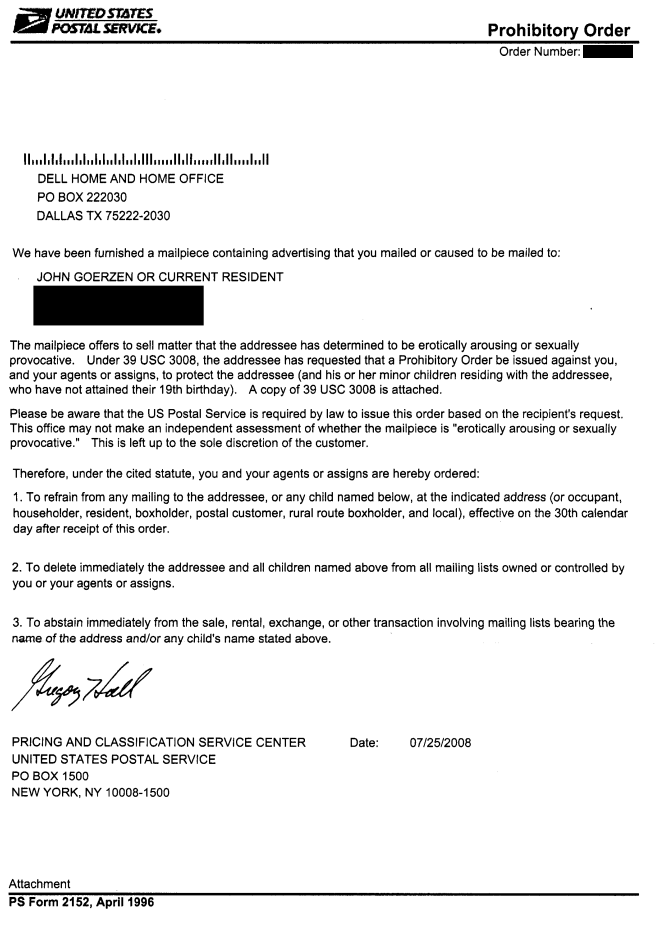
dell-usps

Somehow I get a chuckle over some Dell mail clerk trying to figure out how an 11-pound laptop is sexually provocative.

From August 25 on, it is a federal offense for Dell to send me another Home and Home Office catalog. This is a branch of criminal law, not civil law. That is, it's the maybe-go-to-jail branch of law.

How disappointed I was to receive yet another catalog from them today. If only they had waited 5 more days, I could have turned them in now.

Oh well. There's always next month's catalog. Let's just hope the clerk that received the USPS letter removed my name with a better system than everyone else at Dell uses, eh?

Sami Haahtinen: Dynamic network configuration

I've been meaning to write up on this for quite some time now, but always have something seemingly more important things to do. Most modern Linux distributions offer ways to manage network interfaces via some kind of abstraction. Usually this abstraction allows one to dynamically rename and add network interfaces. For Debian family management is done with ifupdown, while with RedHat family it's sysconfig. In addition there is NetworkManager which is a cross platform solution for dynamic network configuration (which eliminates the need to rename interfaces). Case Xenserver Usually this comes in rather handy, but on other occasions it can be a pain. A while I was helping out with an installation of a XenServer instance. This server had, for some reason, ethernet interfaces reversed in comparison to the other XenServers on the site. Luckily the service console has the network configuration in ifcfg scripts. We were easily able to reverse the interfaces by binding the interfaces to certain hardware addresses. The only problem is that the interface is renamed only when the interface is brought up. What's worse the interfaces were enumerated before the server would bring up all of the interfaces. Only eth0 was brought up for management purposes before enumerating. This means that the original eth0 was renamed to _tmp_xxxxxx. The (oh so elegant) solution was to create a script that does ifup eth1; ifdown eth1. Problem solved. Case tap0 I also experienced similar problems when I was setting up my OpenVPN tunnel. I wanted to use a bridged connection to my network, but for that I needed to create a br0 interface with tap0 as a member. It's easy enough to create ifupdown configuration to set up tap0. Hook that up to br0 and you are all set. The same problem will bite you here. The interface tap0 is actually created only when the tap0 is brought up and br0 members are added only if they are present. The solution? In my case, create a custom script that adds the device manually after it's been created properly. I was unable to find anything that works without using a custom script =( In retrospect Looking back at these cases, I should have known better. The problem was obvious and it took me way too long to figure out the cause for my problems. Then again, the utilities should be able to create a reasonable abstraction for themselves that they use to determine the actual status of the whole system. This way the trickery needed for setting up simple interface would be obsolete. You can't have it all, but you can always hope.

Martín Ferrari: Wunderbar!

DC8 group photoYou can say that DebConf8 is officially is over for you, when you're finally home, after three weeks in Mar del Plata; go to a primary school friend's house to celebrate his birthday, and end the day watching a movie alone. It's also when you delete the reminder for the two weekly IRC meetings, when you have to go back to classes, convince your boss not to kill you because of all the work hours spent on organisation, make your pet cat recognise you again, and be able to make a blog post about it. What can I say about DC8? It's been madness, rush, fun, tiredness beyond belief, intoxication, mao, meetings every day with the hotel, friends that you get to see only once a year, musicians out of key, and pride. Pride of seeing people enjoying themselves, things going more or less as were planned, and being part of a group of people that worked hard to make this dream come true: thanks to all of you! Cl mence Po syOne little thing I brought from MDQ is a copy of In Bruges, a movie I didn't know anything about, but whose title caught me. That's the movie I've just seen and loved because it brought me memoirs of Bruges and Belgium. City and country I visited last year after DebConf, and fell in love with. That's something else that DebConf has been for me: the opportunity to visit countries far away from mine, and not wanting to ever stop. Anyway, I still want to see some fellow debianites before they go to their respective countries. So a barbecue will take place at my home this weekend, just to compete with Steve's. If you're still around, just talk to me to arrange details and eat a little more beef if you hadn't got an overdose yet! By the way, I totally fell in love with Cl mence Po sy after this movie :-) Tags: Planet Lugfi, Planet Debian

Next.

Previous.



