Search Results: "ron"

26 February 2007

Michael Prokop: argument list too long

A problem everyone stumbles across (at least) once:
% tar zcf stats_2005.tar.gz stats_2005*
zsh: argument list too long: tar
The reason? Too many files for the ARG_MAX limit. ARG_MAX defines the maximum length of arguments to the exec function (more precise: bytes of args plus environment for exec), defined in /usr/include/linux/limits.h on your Linux system:
% ls -la   grep -c stats_2005
9037
% getconf ARG_MAX
131072
% cpp << EOF   tail -1
#include <limits.h>
ARG_MAX
EOF
131072
%
Ok. But how to work around the issue? Possible solution for GNU:
% find . -name 'stats_2005*' > filelist
% tar zcf stats_2005.tar.gz --files-from filelist
Without the temporary file (filelist in our example):
% find . -name 'stats_2005*' -print   tar zcf stats_2005.tar.gz --files-from -
zsh provides zargs (but AFAIK it doesn’t work with gzip in the same command line due to the way zargs works, so create the archive in one step and compress it in another step later):
% autoload zargs
% zargs -- stats_2005* -- tar --ignore-failed-read -rpf stats_2005.tar
The approach works with other tools than tar as well of course, usage example for afio:
find . -name 'stats_2005*' -print   afio -o -Z stats_2005.afio
Depending on the type of problem (rm, cp, mv,…) you can choose differented approaches as well, some further examples:
% for file in stats_2005* ; do rm -f -- "$file" ; done
% perl -e 'unlink <stats_2005*>'
% zsh -c 'zmodload zsh/files && rm -f -- stats_2005*'
% zsh -c 'autoload -U zargs; zargs -r ./stats_2005* -- rm -f'
% ksh93 -c 'command -x rm -f -- stats_2005*'
% find . -maxdepth 1 -name 'stats_2005*' -print0   xargs -r0 rm -f
% find . -name 'stats_2005*' -print0   xargs -0 mv -i --target-dir=/destination
% zmodload zsh/files ; mv -- stats_2005* /destination

25 February 2007

Uwe Hermann: LinuxBIOS talk video recording from FOSDEM 2007

LinuxBIOS logo Highly recommended for anybody who might be even remotely interested in LinuxBIOS: There's a video recording (OGG, 234 MB) of the LinuxBIOS talk at FOSDEM 2007 by LinuxBIOS-founder Ron Minnich. The talk is about LinuxBIOS, its history, how it works, what the main challenges are, where it's used today and what the future will likely hold. Watch it, you won't regret it. And if you want to know more, or maybe even consider contributing, head over to linuxbios.org or contact the mailing list.

Adam Rosi-Kessel: Grimmelmann and Kozinski on Law

I recently came across two old and unrelated writings about law, both of which are worth reading, especially for people with strong opinions but no formal training. The first is this piece, entitled Seven Ways in Which Code Equals Law (And One in Which It Does Not), by recently-appointed New York Law School professor James Grimmelmann and EFF Legal Director Cindy Cohn. Several observations are particularly appropriate for the slashdot crowd (and, to a lesser extent, certain members of the Debian community and others who grew up on a diet of BASIC, Pascal, and then C and later perl). I especially like this bit about “hacking the law”:
Some people, seeing this connection, and remembering the values of good code, try to improve the legal system by treating it as a computer. People come to me with ideas for hacking the law. The government says that cryptography is a weapon, they say, but the Bill of Rights says we have the right to bear arms. So that means we have a Constitutional right to use cryptography. But the legal system isn t a computer. If you can t convince a judge that what you re proposing is consistent with the values underlying a law, your argument will go nowhere. People go to jail every year because they think they ve found a way to hack the Sixteenth Amendment. The income tax is illegal, they say, or, The income tax is voluntary, see, it says so right here, and then they get convicted of tax evasion and sent to jail. We did convince several judges about the Constitutional dimension of cryptography, but the claim started from the values of the First Amendment, not a mechanical reading of its words. It s a category mistake to treat the legal system as just another architecture with its own specialized language. Code and law are different ways of regulating; they have different textures. All of those people who are required to make the legal system work leave their mark on its outcomes: they make a certain amount of drift and discretion almost inevitable. Code doesn t have such a limit: it can make perfectly hard-nosed bright-line rules and hold everyone in the world to them. Code is capable of a kind of regulatory clarity and intensity that law can only state, never really achieve.
I don’t entirely agree with the other article, entitled What I Ate For Breakfast and Other Mysteries of Judicial Decision Making by outspoken Ninth Circuit Judge Alex Kozinski (unofficial site maintained by Aaron Swartz, wikipedia entry). For example, I think critical legal studies has resulted in some interesting insights, some of which actually have practical applciation. Still, Judge Kozinski makes an important point about the numerous factors that act as a check on discretion in judicial decisionmaking:
It is popular in some circles to suppose that judicial decision making can be explained largely by frivolous factors, perhaps for example the relationship between what judges eat and what they decide. Answering questions about such relationships is quite simple - it is like being asked to write a scholarly essay on the snakes of Ireland: There are none. But as far back as I can remember in law school, the notion was advanced with some vigor that judicial decision making is a farce. Under this theory, what judges do is glance at a case and decide who should win - and they do this on the basis of their digestion (or how they slept the night before or some other variety of personal factors). If the judge has a good breakfast and a good night’s sleep, he might feel lenient and jolly, and sympathize with the downtrodden. If he had indigestion or a bad night’s sleep, he might be a grouch and take it out on the litigants. Of course, even judges can’t make both sides lose; I know, I’ve tried. So a grouchy mood, the theory went, is likely to cause the judge to take it out on the litigant he least identifies with, usually the guy who got run over by the railroad or is being foreclosed on by the bank. This theory immodestly called itself Legal Realism. Just to prove that even the silliest idea can be pursued to its illogical conclusion, Legal Realism spawned Critical Legal Studies. As I understand this so-called theory, the notion is that because legal rules don’t mean much anyway, and judges can reach any result they wish by invoking the right incantation, they should engraft their own political philosophy onto the decision-making process and use their power to change the way our society works. So, if you accept that what a judge has for breakfast affects his decisions that day, judges should be encouraged to have a consistent diet so their decisions will consistently favor one set of litigants over the other. I am here to tell you that this is all horse manure. And, like all horse manure, it contains little seeds of truth from which tiny birds can take intellectual nourishment. The little truths are these: Under our law judges do in fact have considerable discretion in certain of their decisions: making findings of fact, interpreting language in the Constitution, statutes and regulations; determining whether officials of the executive branch have abused their discretion; and, fashioning remedies for violations of the law, including fairly sweeping powers to grant injunctive relief. The larger reality, however, is that judges exercise their powers subject to very significant constraints. They simply can’t do anything they well please.
Finally, I will link, but not embed, this video of the Anna Nicole Smith court order, for an entirely different perspective on the legal process. You almost don’t really want to have to see this stuff.

23 February 2007

Simon Law: DemoCamp Montr al 1


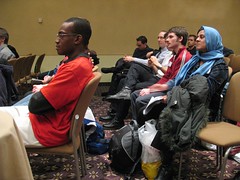
Audience
Originally uploaded by sfllaw.
There's less than a week before Montr al's next little technology un-conference. DemoCamp Montreal 1 (Fran ais) follows in the footsteps of Toronto's DemoCamp, bringing neat demonstrations to the spotlight. What is DemoCamp? It's a mini-conference where you show up and get to see people present the cool things that they're doing. Be it some software they wrote, a robot they built, or even a live tutorial, there's always something interesting happening. And you need to know. All you have to do is show up. We'll be at the Societ des arts technologiques which has been cool enough to donate their space for us. Just show up on Tuesday 27 February 2007 at 18:30, after putting your name down on the registration list. Don't be shy, it's free! Demonstrations are short, sweet, and PowerPoint slides are forbidden. You get to actually see something happen, which is a much more exciting than your usual conference lecture. In addition, we'll hang out afterwards to shoot the breeze and discuss what we saw. I'll be there with my camera, helping my friends [info]gorbash_dragon and [info]peaceful_dragon run the show. Jonathan Kopanas, who went to Concordia, is coming up to introduce the presenters and Austin Hill is drumming up publicity. DemoCamp Montr al 1
Tuesday 27 February 2007
18:30 20:30
Societ des arts technologiques
1195 boul. St-Laurent
Free admission
( Sign up Upcoming.org Google Maps ) I'll see you there!

MJ Ray: Debian: Links for 2007-02-23

While we're fixing some network problems, here is a musical interlude^W^Wset of links...
Explaining Debian at parties
'Do not try to convince people to try it out or you will become a support hotline. Instead, tell them about LUGs and mailing lists (and how cool it can be) and put the challenge on them: "if you try it, those are your support channels. Are you up for it?"'
Index of /~joerg/templates
Explanations of some common reasons for getting REJECT from ftp-master.
gravityboy: Politics
"If we're going to make interactions between developers more civil and friendly and less personally hostile then we need a different kind of stick. Maybe a carrot of sorts is in order too?"
Consensus and community review in open source and open standards Decentralized Information Group (DIG) Breadcrumbs
'this is quite a stretch with respect to the normal dictionary meaning of "consensus"'
Social Drag
How many Debian Developers are dressed in Social Drag?
debian Gender Research
More research to add to the surveys page
#354950 - ITP: gauche-readline -- A readline-like library for the Gauche Scheme implementation - Debian Bug report logs
Contemplating sponsoring again.
The joys of English cuisine are abomination in God's sight Ted Walther's Private Diary
Blast from debian past: Ted Walther's gullibility for stereotyping is an abomination in God's sight and those foods are hardly typical English. For instance, the only one on his PS list that I've eaten recently is flapjack (not flapjacks, which is something else and not English AFAIK) and I can only remember eating five of the list in the last year. Also, the linked site seems to concentrate on processed pap from multinationals and supermarkets, rather than real trad English food. Example: "Yorkshire puddings are basically a bread type product. You can use them in place of dinner rolls." Why not make 'em a bit harder, cook 'em a bit longer and you can use them for cobbling the street instead? Yorkshire pudding should be a baked batter with a soft middle and a crisp puffy edge. Nothing like bread. And don't get me started about the pasties. Honestly, if you learn about food from such sources, no wonder you'd think it an abomination.
Re: Position Statement to the Dunc-Tanc "experiment"
"had somebody wanted to kill (or inflict maximum damage) to the project, he couldn't have done any better than the current DPL"
Releas-o-meter
Interesting idea - why no cron-run copy on the web?
EUPL v 1.0 revokable ?
One that may appear in a future 'bits from debian-legal' - it seems the EU are popularising a type of termination clause. Yay.
Future of Debian Weekly News
As I hoped, Joey is explicitly calling for sponsorship for DWN production.
DPL 2007, Current Candidates
still don't have a title is keeping a list of DPL candidates, so I won't put one up this year.
#411041 - request for debian-l10n-persian mailing list - Debian Bug report logs
Tell all your persian-speaking friends to show their support!
Interprete I cite, you cite, I rant
Lack of references is a problem on lists like debian-legal where explaining everything again can drive you insane and still not convince some people.
Lucas Nussbaum's Blog State of software for Suspend to RAM/Disk ?
More tips on the "Will I Work Or Not?" suspend problems.
only on debian-devel - she.geek.nz
> Am I mistaken or this is a flame on how to flame ?

Simon Richter: Threads

Miriam, coroutines have the same problem as threads, futures and all the other interesting concepts out there: they are perceived as a magic bullet when they are merely one tool in the great toolbox. Whether a tool is appropriate depends on the job. Postgres, for example, handles each connection in a separate process, which adds a lot of complexity to their internal structures as all concurrent accesses need to be handled properly. However, SQL's transaction and isolation semantics make a single-threaded implementation almost as hard to implement, so the correct answer was to use threads. The biggest problem with threads is data consistency, and this is where almost all negative examples originate: some variable was not declared volatile, some lock not held long enough, some set of locks taken in the wrong order. A rule of thumb should be: if your threads need to interact, then you should not be using threads. If you have to compute something which will take longer, it is absolutely fine to start a new thread, but then you will have to protect the inter-thread communication appropriately. What is appropriate depends on the problem again; in most cases it will be message queues which allow the other thread to handly the request when it is in a safe state. Coroutines come in at a point where "you should not be using threads", by essentially allowing me to write a producer-consumer model as if it were threaded, and then letting the compiler build a nonthreaded version from that. In the C++ world, most algorithms can not be combined directly because they are written as a consumer/producer loop and cannot be suspended -- coroutines will make that possible.

Gunnar Wolf: Talk submitted for YAPC::EU

I just submitted my talk proposal for YAPC::EU, which will be held in Vienna in late August. The topic? Integrating Perl in a wider distribution: The Debian pkg-perl group.
I took part in YAPC::NA (Yet Another Perl Conference - North America) in 2001, in Montreal, and YAPC::EU (you guessed right: Europe) in 2002, in Munich. While in Munich, I met Debian's Erich, Weasel and the late Jens. It is a very nice conference with all kinds of Perl-heads, apt for different experience levels. the talk I am proposing will be about what do we work for in Debian, how can we get a better synergy from our upstream group and (oh, this point is quite itchy - specially in strongly opinioned communities such as Ruby's! Perl people are quite nice to play with, however, but still...) what do we (as Debian maintainers) request from them in order for life to be smoother.
Of course, I only submitted the talk. The CFP has just been launched, and so far, mine is the fourth talk offered - It can still be rejected (as it is not really related to Perl development, the heart of YAPC), but I guess it will be deemed interesting by the Perl monks reviewing them.
In any case, hope to see you in Vienna as well!

22 February 2007

Ben Armstrong: make-live -p gnome-junior

Ever since I started working towards a Debian Jr. livecd back in November, I’ve played off and on with qemu, approx and debian-live. Yesterday, I took another kick at the can. Being frustrated with make-live’s inability to combine two package lists, Daniel Baumann came to my rescue, promptly commiting and then releasing live-package 0.99.23-1 with three new package lists for Debian Jr. So now we have something to play with. Try it out. Install live-package 0.99.23-1 or later, configure /etc/make-live.conf to set LIVE_MIRROR to your favourite mirror (I use the apt caching proxy approx to avoid re-downloading the same packages from one run to the next) and pick an image and type to build, e.g.
$ sudo make-live -t usb -p gnome-junior
This makes a ./debian-live/binary.img that can be put on a 1G usb key flashdrive. We have more work to do to polish this. Particularly, since the GNOME and KDE flavours are larger than a 700M CD, some fat could be trimmed. If you’ve tried it, I’d love to hear your ideas on debian-jr@lists.debian.org.

Andrew Pollock: [life] New York, New York

Since this year is the year we do the east coast, for the President's Day weekend, we made the (freakin' long) trek over to New York to scope it out. I have to say that I liked it a whole lot more than I thought I would. I thought it'd be really big and overbearing and crowded. Maybe because it was a holiday weekend, and insanely cold, it wasn't that crowded. It also didn't come across as being that big and scary. The grid layout makes it easy to figure out where you are in relation to where you want to be, but for someone like me, who's terrible at remembering numbers, remembering any given address is a nightmare. We flew out from San Jose on Friday night, and arrived at 6 the next morning in Newark. My mate Andrew Calman, who's in the US for 5 weeks, tagged along and was spending the entire week in New York for work, so he had accommodation in the corporate apartment. We all headed to there and had showers and then caught up with my friend Franko, an ex-Asia Online crony, who's now living in New York. Andrew's friend Lisa flew in from London for the weekend as well, so there was quite the merry band of tourists. First impression: extremely cold. I don't think it broke over 0 degrees Celsius much of the time. This was the first time I'd been in a city with snow, although it didn't snow while we were there. It was different to see piles of dirty snow in the gutters, and how filthy all the cars were from the snow and the salt on the roads. Crossing streets often involved negotiating a big pile of snow. No alleys. Nowhere for rubbish but on the footpath, where it seemed to get collected very frequently. So you walk along and there's just bags and bags of crap lying around everywhere until it's picked up. Way small apartments. Franko lives in a studio in Chelsea, the mattress is on an elevated "shelf" that you have to climb up a ladder to get to. The entire apartment is just the living room with the "loft" suspended on one side, and a tiny kitchen and bathroom off the other side. All this for about $1500 a month. Franko magnanimously slept on the couch and gave us the bed. If I had have known the apartment was that small, I wouldn't have let him put us up, or I would have insisted we brought our inflatable mattress. After we had breakfast, we went to MoMA, which I felt was a bit expensive, at $20. At least they didn't try and charge for the cloakroom service. Highlight of that outing was seeing Jonathan Price wandering around. I recognised him instantly from Ronin, but couldn't remember either his name nor his character's name. Turns out he's been in a few other recent movies as well but I didn't recognise him. After MoMA, we had a late lunch at a Korean place that Franko liked, and then Sarah and I took the subway to Brooklyn so Sarah could catch up with a long lost school friend she hadn't seen since high school. After that, we went to 7B for a drink, and then Room Service for dinner. The food was great, the service less so. I think we were dead on feet by this stage, so went back to Franko's and crashed. On Sunday morning, we went and visited Sarah's boss, who had had an emergency appendectomy the previous week (instead of speaking at LinuxWorld) and was laid up in the Marriott Marquis, right on Times Square. Times Square was insane. I can't imagine what it must be like there for New Year's Eve. We grabbed a hot dog and a slice of pizza there for lunch, and then trekked down to Wall Street briefly. Checked out Ground Zero. That made me feel sad. Manhattan's not that big. I can appreciate how much September 11 must have rocked everybody living there. I think we then had a power nap. Good idea that was. We hit an underground bar somewhere I can't remember, that you really had to know about to find, and then had some dinner at a random Italian restaurant in Little Italy. Then we hit the Empire State building. I think that cost about as much (if not more) than MoMA just to go up to the lower of the two observation decks. It was 11:30pm by this stage, and it was absolutely freezing up there. The view was pretty impressive though. We had a drink at another fairly hard-to-find-unless-you-knew-it-was-there bar (I think it was called 3rd Floor) and called it a night. On Monday, we headed off to Liberty Island to check out the Statue of Liberty up close and personal. As much security as the airport, just to get on the ferry. Absolutely freezing out on the island as well. We only stayed out there long enough to get on the next ferry back. Overall, we had an excellent weekend there, and I definitely like the place. It was great having a local guide, so we got to eat and drink at some places we'd never have found otherwise. The subway system is fantastic, at $2 a ride, no matter where you go. Taxis are also a bit of a must, and didn't seem outrageously expensive. The NJ Transit train seemed like a good way to get between Manhattan and Newark airport. I felt like it was pretty expensive city though. Everything added up, and it seemed like we were spending money hand over fist at times. It also took a lot longer to do stuff than I'd anticipated, so we got a lot less done than we'd hoped. We were already planning on having to make at least a second trip to see the place properly. At least it'll be warmer next time. Photos from the weekend are here.

21 February 2007

Joachim Breitner: News from the XaraLX front

What happened so far: Pretty much one year ago, Xara released a Linux port of there XaraX vector graphics suite under the GPL, and everyone was happy, as it is a pretty good piece of software. A small portition of the program, the drawing library CDraw, was still distributed as a non-free binary blob with the prospect of freeing it later. to prepare for that, I created a debian package in non-free. About half a year ago, development as slowed down as the company s team was tight into other tasks and outside contributions were still few.Last thursday someone asked on the mailing list for news on the freeing of the CDraw library, starting an unseen surge of new posts on the list, from Xara employees, free-time developers and outstanders. Besides some unnecessarily rude messages, it was an interesting discussion on how a small non-free part of a program seems to scare of a lot of developers from working at the otherwise free program at all. It also became clear that Xara, recently being bough by MAGIX, will not release the CDraw library any time soon, being afraid that others might use the code to compete their commercial Windows version of XaraX.The solution, it seems, will be an internal fork that uses Cairo to render if the CDraw binary is not available. This will, at least for a while, cripple XaraLX, it will most likely be slower than the supposedly very fast CDraw, but it will be fully free software. At least the Xara guys don t oppose the plan, so there is hope that it will succeed. And who knows, maybe they will release CDraw when they see that a real free software does attrackt outside contributions.

Arnaud Fontaine: pmnew-gui announcement

These last weeks, Enrico and me have worked on a GUI frontend for pmnew. At the moment, the prototype is limited to the task of finding new packages to install. The goal of pmnew-gui is to have every little detail designed to be as smart as possible: for example, the list of packages shows at the top the packages that the system thinks you are interested in having comparing your system to thousands other systems. Screenshots http://people.debian.org/~enrico/2007-02/sshot-startup.png
http://people.debian.org/~enrico/2007-02/sshot-audio.png
http://people.debian.org/~enrico/2007-02/sshot-games.png Get it
bzr branch \
http://people.debian.org/~enrico/2007-02/pmnew-gui/
Setup The README gives some details about the setup. In short you will have to do the following steps:
apt-get install python-debian python-deb822 python-xapian \
python-apt python-glade2 python-gtk2
./update-data
./pmnew-gui
It works better if you have a network connection, and if you have popularity-contest installed and running. Feel free to send us feedbacks about the GUI. Links

Martin F. Krafft: Leaving Limerick

I have returned home after five weeks of Ph.D. research in Limerick. I've come a bit further on the way towards my thesis but still have not reached the critical mass moment when my inertia makes me go on and on until the work is done. But in all fairness, I've made a good deal of progress and now should have all I need to work on this in my spare time at home too. I also had a fabulous time outside of the office, being immersed into a wonderful circle of lads and ladies from the very start. I would not be able to capture all the fun in writing about it, so I won't and instead resort to looking forward to my return for a two-day workshop in a little less than three weeks, and another longer stay in April/May. This time, I won't lure my bike along. It was a good idea, but there was too much rain and mud to really enjoy it. Even though transport to and from Limerick (which isn't exactly well-connected to the rest of the world in terms of transport) was mostly painless (thanks to people like Ewan, who'd take me along to Dublin and drop me in front of my hotel), it's probably more trouble than worth especially since I doubt I could get bored around "109/110 Elm Park" (which is where I lived). Daren, Mel, Claire, Jonathan, Cliona, Cathal, Sarah, Caitriona, Lisa, James, Jerry, Karen, Jurij, Gary, Eoin, and everyone else whose name I didn't manage to store (forgive me), I miss y'all already NP: Amorphis / Elegy

Benjamin Mako Hill: Trademark Violation and Greater Evils

Biella Coleman recently mentioned counterfeit drugs in a blog post:
A pirated movie carries little consequence, except for that the movie industry may lose some cash flow. A fake Rolex purchased on the bustling streets of NYC saves you a lot of money (and robs you of a warranty). But counterfeit drugs, the consequences and stakes are at a whole other, more serious, order of things.
Biella's intentions in drawing the analogy are harmless -- people really do lose their lives because of fake drugs while rock-off movies and Rolexes are relatively harmless. However, her aside reminds me of the much less harmless, fair, and honest analogies drawn by Pat Choate in Hot Property who used examples like counterfeit drugs and dishonestly labeled aircraft parts to support a high protectionist position on IP. Because of the arguments made by people like Choate, I believe that there is a subtle danger in the type of analogy that Biella draws that I think we should try to guard against in the future. The danger lies in the fact that these comparisons tend to conflate at least two very different kinds of illegal activity. Trademark violations are illegal. So it selling drugs without approval from regulatory bodies. So is manslaughter and murder -- both terms used in the Times article Biella links to to describe the actions of drug counterfeiters. Laws in most countries already prohibit all of these things and offer increasingly harsh punishments for each action. In fact, selling unlicensed drugs and killing people is much more illegal than violating trademark and making knockoffs. And it should be. When someone commit IP violations in the process of committing much worse crimes, we should focus on highlighting, condemning, and punishing the much worse crime, not the IP violation which in comparison is almost inconsequential. The punishment for counterfeiting drugs may only be a slap on the wrist and that's probably an appropriate punishment for the counterfeiting component of the crime. The other worse crimes that the counterfeiter is also committing should be punished much more harshly. If, as the Dr. Reggi quoted in the Times article complains, "counterfeiting a medicine can be [only] a misdemeanor," we need stronger laws against selling unregulated drugs -- not stronger IP laws. If we confuse and compare bootleg movies and knock-off Rolexes with fake malaria or AIDS drugs, we're likely to come to the opposite conclusion. Our reactions to such situations should be, "People are killing people with fake drugs! We need stronger laws against killing people in these ways." They should not be "People are killing people with fake drugs! Interesting to note that they are also violating trademark laws like other counterfeiters." The former reaction will frame the discussion in a way that lets us treat the bad components of the crime more harshly and will not help IP high protectionists argue for stronger IP through a disingenuous process of guilt by association.

Lars Wirzenius: Finnish politics: Demonstration against the EUCD tomorrow

There's going to be a demonstration against abuse of Lex Karpela, the new Finnish copyright law based on the EU copyright directive. Tomorrow, at 13:00, in front of the parliament building. For more information, see Mikko Rauhala's EUCD page.

Pierre Habouzit: git tricks ...

when you have a svn-like use of git (I mean with a central repository), it's a good thing to repack the central repository from time to time. If your repository lives (totally random example) in /git/pkg-xorg/lib/mesa.git, you can do:
   cd /git/pkg-xorg/lib/mesa.git && GIT_DIR=. git repack -a -d
I'm told that some people that had more than 1.5Go of git repositories have seen their main repositories shrink well under 200Mo of disk usage. On my own git central server, I use that as a cron:
 #! /bin/bash
 GIT_BASE=/git
 for repo in $GIT_BASE/*.git; do
     pushd $repo &>/dev/null
     GIT_DIR=. git repack -a -d  &>/dev/null
     popd $repo &>/dev/null
 done
but on a big and loaded server one could make it better and repack only when it seems to be needed and use (untested):
 #! /bin/bash
 GIT_BASE=/git
 GIT_THRESHOLD=5000
 for repo in $GIT_BASE/*.git; do
     pushd $repo &>/dev/null
     if test $(find objects   cut -d/ -f3   wc -w) -gt $GIT_THRESHOLD; then
         GIT_DIR=. git repack -a -d  &>/dev/null
     fi
     popd $repo &>/dev/null
 done

MJ Ray: Environment: Links for 2007-02-21

The Weston Mercury - Tropicana vote - where was your councillor?
Fantastic work by Archant's local newspaper, actually calling councillors and asking them to account for the way they voted on a controversial seafront development. I'm surprised so many of the Worle councillors failed to vote for various reasons. I also think it's a bit poor that the vote was so late at night.
BBC NEWS England Cornwall Row over response to overcrowding
An amazingly brutal and probably honest answer about the local rail company's approach to commuter trains.
BBC NEWS England Train company says sorry to users
Train company admits "too much capacity was removed from the timetable".
Sustainable Building Sourcebook Contents
A book about green building in Texas USA. The whole thing seems to be online (sponsored) and it has some useful explanations about things like thermal mass.
The Weston Mercury - Town centre demolition
Dolphin Square is ugly, but I think it's actually one of the better examples of 60s rectangular town centre building. It's not listed or anything and it's so near the beach, I don't doubt it will be demolished. What will happen to our supermarket there? I hope there will still be one in the town centre area.
RADBURN, NJ
A recent planning process commented that my part of the village is a 'Radburn-style' development and that's why some parts have parking problems at the moment. I didn't know what that meant, so I looked it up. It means that the main access to our houses are footpaths and cars are left in cul-de-sacs around the edge of the development. That explains some of the apparently-confusing naming/numbering decisions. This is the site of the original Radburn.
Top 10 annoying commuting issues
Martyn in top form, ranting about his trip to work. I'm so glad my commutes are mostly cycling across countryside now.
Everyday Cycling - British Cycling Confirms Major Cyclosportive
Want to ride the TdF London-Kent route on 1st July?
Bagel Belly Blog: Travel trouble
Savs's long lane to Leicester. My comment: don't ever believe the route planners. Every one I've seen so far optimises for theoretical speed or distance, when what we really need is resilience and fuel economy too. The A47 vs A11/A14 choice is an extreme example: A11/A14 has far more free-flowing junctions and dual-carriageway than the A47.

Dirk Eddelbuettel: littler 0.0.10 released

Another bug fix release -- this time triggered by Detlef's problems to build r (pronounced littler) on SUSE/OpenSUSE. Jeff also added better rng initialization fixing problems I noticed with tempfile(), added checks for the upcoming R 2.5.0, and made tests in tests/ use a path of ../r. Lastly, we added a short segment on the upcoming, err, shall I say 'cousin' Rscript that will be released with R 2.5.0. As usual, everything is in our svn archive, on my r page, and in the local directory here. A fresh package is in Debian's incoming queue, and Jeff's littler page at Vanderbilt should reflect the new release soon too.

Gunnar Wolf: Back from [VAC]?

On January 13, I sent a mail to debian-private saying I'd be on a semi-vacation until around February 10 - And yes, for over a month I've basically not touched my packaging, and for around three months my general profile in Debian has been really low. I sent this message because the Institute I work at moved, and I got the task of taking care of everything related with electrons flows carrying information (namely, voice and data networks).
It's not that I'm really-really-back now - Work is still too absorbing, users still come too often to me expecting me to solve their problems. I can often try to do so on the data network, but I'm far from even having access to the voice equipment (I've done my hardest effort not to get such access, because that'd instantly turn me into the phone operator for life). However, for the first time in many weeks, today I had some quiet time, I catched up with some mailing lists, and... Well, I expect to work on my QA page.
Boy, team-maintainership rules! pkg-perl friends, thanks for saving me from the creepy bugs sometimes too often. I expect to pick up work I haven't even looked at since I committed to doing so with the pkg-ruby-extras team as well, specifically, getting mongrel in shape and into Debian, despite our deep differences with its author. This will make Rails roll smoother and faster in Debian. And of course, there is Debconf. After last year's burnout, I think I recovered - I'm not a core organizator anymore, but I'm back to work my way to Edimburgh ;-)
As for my local activities (Mexican Free Software conferences, meetings and people): Partly because so I decided and partly because so it happened, I've been off the hook with the local community since before Debconf 6. Before, because I was too busy to think about anything besides it, and after, because I was burnt out and somewhat bitter at several facts. I've been to few regional or local conferences, also because I knew that between last October and today I'd be too tied up at work. But last week we had both CONSOL and BarCamp Mexico. Somehow I managed to be at both (well, at CONSOL I was only enough time to do my two talks, for which I miraculously managed to get prepared, and BarCamp was during the weekend). Both were very positive for me, and I'm willing again to find some time to devote to promoting and developing Free Software in our country.
Oh! One more note: Thanks to Sergio Mendoza for pushing me and for co-discussing on the subject, we are getting small but tangible results pointing to a Debian-UNAM project. Not much to see yet, besides having received the domain authority, which for now just means a nicer name for Nisamox, Mexico's main (and only long-running) full Debian mirror.

Alastair McKinstry: Twinkle, twinkle

Our youngest daughter Sabdhbh, in bed
After singing the first verse for many years to my kids at night, I chanced upon the full words to this lullaby fairly recently, in an old book on Astronomy for children, Among the Stars by Agnes Giberne, 1885.

::READ MORE

20 February 2007

Erich Schubert: Dell customer wishlist

Dell is collecting customer wishes. It's interesting to see that all the top wishes are software related: starting with Linux preinstalled, OpenOffice, no AOL software preinstalled but a plain Vista only, Firefox as default browser or no software installed at all. I'd strongly suggest Dell to consider bundling at least OpenOffice, Firefox, Inkscape, Gaim, Thunderbird, Gimp and some more of the great Opensource software available for Windows (remember: they're free - no extra cost, but some customers will be happy for having a good vector graphics program, or a free office suite...) And I'd definitely like to see Dell offering a "no windows" option; I don't want to pay the Microsoft tax. An OS-less PC is fine for me, but it should be really cheap for Dell to get e.g. Ubuntu preinstalled.

Next.

Previous.