Search Results: "ron"

3 March 2007

Julien Valroff: Sound output broken on my Dell Inspiron

I have recently noticed that the sound output of my (nearly) 3 months-old Dell Inspiron 1300 is broken. I am pretty sure it is something like a bad contact. As I use this laptop mainly as a media box, I cannot leave it in this state. I thus wrote to Dell Support team on Thursday evening, less than 5 days before the end of the 90 days warranty. They called me back yesterday morning to confirm they have received my request, and I received an e-mail yesterday afternoon asking me to do some further tests. I think I will have to sent the laptop back and wait for ages until it comes back. As it obviously runs Debian, I will also have to set up the original system back on it, which will oblige me to re-install the whole system after repair. Cheap is not always good.

2 March 2007

Erich Schubert: VMWare doesn't work.

I tried to setup VMWare today, to be able to have some virtual machines to test random stuff. My laptop only has a small HD, so I want to have all the VM stuff on my huge external USB drive. Also I only use them occasionally, so that pretty much rules out Xen. So I decided to give VMWare a try. VMWare has always been a desaster installation-wise. It took me like 5 runs to get it installed properly; you need to apply some patches or it won't work with current kernels etc. After these tries it had installed without any further error messages and the GUI also came up easily. However none of the VMs I created did anything; apparently they're supposed to at least show some BIOS like screen. Instead I only get the error message "Unable to change virtual machine power state: The process exited with an error: End of error message." And of course it doesn't tell me which process or anything else that could help debugging it. Shutdown also doesn't work properly - stopping vmware leaves a vmware-serverd process running that needs to be killed with -9. As usual, commercial software is totally disappointing. [Update: so neither the vmmon shipped with VMWare nor the one from vmware-any-any-update108 worked; keep your eyes open for update109. I managed to patch vmmon myself, in include/compat_kernel.h move the if/else part up to the front, as it is in update108.]

MJ Ray: Bad Tech: CGI Scripts and Line Endings

Bad Tech: DOS using different line end character sequences. Problem: CGI scripts uploaded with the MS Windows version of FileZilla over SFTP don't work until converted. Either there's some FileZilla settings wrong by default, or it just doesn't work. Solution: Evilly, I made a perl^M symlink to stop having to convert users' files. Surely there's a better way I'm not seeing?

Christine Spang: Free Your Music

While I’m not a Harvard student, I’m vaguely affiliated through some friends of mine with Harvard Free Culture, a local Free Culture chapter. They are, after all, just up the street. One of our newest projects is the Free Music Project. The goal, is, well, to gather together music under free licenses, both for just making a centralized collection of free music and for other specialized purposes, like providing music to go on OLPC laptops and school servers. So, go find free music, or if you’re an artist, re-release your music under a free license or record some new stuff. (If you’re in the Boston area, Antenna Alliance can help you get your music recorded for free. Who knows, maybe your music will end up on millions of laptops.

Biella Coleman: On Edmonton, Place, and State of Mind

Recently, I got a comment on an older blog post on Edmonton that basically agreed with another comment that Edmonton was so not the cat’s meow. Despite the winter and many months later, I guess I still do think it is, although in saying so, it is not I think their assessments are wrong, I think my take has as much to do as what has come before (like NJ, which was not the high point o my life), my experiences here, and what is to come in the future. I tend to like Edmonton because there is enough stuff to do but not too much to do. It is that whole freedom from choice that I like because I often shut down in the face of too much choice. What also colors my experience in a positive light is that generally, Canadian politics, social policy, and way of life, are a step up or two (or maybe three) than that of the United States. So the worst of Canada (if you are even to call Edmonton that, which I would not), in this regard, beats out the best of the United States. And I have lived most of my life in the US so that is my point of comparison. Even if you are living in a fantastic American city, you always face the possibility of struggling in ways that will *never* happen in Canada. It makes for a calmer, less aggressive society. For example, I recently learned that Edmonton has the highest murder rate in Canada, at a whopping …. 36 people per year (population of Edmonton = 1 million). I grew up in a place, Puerto Rico where the yearly murder rate hovers at about 700-800 per year (population = 4 million). And yet people here are freaking out over the high rate of murder, which is a good thing because hopefully they can bring it down but this fact should make the US pause and think about what they are doing up north to keep the murder rate so darn low (and the answer I think is pretty easy to find). But perhaps a lot of my love of the place has as much to do or more with my state of mind. After a grueling year of finishing a dissertation under pressure as I had deadline, and then living in NJ where I was on the job market (which meant spending so much time churning out application after application and then flying around interviews), in addition to flying 7 times in one year to visit my mom, my life here just feels so much more sane than it has been in years. What sealed it all was that right before I moved here in August I was lucky enough to be offered a permanent job (which means this summer I will be moving to NYC to join this department and I will be back to the land of overwhelming choice), so that for the first time in 5 years I did not have to apply for anything in the fall that would guarantee my livelihood for the next academic year. I was not faced with a year of lots of travel (and actually traveling in out out Edmonton is really one of my least favorite things). With that firmly in place, I could just concentrate on things like my work, my friends, brewing kombucha and do things routinely, like exercise, which I had not consistently done for years. There are things about Edmonton that I find totally obnoxious like the cities inability to plow roads leaving a thick glaze of black ice on the roads so that when you drive in the city, you basically are at real risk for an accident (and this is despite a 6.6 BILLION government surplus). There are a tad too many strip malls in the outlaying areas, and of course there is the infamous winter. We are still deep in it. The cold temperatures have been with us steadily for months now and according to folks, there are still two more months to look forward to. The cold and the constant layering of clothes are getting to me a little, although I do appreciate that the cold is just not as cold as one would think with the actual temperatures. The lack of wind, the dry conditions, the cute as chubby-as-anything- bunnies that run through the snow, and the overpowering sun all help to make -6 F much more mild, so it is not as bad as you would or I would think it was. So while I am thrilled to join the department where I am moving too, I will be sad when I leave, though perhaps not as sad as Edmontons “darling” hockey player, Ryan Smith, who was just traded by the Oilers to the NY Islanders. The day he left, he literally was shedding tears at the airport. And I have to say, even though I have no attachment to hockey, I found the pictures endearing because there is nothing like seeing a grown Canadian man cry over hockey! : )

Nico Golde: wikipedia starts to suck

The famous Wikipedia online encyclopedia starts to suck. Well at least the German, haven't looked at other languages.
First they (ok in particular one wikipedia guy) wanted to delete the article about my favourite live cd grml (crux linux for example is deleted).

Ok could be just an action of some random idiot. But then I read an article in Tim Pritlove's weblog that they also deleted an article about Julia Seelinger a young politician of the green party in Berlin because of their so-called "relevance criterias".

And there are many other discussions about deleting articles, for example here.

WTF has happened to wikipedia? Is there any valid argument to delete an article apart from the argument that the content itself is totally wrong?
Isn't disk storage cheap enough today to keep these articles?
Wasn't one of the goals of wikipedia to catch up all the human knowledge?

Really, I can't understand this bureaucracy currently happening in wikipedia but if some random fools start to delete articles with these arguments I
wouldn't wonder if people stop writing and editing articles for the Wikipedia. It also sad for the people who put their efforts into wikipedia and wrote the articles.

Just sad.

MJ Ray: Never mind the wheels...

Never mind the wheels what about the fuel ? Update: Morrisons have withdrawn unleaded petrol from suspected stations as a precaution. Well done! Meanwhile, last I heard, Tesco were still denying that the contaminated fuel was anything to do with them, while flushing their tanks. Hey, it's not their cars which are kangarooing.

MJ Ray: OpenWRT (3)

More comments, which I think help to narrow my choice to OpenWRT or FreeWRT. Kris Marsh commented:
"I can't comment on dd-wrt, as I've never tried it. I can, however, say that OpenWRT is great. Personally, I don't see the point in X-WRT, as I use vi and /etc/ to modify configs. Assuming you're handy with Debian (;-)), then you should be just fine without X-WRT. Tip: If you want to use WPA, you need to install the "nas" package: "ipkg install nas". I believe this non-free package is what a previous commenter was referring to."
Yes, I want to use WPA (I think some of the machines here can't do IPSec and WEP just isn't good enough) so I guess I have another freedom problem. I'd be happy with ed, but I might try X-WRT just to see how it copes with my web browser (I expect badly, like many embedded web apps, but then I could file bugs or fix it up). ranf mentioned:
"There is also a OpenWRT fork named FreeWRT ."
Argh, another candidate! Seriously, thanks for the tip. I'm not sure what it offers me over OpenWRT, as FreeWRT doesn't list either my router (Belkin POS) or my office host system (gobo) as supported and I don't intend to install svn any time soon. I'll probably try its Web Image Builder. Taneli commented:
"I believe Kamikaze has open source broadcom drivers (it's using 2.6). No idea if backport exists, but I'd venture no. Using Kamikaze sounds quite dangerous, but I haven't tried."
nbd wrote:
"Hi there. A few comments on your blog post: The main reason why the free Broadcom drivers haven't been included yet is because they're simply not ready. The Broadcom SoC needs to be handled differently than the MiniPCI cards and I'm working with the bcm43xx on that. Actually the new 2.6 based port is almost complete. As to which Firmware you want: As an OpenWrt developer I very much recommend installing X-Wrt on OpenWrt :) Anyways... Have fun!"
Yes, this is definitely a "fun" choice! I guess I won't know what works until I JFDI and pick up the pieces. Glad to hear the Broadcom drivers are still being worked on: I've met a lot of Broadcom cards and some of them can only be coerced with ndiswrapper, which isn't good. I wish I knew enough about network hardware to hack sensibly, but I don't know where to start and there's so much else to do. Finally, it looks like dd-wrt isn't a good choice. Yammering (Clint Adams) linked me to this rant and Simon Farnsworth commented along similar lines:
"X-WRT is just an easier UI that installs over OpenWRT. DD-WRT is a competing project to OpenWRT, based on the OpenWRT code, but using such "free" software techniques as product activation, and per-seat licencing to stop you "misusing" your GPL rights. I'd recommend OpenWRT/X-WRT, just because they tend to be more respectful of licences, and less prone to demanding money with menances."
I've no problem with commercialism itself, but I dislike broken promises and playing fast-and-loose with copyright. If there's evidence the other way, please let me know!

1 March 2007

Russell Coker: Mercedes S class and car safety

The S Class Mercedes has some really interesting safety features, see this 6.8M PDF file for details. If you are interested in technology then you want to read it just to learn about all the cool features - it's got more technology than a Prius!

The S class includes the following features to protect the occupants in the event of a crash:

The following features reduce the risk and/or severity of a crash:

After a crash there are more safety features that can help you:

These features are documented as being available in the latest S Class, I haven't investigated what is available in the cheaper models and I'm not even sure where to find information on the safety features available in older models (a second-hand E class is more in my price range). But if I won the lottery a S class Merc would be high on my list of things to buy!

If you know of other cars that have a similar set of safety features to the S class and cost less then please let me know.

I will probably write a blog post about the BMW safety features in the near future. I couldn't do so immediately because the BMW web site sucks. They have a form for me to fill in contact details so that they can post me a brochure (I want to read it NOW ONLINE). The form doesn't like my postcode and refuses to proceed (it should at least have an option for them to contact me via email or phone).

MJ Ray: OpenWRT (2)

OK, it's taking longer to find time to do this. The network is holding up this week and customers have work that needs doing urgently, so I've not risked bricking the router. sdf commented:
"i would try dd-wrt (dd-wrt.de) instead..."
Mark commented:
"Install OpenWRT 0.9 (not "Kamikaze", which is a ground-up rewrite in pre-alpha). Install X-WRT to get webinf^2 (better web interface for configuration). Read the OpenWRT documentation on how to backup/restore your firmware. Make a backup once after you get everything configured, again before installing any major new packages, and again just before a firmware upgrade. The IRC channel is hit-or-miss but the forums are well-attended by knowledgeable people. Hope this helps."
Thanks. That's a great help. sebastian commented:
"Just saw your blog entry, you could have a look at X-WRT, which is an enhanced web configuration frontend to OpenWRT. ( http://x-wrt.org/ ) otherwise, they just plain rock (my opinion) ;-)"
Ben Finney commented:
"One warning I'd give is to make clear that OpenWRT happily sets up a 'non-free' repository source for its 'ipkg' package manager. This is necessary to get the Linux 2.4.3x module for most Broadcom wireless chips, and for 'nas' which is apparently needed for WPA encryption. I vaguely recall someone announcing recently that free-software drivers were now available for most Broadcom chipsets, but that's likely only in Linux 2.6.x and may take quite some time to appear in OpenWRT."
I'm aware that I'm pretty screwed by the Broadcom chipset, but it's a step forwards from where I am. The reply:
"I'm not sure whether to hope for an improvement. Do you know if the Broadcom chipset on these devices is one that now has free drivers available? If so, possibly we could agitate for those drivers to be backported to the kernel used in OpenWRT."
I don't know, but I guess I'll find out soon. Thanks for all the great comments so far, but now I'm not sure whether I want OpenWRT, X-WRT or dd-wrt!

28 February 2007

Joey Hess: my anti-platform

Why you won't be voting for me for DPL this year. Or, my plans for Debian stuff over the next year (or three). Most of these plans embody larger themes and directions that I feel Debian should take. I am a strong beliver that working code and getting stuff done is the best way to work toward larger goals, so I won't bother to try to explain the larger goals.
constantly usable testing This is so important that it has its own page. This is my first public posting of that proposal, and it should not be considered finished. I plan to finish it, and get to work on it. website www.debian.org is deprecated, but this is not obvious to either users or developers. That's because it's not formally deprecated, we just treat it like it is: We don't use it for anything new. Instead we have wikis, planet, times.debian.net, etc, etc, etc, etc. Unfortunatly that has created a bit of a mess for users, who are still often stuck trying to use www.debian.org, or who can't find new stuff that is on other sites. A solution could be creating an alternate starting point for users, to help them learn about Debian, install it, and point them to docs and all the other useful sites once they're more involved and using Debian. I hope to find time to work on and promote such a thing. I plan to continue moving stuff that needs to be maintained actively and grow off of www.debian.org to the wiki (as I've done with some of d-i stuff, for example), and encourage others to do so as well. Anything under /devel/ on www.debian.org is an especially good candidate for the wiki. double the archive sync frequency again Now that we've switched to updating the archive twice a day, and dealt with the (minor) issues caused by it, it should be easier to increase it to a frequency that is more likely to cause noticible turnaround time improvements and thus speed up some development. As it is, many people sleep through one or the other archive update. So I support doubling it to four times a day, or more (six seems better). automated whole system testing Automated whole system testing is important because Debian needs to keep working in so many obscure and annoying to test situations. Does d-i work on m68k? Does the desktop task install properly and work? Does debootstrap install a usable system on every architecture? If we rely on user reports, things can fall through the cracks entirely or not be noticed for too long. I've been running a d-i lab for a few years, which tries to automatically test installs on 6 architectures. However, between the current kernel not supporting several of my test machines due to hardware and software bugs, and the general time sync of keeping a rack of aging and obscure test boxes working, this has not been very useful lately. I feel that the solution is emulation: It should be possible to run Debian under emulation for most architectures. I hope to get an absurdly powerful server donated, and switch my test lab over to running in emulation on it. developer (virtual) machines The other benefit of emulation is that everything needed for testing stuff under emulation can be easily distributed to others. Getting developer accessible machines for certian architectures has been a problem in Debian. Emulated systems can sidestep this problem. All that's needed is a collection of documents and/or bootable images that developers can use to set up virtual machines for as many architectures as possible. We have steps in this direction. Hercules contains documentation for how to install in it using d-i. There is a kernel flavor and d-i boot images for mips on qemu. Having to ssh out to a DSA adminned box to deal with a buld failure on $ARCH, and having to wait for build deps to be installed should begin to feel antequated and quaint. It is. find the next nslu2 Debian's support for the nslu2 is an excellent development. It opens up using Debian for a whole new set of tasks, that need low-powered, semi-embedded, commodity hardware, that before were the province of special-purpose embedded distros. It also blew the popcon numbers for arm through the roof. We need to find the next nslu2-like target and get to work on it. I'm hoping that it will be a wireless router, because that's the only thing I'm not running Debian on now. :-) But it could also be a cell phone, or PDA..

Evan Prodromou: 9 Vent se CCXV

Lots of short, sharp items today that I want to get down.

LinuxQuestions.org supports OpenID First, I'm psyched to see that LinuxQuestions Wiki now supports OpenID. Jeremy gave the scoop in The LQ Wiki Now Supports OpenID. I was glad to see that LQ's on the OpenID path. It's a really strong community site, and I think it'll benefit greatly from opening up the authentication process. tags:

Wikia and OpenID Angela Beesley had some comments on my Journal/7 Vent se CCXV posting about wikiHow's support of OpenID. In that posting, I said that I thought companies with lots of wikis, like Wikia or wiki farms, might have a disincentive to participate in the OpenID network. Angela put me straight on the issue in a post on WikiAngela about OpenID. I'm glad to hear that Wikia is considering supporting the protocol. Then again, it's hard to believe that an Open Content, Open Source company is really going to go out of its way to avoid open standards and open login. tags:

DemoCampMontreal1 I had a good time last night at DemoCampMontreal1. I gave the first demo -- on, of course, the MediaWiki OpenID extension -- and I had some technical difficulties that didn't let me show off all the functionality. Which was kind of a bummer, but there were lots of questions about it from the audience, so that kind of made up my time. The room was packed, by the way -- pretty much anyone who's anyone in Montreal tech was there. I'm looking forward to DemoCampMontreal2 on 29 March! tags:

certifi.ca One of the best ways to establish credentials on the Web is to use a signed SSL certificate in your browser. It's fast, incredibly secure, and once you get it set up you can just forget it. They're also practically immune to phishing. Unfortunately, most people don't even know what browser certificates are, how they work, or what to do with them. Consequently, most Web sites don't support browser certificate authentication. Vicious cycle. But, one of the cool things about OpenID is that you can disconnect the authentication method from the Web site you're using. Most OpenID identity providers still use username/password combos for authentication, which is why critics have said that the standard is vulnerable to phishing attacks. I wanted to see if it were possible to set up an OpenID identity provider that used browser certificates as the only authentication system. So, in my copious free time, I've hacked up certifi.ca. It's based on the cool PHP OpenID Server that JanRain made, but I've ripped out all the password stuff, and now it runs on luscious certificatey goodness. I'm going to be enhancing the service in the near future, but I wanted to get feedback from folks interested in OpenID as soon as possible. I'm using it for my primary OpenID delegate, and it seems to be working great. Please give it a try and let me know what you think (admin@certifi.ca). tags:

DemoCampMontreal1 on Montreal Poutine There's an article on DemoCampMontreal1 on Midnight Poutine. That's me up on the stage, in the photo! tags:

Nepean Hotspurs Selects win On Saturday, a Muslim girl named "Azzy" Mansour, from Ontario playing in a soccer tournament in Laval was ejected from the tournament (by a Muslim referee, notably) for wearing a hijab -- reportedly because it was a safety hazard. (Montreal Gazette story, registration required.) Admirably, her entire team forfeited the tournament in protest. I'm not excited about Quebec's reactionary activity around Muslim, Sikh, and other religious community's different clothing rules. However, I understand that Quebecois -- and French people -- have a different idea of personal freedom than Americans. I try to be understanding and put myself in the Quebec headspace for this kind of stuff. Mostly, though: I admire the soccer team, the Nepean Hotspurs Selects, for standing up for their teammate and their friend. A lot of teams might have gone ahead and played without her, and it took some courage to drop out of a tournament they'd had high hopes for. They're sixth-grade girls, but they've learned something about integrity that most adults never learn. Kudos to them. tags:

Alexander Schmehl: The emanzipation of men - or: How to get your boyfriend to go shopping with you

Dear Ladies, if you'd like your husband / boyfriend to go shopping with you, get your shop to be at least a bit friendly to him. There is nothing wrong, if you need two hours to buy a new blouse. (Actually, I heard some men need some time for shopping, too, so that doesn't even count as "typical feemale".) There is nothing wrong, when your man has nothing to do... beside trying to find your clothes in an other size... or trying to figure out, if that color is apricot or peach, and if it would look good to something of the color pumpkin. What makes such trips horrible is that boutiques are often overheated (Well, that might be a must; they must not be too cold for a women to take her clothes of), narrow (How many clothes stands can you squeeze into a 10m2 shop?) and loud. If you want us to go shopping with you, go to a boutique, where a men can at least have a seat. Possibly with a water cooler nearby. That would make it a lot easier for us. A positive example is Eierund. They have some kind of "men and children area". Children will find comics and can watch movies, and men can read car and computer magazines (or steal the comics from the children). They even have sweet apples and a really comfortable couch. That's how you make your man enjoy going shopping with you! PS: Having a nice girlfriend, who doesn't take that long shopping helps a lot, too.

Ian Murdock: How about a Gmail Contacts API?

Since I’m on a Google kick these last few days, let me ask a question I’ve been kicking around in my head for a long time: When are we going to get an API for our Gmail contacts? Like scads of other people, I use Gmail as my primary mail “client” these days, and that means I want things like email autocomplete to work, which means Gmail has to know about my contacts (or at least their email addresses). Gmail actually has a really slick interface to contact management that I’d happily use as my main address book. Trouble is, it’s not synchronized with anything, most importantly my cell phone, where I also want that address book to be available. So, for now, I have to maintain two address books—one in Gmail (with just the email addresses), and one in my phone (with everything else). Invariably, it takes effort to keep them “synchronized”, and I’m not always successful at doing so. I was hopeful that the new “APIs to integrate with existing infrastructure” introduced in Google Apps Premier would finally address this shortcoming—after all, integration with corporate directories would seem to be a feature high on the “must have” list for any enterprise looking at Google. Alas, the APIs appear to only deal with single sign on and account provisioning, and do not appear to do any sort of deeper directory integration. With an API, Plaxo could presumably synchronize contacts between Gmail and phones (and Outlook etc.), or even better, someone could do over the air synchronization. There have certainly been a wave of interesting products doing similar things using the Google Calendar API. I’ve thought about doing a synchronizer with libgmail, by I’m not sure what would happen (e.g., would I somehow trip the “lockdown in sector 4” alarm, which given my reliance on Gmail, would be pretty darned disruptive). Thoughts? Anyone else in a similar situation?

27 February 2007

Sune Vuorela: aggregated on planet debian!

Thanks to Ana I am now on debian planet. I have ended up underneath Steve McIntyre, but as I am quite strong, I think I can handle it. Lately on the Debian devel maillist, there has been some flaming about maintainers and when to answer their bugs. I whined a bit about KDE team being a bit overloaded - and suddenly a guy started working on the KDE related bugs. Olivier Vitrat is my current hero for the next couple of days.

David Welton: php4, php5, objects and cloning

We take a very simple class:
class Foobar  
var $myvar = 1;
function Foobar()  
 
function printit()  
    echo "var is " . $this->myvar . "\n";
 
function incr()  
    $this->myvar += 1;
 
 
$f = new Foobar();
$a = $f;
$b = $f;
$a->printit();
$a->incr();
$b->printit();
And run it with PHP4 and PHP5:
davidw@byron:/tmp$ php4 foobar.php 
var is 1
var is 1
davidw@byron:/tmp$ php5 foobar.php 
var is 1
var is 2
Apparently it's possible to use the clone function to do what we want with PHP5, but... that means we have to track down every single place in the code where there is something like $foo = $bar. And hope that we got them all, because otherwise subtle bad things might happen. The codebase I've inherited isn't great to begin with, and hunting down every object copy is bound to be torture. Ouch. Update It's been pointed out that my description of exactly what's happening internally isn't correct. However, from my point of view, the end result is the same: a massive search and replace operation in order to obtain the "old" behavior by using clone. Most likely, this means that we won't be able to upgrade soon, which means that we won't be able to take advantage of some of the nice new PHP5 features, which will slow down other works in progress. For want of a nail...

Josselin Mouette: Le grand retour

With each new GNOME versions, the icon themes from gnome-themes-extras are becoming less useful. The desktop and applications needs evolve, and the default theme is growing, providing more and more icons the icon themes can't provide. Because of that, the desktop is looking less consistent when using those icon themes. With GNOME 2.16 and the move to the Tango naming scheme, it is even worse as most icons got renamed. As upstream isn't touching this package anymore, I have decided to rework it entirely, and to migrate it to the new naming scheme. It was a very tedious task, but the result is much better than what I expected. To my surprise, I found the freedesktop.org icon naming specification to be a very good document that brings much simplicity to icon themes. Especially, the MIME types specification makes it much simpler to provide only a few icons, and the default theme contains much fewer icons than before. The result is in the pkg-gnome alioth repository, and uploaded to experimental. As Clearlooks is good but not great, I appreciate much the grand retour of Gorilla and Nuvola, the best themes ever, on my desktop. They are now more tightly integrated to the desktop than ever before. What now? First, I'd like people to test the themes. There are 6 of them and I don't use all of them. Please report inconsistencies, obviously missing icons, or wrongly named ones. You can also help by making new icons. Just grab inkscape, open icons, and make the changes. It's much easier than you could expect, especially if you start by combining existing icons. The icon naming specification will show you which icons can be useful additions. Some translations are also completely wrong, please don't hesitate to send me updates.

Edd Dumbill: OpenID and microformats support on XTech site

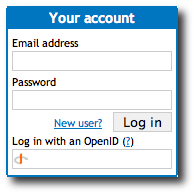
Thanks in no small part to the advocacy of Simon Willison, I've just OpenID-enabled the XTech web site. OpenID log in box on Expectnation Users can now create their accounts using an OpenID, or associate an OpenID with an existing account. A single-sign on solution like OpenID solves an important problem for us, as most people tend to interact with our conference web sites in only one or two time periods each year. While we've gone to the trouble of making retrieving a password easy, there's still the mental burden on the user of setting up the account and noting it down somewhere. As a measure of the impact of this on me personally: I habitually save registration confirmation emails in a certain mail folder. Since 1997 I have collected no fewer than 572 of these, and I'm sure some have been missed! One other cool thing about OpenID is that finally I can get the identity I wish to have. No longer do I have to be a compulsive early adopter of every service just to get the name edd. (Well, as long as said service integrates OpenID of course!) Personal branding is an important attractive aspect of OpenID.ImplementationImplementing OpenID using the Ruby ruby-openid gem was quite straightforward, as was the logical integration into our user models. I've not been the only one following this path recently, as illustrated by this post on Rails OpenID integration from Dan Webb.The harder problem of deploying OpenID lies in making the user interface work well: ultimately that will have a huge influence over its uptake. We've made a decent first go of it in Expectnation, but I'm sure we'll evolve and improve it over time. The main puzzling thing is how obvious to make the OpenID facility, given its relatively small take-up right now. We don't want to confuse normal users too much by using it. Microformats When I did my behind-the-scenes piece on the building of the XTech schedule last week, one feature I didn't discuss was the support for microformats we have in the schedule and on the session pages. If you use a tool such as Operator, you can easily save talk times to your calendar while reading the schedule.
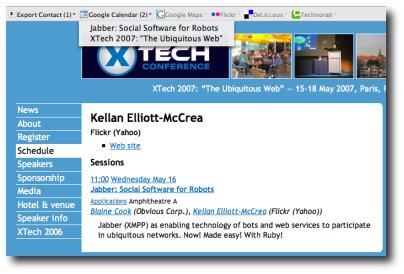
XTech schedule microformats I'm personally a little late to the microformats party. Being a fan of pragmatic RDF, I didn't see much need for microformats right away. However, with tools like Operator I can honestly say that the use of microformats does enhance the XTech schedule.My impressions of microformats (in particular hCalendar and hCard) from using them are mixed. One the plus side, it was very easy to do. On the negative side, I found them restrictive in the sense that for the metadata to be present in the hCalendar object, it needs to be part of the HTML presentation.So, while microformats are meant to be about making human readable data useful for computers, they can have a tail-wagging effect on the human markup. Let me elaborate. In the conference schedule there is a grid overview. For readability here we want to keep the details down to a minimum in each box. There is definitely no need to repeat the date of each presentation when you can see there's a grid per day.But also we want to have microformats available in the page so users can use the grid to pick off talks to add to their calendar. The only details you currently get from the microformat are those you physically include inside the div marked as vevent. This means we can't embed the full details, such as the talk description. It also means I indulge in some dubious markup practices (an empty abbr element) in order to get the date and time into each hCalendar object.It seems to me that this could be ameliorated by more intelligent user agent behaviour. Each of my hCalendar events is given a URL. At the end of that URL is a full description of the event, using microformats. So, as long as I reference the URL in a summary page, the user agent can beetle off and pull down the full information, in much the same sort of way that FOAF uses the rdfs:seeAlso property.So, remove the expectation that microformats provide complete data, and I'm sold.Other schedule features: iCal, Upcoming.org
Of course, we have iCalendar support in the XTech schedule, so you can subscribe conventionally using iCal, Evolution or a similar program. Aaron Straup Cope took the iCalendar, and uploaded each event into Upcoming.org. If you look at the upcoming events tagged xtech07, you see the results of his work.This foreshadows some of the social elements we plan to add to Expectnation itself: indicating your intent to attend a talk, and adding comments to it. As a program chair I'm finding this quite fascinating to watch.

Erich Schubert: Driver woes

I always liked pretending that nowadays, there are no driver issues with Linux (well, except for ATI and NVidia not releasing specifications, so for some of their product there are no good drivers available). Well, thats not entirely true. Just these days, I've been running into some driver issues with my Intel hardware; and Intel recently has been the favourite of Linux developers for actually publishing driver source code under a free license. Some details on the driver issues I had: IPW3945 wireless with WPA on dual core. Apparently, there is some kind of race condition in the dual core setup under load, when two interrupts end up being handled by different CPUs. The WPA path probably is a bit slower, I read that theoretically it should also happen with WEP. The effect is as this: when transferring data quickly, e.g. from a local machine on a WPA encrypted network (such as my parents wireless; basic WPA via the common AVM Fritz!Box), it will drop the connection every minute or so, and take another minute to reconnect. Obviously, that makes the wireless rather useless... This is what the errors looked like:
TKIP: ICV error detected: STA=...
N/A: Michael MIC verification failed for MSDU from ... keyidx=0
wifi0: MSDU decryption/MIC verification failed (SA=... keyidx=0)
TKIP: received packet without ExtIV flag from ...
Upgrading to Kernel 2.6.20 turned these errors into something like Firmware bug detected; reconnect already was a bit faster. Upgrading the firmware past the Debian-packaged (in non-free) version to a newer one change them again (I think the ICV error remained) and made the reconnects even faster; still large transfers don't work reliably with WPA. Another reason I upgraded to 2.6.20 was that the microphone didn't work on my Dell 640m. The upgrade helped here, I now can record from my microphone. Every now and then, my system kind of freezes on resume; it seems that some interrupts (especially the keyboard interrupt) remain disabled... I also tried the newer i810-modesetting driver, that should be able to handle the 1440x900 resolution without the aid of i915resolution (which basically overwrites part of the video BIOS to add the resolution to the supported resolutions list). The screen remained black (with both unstable and experimental versions of the driver). Another reason why I was trying this driver is that the current driver has like a default gamma 1.5 for XV, apparently - all XV using apps playback videos way too bright. Even if they don't have an XV gamma control. Well, on the other hand, thats what Windows users might be exposed to every day. 99% of the time, everything works fine for me, too. It just remains open whether 2.6.18 is actually the right kernel to use for the upcoming release... 2.6.20 improved on some of my issues. On the other hand, yaird failed to make a proper initrd for my computer, because CBC (cipher block chaining, a common choice if you encrypt your harddisk) became a module and wasn't added. There are just so many details to iron out when upgrading the kernel... that would pretty much mean an unfreeze, I guess. :-( If we would release more often, that wouldn't be as essential, but for a release interval of two years, we really should have a kernel with few driver issues. And even if we're going to ship newer kernels with "dot releases" of etch, we'll have to avoid issues such as the CBC-module being unknown to yaird.

26 February 2007

Biella Coleman: Critical Mass in Computing

Social Studies of Science just published an article by on the importance of reaching a critical mass for recruiting women to study computer science. Below is the abstract: The Strength of Numbers
Strategies to Include Women into Computer Science
Vivian Anette Lagesen Vivian Anette Lagesen, Norwegian University of Science and Technology (NTNU), Norway, Vivian.Lagesen@hf.ntnu.no This paper investigates four different inclusion strategies used to recruit women to computer science: achieving a critical mass, educational reform, redefining the gendered symbolism of computer science and changing the content of the discipline. The relationship between and the relative importance of these four strategies are explored by looking at the extensive and successful Women and Computing Initiative (WCI) that was run by the Norwegian University of Science and Technology (NTNU), starting in 1996, to recruit and retain more women in computer science. The findings suggest that a direct effort to increase the relative number of women is the most important strategy. While raising the number of women recruited seems to affect the symbolic perception of computer science, this effect is difficult to achieve through attempts to directly change the symbolic image of the discipline. In addition, a substantial increase in the number of women appears to cause an improvement in their learning environment, probably because minority problems such as too much visibility and unwanted attention became less prominent. Key Words: computer science critical mass gender higher education inclusion

Next.

Previous.