Search Results: "tar"

20 June 2010

Craig Small: Helping Free Software: Translations

Well the latest version of PSmisc is almost finished, so I pushed the tar archive up to the spot for the translators, waiting for the updates before it gets released.

It reminded me that perhaps a lot of people don't know how their programs get translated. Perhaps there are some that could even contribute. The nice thing about the translation systems is that you don't need to know programming to help.

PSmisc uses the translation project as its method. The program itself uses gettext for the translation part which makes a single text file called a POT file. A translator takes this text file and makes a po file, such as it.po for the Italian translation and then translates, which basically means editing the file, reading each first line of a set and writing the translation on the second line.

For the programmer, once it is setup it is pretty simple to use, just mark your translatable lines and follow some simple rules, mainly about not embedding too much in a string. I've used this system for years for quite a few of my programs and there is little added work for me.

Unfortunately, translating is hard work and should be a long-term commitment. Having a look at the translation project's Translation Matrix and you can see that some languages do suffer, though there are some very good results there too. Particular kudos goes to the Vietnamese group which I think is just Clytie who does a marvellous job and is often the first translation file I get.

For the Debian project, there are many places where translations can occur. There doesn't seem to be a centralised place for this, but some of the places they use translation work are:

<script defer="defer" src="http://static.zemanta.com/readside/loader.js" type="text/javascript"></script>

19 June 2010

Torsten Werner: Results from the Debian Community Poll

I have announced the Debian Community Poll in my former blog post. I have closed the poll today and I will start publishing its results now.
What is the codename of the current stable release?This is the only compulsory question with the intention to block spammers. The correct codename is Lenny but I have accepted almost any answer that is somehow related to Debian. Version numbers, names from Sarge to Experimental, even well known codenames and version numbers from Ubuntu have been counted as correct. 22 partipants answered wrongly and their submissions got removed from the result set. A whopping number of 3258 submissions have been accepted and get analyzed now. Thanks to all participants!
How long have you been using Debian?

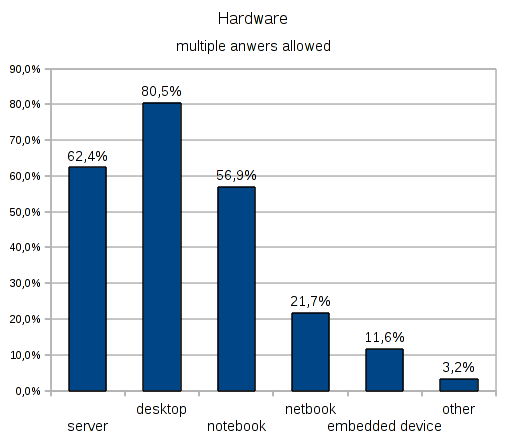
On what kind of hardware are you using Debian?
Multiple answers are allowed for this question and that is why the values do not sum up to 100%.
  • 80.5% are using Debian on the desktop
  • 62.4% on the server
  • 56.9% on the notebook
  • 21.7% on the netbook
  • 11.6% on embedded device(s)
  • 3.2% on other device(s)
The following other devices have been mentioned: smartphone, virtual machine, nettop, NAS, HTPC, workstation, pendrive, live cd, cluster, thin client, router, rocket flight computer, ibm mainframe, and automatic bar tender.

Do you contribute to Debian?
  • 50.0% choose answer #5: I don't contribute on a regular base.
  • 31.2% choose answer #4: I'm regularly helping other Debian users.
  • 8.0% choose other (see below) or simply did not answer
  • 4.9% choose answer #3: I'm regularly contributing to Debian packages without uploading them by myself.
  • 4.5% choose answer #1: I'm a Debian developer.
  • 1.4% choose answer #2: I'm a Debian maintainer.
The following other answers have been provided:
  • upstream developer or contributor
  • translator
  • bug reporter
  • advocator
  • former DD or DM
  • prospective DD or DM
  • mirror maintainer
  • package/installer tester
  • documentation writer
  • donator or debconf sponsor
  • debconf organizer or helper

How do you think about the Debian Free Software Guidelines (DFSG)?
  • 46.0% choose answer #2: I like the DFSG but it is not the most important reason for using Debian.
  • 36.6% choose answer #1: The DFSG is very important to me. I could live with many changes in Debian but I would be very upset if Debian would allow non-free software into its main component in the future.
  • 10.1% choose answer #3: I don't know.
  • 4.9% choose answer #4: I don't care.
  • 2.4% did not answer.

Are you using Debian derived distributions, too?
Multiple answers are allowed for this question and that is why the values do not sum up to 100%. There were a lot of different answers but the most frequent are:
  • 47.1%: Ubuntu (Kubuntu, Lubuntu, Xubuntu)
  • 40.8%: no answer; this was the only way to say that someone does not use a derived distribution
  • 11.0%: other (see below)
  • 7.0%: damn small linux
  • 4.8%: Sidux
  • 4.3%: grml (juxlala)
  • 2.2%: Knoppix
  • 1.6%: ELive
  • 1.4%: Maemo
The other answer includes the following distributions: 64studio, ALT Linux, arch linux, ArtistX, BackTrack, BRLix, Canaima GNU/Linux, catix, cdlinux.pl, CloneZilla, CrunchBang, Custom, ddwrt, debian arm userspace for zipit z2, DebXO (?), DreamLinux, Easy Peasy, eb4, eeebuntu, EMC2 Ubuntu (linuxcnc.org), Emdebian, Estrella Roja, Fedora, Finnix, Gentoo, gNewSense, Hackable:1, Kanotix, Kuliax, LFS and CLFS, LinEx, Linux Mint, live CDs, live-helper, Mepis antix, Musix, My own LiveCD, Mythbuntu, OpenInkpot, openwrt, paipix gnu, Parsix, Peppermint, personal debian derived, proxmox, Puppy, PureOS, qtopia, SHR, simplyMEPIS, Skolelinux, slackware, SymphonyOS, Toutou, Trisquel, tty GNU/Linux, UHU Linux, Univention Corporate Server, vinux, Voyage, Vyatta, whiite, Xandros, Xarnoppix. Not all of them are derived from Debian.

- to be continued -

18 June 2010

Marco T&uacute;lio Gontijo e Silva: Immix on GHC Summer of Code weekly report #6

My project. This post assumes that the reader has read my last post. I started the change in the line representation. Instead of a single linked list of free lines, it s better to work with line groups, to avoid fragmentation inside lines in allocation. I ve create a struct to represent this line group, with a pointer to the next group, and the size, in lines, of the group. It is stored in includes/rts/storage/GC.h currently, but I m not sure if this is the best place to put it, and I m thinking about changing it latter.
#include "rts/OSThreads.h"
typedef struct line_  
    struct line_ *next;
    StgWord size;
  line;
/* -----------------------------------------------------------------------------
Then we need to change the code of liberation of lines in rts/sm/Sweep.c.
            else if(!(bd->flags & BF_MEDIUM))  
                StgBool sequence;
                sequence = 0;
                for(i = 1; i < BLOCK_SIZE_W / BITS_IN(W_); i++)  
                    StgPtr start;
                    start = bd->start + BITS_IN(W_) * i;
                    if(bd->u.bitmap[i] == 0 && bd->u.bitmap[i - 1] == 0 &&
                       start + BITS_IN(W_) <= bd->free)  
                        printf("DEBUG: line_found(%p)\n", start); fflush(stdout);
                        if(gen->first_line == NULL)  
                            gen->first_line = (line *) start;
                         
                        if(sequence)  
                            last_line->size++;
                         
                        else  
                            if(last_line != NULL)  
                                last_line->next = (line *) start;
                             
                            last_line = (line *) start;
                            last_line->next = NULL;
                            last_line->size = 1;
                         
                        sequence = 1;
                     
                    else  
                        sequence = 0;
                     
I ve tested this code using the same technique as before, checking the produced list trasversing it after it s done. The list obtained showed the correct lines. Now I m back to the allocation code, which never worked. The changes in rts/sm/Evac.c are straightfoward.
        if (gen->first_line != NULL &&
            size <= BITS_IN(W_) * gen->first_line->size)  
            ws->todo_free = (StgPtr) gen->first_line;
            ws->todo_lim = ws->todo_free + BITS_IN(W_) * gen->first_line->size;
            gen->first_line = gen->first_line->next;
            to = ws->todo_free;
         
This cause the same kind of errors I was getting before. I should go back to debugging. My co-supervisor in my Oriented Project in Computer Science suggested me using valgrind. I ll try it.
Last week I forgot to mention I ve presented my final presentation about my Oriented Project in Computer Science. This week I finished writing my monograph.

17 June 2010

Steve Kemp: That friend promises his undying friendship if you would do him a small favour.

Perl & Apache?
Once upon a time, within the past year, I saw mention of a simpler version of mod_perl - an apache module which let you write code to run within the context of a persistent perl process. However my DuckDuckGofu is weak, and I'm struggling to find this project. Did I dream it, or could somebody tell me where it lives?
Dynamic Picture Frames
So I've been taking pictures recently. Lots of pictures. Many times many images have been printed and hung upon my walls, and the price of frames is starting to become onerous. I'd love to see some kind of "dynamic" picture wall - but the two alternatives I considered fail:
Metal & Magnets
Place a huge sheet of metal upon your wall. Then put wee magnets inside your frames.
Corkboard
Imagine a full wall that was paneled with what is essentially a large notice-board..
Both of these would look ugly; the metal one perhaps less so. But the idea of having a wall which could have pictures mounted upon it, without having big nail holes if you rearranged and which could cope with dynamic repositioning and sizes is nice .. Invent it for me? I'll buy one. Probably even two...
ObFilm: The Godfather

Thomas Koch: NoSQL summer at lake constance

Have you already started to try out these new storage/database things commonly referred to as NoSQL? (For you google-bot, I'm talking about CouchDB, Cassandra, HBase, Hadoop, Hypertable, MongoDB, Tokyo Cabinet, etc). Well, it's one thing to install and use them but another to understand all the computer science background about them.
Therefor many developers around the world thought to make this summer a NoSQL summer. Local meetings are held in many cities: London, Los Angeles, New York, Paris, lake constance ... :-)
If you like to meet for a beer and learn and discuss about some of the hottest stuff in computing, then come around! Please select the dates when you can join and the papers you'd like to discuss. You can subscribe to email announcements or ical and rss feeds at the lake constance nosql summer page.

16 June 2010

Mehdi Dogguy: Buildd status pages

Recently, I started to write some web tool to track the status of ongoing transitions in unstable. I thought I could use some code from the Buildd status project (to see how it fetches the status for each package). Unfortunately, this caused some nightmares for some WB admin :) (because they used to rely on the generated BDB files and not the PGSql database, where the former is a snapshot of the latter stored in a funny format). Those BDB files were considered deprecated and status pages were looking for some love. Besides, the BDB files were kept in sync by regenerating them regularly (every 15 minutes, AFAIK). So, the information stored there was up-to-date only for a couple of seconds and then outdated, waiting for the next run to be updated. Last weekend, I rewrote the status pages from scratch to make them use the PGSql database. I kept the same user interface (and pages arguments) to make it a drop-in replacement for the old one. Today, thanks to the WB admins, the new status pages replaced the old ones! There are no new visible features for now (except the backend and some links) but I have a list of new features that I intend to implement. These new features will be implemented in my local copy first and then integrated if WB admins want them. And, as some of you already noticed, the new status pages are aware of non-free packages (because it happens that the data is present in the PGSql database :) thank WB admins for that!).

David Paleino: Bash-Completion 1.2 released

After more than 9 months from the previous release, the Bash Completion Team is proud to announce the release of bash-completion 1.2! In this release, we dropped support for bash < 3.2. We're sorry, but we cannot stop development just to support versions that old. By now, everyone should have a version fulfilling our requirement. As usual, lots of completions have been added: we're now at 168 files in our contrib/ directory (1.1 had 145, and 1.0 had 44 -- but most completions in 1.0 were bundled in the main file). Now bash_completion only contains helper functions, and basic filename-based completions. Everything has moved to contrib/! This release also saw the contribution of many external people, despite the fact that our bugtracker on Alioth doesn't seem to work too well (problem with attachments, anyone?). Anyhow, you're invited to register and start filing bugs as you find them :). Apart from the usual team members (Ville Skytt , Freddy Vulto, the newcome Leonard Crestez and me), we've had contributions from (in no particular order): Ted Stern, Jeremie Lasalle Ratelle, Rapha l Droz, Adrian Friedli, Ildar Mulyukov, Neville Gao, Austin English, Igor Murzov, Mario Schwalbe and Mark van Rossum. Thank you people for helping us! For completion developers: we added new helper functions. Most notably, it's now possible to get the current and the previous "word" just by calling:
_get_comp_words_by_ref cur prev
instead of (up to 1.1):
cur=$(_get_cword) prev=$ COMP_WORDS[COMP_CWORD-1]
Also, we have a new helper to deal with completion with colons, __ltrim_colon_completions(). See the comment in bash_completion for its documentation. You'll find more helpers directly in bash_completion. We're still far from having a distributable API documentation, so please forgive us. Enjoy the new bash-completion! -- David

Petter Reinholdtsen: Calling tasksel like the installer, while still getting useful output

A few times I have had the need to simulate the way tasksel installs packages during the normal debian-installer run. Until now, I have ended up letting tasksel do the work, with the annoying problem of not getting any feedback at all when something fails (like a conffile question from dpkg or a download that fails), using code like this:
export DEBIAN_FRONTEND=noninteractive
tasksel --new-install
This would invoke tasksel, let its automatic task selection pick the tasks to install, and continue to install the requested tasks without any output what so ever. Recently I revisited this problem while working on the automatic package upgrade testing, because tasksel would some times hang without any useful feedback, and I want to see what is going on when it happen. Then it occured to me, I can parse the output from tasksel when asked to run in test mode, and use that aptitude command line printed by tasksel then to simulate the tasksel run. I ended up using code like this:
export DEBIAN_FRONTEND=noninteractive
cmd="$(in_target tasksel -t --new-install   sed 's/debconf-apt-progress -- //')"
$cmd
The content of $cmd is typically something like "aptitude -q --without-recommends -o APT::Install-Recommends=no -y install ~t^desktop$ ~t^gnome-desktop$ ~t^laptop$ ~pstandard ~prequired ~pimportant", which will install the gnome desktop task, the laptop task and all packages with priority standard , required and important, just like tasksel would have done it during installation. A better approach is probably to extend tasksel to be able to install packages without using debconf-apt-progress, for use cases like this.

Russell Coker: Carpal Tunnel Getting Better

Three months ago I wrote about getting Carpal Tunnel Syndrome [1]. A few weeks after that I visited the specialist again and had my wrist brace adjusted to make it a little less uncomfortable. The specialist also gave me some quick ultra-sound treatment and then said that if it didn t get better in a month or two then I should just get a referral to a surgeon! I didn t have a bad case, some people have their hand muscles atrophy. My hand strength was measured as 50Kg in my left hand (the one with CTS) and 52Kg in my right hand. The greater strength in my right hand is probably more due to the lack of left-handed tools and sporting equipment than any muscle atrophy. This is slightly better than the physical standards for the Victoria Police (just over 50Kg average for both hands) [2] and a lot better than the Australian Federal Police physical standards of 45Kg for the dominant hand and 40Kg for the non-dominant [3]. Really my hand strength should have been recorded as 490Newton and 510Newton respectively, medicine is the science of healing, in all aspects of science the Newton is the measure of force. Over the past few months my hand seems to have recovered a lot while wearing the wrist-brace 24*7. I ve just started going without the wrist-brace during the day and it seems to be OK. I m currently planning to wear the wrist brace at night for a year or two as it s the only way to ensure that my hand doesn t end up on a bad angle when I m asleep. At this stage it seems that I ve made as close to a full recovery from CPS as is possible!

15 June 2010

Marco T&uacute;lio Gontijo e Silva: Summer of Code weekly report #5

My project. This post assumes that the reader has read my last post. This was a week full of segfaults, failed assertions, changes in the user data and other crazy stuff. I started working on the allocation of memory on the freed lines. In the first glance, it seemed to be much harder than the small changes I ve done to free memory in lines, because of the a never-seen-before-by-me datatypes being dealed with in alloc_for_copy(), from rts/sm/Evac.c: gen_workspace. But in a short time the code of alloc_for_copy() has shown itself to be simple, and it was easy to do an initial implementation. I went in the same path I was going on before, trying the simplest solution that works. For instance, the line representation used is not ideal, because groups of lines are not considered, but it was the simplest at that time, and I plan to improve it latter. The gen_workspace data type contains a pointer to an area of a block that is not being used (todo_free) and a pointer to the end of that area (todo_lim). When a space for an object is requested, it s allocated in this area, and todo_free is adjusted. If the area is full, a new block is requested. My intended change was to return the first free line of the generation when the object is smaller or equal to the size of a line, and use the current approach otherwise. This is the simplest way I could think, but has the problem that the only one object is allocated per line. This was a known issue.
    if(size <= BITS_IN(W_) && gen->first_line != NULL)  
        to = gen->first_line;
        gen->first_line = (StgPtr) *gen->first_line;
        return to;
     
    ws = &gct->gens[gen->no];
After that I got the first round of segfaults. One problem I could spot so far was in the code in rts/sm/Sweep.c, related to the liberation of the lines. The block is allocated by need, and there s a pointer to the first free byte, free. This free space is used by alloc_for_copy(). So, we should only think of lines in the region already allocated in the block, that is, where the address is smaller than free.
                    if(bd->u.bitmap[i] == 0 && bd->u.bitmap[i - 1] == 0 &&
                       start + BITS_IN(W_) <= bd->free)
But the segfaults, memory corruptions, etc, kept going on. I tried some restrictions, like allocating in lines only objects with the exact size of a line, or very small objects (size == 2), or allocating just one object for generation, or only one object at all. I also tried checking for the type of the allocated object, to see a correlation with the problems I was having. Nothing helped by now. So I thought I should work on other things, so that maybe my mind gets clearer and I can spot the problem. I followed the suggestion of using todo_free and todo_lim to make it possible to allocate more than one object in a line. I liked this change, since I had the impression that it fits better with the rest of the code than the initial implementation, and it will be easier to addapt it when I improve the representation of the free lines. As I said, I wanted something to work while I think in how I ll solve the segfault problems. The bad side of this choice is that I ll not be able to test it, since it s just a reimplementation of the same idea in the allocation code, and is not expected to work. The good size is that it may work, and solve the problems I was having by accident.
    if (ws->todo_free > ws->todo_lim)  
        if (size <= BITS_IN(W_) && gen->first_line != NULL)  
            ws->todo_free = gen->first_line;
            gen->first_line = (StgPtr) *gen->first_line;
            to = ws->todo_free;
            ws->todo_lim = ws->todo_free + BITS_IN(W_);
          else  
            to = todo_block_full(size, ws);
         
     
I got the same results as with the older implementation, and no ideas about how to solve it (yet). So I thought about another thing to work on, which I m talking about all through this post: improve the free line representation. This has the advantage of being testable, since it s unrelated to the allocation code, and may give me an idea about how I can fix the segfaults. The bad side is that it probably won t fix my problems directly. I m working on it right now.
Following a suggestion, I ve started using gdb to see what was happening in the GC instead of including printfs everywhere, and it s been useful. I ve noticed that sometimes printf is more effective, but sometimes gdb is much better.

Christian Perrier: Please remove my name from your web site

I hope that some of you, outside the French Cabal, are able to understand French. I would be sorry if you missed the whole fun of this. The story starts at http://lists.debian.org/debian-l10n-french/2010/05/msg00178.html. In short, someone apparently named "Alain S<shhhhdonttellmyname>" mailed the debian-l10n-french mailing list to request for a message written in march 2006 by someone else whose name is also S<shhhhdonttellmyname> to be removed from the debian-*user*-french mailing list archives. "Someone" then politely answered him with http://lists.debian.org/debian-l10n-french/2010/05/msg00179.html, trying to use as less irony as possible. At least, this "someone" refrained himself to explain that, doing so, yet another copy of Mr S<shhhhdonttellmyname> name was being replicated over dozens of servers all over the world, also exposing that he's probably living in Antony, Bourg La Reine, Chatenay Malabry, Chevilly Larue, Fontenay Aux Roses, Fresnes, L'Ha Les Roses, Le Plessis-Robinson or Sceaux, in France. Later on, this "someone" received many private mails from that Mr S<shhhhdonttellmyname>, which got automatically and gradually classified as spam. Funnily, a few days later, that "someone" received another mail from another person, posting from the very same IP address and requesting for such removal again. That "someone" being Very Evil and a little bit pissed off answered with http://lists.debian.org/debian-l10n-french/2010/06/msg00136.html which is untranslatable. So, this is why I hope you can read French. Have fun.

Craig Small: Australian Internet Censorship and Data Retention

Just going on how they treat matters regarding the internet, it seems that the current Australian government is trying to beat the previous government's poor record. Where the previous government seemed to think the internet a scary and unimportant thing that they didn't really understand and therefore ignored it, the current government seems to be trying to do something, but like a lot of other things they do, do something badly.

Internet Filtering
One of their bright ideas is to censor the internet, by putting some rather large filters right in the middle of all the ISPs. Supposedly this is going to protect the children, though other than some mad ranting by Senator Conroy he hasn't said which children or how.

The clearest information is that it will block Refused Content or RC rated information. The problem with this is there is no clear definition what this is. With no clear boundary you can get what is "scope creep". Bit by bit, each group with their own agenda will try to get whatever they don't like banned. Some will fail, but others will get their little set of demons onto the list.

From "children overboard" to the strange siezure of the wikileaks founder's passport when he returned to Australia, you can never trust the government fully. As the filter list will be a closed list, who is to say if it is right a particular webpage or website should be banned? Books or films that are banned are known, you can find out what they are and why. A proper discussion and review can then be undertaken. By contrast, you won't even know something is banned unless you try to visit it.

I've personally seen the "great firewall of china". What is filtered is often arbitary, though anything that is embarassing to the government is filtered. It slows a lot of sites down and makes others look strange. Do you really what to live in a country where the government decides what ideas should be seen? Or even a country that places like China can point to and say they are doing the same thing, so its all ok?

Data Retention
The next bright idea by the government is to make ISPs keep 10 years of internet browsing history of all their users. This would be like tapping everyone's phone, just in case you did something wrong in the next 10 years.

There hasn't been much detail about this proposal but let's assume for a moment that it keeps URLs. Now of course most people's internet addresses move around, so you will also need to keep some sort of log of which account used what address for the same time.

The URLs will tell the government which websites you have visited, but URLs also tell them which pages you visited. You can also often assume which pages you read and which you didn't because of the time between this viewed page and the next.

Search engine queries are also encoded into a url. Google searches usually have something at the end of the url which is what you were searching for. There is also a chain of visited pages, so someone looking at a log could see your search, you go to a site, perhaps you then visit a banking or paypal site (have you bought something now?)

Even if you think you have nothing to worry about what the government might do with this information, including future governments, this information has to sit somewhere. Data sitting around for 10 years has 10 years time of being stolen or copied. Perhaps some activists obtain this log and publish a list of names of people who visited a particular website.

There is current laws for lawful interception. This is where the police or another security agency goes to the court and says a particular person has done certain bad things and asks if they can intercept their internet traffic. It's the same rules if they want to tap your phone. Except for "fishing trips" where police just randomly look at information from anyone hoping to trip up on something, what is this system going to be used for?

What can you do?
If you're not happy about either, or both, of these new proposals, it is time to do something about it. Visit the website Open Internet Website for what you can do. One of the things is to
tell you mum about internet censorship which has a funny message from comedian Akmahl Saleh that also has an important side.

Most of important of all, don't let these proposals become law because of apathy!

<script defer="defer" src="http://static.zemanta.com/readside/loader.js" type="text/javascript"></script>

Stefano Zacchiroli: debian squeeze artwork contest

we want you for Squeeze artwork You might have heard that Debian is closing up on the forthcoming Squeeze release. In its aim to be "universal", Debian addresses several different kinds of users and Squeeze will be no exception. For several users, and in particular for desktop users, artworks do matter and initiatives like the one started by Valessio Brito are likely to improve their user experience. In essence, the initiative is a Debian Squeeze artwork "contest" where Debian enthusiasts skilled in graphics can contribute themes and propose them to become the official/default theme for Debian Squeeze. So, are you a Debian enthusiast that would like to help Debian by putting into use your graphic skills?
This is a big chance to do that! Before going forward, please check the rather precise requirements that Valessio prepared and check some of the already submitted proposals. Good luck!

14 June 2010

Alexander Reichle-Schmehl: [Update] RC Bug stats again published in this blog

As you have probably already seen, I started again to publish the statistics of the release critical bug reports. I stopped to do so, when I restarted to send out the Debian Project News, where they are also a regular part. However I've been told, that quite some readers script the last part of the DPN with the regular things, like DSAs, New and Noteworthy packages, etc., as they already know them. So here they are again, published every Friday noon (CEST) by a tiny script. Update: Moritz Muehlenhoff just informed me, that I should also ingore RC bugs having the tag security for my statistics, as they come in all over the time and can always be fixed with a security update or in a point release. Currently 34 bugs have this tag, bringing the total number of bugs to be delat with down to 187.

Gunnar Wolf: What Mexico feels like

I have been recently approached by several friends, from different countries. Mexico and the violence seems to be a frequent news topic all over the world. I live in Mexico City, as ~25% of the country's population does. This is not an easy city, of course, and I won't deny it has tons of problems of its own. However, Mexico City (and even more so the approximately of it that is politically located in Distrito Federal, the formal country capital) is very lucky in this regard. Still, in most of the country, the violence is mostly in the news, mostly a worrying perception that is every day more insistent. My parents live in Cuernavaca, Morelos, ~80Km south from us. Morelos has been known for decades for being the druglords' getaway and safe haven, so it remained a mostly peaceful state for most of this time. This has changed, and at some points during this year, militarization feels quite creepy... Fortunately, just for a couple of weeks, and then back to what seems like normal. The real problems in Morelos is the undeniable corruption of its successive governments, the lack of regard for the population, the inexistent urban planning... However, I know from several friends living in the North of the country (and all along the very long border - The most drug-related violent states nowadays are Chihuahua, Durango, Sinaloa, Tamaulipas and Nuevo Le n, with only two states in the South Michoac n and Guerrero) that violence is really felt by local population on the streets. Some friends say they have grown used to hearing shootings (Durango), others say that it is now usual that the cartels openly strangle the city's vial system with the express purpose of showing off their strength (Monterrey, Nuevo Le n, one of Mexico's most important cities and taken in the past as a token of industrialization and first-world-like life conditions... Just don't look towards the poor areas). About Chihuahua, I'd rather not even talk, as by all accounts (official even) it rivals Iraq in the lack of control the government has of its territory. Still, with all that as background... I am afraid of what I read today in the news. I know a single declaration is not enough to worry about (as said in El Quijote, una golondrina sola no hace verano , a single swallow does not mean it's summer), but those things always start small... Until they explode. La Jornada reports that The retired general Luis Garfias Maga a recommends suspending constitutional guarantees in the country to be able to properly fight violence. The last century we had a sad and long history of cases where the military took over civilian power and suspended the constitutional rights in basically every nation in Latin America Except for Mexico. Not one of those cases was overall successful. Not one of them went by without raging abuses, without terrible consequences. I don't see imminent we will go over to a military rule nor anything close to it, but the environment is getting each time closer to how it was like before said rights suspension. We should learn that it is just not the way, it leads nowhere. I am convinced, and will keep insisting on it at every ocassion, that the only possible way to fight violence is by reducing the social distance, and that should be achieved most importantly by reducing poverty, but also by making it harder to become incredibly rich. Mexico's percentage of poor people has grown over the last decades, but at the same time, the amount of wealth concentrated in very few hands has grown much faster. A society with terribly rich and terribly poor people leads to hatred, leads to desperation, leads to violence. A flatter society, even if the overall standard was to be somewhat lower, tends to a better equilibrium. And yes, I know the original problem with drugs is that Mexico is a great transit area for drugs to reach the USA (and I could also rant about drug legalization I won't, it's late and I must go to work), but the main fuel for young people to leave everything behind and take the risk of starting a life of open ilegality is the lack of future they face all life long. That leads many to risk their lives attempting to cross the border to the USA (Mexico "exports" 500,000 people every year), but also lures them to jobs where they will have easy money... In exchange for their lifes, ultimately. Anyway... Just to repeat and round off: The answer to this problem is not repression, is not policial or military strength. Our only way out is through social justice.

Gunnar Wolf: Planned obsolescence and propietary gear - Dear lazyweb, a sports tracking app for a N95 phone?

Grah. I got my current phone (a Nokia N95) back in January 2008. It was the first phone I ever paid for, and I don't expect that to change - The feature set I need from a phone is extremely basic, but I wanted to have a GPS unit on me, without needing to plan for it beforehand. As I recently blogged, I just got over the 5000Km mark (5269 as of last Friday), with almost daily usage since I registered. A couple of days ago (although please note I don't log in often to the web page, I just upload my , I was greeted by this gem:
IMPORTANT NEWS Thank you Nokia Sports Tracker beta users! After two and a half years of operation, the Nokia Sports Tracker beta service will close as of June 30, 2010. Thanks to all of you exercise enthusiasts who used the service and contributed valuable feedback to its improvement. We want you to stay active. You can keep tracking workouts through a new, non-Nokia service provided by Sports Tracking Technologies available for free in the Ovi Store. The new service is open for registrations at sports-tracker.com, and you'll even be able import your workout history from Nokia Sports Tracker until August 31, 2010.
In my case, instead of Thank you they could have just said Fuck off. They are directing me to a new application available in Nokia's Ovi store. Of course, this application is linked to a new 100% Flash-powered website. That would be a big turnoff for me, yes, although there are many ways around it (after all, I don't need the website functionality every day). However, I find the list of supported phones does not include the N95 (any version). This means, my two year old phone (which I bought as soon as the model arrived in Mexico) is obsolete now and they want me to (spend more money and) switch to a new one. Am I going to do that? Hell no! The N95 phone is quite good. The only gripes I have is with the (slow, buggy and memory leak and phone crash prone) Symbian S60 operating system. I will probably keep using the SportsTracker application, although I won't be able to link my tracks as easily as I do today. So... Dear lazyweb, do you know of any similar program? The feature set I use in Sports Tracker is:
  1. Have different activity profiles. I use Running and Cycling, and very ocassionaly Walking.
  2. Of course, GPS tracking, getting average and top speeds, altitude profile, etc.
  3. Aggregation into something website-friendly
  4. The ability to do my uploads post-factum (i.e. do not rely on a data plan, allow me to upload my excercising when I get home)
There are probably more things I'd want. But I am a geek, and I basically enjoy tracking myself, and sharing my tracks with $world. Thanks, dear lazyweb. I am confident you won't let me down.

John Goerzen: Camping with 2 Boys

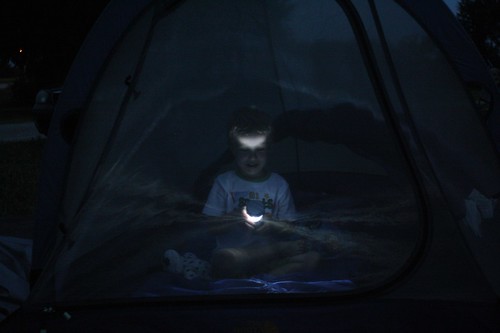
Friday I took the day off for us to go camping. Due to the birth of Oliver, our last time camping was in 2008. Back then, Terah had asked me what I wanted for father s day, and I suggested camping. Except when she was pregnant last year (and then Oliver was little), we have sort of had a standing plan to go camping twice a year: around father s day and my birthday. She says that s way more camping in a year than anyone needs. Anyhow, Jacob doesn t remember the last time we went camping; he was not quite 2 at the time. I explained that we would sleep in tents, and he d get one just his size. He laughed at that. Then I explained that he would get a bag to sleep in, and he thought that was hilarious. He kept talking about tents and even more so about sleeping bags until he actually got to be in one. It seems like each time we go camping, we wind up somewhere else. We ve camped at Kanoplis Lake and Marion Park and Lake in the past few years. But this time we went to Cedar Valley Reservoir near Garnett, KS. It was a nice place to be, with some wilderness camping areas far from any RV hookups (though right next to a gravel driveway where we could park). Almost as soon as we got out of the car, Jacob found a partially-burned stick left in a fire ring. So of course his hands were black pretty quick. He kept track of that stick the whole time we were there, and used it for everything he could think of. His favorite use, though, was at the lake to splash water: 2010-06-11 15.20.21.jpg The lake really was his favorite feature. He loved to throw rocks and sticks in it with me, to splash himself, and to stick his feet in. Oh, and to splash me. IMG_4057.JPG The pier was also a great thing for him he at first thought it was a boat, then really wanted to go. I made him hold my hand the whole time, and he liked walking on it. But he was frustrated that he couldn t reach the water. Somehow, Jacob acted as if he could sit in the hot sun for hours, just making small splashes with a stick. I, on the other hand, felt the 90-degree heat strongly, and eventually we found a shady spot to play in the lake. Oliver enjoyed crawling around on a blanket or on the grass. Though Terah put a stop to that after she noticed that he came across a pile of fish heads and was about to reach for one and put it in his mouth. We cooked over a campfire Friday night and Saturday morning. It took me a lot longer to start a fire than normal. Part of the problem was that there had been a lot of rain in the area, and it was humid, so there was little kindling to be found. Plenty of larger pieces of wood, so once the fire got going, it burned nicely. We cooked brats, brought along some homemade bread, had grilled foil-wrapped potatoes, and had stir-fry vegetables. Oliver got to eat with us too, of course: IMG_4022.JPG Terah is a big believer in smores, so after supper we made some smores Jacob predictably got sticky from the marshmallows and chocolate. Jacob started asking when I d set up the tent almost as soon as he found his stick. All afternoon he kept asking. Finally we got it set up, and of course he was so excited that he played inside it for an hour before he fell asleep. Terah had bought a $4 lantern at Walmart to give to him to use in his tent. I told him that there would be a surprise lantern in his tent for him to use. And he loved his lantern. It could turn on, off, and flash red. At one point he asked me, Dad, do you have a surprise lantern too? No, I will just use my flashlight. He looked a bit sad about that. For about 5 seconds. Then he turned on his lantern again. Here he is with it, still playing happily about 2 hours after his bedtime: IMG_4100.JPG And in the morning, of course he was still wanting that, but also wanted to play with his digital camera (a kid s version that also has a simple game or two on it). Without leaving the tent, of course. IMG_4105.JPG Oliver was getting hungry while we worked on breakfast, so I gave him some bread to munch on. IMG_4119.JPG We used our cast iron skillet to fry some bacon for breakfast. Then Terah made some pancakes in the skillet (with the bacon grease). Greasiest and best pancakes ever. After that, we had some fried and scrambled eggs. After that, we had more smores (I wasn t kidding about Terah being a big believer in them.) Jacob decided that he wanted to play in the other tent. He enjoyed playing with Terah, Oliver, and the air mattress (that Terah appreciated as much as I thought it took up too much space in the car). There s a little window on the back that can open to a screen or open completely. Jacob and Oliver enjoyed looking out of it while open. Or rather, Jacob enjoyed that, while Oliver enjoyed licking it. IMG_4161.JPG I had my Droid with me to keep an eye on the weather. The forecast for several days had called for a 20% chance of storms on Saturday. I checked Saturday morning at 7, and it still called for 20% chance of storms after 1PM. We decided we d pack up our tents after breakfast so we could stay as long as we liked or leave on short notice if we preferred. Clouds seemed to be building, though, so I checked the forecast again at maybe 9. Now it called for 60% chance of thunderstorms and heavy rain before 1PM. Guess I shouldn t have been surprised; it is Kansas after all. As I had the first tent about 90% put away, it started to rain. We rushed to get the rest of the stuff in the car, and by the time we did, it was raining heavily. We had planned to spend at least part of the afternoon there, but decided we d look for another place to stop on the way home. We stopped first at Garnett s North Lake, as the rain had let up for awhile. We spotted a fishing pier that Jacob wanted to walk on, but the bridge out to it was underwater, so we passed on that. While Terah fed Oliver in a shelter, Jacob and I played on some swings. Then we walked down to that lake. Jacob carefully came to an abrupt stop and looked both ways at each disused road between us and the lake, saying OK when it was clear to go. The rain picked up again, so we started heading towards home. It got quite heavy, with thunder and everything, which Jacob didn t care for at all. Both boys went to sleep, though. We stopped at Marion Reservoir on the way home. Jacob hadn t been able to play in the lake at Garnett (the place we stopped had a bank that was too steep) and so we played there. He waded into the water at the swimming area, and predictably enjoyed yes throwing rocks into the lake. When we got home, I set out the wet tent and tarps (it s not good to store that stuff wet) to dry there hadn t been rain at home yet. Camping s a lot of work, but it was a good family activity. I m looking forward to our next time, and hope we can choose a weekend a little less hot and damp.

Christine Spang: Christine Spang: the end of an era

The world around me seems to whirl these days. One week ago, I graduated from MIT. People I've known during the last four years have been dispelling to various parts of the globe one by one, day by day. California, Canada, Indonesia, Seattle. Some will be back again. Some will not, or if so only to visit. pika is a continuous bustle of activity as the summer has commenced and it has filled with creative and adventurous MIT students who've suddenly found themselves having free time. A hammock being built on the roofdeck. Thrice-weekly icecream forays. Common areas overflowing with people playing musical instruments, chatting, and messing around on laptops. Summer's warmth has arrived, bringing with it farmer's markets, strawberry picking, and swimming expeditions. While it's wonderful to get to meet so many new people living in a college environment, I can't help but feel sadness thinking about everyone who's left. There are always more friends to be made as new people arrive, but old ones moving away leave bittersweet memories, and the new relationships are always a bit different as the age discrepancy between me and others changes. Or the me-the-ephemeral-collection-of-thoughts-which-when-regarding-other-people-sometimes-involve-the-mentor/mentee-distinctions-caused-by-one-party-being-older-or-more-knowledgeable-than-the-other-at-least-in-certain-areas changes. The end of a semester always feels like this, but this year even more so as the people I started university with start down new paths. For me, that was going to involve staying on at MIT to complete a one-year master's program, the "M.Eng." in electrical engineering and computer science. That plan, too, has changed. I've deferred the degree and accepted a full-time engineering position at Ksplice, an exciting early-stage Linux startup here in Cambridge. I'd been working at Ksplice part-time since January before joining full-time immediately following graduation. Ksplice is the realization of ideas I saw being born on the whiteboard at SIPB when I was a freshman, and it's fun to see that play out in a small, ever-changing, low-bullshit company. All in all, there are many more exciting things down the road, and, working at an MIT startup, I haven't even escaped the MIT/Cambridge reality-distortion bubble yet. Still, it's tempting to resist change and let myself romanticize the good old days, hoping to catch every person I've ever enjoyed spending time with and hold them down here forever. That's not the way life works, though. Change happens.

13 June 2010

Craig Small: Does your program use gethostbyname() ?

There has been some discussion on the Debian IPv6 list about how the function gethostbyname() has changed. The manual page says this function is obsolete and with good reason.

A new feature of the function is that if a hostname has both IPv4 and IPv6 entries then the order of the return values is not predefined. In fact it used to be you'd get the IPv4 addresses first, then the IPv6. That has now changed and with the more recent glibc you will get an IPv6 address first. Quite often old code doesn't even check the address family or the size of address structure but just copies the relevant 4 bytes. You then get the first part of an 16-byte IPv6 address wedged into a 4-byte IPv4 address structure which basically means you get a mess.

The fix is pretty simple by changing the system call from gethostbyname() and using getaddrinfo() instead. If you only want the IPv4 addresses, perhaps because other parts of the code have not been checked or changed, then set the hints variable to return only IPv4 addresses.

If one of your packages is starting to play up and unable to connect to certain remote places and is instead trying to get to some "random" address, have a quick check for gethostbyname(). A quick grep across the source code may save a lot of debugging time.


<script defer="defer" src="http://static.zemanta.com/readside/loader.js" type="text/javascript"></script>

12 June 2010

Aurelien Jarno: bindv6only=1 and GNU/kFreeBSD

A few months ago the netbase package started to install the /etc/sysctl.d/bindv6only.conf file to switch the default bindv6only value from 0 to 1. A lot of people are not happy with this change, but it is not my goal to give my opinion here. On the other hand, people have propagated the rumour that it has been done as the FreeBSD kernel, used in the kfreebsd-amd64 and kfreebsd-i386 ports of Debian, only supports the mode corresponding to 1. Let s give the truth:

Next.

Previous.