Search Results: "ag"

17 July 2014

Juliana Louback: Contribute a JSCommunicator Translation

To those who don t know, JSCommunicator is a SIP communication tool developed in HTML and JavaScript, currently supporting audio/video calls and SIP SIMPLE instant messaging. We ve recently added i18n internationalization support for English, Portuguese, Spanish, French and now Hebrew. We would like to have support for other languages and it s a pretty straightforward process to add a translation, so even if you do not have a tech background you can contribute! Setup First, create and account in Github. Github is a hosting service for git repositories and open source projects get to use Github for FREE! As a result, many open source project repositories are hosted on Github, including but not limited to JSCommunicator. Once you have created your git account, follow steps 1-4 in the section Setting up git listed in Github s setup tutorial. This will help you install git and configure anything you need. Fork Now fork the JSCommunicator repo. I really like the word fork . Great term. If this is your first fork, know that this will make a copy of the JSCommunicator repo and all its respective code to your Github account. Here s how we go about it:
  1. Sign in to Github
  2. Browse to https://github.com/JLouback/jscommunicator
  3. Somewhere around the upper left corner, you will see a button labeled Fork . Click that.
fork You should now have your own JSCommunicator repository on your Github account. On your main page select the tab Repositories . It should be the first on the list. The url will be https://github.com/YOUR-USERNAME/jscommunicator. My Github username is JLouback, so my jscommunicator repo can be found at https://github.com/JLouback/jscommunicator. Clone Now you should download all that code to your local machine so you can edit it. On your JSCommunicator page somewhere around the lower right corner you ll see a field entitled HTTPS clone URL: clone I don t know if this is correct, but you can just copy the URL on your browser too. I do that. Now on your terminal, navigate to the directory you d like to place your repository and enter
git clone https://github.com/YOUR-USERNAME/jscommunicator
The current directory should now have a folder named jscommunicator and in it is all the JSCommunicator code. Switch branches The JSCommunicator repo has a branch for the i18n support. A branch is basically a copy of the code that you can modify without changing the original code. It s great for adding new features, once everything is done and tested you can add the new feature to the original code. A more detailed explanation of branches can be found here. On the terminal, enter
cd jscommunicator
git branch -a
This will list all the branches in the repository, both local and remote. There should be a branch named remotes/origin/i18n-support . Switch to this branch by entering
git checkout --track origin/i18n-support
This will create a local branch named i18n-support with all the contents of the remote i18n-branch in https://github.com/opentelecoms-org/jscommunicator. Create a .properties file Now your jscommunicator directory will have some new files for the internationalization functionality. Among them you should find an INTERNATIONALIZATION_README file with instructions for adding a JSCommunicator translation. It s a less detailed version of this post, but it s worth a read in case I ve missed something here. Go to the directory internationalization . You ll see a few .properties files with different language codes. Choose the language of your preference for the translation base and make a copy of it in the internationalization directory. Your copy should be named Messages_LANGUAGECODE.properties . For example, the language code for german is de , so the german file should be named Messages_de.properties . If you re not sure about the code for your language, please check out this list of ISO 639-1 language codes so you re using the same code as (most) browsers. The .properties file is list of key-value pairs, a word or a few words joined by _ which is the key, the equals sign = then a word or phrase which is the value. Do not change anything to the left of the equals sign. Translate what is on the right of the equals sign. Modify available_languages.xml Go back to the root directory (jscommunicator) and open the file named available_languages.ruby . This .ruby has a series of language elements. At the end of the last </language> add a new language element with your language display name and code, copying the previous languge elements. You actually can put your language element anwhere, as long as it s after the ' and before the , as well as not cutting into any of the other language elements. Your display name should be the name of the language in its native language, for example for a french translation we ll put Fran ais (I think). And the code is the code we used for the .properties file. Here s how it should look:
<language>
    <display>Deutsch</display>
    <code>de</code>
</language>
Save your changes and voila! Test your work Once you ve made a .properties file, JSCommunicator will automatically load your translation if you ve set your browser preference to that language. If your browser preference is french, it will load the Messages_fr.properties. If your browser preference is a language we don t have a translation for (let s say german), JScommunicator will load the default Messages.properties file which is in english. The available_languages.ruby is used to build a language selection menu. If you add a language element without a corresponding .properties file, JSCommunicator will throw a JS error and load the default (english) translation. The same happens if you use different language codes in the .properties file name and the available_languages.ruby. The error won t disturb your use of JSCommunicator, it just won t load the language you selected. No harm, no foul. But if you want others to use your translation, do take care to do this correctly. If you read the INTERNATIONALIZATION_README, you will have seen that we need the jquery.i18n.properties.js file that s included in the .html pages. You can download that code here. Be sure to place it in the jscommunicator directory. This is only necessary if you want to see your addition at work, you don t need this file to contribute your translation. There are other 3rd party code dependencies to run JSCommunicator too as you may have noticed. Just creating the .properties file and adding a language element to available_languages.ruby, if done correctly, is enough to make a pull request. Commit Here s the part where we load all your local changes to your remote repository. In the terminal, navigate to the root directory (jscommunicator) and enter
git add internationalization/Messages_de.properties
git add available_languages.ruby
Of course, please replace Messages_de.properties with the name of your new .properties file. And mind you, we don t have a german translation yet! Then enter
git commit -m "German translation"
You can enter whatever you d like in the part, it s a good idea to explain what language you are adding. Now we can push the changes:
git push -u origin i18n-support
You should now see the changes you made in your Github account page at github.com/YOUR_USER/jscommunicator. The message you put in double quotations ( ) in the commit will be beside each modified file. This push also creates a new branch in your jscommunicator repository, now you will have a master and a i18n-support branch. Pull Now it s time to share your translation with everyone else if you feel so inclined. Your version of JSCommunicator has a new translation but not the official version. First navigate to you jscommunicator repo at github.com/YOUR_USER/jscommunicator and make sure you are on the i18n-branch as that will contain your changes. branches Click the green button directly to the left of the branch drop down menu shown above. This will create a pull request to add your new code to the official jscommunicator code. Once you click that button, you should see this: pull Make sure that the base repo (the first on the line above the green Create pull request button) is opentelecoms-org:i18n-support and not opentelecoms-org:master or another branch name. If it is, just click Edit on the right and you ll be able to select the branch from a dropdown like so: pullEdit If first repo is opentelecoms-org:i18n-support and the second is YOUR_USER:i18n-support and you ve verified (scroll down) that there are 2 files changed which are your new .properties file and the added element to the available_languages.xml, go ahead and press create pull request. It ll open a window with a text box you can add an explanation to with one final Create pull request button. Click that and you re done! You ve kindly contributed with a translation for JSCommunicator!

Russ Allbery: wallet 1.1

Wallet is the secure credential management infrastructure that we use at Stanford, primarily for keytabs but increasingly for any sort of security keys that have to be stored somewhere and retrieved by specific systems or people. The primary goal of this release is to add Duo support. This is currently somewhat preliminary, with only a single Duo integration object type that creates a UNIX integration. (Well, technically it can create any type of integration, but the integration information is returned in the format expected by the UNIX integration.) I expect a later release to rename all existing "duo" object types to "duo-unix" and add additional object types for the various other types of integrations that one wants to support, but that work will have to wait for another day. Since it's been over a year since the previous release, there are also other accumulated bug fixes and improvements. I also tried to merge or address as many issues or patches that had been sent to me over the past year as I could, although many larger patches or improvements had to be deferred. Highlights: There are also multiple other bug fixes and general improvements, such as using DateTime objects uniformly for all database access that involves date fields, and recording ACL renames in the ACL history table. Both the API and the database layer are still kind of a mess, and I'd love to rewrite them with the benefit of experience and more knowledge, but that's a project for another day. You can get the latest release from the wallet distribution page.

16 July 2014

Steve Kemp: So what can I do for Debian?

So I recently announced my intention to rejoin the Debian project, having been a member between 2002 & 2011 (inclusive). In the past I resigned mostly due to lack of time, and what has changed is that these days I have more free time - primarily because my wife works in accident & emergency and has "funny shifts". This means we spend many days and evenings together, then she might work 8pm-8am for three nights in a row, which then becomes Steve-time, and can involve lots of time browsing reddit, coding obsessively, and watching bad TV (currently watching "Lost Girl". Shades of Buffy/Blood Ties/similar. Not bad, but not great.) My NM-progress can be tracked here, and once accepted I have a plan for my activities: I believe this will be useful, even though there will be limits - I've no patience for PHP and will just ignore it, along with its ecosystem, for example. As progress today I reported #754899 / CVE-2014-4978 against Rawstudio, and discussed some issues with ITP: tiptop (the program seems semi-expected to be installed setuid(0), but if it is then it will allow arbitrary files to be truncated/overwritten via "tiptop -W /path/to/file" (ObRandom still waiting for a CVE identifier for #749846/TS-2867..) And now sleep.

Matthias Klumpp: AppStream 0.7 specification and library released

appstream-logoToday I am very happy to announce the release of AppStream 0.7, the second-largest release (judging by commit number) after 0.6. AppStream 0.7 brings many new features for the specification, adds lots of good stuff to libappstream, introduces a new libappstream-qt library for Qt developers and, as always, fixes some bugs. Unfortunately we broke the API/ABI of libappstream, so please adjust your code accordingly. Apart from that, any other changes are backwards-compatible. So, here is an overview of what s new in AppStream 0.7: Specification changes Distributors may now specify a new <languages/> tag in their distribution XML, providing information about the languages a component supports and the completion-percentage for the language. This allows software-centers to apply smart filtering on applications to highlight the ones which are available in the users native language. A new addon component type was added to represent software which is designed to be used together with a specific other application (think of a Firefox addon or GNOME-Shell extension). Software-center applications can group the addons together with their main application to provide an easy way for users to install additional functionality for existing applications. The <provides/> tag gained a new dbus item-type to expose D-Bus interface names the component provides to the outside world. This means in future it will be possible to search for components providing a specific dbus service:
$ appstream-index what-provides dbus org.freedesktop.PackageKit.desktop system
(if you are using the cli tool) A <developer_name/> tag was added to the generic component definition to define the name of the component developer in a human-readable form. Possible values are, for example The KDE Community , GNOME Developers or even the developer s full name. This value can be (optionally) translated and will be displayed in software-centers. An <update_contact/> tag was added to the specification, to provide a convenient way for distributors to reach upstream to talk about changes made to their metadata or issues with the latest software update. This tag was already used by some projects before, and has now been added to the official specification. Timestamps in <release/> tags must now be UNIX epochs, YYYYMMDD is no longer valid (fortunately, everyone is already using UNIX epochs). Last but not least, the <pkgname/> tag is now allowed multiple times per component. We still recommend to create metapackages according to the contents the upstream metadata describes and place the file there. However, in some cases defining one component to be in multiple packages is a short way to make metadata available correctly without excessive package-tuning (which can become difficult if a <provides/> tag needs to be satisfied). As small sidenote: The multiarch path in /usr/share/appdata is now deprecated, because we think that we can live without it (by shipping -data packages per library and using smarter AppStream metadata generators which take advantage of the ability to define multiple <pkgname/> tags) Documentation updates In general, the documentation of the specification has been reworked to be easier to understand and to include less duplication of information. We now use excessive crosslinking to show you the information you need in order to write metadata for your upstream project, or to implement a metadata generator for your distribution. Because the specification needs to define the allowed tags completely and contain as much information as possible, it is not very easy to digest for upstream authors who just want some metadata shipped quickly. In order to help them, we now have Quickstart pages in the documentation, which are rich of examples and contain the most important subset of information you need to write a good metadata file. These quickstart guides already exist for desktop-applications and addons, more will follow in future. We also have an explicit section dealing with the question How do I translate upstream metadata? now. More changes to the docs are planned for the next point releases. You can find the full project documentation at Freedesktop. AppStream GObject library and tools The libappstream library also received lots of changes. The most important one: We switched from using LGPL-3+ to LGPL-2.1+. People who know me know that I love the v3 license family of GPL licenses I like it for tivoization protection, it s explicit compatibility with some important other licenses and cosmetic details, like entities not loosing their right to use the software forever after a license violation. However, a LGPL-3+ library does not mix well with projects licensed under other open source licenses, mainly GPL-2-only projects. I want libappstream to be used by anyone without forcing the project to change its license. For some reason, using the library from proprietary code is easier than using it from a GPL-2-only open source project. The license change was also a popular request of people wanting to use the library, so I made the switch with 0.7. If you want to know more about the LGPL-3 issues, I recommend reading this blogpost by Nikos (GnuTLS). On the code-side, libappstream received a large pile of bugfixes and some internal restructuring. This makes the cache builder about 5% faster (depending on your system and the amount of metadata which needs to be processed) and prepares for future changes (e.g. I plan to obsolete PackageKit s desktop-file-database in the long term). The library also brings back support for legacy AppData files, which it can now read. However, appstream-validate will not validate these files (and kindly ask you to migrate to the new format). The appstream-index tool received some changes, making it s command-line interface a bit more modern. It is also possible now to place the Xapian cache at arbitrary locations, which is a nice feature for developers. Additionally, the testsuite got improved and should now work on systems which do not have metadata installed. Of course, libappstream also implements all features of the new 0.7 specification. With the 0.7 release, some symbols were removed which have been deprecated for a few releases, most notably as_component_get/set_idname, as_database_find_components_by_str, as_component_get/set_homepage and the pkgname property of AsComponent (which is now a string array and called pkgnames ). API level was bumped to 1. Appstream-Qt A Qt library to access AppStream data has been added. So if you want to use AppStream metadata in your Qt application, you can easily do that now without touching any GLib/GObject based code! Special thanks to Sune Vuorela for his nice rework of the Qt library! And that s it with the changes for now! Thanks to everyone who helped making 0.7 ready, being it feedback, contributions to the documentation, translation or coding. You can get the release tarballs at Freedesktop. Have fun!

Dirk Eddelbuettel: Introducing RcppParallel: Getting R and C++ to work (some more) in parallel

A common theme over the last few decades was that we could afford to simply sit back and let computer (hardware) engineers take care of increases in computing speed thanks to Moore's law. That same line of thought now frequently points out that we are getting closer and closer to the physical limits of what Moore's law can do for us. So the new best hope is (and has been) parallel processing. Even our smartphones have multiple cores, and most if not all retail PCs now possess two, four or more cores. Real computers, aka somewhat decent servers, can be had with 24, 32 or more cores as well, and all that is before we even consider GPU coprocessors or other upcoming changes. And sometimes our tasks are embarassingly simple as is the case with many data-parallel jobs: we can use higher-level operations such as those offered by the base R package parallel to spawn multiple processing tasks and gather the results. I covered all this in some detail in previous talks on High Performance Computing with R (and you can also consult the Task View on High Performance Computing with R which I edit). But sometimes we can't use data-parallel approaches. Hence we have to redo our algorithms. Which is really hard. R itself has been relying on the (fairly mature) OpenMP standard for some of its operations. Luke Tierney's (awesome) keynote in May at our (sixth) R/Finance conference mentioned some of the issues related to OpenMP. One which matters is that OpenMP works really well on Linux, and either not so well (Windows) or not at all (OS X, due the usual issue with the gcc/clang switch enforced by Applem but the good news is that the OpenMP toolchain is expected to make it to OS X is some more performant form "soon"). R is still expected to make wider use of OpenMP in future versions. Another tool which has been around for a few years, and which can be considered to be equally mature is the Intel Threaded Building Blocks library, or TBB. JJ recently started to wrap this up for use by R. The first approach resulted in a (now superseded, see below) package TBB. But hardware and OS issues bite once again, as the Intel TBB is not really building that well for the Windows toolchain used by R (and based on MinGW). (And yes, there are two more options. But Boost Threads requires linking which precludes easy use as e.g. via our BH package. And C++11 with its threads library (based on Boost Threads) is not yet as widely available as R and Rcpp which means that it is not a real deployment option yet.) Now, JJ, being as awesome as he is, went back to the drawing board and integrated a second threading toolkit: TinyThread++, a small header-only library without further dependencies. Not as feature-rich as Intel Threaded Building Blocks, but at least available everywhere. So a new package RcppParallel, so far only on GitHub, wraps around both TinyThread++ and Intel Threaded Building Blocks and offers a consistent interface available on all platforms used by R. Better still, JJ also authored several pieces demonstrating this new package for the Rcpp Gallery: All four are interesting and demonstrate different aspects of parallel computing via RcppParallel. But the last article is key. Based on a question by Jim Bullard, and then written with Jim, it shows how a particular matrix distance metric (which is missing from R) can be implemented in a serial manner in both R, and also via Rcpp. The key implementation, however, uses both Rcpp and RcppParallel and thereby achieves a truly impressive speed gain as the gains from using compiled code (via Rcpp) and from using a parallel algorithm (via RcppParallel) are multiplicative! Between JJ's and my four-core machines the gain was between 200 and 300 fold---which is rather considerable. For kicks, I also used a much bigger machine at work which came in at an even larger speed gain (but gains become clearly sublinear as the number of cores increases; there are however some tuning parameters). So these are exciting times. I am sure there will be lots more to come. For now, head over to the RcppParallel package and start playing. Further contributions to the Rcpp Gallery are not only welcome but strongly encouraged.
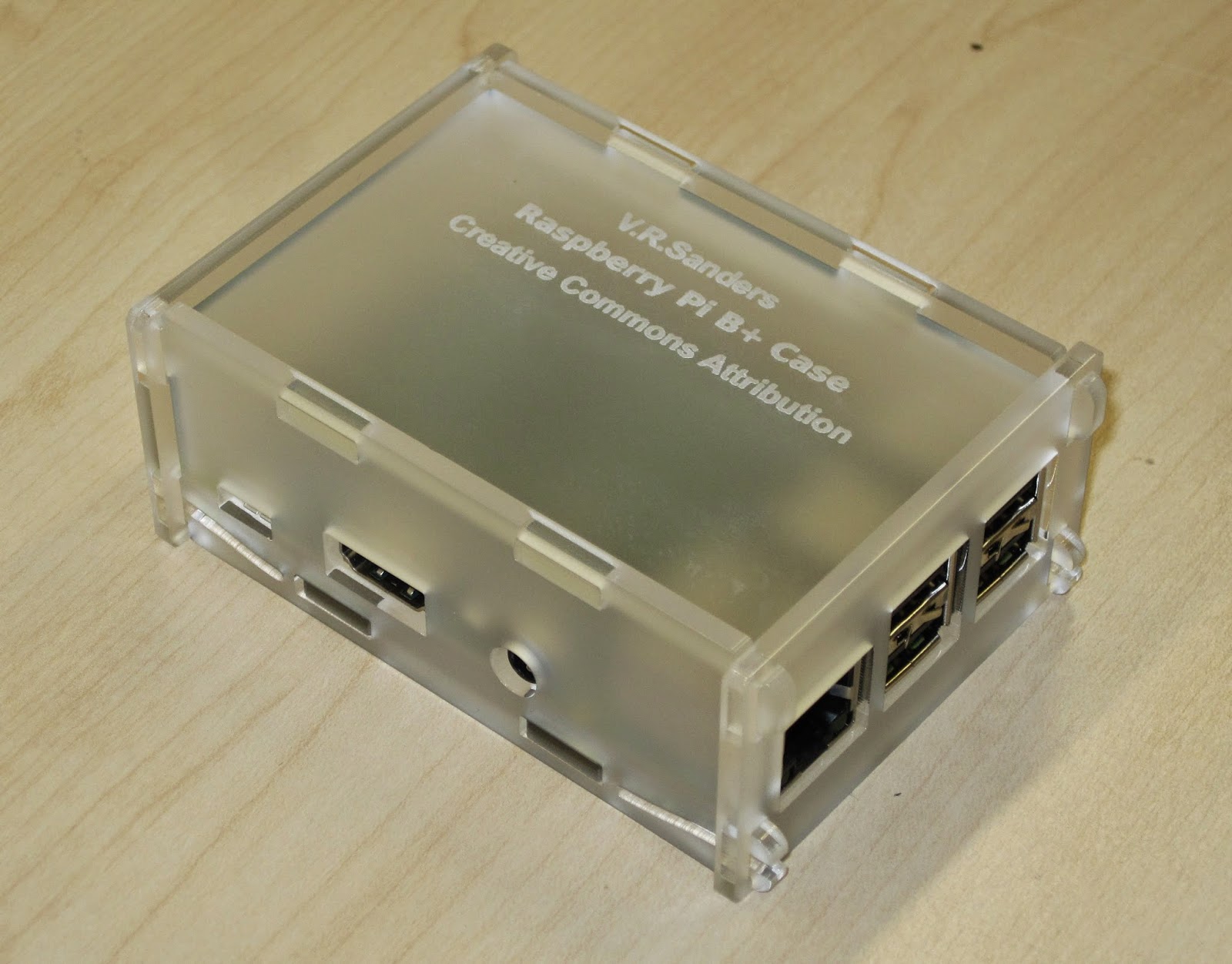
Vincent Sanders

It is no great secret that my colleagues at Collabora have been doing work with the Raspberry Pi Foundation.

My desk is very near Marco and I often see him working with the various Pi boards. Recently he obtained one of the new B+ units for testing and I thought it looked a little sad sat naked on his desk.

To remedy this bare board problem I designed and built a laser cut a case for him and now the B+ has been publicly released I can make the design freely available.

The design is completely original though is inspired by several other plastic "clip" type designs I have seen. Originally I created and debugged the case design for my parallella though tweaking it for the Pi was pretty easy.

The design is under a CC attribution licence and I ought to say that my employer is in no way responsible for this, its all my own fault.

Wouter Verhelst: Reprepro for RPM

Dear lazyweb, reprepro is a great tool. I hand it some configuration and a bunch of packages, and it creates the necessary directory structure, moves the packages to the right location, and generates a (signed) Debian package repository. Obviously it would be possible to all that reprepro does by hand by calling things like cp and dpkg-scanpackages and gpg and other things by hand but it's easy to forget a step when doing so, and having a tool that just does things for me is wonderful. The fact that it does so only on request (i.e., when I know something has changed, rather than "once every so often") is also quite useful. At work, I currently need to maintain a bunch of package repositories. The Debian package archives there are maintained with reprepro, but I currently maintain the RPM archives pretty much by hand: create the correct directories, copy the right files to the right places, run createrepo over the correct directories (and in the case of the OpenSUSE repository, also run gpg), and a bunch of other things specific to our local installation. As if to prove my above point, apparently I forgot to do a few things there, meaning, some of the RPM repositories didn't actually work correctly, and my testing didn't catch on. Which makes me wonder how RPM package repositories are usually maintained. When one needs to maintain just a bunch of packages for a number of servers, well, running createrepo manually isn't too much of a problem. When it gets beyond own systems, however, and when you need to support multiple builds for multiple versions of multiple distributions, having to maintain all those repositories by hand is probably not the best idea. So, dear lazyweb: how do large RPM repositories maintain state of the packages, the distributions they belong to, and similar things? Please don't say "custom scripts" ;-)

Juliana Louback: Become an Open-source Contributor Video Conference

A couple weeks ago I was contacted by Yehuda Korotkin through one of the Debian mailing lists. Yehuda is a tech professor at one of Israel s leading colleges for women. He proposed a video conference to present the open source community to his class and explain how they can contribute to open source projects. I volunteered to participate and last Monday (July 14th 2014) we had our virtual meeting, which I hope was the first of many. Shauna G. also participated from Boston, making it a Israel - USA - Brazil meetup. Pretty impressive, eh? The conference was hosted on Google Hangouts, the video is available for viewing here. Run time is around 2.5 hours so to save you time I ve kindly posted a summary of the conference! To be frank, I look ghastly half the time so I d much prefer that you read this post. First there was a Q&A period which was more of a discussion panel, followed by a hands-on session where the girls made their first contribution to an open source project. Here s the gist of it: Q&A Hands on For the practical part of our conference, Yehuda s students contributed to Jscommunicator s Issue #5 which requests i18n support for major languages. JSCommunicator is a SIP communication tool developed in HTML and JavaScript, currently supporting audio/video calls and SIP SIMPLE instant messaging. First we set up Github in their local machines and forked the Jscommunicator repo. We learned the basic git commands needed to push changes to their remote repositories and to create a pull requests. This is explained in further detail here. At the end of the conference with nearly an hour overtime due to my tendency to be overly verbose, Yehuda s class made their first contribution with a Hebrew translation for Jscommunicator! All in all, it was great to virtually meet Yehuda and his epic students who all seemed very clever engineers. I m looking forward to our next meetup once I gain some time-management skills.

Rapha&#235;l Hertzog: Spotify migrate 5000 servers from Debian to Ubuntu

Or yet another reason why it s really important that we succeed with Debian LTS. Last year we heard of Dreamhost switching to Ubuntu because they can maintain a stable Ubuntu release for longer than a Debian stable release (and this despite the fact that Ubuntu only supports software in its main section, which misses a lot of popular software). Spotify Logo A few days ago, we just learned that Spotify took a similar decision:

A while back we decided to move onto Ubuntu for our backend server deployment. The main reasons for this was a predictable release cycle and long term support by upstream (this decision was made before the announcement that the Debian project commits to long term support as well.) With the release of the Ubuntu 14.04 LTS we are now in the process of migrating our ~5000 servers to that distribution.
This is just a supplementary proof that we have to provide long term support for Debian releases if we want to stay relevant in big deployments. But the task is daunting and it s difficult to find volunteers to do the job. That s why I believe that our best answer is to get companies to contribute financially to Debian LTS. We managed to convince a handful of companies already and July is the first month where paid contributors have joined the effort for a modest participation of 21 work hours (watch out for Thorsten Alteholz and Holger Levsen on debian-lts and debian-lts-announce). But we need to multiply this figure by 5 or 6 at least to make a correct work of maintaining Debian 6. So grab the subscription form and have a chat with your management. It s time to convince your company to join the initiative. Don t hesitate to get in touch if you have questions or if you prefer that I contact a representative of your company. Thank you!

5 comments Liked this article? Click here. My blog is Flattr-enabled.

Jon Dowland: Mac

My job exposes me to a large variety of computing systems and I regularly use Mac, Windows and Linux desktops. My main desktop environment at home and work has been Debian GNU/Linux for over 10 years. However every now and then I take a little "holiday" and use something else for a few weeks. Often I'm spurred on by some niggle or other on the GNOME desktop, or burn-out with whatever the current contentious issue of the moment is in Debian. Usually I switched to Windows and I used it as an excuse to play some computer games. Last November I had just such an excuse to take a holiday but this time I opted to go for Mac. I had a back-log of Mac issues to investigate at work anyway. I haven't looked back. It appears I have switched for good. I've been meaning to write about this for some time, but I couldn't quite get the words right. I doubted I could express my frustrations in a constructive, helpful way, even if I think that my experiences are useful and my discoveries valuable, perhaps I would put them across in a way that seemed inciteful rather than insightful. I wasn't sure anyone cared. Certainly the GNOME community doesn't seem interested in feedback. I turns out that one person that doesn't care is me: I didn't realise just how broken the F/OSS desktop is. The straw that broke the camel's back was the file manager replacing type-ahead find with a search but (to seemlessly switch metaphor) it turns out I'd been cut a thousand times already. I'm not just on the other side of the fence, I'm several fields away. Sometimes community people write about their concerns with whether they're going in the right direction, or how to tell the difference between legitimate complaints, trolls and whiners. When I look at conferences now, the sea of Thinkpads was replaced with a sea of Apple Macs a long time ago now, and the Thinkpads haven't come back. I'd suggest: don't worry about the whiners. Worry about the leavers. What does this mean for my Debian involvement? Well, you can't help but have noticed that I've done very little this year. I've written nearly exclusively about music so far. the good news is: I still regularly use Debian, and I still intend to stay involved, just not on the desktop. I'm essentially only maintaining two packages now, lhasa and squishyball. I might pick up a few more (possibly archivemail if the situation doesn't improve) but I'm happy with a low package load; I'd like to make sure the ones I do maintain are maintained well. The sum of all my Debian efforts this year have been to get these two (or three) ship-shape. I have a bunch of other things I'd like to achieve in Debian which are not packages, and a larger package load would just distract from them. (We really are too package-oriented in Debian).

15 July 2014

Michal &#268;iha&#345;: New UI for Weblate

For quite some time, I'm working on new UI for Weblate. As the time is always limited, the progress is not that fast as I would like to see, but I think it's time to show the current status to wider audience. Almost all pages have been rewritten, the major missing parts are zen mode and source strings review. So it's time to play with it on our demo server. The UI is responsive, so it works more or less on different screen sizes, though I really don't expect people to translate on mobile phone, so not much tweaking was done for small resolutions. Anyway I'd like to hear as much feedback as possible :-).

Filed under: English phpMyAdmin SUSE Weblate 2 comments Flattr this!

Mario Lang

Mixing vinyl again The turntables have me back, after quite some long-term mixing break. I used to do straight 4-to-the-floor, mostly acid or hardtek. You can find an old mix of mine on SoundCloud. This one is actually back from 2006. But currently I am more into drum and bass. It is an interesting mixing experience, since considerably harder. Here is a small but very recent minimix. Experts in the genre might notice that I am mostly spinning stuff from BlackOutMusicNL, admittedly my favourite label right now.

13 July 2014

Laura Arjona: New GPG Key!

Achievement unlocked: I have a new GPG key:

0xF22674467E4AF4A3

pub 4096R/7E4AF4A3 2014-07-13 [caduca: 2016-07-12]
Fingerprint = 445E 3AD0 3690 3F47 E19B 37B2 F226 7446 7E4A F4A3
uid Laura Arjona Reina <laura.arjona@upm.es>
uid Laura Arjona Reina <larjona@fsfe.org>
uid Laura Arjona Reina <larjona99@gmail.com>
sub 3072R/CC706B74 2014-07-13 [expires: 2016-07-12]
sub 3072R/7E51465F 2014-07-13 [expires: 2016-07-12]
sub 4096R/74C23D6E 2014-07-13 [expires: 2016-07-12]

The master key is 4096 bit, stored in a safe place, and 2 subkeys 3072 bit, stored in an FSFE Smartcard (I cannot store 4096 keys there).

I have carefully used the FSFE SmartCard Howto and Creating the perfect GPG keypair by Alex Cabal for strenghtening hash preferences and creating revocation certificate.

It seems everything works as intended. Passphrase is strong and this time I will not forget it. As first celebration, 1/2 lt icecream is waiting for me after dinner :)

People knowing me and around Madrid, please send me an encrypted mail as test or normal communication, and ping me to meet and sign keys :) One more step towards involvement in Debian and free software, controlling my digital life and communications, and becoming familiar with these technologies so I can teach them to my son as the natural way . Yay!
Filed under: My experiences and opinion, Tools Tagged: Contributing to libre software, Debian, encryption, English, Free Software, gpg, libre software, Moving into free software, mswl-cases

Steve Kemp: A brief twitter experiment

So I've recently posted a few links on Twitter, and I see followers clicking them. But also I see random hits. Tonight I posted a link to http://transient.email/, a domain I use for "anonymous" emailing, specifically to see which bots hit the URL. Within two minutes I had 15 visitors the first few of which were:
IP User-Agent Request
199.16.156.124Twitterbot/1.0;GET /robots.txt
199.16.156.126Twitterbot/1.0;GET /robots.txt
54.246.137.243python-requests/1.2.3 CPython/2.7.2+ Linux/3.0.0-16-virtualHEAD /
74.112.131.243Mozilla/5.0 ();GET /
50.18.102.132Google-HTTP-Java-Client/1.17.0-rc (gzip)HEAD /
199.16.156.125Twitterbot/1.0;GET /robots.txt
185.20.4.143Mozilla/5.0 (compatible; TweetmemeBot/3.0; +http://tweetmeme.com/)GET /
23.227.176.34MetaURI API/2.0 +metauri.comGET /
74.6.254.127Mozilla/5.0 (compatible; Yahoo! Slurp; http://help.yahoo.com/help/us/ysearch/slurp);GET /robots.txt
So what jumps out? The twitterbot makes several requests for /robots.txt, but never actually fetches the page itself which is interesting because there is indeed a prohibition in the supplied /robots.txt file. A surprise was that both Google and Yahoo seem to follow Twitter links in almost real-time. Though the Yahoo site parsed and honoured /robots.txt the Google spider seemed to only make HEAD requests - and never actually look for the content or the robots file. In addition to this a bunch of hosts from the Amazon EC2 space made requests, which was perhaps not a surprise. Some automated processing, and classification, no doubt. Anyway beer. It's been a rough weekend.

Dimitri John Ledkov: Hacking on launchpadlib

So here is a quick sample of my progress playing around with launchpadlib using lp-shell from lptools:
In [1]: lp
Out[1]: <launchpadlib.launchpad.Launchpad at 0x7f49ecc649b0>

In [2]: lp.distributions
Out[2]: <launchpadlib.launchpad.DistributionSet at 0x7f49ddf0e630>

In [3]: lp.distributions['ubuntu']
Out[3]: <distribution at https://api.launchpad.net/1.0/ubuntu>

In [4]: lp.distributions['ubuntu'].display_name
Out[4]: 'Ubuntu'

In [5]: lp.distributions['ubuntu'].summary
Out[5]: 'Ubuntu is a complete Linux-based operating system, freely available with both community and professional support.'

In [7]: import sys; print(sys.version)
3.4.1 (default, Jun 9 2014, 17:34:49)
[GCC 4.8.3]

There is not much yet, but it's a start. python3 port of launchpadlib is coming soon. It has been attempted a few times before and I am leveraging that work. Porting this stack has proven to be the most difficult python3 port I have ever done. But there is always python-libvirt that still needs porting ;-)

Some of above is just merge proposals against launchpadlib & lazr.restfulclient, and requires not yet packaged modules in the archive. When trying it out, I'm still getting a lot of run-time asserts and things that haven't been picked up by e.g. pyflakes3 and has not been unit-tested yet.

Russ Allbery: Review: Neptune's Brood

Review: Neptune's Brood, by Charles Stross
Series: Freyaverse #2
Publisher: Ace
Copyright: July 2013
ISBN: 1-101-62453-1
Format: Kindle
Pages: 325
Neptune's Brood is set in the same universe as Saturn's Children, but I wouldn't call it a sequel. It takes place considerably later, after substantial expansion of the robot civilization to the stars, and features entirely different characters (or, if there was overlap, I didn't notice). It also represents a significant shift in tone: while Saturn's Children is clearly a Heinlein pastiche and parody, Neptune's Brood takes its space opera more seriously. There is some situational humor assault auditors, for example but this book is played mostly straight, and I detected little or no Heinlein. This is Stross fleshing out his own space opera concept. This being Stross, that concept is not exactly conventional. This is a space opera about economics. Specifically, it's a space opera about interstellar economics, a debt pyramid, and a very interesting remapping of the continual growth requirements of capitalism to the outward expansion of colonization. The first-person protagonist comes from a "family" (as in Saturn's Children, the concept exists but involves rather more aggressive control of the instantiated "children") of bankers, but she is a forensic accountant and historian who specializes in analysis of financial scams. As you might expect, this is a significant clue about the plot. Neptune's Brood opens with Krina in search of her sister. She is supposed to be an itinerant scholar, moving throughout colonized space to spend some time with various scattered sisters, spreading knowledge and expanding her own. But it's clear from the start of the book that something else is going on, even before an assassin with Krina's face appears on her trail. Unfortunately, it takes roughly a third of the book to learn just what is happening beneath the surface, and most of that time is spent in a pointless interlude on a flying cathedral run by religious fanatics. The religion is a callback to Saturn's Children: robots who are trying to spread original humanity (the Fragiles) to the stars. This mostly doesn't go well, and is going particularly poorly for the ship that Krina works for passage on. But this is a brief gag that I thought went on much too long. The plot happens to Krina for this first section of the book rather than the other way around, little of lasting significance other than some character introductions occurs, and the Church itself, while playing a minor role in the later plot, is not worth the amount of attention that it gets. The best parts of the early book are the interludes in which Krina explains major world concepts to the reader. These are absolutely blatant infodumping, and I'm not sure how Stross gets away with them, but somehow he does, at least for me. They remind me of some of his blog posts, except tighter and fit into an interesting larger structure. Thankfully, once Krina finally arrives on Shin-Tethys, the plot improves considerably. There was a specific moment for me when the book became interesting: when Krina finds her sib's quarters in Shin-Tethys and analyzes what she finds there. It's the first significant thing in the book that she does rather than have done to her or thrust upon her, and she's a much better character when she's making decisions. This is also about the point where Stross starts fully explaining slow money, which is key to both the economics and the plot, and the plot starts to unwind its various mysteries and identify the motives of the players. Even then, Krina suffers from a lack of agency. Only at rare intervals does she get a chance to affect the story. Most of what she did of relevance to this book she did in the past, and while those descriptions of the backstory are interesting, they don't entirely make up for a passive protagonist. Thankfully, the other characters are varied and interesting enough, and the political machinations and cascading revelations captivating enough, that the last part of the book was very satisfying even with Krina on for the ride. This is a Stross novel, so it's full of two-dollar technical words mixed with technobabble. However, it shares with Saturn's Children the recasting of robots as the norm and fleshy humans as the exception, which means much of the technobabble is a straight substitution for our normal babble about meaty bodies and often works as an alienation technique. That makes it a bit more tolerable for me, although I still wished Stross would turn down the manic vocabulary in places. This bothers some people more than others; if you had no trouble with Accelerando, Neptune's Brood will pose no problems. I don't think the first section of this book was successful, but I liked the rest well enough to recommend it. If you like your space opera with a heavy dose of economics, a realistic attitude towards deep space exploration without faster-than-light technology, and a realistic perspective on the hostility of alien planets to Earth life, Neptune's Brood is a good choice. And any book that quotes David Graeber's Debt, and whose author has clearly paid attention to its contents, wins bonus points from me. Rating: 8 out of 10

12 July 2014

Dirk Eddelbuettel: RcppArmadillo 0.4.320.0

While I was out at the (immensely impressive and equally enjoyable) useR! 2014 conference at UCLA, Conrad provided a bug-fix release 4.320 of Armadillo, the nifty templated C++ library for linear algebra. I quickly rolled that into RcppArmadillo release 0.4.320.0 which has been on CRAN and in Debian for a good week now. This release fixes some minor things with sparse and dense Eigen solvers (as well as one RNG issue probably of lesser interest to R users deploying the RNGs from R) as shown in the NEWS entry below.
Changes in RcppArmadillo version 0.4.320.0 (2014-07-03)
  • Upgraded to Armadillo release Version 4.320 (Daintree Tea Raider)
    • expanded eigs_sym() and eigs_gen() to use an optional tolerance parameter
    • expanded eig_sym() to automatically fall back to standard decomposition method if divide-and-conquer fails
    • automatic installer enables use of C++11 random number generator when using gcc 4.8.3+ in C++11 mode
Courtesy of CRANberries, there is also a diffstat report for the most recent release. As always, more detailed information is on the RcppArmadillo page. Questions, comments etc should go to the rcpp-devel mailing list off the R-Forge page.

This post by Dirk Eddelbuettel originated on his Thinking inside the box blog. Please report excessive re-aggregation in third-party for-profit settings.

Paul Tagliamonte: Satuday's the new Sunday

Hello, World! For those of you who enforce my Sundays on me (keep doing that, thank you!), I ll be changing my Saturdays with my Sundays. That s right! In this new brave world, I ll be taking Saturdays off, not Sundays. Feel free to pester me all day on Sunday, now! This means, as a logical result, I will not be around tomorrow, Saturday. Much love.

Matt Brown: GPG Key Management Rant

2014 and it s still annoyingly hard to find a reasonable GPG key management system for personal use All I want is to keep the key material isolated from any Internet connected host, without requiring me to jump through major inconvenience every time I want to use the key. An HSM/Smartcard of some sort is an obvious choice, but they all suck in their own ways:
* FSFE smartcard it s a smartcard, requires a reader, which are generally not particular portable compared to a USB stick.
* Yubikey Neo restricted to 2048 bits, doesn t allow imports of primary keys (only subkeys), so you either generate on device and have no backup, or maintain some off-device primary key with only subkeys on the Neo, negating the main benefits of it in the first place.
* Smartcard HSM similar problems to the Neo, plus not really supported by GPG well (needs 2.0 with specific supporting module version requirements).
* Cryptostick made by some Germans, sounds potentially great, but perpetually out of stock. Which leaves basically only the roll your own dm-crypt+LUKS usb stick approach. It obviously works well, and is what I currently use, but it s a bunch of effort to maintain, particularly if you decide, as I have, that the master key material can never touch a machine with a network connection. The implication is that you now need to keep an airgapped machine around, and maintain a set of subkeys that are OK for use on network connected machines to avoid going mad playing sneakernet for every package upload. The ideal device would be a USB form factor, supporting import of 4096 bit keys, across all GPG capabilities, but with all crypto ops happening on-device, so the key material never leaves the stick once imported. Ideally also cheap enough (e.g. ~100ish currency units) that I can acquire two for redundancy. As far as I can tell, such a device does not exist on this planet. It s almost enough to make a man give up on Debian and go live a life of peace and solitude with the remaining 99.9% of the world who don t know or care about this overly complicated mess of encryption we ve wrought for ourselves. end rant.

11 July 2014

Russ Allbery: Net::Duo 1.00

This is the first release of Net::Duo, which provides an object-oriented Perl interface for the Duo Security REST APIs. It attempts to abstract some of the API details and provide an object-oriented view of the returned objects in order to make use of the API in Perl code more natural than dealing with JSON data structures directly. Currently, some parts of the Auth and Admin APIs are implemented alongside with generic methods to call any of the JSON-based APIs. The approach I took with this module was a bit of a science experiment, and I'm still not entirely sure what I think about the results. Duo Security offers sample Perl code that provides the equivalent of the call and call_json Net::Duo methods but stops there. One sends in data structures and gets back data structures from JSON and manipulates everything in that format. I prefer a more object-oriented style, and want the module to do a bit more of the work for me, so this implementation wraps some of the APIs in objects with method calls. For updates, there are setters for the object itself and then a commit method to push the changes to Duo. This requires more implementation effort, and each API that should get richer treatment has to be modelled, but the resulting code looks like more natural object-oriented code. I wasn't completely sure going in if the effort to reward tradeoff made sense, and having finished the module sufficiently for Stanford's immediate needs, I'm still not sure. It was certainly more effort to write the base module this way, but on the other hand it also meant that I could map Perl notions of true and false to Duo's and provide much simpler methods for common operations. I still think this will make the code more maintainable in the long run, but I think it's within the margin of difference of opinion. Regardless, you can get the latest version from the Net::Duo distribution page and shortly from CPAN as well.

Next.

Previous.