Search Results: "tim"

15 November 2011

Michael Casadevall: Secure Boot - its here and been here for quite awhile ...

There's been a lot of noise with Microsoft requiring Secure Boot for Windows 8 OEMs. For those of you unfamiliar with it, Secure Boot requires that the boot chain is signed, and this 'feature' must be enabled by default. Although I have been unable to find specific details, it appears that the chain of trust needs to extend from BIOS/UEFI all the way down to the kernel. Obviously, requiring a signed boot chain makes using FOSS platforms like Ubuntu or Debian an impossibility short of having the UEFI Platform Key and resigning the entire chain.

Steven Sinofsky's MSDN blog has a fairly good overview how it works. Canonical and Red Hat also have a good white paper on why secure boot is a serious problem for Linux distributions. Even if secure boot itself can be disabled, it *greatly* rises the bar for general end-users to successfully install Ubuntu on their machine. In addition, it is the responsibility of OEM and BIOS manufacturers to provide the option to disable it.

There already has been a long history of OEMs removing BIOS options or introducing DRM; for instance, locking out VTx on Sony laptops, or restricting laptops to only accept 'branded' wifi and 3G cards. Given this track record, can OEMs realistically be trusted to have this option available?

What most people don't realize is that secure boot itself is not a new concept; its simply part of the Trusted Computing initiative, and has been implemented on embedded platforms for many years. If you own any iPhone, or one of the vast majority of Android devices, you are using a device that either has the secure boot feature, or something very close. This especially painful in Android as Google's security system restricts users to a *very* limited shell and subset of utilities which can be used on non-rooted devices. WebOS, Maemo, and to my knowledge Meego give the end-user full unrestricted access to the boot chain and you can swap kernels and even the entire OS out if one was so motivated.

Although it is still an ongoing problem, several vendors such as HTC, Samsung, Motorola (kinda), and even Sony. In the Android community, having unlockable bootloaders has been a welcome middle ground in the traditionally restrictive and locked-down world of cellular devices.

While some may argue that such locks are necessary to protect consumers, it is perfectly feasible to create devices with unlocked bootloaders that are still secure. The Nook Color's is an Android powered eReader. It's stock firmware doesn't allow sideloaded applications or even access to a user shell via adb, but the BootROM on the device attempts to boot from the microSD card before eMMC, making it possible for enterprising users to easily modify the underlying OS (as well as making it physically impossible to brick the device due to a bad flash). Barnes and Nobles even sells a book on rooting the Nook Color; it was right next to the devices on display at the time. In addition, they've continued the tradition of easily modifiable devices with both the Nook Simple Touch, and the Nook Tablet.

One of the most impressive attributes is the possibility of running Ubuntu on it. The absolute poster child for this is the Toshiba AC100. For those of you unfamiliar, it ultralight netbook that shipped with Android 2.1/2.2 with easy access to the built in flash via the mini-USB port on the side of the device. Due to the valiant efforts of the AC100 community, Ubuntu was ported to this device, and became a supported platform with images available on cdimages.ubuntu.com. If you were an attendee at UDS, you likely saw several AC100s all running Ubuntu.

This brings me to the point that motivated me to write this post in the first place. One of the most impressive tablets I've seen to date is the ASUS eeePad Transformer, an Android tablet with fully dockable keyboard. I have one of these devices, and its one of the most impressive and usable Android tablets I own. Sadly, such a powerful device was hobbled from its true potential due to ASUS's decision to ship the device with a locked and encrypted bootloader. Surprisingly, the Secure Boot Key (SBK) was acquired and released to the wild, making it possible to reflash the device. Sadly, even with the SBK, the device's bootloader is still extremely hobbled compared to the AC100 making flashing a slow and difficult process.

In response, ASUS refreshed the eeePad's hardware to the new B70 SKU, which has a new Secure Boot. Despite this, a root exploit was recently found to allow people to circumvent these restrictions and install customs ROMs. It is however only a manor of time before ASUS responds and releases a new update that fixes this bug.

Steven Barker (lilstevie) on xda-developers successfully created a port of Ubuntu to the Transformer. Currently, installing Ubuntu on the Transformer requires nvflash access, so its not possible to use his image on the newly liberated B70 devices. I am certain that a new method of installing via an update.zip will be developed for those of us with hobbled devices.

It is a showcase of what is possible when you have open hardware, and also proves one indisputable point: any 'trusted boot' or DRM scheme can and will be defeated; at best you piss off your userbase, and at worst, you force users to exploit bugs to gain control of their device. As it is impossible to reflash these devices from the bootloader, a failed kernel flash WILL brick these devices, increasing warranty and support costs as users try to return their now broken devices.

In closing, while there have been some victories in ongoing war of open hardware vs. trusted comptuing, the road ahead still remains very murky. Victories in the mobile market have shown that there is a market for open devices. Google's own Nexus One was sold as a developers phone and as a way to encourage manufacturers to raise the bar. It sold well enough to recoup its development costs.. While there is no official statements, the Nokia N900 is suspected to have broken all sales expectations, backed up by the fact that Angry Birds sold extremely well on the Ovi Store for the N900.

From the article in question:
What reaction have you had in terms of sales and customer feedback?

Angry Birds had already been launched on App Store before it came out on Ovi Store, and it had a great review average from iPhone reviewers and users alike, so we expected a good reception from N900 users as well.

Even so, we were quite surprised by just how the N900 community immediately took the game to heart. The game obviously made many people very happy, and that is really the greatest achievement that anyone who creates entertainment for a living can hope for. Well, maybe the greatest achievement is huge bundles of cash, but making people happy comes a close second.

In the first week that Angry Birds has been on the Ovi Store, it has been downloaded almost as many times as the iPhone version in six weeks. Given that most N900 users have not even used Ovi Store yet, we are confident that there will be many more downloads in the months to come, and are sure that the N900 version will be very profitable.

That being said, with Microsoft pushing secure boot and trusted computing down everyone's throats with Windows 8, it is hard to say what the future might hold for those of us who want to own our devices.

Michal Čihař: QtSDK installation troubles

Recently my installation of Qt SDK I use for development of applications for Nokia N950 (N9) got broken. It happened by update some postinst script failed what caused almost no part of Harmattan SDK to be installed. I hoped this to be temporary error which will get fixed by later updates, but it turned out to persist even for 1.1.4 which has been released week ago. Yesterday I finally got time to look into it and after some debugging I found out that it was trying to install x86_64 version, which was not downloaded because I was using 32bit installer. I quickly realized this was caused by using 64-bit kernel, while running 32-bit userspace, for which the installer somehow was not prepared. Fortunately there is easy workaround for that:
linux32 ./Qt_SDK_Lin32_online_v1_1_4_en.run
What will run the binary in 32-bit personality and make kernel pretend it is compiled for 32-bit.

Filed under: English Meego 2 comments Flattr this!

14 November 2011

MJ Ray: Growing Your Co-operative, Bristol

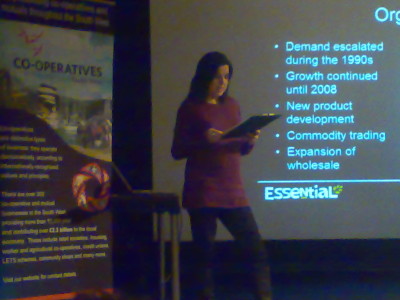
Photo of Eli Sarre

Eli Sarre from Essential Trading speaking at C-SW Annual Conference

Last Friday (11 November 2011), I was at the Cooperatives-SW annual conference at the Cube Cinema in Bristol, titled Growing Your Co-operative and sponsored by the Co-operative Membership South and West. It was another sold-out event, featuring headline talks from Co-op Party member and Labour MP Kerry McCarthy, Eli Sarre of Essential Trading worker co-op (pictured), Carole Theyer of Sparks Inc and Jim Pettipher from Co-operative Futures. There were also some great workshops I went to a finance workshop led by Ian Rothwell from Co-operative and Community Finance and a regulations one with Paul Martin of Kabin (details may appear on their event page) and a brilliant lunch from Runcible Spoon (and those of you who know me will know I have been livid with some co-op event lunches!) with some time to chat and network, although I also went to a fringe meeting about the RISE problems. The event concluded with the formal AGM of Co-operatives SW (electing a new chairperson and approving transfer to a new co-op corporation) as well as a bit more chat afterwards. I felt it was a great event and well worth my time being there. I m glad that some people from outside the co-op movement, from community businesses like the Strawberry Line Cafe and a few people considering joining or forming co-ops, were there and I hope it was good for them too.

Bdale Garbee: RF Immunity

We've had sporadic Altus Metrum customer reports about RF susceptibility issues with their TeleMetrum installations. In almost every case, these problems have been completely resolved by either making sure the system battery has sufficient charge before launch, or through the application of standard engineering techniques such as twisting wire pairs to reduce differential coupling. However, even when every technique we could think of had been applied, once in a while someone still had issues. Around the time of LDRS this year, the incidence of such reports seemed to increase. One customer, in particular, had an installation in which he virtually always saw continuous resets of the board once his 54mm airframe was put on a launch rail, and several customers reported seeing board resets during ejection charge firing. Keith and I saw a board reset during main charge firing happen in person at NCR's Oktoberfest, and with a couple days available to work together after that launch, we decided it was time to figure out what was really going on. Here's what we've learned. In bench testing, it quickly became clear that the problem was the 3.3 volt power supply rail getting pulled down far enough to reset the CPU. This most frequently happened during ejection charge firing, when the input of the LDO regulator is pulled down by the near-short presented by the e-match when a pyro FET is turned on. To keep the 3.3 volt rail voltage up during firing, we include a 100uF bulk capacitor on the regulator's output. In all of our prior bench testing, we never saw the 3.3 volt rail droop significantly. Clearly something had changed... or maybe several things had changed? The first thing I wondered about was whether the new Kalman filtering code, which requires more compute cycles from the processor, might be consuming enough more power to pull the rail down faster during charge firing. After poking around at it, though, we have no data to suggest the new code makes a measurable difference in power consumption. The next thing we pondered was that at least some of the e-matches we and others are using in the hobby now come from the fireworks industry, where it is apparently considered a feature for the match to retain continuity after firing. This means the input of the LDO gets held down for longer than with the e-matches we used to use and Quest Q2G2 igniters that open when fired. But that still didn't make sense as the root cause, as we chose the FET firing time such that even with a dead short across the igniter terminals, the 3.3 volt rail wouldn't be pulled down far enough to cause trouble during firing. One of the big changes between v1.0 and v1.1 on TeleMetrum was that the newer boards incorporate a better reset circuit. This helps ensure the GPS chip always comes up running at power on, which was a problem at temperature extremes with older boards. However, a side-effect of this change is that a v1.1 board will reset any time the 3.3 volt rail drops below 3.15 volts, whereas older boards didn't trip until a much lower voltage. So the recent increase in reports might just be related to more v1.1 boards being placed in service? While experimenting on the bench, we observed that injecting RF energy into the input of the LDO regulator had the effect of pulling down the output voltage, presumably because the internal reference source accumulates charge and is fooled into thinking the output is too high. Since our designs all have the power switch contacts ahead of the LDO, the wires going out to the switch and back are effectively an antenna... as are, to a lesser extent, the wires going to the e-matches. There is some variability from part to part in just how badly the LDO reacts. But by attaching a tuned length of wire as an antenna to the LDO input and playing around, we were finally able to reproduce the problem reliably on a test board at my bench! On further analysis, we realized that the output of the USB battery charger chip and the input of the LDO both expect a 1uF bypass cap to ground. At some point, those looked redundant and we eliminated one of the two. Unfortunately, we weren't internalizing the fact that the switch leads were between the two caps, and the one we left was on the output of the charger and not at the input of the LDO. Placing a suitable bypass cap right at the input of the LDO turns out to have a truly dramatic effect on RF immunity! Once we realized that RF getting into the LDO input was the problem, Keith pointed out that we used to see "noise" in the accelerometer data on earlier boards that was caused by the 3.3 volt rail moving slightly during radio transmit, which we fixed with a hardware change on v1.1. We are now convinced that this was at least partly related to RF coupling to the LDO input, not just the change in power consumption on the LDO output. We didn't realize what was going on in earlier testing because we often didn't have ematches wired up, so RF coupling was minimal. But going back to flights logged with v1.0 boards that included deployment, and studying the magnitude of the "steps" in acceleration data observed when the transmitter was on, Keith was able to compute the amount the 3.3 volt rail must have sagged if the real acceleration wasn't changing... which in some cases was as much as 180mV! We think this proves that RFI could cause the LDO to drop its output voltage below the reset controller set point on v1.1 boards. Based on these observations, I'm making two hardware changes for the next version of TeleMetrum (version 1.2), and Keith is also making a software change. We have tested all of these changes on real boards both on the bench and in test flights, and the net effect is a major improvement in the RF immunity of TeleMetrum. The first hardware change is moving to a slightly lower trip voltage on the reset controller. Instead of 3.15, the new part trips at 3.00 volts nominal. This gives us more "headroom" to tolerate 3.3 volt rail droop during charge firing, and will allow the board to operate longer on a given battery charge. This change is not relevant for v1.0 and prior. The second hardware change is adding an appropriate bypass capacitor right at the LDO input. This requires a PCB update, but it's possible for me to update existing production boards by adding an 0402 cap right across the appropriate pins on the regulator chip. The software change prevents our altimeters from turning on the radio transmitter while an ejection charge is firing. Since the RF transmitter draws substantial additional power, this should help keep the 3.3 volt rail from drooping. This may not really matter, but it feels like the right thing to do. This change will be part of our next stable firmware release. We think most TeleMetrum customers need not worry about these updates. But if you have seen odd resets on the rail or during ejection charge firing in flight with a TeleMetrum v1.1, feel free to contact me about updating your existing board to include these improvements.

Vincent Bernat: A quick look at Typekit

Back in the dark ages of the web, before the introduction of CSS 3, browsers could only display fonts available on the client system. Thanks to the introduction of @font-face and its now widespread support, this is over. Now, Web designers have access to a large selection of fonts and most users will be able to appreciate them. Typekit provides a subscription-based library of hosted, high-quality fonts to use on websites. I expose here my own, mostly uneducated1 on the typographic side, look on this service.

Fonts embedding 101 There are several ways to embed fonts for the Web. Let s have a look at the most common ones.

Self-hosting and @font-face A first possibility is to host fonts yourself and provide a CSS file with the appropriate @font-face declarations. There are five important things to know:
  1. There is no common format. You will need to host different versions of the same font to support most browsers.
  2. Of course, Internet Explorer comes with its own quirks that you need to work around.
  3. Most browsers enforce a same origin policy. You need to serve your fonts from the same domain as the requesting page. You can circumvent such a limitation by enabling cross-origin resource sharing: add an Access-Control-Allow-Origin header when serving fonts.
  4. Fonts are unlikely to change. To leverage caching, configure an explicit expiration date far in the future. Something like 30 days.
  5. There is no MIME types registered for fonts. Don t bother setting one, even if Google Chrome likes to complain about them in the console.
One great resource is Font Squirrel which provides kits with fonts and the appropriate CSS declarations. You choose your font family (or upload one of your own), the formats that you want to use (check them all) and you will get a ZIP archive with all fonts and a CSS file. You may want to tweak it a bit to enable automatic use of the bold variant when needed and to use a local copy if available. For example, if you choose Crimson, an oldstyle typeface, you may want to declare the bold version with font-weight: bold and add local names:
@font-face  
    font-family: 'Crimson';
    src: url('Crimson-Bold-webfont.eot');
    src: local('Crimson Bold'), local('Crimson Text Bold'),
         url('Crimson-Bold-webfont.eot?#iefix') format('embedded-opentype'),
         url('Crimson-Bold-webfont.woff') format('woff'),
         url('Crimson-Bold-webfont.ttf') format('truetype'),
         url('Crimson-Bold-webfont.svg#CrimsonBold') format('svg');
    font-weight: bold;
    font-style: normal;
 

Google Web Fonts For open-source fonts, you can also use Google Web Fonts instead of hosting the files yourself. Build a collection of fonts and choose the variants that you want to use for each of them. You will then be provided with a code snippet to paste in the <head> element of your page. For example, for Crimson:
<link href='http://fonts.googleapis.com/css?family=Crimson+Text:400,700,400italic'
      rel='stylesheet' type='text/css'>
Why choose this solution over self-hosting?
  1. You don t use your own bandwith to serve fonts. This may be important if you pay for it.
  2. Google uses its own CDN to serve fonts. If you don t use a CDN yourself, this can be a major performance improvement.
  3. Caching is more efficient since many sites will use the same font.
  4. It s easier to do it right.
Unless you are concerned about Google tracking your users2, I think this is a better solution than self-hosting. Quick delivery of fonts is pretty important since content rendering can be delayed by them.

Typekit: the good parts So, why choose Typekit? First, there is the very large choice of fonts. The first paid plan comes with more than 500 fonts from about 80 foundries. There are about a hundred serif fonts and a couple hundred sans serif ones. Typekit provides a convenient interface to browse fonts. You can either search fonts by name or by characteristics. In the last case, you can filter on properties like the classification (serif, sans serif, decorative, etc.), weight, width, contrast, x-height, recommended use or language support. Once a font is selected and added to your kit, you can easily choose what variants you want. The kit total size is displayed. If you happen to meet any problem or have some questions, Typekit support is very responsive. I got clear and crisp answers in less than a few hours in the week-end.

and the bad ones Unfortunately, Typekit has also some shortcomings. One of the most commonly cited is that Javascript is mandatory. No Javascript, no fonts. If you want to display the appropriate fonts for users without Javascript, you should just not use Typekit.

Not free, nor free While Typekit offers some open-source fonts, most of them are not. Moreover, only a few of them are available in the free plan. While I would prefer to use open-source fonts, I don t consider this a strong requirement: if you are dissatisfied for some reason, switching back to open-source fonts (or another service) is fast and easy. I like serif fonts a lot and they get less attention from the FLOSS world: it is difficult to find one whose readability on screen is excellent. Droid Serif is a nice font but is a bit too black for me. Maybe Cardo would be a good match. You may disagree and in this case, Google Web Fonts or self-hosting seem the perfect match.

Difficulty to choose and test fonts While browsing fonts is easy and smooth, choosing and testing them is another matter. For example, Typekit is missing some interface to compare font rendering for whole paragraphs at a given size. It also misses a way to check how two fonts render together, one for headings and one for paragraphs. Here, Google Web Fonts is more versatile. Things become really difficult when you want to test your selected fonts for real. Except if you have invested into one of the expensive plans, you can only include a limited number of fonts in your kit. Each time you want to try another set of fonts, you need to modify your kit and wait for it to be distributed across Typekit network. You may have to wait five or ten minutes between each change! Another inconvenient thing is that once you publish your site, any change to the kit will affect the published version. Therefore, you need to use a second kit for development and play back and forth with those two kits. What would be convenient here is a special kit with all fonts from the library with restricted access to some IP to avoid abuse. This is something done by Fontdeck, a competitor.

Poor subset support Because you want to keep the font size small (about 30 kB for each variant), Typekit usually proposes two subsets: the default one contains only latin characters and the complete one with all glyphs. If some glyph is absent from the default subset, you need to use the complete one which is roughly two to four times the size of the default one. This is a bit huge for only one character. What would be nice is to have subsets for each language. In my case, I would take a French subset because I need the glyph which appears in French in words like c ur (heart or core) or il (eye). I don t want to select the complete subset just for this character. When a glyph is absent, the next font in the CSS stack is used. For example, if the selected font is FF Tisa Web Pro and the next font in the stack is Droid Serif, here is how the word c ur may be rendered. On the first line, FF Tisa Web Pro contains the appropriate glyph. On the second line, the glyph is absent and taken from Droid Serif. Since x-height and contrast are a bit different, the replaced glyph seems out of tone. At small sizes, the difference accounts for more than 10%. Various rendering of word "c ur" I have also added a third line where the ligature is built from o and e and the following style is applied to e :
.lf-ligature  
    margin-left: -0.172em;
    zoom: 1; /* Here to trigger hasLayout on IE7 */
 
As you can see, the result seems good. I have a piece of Javascript turning a ligature into the appropriate markup. It can be extended to handle more ligatures and could be adapted to handle other composed characters (like the ones in Anton n Dvo k ).

Defective caching Because a document can only be rendered after the fonts have been loaded3, it is pretty important to deliver fonts as fast as possible. Typekit uses Edgecast as a CDN and DynECT for DNS hosting. Two files are downloaded. Both of them are hosted on use.typekit.com. The first one is a script that will act as a loader. Based on the characteristics of your browser, it will choose how to download the requested fonts for best rendering. The second file is generally a big CSS file containing the fonts. Here are the headers returned for the first file:
HTTP/1.1 200 OK
Accept-Ranges: bytes
Cache-Control: max-age=300
Content-Encoding: gzip
Content-Type: text/javascript
Date: Tue, 08 Nov 2011 18:34:16 GMT
ETag: "388467610+gzip"
Expires: Tue, 08 Nov 2011 18:39:16 GMT
Last-Modified: Sat, 05 Nov 2011 09:31:57 GMT
Server: ECS (cdg/D624)
Vary: Accept-Encoding
X-Cache: HIT
Content-Length: 7440
First, notice that the content is served compressed. Good point. The next headers to look at are Cache-Control, Date, ETag and Expires: the server requests the content to be cached for 5 minutes. When the browser notices that its copy is out-of-date, it will issue a new request including a If-None-Match: 388467610+gzip header. Unless the kit has been modified, the server will answer with 304 Not Modified and no content. The copy of the browser will be valid for another 5 minutes. This means that after 5 minutes, at least 3 round-trips are needed to check if our fonts are up-to-date. Worse, sometimes, Typekit servers may be just slow. They can wait one second before answering, just to send a 304. Since the first file is a script embedded in <head>, the whole page is blocked until you get the answer. Here is an illustrative example with Chromium 14 where a page using Typekit is loaded while all static assets are in the navigator cache and things have gone wrong (which is pretty rare): Screenshot of Chromium Inspector Since fonts are needed, the rendering has been paused for 3.5 seconds until Typekit was fully loaded. If we look more closely, we may also notice we got a status 200 from the server instead of 304. Here is an excerpt of the browser request:
GET /tyt0atd.js HTTP/1.1
Host: use.typekit.com
Connection: keep-alive
Accept-Encoding: gzip,deflate,sdch
If-None-Match: "2200251225+gzip"
If-Modified-Since: Thu, 10 Nov 2011 11:38:11 GMT
And here is an excerpt of the answer headers:
HTTP/1.1 200 OK
Accept-Ranges: bytes
Cache-Control: max-age=300
Content-Type: text/javascript
Date: Fri, 11 Nov 2011 17:10:03 GMT
ETag: "2200251225"
Expires: Fri, 11 Nov 2011 17:15:03 GMT
Last-Modified: Thu, 10 Nov 2011 11:38:11 GMT
Server: EOS (lax001/54E5)
Content-Length: 25755
What happened? For some unknown reason, the server denied the access to the compressed version of the resource: there is no Content-Encoding: gzip while the browser did send Accept-Encoding: gzip. The tag provided by the browser (2200251225+gzip) came obviously from the compressed resource and therefore does not match. RFC 2616 requests If-Modified-Since header to be ignored if the tag does not match. Consequently, the server answers with 200 OK and resend the whole file. The same problem happened with the CSS file. Let me stress again how important the problem is: we had to download again the two files but we also downloaded the non-compressed version. Now, let s suppose that we did not run into this problem and the server answered with 304 Not Modified. The result is still not satisfactory: we would have waited 1.3 seconds to get both answers from the server. Keep in mind that most of the time, Typekit is pretty fast. Here is how I think this should have been done: each time you modify your font kit, you get a new URL to use (containing the version of the font kit for example). This resource and the associated fonts (whose URL is also versioned) are requested to be cached for several days. As a sidenote, this also enables to modify a kit for your development environment without modifying the kit for your production site. I suspect that Typekit did not go this way to track kit usage more accurately and enforce the appropriate pricing. Having multiple versions of the same kit would also allow us to use more fonts that we are paying for. UPDATED: Typekit support knows the problem and is working on it:
You ve identified a small bug in our CDN provider that we re working with them to fix. Hopefully I can give an explanation of what s happening. The CDN edge servers have a cache of recently served kits on them. Any request that is served from that cache will be correctly Gzipped and handle ETags. Unfortunately, if the content isn t already in cache and needs to be fetched from the master origin server then the request won t be gzipped correctly which has the side effect of breaking ETags. [ ] We are working to on getting this bug fixed, but any change to a globally distributed CDN will take some time. We re also working on having our content cached longer than 5 minutes whilst still allowing people to quickly update their site.

Conclusion I have mixed feelings about Typekit. While the difficulty to test fonts and the lack of language-related subsets are annoying, I have been able to work around them. However, the caching problem is more annoying. I am still considering going back to Google Web Fonts just because of this.

  1. While I have a high interest in typography, have my own copy of The Elements of Typographic Style by Robert Bringhurst and have throughly read The Elements of Typographic Style Applied to the Web , I am still fairly novice on this matter.
  2. Google serves fonts from a cookie-less domain. Technically, they could still do some kind of tracking but I believe they don t.
  3. In fact, browsers have different strategies on how to render before fonts availability. Paul Irish wrote a comprehensive article on FOUT. One common strategy is to render a blank space until downloaded fonts are available. If this takes too much time, fallback fonts may be used.

13 November 2011

Benjamin Mako Hill: Famous in Scratch

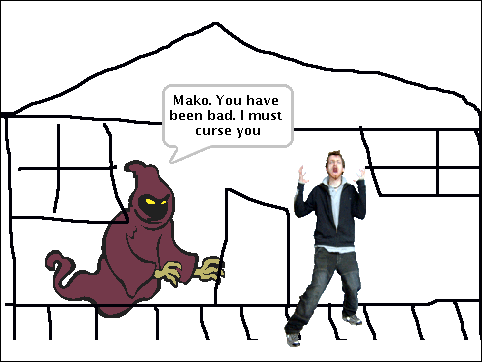
A few years ago, I ran into my friend Jay in the MIT Infinite Corridor. He was looking for volunteers to have their pictures taken and then added to the library of freely licensed and remixable media that would ship with every version of Scratch -- the graphical programming language built by Mitch Resnick's Lifelong Kindergarten group that is designed to let kids create animations and interactive games. Jay suggested I make some emotive faces and I posed for three images that made the final cut: /copyrighteous/images/scratchlib-mako-laughing.gif /copyrighteous/images/scratchlib-mako-screaming.gif /copyrighteous/images/scratchlib-mako-stop.gif But although I've spent quite a bit of time studying the Scratch community in the last few years as it is grown to include millions of participants and projects, I forgot about about Jay's photo shoot. A couple months ago, Acetarium resident Andres Lombana Bermudez pointed out that there was a mako tag on the Scratch website and that a whole bunch of users had been publishing projects using the pictures of me which, apparently, shipped in Scratch under my name. For example, in this project in which I dance in front of a enormous "MAKO" banner: /copyrighteous/images/scratchweb-dance.png That said, given the rather emotive nature of the pictures, I seem to usually end up being blown up shot, shrunk, set on fire by dragons, or meeting other similarly unfortunate ends. /copyrighteous/images/scratchweb-bad_mako.png /copyrighteous/images/scratchweb-looks_arent_everything.png There's quite many more entertaining examples under the tag and many more elsewhere on the Scratch website although they are a little trickier to track down. Jonathan Zittrain likes to say that the best technologies are generative in the sense that they encourage their users to make things with them that the designer never forsaw or anticipated. I feel generative.



Guido G nther: Testing libvirt and KVM/QEMU with libvirt-tck

Debian's libvirt in unstable finally passes the Technology Compatibility Kit (libvirt-tck) for qemu:///system:
Files=59, Tests=1579, 315 wallclock secs ( 0.77 usr  1.02 sys + 31.40 cusr 10.14 csys = 43.33 CPU)
Result: PASS
We're running libvirt's internal test suite since 0.9.0 but this doesn't launch any real virtual machines to check things like suspend, resume, snapshotting, migration and it doesn't create storage pools and volumes or networks. This means a lot of testing was done manually with each release. libvirt-tck provides a framework to perform these kinds of integration testing between libvirt and it's drivers, comes with hundreds of testcases already and it's easy to set up since it's available in experimental:
apt-get install -t experimental libvirt-tck
Edit /etc/libvirt-tck/default.cfg if you don't want to use the default connection URI. Then just run libvirt-tck:
libvirt-tck
Since this is supposed to stress libvirtd and the hypervisor and since it creates and deletes storage pools, networks and virtual machines it's recommended to run this on a dedicated system to make sure the tests don't blow away any precious config. If a test fails one can debug that single test using:
LIBVIRT_TCK_CONFIG=/etc/libvirt-tck/default.cfg prove --verbose /usr/share/libvirt-tck/tests/hooks/051-daemon-hook.t
This already revealed errors in our package like a missing parted build dependency breaking the creation of disk based storage pools, bugs in libvirt, crashes in QEMU and minor errors in the test suite itself. We're currently cheating a bit since the tests for hooks and nwfilter are currently disabled due to license problems with the used Perl modules. libvirt-tck can easily be integrated into Jenkins since it can now use libtap-formatter-junit-perl to generate JUnit XML. To do so simply configure a free-style software project to execute these commands:
rm -f libvirt-tck.xml
sudo libvirt-tck --timer --format junit --force > libvirt-tck.xml
allow Jenkins to run libvirt-tck as root
jenkins ALL=(ALL) NOPASSWD: /usr/bin/libvirt-tck --timer --format junit --force
and configure it to publish a JUnit test result report. Currently I'm only running the tests for qemu:///system so any help running and debugging this for LXC, VirtualBox or XEN is very welcome. Many thanks go to Salvatore Bonaccorso for packaging the missing Perl modules needed by libvirt-tck.

12 November 2011

Stefano Zacchiroli: at last

I'm not exactly green, and yet the first time a given mister became prime minister of my country I didn't even have the right to vote. Now, I just feel relieved.

John Goerzen: Greece part 5: Friends and Radios

See also parts 1, 2, 3, and 4. This is the biggest highlight of our trip to Greece for me. I enjoy having the chance to meet people, visit for awhile, and make new friends and that certainly happened in Greece. In one of the shops we happened to step into, I noticed a radio behind the counter. That s not unusual itself; radios often catch my eye these days. But this radio was tuned to 21.070, an amateur radio frequency. So I asked the shop owner if he happened to be a ham. And indeed he was. He was Lakis (SV5KKU), and Terah and I had a great time visiting with him. Terah took some photos of us, and then we made our purchases and headed out. I had brought my HT (handheld radio, weighs a few ounces and is powered by batteries) with me, and Lakis told me about the repeaters in the area. I had known about some of that since I had emailed Panos of the amatuer radio club in Rhodes before leaving home (I found his name via Google). A couple of days later, on Tuesday, we found ourselves back in Lindos. It was mid-afternoon, so the shops were quiet. After a late lunch, I thought it would be nice to drop in on Lakis one more time, since we were scheduled to fly back the following morning. I m not sure how long we stayed it must have been at least an hour and enjoyed the fresh orange juice he prepared. After we got back to our hotel Tuesday, I learned that our flights on Wednesday were canceled due to a nationwide air traffic controller strike in Greece. After 3 hours on the phone with Delta (more on that experience later), we got rescheduled to fly back Friday. On Wednesday morning, I remembered that the Rhodes amateur radio club meets every Wednesday evening, and now I would be able to go! I knew how to contact Lakis by email and on the radio, and he kindly offered to pick me up and take me there. So that evening, I got a tour of his impressive mountaintop installation, and then it was on to the club the Radio Amateur Association of the Dodecanese (SZ5RDS). There I met Panos, whom I had emailed earlier (and I think surprised him a bit). It was a friendly group, and they translated into English for me every so often so I knew what was being discussed. When I was about to leave, they gave me this: The translation, partly from my memory and partly with the help of Google Translate, is:
Radio Amateur Association of the Dodecanese, SZ5RDS Our friend and radio colleague KR0L JOHN GOERZEN, who visited the island, has our recognition as an HONORARY CLUB MEMBER. PRESIDENT KAVALAKIS PANAGIOTIS SV5AZK (Panos) SECRETARY PAPADIMITRIOU CHRISTOS SV5DDT RHODES Oct. 5, 2011
(I hope that any Greeks reading this will send me corrections.) I truly appreciated that gesture and meeting all the people in the club. On the way back to the hotel, Lakis and I stopped by a restaurant, which I believe had the best souvlaki I ve ever tasted thanks! We brought some back for Terah. She had chosen to stay at the hotel that evening and had a small hotel meal earlier, but enjoyed the souvlaki and pita. Terah had explained to the ma tre d that I wasn t along that evening because I had gone to an amateur radio club meeting. Judging by the surprised reaction, this was probably the first time they had heard that particular comment! Experiences like this make travel fun and worthwhile. Thank you very much, Lakis and everyone in the club I hope to have a chance to visit again.

Kai Wasserb ch: New Greasemonkey script available for WotC's Magic section

No matter whether you're a professional or hobby player, if you play Magic: The Gathering, you certainly visit Wizards of the Coast's homepage from time to time. And while other parts of the WotC's page have been made unusable without ECMAScript enabled, the MTG part can be used without it mostly. The one part, that didn't work (and I needed) was card links. They have some ECMAScript to fetch the image from the Gatherer and overlay that on the current page, if you hover over a card link. If you click, it's again some script, that opens a Gatherer window. I just want all card links to be plain links pointing to the respective entries in the rather lightweight magiccards.info card search, which displays all relevant data in a compact layout. Today I finally got around to throw the ten or so lines of ECMAScript together, Greasemonkey needs to make that happen. If you like to give it a try, you can download it from my Greasemonkey script collection (direct link for the impatient: wotc_with_noscript_and_card_links.user.js). As an additional note: I'd like to point out, that there are other scripts available from userscripts.org which can do the same. But all those scripts did a lot else (like using jQuery to fetch the image on mouse over from magiccards.info).

11 November 2011

Niels Thykier: build-arch for everyone

The other day, I was asked if it was really possible to get build-arch support in Wheezy (as in, buildds using build-arch) by adding these optional targets. Lets have a look at the data that is available to us: To simplify my calculation I will assume we can fix packages over a course of 150 days (which is 5 months of ~30 days or every day in Dec to April). So 500/150 = 10/3 =~ 3.3 packages from the reduced set should be fixed every day. Erring on the side of caution, we should make that 4 packages every day. So if we fix 4 packages from the reduced set every day, we will definitely fix all of them before Wheezy. But the reduced set are only the source packages that could possibly benefit from having a build-arch target (it builds both arch:all and non-arch:all packages). There could (and probably will) still be sources building non-arch:all packages without a build-arch target. Furthermore, with the rate of 4 a day we will only have a month to get dpkg and buildd support In short, no. I do not expect us to get archive-wide build-arch support on buildds for Wheezy. But I will do my best to ensure that option #4 flip the switch becomes very attractive early in the Wheezy + 1 development schedule. I hope you will join us in this endeavour. Most of the time it is a trivial 3-4 line fix and often you can even throw in some hardening flags to spice it up a bit. The easiest way to help is to fix your (team s) packages listed in the reduced set . Once you are done with that you can look at the rest of your (team s) packages (see the full dd-list). The most important thing to remember is that Build-Depends-Indep is still broken! That is, you cannot rely on Build-Depends-Indep being installed on a buildd in the build target. So any existing workarounds have to stay for now (i.e. check for certain commands or deferring indep till binary-indep is called). If you are in doubt about how to fix a certain package feel free to ask for help. Note: I pull the data directly from lintian.d.o (full set) and UDD (reduced set). I try to remember to refresh it daily. The full set is basically (z)grep cut uniq on the lintian log, the reduced set is found using the UDD query from this script (based on a query done by Jakub Wilk). Since all data is (in)directly based on lintian.d.o only packages that are in sid are considered.

Alexander Reichle-Schmehl: Release Critical Bug report for Week 45

The bug webinterface of the Ultimate Debian Database currently knows about the following release critical bugs:
In Total:1869
Affecting Wheezy:1211
Wheezy only:155
Remaining to be fixed in Wheezy:1056
Of these 1056 bugs, the following tags are set:
Pending in Wheezy:54
Patched in Wheezy:197
Duplicates in Wheezy:48
Can be fixed in a security Update:33
Contrib or non-free in Wheezy:12
Claimed in Wheezy:0
Delayed in Wheezy:10
Otherwise fixed in Wheezy:87
Ignoring all the above (multiple tags possible) 684 bugs need to be fixed by Debian Contributors to get Debian 7.0 Wheezy released. However, with the view of the Release Managers, 1105 need to be dealt with for the release to happen. Please see Interpreting the release critical bug statistics for an explanation of the different numbers.

Jon Dowland: Retiring from the Debian games team

After over five years, I've decided to retire from the Debian Games Team. The games team has been a fun group to work within Debian: packaging doom-related programs was my route into Debian and I've really enjoyed it. Spare time is very tight at the moment, and I'm not dedicating much at all to Debian work. Within that, I'd quite like to try and focus on some other areas. Good luck to the team going forward!

10 November 2011

Adnan Hodzic: Linux power regression + overheating problem on ThinkPad [fixed?]

This blog post isn t only directed to ThinkPad owners as most notebook Linux users with Intel Core Duo 1/2 and i3/i5/i7 processors have been affected by this bug if not all. And yes, this problem is present on latest Debian Unstable and Ubuntu 11.10. Prelude I m owner of Thinkpad X300, great machine except the fact that just recently I replaced its 3rd cooling fan! Yea, I do a lot of compiling and it s on all the time, but still this kind of things shouldn t happen. I first linked this problem to the fact that Thinkpad fan on Linux (as of 2.6.22) always works at what s its basically maximum RPM, thus the reason there are numerous fan control scripts. My favorite one is Thinkfan, but controlling fan doesn t really help if you have a overheating problem. For matter of a fact it working on its maximum speed might only help, with its own toll. As of kernel 2.6.38 up until 3.1 (still present) there has been a problem of power regression but besides this I had slight problem with overheating. Regarding overheating in beginning I tried reporting bugs, tried different Thinkfan configurations, blamed proprietary software such as Adobe Flash for spiking up CPU temperature, however this problem was somewhat solved. After numerous battery calibrations and as these didn t work in the end for battery life getting poorer with each day, I just blamed the factor that notebook was getting pretty old (~3 years). Then the consumer woke up inside of me and I thought it was time to get new notebook. I laid my eyes upon ThinkPad X1 thing of beauty except one mayor drawback, its price. I did some reading on X1 and interesting enough, X300 comes with Core Duo 2 L7100 but overheating + power regression was still present even on latest Intel Core I* series. Reading this killed the consumer and woke up the hacker side. Solution Initial workaround to the problems of power regression is to add pcie_aspm=force besides existing GRUB boot arguments, this did help to some point but what really helped in both cases was also adding i915.i915_enable_rc6=1 or at least I thought so since this line only applies to Sandy Bridge (i3/i5/i7) and latter. In the end my /etc/default/grub looks like:
GRUB_CMDLINE_LINUX_DEFAULT="quiet splash pcie_aspm=force i915.i915_enable_rc6=1"
and make sure you run update-grub after making these changes. Besides the arguments I used there are other ones you can use and for more info please head to Tweaks To Extend The Battery Life Of Intel Linux Notebooks . Results I ended up with such simple tweak are more then satisfactory as I got some ~45 extra minutes of battery life besides the fact that it lowered temperature by some ~10 C. Guess this also gives me extra time until I get a chance to lay my hands on X1 Smile P.S: After I posted this some argued that this is a workaround rather then a fix and folks at [Phoronix] just posted what they call a proper solution to this problem. Also please note although Sandy Bridge users that enable this might sometimes get a video corruption bug, i915_enable_rc6 is still supposed to get enabled by default in 3.2. So logical conclusion you can come up with is unless you re troubled by this problem, you might not want to use this work around/fix at this point. And hope it ll be fixed in future releases of your favorite Linux distribution.

Michal &#268;iha&#345;: phpMyAdmin demo server updates

phpMyAdmin demo server got some updates recently. First of all I've updated MySQL and MariaDB version it uses (MySQL is now on 5.5.7 and MariaDB on 5.3.2). Later I've finally found time to make mentions of demo server less intrusive and fit more in existing interface. I've used jQuery to inject information about demo server to main page as one of standard boxes. It fits there nicely and puts information on main page where most users land anyway (you can see it for example here). With most important information on main page, the other pages could be reduced and now only mentions demo server and Git revision it is using. This brings user experience closer to real phpMyAdmin without intrusive information shown on top of every page. I hope you will like it :-).

Filed under: English Phpmyadmin 0 comments Flattr this!

9 November 2011

Martin Zobel-Helas: How to read Debian's mailing list archives locally

From time to time i want to answer on mails on Debian mailinglists that i am not subcribed to. To have proper reply-headers set, i usually copied the archive mbox from master.debian.org to my local machine. Now i found a much nicer way.
apt-get install fuse afuse sshfs
adduser zobel fuse
mkdir ~/fuse/
afuse -o mount_template="sshfs %r:/ %m" -o unmount_template="fusermount -u -z %m" -o timeout=60 ~/fuse
mutt -f /home/zobel/fuse/master.debian.org/home/debian/lists/debian-user/debian-user.201111

Gunnar Wolf: On the social-based Web and my reluctance to give it my time

I recently started getting mails from no-reply@joindiaspora.com. Usually, a mail from no-reply@whatever is enough to make me believe that the admins of said whatever are clueless regarding what e-mail means and how should it work. And in this case, it really amazes me If I get an invite to Diaspora*, right, I should not pester a hypothetical sysadmin@joindiaspora.com to get me off his list, but I should be able to reply to the person mailing me Maybe requesting extra details on what he is inviting me to, or allowing me to tell him why I'm not interested. But yes, Diaspora* has fallen to the ease of requiring me to join their network to be able to communicate back with the "friend" who invited me. Some of the (three?) readers of this site might not be familiar with the Diaspora* project. It is a free reimplementation (as far as I know) of something similar to Facebook Free not only in the sense that it runs free software, but also because it is federated Your data will not belong to a specific company (that is, you are not the value object they sell and make money with), but you can choose and switch (or become) the provider for your information. A very interesting proposal, socially and technically. I find that a gross violation of netiquette. I should be able to reply to the mail - Even if in this case it were to (and sorry As you are spreading my name/mail, you will excuse me if I spread your name ;-) ) fernando.estrada.invite1501335@joindiaspora.com. Such an (fictional FWIW) address would allow for mail to reach back the submitter by the same medium it was sent, without allowing open spamming into the network. Now, what prompted me to write this mail (just before adding no-reply@joindiaspora.com to my blacklist) is the message I got (in an ugly HTML-only mail which erroneously promised to be text/plain, sigh...) is that Fernando sent me as the inviting message, So, at least are you going to give Diaspora a chance? The answer is: No.. But not because of being a fundamentalist. Right, I am among what many people qualify as Free Software zealots, but many of my choices (as this one is) is in no way related to the software's freeness. I use non-free Web services, as much as many of you do. Yes, I tend to use them less, rather than more (as the tendency goes). But the main reason I don't use Twitter is the same reason I don't use Identi.ca, its free counterpart And the reason I'm not interested in Facebook is the same reason I will not join Diaspora* Because I lack time for yet another stream of activity, of information, of things to do and think about. Yes, even if I care about you and I want to follow what's going on in your life: The best way to do it is to sit over a cup of coffee, or have some dinner, or to meet once a year in the most amazing conference ever. Or we can be part of distributed projects together, and we will really interact lots. Or you can write a blog! I do follow the blogs of many of my friends (plus several planets), even if they have fallen out of fashion A blog post pulls me to read it as it is a unit of information, not too much depending on context (a problem when I read somebody's Twitter/Identica lines: You have to hunt a lot of conversations to understand what's going on), gives a true dump of (at least one aspect of) your state of (mind life work), and is a referenceable unit I can forward to other people, or quote if needed. So, yes, I might look old-fashioned, clinging to the tools of the last-decade for my Social Web presence. I will never be a Social Media Expert. I accept it But please, don't think it is a Stallmanesque posture from me. It is just that of a person who can lose too much time, and needs to get some work done in the meantime. (oh, of course: Blog posts also don't have to make much sense or be logically complete. But at least they allow me to post a full argument!)
Jon Dowland: Minecraft

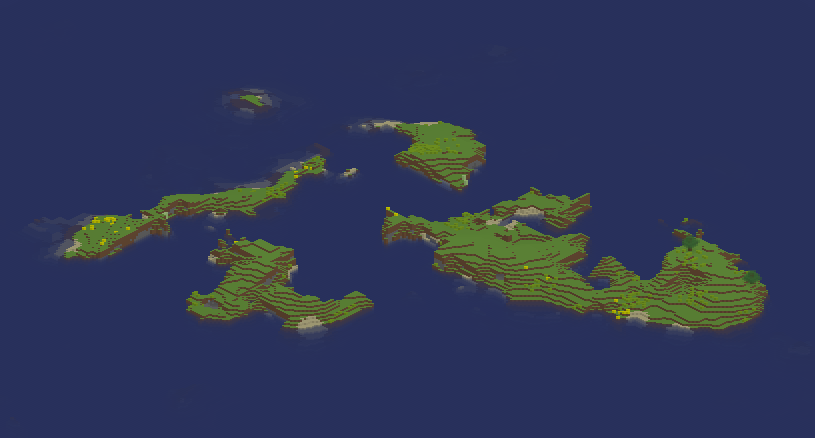
The Archipelago The Archipelago
Bird's eye view Bird's eye view
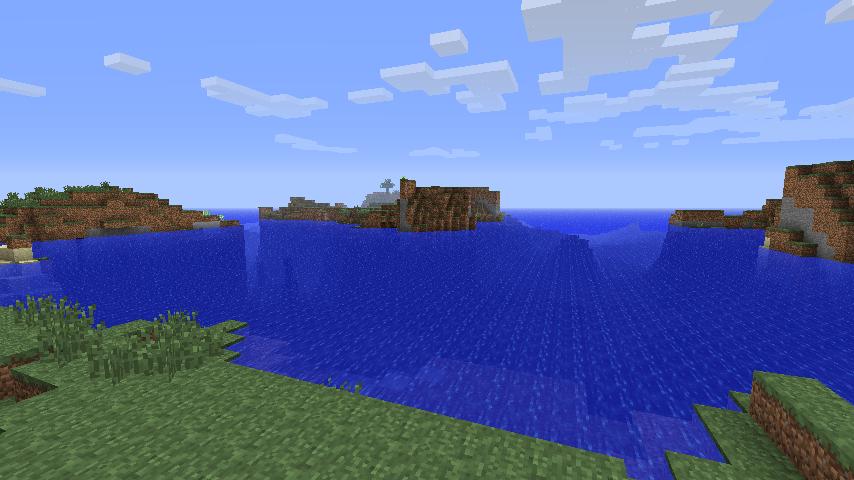
You're on a small island in the middle of a vast ocean. There's nothing but dirt, stone and grass on the your island, which is part of a tiny archipelago. One of the nearby islands features a dark cave, with what looks like a coal seam near the entrance. You can glimps two small trees on another island nearby. All around your little clutch of islands is what appears to be vast, unending ocean in all directions. It's midday and you need to make yourself safe for the night. You can use the wood from the trees to craft a pickaxe. With this, you can fetch some coal from the seam. With the coal, you can create some torches, to see in the dark. You might have enough wood left over to make a door, if you're lucky. Or perhaps you should save it to craft a boat, or a sword. Groans from something unknown emanate worryingly closely from the darkness of the cave. You're lucky: one of your two trees has dropped a sapling. You eagerly plant it. In a few days time, you might be able to harvest some more wood. You've been granted a temporary reprieve, but the law of diminishing returns means at some point, and soon, you'll run out of wood. Swimming is time-consuming. By the time you have assembled a meagre supply of wood and coal, it's almost sunset. You nervously dig a burrow in the mud of your original island, light it with a torch and block the entrance back up. Night passes slowly as you listen to things crawling around in the darkness outside. I first learned about Minecraft from this blog post by Mike Watson last year. Mike did a great job of demonstrating the narrative power of the game and his post left a lasting impression on me. Every now and then I dip in to Minecraft to see what's new since the last time I played it. In the last few months version 1.8 was released and so I started a new map to check it out. I ended up with a corker of a randomly-generated map. Inspired by Mike's post, I thought I'd write a bit about it. In a follow-up post I will provide the map itself.

8 November 2011

Jan Hauke Rahm: On GNOME 3

Since there have been a few blog posts about GNOME 3 already, I m sure you don t mind me adding one. I m one of those who don t do any work, just lurk around and wait for stuff to be fixed or working in the first place. I also don t like compiling GNOME myself. I barely touched the already packaged stuff in the repository of our Debian GNOME packaging team. But I run unstable plus stuff from experimental. I ll thus have a bit of a different experience with GNOME 3 than current testing users who at least in parts don t seem to like what they re getting. That being said I love it. No, I don t mind running network manager on my systems, I even have it on my netbook (Atom processor). I used wicd for a long time because network manager really got nothing done back in the days (half a year ago or what :)). Nowadays, since version 0.9, it works fine for me. No fiddling around with config files, perfect integration in the desktop, and LAN and WLAN Just Work [tm]. No, I don t like if some weird dependencies dictate what tools to use. I usually used pidgin for messaging, for instance. Now I m using empathy, simply because it s best integrated in GNOME. And no, I won t switch from mutt to evolution. :-P And there are more such cases. Also, these weird accessibility tools that are stuck in the gnome-shell top panel , I don t need them. Still there. (There s an extension to remove it, by the way.) Also, I must say, GNOME 3.2 is a lot better than 3.0 already. And I think 3.4 might do the final trick for me. Fact is, with GNOME 3 I have a much cleaner desktop, there is more room for windows (which is nice on a netbook display), there are web apps which I already use a lot, and it has a professional, not too playful look (i.e. a few effects, clear and consistent theming, no bubbling windows). And the new notification stuff is just awesome, especially with the empathy integration. Oh, and too many mouse click to access an application? 1) Put your most used apps in the favorites bar (or whatever it is called); it s just one click then. 2) Press your meta-key (that way our name for the windows key, or was that the ESC key? Whatever, press your windows key), type in the first two or three letters of your application, and hit enter; you don t need a mouse at all. There. It had to be said. :)

Jon Dowland: GNOME 3

Oh, boy. Where do I start I postulate that there exists something called the "UI Singularity". Those who spend too much time considering the optimal way to interact with computing devices eventually pass through this singularity and can no longer effectively communicate with those of us on the other side. At least that's one way to explain what seems to be happening to free-software desktop environments. From the outside, it would appear this happened to KDE with KDE 4, and now, unfortunately, it has happened to GNOME, with GNOME 3. I've had GNOME 3.0 running on my Debian laptop for a few months, which I have used casually. At work, we installed Fedora 15 (GNOME 3.0) on our 69-seat Linux lab over the summer, which I have used on occasion to achieve specific things. I haven't dared upgrade my main work machine yet. So, it could be argued that I haven't spent enough time immersed in the GNOME 3 experience to really judge it fairly. On the face of it, I wish 3 was an iterative development from 2, and didn't throw so many babies out with the bathwater. My casual use of it so far has not endeared it to me at all. In the interests of being fair, rather than deliver my opinion of GNOME 3 as it currently stands, I've decided to try and use it in anger for a while to truly see whether I can "get it". Now that we're past the start of term, I am attempting to use a lab-configured Fedora 15 machine as my main work environment. I'll run with this for a while, and then try a Fedora 16 instance (I need to consider whether we should move to F16 for the second semester anyway) to see what improvements GNOME 3.2 brings.

Next.

Previous.