Search Results: "tim"

22 November 2011

Jonas Smedegaard: Asia 2011 - India

Arrival in a new country is always exciting. This was my first time ever to visit India, and although I have heard especially cultural bits and pieces, I was as usual nowhere near "well" prepared. How to fill out the registration forms (surprisingly needed in addition to the visa already gathered ahead of departure) when your only known address in India is on the laptop you completely drained the battery of during the flight? Luckily they tolerated the "address during stay" to be left blank. I got out in the heat of Hyderabad in the late afternoon, got a cab, and had my host instruct the cab driver - over the phone via roaming to Denmark - where to drop me off. After a long ride with cows and beautiful dressed pedestrians casually crossing the high speed road and a short pitstop at an ATM, I finally met Pavithran. Until then we only knew each other from casual online chat. (I should later learn that my first impression was quite unusual - not cows or clothes or chat, but roads capable of driving at high speed!) Pavithran checked me into a small hotel and we visited his home. It was in the middle of being rebuild, so impossible to stay at as had been our original planed. After a few hours of looking at the neighbourhood and talking about possible events during the week, we decided to cancel the hotel and instead go visit his parents in Khammam, some 5 hours away by bus This text is part of my Asia 2011 scriblings.

Dirk Eddelbuettel: RPostgreSQL 0.2-0, 0.2-1 and an unsung Open Source hero

RPostgreSQL goes back to a topic suggestion I had made for the Google Summer of Code 2008, and specifically for the R Project participation that year. And Sameer Kumar Prayaga (whom I then mentored for the project) did a fine job that summer putting together a working framework of package connecting R and the excellent PostgreSQL database system. Unfortunately, Sameer vanished once the summer was up; I heard he got himself a job a another db company. Fast-forward a few years. A caretaker group had maintained the package in the meantime, but without really writing any new code. But thanks to the tireless efforts of Tomoaki Nishiyama, who not only wrote a lot of new code addressing some of issues logged at the Google Code project page, but also stepped forward and became the new lead maintainer, things are much, much better now. The first 0.2-0 release a few weeks ago already addressed a rather large number of issues, bringing the feature set much closer to what one would expect from a feature-complete package. But one big thorn remained: builds on Windows still required a local PostgreSQL library installation as well as local compilation. And as we can tell from the mailing list(s), this is a little daunting for many potential users. But what did release 0.2-1 bring: a complete set of libpq sources so that builds on Windows no longer require presence of local PostgreSQL sources! We tested this using Uwe Ligges' excellent win-builder service for R, and after I reminded Uwe on the weekend to no longer blacklist build attempts of RPostgreSQL, we now have Windows binaries for direct installation. Just call install.packages(), and you're good to go -- much nicer! Tomoaki achieved this pretty much single-handedly, and for that reason he greatly deserves some extra praise as an unsung Open Source hero!

21 November 2011

Alastair McKinstry: From a comment by Brad K at Causon's Book:

From a comment by Brad K at Causon's Book: It is a couple of days old now, so I imagine you have seen this. One hedge broker for grain and cattle, Barnhardt Capital Management (http://barnhardt.biz/) has called it quits. Most agribusiness deals with futures and options on their crops to make a good part of their annual income. According to Ann: "The reason for my decision to pull the plug was excruciatingly simple: I could no longer tell my clients that their monies and positions were safe in the futures and options markets because they are not. And this goes not just for my clients, but for every futures and options account in the United States. The entire system has been utterly destroyed by the MF Global collapse. " Interesting times. As the global financial system (not just banks) is wobbling, we need to ensure the food supplies. Time to plant veg and stock up on tins?

Siegfried Gevatter: Debian Games Team Meeting

This announcement was provided by Martin Erik Werner. I m reproducing it for Planet Ubuntu. The Debian/Ubuntu Games Team is organizing another meeting. If you re into developing and/or packaging of games, or just generally curious about games in Debian/Ubuntu, you should join! It will be held next Saturday, the 26th of November, in the #debian-games channel on irc.debian.org (also know as irc.oftc.net) at 10:00 UTC. More information is available on the wiki page Games/Meetings/2011-11-26. The agenda starts off with the usual round of introductions, so if you re new to the Team, say hi! Then we ll be going through the action items from the last meeting, including work on the Debian Games LiveCD, and what s up with the /usr/games/ path anyways? Next we ll be moving onto how the Games Team is faring in terms of members: are new recruits finding it comfortable, should we advertise more? Next up it s the squeeky penguin: Wheezy is somewhere in the not-completely-distant future, how does that affect the Games Team, should we be scuffling to get specific tasks done? Then onto the recurring question of Sponsoring, and how to improve it, should we be utilising DebExpo more? What about our favourite PET? Lastly, PlayDeb is doing some really neat stuff, would it make sense for our team to push some changes to PlayDeb? Would it make sense for PlayDeb to push changes to Debian Games? Hopes are for a good discussion, and a merry time, hope to see you all there! Related posts:
  1. Debious A dubious Debian packaging GUI
  2. One week with Debian
  3. A list of some commercial GNU/Linux games

No comments
Siegfried-Angel Gevatter Pujals, 2011. Permalink License Post tags: , ,

flattr this!

Russell Coker: Galaxy S vs Xperia X10 and Android Network Access

Galaxy S Review I ve just been given an indefinite loan of a Samsung Galaxy S which is more useful than the Sony Ericsson Xperia X10 that I own. I think that the main benefit is that it runs Android 2.2 instead of Android 2.1 on the Xperia. 2.2 is what gives it USB tethering support without extra software (something I haven t tested yet but will use a lot if it works correctly) and Wifi AP support. Both phones are about the same size, the Galaxy S has slightly more RAM (reported as 304M vs 280M which doesn t really matter) and a lot more main storage (1.87G vs 465M usable after the OS is loaded). The main down-sides of the Galaxy S is that it lacks a flash . I m not aware of any phone camera having a proper flash, but the limited LED flash is useful for taking pictures at times and there are a variety of programs that can turn it on for use as a torch. Also I wonder whether the Samsung people actually test their phones in real use or whether they just build them to spec. When you read the specs it sounds nice to have a phone that s only 9.9mm thick (apart from the bulge at the bottom), but that makes it really difficult to hold. The Xperia X10 is 13mm thick and isn t as slick so you are much less likely to drop it. I sometimes wonder whether phone companies are designing their products to be broken so that they can sell replacements. Three Networking Sucks My parents use 3G broadband from Three as their only connection to the Internet, this is fast enough for viewing Youtube on occasion and generally works well for them. However whenever I try to transfer any data to their system which has integrity checks it turns out to be corrupted. About every megabyte of data transferred has a corrupt packet that has a matching checksum presumably it s a bug in Three s network. Because Three are desperate for customers they have given me a free 6 month subscription to a data SIM [1]. I ve been using that SIM with my Galaxy S and found the same data corruption problem and I ve reproduced it in many places around Melbourne so this isn t just one unreliable cell tower, it s something broken in the core of the Three network. The obvious solution to this is to use a VPN so the corrupt packets will be dropped. So I set up a PPTP VPN only to discover that it seems impossible to make the default route be via the VPN, there has been a bug report about this since 2009 the iPhone allows configuring whether Internet traffic should go via the VPN, it can t be that hard [2]. There is an option to use a proxy for web access, but when I tried that on Android 2.1 it only worked for the system web browser not for things like the Android Market. But there is no option for configuring a proxy for use when the VPN is active, so it doesn t seem likely that I could run a proxy on the VPN network and direct all traffic to it. Due to corruption on the Three network and the inability to get a VPN working correctly it seems that I can t use the Three SIM. Android isn t Really Free Software While Android implementations generally stick to the GPL and other free software licenses that are involved they seem to be a poor example of providing freedom to users. My Xperia X10 is running Android 2.1 because Sony-Ericsson has locked the boot loader so I can t install a newer kernel. They don t care enough to release a new version this is stupid of them because it means that I am much less likely to recommend their products. If Sony-Ericsson releases a newer Android release then it will be a total OS reinstall, unlike the way I can upgrade a Debian system an application at a time. I can t install new packages that replace system packages, so the Email and SMS programs that I ve installed sit along side the ones that came with the system. Periodically the unwanted SMS and Email programs show up. I can t make my Android phones perform basic networking tasks that I ve done on Linux systems since the early 90 s. Hiding the complexity from the newbies is OK, but they need to make the full capabilities of the system available to experts. It seems to me that Android effectively gives the majority of users no more freedom than the iPhone does. Even for the small minority of us who are technically capable of rooting phones and installing CyanogenMod etc it s often limited by technical measures and the amount of time required. Update: Philipp Kern pointed out that his Galaxy S has a front facing camera. I have checked my phone and discovered that it has one too. When I published this post I criticised the Galaxy S for not having a front facing camera for video-calls based on a misunderstanding of the Wikipedia page (which says that SOME models lack it) and not testing it. Thanks for the correction Philipp and sorry for publishing wrong data.

Benjamin Mako Hill: Iron Blogger

I want to blog frequently but usually don't seem to find the time for it. I'm not above tying myself to the mast if it means blogging more. Iron Blogger is a blogging and drinking club based on this premise. The rules are pretty simple: Nelson Elhage ran the original Iron Blogger for about a year before the effort ran out of steam. I've started a new instance with a couple people from the previous group and a bunch of folks from Berkman, MIT, and beyond. If you live in Boston and want to join, there are still a couple of spots available. I'm going to cap the current group, at least temporarily, at about 30 people because I think that's the maximum we'll fit into a local pub. Look over the site and send me an email if you're interested. If you don't live in Boston but want to organize your own Iron Blogger, you can use the software in Nelson's git repository (or my branch) to automate nearly the whole process of tracking posts, generating reports, and updating the ledger of debts.

Paul Wise: Debian/Ubuntu games team meeting #6

The Debian/Ubuntu games team is organizing another meeting, if you're into developing and/or packaging of games, or just generally curious about games in Debian/Ubuntu, you should join! It will be held next Saturday, on the 26th of November, in the #debian-games channel on irc.debian.org (also know as irc.oftc.net). More information is available on the meeting wiki page. The agenda starts off with the usual round of introductions, so if you're new to the team, say hi! Then we'll be going through the action items from the last meeting, including work on the Debian Games LiveCD, and what's up with the /usr/games/ path anyways? Next we'll be moving onto how the games team is faring in terms of members: are new recruits finding it comfortable, should we advertise more? Next up it's the squeeky penguin: Wheezy is somewhere in the not-completely-distant future, how does that affect the games team, should we be scuffling to get specific tasks done? Then onto the recurring question of sponsoring, and how to improve it, should we be utilising DebExpo more? What about our favourite PET? Lastly, PlayDeb is doing some really neat stuff, would it make sense for our team to push some changes to PlayDeb? Would it make sense for PlayDeb to push changes to Debian Games? Hopes are for a good discussion, and a merry time, hope to see you all there! (This text provided by Martin Erik Werner)

20 November 2011

Gregor Herrmann: RC bugs 2011/46

as expected this week was characterised by fixing bugs around the perl 5.14 transition. besides that I've also uploaded a couple of NMUs with patches kindly provided in the BTS by some tireless bug fixers.

Michael Casadevall: Possible GLX Bug in Ubuntu; feedback needed (affects Intel video cards 2D/3D acceleration)

So I've been recently screwing around with VirtualBox on a personal project, and I ran into an issue with not being able to enable 2D/3D acceleration on Ubuntu 11.10. After quite a bit of debugging and forum searching, the problem was that the NVIDIA GLX driver was being loaded instead of the standard MESA one, preventing any video acceleration from properly working on my Intel based video card.

I just recently reinstalled Kubuntu on this laptop, and since its a fairly stock install at the moment, I suspect that this is a general (K)ubuntu bug, and not something related to me screwing around with my system. In addition, since I switched to using Kubuntu full time, this is the first time I've seen transparency and other desktop effects, and system performance has improved dramatically. While I can't say for certian, I suspect that my system was also affected on its previous install. Part of the issue may be related to what packages are seeded per flavour, so this bug may only affect those who installed Kubuntu over say Xubuntu or Ubuntu; without more information, its impossible to say.

This is where you can help; if you are running any flavor of Ubuntu with an Intel based video card, you might be affected by this too.

Here's how to check; open a terminal, and type:

mcasadevall@daybreak:/var/log$ cat /var/log/Xorg.0.log

then find the section where the glx module is loaded. It looks something like this:

[236901.570] (II) LoadModule: "glx"
[236901.571] (II) Loading /usr/lib/xorg/modules/extensions/libglx.so
[236901.578] (II) Module glx: vendor="X.Org Foundation"
[236901.578] compiled for 1.10.4, module version = 1.0.0
[236901.578] ABI class: X.Org Server Extension, version 5.0

(this is on a machine where the Intel acceleration is properly working).

If it says 'ATi' or 'NVIDIA', you've run into the same issue I have. So dear readers, I ask that if you've had any issue with graphic performance, gaming, or simple UI lag and have an Intel video card, please post a comment with you video card, what flavor of Ubuntu you have installed, and the glx section of Xorg.0.log. If I get a few reports that confirm this, I'll file a proper bug in Launchpad, and then work to get this fixed.

19 November 2011

Dominique Dumont: Debian SDL packaging team revival

Hello Most SDL packages are outdated, people are complaining in the BTS, and the team is mostly inactive. That s bad news for my project. What can I do ? Well, it s Debian project, I just have to step up. Thanks to Sam Hocevar, I m now admin on Debian Alioth SDL packaging project. I d like to revive the team. (Note that I don t have the bandwidth to be the team all by myself). Here are the first steps I plan (mostly inspired by the way Debian-perl team is working): Now, there are some ground rules I wish to push forward: If you don t agree with the above points, now is the time to say it. Feel free to join by:
  1. Creating an account on Alioth
  2. request to join sdl-team
  3. Last but not least, send a short introduction mail to pkg-sdl-maintainers AT lists.alioth.debian.org so we can know each other.
See you soon :-)

18 November 2011

Matthew Garrett: Clarifying the "secure boot attack"

Yesterday I wrote about an alleged attack on the Windows 8 secure boot implementation. As I later clarified, it turns out that the story was, to put it charitably, entirely wrong. The attack is a boot kit targeted towards BIOS-based boots. It lives in the MBR. It'll never be executed on any UEFI systems, let alone secure boot ones. In fact, this is precisely the kind of attack that secure boot is intended to protect against. So, context.

The MBR contains code that's executed by the BIOS at boot time. This code is unverifiable - it's permitted to have arbitrary functionality. There's only 440 bytes, but that's enough to jump to somewhere else and read code from elsewhere. There's no way for the BIOS to know that this code is malicious. And one thing this code can obviously do is load the normal boot code and modify it to behave differently. Any self-validation code in the loader can be patched out at this point. The modified loader will then load the kernel, and potentially also modify it. At this point, you've lost. Any attempts to validate the code can be redirected to the original code and so everything will look fine, up until the point where the user runs a specific application and suddenly your kernel is sending all your keystrokes over UDP to someone in Nigeria.

These attacks exist now. They're in the wild. In a normal UEFI world you'd do the same thing by just replacing the UEFI bootloader. But with secure boot you'll be able to validate that the bootloader is appropriately signed and if someone's modified it you'll drop into some remediation mode that recovers your files, from install media if necessary.

Obviously, this protection is based on all the components of secure boot (ie, everything that runs before ExitBootServices() is called) being perfect. As I said, if any of them accept untrusted input and misinterpret it in such a way that they can be tricked into running arbitrary code, you'll still have problems. But when discussing the pros and cons of secure boot, it's important to make sure that we're talking about reality rather than making provably false assertions.

comment count unavailable comments

Alexander Reichle-Schmehl: Release Critical Bug report for Week 46

The bug webinterface of the Ultimate Debian Database currently knows about the following release critical bugs:
In Total:1812
Affecting Wheezy:1161
Wheezy only:163
Remaining to be fixed in Wheezy:998
Of these 998 bugs, the following tags are set:
Pending in Wheezy:47
Patched in Wheezy:191
Duplicates in Wheezy:47
Can be fixed in a security Update:31
Contrib or non-free in Wheezy:16
Claimed in Wheezy:0
Delayed in Wheezy:4
Otherwise fixed in Wheezy:89
Ignoring all the above (multiple tags possible) 631 bugs need to be fixed by Debian Contributors to get Debian 7.0 Wheezy released. However, with the view of the Release Managers, 1053 need to be dealt with for the release to happen. Please see Interpreting the release critical bug statistics for an explanation of the different numbers.

Pau Garcia i Quiles: FOSDEM 2012 CrossDesktop DevRoom Call for Talks

FOSDEM is one of the largest gatherings of Free Software contributors in the world and happens each February in Brussels (Belgium). One of the developer rooms will be the CrossDesktop DevRoom, which will host Desktop-related talks. We are now inviting proposals for talks about Free/Libre/Open-source Software on the topics of Desktop development, Desktop applications and interoperativity amongst Desktop Environments. This is a unique opportunity to show novel ideas and developments to a wide technical audience. Topics accepted include, but are not limited to: Enlightenment, Gnome, KDE, XFCE, Windows, Mac OS X, general desktop matters, applications that enhance desktops and web (when related to desktop). Talks can be very specific, such as developing mobile applications with Qt Quick; or as general as predictions for the fusion of Desktop and web in 5 years time. Topics that are of interest to the users and developers of all desktop environments are especially welcome. The FOSDEM 2011 schedule might give you some inspiration. Please include the following information when submitting a proposal: your name, the title of your talk (please be descriptive, as titles will be listed with around 250 from other projects) and a short abstract of one or two paragraphs. The deadline for submissions is December 20th 2011. FOSDEM will be held on the weekend of 4-5 February 2012. Please submit your proposals to crossdesktop-devroom@lists.fosdem.org Also, if you are attending FOSDEM 2012, please add yourself to the KDE community wiki page so that we organize better. We need volunteers for the booth!

17 November 2011

Alastair McKinstry: Never Again

Never Again I grew up in the era of old men at Church, wearing poppies and their medals this time of year, in commemoration of their friends and neighbours who had died in the Great War. On the 11 November, they would remember the Armistice, those who had died, and with silence respect the promise that it be the War to End All Wars. Because for them this was not an ironical phrase, but a promise betrayed; that Never Again should this happen. As the last of those men have died, the commemorations of the Armistice have been insidiously hijacked, and using 'honouring our troops', those who never had to see their brothers drown in the mud at Passchendale have moved from 'Never Again' to 'Always Ready', always ready to fight, always read to go to war. As a pacifist I have always felt uneasy about war commemorations. But it is all too late that I realise why I never really had a problem with those who fought in the war, and never talked of its horrors. Its those for whom the commemoration is a time for fine speeches, then back to the office to prepare for the next war that I despise. Never again.

Ross Burton: iPhoneApMon in Shell

This really isn't how it should look, but it's a 15 minute hack in Javascript to give me something that doesn't involve a terminal. One day I'll find the time to integrate this properly into the network menu...

Matthew Garrett: Making timeouts work with suspend

A reasonably common design for applications that want to run code at a specific time is something like:

time_t wakeup_time = get_next_event_time();
time_t now = time(NULL);
sleep(wakeup_time-now);

This works absolutely fine, except that sleep() ignores time spent with a suspended system. If you sleep(3600) and then immediately suspend for 45 minutes you'll wake up after 105 minutes, not 60. Which probably isn't what you want. If you want a timer that'll expire at a specific time (or immediately after resume if that time passed during suspend), use the POSIX timer family (timer_create, timer_settime and friends) with CLOCK_REALTIME. It's a signal-driven interface rather than a blocking one, so implementation may be a little more complicated, but it has the advantage of actually working.

comment count unavailable comments

Raphaël Hertzog: People Behind Debian: Mark Shuttleworth, Ubuntu s founder

I probably don t have to present Mark Shuttleworth he was already a Debian developer when he became millionaire after having sold Thawte to Verisign in 1999. Then in 2002 he became the first African (and first Debian developer) in space. 2 years later, he found another grandiose project to pursue: bring the Microsoft monopoly to an end with a new alternative operating system named Ubuntu (see bug #1). I have met Mark during Debconf 6 in Oaxtepec (Mexico), we were both trying to find ways to enhance the collaboration between Debian and Ubuntu. The least I can say is that Mark is opinionated but any leader usually is, and in particular the self-appointed ones! :-) Read on to discover his view on the Ubuntu-Debian relationship and much more. Raphael: Who are you? Mark: At heart I m an explorer, inventor and strategist. Change in technology, society and business is what fascinates me, and I devote almost all of my time and wealth to the catalysis of change in a direction that I hope improves society and the environment. I m 38, studied information systems and finance at the University of Cape Town. My hearts home is Cape Town, and I ve lived there and in Star City and in London, now I live in the Isle of Man with my girlfriend Claire and 14 precocious ducks. I joined Debian in around 1995 because I was helping to setup web servers for as many groups as possible, and I thought Debian s approach to packaging was very sensible but there was no package for Apache. In those days, the NM process was a little easier ;-) Raphael: What was your initial motivation when you decided to create Ubuntu 7 years ago? Mark: Ubuntu is designed to fulfill a dream of change; a belief that the potential of free software was to have a profound impact on the economics of software as well as its technology. It s obvious that the technology world is enormously influenced by Linux, GNU and the free software ecosystem, but the economics of software are still essentially unchanged. Before Ubuntu, we have a two-tier world of Linux: there s the community world (Debian, Fedora, Arch, Gentoo) where you support yourself, and the restricted, commercial world of RHEL and SLES/SLED. While the community distributions are wonderful in many regards, they don t and can t meet the needs of the whole of society; one can t find them pre-installed, one can t get certified and build a career around them, one can t expect a school to deploy at scale a platform which is not blessed by a wide range of institutions. And the community distributions cannot create the institutions that would fix that. Ubuntu brings those two worlds together, into one whole, with a commercial-grade release (inheriting the goodness of Debian) that is freely available but also backed by an institution. The key to that dream is economics, and as always, a change in economics; it was clear to me that the flow of money around personal software would change from licensing ( buying Windows ) to services ( paying for your Ubuntu ONE storage ). If that change was coming, then there might be room for a truly free, free software distribution, with an institution that could make all the commitments needed to match the commercial Linux world. And that would be the achievement of a lifetime. So I decided to dedicate a chunk of my lifetime to the attempt, and found a number of wonderful people who shared that vision to help with the attempt. It made sense to me to include Debian in that vision; I knew it well as both a user and insider, and believed that it would always be the most rigorous of the community distributions. I share Debian s values and those values are compatible with those we set for Ubuntu.
Debian would always be the most rigorous of the community distributions.
Debian on its own, as an institution, could not be a partner for industry or enterprise. The bits are brilliant, but the design of an institution for independence implies making it difficult to be decisive counterparty, or contractual provider. It would be essentially impossible to achieve the goals of pre-installation, certification and support for third-party hardware and software inside an institution that is designed for neutrality, impartiality and independence. However, two complementary institutions could cover both sides of this coin. So Ubuntu is the second half of a complete Debian-Ubuntu ecosystem. Debian s strengths complement Ubuntu s, Ubuntu can achieve things that Debian cannot (not because its members are not capable, but because the institution has chosen other priorities) and conversely, Debian delivers things which Ubuntu cannot, not because its members are not capable, but because it chooses other priorities as an institution. Many people are starting to understand this: Ubuntu is Debian s arrow, Debian is Ubuntu s bow. Neither instrument is particularly useful on its own, except in a museum of anthropology ;)
Ubuntu is Debian s arrow, Debian is Ubuntu s bow.
So the worst and most frustrating attitude comes from those who think Debian and Ubuntu compete. If you care about Debian, and want it to compete on every level with Ubuntu, you are going to be rather miserable; you will want Debian to lose some of its best qualities and change some of its most important practices. However, if you see the Ubuntu-Debian ecosystem as a coherent whole, you will celebrate the strengths and accomplishments of both, and more importantly, work to make Debian a better Debian and Ubuntu a better Ubuntu, as opposed to wishing Ubuntu was more like Debian and vice versa. Raphael: The Ubuntu-Debian relationship was rather hectic at the start, it took several years to mature . If you had to start over, would you do some things differently? Mark: Yes, there are lessons learned, but none of them are fundamental. Some of the tension was based on human factors that cannot really be altered: some of the harshest DD critics of Canonical and Ubuntu are folk who applied for but were not selected for positions at Canonical. I can t change that, and wouldn t change that, and would understand the consequences are, emotionally, what they are. Nevertheless, it would have been good to be wiser about the way people would react to some approaches. We famously went to DebConf 5 in Porto Allegre and hacked in a room at the conference. It had an open door, and many people popped a head in, but I think the not-a-cabal collection of people in there was intimidating and the story became one of exclusion. If we d wanted to be exclusive, we would have gone somewhere else! So I would have worked harder to make that clear at the time if I d known how many times that story would be used to paint Canonical in a bad light. As for engagement with Debian, I think the situation is one of highs and lows. As a high, it is generally possible to collaborate with any given maintainer in Debian on a problem in which there is mutual interest. There are exceptions, but those exceptions are as problematic within Debian as between Debian and outsiders. As a low, it is impossible to collaborate with Debian as an institution, because of the design of the institution.
It is generally possible to collaborate with any given maintainer [ ] [but] it is impossible to collaborate with Debian as an institution.
In order to collaborate, two parties must make and keep commitments. So while one Debian developer and one Ubuntu developer can make personal commitments to each other, Debian cannot make commitments to Ubuntu, because there is no person or body that can make such commitments on behalf of the institution, on any sort of agile basis. A GR is not agile ;-) . I don t say this as a critique of Debian; remember, I think Debian has made some very important choices, one of those is the complete independence of its developers, which means they are under no obligation to follow a decision made by anyone else. It s also important to understand the difference between collaboration and teamwork. When two people have exactly the same goal and produce the same output, that s just teamwork. When two people have different goals and produce different product, but still find ways to improve one anothers product, that s collaboration. So in order to have great collaboration between Ubuntu and Debian, we need to start with mutual recognition of the value and importance of the differences in our approach. When someone criticises Ubuntu because it exists, or because it does not do things the same way as Debian, or because it does not structure every process with the primary goal of improving Debian, it s sad. The differences between us are valuable: Ubuntu can take Debian places Debian cannot go, and Debian s debianness brings a whole raft of goodness for Ubuntu. Raphael: What s the biggest problem of Debian? Mark: Internal tension about the vision and goals of Debian make it difficult to create a harmonious environment, which is compounded by an unwillingness to censure destructive behaviour. Does Debian measure its success by the number of installs? The number of maintainers? The number of flamewars? The number of packages? The number of messages to mailing lists? The quality of Debian Policy? The quality of packages? The freshness of packages? The length and quality of maintenance of releases? The frequency or infrequency of releases? The breadth of derivatives? Many of these metrics are in direct tension with one another; as a consequence, the fact that different DD s prioritise all of these (and other goals) differently makes for interesting debate. The sort of debate that goes on and on because there is no way to choose between the goals when everyone has different ones. You know the sort of debate I mean :-) Raphael: Do you think that the Debian community improved in the last 7 years? If yes, do you think that the coopetition with Ubuntu partly explains it? Mark: Yes, I think some of the areas that concern me have improved. Much of this is to do with time giving people the opportunity to consider a thought from different perspectives, perhaps with the benefit of maturity. Time also allows ideas to flow and and of course introduces new people into the mix. There are plenty of DD s now who became DD s after Ubuntu existed, so it s not as if this new supernova has suddenly gone off in their galactic neighbourhood. And many of them became DD s because of Ubuntu. So at least from the perspective of the Ubuntu-Debian relationship, things are much healthier. We could do much better. Now that we are on track for four consecutive Ubuntu LTS releases, on a two-year cadence, it s clear we could collaborate beautifully if we shared a freeze date. Canonical offered to help with Squeeze on that basis, but institutional commitment phobia reared its head and scotched it. And with the proposal to put Debian s first planned freeze exactly in the middle of Ubuntu s LTS cycle, our alignment in interests will be at a minimum, not a maximum. Pure <facepalm />. Raphael: What would you suggest to people (like me) who do not feel like joining Canonical and would like to be paid to work on improving Debian? Mark: We share the problem; I would like to be paid to work on improving Ubuntu, but that s also a long term dream ;-) Raphael: What about using the earnings of the dormant Ubuntu Foundation to fund some Debian projects? Mark: The Foundation is there in the event of Canonical s failure to ensure that commitments, like LTS maintenance, are met. It will hopefully be dormant for good ;-) Raphael: The crowdfunding campaign for the Debian Administrator s Handbook is still going on and I briefly envisioned the possibility to create the Ubuntu Administrator s Handbook. What do you think of this project? Mark: Crowdfunding is a great match for free software and open content, so I hope this works out very well for you. I also think you d find a bigger market for an Ubuntu book, not because Ubuntu is any more important than Debian but because it is likely to appeal to people who are more inclined to buy or download a book than to dive into the source. Again, this is about understanding the difference in audiences, not judging the projects or the products. Raphael: Is there someone in Debian that you admire for their contributions? Mark: Zack is the best DPL since 1995; it s an impossible job which he handles with grace and distinction. I hope praise from me doesn t tarnish his reputation in the project!
Thank you to Mark for the time spent answering my questions. I hope you enjoyed reading his answers as I did.

Subscribe to my newsletter to get my monthly summary of the Debian/Ubuntu news and to not miss further interviews. You can also follow along on Identi.ca, Google+, Twitter and Facebook .

32 comments Liked this article? Click here. My blog is Flattr-enabled.

Timo Jyrinki: On discussing free software mobile phones

Since I think I just summarized a few thoughts of mine well at LWN, I'll copy-paste it here:
I can grumble about Android from time to time, but I do not say that it sucks. Extreme views are what are annoying. Android is what it is and it's great as it is, even though it could be different as well.

When it comes to discussing about free software and mobile phones, I'm especially annoyed by two types of comments:

1. People essentially saying that there is no value in an open project, ie. free software code dumps should be enough for everybody. I'm interested in the long term viability of free software projects, and it is hard to have successful projects without there being all sorts of factors that make up a good project - like transparency, inclusion, meritocracy. Even though the mobile projects have had little resources and a hard road, it's not useful to forget about these goal in the longer term. For example Debian, Mer, SHR, KDE Plasma Active have some of these in the mobile sector. I hope the best for them (and participate).

2. People complaining about something being not 100% free software, while not themselves actually even interested in it for other sake than complaining. When I've been talking about free software mobile phones, from time to time there is someone complaining about eg. not open GSM stack, wlan firmwares etc.. and to put it sharply probably writing the message from iPhone, while I'm reading it on Neo FreeRunner. If the complainer would be Harald Welte, I'd probably listen and agree with him.

So there. For more civilized discussion.

Russell Coker: Cruises

It seems that in theory cruises can make for quite economical vacations. The cheapest prices tend to be around $100 per person per night for an inside cabin (IE no window) with two people (there is a significant extra fee for having a cabin with only one person). If you book a room in a half-decent hotel with a pool in some moderately desirable place then you will probably pay about $200 per night which might get you free breakfast but won t include lunch or dinner. Cruises include all the free food you can eat for at least 16 hours of the day with maybe an extra fee for getting food in the middle of the night. When a cruise ship stops at the port you can pay for an expensive shore trip arranged by the cruise company or have a cheap trip that involves walking on the beach or taking a taxi to somewhere local. Of course there are lots of extras that can make a cruise really expensive, but if you don t plan to eat at speciality restaurants or drink much alcohol then that shouldn t be a problem. I ve just booked a short luxury cruise, mostly as a trial of the cruise concept. The process of doing so was difficult enough that even if I hadn t previously needed a holiday then I d probably need one now. It would be interesting to compare the amount of time that a reasonable person would be likely to spend choosing a holiday and purchasing it for the different types of holiday, I expect that cruising would be a long way behind everything that involves flying to a foreign city and staying in a hotel. The Issues of Booking When booking a regular holiday you choose where to visit, then choose the time of year, the accommodation, and travel. While the order can vary it s generally a sequential process without too many variables at any stage. With a cruise one of the first decisions is to choose the cruise line, different lines cater to various market segments it s clear what Disney cruises aim for but often not so clear for others. Apart from Disney the other cruise lines don t seem to make clear statements about who they are and aren t targeting. Then there are a variety of ships run by each cruise line which in many cases offer different features, do you want 1 pool or 4? Do you want ice skating? The cruise lines that I have investigated don t offer clear comparisons of their ships. As a cruise ship is essentially a hotel, a collection of restaurants, and some other entertainment you can t just arbitrarily choose one the way you might choose a random hotel with a suitable price and rating. Now while you can choose a hotel and generally get a room when you want a cruise booking has to be made when the ship is in a convenient port. So your holiday needs to be scheduled around the availability of the ship. CruiseCritic.com is an excellent source of information on cruises and has a very active and useful advice forum [1]. The forum appears to be dominated by retirees, presumably because retirees have time to just wait for a ship they like to visit their local port while people who have to schedule holidays around work projects etc. When booking a hotel I have found that Wotif.com is really good for comparing hotels and finding a reasonably cheap one and they also have periodic mail-outs about special deals. I have made a couple of short vacations based on Wotif offering me unusually good prices on a hotel in a place that I was mildly interested in visiting. There are also special deals on cruises, but it s a lot more difficult to take them. Firstly as cruises aren t as interchangeable as hotels it s not as appealing to take an offer of a cruise you didn t previously consider because it s going cheap. The second factor is that according to cruise reviews there is more variation among cabins than there is among hotel rooms. The design of the ship that is needed to cram everything in the available space means that some cabins apparently have noise pollution from various activities on the ship while others are considered to have problems for people prone to sea-sickness. Discounts probably only apply after people who pay non-discount rates have had a chance to book what might be considered the better cabins. Of course it could be a good thing to have most of the ship booked out, CruiseCritic.com has some reviews of individual cabins and presumably there are people who compare hundreds of cabins to discover what is ideal for them. The Problem with Princess I have booked a Princess cruise. I chose it because it was going cheap, but the first two travel agents that advertised it were unable to take my order because Princess only allows US based agencies (which means the discount agents on the net) to sell to US customers I don t think that the people who run the Princess cruise company know what the Internet is about. So I booked the cruise through the Princess web site, they took my money, told me that a good chunk of that money would never be returned if I cancelled, and then sent me to the web page for providing all the information that they need which is a lot. The big problem was when their web site absolutely demanded a passport number and said that I would not be allowed to board without one even though their FAQ (and common sense) indicated that a cruise which doesn t involve any international travel has no need of a passport. Taking someone s money and then telling them that they can t attend due to not having a valid passport is one way of making a future passenger very unhappy. I called the support people (which was Carnival) and had to listen to some really strange hold music it was difficult to determine if the music was produced by someone with unusual tastes in electronic music vastly different from my own preference or whether the computer which manages the phone calls was producing noise instead of music. Eventually I got through to an operator who was very helpful and stored my drivers license number which was adequate. While on the topic of their web site, when booking a cruise with Princess they list which types of cabin (interior, balcony, etc) are available and list the price for the cheapest category of cabin in each price. However if the cheapest category is all sold out then it will still list that cheapest price and thus be advertising a price that can t be booked. This is misleading and annoying. Further Hassle But the difficulty doesn t end here. On a cruise you have to book in advance for which dinner seating you desire which is usually only early or late but some ships offer anytime . Then if you happen to be travelling with people who are in a separate cabin and paying separately (which one would expect to be fairly common) there is no obvious way of synchronising dinner preferences the ship people might assign people to different tables. I admit that I haven t fully explored the post-booking part of the Princess web site, maybe I can arrange a shared table but for the moment my pain threshold for the cruise booking process has been exceeded. Other Cruising Stuff Insight Cruises (formerly Geek Cruises) offers a variety of educational cruises including science, astronomy, chess, art, history, and some other things [2]. From a casual inspection of their web site it seems that the cruise prices are around $300 per night for a 2 person cabin and the registration fees for the conferences are between $1200 and $1500. Most readers of my blog will consider this to be unreasonably expensive as registration for a Linux conference tends to be a lot less than $1000. But when compared to typical for-profit conferences $1500 isn t anywhere near the high end of the range. Also while someone who is choosing a cruise holiday can easily get a cruise that costs less than $200 per day for a 2 person cabin, for commercial conferences it s not uncommon to spend more than $300 per night for two people on accommodation and food. So the only noteworthy part about the cost is that accommodation will be quite expensive if you aren t sharing a room. If you want to run a conference on a cruise there are companies which specialise in such things, Landry and Kling is one company that specialises in planning corporate events [3]. They do seem to aim for the high end of the market, including chartering a small cruise ship or half a large cruise ship that means ~1000 passengers. While there are some conferences with more than 1000 delegates it seems that most conferences top out at about 500 delegates. However I know that some conferences have limited the number of delegates to the maximum capacity of the biggest lecture hall available as some cruise ships have a theater with more than 1000 seats it seems that similar conferences could potentially arrange a half ship charter. A half ship charter apparently allows exclusive access to one of the theaters (at least when it s not needed for evening entertainment) and exclusive seating at the main dining room. It s a standard feature that cruise ships have all the equipment you might need to run a conference. Autism on the Seas is a brand used by the Alumni Cruise company for their holiday packages for special needs children [4]. They sell cruise tickets at the regular list price and the commission that they receive when acting as a travel agency is enough to hire staff to look after the kids while presumably still running at a profit. It seems to me that a similar model could be used for a computer conference, make a profit on cruise ticket sales and then have no extra costs for the conference for people sharing a room that would be cheaper than most Linux conferences I ve attended. For smaller conferences and un-conferences there is no minimum reservation size. One down-side for a computer conference is the cost of Internet access, according to Wikipedia a personal installation of satellite net access costs $5 per megabyte and ship pricing for their Internet access is up around $30-$100 per hour per person! But in the old days when attending a conference meant a week of no net access we survived somehow. It also seems to me that if a company had a small development team it could be productive to put everyone on a cruise ship with a server for testing and version control. They could do 9 hour days on board and still have lots of time for relaxation as it s only a few minutes walk to the pool. Of course this wouldn t work if some members of the team wanted to stay home due to slow and expensive net access.

15 November 2011

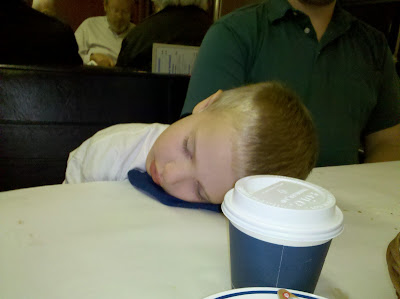
John Goerzen: A Parenting Dilemma

A few snippets so far from our train trip from Kansas to Portland. Terah, Jacob, Oliver, and I are on the trip, which is about 2.5 days on the train. The Parenting Dilemma So, if you are eating dinner, and your 5-year-old falls asleep with his head on the table, and you know he had been excitedly waiting for raspberry sorbet for dessert, and know there will be tears when he later realizes he missed it, what do you do? Let him sleep, or wake him up (with possible tears right then in the dining car?) As it turned out, I tried to quietly ask him if he wanted dessert. He woke up with a start, banged his head on the table, and then, yes, there were tears. I asked him if he wanted dessert or if he wanted to keep sleeping, and he gave a pathetic, sniffling, dessert. But by the time dessert arrived, he had fallen asleep again. I finally woke him up again, asked if he wanted to eat, and he just ignored me. I asked twice more and then he all of a sudden realized what he was being asked, sat bolt upright, and dug in. Graffiti Jacob noticed graffiti in Los Angeles. He called it silly words and kept commenting about it as we passed it. Bears Oliver always sleeps with a stuffed bear, which is his favorite comfort animal. But Oliver is 2, and when he says bear , it sounds more like beer . Plus, the boys still seem to be operating on Central Time. So at 4:15AM yesterday, Oliver awakened us saying: Beer! Beer! Beer! Where s beer? Where s beer? Need beer! Beeeeeer! Butterflies Jacob always sleeps with a stuffed butterfly, which he likes just like Oliver likes his bear. Jacob had this conversation with me this morning: Jacob: My butterfly knows all the people in the world. And all the animals, too! Me: Does butterfly even know Nash? (our cat) Jacob: Yeah, and he knows Sam and Edna too! (the cats across the road) Me: Wow. I think butterfly knows a lot more people and animals than I do. Jacob: *brief pause, then* Oh, silly dad! *collapses laughing*

Next.

Previous.