Search Results: "ed"

13 February 2015

Jonathan Carter: Debconf 2016 to be hosted in Cape Town

Table Mountain, an icon of Cape Town Long story short, we put in a bid to host Debconf 16 in Cape Town, and we got it! Back at Debconf 12 (Nicaragua), many people asked me when we re hosting a Debconf in South Africa. I just laughed and said Who knows, maybe some day . During the conference I talked to Stefano Rivera (tumbleweed) who said that many people asked him too. We came to the conclusion that we d both really really want to do it but just didn t have enough time at that stage. I wanted to get to a point where I could take 6 months off for it and suggested that we prepare a bid for 2019. Stefano thought that this was quite funny, I think at some point we managed to get that estimate down to 2017-2018. That date crept back even more with great people like Allison Randal and Bernelle Verster joining our team, along with other locals Graham Inggs, Raoul Snyman, Adrianna Pi ska, Nigel Kukard, Simon Cross, Marc Welz, Neill Muller, Jan Groenewald, and our international mentors such as Nattie Mayer-Hutchings, Martin Krafft and Hannes von Haugwitz. Now, we re having that Debconf next year. It s almost hard to believe, not sure how I ll sleep tonight, we ve waited so long for this and we ve got a mountain of work ahead of us, but we ve got a strong team and I think Debconf 2016 attendees are in for a treat! Since I happened to live close to Montr al back in 2012, I supported the idea of a Debconf bid for Montr al first, and then for Cape Town afterwards. Little did I know then that the two cities would be the only two cities bidding against each other 3 years later. I think both cities are superb locations to host a Debconf, and I m supporting Montr al s bid for 2017. Want to get involved? We have a mailing list and IRC channel: #debconf16-capetown on oftc. Thanks again for all the great support from everyone involved so far!

Richard Hartmann: Release Critical Bug report for Week 07

The UDD bugs interface currently knows about the following release critical bugs: How do we compare to the Squeeze and Wheezy release cycles?
Week Squeeze Wheezy Jessie
43 284 (213+71) 468 (332+136) 319 (240+79)
44 261 (201+60) 408 (265+143) 274 (224+50)
45 261 (205+56) 425 (291+134) 295 (229+66)
46 271 (200+71) 401 (258+143) 427 (313+114)
47 283 (209+74) 366 (221+145) 342 (260+82)
48 256 (177+79) 378 (230+148) 274 (189+85)
49 256 (180+76) 360 (216+155) 226 (147+79)
50 204 (148+56) 339 (195+144) ???
51 178 (124+54) 323 (190+133) 189 (134+55)
52 115 (78+37) 289 (190+99) 147 (112+35)
1 93 (60+33) 287 (171+116) 140 (104+36)
2 82 (46+36) 271 (162+109) 157 (124+33)
3 25 (15+10) 249 (165+84) 172 (128+44)
4 14 (8+6) 244 (176+68) 187 (132+55)
5 2 (0+2) 224 (132+92) 175 (124+51)
6 release! 212 (129+83) 161 (109+52)
7 release+1 194 (128+66) 147 (106+41)
8 release+2 206 (144+62)
9 release+3 174 (105+69)
10 release+4 120 (72+48)
11 release+5 115 (74+41)
12 release+6 93 (47+46)
13 release+7 50 (24+26)
14 release+8 51 (32+19)
15 release+9 39 (32+7)
16 release+10 20 (12+8)
17 release+11 24 (19+5)
18 release+12 2 (2+0)
Graphical overview of bug stats thanks to azhag:

Olivier Berger: Testing the RuneStone interactive Python courses server in docker

I ve been working on setting up a Docker container environment allowing to test the RuneStone Interactive server. RuneStone Interactive allows the publication of courses containing interactive Python examples, and while most of the content is static (the Python examples are run innside a Python interpreter implemented in JavaScript, hence locally in the JS VM of the Web browser), the tool also offers an environment allowing to monitor the progress of learners in a course, which is dynamic and is queried by the browser over AJAX APIs. That s the part which I wanted to be able to operate for test purposes. As it is a web2py application, it s not exactly obvious to gather all dependencies and run locally. Well, in fact it is, but I want to understand the architecture of the tool to be able to understand the deployment constraints, so making a docker image will help in this purpose. The result is the following : Now, it s easier to test the writing of a new course (yet another container above the latter one), and directly test for real.

Daniel Leidert: Motion picture capturing: Debian + motion + Logitech C910 - part II

In my recent attempt to setup a motion detection camera I was disappointed, that my camera, which should be able to record with 30 fps in 720p mode only reached 10 fps using the software motion. Now I got a bit further. This seems to be an issue with the format used by motion. I've check the output of v4l2-ctl ...
$ v4l2-ctl -d /dev/video1 --list-formats-ext
[..]
ioctl: VIDIOC_ENUM_FMT
Index : 0
Type : Video Capture
Pixel Format: 'YUYV'
Name : YUV 4:2:2 (YUYV)
[..]
Size: Discrete 1280x720
Interval: Discrete 0.100s (10.000 fps)
Interval: Discrete 0.133s (7.500 fps)
Interval: Discrete 0.200s (5.000 fps)
[..]

Index : 1
Type : Video Capture
Pixel Format: 'MJPG' (compressed)
Name : MJPEG
[..]
Size: Discrete 1280x720
Interval: Discrete 0.033s (30.000 fps)
Interval: Discrete 0.042s (24.000 fps)
Interval: Discrete 0.050s (20.000 fps)
Interval: Discrete 0.067s (15.000 fps)
Interval: Discrete 0.100s (10.000 fps)
Interval: Discrete 0.133s (7.500 fps)
Interval: Discrete 0.200s (5.000 fps)
[..]
... and motion:
$ motion
[..]
[1] [NTC] [VID] v4l2_set_pix_format: Config palette index 17 (YU12) doesn't work.
[1] [NTC] [VID] v4l2_set_pix_format: Supported palettes:
[1] [NTC] [VID] v4l2_set_pix_format: (0) YUYV (YUV 4:2:2 (YUYV))
[1] [NTC] [VID] v4l2_set_pix_format: 0 - YUV 4:2:2 (YUYV) (compressed : 0) (0x56595559)
[1] [NTC] [VID] v4l2_set_pix_format: (1) MJPG (MJPEG)
[1] [NTC] [VID] v4l2_set_pix_format: 1 - MJPEG (compressed : 1) (0x47504a4d)
[1] [NTC] [VID] v4l2_set_pix_format Selected palette YUYV
[1] [NTC] [VID] v4l2_do_set_pix_format: Testing palette YUYV (1280x720)
[1] [NTC] [VID] v4l2_do_set_pix_format: Using palette YUYV (1280x720) bytesperlines 2560 sizeimage 1843200 colorspace 00000008
[..]
Ok, so both formats YUYV and MJPG are supported and recognized and I can choose both via the v4l2palette configuration variable, citing motion.conf:
# v4l2_palette allows to choose preferable palette to be use by motion
# to capture from those supported by your videodevice. (default: 17)
# E.g. if your videodevice supports both V4L2_PIX_FMT_SBGGR8 and
# V4L2_PIX_FMT_MJPEG then motion will by default use V4L2_PIX_FMT_MJPEG.
# Setting v4l2_palette to 2 forces motion to use V4L2_PIX_FMT_SBGGR8
# instead.
#
# Values :
# V4L2_PIX_FMT_SN9C10X : 0 'S910'
# V4L2_PIX_FMT_SBGGR16 : 1 'BYR2'
# V4L2_PIX_FMT_SBGGR8 : 2 'BA81'
# V4L2_PIX_FMT_SPCA561 : 3 'S561'
# V4L2_PIX_FMT_SGBRG8 : 4 'GBRG'
# V4L2_PIX_FMT_SGRBG8 : 5 'GRBG'
# V4L2_PIX_FMT_PAC207 : 6 'P207'
# V4L2_PIX_FMT_PJPG : 7 'PJPG'
# V4L2_PIX_FMT_MJPEG : 8 'MJPEG'
# V4L2_PIX_FMT_JPEG : 9 'JPEG'
# V4L2_PIX_FMT_RGB24 : 10 'RGB3'
# V4L2_PIX_FMT_SPCA501 : 11 'S501'
# V4L2_PIX_FMT_SPCA505 : 12 'S505'
# V4L2_PIX_FMT_SPCA508 : 13 'S508'
# V4L2_PIX_FMT_UYVY : 14 'UYVY'
# V4L2_PIX_FMT_YUYV : 15 'YUYV'
# V4L2_PIX_FMT_YUV422P : 16 '422P'
# V4L2_PIX_FMT_YUV420 : 17 'YU12'
#
v4l2_palette 17
Now motion uses YUYV as default mode as shown by its output. So it seems that all I have to do is to choose MJPEG in my motion.conf:
v4l2_palette 8
Testing again ...
$ motion
[..]
[1] [NTC] [VID] vid_v4lx_start: Using V4L2
[1] [NTC] [ALL] image_ring_resize: Resizing pre_capture buffer to 1 items
[1] [NTC] [VID] v4l2_set_control: setting control "Brightness" to 25 (ret 0 )
Corrupt JPEG data: 5 extraneous bytes before marker 0xd6
[1] [CRT] [VID] mjpegtoyuv420p: Corrupt image ... continue
[1] [NTC] [VID] v4l2_set_control: setting control "Brightness" to 14 (ret 0 )
Corrupt JPEG data: 1 extraneous bytes before marker 0xd5
[1] [CRT] [VID] mjpegtoyuv420p: Corrupt image ... continue
[1] [NTC] [VID] v4l2_set_control: setting control "Brightness" to 36 (ret 0 )
Corrupt JPEG data: 3 extraneous bytes before marker 0xd2
[1] [CRT] [VID] mjpegtoyuv420p: Corrupt image ... continue
[1] [NTC] [VID] v4l2_set_control: setting control "Brightness" to 58 (ret 0 )
Corrupt JPEG data: 1 extraneous bytes before marker 0xd7
[1] [CRT] [VID] mjpegtoyuv420p: Corrupt image ... continue
[1] [NTC] [VID] v4l2_set_control: setting control "Brightness" to 80 (ret 0 )
Corrupt JPEG data: 4 extraneous bytes before marker 0xd7
[1] [CRT] [VID] mjpegtoyuv420p: Corrupt image ... continue
[1] [ERR] [ALL] motion_init: Error capturing first image
[1] [NTC] [ALL] image_ring_resize: Resizing pre_capture buffer to 16 items
Corrupt JPEG data: 4 extraneous bytes before marker 0xd1
[1] [CRT] [VID] mjpegtoyuv420p: Corrupt image ... continue
Corrupt JPEG data: 11 extraneous bytes before marker 0xd1
[1] [CRT] [VID] mjpegtoyuv420p: Corrupt image ... continue
Corrupt JPEG data: 3 extraneous bytes before marker 0xd4
[1] [CRT] [VID] mjpegtoyuv420p: Corrupt image ... continue
Corrupt JPEG data: 7 extraneous bytes before marker 0xd1
[..]
... and another issue is turning up :( The output above goes on and on and on and there is no video capturing. So accordingly to $searchengine the above happens to a lot of people. I just found one often suggested fix: pre-load v4l2convert.so from libv4l-0:
$ LD_PRELOAD=/usr/lib/x86_64-linux-gnu/libv4l/v4l2convert.so motion
But the problem persists and I'm out of ideas :( So atm it lokks like I cannot use the MJPEG format and don't get 30 fps at 1280x720 pixels. During writing I then discovered a solution by good old trial-and-error: Leaving the v4l2_palette variable at its default value 17 (YU12) and pre-loading v4l2convert.so makes use of YU12 and the framerate at least raises to 24 fps:
$ LD_PRELOAD=/usr/lib/x86_64-linux-gnu/libv4lg/v4l2convert.so motion
[..]
[1] [NTC] [VID] v4l2_do_set_pix_format: Testing palette YU12 (1280x720)
[1] [NTC] [VID] v4l2_do_set_pix_format: Using palette YU12 (1280x720) bytesperlines 1280 sizeimage 1382400 colorspace 00000008
[..]
[1] [NTC] [EVT] event_new_video FPS 24
[..]
Finally! :) The results are nice. It would maybe even be a good idea to limit the framerate a bit, to e.g. 20. So that is a tested configuration for the Logitech C910 running at a resolution of 1280x720 pixels:
v4l2_palette 17
width 1280
height 720
framerate 20
minimum_frame_time 0
pre_capture 10 # 0,5 seconds pre-recording
post_capture 50 # 2,5 seconds after-recording
auto_brightness on
ffmpeg_variable_bitrate 2 # best quality
Now all this made me curious, which framerate is possible at a resolution of 1920x1080 pixels now and how the results look like. Although I get 24 fps too, the resulting movie suffers of jumps every few frames. So here I got pretty good results with a more conservative setting. By increasing framerate - tested up to 15 fps with good results - pre_capture needed to be decreased accordingly to values between 1..3 to minimize jumps:
v4l2_palette 17
width 1920
height 1080
framerate 12
minimum_frame_time 0
pre_capture 6 # 0,5 seconds pre-recording
post_capture 30 # 2,5 seconds after-recording
auto_brightness on
ffmpeg_variable_bitrate 2 # best quality
Both configurations lead to satisfying results. Of course the latter will easily fill your hardrive :) TODOI guess, the results can be optimzed further by playing around with ffmpeg_bps and ffmpeg_variable_bitrate. Maybe then it is possible to record without jumps at higher framerates too(?). I also didn't test the various norm settings (PAL, NTSC, etc.).

Steve McIntyre: Linaro VLANd v0.2

I've been working on this for too long without really talking about it, so let's fix that now! VLANd is a simple (hah!) python program intended to make it easy to manage port-based VLAN setups across multiple switches in a network. It is designed to be vendor-agnostic, with a clean pluggable driver API to allow for a wide range of different switches to be controlled together. There's more information in the README file. I've just released v0.2, with a lot of changes included since the last release: I've demonstrated this code today in Hong Kong at the Linaro Connect event, and now I'm going on vacation for 4 weeks. Australia here I come! :-)

Neil Williams: OpenTAC mailing list

After the OpenTAC session at Linaro Connect, we do now have a mailing list to support any and all discussions related to OpenTAC. Thanks to Daniel Silverstone for the list. List archive: http://listmaster.pepperfish.net/pipermail/opentac-vero-apparatus.com More information on OpenTAC: http://wiki.vero-apparatus.com/OpenTAC

12 February 2015

Richard Hartmann: A Dance with Dragons

Yesterday, I went to the Federal Office for Information Security (BSI) on an invitation to their "expert round-table on SDN". While the initial mix of industry attendees was of.. varied technical knowledge.. I was pleasantly surprised by the level of preparation by the BSI. None of them were networkers, but they did have a clear agenda and a pretty good idea of what they wanted to know. During the first round-table, they went through Yes, some of those questions are rather basic and/or generic, but that was on purpose. The mix of clear expectations and open-ended questions was quite effective at getting at what they wanted to know. During lunch, we touched on the more general topic of how to reach and interact with technical audiences, with regards to both networks and software. The obvious answer for initial contact in regards to networks was DENOG; which they didn't know about. With software, the answer is not quite as simple. My suggestion was to engage in a positive way and thus build trust over time. Their clear advantage is that, contrary to most other services, their raison d' tre is purely defensive and non-military so they can focus on audits, support of key pieces of software, and, most important of all, talk about their results. No idea if they will actually pursue this, but here's to hoping; we could all use more government players on the good side.

Raphaël Hertzog: Freexian s report about Debian Long Term Support, January 2015

Like each month, here comes a report about the work of paid contributors to Debian LTS. Individual reports In January, 48 work hours have been equally split among 4 paid contributors. Their reports are available: Evolution of the situation During the last month, the number of paid work hours has made a noticeable jump: we re now at 58 hours per month. At this rate, we would need 3 more months to reach our minimal goal of funding the equivalent of a half-time position. Unfortunately, the number of new sponsors actually in the process is not likely to be enough to have a similar raise next month. So, as usual, we are looking for more sponsors. In terms of security updates waiting to be handled, the situation looks a bit worse than last month: the dla-needed.txt file lists 37 packages awaiting an update (7 more than last month), the list of open vulnerabilities in Squeeze shows about 63 affected packages in total (7 more than last month). The increase is not too worrying, but the waiting time before an issue is dealt with is sometimes more problematic. To be able to deal with all incoming issues in a timely manner, the LTS team needs more resources: some months will have more issues than usual, some issues will be longer to handle than others, etc. Thanks to our sponsors The new sponsors of the month are in bold.

No comment Liked this article? Click here. My blog is Flattr-enabled.

Sven Hoexter: Out of the comfort zone: What I learned from my net-snmp backport on CentOS 5 and 6

This is a short roundup of things I learned after I've rolled out the stuff I wrote about here. Bugs and fighting with multiarch rpm/yum One oversight led me to not special case the perl-devel dependency on the net-snmp-devel package for CentOS 5, to depend on perl instead. That was easily fixed but afterwards a yum install net-snmp-devel still failed because it tried to install the stock CentOS 5 net-snmp-devel package and its dependencies. Closer investigation showed that it did so because I only provided x86_64 packages in our internal repository but it wanted to install i386 and x86_64 packages. Looking around this issue is documented in the Fedora Wiki. So the modern way to deal with it is to make the dependency architecture dependend with the
% ?_isa 
macro. That is evaluated at build time of the src.rpm and then the depedency is hardcoded together with the architecture. Compare
$ rpm -qRp net-snmp-devel-5.7.2-18.el6.x86_64.rpm grep perl
perl-devel(x86-64)
to
$ rpm -qRp net-snmp-devel-5.7.2-19.el5.centos.x86_64.rpm  grep perl
perl
As you can see it's missing for the el5 package and that's because it's too old, or more specific, rpm is too old to know about it. The workaround we use for now is to explicitly install only the x86_64 version of net-snmp-devel on CentOS 5 when required. That's a
yum install net-snmp-devel.x86_64
Another possible workaround is to remove i386 from your repository or just blacklist it in your yum configuration. I've read that's possible but did not try it. steal time still missing on CentOS 6 One of the motivations for this backport is support for steal time reporting via SNMP. For CentOS 5 that's solved with our net-snmp backport but for CentOS 6 we still do not see steal time. A short look around showed that it's also missing in top, vmstat and friends. Could it be a kernel issue? Since we're already running on the CentOS Xen hypervisor we gave the Linux 3.10.x packages a spin in a domU and now we also have steal time reporting. Yes, a kernel issue with the stock CentOS 6/RHEL 6 kernel. I'm not sure where and how to fill it since RedHat moved to KVM.

Sven Hoexter: Comparing apples and oranges: IPv6 adoption vs HTTP/2 adoption

I did not yet read the HTTP/2 draft but I've read the SPDY draft about 2.5 years ago. So I might be wrong here with my assumptions. We're now about 17 years into the IPv6 migration and still we do not have widespread IPv6 adoption on the client side. That's mostly an issue of CPE device rotation at the customer side and updating provisioning solutions. For the server side we're more or less done. Operating system support is there, commercial firewall and router vendors picked it up in the last ten years, datacenter providers are ready, so we're waiting for the users to put some pressure on providing a service via IPv6. Looking at HTTP/2 it's also a different protocol. The gap might be somewhat closer than the one between IPv4 and IPv6, but it's still huge. Now I'd bet that in the case of HTTP/2 we'll also see a really slow adoption, but this time it's not the client side that's holding back the adoption. For HTTP/2 I've no doubts about a fast adoption on the client side. Google and Mozilla are nowadays providing some kind of continues delivery of new features to the end user on a monthly basis (surprisingly that also works for mobile devices!). So the web browser near you will soon have a HTTP/2 implementation. Even Microsoft is switching to a new development model of rolling updates with Windows 10 and the Internet Explorer successor. But looking at the server side I doubt we'll have widespread HTTP/2 support within the next 5 years. Maybe in 10. But I doubt even that. With all those reverse proxies, interception devices for header enrichment at mobile carriers, application servers, self written HTTP implementations, load balancers and so on I doubt we'll have a fast and smooth migration ahead. But maybe we're all lucky and I'm wrong. I'd really love to be wrong here. Maybe we can provide working IPv4-IPv6 dual-stack setups for everyone in the meantime.

Daniel Leidert: Setting up a network buildd with pbuilder ... continued

Last year I'd described my setup of a local network-buildd using pbuilder, ccache, inoticoming and NFS. One then-still-open goal was to support different Debian releases. This is especially necessary for backports of e.g. bluefish. The rules to contribute backports require to include all changelog entries since the last version on debian-backports or since stable if it's the first version in an uploaded package. Therefor one needs to know the last version in e.g. wheezy-backports. Because I'm not typing the command (the source package only gets uploaded and inoticoming starts the build process) I was looking for a way to automatically retrieve that version and add the relevant -vX.Y-Z switch to dpkg-buildpackage.The solution I found requires aptitude and a sources.list entry for the relevant release. If you are only interested in the solution, just jump to the end :)I'm going to add the version switch to the DEBBUILDOPTS variable of pbuilder. In my setup I have a common (shared) snippet called /etc/pbuilderrc.inc and one configuration file per release and architecture, say /etc/pbuilderrc.amd64.stable. Now the first already contains ...
DEBBUILDOPTS="-us -uc -j2"
... and DEBBUILDOPTS can be extended in the latter:
DEBBUILDOPTS+="..."
Because the config file is parsed pretty early in the process the package name has not yet been assigned to any variable. The last argument to pbuilder is the .dsc file. So I use the last argument and parse the file to retrieve the source package name.
cat $ @: -1    grep -e ^Source   awk -F\  '  print $2  '
The solution above works, because pbuilder is a BASH script. Otherwise it maybe needs some tweaking. I use the source package name, because it is unique and there is just one :) Now with this name I check for all versions in wheezy* and stable* and sort them. The sort order of aptitude is from low to high, so the last line shopuld contain the highest version. This covers the possibility that there has not yet been a backport or that there is one:
aptitude versions -F '%p' --show-package-names=never --group-by=none --sort=version \
"?narrow(?source-package(^PACKAGE\$), ?or(?archive(^wheezy.*), ?archive(^stable.*)))" \
tail -n 1 sed -e 's#~bpo.*$##g'
The sed-part is necessary because otherwise dh_genchanges will add a superfluous changelog entry (the last one of the last upload). To make things easier, I assign the name and version to variables. So this is the complete solution:

[..]
MYPACKAGE=" cat $ @: -1 grep -e ^Source awk -F\ ' print $2 ' "
MYBPOVERS=" aptitude versions -F '%p' --show-package-names=never --group-by=none --sort=version "?narrow(?source-package(^$MYPACKAGE\$), ?or(?archive(^wheezy.*), ?archive(^stable.*)))" tail -n 1 sed -e 's#~bpo.*$##g' "

log "I: Package is $MYPACKAGE and last stable/bpo version is $MYBPOVERS"

DEBBUILDOPTS+=" -v$MYBPOVERS"
[..]
ExamplesI've recently built a new bluefish backport. The last backport version is 2.2.6-1~bpo70+1. There is also the stable version 2.2.3-4. So the version I need is 2.2.6-1 (2.2.6-1~bpo70+1 < 2.2.6-1!!). Checking the log it works:
I: Package is bluefish and last stable/bpo version is 2.2.6-1
A different example is rsync. I've recently locally rebuilt it for a stable system (wanted to make use of the --chown switch). There is not yet a backport. So the version I (would) need is 3.0.9-4. Checking the logs again and works too:
I: Package is rsync and last stable/bpo version is 3.0.9-4
Feedback appreciated ... Links

11 February 2015

John Goerzen: Reactions to Has modern Linux lost its way? and the value of simplicity

Apparently I touched a nerve with my recent post about the growing complexity of issues. There were quite a few good comments, which I ll mention here. It s provided me some clarity on the problem, in fact. I ll try to distill a few more thoughts here. The value of simplicity and predictability The best software, whether it s operating systems or anything else, is predictable. You read the documentation, or explore the interface, and you can make a logical prediction that when I do action X, the result will be Y. grep and cat are perfect examples of this. The more complex the rules in the software, the more hard it is for us to predict. It leads to bugs, and it leads to inadvertant security holes. Worse, it leads to people being unable to fix things themselves one of the key freedoms that Free Software is supposed to provide. The more complex software is, the fewer people will be able to fix it by themselves. Now, I want to clarify: I hear a lot of talk about ease of use. Gnome removes options in my print dialog box to make it easier to use. (This is why I do not use Gnome. It actually makes it harder to use, because now I have to go find some obscure way to just make the darn thing print.) A lot of people conflate ease of use with ease of learning, but in reality, I am talking about neither. I am talking about ease of analysis. The Linux command line may not have pointy-clicky icons, but at least at one time once you understood ls -l and how groups, users, and permission bits interacted, you could fairly easily conclude who had access to what on a system. Now we have a situation where the answer to this is quite unclear in terms of desktop environments (apparently some distros ship network-manager so that all users on the system share the wifi passwords they enter. A surprise, eh?) I don t mind reading a manpage to learn about something, so long as the manpage was written to inform. With this situation of dbus/cgmanager/polkit/etc, here s what it feels like. This, to me, is the crux of the problem: It feels like we are in a twisty maze, every passage looks alike, and our flashlight ran out of battieries in 2013. The manpages, to the extent they exist for things like cgmanager and polkit, describe the texture of the walls in our cavern, but don t give us a map to the cave. Therefore, we are each left to piece it together little bits at a time, but there are traps that keep moving around, so it s slow going. And it s a really big cave. Other user perceptions There are a lot of comments on the blog about this. It is clear that the problem is not specific to Debian. For instance: This stuff is really important, folks. People being able to maintain their own software, work with it themselves, etc. is one of the core reasons that Free Software exists in the first place. It is a fundamental value of our community. For decades, we have been struggling for survival, for relevance. When I started using Linux, it was both a question and an accomplishment to have a useable web browser on many platforms. (Netscape Navigator was closed source back then.) Now we have succeeded. We have GPL-licensed and BSD-licensed software running on everything from our smartphones to cars. But we are snatching defeat from the jaws of victory, because just as we are managing to remove the legal roadblocks that kept people from true mastery of their software, we are erecting technological ones that make the step into the Free Software world so much more difficult than it needs to be. We no longer have to craft Modelines for X, or compile a kernel with just the right drivers. This is progress. Our hardware is mostly auto-detected and our USB serial dongles work properly more often on Linux than on Windows. This is progress. Even our printers and scanners work pretty darn well. This is progress, too. But in the place of all these things, now we have userspace mucking it up. We have people with mysterious errors that can t be easily assisted by the elders in the community, because the elders are just as mystified. We have bugs crop up that would once have been shallow, but are now non-obvious. We are going to leave a sour taste in people s mouth, and stir repulsion instead of interest among those just checking it out. The ways out It s a nasty predicament, isn t it? What are your ways out of that cave without being eaten by a grue? Obviously the best bet is to get rid of the traps and the grues. Somehow the people that are working on this need to understand that elegance is a feature a darn important feature. Sadly I think this ship may have already sailed. Software diagnosis tools like Enrico Zini s seat-inspect idea can also help. If we have something like an ls for polkit that can reduce all the complexity to something more manageable, that s great. The next best thing is a good map good manpages, detailed logs, good error messages. If software would be more verbose about the permission errors, people could get a good clue about where to look. If manpages for software didn t just explain the cavern wall texture, but explain how this room relates to all the other nearby rooms, it would be tremendously helpful. At present, I am unsure if our problem is one of very poor documentation, or is so bad that good documentation like this is impossible because the underlying design is so complex it defies being documented in something smaller than a book (in which case, our ship has not just sailed but is taking on water). Counter-argument: progress One theme that came up often in the comments is that this is necessary for progress. To a certain extent, I buy that. I get why udev is important. I get why we want the DE software to interact well. But here s my thing: this already worked well in wheezy. Gnome, XFCE, and KDE software all could mount/unmount my drives. I am truly still unsure what problem all this solved. Yes, cloud companies have demanding requirements about security. I work for one. Making security more difficult to audit doesn t do me any favors, I can assure you. The systemd angle To my surprise, systemd came up quite often in the discussion, despite the fact that I mentioned I wasn t running systemd-sysv. It seems like the new desktop environemt ecosystem is the systemd ecosystem in a lot of people s minds. I m not certain this is justified; systemd was not my first choice, but as I said in an earlier blog post, jessie will still boot . A final note I still run Debian on all my personal boxes and I m not going to change. It does awesome things. For under $100, I built a music-playing system, with Raspberry Pis, fully synced throughout my house, using a little scripting and software. The same thing from Sonos would have cost thousands. I am passionate about this community and its values. Even when jessie releases with polkit and all the rest, I m still going to use it, because it is still a good distro from good people.

Daniel Leidert: Blogger RSS feed and category URLs with combined labels/tags

Run a blog on blogger.com? Maybe made it bilingual? Maybe blog on different topics? Wondering how the URL for an RSS feed for e.g. two labels looks like? Asking how to see all articles matching two tags (labels)? Finding a keyword under one or more labels? Many things are possible. I'll show a few examples below. Maybe that is even interesting for the planet Debian folks. I happen to blog mostly in English about Debian topics. But sometimes I also want to post something in German only (e.g. about German tax software). It is discouraged to put the latter on planet-debian. Instead it can be published in the language specific planet feed. So instead of adding new tags, one could easily combine two labels: the one for language of the feed and the one for Debian related posts (e.g. debian+english or debian+german). Therefor this post goes to the Debian planet. Search for combbined labels/tagsSay I want to view all postings related to the topics FOO and BAR. Then it is:

http://domain.tld/search/label/FOO+BAR OR
http://domain.tld/search/?q=label:FOO+label:BAR
Be aware that labels are case sensitive and that more labels can be added. The examples below will show all postings related to the topics debian and n54l and xbmc:

http://www.wgdd.de/search/label/debian+n54l+xbmc
http://www.wgdd.de/search/?q=label:debian+label:n54l+label:xbmc
It is also possible to search for all posts related to the topics FOO or BAR:

http://domain.tld/search/?q=label:FOO label:BAR
Say for example, you want to see all postings related to the topics logitech or toshiba, then it is:

http://www.wgdd.de/search/?q=label:logitech label:toshiba
Feed URLsTo get back to the first example lets say, the feed shall contain all posts related to the topics FOO and BAR. Then it is:

http://domain.tld/feeds/posts/default/-/FOO/BAR/ OR
http://domain.tld/feeds/posts/default?q=label:FOO+label:BAR
Respecitvely to show all feeds related to either of those topics use:

http://domain.tld/feeds/posts/default/?q=label:FOO label:BAR
To get a feed of the example topics as shown above then would be:

http://www.wgdd.de/feeds/posts/default/-/debian/n54l/xbmc/
http://www.wgdd.de/feeds/posts/default?q=label:debian+label:n54l+label:xbmc
http://www.wgdd.de/feeds/posts/default?q=label:logitech label:toshiba
Coming back to planet Debian, below is a solution for a multi-lingual planet contribution (if both planets would exist):

http://www.wgdd.de/feeds/posts/default?q=label:planet-debian+label:english
http://www.wgdd.de/feeds/posts/default?q=label:planet-debian+label:german
Advanced ...There is much more possible. I'll just show two more examples. AND and OR can be combined ...
http://www.wgdd.de/feeds/posts/default?q=label:debian+(label:logitech label:toshiba)
... and a keyword search can be added too:
http://www.wgdd.de/feeds/posts/default?q=stick+(label:debian+(label:logitech label:toshiba))
Links

Daniel Leidert: Issues with Server4You vServer running Debian Stable (Wheezy)

I recently acquired a vServer hosted by Server4You and decided to install a Debian Wheezy image. Usually I boot any device in backup mode and first install a fresh Debian copy using debootstrap over the provided image, to have a clean system. In this case I did not and I came across a few glitches I want to talk about. So hopefully, if you are running the same system image, it saves you some time to figure out, why the h*ll some things don't work as expected :) Cron jobs not runningI installed unattended-upgrades and adjusted all configuration files to enable unattended upgrades. But I never received any mail about an update although looking at the system, I saw updates waiting. I checked with
# run-parts --list /etc/cron.daily
and apt was not listed although /etc/cron.daily/apt was there. After spending some time to figure out, what was going on, I found the rather simple cause: Several scripts were missing the executable bit, thus did not run. So it seems, for whatever reason, the image authors have tempered with file permissions and of course, not by using dpkg-statoverride :( It was easy to fix the file permissions for everything beyond /etc/cron*, but that still leaves a very bad feeling, that there are more files that have been tempered with! I'm not speaking about customizations. That are easy to find using debsums. I'm speaking about file permissions and ownership.Now there seems no easy way to either check for changed permissions or ownership. The only solution I found is to get a list of all installed packages on the system, install them into a chroot environment and get all permission and ownership information from this very fresh system. Then compare file permissions/ownership of the installed system with this list. Not fun. init from testing / upstart on holdToday I've discovered, that apt-get wanted to update the init package. Of course I was curious, why unattended-upgrades didn't yet already do so. Turns out, init is only in testing/unstable and essential there. I purged it, but apt-get keeps bugging me to update/install this package. I really began to wonder, what is going on here, because this is a plain stable system:
  • no sources listed for backports, volatile, multimedia etc.
  • sources listed for testing and unstable
  • only packages from stable/stable-updates installed
  • sets APT::Default-Release "stable";
First I checked with aptitude:
# aptitude why init
Unable to find a reason to install init.
Ok, so why:
# apt-get dist-upgrade -u
Reading package lists... Done
Building dependency tree
Reading state information... Done
Calculating upgrade... Done
The following NEW packages will be installed:
init
0 upgraded, 1 newly installed, 0 to remove and 0 not upgraded.
Need to get 0 B/4674 B of archives.
After this operation, 29.7 kB of additional disk space will be used.
Do you want to continue [Y/n]?
JFTR: I see a stable system bugging me to install systemd for no obvious reason. The issue might be similar! I'm still investigating. (not reproducible anymore)Now I tried to debug this:
# apt-get -o  Debug::pkgProblemResolver="true" dist-upgrade -u
Reading package lists... Done
Building dependency tree
Reading state information... Done
Calculating upgrade... Starting
Starting 2
Investigating (0) upstart [ amd64 ] < 1.6.1-1 1.11-5 > ( admin )
Broken upstart:amd64 Conflicts on sysvinit [ amd64 ] < none -> 2.88dsf-41+deb7u1 2.88dsf-58 > ( admin )
Conflicts//Breaks against version 2.88dsf-58 for sysvinit but that is not InstVer, ignoring
Considering sysvinit:amd64 5102 as a solution to upstart:amd64 10102
Added sysvinit:amd64 to the remove list
Fixing upstart:amd64 via keep of sysvinit:amd64
Done
Done
The following NEW packages will be installed:
init
0 upgraded, 1 newly installed, 0 to remove and 0 not upgraded.
Need to get 0 B/4674 B of archives.
After this operation, 29.7 kB of additional disk space will be used.
Do you want to continue [Y/n]?
Eh, upstart?
# apt-cache policy upstart
upstart:
Installed: 1.6.1-1
Candidate: 1.6.1-1
Version table:
1.11-5 0
500 http://ftp.de.debian.org/debian/ testing/main amd64 Packages
500 http://ftp.de.debian.org/debian/ sid/main amd64 Packages
*** 1.6.1-1 0
990 http://ftp.de.debian.org/debian/ stable/main amd64 Packages
100 /var/lib/dpkg/status
# dpkg -l upstart
Desired=Unknown/Install/Remove/Purge/Hold
Status=Not/Inst/Conf-files/Unpacked/halF-conf/Half-inst/trig-aWait/Trig-pend
/ Err?=(none)/Reinst-required (Status,Err: uppercase=bad)
/ Name Version Architecture Description
+++-=============================-===================-===================-===============================================================
hi upstart 1.6.1-1 amd64 event-based init daemon
Ok, at least one package is at hold. This is another questionable customization, but in case easy to fix. But I still don't understand apt-get and the difference to aptitude behaviour? Can someone please enlighten me? Customized filesThis isn't really an issue, but just for completion: several files have been customized. debsums easily shows which ones:
# debsums -ac
I don't have the original list anymore - please check yourself

Michal &#268;iha&#345;: Hosted Weblate welcomes new projects

In past days, several new free software projects have been added to Hosted Weblate. If you are interested in translating your project there, just follow instruction at our website. The new projects include: PS: Added later during the week:

Filed under: English phpMyAdmin SUSE Weblate 0 comments Flattr this!

Rhonda D'Vine: Zaz

It is time for some more music. This woman was introduced to me by a friend who actually understands what she sings about, because she sings in French. Regardless, her voice and feeling for music touched me deep, so today I want to present to you Zaz (homepage seems French only). Like mentioned, she sings in French, and her connection with the Chanson genre brought her (deserved) comparison with the great dith Piaf. Without further ado, here are the songs: I hope you can enjoy her as much as I do.

/music permanent link Comments: 1 Flattr this

Mike Hommey: Announcing git-cinnabar 0.1.0

As you may or may not know, I have been working on this project for quite some time, but actually really started the most critical parts a couple months ago. After having looked for (and chosen) a new name for what was a prototype project, it s now time for a very first release. So what is this all about? Cinnabar is the common natural form in which mercury can be found on Earth. It contains mercury sulfide and its powder is used to make the vermillion pigment. What does that have to do with git? Hint: mercury. Git-cinnabar is a git remote helper (you can think of that as a plugin) to interact with mercurial repositories. It allows to clone, pull and push from/to mercurial remote repositories, using git. Numerous such tools already exist. Where git-cinnabar stands out is that it doesn t use a local mercurial clone under the hood (unlike all the existing other such tools), and is close to an order of magnitude faster to clone a repository like mozilla-central than the git-remote-hg that used to be shipped as a contrib to git. I won t claim it is exempt of problems and limitations, which is why it s not a 1.0. I m however confident enough with its state to make the first official release. Get it on github. If you ve been using the prototype, you can actually continue to use that clone and update it. Github conveniently keeps things working after a rename. You can update the remote url if you feel like it, though. If you are a Gecko developer, you can take a look at a possible workflow.

10 February 2015

Enrico Zini: systemd-default-rescue

seat-inspect Four months ago I wrote this somewhere:
Seeing a DD saying "this new dbus stuff scares me" would make most debian users scared. Seeing a DD who has an idea of what is going on, and who can explain it, would be an interesting and exciting experience. So, let's be exemplary, competent and patient. Or at least, competent. Some may like or not like the changes, but do we all understand what is going on? Will we all be able to support our friends and customers running jessie? I confess that although I understand the need for it, I don't feel competent enough to support systemd-based machines right now. So, are we maybe in need of help, cheat sheets, arsenals of one-liners, diagnostic tools? Maybe a round of posts on -planet like "one debian package a day" but with new features that jessie will have, and how to understand them and take advantage of them?
That was four months ago. In the meantime, I did some work, and it got better for me. Yesterday, however, I've seen an experienced Linux person frustrated because the shutdown function of the desktop was doing nothing whatsoever. Today I found John Goerzen's post on planet. I felt like some more diagnostic tools were needed, so I spent the day making seat-inspect. seat-inspect tries to make the status of the login/seat system visible, to help with understanding and troubleshooting. The intent of running the code is to have an overview of the system status, both to see what the new facilities are about, and to figure out if there is something out of place. The intent of reading the code is to have an idea of how to use these facilities: the code has been written to be straightforward and is annotated with relevant bits from the logind API documentation. seat-inspect is not a finished tool, but a starting point. I put it on github hoping that people will fork it and add their own extra sanity checks and warnings, so that it can grow into a standard thing to run if a system acts weird. As it is now, it should be able to issue warnings if some bits are missing for network-manager or shutdown functions to work correctly. I haven't really tested that, though, because I don't have a system at hand where they are currently not working fine. Another nice thing of it is that when running seat-inspect -v you get a dump of what logind/consolekit think about your system. I found it an interesting way to explore the new functionalities that we recently grew. The same can be done, and in more details, with loginctl calls, but I lacked a summary. After writing this I feel a bit more competent, probably enough to sit at somebody's computer and poke into loginctl bits. I highly recommend the experience.

Petter Reinholdtsen: Nude body scanner now present on Norwegian airport

Aftenposten, one of the largest newspapers in Norway, today report that three of the nude body scanners now is put to use at Gardermoen, the main airport in Norway. This way the travelers can have their body photographed without cloths when visiting Norway. Of course this horrible news is presented with a positive spin, stating that "now travelers can move past the security check point faster and more efficiently", but fail to mention that the machines in question take pictures of their nude bodies and store them internally in the computer, while only presenting sketch figure of the body to the public. The article is written in a way that leave the impression that the new machines do not take these nude pictures and only create the sketch figures. In reality the same nude pictures are still taken, but not presented to everyone. They are still available for the owners of the system and the people doing maintenance of the scanners, as long as they are taken and stored. Wikipedia have a more on Full body scanners, including example images and a summary of the controversy about these scanners. Personally I will decline to use these machines, as I believe strip searches of my body is a very intrusive attack on my privacy, and not something everyone should have to accept to travel.

Benjamin Mako Hill: Kuchisake-onna Decision Tree

Mika recently brought up the Japanese modern legend of Kuchisake-onna ( ). For background, I turned to the English Wikipedia article on Kuchisake-onna which had the following to say about the figure (the description matches Mika s memory):
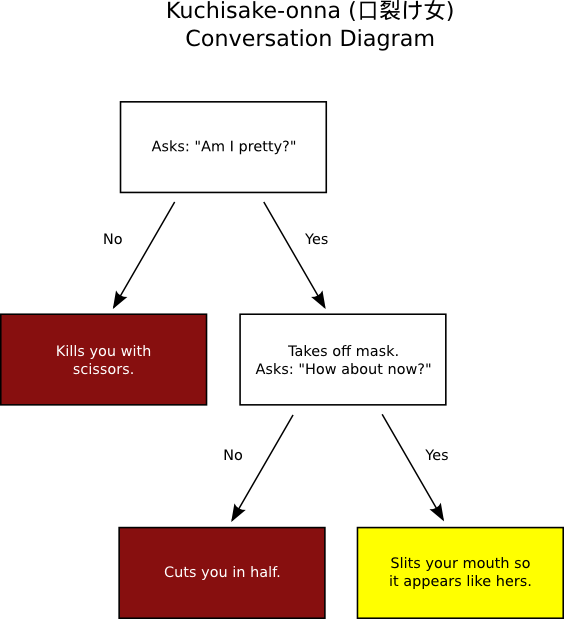
According to the legend, children walking alone at night may encounter a woman wearing a surgical mask, which is not an unusual sight in Japan as people wear them to protect others from their colds or sickness. The woman will stop the child and ask, Am I pretty? If the child answers no, the child is killed with a pair of scissors which the woman carries. If the child answers yes, the woman pulls away the mask, revealing that her mouth is slit from ear to ear, and asks How about now? If the child answers no, he/she will be cut in half. If the child answers yes, then she will slit his/her mouth like hers. It is impossible to run away from her, as she will simply reappear in front of the victim.
To help anyone who is not only frightened, but also confused, Mika and I made the following decision tree of possible conversations with Kuchisake-onna and their universally unfortunate outcomes.
Decision tree of conversations with Kuchisake-onna.Decision tree of conversations with Kuchisake-onna.
Of course, we uploaded the SVG source for the diagram to Wikimedia Commons and used the diagram to illustrate the Wikipedia article.

Next.

Previous.