Search Results: "zed"

18 September 2017

Carl Chenet: The Github threat

Many voices arise now and then against risks linked to the Github use by Free Software projects. Yet the infatuation for the collaborative forge of the Octocat Californian start-ups doesn t seem to fade away.

These recent years, Github and its services take an important role in software engineering as they are seen as easy to use, efficient for a daily workload with interesting functions in enterprise collaborative workflow or amid a Free Software project. What are the arguments against using its services and are they valid? We will list them first, then we ll examine their validity.

1. Critical points

1.1 Centralization

The Github application belongs to a single entity, Github Inc, a US company which manage it alone. So, a unique company under US legislation manages the access to most of Free Software application code sources, which may be a problem with groups using it when a code source is no longer available, for political or technical reason.

The Octocat, the Github mascot

This centralization leads to another trouble: as it obtained critical mass, it becomes more and more difficult not having a Github account. People who don t use Github, by choice or not, are becoming a silent minority. It is now fashionable to use Github, and not doing so is seen as out of date . The same phenomenon is a classic, and even the norm, for proprietary social networks (Facebook, Twitter, Instagram).

1.2 A Proprietary Software

When you interact with Github, you are using a proprietary software, with no access to its source code and which may not work the way you think it is. It is a problem at different levels. First, ideologically, but foremost in practice. In the Github case, we send them code we can control outside of their interface. We also send them personal information (profile, Github interactions). And mostly, Github forces any project which goes through the US platform to use a crucial proprietary tools: its bug tracking system.

Windows, the epitome of proprietary software, even if others took the same path

1.3 The Uniformization

Working with Github interface seems easy and intuitive to most. Lots of companies now use it as a source repository, and many developers leaving a company find the same Github working environment in the next one. This pervasive presence of Github in free software development environment is a part of the uniformization of said developers working space.
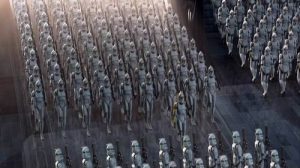
Uniforms always bring Army in my mind, here the Clone army

2 Critical points cross-examination

2.1 Regarding the centralization

2.1.1 Service availability rate

As said above, nowadays, Github is the main repository of Free Software source code. As such it is a favorite target for cyberattacks. DDOS hit it in March and August 2015. On December 15, 2015, an outage led to the inaccessibility of 5% of the repositories. The same occurred on November 15. And these are only the incident reported by Github itself. One can imagine that the mean outage rate of the platform is underestimated.
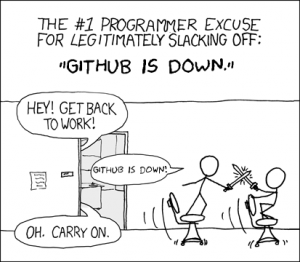
2.1.2 Chain reaction could block Free Software development

Today many dependency maintenance tools, as npm for javascript, Bundler for Ruby or even pip for Python can access an application source code directly from Github. Free Software projects getting more and more linked and codependents, if one component is down, all the developing process stop.

One of the best examples is the npmgate. Any company could legally demand that Github take down some source code from its repository, which could create a chain reaction and blocking the development of many Free Software projects, as suffered the Node.js community from the decisions of Npm, Inc, the company managing npm.

2.2 A historical precedent: SourceForge

Github didn t appear out of the blue. In his time, its predecessor, SourceForge, was also extremely popular.

Heavily centralized, based on strong interaction with the community, SourceForge is now seen as an aging SAAS (Software As A Service) and sees most of its customers fleeing to Github. Which creates lots of hurdles for those who stayed. The Gimp project suffered from spams and terrible advertising, which led to the departure of the VLC project, then from installers corrupted with adwares instead of the official Gimp installer for Windows. And finally, the Project Gimp s SourceForge account was hacked by SourceForge team itself!

These are very recent examples of what can do a commercial entity when it is under its stakeholders pressure. It is vital to really understand what it means to trust them with data and exchange centralization, where it could have tremendous repercussion on the day-to-day life and the habits of the Free Software and open source community.

2.3. Regarding proprietary software

2.3.1 One community, several opinions on proprietary software

Mostly based on ideology, this point deals with the definition every member of the community gives to Free Software and open source. Mostly about one thing: is it viral or not? Or GPL vs MIT/BSD.

Those on the side of the viral Free Software will have trouble to use a proprietary software as this last one shouldn t even exist. It must be assimilated, to quote Star Trek, as it is a connected black box, endangering privacy, corrupting for profit our uses and restrain our freedom to use as we re pleased what we own, etc.

Those on the side of complete freedom have no qualms using proprietary software as their very existence is a consequence of freedom without restriction. They even agree that code they developed may be a part of proprietary software, which is quite a common occurrence. This part of the Free Software community has no qualm using Github, which is well within their ideology parameters. Just take a look at the Janson amphitheater during Fosdem and check how many Apple laptops running on macOS are around.

FreeBSD, the main BSD project under the BSD license

2.3.2 Data loss and data restrictions linked to proprietary software use

Even without ideological consideration, and just focusing on Github infrastructure, the bug tracking system is a major problem by itself.

Bug report builds the memory of Free Software projects. It is the entrance point for new contributors, the place to find bug reporting, requests for new functions, etc. The project history can t be limited only to the code. It s very common to find bug reports when you copy and paste an error message in a search engine. Not their historical importance is precious for the project itself, but also for its present and future users.

Github gives the ability to extract bug reports through its API. What would happen if Github is down or if the platform doesn t support this feature anymore? In my opinion, not that many projects ever thought of this outcome. How could they move all the data generated by Github into a new bug tracking system? One old example now is Astrid, a TODO list bought by Yahoo a few years ago. Very popular, it grew fast until it was closed overnight, with only a few weeks for its users to extract their data. It was only a to-do list. The same situation with Github would be tremendously difficult to manage for several projects if they even have the ability to deal with it. Code would still be available and could still live somewhere else, but the project memory would be lost. A project like Debian has today more than 800,000 bug reports, which are a data treasure trove about problems solved, function requests and where the development stand on each. The developers of the Cpython project have anticipated the problem and decided not to use Github bug tracking systems.

Issues, the Github proprietary bug tracking system

Another thing we could lose if Github suddenly disappear: all the work currently done regarding the push requests (aka PRs). This Github function gives the ability to clone one project s Github repository, to modify it to fit your needs, then to offer your own modification to the original repository. The original repository s owner will then review said modification, and if he or she agrees with them will fuse them into the original repository. As such, it s one of the main advantages of Github, since it can be done easily through its graphic interface.

However reviewing all the PRs may be quite long, and most of the successful projects have several ongoing PRs. And this PRs and/or the proprietary bug tracking system are commonly used as a platform for comment and discussion between developers.

Code itself is not lost if Github is down (except one specific situation as seen below), but the peer review works materialized in the PRs and the bug tracking system is lost. Let s remember than the PR mechanism let you clone and modify projects and then generate PRs directly from its proprietary web interface without downloading a single code line on your computer. In this particular case, if Github is down, all the code and the work in progress is lost. Some also use Github as a bookmark place. They follow their favorite projects activity through the Watch function. This technological watch style of data collection would also be lost if Github is down.

Debian, one of the main Free Software projects with at least a thousand official contributors

2.4 Uniformization

The Free Software community is walking a thigh rope between normalization needed for an easier interoperability between its products and an attraction for novelty led by a strong need for differentiation from what is already there.

Github popularized the use of Git, a great tool now used through various sectors far away from its original programming field. Step by step, Git is now so prominent it s almost impossible to even think to another source control manager, even if awesome alternate solutions, unfortunately not as popular, exist as Mercurial.

A new Free Software project is now a Git repository on Github with README.md added as a quick description. All the other solutions are ostracized? How? None or very few potential contributors would notice said projects. It seems very difficult now to encourage potential contributors into learning a new source control manager AND a new forge for every project they want to contribute. Which was a basic requirement a few years ago. It s quite sad because Github, offering an original experience to its users, cut them out of a whole possibility realm. Maybe Github is one of the best web versioning control systems. But being the main one doesn t let room for a new competitor to grow. And it let Github initiate development newcomers into a narrow function set, totally unrelated to the strength of the Git tool itself.

3. Centralization, uniformization, proprietary software What s next? Laziness?

Fight against centralization is a main part of the Free Software ideology as centralization strengthens the power of those who manage it and who through it control those who are managed by it. Uniformization allergies born against main software companies and their wishes to impose a closed commercial software world was for a long time the main fuel for innovation thirst and intelligent alternative development. As we said above, part of the Free Software community was built as a reaction to proprietary software and their threat. The other part, without hoping for their disappearance, still chose a development model opposite to proprietary software, at least in the beginning, as now there s more and more bridges between the two.

The Github effect is a morbid one because of its consequences: at least centralization, uniformization, proprietary software usage as their bug tracking system. But some years ago the Dear Github buzz showed one more side effect, one I ve never thought about: laziness. For those who don t know what it is about, this letter is a complaint from several spokespersons from several Free Software projects which demand to Github team to finally implement, after years of polite asking, new functions. Since when Free Software project facing a roadblock request for clemency and don t build themselves the path they need? When Torvalds was involved in the Bitkeeper problem and the Linux kernel development team couldn t use anymore their revision control software, he developed Git. The mere fact of not being able to use one tool or functions lacking is the main motivation to seek alternative solutions and, as such, of the Free Software movement. Every Free Software community member able to code should have this reflex. You don t like what Github offers? Switch to Gitlab. You don t like it Gitlab? Improve it or make your own solution.

The Gitlab logo

Let s be crystal clear. I ve never said that every Free Software developers blocked should code his or her own alternative. We all have our own priorities, and some of us even like their beauty sleep, including me. But, to see that this open letter to Github has 1340 names attached to it, among them some spokespersons for major Free Software project showed me that need, willpower and strength to code a replacement are here. Maybe said replacement will be born from this letter, it would be the best outcome of this buzz.

In the end, Github usage is just another example of Internet usage massification. As Internet users are bound to go to massively centralized social network as Facebook or Twitter, developers are following the same path with Github. Even if a large fraction of developers realize the threat linked this centralized and proprietary organization, the whole community is following this centralization and uniformization trend. Github service is useful, free or with a reasonable price (depending on the functions you need) easy to use and up most of the time. Why would we try something else? Maybe because others are using us while we are savoring the convenience? The Free Software community seems to be quite sleepy to me.

The lion enjoying the hearth warm

About Me Carl Chenet, Free Software Indie Hacker, founder of the French-speaking Hacker News-like Journal du hacker. Follow me on social networks Translated from French by St phanie Chaptal. Original article written in 2015.

16 September 2017

Dirk Eddelbuettel: pinp 0.0.1: pinp is not PNAS

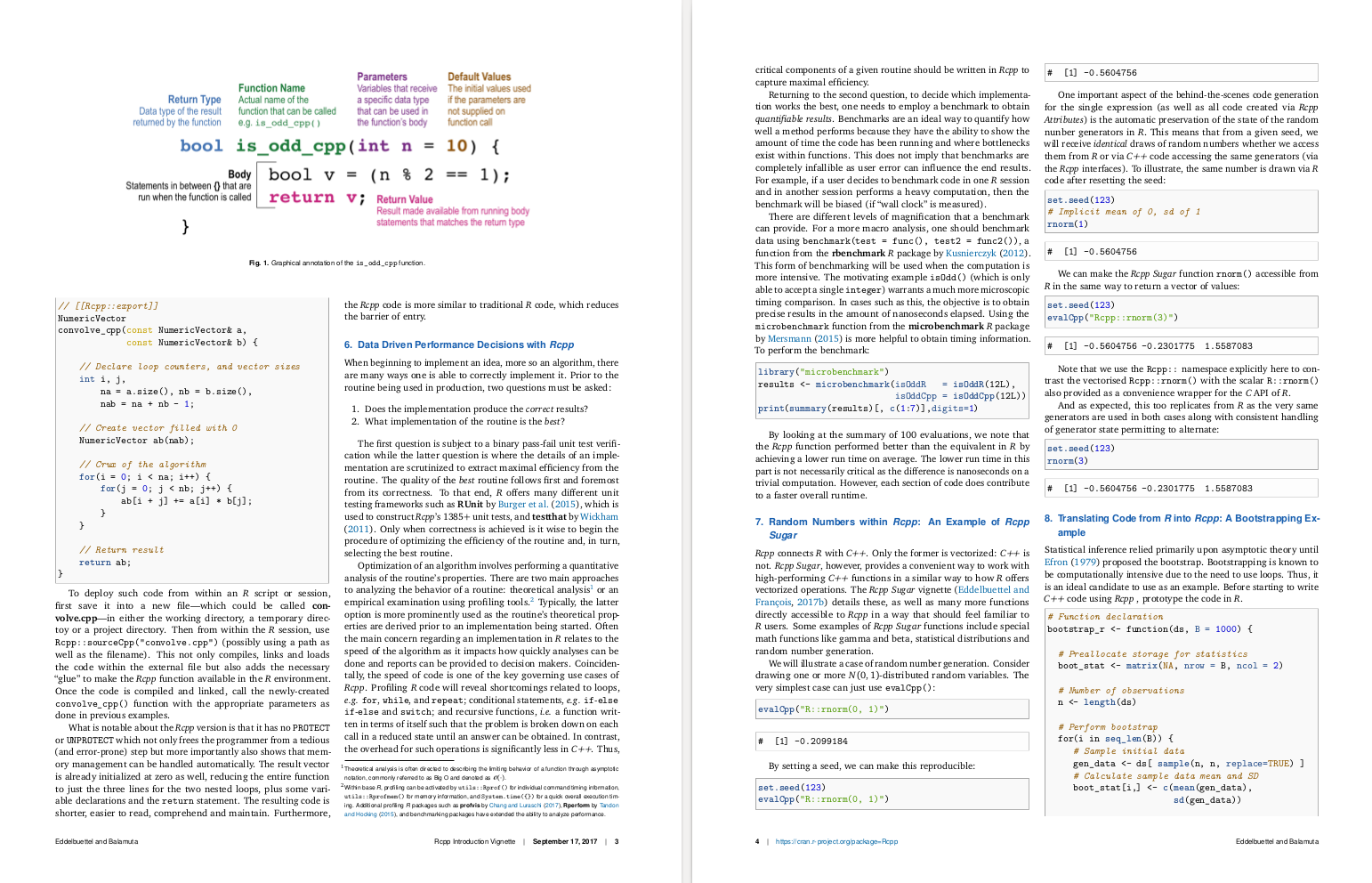
A brandnew and very exciting (to us, at least) package called pinp just arrived on CRAN, following a somewhat unnecessarily long passage out of incoming. It is based on the PNAS LaTeX Style offered by the Proceeding of the National Academy of Sciences of the United States of America, or PNAS for short. And there is already a Markdown version in the wonderful rticles packages. But James Balamuta and I thought we could do one better when we were looking to typeset our recent PeerJ Prepint as an attractive looking vignette for use within the Rcpp package. And so we did by changing a few things (font, color, use of natbib and Chicago.bst for references, removal of a bunch of extra PNAS-specific formalities from the frontpage) and customized a number of other things for easier use by vignettes directly from the YAML header (draft mode watermark, doi or url for packages, easier author naming in footer, bibtex file and more). We are quite pleased with the result which seems ready for the next Rcpp release---see e.g., these two teasers:
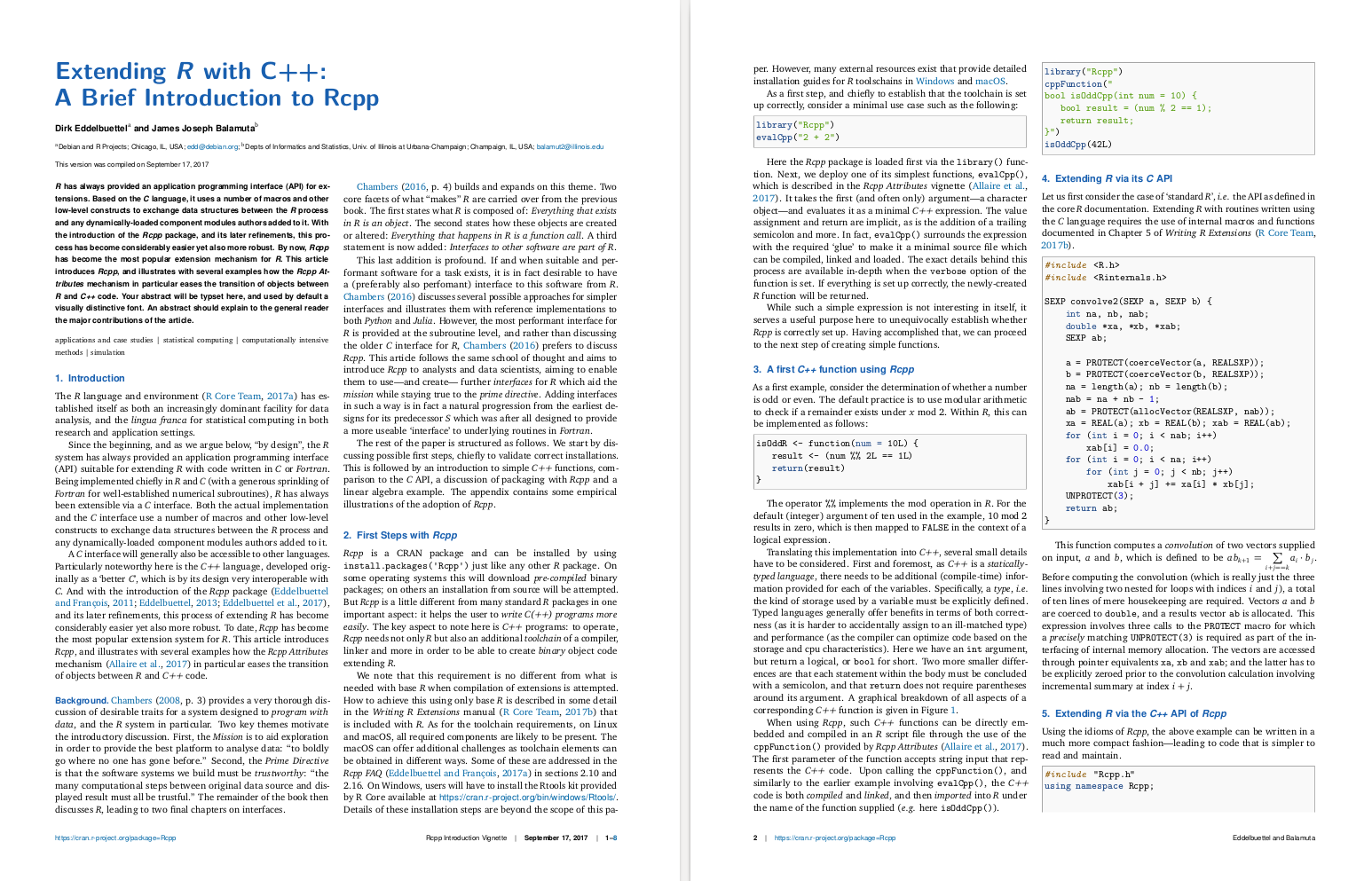
and
and the pinp package page or the GitHub repo have the full (four double-)pages of what turned a more dull looking 27 page manuscript into eight crisp two-column pages. We have few more things planned (i.e., switching to single column mode, turning on linenumbers at least in one-column mode). For questions or comments use the issue tracker off the GitHub repo.

This post by Dirk Eddelbuettel originated on his Thinking inside the box blog. Please report excessive re-aggregation in third-party for-profit settings.

14 September 2017

Lior Kaplan: Public money? Public Code!

An open letter published today to the EU government says:
Why is software created using taxpayers money not released as Free Software?
We want legislation requiring that publicly financed software developed for the public sector be made publicly available under a Free and Open Source Software licence. If it is public money, it should be public code as well. Code paid by the people should be available to the people!
See https://publiccode.eu/ for the campaign details. This makes me think of starting an Israeli version
Filed under: Uncategorized

13 September 2017

Shirish Agarwal: Android, Android marketplace and gaming addiction.

This would be a longish piece so please bear and play with tea, coffee, beer or anything stronger that you desire while reading below  I had bought an Android phone, a Samsung J5 just before going to debconf 2016. It was more for being in-trend rather than really using it. The one which I shared is the upgraded version (recentish) the one I have is 2 GB for which I had paid around double of what the list price was. The only reason I bought the model is that it had removable battery at the price point I was willing to pay. I did see that Samsung has the same ham-handed issues with audio as previous Nokia devices use to, the speakers and microphone probably the cheapest you can get on the market. Nokia was same too, at least on the lower-end of the market, while Oppo has loud ringtones and loud music, perfect for those who are a bit hard of hearing (as yours truly is). I had been pleasantly surprised by the quality of photos Samsung J5 was churning even though I m less than average shooter, never been really into it so was a sort of wake-up call for where camera sensor technology is advancing. And of course with newer phones the kind of detail it can capture is mesmerizing to say the least, although wide-angle shots still would take some time to get right I guess. If memory serves me right, sometime back Laura Arjona Reina (who handles part of debian-publicity and part of debian-women among other responsibilities) shared a blog post on p.d.o. where she had shared the troubles she had while exporting data from the phone. While she shared that and I lack the time or the energy to try and find it ( the entry is really bookmarkable, at least that specific blog post). What was interesting though that I had gone few years ago to Bangalore, there is an organization which I like and admire CIS great for researchers. Anyways they had done a project getting between 10-20 phones from the market made of Chinese origin (almost all mobiles sold in India, the fabrication of CPU and APU etc. are done in China/Taiwan and then assembled here). Here what is done at the most is assembly which for all political purposes is called manufacturing . All the mobiles kept quite a bit of info. on the device even after you wiped them clean/put some other ROM on them. The CIS site is more than a bit cluttered otherwise would have shared the direct link. I do hope to send an e-mail to CIS and hopefully they will respond with the report and will share that here as and when. It would be interesting to know if after people flash a custom rom if the status quo is the same as it was before. I do suspect it would be the former as flashing ROMs on phones is still a bit of specialized subject at least here in India with even an average phone costing a month or two s salary or more and the idea of bricking the phone scares most people (including yours truly). Anyways, for a long time I was on bed and had the phone. I used 2 games from the android marketplace which both mum and I enjoy and enjoyed. Those are Real jigsaw and Jigsaw puzzle HD . The permissions dialog which Real jigsaw among other games has is horrible and part of me freaks that all such apps. have unrestricted access to my storage area. Ideally, what Android should have done is either partition or give functionality to the user to have private space for their photos and whatever media they have and the rest of the area is like a public park. If anybody has any thoughts on partitioning on Android phone would like to hear that. One game though which really hooked mumma and me is The Island Experiment . It reminded me of my younger days when gaming addiction was not treated as a disease but thankfully now is . I would call myself somewhat of a functional addict as in do my every day things, work etc. but do dream about the game as to what it will show me next. A part of it is the game is web-based (which means it needs constant internet connection) and web access is somewhat pricey, although with Reliance Jio an upcoming data network operator having bundles of money and promising the moon, network issues at least on low-bandwidth game which I and mum are playing hopefully will not have any issues. I haven t used tshark or any such tool to analyze the traffic but I guess it probably just sends short messages of number of clicks in a time period and things like that, all the rest (I guess) is happening on the mobile itself. I know at sometime I probably will try to put a custom rom on it but which one is the question as there are so many and also which is most compatible with my device. It seems I would have to do lot of homework before I can make any choices. Couple of months back, a friend of mine Akshat who has been using Android for few years enabled Developer Options which I didn t know about till he shared that info. with me. I do hope people do check Akshat s repo. as he has made/has quite a few useful scripts, especially if you are into digital photography. I have shared with him gimp scripting few days back so along with imagemagick you might see him doing some rough scripts in it. Of course, if people use it and give feedback he might clean the scripts a bit so it gives useful error messages and gives statement like gimp is not installed on your system, please install it or ask for specific version but as it works in free software it is somewhat directly proportional to the number of users, bugs and users behind it. A good example of what I mean is youtube-dl . I filed 873853 where I shared the upstream ticket. Apparently YouTube again changed few days back and while upstream has fixed it, the youtube-dl maintainer probably needs to find time and get the new version up. Apparently the issues lies in [$] dpkg -L youtube-dl grep youtube.py
/usr/lib/python3/dist-packages/youtube_dl/extractor/youtube.py
Hopefully somebody does the needful. Btw, I find f-droid extremely useful and especially osmand but sadly both of them are not shared or talked about by people  The reason I shared about Developer Options in Android is that few days back I noticed that the phone wonks off and has unpredictable behaviour such as not letting me browse the web, do additions or deletions using the google play store and alike . Things came to a head when few days back I saw a fibre-optic splicing operation being carried by some workers near my home by the state operator which elated me and wanted to shoot the video for it but the battery died/there was no power even though I hadn t used it much. I have deliberately shared the hindi version which tells how that knowledge is now coming to the masses. I had seen fibre-optic splicing more than a decade and a half back at some net conference where it was going to be in your neighbourhood soonish, hopefully it will happen soon  I had my suspicions for quite sometime all the issues with the phone were not due to proper charging. During course of my investigation, found out that in Developer Options there is an option called USB Configuration and changing that from the default MTP (Media Transfer Protocol) (which is basically used to put or take movies, music or any file from the phone to the computer or vice-versa improved much better behaviour on my android phone. But this caused an unexpected side-effect, I got pretty aggressive polling of the phone by the computer even after saying I do not want to share the phone details with the computer. This I filed as 874216 . The phone and I am guessing most Samsung phones today come with an adaptor with a USB male socket which goes in to the phone s usb port. There is the classical port for electricity but like most people heavily rely on usb charging even for deep fully powered down phone for full charging. One interesting project which I saw which came in Debian some days back is dummydroid. I did file a bug about it . I do hope that either the maintainer gives some more documentation. I am sure many people might use and add to the resource if the documentation was/is there. I did take a look at the package and the profile seems to be like an xml pair kind of database. Having more profiles shouldn t be hard if we knew what info. needs to be added and how do we find that info. Lastly, I am slowly transferring all the above knowledge to my mum as well, although in small doses. She, just like me has and had problems coming from resistive touchscreen to capacitive touchscreen. You can call me wrong but resistive touchscreen seemed to be superior and not as error-prone or liable to commit mistakes as is possible in capacitive touchscreens. There may be a setting to higher/lower the threshold for touching which I have not been able to find as of yet. Hope somebody finds something useful in there. I do hope that Debian does become a replacement to be used on such mobiles but then they would have to duplicate/also have some sort of mainstream content with editors to help people find stuff, something that Debian is not so good at currently. Also I m not sure Synaptic is good fit as a mobile store.
Filed under: Miscellenous Tagged: #Android, #capacitive touchscreen, #custom ROMs, #digital photography, #dummydroid, #f-droid, #fabrication, #flashing, #game addiction, #Google Play Store, #Mainstreaming Debian, #mobile connectivity, #Oppo, #osmand, #planet-debian, #resistive touchscreen, #Samsung Galaxy J5, #scripting, #USB charging, #USB configuration, #youtube-dl, gaming

Reproducible builds folks: Reproducible Builds: Weekly report #124

Here's what happened in the Reproducible Builds effort between Sunday September 3 and Saturday September 9 2017: Media coverage GSoC and Outreachy updates Debian will participate in this year's Outreachy initiative and the Reproducible Builds is soliciting mentors and students to join this round. For more background please see the following mailing list posts: 1, 2 & 3. Reproduciblity work in Debian In addition, the following NMUs were accepted: Reproduciblity work in other projects Patches sent upstream: Packages reviewed and fixed, and bugs filed Reviews of unreproducible packages 3 package reviews have been added, 2 have been updated and 2 have been removed in this week, adding to our knowledge about identified issues. Weekly QA work During our reproducibility testing, FTBFS bugs have been detected and reported by: diffoscope development Development continued in git, including the following contributions: Mattia Rizzolo also uploaded the version 86 released last week to stretch-backports. reprotest development tests.reproducible-builds.org Misc. This week's edition was written by Bernhard M. Wiedemann, Chris Lamb, Holger Levsen, Mattia Rizzolo & reviewed by a bunch of Reproducible Builds folks on IRC & the mailing lists.

10 September 2017

Sylvain Beucler: dot-zed archive file format

TL,DR: I reverse-engineered the .zed encrypted archive format.
Following a clean-room design, I'm providing a description that can be implemented by a third-party.
Interested? :) (reference version at: https://www.beuc.net/zed/) .zed archive file format Introduction Archives with the .zed extension are conceptually similar to an encrypted .zip file. In addition to a specific format, .zed files support multiple users: files are encrypted using the archive master key, which itself is encrypted for each user and/or authentication method (password, RSA key through certificate or PKCS#11 token). Metadata such as filenames is partially encrypted. .zed archives are used as stand-alone or attached to e-mails with the help of a MS Outlook plugin. A variant, which is not covered here, can encrypt/decrypt MS Windows folders on the fly like ecryptfs. In the spirit of academic and independent research this document provides a description of the file format and encryption algorithms for this encrypted file archive. See the conventions section for conventions and acronyms used in this document. Structure overview The .zed file format is composed of several layers. Or as a diagram:
+----------------------------------------------------------------------------------------------------+
  .zed archive (MS-CBF)                                                                               
                                                                                                      
   stream #1                         stream #2                       stream #3...                     
  +------------------------------+  +---------------------------+  +---------------------------+      
    metadata (MS-OLEPS)               encryption (AES)               encryption (AES)                 
                                      512-bytes chunks               512-bytes chunks                 
    +--------------------------+                                                                      
      obfuscation (static key)        +-----------------------+      +-----------------------+        
      +----------------------+       -  compression (zlib)     -    -  compression (zlib)     -       
       _ctlfile (TLV)                                                                            ...  
      +----------------------+          +---------------+              +---------------+               
    +--------------------------+          file contents                  file contents                
                                                                                                      
    +--------------------------+     -  +---------------+      -    -  +---------------+      -       
      _catalog (TLV)                                                                                  
    +--------------------------+      +-----------------------+      +-----------------------+        
  +------------------------------+  +---------------------------+  +---------------------------+      
+----------------------------------------------------------------------------------------------------+
Encryption schemes Several AES key sizes are supported, such as 128 and 256 bits. The Cipher Block Chaining (CBC) block cipher mode of operation is used to decrypt multiple AES 16-byte blocks, which means an initialisation vector (IV) is stored in clear along with the ciphertext. All filenames and file contents are encrypted using the same encryption mode, key and IV (e.g. if you remove and re-add a file in the archive, the resulting stream will be identical). No cleartext padding is used during encryption; instead, several end-of-stream handlers are available, so the ciphertext has exactly the size of the cleartext (e.g. the size of the compressed file). The following variants were identified in the 'encryption_mode' field. STREAM This is the end-of-stream handler for: This end-of-stream handler is apparently specific to the .zed format, and applied when the cleartext's does not end on a 16-byte boundary ; in this case special processing is performed on the last partial 16-byte block. The encryption and decryption phases are identical: let's assume the last partial block of cleartext (for encryption) or ciphertext (for decryption) was appended after all the complete 16-byte blocks of ciphertext: In either case, if the full ciphertext is less then one AES block (< 16 bytes), then the IV is used instead of the second-to-last block. CTS CTS or CipherText Stealing is the end-of-stream handler for: It matches the CBC-CS3 variant as described in Recommendation for Block Cipher Modes of Operation: Three Variants of Ciphertext Stealing for CBC Mode. Empty cleartext Since empty filenames or metadata are invalid, and since all files are compressed (resulting in a minimum 8-byte zlib cleartext), no empty cleartext was encrypted in the archive. metadata stream It is named 05356861616161716149656b7a6565636e576a33317a7868304e63 (hexadecimal), i.e. the character with code 5 followed by '5haaaaqaIekzeecnWj31zxh0Nc' (ASCII). The format used is OLE Property Set (MS-OLEPS). It introduces 2 property names "_ctlfile" (index 3) and "_catalog" (index 4), and 2 instances of said properties each containing an application-specific VT_BLOB (type 0x0041). _ctlfile: obfuscated global properties and access list This subpart is stored under index 3 ("_ctlfile") of the MS-OLEPS metadata. It consists of: The ciphertext is encrypted with AES-CBC "STREAM" mode using 128-bit static key 37F13CF81C780AF26B6A52654F794AEF (hexadecimal) and the prepended IV so as to obfuscate the access list. The ciphertext is continuous and not split in chunks (unlike files), even when it is larger than 512 bytes. The decrypted text contain properties in a TLV format as described in _ctlfile TLV: Archives may include "mandatory" users that cannot be removed. They are typically used to add an enterprise wide recovery RSA key to all archives. Extreme care must be taken to protect these key, as it can decrypt all past archives generated from within that company. _catalog: file list This subpart is stored under index 4 ("_catalog") of the MS-OLEPS metadata. It contains a series of 'fileprops' TLV structures, one for each file or directory. The file hierarchy can be reconstructed by checking the 'parent_id' field of each file entry. If 'parent_id' is 0 then the file is located at the top-level of the hierarchy, otherwise it's located under the directory with the matching 'file_id'. TLV format This format is a series of fields : Value semantics depend on its Type. It may contain an uint32be integer, a UTF-16LE string, a character sequence, or an inner TLV structure. Unless otherwise noted, TLV structures appear once. Some fields are optional and may not be present at all (e.g. 'archive_createdwith'). Some fields are unique within a structure (e.g. 'files_iv'), other may be repeated within a structure to form a list (e.g. 'fileprops' and 'passworduser'). The following top-level types that have been identified, and detailed in the next sections: Some additional unidentified types may be present. _ctlfile TLV _catalog TLV Decrypting the archive AES key rsauser The user accessing the archive will be authenticated by comparing his/her X509 certificate with the one stored in the 'certificate' field using DER format. The 'files_key_ciphertext' field is then decrypted using the PKCS#1 v1.5 encryption mechanism, with the private key that matches the user certificate. passworduser An intermediary user key, a user IV and an integrity checksum will be derived from the user password, using the deprecated PKCS#12 method as described at rfc7292 appendix B. Note: this is not PKCS#5 (nor PBKDF1/PBKDF2), this is an incompatible method from PKCS#12 that notably does not use HMAC. The 'pkcs12_hashfunc' field defines the underlying hash function. The following values have been identified: PBA - Password-based authentication The user accessing the archive will be authenticated by deriving an 8-byte sequence from his/her password. The parameters for the derivation function are: The derivation is checked against 'pba_checksum'. PBE - Password-based encryption Once the user is identified, 2 new values are derived from the password with different parameters to produce the IV and the key decryption key, with the same hash function: The parameters specific to user key are: The user key needs to be truncated to a length of 'encryption_strength', as specified in bytes in the archive properties. The parameters specific to user IV are: Once the key decryption key and the IV are derived, 'files_key_ciphertext' is decrypted using AES CBC, with PKCS#7 padding. Identifying file streams The name of the MS-CFB stream is derived by shuffling the bytes from the 'file_id' field and then encoding the result as hexadecimal. The reordering is:
Initial  offset: 0 1 2 3 4 5 6 7 8 9 10 11 12 13 14 15
Shuffled offset: 3 2 1 0 5 4 7 6 8 9 10 11 12 13 14 15
The 16th byte is usually a NUL byte, hence the stream identifier is a 30-character-long string. Decrypting files The compressed stream is split in chunks of 512 bytes, each of them encrypted separately using AES CBS and the global archive encryption scheme. Decryption uses the global AES key (retrieved using the user credentials), and the global IV (retrieved from the deobfuscated archive metadata). The IV for each chunk is computed by: Each chunk is an independent stream and the decryption process involves end-of-stream handling even if this is not the end of the actual file. This is particularly important for the CTS handler. Note: this is not to be confused with CTR block cipher mode of operation with operates differently and requires a nonce. Decompressing files Compressed streams are zlib stream with default compression options and can be decompressed following the zlib format. Test cases Excluded for brevity, cf. https://www.beuc.net/zed/#test-cases. Conventions and references Feedback Feel free to send comments at beuc@beuc.net. If you have .zed files that you think are not covered by this document, please send them as well (replace sensitive files with other ones). The author's GPG key can be found at 8FF1CB6E8D89059F. Copyright (C) 2017 Sylvain Beucler Copying and distribution of this file, with or without modification, are permitted in any medium without royalty provided the copyright notice and this notice are preserved. This file is offered as-is, without any warranty.

7 September 2017

Steinar H. Gunderson: Licensing woes

On releasing modified versions of GPLv3 software in binary form only (quote anonymized):

And in my opinion it's perfectly ok to give out a binary release of a project, that is a work in progress, so that people can try it out and coment on it. It's easier for them to have it as binary and not need to compile it themselfs. If then after a (long) while the code is still only released in binary form, then it's ok to start a discussion. But only for a quick test, that is unneccessary. So people, calm down and enjoy life!
I wonder at what point we got here.

Thomas Lange: My recent FAI activities

During DebConf 17 in Montr al I had a FAI demo session (video), where I showed how to create a customized installation CD and how to create a diskimage using the same configuration. This diskimage is ready for use with a VM software or can be booted inside a cloud environment. During the last weeks I was working on FAI 5.4 which will be released in a few weeks. I you want to test it use
deb https://fai-project.org/download beta-testing koeln
in your sources.list file. The most important new feature will be the cross architecture support. I managed to create an ARM64 diskimage on a x86 host and boot this inside Qemu. Currently I learn how to flash images onto my new Hikey960 board for booting my own Debian images on real hardware. The embedded world is still new for me and very different in respect to the boot process. At DebConf, I also worked on debootstrap. I produced a set of patches which can speedup debootstrap by a factor of 2. See #871835 for details. FAI debootstrap ARM

5 September 2017

Kees Cook: security things in Linux v4.13

Previously: v4.12. Here s a short summary of some of interesting security things in Sunday s v4.13 release of the Linux kernel: security documentation ReSTification
The kernel has been switching to formatting documentation with ReST, and I noticed that none of the Documentation/security/ tree had been converted yet. I took the opportunity to take a few passes at formatting the existing documentation and, at Jon Corbet s recommendation, split it up between end-user documentation (which is mainly how to use LSMs) and developer documentation (which is mainly how to use various internal APIs). A bunch of these docs need some updating, so maybe with the improved visibility, they ll get some extra attention. CONFIG_REFCOUNT_FULL
Since Peter Zijlstra implemented the refcount_t API in v4.11, Elena Reshetova (with Hans Liljestrand and David Windsor) has been systematically replacing atomic_t reference counters with refcount_t. As of v4.13, there are now close to 125 conversions with many more to come. However, there were concerns over the performance characteristics of the refcount_t implementation from the maintainers of the net, mm, and block subsystems. In order to assuage these concerns and help the conversion progress continue, I added an unchecked refcount_t implementation (identical to the earlier atomic_t implementation) as the default, with the fully checked implementation now available under CONFIG_REFCOUNT_FULL. The plan is that for v4.14 and beyond, the kernel can grow per-architecture implementations of refcount_t that have performance characteristics on par with atomic_t (as done in grsecurity s PAX_REFCOUNT). CONFIG_FORTIFY_SOURCE
Daniel Micay created a version of glibc s FORTIFY_SOURCE compile-time and run-time protection for finding overflows in the common string (e.g. strcpy, strcmp) and memory (e.g. memcpy, memcmp) functions. The idea is that since the compiler already knows the size of many of the buffer arguments used by these functions, it can already build in checks for buffer overflows. When all the sizes are known at compile time, this can actually allow the compiler to fail the build instead of continuing with a proven overflow. When only some of the sizes are known (e.g. destination size is known at compile-time, but source size is only known at run-time) run-time checks are added to catch any cases where an overflow might happen. Adding this found several places where minor leaks were happening, and Daniel and I chased down fixes for them. One interesting note about this protection is that is only examines the size of the whole object for its size (via __builtin_object_size(..., 0)). If you have a string within a structure, CONFIG_FORTIFY_SOURCE as currently implemented will make sure only that you can t copy beyond the structure (but therefore, you can still overflow the string within the structure). The next step in enhancing this protection is to switch from 0 (above) to 1, which will use the closest surrounding subobject (e.g. the string). However, there are a lot of cases where the kernel intentionally copies across multiple structure fields, which means more fixes before this higher level can be enabled. NULL-prefixed stack canary
Rik van Riel and Daniel Micay changed how the stack canary is defined on 64-bit systems to always make sure that the leading byte is zero. This provides a deterministic defense against overflowing string functions (e.g. strcpy), since they will either stop an overflowing read at the NULL byte, or be unable to write a NULL byte, thereby always triggering the canary check. This does reduce the entropy from 64 bits to 56 bits for overflow cases where NULL bytes can be written (e.g. memcpy), but the trade-off is worth it. (Besdies, x86_64 s canary was 32-bits until recently.) IPC refactoring
Partially in support of allowing IPC structure layouts to be randomized by the randstruct plugin, Manfred Spraul and I reorganized the internal layout of how IPC is tracked in the kernel. The resulting allocations are smaller and much easier to deal with, even if I initially missed a few needed container_of() uses. randstruct gcc plugin
I ported grsecurity s clever randstruct gcc plugin to upstream. This plugin allows structure layouts to be randomized on a per-build basis, providing a probabilistic defense against attacks that need to know the location of sensitive structure fields in kernel memory (which is most attacks). By moving things around in this fashion, attackers need to perform much more work to determine the resulting layout before they can mount a reliable attack. Unfortunately, due to the timing of the development cycle, only the manual mode of randstruct landed in upstream (i.e. marking structures with __randomize_layout). v4.14 will also have the automatic mode enabled, which randomizes all structures that contain only function pointers. A large number of fixes to support randstruct have been landing from v4.10 through v4.13, most of which were already identified and fixed by grsecurity, but many were novel, either in newly added drivers, as whitelisted cross-structure casts, refactorings (like IPC noted above), or in a corner case on ARM found during upstream testing. lower ELF_ET_DYN_BASE
One of the issues identified from the Stack Clash set of vulnerabilities was that it was possible to collide stack memory with the highest portion of a PIE program s text memory since the default ELF_ET_DYN_BASE (the lowest possible random position of a PIE executable in memory) was already so high in the memory layout (specifically, 2/3rds of the way through the address space). Fixing this required teaching the ELF loader how to load interpreters as shared objects in the mmap region instead of as a PIE executable (to avoid potentially colliding with the binary it was loading). As a result, the PIE default could be moved down to ET_EXEC (0x400000) on 32-bit, entirely avoiding the subset of Stack Clash attacks. 64-bit could be moved to just above the 32-bit address space (0x100000000), leaving the entire 32-bit region open for VMs to do 32-bit addressing, but late in the cycle it was discovered that Address Sanitizer couldn t handle it moving. With most of the Stack Clash risk only applicable to 32-bit, fixing 64-bit has been deferred until there is a way to teach Address Sanitizer how to load itself as a shared object instead of as a PIE binary. early device randomness
I noticed that early device randomness wasn t actually getting added to the kernel entropy pools, so I fixed that to improve the effectiveness of the latent_entropy gcc plugin. That s it for now; please let me know if I missed anything. As a side note, I was rather alarmed to discover that due to all my trivial ReSTification formatting, and tiny FORTIFY_SOURCE and randstruct fixes, I made it into the most active 4.13 developers list (by patch count) at LWN with 76 patches: a whopping 0.6% of the cycle s patches. ;) Anyway, the v4.14 merge window is open!

2017, Kees Cook. This work is licensed under a Creative Commons Attribution-ShareAlike 3.0 License.
Creative Commons License

4 September 2017

Jonathan Dowland: Sortpaper: 16:9 edition

sortpaper 16:9 sortpaper 16:9
Back in 2011 I stumbled across a file "sortpaper.png", which was a hand-crafted wallpaper I'd created some time in the early noughties to help me organise icons on my computer's Desktop. I published it at the time in the blog post sortpaper. Since then I rediscovered the blog post, and since I was looking for an excuse to try out the Processing software, I wrote a Processing Sketch to re-create it, but with the size and colours parameterized: sortpaper.pde.txt. The thumbnail above links to an example 1920x1080 rendering.

Daniel Pocock: Spyware Dolls and Intel's vPro

Back in February, it was reported that a "smart" doll with wireless capabilities could be used to remotely spy on children and was banned for breaching German laws on surveillance devices disguised as another object. Would you trust this doll? For a number of years now there has been growing concern that the management technologies in recent Intel CPUs (ME, AMT and vPro) also conceal capabilities for spying, either due to design flaws (no software is perfect) or backdoors deliberately installed for US spy agencies, as revealed by Edward Snowden. In a 2014 interview, Intel's CEO offered to answer any question, except this one. The LibreBoot project provides a more comprehensive and technical analysis of the issue, summarized in the statement "the libreboot project recommends avoiding all modern Intel hardware. If you have an Intel based system affected by the problems described below, then you should get rid of it as soon as possible" - eerily similar to the official advice German authorities are giving to victims of Cayla the doll. All those amateur psychiatrists suggesting LibreBoot developers suffer from symptoms of schizophrenia have had to shut their mouths since May when Intel confirmed a design flaw (or NSA backdoor) in every modern CPU had become known to hackers. Bill Gates famously started out with the mission to put a computer on every desk and in every home. With more than 80% of new laptops based on an Intel CPU with these hidden capabilities, can you imagine the NSA would not have wanted to come along for the ride? Four questions everybody should be asking
  • If existing laws can already be applied to Cayla the doll, why haven't they been used to alert owners of devices containing Intel's vPro?
  • Are exploits of these backdoors (either Cayla or vPro) only feasible on a targeted basis, or do the intelligence agencies harvest data from these backdoors on a wholesale level, keeping a mirror image of every laptop owner's hard disk in one of their data centers, just as they already do with phone and Internet records?
  • How long will it be before every fast food or coffee chain with a "free" wifi service starts dipping in to the data exposed by these vulnerabilities as part of their customer profiling initiatives?
  • Since Intel's admissions in May, has anybody seen any evidence that anything is changing though, either in what vendors are offering or in terms of how companies and governments outside the US buy technology?
Share your thoughts This issue was recently raised on the LibrePlanet mailing list. Please feel free to join the list and click here to reply on the thread.

1 September 2017

Rapha&#235;l Hertzog: My Free Software Activities in August 2017

My monthly report covers a large part of what I have been doing in the free software world. I write it for my donors (thanks to them!) but also for the wider Debian community because it can give ideas to newcomers and it s one of the best ways to find volunteers to work with me on projects that matter to me. Debian LTS This month I was allocated 12h and during this time I did 4 days of front desk handling CVE triage (28 commits to the security tracker). I had a bit of time left and I opted to work on a package that had been lingering for a while: exiv2. It turns out the security researchers who requested the CVE did not even contact the upstream author so I opened 12 tickets on GitHub. The upstream author was unaware of those issues and is relatively unfamiliar with the general process of handling security updates. I started the work of reproducing each issue and so far they only affect the version 0.26 in experimental. Misc Debian/Kali work live-build and live-config. I pushed a few updates: dropping the useless xorriso hardlinks option (as discussed in https://bugs.kali.org/view.php?id=4109), adding a .disk/mkisofs file on request of Thomas Schmitt, fixing a severe issue with the handling of locales configuration that broke wayland sessions entirely. open-vm-tools and vmwgfx. The switch of GNOME to Wayland by default resulted in multiple regressions reported by Kali users, in particular for VMWare users where desktop resizing was no longer working. There was a patch available but it did not work for me, so I worked with Thomas Hellstrom (of VMWare) to identify the problems and he provided me an updated patch. I submitted this patch to Debian too (bug report, pull request). Linux 4.12 also showed another regression for VMWare users where the screen would not be refreshed/updated when you are using Wayland/KMS. I did multiple tests for Thomas and provided the requested data so that they could create a fix (which I incorporated into Kali and should come to Debian through the upstream stable tree). Packaging. I uploaded zim 0.67 to unstable. I fixed an RC bug on shiboken to get pyside and ubertooth back into testing. I had to hack the package to use gcc-6 on mips64el because that architecture is suffering from a severe gcc bug which probably broke a large part of the code compiled since the switch to gcc-7 (and which triggered a test failure in shiboken, fortunately) I wonder if anybody will make sure to recompile all packages that might have been misbuilt. Infrastructure. In a discussion on debian-devel, the topic of using tracker.debian.org to store who is maintaining what came up again. I responded to let know that this is something that I d like to see done and that I have already taken measures to go into this direction. I wanted to make an experiment with my zim package but quickly came on a problem with ftpmaster s lintian auto-rejects (which I submitted in #871575). The BTS is now linking to tracker.debian.org on its web interface. To continue and give a push to this move, I scanned all the files in the qa SVN repository and updated many occurrences of packages.qa.debian.org with tracker.debian.org. I also spotted a small problem in the way we handle autoremovals mails in tracker.debian.org, we often get them twice: I filed #871683 to get this fixed on release.debian.org. Bug reports. vmdebootstrap creates unbootable qemu image (#872999). bugs in udebs are not shown on view by source package (#872784). New upstream release of ethtool (#873692). Upstream bugreport on systemd: support a systemd.swap=no boot command-line option. I also shared some of my ideas/dreams in #859867 speaking of a helper tool to setup and maintain up-to-date build chroots and autopkgtest qemu images. More bug fixes and pull requests. I created a patch to fix a build failure of systemd when /tmp is an overlayfs (#854400, the pull request has been discarded). I fixed the RC bug #853570 on ncrack and forwarded my changes upstream (here and here). Thanks See you next month for a new summary of my activities.

No comment Liked this article? Click here. My blog is Flattr-enabled.

Dirk Eddelbuettel: RcppAnnoy 0.0.9

An new version 0.0.9 of RcppAnnoy, our Rcpp-based R integration of the nifty Annoy library by Erik, is now on CRAN. Annoy is a small and lightweight C++ template header library for very fast approximate nearest neighbours. This release corrects an issue for Windows users discovered by GitHub user 'khoran' who later also suggested the fix of binary mode. It upgrades to Annoy release 1.9.1 and brings its new Manhattan distance to RcppAnnoy. A number of unit tests were added as well, and we updated some packaging internals such as symbol registration. And I presume I had a good streak emailing with Uwe's robots as the package made it onto CRAN rather smoothly within ten minutes of submission:
RcppAnnou to CRAN
Changes in this version are summarized here:

Changes in version 0.0.9 (2017-08-31)
  • Synchronized with Annoy upstream version 1.9.1
  • Minor updates in calls and tests as required by annoy 1.9.1
  • New Manhattan distance modules along with unit test code
  • Additional unit tests from upstream test code carried over
  • Binary mode is used for save (as suggested by @khoran in #21)
  • A new file init.c was added with calls to R_registerRoutines() and R_useDynamicSymbols()
  • Symbol registration is enabled in useDynLib

Courtesy of CRANberries, there is also a diffstat report for this release.

This post by Dirk Eddelbuettel originated on his Thinking inside the box blog. Please report excessive re-aggregation in third-party for-profit settings.

31 August 2017

Chris Lamb: Free software activities in August 2017

Here is my monthly update covering what I have been doing in the free software world in August 2017 (previous month):
Reproducible builds

Whilst anyone can inspect the source code of free software for malicious flaws, most software is distributed pre-compiled to end users. The motivation behind the Reproducible Builds effort is to allow verification that no flaws have been introduced either maliciously or accidentally during this compilation process by promising identical results are always generated from a given source, thus allowing multiple third-parties to come to a consensus on whether a build was compromised. I have generously been awarded a grant from the Core Infrastructure Initiative to fund my work in this area. This month I:
  • Presented a status update at Debconf17 in Montr al, Canada alongside Holger Levsen, Maria Glukhova, Steven Chamberlain, Vagrant Cascadian, Valerie Young and Ximin Luo.
  • I worked on the following issues upstream:
    • glib2.0: Please make the output of gio-querymodules reproducible. (...)
    • gcab: Please make the output reproducible. (...)
    • gtk+2.0: Please make the immodules.cache files reproducible. (...)
    • desktop-file-utils: Please make the output reproducible. (...)
  • Within Debian:
  • Categorised a large number of packages and issues in the Reproducible Builds "notes" repository.
  • Worked on publishing our weekly reports. (#118, #119, #120, #121 & #122)

I also made the following changes to our tooling:
diffoscope

diffoscope is our in-depth and content-aware diff utility that can locate and diagnose reproducibility issues.

  • Use name attribute over path to avoid leaking comparison full path in output. (commit)
  • Add missing skip_unless_module_exists import. (commit)
  • Tidy diffoscope.progress and the XML comparator (commit, commit)

disorderfs

disorderfs is our FUSE-based filesystem that deliberately introduces non-determinism into directory system calls in order to flush out reproducibility issues.

  • Add a simple autopkgtest smoke test. (commit)


Debian
Patches contributed
  • openssh: Quote the IP address in ssh-keygen -f suggestions. (#872643)
  • libgfshare:
    • SIGSEGV if /dev/urandom is not accessible. (#873047)
    • Add bindnow hardening. (#872740)
    • Support nodoc build profile. (#872739)
  • devscripts:
  • memcached: Add hardening to systemd .service file. (#871610)
  • googler: Tidy long and short package descriptions. (#872461)
  • gnome-split: Homepage points to domain-parked website. (#873037)

Uploads
  • python-django 1:1.11.4-1 New upstream release.
  • redis:
    • 4:4.0.1-3 Drop yet more non-deterministic tests.
    • 4:4.0.1-4 Tighten systemd/seccomp hardening.
    • 4:4.0.1-5 Drop even more tests with timing issues.
    • 4:4.0.1-6 Don't install completions to /usr/share/bash-completion/completions/debian/bash_completion/.
    • 4:4.0.1-7 Don't let sentinel integration tests fail the build as they use too many timers to be meaningful. (#872075)
  • python-gflags 1.5.1-3 If SOURCE_DATE_EPOCH is set, either use that as a source of current dates or the UTC-version of the file's modification time (#836004), don't call update-alternatives --remove in postrm. update debian/watch/Homepage & refresh/tidy the packaging.
  • bfs 1.1.1-1 New upstream release, tidy autopkgtest & patches, organising the latter with Pq-Topic.
  • python-daiquiri 1.2.2-1 New upstream release, tidy autopkgtests & update travis.yml from travis.debian.net.
  • aptfs 2:0.10-2 Add upstream signing key, refer to /usr/share/common-licenses/GPL-3 in debian/copyright & tidy autopkgtests.
  • adminer 4.3.1-2 Add a simple autopkgtest & don't install the Selenium-based tests in the binary package.
  • zoneminder (1.30.4+dfsg-2) Prevent build failures with GCC 7 (#853717) & correct example /etc/fstab entries in README.Debian (#858673).

Finally, I reviewed and sponsored uploads of astral, inflection, more-itertools, trollius-redis & wolfssl.

Debian LTS

This month I have been paid to work 18 hours on Debian Long Term Support (LTS). In that time I did the following:
  • "Frontdesk" duties, triaging CVEs, etc.
  • Issued DLA 1049-1 for libsndfile preventing a remote denial of service attack.
  • Issued DLA 1052-1 against subversion to correct an arbitrary code execution vulnerability.
  • Issued DLA 1054-1 for the libgxps XML Paper Specification library to prevent a remote denial of service attack.
  • Issued DLA 1056-1 for cvs to prevent a command injection vulnerability.
  • Issued DLA 1059-1 for the strongswan VPN software to close a denial of service attack.

Debian bugs filed
  • wget: Please hash the hostname in ~/.wget-hsts files. (#870813)
  • debian-policy: Clarify whether mailing lists in Maintainers/Uploaders may be moderated. (#871534)
  • git-buildpackage: "pq export" discards text within square brackets. (#872354)
  • qa.debian.org: Escape HTML in debcheck before outputting. (#872646)
  • pristine-tar: Enable multithreaded compression in pristine-xz. (#873229)
  • tryton-meta: Please combine tryton-modules-* into a single source package with multiple binaries. (#873042)
  • azure-cli:
  • fwupd-tests: Don't ship test files to generic /usr/share/installed-tests dir. (#872458)
  • libvorbis: Maintainer fields points to a moderated mailing list. (#871258)
  • rmlint-gui: Ship a rmlint-gui binary. (#872162)
  • template-glib: debian/copyright references online source without quotation. (#873619)

FTP Team

As a Debian FTP assistant I ACCEPTed 147 packages: abiword, adacgi, adasockets, ahven, animal-sniffer, astral, astroidmail, at-at-clojure, audacious, backdoor-factory, bdfproxy, binutils, blag-fortune, bluez-qt, cheshire-clojure, core-match-clojure, core-memoize-clojure, cypari2, data-priority-map-clojure, debian-edu, debian-multimedia, deepin-gettext-tools, dehydrated-hook-ddns-tsig, diceware, dtksettings, emacs-ivy, farbfeld, gcc-7-cross-ports, git-lfs, glewlwyd, gnome-recipes, gnome-shell-extension-tilix-dropdown, gnupg2, golang-github-aliyun-aliyun-oss-go-sdk, golang-github-approvals-go-approval-tests, golang-github-cheekybits-is, golang-github-chzyer-readline, golang-github-denverdino-aliyungo, golang-github-glendc-gopher-json, golang-github-gophercloud-gophercloud, golang-github-hashicorp-go-rootcerts, golang-github-matryer-try, golang-github-opentracing-contrib-go-stdlib, golang-github-opentracing-opentracing-go, golang-github-tdewolff-buffer, golang-github-tdewolff-minify, golang-github-tdewolff-parse, golang-github-tdewolff-strconv, golang-github-tdewolff-test, golang-gopkg-go-playground-validator.v8, gprbuild, gsl, gtts, hunspell-dz, hyperlink, importmagic, inflection, insighttoolkit4, isa-support, jaraco.itertools, java-classpath-clojure, java-jmx-clojure, jellyfish1, lazymap-clojure, libblockdev, libbytesize, libconfig-zomg-perl, libdazzle, libglvnd, libjs-emojify, libjwt, libmysofa, libundead, linux, lua-mode, math-combinatorics-clojure, math-numeric-tower-clojure, mediagoblin, medley-clojure, more-itertools, mozjs52, openssh-ssh1, org-mode, oysttyer, pcscada, pgsphere, poppler, puppetdb, py3status, pycryptodome, pysha3, python-cliapp, python-coloredlogs, python-consul, python-deprecation, python-django-celery-results, python-dropbox, python-fswrap, python-hbmqtt, python-intbitset, python-meshio, python-parameterized, python-pgpy, python-py-zipkin, python-pymeasure, python-thriftpy, python-tinyrpc, python-udatetime, python-wither, python-xapp, pythonqt, r-cran-bit, r-cran-bit64, r-cran-blob, r-cran-lmertest, r-cran-quantmod, r-cran-ttr, racket-mode, restorecond, rss-bridge, ruby-declarative, ruby-declarative-option, ruby-errbase, ruby-google-api-client, ruby-rash-alt, ruby-representable, ruby-test-xml, ruby-uber, sambamba, semodule-utils, shimdandy, sjacket-clojure, soapysdr, stencil-clojure, swath, template-glib, tools-analyzer-jvm-clojure, tools-namespace-clojure, uim, util-linux, vim-airline, vim-airline-themes, volume-key, wget2, xchat, xfce4-eyes-plugin & xorg-gtest. I additionally filed 6 RC bugs against packages that had incomplete debian/copyright files against: gnome-recipes, golang-1.9, libdazzle, poppler, python-py-zipkin & template-glib.

28 August 2017

John Goerzen: The Joy of Exploring: Old Phone Systems, Pizza, and Discovery

This story involves boys pretending to be pizza deliverymen using a working automated Strowger telephone exchange demonstrator on display in a museum, which is very old and is, to my knowledge, the only such working exhibit in the world. (Yes, I have video.) But first, a thought on exploration. There are those that would say that there is nothing left to explore anymore that the whole earth is mapped, photographed by satellites, and, well, known. I prefer to look at it a different way: the earth is full of places that billions of people will never see, and probably don t even know about. Those places may be quiet country creeks, peaceful neighborhoods one block away from major tourist attractions, an MTA museum in Brooklyn, a state park in Arkansas, or a beautiful church in Germany. Martha is not yet two months old, and last week she and I spent a surprisingly long amount of time just gazing at tree branches she was mesmerized, and why not, because to her, everything is new. As I was exploring in Portland two weeks ago, I happened to pick up a nearly-forgotten book by a nearly-forgotten person, Beryl Markham, a woman who was a pilot in Africa about 80 years ago. The passage that I happened to randomly flip to in the bookstore, which really grabbed my attention, was this:
The available aviation maps of Africa in use at that time all bore the cartographer s scale mark, 1/2,000,000 one over two million. An inch on the map was about thitry-two miles in the air, as compared to the flying maps of Europe on which one inch represented no more than four air miles. Moreover, it seemed that the printers of the African maps had a slightly malicious habit of including, in large letters, the names of towns, junctions, and villages which, while most of them did exist in fact, as a group of thatched huts may exist or a water hold, they were usually so inconsequential as completely to escape discovery from the cockpit. Beyond this, it was even more disconcerting to examine your charts before a proposed flight only to find that in many cases the bulk of the terrain over which you had to fly was bluntly marked: UNSURVEYED . It was as if the mapmakers had said, We are aware that between this spot and that one, there are several hundred thousands of acres, but until you make a forced landing there, we won t know whether it is mud, desert, or jungle and the chances are we won t know then! Beryl Markham, West With the Night
My aviation maps today have no such markings. The continent is covered with radio beacons, the world with GPS, the maps with precise elevations of the ground and everything from skyscrapers to antenna towers. And yet, despite all we know, the world is still a breathtaking adventure. Yesterday, the boys and I were going to fly to Abilene, KS, to see a museum (Seelye Mansion). Circumstances were such that we neither flew, nor saw that museum. But we still went to Abilene, and wound up at the Museum of Independent Telephony, a wondrous place for anyone interested in the history of technology. As it is one of those off-the-beaten-path sorts of places, the boys got 2.5 hours to use the hands-on exhibits of real old phones, switchboards, and also the schoolhouse out back. They decided why not? to use this historic equipment to pretend to order pizzas. Jacob and Oliver proceeded to invent all sorts of things to use the phones for: ordering pizza, calling the cops to chase the pizza delivery guys, etc. They were so interested that by 2PM we still hadn t had lunch and they claimed we re not hungry despite the fact that we were going to get pizza for lunch. And I certainly enjoyed the exhibits on the evolution of telephones, switching (from manual plugboards to automated switchboards), and such. This place was known it even has a website, I had been there before, and in fact so had the boys (my parents took them there a couple of years ago). But yesterday, we discovered the Strowger switch had been repaired since the last visit, and that it, in fact, is great for conversations about pizza. Whether it s seeing an eclipse, discovering a fascination with tree branches, or historic telephones, a spirit of curiosity and exploration lets a person find fun adventures almost anywhere.

27 August 2017

Carl Chenet: The Importance of Choosing the Correct Mastodon Instance

Remember, Mastodon is a new decentralized social network, based on a free software which is rapidly gaining users (already there is more than 1.5 million accounts). As I ve created my account in June, I was a fast addict and I ve already created several tools for this network, Feed2toot, Remindr and Boost (mostly written in Python).

Now, with all this experience I have to stress out the importance of choosing the correct Mastodon instance.

Some technical reminders on how Mastodon works

First, let s quickly clarify something about the decentralized part. In Mastodon, decentralization is made through a federation of dedicated servers, called instances , each one with a complete independent administration. Your user account is created on one specific instance. You have two choices:

  • Create your own instance. Which requires advanced technical knowledge.
  • Create your user account on a public instance. Which is the easiest and fastest way to start using Mastodon.

You can move your user account from one instance to another, but you have to follow a special procedure which can be quite long, considering your own interest for technical manipulation and the total amount of your followers you ll have to warn about your change. As such, you ll have to create another account on a new instance and import three lists: the one with your followers, the one with the accounts you have blocked, and the one with the account you have muted.

From this working process, several technical and human factors will interest us.

A good technical administration for instance

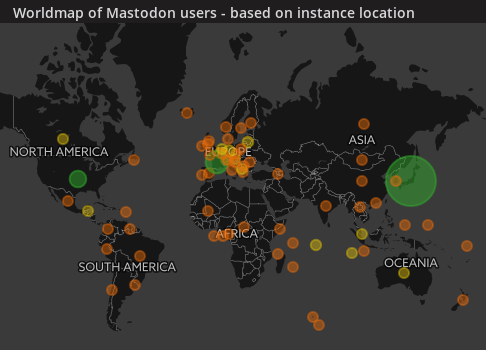
As a social network, Mastodon is truly decentralized, with more than 1.5 million users on more than 2350 existing instances. As such, the most common usage is to create an account on an open instance. To create its own instance is way too difficult for the average user. Yet, using an open instance creates a strong dependence on the technical administrator of the chosen instance.

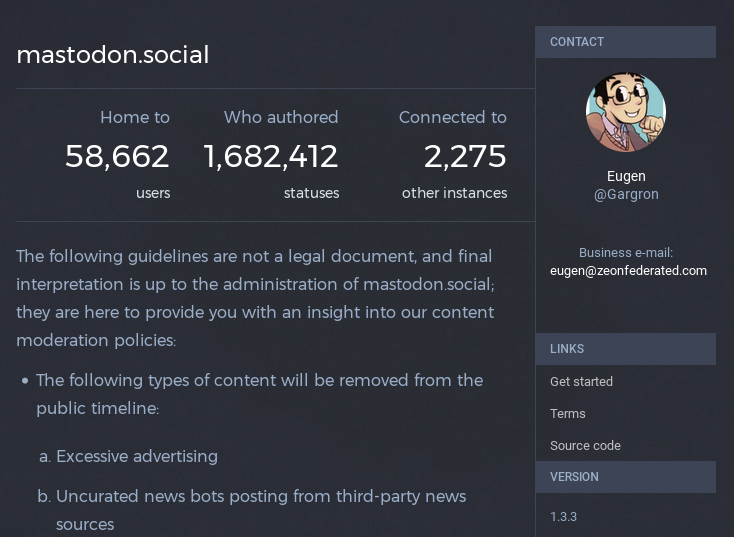
The technical administrator will have to deal with several obligations to ensure its service continuity, with high-quality hardware and regular back-ups. All of these have a price, either in money and in time. Regarding the time factor, it would be better to choose an administration team over an individual, as life events can change quite fast everyone s interests. As such, Framasoft, a French association dedicated to promoting the Free software use, offers its own Mastodon instance named: Framapiaf. The creator of the mastodon project, also offers a quite solid instance, Mastodon.social (see below).

Regarding the money factor, many instance administrators with a large number of users are currently asking for donation via Patreon, as hosting an instance server or renting one cost money.

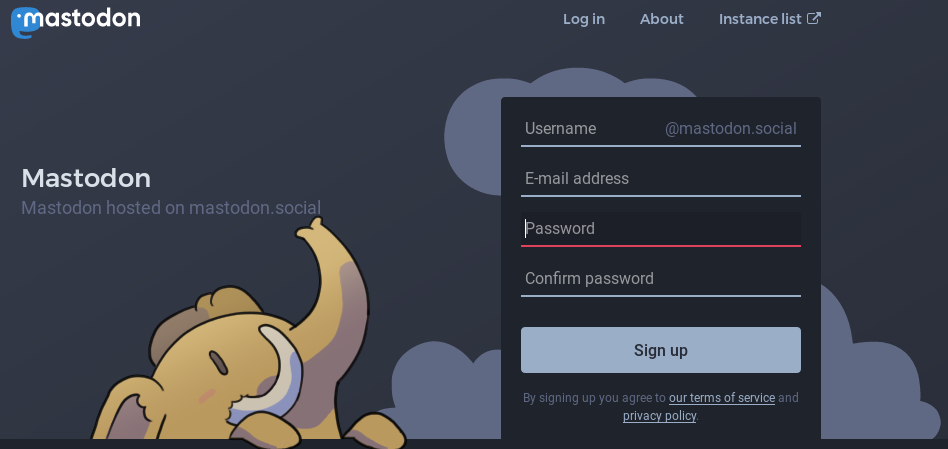
Mastodon.social, the first instance of the Mastodon network

The Ideological Trend Of Your Instance

If anybody could have guessed the previous technical points since the recent registration explosion on the Mastodon social network, the following point took almost everyone by surprise. Little by little, different instances show their culture , their protest action, and their propaganda on this social network.

As the instance administrator has all the powers over its instance, he or she can block the instance of interacting with some other instances, or ban its instance s users from any interaction with other instances users.

With everyone having in mind the main advantages to have federalized instance from, this partial independence of some instances from the federation was a huge surprise. One of the most recent example was when the Unixcorn.xyz instance administrator banned its users from reading Aeris account, which was on its own instance. It was a cataclysm with several consequences, which I ve named the #AerisGate as it shows the different views on moderation and on its reception by various Mastodon users.

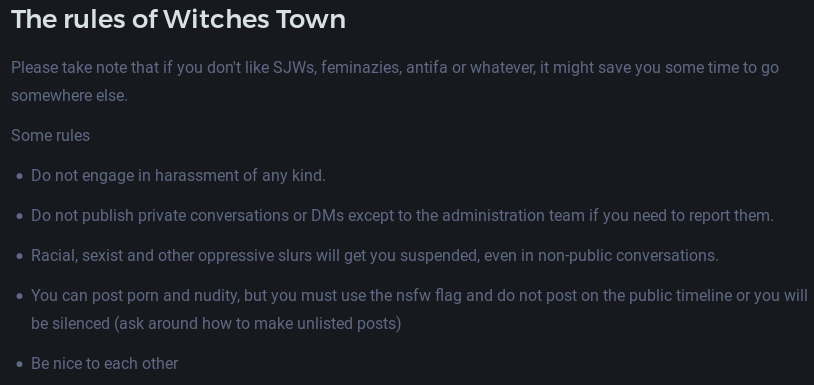
If you don t manage your own instance, when you ll have to choose the one where to create your account, make sure that the content you plan to toot is within the rules and compatible with the ideology of said instance s administrator. Yes, I know, it may seem surprising but, as stated above, by entering a public instance you become dependent on someone else s infrastructure, who may have an ideological way to conceive its Mastodon hosting service. As such, if you re a nazi, for example, don t open your Mastodon account on a far-left LGBT instance. Your account wouldn t stay open for long.

The moderation rules are described in the about/more page of the instance, and may contain ideological elements.

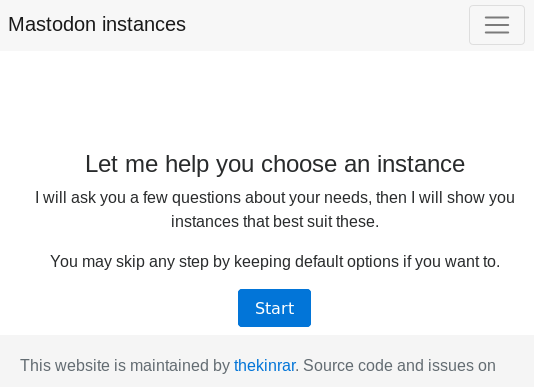
To ease the process for newcomers, it is now possible to use a great tool to select what instance should be the best to host your account.

Remember that, as stated above, Mastodon is decentralized, and as such there is no central authority which can be reached in case you have a conflict with your instance administrator. And nobody can force said administrator to follow its own rules, or not to change them on the fly. Think Twice Before Creating Your Account

If you want to create an account on an instance you don t control, you need to check two elements: the availability of the instance hosting service in the long run, often linked to the administrator or the administration group of said instance, and the ideological orientation of your instance. With these two elements checked, you ll be able to let your Mastodon account growth peacefully, without fearing an outage of your instance, or simple your account blocked one morning because it doesn t align with your instance s ideological line.

in Conclusion

To help me get involved in free software and writing articles for this blog, please consider a donation through my Liberapay page, even if it s only a few cents per week. My contact Bitcoin and Monero are also available on this page. Follow me on Mastodon Translated from French to English by St phanie Chaptal.

20 August 2017

Dirk Eddelbuettel: #10: Compacting your Shared Libraries, After The Build

Welcome to the tenth post in the rarely ranting R recommendations series, or R4 for short. A few days ago we showed how to tell the linker to strip shared libraries. As discussed in the post, there are two options. One can either set up ~/.R/Makevars by passing the strip-debug option to the linker. Alternatively, one can adjust src/Makevars in the package itself with a bit a Makefile magic. Of course, there is a third way: just run strip --strip-debug over all the shared libraries after the build. As the path is standardized, and the shell does proper globbing, we can just do
$ strip --strip-debug /usr/local/lib/R/site-library/*/libs/*.so
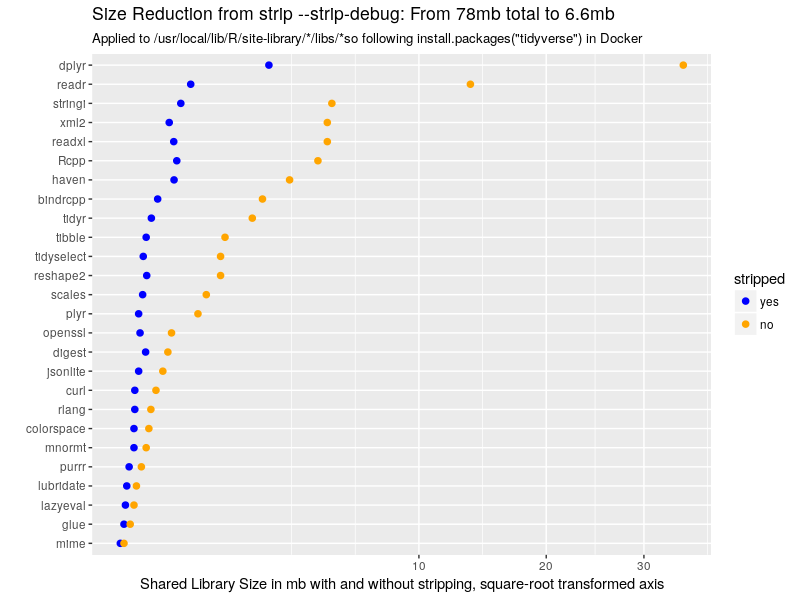
using a double-wildcard to get all packages (in that R package directory) and all their shared libraries. Users on macOS probably want .dylib on the end, users on Windows want another computer as usual (just kidding: use .dll). Either may have to adjust the path which is left as an exercise to the reader. The impact can be Yuge as illustrated in the following dotplot:
This illustration is in response to a mailing list post. Last week, someone claimed on r-help that tidyverse would not install on Ubuntu 17.04. And this is of course patently false as many of us build and test on Ubuntu and related Linux systems, Travis runs on it, CRAN tests them etc pp. That poor user had somehow messed up their default gcc version. Anyway: I fired up a Docker container, installed r-base-core plus three required -dev packages (for xml2, openssl, and curl) and ran a single install.packages("tidyverse"). In a nutshell, following the launch of Docker for an Ubuntu 17.04 container, it was just
$ apt-get update
$ apt-get install r-base libcurl4-openssl-dev libssl-dev libxml2-dev
$ apt-get install mg          # a tiny editor
$ mg /etc/R/Rprofile.site     # to add a default CRAN repo
$ R -e 'install.packages("tidyverse")'
which not only worked (as expected) but also installed a whopping fifty-one packages (!!) of which twenty-six contain a shared library. A useful little trick is to run du with proper options to total, summarize, and use human units which reveals that these libraries occupy seventy-eight megabytes:
root@de443801b3fc:/# du -csh /usr/local/lib/R/site-library/*/libs/*so
4.3M    /usr/local/lib/R/site-library/Rcpp/libs/Rcpp.so
2.3M    /usr/local/lib/R/site-library/bindrcpp/libs/bindrcpp.so
144K    /usr/local/lib/R/site-library/colorspace/libs/colorspace.so
204K    /usr/local/lib/R/site-library/curl/libs/curl.so
328K    /usr/local/lib/R/site-library/digest/libs/digest.so
33M     /usr/local/lib/R/site-library/dplyr/libs/dplyr.so
36K     /usr/local/lib/R/site-library/glue/libs/glue.so
3.2M    /usr/local/lib/R/site-library/haven/libs/haven.so
272K    /usr/local/lib/R/site-library/jsonlite/libs/jsonlite.so
52K     /usr/local/lib/R/site-library/lazyeval/libs/lazyeval.so
64K     /usr/local/lib/R/site-library/lubridate/libs/lubridate.so
16K     /usr/local/lib/R/site-library/mime/libs/mime.so
124K    /usr/local/lib/R/site-library/mnormt/libs/mnormt.so
372K    /usr/local/lib/R/site-library/openssl/libs/openssl.so
772K    /usr/local/lib/R/site-library/plyr/libs/plyr.so
92K     /usr/local/lib/R/site-library/purrr/libs/purrr.so
13M     /usr/local/lib/R/site-library/readr/libs/readr.so
4.7M    /usr/local/lib/R/site-library/readxl/libs/readxl.so
1.2M    /usr/local/lib/R/site-library/reshape2/libs/reshape2.so
160K    /usr/local/lib/R/site-library/rlang/libs/rlang.so
928K    /usr/local/lib/R/site-library/scales/libs/scales.so
4.9M    /usr/local/lib/R/site-library/stringi/libs/stringi.so
1.3M    /usr/local/lib/R/site-library/tibble/libs/tibble.so
2.0M    /usr/local/lib/R/site-library/tidyr/libs/tidyr.so
1.2M    /usr/local/lib/R/site-library/tidyselect/libs/tidyselect.so
4.7M    /usr/local/lib/R/site-library/xml2/libs/xml2.so
78M     total
root@de443801b3fc:/# 
Looks like dplyr wins this one at thirty-three megabytes just for its shared library. But with a single stroke of strip we can reduce all this down a lot:
root@de443801b3fc:/# strip --strip-debug /usr/local/lib/R/site-library/*/libs/*so
root@de443801b3fc:/# du -csh /usr/local/lib/R/site-library/*/libs/*so
440K    /usr/local/lib/R/site-library/Rcpp/libs/Rcpp.so
220K    /usr/local/lib/R/site-library/bindrcpp/libs/bindrcpp.so
52K     /usr/local/lib/R/site-library/colorspace/libs/colorspace.so
56K     /usr/local/lib/R/site-library/curl/libs/curl.so
120K    /usr/local/lib/R/site-library/digest/libs/digest.so
2.5M    /usr/local/lib/R/site-library/dplyr/libs/dplyr.so
16K     /usr/local/lib/R/site-library/glue/libs/glue.so
404K    /usr/local/lib/R/site-library/haven/libs/haven.so
76K     /usr/local/lib/R/site-library/jsonlite/libs/jsonlite.so
20K     /usr/local/lib/R/site-library/lazyeval/libs/lazyeval.so
24K     /usr/local/lib/R/site-library/lubridate/libs/lubridate.so
8.0K    /usr/local/lib/R/site-library/mime/libs/mime.so
52K     /usr/local/lib/R/site-library/mnormt/libs/mnormt.so
84K     /usr/local/lib/R/site-library/openssl/libs/openssl.so
76K     /usr/local/lib/R/site-library/plyr/libs/plyr.so
32K     /usr/local/lib/R/site-library/purrr/libs/purrr.so
648K    /usr/local/lib/R/site-library/readr/libs/readr.so
400K    /usr/local/lib/R/site-library/readxl/libs/readxl.so
128K    /usr/local/lib/R/site-library/reshape2/libs/reshape2.so
56K     /usr/local/lib/R/site-library/rlang/libs/rlang.so
100K    /usr/local/lib/R/site-library/scales/libs/scales.so
496K    /usr/local/lib/R/site-library/stringi/libs/stringi.so
124K    /usr/local/lib/R/site-library/tibble/libs/tibble.so
164K    /usr/local/lib/R/site-library/tidyr/libs/tidyr.so
104K    /usr/local/lib/R/site-library/tidyselect/libs/tidyselect.so
344K    /usr/local/lib/R/site-library/xml2/libs/xml2.so
6.6M    total
root@de443801b3fc:/#
Down to six point six megabytes. Not bad for one command. The chart visualizes the respective reductions. Clearly, C++ packages (and their template use) lead to more debugging symbols than plain old C code. But once stripped, the size differences are not that large. And just to be plain, what we showed previously in post #9 does the same, only already at installation stage. The effects are not cumulative.

This post by Dirk Eddelbuettel originated on his Thinking inside the box blog. Please report excessive re-aggregation in third-party for-profit settings.

17 August 2017

Shirish Agarwal: Composers are not given due recognition

Update Some youtube links are not viewable or even seen on planet.debian.org. Seems p.d.o. tries its best to remove external links, sorry for the breakage. Beware some youtube-links would be shared in this entry, sorry couldn t find a better/easier media platform to work with. If anyone knows any other platform or wants to suggest, feel free to either mail me or let me know in comments. I want to start today s sharing with a picture of Ganesha I saw today. It is and was public art hence sharing it without an issue. Sketch of Ganesha/Ganapati This is starting of festivities time in India and Ganesha or Ganpati is looked up as a good omen in India. The festival of Ganesh Chaturthi would be starting on the 25th of August and is a sight to behold. Just like Rio has its carnival, Ganesh Chaturthi is also a carnival. We also have parades where people come with Pandals (or temporary structures) The mythology says he has a sweet tooth (hence lot of distribution of sweets, especially modak) and anything which might be troubling people, he creates solutions for them. Here is one video of how people celebrate his immersion in India. This is from my home-town few years ago, every year the madness and the celebrations are becoming more and more. People from far off come to see how we celebrate and see how different people make their Pandals. While some are with music, others are with social messages. Usually people start going to see these structures after dusk and return home way after midnight or early morning. I hope to do this endeavour after many years. One is drunk from hearing all sorts of different kids of music, decoration, messages, a feast and a strain to all the senses. Ganesha immersion celebrations https://www.youtube.com/watch?v=hjWfpGUryho If one is interested one can find more info. at https://en.wikipedia.org/wiki/Ganesh_Chaturthi After quite a bit of time, I wrote an article about various foss internships which I knew besides GSOC over the years. I finally penned them down at https://itsfoss.com/best-open-source-internships/ Interestingly, I was amazed to see that all FOSS U.S. projects (outside of GSOC) are for students who are either living or studying in U.S. and have a student work visa (which from private discussions I came to know is lot harder to get nowadays than before). Except for the National Science Foundation (NSF) which probably has U.S. defence relations and hence they might be sensitive, I fail to understand other institutes preferences for only getting people from the U.S. and hence having a lesser talent pool of people. This also affects the growth of the projects themselves. Just think how limited Debian would have been if it had decided to only have people from only any one community develop it. Dunno if this is due to the present President Trump or these policies had been there before. It would be nice and interesting if people in the know can share. What has also been interesting to watch is Mr. Trump blaming low-cost manufacturing centres like India and China when as far as I recall, lot of manufacturing, specifically auto-mobiles manufacturing was shifted out of the U.S. to Ireland and other places years before which are relatively high-cost places (at least compared to India). I *believe* the change was as early as in 1980 s itself where India was insulated and had a limited market for everything (similar to Russian communism as shown in popular media but not so bad.) Interestingly, it took almost a month for the perl 2.56 to make the transition smoothly. It took quite a bit of time for all the components to work together and be installable. Also saw this few days back http://fortune.com/2017/04/12/auto-industry-decline/ While Tesla is expensive even by American standards the idea of lesser parts, lesser complexity and hence lower costs to use, maintain is good. I do hope that he and his team or any of the competitors do overcome the significant challenges. Any significant improvement in battery technology is bound to have huge impact in almost everything that is used in 21st century. Two recent articles tell me the future may become present very quickly. https://www.purdue.edu/newsroom/releases/2017/Q2/instantly-rechargeable-battery-could-change-the-future-of-electric-and-hybrid-automobiles.html Toyota could finally start mass producing electric cars thanks to China I do hope to see EV being prevalent before the next decade is over otherwise we don t have any hope due to climate change. As for my health, I am much better than before. Just to share some stats, before my illness for lack of better word, I was 120 kgs. , when I was kept in the hospital for about 2-2.5 weeks I came down to 95 kgs. and now back upto 108 kgs. Do go for exercising every other day and trying to get back the strength, stamina and increasing a bit of both. Doctors have given me another 4-5 months after which a brain scan will reveal if there are any remaining blood clots in the brain or not. Lastly, while it has become somewhat of a sensitive issue to love Muslims or to talk about their work in any field in the current political climate, there are 4-5 music pieces I listen whenever I can, especially before going to bed. While almost all the pieces have been sung and written by Muslims, sadly I don t know who the composers of these beautiful songs are. While it is much easier to get the names of the singer and the lyricist, one of the more important roles in my view is the composer or/and music arranger. Without them, the songs would not have the same haunting quality that the songs have. While I have been lucky to find the names of the composer/music arranger for the pieces below but this is not the case if and when the songs comes on television. I do remember in old times at least on Radio they used to mention about who has given the music as well, dunno in modern times. I am sharing the songs, and hopefully will also share the translations if I find on the web, please see the lyrics. The numbering is for convenience only and am torn in these 4-5 songs which is the best. Just to share these are all sufi love songs except the last one which I am sharing. 1. Lyrical song https://www.youtube.com/watch?v=ehqN6oTpmb8 Translation with video of song http://www.bollynook.com/en/lyrics/6443/aaj-din-chadheya/ While there probably are stories with each song, I was lucky to find the story about this one. The lyrics of the song are actually a love lost Punjabi poet who writes in the memory of his beloved to which he could not marry and he pens those when standing in line for his liquor. The story goes on that he marries a girl later in life who bears a resemblance to his beloved whom he couldn t forget till his dying day. 2. Lyrical song https://www.youtube.com/watch?v=uTC_2c83qn0 The same song has been sung by different people and I love them all the more for it. Another video https://www.youtube.com/watch?v=3G7Qg4LJ7WE Another video https://www.youtube.com/watch?v=kOsvNuR3m5Y Translation http://www.bollynook.com/en/lyrics/10703/o-re-piya/ 3. Lyrical song https://www.youtube.com/watch?v=qG7Kms_YA5Q The translation http://www.filmyquotes.com/songs/885 The translation of the song is a bit crude but then translations are supposed to be crude  Anyways, the above song is what would be called a perfect Sufi song. I hope people enjoy the longing and the silence which follows this piece. Another classic one 4. Lyrical song https://www.youtube.com/watch?v=Ube5XhN_lpM English translation http://www.ardhamy.com/song/aye-dil-e-naadan While the song is from the movie Razia Sultana and was a flop as the movie was about Race and controversial then as it probably would be now. As seen in the other songs of the same genre, it has strands of longing, loneliness as seen of the above. 5. Lyrical song https://www.youtube.com/watch?v=tv242qOnHJA This one is not a sufi song but I love all the women and the girls and the way they enhanced the song. I dunno how much they must have practised as it s a very fast and peppy song and doesn t give time to the singer to breathe except for that one section which has a bit of Carnatic music. At the very end I would like to share http://www.globalrhythm.net/ I have found some interesting sounds on the site. Hope the site enriches you as well. FWIW I have no links with the site except as somebody who likes to diversify his music listening. Lastly, for a long period of time, I had been hearing the criticism, especially for FOSS games that they don t have AAA quality assets. Recently I came across a game called Starship Theory (sadly its only for MS-Windows) Game video https://www.youtube.com/watch?v=imaL2pjNURg You look at the game and see the number of videos the guy has made. What FOSS game developers can learn from this, you don t need high-end 2.5/3d models, clipart will do but need depth in gameplay which can make FOSS games be popular and also earn a pretty bundle. I do hope some FOSS game upstream developers take note and use that game s inspiration to bring more depth. That doesn t mean games like 0ad are not liked by people but it takes huge amount of time and resources. 0ad video https://www.youtube.com/watch?v=DHx5XBtypcQ Hope you have a good time with all the ideas, anecdotes and videos I shared above.
Filed under: Miscellenous Tagged: #FOSS Internships, #Ganesh Chaturthi, #Ganeshji, #planet-debian, #Sufi Bollywood Music, FOSS, FOSS games, politics

13 August 2017

Mike Gabriel: @DebConf17: Work for Debian and FLOSS I got done during DebCamp and DebConf... and Beyond...

People I Met and will Remember Topics I have worked on Talks and BoFs Packages Uploaded to Debian unstable Packages Uploaded to Debian NEW I also looked into lightdm-webkit2-greeter, but upstream is in the middle of a transition from Gtk3 to Qt5, so this has been suspended for now. Packages Uploaded to oldstable-/stable-proposed-updates or -security Other Package related Stuff Thanks to Everyone Making This Event Possible A big thanks to everyone who made it possible for me to attend this event!!!

Next.

Previous.