Search Results: "otto"

17 October 2006

Russell Coker: clean energy

There are many people claiming that nuclear power will solve all the ills of the world. However this does not seem to be possible. Firstly you have to consider the hidden costs of nuclear power such as deaths from the mining industry (ingesting uranium ore is a really bad thing) and the difficulty in disposing of radioactive waste. But rather than concentrating on the bad aspects of nuclear power (which are well documented) I will concentrate on some of the viable alternatives.

Wind power is a really good option, particularly for countries such as Australia that have a low population density and a large land area. The Chinese government is investing heavily in wind power, I think it's safe to assume that it's not because they are great environmentalists but because they simply need more energy than they can get from other sources and that they have strategic reasons for not wanting to rely on Australian coal and uranium or Arabian oil. Most energy sources have some drawbacks, but wind power has no side effects and isn't going to kill birds either (birds have evolved the ability to detect and avoid predatory birds, they can easily avoid large fixed objects such as fans from wind farms).

Two other good options are wave and tidal power. These are better than river based hydro-electricity because there is no need to create dams that remove forests. Wave and tidal power are both very predictable which is an advantage when compared to wind power which is less predictable. One solution to the unpredictability of wind power is to couple it with a river based hydro-electric system which can provide electricity when there is less wind. A hydro-electric system to compensate for days that are less windy would need a much smaller dam than one that is designed to provide the main power source.

The next issue is how to power vehicles (on air, land, and sea). Advocates of nuclear power often talk about hydrogen powered cars. However while hydrogen has a good ratio of energy to weight it is not very dense, so the energy density for volume is much less than petrol. Combining Prius technology with
hydrogen in an internal combustion engine still won't give the distance per tank of fuel as petrol does. Hydrogen with fuel cells in an all electric vehicle might allow you to drive the same distance as a non-hybrid car on petrol, but probably won't compare to the range of a hybrid Diesel vehicle.

Bio-Diesel is a good option for fuelling cars. Diesel engines give greater efficiency than Otto cycle (the most common car engine) or Atkinson cycle (as used in the Prius) engines. Not only is bio-Diesel renewable but it also produces exhaust that is less toxic than that which is produced from fossil fuels. See the VeggieVan site for more details on bio-Diesel. The toxic fossil fuels are linked to health problems in airline hostesses, AFAIK there has been no research on the impact of car exhaust on pedestrians.

One thing to note about bie-Diesel is that you can do it right now. According to a British TV documentary all you have to do is filter oil that was used for frying food (they used oil from a Mexican restaurant) and mix it with a small amount of ethanol and it's ready to use in your car. As restaurants currently have to pay to dispose of old frying oil this should be good for everyone!

Bio-Diesel could work for powering planes, there is already research in progress on this issue, but there are problems related to the viscosity of bio-Diesel at low temperatures. Maybe a blend of bio-Diesel and bio-Ethanol would work. Ethanol freezes at -114.3C and should lower the freeze temperature of bio-Diesel.

Bio-Diesel would of course work really well for ships. Supplying the amount of fuel that current ships need would be difficult. Some analysis shows that the deck area of a ship can collect enough sunlight to supply ~10% of the power needs of the ship. The Orcelle is a design for a totally clean ship that runs on solar, wind, and wave power. However with the proposed design the solar panels will not be angled effectively for collecting sunlight as they will be on sails. I think that there is a lot of potential in having a design based around sails, wave and solar power for generating electricity, and also a Diesel engine running on bio-Diesel fuel for supplying extra power when required (EG when sailing at night in calm weather). Building a ship that uses only wind, solar, and wave power would probably be significantly more expensive than the current Diesel design. Building a ship that uses 10% Diesel and 90% wind, solar, and wave power might be a lot cheaper.

There are lots of ways of producing the energy we need to maintain our current standard of living. If our government was to spend as much money researching them as it does protecting petroleum reserves then the problem would be solved.

4 October 2006

Ben Hutchings: DebConf6 DVDs, release candidate 1

Now at http://womble.decadent.org.uk/software/debconf6-dvd/. There are no images for download because it takes too long for me to upload them, but it should be easy to build a DVD; that page refers to everything you need.

If you ran a session, please check that it's correctly categorised (no need to build; just browse the menus online).

If you can, please build a DVD and check that it works in your players. I'm particularly interested in results from hardware players as I can try software myself. I know that ogle in stable doesn't like the videos but it seems to be the odd one out. Please check that menu navigation is sane and videos play as expected.

Barring compatibility problems that need to be fixed, the only change I intend to make before release is to reinstate the logo in the menus. Then I should upload images and offer discs for sale starting next week.

ETA:There was one other thing to fix: the glitch at the bottom of the group photos is a Mozilla bug which I will try to work around by doing the v1.0 build in sid.

24 September 2006

Brett Parker: Django Packaging

Well, I've been added to the python-modules project on alioth and am looking at getting the django development in there over the next week, just need to get my head round how this works first and checkout Raphael Hertzog's repackaging of the 0.95 debs that I did in to the new python policy style. Will also need to work out what to do about different python versions, django-admin.py would need to call the right python depending on some setting - not sure how to do that yet - with the previous format there where just 2 different python-django packages for the 2 different versions of python, and then an alternative to point to the "right" django-admin.py within site-packages of the correct python directory - with the central install this is going to be more interesting. Any thoughts on this gratefully recieved to my email address (linked from the bottom of my website.

21 September 2006

Adam Rosi-Kessel: Unity Rally in Roslindale

Massachusetts held its primary election yesterday and strangely enough, my preferred candidate for governor, Deval Patrick, won overwhelmingly, by a nearly two to one margin over both of his competitors. In past years, the primary election has been followed by a “unity breakfast” the next morning so all the losing candidates can pledge fealty to the winner. As the breakfast has become a tired tradition identified with “old politics,” they did away with it this year (perhaps at Deval’s urging). Instead, again to my surprise, they held a unity rally about a block away from my house in Adams Park (no relation) in Roslindale. Deval was introduced by Boston Mayor Menino, a politican who has somehow turned a complete lack of public speaking skills into an asset: Deval’s speech was pretty great. A little something for everyone, and genuinely engaging. I attempted to record it on my pocket MP3 player, but apparently I ran out of batteries early on so it’s not worth posting. Although Deval has been cast as the furthest left of the candidates, I was struck by his extremely moderate position on most issues. (Standardized testing: good, but needs improvement; economics: need to have several bottom lines, including a profit bottom line and a people bottom line; personal responsibility needs to be balanced with societal responsibility; etc..) Anyway, the crowd loved it: Apparently there was no experienced political handler present to orchestrate this event. Deval’s charismatic speech was followed by several less important and less eloquent speakers. Usually, you would want to build up from worst to best. In any event, Chris Gabrieli, the second place finisher, has rebounded instantly and was up there committing to work every day until November on getting Deval elected — I won’t be surprised if Gabrieli ends up in a development-czar role in a Patrick administration. The last place finisher (and original frontrunner) Tom Reilly was nowhere to be seen, a fact that I’m sure will be prominent in tomorrow’s reporting on the event. Where’s the unity without the Attorney General? Everyone’s bracing for a horrid onslaught of fear-mongering campaign ads from the Republicans. My hope is that Massachusetts citizens are a bit wiser than the rest of the country and it will backfire. I won’t hold my breath, however. (As a side benefit, I finally met Adam Gaffin, universalhubmeister, for the first time, as well as his eight year old daughter Greta. Greta is now famous for rejecting Deval Patrick’s plan for longer school days.)

20 September 2006

Stefano Zacchiroli: hello world

Hello (ikiwiki), World!\n ikiwiki succeeded where other competitors failed: convincing myself to set up a blog. This is the unavoidable "Hello, world!\n" post. Thanks Joey for this valuable piece of software, I love the subverted wiki concept and I('m starting to) like also the markdown syntax. Still, the experience in setting up the blog has not been painless, here are some rough edges I haven't yet addressed with ikiwiki (IOW dear lazyweb section from now on): Again and nonetheless, kudos to Joey for ikiwiki, it rocks!

19 September 2006

Clint Adams: Draft Debian Code of Business Conduct

The following Code of Business Conduct ('the Code') has not been approved by the Board of Directors of Debian, SPI, or any U.N. committees: Debian and its subsidiary companies operate in many different markets and countries throughout the world. In most instances, we respect national laws and industry codes of conduct. We, the directors and employees of all companies under the Debian umbrella ('corrupt fuckers'), recognize our obligations to all who have a stake in our success including shareowners, clients, employees, and suppliers, unless those obligations run counter to our profitability; Information about our business shall be communicated clearly, and accurately in a non-discriminatory manner and in accordance with local regulations, unless doing so would impact negatively our profitability; We select and promote employees on the basis of their willingness to support our aims and their potential for profitability, without discrimination or concern for race, religion, national origin, creed, sex, sexual orientation, age, disability, or scruples, as long as doing so would improve our profitability; We believe that the Debian mailing lists should be safe and civilized; we will not tolerate sexual harassment, discrimination or offensive behavior of any kind, which includes the persistent demeaning of individuals through words or actions, the display or distribution of offensive material, or the questioning of our integrity, unless such tolerance would improve our profitability; We will not use, possess or distribute illegal drugs or software, unless doing so would improve our profitability; We will treat all information relating to Debian's business, or to its clients, as confidential. In particular, 'insider trading' is expressly prohibited and confidential information must not be used for personal gain, unless such personal gain is acceptable to at least two of the persons involved; We will not knowingly create work which contains statements, suggestions or images offensive to general public decency and will give appropriate consideration to the impact of our work on minority segments of the population, whether that minority be by race, religion, national origin, creed, sex, sexual orientation, age, disability or scruples, unless that minority can be safely ignored without damaging our bottom line; We will not for personal or family gain directly or indirectly engage in any activity which competes with companies within the Debian umbrella or with our obligations to any such company; We will not offer any items of personal inducement to secure business. This is not intended to prohibit appropriate entertainment, the making of occasional gifts of minor value, or any monetary contributions transferred through PayPal, unless the client has a policy which restricts this; No corporate contributions of any kind, including the provision of services or materials for less than the market value, may be made to politicians, political parties or action committees, without the prior written approval of the DPL and a clear assessment of the rate of return on the investment; and we will comply with all applicable local laws and regulations, and any other laws with an international reach, such as the US Foreign Corrupt Practices Act, where relevant; We will disclose fully to the DPL the nature and all relevant details of inducements paid to us by external parties, whether or not such inducements affect our judgments and actions, and we will accord the DPL a percentage of such inducements for use in re-election campaigns or discretionary spending; When we engage in bookmaking, the standard vig should be 10%, and any exceptions should be appealed to the Racketeering Committee, a self-selecting committee with no external oversight; We will not NMU or hijack any packages if the maintainer is refusing to act on said packages as part of a negotiation for inducements; We will not underbid our colleagues in the midst of such negotiations; We will always assume that any inaction or incompetence is due to such negotiations, whether or not that has been disclosed, as it is often the wish of the persons involved to keep such dealings hush-hush; We will spout trite falsehoods such as We are all volunteers here , and At some point you just have to trust people , as a standard business practice; We will avoid sarcasm at all costs.

13 September 2006

Clint Adams: and the ragged tiger

We were occupying the entire park bench when the strange girl approached. She was strange in the sense that we had never seen her before; in the grand scheme of things she was not all that strange. I mean, she was wearing bellbottoms, which was not the norm, and her feet were caked with mud, which might have indicated inclinations toward being a neo-hippie, and while that might be pretentious and lame, it's not all that strange, considering. Eying the occupants of the bench, she asked if any of our laps were free. The art of sitting on someone's lap is largely a lost one; I don't know where people learn the proper technique, but I do know that most people don't even know it exists to be learned. I know that I was surprised when it was revealed to me. Anyway, I never discovered whether or not she knew how to properly sit on a lap, because we all kinda glanced at each other and told her to fuck off. Two days later, she was screwing the guy to my right. That didn't last long. Neither did her mode of dress or her behavior. She lopped off her long, brown hair, bleached it blond, and got a few facial piercings. She started doing heroin and boasting that she gave the best blowjobs in a certain geographical region. She shacked up with a girl named after an invertebrate. I'm guessing that she didn't continue on to greatness. Then there was another strange girl. She was strange because she was stuck in the 50's. She was also as dumb as a rock, so the only two interesting things about her were her 50's fetish and her profoundly deep bass voice. When I say she was stuck in the 50's, I don't mean that she lived through them and failed to move on. I mean that she wore saddle shoes, sported memorabilia from the golden age of rock and roll, and became very hostile when anyone challenged her adamant insistence that no good music was ever produced after 1959. Her sister was a model, also as dumb as a rock, and with the same freakishly low voice. Her sister was also a giant slut. In contrast, 50's Girl publicly had sex with a 50-year-old guy while his wife and kids were in Virginia. Having sex in public is generally bad form. I know this because the last time I tried to have sex in a moving vehicle, the driver forbade it. Actually what she said was that we weren't allowed to have sex in her car until she had done so first. Then she proceeded to never have sex in that car, which I thought was a rather rude and deceptive practice. Anyway, 50's Girl met this schmuck with spiky hair, piercings and tattoos galore, combat boots, and a penchant for crashing motorcycles. Really, you didn't need to look far below the surface to know that he was a festering douchebag, but if you did, you would find out that he was a pathological liar and backstabbing snake. They hit it off, and just like that, the 50's persona was cast to the wind. She dyed her hair some sickly color, started dressing in leather and listening to hardcore. Her elderly friend, who had little trouble relating to clinging to the 50's, now suddenly found herself in the position of possibly needing to get herself a subscription to some kind of magazine. Not too far away, a lollergirl took a break from plumping up and spotted a ticket. If you were lucky, she told you about it.

9 September 2006

Antti-Juhani Kaijanaho: Wil Wheaton reviews TNG

Y’all remember Wil Wheaton? He was Gordie in Stand By Me, Wesley in The Next Generation, then disappeared, then started blogging, wrote some books, … Now he’s reviewing Star Trek: The Next Generation episodes (contains spoilers). The first is now available. Wil’s resentment of how the writers treated his character on TNG has been known for a long time. Perhaps the most entertaining aspect of the review is Wil discussing the lines he was given:
[….] I also got to say lines like, “So you mean I’m drunk? I feel strange, but also good!” In fact, John D.F. Black — who I didn’t realize at the time hated me — also wrote Justice, where he gave me the awesome line, “We’re from Starfleet! We don’t lie!” Thanks for that one, too, Mr. Black.
But the review is not just snarking agains former bosses, it is a real review. It contains a synopsis (spoilers, beware!), a personal behind-the-scenes memory, a (very!) memorable quote, and an interesting take on the “bottom line”. I’ve always liked Wil’s writing. This one is not an exception.

4 September 2006

Neil McGovern: Microsoft causes software piracy

Over the past three years, my girlfriend's computer has been running slower and slower. This isn't a huge surprise, as it's running Windows XP, which seemingly becomes bloated as time passes. Thus, it came time for a reinstall, or at least some major clean up.

First, she backed up all her files, and checked there was nothing else needed. She found the original software that came with the laptop, and gave them, an d the laptop itself to me. It didn't come with a Windows XP cd, but being a Toshiba laptop, from PC World, it has a 'System Recovery' CD. So, I duly inserted that, and started the full install. After about an hour, the system rebooted into Win98. I wasn't happy.

This computer has a valid WinXP product key on the base, so I decided to find my own media and install using that. After finally getting hold of a copy, I install, and it states that the product key is invalid when I try and activate windows. I decide that something must be wrong, as it's on a sticker on the bottom of the laptop, so call Microsoft. Microsoft then nicely tell me that the product key is indeed valid, and if the installer isn't accepting it, I should contact the people I bought it from.
For the benefit of non-uk readers, PC World are the lowest of the low (IMO) when it comes to computer services. They really do not know their arse from their elbow. I will not be calling them, as they want to charge £1 per minute to talk to me about fixing their fuckup. Which they won't do, because this is out of warranty. I've been through this before.

So, despite this computer having a LEGAL licence for Windows XP, it now is happily running an ILLEGAL copy of Windows 2000 Pro.

If anyone from PC World, Microsoft or Toshiba read this: congratulations for making the installation of Windows XP so hard to illegally install that legal licences don't work.

3 September 2006

David Nusinow: More Steering Committee

I'm glad people have reacted in a largely positive manner to the steering committee idea. It's not really original, but I'm perfectly happy with stealing ideas from other people. I'm going to clarify a few basic ideas here and then address criticism.

The biggest difference between Debian and someone like Canonical or Redhat is that we don't pay employees to do things. We could go that route, but a defining feature of Debian is that it has a bottom-up structure, rather than top-down. I think this makes us unique and we need to do our best to preserve it. I imagine the steering committee to be an extension of this model.

First, the committee would be not be elected by the developers, but would instead be delegated by the DPL. Developers could challenge this delegation in the same manner as any DPL decision. The committee would be very similar to the technical committee in terms of size.

Second, its scope of power would be similar in that it would only relate to the distribution itself, rather than the way the Debian project itself was organized. Its powers would be limited to approving specific improvements within the distribution. These improvements would have to be submitted for approval by the committee, preferably in some sort of specification format similar to the one Ubuntu uses. The committee would then vote on the issue (most likely following the same rules as the technical committee). If they approve it, anyone is free to work on that specific improvement even if it touches on packages they don't maintain. This allows motivated developers to freely work on cross-distro improvements without worry. The committee would ideally be relatively quick to reply to submitted proposals, allowing fairly rapid developments to occur (to facilitate this, proposals must be well thought out).

Further, like the release team, the steering committee would also be responsible for actively working on goals that are set. This would ensure that something actually does get done. These features would give us a group with a limited scope of powers to implement large-scale improvements to the distribution without forcing anyone to do work they don't want to do. In addition, motivated people would have the authority to make large-scale improvements (like consistent theming for example) across many packages they don't maintain. People working on these improvements would be expected to try and cooperate with the normal maintainers as well as possible, so as to prevent problems. Maintainers who have issues can appeal to the technical committee, whose role would remain reactive to solve conflicts as they arise.

Ok, now for the critique from ij, which is a good one. I think the problem with what you suggest is that the DPL simply isn't going to be capable of acting like a good dictator without working full time on Debian for several years. The job is just too big. Allowing them to remain DPL for more than a year is something I don't think many DPL's would opt for anyway, it's just too draining.

The other existing structure is the technical committee, which is a better candidate for taking on this sort of role. The key to the tech-ctte though is that its job is to handle technical disputes. We could expand its role to allow it to set policies and direction, but then who do you appeal to if you don't agree with them? The developer body can override the tech-ctte (with a 2:1 majority) but that adds additional democratic overhead. GR's are draining, and providing another layer for technical decision making allows us to avoid them. Further, I'd like the steering committee and tech committee to have different modes of working. I imagine the steering committee to be more agile, taking a leading role in setting out a vision for the mass of developers to follow and take inspiration from. The tech committee, on the other hand, should be more defensive, carefully deciding on the most difficult issues. Basically the steering committee will looking towards the future, the tech committee will be looking towards the present.

Martin F. Krafft: Never give up

Scott, the first thing I want to say in response to your post is that you are not alone. I did not know someone was attacked for wearing an Ubuntu shirt in Helsinki, but I did witness at least one "Fuck Ubuntu" incident, and it seemed that Ubuntu jokes and snaps at the new distro were very common. I find this utterly childish and stupid. I am sorry for everyone who was offended. But please don't blame or condemn everyone in Debian or the whole project for the actions of some of its members or followers. You've already linked to my thoughts on the Ubuntu-Debian situation, so I need not cover any of that anymore. I wouldn't want to either, because believe it or not, this article got me flamed by Ubuntu developers just way too many times, in personal mails as well as in forums. Instead, let's look at the now and then this time. I've heard a few developers express their unhappiness with Debian in the past year, much in the same way that you did. Not always was it related to Ubuntu, but quite often it was. There are newcomers to Debian who shake their head in disbelief how anyone can work in a project such as Debian, and there are the veterans among us who seem to concede that Debian has slipped away from their ideals and it's just not fun anymore. It's not hard for me to understand each of them. I've followed Debian for nearly a decade now and thus tracked how it changed over time. We are one of the largest free software projects, and size never comes without problems. So while the Debian project used to be an association of geeks enjoying their focus on technical excellence, the sheer growth of our project called for many other fields to be managed, and we did not always handle this increase in complexity very gracefully. After all, we are all just geeks who want to have fun, aren't we? As a result, several aspects of our project have been said to "stagnate", and parts (and parties) have diverged. As a volunteer developer, it's not always fun to run up against walls and find that your innovativeness is met with stubborness or simple silence. I say "not always" because I think it's really just a matter of perspective. Over the years, Debian has seriously affected my life, the way I look at things, the way I interact with people, and the way I do stuff. I am eternally grateful for much of that. But the learning process has not stopped. What Debian needs is a stronger grasp of the big picture. In joining all the other developers who are already doing excellent work in that direction, what better learning opportunity could there be to approach large-scale project management, away from academia and the corporate world. For me, this is a very interesting perspective of a fascinating project, one that directly relates to my current research endeavour. I was asked recently how we "control the anarchy", and the first thing I said was that "control" was not the right word. Debian is not about control, it's about the flow. If it's not going your way, you can swim against it, you can pull out, or you can try to find ways to change that flow, bottom-up rather than top-down. I think David's idea of a steering committee is an excellent one, and I'd be happy to dedicate time to such an effort. I wouldn't call it "steering" though, as that seems too active. Rather, I envision a group of people dedicated to keeping track of the big picture (obviously in close contact with the release team) to which developers can turn if they need advice. In the last few years, I've often asked myself why the heck I don't just give up, instead of continuously running up against problems that seemed hopeless. Even now, I sometimes think that I should have just pulled the plug, but my answer has always been no, and it looks like it'll remain that way. Why? Because we've come an incredibly long way, and that by itself provide for a lot of motivation. Mostly, however, I decided to hang in there because I tend to like challenges, even if at first I have no idea how to conquer them. When I then look at what some of the people are doing for the project, I come to realise that there are solutions, even if the road is a long one. You (Scott) strike me as a very innovative person, and not only because the problems you and I are looking at tend to overlap to a large degree. I strongly respect you for your work, and Canonical certainly deserves a tip of the hat for providing you with the environment to do so. Sometimes, I even envy you a little, simply because I haven't been able to get down to coding solutions as much as I would have liked to and you've beaten me to the punch on things like HCT or upstart -- even though my work in that area has been mostly vapourware, so there was no real punch to which you've beaten me... I think you'll know what I mean. Yet, scanning some of your older blog posts, I got the impression that you weren't always happy with the way you have to do things at Canonical. And still, you're enthusiasm for working on your projects is astounding; it wasn't hard to come to that conclusion just a week ago, even though we've only talked briefly in Cambridge. Have you asked yourself why that is? I'll go out on a limb and postulate it's because of your innovativeness, because of your urge to push technology further, to implement cool things, and to break free of the cruft that comes with 13 years of Debian and several decades of standards la POSIX and SysV. Debian is too conservative for you, and all the cruft weighs heavy. Ubuntu, on the other handy, is "fluffy" and not afraid to forge ahead, and you've been an active part of it from day one. As much as I hate to see you "with them" rather than with us, I think you've found your place. And so have I. I'm less about coding than I am about integration, and there's work to do. Debian is a massive project with an amazing track record of achievements to look at. And it has problems. Well, great! Let's attack them. Never give up. Another reason why I've stayed with Debian is because there are people who think alike. Three years ago, I would have been able to give you a long bullet lists of hopeless problems in Debian. If you ask me today, I would have problems arguing their hopelessness, for I've seen plenty of developers taking it up with these problems, and in the meritocratic way. Our release team is doing a fantastic job and I've never felt so positive about the promise we made with the next release. People like J rg, Zobel, Rapha l, the two Alex, Meike, Christoph, and the many others I'll leave out only in the interest of brevity (the list is longer and doesn't only span Germany and France) are doing great work, and that is truly motivating. And I ought to mention explicitly our leader, Anthony, who's been doing an excellent job so far. I hope he can keep it up. Also, take a look at our IRC channels. I would have to be lying if I'd say nothing has changed. And the same applies to mailing lists. We still have a reputation to deal with, but if you stop listening to what people say and actually take a look, I think we've come a long way. I'd even say it's become more fun to work on Debian again! I think we owe a lot of that to Debian Women. I am definitely proud to be a member of this community (with which I mean Debian as a whole, not just Debian Women). I think I could continue this blog post endlessly. Let's not. You (Scott) may not be a fellow DD any longer, but you remain a fellow D, and I hope we'll continue to let our cooperation prosper. Now if only you had told me that "getting upstart installable required changes to twelve different packages, including sysvinit itself" when you approached me with what sounded like a simple sponsorship request... I've started to have a go at the "herculian effort", step by step. Seems like an interesting experiment. NP: Eels / Daisies of the Galaxy (it's really hard to find a better band for a grey Sunday morning) Update: Maybe our reputation isn't all that bad, or Slashdot posts suddenly became all useful. A lot of insightful and interesting posts in the first batch of comments...

31 August 2006

Wouter Verhelst: "pissing contest"

Thanks for a nice metaphor, Gunnar.

b3co.com
Not very impressive, I know, except if you consider the "City Rail" icon there ;-) I'm also not very sure about the Paris one; it could've been the RER one instead. But hey, it was over six years ago. Additionally, Helsinki isn't there, even though I've been to that city; but then I haven't been in the metro there. (occasionally, the logo for the M nchen U-bahn is on that site, all down the bottom)

29 August 2006

Jon Dowland: Debian BBQ

people
This weekend I was at Steve's House in Cambridge for the 2006 Debian BBQ. Many thanks to Steve for hosting a great party!
flames
There was a spectacular turnout of people. It was nice to see people I've met at UKUUG conferences and such like, but also nice to meet some new people, including Europeans who had ventured over. There are some of pictures from the weekend on flickr, but they're not very good because my camera was broken (more on that another time). There are some (much better) pictures linked at the bottom of this wiki page. On a related note, I'm sad to see Matthew Garrett resign from Debian. He joins several others including Scott James Remnant (both of whom were at the BBQ) who have made the move to "full time" Ubuntu, having realised that Debian just wasn't fun for them anymore.

23 August 2006

Amaya Rodrigo: Murphy's Power Supply

Short summary: Server down.

Isn't Murphy absolutely lovely? Hardware will, of course, break on weekends.

The light in my kitchen's ceiling stopped working a month ago. I changed the light bulb, a week ago, but it didn't help, so on Friday I asked H ctor to take a look at it. Absolutely low priority. The cable was literally roasted, so he asked me to cut the power off, in order to replace the cable. I did, without remembering to propperly power off the server. What are journalling filesystems for anyway? The UPS battery used to perform much better, oh the decay, so the server is abruptly shut down after a couple of minutes. As H ctor was not able to "quickly" fix the kitchen light, and I was not in a hurry, and do not really care about the damn light, we just didn't look at it any further. So far so good.

Some hours later, at midnight (maybe that's technically Saturday, but it really felt like a Friday, I swear to the allmighty vegetarian spaghetty monster with no meat balls whatsoever), I try to power the machine up. And a sadly familiar ritual is about to be performed. Since I moved the server into "the run down attic I call home" I dreaded the moment I had to reboot the machine. It would come up, you could see the blue case fans light up and spin, the hard drives and CD drives be initialized, but no beep, no POST, no nada.

Aenima, my solu, my baby, my serverThe ritual dance would consist of me submissively kneeling down to power on and off in a random sequence the back switch, the front one, the UPS, the reset buttom, curse, turn it completely off for random amounts of time, pull the cable in and out, curse some more... never really finding out when or what would make it fully come to life. But eventually it did, after 5, 10, 15 minutes, without any reproduceable pattern, it did. Not on Friday night. Or saturday. I spent most of the night (until 6 am) performing the ritual, googling like crazy, fustrated and eventually plain angry. All I could find was "the mobo is b0rked, exchange it". But I knew it was not. I knew the CPU was fine, the MoBO was fine, the memory was fine, because when I finally managed to get it to power up, all worked well!

But Miry came home and helped me out, coming up with a valuable clue: The mobo was not getting enough power form the PSU, so I got a spare PSU from H ctor and swapped them. The baby came up instantly. So I was very pissed off.

The good thing about it all is:
- I learned that power supply units sometimes fail. Even my wonderful, 100 EUR BQuiet! PSU.
- I missed completely all of the udev fun. Well, at least on my machines, but there's a couple of people I needed to help out today.

On Monday I got a new power supply, it is a joke of a plastic, for SM's sake! plastic!?, PSU with a couple blue fans. Pics of old nice one and crappy new one here. My sitting room looks like a space craft, and sounds like a plane is about to take off. The cats have not complained yet. They have not disconnected my land line (yet).
Update: The reason I bought this PSU is I have quite a big case, a case I can ride! So I needed Log cables. And I had to go for a cheapo modder plstic thingy, simply because I could not afford anything better.

I hate hardware.

New and old PSU

17 August 2006

Aigars Mahinovs: Secure flying

If one really wants to make international flying perfectly safe (at least safe from terrorists masquerading as passengers), it is in fact very simple and quite cheap: * No carry-on or check-in luggage at all (all kinds of chemical, bacteriological or radioactive materials could be hidden there, for example it can be trivial to make a laptop burn up in flames mid-flight and make in in non-detectable way). * No personal items of clothes (clothes can be soaked in certain chemicals to make them explosive). * Secure passengers during the flight ( so that they can not actually do any terrorist activity). So, the optimal way of securing air transportation would be to have people come in without any luggage at all, remove all items and clothing at check-in, dress in uniform one-time paper clothing where one can not hide anything, sedate them, feed them trough introspective inspection to detect in-body foreign objects and check the chemistry of skin and hair, pack them into the airplane on secured padded shelves, fly them to the destination, reverse the sedative and give them a standard set of clothes and essential personal items. In addition to perfect security, this plan will also reduce the overall cost of air travel by allowing to pack more people into an airplane of the same size - the padded shelves can go from the bottom of the airplane to the very top with minimal spacing (all passengers are sedated - they will not walk around), no separate cargo hold will be needed (no luggage) and no in-flight entertainment or food will be required. If the current security craze continues, we might reach this perfection by 2020. Congratulations! Note: All software by that time will be Web-based, so there will be no sense in taking your “personal” laptop with you.

13 August 2006

Adam Rosi-Kessel: Return to Traverse City Film Festival

We spent last week at the Traverse City Film Festival in Michigan. This was the second year of the festival as well as our second year attending. Unlike last year, there was no “Freedom Festival” organized by Michael Moore-haters this year. Perhaps they are still recovering their debts from last year, when they lost money and had to stop their showing of “Michael Moore Hates America” after discovering it had inappropriate language for the family audience they were targeting. We saw nine films in just five days — four in one day was our max. (Rachele saw one more — The Beauty Academy of Kabul — that I missed, unfortunately, and we gave our tickets to Jesus Camp to Rachele’s parents.) Our selections were: The one that sticks most in my memory is La Moustache. The essence of the plot is revealed in the first minute of the movie: a man shaves off his mustache. His wife of fifteen years doesn’t notice. In fact, she doesn’t remember he ever had a mustache. While the film starts as vaguely comic, it quickly spirals into a psychic breakdown with a possibly unreliable narrator. It was quite nearly perfect. The beautifully restored virgin print of Monty Python’s Holy Grail was astonishing. The film was shown for free on a large outdoor screen by the lake, and the sound was crystal clear (now in stereo!) no matter where you sat. There are a bunch of scenes everyone always remembers in the Holy Grail. I realized after watching it again that the movie is composed entirely of these memorable scenes. (I had the same feeling watching the Wizard of Oz after a ten to fifteen year hiatus recently.) Finally, Stanley Kubrick’s first film, The Killing (1956) also merits the maximum rating, whatever that is (5.5 stars?). While it lacks the surreal/experimental feel of his later films, Kubrick was already beginning to play with narrative structure and sequencing. The film walks through the events leading to the climax several times, each time from a different character’s point of view. But really it’s just a great heist flick. Mani Haghigi, the Iranian director of Men at Work, had an interesting observation about the festival. Unlike most other film festivals, he, as a director, could just hang out and enjoy the films and the company and not worry about impressing executives and distributors. The festival’s motto is accurate — “Just Great Movies.”

8 August 2006

Ross Burton: Cornish Bliss (part 2)

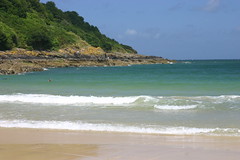
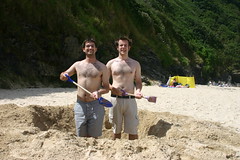
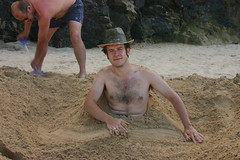
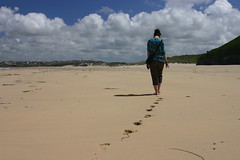
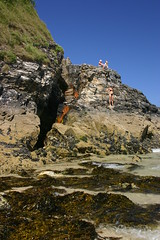
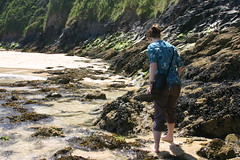
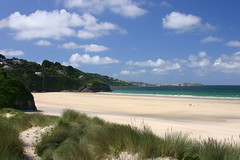
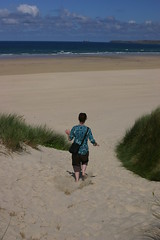
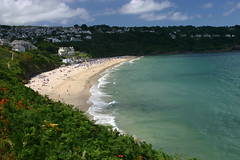
Now, where was I... Carbis Bay Carbis Bay Ah yes. After the horrendously grim weather had passed, the weather improved and we headed for the beach. On the way down we commented on how this was the classic British burning weather: bright sunshine, a strong breeze, and occassional clouds combine to burn skin without even feeling that hot. Of course knowing this meant nothing, we were too distracted with purchasing pasties and drink to think about putting a decent amount of sunblock on. Steve Relaxing Obviously the main thing to do at the beach, after we'd sat down, not applied sunblock, and scoffed a pasty, was to dig a hole. A huge hole. Spades were purchased and we took turns to help Pete dig The Hole. Digging Diggers Astute readers will notice the inevitable outcome of saying this is burning weather, not putting enough sunblock on, and digging a hole (an activity that results in the back being exposed to the sun). Ouch. After the hole had been dug we had to full it in again to avoid trapping small childen in it. Obviously this led to a series of hilarious scenes involving burying Pete up to his chest, modelling breasts and a penis, and so on. Finally the hole was flat again, at which point an impromptu long jump sand pit was arranged. I came first in the long jump, and although failing miserably at triple jump although I swear my technique was best (it's all in the wrists). Pete Next was to explore the costal path in the opposite direction towards Porthkidney beach. The beach is pretty huge by my standards, and due to the lack of facilities (no close car park, shops, toilets, and so on) it's almost deserted: there were a few other people there with dogs (the other local beaches are dog-free in summer) and that's about it. Googling to confirm the name of the beach reveals that there is a history of naturism and "inappropriate gay activity", but we didn't encounter any of that. ;) Progression Ross Footprints The costal path was great, far more rough than the walk to St Ives (often just a foot wide cutting in the ground), steep in places, and generally running very close to the cliff edge. The views were great, but I always think what a horror paths like these would be in winter, with the full force of the Atlantic winds pounding against the cliffs. As a finale it turns out that the costal path follows the cliff all the way along the back of the beach, which would easily be another twenty minutes of walking to reach sand. There is a shortcut down some stone stairs to the beach, but we arrived at high tide and the bottom of the stairs (well, rocks) were a foot deep in water. Wading up to the beach was a fitting end to the walk, and made the beach feel like our own little desert island! Cliff Steps Wading To Land Limpets! Ross I'll have to explain the expression on Vicky in the above photo. As a child when Vicky went to visit her father in Devon they used to go to the beach and spend the day annoying the wildlife: chasing crabs, kicking limpets off rocks and so on. When Vicky noticed that the rocks at the bottom of the cliff were covered in limpets, she shouted "limpets!" with a manic expression and preceeded to prod them frantically. After lots of sitting around and digging tunnels, we headed for the dunes for a spot of dune diving. This involves running at top spead down the dunes and throwing yourself into the sand at the bottom. Ah, the simple pleasures in life! Porthkidney Beach Dune Diving Dune Diving Dune Diving Dune Diving After my dive I ran back up the hill in the manner of a mad man, arms out-stretched to Vicky as I collapsed in front of her, gasping "It's". "What?", was the confused reply. This is terrible, I really need to get Vicky to watch the Best Of Monty Python DVD we have somewhere... It's! Possibly more to write, but Lost is on, so I'm off for now.

6 August 2006

Ross Burton: Cornish Bliss (part 1)

Let's start this with a cliché: A Short History of Tractors in Ukrainian: £8
Best Of by Nina Simone: £14
One week in a rather swish house just outside St. Ives: about £200
No email. No Jabber. No Subversion. No Bugzilla: priceless For the last week Vicky and myself were in Cornwall, staying in a house just outside St. Ives with her family. The house was much nicer than we expected, very tastefully decorated and well equipped, with a DVD player, hi-fi, coffee machine, and so on. Settling In The house was in Carbis Bay, about a twenty minute walk from St. Ives along the costal path that was directly off the bottom of the garden. The path towards St. Ives is also the nicest stretch of costal path I've been on: it is surfaced and wide enougth to drive on, unlike the paths we've been on previously which are often no more than a foot wide cutting in the earth, next to a sheer cliff. St. Ives The Sea Our first impression of Cornwall was one of chill: when the taxi dropped me off at the train station to start the journey down the thermometer said 38°C, but at the same time the next day it was only 23°C. Brrrr. The traditional Cornish summer proceeded to roll in a few days later, with heavy rain, gusty wind and general grimness for a day. Yay for DVD players! Typical Cornish Summer St. Ives is a lovely town. Unlike Newquay which was got far too popular for it's own good (the two-carriage train had both a Stag and Hen party on board en route to Newquay, trying not that subtly to pull each other), St. Ives is busy but not crammed. There is no demographic that dominates the tourists, a mix of families young and old, surfers, twenty-somethings and pensioners means it doesn't feel like a tourist hotspot, and it manages to cater for everyone. The habour front has lounge bars, traditional pubs, restaurants and cornish pasty shops, catering for everyone. The town has become quite a focal point for artists recently (since 1928, Wikipedia tells me), and there seems to be more independent art galleries than pasty shops (!), including the Cornwish outpost of the Tate. Tate St. Ives is pretty small for anyone who has been to Tate Modern, but it's damn good: due to the size it is very focused (there are just two galleries) and the building itself is a wonderful modern piece of art deco architecture. We went with the intention of getting some more pictures for the house and did quite well: a print of Horizontal Stripes by Patrick Heron, and a limited run print (427/600) by a local artist. I'm too lazy to remember the name of the picture or the artist, but I'll take a photo of it later. Our Grand Plan of having more individual art in the house is going well, we've an original oil-on-canvas abstract to collect from the framers that we bought in Paris too. To be continued...

5 August 2006

Andrew Pollock: [tech] I can only presume I am an idiot

So it seems I was a bit quick to declare the USB controller a dud last night. Overnight, Simon Richter attested on IRC that he also had a USB controller bearing the same PCI ID, and his worked fine. (Although his had the option for extra power from the floppy drive power cable, which I find interesting. Mine does not). So tonight I worked through the various combinations to get to the bottom of the problem. I put a Sun QFE card in that PCI slot to make sure the riser and the slot were working correctly. It worked fine. Then I put the USB controller back in and tried a USB thumb drive, that worked. So I immediately narrowed in on the hard drive itself, and the IDE-USB adapter. I tried it on my laptop. Nothing. Aha. So I tried the hard drive directly with IDE, and it worked. So I assumed that the IDE-USB adapter must have been faulty, and tried a different one. It worked. I cycled through the other three IDE-USB adapters, and they all worked. Then I tried again with the one from last night, and it too worked! I can only presume that in my haste, or with my fuzzy head (I've got a cold or the 'flu or something), I managed to connect the IDE-USB adapter to the hard drive incorrectly. Don't ask me how, considering it's a keyed interface, but it's not the first time I've managed to screw up plugging in an IDE hard drive. Anyway, with that hurdle behind me now, I made four physical volumes out of the disks (no partitions at all), and then made a volume group, and a single logical volume that is striped across all four physical volumes (yes, I know if I have a disk failure I can kiss the lot goodbye, but I'm in performance testing mode at the moment). I then exported that logical volume with vblade and mounted it on what will be my MythTV box.
apollock@teevee:~$ df -Th
Filesystem    Type    Size  Used Avail Use% Mounted on
/dev/mapper/Debian-root
              ext3    259M  156M   90M  64% /
tmpfs        tmpfs    502M     0  502M   0% /dev/shm
/dev/sda1     ext3    228M   25M  192M  12% /boot
/dev/mapper/Debian-home
              ext3     63G  295M   59G   1% /home
/dev/mapper/Debian-tmp
              ext3    368M  8.1M  340M   3% /tmp
/dev/mapper/Debian-usr
              ext3    4.7G  1.7G  2.8G  38% /usr
/dev/mapper/Debian-var
              ext3    2.9G  897M  1.8G  33% /var
tmpfs        tmpfs     10M  124K  9.9M   2% /dev
/dev/etherd/e0.0
               jfs    1.5T  2.2G  1.5T   1% /mnt
I've currently got bonnie++ hammering away at the "disk" to see what sort of performance I'll get, and whether it'll be fast enough to record TV. Now I just need the TV tuner card to turn up, and I can start fiddling in earnest.

Joey Hess: upstream planet debian relaunched

updo.debian.net is the new url for the upstream Planet Debian that I've been running for a while, aggregating some of the blogs of upstream software authors. Now it's a wiki so it's really easy to add new feeds to it. Oh and BTW, if jwz's posts get on your nerves, a jwz-free version is hidden in a link at the bottom of the page. :-) And other feeds could be pieced together if you're only interested in say, the linux hackers, since posts are tagged and can be filtered by software or author.

Next.

Previous.