Search Results: "nion"

8 May 2011

Stefano Zacchiroli: debconf11 and you

DebConf11 program, the FOSS way

I'm going to DebConf11 and, once more, I'm thrilled at idea of living for about 2 weeks immersed in a very very very, very Debian-ic life. DebConf10, DebConf edition of last year, has been for me one of the most intense DebConfs ever, it would be hard to match it. But one of the nice things about DebConf, no matter the edition, is that it's very "open source" and do-ocratic in they way it is organized: everyone could contribute into making it even better than the previous edition. For one thing, there is no "event organizer" company behind DebConf. Rather, most of the hard work that goes into making a DebConf possible is done by the DebConf team, a volunteer team formed by a mixture of Debian contributors, local team members, and DebConf enthusiasts. But while they take care of most of the work and hence deserve the thanks of all DebConf attendees for that they do not account for all that makes a DebConf a great DebConf. For instance, having a great program is up to DebConf participants and the event proposals they submit: talks, BoF, panel discussions, film projections, contests, you name it. Today, in deadline frenzy mode (read on), I've submitted for review the following events for DebConf11: That's it from me, how about you?
Are you going to DebConf and willing to attend a conference with a great program? Great, then start submitting a great event yourself! Anything you are working on in Debian or you are excited about qualifies. And don't worry if you've never attended DebConf either, video archives from past DebConfs can give you more than a feeling of typical DebConf events. While the first deadline for events submission expires today, submissions will be open all the way to the end of the conference, but you should better hurry up as the early birds get the best scheduling slots (and missing the deadline, you'll miss the round of the review for the main program ... but you still have a few hours left :)). Good luck and see you in Banja Luka.

27 April 2011

Matthew Garrett: On platforms

At some stage the seminal KDE vs Gnome paper vanished from its original home, and while it's still available in a few places (such as here) it set me thinking. What are the fundamental differences between Gnome and KDE development? There's lots of little differences (2006: Gnome parties on a beach. Akademy has melted ice cream in the rain) but they're both basically communities made up of people who are interested in developing a functional and interesting desktop experience. So why do the end results have so little in common?

Then I read this and something that had been floating around in my mind began to solidify. KDE assumes a platform and attempts to work around its shortcomings. Gnome helps define the platform and works on fixing its shortcomings.

It's pretty easy to see this across the platform. The developer of the Gnome Bluetooth support has multiple commits to the underlying Bluetooth stack, while nobody who's committed to bluedevil appears to. The main developer of the Gnome Networkmanager support is Networkmanager upstream, with the same applying to the Gnome power management infrastructure. And when Gnome developers find limitations in graphics drivers, those tend to be fixed in the graphics drivers rather than worked around in the UI code. KDE builds on top of what's already there, while Gnome is happy to flatten some mountains first.

I should emphasise that I'm not criticising KDE here[1]. These are both rational development models. One optimises for making things work and will compromise on functionality in order to be more portable to different underlying operating systems. The other optimises for additional functionality at the cost of being tied to a much smaller number of underlying operating systems that have to be completely up to date. But understanding that this distinction exists is key to understanding fundamental differences between the projects, and any argument about which is better or about how there should be more collaboration has to take these fundamentally different approaches into consideration. My personal belief is that a tightly integrated platform is going to produce a more compelling product in the long run than one built on top a series of abstraction layers, but we'll see what happens in the long run.

And then, of course, there's Unity and Canonical's gradual effort to turn Ubuntu into a platform distinct from either Gnome or KDE. But that's a separate post.

[1] Well, except for the melted ice cream at Akademy 2006. But I think that's fair.

(comment count unavailable Comments Comment on this)

26 April 2011

Julien Danjou: Why not Lua

Since my latest announcement of the Lua workshop, I received a couple of emails asking why I discourage the use of Lua. Actually, I already wrote out many of the things I dislike about Lua. I won't come back on this technical issues here, but since Lua 5.2 is not yet released (it's still at alpha stage), they are still relevant nowadays. Stack based API is harder

The ease of integration of Lua into a C program is one of the point of Lua. They claim it's very easy to integrate Lua into your C application, because it does not use pointer, nor reference counting, nor anything that requires a minimum amount of skills to be used. It uses a virtual stack based approach. You push or pop things on a stack, and refers to them using a relative or absolute index. In order to people who never wrote Lua code to understand, here's a quick example on how this work. The L pointer is a Lua environment.

/* Create a table on the stack: index 1 */
lua_newtable(L);
/* Push a string on the stack: index 2 */
lua_pushstring(L, "hello");
/* Push a number on the stack: index 3 */
lua_pushnumber(L, 123);
/* Set newtable["hello"] = 123 */
lua_settable(L, -3);
You first push a table (in Lua, a table is almost equivalent to what you'd call a hash table in other language), then push the key, the value, and do the assignment operation. In the settable, we use -3 as index, meaning the "3rd item on the stack counting from top". We could also have written lua_settable(L, 1), since the table is also the first item on the stack from the bottom. So far, so good. Problems arise when you do more complicated stuff. My previous example is what you would typically find in a tutorial, but of course, real life is different, and usually more complex. If you cut the things in different parts, it can start to be more complicated. Let's take a look at the following:
/* Create a table on the stack: index 1 */
lua_newtable(L);
/* Push a string on the stack: index 2 */
lua_pushstring(L, "hello");
/* Push a number on the stack: index 3 */
lua_pushnumbe(L, mycomputingfunction());
/* Set newtable["hello"] = 123 */
lua_settable(L, -3);
Here, we do exactly the same thing, but we do not push 123 directly: we compute it. And here's the trick: if your computing function is also using the Lua stack, things can become very messy. As long as your computing function use the stack cleanly by pushing and poping all its item, and returning the stack in the same state it was before, you're safe. The problem is that in a complex program, you also write bugs. You do not chose to, but you do. And sometimes, you forget to pop one of the item you fetched from a table. Imagine that mycomputingfunction is:
int
mycomputingfunctiong(void)
 
  /* Just push the table we want to fetch
     the number from on the stack */
  pushatableonstack(L);
  lua_pushstring(L, "mykey");
  lua_gettable(L, -2);
  return lua_tonumber(L, -1);
 
This function works perfectly. It pushes a table, then a key ("mykey"), then fetches mytable["mykey"] and pops the key (lua_gettable does push value/pop key itself), and then returns the numeric value of the last item (the fetched one) of the stack. However, this function has a bug: it does not pop the table! This does not prevent the function to work. It does not raise a segmentation fault. It does not show any problem under gdb. It does not show any leak under Valgrind. It does now show any problem under any standard C debugging tool. But when you'll start using it, your program will start to do weird things, and you'll have to spend a huge amount of time debugging it manually, dumping the stack content at each step of your program to watch out what's wrong. Another bad thing, that can happen, is some code poping accidentally an item from the stack, or worst, from an empty stack. This does not raise any error on the Lua side, but will break your program in very unfunny way. Even if I've been very meticulous writing awesome, but we hit that problem regularly. The easiest workaround is to use lua_settop(L, 0) to reset the stack to 0 element. Doing this regularly (like after each program event or treatment) can remove left-over items and avoid the never ending stack grow you may experience if your left-over items continue to pile up. Did I tell you I dislike work-around? You could also use lua_call(), which would avoid such an error, but this would require a huge amount of indirection, and would make write more (useless) code. This kind of problem does not exists with pointer based API. If you screw things up, the problem will cause a segmentation fault or leak memory, or cause things you can (easily) debug with standard tools like gdb or Valgrind. No reference counting is a pain in the ass

Userdata objects are variable Lua size objects embedding a C struct you define. It's the equivalent of an object in object oriented language. Lua does not provide any reference counting for the userdata objects. That means you can push this objects on the stack, use them, but they cannot directly reference each others. If you have a "car" userdata and a "wheel" one, the car cannot hold directly a reference to the wheel. This is not possible because userdata are allocated and garbage collected by Lua, and there's no way to increase the reference counting yourself. So the common hack is to store the wheel into a table as a value, and store the table index as an integer into the car data structure. This obviously makes memory leaks tracking harder, add huge level of reference indirection in usage (still more code), and does not make the whole process less error prone (at least in my opinion). No paradigm makes you lose time

Lua is proud to come with no paradigm and to provide metatables. I already showed 3 years ago that it has big flaws. To me, this ain't no good. Lua is not functional, nor it is object oriented. Most people, including me, want one of this paradigm, or any else. Plain old imperative is not enough. So you'll start to build more, or to use something like LOOP, which implements an object model. You'll implement your paradigm. I say life is too short to (re)write a paradigm. In awesome we wanted to have an object oriented approach (this is kind of typical in such a graphical application context), so we tried to build one. To me, this started to be a show stopper when I realized that I've ended writing Python object model into Lua while developing awesome (which aims to be a window manager, not a language). This is one of the reason I stopped hacking on Lua things. I liked Python object model and wanted to have it in Lua, and spending time rewriting Python is just not worth it. I probably should have chose Python, not Lua. YMMV. Embedding may not be a good choice

This is not Lua related, but I want to mention it. Googling for "embedding vs extending" will probably tell you more about why you should double check that you really need to embed Lua rather than to extend it. Being small is not an excuse

One common argument to choose Lua is that it has a small footprint. Yeah, that's true, but that's useless. Bummer! When I program, I don't have any resource usage pressure. People who have such pressure are either paranoids or playing in the world of embedded computers. This is also a no more existing conception since quad core processors equiped phones are coming into the market. I'm rather confident that what we used to call embedded devices are just dead and are now plain computers. But as usual, YMMV. So start to forget about it, run in your underpants and yelling "yay we killed that shit!", and then use real computers stuff. :-) Even if benchmarks show how Lua is damn fast, remember what a benchmark proves: that you can do useless things very fast. Too few extension modules

This is not directly Lua's fault, but there's too few extension modules for Lua. The community is quite small compared to other big languages' ones. So think twice

before you choose Lua (or any other language). My recommendations these days would be not to embed, but to extend. If you really have no choice and need to embed a language into your application, GNU Guile is probably worth considering, because it's a Scheme and therefore a functional language :-), and because it can provides also different languages. Including Lua. Flattr this

24 April 2011

Adnan Hodzic: Price of bleeding edge? (update)

Since Debian is in GNOME3 transition period, after last dist-upgrade I lived on bare minimum of GNOME DE and its apps. basically all I had working right was Chromium and Terminal, instead of Rhythmbox I used mpg321, instead of Gedit it was Vim and so on, which is all fine except the fact it had me living in 2000 again. It was all due to python-gtk2 version that was missing in Sid repositories. Furthermore, as I was unable to restart X and had my notebook on suspend after every login I had to retype my wifi passphrase due to a bug in gnome-keyring. I believe I did my part, reported the bugs and waited maintainers responsible for those packages to do something. But this situation went on for 8 days. I remember the times when you couldn t fire up X for weeks, but after those days Unstable has gained reputation that it s not like that anymore, but after having a situation like this one, it makes me wonder. Please, don t take this the wrong way, I mean no harm but the ultimate question that is brought up here is is this the price of bleeding edge? *Update As many of you came down on me with anger, let me say couple of things. First of all, when I first wrote this post I was kind of using it for venting. Second of all original title was Price of freedom as it sounds too confrontational and for some misleading I had it changed to Price of bleeding edge . What happened above could ve been avoided if I used safe-upgrade instead of dist-upgrade, as at the time I was just too tired and wasn t paying enough attention to the list of all the packages that are going to be removed. I use Sid for few years now, and am of a opinion if used with attention it is the the best bleeding edge/devel distro out there. I wasn t ranting and am still of opinion that things like this need to be discussed among us, of course we can just stick to the line debian is the best and we re not going anywhere. Maybe I did go over the line with this attempt of positive criticism, but I really don t see nothing wrong with what I did here, as one of items from Debian Social Contract is We Won t Hide Problems thus let s talk about it. Again, I apologize if I offended anyone, as point of this whole post wasn t of such nature.

Kai Wasserb ch: S3TC-compressed textures with Wine

Yesterday I received another report for a game, which wasn't working with the wine-unstable packages built by me. The reason why the reporter wrote to me and suspected a bug in my builds was, that the same game worked on the system of a friend (using a different distribution). After some exchanged e-mails it became apparent that this was yet another installment of S3TC-compressed textures. And as this wasn't the first time I got such reports, I thought I blog about the solution today. As S3TC is one of those patent-encumbered texture compression formats (don't ask me why one can get a patent for such things, it's, IMHO, a very bad thing and we'd be better off, with a lot less patents), Mesa doesn't support it out of the box. You need to install an additional library or the proprietary driver for your graphics card. Before installing the library, make sure, that it is legal in your jurisdiction (i.e. check whether the patent is valid in your jurisdiction). If that is the case, you can install libtxc-dxtn0 from the Debian Multimedia repository or compile it yourself from source. If the patent is valid in your jurisdiction, you're most likely required to get a license from the rights holder for using the library, but I'm no lawyer so you might want to consult one prior to making your decision. For amd64 users, there is an additional caveat: Wine needs the 32 bit variant installed. At the moment, this means downloading the i386 package from debian-multimedia.org and extracting the library to /usr/lib32. For users with the r600c/g driver it gets (currently) really tricky, as there is no fully working support for loading libtxc_dxtn.so (current status is WIP). Here the only solution I know, would be to use the proprietary driver or writing patches for r600g (last option preferred *g*).

John Goerzen: Adventure: 1 dad, 2 boys, and lots of trains

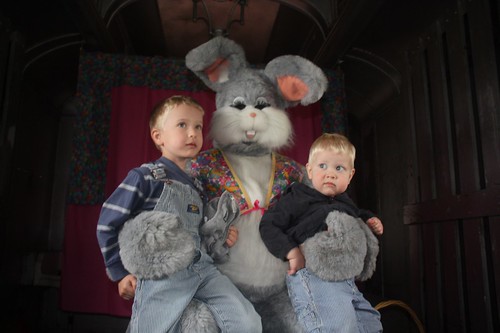
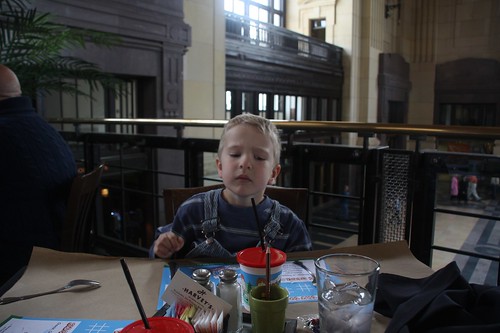
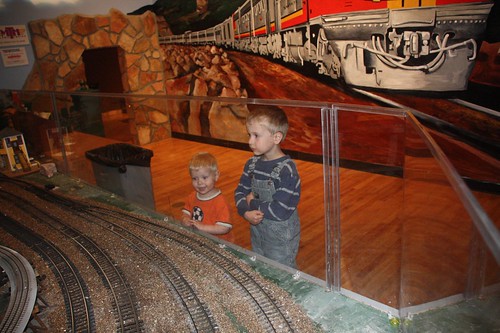
Terah and I recently decided that each of us could use a day off of not having to do work or supervise boys. Yesterday I had the day off work so that was mine. I took my Kindle, along with its Gutenberg copy of War and Peace, which yes, I m reading for fun. I slept in a bit, then got breakfast and sat down at Botanica, the Wichita Gardens with the Kindle for awhile. That was a nice way to spend the morning. Today was Terah s day off. Initially I thought of taking the boys to The Cosmosphere, one of the world s premier space museums, or to the Kansas Aviation Museum. But then I realized that the Midland Railway, a historic excursion line in Baldwin City, KS, was having their first train trip of the year. And it s the Easter special: you take the train a few miles out of town, get off, the kids do an Easter egg hunt, then also get to get their picture taken with the Easter bunny. Kid paradise, right? What could be better? So this is how my alarm came to be set for 5:15 on a Saturday morning. Oliver woke up early, but I had to get Jacob up. He was groggy, trying to cover his face and ears, and annoyed at me for trying to wake him up. Until I said, Jacob, it s time to get ready for the car trip to the train ride. Can you go get dressed for the day? Silence. Then about 5 seconds later, he jumped up, said, OK dad, I will do it, and he did. We drove our 2.5 hours. I had set out a non-dirty breakfast in the car for them the night before, so they munched while we drove. Then had to wait in a huge line for our tickets. An hour later we had them got the last 3 tickets for the first departure of the day, 10AM and ran to get on the train before it left. Jacob and Oliver both got very quiet. Sometimes Jacob especially does that when he s very excited about things. He doesn t always look it right then, but I knew I d be hearing about it later. He had his face almost pressed to the window the whole way. IMG_5685.JPG Oh, and yes, he dressed himself and I didn t check to make sure he had the correct shirt, or that it wasn t on inside-out, until it was too late. Oops. We rode in an ex-CP car built in 1936. One of the cars on the train was built in the 1890s quite some neat equipment. Anyhow, next came the hunt. There were two large lawns covered in eggs, separated by age group. Jacob and Oliver were in the younger group, but still only got a few eggs (there were lots of other parents, uhm, helping their kids by picking up eggs the kids were too slow to get and putting them in baskets ) But they were thrilled with the experience so that s what counts. They moved the locomotive to the other end of the train for the trip back using an adjacent track. Lots of the kids watched them couple it back on. Jacob and Oliver were particularly interested nothing could have distracted them from watching that train though they didn t particularly like the noise of the horn. IMG_5655.JPG On the way back, someone in an Easter bunny suit was on the train for pictures. I took the boys there. They usually refuse to sit on laps of Santa and such, so I didn t figure much success. They actually agreed to do it. And despite their expressions in this photo, Jacob later told me over and over how much fun it was to be with the Easter bunny. IMG_5671.JPG After we got back, we headed for the car. Jacob insisted on carrying his own Easter bag, and predictably wound up carrying it upside down for awhile. So his bag had some grass in it from picking the candy back up. Oliver discovered some rocks by a ditch and had fun throwing them in to make a splash, so we paused for that for awhile. By this point it was about noon. So at this point, what does a dad who has managed to keep two active boys in line for an hour, help them with an egg hunt and giant rabbit, and keep them from falling into the ditch they re throwing rocks into, do? Say that it s time to eat lunch and then head for home so we can be there in time for supper? Or go for MORE ADVENTURE? I said, Jacob, how would you like to eat lunch inside a big train station in Kansas City? Pause for a couple of seconds to think. YEAH! I have never had lunch in a train station before! Let s go! Shall we go NOW? So I gave them the leftover breakfast to eat during the hour drive on towards the beautiful Kansas City Union Station. It s one of the few grand American train stations that survives intact, and is just stunning. Jacob and Oliver both fell asleep on the way there. We parked, walked inside, and Jacob just froze. Dad WOW! That ceiling is SO HIGH! I can t even reach it! He then raised his hand as high as it would go and said, See dad, it is so high I can t touch it! (Most ceilings are, but this one is indeed much, much taller than most.) We ate lunch in the second level of a restaurant right in the Grand Hall, which Jacob really enjoyed. Here s Jacob, annoyed that I pulled out the camera again: IMG_5693.JPG Then we went exploring for an hour. Jacob talked about his adventure . We went up the elevators and checked out the balconies. Then we found the Model Railroad Experience. And oh my. The boys were visibly the most excited they had been all day. Oliver just froze at the spot he walked through the door, not caring to move and see the rest of the exhibit because he was so fascinated by what he already saw. There was a huge layout in the middle of the room, and smaller ones in adjacent rooms. We finally made our way there, and Oliver just ran round and round one of them, following a train, excitedly yelling There it is! There it is! There it is! Here s a photo from the big layout: IMG_5706.JPG Jacob cried when it was time to go, but I had promised them some dessert before we left, so after a bite of ice cream we were on our way. On the way home, every 15 minutes or so, Jacob would make a remark like this: Dad, the train ride was SO fun! or Dad, I really liked Kansas City Union Station! and so forth, naming every highlight of the day for him several times over: the Easter bunny, the egg hunt, train ride, and everything about Union Station. On the way home, we stopped at our favorite restaurant in Emporia: BobbyD s Merchant St. BBQ. This is always a hit for everyone in the family. A down-home place that has excellent food, is not far off our path, and never seems to have a wait. Yum.

22 April 2011

Steve McIntyre: Bias in the news

Apologies for yet more politics; normal-ish service will be resumed shortly, I hope. I've just put the following into the "BBC News website feedback" form, but I doubt it will have any impact. Quoting it here for the record... The BBC news website appears to be showing a systemic bias over the AV referendum. For the last few weeks, there has been regular coverage of the referendum and it seems that there has been the usual blind adherence to "balance" - every story about AV has included some of the (incorrect, unscientific, even hate-filled) propaganda from the "no to AV" campaign without critique or analysis. It's difficult to see any justification for this except deliberate editorial bias, but I don't imagine that there's much that can be done about that. However, right now on the BBC News front page at http://www.bbc.co.uk/news/ I can see that there is a link "Referendum views" that points to yet another opinion piece from a "No" campaigner (Frederick Forsyth). I only see a single view here, not the plural "views" suggested. I don't see any positive view for AV promoted from the front page at all, nor any link from this puff piece to the other articles that have been written in the recent past. Looking further, I can see that there *has*, in fact, been a positive piece on the News Front Page today (from Billy Bragg) but there are no visible links to it any more. Both articles were posted/updated at the same time this morning (22nd April, 08:34 BST) yet now only the negative one remains. Very shoddy, and not at all what I would expect from the BBC.

21 April 2011

Raphaël Hertzog: People behind Debian: Meike Reichle, member of Debian Women

Meike Reichle is a Debian developer since 2008 but has been involved for longer than that, in particular in Debian Women. She s a great speaker and shared her experience in a Debconf talk. She s also part of the Debian publicity team and managed the live coverage of the last release on identi.ca. Enough introduction, learn more about her by reading the interview. My questions are in bold, the rest is by Meike. Who are you? My name is Meike Reichle, I am a studied information scientist and work as a project manager at Pengutronix, an embedded Linux company probably best known for their ARM kernel work. I live in Germany, more exactly in Lower Saxony, but I was originally born and raised in Swabia. Although I moved here ten years ago I still have a rather strong Swabian cultural identity. (Among other things I pride myself on having introduced a number of fellow DDs to the true promise that are real hand-made Sp tzle ;-) ) I am married to Alexander Reichle-Schmehl, we ll have our third wedding anniversary this summer. Apart from Debian most of my spare time is used for all kinds of crafts and DIY activities. Making things with my hands always gives me a great sense of accomplishment. My Free software history is summed up pretty quickly. Like most women of my age I wasn t introduced to computers until well into my teens. I didn t have a computer of my own until I started studying at the university in 2001. From there on things developed rather quickly: Working on the University s Unix terminals got me hooked on *nixes, so I got me one of those Linuxes everyone talked about. I tried a couple of different distributions, ended up with Debian around 2004, started contributing in 2005, and finally became a full DD what a nice coincidence! exactly this day (Apr 18th) three years ago. You re part of Debian Women. How is the project going? I have the feeling that the number of women involved in Debian has not significantly increased. The amount of women active within Debian is a tricky thing to judge. Here s a quick example why: When the DPL was elected in 2004 there were 911 Debian Developers eligible to vote, 4 of them were female. Shortly after, during DebConf4, debian-women was founded. When the current DPL was reelected last month, there were again 911 Debian Developers eligible to vote, but this time 13 of them were women. You can look at these numbers and say The number of female DDs has more than tripled, what a success! Or you can pull out your calculator and it will tell you that in terms of ratio this puts us from a measly 0.4% to an only slightly less measly 1.4% ratio of female DDs. This still is pardon my language a bloody shame, but sadly also pretty close to the average ratio of women in Free Software. So, while I do think that the debian-women project did already have a significant impact on the Debian project as a whole, I don t think it has achieved its goals yet. Not for a long time. There s still a lot to be done but unfortunately the debian-women project has somewhat run out of steam at the moment. The seven years of its existence divide quite equally into the first half, which was very active and saw great results, and the second half, which was very slow and much more passive. In my impression debian-women is currently undergoing a rather bumpy generational change. On the one hand a lot of the original members, including myself, have reduced their involvement. Speaking for myself this is caused by shift of interests as much as general weariness. On the other hand there are only very few women following up. This development is also reflected quite harshly in DD numbers: If I don t misjudge any first names (and I desperately hope I do!) for the last three years not a single woman has joined Debian as a developer! After the great start debian-women has had, this is a very painful thing to see! That said, things don t look all bad. There is a number of women maintaining packages without being DDs and there s also at least one woman currently in NM, so there s hope this standstill won t last very much longer. But still, the fact remains that debian-women is suffering from a rather serious recruitment problem and I hope that this interview might actually help to spur some new or not yet active members into action. The aim of debian-women is far from achieved and now that its initial members are receding its time for new members to step up and take initiative. What should Debian do to be more attractive to women ? I think the general atmosphere has improved, we re less tolerant with rude behaviour, the usual tone on mailing lists has improved. Yet it doesn t seem to be enough. If there was a female DD for every time I answered that question First of all, I agree, Debian as a community has improved tremendously! Our general tone is much more friendly and cooperative and there is now a much better awareness of the impression we give to outsiders and newcomers. Now on to the difficult part: The question what should be done to get more women into Free Software has been around almost as long as Free Software exists, and it has been answered very well by a lot of people: Twenty years ago Ellen Spertus wrote Why are There so Few Female Computer Scientists? and most of it still holds true. Almost ten years ago Val Henson (now Aurora) wrote HOWTO Encourage Women in Linux and that also is still pretty accurate. In 2006 Floss Pols undertook extensive research to find out why there were so few women in Open Source and Free Software and how that could be changed. They also came up with a very good set of recommendations. All of these texts highlight different aspects of that question and all of them have very good points. I personally have, over the years, arrived at a rather sociological, not to say holistic point of view. In fact I answered the exact same question a few days ago, and the answer I gave then was this: After ~10 years of women in tech advocacy I d say the ultimate and final measure to get more women into Free Software is by finally achieving a truly equal society and at the same time dramatically improving child care support in almost any country. I ve come to the conclusion that what really holds women back in practice is not so much a lack of skill or interest but a simple lack of opportunity. For most of us Free Software is what we do in our spare time and that s something that women, even today, have considerably less of than men. Even in couples where both partners work full-time it is still mostly the woman who does the majority of the housework and child care duties. In most cultures men have a perceived right to their leisure time that does not to the same degree exist for women. That is one major reason, the other is instilled modesty, which has kind of become my personal arch-enemy by now. I ve talked to so many girls and women at all sorts of events about why they won t take up Computer Science studies or join a Free Software project and the answer I hear most often is that they do not consider themselves good enough in one or another aspect. Sometimes they will doubt their technical skills, sometimes their language skills, sometimes their stamina. Needless to say these girls and women were not any less qualified than the people already active in Free Software. So, yes, in the short and medium term making Debian a more welcoming and friendly place is the way to go. As many others pointed out already this will not only benefit prospective contributors but the community as a whole: those new to it as well as those who ve been in it for a long time. In the long term however what we need is empowerment! Women who are just as confident about their skills as men and are not discouraged by uncooperative environments. This is of course something that is culturally deep-rooted and can only happen in a very large time frame. So, for the moment the way to go in my view is accessibility: a cooperative atmosphere, a code of conduct, comprehensive documentation not only of technical aspects but also of structures and processes. The other thing we need to do is to have as many already active women as possible attend as many Linux/Debian/Free Software/Whatever events as possible. In my experience it happens quite often that other women see these women, feel very inspired by them, get to talk to them and then a few days later show up on some mailing list or IRC channel. From what I ve seen personal contact still beats any other kind of recruiting measures. You re a Debian developer but you re also married with a Debian developer (Alexander Reichle-Schmehl). Did you meet because of Debian? If not, who introduced Debian to the other one? :-) We did in fact meet because of Debian. More specifically during our booth shift at the Debian booth at LinuxTag 2005, where I did a talk on the debian-women project and Alex organised the DebianDay. After that our relationship developed pretty much along our Debian activities: After our initial meeting we talked a lot on #debian.de, when Alex went to DebConf5 and I didn t we noticed that we kind of missed each other. The first gift he ever gave me was a Debconf5 shirt and a box Finnish chocolates (I still have one of them today. :) ) Our first secret kiss was at ApacheCon 2005, where we were both staffing the Debian booth (kudos to abe for pretending not to notice). We then became an official couple at Berlinux 2005 where we were both staffing the Debian booth and giving talks on packaging and user motivation. Our first real relationship stress test was when we both joined the DebConf6 orga team. It was a stressful time, but we passed it with flying colours! About a year later we announced our engagement via planet.debian.org. Our wedding was a veritable MiniDebConf, one of the best gifts we got was a Debian cookbook including the favourite recipes of DDs from around the world. By now we ve both finished university and work full-time jobs, so we don t do as many talks and attend as many Debian events as we used to. Instead we now mainly focus on press and publicity work, which is quite practical to work on as a pair. It s actually rather funny that way, Alex and I get confused with each other quite often, since we have almost the same name, often pick up on each other s E-Mail conversations and are most often quoted by our function rather than by name. Because of we have kind of merged into this virtual Debian Press Person in the perception of many of our contacts. You also have another hat : Debian Press Officer. What is this about? What would you suggest to people who would like get involved in that domain? Debian press work is mainly about providing an official and coordinated point of contact to anyone wanting information from or about Debian. The press team answers all sorts of inquiries (the most popular one is is of course always the next release date) and makes sure all important events and developments within Debian receive the attention and recognition they deserve. Debian is a diverse project where every sort of contributor is free to voice his or her opinion in any way. We don t have NDAs or prescribed terminology. That s one of the things I love about Debian but also something that makes us difficult to handle for conventional media. They want official statements, in generally understandable terms, at appointed times. That s what the press team takes care of. Almost all of the press work is done in the publicity team, which coordinates using IRC, Mail and SVN. The publicity team also publishes the Debian Project News, which are very popular among our users and developers. Press work is also an area of work that offers lots of possibilities for non-technical contribution. http://wiki.debian.org/Teams/Publicity lists a number of possibilities for contribution and, like most Debian Teams, we d be more than grateful to get some more helping hands and happy to introduce interested newcomers to our work. What s the biggest problem of Debian? In my view: Overwork. Debian has thousands of contributors but still a lot of the main work rests on very few shoulders. We need more contributors, especially, but not only in the key teams. In order to get more people we need to do some marketing which is very hard for us, since we are very proud of our independence and have a strong focus on purely technical aspects rather than aiming for popularity. However, with the current amount of Open Source and Free Software projects to join we find ourselves not only in a contest on technical excellence but also a sort of popularity contest that is about perception rather than hard facts. This popularity contest is difficult for Debian and currently costs us quite a bunch of very capable people. Do you have wishes for Debian Wheezy? My answer to that is a non-technical one: I think Debian is currently very under-appreciated, we do a lot of great work and maybe even more importantly we do a lot of important work for Software Freedom, sometimes even at the cost of our above-mentioned popularity. I hope people will appreciate that more again in the future. Is there someone in Debian that you admire for their contributions? Over the years I have made a lot of friends within the Debian community, some have even become family. That makes it somewhat hard to single out individual people. I think what I admire most is continuous commitment. I am very impressed by those among us who have kept up a high level of commitment over many years and at the same time managed to bring that in line with a fulfilled personal/family life. That s something that I hope I ll also be able to achieve in the years to come.

Thank you to Meike for the time spent answering my questions. I hope you enjoyed reading her answers as I did. Subscribe to my newsletter to get my monthly summary of the Debian/Ubuntu news and to not miss further interviews. You can also follow along on Identi.ca, Twitter and Facebook.

2 comments Liked this article? Click here. My blog is Flattr-enabled.

18 April 2011

Sjoerd Simons: Telepathy and VP8!

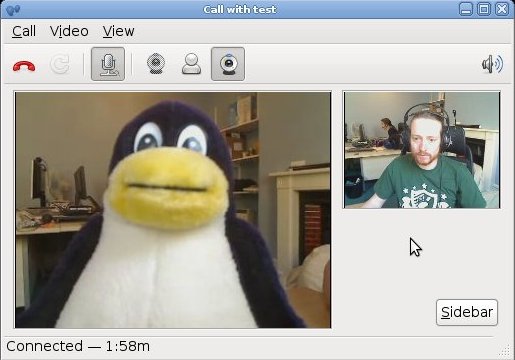
Yesterday Google announced the WebM Project, giving the world a new open and royalty-free video codec called VP8. Thanks to Collabora Multimedia and Entropy Wave support for it landed in gstreamer git shortly after the announcement. In Telepathy we quite like video conferencing, so as a logical next step i quickly put together some proof of concept RTP payloading elements for Gstreamer with the obvious result: A call with tux The screenshot isn't very exciting, which is exactly how it should be. In the world i would like to live in people don't have to care about video codecs, whether it is for video calls, playing online media or whatever else they want to do with video. Looking at the list of supporters for the WebM project this may actually happen and that in my opinion is much is actually the most important aspect of it all. The most important aspect that is missing at this point to bring VP8 as the video calling codec to the world is the lack of a standard RTP specification. Which is something we will hopefully start working on with various other parties in the WebM project reasonably soon. For now if you want to feel cutting edge get Empathy from git master and my rtp elements. To give things a first try :) A Belorussian translation of this article is available here

Steve McIntyre: Lies, damn lies and voting system lies

So we're just over 2 weeks away from our next set of local elections in the UK (May 5th), and alongside those elections we're also being asked about switching to a new voting system for future elections. For a long time we've used the simple First Past The Post (FPTP) system here, but now we have the possbility of moving to Alternative Vote (AV) instead. First Past The Post FPTP is simple to understand - the person who receives more votes than any single other person wins. But that simplicity is the only good thing, and there are many problems with it. It's unfair: in an election with 10 candidate, it's possible for a winner to have just 11% of the vote, even in the case where the other 89% of voters would consider them to be the worst option. It's also very susceptible to tactical voting, leading to nasty tactics in parties' election literature like claiming "party foo cannot win here, so don't waste your vote on them - vote for us instead!". See this Wikipedia article for more background. Alternative Vote AV is slightly more complicated. Instead of just placing a mark against their single preferred candidate, voters are able to rank as many of the candidates as they like. In the case that there is not a clear winner with more than 50% of the votes from the initial count, the lowest-ranked candidate is eliminated and second-choice votes from their supporters are counted and re-distributed for the other candidates. Iterate this process until one candidate gets more than 50% of the total votes. By re-calculating the votes this way, supporters of less popular candidates / parties should no longer feel the pressure to vote tactically and a more accurate picture of voter intention should emerge. The downsides? AV will tend to lead to slower, more expensive counting due to the potential for several rounds. It's still not real proportional voting, but it's better than FPTP in this regard. Again, Wikipedia has a good article about this subject. Other options? I'd be much happier to see discussion / trials of other voting systems. For example, Debian uses a variation on Condorcet called Cloneproof Schwartz Sequential Dropping which is an excellent system for fair voting, but it's very difficult to explain and counting votes is comparatively very expensive. It's bad enough getting ostensibly-intelligent Debian developers to understand this system; extending this to a national election would be impossible in my opinion. It's also not an option on the ballot here... :-) Politicians spreading lies I know this won't come as a major shock for a nationwide referendum, but there's a lot of campaigning going on. And, in the best traditions of political campaigning, there's a huge amount of bullshit being spread. The worst is coming from the "No to AV" campaign, as far as I can see. Without many positive things to claim, various members of the Conservative party (current government, with most to fear from a change of voting system, of course) are spouting outright lies and sowing FUD in all directions:
  1. Claiming that AV will cost 250 million, most of which would be for the cost of electronic voting machines. Except... there's no evidence that these would be needed, nor are there any plans to use them.
  2. Continuing on, highlighting the alleged "extra costs" of AV: campaign poster FUD saying that we need to choose between cardiac facilities for babies and AV, or between equipment for our soldiers and AV. Except... there's no evidence that costs will be that high, nor that we have to make such binary choices.
  3. Claims from senior Conservative figures that changing to AV would mean more votes and legitimacy for extremists like the British National Party. Except... there is no evidence that AV will boost minority extremist parties. The BNP themselves are urging their supporters to vote against AV. Finally, if these parties have a high enough proportion of votes that they should be getting seats in parliament then they should have those seats - this is one of the tenets of democracy. Why should we be choosing a voting system to deliberately disenfranchise people?
  4. Finally, even David Cameron is at it: "too much of the debate about the alternative vote (AV) had so far been dominated by 'scientific' evaluation of the two systems' merits. But for me, politics shouldn't be some mind-bending exercise. It's about what you feel in your gut - about the values you hold dear and the beliefs you instinctively have. And I just feel it, in my gut, that AV is wrong." Well, it's nice that our Prime Minister wants to ignore all the scientific evidence and go with his gut feeling. After all, why would we want to think about choices like this?
Don't swallow the bullshit If you're eligible to vote in the UK, please ignore the bollocks. Make up your own mind how to vote in this referendum, by looking at the facts. I've done that and I'll be voting in favour of switching to AV.

15 April 2011

Jon Dowland: vote

I've just voted Stefano Zacchiroli for Debian Project Leader (DPL). The voting period closes tonight, so if you are a Debian developer and haven't yet voted, please do! Debian uses a Condorcet voting system, which to my non-expert eyes, bears some resemblance to "Single Transferrable Vote" (STV), at least compared to "First Past the Post" (FPTP). There is a debate raging in the UK as to whether Government elections should be counted based on an STV method instead of FPTP, with a referendum on the subject in May. I'm leaning towards "Yes to AV", but this opinion piece by journalist Stuart Campbell (which argues that people should spoil their ballots) is worth a read.

Patrick Schoenfeld: Last time I've used network-manager..

Theres an ongoing thread on the Debian mailing lists about making network-manager installed by default on new Debian installations. I won't say much about the thread. Its just a prototype example for Debian project discussions: Discuss everything to death and if its dead discuss a little more. And - very important - always restate the same arguments as often as you can. Or if its not your own argument you restate, restate the arguments of others. Ending with 100 times stated the same argument. Even if its already disproved.

I don't have a strong opinion about the topic in itself. However there is something I find kinda funny. A statement brought up by the people who strongly oppose network-manager as a default.
A statetement I've heard so often that I can't count it anymore.

The last time I've tried network-manager it sucked.
It often comes in different masquerades, like:

But it basically boils down to that basic essence of the sentence I've written above. Sometimes I ask people who express this opinion a simple question:

When did you test network-manager the last time?
The answers are different but again the basic essence of the answers is mostly the same (even if people would never say it that way):

A long time ago. Must have been around Etch.
And guess what: There was a time when I had a similar opinion. Must have been around Etch.
During the life cycle of network-manager between Etch and now a lot has happened. I restarted using network-manager at some point of the Lenny development.
My daily driver for the management of my network connections on my notebook. Yes, together with ifupdown because, yes, network-manager does not support every possible network-setup with all of the special cases possible. But it supports auto-configuring of wired and wireless devices. Connecting to a new encrypted network, either in a WLAN or in a 802.1x LAN, using UMTS devices, using tethering with a smart phone. And everything: on a few mouse-clicks.

Yes, it had some rough edges in that life cycle. Yes, it had that nasty upgrade bug, which was very annoying.
But face it: It developed a lot. Here are some numbers:

Diffstat between the etch version and the lenny version:
362 files changed, 36589 insertions(+), 36684 deletions(-)

Diffstat between the Lenny version and the current version in sid:
763 files changed, 112713 insertions(+), 56361 deletions(-)

The upgrade bug has been solved recently. Late. But better late then never.

So what does that mean? It means that, if your last network-manager experience was made with Lenny or even worse around Etch, you should better give it another try, if you are interested in knowing what you talk about. For now it seems that a lot of people do not know. Not even in a distance.

8 April 2011

Steve Kemp: IPv6 and thttpd

thttpd is a simple, small, portable, fast, and secure HTTP server which supports both IPv4 & IPv6. However one noticable omission in the handling of requests for thttpd is support for the X-Forwarded-For header - which is even noted upo nthe thttpd wikipedia entry. There is a simple patch floating around which claims to fix this; but as I belatedly noticed tonight it only works for IPv4. If you look at libhttpd.h of the thttpd source you'll see this:
typedef union  
    struct sockaddr sa;
    struct sockaddr_in sa_in;
#ifdef USE_IPV6
    struct sockaddr_in6 sa_in6;
    struct sockaddr_storage sa_stor;
#endif /* USE_IPV6 */
      httpd_sockaddr;
As a quick hack I updated this structure to add the following member:
    char real_ip[200];
Now I could update that member when a client connects and later update it as a result of any X-Forwarded-For: headers which might be present in incoming requests. Finally I updated the logging to use this field rather than anything else and the job was complete. Without this work if you're running as a proxy and you receive an IPv6 connection you'll see it reported as 127.0.0.1. I'm sure my approach isn't as clean as it could be - due to the extra member- but it will suffice for now. ObQuote: "This gun you're holding belonged to your father; he could conduct a symphony orchestra with it. " - Wanted

Mehdi Dogguy: Oops! I did it again

Well, I still don t feel ready enough to go back to (real) work. So, once more, I had to get my fingers on something to hack and I picked the Buildd Status Pages once more. It s not my favorite project, but I decided to implement the few remaining ideas and get (temporarily) done with it. So, here we are with new features (and a few bug fixes): In my opinion, this new set of features deprecates totally the old version, since all (and more) is now covered and working with this new version. So, I think we can remove pkg.cgi and friends and put some redirection to the new scripts. If you disagree, please tell us ! I ll submit a bugreport to QA folks asking them to change/remove links still present on the PTS and DDPO. I think that this is the last set of changes before a while (except fixes). I hope that you ll enjoy these new features as much as I do. If I still have some energy, I ll try to spend it on -release stuff where there are several ongoing transitions (and many others waiting for acks, hints, analysis, etc ).

7 April 2011

Raphaël Hertzog: People behind Debian: Adam D. Barratt, release manager

Adam D. Barratt is a Debian developer since 2008, in just a few years he got heavily involved to the point of being now Release manager , a high responsibility role within the community. He worked hard with the other members of the release team to make Squeeze happen. You could expect the release managers to have some rest after a big release, but it s not really the case. With the long freeze, loads of transitions have accumulated and they are now busy to get all those updated packages in the new testing (wheezy). Despite this Adam took some time to answer my questions. He shares with us his impression on the Squeeze release, his opinion on time-based freezes (regular/predictable freeze) and much more. Read on. My questions are in bold, the rest is by Adam. Who are you? I m a 31 year old software developer and part-time sysadmin for a software and IT services company based in the south of England. I have no children, no pets and a long-suffering partner who puts up with me spending far too much time tinkering with things and people making fun of her Macbook during Debconf. As well as being on the release team, I m a member of the maintainer teams for devscripts and lintian. Can you describe your journey in Debian and in the release team? I was introduced to Debian as part of an infrastructure upgrade at work, moving from a set of Red Hat and Solaris-based systems. As part of that, we submitted some bugs for issues we found during the upgrade and for small patches we included in some software to add extra functionality we wanted. From that starting point I became more interested in Debian in general and began following some of the mailing lists and IRC channels. When Julian Gilbey asked for help with the maintenance of devscripts, I submitted some patches for some of the outstanding bug reports and was invited to join the team which was being created to handle maintenance for the package. One of the then Release Managers was also on the team and asked if I d be interested in working on a couple of updates they wanted to the scripts which generate the proposed-updates overview pages. I added the new functionality which was merged in to the live scripts and a little while later I was invited to join the team, shortly before Debconf 9. As most readers will be aware, we unfortunately reached a point during last year where we didn t have anyone filling the Release Manager role. During that period, I became more active in handling transitions and requests for updates to stable and as time went on more people started to suggest that I should put myself forward for the position, or refer to me as already being RM. I procrastinated over the decision for some time but after discussions during Debconf 10 I came round to the idea that we should have the RM role filled again and agreed to take it on, together with Neil. The rest, as they say How much time do you usually spend working for the release team ? I ve been trying to work out how to usefully answer this question. My initial answer was approximately two hours each day , but the longer I thought about it the more I started debating exactly what I should include under the umbrella of release work; after some to-and-fro I ve decided to stick with my initial answer. During periods when Debian is frozen and particularly in the lead up to the release that time commitment increases significantly, particularly over weekends. I m reliably informed that at that point the correct answer to the question is too much time . :-) What s your own retrospective of the Squeeze release? What went well and what needs to be improved? Overall, I believe the release went well and that we should all be proud of the Squeeze release. The parts of the release cycle which highlighted the need for improvement all share, imo, a single root cause communication, particularly around freeze-related plans. We worked hard during the freeze itself to improve our communication with the rest of the project and want to continue in that vein during the Wheezy cycle. One thing that I personally found quite difficult at times before the freeze was keeping track of the transitions which were still waiting for a place in the queue; it s also something that we could improve on at this early stage of the Wheezy cycle. In order to help us keep a clear overview of requests for transitions, stable updates and binNMUs, it would be helpful if they could be filed as appropriately user-tagged bugs. This not only allows us to easily get an overview of the status of requests from the BTS but also aids transparency by allowing anyone else to do so; as a useful additional feature, it means that we can use the BTS s blocking functionality to indicate reasons why a request cannot be fulfilled right now. Are you in favor of time based freeze? I think there s merit in having a time frame that we can work towards in order to achieve the goals which we set ourselves for the release, as individual maintainers, maintenance teams and a project. I do have concerns that even with such a time frame in place there will still be uploads made very close to the proposed freeze point and transitions which may be unfinished, for example because of an unforeseen entanglement with or reliance on the transition of another package. One thing I m interested in is how exact and specific that time frame should be and the balance between predictability and being able to achieve everything we want for a great release; this is something we can cover in the debate on this subject which I know many people have strong opinions about. What are your plans for Debian Wheezy? The Wheezy to-do list I started before the final Squeeze release begins multiarch, multiarch, multiarch . It looks like we re finally going to get that achieved during this release cycle, thanks to a great deal of hard work from various people. I m also interested in seeing the C.UTF-8 locale standardised throughout Debian and continuing to work on our tools and processes to make tracking of transitions and stable updates simpler (or at least appearing to be so :-) and more transparent. With my package maintenance hats on, I d like to help ensure that both devscripts and lintian are able to keep pace with changes in the development landscape in Debian (e.g. more useful package diffing for source format v3 packages) and continue to be tools that are an integral part of package development in Debian. Some people (including me) would like a rolling distribution constantly usable by end-users. Do you think that the release process currently geared towards producing stable can be accommodated to support this? I m not yet convinced that the concept of a rolling, constantly usable distribution can be easily integrated in to the workflow that exists around preparing stable releases in Debian. The testing distribution was created as, and continues to be used as, a tool to enable the release team to create the next stable release that it happens to be something that people can use every day for much of the time is mostly a happy side-effect of the fact that we don t gratuitously break it, but is by no means guaranteed to be the case early in the release cycle or during large, disruptive, transitions. It s been suggested that testing and rolling could be basically the same for most of the cycle, with rolling then continuing to be updated when testing is frozen. This would essentially mean an extra suite which is only used for a few months every couple of years or so, which is one of the things that testing was intended to avoid (i.e. the old frozen suite) and seems like a lot of overhead to introduce in order to reduce disruption to some users during the freeze. The early part of the release cycle also tends to include a number of larger transitions which often require packages to either be removed from testing or broken as part of migrating the transition, if they are not able to be successfully updated in time. What s the biggest problem of Debian? The thing that I ve been noticing myself becoming frustrated by recently is a tendency to debate the minor details of proposals, rather than concentrating on getting the key points right to begin with. Clearly for some projects such as multiarch the details may be as important as the big picture, but in most cases the people working on a development should be allowed to look after the smaller details themselves. That s not meant to imply that feedback from other parts of the project should not be welcomed, simply that if we consider Debian to be a do-ocracy then we need to permit people the freedom to do . Is there someone in Debian that you admire for their contributions? All previous release managers, for making the job look much easier than it seems when you re in the hot seat . :-) Outside of the release team, Joey Hess for his contributions to various parts of the Debian development environment over the years, such as debhelper and debian-installer, and Colin Watson for his enviable willingness to tackle a wide variety of different projects within Debian.
Thank you to Adam for the time spent answering my questions. I hope you enjoyed reading his answers as I did. Subscribe to my newsletter to get my monthly summary of the Debian/Ubuntu news and to not miss further interviews. You can also follow along on Identi.ca, Twitter and Facebook.

No comment Liked this article? Click here. My blog is Flattr-enabled.

6 April 2011

Mehdi Dogguy: Buildd status pages: say goodbye to external dependencies

Last week, I had to put my daily (real) work off for a bit, to get some rest. I took this occasion to implement a few ideas I had for the Buildd Status Pages. Mainly, I wanted to get rid of my external dependencies which are: Besides of getting rid of external dependencies, there were also a few feature requests (#618676, #612174, #518526) waiting for a while and it was good time to fix them. Hopefully, there are related to what I was fixing. The final version is now deployed and can be used. The implemented changes are : I think that I tested well enough this new version and it works okay. Nevertheless, if you encounter a bug or a strange behavior, please don t hesitate to contact me (either by mail or on irc) or submit a bug report against buildd.debian.org. The next steps (probably) are :

5 April 2011

Kees Cook: Linux Security Summit 2011 CFP

I m once again on the program committee for the Linux Security Summit, so I d love to see people submit talks, attend, etc. It will be held along with the Linux Plumber s Conference, on September 8th in Santa Rosa, CA, USA. I d really like to see more non-LSM developers and end-users show up for this event. We need people interested in defining threats and designing defenses. There is a lot of work to be done on all kinds of fronts and having people voice their opinions and plans can really help us prioritize the areas that need the most attention. Here s one of many archives of the announcement, along with the website. We ve got just under 2 months to get talks submitted (May 27th deadline), with speaker notification quickly after that on June 1st. Come help us make Linux more secure! :)

3 April 2011

Raphaël Hertzog: March 2011 wrap up

Since I m soliciting donations to support my Debian work, the least I can do is explain what I do. You can thus expect to see an article like this one every month. Multi-Arch work I updated the code to use another layout for the control files stored in /var/lib/dpkg/info/. Instead of using a sub-directory per architecture (arch/package.type), we decided to use package:arch.type but only for packages which are Multi-Arch: same. dpkg is taking care to rename the files the first time it is executed with write rights and then updates /var/lib/dpkg/info/format to remember that the upgrade has been done and that we can rely on the new structure. I filed a few bugs on packages that are improperly accessing those internal files instead of using the appropriate dpkg-query interface. I sent a heads-up mail on -devel to make other people aware of those problems in the hope to discover most of them as early as possible. After that, the work stalled because Guillem went away for 2 weeks and thus stopped his review of my work. I hope he will quickly resume the review and that we will get something final this month. With the arrival of dpkg 1.16.0, it s now possible to start converting libraries to multi-arch even if full multi-arch support has not yet landed in dpkg proper. See http://wiki.debian.org/Multiarch/Bootstrapping for the detailed plan. If you re curious about Multi-Arch, you might want to read this article of Steve Langasek as well. Bug triage for dpkg in launchpad At the start of the month, there was close to 500 bugs reported against the dpkg package in Launchpad. Unfortunately most of it is noise many of the reported bugs are misfiled, they show an upgrade problem of a random package and that upgrade problem confuses update-manager which tries to configure an already configured package. This generates a second error that apport attributes to dpkg and the resulting bug report is thus filed on dpkg. There are literally hundreds of those that have to be reclassified. Michael Vogt and Brian Murray did some triaging, and I also spend quite some hours on this task. It s a bit frustrating as I tend to mark many reports Incomplete because there s no way they can be acted upon and many of them are so old that the reporter is unlikely to be able to provide supplementary information. But in the middle of this noise, there are some useful bug reports, like LP#739179 which enabled me to fix a regression even before it reached Debian Unstable (because Ubuntu runs a snapshot of dpkg with multiarch support). I subscribed to the Launchpad bugs for dpkg via the Debian Package Tracking System (thanks to the derivatives-bugs keyword) and will try to keep up with the incoming reports. Misc dpkg work The ftpmasters came up with a request for a new field (see 619131) in source packages. After a quick discussion and a round of review on debian-policy@l.d.o, I implemented the new Package-List field. This should allow the ftpmasters to save some time in NEW processing, but we deferred the change for the next dpkg version (1.16.1) to ponder a bit more on the design of the field. I also fixed a bunch of bugs (#619541, #605719, #598922, #616096) and merged a patch of Mark Hymers to recognize the new Built-Using field. Developers-reference work The review process for changes to the developers-reference is not working as it should. And I suffered from it while trying to integrate the patch I wrote for the Developer duties chapter (see #548867). We purposely changed the maintainer field from debian-doc to debian-policy in the hope to have more reviews of suggested changes and to seek some sort of consensus before committing anything. But we don t get more reviews and deciding to commit a patch is now even harder than it was (except for trivial stuff where personal opinions can t interfere). In my case, I only got the feedback of Charles Plessy which was very mixed to say the least. I tried to improve my patch based on what he expressed but I also clearly disagreed with some of his assertions and was convinced that my wording was in line with the dominant point of view within Debian. We tried to involve the release team in the discussion because most of what I documented was about helping making stable release happen, but nobody of the team answered. Instead of letting the situation (and my patch) rot, I solicited feedback from the DPL and from another developers-reference editor to see whether my patch was an improvement or not. After some more time, I went ahead and committed it. It was not pleasant for anyone. I don t know how we can improve this. Contrary to the policy, the developers-reference is a document that is not normative, I believe the result is better when we put some soul into it. But it s a real challenge when you seek a consensus and that the interest in reviewing changes is so low. DVD shop listed on debian.org In February, I launched a DVD shop whose benefits are used to fund my Debian work. Shortly after the launch I used the official form to be added to the official listing of Debian CD vendors and offered a few suggestions to deal with vendors who are selling unofficial images (with firmware in my case). A few weeks later, I got no answers: neither for my request nor for my suggestions, I mailed the cdvendors@debian.org team directly asking for a status update and quickly got an answer suggesting that Simon Paillard usually does the work and can t process the backlog due to some injury. At this point no concerns had been raised about adding me to the list. To save some time and some work for the team, I added myself to the list since I had commit rights and I informed them that I did it, so that they can review it. Shortly after I did that, Martin Zobel Helas objected to my addition. I cleared some misunderstandings but the discussion also lead to some changes to please everybody: the listing now indicates that some images are unofficial and I have prepared a special landing page for people coming from the Debian website through this listing. Debian column on OMG! Ubuntu I have always been a firm believer that it s important for Debian to reach out to the widest public with its message of freedom. Thus when Benjamin Humphrey contacted the debian-publicity team to find volunteers to write a Debian column on OMG! Ubuntu, I immediately jumped in. I wrote 4 articles over there. The tone is very different from my articles on my blog and I like that duality. Check out Debian is dying! Oh my word!, Debian or Ubuntu, which is the best place to contribute?, Are you contributing your share? and Ubuntu s CTO reveals DEX: an effort to close the gap with Debian. It s a great win-win situation, OMG! Ubuntu benefits from my articles, Debian s values are relayed further, and OMG! Ubuntu s large audience also helps me develop my own blog. Work on my book I had lots of paperwork to do this month (annual accounting stuff for my company) and I did not have as much time as I hoped for my book. Still I have a updated a few more chapters of my French book and I certainly hope to complete the update during April. This means that the work on the English translation could start in may. Work on my blog Just like for my book, it has been relatively difficult for me to cope with my policy of two articles every week. But I still managed to get quite some good stuff out. I interviewed Christian Perrier (Debian s translation coordinator) and also Bdale Garbee (chair of Debian s technical committee). I finished my series of Debian Cleanup Tips with 2 supplementary articles: The removal of firmware is causing troubles to quite some users so I wrote an article explaining how to deal with the problem. A regular reader also asked me to write an article about Jigdo, I executed myself because it was a good idea and that he has been very nice with me: Download ISO images of Debian CD/DVD at light speed with Jigdo. Last but not least, I shared my package maintainer pledge which inspired my developers-reference patch (see discussion above). Thanks Many thanks to all the people who showed their appreciation of my work. The 324.37 EUR that you gave me in February represented 2 days and a half of my time that I have spent working on the above projects. See you next month for a new summary of my activities.

2 comments Liked this article? Click here. My blog is Flattr-enabled.

31 March 2011

Josselin Mouette: News@11: Mozilla gives the finger to embedders

There have been a lot of web browsers embedding the Gecko engine, especially through the gtkmozembed library (it was not really a proper library but let s call it like that). I remember being a happy user of galeon, which went on as epiphany, but there were also all these small applications that just need a good HTML renderer in one of their widgets, like yelp, or several Python applications using python-gtkmozembed. Anyone having had to deal with these applications, especially the most complex ones, could tell you a few things: So, today, it is official: Mozilla is dropping gtkmozembed from their codebase. I don t think this will come as a surprise to anyone. You can t develop a new version of a behemoth, monolithic application every 3 months while still caring about the interfaces underneath. Embedded applications have been migrating to webkit over the recent years, and those that don t do it really soon will die. The interesting part of the announcement is not here. It can be found hidden in a bug report: a stable and versioned libmozjs will just never happen. What does it mean? First of all, it means that Debian and Ubuntu will have to go on maintaining their own versioning of libmozjs so that it can be linked to in a decent way by applications using the SpiderMonkey JS engine. It also means that this version will have to be bumped more often. But it also puts into question the whole future of SpiderMonkey as a separate library. With a shortened release cycle, the Mozilla developers will be tempted to add more specific interfaces to SpiderMonkey, reducing its genericity in favor of its use in Firefox itself. This will produce less and less useful libmozjs versions, until we reach the point when they ll make the same announcement as above, with s/gtkmozembed/libmozjs/. This is especially relevant in the context of the GNOME Shell, which is at the core of the GNOME 3 experience. The developers deliberately chose to avoid using JavaScriptCore (the JS library inside webkit) through the Seed engine, and used GJS instead, that relies on libmozjs. In my opinion this was done for frivolous reasons (being able to use more language extensions); and not only this put the GNOME developers in an awkward situation where 2 JS interpreters compete in the same desktop, but now it puts a risk on a technology which is at the core of the desktop. One of the reasons for the limited adoption of JSCore is that it lies currently in the same library as Webkit, which is a huge dependency. I ve been very glad to learn that Gustavo is considering the idea of splitting it. We need to provide an escape route for applications using libmozjs, and it looks like more than a decent one. I hope that GNOME Shell follows it sooner than later.

Russell Coker: Links March 2011

Cory Doctorow wrote an interesting article for The Guardian about Harper-Collins attempts to make self-destructing books [1]. They claim that a traditional book falls apart after being read 26 times (a claim that Cory disputes based on personal experience working at libraries) and want ebooks to be deleted after being borrowed so often. Really the copy-right fascists are jumping the shark here.Socialogical Images has an interesting archive of adverts for supposed treatments for autism, obsessive-compulsive disorder, asperger syndrome, and attention deficit and hyperactivity disorder [2]. The New York University Child Study Center conducted the campaign of fake ransom notes to describe a psychological difference as something that kidnaps a child. The possibility that parents should to some extent learn to adapt to their child s nature rather than fixing them with medication is something that most people can t seem to understand.William Cronon has written an interesting analysis of the way Conservative , lobby groups work [3]. They are more organised than I expected.The Reid Report has a good summary of some of the corporat issues related to the Japanese nuclear melt-down [4], apparently the company that runs the reactors decided to delay using sea-water in the hope that their investment could be salvaged and thus put everyone at increased risk. I think that this proves that reactors shouldn t be privately owned.Ian Lowe wrote a good summary of the reasons why Australia should not be using nuclear power when we believed that the Fukushima disaster was over [5]. But it turns out that the Fukushima problems were worse than we thought and the melt-down is getting worse.Christopher Smart wrote a good analysis of Microsoft s latest attempt to extort money from Linux users where they assert patent claims over Android [6]. He points out that .NET/Mono is a risk to Linux.Major Keary wrote a positive review of Snip Burn Solder Shred which is a book about Seriously geeky stuff to make with your kids [7]. Sounds like a fun book.The internal network of RSA has been cracked in some way that apparently weakens the security of SecureID, Bruce Schneier s blog comments section has an interesting discussion of the possibilities [8]. I expect that it s a fairly bad attack, if the attack was minor then surely the RSA people would have told us all the details.Hans Rosling gave an interesting TED talk about The Magic Washing Machine [9]. He describes how his family benefited when his mother first got a washing machine and how this resulted in better education as his mother had more time to get library books for her children. It seems that deploying more electric washing machines should be a priority for improving education and food supplies in third-world countries.Paul Root Wolpe gave an interesting and disturbing TED talk about bio-engineering [10]. He catalogues the various engineered animals and talks about the potential for future developments.Ron Rosenbaum wrote an interesting and insightful article for Slate about Maj. Harold Hering who s military career ended after he asked how to determine whether a nuclear launch order is lawful, legitimate, and comes from a sane president [11]. The question never received a good answer, this is a good reason for moving towards nuclear disarmament and for Americans to vote for the sanest and most intelligent candidate in the presidential elections.Eythor Bender gave an inspiring TED talk about human exoskeletons [12]. He had live demonstrations on stage of a soldier using an exo-skeleton to carry a heavy backpack and a woman who suffered a severe spinal-cord injury walking after being in a wheel-chair for 19 years.

Next.

Previous.