Search Results: "jam"

3 March 2008

Benjamin Mako Hill: Ending Software Patents

Last week, the Free Software Foundation announced an important new initiative called End Software Patents whose goals are pretty evident from the project's name. So far, the initiative is backed by the FSF, the Public Patent Foundation, and the Software Freedom Law Center. There are several organizations who are taking on specific bad patents but ESP is unique in that it is activitely working toward the abolition of software patents in the United States. While the organization is focused on work in the US, it's deeply important globally -- much of the world's patent law is "exported" from the US. The FSF is stretching extremely limited resources in backing ESP to help it get off the ground because we believe two things: Please read the new ESP report on the state of software patents written by the ESP Executive Director Ben Klemens to understand why we are optimistic. And please, support ESP financially in this fight. ESP's continued work is not ensured past the immediate future. Your support will help endow a bright future for the next generation of software developers and users.

1 March 2008

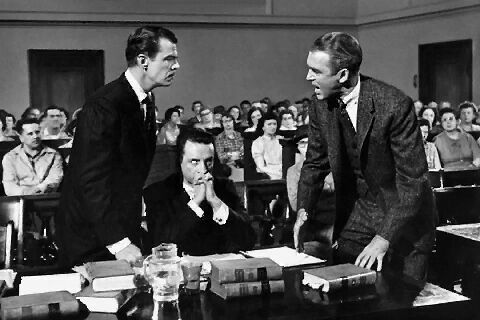
Adam Rosi-Kessel: The Best Movie to Start at 11pm at the End of a Long Trial

Anatomy of a Murder. David Denby put it best:
Otto Preminger s Anatomy of a Murder, from 1959, is still the best courtroom drama ever made in this country, and, in its occasional forays out of the court, among the finest evocations of place an Upper Peninsula Michigan resort area in the off-season, leafless, underpopulated, alcoholic, and forlorn. James Stewart, in one of his wonderful melancholy late performances, plays a former county prosecutor named Biegler, a lifelong bachelor who now spends his time with a non-practicing lawyer (Arthur O Connell) and an unpaid secretary (Eve Arden), who sticks around for the wisecracks. The movie is leisurely, detailed, realistic, intensely companionable; you get a sense of how people exist at the margins of a profession without losing their dignity.
Although there are some distinctions between a murder defense in the 1950’s in the Upper Peninsula of Michigan and modern-day patent litigation, the essence of trial technique is really not all that different. Highly recommended.
Prosecutor: Lieutenant Manion, wasn’t your action against Barney Quill much the same thing as your action against Miller or the Lieutenant you slapped at the cocktail party — all done in the heat of anger, with a willful, conscious desire to hurt or kill?
Defendant: I don’t remember my action against Quill.
Prosecutor: How long had you known your wife was stepping out with Quill?
Defendant: I never knew anything like that. I trust my wife.
Prosecutor: You just occasionally beat her up for the fun of it, I suppose?
Defense Counsel: There has been nothing established to permit a question like that. He keeps trying to insinuate without ever coming to the point. Let him ask the Lieutenant, did he ever beat his wife.
Judge: I will sustain the objection. Do you want to re-phrase your question, Mr. Dancer?
Prosecutor: No thank you, Your Honor. I’ve finished.
Technorati Tags: , ,

Anthony Towns: Been a while...

So, sometime over the past few weeks I clocked up ten years as a Debian developer:
From: Anthony Towns <aj@humbug.org.au>
Subject: Wannabe maintainer.
Date: Sun, 8 Feb 1998 18:35:28 +1000 (EST)
To: new-maintainer@debian.org
Hello world,
I'd like to become a debian maintainer.
I'd like an account on master, and for it to be subscribed to the
debian-private list.
My preferred login on master would have been aj, but as that's taken
ajt or atowns would be great.
I've run a debian system at home for half a year, and a system at work
for about two months. I've run Linux for two and a half years at home,
two years at work. I've been active in my local linux users' group for
just over a year. I've written a few programs, and am part way through
packaging the distributed.net personal proxy for Debian (pending
approval for non-free distribution from distributed.net).
I've read the Debian Social Contract.
My PGP public key is attached, and also available as
<http://azure.humbug.org.au/~aj/aj_key.asc>.
If there's anything more you need to know, please email me.
Thanks in advance.
Cheers,
aj
-- 
Anthony Towns <aj@humbug.org.au> <http://azure.humbug.org.au/~aj/>
I don't speak for anyone save myself. PGP encrypted mail preferred.
On Netscape GPLing their browser:  How can you trust a browser that
ANYONE can hack? For the secure choice, choose Microsoft.''
        -- <oryx@pobox.com> in a comment on slashdot.org
Apparently that also means I’ve clocked up ten and a half years as a Debian user; I think my previous two years of Linux (mid-95 to mid-97) were split between Slackware and Red Hat, though I couldn’t say for sure at this point. There’s already been a few other grand ten-year reviews, such as Joey Hess’s twenty-part serial, or LWN’s week-by-week review, or ONLamp’s interview with Bruce Perens, Eric Raymond and Michael Tiemann on ten years of “open source”. I don’t think I’m going to try matching that sort of depth though, so here are some of my highlights (after the break).
Hrm, this is going on longer than I’d hoped. Oh well, to be continued!

25 February 2008

Benjamin Mako Hill: Still Seeing Yellow

Recently, the EFF reported that the European commission had responded to a request by European Parliament member Satu Hassi about tracking dots in printers. European Commissioner Franco Frattini replied that tracking dots may constitute a human rights violation saying that:
"..to the extent that individuals may be identified through material printed or copied using certain equipment, such processing may give rise to the violation of fundamental human rights, namely the right to privacy and private life. It also might violate the right to protection of personal data."
Intriguingly, the request text includes a mention to and link to the Seeing Yellow project I started last year as an example of the fact that consumers have complained to printer manufacturers and that these complaints have fallen upon deaf ears. Everyone who called their printer manufacturer in response to Seeing Yellow deserves come credit for the raised visibility to the issue that we've created and the set of actions that have brought the issue this far. Please, keep it up! If you've not complained to your printer manufacturer, visit Seeing Yellow and call today.

Benjamin Mako Hill: My Spring

I'm going to be traveling and giving talks quite a bit this spring. Here's what my schedule looks like now. I don't think much will be added to it: I'll be giving at least one talk at the FSF Members Meeting, the Renaissance Panel, Lugradio Live, Penguicon, and Community One. Matt's wedding is private. To join the FSF members meeting you must become an FSF Associate Member if you are not already. All of the other conferences require some sort of registration. Penguicon, Lugradio Live, and ROFLCon are each cheap and each promises to be a lot of fun. The talk at Hampshire should be free and open to the public. I'll be posting more about each of these as things get closer including details about what is that I'll be talking about. If you'd like me to talk to another group or at another event while I'm town for any of the events above, now would be a good time to ask. If you just want to meet up for a beverage of your choice, that's good too. In either case, get in contact.

24 February 2008

Benjamin Mako Hill: Still Seeing Yellow

Recently, the EFF reported that the European commission had responded to a request by European Parliament member Satu Hassi about tracking dots in printers. European Commissioner Franco Frattini replied that tracking dots may constitute a human rights violation saying that:
"..to the extent that individuals may be identified through material printed or copied using certain equipment, such processing may give rise to the violation of fundamental human rights, namely the right to privacy and private life. It also might violate the right to protection of personal data."
Intriguingly, the request text includes a mention to and link to the Seeing Yellow project I started last year as an example of the fact that consumers have complained to printer manufacturers and that these complaints have fallen upon deaf ears. Everyone who called their printer manufacturer in response to Seeing Yellow deserves come credit for the raised visibility to the issue that we've created and the set of actions that have brought the issue this far. Please, keep it up! If you've not complained to your printer manufacturer, visit Seeing Yellow and call today.

22 February 2008

Benjamin Mako Hill: Credit Card Numbers

Every since I found out that the first digits of any credit card denote the issuer identifier (i.e., folks can tell who issued a credit card and what type it is just from the first digit or two) I've been annoyed almost each time I have to input credit card information on the web. Any decent credit card system knows that if a sixteen digit credit card number starts with 4, it's a Visa. And yet, each time anyone buys anything on the web, they must select "Visa" from the drop-down box. On a certain level we all know this; People in stores and restaurants never have to select the type of card before swiping. /copyrighteous/images/amazon_cc_selectbox.png When I'm feeling generous, I imagine this is so that the credit card companies can give an extra reminder that they only accept certain credit cards -- not being able to select a card type in an "essential" input field constrained to multiple choices is a pretty strong reminder. When I'm feeling less generous, I suspect it might be so that the companies can subtly remind us that they have their own brand credit cards that we might like to acquire.

21 February 2008

Benjamin Mako Hill: Creative Commons and the Freedom Definition

Creative Common Seal for Free Cultural Works Yesterday witnessed the most important step forward for the Definition of Free Cultural Works (DFCW) since its adoption and endorsement by the Wikimedia Foundation a year ago. Although I might have wished things otherwise, Creative Commons is not a social movement fighting for essential freedom or the essential freedoms at the core of the DFCW in particular. From the movement's perspective, CC is more like a law and advocacy firm that works for us -- a very sympathetic one. CC writes, hosts, and supports a variety of licenses. Some are free. Some are not. Last year they took steps to explicitly limit the extent of restrictions they are willing to tolerate in their licenses. Yet, while CC has resisted taking a stand in favor of the Definition of Free Cultural Works, they continue to produce some of the best free licenses, tools, and metadata available and they seem honestly interested in helping users interested in social movements based around these definitions organize more effectively. In perhaps its most important move to date in this area, Creative Commons announced yesterday that it was placing a seal on each of its licenses that provide the essential freedoms laid out in the Definition of Free Cultural Works. The seal links to the definition over at freedomdefined.org. In Creative Commons' words:
This seal and approval signals an important delineation between less and more restrictive licenses, one that creators and users of content should be aware of. A very practical reason users should be aware of these distinctions is that some important projects accept only freely (as defined) licensed or public domain content, in particular Wikipedia and Wikimedia sites, which use the Definition of Free Cultural Works in their licensing guidelines.
The seal is currently on two CC licenses that provide for essential freedom (Attribution and Attribution-ShareAlike) and their public domain dedication. Thanks go to Erik Moeller at the Wikimedia Foundation and everyone at Creative Commons to helped make this happen.

20 February 2008

Vincent Fourmond: pdfnup and page size

I use a combination of pdftk and pdfnup, from the pdfjam package to arrange (PDF) graphs produced by ctioga into an array for printing. However, I find that a simple
pdfnup --nup 3x3 concatenated_graphs.pdf
does not produce an A4 output (even with --paper a4paper), but a PDF who has the same size as individual graphs. Painful. It did take me long to realize it is a feature of pdfnup, who asks pdfTeX to have the paper size adjusted to that of the input when the layout is symmetric and no orientation has been provided. To disable that, and get a real A4 paper, specify the orientation:
pdfnup --orient portrait --nup 3x3 concatenated_graphs.pdf

15 February 2008

Benjamin Mako Hill: Free Culture Elections

Recently, Students for Free Culture -- a non-profit organization dear to my heart -- elected its new board. Several months ago, the group voted to hold its elections using the same preferential election method system that Debian uses. To help make their election easier I agreed to support them with a new set of features in Selectricity aimed at more structured organizational decision-making. Currently Selectricity is more geared toward more informal QuickVotes. From a democratic and voting technology perspective, the election was a huge success. With 16 voters and 13 candidates, a traditional plurality or "first past the post" election would have been a poor match for their group -- the 16 first-place votes were very split among the candidates. The results also show one very polarizing candidate who won the plurality but was in the bottom third of most preferential rankings! The use of Selectricity helped SFC select a board who better represented the preference of their group than they would have otherwise. Exciting stuff! You can read more on the Free Culture website or on the Selectricity blog. Thanks are due both to the previous SFC board who took the risk on the technology and to all of the candidates and voters! I'm currently integrating feedback and improvements based on the SFC election and will open the feature up the public in the next couple weeks. If you want hear about this when it happens, you should subscribe to the Selectricity Blog or drop an email to team@selectricity.org.

10 February 2008

Benjamin Mako Hill: Goodbye AUB

Today, I orphaned AUB -- my very first Debian package and the first free software project whose maintenance I took over. I had been helping and doing work in Debian and the free software community for some time but AUB was the first package I uploaded into Debian with my own name in the maintainer field and with my key in the Debian keyring. AUB is a program for working with Usenet binaries. As late as 2002 perhaps, it was a pretty useful tool for a variety of things. Today, however, it doesn't seem to be useful for much more than indiscriminately downloading large amounts of porn and spam. The software is crusty and written in Perl 4 which, today, seems almost unforgivable. Like Usenet, AUB's day has come and gone. During my maintenance of the package, I ended up taking over upstream development and writing and integrating quite a few new features and patches. In fact, there still seem to be a few users! Unfortunately, I am not one them and I officially gave up on upstream maintenance a few months ago and contacted the submitters of all pending bug reports. Today I'm orphaning the Debian package and completely letting go. None of this is particularly noteworthy, I suppose. If AUB was ever important, it hasn't been for a long time. I think its worth mentioning because it's symbolic of the completion of the life cycle of a free software project that was important in my own growth. Languages, the world, and even I have moved on. In the process, I've grown hugely as a developer, programmer, and free software activist and advocate. Minor as it be, AUB played an important role in this whole process. If you are interested in taking over AUB, please let me know. Otherwise, I'm just as happy to let it disappear.

8 February 2008

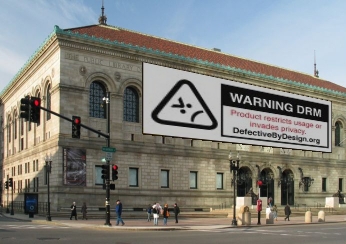
Benjamin Mako Hill: Protest DRM at the Boston Public Library

/copyrighteous/images/bpl_drm.jpg On Saturday February 9th, at 13:00, I'm going to be joining free software and anti-DRM activists to protest the use of DRM by the Boston Public Library on parts of its electronic collection. Those of us protesting are unhappy because the BPL has launched a new service powered by a company called OverDrive. The system gives BPL patrons access to books, music, and movies online -- but only if they use a Microsoft DRM system. There are lots of problems with the introduction of this system: it bars access to users of GNU/Linux and MacOS and creates a dependence on a single technology vendor for access. These are important issues, certainly. The worst problem, however, is much more fundamental. By adopting a DRM system for library content, the BPL is giving OverDrive, copyright holders, and Microsoft the ability to decide what, when, and how its patrons can and cannot read, listen, and watch these parts of the BPL collection. They are giving these companies veto power over the BPL's own ability to access this data -- both now and in the future. Cryptographically, BPL is quite literally handing over the keys to their collection. In the process, they are not only providing a disservice to their patrons. They are providing a disservice to themselves. The first-sale doctrine says that libraries can do essentially whatever they like with copies of books they purchase short of duplication, modification, or performance. Of course, copyright holders would prefer to charge a toll every time someone checks out a book. Public libraries were possible in spite of this desire because they were able to exploit power over the possession and control of their books in the interests of their patrons. With DRM, libraries will reduced to powerlessness. Of course, times have changed. As media and the ways we interact with it is increasingly digital, libraries have changed and will need to change more. But if public libraries are to succeed at their fundamental mission of spreading knowledge and serving communities, this change can't be at the expense of patrons' ability to control their own technology and libraries' ability to control their own collections. I've supported my academic library, MIT Libraries, as they took a risk and stood up to DRM when other institutions did not. And they won. BPL is the largest municipal library in the US and the third largest US library overall. It is the first library to be supported publicly, to be open to the public in the US, and to allow patrons to take home books to read and use them. BPL has an opportunity now to continue this history of leadership, of access, and of patron empowerment. If BPL stands up against DRM and in favor of its patrons' freedom and its own control of its technical destiny and collection, it may set an important precedent. If you're in or near Boston, please join me in Copley Square on Saturday to help make this happen. If you're not near Boston, please help put pressure on similar efforts in your own communities.

Matthew Palmer: Part of the 73rd Barbecue Division...

... is Donna Benjamin and her army of mignons. I'm going to have the mental image of a large collection of steaks wrapped in bacon marching around a parade ground stuck in my head all day now.

Aigars Mahinovs: (Latvian) Velost vvietas R gas centr

(This blog post is in Latvian and is about a public discussion that the capital of Latvia, Riga is having about where to put new bicycle racks in the center of the city. In the post I point to an article describing where to send in suggestions, point out a few possible locations for such racks and suggest installing racks with build-in locks that would require inserting a refundable coin to remove the key locking a bike in place) R gas dome v c ierosin jumus par jaunu velost vvietu novietojumu R gas centr . Es tur nos t ju sekojo us ieteikumus, parosieties ar j s. Vislab k velovietnes b tu izvietot t d viet , kas b tu p rredzama no ce iem, pa kuriem iet daudz cilv ku un ar kur b tu novietotas dro bas nov ro anas kameras, lai minimiz tu z dz bu risku. Viena vietne var tu atrasties Str lnieku laukum vai t tuvum , jo tur ir viegla piek uve no Krasta ielas. Vieta starp RTU ku Ka u 1 un
Krasta ielu var tu b t oti piem rota. Tas ar ierosin s studentus lietot velotransportu pa ce am uz lekcij m Ka u iel . Alberta laukuma var tu atrasties vieta velosip du novieto anai - vieta ir viegli pieejama no Stacijas puses un ir tuvu vair k m viesn c m. Ja ir pl ni izveidot Pay&Ride autom tisko velosip du nomu, tad is var tu b t par vienu no vislab kajiem punktiem dai iecerei. Pils laukums ir viegli sasniedzams no P rdaugavas pa Van u tiltu. Ja tur izveidotu velost vvietu, tad tas iev rojami atvieglotu iesp ju atbraukt ar velosip du pa J rmalas veloceli u p ri Van u tiltam, nogriezties pa labi un uzreiz dro i noparkoties. T pat l dzu apv rt ideju pielietot velovietnes ar ieb v tu atsl gu, lai neb tu nepiecie ams vest l dzi savu sl dzeni. Katrai vietai var tu b t sava sl dzene (bieza un pietieko i gara cietmet la trose) un atsl ga. Atsl gu var tu iz emt no sl dzenes tikai tad, kad sl dzene ir aiztais ta un sl dzenes meh nism ir ielikta 1 Ls mon ta. Atsl dzot sl dzeni ar atsl gu mon ta tiktu atdota atpaka . Tas nodro in s pret vand lismu, kad vienk r i vis m sl dzen m tiktu iz emtas atsl gas un aizmestas prom. Ta u jebkur gad jum j b t vieglam veidam k aizvietot nozaud t s atsl gas gan gad jumos kad velosip da pa nieks to pieprasa (tas var aiz emt vair kas dienas un pras t 5-10 Ls un iesnieguma uzrakst anu) vai ar kad velosip ds ir pamests piesl gt st vokl . Jaunas atsl gas izgatavo anai nevajadz tu pras t vair k k 1 Ls no pils tas bud eta, tad tas 1 Ls sl dzen os izdevumus atmaks s.

7 February 2008

Martin F. Krafft: The Penny & Martin adventure: phase 1

The first phase of the Penny and Martin adventure has come to an end: after a few days of Wellington, we are now sitting on the ferry to Picton, beginning our week-long road trip of the South Island. Penny and Martin in full diving gear We spent the first three days getting our PADI Open Water diving certification. After the obligatory pool session, in which we practiced certain basic skills, such as taking off and replacing the mask underwater and breathing from the partner s (buddy s) backup regulator, we were ready for the open water. Four dives at Kau Bay later, during which we played with sea horses^W ponies, captured and ate scallops (well, the others captured them ), and were chased by vicious jellyfish, we can now go diving whenever and wherever we want, down to 18 metres and intend to do so a few times during the coming week. Later on Tuesday, I accepted the invitation by the folks at the New Zealand Sea Adventures dive shop, Mike and Seamus, and joined them for another dive in the evening, with conditions even worse than the previous four descents. Together with my buddy Jess, a volcano researcher from London, I experienced close to zero visibility at about 12 metres of depth rain and strong winds made the water really murky. I can easily understand how one might get disoriented and uneasy in the pitch black, but with Jess keeping an excellent bearing, it was all hunky dory for me, tagging on to her side and swimming along. Later that night, accompanied by two popping ears, Penny and I joined two of her close friends, Lisa and Chris, for an evening of games, and was introduced to the card game 500 , which is rather similar to the Bavarian game Schafkopf . It thus didn t take me long to get a grasp and win! Wednesday was Waitangi day, the anniversary of the equinomial treaty, and Wellington celebrated it with the One Love festival. Our plans for the day eating breakfast in the tree, frolic at the festival, and chill on the beach started to fall apart when we found aforementioned tree to be trimmed beyond recognition (at least in terms of function). A whining, hung-over Chris in the backseat and a traffic jam then made us skip the festival in favour of breakfast at the Recovery Room (great name!), and general absence of summery temperatures caused us to settle in Penny s back yard for beers and the last rays of sun instead. A Thai dinner later, we slept. (This post is dedicated to Daren, lover of and then reports.)

Martin F. Krafft: Leaving LCA

I am 10 000 metres above sea level, on my way from Melbourne to Wellington. I am looking back at a very enjoyable week of conferencing, with LCA 2008 ending yesterday, followed by today s Open Day. The purpose of this final day is to invite the general public to learn about open-source. Individual projects present their work at booths and field questions by bypassers. Jacinta Richardson and the other organisers and helpers of the Open Day have done an amazing job. The place was buzzing and the selection of projects broad and interesting, even to me. Two talks and a series of lightning talks, as well as catered food for everyone rounded it off. I will try to have this event in mind as we organise a similar event in Buenos Aires after the forthcoming DebConf8 in Argentina. I had a splendid time at the conference and probably can t thank Donna Benjamin and her army of mignons enough for organising it. Compared to the other open-source conferences I previously attended, this one was the most professional. Good job, everyone!!! Here are the highlights: Apart from the busy programme, I particularly enjoyed the hallway track , which is usually the reason why I attend these events. I really ought to practice remembering names and faces a bit better. I am not paying enough tribute to this week with this report, but I shall conclude it regardless. Unless something very unexpected comes up, I will attend next year s LCA in Tasmania. NP: Porcupine Tree: Futile

5 February 2008

Benjamin Mako Hill: Unintentionally Offensive Product Names

I don't think I've been this amused since Reebok accidentally named a shoe after a demon that sexually assaults women. Want to contribute to my list of unintentionally offensive product names?

29 January 2008

Benjamin Mako Hill: Chama o Bombeiro!

In Brazilian Portuguese, "bombeiro" is the word for both a fireman and a plumber. If someone asks you to call a "bombeiro," their statement is usually unambiguous due to context. Usually. /copyrighteous/images/chama_o_bombeiro.png Both SVG source and t-shirts are available at cost.

28 January 2008

Benjamin Mako Hill: Computing in the Cloud Recordings

As I mentioned I would a month or so ago, I attended a workshop on Computing in the Cloud organized by Ed Felton's Center for Information Technology Policy at Princeton University. The conference aimed to discuss the policy issues that are raised by the shift from computing on machines we own and have direct control over to computing on servers owned by others. Think Google, Facebook, MySpace, and that lot. I talked about what all this might mean for free software and for open source and our communities, a bit about the AGPL, and discussed some ideas of how might proceed as a community. Princeton has been organized enough to post audio and video of the whole conference, including recordings of my talk, in a variety of formats and qualities (although unfortunately not in Vorbis and Theora). As I said in my FSF membership appeal last month, I think complications raised by "cloud computing" are one of the most important sets of challenges facing free software this year.

26 January 2008

Andrew Stribblehill: ls color considered harmful

This is a rant I have made many times in person: far too many to count. Since I can't possibly warn everybody who might be affected by this, face to face, I'm hoping you will all spread the word. The problem To begin with, I should say that ls --color is useful. It can show you which items in your directory listing are directories, symlinks, broken symlinks, device nodes, named pipes, whatever. I am glad that it exists. However, let’s consider the basic action of ls. It is, of course, to display which files and directories exist in a directory. This is really quick and easy in Unix. Simply use the libc function opendir() then just readdir() till it returns NULL and errno is 0. In terms of syscalls, this is an open(), one or two read()s and a close(). When you turn on the color option, every directory item incurs the weight of an extra stat() call to see what it is. Worse still, if it’s a symlink, ls will obligingly bound across to the thing linked to, to check it exists. If this causes your automounter to wake up and mount something remote, that’s quite an overhead. If your mount hangs because the remote filesystem is unavailable, you can say goodbye to that process; it'll be stuck blocking on a syscall that will never return. A partial solution To fix the symlink problem, here’s what you do. ls was written to avoid chasing symlinks if configured not to. Check your environment variables for the LS_COLORS variable with: $ env grep ^LS_COLORS If it exists, you have a config file for colour ls: you should edit /etc/DIR_COLORS* or copy it to $HOME/.dircolors and edit it there. Otherwise, type: $ dircolors --print-database > $HOME/.dircolors The edit you need to do is to remove or comment out the ORPHAN line from the file. Unless you were able to edit the file in /etc, you now need to make sure that this new $HOME/.dircolors file is used. In your shell login script (.bash_login for bash and .login for (t)csh, put the line: eval dircolors $HOME/.dircolors (Note that these are backticks, not apostrophes.) Next time you log in, you'll be able to use colourful ls without fear of a remote filesystem freezing your directory listings. In conclusion Use ls --color when you need it, but as with all powerful tools, use it with care. Corrections: James pointed out that to dump the default config it is –print-database not –print-directory.

Next.

Previous.