Search Results: "ina"

30 October 2024

Dirk Eddelbuettel: gcbd 0.2.7 on CRAN: More Mere Maintenance

Another pure maintenance release 0.2.7 of the gcbd package is now on CRAN. The gcbd proposes a benchmarking framework for LAPACK and BLAS operations (as the library can exchanged in a plug-and-play sense on suitable OSs) and records result in local database. Its original motivation was to also compare to GPU-based operations. However, as it is both challenging to keep CUDA working packages on CRAN providing the basic functionality appear to come and go so testing the GPU feature can be challenging. The main point of gcbd is now to actually demonstrate that yes indeed we can just swap BLAS/LAPACK libraries without any change to R, or R packages. The configure / rebuild R for xyz often seen with xyz being Goto or MKL is simply plain wrong: you really can just swap them (on proper operating systems, and R configs see the package vignette for more). But nomatter how often we aim to correct this record, it invariably raises its head another time. This release accommodates a CRAN change request as we were referencing the (now only suggested) package gputools. As hinted in the previous paragraph, it was once on CRAN but is not right now so we adjusted our reference. CRANberries also provides a diffstat report for the latest release. If you like this or other open-source work I do, you can sponsor me at GitHub.

This post by Dirk Eddelbuettel originated on his Thinking inside the box blog. Please report excessive re-aggregation in third-party for-profit settings.

26 October 2024

Russell Coker: The CUPS Vulnerability

The Announcement Late last month there was an announcement of a severity 9.9 vulnerability allowing remote code execution that affects all GNU/Linux systems (plus others) [1]. For something to affect all Linux systems that would have to be either a kernel issue or a sshd issue. The announcement included complaints about the lack of response of vendors and And YES: I LOVE hyping the sh1t out of this stuff because apparently sensationalism is the only language that forces these people to fix . He seems to have a different experience to me of reporting bugs, I have had plenty of success getting bugs fixed without hyping them. I just report the bug, wait a while, and it gets fixed. I have reported potential security bugs without even bothering to try and prove that they were exploitable (any situation where you can make a program crash is potentially exploitable), I just report it and it gets fixed. I was very dubious about his ability to determine how serious a bug is and to accurately report it so this wasn t a situation where I was waiting for it to be disclosed to discover if it affected me. I was quite confident that my systems wouldn t be at any risk. Analysis Not All Linux Systems Run CUPS When it was published my opinion was proven to be correct, it turned out to be a series of CUPS bugs [2]. To describe that as all GNU/Linux systems (plus others) seems like a vast overstatement, maybe a good thing to say if you want to be a TikTok influencer but not if you want to be known for computer security work. For the Debian distribution the cups-browsed package (which seems to be the main exploitable one) is recommended by cups-daemon, as I have my Debian systems configured to not install recommended packages by default that means that it wasn t installed on any of my systems. Also the vast majority of my systems don t do printing and therefore don t have any part of CUPS installed. CUPS vs NAT The next issue is that in Australia most home ISPs don t have IPv6 enabled and CUPS doesn t do the things needed to allow receiving connections from the outside world via NAT with IPv4. If inbound port 631 is blocked on both TCP and USP as is the default on Australian home Internet or if there is a correctly configured firewall in place then the network is safe from attack. There is a feature called uPnP port forwarding [3] to allow server programs to ask a router to send inbound connections to them, this is apparently usually turned off by default in router configuration. If it is enabled then there are Debian packages of software to manage this, the miniupnpc package has the client (which can request NAT changes on the router) [4]. That package is not installed on any of my systems and for my home network I don t use a router that runs uPnP. The only program I knowingly run that uses uPnP is Warzone2100 and as I don t play network games that doesn t happen. Also as an aside in version 4.4.2-1 of warzone2100 in Debian and Ubuntu I made it use Bubblewrap to run the game in a container. So a Remote Code Execution bug in Warzone 2100 won t be an immediate win for an attacker (exploits via X11 or Wayland are another issue). MAC Systems Debian has had AppArmor enabled by default since Buster was released in 2019 [5]. There are claims that AppArmor will stop this exploit from doing anything bad. To check SE Linux access I first use the semanage fcontext command to check the context of the binary, cupsd_exec_t means that the daemon runs as cupsd_t. Then I checked what file access is granted with the sesearch program, mostly just access to temporary files, cupsd config files, the faillog, the Kerberos cache files (not used on the Kerberos client systems I run), Samba run files (might be a possibility of exploiting something there), and the security_t used for interfacing with kernel security infrastructure. I then checked the access to the security class and found that it is permitted to check contexts and access-vectors not access that can be harmful. The next test was to use sesearch to discover what capabilities are granted, which unfortunately includes the sys_admin capability, that is a capability that allows many sysadmin tasks that could be harmful (I just checked the Fedora source and Fedora 42 has the same access). Whether the sys_admin capability can be used to do bad things with the limited access cupsd_t has to device nodes etc is not clear. But this access is undesirable. So the SE Linux policy in Debian and Fedora will stop cupsd_t from writing SETUID programs that can be used by random users for root access and stop it from writing to /etc/shadow etc. But the sys_admin capability might allow it to do hostile things and I have already uploaded a changed policy to Debian/Unstable to remove that. The sys_rawio capability also looked concerning but it s apparently needed to probe for USB printers and as the domain has no access to block devices it is otherwise harmless. Below are the commands I used to discover what the policy allows and the output from them.
# semanage fcontext -l grep bin/cups-browsed
/usr/bin/cups-browsed                              regular file       system_u:object_r:cupsd_exec_t:s0 
# sesearch -A -s cupsd_t -c file -p write
allow cupsd_t cupsd_interface_t:file   append create execute execute_no_trans getattr ioctl link lock map open read rename setattr unlink write  ;
allow cupsd_t cupsd_lock_t:file   append create getattr ioctl link lock open read rename setattr unlink write  ;
allow cupsd_t cupsd_log_t:file   append create getattr ioctl link lock open read rename setattr unlink write  ;
allow cupsd_t cupsd_runtime_t:file   append create getattr ioctl link lock open read rename setattr unlink write  ;
allow cupsd_t cupsd_rw_etc_t:file   append create getattr ioctl link lock open read rename setattr unlink write  ;
allow cupsd_t cupsd_t:file   append create getattr ioctl link lock open read rename setattr unlink write  ;
allow cupsd_t cupsd_tmp_t:file   append create getattr ioctl link lock open read rename setattr unlink write  ;
allow cupsd_t faillog_t:file   append getattr ioctl lock open read write  ;
allow cupsd_t init_tmpfs_t:file   append getattr ioctl lock read write  ;
allow cupsd_t krb5_host_rcache_t:file   append create getattr ioctl link lock open read rename setattr unlink write  ; [ allow_kerberos ]:True
allow cupsd_t print_spool_t:file   append create getattr ioctl link lock open read relabelfrom relabelto rename setattr unlink write  ;
allow cupsd_t samba_var_t:file   append getattr ioctl lock open read write  ;
allow cupsd_t security_t:file   append getattr ioctl lock open read write  ;
allow cupsd_t security_t:file   append getattr ioctl lock open read write  ; [ allow_kerberos ]:True
allow cupsd_t usbfs_t:file   append getattr ioctl lock open read write  ;
# sesearch -A -s cupsd_t -c security
allow cupsd_t security_t:security check_context; [ allow_kerberos ]:True
allow cupsd_t security_t:security   check_context compute_av  ;
# sesearch -A -s cupsd_t -c capability
allow cupsd_t cupsd_t:capability net_bind_service; [ allow_ypbind ]:True
allow cupsd_t cupsd_t:capability   audit_write chown dac_override dac_read_search fowner fsetid ipc_lock kill net_bind_service setgid setuid sys_admin sys_rawio sys_resource sys_tty_config  ;
# sesearch -A -s cupsd_t -c capability2
allow cupsd_t cupsd_t:capability2   block_suspend wake_alarm  ;
# sesearch -A -s cupsd_t -c blk_file
Conclusion This is an example of how not to handle security issues. Some degree of promotion is acceptable but this is very excessive and will result in people not taking security announcements seriously in future. I wonder if this is even a good career move by the researcher in question, will enough people believe that they actually did something good in this that it outweighs the number of people who think it s misleading at best?

25 October 2024

Jonathan Dowland: Behringer Model-D (synths I didn't buy)

Whilst researching what synth to buy, I learned of the Behringer1 Model-D2: a 2018 clone of the 1970 Moog Minimoog, in a desktop form factor.
Behringer Model-D Behringer Model-D
In common with the original Minimoog, it's a monophonic analogue synth, featuring three audible oscillators3 , Moog's famous 12-ladder filter and a basic envelope generator. The model-d has lost the keyboard from the original and added some patch points for the different stages, enabling some slight re-routing of the audio components.
1970 Moog Minimoog 1970 Moog Minimoog
Since I was focussing on more fundamental, back-to-basics instruments, this was very appealing to me. I'm very curious to find out what's so compelling about the famous Moog sound. The relative lack of features feels like an advantage: less to master. The additional patch points makes it a little more flexible and offer a potential gateway into the world of modular synthesis. The Model-D is also very affordable: about 200 GBP. I'll never own a real Moog. For this to work, I would need to supplement it with some other equipment. I'd need a keyboard (or press the Micron into service as a controller); I would want some way of recording and overdubbing (same as with any synth). There are no post-mix effects on the Model-D, such as delay, reverb or chorus, so I may also want something to add those. What stopped me was partly the realisation that there was little chance that a perennial beginner, such as I, could eek anything novel out of a synthesiser design that's 54 years old. Perhaps that shouldn't matter, but it gave me pause. Whilst the Model-D has patch points, I don't have anything to connect to them, and I'm firmly wanting to avoid the Modular Synthesis money pit. The lack of effects, and polyphony could make it hard to live-sculpt a tone. I started characterizing the Model-D as the "heart" choice, but it seemed wise to instead go for a "head" choice. Maybe another day!

  1. There's a whole other blog post of material I could write about Behringer and their clones of classic synths, some long out of production, and others, not so much. But, I decided to skip on that for now.
  2. taken from the fact that the Minimoog was a productised version of Moog's fourth internal prototype, the model D.
  3. 2 oscillators is more common in modern synths

24 October 2024

Emmanuel Kasper: back to blogging and running a feed reader as a containerized systemd service

After reading about Jonathan McDowell feed reader install and the back to blogging initiative, I decided to install a feed reader to follow all those nice blog posts. With a feed reader you can compose your own feed of news based on blog posts, websites, mastodon toots. And then you are independant from ad oriented ranking algorithms of social networks. Since Jonathan used FreshRSS as a feed reader, I started with the same software. On a quick glance on its github page, it sounded like a good project:
  • active contributions
  • different channels for stable and latest version of the software
  • container images pointing to the stable release
  • support multiple databases for storage, including PostgreSQL
  • correct documentation mentioning security caveats
I prefer to do the container image installation using podman since:
  • upgrades from FreshRSS are easy to do and can be done separately from operating system upgrades
  • I do not mess my based operating system with php (subjective) and in case of a compromized freshrss, the freshrss/apache install would be still restrained to its own Linux namespaces, separated from the rest of the system.
Podman is image compatible with Docker as they both implement the OCI runtime specification, and have a nearly identical command line interface. This installation will be done on a Debian server, but should work too on any Linux distribution. Initial setup
  • start a container image based on the start command provided by the FreshRSS project. The podman command line is nearly identical to the docker command line, excepts that podman expects the fully qualified domain name associated with the container image, and I chose to run the freshrss container on the localhost interface only. I also use a defined version tag, because using the latest tag makes it complicated to track which exact ersion I have installed.
# podman pull docker.io/freshrss/freshrss:1.20.1
# podman run --detach --restart unless-stopped --log-opt max-size=10m \
  --publish 127.0.0.1:8081:80 \
  --env TZ=Europe/Paris \
  --env 'CRON_MIN=1,31' \
  --volume freshrss_data:/var/www/FreshRSS/data \
  --volume freshrss_extensions:/var/www/FreshRSS/extensions \
  --name freshrss \
  docker.io/freshrss/freshrss:1.20.1
  • verify where the podman volumes have been created. This is where the user data of freshrss will be stored.
# podman volume ls
# podman volume inspect freshrss_data
  • now that freshrss is installed, you can start its configuration wizard at localhost:8081. You should keep the default sqlite choice
  • finally after running the wizard, you can login again and add some feeds
  • verify that your config has been stored outside the container, and inside the volume (so that it will not be erased in case of upgrages)
# ls -l /var/lib/containers/storage/volumes/freshrss_data/_data/users/
  • verify the state of sqlite database
echo '.tables'  sqlite3  /var/lib/containers/storage/volumes/freshrss_data/_data/users/<your freshrss user>/db.sqlite 
category  entry     entrytag  entrytmp  feed      tag
Going with FreshRSS in Production Podman has this very nice feature that it can generate a systemd unit from a running container, and use systemd to start a container on boot. This is in contrary to docker where the docker daemon does the stop/start of containers on boot. I prefer the systemd approach as it treats containers the same way as other system services. Once the freshrss container is running we can generate a systemd unit of it with:
# podman generate systemd --new --name freshrss   tee /etc/systemd/system/container-freshrss.service
Let s stop the container we started previously, and use systemd to manage it:
# podman stop freshrss
# systemctl enable --now container-freshrss.service
We can verify that we have a listening socket on the localhost interface, on the source port 8081
# systemctl status container-freshrss.service
  ...
# ss --listening --numeric --process '( sport = 8081 )'
Netid         State           Recv-Q          Send-Q                   Local Address:Port                   Peer Address:Port         Process         
tcp           LISTEN          0               4096                         127.0.0.1:8081                        0.0.0.0:*             users:(("conmon",pid=4464,fd=5))
Nota Bene: conmon (8) is the process managing the network namespace in which fresh-rss is running, hence it is displayed as the process owning the listening socket Exposing FreshRSS to the external world We have now a running service, but we need to make it reachable from the internet. The simplest, classical way, is to create a subdomain and a VirtualHost configured as a reverse proxy to access the service at 127.0.0.1:8081. Fortunately the FreshRSS authors have documented this setup in https://github.com/FreshRSS/FreshRSS/tree/edge/Docker#alternative-reverse-proxy-using-apache and those steps are no different from a standard application behind a web reverse proxy. Upgrading freshrss container to a newer version A documentation showing how to install a piece of software is nothing when it does not show how to upgrade that said software. Installing is easy, upgrading is where the challenge is. Fortunately to the good stateless design of freshrss (everything is in the sqlite database, which is backed by a non-epheremal volume in our setup), switchting versions is a peace of cake.
# podman pull docker.io/freshrss/freshrss:1.20.2
# systemctl stop container-freshrss.service
# sed -i 's,docker.io/freshrss/freshrss:1.20.1,docker.io/freshrss/freshrss:1.20.2,' /etc/systemd/system/container-freshrss.service
# systemctl daemon-reload
# systemctl start container-freshrss.service
If you need to rollback, you just need to revert version numbers in the instruction above. Enjoy your own reader feed ! I will add the following feeds of blogs I like, let us see if I follow them better with a feed reader !

Valhalla's Things: Asemic Writing, a Zine

Posted on October 24, 2024
Tags: madeof:atoms, madeof:bits, craft:zine
An open booklet with lines that look like some kind of cursive non-alphabetic script, framed by a border in the same script and four symbols in the corners. I have no idea either. The front of that booklet, with three lines of fake text in different sizes and a circle of the same. Happy Maladay1 to those who celebrate it, I guess.
A template on white paper with pencil lines where text is supposed to go. Multiple A4 sheet of tracing paper with fake text, plus an A6 sheet and a white A6 sheet with a stamp impression. If you care about the how, it started as china ink on tracing paper, with the help of a template (and a correction sheet for one page where I used the wrong line on the template). alt A rubber stamp was carved with the author s signature and stamped on white paper because the ink from the pad wasn t working well on tracing paper. Then everything was scanned (with the correction on top of the wrong page) asemic_zine_scans.tar. Imported in Inkscape and traced asemic_zine_svg.tar. Printed, cut in half, folded and stapled. The magenta lines weren t by design, but are there because my printer is currently2 cursed. And finally, asemic_zine.pdf was created, joining the pages together with pdfjam, for convenience in case somebody wants to download the full thing. All the .tar and .pdf downloads from this page are released under the WTFPL, or All Rites Reversed..

  1. it s still technically Maladay when I write this, even if by the time you ll get this it s probably the 6th of The Aftermath.
  2. I mean, all printers are always cursed, but at different times they can be cursed in different and novel ways.

23 October 2024

Jonathan Dowland: Why hardware synths?

Russell wrote a great comment on my last post (thanks!):
What benefits do these things offer when a general purpose computer can do so many things nowadays? Is there a USB keyboard that you can connect to a laptop or phone to do these things? I presume that all recent phones have the compute power to do all the synthesis you need if you have the right software. Is it just a lack of software and infrastructure for doing it on laptops/phones that makes synthesisers still viable?
I've decided to turn my response into a post of its own. The issue is definitely not compute power. You can indeed attach a USB keyboard to a computer and use a plethora of software synthesisers, including very faithful emulations of all the popular classics. The raw compute power of modern hardware synths is comparatively small: I ve been told the modern Korg digital synths are on a par with a raspberry pi. I ve seen some DSPs which are 32 bit ARMs, and other tools which are roughly equivalent to arduinos. I can think of four reasons hardware synths remain popular with some despite the above:
  1. As I touched on in my original synth post, computing dominates my life outside of music already. I really wanted something separate from that to keep mental distance from work.
  2. Synths have hard real-time requirements. They don't have raw power in compute terms, but they absolutely have to do their job within microseconds of being instructed to, with no exceptions. Linux still has a long way to go for hard real-time.
  3. The Linux audio ecosystem is complex. Dealing with pipewire, pulseaudio, jack, alsa, oss, and anything else I've forgotten, as well as their failure modes, is too time consuming.
  4. The last point is to do with creativity and inspiration. A good synth is more than the sum of its parts: it's an instrument, carefully designed and its components integrated by musically-minded people who have set out to create something to inspire. There are plenty of synths which aren't good instruments, but have loads of features: they re boxes of "stuff". Good synths can't do it all: they often have limitations which you have to respond to, work around or with, creatively. This was expressed better than I could by Trent Reznor in the video archetype of a synthesiser:

22 October 2024

Dirk Eddelbuettel: drat 0.2.5 on CRAN: Small Updates

drat user A new minor release of the drat package arrived on CRAN today, which is just over a year since the previous release. drat stands for drat R Archive Template, and helps with easy-to-create and easy-to-use repositories for R packages. Since its inception in early 2015 it has found reasonably widespread adoption among R users because repositories with marked releases is the better way to distribute code. Because for once it really is as your mother told you: Friends don t let friends install random git commit snapshots. Properly rolled-up releases it is. Just how CRAN shows us: a model that has demonstrated for over two-and-a-half decades how to do this. And you can too: drat is easy to use, documented by six vignettes and just works. Detailed information about drat is at its documentation site. That said, and these days , if you mainly care about github code then r-universe is there too, also offering binaries its makes and all that jazz. But sometimes you just want to, or need to, roll a local repository and drat can help you there. This release contains a small PR (made by Arne Holmin just after the previous release) adding support for an OSflacour variable (helpful for macOS). We also corrected an issue with one test file being insufficiently careful of using git2r only when installed, and as usual did a round of maintenance for the package concerning both continuous integration and documentation. The NEWS file summarises the release as follows:

Changes in drat version 0.2.5 (2024-10-21)
  • Function insertPackage has a new optional argument OSflavour (Arne Holmin in #142)
  • A test file conditions correctly about git2r being present (Dirk)
  • Several smaller packaging updates and enhancements to continuous integration and documentation have been added (Dirk)

Courtesy of my CRANberries, there is a comparison to the previous release. More detailed information is on the drat page as well as at the documentation site. If you like this or other open-source work I do, you can sponsor me at GitHub.

This post by Dirk Eddelbuettel originated on his Thinking inside the box blog. Please report excessive re-aggregation in third-party for-profit settings.

21 October 2024

Sahil Dhiman: Free Software Mirrors in India

Last Updated on 15/11/2024. List of public mirrors in India. Location discovered basis personal knowledge, traces or GeoIP. Mirrors which aren t accessible outside their own ASN are excluded.

North India

East India

South India

West India

CDN (or behind one) Many thanks to Shrirang and Saswata for tips and corrections. Let me know if I m missing someone or something is amiss.

Sven Hoexter: Terraform: Making Use of Precondition Checks

I'm in the unlucky position to have to deal with GitHub. Thus I've a terraform module in a project which deals with populating organization secrets in our GitHub organization, and assigning repositories access to those secrets. Since the GitHub terraform provider internally works mostly with repository IDs, not slugs (this human readable organization/repo format), we've to do some mapping in between. In my case it looks like this:
#tfvars Input for Module
org_secrets =  
    "SECRET_A" =  
        repos = [
            "infra-foo",
            "infra-baz",
            "deployment-foobar",
        ]
    "SECRET_B" =  
        repos = [
            "job-abc",
            "job-xyz",
        ]
     
 
# Module Code
/*
Limitation: The GH search API which is queried returns at most 1000
results. Thus whenever we reach that limit this approach will no longer work.
The query is also intentionally limited to internal repositories right now.
*/
data "github_repositories" "repos"  
    query           = "org:myorg archived:false -is:public -is:private"
    include_repo_id = true
 
/*
The properties of the github_repositories.repos data source queried
above contains only lists. Thus we've to manually establish a mapping
between the repository names we need as a lookup key later on, and the
repository id we got in another list from the search query above.
*/
locals  
    # Assemble the set of repository names we need repo_ids for
    repos = toset(flatten([for v in var.org_secrets : v.repos]))
    # Walk through all names in the query result list and check
    # if they're also in our repo set. If yes add the repo name -> id
    # mapping to our resulting map
    repos_and_ids =  
        for i, v in data.github_repositories.repos.names : v => data.github_repositories.repos.repo_ids[i]
        if contains(local.repos, v)
     
 
resource "github_actions_organization_secret" "org_secrets"  
    for_each        = var.org_secrets
    secret_name     = each.key
    visibility      = "selected"
    # the logic how the secret value is sourced is omitted here
    plaintext_value = data.xxx
    selected_repository_ids = [
        for r in each.value.repos : local.repos_and_ids[r]
        if can(local.repos_and_ids[r])
    ]
 
Now if we do something bad, delete a repository and forget to remove it from the configuration for the module, we receive some error message that a (numeric) repository ID could not be found. Pretty much useless for the average user because you've to figure out which repository is still in the configuration list, but got deleted recently. Luckily terraform supports since version 1.2 precondition checks, which we can use in an output-block to provide the information which repository is missing. What we need is the set of missing repositories and the validation condition:
locals  
    # Debug facility in combination with an output and precondition check
    # There we can report which repository we still have in our configuration
    # but no longer get as a result from the data provider query
    missing_repos = setsubtract(local.repos, data.github_repositories.repos.names)
 
# Debug facility - If we can not find every repository in our
# search query result, report those repos as an error
output "missing_repos"  
    value = local.missing_repos
    precondition  
        condition     = length(local.missing_repos) == 0
        error_message = format("Repos in config missing from resultset: %v", local.missing_repos)
     
 
Now you only have to be aware that GitHub is GitHub and the TF provider has open bugs, but is not supported by GitHub and you will encounter inconsistent results. But it works, even if your terraform apply failed that way.

Russ Allbery: California general election

As usual with these every-two-year posts, probably of direct interest only to California residents. Maybe the more obscure things we're voting on will be a minor curiosity to people elsewhere. I'm a bit late this year, although not as late as last year, so a lot of people may have already voted, but I've been doing this for a while and wanted to keep it up. This post will only be about the ballot propositions. I don't have anything useful to say about the candidates that isn't hyper-local. I doubt anyone who has read my posts will be surprised by which candidates I'm voting for. As always with Calfornia ballot propositions, it's worth paying close attention to which propositions were put on the ballot by the legislature, usually because there's some state law requirement (often that I disagree with) that they be voted on by the public, and propositions that were put on the ballot by voter petition. The latter are often poorly written and have hidden problems. As a general rule of thumb, I tend to default to voting against propositions added by petition. This year, one can conveniently distinguish by number: the single-digit propositions were added by the legislature, and the two-digit ones were added by petition. Proposition 2: YES. Issue $10 billion in bonds for public school infrastructure improvements. I generally vote in favor of spending measures like this unless they have some obvious problem. The opposition argument is a deranged rant against immigrants and government debt and fails to point out actual problems. The opposition argument also claims this will result in higher property taxes and, seriously, if only that were true. That would make me even more strongly in favor of it. Proposition 3: YES. Enshrines the right to marriage without regard to sex or race into the California state constitution. This is already the law given US Supreme Court decisions, but fixing California state law is a long-overdue and obvious cleanup step. One of the quixotic things I would do if I were ever in government, which I will never be, would be to try to clean up the laws to make them match reality, repealing all of the dead clauses that were overturned by court decisions or are never enforced. I am in favor of all measures in this direction even when I don't agree with the direction of the change; here, as a bonus, I also strongly agree with the change. Proposition 4: YES. Issue $10 billion in bonds for infrastructure improvements to mitigate climate risk. This is basically the same argument as Proposition 2. The one drawback of this measure is that it's kind of a mixed grab bag of stuff and probably some of it should be supported out of the general budget rather than bonds, but I consider this a minor problem. We definitely need to ramp up climate risk mitigation efforts. Proposition 5: YES. Reduces the required super-majority to pass local bond measures for affordable housing from 67% to 55%. The fact that this requires a supermajority at all is absurd, California desperately needs to build more housing of any kind however we can, and publicly funded housing is an excellent idea. Proposition 6: YES. Eliminates "involuntary servitude" (in other words, "temporary" slavery) as a legally permissible punishment for crimes in the state of California. I'm one of the people who think the 13th Amendment to the US Constitution shouldn't have an exception for punishment for crimes, so obviously I'm in favor of this. This is one very, very tiny step towards improving the absolutely atrocious prison conditions in the state. Proposition 32: YES. Raises the minimum wage to $18 per hour from the current $16 per hour, over two years, and ties it to inflation. This is one of the rare petition-based propositions that I will vote in favor of because it's very straightforward, we clearly should be raising the minimum wage, and living in California is absurdly expensive because we refuse to build more housing (see Propositions 5 and 33). The opposition argument is the standard lie that a higher minimum wage will increase unemployment, which we know from numerous other natural experiments is simply not true. Proposition 33: NO. Repeals Costa-Hawkins, which prohibits local municipalities from enacting rent control on properties built after 1995. This one is going to split the progressive vote rather badly, I suspect. California has a housing crisis caused by not enough housing supply. It is not due to vacant housing, as much as some people would like you to believe that; the numbers just don't add up. There are way more people living here and wanting to live here than there is housing, so we need to build more housing. Rent control serves a valuable social function of providing stability to people who already have housing, but it doesn't help, and can hurt, the project of meeting actual housing demand. Rent control alone creates a two-tier system where people who have housing are protected but people who don't have housing have an even harder time getting housing than they do today. It's therefore quite consistent with the general NIMBY playbook of trying to protect the people who already have housing by making life harder for the people who do not, while keeping the housing supply essentially static. I am in favor of rent control in conjunction with real measures to increase the housing supply. I am therefore opposed to this proposition, which allows rent control without any effort to increase housing supply. I am quite certain that, if this passes, some municipalities will use it to make constructing new high-density housing incredibly difficult by requiring it all be rent-controlled low-income housing, thus cutting off the supply of multi-tenant market-rate housing entirely. This is already a common political goal in the part of California where I live. Local neighborhood groups advocate for exactly this routinely in local political fights. Give me a mandate for new construction that breaks local zoning obstructionism, including new market-rate housing to maintain a healthy lifecycle of housing aging into affordable housing as wealthy people move into new market-rate housing, and I will gladly support rent control measures as part of that package. But rent control on its own just allocates winners and losers without addressing the underlying problem. Proposition 34: NO. This is an excellent example of why I vote against petition propositions by default. This is a law designed to affect exactly one organization in the state of California: the AIDS Healthcare Foundation. The reason for this targeting is disputed; one side claims it's because of the AHF support for Proposition 33, and another side claims it's because AHF is a slumlord abusing California state funding. I have no idea which side of this is true. I also don't care, because I am fundamentally opposed to writing laws this way. Laws should establish general, fair principles that are broadly applicable, not be written with bizarrely specific conditions (health care providers that operate multifamily housing) that will only be met by a single organization. This kind of nonsense creates bad legal codes and the legal equivalent of technical debt. Just don't do this. Proposition 35: YES. I am, reluctantly, voting in favor of this even though it is a petition proposition because it looks like a useful simplification and cleanup of state health care funding, makes an expiring tax permanent, and is supported by a very wide range of organizations that I generally trust to know what they're talking about. No opposition argument was filed, which I think is telling. Proposition 36: NO. I am resigned to voting down attempts to start new "war on drugs" nonsense for the rest of my life because the people who believe in this crap will never, ever, ever stop. This one has bonus shoplifting fear-mongering attached, something that touches on nasty local politics that have included large retail chains manipulating crime report statistics to give the impression that shoplifting is up dramatically. It's yet another round of the truly horrific California "three strikes" criminal penalty obsession, which completely misunderstands both the causes of crime and the (almost nonexistent) effectiveness of harsh punishment as deterrence.

15 October 2024

Dirk Eddelbuettel: qlcal 0.0.13 on CRAN: Small Calendar Update

The thirteenth release of the qlcal package arrivied at CRAN today. qlcal delivers the calendaring parts of QuantLib. It is provided (for the R package) as a set of included files, so the package is self-contained and does not depend on an external QuantLib library (which can be demanding to build). qlcal covers over sixty country / market calendars and can compute holiday lists, its complement (i.e. business day lists) and much more. Examples are in the README at the repository, the package page, and course at the CRAN package page. This releases synchronizes qlcal with the QuantLib release 1.36 (made this week) and contains some minor updates to two calendars.

Changes in version 0.0.13 (2024-10-15)
  • Synchronized with QuantLib 1.36 released yesterday
  • Calendar updates for South Korea and Poland

Courtesy of my CRANberries, there is a diffstat report for this release. See the project page and package documentation for more details, and more examples. If you like this or other open-source work I do, you can sponsor me at GitHub.

This post by Dirk Eddelbuettel originated on his Thinking inside the box blog. Please report excessive re-aggregation in third-party for-profit settings.

Lukas M rdian: Waiting for a Linux system to be online

Designed by Freepik

What is an online system? Networking is a complex topic, and there is lots of confusion around the definition of an online system. Sometimes the boot process gets delayed up to two minutes, because the system still waits for one or more network interfaces to be ready. Systemd provides the network-online.target that other service units can rely on, if they are deemed to require network connectivity. But what does online actually mean in this context, is a link-local IP address enough, do we need a routable gateway and how about DNS name resolution? The requirements for an online network interface depend very much on the services using an interface. For some services it might be good enough to reach their local network segment (e.g. to announce Zeroconf services), while others need to reach domain names (e.g. to mount a NFS share) or reach the global internet to run a web server. On the other hand, the implementation of network-online.target varies, depending on which networking daemon is in use, e.g. systemd-networkd-wait-online.service or NetworkManager-wait-online.service. For Ubuntu, we created a specification that describes what we as a distro expect an online system to be. Having a definition in place, we are able to tackle the network-online-ordering issues that got reported over the years and can work out solutions to avoid delayed boot times on Ubuntu systems. In essence, we want systems to reach the following networking state to be considered online:
  1. Do not wait for optional interfaces to receive network configuration
  2. Have IPv6 and/or IPv4 link-local addresses on every network interface
  3. Have at least one interface with a globally routable connection
  4. Have functional domain name resolution on any routable interface

A common implementation NetworkManager and systemd-networkd are two very common networking daemons used on modern Linux systems. But they originate from different contexts and therefore show different behaviours in certain scenarios, such as wait-online. Luckily, on Ubuntu we already have Netplan as a unification layer on top of those networking daemons, that allows for common network configuration, and can also be used to tweak the wait-online logic. With the recent release of Netplan v1.1 we introduced initial functionality to tweak the behaviour of the systemd-networkd-wait-online.service, as used on Ubuntu Server systems. When Netplan is used to drive the systemd-networkd backend, it will emit an override configuration file in /run/systemd/system/systemd-networkd-wait-online.service.d/10-netplan.conf, listing the specific non-optional interfaces that should receive link-local IP configuration. In parallel to that, it defines a list of network interfaces that Netplan detected to be potential global connections, and waits for any of those interfaces to reach a globally routable state. Such override config file might look like this:
[Unit]
ConditionPathIsSymbolicLink=/run/systemd/generator/network-online.target.wants/systemd-networkd-wait-online.service

[Service]
ExecStart=
ExecStart=/lib/systemd/systemd-networkd-wait-online -i eth99.43:carrier -i lo:carrier -i eth99.42:carrier -i eth99.44:degraded -i bond0:degraded
ExecStart=/lib/systemd/systemd-networkd-wait-online --any -o routable -i eth99.43 -i eth99.45 -i bond0
In addition to the new features implemented in Netplan, we reached out to upstream systemd, proposing an enhancement to the systemd-networkd-wait-online service, integrating it with systemd-resolved to check for the availability of DNS name resolution. Once this is implemented upstream, we re able to fully control the systemd-networkd backend on Ubuntu Server systems, to behave consistently and according to the definition of an online system that was lined out above.

Future work The story doesn t end there, because Ubuntu Desktop systems are using NetworkManager as their networking backend. This daemon provides its very own nm-online utility, utilized by the NetworkManager-wait-online systemd service. It implements a much higher-level approach, looking at the networking daemon in general instead of the individual network interfaces. By default, it considers a system to be online once every autoconnect profile got activated (or failed to activate), meaning that either a IPv4 or IPv6 address got assigned. There are considerable enhancements to be implemented to this tool, for it to be controllable in a fine-granular way similar to systemd-networkd-wait-online, so that it can be instructed to wait for specific networking states on selected interfaces.

A note of caution Making a service depend on network-online.target is considered an antipattern in most cases. This is because networking on Linux systems is very dynamic and the systemd target can only ever reflect the networking state at a single point in time. It cannot guarantee this state to be remained over the uptime of your system and has the potentially to delay the boot process considerably. Cables can be unplugged, wireless connectivity can drop, or remote routers can go down at any time, affecting the connectivity state of your local system. Therefore, instead of wondering what to do about network.target, please just fix your program to be friendly to dynamically changing network configuration. [source].

14 October 2024

Dirk Eddelbuettel: RcppDate 0.0.4: New Upstream Minor

RcppDate wraps the featureful date library written by Howard Hinnant for use with R. This header-only modern C++ library has been in pretty wide-spread use for a while now, and adds to C++11/C++14/C++17 what will be (with minor modifications) the date library in C++20. This release, the first in 3 1/2 years, syncs the code with the recent date 3.0.2 release from a few days ago. It also updates a few packaging details such as URLs, badges or continuous integration.

Changes in version 0.0.4 (2024-10-14)
  • Updated to upstream version 3.0.2 (and adjusting one pragma)
  • Several small updates to overall packaging and testing

Courtesy of my CRANberries, there is also a diffstat report for the most recent release. More information is available at the repository or the package page. If you like this or other open-source work I do, you can sponsor me at GitHub.

This post by Dirk Eddelbuettel originated on his Thinking inside the box blog. Please report excessive re-aggregation in third-party for-profit settings.

Scarlett Gately Moore: Kubuntu 24.10 Released, KDE Snaps at 24.08.2, and I lived to tell you about it!

Happy 28th birthday KDE!Happy 28th Birthday KDE!
Sorry my blog updates have been MIA. Let me tell you a story As some of you know, 3 months ago I was in a no fault car accident. Thankfully, the only injury was I ended up with a broken arm. ER sends me home in a sling and tells me it was a clean break and it will mend itself in no time. After a week of excruciating pain I went to my follow up doctor appointment, and with my x-rays in hand, the doc tells me it was far from a clean break and needs surgery. So after a week of my shattered bone scraping my nerves and causing pain I have never felt before, I finally go in for surgery! They put in a metal plate with screws to hold the bone in place so it can properly heal. The nerve pain was gone, so I thought I was on the mend. Some time goes by and the swelling still has not subsided, the doctors are not as concerned about this as I am, so I carry on until it becomes really inflamed and developed fever blisters. After no success in reaching the doctors office my husband borrows the neighbors car and rushes me to the ER. Good thing too, I had an infection. So after a 5 day stay in the hospital, they sent us home loaded with antibiotics and trained my husband in wound packing. We did everything right, kept the place immaculate, followed orders with the wound care, took my antibiotics, yet when they ran out there was still no sign of relief, or healing. Went to doctors and they gave me another month supply of antibiotics. Two days after my final dose my arm becomes inflamed again and with extra spectacular levels of pain to go with it. I call the doctor office They said to come in on my appointment day ( 4 days away ). I asked, You aren t concerned with this inflammation? , to which they replied, No. . Ok, maybe I am over reacting and it s all in my head, I can power through 4 more days. The following morning my husband observed fever blisters and the wound site was clearly not right, so once again off we go to the ER. Well thankfully we did. I was in Sepsis and could have died After deliberating with the doctor on the course of action for treatment, the doctor accepted our plea to remove the plate, rather than tighten screws and have me drive 100 miles to hospital everyday for iv antibiotics (Umm I don t have a car!?) So after another 4 day stay I am released into the world, alive and well. I am happy to report, the swelling is almost gone, the pain is minimal, and I am finally healing nicely. I am still in a sling and I have to be super careful and my arm was not fully knitted. So with that I am bummed to say, no traveling for me, no Ubuntu Summit  I still need help with that car, if it weren t for our neighbor, this story would have ended much differently. https://gofund.me/00942f47 Despite my tragic few months for my right arm, my left arm has been quite busy. Thankfully I am a lefty! On to my work progress report. Kubuntu:
With Plasma 6! A big thank you to the Debian KDE/QT team and Rik Mills, could not have done it without you!
KDE Snaps: All release service snaps are done! Save a few problematic ones still WIP.. I have released 24.08.2 which you can find here: https://snapcraft.io/publisher/kde I completed the qt6 and KDE frameworks 6 content packs for core24 Snapcraft: I have a PR in for kde-neon-6 extension core24 support. That s all for now. Thanks for stopping by!

13 October 2024

Taavi V n nen: Bulk downloading Wikimedia Commons categories

Wikimedia Commons, the Wikimedia project for freely licensed media files, also contains a bunch of photos by me and photos of me at various events. While I don't think Commons is going away anytime soon, I would still like to have a local copy of those images available on my own storage hardware. Obviously this requires some way to query for photos you want to download. I'm using Commons categories for this, since that's easy to implement and works for both use cases. The Commons community tends to come up with very specific categories that you can use, and if not, you can usually categorize the files yourself.
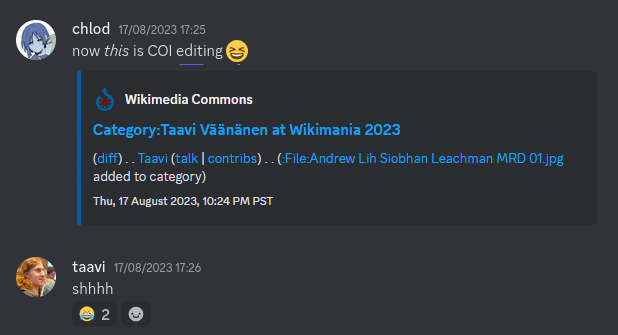
Me replying 'shh' to a Discord message showing myself categorizing photos about me and accusing me of COI editing
thankfully Commons has no such thing as a Conflict of interest (COI) policy
There is almost an existing tool for this: Sam Wilson's mwcli project has support for exporting images one has uploaded to Commons. However I couldn't use that to upload photos of me others have uploaded, plus it's written in PHP and I don't exactly want to deal with the problem of figuring out how to package it in a way I could neatly install it on my NAS. So I wrote my own tool for it, called comload. It's written in Python because Python is easy to deploy (I can just throw it in a .deb and upload it to my internal repository), and because I did not find a Go library to handle Action API pagination for me. The basic usage is like this:
$ comload --subcats "Taavi V n nen"
This will download any files in Category:Taavi V n nen and its sub-categories to the current directory. Former image versions, as well as the image description and SDC data, if any, is also included. And it's smart enough to not download any files that are already there on future runs, so you can just throw it in a systemd timer to get any future files. I'd still like it to handle moved files without creating a duplicate copy, but otherwise I'm really happy with the current state. comload is available from PyPI and from my Git server directly, and is licensed under the GPLv3.

12 October 2024

Jonathan Dowland: Code formatting in documents

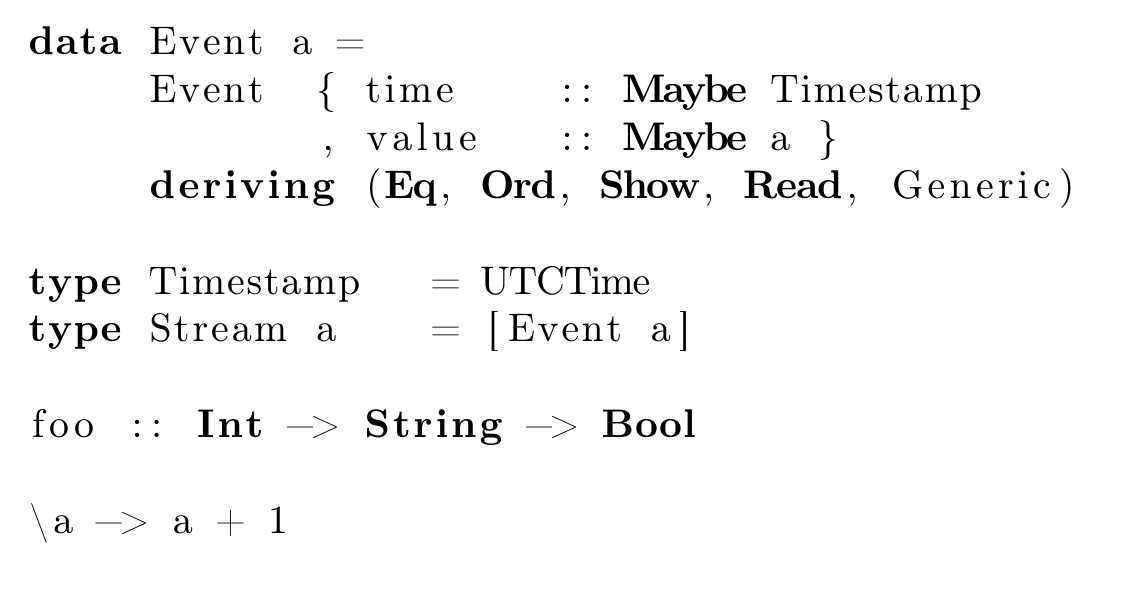
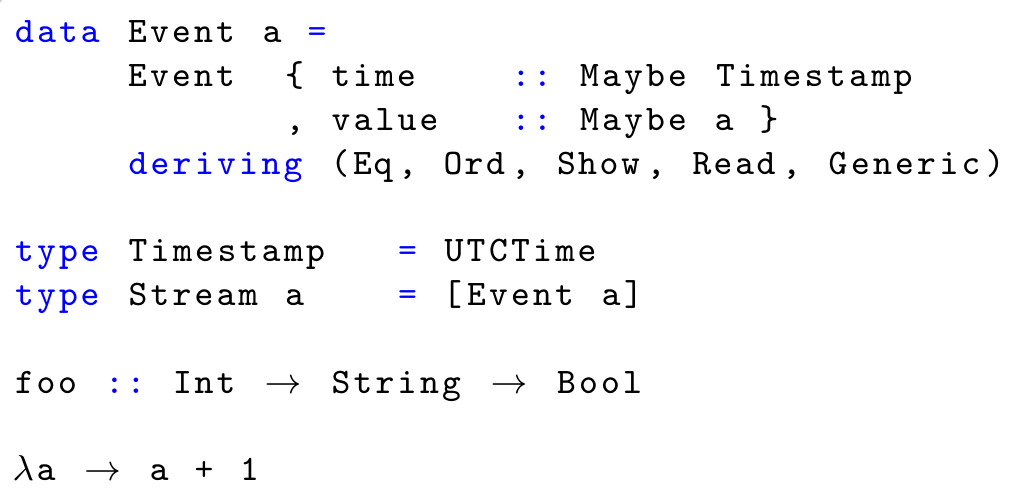
I've been exploring typesetting and formatting code within text documents such as papers, or my thesis. Up until now, I've been using the listings package without thinking much about it. By default, some sample Haskell code processed by listings looks like this (click any of the images to see larger, non-blurry versions):
default output of listings on a Haskell code sample
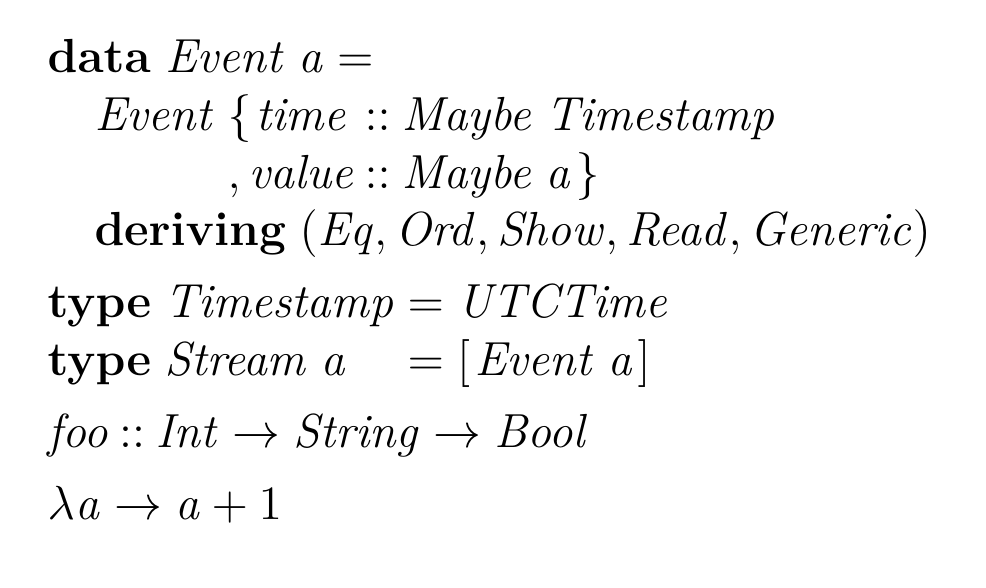
It's formatted with a monospaced font, with some keywords highlighted, but not syntactic symbols. There are several other options for typesetting and formatting code in LaTeX documents. For Haskell in particular, there is the preprocessor lhs2tex, The default output of which looks like this:
default output of lhs2tex on a Haskell code sample
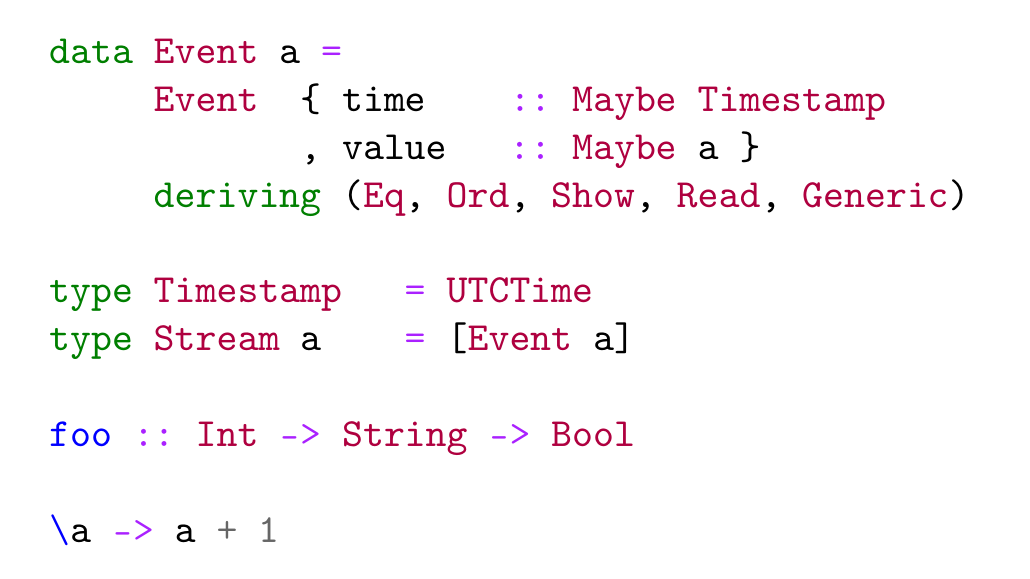
A proportional font, but it's taken pains to preserve vertical alignment, which is syntactically significant for Haskell. It looks a little cluttered to me, and I'm not a fan of nearly everything being italic. Again, symbols aren't differentiated, but it has substituted them for more typographically pleasing alternatives: -> has become , and \ is now . Another option is perhaps the newest, the LaTeX package minted, which leverages the Python Pygments program. Here's the same code again. It defaults to monospace (the choice of font seems a lot clearer to me than the default for listings), no symbolic substitution, and liberal use of colour:
default output of minted on a Haskell code sample
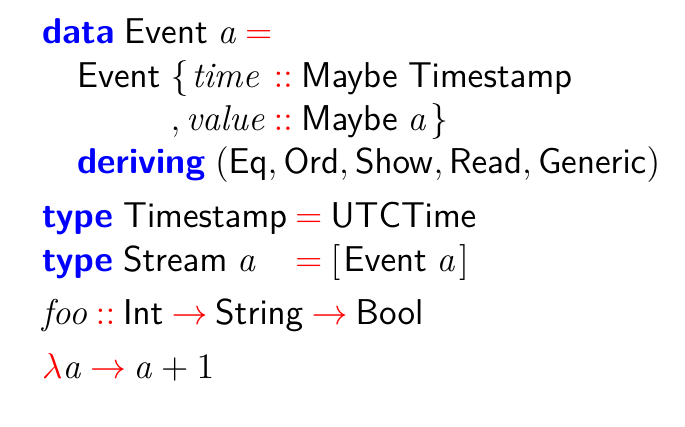
An informal survey of the samples so far showed that the minted output was the most popular. All of these packages can be configured to varying degrees. Here are some examples of what I've achieved with a bit of tweaking
_listings_ adjusted with colour and some symbols substituted (but sadly not the two together) listings adjusted with colour and some symbols substituted (but sadly not the two together)
_lhs2tex_ adjusted to be less italic, sans-serif and use some colour lhs2tex adjusted to be less italic, sans-serif and use some colour
All of this has got me wondering whether there are straightforward empirical answers to some of these questions of style. Firstly, I'm pretty convinced that symbolic substitution is valuable. When writing Haskell, we write ->, \, /= etc. not because it's most legible, but because it's most practical to type those symbols on the most widely available keyboards and popular keyboard layouts.1 Of the three options listed here, symbolic substitution is possible with listings and lhs2tex, but I haven't figured out if minted can do it (which is really the question: can pygments do it?) I'm unsure about proportional versus monospaced fonts. We typically use monospaced fonts for editing computer code, but that's at least partly for historical reasons. Vertical alignment is often very important in source code, and it can be easily achieved with monospaced text; it's also sometimes important to have individual characters (., etc.) not be de-emphasised by being smaller than any other character. lhs2tex, at least, addresses vertical alignment whilst using proportional fonts. I guess the importance of identifying individual significant characters is just as true in a code sample within a larger document as it is within plain source code. From a (brief) scan of research on this topic, it seems that proportional fonts result in marginally quicker reading times for regular prose. It's not clear whether those results carry over into reading computer code in particular, and the margin is slim in any case. The drawbacks of monospaced text mostly apply when the volume of text is large, which is not the case for the short code snippets I am working with. I still have a few open questions:

  1. The Haskell package Data.List.Unicode lets the programmer use a range of unicode symbols in place of ASCII approximations, such as instead of elem, instead of /=. Sadly, it's not possible to replace the denotation for an anonymous function, \, with this way.

11 October 2024

Steve McIntyre: Rock 5 ITX

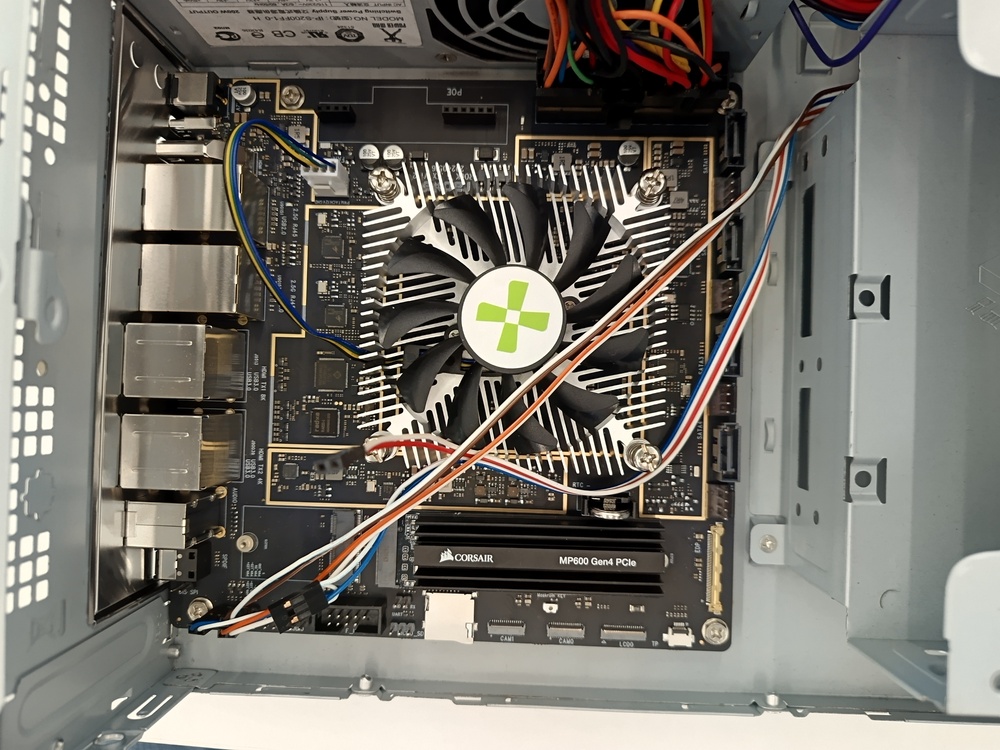
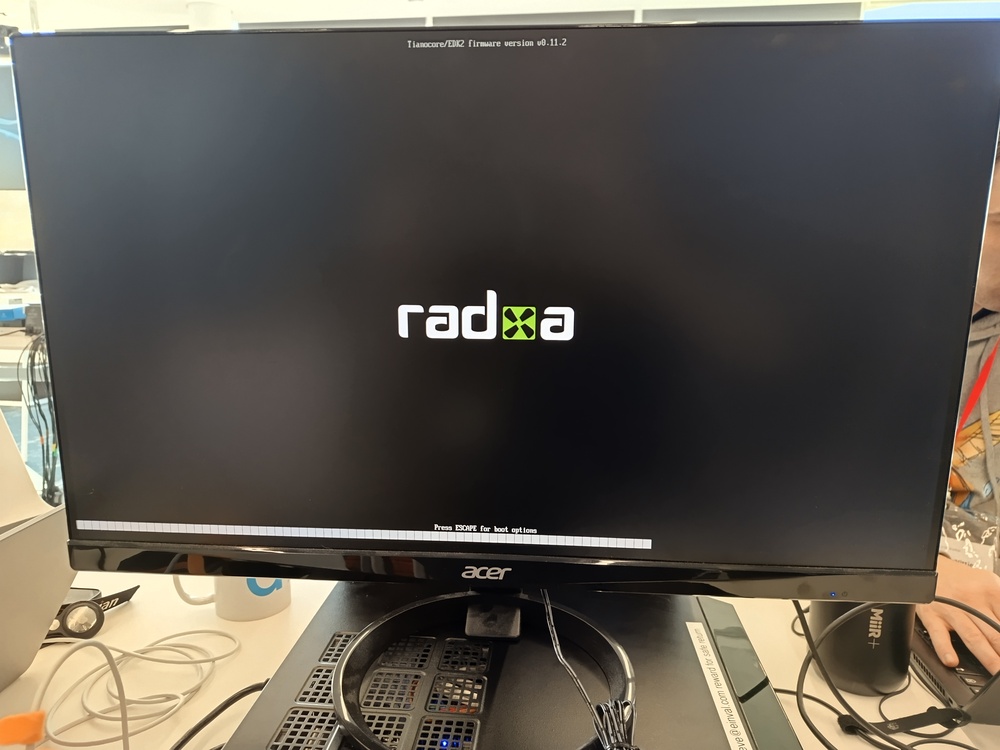
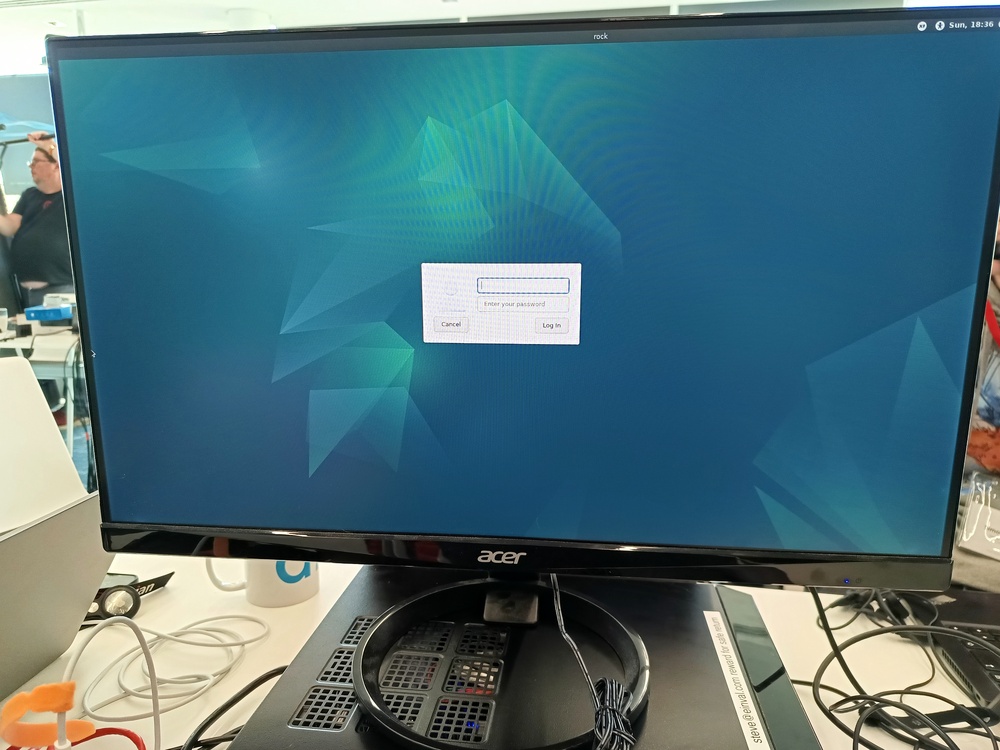
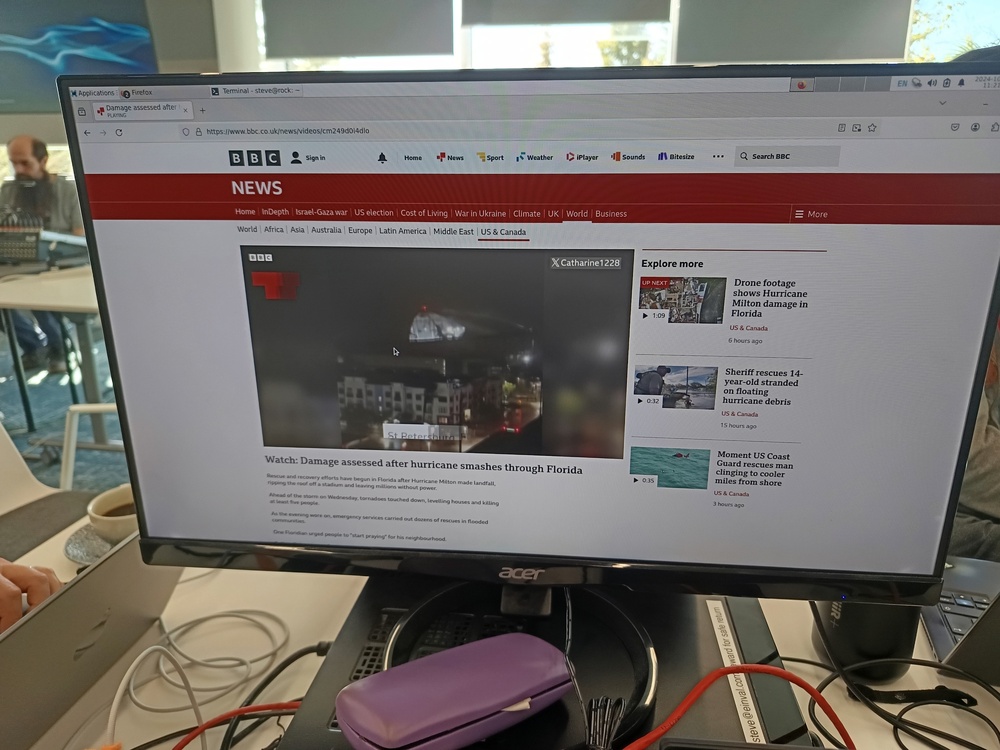
It's been a while since I've posted about arm64 hardware. The last machine I spent my own money on was a SolidRun Macchiatobin, about 7 years ago. It's a small (mini-ITX) board with a 4-core arm64 SoC (4 * Cortex-A72) on it, along with things like a DIMM socket for memory, lots of networking, 3 SATA disk interfaces. The Macchiatobin was a nice machine compared to many earlier systems, but it took quite a bit of effort to get it working to my liking. I replaced the on-board U-Boot firmware binary with an EDK2 build, and that helped. After a few iterations we got a new build including graphical output on a PCIe graphics card. Now it worked much more like a "normal" x86 computer. I still have that machine running at home, and it's been a reasonably reliable little build machine for arm development and testing. It's starting to show its age, though - the onboard USB ports no longer work, and so it's no longer useful for doing things like installation testing. :-/ So... I was involved in a conversation in the #debian-arm IRC channel a few weeks ago, and diederik suggested the Radxa Rock 5 ITX. It's another mini-ITX board, this time using a Rockchip RK3588 CPU. Things have moved on - the CPU is now an 8-core big.LITTLE config: 4*Cortex A76 and 4*Cortex A55. The board has NVMe on-board, 4*SATA, built-in Mali graphics from the CPU, soldered-on memory. Just about everything you need on an SBC for a small low-power desktop, a NAS or whatever. And for about half the price I paid for the Macchiatobin. I hit "buy" on one of the listed websites. :-) A few days ago, the new board landed. I picked the version with 24GB of RAM and bought the matching heatsink and fan. I set it up in an existing case borrowed from another old machine and tried the Radxa "Debian" build. All looked OK, but I clearly wasn't going to stay with that. Onwards to running a native Debian setup! I installed an EDK2 build from https://github.com/edk2-porting/edk2-rk3588 onto the onboard SPI flash, then rebooted with a Debian 12.7 (Bookworm) arm64 installer image on a USB stick. How much trouble could this be? I was shocked! It Just Worked (TM) I'm running a standard Debian arm64 system. The graphical installer ran just fine. I installed onto the NVMe, adding an Xfce desktop for some simple tests. Everything Just Worked. After many years of fighting with a range of different arm machines (from simple SBCs to desktops and servers), this was without doubt the most straightforward setup I've ever done. Wow! It's possible to go and spend a lot of money on an Ampere machine, and I've seen them work well too. But for a hobbyist user (or even a smaller business), the Rock 5 ITX is a lovely option. Total cost to me for the board with shipping fees, import duty, etc. was just over 240. That's great value, and I can wholeheartedly recommend this board! The two things that are missing compared to the Macchiatobin? This is soldered-on memory (but hey, 24G is plenty for me!) It also doesn't have a PCIe slot, but it has sufficient onboard network, video and storage interfaces that I think it will cover most people's needs. Where's the catch? It seems these are very popular right now, so it can be difficult to find these machines in stock online. FTAOD, I should also point out: I bought this machine entirely with my own money, for my own use for development and testing. I've had no contact with the Radxa or Rockchip folks at all here, I'm just so happy with this machine that I've felt the need to shout about it! :-) Here's some pictures... Rock 5 ITX top view Rock 5 ITX back panel view Rock 5 EDK2 startuo Rock 5 xfce login Rock 5 ITX running Firefox

Freexian Collaborators: Monthly report about Debian Long Term Support, September 2024 (by Roberto C. S nchez)

Like each month, have a look at the work funded by Freexian s Debian LTS offering.

Debian LTS contributors In September, 18 contributors have been paid to work on Debian LTS, their reports are available:
  • Abhijith PA did 7.0h (out of 0.0h assigned and 14.0h from previous period), thus carrying over 7.0h to the next month.
  • Adrian Bunk did 51.75h (out of 9.25h assigned and 55.5h from previous period), thus carrying over 13.0h to the next month.
  • Arturo Borrero Gonzalez did 10.0h (out of 0.0h assigned and 10.0h from previous period).
  • Bastien Roucari s did 20.0h (out of 20.0h assigned).
  • Ben Hutchings did 20.0h (out of 12.0h assigned and 12.0h from previous period), thus carrying over 4.0h to the next month.
  • Chris Lamb did 18.0h (out of 18.0h assigned).
  • Daniel Leidert did 23.0h (out of 26.0h assigned), thus carrying over 3.0h to the next month.
  • Emilio Pozuelo Monfort did 23.5h (out of 22.25h assigned and 37.75h from previous period), thus carrying over 36.5h to the next month.
  • Guilhem Moulin did 22.25h (out of 20.0h assigned and 2.5h from previous period), thus carrying over 0.25h to the next month.
  • Lucas Kanashiro did 10.0h (out of 5.0h assigned and 15.0h from previous period), thus carrying over 10.0h to the next month.
  • Markus Koschany did 40.0h (out of 40.0h assigned).
  • Ola Lundqvist did 6.5h (out of 14.5h assigned and 9.5h from previous period), thus carrying over 17.5h to the next month.
  • Roberto C. S nchez did 24.75h (out of 21.0h assigned and 3.75h from previous period).
  • Santiago Ruano Rinc n did 19.0h (out of 19.0h assigned).
  • Sean Whitton did 0.75h (out of 4.0h assigned and 2.0h from previous period), thus carrying over 5.25h to the next month.
  • Sylvain Beucler did 16.0h (out of 42.0h assigned and 18.0h from previous period), thus carrying over 44.0h to the next month.
  • Thorsten Alteholz did 11.0h (out of 11.0h assigned).
  • Tobias Frost did 17.0h (out of 7.5h assigned and 9.5h from previous period).

Evolution of the situation In September, we have released 52 DLAs. September marked the first full month of Debian 11 bullseye under the responsibility of the LTS Team and the team immediately got to work, publishing more than 4 dozen updates. Some notable updates include ruby2.7 (denial-of-service, information leak, and remote code execution), git (various arbitrary code execution vulnerabilities), firefox-esr (multiple issues), gnutls28 (information disclosure), thunderbird (multiple issues), cacti (cross site scripting and SQL injection), redis (unauthorized access, denial of service, and remote code execution), mariadb-10.5 (arbitrary code execution), cups (arbitrary code execution). Several LTS contributors have also contributed package updates which either resulted in a DSA (a Debian Security Announcement, which applies to Debian 12 bookworm) or in an upload that will be published at the next stable point release of Debian 12 bookworm. This list of packages includes cups, cups-filters, booth, nghttp2, puredata, python3.11, sqlite3, and wireshark. This sort of work, contributing fixes to newer Debian releases (and sometimes even to unstable), helps to ensure that upgrades from a release in the LTS phase of its lifecycle to a newer release do not expose users to vulnerabilities which have been closed in the older release. Looking beyond Debian, LTS contributor Bastien Roucari s has worked with the upstream developers of apache2 to address regressions introduced upstream by some recent vulnerability fixes and he has also reached out to the community regarding a newly discovered security issue in the dompurify package. LTS contributor Santiago Ruano Rinc n has undertaken the work of triaging and reproducing nearly 4 dozen CVEs potentially affecting the freeimage package. The upstream development of freeimage appears to be dormant and some of the issues have languished for more than 5 years. It is unclear how much can be done without the aid of upstream, but we will do our best to provide as much help to the community as we can feasibly manage. Finally, it is sometimes necessary to limit or discontinue support for certain packages. The transition of a release from being under the responsibility of the Debian Security Team to that of the LTS Team is an occasion where we assess any pending decisions in this area and formalize them. Please see the announcement for a complete list of packages which have been designated as unsupported.

Thanks to our sponsors Sponsors that joined recently are in bold.

10 October 2024

Gunnar Wolf: Started a guide to writing FUSE filesystems in Python

As DebConf22 was coming to an end, in Kosovo, talking with Eeveelweezel they invited me to prepare a talk to give for the Chicago Python User Group. I replied that I m not really that much of a Python guy But would think about a topic. Two years passed. I meet Eeveelweezel again for DebConf24 in Busan, South Korea. And the topic came up again. I had thought of some ideas, but none really pleased me. Again, I do write some Python when needed, and I teach using Python, as it s the language I find my students can best cope with. But delivering a talk to ChiPy? On the other hand, I have long used a very simplistic and limited filesystem I ve designed as an implementation project at class: FIUnamFS (for Facultad de Ingenier a, Universidad Nacional Aut noma de M xico : the Engineering Faculty for Mexico s National University, where I teach. Sorry, the link is in Spanish but you will find several implementations of it from the students ). It is a toy filesystem, with as many bad characteristics you can think of, but easy to specify and implement. It is based on contiguous file allocation, has no support for sub-directories, and is often limited to the size of a 1.44MB floppy disk. As I give this filesystem as a project to my students (and not as a mere homework), I always ask them to try and provide a good, polished, professional interface, not just the simplistic menu I often get. And I tell them the best possible interface would be if they provide support for FIUnamFS transparently, usable by the user without thinking too much about it. With high probability, that would mean: Use FUSE. Python FUSE But, in the six semesters I ve used this project (with 30-40 students per semester group), only one student has bitten the bullet and presented a FUSE implementation. Maybe this is because it s not easy to understand how to build a FUSE-based filesystem from a high-level language such as Python? Yes, I ve seen several implementation examples and even nice web pages (i.e. the examples shipped with thepython-fuse module Stavros passthrough filesystem, Dave Filesystem based upon, and further explaining, Stavros , and several others) explaining how to provide basic functionality. I found a particularly useful presentation by Matteo Bertozzi presented ~15 years ago at PyCon4 But none of those is IMO followable enough by itself. Also, most of them are very old (maybe the world is telling me something that I refuse to understand?). And of course, there isn t a single interface to work from. In Python only, we can find python-fuse, Pyfuse, Fusepy Where to start from? So I setup to try and help. Over the past couple of weeks, I have been slowly working on my own version, and presenting it as a progressive set of tasks, adding filesystem calls, and being careful to thoroughly document what I write (but maybe my documentation ends up obfuscating the intent? I hope not and, read on, I ve provided some remediation). I registered a GitLab project for a hand-holding guide to writing FUSE-based filesystems in Python. This is a project where I present several working FUSE filesystem implementations, some of them RAM-based, some passthrough-based, and I intend to add to this also filesystems backed on pseudo-block-devices (for implementations such as my FIUnamFS). So far, I have added five stepwise pieces, starting from the barest possible empty filesystem, and adding system calls (and functionality) until (so far) either a read-write filesystem in RAM with basicstat() support or a read-only passthrough filesystem. I think providing fun or useful examples is also a good way to get students to use what I m teaching, so I ve added some ideas I ve had: DNS Filesystem, on-the-fly markdown compiling filesystem, unzip filesystem and uncomment filesystem. They all provide something that could be seen as useful, in a way that s easy to teach, in just some tens of lines. And, in case my comments/documentation are too long to read, uncommentfs will happily strip all comments and whitespace automatically! So I will be delivering my talk tomorrow (2024.10.10, 18:30 GMT-6) at ChiPy (virtually). I am also presenting this talk virtually at Jornadas Regionales de Software Libre in Santa Fe, Argentina, next week (virtually as well). And also in November, in person, at nerdear.la, that will be held in Mexico City for the first time. Of course, I will also share this project with my students in the next couple of weeks And hope it manages to lure them into implementing FUSE in Python. At some point, I shall report! Update: After delivering my ChiPy talk, I have uploaded it to YouTube: A hand-holding guide to writing FUSE-based filesystems in Python, and after presenting at Jornadas Regionales, I present you the video in Spanish here: Aprendiendo y ense ando a escribir sistemas de archivo en espacio de usuario con FUSE y Python.

Freexian Collaborators: Debian Contributions: Packaging Pydantic v2, Reworking of glib2.0 for cross bootstrap, Python archive rebuilds and more! (by Anupa Ann Joseph)

Debian Contributions: 2024-09 Contributing to Debian is part of Freexian s mission. This article covers the latest achievements of Freexian and their collaborators. All of this is made possible by organizations subscribing to our Long Term Support contracts and consulting services.

Pydantic v2, by Colin Watson Pydantic is a useful library for validating data in Python using type hints: Freexian uses it in a number of projects, including Debusine. Its Debian packaging had been stalled at 1.10.17 in testing for some time, partly due to needing to make sure everything else could cope with the breaking changes introduced in 2.x, but mostly due to needing to sort out packaging of its new Rust dependencies. Several other people (notably Alexandre Detiste, Andreas Tille, Drew Parsons, and Timo R hling) had made some good progress on this, but nobody had quite got it over the line and it seemed a bit stuck. Colin upgraded a few Rust libraries to new upstream versions, packaged rust-jiter, and chased various failures in other packages. This eventually allowed getting current versions of both pydantic-core and pydantic into testing. It should now be much easier for us to stay up to date routinely.

Reworking of glib2.0 for cross bootstrap, by Helmut Grohne Simon McVittie (not affiliated with Freexian) earlier restructured the libglib2.0-dev such that it would absorb more functionality and in particular provide tools for working with .gir files. Those tools practically require being run for their host architecture (practically this means running under qemu-user) which is at odds with the requirements of architecture cross bootstrap. The qemu requirement was expressed in package dependencies and also made people unhappy attempting to use libglib2.0-dev for i386 on amd64 without resorting to qemu. The use of qemu in architecture bootstrap is particularly problematic as it tends to not be ready at the time bootstrapping is needed. As a result, Simon proposed and implemented the introduction of a libgio-2.0-dev package providing a subset of libglib2.0-dev that does not require qemu. Packages should continue to use libglib2.0-dev in their Build-Depends unless involved in architecture bootstrap. Helmut reviewed and tested the implementation and integrated the necessary changes into rebootstrap. He also prepared a patch for libverto to use the new package and proposed adding forward compatibility to glib2.0. Helmut continued working on adding cross-exe-wrapper to architecture-properties and implemented autopkgtests later improved by Simon. The cross-exe-wrapper package now provides a generic mechanism to a program on a different architecture by using qemu when needed only. For instance, a dependency on cross-exe-wrapper:i386 provides a i686-linux-gnu-cross-exe-wrapper program that can be used to wrap an ELF executable for the i386 architecture. When installed on amd64 or i386 it will skip installing or running qemu, but for other architectures qemu will be used automatically. This facility can be used to support cross building with targeted use of qemu in cases where running host code is unavoidable as is the case for GObject introspection. This concludes the joint work with Simon and Niels Thykier on glib2.0 and architecture-properties resolving known architecture bootstrap regressions arising from the glib2.0 refactoring earlier this year.

Analyzing binary package metadata, by Helmut Grohne As Guillem Jover (not affiliated with Freexian) continues to work on adding metadata tracking to dpkg, the question arises how this affects existing packages. The dedup.debian.net infrastructure provides an easy playground to answer such questions, so Helmut gathered file metadata from all binary packages in unstable and performed an explorative analysis. Some results include: Guillem also performed a cursory analysis and reported other problem categories such as mismatching directory permissions for directories installed by multiple packages and thus gained a better understanding of what consistency checks dpkg can enforce.

Python archive rebuilds, by Stefano Rivera Last month Stefano started to write some tooling to do large-scale rebuilds in debusine, starting with finding packages that had already started to fail to build from source (FTBFS) due to the removal of setup.py test. This month, Stefano did some more rebuilds, starting with experimental versions of dh-python. During the Python 3.12 transition, we had added a dependency on python3-setuptools to dh-python, to ease the transition. Python 3.12 removed distutils from the stdlib, but many packages were expecting it to still be available. Setuptools contains a version of distutils, and dh-python was a convenient place to depend on setuptools for most package builds. This dependency was never meant to be permanent. A rebuild without it resulted in mass-filing about 340 bugs (and around 80 more by mistake). A new feature in Python 3.12, was to have unittest s test runner exit with a non-zero return code, if no tests were run. We added this feature, to be able to detect tests that are not being discovered, by mistake. We are ignoring this failure, as we wouldn t want to suddenly cause hundreds of packages to fail to build, if they have no tests. Stefano did a rebuild to see how many packages were affected, and found that around 1000 were. The Debian Python community has not come to a conclusion on how to move forward with this. As soon as Python 3.13 release candidate 2 was available, Stefano did a rebuild of the Python packages in the archive against it. This was a more complex rebuild than the others, as it had to be done in stages. Many packages need other Python packages at build time, typically to run tests. So transitions like this involve some manual bootstrapping, followed by several rounds of builds. Not all packages could be tested, as not all their dependencies support 3.13 yet. The result was around 100 bugs in packages that need work to support Python 3.13. Many other packages will need additional work to properly support Python 3.13, but being able to build (and run tests) is an important first step.

Miscellaneous contributions
  • Carles prepared the update of python-pyaarlo package to a new upstream release.
  • Carles worked on updating python-ring-doorbell to a new upstream release. Unfinished, pending to package a new dependency python3-firebase-messaging RFP #1082958 and its dependency python3-http-ece RFP #1083020.
  • Carles improved po-debconf-manager. Main new feature is that it can open Salsa merge requests. Aiming for a lightning talk in MiniDebConf Toulouse (November) to be functional end to end and get feedback from the wider public for this proof of concept.
  • Carles helped one translator to use po-debconf-manager (added compatibility for bullseye, fixed other issues) and reviewed 17 package templates.
  • Colin upgraded the OpenSSH packaging to 9.9p1.
  • Colin upgraded the various YubiHSM packages to new upstream versions, enabled more tests, fixed yubihsm-shell build failures on some 32-bit architectures, made yubihsm-shell build reproducibly, and fixed yubihsm-connector to apply udev rules to existing devices when the package is installed. As usual, bookworm-backports is up to date with all these changes.
  • Colin fixed quite a bit of fallout from setuptools 72.0.0 removing setup.py test, backported a large upstream patch set to make buildbot work with SQLAlchemy 2.0, and upgraded 25 other Python packages to new upstream versions.
  • Enrico worked with Jakob Haufe to get him up to speed for managing sso.debian.org
  • Rapha l did remove spam entries in the list of teams on tracker.debian.org (see #1080446), and he applied a few external contributions, fixing a rendering issue and replacing the DDPO link with a more useful alternative. He also gave feedback on a couple of merge requests that required more work. As part of the analysis of the underlying problem, he suggested to the ftpmasters (via #1083068) to auto-reject packages having the too-many-contacts lintian error, and he raised the severity of #1076048 to serious to actually have that 4 year old bug fixed.
  • Rapha l uploaded zim and hamster-time-tracker to fix issues with Python 3.12 getting rid of setuptools. He also uploaded a new gnome-shell-extension-hamster to cope with the upcoming transition to GNOME 47.
  • Helmut sent seven patches and sponsored one upload for cross build failures.
  • Helmut uploaded a Nagios/Icinga plugin check-smart-attributes for monitoring the health of physical disks.
  • Helmut collaborated on sbuild reviewing and improving a MR for refactoring the unshare backend.
  • Helmut sent a patch fixing coinstallability of gcc-defaults.
  • Helmut continued to monitor the evolution of the /usr-move. With more and more key packages such as libvirt or fuse3 fixed. We re moving into the boring long-tail of the transition.
  • Helmut proposed updating the meson buildsystem in debhelper to use env2mfile.
  • Helmut continued to update patches maintained in rebootstrap. Due to the work on glib2.0 above, rebootstrap moves a lot further, but still fails for any architecture.
  • Santiago reviewed some Merge Request in Salsa CI, such as: !478, proposed by Otto to extend the information about how to use additional runners in the pipeline and !518, proposed by Ahmed to add support for Ubuntu images, that will help to test how some debian packages, including the complex MariaDB are built on Ubuntu. Santiago also prepared !545, which will make the reprotest job more consistent with the result seen on reproducible-builds.
  • Santiago worked on different tasks related to DebConf 25. Especially he drafted the fundraising brochure (which is almost ready).
  • Thorsten Alteholz uploaded package libcupsfilter to fix the autopkgtest and a dependency problem of this package. After package splix was abandoned by upstream and OpenPrinting.org adopted its maintenance, Thorsten uploaded their first release.
  • Anupa published posts on the Debian Administrators group in LinkedIn and moderated the group, one of the tasks of the Debian Publicity Team.
  • Anupa helped organize DebUtsav 2024. It had over 100 attendees with hand-on sessions on making initial contributions to Linux Kernel, Debian packaging, submitting documentation to Debian wiki and assisting Debian Installations.

Next.

Previous.