Search Results: "evo"

25 December 2012

Russ Allbery: Review: A Paradise Built in Hell

Review: A Paradise Built in Hell, by Rebecca Solnit
Publisher: Penguin
Copyright: 2009
Printing: 2010
ISBN: 0-14-311807-2
Format: Trade paperback
Pages: 319
A Paradise Built in Hell is a book with an agenda. Solnit's goal is to convince the reader that nearly everything we're shown in movies and popular culture about human behavior during disasters is wrong. Not only is destructive mass panic unusual verging on nonexistent, spontaneous cooperation and acts of startling courage and resourcefulness are commonplace. The heroes that we hear about afterwards are more the norm than the exception. Disasters are far more likely to bring out the best in people than the worst. They break down barriers and form spontaneous human communities that survivors remember for a lifetime. Rather than natural disasters leading inevitably to an exacerbating human crisis in the absence of strong authority, Solnit argues that they are an amazing human opportunity, and that the most negative and destructive human behavior during crises is not from untrained victims but from the panic of the elites who are supposedly responsible for protecting the public. I think her analysis and presentation is both deeply appealing and deeply flawed. The flaws involve extrapolation and generalization beyond the applicability of her research, and I'll say more about that in a moment. But the appeal is still surprising and satisfying, and I think there's a lot of truth in this book despite its one-sided presentation. I like to tell people, half-jokingly, that I'm an anarchosyndicalist. It's my political alliegance of the heart: the political structure that I know would never work, but that matches the world I want to live in. (I suspect much of the belief in libertarianism is of this form.) Now I have a book to point people at when they ask what the appeal of anarchosyndicalism is. The sense of spontaneous community, of bonding, of reaching out to other people to do something necessary, together, that Solnit describes here in the aftermath of a disaster matches that vision of a world without imposed economic authority, where people spontaneously collaborate to solve problems. A Paradise Built in Hell is structured by disaster, providing a tour of major disasters and their aftermath interspersed with extended musings on what the human reactions mean and how disaster communities functioned. The major disasters discussed are the 1906 San Francisco earthquake, the Halifax explosion, the 1985 Mexico City earthquake, 9/11, and Hurricane Katrina. Solnit moves through them in chronological order, closing the book with Katrina, which had (at least for me) the most infuriating and uplifting mixes of community bonding and elite panic. But both of those factors are present from the beginning in the 1906 earthquake: spontaneous human organization that (from multiple first-hand accounts) transformed people's lives mixed with a military reaction and elite panic that possibly did more damage to the city than the earthquake did. Elite panic is the dark side of Solnit's celebration of human altruism and spontaneous community organization. The primary picture she paints is of ordinary people responding with great courage and creativity and finding, in their reaction, a transformative experience and a sense of purpose that often becomes the most powerful and positive experience of their life. But this is at odds with a deeply-entrenched elite belief in mass panic, in the necessity of keeping information from the public to suppress their reaction, and in the need to re-establish "order." And with that, Solnit is absolutely scathing, and with some justification. Along with detailed accounts of these major disasters, Solnit also gives the reader a tour of the research literature on disasters, research that has shown that the panic and chaos that is at the center of practically every disaster movie ever made is essentially a myth. Mass panic in disasters is not only rare, it's close to non-existent. As you might expect, the handling of Katrina by both the government and by neighboring white communities is the subject of the harshest attacks. The material on Katrina presented here is enough to make anyone want to throw out the current playbook on how we react to disasters (and lest one think Solnit is unfair, her research matches very closely with other research and journalism on Katrina that I've seen from a wide variety of sources). But Solnit shows that this is a pattern: the combination of our media-driven belief in how people will react to disasters combined with the elite need to re-establish control plays out in many major disasters, and almost always negatively. Even in 9/11, the official response in some cases hampered and undermined an already-effective unofficial response. This is very interesting and has concrete implications for public policy around disasters. But where Solnit moves onto thinner anarchosyndicalist ice is the story that she tells about disasters as dramatic upheavals of the established social order that could point to a revolution in how we interact with each other. Solnit is deeply inspired by human altruism during disasters, and her enthusiasm is somewhat contageous, but it was useful to read this book shortly after Bruce Schneier's Liars and Outliers. I think Solnit, in her understandable eagerness to find a way to extend disaster behavior to general life, does not understand the relationships between what Schneier terms moral, reputational, and institutional pressures. And that's the core of why we need to both enable spontaneous human response in disasters and have organized first responders and supporting infrastructure, and why disaster communities will break down when extended beyond the disaster. When I first mentioned A Paradise Built in Hell to my mother, her first reaction was dubiousness due to her memory of the 1977 New York City blackout. There was a disaster that resulted in widespread looting and destruction, rather than the positive reaction Solnit describes. Solnit does have a cogent argument for why looting is poorly analyzed (we don't, for example, distinguish between breaking into stores to get desperately needed supplies and doing so for personal gain) and should not be a priority in a life-threatening disaster. But it's not completely convincing; in some disasters, particularly ones like the 1977 power outage that were not particularly life-threatening, the looting has been the most destructive part of the disaster. Schneier provides what I think is the missing piece, both to this and to why the wonderful behavior during disasters doesn't last into everyday life. During a life-threatening disaster, moral pressures are massively increased. Nearly all of us have self-images and moral beliefs that provide very strong incentives to help others and collaborate in the face of life-threatening emergencies, incentives that override other motives and lead to the sort of behavior that Solnit celebrates. But moral pressures have inherent limitations. That moral reaction applies most strongly to small groups (such as bands of survivors), and will start to break down as larger society re-establishes itself. And disasters, like a power outage, that are not immediately life-threatening will not provoke the same intensification of moral pressures: we don't have strong moral beliefs and internal stories about staying quietly at home during power outages the way that we do for saving people from burning buildings or pulling them out of rubble. Once larger communities have reformed and that short-term emergency reaction has dissipated, the need for institutional pressures (police, law, and formal authority structures) will return. I wish Solnit had been able to read Schneier's book before writing hers. I think his analysis structure provides a healthy dose of realism and perspective to her desire for a self-organizing communal world, and might have blunted her enthusiastic but somewhat unrealistic hopes for finding some key to a revolution in human organization in the heart of disasters. But if A Paradise Built in Hell is unlikely to lead to a radical change in how we organize societies, it should at least provoke a radical rethinking of some of our unnecessary pessimism about our fellow humans. The evidence is substantial and compelling: crisis brings out the best in people, not the worst, and the ordinary people who happen to be around are capable of becoming some of the most amazing disaster response teams that we can imagine. This has numerous mundane implications for social policy. We should consider simple training for the general public, for example, to strengthen that reaction, should allow for it in legal structures and training of first responders (around looting, for instance), and should do everything we can to kill the destructive myth that people cannot be trusted in disasters or that mass panic will be as much of a threat as the disaster. But the best part of this book is that it provides a concrete, well-documented, and well-defended reason to let go of some of our cynicism and to extend a bit of trust to our fellow humans. There sadly aren't earth-shaking implications for everyday society, but there is a wealth of evidence that shows that we're better people in the crunch than we believe we are, or that we expect of others. And the more that we can embrace the dissolution of boundaries and social hierarchies in the middle of disasters, the more we are likely to be surprised by deep human connection and a sense of shared, focused purpose. Solnit is a bit long-winded with her agenda, but that bright hope has stuck with me. Recommended. Rating: 8 out of 10

22 December 2012

Bartosz Feński: Two full-time days to work on Debian

My current employer as a benefit offers two days of paid volunteer time every calendar year. In September I decided to devote this time for Debian project. It wasn t easy to convince HR and my manager (hi Gloria ;) ) that such activity can be considered as volunteering but I eventually did it! So last Thursday and Friday were days I could spent working on my packages and other stuff related to Debian ;) Let s talk about effects. 5 packages updated, 16 bugs closed, more than 50 lintian warnings/errors solved. Here goes changelogs from updated packages:
calcurse (3.1.2-1) unstable; urgency=low
* The Akamai Technologies paid volunteer days release.
* Package made from scratch (this was funny experience):
- uses new quilt source format
- uses new copyright format
- uses debhelper compatibility level 9 w/hardening options
- uses the newest Standards-Version
* New upstream version:
- supports UTF8 (Closes: #558671)
- hopefully fixes problem with accented characters (Closes: #466010) -- Bartosz Fenski <fenio> Thu, 20 Dec 2012 13:51:08 +0100 httpie (0.3.1-1) unstable; urgency=low * The Akamai Technologies paid volunteer days release.
* Includes manual page (Closes: #673067)
Courtesy of Khalid El Fathi <khalid>. Thanks!
* New upstream version. (Closes: #693810)
- handles binary transfers properly (Closes: #689974) -- Bartosz Fenski <fenio> Thu, 20 Dec 2012 14:27:59 +0100 skipfish (2.10b-1) unstable; urgency=low * The Akamai Technologies paid volunteer days release.
* New upstream version.
* Bumped Standards-Version (no changes needed).
* Various path fixes because of upstream changes.
* Added new libpcre3-dev build dependency.
* Totally rewritten copyright file to comply with new copyright standard. -- Bartosz Fenski <fenio> Thu, 20 Dec 2012 14:59:36 +010 ipcalc (0.41-3) unstable; urgency=low * The Akamai Technologies paid volunteer days release.
* ACK previous NMU, thanks Christopher!
* Documents some missing features in the manpage (Closes: #588143)
Thanks Tanguy Ortolo <tanguy>!
* Fixes other minor problems in manpage (Closes: #688148)
* Description now says it's tool IPv4 only (Closes: #628955)
* Fixes lack of </table> tag when printing supernets (Closes: #600251)
* The following changes are courtesy of Jari Aalto <jari.aalto>:
- Remove deprecated dpatch and upgrade to packaging format "3.0 quilt".
- Update to Standards-Version to 3.9.3 and debhelper to 9.
- Add build-arch and build-indep targets; use dh_prep in rules file.
- Patch 03: update with "quilt refresh" to make it apply cleanly.
Thanks to these changes (Closes: #670737) -- Bartosz Fenski <fenio> Fri, 21 Dec 2012 12:30:11 +0100 netw-ib-ox-ag (5.39.0-1) unstable; urgency=low * The Akamai Technologies paid volunteer days release.
* New upstream version.
* Uses Homepage header. (Closes: #615219, #615294, #615321, #615436, #645522)
* Bumped Standards-Version (no changes needed).
* Switch to dpkg-source 3.0 (quilt) format)
* Fixes FTBFS on s390x and sparc64 (Closes: #639493)
* Fixes 29 (sic!) lintian warnings/errors thus many small changes
in packaging scripts.
-- Bartosz Fenski <fenio> Fri, 21 Dec 2012 15:38:29 +0200
Despite this I did something else. I sent end of the world joke-mail to debian-mentors mailing list stating (ignore the fact that my own server marked me as spammer; fixed already ;P) that I m going to review and try to upload every package that will be send to me during end-of-the-world day.
That action was quite successful although no package has been uploaded yet. I reviewed 4 of them and two more are yet to come. So it looks that these two days sponsored by Akamai motivated me enough to spent few more days or even months and help other people to contribute to Debian. Thank you Akamai!

15 December 2012

Thorsten Glaser: Der heilige Frieden?

(Apologies for putting this on Planet Debian, but it says the one or other non-English post is okay as long as it s an exception. I feel I need to reach more people with this, but don t feel like translating this into English right now.)
Update: Tanguy asked for a short English summary: it s me ranting against the rioting against muslims and the call for more CCTV surveillance after a possible bomb was found at the train station. In Bonn herrscht immer noch Bombenstimmung , wenn man z.B. auf die Webseite der Lokalzeitung schaut von dem Amoklauf in Connecticut, ber den sich im IRC gewunder wird, ist immer noch nichts zu sehen, daf r wird flei ig wider Islamisten gehetzt. Ich finde das besorgniserregend, mu doch jetzt jeder Angeh rige des Islams f rchten, verfolgt oder benachteiligt zu werden. Das reizt doch erst recht zum Gegenschlag, bei dem dann auch Menschen, die absolut nicht mit der hier vorherrschenden Meinung und Politik bereinstimmen, getroffen werden k nnen. Ich pers nlich habe kein Problem mit Menschen anderen Glaubens oder anderer Weltanschauung, solange wir friedlich miteinander leben k nnen. Ich teile eure Unzufriedenheit mit dem herrschenden Staat, der immer weitergehenden berwachung, Unterdr ckung von Leuten, die nicht dem vorherrschenden Menschenbild entsprechen (egal an welchen Kategori n), und bitte die, die dies lesen, nochmal nachzudenken, bevor sie etwas tun, was hinterher Unschuldige trifft oder gar in friendly fire ausartet. Hat eigentlich wer die in Bad Godesberg ausgegebenen Koran-B cher sich mal angeschaut? Als ich davon las, war ich ja zugegebenerma en neugierig, weil ich vom Koran leider eher wenig kenne, wei aber nicht, wie neutral oder eben nicht die bersetzung gehalten ist. Anhand dessen, was ich bereits mitbekam, sollte das eher friedlicher sein als was durch sp tere Theologen festgelegt wurde wie ja auch zum Beispiel im Christentum, aber ber die Horrorepisoden der christlichen Kirche will ich jetzt auch nicht mich auslassen, in der Hoffnung, da auch diese sich mit den Jahren gebessert hat. (Ist nur halt das Problem mit den Leuten, die die alten Hetzparolen jetzt noch verbreiten. Ist wie im Netz mit den Groupies von Theo de Raadt, die noch asiger zu Leuten sind als er selber.) (Au erdem mu man ja bef rchten, durch Besitz eines Korans schon vorverurteilt zu werden heutzutage *seufz* ich finde das nicht gut!) Update (ich verga ): auch der Ruf nach mehr Video berwachung ist nur Panikmache. Das geht nur zu Lasten des Normalb rgers. Vielleicht lassen sich noch Kleinstdelikte wie Taschendiebstahl damit abschrecken, aber gerade diese Bomben und dergleichen sind doch oft von Leuten, die vor Konsequenzen keine Angst haben, organisiert. Die werden dann maximal M rtyrer. Ich wiederhole nochmal f r die Politiker und die ganz langsamen unter den Lesern: berwachung verhindert keine Straftat.

14 December 2012

Roland Mas: Back to space

A long time ago, I spent many many hours playing Frontier (Elite 2) on the family Atari ST. It was nice-looking (oh, those sunrises on distant planets!), playable, varied, had ample room for progression, very different possible roles, a huge universe of which nobody could ever hope of exploring more than a tiny fraction, and it was basically the first game I encountered with no set goals. You are a spaceship pilot in a galaxy colonised left and right, and it's up to you to decide what you want the game to be. Pirate, headhunter, mercenary, trader, taxi, explorer, there's no end goal to achieve except what you fix for yourself. That was, for me as a youngster, a mind-opening experience, which I never felt as strongly since (with the possible exception of the Creatures game, but I barely tried it). Then came modernity, the PC, and the First Encounters sequel (Elite 3). It added moderate complexity to the gameplay, some sort of political evolution among the factions and a kind of plot so the galaxy was no longer quite so static, but the end results were still a bit disappointing. It felt like Frontier with a few not-exactly-overwhelming textures stuck onto the ships, a loose plot arc, and a third faction, the Alliance of Independent Systems, beyond the Federation and the Empire. Not that exciting, although the name of the Alliance's capital star system stayed in my mind. So, like many others, I came to wait for Elite 4. That wait started in 1995, more than seventeen years ago. During that time, Duke Nukem Forever was announced, promised, developed, postponed, abandoned, found again, developed again, and it was even actually released in 2011, while Elite 4 went into the same kind of hell only without the actual release (yet). At some point I started trying various substitutes to help pass time. There was Parsec which was a nice-looking space combat simulator, multiplayer and all, but never felt like finished. Development slowed down to a thin trickle, and it seems like it only recently started again as Open Parsec. Hopefully it won't wither off again, but since it's only focused on combat, it's not exactly the same spirit as Elite. There's Oolite, but it looks and feels very much like a lightly-modernised Frontier. Better textures, sure, but the UI still looks like it got taken from the times where games mentioned they required an EGA/VGA video card. There's Vega Strike. It's very promising too, and I did try it at some point, but it was crashing too often for my tastes. Development seems to have slowed down, but not stopped; maybe it's time I gave it another go. I just recently found out about Pioneer, and I admit I'm excited. Really excited. It feels like like Frontier felt at the time. It's not finished yet (the on-planet cities in particular look a bit weird), but from the alpha I tried and the videos on the website it's really impressive. I'm going to keep an eye on that, knowing I could spend quite some time in there even before it's quite finished, if only to fly a spaceship in the canyons of Europa with Jupiter rising in the distance. I'll let you know if I find a black monolith. But the main event triggering this blog post is that apparently Elite 4 is not dead (yet). Much better, it's under heavy development, under the Elite Dangerous name, and the current state seems to be rather good already. And Frontier Developments, the company behind it, opened a Kickstarter campaign to fund the project. The screenshots and the videos look impressive, and the interviews of the lead developer imply that the gameplay will be awesome. The galaxy will apparently be really dynamic, and the player's actions could really influence its geopolitical (galactopolitical?) evolution, the profitability of trade routes, the prevalence and repartition of space pirates in various sectors, and so on. Combine with a multi-player mode, and this could become the greatest game ever made (for my personal taste at least). So I'm very much hoping the funding campaign reaches its target. The release date is set to March 2014. It's going to be a long wait, fraught with incertitudes. But then again, Duke Nukem Forever was eventually released, wasn't it? [No, I never played the original Elite. I'm not that old.]

12 December 2012

Sylvestre Ledru: Mini Debconf 2012 - videos and feedbacks

A bit more than two weeks after the Mini Debconf in Paris, I am glad to say that the videos of the event are finally published (the sound is not very good for the 4 first presentations, sorry about that).
They will be also available on the new IRILL website with a video player when ready.
All slides are also available on the page of the event. I believe that there is a consensus about the quality of the event. We had around 150 people attending to the event, many interesting and various talks.
As usual, it was nice to meet some old and new friends from Debian. Mini debconf - group picture
Group picture by Frederic Lehobey
For those who wonder, I am confident there will be a 2013 Parisian Mini Debconf. Various feedbacks about the event:
Lucas Nussbaum
Stefano Zacchiroli
Vincent Untz
Raphael Hertzog
Pietro Abate
Logilab (Julien Cristau)
The 'official' Debian news And, once more, many thanks to the sponsors!
Logilab SmartJog
Bearstech Evolix
IRILL

11 December 2012

Francesca Ciceri: Welcome Malatesta, Goodbye Kasbah!

Kasbah, my old laptop, is almost dead. It was my first laptop, an Asus X50C, which worked like a charm and was robust like a tank. But then the screen hinges broke. Time for a new one. So, ladies and gentlemen, I'm glad to present you malatesta. Malatesta is a Lenovo Thinkpad E335. Sadly, while kasbah worked with free drivers, malatesta requires proprietary drivers both for the video card and the wifi. Which sounds a bit ironic for a laptop named after a famous anarchist. The only two problems I encountered with it were related to the video card (00:01.0 VGA compatible controller: Advanced Micro Devices [AMD] nee ATI Device 9808) and the special keys. Malatesta worked well with the kernel of Squeeze, but freezed during the boot with Wheezy. Thankfully, I stumbled upon this blogpost by Blars Blarson suggesting to use the fglrx-driver with Sid. And that solved the problem. Another little odissey was the brightness of the monitor. With kernels < 3.2.0-4-amd64 the thinkpad_acpi didn't recognize my model and I was stuck with a brightness level probably visible from the outer space. Neither xrandr nor xbacklight could help, and I was seriously considering to use sunglasses to work (a slight unusual approach to the brightness problem, I know, but I suffer of migraines and couldn't bear an hyper-bright monitor), when the upgrade to Sid solved the problem. On the bright side (pun intended) this laptop was born without Windows. (Both malatesta and kasbah were shipped with FreeDOS). Now, if you're wondering about the names: my first namescheme was "references to songs by the Clash" (and kasbah is obviously for "Rock the Casbah", with a typo). But it wasn't really scalable. Since last year, I've decided to name my systems after famous anarchists. The server is named after one of my all time favourite anarchists, Buenaventura Durruti.
madamezou@durruti:~$ cat /etc/motd
%%%%%%%%%%%%%%%%%%%%%%%%%%%%%%%%%%%%%%%%%%%%%%%%%%%%%%%%%%%%%%%%%%%%%
Llevamos un mundo nuevo en nuestros corazones;
y ese mundo est  creciendo en este instante
                        Buenaventura Durruti
%%%%%%%%%%%%%%%%%%%%%%%%%%%%%%%%%%%%%%%%%%%%%%%%%%%%%%%%%%%%%%%%%%%%%
While the new laptop's name comes from Errico Malatesta.
madamezou@malatesta:~$ cat /etc/motd 
%%%%%%%%%%%%%%%%%%%%%%%%%%%%%%%%%%%%%%%%%%%%%%%%%%%%%%%%%%%%%%%%%%%%%
We anarchists do not want to emancipate the people;
We want the people to emancipate themselves.
            Errico Malatesta, L'Agitazione (18 June 1897)
%%%%%%%%%%%%%%%%%%%%%%%%%%%%%%%%%%%%%%%%%%%%%%%%%%%%%%%%%%%%%%%%%%%%%

3 December 2012

Joey Hess: hledger

Apologies in advance for writing a long blog post about the dull and specialised subject of double-entry accounting from the Unix tools perspective, that ends up talking about Monads to boot. I can't believe I'm about to write such a thing, but I'm finding it an oddly interesting subject. double-entry accounting I've known of, though probably not really understood double entry accounting for a while, thanks to GnuCash. I think GnuCash did something rather special in making such a subject approachable to the layman, and I've been happy to recommend GnuCash to friends. I was stoked to find a chapter in my sister Anna's new book that happily and plausibly suggests readers use GnuCash. But for my personal use, GnuCash is clunky. I mean, I'm a programmer, but I can't bring any of my abilities to bear on it, without a deep dive into the code. The file format is opaque (and a real pain to keep checked into git with all the log files); the user interface is often confusing, but there's no benefit to its learning curve, it never seems to get better than manually entering data into its ledger, or perhaps importing data from a bank. I've never found the reports very useful. I've got perhaps a year of data in GnuCash, but it's fragmented and incomplete and not something I've been able to motivate myself to keep up with. So I have less financial data than I'd like. I'm hoping ledger will change that. ledger I've known about ledger for a while, at least since This Linux Weekly News article. It's a quintessential Unix tool, that simply processes text files. The genius of it is the simplicity of the file format, that gets the essence and full power of double entry bookeeping down to something that approaches a meme. Once you get the file format stuck in your head, you're done for.
2004/05/27 Book Store
      Expenses:Books                 $20.00
      Liabilities:Visa
starting to use hledger Now as a Haskell guy, I was immediately drawn to the Haskell clone, hledger. It's nice that there are two (mostly) compatable implementations of ledger too. So from here on, I'll be talking about hledger. I sat down and built a hledger setup for myself the other day. I started by converting the GnuCash books I have been keeping up-to-date, for a small side business (a rental property). It quickly turned into something like programming, in the best way, as I used features like: a modern unix program While I've been diving into hledger, I've been drawing all kinds of parallels between it and other modern Unix-friendly programs I use lately. I think we've gone over a bit of a watershed recently. Unix tools used to be either very simple and crude (though often quite useful), or really baroque and complex with far too many options (often due to 10-30 years of evolution). Or they were a graphical user interface, like GnuCash, and completely divorced from Unix traditions. The new unix programs have some commonalities... importing data After manually converting my GnuCash data, I imported all my PayPal history into hledger. And happily it calculates the same balance Paypal does. It also tells me I've paid PayPal $180 in transaction fees over the years, which is something PayPal certianly doesn't tell you on their website. (However, my current import from PayPal's CSV files is a hackish, and only handles USD currency, so I miss some currency conversion fees.) I also imported my Amazon Payments history, which includes all the Kickstarter transactions. I almost got this to balance, but hledger and Amazon disagree about how many hundreths of a cent remain in my account. Still, pretty good, and I know how much I paid Amazon in fees for my kickstarter, and how much was kicked back to Kickstarter as well. (Look for a cost breakdown in some future blog post.) At this point, hledger stats says I have 3700 transactions on file, which is not bad for what was just a few hours work yesterday. One problem is hledger's gotten a little slow with this many transactions. It takes 5 seconds to get a balance. The ledger program, written in C, is reportedly much faster. hledger recently had a O(n^2) slowdown fixed, which makes me think it's probably only starting to be optimised. With Haskell code, you can get lucky and get near C (language, not speed of light) performace without doing much, or less lucky and get not much better than python performance until you dive into optimising. So there's hope. harnessing haskell If there's one place hledger misses out on being a state of the art modern Unix program, it's in the rules files that are used to drive CSV imports. I found these really hard to use; the manual notes that "rules file parse errors are not the greatest"; and it's just really inflexible. I think the state of the art would be to use a Domain Specific Language here. For both my Amazon and PayPal imports I had CVS data something like:
date, description, amount, fees, gross
I want to take the feeds into account, and make a split transaction, like this:
date description
    assets:accounts:PayPal             $9.90
    expenses:transaction fees:PayPal   $0.10
    income:misc:PayPal                 -$10.00
This does not seem possible with the rules file. I also wanted to combine multiple CVS lines, to do with currency conversions, into a single transaction, and couldn't. The problem is that the rules file is an ad-hoc format, not a fully programmable one. If instead, hledger's rules files were compiled into standalone haskell programs that performed the import, arbitrarily complicated conversions like the above could be done. So, I'm thinking about something like this for a DSL.. I doubt I'll get much further than this, since I have a hacked together multi-pass importer that meets my basic needs. Still, this would be nice, and being able to think about adding thing kind of thing to a program cleanly is one of the reasons I reach for the Haskell version when possible these days. First, here's part of one of my two paypal import rules files (the other one extracts the transaction fees):
amount-field 7
date-field 0
description-field %(3) - %(4) - %(11)
base-account assets:accounts:PayPal
Bank Account
assets:accounts:checking
.*
expenses:misc:PayPal
That fills out the basic fields, and makes things with "Bank Account" in their description be categorised as bank transfers. Here's how it'd look as Haskell, carefully written to avoid the $ operator that's more than a little confusing in this context. :)
main :: IO ()
main = convert paypalConveter
paypalConverter :: [CSVLine] -> [Maybe Transaction]
paypalConverter = map convert
  where
    convert = do
        setAmount =<< field 7
        setDate =<< field 0
        setDescription =<< combine " - " [field 3, field 4, field 11]
        defaultAccounts
            "assets:accounts:PayPal" ==> "expenses:misc:PayPal"
        inDescription "Bank Account" ?
            "assets:accounts:PayPal" ==> "assets:accounts:checking"
That seems like something non-haskell people could get their heads around, especially if they didn't need to write the boilerplate function definitions and types at the top. But I may be biased. :) Internally, this seems to be using a combination Reader and Writer monad that can get at fields from a CSV line and build up a Transaction. But I really just made up a simple DSL as I went along and thew in enough syntax to make it seem practical to implement. :) Of course, a Haskell programmer can skip the monads entirely, or use others they prefer. And could do arbitrarily complicated stuff during imports, including building split transactions, and combining together multiple related CVS lines into a single transaction.

29 November 2012

Roland Mas: Wii(gh2)midi yet again

Not that I'm bored or anything, but I spent some more time on this since last month, and apparently some people are interested enough, so here's the recent news about wiigh2midi. Also, since the code moved (and it doesn't harm mentioning it again): Wiimidi is developed with Bazaar, and the public branch is at https://alioth.debian.org/~lolando/bzr/wiimidi/trunk/. So, to grab a copy:
 bzr checkout https://alioth.debian.org/~lolando/bzr/wiimidi/trunk/
Patches welcome, of course! Also, I'll be interested to hear about your applications. I've been told about a Wiimote-powered foot controller, which is exactly the kind of unpredictable results I was hoping to achieve by publishing my code. Keep it up, I want to hear about Wiimote-controlled robot dinosaurs next! Update: Wiimidi now has its dedicated page at Wiimidi.

Michal &#268;iha&#345;: Multi part progress in Weblate

Weblate is still evolving and it recently got new feature to allow better overview of translation status - multi part progress bars. The motivation to show more information is to have better overview of the translation. The numbers have been always shown withing Weblate, but making it graphical gives it much better visibility: Multi part progress in Weblate I'm still unsure about colors to use for highlighting different state - the failed checks should not be too different from translated strings as they might contain quite some false positives while fuzzy strings need to be really different as they absolutely need attention from translator. If you have better ideas about color scheme, please let me know! You can see live example at Polish summary at l10n.cihar.com.

Filed under: English Weblate 3 comments Flattr this!

24 November 2012

Russ Allbery: Review: Dune

Review: Dune, by Frank Herbert
Series: Dune #1
Publisher: Ace
Copyright: 1965
Printing: September 1990
ISBN: 0-441-17271-7
Format: Mass market
Pages: 537
The Atreides family, distant cousins to the imperial family, have ruled the planet of Caladan for twenty generations. Caladan is a wet farming world, comfortable and pleasant, but not horribly important. But House Atreides is feuding with House Harkonnen, and, at the start of Dune, that feud maneuvers Duke Leto into giving up his holdings and moving his family to take possession of Arrakis. Arrakis is a desert planet, previously controlled by Baron Harkonnen. It is unrelentingly hostile, home to smugglers and dangerous local desert dwellers called Fremen. But it's also one of the most important planets in the galaxy, since it's the sole origin of the chemical called melange, or spice. Spice permits a limited form of prescience, which allows the navigators of the Spacing Guild to successfully steer ships across the interstellar void. Arrakis's production of spice is what makes interstellar travel, and therefore all of interstellar civilization, possible. Dune is the story of Paul Atreides, son and heir to Duke Leto Atreides. His mother, Lady Jessica, is one of the Bene Gesserit, a secretive order of women devoted to mental and physical discipline and to the long-term genetic improvement of mankind. He is not supposed to exist; Lady Jessica was supposed to only bear a daughter of Leto. But he may be something special, the long-sought (but also dangerous) Kwisatz Haderach who can unite male and female Bene Gesserit powers. The Bene Gesserit take great interest in him from the start of Dune. More surprisingly, so do the Fremen of Arrakis; from the moment he arrives there, he seems to be fulfilling prophecies of theirs that are partly, but not entirely, ones planted by the Bene Gesserit long ago. The feud with the Harkonnens, the unstable place of Arrakis in galactic politics, the dreams of the Fremen and the Imperial ecologist on Arrakis of terraforming, Bene Gesserit plans, Paul's abilities, and the legends of the Fremen all combine in a complex mix of politics, battle, and clashes of culture. Dune is an acknowledged SF masterpiece, one of the best-known classics of the genre. It's usually found in short lists of the best SF novels ever written. It spawned five sequels by Frank Herbert (about which more in a moment), as well as numerous additional sequels and prequels by Kevin J. Anderson and Brian Herbert. It's been adopted for the screen twice, not to mention board games, video games, and numerous other projects. This is my second reading, the first in about twenty years, but the story was still immediately familiar from having seen films and having discussed and read about the universe. This is not science fiction in any strict sense. Dune is science fiction in the same way that Star Wars is: a futuristic gloss on top of power structures inspired by feudalism, heavily mixed with mysticism, mental powers, magic, and implausible but convenient science that creates the story effects the author wants. Both Bene Gesserit powers in general and Paul's abilities in particular are effectively magic. There is some hand-waving explanation of their ability to verbally control other people as taking advantage of specific pitches and intonations that people are vulnerable to, but it's effectively spell-casting (and is a direct inspiration for Jedi mind tricks). All of the mysticism (and there's quite a lot of it in Dune, including race memory, precognition, and even molecular transformation) resembles the Force from Star Wars more than anything scientific. Dune is epic fantasy told on a science fiction stage, complete with a young protagonist coming into his powers and dangerous and sometimes hostile mentors. What Dune gets right, and what has put it so high in the pantheon of great science fiction, is the world building. Herbert sets the story tens of thousands of years into the future of humanity and then effectively projects the feeling of deep history over everything in the novel. This is the kind of book that has appendices with more background information; more to the point, it's the kind of book where you may actually read them out of curiosity. Mankind has a vast interstellar empire (Herbert's universe, like Asimov's Foundation universe, admits no aliens) governed by a system akin to the early British monarchy. An emperor rules in balance with the Great Houses, who meet in a sort of parliament. But against both is a third force: the Spacing Guild, who maintains a monopoly over all interstellar travel. (And the Bene Gesserit form an underground, secretive fourth power base.) Herbert plays with vast swaths of time and great forces of history as well as very good epic fantasy and better than nearly all SF I've read. The detailed world-building is equally good. Nearly all of Dune takes place on the desert planet of Arrakis, which has a lovingly-described ecology and local culture built entirely around scarcity of water. (The details of that ecology are much of the plot and mystery of the book, so I won't spoil them further.) While I doubt the precise details hold up to close scientific scrutiny, this is an obvious precursor to the great ecological stories of later SF, such as Kim Stanley Robinson's Mars trilogy. The details all feel right and hang together in satisfying ways, while also generating the great Sand Worms of Arrakis, a key ingredient in several of the best set pieces in the history of SF. This is the sort of book where the fascinating details and discoveries about the world do as much to keep one turning the pages as the plot, although the plot is also satisfyingly twisty and tense. Unfortunately, Dune doesn't get everything right. The amount of mysticism involved is a bit much, and at times the drug-trip mystical experiences of viewpoint characters turn into excessively purple prose and nearly incomprehensible descriptions. Those mystical experiences also involve race and genetic memory, a concept that's just scientific enough to be unbelievable. A few of the other scentific cheats are also rather blantant; for example, Herbert constructs an elaborate, artificial technology of shielding that seems designed primarily as an excuse to add sword combat to a futuristic story, and I have always struggled to suspend disbelief about the way lasers and shields interact in Dune. The Spacer Guild's monopoly on interstellar travel can be explained; their monopoly on local orbital space, or even the high stratosphere, both vital to allow certain things on Arrakis to remain secret, are much more dubious. Herbert mostly doesn't try to explain these things, and as with Star Wars the less explained the cheats are, the better they work as part of the story. But the technological background doesn't hold up against much examination. Worse, for me, is the general quality of the writing. Herbert does some things very well, such as world-building, and avoids awkward infodumps. Characterization and pacing are both fairly solid; he does a good job with Paul and Jessica in particular, and I've always liked the Fremen. But he wants to put the reader in everyone's head, frequently by giving character thoughts as italicized dialogue, and to enable that he uses a perspective that I always find distracting. Most fiction is written in tight third person. This means that the viewpoint character for any given section of the book is referred to in the third person, like all the other characters, but the reader has special access to their thoughts and emotions. We get to know what they're really thinking and feeling, not just the impressions they give to others, while the non-viewpoint characters are shown only from external appearances and the thoughts of the viewpoint character. Some books hold to the same viewpoint character throughout, but more commonly books move between viewpoint characters at scene breaks to provide more angles on the book's events. First person, in which the story is told by a specific character as if they were telling a story or writing it down, is the most common alternative. Third person objective, in which we don't get any special insight into the internal thoughts of any of the characters, is less common but still unsurprising. Dune does not use any of those perspectives. Instead, Dune uses wandering third-person omniscient, in which we get the inner thoughts and emotions of a character in a scene and then a few lines later the inner thoughts and emotions of a different character. This is the sort of thing that may or may not bug you depending on how much you've read, how deep the expectations of perspective are ingrained, and how much you notice perspective. It drives me nuts. I subconsciously align with the viewpoint character of a section, and pay attention to the ways that authors indicate which character will be the viewpoint character at the start of a scene. Herbert's constant flitting from character to character makes me dizzy. We get the verbatim thoughts of everyone almost indiscriminately, making me feel like I'm randomly hopscotching through the scene. For me, this does two things: it hurts my ability to get engrossed in the story, since I'm constantly thrown out of my normal reading mode when the viewpoint unexpectedly shifts, and it makes the writing feel repetitive. One keeps hearing about the same thing from multiple perspectives, and at times the story bogs down in everyone's internal dialogues rather than showing character reactions and letting the reader draw their own conclusions. I think it tries for a cinematic perspective, but ends up making the story feel muddled. The other flaw, which I didn't notice originally but which leaped out at me during this re-read, is that Herbert's world-building uses quite a few stereotypes. The most notorious, and most widely discussed, is of course the Fremen. Herbert draws heavily on Arab and Islamic culture even beyond the obvious similarities of people living in a harsh, arid climate. He borrows some rather loaded terms and cultural markers, such as jihad, to construct a culture of potential religious fanatics. This is not all bad; the Fremen are clearly portrayed as the good guys, which is a refreshing change from more typical current portrayals of Islam. But it becomes clear that they have aligned their entire culture around influences from outside, and the whole plot of Dune can be fairly characterized as an instance of "what these people need is a white man." Paul (and Kynes before him) joins their culture as well, but Paul becomes a better native than the natives, while simultaneously bringing his outside perspective. It's the sort of plot that is more widely noticed today than it would have been in 1965. Another major example of this, and one that I found more blatant, is that Herbert turns the Harkonnen into hissable, one-sided villains and uses some nasty stereotypes to do it. The insane torturer is consistently and repeatedly described as effeminate, fat is used as a marker of moral inferiority and evil, and the primary villain is homosexual and prefers drugged young male slaves. Here too, this sort of characterization short-cut was more common in 1965, but it's not appealing and makes the (already rather camp) scenes set among the Harkonnen even less enjoyable. Less clear-cut is the way women are handled throughout Dune. I do have to give Herbert some credit, particularly for the era in which he was writing. There are powerful female characters in Dune, including both Jessica and Alia, who have their own independent power and successfully pursue their own agendas throughout. The effectively all-female Bene Gesserit is a major political power in the story and is treated by the other players with respect as well as fear. But it's hard not to also notice the general position of women as subservient to men, not only in the general culture of the Great Houses but also in the more positively-portrayed Fremen culture. Indeed, the subservience of women is even worse in Fremen culture, where they're treated like property and where being killed by a woman is a sign of shame. Again, Herbert deserves some credit for doing better than a lot of 1960s fiction, but the sexism fairy has still been at work here. None of these flaws change the fact that Dune is a masterpiece. Herbert brings together history, world building, ecology, politics, and a compelling coming-of-age story about a messiah figure into a fast-paced, sweeping epic with a thoroughly satisfying conclusion. I think they do make it a flawed masterpiece, but it's still one of those SF novels that everyone should read at least once. Sadly, it's also a masterpiece that I think has suffered from its own success in the form of sequels, prequels, and a ton of supporting material. This is one of the problems that truly excellent world building can lead to. Human history is fractal: any specific detail can be examined in more depth and will usually lead (provided that information is available at all) to even more fascinating detail. The best world building conveys that impression of depth. That's what Herbert achieves here with hints, notes, and asides: the sense that galactic history is a vast ediface with the same fractal complexity as real human history. It makes for a compelling background, but it also inspires people to dig into that background and flesh out all of the details the way that we do with human history. But this doesn't actually work; invented history created by one person simply cannot be fractal in the same way. Human history is endlessly complex because it was generated by the complex interactions of many people. Invented history is an illusion that hints at complexity by building the same surface, but one mind, or even a small number of minds, cannot generate the same depth. The result is that if one digs too deep, one removes that convincing surface and ends up with a mundane, simplistic, and unsatisfyingly fake set of events. I think that's what's happened with all of the supporting material that's been written around Dune since its original publication. Dune is of a piece, a single story that's deeply enjoyable on its own terms and leaves the reader with a satisfying impression of complexity. The systemic excavation of that complexity lessens it and reveals too much of the illusion. Yes, I want to know more about the Butlerian Jihad, but that's the point: the wanting is the sign of succesful crafting of imagined history. Reading the definitive account is more likely to leave me unsatisfied than to lead to the recursive curiosity that human history can create. The sequels to Dune written by Herbert himself are, for me, another matter. Some reviewers level the same criticism at them: that Herbert dives too far into background best left unexplored. But they have the advantage of moving forward, telling more of the story set off by Paul, and the end of Dune is a clear setup for a sequel. One of Paul's goals throughout most of the book has been left unaccomplished. I don't think Herbert dove too deep into his creation; rather, my problem with his sequels (all of which I've read, although it's been some years now) is that he took the story in a direction that I actively disliked and found painful to read. Regardless, the general consensus is that the sequels aren't as good as the original, and while Dune doesn't fully resolve its story, it's complete enough that it's possible to stop here. Stopping is the general recommendation, although I still may re-read and review the sequels at some point. Followed by Dune Messiah. Rating: 8 out of 10

22 November 2012

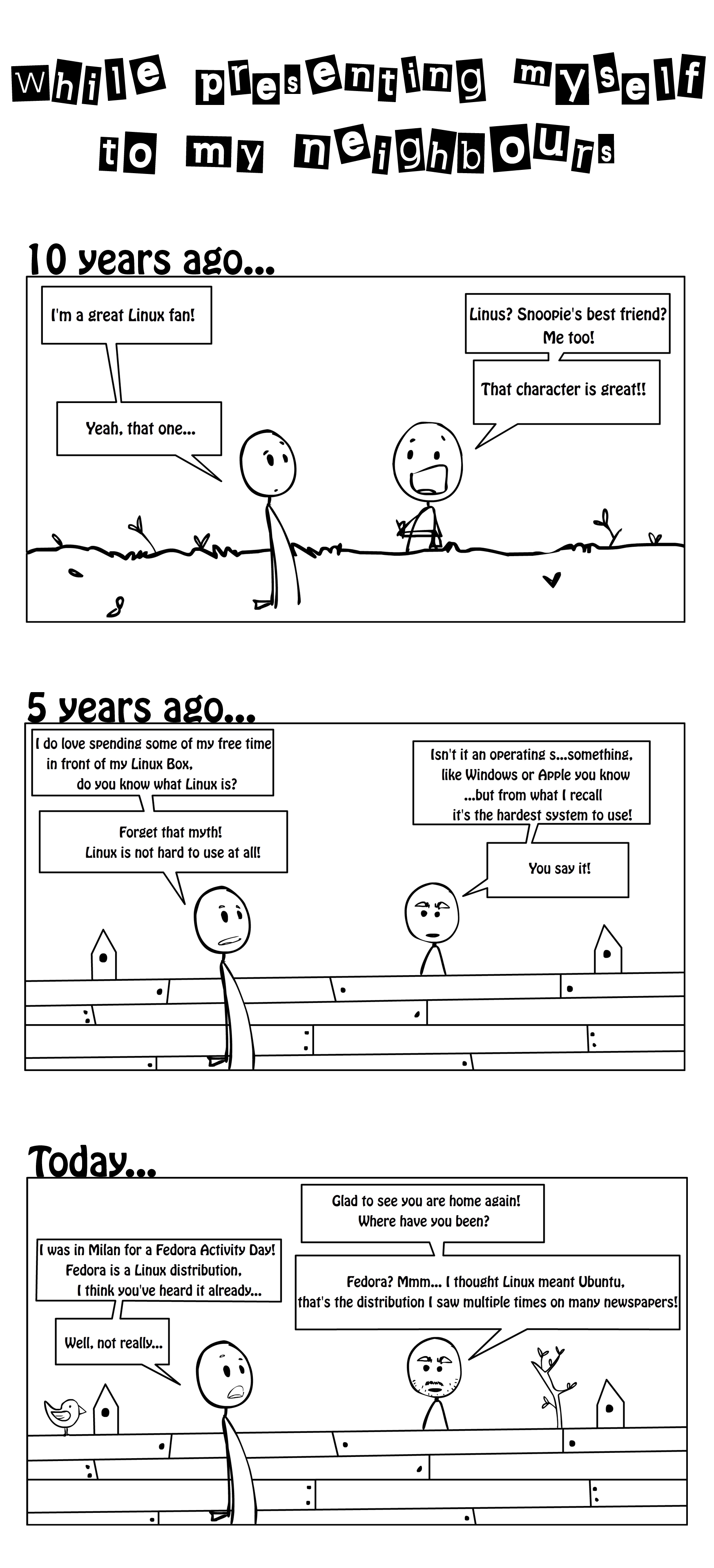
Andrea Veri: The Linux s perception of my neighbours

I live in a little village close to the city and one of the houses close to my property is for rent since more than ten years. A lot of families and people succeeded in that house and every time someone new joined my Linux evangelist hat jumped in my head. I ve always presented myself as a Linux geek to my neighbours and it has been nice seeing how the Linux word evolved (with funny and surprising quotes) during the past ten years in their minds. A friend of mine (Aretha Battistutta) made a little comic strip out of the topic and the result is simply amazing. Enjoy!

12 November 2012

Gunnar Wolf: Update on my e-voting-related work @e_voto

For the last couple of years, one of the topics I have tackled with several columns and a couple of articles published, several presentations on conferences and many comments wherever I can is raising awareness on why security experts around the world oppose electronic voting. Slightly over a year ago, I started gathering all the published news (in Spanish, with some notes in English if I feel them relevant enough) that came to my greedy hands and archiving them, categorized as well as I could, into what I came to call an Electronic voting observatory. I don't feed it with the frequency I'd like, but overall I do feel there is an interesting amount of information in there. About a month and a half ago, via Twitterfeed, I set up a Twitter account where my bot echoes everything I get on that regard. So, while you can follow the observatory via RSS (as probably most readers of my blog will do), I know there are many Twitter users among you @e_voto might be interesting to you if you speak Spanish and are interested in the topic. I try not to be partisan on the information I copy there; of course I am subjective (I try not to refer to news which don't provide new insight or data points, or to obvious repeats), but I am doing this effort to follow the development as it unfolds, not to push my viewpoints.

6 November 2012

Stefano Zacchiroli: bits from the DPL for October 2012

Freshly baked, bits from the DPL for October 2012.
Dear Project Members,
another month, another periodic report of DPL-ish activities, this time for October 2012. Highlights Debian on public clouds I've spent quite some time to improve Debian presence on the so called "public clouds". Following up to an inquiry of a fellow developer, I've reached out to Microsoft to investigate the possibility of having Debian as an option on Windows Azure. Around the same time, I've been approached by Amazon to have Debian as an option on the AWS marketplace. In both cases, we will need to overcome challenges of various kinds, at the technical (e.g. image preparation), bureaucratic (e.g. terms of the agreements we'll need to accept to be present), and political (e.g. chain of trust, platform freedom) levels. Up to now, discussions have been going on mostly in private, simply because they started as 1-to-1 inquiries and continued from there, but there is no good reason they should remain so. Hence, thanks to the listmasters and in particular Alexander Wirt, we have setup the new debian-cloud mailing list. If you are interested in these topics please join the list. For both Azure and AWS there is good progress on the technical part already; summaries will soon be posted on the list so that we are all on the same page. Similarly, I'll post there status reports about the bureaucratic requirements. And of course there is no reason to focus on specific clouds, if you'd like to support others and are willing to put some work to that end, please join the list and let us know. DPL helpers meeting I've already bothered you at least in my last platform and DebConf13 talk with observations about how non-scalable the DPL job is. After having collected applications of DPL helpers for a while, I've finally sat down and tried to put those applications into good use. The idea is simple: to the extend of possible, we should shift from a one-man-band job to a more "board-like" job, with people sharing an agenda, a list of outstanding tasks, and public communication. We have started slowly, setting up the #debian-dpl IRC channel and running periodic bi-weekly meetings there. You can find the meeting minutes and full logs at the usual place. We are still ramping up, so we don't have yet "fancy" stuff like a mailing list or an issue tracker entry, but they're in the working. Some of the outcome are starting to show, too (e.g. as part of recent discussions on 3rd party orphaning, or on our inbound trademark policy, or even in the forthcoming DMCA policy to make mentors.d.n an official project service). It's an experiment and a big challenge. I'm, for one thing, not yet convinced there are enough people interested in sharing the load of DPL duties (that look boring, for many tech geeks) in the long run. But I'm also convinced that the sustainability of the Debian organization model depends on this, so it's worth trying. If you're interested in the challenge and willing to volunteer some of your time, please join us on #debian-dpl . I'll take care of keeping the project informed of further evolution, in particular about the communication channels we will pick for day to day activities and accountability. Events / public communication I've spent most of my remaining Debian time in October attending events on behalf of the Project, in particular: On the topic of public communication, I've also coordinated with the press team an answer to a press inquiry about Secure Boot (which has become part of this article), and happily vouched for the Ubuntu charity marathon, adding some Debian challenges to it. Delegations As largely overdue matters, I've finalized the delegations mentioned last month, namely: FTP masters, New Members Front Desk, and Policy editors. Assets and legal stuff Miscellanea Now let's all go back to RC Bug squashing to make Wheezy a reality. SPAM-my link of the month is http://udd.debian.org/bugs.cgi and its various "views" at the bottom of the page. Cheers.
PS the day-to-day activity log for October 2012 is available at the usual place master:/srv/leader/news/bits-from-the-DPL.txt.201210

2 November 2012

Neil Williams: Introducing pyBit - Buildd Integration Toolkit

pyBit - cross-platform package building using AMQP


Message queues provide a simple way to create a distributed, cross-platform buildd toolkit to build packages using a collection of buildds, direct from various VCS clients. pyBit is intended to support rapidly evolving software collections and can support multiple VCS frontends and multiple build backends. Cross building is expected to be supported for some backends. The initial backend uses dpkg for Debian with subversion providing the source and sbuild doing the actual build.

pyBit includes support for cancelling selected builds and using multiple buildd clients per architecture, per platform and per suite.

Hooks are available or in development for subversion and git, other VCS hooks can be added. A RESTful web API provides live build reports and can generate build jobs for specific packages using particular VCS branches on selected architectures to support re-building packages at any point in the development process. Build history is stored using postgresql.

Other buildd systems can rebuild long lists of packages or build lots of binary packages from relatively slow moving source packages. PyBit exists to handle much more rapid software development across a wide range of platforms, VCS inputs and architectures. Buildd clients which are under-used can be tasked with building multiple suites or adding cross-build support. Buildd clients which are over-utilised are easily identified and adding new machines to an existing architecture / platform / suite pool should be easy. Hook activation automatically cancels any ongoing build for the same architecture, platform and suite to avoid wasting time on an interim version.

The emphasis in pyBit is to have fast builds with redundant clients, reliable reporting using a flexible and intuitive frontend. To this end, there is no need for a source package to be uploaded. Depending on the VCS hook in use, builds can happen every time a particular file is changed (e.g. debian/changelog for a native Debian package) or at every push (for a distributed VCS) or whatever is appropriate for a particular software collection. Builds are checked for available build-dependencies and packages re-queued if the build-dependencies are not yet met.

In the longer term, it may well be possible to use more than one server / database combination to support more builds and more platforms.

So far, we've got to a working model and tagged 0.1.0 as the first downloadable release. There is a lot more to do, especially adding more documentation, more VCS hooks, support for more VCS methods on the buildd clients and more buildd client scripts for platforms other than Debian. (The git hook and git source client are expected to let pyBit be self-buildable but a certain amount of configuration will be required for the server and each client which makes it not-quite self-hosting.)

pyBit concentrates on preparing collections of binary packages which can be used to build others, rather than trying to rebuild everything every time - this allows more rapid upstream software development and encourages modular, re-usable software. pyBit will also support rebuilding specific versions, architectures, suites or platforms via the RESTful web API. Access to this frontend can be controlled through any of the standard methods.

Components are loosely coupled via JSON encoded messages sent using rabbitMQ and curl. A new client can be added at any time and it will simply pick up buildd jobs from the relevant queue.

Development has now moved to Github and if anyone wants to look at new clients and new hooks, just contact the team by email or via IRC (#pybit on irc.oftc.net). Current development is based on Debian Squeeze 6.0.6 with backports and also on Debian Wheezy - more testing is welcome. Patches are also very welcome, pyBit is licensed under GPL2+.

There is no intrinsic reason why pyBit could not support any buildd platform capable of taking source from a known location and building a set of binaries. Packages are added to the queues whenever the hook is activated, so adding new packages to the collection is simply a case of triggering the existing hook.

Another interesting challenge for pyBit would be to trigger a hook on a new source code repository and just let it work through every package until everything is built. That probably won't work with the current 0.1.0 code but if that is what you'd like to work on, join the team.

1 November 2012

Antoine Beaupr : My short computing history

This is a long story. I wanted to document which tools I used on my desktop, but then realized it was difficult to do this without an historical context. This therefore, became a history of my computer usage and programming habits.

Before the desktop: vic 20 and apple My first contacts with computers were when my uncle showed me his Apple computers at his home. He was working at UQAM and had access to all sorts of crazy computers. My memory is vague, but I believe he showed me a turtle moving around the screen, which I suspect was Logo, and some rabbit game which I was quite fond of. Later, I hooked up with a Vic-20 (similar to a Commodore 64) and typed in my first programs. Back then, you would painstakingly transcribe the program from a book into the screen, type RUN at the end and really hope that you didn't make a typo. You could also read and write data off audio tape with an external tape drive, which was really amazing. To put things into perspective, the Vic-20 would plug into your television for a display, and the computer was "in the keyboard". Old school shit. The language was BASIC, which was awful. Later, we got luxurious and had the privilege of a Macintosh Plus computer. 3000$ plus the printer, that was quite something. Still, that modern system could run Word, had games, and a 9" black and white screen. But the best part, and where I really started to learn to program, is with Hypercard, the crazy software written by Bill Atkinson that became the inspiration for wikis, the Myst computer game and, to a certain extent, popularized the concept of hyperlinking, which is the basic principle of the World Wide Web.

The early years: afterstep and FreeBSD But my real computer life all started with FreeBSD 2.2.x (probably 2.2.5), around 1997, when I installed my first FLOSS operating system. This was just amazing: source code for everything, down to the compilers themselves, I was amazed, since I was coming from a Mac (still had that Mac Plus lying around) and Windows (95!) world. Back then, X11 (XFree86, it was called) was a fantasy. Something I would compile with the FreeBSD ports system and sometimes would be able to run. Window managers were some weird things I wasn't sure how to use, but I figured out twm (yuck!) but was still amazed. At the university, we had SGI workstations (remember the Indigo machines?) on which I started setting up the Afterstep window manager, which I used for a long time. The web browser was Netscape Communicator 4, and lo and behold, it also did email, although I mostly used Pine over a modem terminal to the university. Internet access at home was spotty and was dependent on students compiling discreetly copies of slirp which were allowing us, in a really clunky way, to run a PPP session over those terminal lines. That actually got my account suspended because I messed up my sendmail configuration and was sending emails that appeared to be coming as , which freaked out the sysadmins that be over there. The hardware was a Pentium 166Mhz with 32MB of ram and 20GB of disk space, which was a huge improvement over the 1MB of ram and 20MB of (external!) hard disk that the Mac Plus was proud of. By then, I started programming in more languages: I learned the basics of shell scripting, C programming and I had learned Pascal in a college class.

The real freedom: Debian and... enlightenment? I then switched to Debian, thanks to my friend scyrma, which showed me the power of dselect which, for a FreeBSD user, was really impressive. Imagine that: you could just install software and all dependencies without compiling anything! ;) I don't exactly remember when that was, but it was probably Woody. I probably still used afterstep, but at that time, changing window managers was like changing t-shirts and we would waste countless hours fiddling around with borders and background images and other silly things. I remember running Enlightenment and writing software for it, for example, but not much else. Back then, email was still over pine, but a new web browser was rearing its ugly head, Mozilla, and was quickly trimmed down to Phoenix, shortly lived as Mozilla Firebird, only to be finally renamed Mozilla Firefox, and was unleashed as a stable release to an unsuspecting Internet Explorer and Microsoft-dominated world. Throughout this chaos, I also used various Mozilla derivatives like Galeon since all of this was pretty unstable and heavy for my poor computers. This was probably around 2002 to 2005. By then, I had formal classes on programming languages, was forced to learn Java, discovered C++, and learned more C as the university assumed that you knew that language in the data structures and algorithm class, which some students really didn't find funny at all. I also learned some Prolog and Haskell back then. Through my experiences with free software, I discovered various eclectic programming languages like TCL, and kept an eye out for other languages like lisp (thanks to Emacs), Forth (thanks to the FreeBSD boot loader), HTML/CSS/Javascript (no thanks to the web). There are probably others I am forgetting here, voluntarily or not.

The years of the desktops: rox, sawfish and gnome Another stable increment on my desktop was the use of the sawfish window manager and the rox desktop, mostly because of the awesome Rox file manager that had no equal in the rest of the free software world. Gnome was an atrocity and KDE even more so: bloated and unstable. Eventually, however, KDE and Gnome not only matured, but simply took over the whole of the graphical environment psyche of the free world. People nowadays don't even know what a window manager is and assume that you now have a "desktop environment", which, for me, is a real desk with a bunch of papers, a radio transceiver and maybe a computer with a screen lying around. So I did use KDE, and then Gnome. I switched from KDE to Gnome because I felt that Gnome left me more space to run my own stuff without starting crazy daemons to preload everything. At this point, Firefox was the new thing and basically stable enough for daily use. This lasted until around 2009, I guess. On the programming side, I had picked up Perl because I had to learn it to work at Ericsson (don't ask) and learned PHP to pay my rent, which I consider one of the biggest professional mistakes I have made so far in that story. It is around that time that Koumbit was founded by me and other friends.

The tiles fall on the gnomes: awesome desktop and sysadmin programming At some point, friends (mostly comar and millette) introduced me to wmii as the best thing since sliced bread. I banged my head against it with great pains, but I really enjoyed the hands off approach to window management. Tiling window managers really got a hold on me there, and in fact we can say on the whole desktop, with recent Gnome 3 taking up some tiling concepts itself. I have since then switched to the Awesome Window Manager which is probably the worst name you can use for software (try googling for "Awesome crash" to get an idea). I have switched from Firefox to Chromium, after having repeated crashes from Firefox on a site that Chrome would load fine. I was expecting Chrome to crash only one tab, because of its design, and it turned out to not crash at all, and I have since given up on Firefox totally. I have also given up on desktop environments. While I have given them a chance in quick setups and still use them when forced to, I find them too bloated and single-minded for my needs. I want control over my desktop, and those tools work very hard to remove control and hide it behind user interfaces that treat me like a brain-dead dog. Finally, I have kept on programming in PHP for work, because that's what we do over there (unfortunately). Mostly because of Drupal and Aegir, in which I was and still am deeply involved. But I am quite fond of Python for my personnal project and still use shell scripting to get myself out of trouble or automate data processing from time to time. I have a rule though: once a program hits 100 lines of shell scripting, it needs to be rewritten, usually in Perl because the syntax is closer. During the years 2009 to 2012, I have started to work more and more on system administration however. In 2010, I became a Debian Developer and a lot of my work at Koumbit revolves around system administration, optimisation and maintenance. I work oncall and sometimes get called during the night to nurse servers (which is why I am up writing this right now).

The future of programming I have become seriously disgruntled with programming. I have seen the emergence of the web, where programmers felt it was relevant to rewrite 30 years of programs into the web framework (webmail? wtf?), and now we are seeing the same thing happen with mobile devices, the tracking devices they call phones and "pads", we should rather say. And again they are trying to make people pay for trivial software. I am tired of seeing our community reinvent the wheel every 10 years because of infatuated egos and marketing sprints. We are wasting great minds on this, a lot of energy and precious time. I would rather maintain 5 year old imperfect software than coordinate a 5 year project to rewrite that software into another imperfect software. That is what is happening right now, and it's going nowhere. So here's the current state of affairs, some perls, some tiles, but mostly system administration and less programming. Through all this time, the common pattern is that I have learned to solve problems and document my work, which are key concepts of the job of a system administrator, which is what I really am now. Somehow, that popped into my life like a natural fit. Maybe, one day, I will retire and become a shepherd in far away mountains, but I will always have in my mind the strong desire to fix shit up and make things right with the world. Maybe get involved in a project like Open Source Ecology and especially their Global Village Construction Set to make sure humankind survives all that stupidity.

Rog rio Brito: Another meme: The Geek test

I was with some spare time a few days ago and I took one of those stupid tests that are so popular in the Internet. Well, here are the results, saying that I am, indeed, a Geek, which does not surprise me that much. :)
NerdTests.com says I'm a Cool Nerd King.  Click here to take the Nerd Test, get geeky images and jokes, and write on the nerd forum!
I did expect my Math score to be higher than everything else (I'm only in the 90th percentile with respect to this), while I am high on the Computer side of things (in the 97th percentile). I guess that I should devote myself to more Mathematics and writing less code. :)

28 October 2012

Steve Langasek: SecureBoot in Ubuntu 12.10

The 12.10 release is the first version of Ubuntu that supports Secure Boot out of the box. In what is largely an accident of release timing, from what I can tell (and please correct me if I'm wrong), this actually makes Ubuntu 12.10 the first general release of any OS to support Secure Boot. (Windows 8 of course is also now available; and I'm sure Matthew Garrett, who has been a welcome collaborator throughout this process, has everything in good order for the upcoming Fedora 18 release.) That's certainly something of a bittersweet achievement. I'm proud of the work we've done to ensure Ubuntu will continue to work out of the box on the consumer hardware of the future; in spite of the predictable accusations on the blogowebs that we've sold out, I sleep well at night knowing that this was the pragmatic decision to make, maximizing users' freedom to use their hardware. All the same, I worry about what the landscape is going to look like in a few years' time. The Ubuntu first-stage EFI bootloader is signed by Microsoft, but the key that is used for signing is one that's recommended by Microsoft, not one that's required by the Windows 8 certification requirements. Will all hardware include this key in practice? The Windows 8 requirements also say that every machine must allow the user to disable Secure Boot. Will manufacturers get this right, and will users be able to make use of it in the event the manufacture didn't include the Microsoft-recommended key? Only time will tell. But I do think the Linux community is going to have to remain engaged on this for some time to come, and possibly hold OEMs' feet to the fire for shipping hardware that will only work with Windows 8. But that's for the future. For now, we have a technical solution in 12.10 that solves the parts of the problem that we can solve. This first release gives us preliminary support for booting on Secure Boot, but there's more work to be done to provide a full solution that's sustainable over the long term. We'll be discussing some of that this week at UDS in Copenhagen. And as part of our committment to enabling new hardware on the current LTS release, we will be backporting this work for inclusion in 12.04.2. It remains to be decided how Debian will approach the Secure Boot question. At DebConf 12, many people seemed to consider it a foregone conclusion that Debian would never agree to include binaries in main signed by third-party keys. I don't think that should be a given; I think allowing third-party signatures in main for hardware compatibility is consistent with Debian's principles, and refusing to make Debian compatible with this hardware out of the box does nothing to advance user freedom. I hope to see frank discussion post-wheezy about keeping Debian relevant on consumer hardware of the future.

9 October 2012

Stefano Zacchiroli: bits from the DPL for September 2012

Just posted to d-d-a, bits from the DPL for Septemer 2012.
Heya,
here is the periodic report of DPL activities, this time related to September 2012 (posted here with some delay, as I've been traveling oversea on behalf of Debian for the past few days). Help needed: Google Code-In The Google Code-In (GCI) initiative is about to start again. We don't have a great track record of participating into it, and that's a pity. The initiative revolves around small tasks that other Free Software projects have come to call "easy hacks", showing how effective they're in attracting new volunteers. To participate, we need both mentors and admins. If you're interested see Ana's call for help and please volunteer on the soc-coordination list. Related to this, you've probably seen the report of our participation in GSoC 2012. I'd like to thank all students, mentors, and admins for a very well organized edition. Logo relicensing & other assets The DFSG-relicensing of the Debian logo, which I've mentioned in recent updates, has now happened. The so called Debian "Open Use" logo, in both variants (with and without "Debian") is now dually licensed under LGPL3+ / CC-BY-SA 3.0. The change has been made effective with a resolution of the SPI Board of Directors. Note that the so called "official" logo, which we seem to use very little, is still released under the terms of a non-free license. Discussion is ongoing on -project to stop promoting it. If you're using it or if you've arguments in favor of against that, please participate in the discussion. I've got from SFLC an updated draft of the new proposed trademark policy, implementing most of the changes requested during related August discussions on -project. I'll post it for review there shortly. The Japanese Trademark Office (JPO) has sent us the final confirmation that trademark transfer request (from individuals Debian contributors in the area to SPI) has happened. We've paid the needed fee of 457 CHF to conclude the transaction. We finally settled a domain transfer agreement with the current owner of the debian.eu. Technically, the domain will be transferred to FFIS in the coming weeks. Core teams (non-)news Quite some core teams are in the process of changing their formations these weeks, but most are still pending proper delegation (or equivalent). So here are just a few "teasers": I hope to finalize all the pending tasks above this month. Future events I've spent quite some time to plan my participation in events I'll be attending during October on behalf of Debian, such as the ACM Reflections conference in Urbana-Champaign (at the time of writing, this has already happened), the Ubuntu Developer Summit in Copenhagen, and the LinuxDay event in Turin. Cheers.
PS the day-to-day activity log for September 2012 is available at the usual place master:/srv/leader/news/bits-from-the-DPL.txt.201209

8 October 2012

Eddy Petri&#537;or: HOWTO fix git-buildpackage signs with wrong signature

If you have two or more available gpg keys that can be used for the same identity (e.g.: 'John Doe <john@doe.com>') that you might use to add entries to changelogs of packages, you might end up in situations where git-buildpackage or other similar tool might want to sign packages with the wrong key.

It seems debsign (the tool that actually does the signing) just picks up the first key that is still valid (I also have a revoked key) and matches the used identity.

There are many ways to fix this, but the one that will work for most cases is to run this command:

echo 'DEBSIGN_KEYID=0x0123ABCD' >> ~/.devscripts

Of course, you should replace 0x0123ABCD with the keyid which you prefer.

This will create a ~/.devscripts file (if it didn't exist) which will contain the DEBSIGN_KEY variable with the desired value. This file will be sourced by debsign before doing its actual work, so it will do the right thing when ran.

There are also git-buildpackage specific fixes like defining builder in the [DEFAULT] section of ~/.gbp.conf and passing '-k0x0123ABCD' to debuild something like:

[DEFAULT]
builder = debuild -i -I -k1234ABCD
...

But that probably gets ugly if you use a custom builder.


P.S.: I have just deleted my old key 0xDD1F1F9F since I won't be using it anymore. I don't remember where I put the revocation certificate, but I'll revoke the key, once and if I find the revocation certificate. Otherwise, it will expire in July, next year.

From now on, I am going to use only the key 0xE3E083A1 to which I even added a photo and some newer identities and updated with a few signatures I got during DebConf 9.

1 October 2012

Andrew Pollock: [opinion] On helicopter parenting and strangers in day care facilities

It appears that a recent incident at a different campus of the "preschool" (I call it day care) that Zoe goes to has gotten the attention of the Free-Range Kids blog. Firstly, I need to say that on the parenting spectrum, I definitely self-identify closer to the free-range end than the helicopter end. I'm not sure that I'd let an 8 year old ride the New York subway on their own, but Zoe's not 8 yet, so I really can't say. Sarah and I received the same email that is reprinted on the blog, on Friday night, and we were both (very) mildly alarmed at the situation, but not particularly concerned, mostly because it wasn't the facility that Zoe goes to. I'm not sure I'd be that much more concerned if it was, to be honest. I did like the statistics that the parent quoted in response. I thought that that put things into perspective, but didn't really take abductions by estranged parents into consideration. My one reaction to reading the email was, "why did they wait until after the incident to escalate it?" but then, from my own experiences in dropping off or picking up Zoe, I could totally understand not all the staff knowing on sight all the parents or guardians that do pickups and drop offs. This does lead to one asking how they know who to buzz in, but that's another can of worms. Anyway, I read the 50 or so varyingly indignant comments on the Free Range Kids blog, and since they were talking about the company that I give a not inconsequential amount of money to, I feel the need to write a response. The whole episode raises the question: who was this person and what were they doing there? Some of the commentators hypothesize that they were casing the joint for a future incident, or just giving themselves an impromptu tour before placing their child there (Zoe and I toured before we signed up, but that was an official, prearranged thing). It really is unfortunate that the staff didn't challenge this person, but as I said, they probably all had to review the video surveillance footage together to ascertain that none of them knew who the person was. I consider this a bit of a deficiency itself, but I don't really expect them to all have photographic memory, especially if one parent mostly does drop off and pick up. The other (expensive) option would be to issue each authorized person with an electronically revocable proximity card, so they can let themselves in, but I feel that that's taking things to the extreme. They staff all carry portable radios. If they don't have a discreet "code" they can call when one of them sees a person they don't know, I'm sure they will have after this incident. I personally found the majority of the comments on the Free Range Kids blog to be on the extreme overreaction side of things. As much as I'm a believer in Free Range parenting, I think the day care provider has mostly reacted appropriately. Do I agree with their "locked facility" policy? It's my first experience with a commercial day care facility, so I don't have anything to compare it with. As I said earlier, I can totally understand where they're coming from in terms of limiting their liability. Previously, Zoe was in a "home day care" facility, without any locks, and I for one wasn't constantly worrying about someone wandering into that provider's home and abducting my daughter, so I guess the whole "locked facility" thing is on the more extreme end of the scale for me in the first place, but like I said, I'm uncalibrated for commercial day care centres. I'd certainly like to see the primary school environment that Zoe goes to not be such a locked down affair.

Next.

Previous.