Search Results: "edd"

17 September 2017

Dirk Eddelbuettel: RcppClassic 0.9.7

A rather boring and otherwise uneventful release 0.9.7 of RcppClassic is now at CRAN. This package provides a maintained version of the otherwise deprecated first Rcpp API; no new projects should use it. Once again no changes in user-facing code. But this makes it the first package to use the very new and shiny pinp package as the backend for its vignette, now converted to Markdown---see here for this new version. We also updated three sources files for tabs versus spaces as the current g++ version complained (correctly !!) about misleading indents. Otherwise a file src/init.c was added for dynamic registration, the Travis CI runner script was updated to using run.sh from our r-travis fork, and we now strip the library after they have been built. Again, no user code changes. And no iterate: nobody should use this package. Rcpp is so much better in so many ways---this one is simply available as we (quite strongly) believe that APIs are contracts, and as such we hold up our end of the deal. Courtesy of CRANberries, there are changes relative to the previous release. Questions, comments etc should go to the rcpp-devel mailing list off the R-Forge page.

This post by Dirk Eddelbuettel originated on his Thinking inside the box blog. Please report excessive re-aggregation in third-party for-profit settings.

16 September 2017

Dirk Eddelbuettel: pinp 0.0.1: pinp is not PNAS

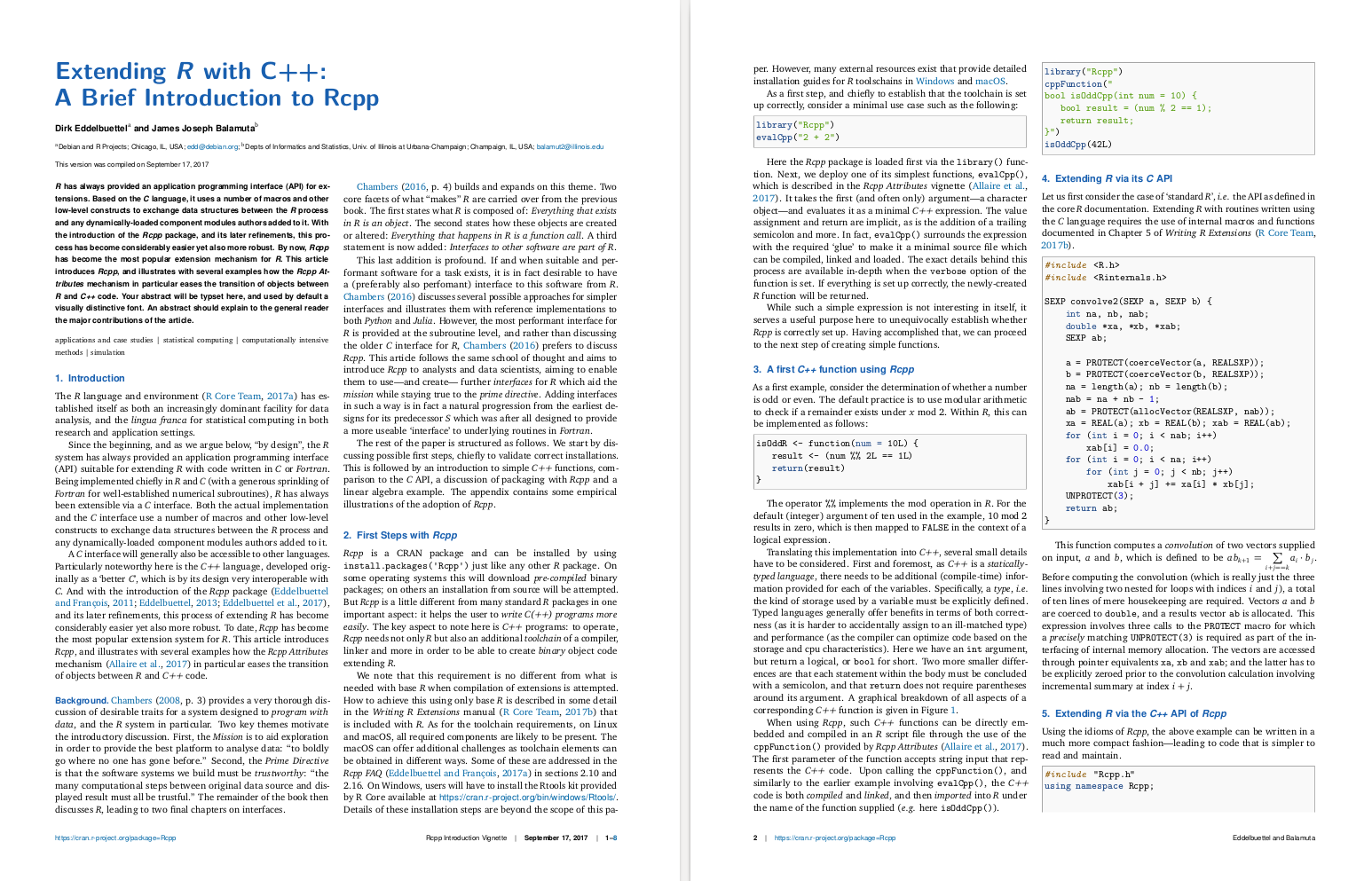
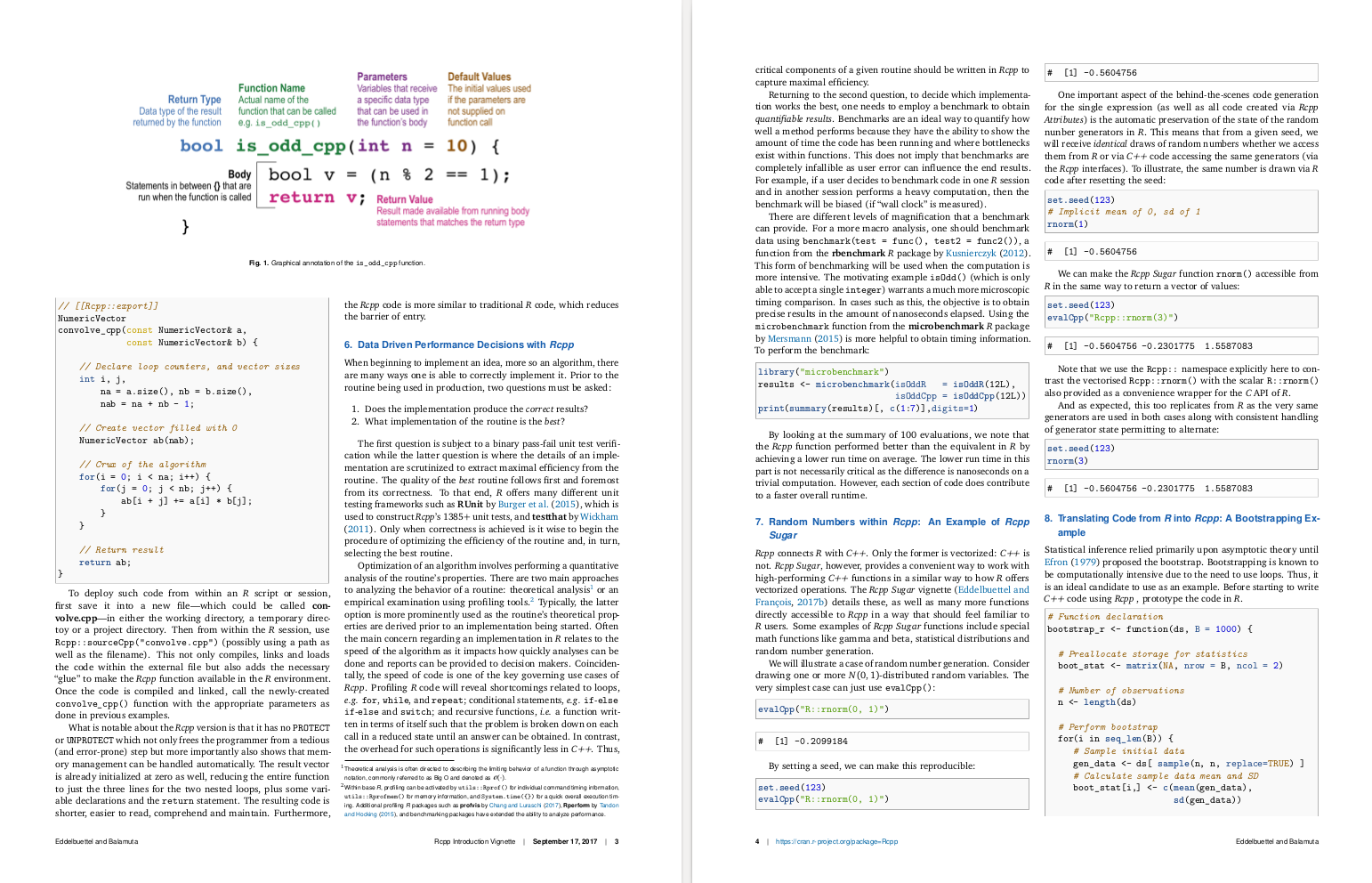
A brandnew and very exciting (to us, at least) package called pinp just arrived on CRAN, following a somewhat unnecessarily long passage out of incoming. It is based on the PNAS LaTeX Style offered by the Proceeding of the National Academy of Sciences of the United States of America, or PNAS for short. And there is already a Markdown version in the wonderful rticles packages. But James Balamuta and I thought we could do one better when we were looking to typeset our recent PeerJ Prepint as an attractive looking vignette for use within the Rcpp package. And so we did by changing a few things (font, color, use of natbib and Chicago.bst for references, removal of a bunch of extra PNAS-specific formalities from the frontpage) and customized a number of other things for easier use by vignettes directly from the YAML header (draft mode watermark, doi or url for packages, easier author naming in footer, bibtex file and more). We are quite pleased with the result which seems ready for the next Rcpp release---see e.g., these two teasers:
and
and the pinp package page or the GitHub repo have the full (four double-)pages of what turned a more dull looking 27 page manuscript into eight crisp two-column pages. We have few more things planned (i.e., switching to single column mode, turning on linenumbers at least in one-column mode). For questions or comments use the issue tracker off the GitHub repo.

This post by Dirk Eddelbuettel originated on his Thinking inside the box blog. Please report excessive re-aggregation in third-party for-profit settings.

Dirk Eddelbuettel: drat 0.1.3

A new version of drat arrived earlier today on CRAN as another no-human-can-delay-this automatic upgrade directly from the CRAN prechecks. It is mostly a maintenance release ensuring PACKAGES.rds is also updated, plus some minor other edits. drat stands for drat R Archive Template, and helps with easy-to-create and easy-to-use repositories for R packages. Since its inception in early 2015 it has found reasonably widespread adoption among R users because repositories with marked releases is the better way to distribute code. The NEWS file summarises the release as follows:

Changes in drat version 0.1.3 (2017-09-16)
  • Ensure PACKAGES.rds, if present, is also inserted in repo
  • Updated 'README.md' removing stale example URLs (#63)
  • Use https to fetch Travis CI script from r-travis

Courtesy of CRANberries, there is a comparison to the previous release. More detailed information is on the drat page.

This post by Dirk Eddelbuettel originated on his Thinking inside the box blog. Please report excessive re-aggregation in third-party for-profit settings.

14 September 2017

Dirk Eddelbuettel: RcppMsgPack 0.2.0

A new and much enhanced version of RcppMsgPack arrived on CRAN a couple of days ago. It came together following this email to the r-package-devel list which made it apparent that Travers Ching had been working on MessagePack converters for R which required the very headers I had for use from, inter alia, the RcppRedis package. So we joined our packages. I updated the headers in RcppMsgPack to the current upstream version 2.1.5 of MessagePack, and Travers added his helper functions allow direct packing / unpacking of MessagePack objects at the R level, as well as tests and a draft vignette. Very exciting, and great to have a coauthor! So now RcppMspPack provides R with both MessagePack header files for use via C++ (or C, if you must) packages such as RcppRedis --- and direct conversion routines at the R prompt. MessagePack itself is an efficient binary serialization format. It lets you exchange data among multiple languages like JSON. But it is faster and smaller. Small integers are encoded into a single byte, and typical short strings require only one extra byte in addition to the strings themselves.

Changes in version 0.2.0 (2017-09-07)
  • Added support for building on Windows
  • Upgraded to MsgPack 2.1.5 (#3)
  • New R functions to manipulate MsgPack objects: msgpack_format, msgpack_map, msgpack_pack, msgpack_simplify, mgspack_unpack (#4)
  • New R functions also available as msgpackFormat, msgpackMap, msgpackPack, msgpackSimplify, mgspackUnpack (#4)
  • New vignette (#4)
  • New tests (#4)

Courtesy of CRANberries, there is also a diffstat report for this release. More information is on the RcppRedis page. More information may be on the RcppMsgPack page. Issues and bugreports should go to the GitHub issue tracker.

This post by Dirk Eddelbuettel originated on his Thinking inside the box blog. Please report excessive re-aggregation in third-party for-profit settings.

Dirk Eddelbuettel: RcppRedis 0.1.8

A new minor release of RcppRedis arrived on CRAN last week, following the release 0.2.0 of RcppMsgPack which brought the MsgPack headers forward to release 2.1.5. This required a minor and rather trivial change in the code. When the optional RcppMsgPack package is used, we now require this version 0.2.0 or later. We made a few internal updates to the package as well.

Changes in version 0.1.8 (2017-09-08)
  • A new file init.c was added with calls to R_registerRoutines() and R_useDynamicSymbols()
  • Symbol registration is enabled in useDynLib
  • Travis CI was updated to using run.sh
  • The (optional MessagePack) code was updated for MsgPack 2.*

Courtesy of CRANberries, there is also a diffstat report for this release. More information is on the RcppRedis page.

This post by Dirk Eddelbuettel originated on his Thinking inside the box blog. Please report excessive re-aggregation in third-party for-profit settings.

13 September 2017

Shirish Agarwal: Android, Android marketplace and gaming addiction.

This would be a longish piece so please bear and play with tea, coffee, beer or anything stronger that you desire while reading below  I had bought an Android phone, a Samsung J5 just before going to debconf 2016. It was more for being in-trend rather than really using it. The one which I shared is the upgraded version (recentish) the one I have is 2 GB for which I had paid around double of what the list price was. The only reason I bought the model is that it had removable battery at the price point I was willing to pay. I did see that Samsung has the same ham-handed issues with audio as previous Nokia devices use to, the speakers and microphone probably the cheapest you can get on the market. Nokia was same too, at least on the lower-end of the market, while Oppo has loud ringtones and loud music, perfect for those who are a bit hard of hearing (as yours truly is). I had been pleasantly surprised by the quality of photos Samsung J5 was churning even though I m less than average shooter, never been really into it so was a sort of wake-up call for where camera sensor technology is advancing. And of course with newer phones the kind of detail it can capture is mesmerizing to say the least, although wide-angle shots still would take some time to get right I guess. If memory serves me right, sometime back Laura Arjona Reina (who handles part of debian-publicity and part of debian-women among other responsibilities) shared a blog post on p.d.o. where she had shared the troubles she had while exporting data from the phone. While she shared that and I lack the time or the energy to try and find it ( the entry is really bookmarkable, at least that specific blog post). What was interesting though that I had gone few years ago to Bangalore, there is an organization which I like and admire CIS great for researchers. Anyways they had done a project getting between 10-20 phones from the market made of Chinese origin (almost all mobiles sold in India, the fabrication of CPU and APU etc. are done in China/Taiwan and then assembled here). Here what is done at the most is assembly which for all political purposes is called manufacturing . All the mobiles kept quite a bit of info. on the device even after you wiped them clean/put some other ROM on them. The CIS site is more than a bit cluttered otherwise would have shared the direct link. I do hope to send an e-mail to CIS and hopefully they will respond with the report and will share that here as and when. It would be interesting to know if after people flash a custom rom if the status quo is the same as it was before. I do suspect it would be the former as flashing ROMs on phones is still a bit of specialized subject at least here in India with even an average phone costing a month or two s salary or more and the idea of bricking the phone scares most people (including yours truly). Anyways, for a long time I was on bed and had the phone. I used 2 games from the android marketplace which both mum and I enjoy and enjoyed. Those are Real jigsaw and Jigsaw puzzle HD . The permissions dialog which Real jigsaw among other games has is horrible and part of me freaks that all such apps. have unrestricted access to my storage area. Ideally, what Android should have done is either partition or give functionality to the user to have private space for their photos and whatever media they have and the rest of the area is like a public park. If anybody has any thoughts on partitioning on Android phone would like to hear that. One game though which really hooked mumma and me is The Island Experiment . It reminded me of my younger days when gaming addiction was not treated as a disease but thankfully now is . I would call myself somewhat of a functional addict as in do my every day things, work etc. but do dream about the game as to what it will show me next. A part of it is the game is web-based (which means it needs constant internet connection) and web access is somewhat pricey, although with Reliance Jio an upcoming data network operator having bundles of money and promising the moon, network issues at least on low-bandwidth game which I and mum are playing hopefully will not have any issues. I haven t used tshark or any such tool to analyze the traffic but I guess it probably just sends short messages of number of clicks in a time period and things like that, all the rest (I guess) is happening on the mobile itself. I know at sometime I probably will try to put a custom rom on it but which one is the question as there are so many and also which is most compatible with my device. It seems I would have to do lot of homework before I can make any choices. Couple of months back, a friend of mine Akshat who has been using Android for few years enabled Developer Options which I didn t know about till he shared that info. with me. I do hope people do check Akshat s repo. as he has made/has quite a few useful scripts, especially if you are into digital photography. I have shared with him gimp scripting few days back so along with imagemagick you might see him doing some rough scripts in it. Of course, if people use it and give feedback he might clean the scripts a bit so it gives useful error messages and gives statement like gimp is not installed on your system, please install it or ask for specific version but as it works in free software it is somewhat directly proportional to the number of users, bugs and users behind it. A good example of what I mean is youtube-dl . I filed 873853 where I shared the upstream ticket. Apparently YouTube again changed few days back and while upstream has fixed it, the youtube-dl maintainer probably needs to find time and get the new version up. Apparently the issues lies in [$] dpkg -L youtube-dl grep youtube.py
/usr/lib/python3/dist-packages/youtube_dl/extractor/youtube.py
Hopefully somebody does the needful. Btw, I find f-droid extremely useful and especially osmand but sadly both of them are not shared or talked about by people  The reason I shared about Developer Options in Android is that few days back I noticed that the phone wonks off and has unpredictable behaviour such as not letting me browse the web, do additions or deletions using the google play store and alike . Things came to a head when few days back I saw a fibre-optic splicing operation being carried by some workers near my home by the state operator which elated me and wanted to shoot the video for it but the battery died/there was no power even though I hadn t used it much. I have deliberately shared the hindi version which tells how that knowledge is now coming to the masses. I had seen fibre-optic splicing more than a decade and a half back at some net conference where it was going to be in your neighbourhood soonish, hopefully it will happen soon  I had my suspicions for quite sometime all the issues with the phone were not due to proper charging. During course of my investigation, found out that in Developer Options there is an option called USB Configuration and changing that from the default MTP (Media Transfer Protocol) (which is basically used to put or take movies, music or any file from the phone to the computer or vice-versa improved much better behaviour on my android phone. But this caused an unexpected side-effect, I got pretty aggressive polling of the phone by the computer even after saying I do not want to share the phone details with the computer. This I filed as 874216 . The phone and I am guessing most Samsung phones today come with an adaptor with a USB male socket which goes in to the phone s usb port. There is the classical port for electricity but like most people heavily rely on usb charging even for deep fully powered down phone for full charging. One interesting project which I saw which came in Debian some days back is dummydroid. I did file a bug about it . I do hope that either the maintainer gives some more documentation. I am sure many people might use and add to the resource if the documentation was/is there. I did take a look at the package and the profile seems to be like an xml pair kind of database. Having more profiles shouldn t be hard if we knew what info. needs to be added and how do we find that info. Lastly, I am slowly transferring all the above knowledge to my mum as well, although in small doses. She, just like me has and had problems coming from resistive touchscreen to capacitive touchscreen. You can call me wrong but resistive touchscreen seemed to be superior and not as error-prone or liable to commit mistakes as is possible in capacitive touchscreens. There may be a setting to higher/lower the threshold for touching which I have not been able to find as of yet. Hope somebody finds something useful in there. I do hope that Debian does become a replacement to be used on such mobiles but then they would have to duplicate/also have some sort of mainstream content with editors to help people find stuff, something that Debian is not so good at currently. Also I m not sure Synaptic is good fit as a mobile store.
Filed under: Miscellenous Tagged: #Android, #capacitive touchscreen, #custom ROMs, #digital photography, #dummydroid, #f-droid, #fabrication, #flashing, #game addiction, #Google Play Store, #Mainstreaming Debian, #mobile connectivity, #Oppo, #osmand, #planet-debian, #resistive touchscreen, #Samsung Galaxy J5, #scripting, #USB charging, #USB configuration, #youtube-dl, gaming

10 September 2017

Steve Kemp: Debian-Administration.org is closing down

After 13 years the Debian-Administration website will be closing down towards the end of the year. The site will go read-only at the end of the month, and will slowly be stripped back from that point towards the end of the year - leaving only a static copy of the articles, and content. This is largely happening due to lack of content. There were only two articles posted last year, and every time I consider writing more content I lose my enthusiasm. There was a time when people contributed articles, but these days they tend to post such things on their own blogs, on medium, on Reddit, etc. So it seems like a good time to retire things. An official notice has been posted on the site-proper.

7 September 2017

Thomas Lange: My recent FAI activities

During DebConf 17 in Montr al I had a FAI demo session (video), where I showed how to create a customized installation CD and how to create a diskimage using the same configuration. This diskimage is ready for use with a VM software or can be booted inside a cloud environment. During the last weeks I was working on FAI 5.4 which will be released in a few weeks. I you want to test it use
deb https://fai-project.org/download beta-testing koeln
in your sources.list file. The most important new feature will be the cross architecture support. I managed to create an ARM64 diskimage on a x86 host and boot this inside Qemu. Currently I learn how to flash images onto my new Hikey960 board for booting my own Debian images on real hardware. The embedded world is still new for me and very different in respect to the boot process. At DebConf, I also worked on debootstrap. I produced a set of patches which can speedup debootstrap by a factor of 2. See #871835 for details. FAI debootstrap ARM

Reproducible builds folks: Reproducible Builds: Weekly report #123

Here's what happened in the Reproducible Builds effort between Sunday August 27 and Saturday September 2 2017: Talks and presentations Holger Levsen talked about our progress and our still-far goals at BornHack 2017 (Video). Toolchain development and fixes The Debian FTP archive will now reject changelogs where different entries have the same timestamps. UDD now uses reproducible-tracker.json (~25MB) which ignores our tests for Debian unstable, instead of our full set of results in reproducible.json. Our tests for Debian unstable uses a stricter definition of "reproducible" than what was recently added to Debian policy, and these stricter tests are currently more unreliable. Packages reviewed and fixed, and bugs filed Patches sent upstream: Debian bugs filed: Debian packages NMU-uploaded: Reviews of unreproducible packages 25 package reviews have been added, 50 have been updated and 86 have been removed in this week, adding to our knowledge about identified issues. Weekly QA work During our reproducibility testing, FTBFS bugs have been detected and reported by: diffoscope development Version 86 was uploaded to unstable by Mattia Rizzolo. It included previous weeks' contributions from: reprotest development Development continued in git with contributions from: Misc. This week's edition was written by Ximin Luo, Chris Lamb, Bernhard M. Wiedemann and Holger Levsen & reviewed by a bunch of Reproducible Builds folks on IRC & the mailing lists.

1 September 2017

Dirk Eddelbuettel: RcppAnnoy 0.0.9

An new version 0.0.9 of RcppAnnoy, our Rcpp-based R integration of the nifty Annoy library by Erik, is now on CRAN. Annoy is a small and lightweight C++ template header library for very fast approximate nearest neighbours. This release corrects an issue for Windows users discovered by GitHub user 'khoran' who later also suggested the fix of binary mode. It upgrades to Annoy release 1.9.1 and brings its new Manhattan distance to RcppAnnoy. A number of unit tests were added as well, and we updated some packaging internals such as symbol registration. And I presume I had a good streak emailing with Uwe's robots as the package made it onto CRAN rather smoothly within ten minutes of submission:
RcppAnnou to CRAN
Changes in this version are summarized here:

Changes in version 0.0.9 (2017-08-31)
  • Synchronized with Annoy upstream version 1.9.1
  • Minor updates in calls and tests as required by annoy 1.9.1
  • New Manhattan distance modules along with unit test code
  • Additional unit tests from upstream test code carried over
  • Binary mode is used for save (as suggested by @khoran in #21)
  • A new file init.c was added with calls to R_registerRoutines() and R_useDynamicSymbols()
  • Symbol registration is enabled in useDynLib

Courtesy of CRANberries, there is also a diffstat report for this release.

This post by Dirk Eddelbuettel originated on his Thinking inside the box blog. Please report excessive re-aggregation in third-party for-profit settings.

31 August 2017

Paul Wise: FLOSS Activities August 2017

Changes

Issues

Review

Administration
  • myrepos: get commit/admin access from joeyh at DebConf17, add commit/admin access for other patch submitters, apply my stack of patches
  • Debian: fix weird log file issues, redirect hardware donor, cleaned up a weird dir, fix some OOB info, ask for TLS on meetings-archive.d.n, check an I/O error, restart broken stunnels, powercycle 1 borked machine,
  • Debian mentors: lintian/security updates & reboot
  • Debian wiki: remove some stray cache files, whitelist 3 email domains, whitelist some email addresses, disable 1 spammer account, disable 1 accounts with bouncing email,
  • Debian QA: apply patch to fix PTS watch file errors, deploy changes
  • Debian derivatives census: run scripts for Purism, remove some noise from logs, trigger a recheck, merge fix by Unit193, deploy changes
  • Openmoko: security updates, reboots, enable unattended-upgrades

Communication
  • Attended DebConf17 and provided some input in BoFs
  • Sent Misc Dev News #44
  • Invite Google gLinux (on IRC) to the Debian derivatives census
  • Welcome Sven Haardiek (of GreenboneOS) to the Debian derivatives census
  • Inquire about the status of Canaima

Sponsors The samba bug report was sponsored by my employer. All other work was done on a volunteer basis.

30 August 2017

Dirk Eddelbuettel: RcppArmadillo 0.7.960.1.2

armadillo image A second fix-up release is needed following on the recent bi-monthly RcppArmadillo release as well as the initial follow-up as it turns out that OS X / macOS is so darn special that it needs an entire separate treatment for OpenMP. Namely to turn it off entirely... Armadillo is a powerful and expressive C++ template library for linear algebra aiming towards a good balance between speed and ease of use with a syntax deliberately close to a Matlab. RcppArmadillo integrates this library with the R environment and language--and is widely used by (currently) 384 other packages on CRAN---an increase of 54 since the CRAN release in June!
Changes in RcppArmadillo version 0.7.960.1.2 (2017-08-29)
  • On macOS, OpenMP support is now turned off (#170).
  • The package is now compiling under the C++11 standard (#170).
  • The vignette dependency is correctly set (James and Dirk in #168 and #169)

Courtesy of CRANberries, there is a diffstat report. More detailed information is on the RcppArmadillo page. Questions, comments etc should go to the rcpp-devel mailing list off the R-Forge page.

This post by Dirk Eddelbuettel originated on his Thinking inside the box blog. Please report excessive re-aggregation in third-party for-profit settings.

29 August 2017

Dirk Eddelbuettel: RcppSMC 0.2.0

A new version 0.2.0 of the RcppSMC package arrived on CRAN earlier today (as a very quick pretest-publish within minutes of submission). RcppSMC provides Rcpp-based bindings to R for the Sequential Monte Carlo Template Classes (SMCTC) by Adam Johansen described in his JSS article. This release 0.2.0 is chiefly the work of Leah South, a Ph.D. student at Queensland University of Technology, who was during the last few months a Google Summer of Code student mentored by Adam and myself. It was pleasure to work with Leah on this, and see her progress. Our congratulations to Leah for a job well done!

Changes in RcppSMC version 0.2.0 (2017-08-28)
  • Also use .registration=TRUE in useDynLib in NAMESPACE
  • Multiple Sequential Monte Carlo extensions (Leah South as part of Google Summer of Code 2017)
    • Switching to population level objects (#2 and #3).
    • Using Rcpp attributes (#2).
    • Using automatic RNGscope (#4 and #5).
    • Adding multiple normalising constant estimators (#7).
    • Static Bayesian model example: linear regression (#10 addressing #9).
    • Adding a PMMH example (#13 addressing #11).
    • Framework for additional algorithm parameters and adaptation (#19 addressing #16; also #24 addressing #23).
    • Common adaptation methods for static Bayesian models (#20 addressing #17).
    • Supporting MCMC repeated runs (#21).
    • Adding adaptation to linear regression example (#22 addressing #18).

Courtesy of CRANberries, there is a diffstat report for this release. More information is on the RcppSMC page. Issues and bugreports should go to the GitHub issue tracker.

This post by Dirk Eddelbuettel originated on his Thinking inside the box blog. Please report excessive re-aggregation in third-party for-profit settings.

25 August 2017

Reproducible builds folks: Reproducible Builds: Weekly report #121

Here's what happened in the Reproducible Builds effort between Sunday August 13 and Saturday August 19 2017: Reproducible Builds finally mandated by Debian Policy "Packages should build reproducibly" was merged into Debian policy! The added text is as follows and has been included into debian-policy 4.1.0.0:
Reproducibility
---------------
Packages should build reproducibly, which for the purposes of this
document [#]_ means that given
- a version of a source package unpacked at a given path;
- a set of versions of installed build dependencies;
- a set of environment variable values;
- a build architecture; and
- a host architecture,
repeatedly building the source package for the build architecture on
any machine of the host architecture with those versions of the build
dependencies installed and exactly those environment variable values
set will produce bit-for-bit identical binary packages.
It is recommended that packages produce bit-for-bit identical binaries
even if most environment variables and build paths are varied.  It is
intended for this stricter standard to replace the above when it is
easier for packages to meet it.
.. [#]
   This is Debian's precisification of the  reproducible-builds.org
   definition  _.
Reproducible work in other projects Bernhard M. Wiedemann's reproducibleopensuse scripts now work on Debian buster on the openSUSE Build Service with the latest versions of osc and obs-build. Toolchain development and fixes #872514 was opened on devscripts by Chris Lamb to add a reproducible-check program to report on the reproducibility status of installed packages. Packages reviewed and fixed, and bugs filed Upstream reports: Debian reports: Debian non-maintainer uploads: Reviews of unreproducible packages 47 package reviews have been added, 58 have been updated and 39 have been removed in this week, adding to our knowledge about identified issues. 4 issue types have been updated: Weekly QA work During our reproducibility testing, FTBFS bugs have been detected and reported by: diffoscope development Development continued in git, including the following contributions: disorderfs development Development continued in git, including the following contributions: reprotest development Development continued in git, including the following contributions: tests.reproducible-builds.org Mattia fixed the script which creates the HTML representation of our database scheme to not append .html twice to the filename. Misc. This week's edition was written by Ximin Luo, Chris Lamb and Holger Levsen & reviewed by a bunch of Reproducible Builds folks on IRC & the mailing lists.

Dirk Eddelbuettel: BH 1.65.0-1

The BH package on CRAN was updated today to version 1.65.0. BH provides a sizeable portion of the Boost C++ libraries as a set of template headers for use by R, possibly with Rcpp as well as other packages. This release upgrades the version of Boost to the rather new upstream version Boost 1.65.0 released earlier this week, and adds two new libraries: align and sort. I had started the upgrade process a few days ago under release 1.64.0. Rigorous checking of reverse dependencies showed that mvnfast needed a small change (which was trivial: just seeding the RNG prior to running tests), which Matteo did in no time with a fresh CRAN upload. rstan is needing a bit more work but should be ready real soon now and we are awaiting a new version. And once I switched to the just release Boost 1.65.0 it became apparent that Cyclops no longer needs its embedded copy of Boost iterator---and Marc already made that change with yet another fresh CRAN upload. It is a true pleasure to work in such a responsive and collaborative community.

Changes in version 1.65.0-1 (2017-08-24)
  • Upgraded to Boost 1.64 and then 1.65 installed directly from upstream source with several minor tweaks (as before)
  • Fourth tweak corrects a misplaced curly brace (see the Boost ublas GitHub repo and its issue #40)
  • Added Boost align (as requested in #32)
  • Added Boost sort (as requested in #35)
  • Added Boost multiprecision by fixing a script typo (as requested in #42)
  • Updated Travis CI support via newer run.sh

Via CRANberries, there is a diffstat report relative to the previous release. Comments and suggestions are welcome via the mailing list or the issue tracker at the GitHub repo.

This post by Dirk Eddelbuettel originated on his Thinking inside the box blog. Please report excessive re-aggregation in third-party for-profit settings.

23 August 2017

Dirk Eddelbuettel: Rcpp now used by 10 percent of CRAN packages

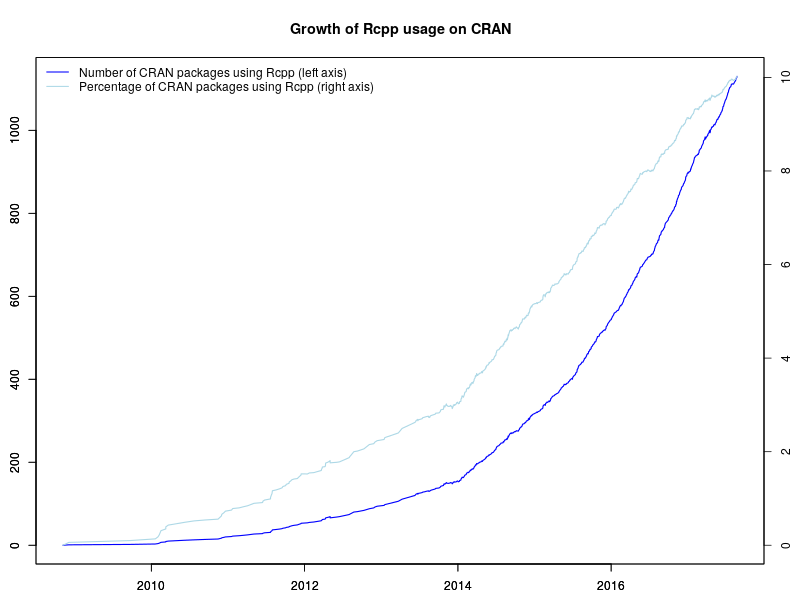
10 percent of CRAN packages Over the last few days, Rcpp passed another noteworthy hurdle. It is now used by over 10 percent of packages on CRAN (as measured by Depends, Imports and LinkingTo, but excluding Suggests). As of this morning 1130 packages use Rcpp out of a total of 11275 packages. The graph on the left shows the growth of both outright usage numbers (in darker blue, left axis) and relative usage (in lighter blue, right axis). Older posts on this blog took note when Rcpp passed round hundreds of packages, most recently in April for 1000 packages. The growth rates for both Rcpp, and of course CRAN, are still staggering. A big thank you to everybody who makes this happen, from R Core and CRAN to all package developers, contributors, and of course all users driving this. We have built ourselves a rather impressive ecosystem. So with that a heartfelt Thank You! to all users and contributors of R, CRAN, and of course Rcpp, for help, suggestions, bug reports, documentation, encouragement, and, of course, code.

This post by Dirk Eddelbuettel originated on his Thinking inside the box blog. Please report excessive re-aggregation in third-party for-profit settings.

20 August 2017

Dirk Eddelbuettel: RcppArmadillo 0.7.960.1.1

armadillo image On the heels of the very recent bi-monthly RcppArmadillo release comes a quick bug-fix release 0.7.960.1.1 which just got onto CRAN (and I will ship a build to Debian in a moment). There were three distinct issues I addressed in three quick pull requests: Armadillo is a powerful and expressive C++ template library for linear algebra aiming towards a good balance between speed and ease of use with a syntax deliberately close to a Matlab. RcppArmadillo integrates this library with the R environment and language--and is widely used by (currently) 382 other packages on CRAN---an increase of 52 since the CRAN release in June! Changes in this release relative to the previous CRAN release are as follows:

Changes in RcppArmadillo version 0.7.960.1.1 (2017-08-20)
  • Added improved check for inherited S4 matrix classes (#162 fixing #161)
  • Changed fastLm C++ function to fastLm_impl to not clash with R method (#164 fixing #163)
  • Added OpenMP check for configure (#166 fixing #165)

Courtesy of CRANberries, there is a diffstat report. More detailed information is on the RcppArmadillo page. Questions, comments etc should go to the rcpp-devel mailing list off the R-Forge page.

This post by Dirk Eddelbuettel originated on his Thinking inside the box blog. Please report excessive re-aggregation in third-party for-profit settings.

Joachim Breitner: Compose Conference talk video online

Three months ago, I gave a talk at the Compose::Conference in New York about how Chris Smith and I added the ability to create networked multi-user programs to the educational Haskell programming environment CodeWorld, and finally the recording of the talk is available on YouTube (and is being discussed on reddit): It was the talk where I got the most positive feedback afterwards, and I think this is partly due to how I created the presentation: Instead of showing static slides, I programmed the complete visual display from scratch as an interaction within the CodeWorld environment, including all transitions, an working embedded game of Pong and a simulated multi-player environments with adjustable message delays. I have put the code for the presentation online. Chris and I have written about this for ICFP'17, and thanks to open access I can actually share the paper freely with you and under a CC license. If you come to Oxford you can see me perform a shorter version of this talk again.
Dirk Eddelbuettel: #10: Compacting your Shared Libraries, After The Build

Welcome to the tenth post in the rarely ranting R recommendations series, or R4 for short. A few days ago we showed how to tell the linker to strip shared libraries. As discussed in the post, there are two options. One can either set up ~/.R/Makevars by passing the strip-debug option to the linker. Alternatively, one can adjust src/Makevars in the package itself with a bit a Makefile magic. Of course, there is a third way: just run strip --strip-debug over all the shared libraries after the build. As the path is standardized, and the shell does proper globbing, we can just do
$ strip --strip-debug /usr/local/lib/R/site-library/*/libs/*.so
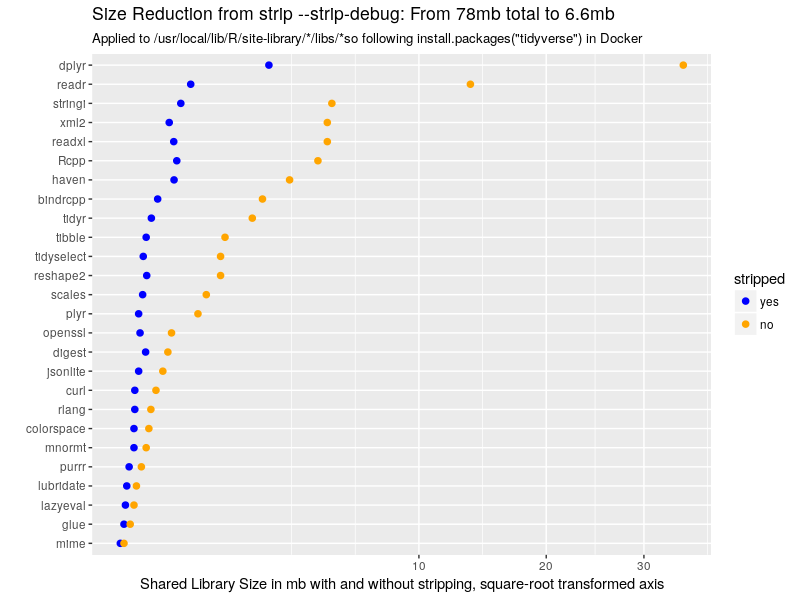
using a double-wildcard to get all packages (in that R package directory) and all their shared libraries. Users on macOS probably want .dylib on the end, users on Windows want another computer as usual (just kidding: use .dll). Either may have to adjust the path which is left as an exercise to the reader. The impact can be Yuge as illustrated in the following dotplot:
This illustration is in response to a mailing list post. Last week, someone claimed on r-help that tidyverse would not install on Ubuntu 17.04. And this is of course patently false as many of us build and test on Ubuntu and related Linux systems, Travis runs on it, CRAN tests them etc pp. That poor user had somehow messed up their default gcc version. Anyway: I fired up a Docker container, installed r-base-core plus three required -dev packages (for xml2, openssl, and curl) and ran a single install.packages("tidyverse"). In a nutshell, following the launch of Docker for an Ubuntu 17.04 container, it was just
$ apt-get update
$ apt-get install r-base libcurl4-openssl-dev libssl-dev libxml2-dev
$ apt-get install mg          # a tiny editor
$ mg /etc/R/Rprofile.site     # to add a default CRAN repo
$ R -e 'install.packages("tidyverse")'
which not only worked (as expected) but also installed a whopping fifty-one packages (!!) of which twenty-six contain a shared library. A useful little trick is to run du with proper options to total, summarize, and use human units which reveals that these libraries occupy seventy-eight megabytes:
root@de443801b3fc:/# du -csh /usr/local/lib/R/site-library/*/libs/*so
4.3M    /usr/local/lib/R/site-library/Rcpp/libs/Rcpp.so
2.3M    /usr/local/lib/R/site-library/bindrcpp/libs/bindrcpp.so
144K    /usr/local/lib/R/site-library/colorspace/libs/colorspace.so
204K    /usr/local/lib/R/site-library/curl/libs/curl.so
328K    /usr/local/lib/R/site-library/digest/libs/digest.so
33M     /usr/local/lib/R/site-library/dplyr/libs/dplyr.so
36K     /usr/local/lib/R/site-library/glue/libs/glue.so
3.2M    /usr/local/lib/R/site-library/haven/libs/haven.so
272K    /usr/local/lib/R/site-library/jsonlite/libs/jsonlite.so
52K     /usr/local/lib/R/site-library/lazyeval/libs/lazyeval.so
64K     /usr/local/lib/R/site-library/lubridate/libs/lubridate.so
16K     /usr/local/lib/R/site-library/mime/libs/mime.so
124K    /usr/local/lib/R/site-library/mnormt/libs/mnormt.so
372K    /usr/local/lib/R/site-library/openssl/libs/openssl.so
772K    /usr/local/lib/R/site-library/plyr/libs/plyr.so
92K     /usr/local/lib/R/site-library/purrr/libs/purrr.so
13M     /usr/local/lib/R/site-library/readr/libs/readr.so
4.7M    /usr/local/lib/R/site-library/readxl/libs/readxl.so
1.2M    /usr/local/lib/R/site-library/reshape2/libs/reshape2.so
160K    /usr/local/lib/R/site-library/rlang/libs/rlang.so
928K    /usr/local/lib/R/site-library/scales/libs/scales.so
4.9M    /usr/local/lib/R/site-library/stringi/libs/stringi.so
1.3M    /usr/local/lib/R/site-library/tibble/libs/tibble.so
2.0M    /usr/local/lib/R/site-library/tidyr/libs/tidyr.so
1.2M    /usr/local/lib/R/site-library/tidyselect/libs/tidyselect.so
4.7M    /usr/local/lib/R/site-library/xml2/libs/xml2.so
78M     total
root@de443801b3fc:/# 
Looks like dplyr wins this one at thirty-three megabytes just for its shared library. But with a single stroke of strip we can reduce all this down a lot:
root@de443801b3fc:/# strip --strip-debug /usr/local/lib/R/site-library/*/libs/*so
root@de443801b3fc:/# du -csh /usr/local/lib/R/site-library/*/libs/*so
440K    /usr/local/lib/R/site-library/Rcpp/libs/Rcpp.so
220K    /usr/local/lib/R/site-library/bindrcpp/libs/bindrcpp.so
52K     /usr/local/lib/R/site-library/colorspace/libs/colorspace.so
56K     /usr/local/lib/R/site-library/curl/libs/curl.so
120K    /usr/local/lib/R/site-library/digest/libs/digest.so
2.5M    /usr/local/lib/R/site-library/dplyr/libs/dplyr.so
16K     /usr/local/lib/R/site-library/glue/libs/glue.so
404K    /usr/local/lib/R/site-library/haven/libs/haven.so
76K     /usr/local/lib/R/site-library/jsonlite/libs/jsonlite.so
20K     /usr/local/lib/R/site-library/lazyeval/libs/lazyeval.so
24K     /usr/local/lib/R/site-library/lubridate/libs/lubridate.so
8.0K    /usr/local/lib/R/site-library/mime/libs/mime.so
52K     /usr/local/lib/R/site-library/mnormt/libs/mnormt.so
84K     /usr/local/lib/R/site-library/openssl/libs/openssl.so
76K     /usr/local/lib/R/site-library/plyr/libs/plyr.so
32K     /usr/local/lib/R/site-library/purrr/libs/purrr.so
648K    /usr/local/lib/R/site-library/readr/libs/readr.so
400K    /usr/local/lib/R/site-library/readxl/libs/readxl.so
128K    /usr/local/lib/R/site-library/reshape2/libs/reshape2.so
56K     /usr/local/lib/R/site-library/rlang/libs/rlang.so
100K    /usr/local/lib/R/site-library/scales/libs/scales.so
496K    /usr/local/lib/R/site-library/stringi/libs/stringi.so
124K    /usr/local/lib/R/site-library/tibble/libs/tibble.so
164K    /usr/local/lib/R/site-library/tidyr/libs/tidyr.so
104K    /usr/local/lib/R/site-library/tidyselect/libs/tidyselect.so
344K    /usr/local/lib/R/site-library/xml2/libs/xml2.so
6.6M    total
root@de443801b3fc:/#
Down to six point six megabytes. Not bad for one command. The chart visualizes the respective reductions. Clearly, C++ packages (and their template use) lead to more debugging symbols than plain old C code. But once stripped, the size differences are not that large. And just to be plain, what we showed previously in post #9 does the same, only already at installation stage. The effects are not cumulative.

This post by Dirk Eddelbuettel originated on his Thinking inside the box blog. Please report excessive re-aggregation in third-party for-profit settings.

18 August 2017

Dirk Eddelbuettel: RcppArmadillo 0.7.960.1.0

armadillo image The bi-monthly RcppArmadillo release is out with a new version 0.7.960.1.0 which is now on CRAN, and will get to Debian in due course. And it is a big one. Lots of nice upstream changes from Armadillo, and lots of work on our end as the Google Summer of Code project by Binxiang Ni, plus a few smaller enhancements -- see below for details. Armadillo is a powerful and expressive C++ template library for linear algebra aiming towards a good balance between speed and ease of use with a syntax deliberately close to a Matlab. RcppArmadillo integrates this library with the R environment and language--and is widely used by (currently) 379 other packages on CRAN---an increase of 49 since the last CRAN release in June! Changes in this release relative to the previous CRAN release are as follows:

Changes in RcppArmadillo version 0.7.960.1.0 (2017-08-11)
  • Upgraded to Armadillo release 7.960.1 (Northern Banana Republic Deluxe)
    • faster randn() when using OpenMP (NB: usually omitted when used fromR)
    • faster gmm_diag class, for Gaussian mixture models with diagonal covariance matrices
    • added .sum_log_p() to the gmm_diag class
    • added gmm_full class, for Gaussian mixture models with full covariance matrices
    • expanded .each_slice() to optionally use OpenMP for multi-threaded execution
  • Upgraded to Armadillo release 7.950.0 (Northern Banana Republic)
    • expanded accu() and sum() to use OpenMP for processing expressions with computationally expensive element-wise functions
    • expanded trimatu() and trimatl() to allow specification of the diagonal which delineates the boundary of the triangular part
  • Enhanced support for sparse matrices (Binxiang Ni as part of Google Summer of Code 2017)
    • Add support for dtCMatrix and dsCMatrix (#135)
    • Add conversion and unit tests for dgT, dtT and dsTMatrix (#136)
    • Add conversion and unit tests for dgR, dtR and dsRMatrix (#139)
    • Add conversion and unit tests for pMatrix and ddiMatrix (#140)
    • Rewrite conversion for dgT, dtT and dsTMatrix, and add file-based tests (#142)
    • Add conversion and unit tests for indMatrix (#144)
    • Rewrite conversion for ddiMatrix (#145)
    • Add a warning message for matrices that cannot be converted (#147)
    • Add new vignette for sparse matrix support (#152; Dirk in #153)
    • Add support for sparse matrix conversion from Python SciPy (#158 addressing #141)
  • Optional return of row or column vectors in collapsed form if appropriate #define is set (Serguei Sokol in #151 and #154)
  • Correct speye() for non-symmetric cases (Qiang Kou in #150 closing #149).
  • Ensure tests using Scientific Python and reticulate are properly conditioned on the packages being present.
  • Added .aspell/ directory with small local directory now supported by R-devel.

Courtesy of CRANberries, there is a diffstat report. More detailed information is on the RcppArmadillo page. Questions, comments etc should go to the rcpp-devel mailing list off the R-Forge page.

This post by Dirk Eddelbuettel originated on his Thinking inside the box blog. Please report excessive re-aggregation in third-party for-profit settings.

Next.

Previous.