Search Results: "beh"

25 January 2017

Martin-Éric Racine: OpenWRT Backfire on WRT54GL signal strenght

Because I wanted my home router to use at least decently supported software that provides complete out-of-the-box support for native IPv6, I recently got around upgrading my WRT54GL's firmware from White Russian to Backfire, which is the most recent OpenWRT release that fits the hardware's limited amount of flash memory.

One issue remains unanswered:

In GNOME shell's top panel and WiFi menu, the signal strength remains at 2 out of 4 bars. Given how the router sits only a few meters behind me, I would have expected much better signal strength than that.

Would anyone happen to know how to improve on these results? Thanks!

23 January 2017

Sam Hartman: Cudos to GDB Contributors

I recently diagnosed a problem in Debian's pam-p11 package. This package allegedly permits logging into a computer using a smart card or USB security token containing an ssh key. If you know the PIN and have the token, then your login attempt is authorized against the ssh authorized keys file. This seems like a great way to permit console logins as root to machines without having a shared password. Unfortunately, the package didn't work very well for me. It worked once, then all future attempts to use it segfaulted. I'm familiar with how PAM works. I understand the basic ideas behind PKCS11 (the API used for this type of smart card), but was completely unfamiliar with this particular PAM module and the PKCS11 library it used. The segfault was in an area of code I didn't even expect that this PAM module would ever call. Back in 1994, that would have been a painful slog. Gdb has improved significantly since then, and I'd really like to thank all the people over the years who made that possible. I was able to isolate the problem in just a couple of hours of debugging. Here are some of the cool features I used: Anyway, with just a couple of hours and no instrumentation of the code, I managed to track down how a bunch of structures were being freed as an unexpected side effect of one of the function calls. Neither I nor the author of the pam-p11 module expected that (although it is documented and does make sense in retrospect). Good tools make life easier.

19 January 2017

Matthew Garrett: Android apps, IMEIs and privacy

There's been a sudden wave of people concerned about the Meitu selfie app's use of unique phone IDs. Here's what we know: the app will transmit your phone's IMEI (a unique per-phone identifier that can't be altered under normal circumstances) to servers in China. It's able to obtain this value because it asks for a permission called READ_PHONE_STATE, which (if granted) means that the app can obtain various bits of information about your phone including those unique IDs and whether you're currently on a call.

Why would anybody want these IDs? The simple answer is that app authors mostly make money by selling advertising, and advertisers like to know who's seeing their advertisements. The more app views they can tie to a single individual, the more they can track that user's response to different kinds of adverts and the more targeted (and, they hope, more profitable) the advertising towards that user. Using the same ID between multiple apps makes this easier, and so using a device-level ID rather than an app-level one is preferred. The IMEI is the most stable ID on Android devices, persisting even across factory resets.

The downside of using a device-level ID is, well, whoever has that data knows a lot about what you're running. That lets them tailor adverts to your tastes, but there are certainly circumstances where that could be embarrassing or even compromising. Using the IMEI for this is even worse, since it's also used for fundamental telephony functions - for instance, when a phone is reported stolen, its IMEI is added to a blacklist and networks will refuse to allow it to join. A sufficiently malicious person could potentially report your phone stolen and get it blocked by providing your IMEI. And phone networks are obviously able to track devices using them, so someone with enough access could figure out who you are from your app usage and then track you via your IMEI. But realistically, anyone with that level of access to the phone network could just identify you via other means. There's no reason to believe that this is part of a nefarious Chinese plot.

Is there anything you can do about this? On Android 6 and later, yes. Go to settings, hit apps, hit the gear menu in the top right, choose "App permissions" and scroll down to phone. Under there you'll see all apps that have permission to obtain this information, and you can turn them off. Doing so may cause some apps to crash or otherwise misbehave, whereas newer apps may simply ask for you to grant the permission again and refuse to do so if you don't.

Meitu isn't especially rare in this respect. Over 50% of the Android apps I have handy request your IMEI, although I haven't tracked what they all do with it. It's certainly something to be concerned about, but Meitu isn't especially rare here - there are big-name apps that do exactly the same thing. There's a legitimate question over whether Android should be making it so easy for apps to obtain this level of identifying information without more explicit informed consent from the user, but until Google do anything to make it more difficult, apps will continue making use of this information. Let's turn this into a conversation about user privacy online rather than blaming one specific example.

comment count unavailable comments

17 January 2017

Ritesh Raj Sarraf: Linux Tablet-Mode Usability

In my ongoing quest to get Tablet-Mode working on my Hybrid machine, here's how I've been living with it so far. My intent is to continue using Free Software for both use cases. My wishful thought is to use the same software under both use cases.
  • Browser: On the browser front, things are pretty decent. Chromium has good support for Touchscreen input. Most of the Touchscreen use cases work well with Chromium. On the Firefox side, after a huge delay, finally, Firefox seems to be catching up. Hopefully, with Firefox 51/52, we'll have a much more usable Touchscreen browser.
  • Desktop Shell: One of the reason of migrating to GNOME was its touch support. From what I've explored so far, GNOME is the only desktop shell that has touch support natively done. The feature isn't complete yet, but is fairly well usable.
    • Given that GNOME has touchscreen support native, it is obvious to be using GNOME equivalent of tools for common use cases. Most of these tools inherit the touchscreen capabilities from the underneath GNOME libraries.
    • File Manager: Nautilus has decent support for touch, as a file manager. The only annoying bit is a right-click equivalent. Or in touch input sense, a long-press.
    • Movie Player: There's a decent movie player, based on GNOME libs; GNOME MPV. In my limited use so far, this interface seems to have good support. Other contenders are:
      • SMPlayer is based on Qt libs. So initial expectation would be that Qt based apps would have better Touch support. But I'm yet to see any serious Qt application with Touch input support. Back to SMPlayer, the dev is pragmatic enough to recognize tablet-mode users and as such has provided a so called "Tablet Mode" view for SMPlayer (The tooltip did not get captured in the screenshot).
      • MPV doesn't come with a UI but has basic management with OSD. And in my limited usage, the OSD implementation does seem capable to take touch input.
  • Books / Documents: GNOME Documents/Books is very basic in what it has to offer, to the point that it is not much useful. But since it is based on the same GNOME libraries, it enjoys native touch input support. Calibre, on the other hand, is feature rich. But it is based on (Py)Qt. Touch input is told to work for Windows. For Linux, there's no support yet. The good thing about Calibre is that it has its own UI, which is pretty decent in a Tablet-Mode Touch workflow.
  • Photo Management: With compact digital devices commonly available, digital content (Both Photos and Videos) is on the rise. The most obvious names that come to mind are Digikam and Shotwell.
    • Shotwell saw its reincarnation in the recent past. From what I recollect, it does have touch support but was lacking quite a bit in terms of features, as compared to Digikam.
    • Digikam is an impressive tool for digital content management. While Digikam is a KDE project, thankfully it does a great job in keeping its KDE dependencies to a bare minimum. But given that Digikam builds on KDE/Qt libs, I haven't had any much success in getting a good touch input solution for Tablet Mode. To make it barely usable in Table-Mode, one could choose a theme preference with bigger toolbars, labels and scrollbars. This helps in making a touch input workaround use case. As you can see, I've configured the Digikam UI with Text alongside Icons for easy touch input.
  • Email: The most common use case. With Gmail and friends, many believe standalone email clients are no more a need. But there always are users like us who prefer emails offline, encrypted emails and prefer theis own email domains. Many of these are still doable with free services like Gmail, but still.
    • Thunderbird shows its age at times. And given the state of Firefox in getting touch support (and GTK3 port), I see nothing happening with TB.
    • KMail was something I discontinued while still being on KDE. The debacle that KDEPIM was, is something I'd always avoid, in the future. Complete waste of time/resource in building, testing, reporting and follow-ups.
    • Geary is another email client that recently saw its reincarnation. I recently had explored Geary. It enjoys similar benefits like the rest applications using GNOME libraries. There was one touch input bug I found, but otherwise Geary's featureset was limited in comparison to Evolution.
    • Migration to Evolution, when migrating to GNOME, was not easy. GNOME's philosophy is to keep things simple and limited. In doing that, they restrict possible flexibilities that users may find obvious. This design philosophy is easily visible across all applications of the GNOME family. Evolution is no different. Hence, coming from TB to E was a small unlearning + newLearning curve. And since Evolution is using the same GNOME libraries, it enjoys similar benefits. Touch input support in Evolution is fairly good. The missing bit is the new Toolbar and Menu structure that many have noticed in the newer GNOME applications (Photos, Documents, Nautilus etc). If only Evolution (and the GNOME family) had the option of customization beyond the developer/project's view, there wouldn't be any wishful thoughts.
      • Above is a screenshot of 2 windows of Evoluiton. In its current form too, Evolution is a gem at times. For my RSS feeds, they are stored in a VFolder in Evolution, so that I can read them when offline. RSS feeds are something I read up in Tablet-mode. On the right is an Evolution window with larger fonts, while on the left, Evoltuion still retains its default font size. This current behavior helps me get Table-Mode Touch working to an extent. In my wishful thoughts, I wish if Evolution provided flexibility to change Toolbar icon sizes. That'd really help easily touch the delete button when in Tablet Mode. A simple button, Tablet Mode, like what SMPlayer has done, would keep users sticky with Evolution.
My wishful thought is that people write (free) software, thinking more about usability across toolkits and desktop environments. Otherwise, the year of the Linux desktop, laptop, tablet; in my opinion, is yet to come. And please don't rip apart tools, in porting them to newer versions of the toolkits. When you rip a tool, you also rip all its QA, Bug Reporting and Testing, that was done over the years. Here's an example of a tool (Goldendict), so well written. Written in Qt, Running under GNOME, and serving over the Chromium interface. In this whole exercise of getting a hybrid working setup, I also came to realize that there does not seem to be a standardized interface, yet, to determine the current operating mode of a running hybrid machine. From what we explored so far, every product has its own way to doing it. Most hybrids come pre-installed and supported with Windows only. So, their mode detection logic seems to be proprietary too. In case anyone is awaer of a standard interface, please drop a note in the comments.

Categories:

Keywords:

Like:

14 January 2017

Mike Gabriel: UIF bug: Caused by flawed IPv6 DNS resolving in Perl's NetAddr::IP

TL;DR; If you use NetAddr::IP->new6() for resolving DNS names to IPv6 addresses, the addresses returned by NetAddr::IP are not what you might expect. See below for details. Issue #2 in UIF Over the last couple of days, I tried to figure out the cause of a weird issue observed in UIF (Universal Internet Firewall [1], a nice Perl tool for setting up ip(6)tables based Firewalls). Already a long time ago, I stumbled over a weird DNS resolving issue of DNS names to IPv6 addresses in UIF that I reported as issue #2 [2] against upstream UIF back then. I happen to be co-author of UIF. So, I felt very ashamed all the time for not fixing the issue any sooner. As many of us DDs try to get our packages into shape before the next Debian release these days, I find myself doing the same. I started investigating the underlying cause of issue #2 in UIF a couple of days ago. Issue #119858 on CPAN Today, I figured out that the Perl code in UIF is not causing the observed phenomenon. The same behaviour is reproducible with a minimal and pure NetAddr::IP based Perl script (reported as Debian bug #851388 [2]. Thanks to Gregor Herrmann for forwarding Debian bug upstream (#119858 [3]). Here is the example script that shows the flawed behaviour:
#!/usr/bin/perl
use NetAddr::IP;
my $hostname = "google-public-dns-a.google.com";
my $ip6 = NetAddr::IP->new6($hostname);
my $ip4 = NetAddr::IP->new($hostname);
print "$ip6 <- WTF???\n";
print "$ip4\n";
exit(0);
... gives...
[mike@minobo ~]$ ./netaddr-ip_resolv-ipv6.pl
0:0:0:0:0:0:808:808/128 <- WTF???
8.8.8.8/32
In words... So what happens in NetAddr::IP is that with the new6() "constructor" you initialize a new IPv6 address. If the address is a DNS name, NetAddr::IP internally resolves it into an IPv4 address and converts this IPv4 address into some IPv6'ish format. This bogus IPv6 address is not the one matching the given DNS name. Impacted Software in Debian Various Debian packages use NetAddr::IP and may be affected by this flaw, here is an incomplete list (use apt-rdepends -r libnetaddr-ip-perl for the complete list): Any of the above packages could be affected if NetAddr::IP->new6(<dnsname>) is being used. I haven't checked any of the code bases, but possibly the corresponding maintainers may want to do that. References light+love
Mike

Russ Allbery: Review: Enchanters' End Game

Review: Enchanters' End Game, by David Eddings
Series: The Belgariad #5
Publisher: Del Rey
Copyright: December 1984
Printing: February 1990
ISBN: 0-345-33871-5
Format: Mass market
Pages: 372
And, finally, the conclusion towards which everything has been heading, and the events for which Castle of Wizardry was the preparation. (This is therefore obviously not the place to start with this series.) Does it live up to all the foreshadowing and provide a satisfactory conclusion? I'd say mostly. The theology is a bit thin, but Eddings does a solid job of bringing all the plot threads together and giving each of the large cast a moment to shine. Enchanters' End Game (I have always been weirdly annoyed by that clunky apostrophe) starts with more of Garion and Belgarath, and, similar to the end of Castle of Wizardry, this feels like them rolling on the random encounter table. There is a fairly important bit with Nadraks at the start, but the remaining detour to the north is a mostly unrelated bit of world-building. Before this re-read, I didn't remember how extensive the Nadrak parts of this story were; in retrospect, I realize a lot of what I was remembering is in the Mallorean instead. I'll therefore save my commentary on Nadrak gender roles for an eventual Mallorean re-read, since there's quite a lot to dig through and much of it is based on information not available here. After this section, though, the story leaves Garion, Belgarath, and Silk for nearly the entire book, returning to them only for the climax. Most of this book is about Ce'Nedra, the queens and kings of the west, and what they're doing while Garion and his small party are carrying the Ring into Mordor er, you know what I mean. And this long section is surprisingly good. We first get to see the various queens of the west doing extremely well managing the kingdoms while the kings are away (see my previous note about how Eddings does examine his stereotypes), albeit partly by mercilessly exploiting the sexism of their societies. The story then picks up with Ce'Nedra and company, including all of the rest of Garion's band, being their snarky and varied selves. There are some fairly satisfying set pieces, some battle tactics, some magical tactics, and a good bit of snarking and interplay between characters who feel like old friends by this point (mostly because of Eddings's simple, broad-strokes characterization). And Ce'Nedra is surprisingly good here. I would say that she's grown up after the events of the last book, but sadly she reverts to being awful in the aftermath. But for the main section of the book, partly because she's busy with other things, she's a reasonable character who experiences some actual consequences and some real remorse from one bad decision she makes. She's even admirable in how she handles events leading up to the climax of the book. Eddings does a good job showing every character in their best light, putting quite a lot of suspense (and some dramatic rescues) into this final volume, and providing a final battle that's moderately interesting. I'm not sure I entirely bought the theological ramifications of the conclusion (the bits with Polgara do not support thinking about too deeply), but the voice in Garion's head continues to be one of the better characters of the series. And Errand is a delight. After the climax, the aftermath sadly returns to Eddings's weird war between the sexes presentation of all gender relationships in this series, and it left me with a bit of a bad taste in my mouth. (There is absolutely no way that some of these relationships would survive in reality.) Eddings portrays nearly every woman as a manipulative schemer, sometimes for good and sometimes for evil, and there is just so much gender stereotyping throughout this book for both women and men. You can tell he's trying with the queens, but women are still only allowed to be successful at politics and war within a very specific frame. Even Polgara gets a bit of the gender stereotyping, although she remains mostly an exception (and one aspect of the ending is much better than it could have been). Ah well. One does not (or at least probably should not) read this series without being aware that it has some flaws. But it has a strange charm as well, mostly from its irreverence. The dry wise-cracking of these characters rings more true to me than the epic seriousness of a lot of fantasy. This is how people behave under stress, and this is how quirky people who know each other extremely well interact. It also keeps one turning the pages quite effectively. I stayed up for several late nights finishing it, and was never tempted to put it down and stop reading. This is not great literature, but it's still fun. It wouldn't sustain regular re-reading for me, but a re-read after twenty years or so was pretty much exactly the experience I was hoping for: an unchallenging, optimistic story with amusing characters and a guaranteed happy ending. There's a place for that. Followed, in a series sense, by the Mallorean, the first book of which is The Guardians of the West. But this is a strictly optional continuation; the Belgariad comes to a definite end here. Rating: 7 out of 10

Sven Hoexter: moto g falcon reactivation and exodus mod

I started to reactivate my old moto g falcon during the last days of CyanogenMod in December of 2016. First step was a recovery update to TWRP 3.0.2-2 so I was able to flash CM13/14 builds. While CM14 nightly builds did not boot at all the CM13 builds did, but up to the last build wifi connections to the internet did not work. I could actually register with my wifi (Archer C7 running OpenWRT) but all apps claim the internet connection check failed and I'm offline. So bummer, without wifi a smartphone is not much fun. I was pretty sure that wifi worked when I last used that phone about 1.5 years ago with CM11/12, so I started to dive into the forums of xda-developers to look for alternatives. Here I found out about Exodus. I've a bit of trouble trusting stuff from xda-developer forums but what the hell, the phone is empty anyway so nothing to loose and I flashed the latest falcon build. To flash it I had to clean the whole phone, format all partitions via TWRP and then sideloaded the zip image file via adb (adb from the Debian/stretch adb package works like a charm, thank you guys!). Booted and b m wifi works again! Now Exodus is a really striped down mod, to do anything useful with it I had to activate the developer options and allow USB debugging. Afterwards I could install the f-droid and Opera apk via "adb install foo.apk". Lineage OS As I could derive from another thread on xda-developers Lineage OS has the falcon still on the shortlist for 14.x nightly builds. Maybe that will be an alternative again in the future. For now Exodus is a bit behind the curve (based on Android 6.0.1 from September 2016) but at least it's functional.

10 January 2017

Vincent Fourmond: Version 2.1 of QSoas is out

I have just released QSoas version 2.1. It brings in a new solve command to solve arbitrary non-linear equations of one unknown. I took advantage of this command in the figure to solve the equation for . It also provides a new way to reparametrize fits using the reparametrize-fit command, a new series of fits to model the behaviour of an adsorbed 1- or 2-electrons catalyst on an electrode (these fits are discussed in great details in our recent review (DOI: 10.1016/j.coelec.2016.11.002), improvements in various commands, the possibility to now compile using Ruby 2.3 and the most recent version of the GSL library, and sketches for an emacs major mode, which you can activate (for QSoas script files, ending in .cmds) using the following snippet in $HOME/.emacs:

(autoload 'qsoas-mode "$HOME/Prog/QSoas/misc/qsoas-mode.el" nil t)
(add-to-list 'auto-mode-alist '("\\.cmds$" . qsoas-mode))

Of course, you'll have to adapt the path $HOME/Prog/QSoas/misc/qsoas-mode.el to the actual location of qsoas-mode.el.As before, you can download the source code from our website, and purchase the pre-built binaries following the links from that page too. Enjoy !

9 January 2017

Petter Reinholdtsen: Where did that package go? geolocated IP traceroute

Did you ever wonder where the web trafic really flow to reach the web servers, and who own the network equipment it is flowing through? It is possible to get a glimpse of this from using traceroute, but it is hard to find all the details. Many years ago, I wrote a system to map the Norwegian Internet (trying to figure out if our plans for a network game service would get low enough latency, and who we needed to talk to about setting up game servers close to the users. Back then I used traceroute output from many locations (I asked my friends to run a script and send me their traceroute output) to create the graph and the map. The output from traceroute typically look like this:
traceroute to www.stortinget.no (85.88.67.10), 30 hops max, 60 byte packets
 1  uio-gw10.uio.no (129.240.202.1)  0.447 ms  0.486 ms  0.621 ms
 2  uio-gw8.uio.no (129.240.24.229)  0.467 ms  0.578 ms  0.675 ms
 3  oslo-gw1.uninett.no (128.39.65.17)  0.385 ms  0.373 ms  0.358 ms
 4  te3-1-2.br1.fn3.as2116.net (193.156.90.3)  1.174 ms  1.172 ms  1.153 ms
 5  he16-1-1.cr1.san110.as2116.net (195.0.244.234)  2.627 ms he16-1-1.cr2.oslosda310.as2116.net (195.0.244.48)  3.172 ms he16-1-1.cr1.san110.as2116.net (195.0.244.234)  2.857 ms
 6  ae1.ar8.oslosda310.as2116.net (195.0.242.39)  0.662 ms  0.637 ms ae0.ar8.oslosda310.as2116.net (195.0.242.23)  0.622 ms
 7  89.191.10.146 (89.191.10.146)  0.931 ms  0.917 ms  0.955 ms
 8  * * *
 9  * * *
[...]
This show the DNS names and IP addresses of (at least some of the) network equipment involved in getting the data traffic from me to the www.stortinget.no server, and how long it took in milliseconds for a package to reach the equipment and return to me. Three packages are sent, and some times the packages do not follow the same path. This is shown for hop 5, where three different IP addresses replied to the traceroute request. There are many ways to measure trace routes. Other good traceroute implementations I use are traceroute (using ICMP packages) mtr (can do both ICMP, UDP and TCP) and scapy (python library with ICMP, UDP, TCP traceroute and a lot of other capabilities). All of them are easily available in Debian. This time around, I wanted to know the geographic location of different route points, to visualize how visiting a web page spread information about the visit to a lot of servers around the globe. The background is that a web site today often will ask the browser to get from many servers the parts (for example HTML, JSON, fonts, JavaScript, CSS, video) required to display the content. This will leak information about the visit to those controlling these servers and anyone able to peek at the data traffic passing by (like your ISP, the ISPs backbone provider, FRA, GCHQ, NSA and others). Lets pick an example, the Norwegian parliament web site www.stortinget.no. It is read daily by all members of parliament and their staff, as well as political journalists, activits and many other citizens of Norway. A visit to the www.stortinget.no web site will ask your browser to contact 8 other servers: ajax.googleapis.com, insights.hotjar.com, script.hotjar.com, static.hotjar.com, stats.g.doubleclick.net, www.google-analytics.com, www.googletagmanager.com and www.netigate.se. I extracted this by asking PhantomJS to visit the Stortinget web page and tell me all the URLs PhantomJS downloaded to render the page (in HAR format using their netsniff example. I am very grateful to Gorm for showing me how to do this). My goal is to visualize network traces to all IP addresses behind these DNS names, do show where visitors personal information is spread when visiting the page.

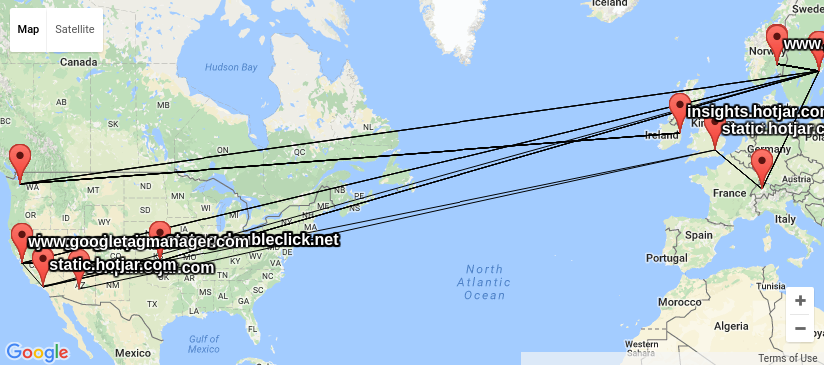
map of combined traces for URLs used by www.stortinget.no using GeoIP When I had a look around for options, I could not find any good free software tools to do this, and decided I needed my own traceroute wrapper outputting KML based on locations looked up using GeoIP. KML is easy to work with and easy to generate, and understood by several of the GIS tools I have available. I got good help from by NUUG colleague Anders Einar with this, and the result can be seen in my kmltraceroute git repository. Unfortunately, the quality of the free GeoIP databases I could find (and the for-pay databases my friends had access to) is not up to the task. The IP addresses of central Internet infrastructure would typically be placed near the controlling companies main office, and not where the router is really located, as you can see from the KML file I created using the GeoLite City dataset from MaxMind.

scapy traceroute graph for URLs used by www.stortinget.no I also had a look at the visual traceroute graph created by the scrapy project, showing IP network ownership (aka AS owner) for the IP address in question. The graph display a lot of useful information about the traceroute in SVG format, and give a good indication on who control the network equipment involved, but it do not include geolocation. This graph make it possible to see the information is made available at least for UNINETT, Catchcom, Stortinget, Nordunet, Google, Amazon, Telia, Level 3 Communications and NetDNA.

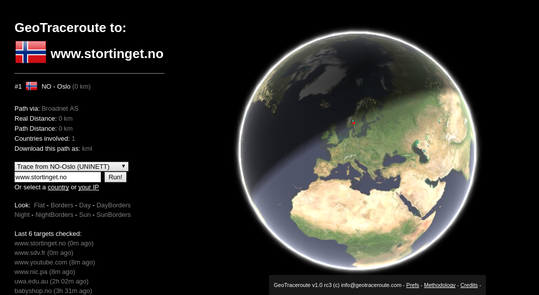
example geotraceroute view for www.stortinget.no In the process, I came across the web service GeoTraceroute by Salim Gasmi. Its methology of combining guesses based on DNS names, various location databases and finally use latecy times to rule out candidate locations seemed to do a very good job of guessing correct geolocation. But it could only do one trace at the time, did not have a sensor in Norway and did not make the geolocations easily available for postprocessing. So I contacted the developer and asked if he would be willing to share the code (he refused until he had time to clean it up), but he was interested in providing the geolocations in a machine readable format, and willing to set up a sensor in Norway. So since yesterday, it is possible to run traces from Norway in this service thanks to a sensor node set up by the NUUG assosiation, and get the trace in KML format for further processing.

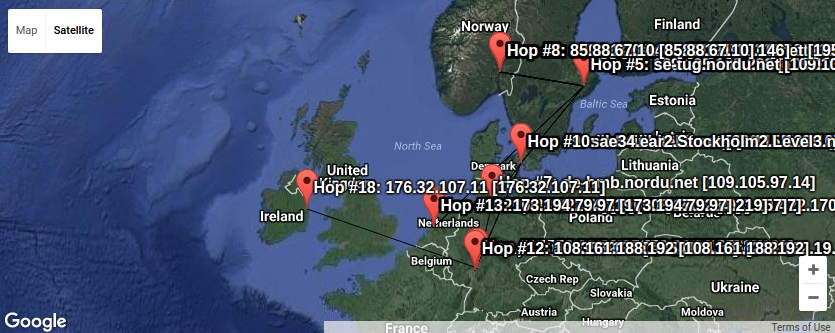
map of combined traces for URLs used by www.stortinget.no using geotraceroute Here we can see a lot of trafic passes Sweden on its way to Denmark, Germany, Holland and Ireland. Plenty of places where the Snowden confirmations verified the traffic is read by various actors without your best interest as their top priority. Combining KML files is trivial using a text editor, so I could loop over all the hosts behind the urls imported by www.stortinget.no and ask for the KML file from GeoTraceroute, and create a combined KML file with all the traces (unfortunately only one of the IP addresses behind the DNS name is traced this time. To get them all, one would have to request traces using IP number instead of DNS names from GeoTraceroute). That might be the next step in this project. Armed with these tools, I find it a lot easier to figure out where the IP traffic moves and who control the boxes involved in moving it. And every time the link crosses for example the Swedish border, we can be sure Swedish Signal Intelligence (FRA) is listening, as GCHQ do in Britain and NSA in USA and cables around the globe. (Hm, what should we tell them? :) Keep that in mind if you ever send anything unencrypted over the Internet. PS: KML files are drawn using the KML viewer from Ivan Rublev, as it was less cluttered than the local Linux application Marble. There are heaps of other options too. As usual, if you use Bitcoin and want to show your support of my activities, please send Bitcoin donations to my address 15oWEoG9dUPovwmUL9KWAnYRtNJEkP1u1b.

3 January 2017

Reproducible builds folks: Reproducible Builds: week 88 in Stretch cycle

What happened in the Reproducible Builds effort between Sunday December 25 and Saturday December 31 2016: Media coverage Reproducible bugs filed Chris West: Chris Lamb: Rob Browning: Reviews of unreproducible packages 7 package reviews have been added, 12 have been updated and 14 have been removed in this week, adding to our knowledge about identified issues. 2 issue types have been updated: Weekly QA work During our reproducibility testing, the following FTBFS bugs have been detected and reported by: diffoscope development strip-nondeterminism development try.diffoscope.org development tests.reproducible-builds.org Misc. This week's edition was written by Chris Lamb, Holger Levsen and was reviewed by a bunch of Reproducible Builds folks on IRC & the mailing lists.

Russ Allbery: Review: Castle of Wizardry

Review: Castle of Wizardry, by David Eddings
Series: The Belgariad #4
Publisher: Del Rey
Copyright: May 1984
Printing: September 1991
ISBN: 0-345-33570-8
Format: Mass market
Pages: 373
Castle of Wizardry is the fourth book of the Belgariad and very much the middle of the story. Despite coming after an intermediate climax, this isn't the sort of series you can start in the middle. The problem with intermediate climaxes in a long series is that the next book can be a bit of a let-down as the characters do the necessary regrouping and reorienting and determine next steps. I think that hurts Castle of Wizardry quite a lot. The best bits are at the beginning, as the party escapes the consequences of Magician's Gambit, collects one more party member, shows us a lot more of Errand (who is always delightful), and confounds Relg's life and world view considerably. (Although there's a good bit of authorial fiat in the last.) This builds into a major story event, which would normally help avoid the let-down after the climax, but it's the major story event that is so frequently and obviously foreshadowed that you'd have to be as dumb as, well, Garion to not know what's coming. That gives a certain "yes, yes, we know already" tone to proceedings that robs it of its ability to rebuild tension. That said, the appeal of this series continues to be in the small details. While the first major event of this book goes pretty much as expected (including Ce'Nedra's reaction, which is just as irritating as you might be expecting), my favorite part was the endless, bubbly enthusiasm of the incredibly powerful artifact that features heavily. Usually epic fantasy will treat such world-breaking objects with seriousness and awe, as treasures to be admired and sacred (or terrifying) great works. See, for instance, the ur-example of Tolkien's rings, both the One Ring and the elven rings of power. Eddings manages a mix of awe and bemusement that doesn't undermine their power but that adds a delightful human element. This series pulls off treating a powerful magical artifact like an over-enthusiastic puppy without making it feel any less dangerous. It's a very neat, and I think underappreciated, trick to pull off. Another part of this book I liked, if a more stock one, is Garion's reactions after the big story event. This isn't the first book to portray basic decency and thoughtfulness as a major feature in people from humble backgrounds elevated to great power, but I always enjoy seeing that. Garion stops whining (mostly) and starts acting like a decent, level-headed person who doesn't assume he has the right to arrange other people's lives, and is rewarded for it. Real life is often not that fair or ethical, but that's why one reads wish-fulfillment fantasy like this: for a world in which being a good person is rewarded. However, Eddings does have some structural issues here. The narrative arc of this book, as a stand-alone entity, is odd. Its most dramatic event is in the middle, and then has a long traveling section that's, by comparison, much less exciting. The events of that section feel more like random encounters than a coherent part of the story, and are preceded by the most utterly ridiculous temper tantrums. I think the tantrums were meant to be pure humor, but my reaction was primarily eye-rolling. I have a hard time reconciling a screaming fit and breaking furniture with the long life experience and thoughtful planning of the character in question. And then there is the Ce'Nedra section that closes this book, and Ce'Nedra in this book more generally. To be fair, Castle of Wizardry is clearly intended to be Ce'Nedra's moment to grow as a person and stop being a childish brat. This does happen somewhat, and there are moments in the last section of the book where she does admirable things. But I couldn't quite believe in the mechanism, and it doesn't help that it's one of the most ham-handed bits of pre-ordained success in a book that has a tendency towards them. That undermines the real attempts Eddings makes to ground that success in Ce'Nedra's actual skills. Also undermining this is that those skills are manipulating people shamelessly, which Eddings seems to think is charming and attractive and I... don't. But the real problem is that I flatly disbelieve in Ce'Nedra as a character, or, given the apparent existence of such a creature, the level of tolerance that other characters show her. If I'd been Polgara, within fifteen minutes of meeting her I would have been seriously debating whether the destruction of the world might be a small price to pay for the satisfaction of dumping her down the nearest well. And not only is she awful by herself but Garion also descends to the same level whenever he's around her, until both of them are behaving like blithering idiots. I suspect part of my issue is that, to the extent that she is realistic at all, Ce'Nedra is the sort of intensely high-drama person who I have some amount of life experience with, and that life experience says "do not let this person anywhere near your life." Red flags all over everything. Garion needs to nope the hell out, because this will not end well. (Except, of course, it will, because it's that sort of series and the power of the author is strong.) I want female characters with real agency in my fantasy, and I want a female protagonist who is doing things of equal importance as the male protagonist (not that Eddings attempts to go that far). But Ce'Nedra reads like a fictional character written by someone who had never met a woman, but has extensively studied female supporting characters in books about junior-high social cliques and then tried to reconcile that research with the stereotype of women as manipulative seductresses. Yes, this series is full of stereotypes and characters painted in broad strokes, but Ce'Nedra is several tiers below every other supporting character in the book in both believability and in my desire to read about her. It's not that Eddings doesn't know how to write women at all. Polgara still falls into a few stereotyped categories, but she's sensible, opinionated, and has clear agency throughout the story. Taiba is delightful, if minor here. Poledra is absolutely wonderful whenever she appears. Some of the queens are obviously practical and sensible. And this book features a surprisingly good resolution to the subplot around Barak's wife, although the mechanism is a bit eye-rollingly cliched. Ce'Nedra's character is unusual for the series and almost certainly a deliberate authorial choice, and this book is supposed to be her coming of age. But I am baffled by that choice, and there's very little about it that I enjoyed reading. One more minor complaint: Silk gets a "tragic secret" in this book, and I really wish he hadn't. More time with Silk is always a feature, and I still love the character, but his oddities were already adequately explained by both his innate character and his way of dealing with a particularly awkward court situation. (One that ties into Eddings's habit of using some bad relationship stereotypes, but that's a rant for another day.) I think this additional tragic secret was gratuitous and really unnecessary, not to mention weirdly implausible and oddly cruel towards the other character involved. I was hoping that Magician's Gambit had turned a corner for the series, but Castle of Wizardry, despite having some neat moments, has some serious flaws. One more book to go, in which we learn that some of the eastern races have redeeming qualities! Followed by Enchanter's End Game. Rating: 6 out of 10

Maria Glukhova: Getting to know diffoscope better

I apologize to all potential readers of this blog for not writing a comprehensive Introduction post with details of the project I am taking part in during my internship, as well as some story about how I ended up there. Let me just say that I was a Debian user for years when I discovered it is taking part in Outreachy as one of organisations. Their Reproducible Builds effort has a noble goal and a bunch of great people behind it - I had no chances not to get excited by it. Looking for a place where my skills could be of any use, I discovered diffoscope - the tool for in-depth comparassion of files, archives etc. My mentor, Mattia Rizzolo, supported my decision to work on it, so now I am concentrating my efforts on improving diffoscope. As my first steps, I am doing small (but hopefully still somewhat important) job of fixing existing bugs. It helps me to better understand how diffoscope works, as well as introduces me to the workflow of opensource development. During December, I have done several small contributions, mostly fixing bugs.

Test data and jessie-backports First of them could be somewhat called cleaning up after my own mistake, although that mistake wasn t trivial. During the application period, I have fixed a bug with diffoscope failing while comparing symlinks to directory. That was a small change, but I included some tests for that case anyway. And that actually caused problems. With these tests, I included test data: two folders with symlinks. All was good in unstable version of Debian, but in jessie-backports, that commit caused build to fail. After some digging, I discovered the problem was caused by build process including copying that data. That was done using shutils Python module, and older version of that module, included in jessie, could not handle copying symlinks to directory properly. Thanks to my mentor for giving me a hint on how to resolve this: using temporary folders and creating these symlinks at runtime. That way, we ensured tests run without problems during build process on jessie. What have I learned: A great deal, actually. I spent too much time on that one, but I learned how to build packages, what happens during dpkg-buildpackage run and what debhelper tools are for. I also learned a bit about what chroot is and how to use it for testing.

ICC profile files and file type recognizing regexp Another one was also about failing tests and, therefore, failing build. Failing tests were all due to ICC files were not recognized by diffoscope. Turned out libmagic got an update which changed the description of ICC profile files. Diffoscope was relying on regexp applied to file type description to recognize the file, so I changed regexp to reflect the changes in libmagic. What have I learned: How diffoscope recognizes file types. Got me thinking: maybe there is a better way? That regexp-based approach is doomed to cause problems with every file type description change. I have this question still lingering in my mind - maybe I will come up with an idea later.

Order-like difference in text files Next, I decided to do something a bit bigger and fullfilled a feature request. That request was for detecting order-like difference in text files (when files has the same lines, but in different order). I did it by collecting added and removed lines in diff output in lists, sorting and then comparing them. Sadly, I forgot about one particular case - when one of the files is missing the newline at the end of file. I was kindly reminded of that quite soon in comments on the bug-tracker (thanks danielsh!) and have already fixed that. I also recieved feedback on how better implement it deeper in the diffoscope - not using the results of diff, but rather comparing sum of hashes of the lines directly in the difference module. I am yet to try that. What have I learned: That a call to diff is actually the slowest part of the diffoscope run when done on two big text files. Could it help somehow in speeding it up? I don t know yet. I also learned to comment on bugs in Debian bugtracker and was surprised by how much feedback I got. Thanks to my mentor for pushing me to do that - I definetely need to overcome my fear of communications to be more effective!

Random FTBFS There was also a very nasty bug that caused diffoscope to fail to be built from source randomly, failing with non-informative Fatal Python error: deallocated None. It already seemed strange when it was first reported; It got only more strange when suddenly that bug ceased to be reproducible. We hoped that would mean that bug was caused by some external tool, and was fixed there. Turns out it was not that easy. I tested this on two separate computers and on virtual machine; I used different versions of diffoscope. Well. Seems like that bug is still somehow tied to diffoscope version and not some external tool version - I still can do git checkout 64 and be able to reproduce the bug (still randomly, though). Although I spent quite a lot of time on that one, the only result was the information about connection between bug apperances and diffoscope version. I still wasn t able to get to the root of the problem - hopefully, someone else will be able to, given the information I found. What have I learned: git-bisect! Thanks to my friend for pointing me to it, that tool came handy in that situation. Also, got some experience in catching nasty bugs like that (pity that no experience in squashing them). I had some extra time commitements in December, one of them (Reproducible Builds Summit II) connected to my internship and one (my exam session in university) not. In January, I should be able to allocate more time to that work - I hope it will help me achieve more significant results. Many thanks to Mattia Rizzolo, Chris Lamb, Holger Levsen and all other folks of Reproducible Builds project - I cannot stress enough how important your support is to me. Wish you all a great 2017!

1 January 2017

Joey Hess: p2p dreams

In one of the good parts of the very mixed bag that is "Lo and Behold: Reveries of the Connected World", Werner Herzog asks his interviewees what the Internet might dream of, if it could dream. The best answer he gets is along the lines of: The Internet of before dreamed a dream of the World Wide Web. It dreamed some nodes were servers, and some were clients. And that dream became current reality, because that's the essence of the Internet. Three years ago, it seemed like perhaps another dream was developing post-Snowden, of dissolving the distinction between clients and servers, connecting peer-to-peer using addresses that are also cryptographic public keys, so authentication and encryption and authorization are built in. Telehash is one hopeful attempt at this, others include snow, cjdns, i2p, etc. So far, none of them seem to have developed into a widely used network, although any of them still might get there. There are a lot of technical challenges due to the current Internet dream/nightmare, where the peers on the edges have multiple barriers to connecting to other peers. But, one project has developed something similar to the new dream, almost as a side effect of its main goals: Tor's onion services. I'd wanted to use such a thing in git-annex, for peer-to-peer sharing and syncing of git-annex repositories. On November 13th, I started building it, using Tor, and I'm releasing it concurrently with this blog post.
git-annex's Tor support replaces its old hack of tunneling git protocol over XMPP. That hack was unreliable (it needed a TCP on top of XMPP layer) but worse, the XMPP server could see all the data being transferred. And, there are fewer large XMPP servers these days, so fewer users could use it at all. If you were using XMPP with git-annex, you'll need to switch to either Tor or a server accessed via ssh.
Now git-annex can serve a repository as a Tor onion service, and that can then be accessed as a git remote, using an url like tor-annex::tungqmfb62z3qirc.onion:42913. All the regular git, and git-annex commands, can be used with such a remote. Tor has a lot of goals for protecting anonymity and privacy. But the important things for this project are just that it has end-to-end encryption, with addresses that are public keys, and allows P2P connections. Building an anonymous file exchange on top of Tor is not my goal -- if you want that, you probably don't want to be exchanging git histories that record every edit to the file and expose your real name by default. Building this was not without its difficulties. Tor onion services were originally intended to run hidden websites, not to connect peers to peers, and this kind of shows.. Tor does not cater to end users setting up lots of Onion services. Either root has to edit the torrc file, or the Tor control port can be used to ask it to set one up. But, the control port is not enabled by default, so you still need to su to root to enable it. Also, it's difficult to find a place to put the hidden service's unix socket file that's writable by a non-root user. So I had to code around this, with a git annex enable-tor that su's to root and sets it all up for you.
One interesting detail about the implementation of the P2P protocol in git-annex is that it uses two Free monads to build up actions. There's a Net monad which can be used to send and receive protocol messages, and a Local monad which allows only the necessary modifications to files on disk. Interpreters for Free monad actions can chose exactly which actions to allow for security reasons. For example, before a peer has authenticated, the P2P protocol is being run by an interpreter that refuses to run any Local actions whatsoever. Other interpreters for the Net monad could be used to support other network transports than Tor.
When two peers are connected over Tor, one knows it's talking to the owner of a particular onion address, but the other peer knows nothing about who's talking to it, by design. This makes authentication harder than it would be in a P2P system with a design like Telehash. So git-annex does its own authentication on top of Tor. With authentication, users would need to exchange absurdly long addresses (over 150 characters) to connect their repositories. One very convenient thing about using XMPP was that a user would have connections to their friend's accounts, so it was easy to share with them. Exchanging long addresses is too hard. This is where Magic Wormhole saved the day. It's a very elegant way to get any two peers in touch with each other, and the users only have to exchange a short code phrase, like "2-mango-delight", which can only be used once. Magic Wormhole makes some security tradeoffs for this simplicity. It's got vulnerabilities to DOS attacks, and its MITM resistance could be improved. But I'm lucky it came along just in time. So, it takes only installing Tor and Magic Wormhole, running two git-annex commands, and exchanging short code phrases with a friend, perhaps over the phone or in an encrypted email, to get your git-annex repositories connected and syncing over Tor. See the documentation for details. Also, the git-annex webapp allows setting the same thing up point-and-click style. The Tor project blog has throughout December been featuring all kinds of projects that are using Tor. Consider this a late bonus addition to that. ;) I hope that Tor onion services will continue to develop to make them easier to use for peer-to-peer systems. We can still dream a better Internet.
This work was made possible by all my supporters on Patreon.

Russ Allbery: Review: Secrets of Productive People

Review: Secrets of Productive People, by Mark Forster
Publisher: Teach Yourself
Copyright: 2015
ISBN: 1-4736-0885-6
Format: Kindle
Pages: 289
Regular readers of my reviews will know that Mark Forster is my favorite writer on time management and productivity. That's mostly because of his flexible toolkit approach that talks about theory and overall goals and then describes multiple ways to get there, rather than presenting a single system that will solve all your problems. There are a lot of writers who explain productivity tips and tricks or describe systems that work for them. There are fewer who can explain why those tricks work (and why they sometimes don't work), and even fewer who can put them into a meaningful analytical framework for thinking about productivity. Forster has several books, but they're a mixed bag. His clearest and most coherent book prior to this one was Do It Tomorrow. Secrets of Productive People is organized differently, chopped up in to small bite-sized chunks with synopses to an extent that it felt a bit choppy to me, but apart from that it's the closest I've seen to an updating of Do It Tomorrow. His other books can be slight (The Pathway to Awesomeness) or downright weird (How to Make Your Dreams Come True). I still have a soft spot for Do It Tomorrow, and I like how it was organized a bit better than this one, but I think Secrets of Productive People has become my new recommendation for where to start with Forster. Secrets of Productive People is divided into five sections: The basics of productivity, the productive attitude, productive projects, aids to productivity, and productivity in action. Each part is divided into several small chapters, which open with a generous helping of quotes about some productivity topic (and I'm going to go back and save some of those), present some easily-digestible related set of thoughts (usually with an exercise), and conclude with a summary. Each chapter is about the length of a long blog post. I think this structure interferes with developing an idea at greater length, but it does make for good reading material in an environment where you're regularly interrupted or only have five or ten minutes. I think I've mentioned in every review that Forster won me over by being willing to talk about the problems with attempting to do too much, not just presenting a system to allow one to accomplish more. Some other books, such as David Allen's famous Getting Things Done, seem to assume you already know what you need to get done, or will easily be able to figure that out when you think for a while, and just need a system to manage all the things you've decided to do. Forster takes the opposite approach, and this book is the clearest yet on this point: most productivity problems are not from being insufficiently efficient, but from doing the wrong things and too many things. You don't need more time; everyone gets the same amount of time. You need to do the right things with the time you have, and that usually means doing fewer things. Readers of Forster's previous books will recognize many of the themes here. Some of the techniques from Do It Tomorrow and some of the exercises from Get Everything Done show up again here. But Forster has streamlined and focused the advice, discarded some things, made his task management recommendations less elaborate and more focused, and spends much more time hammering home the point that the only prioritization that really matters is whether you commit to doing something or don't. The specific task management system he recommends here is one of the variations he's been talking about in his blog and is much simpler than the Do It Tomorrow system: pick five tasks, work on them until you've finished three of them, and then refill to five tasks. I've been using it since reading this book, replacing one of Forster's more elaborate systems from his blog, and it's surprisingly effective. He breaks down in some detail why this works and how to extract additional useful feedback information from it, and now I want to do some of the additional exercises he describes. (That said, I'm still dubious about his advice to not keep any larger to-do list and only rely on your analysis at the time of refilling the list to decide what to do. I use this system with a supplemental, longer list of ideas for future tasks, and that works better for me, although I do have to fight forming a sense of obligation about the things on the longer list. David Allen still has a point that if you don't write down a complete inventory of the things you're worrying about, your brain will try to obsess over them to keep from forgetting them.) The productive projects section told me some things I needed to hear about time commitments. Projects take regular, focused attention, and starting numerous things without giving them that attention is much worse than doing far fewer things but doing them regularly and reliably. I think Forster's coaching on focus and persistence is very valuable; the trick, of course, is building up your willpower for it and learning to say no. This is in-line with recent psychological analysis of multi-tasking and its various negative effects. The working to-do list capped at five things provides enough variety to mentally shift gears if one runs out of steam on some specific project while maintaining enough focus to not leave things behind half-done. The productivity aids section provides a more random collection of tips and tricks, many of which I've seen before in his previous books. I've mostly not tried these, so can't say much about how effective they are, but Forster's ideas almost always sound interesting and plausible. I thought the weakest part of the book was the last section, on applied productivity. Here, Forster takes various life areas (exercise, parenting, finances, writing, etc.) and talks about how the principles of this book can be applied to them. Each area could be a book in itself, and the short essay format of these chapters doesn't do justice to large topics. The result is a rather repetitive section that just stresses analysis, metrics, and repeated, focused attention all valid points, but ones you can pick up from the previous chapters. I don't think these case studies added much value. Do It Tomorrow is still my favorite Forster book to read, but I think Secrets of Productive People is now the best and most polished overview of his time management and productivity approach. If you're interested in this topic and not already sick of Forster from my previous recommendations, this would be a great place to start. I got a lot out of it even with all the time management reading I've previously done, and will probably re-read sections of it and try more of the exercises. Rating: 9 out of 10

31 December 2016

Chris Lamb: Free software activities in December 2016

Here is my monthly update covering what I have been doing in the free software world (previous month):
Reproducible builds

Whilst anyone can inspect the source code of free software for malicious flaws, most software is distributed pre-compiled to end users. The motivation behind the Reproducible Builds effort is to permit verification that no flaws have been introduced either maliciously or accidentally during this compilation process by promising identical results are always generated from a given source, thus allowing multiple third-parties to come to a consensus on whether a build was compromised. This month:
I also made the following changes to our tooling:
diffoscope

diffoscope is our in-depth and content-aware diff utility that can locate and diagnose reproducibility issues.

  • Optimisations:
    • Avoid unnecessary string manipulation writing --text output (~20x speedup).
    • Avoid n iterations over archive files (~8x speedup).
    • Don't analyse .deb s twice when comparing .changes files (2x speedup).
    • Avoid shelling out to colordiff by implementing color support directly.
    • Memoize calls to distutils.spawn.find_executable to avoid excessive stat(1) syscalls.
  • Progress bar:
    • Show current file / ELF section under analysis etc. in progress bar.
    • Move the --status-fd output to use JSON and to include the current filename.
  • Code tidying:
    • Split out the try.diffoscope.org client so that it can be released separately on PyPI.
    • Completely rework the diffoscope and diffoscope.comparators modules, grouping similar utilities into their own modules, etc.
  • Miscellaneous:
    • Update dex_expected_diffs test to ensure compatibility with enjarify 1.0.3.
    • Ensure that running from Git will always use that checkout's Python modules.
    • Add a simple profiling framework.

strip-nondeterminism

strip-nondeterminism is our tool to remove specific non-deterministic results from a completed build.

  • Makefile.PL: Change NAME argument to a Perl package name.
  • Ensure our binaries are available in autopkgtest tests.

try.diffoscope.org

trydiffoscope is a web-based version of the diffoscope in-depth and content-aware diff utility. Continued thanks to Bytemark for sponsoring the hardware.

  • Show progress bar and position in queue, etc. (#25 & #26)
  • Promote command-line client with PyPI instructions.
  • Increase comparison time limit to 90 seconds.

buildinfo.debian.net

buildinfo.debian.net is my experiment into how to process, store and distribute .buildinfo files after the Debian archive software has processed them.

  • Added support for version 0.2 .buildinfo files. (#15)

Debian
Debian LTS

This month I have been paid to work 13 hours on Debian Long Term Support (LTS). In that time I did the following:
  • "Frontdesk" duties, triaging CVEs, etc.
  • Issued DLA 733-1 for openafs, fixing an information leak vulnerability. Due to incomplete initialization or clearing of reused memory, directory objects could contain 'dead' directory entry information.
  • Issued DLA 734-1 for mapserver closing an information leakage vulnerability.
  • Issued DLA 737-1 for roundcube preventing arbitrary remote code execution by sending a specially crafted email.
  • Issued DLA 738-1 for spip patching a cross-site scripting (XSS) vulnerability.
  • Issued DLA 740-1 for libgsf fixing a null pointer deference exploit via a crafted .tar file.

Debian Uploads
  • redis:
    • 3.2.5-5 Add RunTimeDirectory=redis to systemd .service files.
    • 3.2.5-6 Add missing Depends on lsb-base for /lib/lsb/init-functions usage in redis-sentinel's initscript.
    • 3.2.6-1 New upstream release.
    • 4.0-1 & 4.0-rc2-1 New upstream experimental releases.
  • aptfs: 0.9-1 & 0.10-1 New upstream releases.


Debian FTP Team

As a Debian FTP assistant I ACCEPTed 107 packages: android-platform-libcore, compiz, debian-edu, dehydrated, dh-cargo, gnome-shell-extension-pixelsaver, golang-1.8, golang-github-btcsuite-btcd-btcec, golang-github-elithrar-simple-scrypt, golang-github-pelletier-go-toml, golang-github-restic-chunker, golang-github-weaveworks-mesh, golang-google-genproto, igmpproxy, jimfs, kpmcore, libbio-coordinate-perl, libdata-treedumper-oo-perl, libdate-holidays-de-perl, libpgobject-type-bytestring-perl, libspecio-library-path-tiny-perl, libterm-table-perl, libtext-hogan-perl, lighttpd, linux, linux-signed, llmnrd, lua-geoip, lua-sandbox-extensions, lua-systemd, node-cli-cursor, node-command-join, node-death, node-detect-indent, node-domhandler, node-duplexify, node-end-of-stream, node-first-chunk-stream, node-from2, node-glob-stream, node-has-binary, node-inquirer, node-interpret, node-is-negated-glob, node-is-unc-path, node-lazy-debug-legacy, node-lazystream, node-load-grunt-tasks, node-merge-stream, node-object-assign-sorted, node-orchestrator, node-pkg-up, node-resolve-from, node-resolve-pkg, node-rx, node-sorted-object, node-stream-shift, node-streamtest, node-string.prototype.codepointat, node-strip-bom-stream, node-through2-filter, node-to-absolute-glob, node-unc-path-regex, node-vinyl, openzwave, openzwave-controlpanel, pcb-rnd, pd-upp, pg-partman, postgresql-common, pybigwig, python-acora, python-cartopy, python-codegen, python-efilter, python-flask-sockets, python-intervaltree, python-jsbeautifier, python-portpicker, python-pretty-yaml, python-protobix, python-sigmavirus24-urltemplate, python-sqlsoup, python-tinycss, python-watson-developer-cloud, python-zc.customdoctests, python-zeep, r-cran-dbitest, r-cran-dynlm, r-cran-mcmcpack, r-cran-memoise, r-cran-modelmetrics, r-cran-plogr, r-cran-prettyunits, r-cran-progress, r-cran-withr, ruby-clean-test, ruby-gli, ruby-json-pure, ruby-parallel, rustc, sagemath, sbuild, scram, sidedoor, toolz & yabasic. I additionally filed 4 RC bugs against packages that had incomplete debian/copyright files against jimfs, compiz, python-efilter & ruby-json-pure.

29 December 2016

Russ Allbery: Review: Pawn of Prophecy

Review: Pawn of Prophecy, by David Eddings
Series: The Belgariad #1
Publisher: Del Rey
Copyright: April 1982
Printing: August 1990
ISBN: 0-345-33551-1
Format: Mass market
Pages: 258
I hit a period in November when I felt like reading something entirely undemanding and fun, something that was predictable, comfortable, and guaranteed to be a happy ending. There are times in life for books like that. I've been vaguely thinking of re-reading the Belgariad for a while, which I'd not read since I was in college, and that seemed to fit the bill. Garion is a farm-boy in Sendaria, a quiet and industrious kingdom full of farmers. His only family is his Aunt Pol, who ran the kitchen at Faldor's farm. His life has all the hallmarks of being entirely unremarkable, despite occasional visits by a traveling vagabond, Wolf, who clearly knows his Aunt Pol. But then something extremely important is stolen elsewhere, Wolf and Pol have to leave to pursue it for reasons that are quite murky to Garion, and Pol is unwilling to leave Garion behind. This begins Garion's great adventure, in which he becomes far more important and powerful than he would have ever imagined. That's the promise, at least, and the stock plot of every series like this. And let me be clear up front: the Belgariad is very stock. That's part of what I was in the mood for, but don't come to this series looking for interesting differentiation. It's clearly in the center of the secondary world chosen one fantasy genre, with a great evil, forces of good arrayed against it, and someone who unknowingly has the power to stop evil but has to learn how to use it. If you're in the mood for this, every note will be comfortably familiar; if not, it might be boringly predictable. Unfortunately, this particular book does not cast the Belgariad in a good light. Garion's introduction to this story is intensely irritating, almost entirely because no one will tell him what's going on. Pol is excessively protective (smotheringly so), but shuts down any questions he has and doesn't explain why she's freaking out. (This doesn't become entirely clear until towards the end of the second book.) What little scraps Garion picks up, he has to get by eavesdropping. Even by the end of this book, when Garion has met royalty and started helping with larger political issues (albeit mostly by accident), everyone is keeping him in the dark and he doesn't believe the hints he's gotten. I can't remember how I reacted to this the first time I read this series, but the second time through, it was extremely frustrating. The frustration is stronger because any regular reader of this genre knows exactly what Garion is, although not precisely how the story will play out, and can make fairly good guesses about Pol and Wolf from early in the story. Everyone playing coy doesn't even add legitimate suspense or set up a big reveal. It just made me irritated at Garion's blindness (it's mildly understandable given how foreign the idea is to his life, but he seems remarkably dense even with that), and even more irritated at Wolf and, in particular, Aunt Pol for keeping him so thoroughly in the dark. Garion is very attached to his aunt; on this re-reading, I wasn't entirely sure why. She occasionally shows love and support, and she's certainly wise, but for most of the book she treats him with brusque condescension and tries to keep him as ignorant as possible. Garion's weird entanglement with a black rider that he'd seen for most of his life doesn't make this any better. It's creepy and disturbing, it's not entirely resolved in this book, and Garion is clearly in danger, which wasn't the vibe that I was looking for when starting this re-read. And it's hard to escape the feeling that Garion might have managed to tell someone if all the adult figures in his life weren't so secretive, dismissive, and excessively controlling. So, all in all, an inauspicious beginning. It was good enough to keep me reading when I first read the series, and it was good enough on this re-read, but just barely. The saving grace is Silk and Barak, when the story finally meets them. Those who have read this series will know that they're just the beginning of the party-building process that will take up much of this series (so many Lord of the Rings resonances), but the one thing I will give Eddings is that he writes entertaining supporting characters. Both of them are a bit stereotyped, but they add so much to this story. Silk in particular is a delight and remains a delight throughout the series, adding a much-needed level of snark and sneaky enjoyment that lightens so many of the serious episodes of this story. The Belgariad in general is highly derivative map exploration fantasy, and you shouldn't expect anything deeper. It is, however, enjoyable map exploration fantasy with some entertaining supporting cast members. Sadly, only the glimmers of that are visible from this book. Pawn of Prophecy is mostly an irritating tour of bad parenting techniques, refusal to talk to teenagers, sneaking around to get information that should have been legitimately shared, and taking forever to get around to the mythology that we all know is coming. I therefore can't recommend this book, although one does have to read it in order to read the rest of the series, which as I recall gets considerably better. Followed by Queen of Sorcery. Rating: 5 out of 10

26 December 2016

Lucas Nussbaum: The Linux 2.5, Ruby 1.9 and Python 3 release management anti-pattern

There s a pattern that comes up from time to time in the release management of free software projects. To allow for big, disruptive changes, a new development branch is created. Most of the developers focus moves to the development branch. However at the same time, the users focus stays on the stable branch. As a result: This situation can grow up to a quasi-deadlock, with people questioning whether it was a good idea to do such a massive fork in the first place, and if it is a good idea to even spend time switching to the new branch. To make things more unclear, the development branch is often declared stable by its developers, before most of the libraries or applications have been ported to it. This has happened at least three times. First, in the Linux 2.4 / 2.5 era. Wikipedia describes the situation like this:

Before the 2.6 series, there was a stable branch (2.4) where only relatively minor and safe changes were merged, and an unstable branch (2.5), where bigger changes and cleanups were allowed. Both of these branches had been maintained by the same set of people, led by Torvalds. This meant that users would always have a well-tested 2.4 version with the latest security and bug fixes to use, though they would have to wait for the features which went into the 2.5 branch. The downside of this was that the stable kernel ended up so far behind that it no longer supported recent hardware and lacked needed features. In the late 2.5 kernel series, some maintainers elected to try backporting of their changes to the stable kernel series, which resulted in bugs being introduced into the 2.4 kernel series. The 2.5 branch was then eventually declared stable and renamed to 2.6. But instead of opening an unstable 2.7 branch, the kernel developers decided to continue putting major changes into the 2.6 branch, which would then be released at a pace faster than 2.4.x but slower than 2.5.x. This had the desirable effect of making new features more quickly available and getting more testing of the new code, which was added in smaller batches and easier to test. Then, in the Ruby community. In 2007, Ruby 1.8.6 was the stable version of Ruby. Ruby 1.9.0 was released on 2007-12-26, without being declared stable, as a snapshot from Ruby s trunk branch, and most of the development s attention moved to 1.9.x. On 2009-01-31, Ruby 1.9.1 was the first release of the 1.9 branch to be declared stable. But at the same time, the disruptive changes introduced in Ruby 1.9 made users stay with Ruby 1.8, as many libraries (gems) remained incompatible with Ruby 1.9.x. Debian provided packages for both branches of Ruby in Squeeze (2011) but only changed the default to 1.9 in 2012 (in a stable release with Wheezy 2013). Finally, in the Python community. Similarly to what happened with Ruby 1.9, Python 3.0 was released in December 2008. Releases from the 3.x branch have been shipped in Debian Squeeze (3.1), Wheezy (3.2), Jessie (3.4). But the python command still points to 2.7 (I don t think that there are plans to make it point to 3.x, making python 3.x essentially a different language), and there are talks about really getting rid of Python 2.7 in Buster (Stretch+1, Jessie+2). In retrospect, and looking at what those projects have been doing in recent years, it is probably a better idea to break early, break often, and fix a constant stream of breakages, on a regular basis, even if that means temporarily exposing breakage to users, and spending more time seeking strategies to limit the damage caused by introducing breakage. What also changed since the time those branches were introduced is the increased popularity of automated testing and continuous integration, which makes it easier to measure breakage caused by disruptive changes. Distributions are in a good position to help here, by being able to provide early feedback to upstream projects about potentially disruptive changes. And distributions also have good motivations to help here, because it is usually not a great solution to ship two incompatible branches of the same project. (I wonder if there are other occurrences of the same pattern?) Update: There s a discussion about this post on HN

22 December 2016

Shirish Agarwal: My letter to Government of Maharashtra on Real Estate Rules and Regulation Draft rules

While I try to minimize Politics and Economics as much as I can on this blog, it sometimes surfaces. It is possible that some people may benefit or at least be aware. A bit of background is necessary before I jump into the intricacies of the Maharashtra Real Estate Rules and Regulation Draft Rules 2016 (RERA) . Since ever, but more prominently since 2007/8 potential homeowners from across the country have been suffering at the hands of the builder/promoter for number of years. While it would be wrong to paint all the Real Estate Developers and Builders as cheats (we as in all tenants and homeowners hope there are good ones out there) many Real Estate Builders and promoters have cheated homeowners of their hard-earned money. This has also lessened the secondary (resale) market and tenants like me have to fight over morsels as supply is tight. There were two broad ways in which the cheating is/was done a. Take deposits and run away i.e. fly by night operators Here the only option for a homeowner is to file an FIR (First Information Report) and hope the culprits are caught. 99% of the time the builder/promoter goes somewhere abroad and the potential home buyers/home-owners are left holding the can. This is usually done by small real estate promoters and builders. b. The big boys would take all or most money of the project, may register or not register the flat in your name, either build a quarter or half-finished building and then make excuses. There are some who do not even build. The money given is used by the builder/developer either for his own needs or using that money in some high-profile project which is expensive and may have huge returns. They know that home-owners can t do anything, at the most go to the court which will take more than a decade or two during which time the developer would have interest-free income and do whatever he wants to do. One of the bigger stories which came up this year was when the Indian Cricket Captain, M.S. Dhoni (cricket is a religion in India, and the cricketers gods for millions of Indians) had to end his brand engagement and ambassadorship from Amrapali Housing Group. Apparently, his wife Sakshi was on the Board of directors at Amrapali Housing and had to resign The Government knew of such issues and had been working since last few years. Under the present Government, a Model Agreement and a Model Real Estate Rules and Regulation Bill was passed on 31st March and came into force on 1st May 2016. India, similar to the U.S. and U.K. follows a federal structure. While I have shared this before, most of the laws in India fall in either of three lists, Central List, Concurrent Lists and State Lists. Housing for instance, is a state subject so any laws concerning housing has to be made by the state legislature. Having a statutory requirement to put the bill in 6 months from 1st of May, the Government of Maharashtra chose to put the draft rules in public domain on 12th December 2016, about 10 days ago and there were efforts to let it remain low-key so people do not object as we are still in the throes of demonetisation. By law they should have given 30 days for people to raise objections and give suggestions. The State Government too could have easily asked an extension and as both the State and the Centre are of the same Political Party they would have easily got it. With that, below is the e-mail I sent to suggesstionsonrera@maharashtra.gov.in Sub Some suggestions for RERA biggest suggestion, need to give more time study the implications for house-owners. Respected Sir/Madame, I will be publishing the below mail as a public letter on my blog as well. I am writing as a citizen, a voter, a potential home owner, currently a tenant . If houses supply is not in time, it is us, the tenants who have the most to lose as we have to fight over whatever is in the market. I do also hope to be a home buyer at some point in time so these rules would affect me also somewhere in the hazy future. I came to know through the media that Maharashtra Govt. recently introduced draft rules for RERA Real Estate (Regulation and Development) Act, 2016 . I hope to impress upon you that these proposed Rules and Regulations need to be thoroughly revised and new draft rules shared with the public at large with proper announcement in all newspapers and proper time ( more than a month ) to study and give replies on the said matter. My suggestions and complaints are as under a. The first complaint and suggestion is that the date between the draft regulations and suggestions being invited by members of public is and was too little 12 December 2016 23 December 2016 (only 11 days) for almost 90 pages of Government rules and regulations which needs multiple rounds of re-reading to understand the implications of the draft rules . Add to that unlike the Central Building Legislation, Model Agreement which was prepared by Centre and also given wide publicity, the Maharashtra Govt. didn t do any such publicity to bring it to the
notice of the people. b. I ask where was the hurry to publish these draft rules now when everybody is suffering through the result of cash-crunch on top of other things. If the said draft rules were put up in January 2017, I am sure more people would have responded to the draft rules. Ir raises suspicion in the mind of everybody the timing of sharing the draft rules and the limited time given to people to respond. E.g. When TRAI (Telephone Regulatory Authority of India) asked for suggestion it gives more than a month, and something like housing which is an existential question for everybody, i.e. the poor, the middle and the rich, you have given pretty less time. While I could change my telephone service providers at a moment s notice without huge loss, the same cannot be said either for a house owner (in case of builder) or a tenant as well. This is just not done. c. The documents are at https://housing.maharashtra.gov.in/sitemap/housing/Rera_rules.htm under different sub-headings while the correct structure of the documents can be found at nared s site
http://naredco.in/notifications.asp . At the very least, the documents should have been in proper order. Coming to some of the salient points raised both in the media and elsewhere 1. On page 6 of Part IV-A Ext1.pdf you have written Explanation.-The registration of a real estate project shall not be required,- (i) for the purpose of any renovations or repair or redevelopment which does not involve marketing, advertisement, selling or new allotment of any apartment , plot or building as the case may be under
the real estate project; RERA draft rules What it means is that the house owner and by the same stroke the tenant would have absolutely no voice to oppose any changes made to the structure at any point of time after the building is built. This means the builder is free to build 12-14-16 even 20 stories building when the original plans were for 6-8-10. This rule gives the builder to do free for all till the building doesn t get converted into a society, a process which does and can take years to happen. 2. A builder has to take innumerable permissions from different authorities at each and every stage till possession of a said property isn t handed over to a home buyer and by its extension to the tenant. Now any one of these authorities could sit on the papers and there is no accountability of by when papers would be passed under a competent authority s desk. There was a wide belief that there would be some
rules and regulations framed in this regard but the draft rules are silent on the subject matter. 3. In Draft rule 5. page 8 of Part IV-A Ext1.pdf you write Withdrawal of amounts deposited in separate account.-(1) With regard to the withdrawal of amounts deposited under sub-clause (D) of clause (l) of sub-section (2) of section 4, the following provisions shall apply:- (i) For new projects which will be registered after commencement. Deposit in the escrow account is from now onwards. So what happens to the projects which are ongoing at the moment, either at the registration stage or at building stage, thousands of potential house owners would be left to fend for themselves. There needs to be some recourse for them as well. 3b. Another suggestion is that the house-owners are duly informed when promoters/builders are taking money from the bank and should have the authority to see that proper documents and procedure was followed. It is possible that unscrupulous elements may either bypass it or give some different documents which are not in knowledge of the house-owner, thus defeating the purpose of the escrow account itself. 4. On page 44 of Pt.IV-A Ext.161 in the Model Agreement to be entered
between the Promoter and the Alottee you have mentioned (i)The Allottee hereby agrees to purchase from the Promoter and the Promoter hereby agrees to sell to the Allottee one Apartment No. .. of the type .. of carpet area admeasuring .. sq. metres on floor in the building __________along with (hereinafter referred to as the Apartment ) as shown in the Floor plan thereof hereto annexed and marked Annexures C
for the consideration of Rs. . including Rs. . being the proportionate price of the common areas and facilities appurtenant to the premises, the nature, extent and description of the common/limited common areas and facilities which are more particularly described in the Second Schedule annexed herewith. (the price of the Apartment including the proportionate price of the limited common areas and facilities and parking spaces should be shown separately). (ii) The Allottee hereby agrees to purchase from the Promoter and the Promoter hereby agrees to sell to the Allottee garage bearing Nos ____ situated at _______ Basement and/or stilt and /or ____podium being
constructed in the layout for the consideration of Rs. ____________/- (iii) The Allottee hereby agrees to purchase from the Promoter and the Promoter hereby agrees to sell to the Allottee Car parking spaces bearing Nos ____ situated at _______ Basement and/or stilt and /or ____podium and/or open parking space, being constructed in the layout for the
consideration of Rs. ____________/-. The total aggregate consideration amount for the apartment including garages/car parking spaces is
thus Rs.______/- Draft rules. What has been done here is the parking space has been divorced from sale of the flat . It is against natural justice, logic, common sense as well-known precedents in jurisprudence (i.e. law) In September 2010, the bench of Justices R M Lodha and A K Patnaik had ruled in a judgement stating developers cannot sell parking spaces as independent real-estate units. The court ruled that parking areas are common areas and facilities . This was on behalf of a precedent in Mumbai High Court as well. http://www.reinventingparking.org/2010/09/important-parking-ruling-by-indias.html This has been reiterated again and again in courts as well as consumer
forums http://timesofindia.indiatimes.com/city/mumbai/Cant-charge-flat-buyer-extra-for-parking-slot/articleshow/22475233.cms and has been the norm in several Apartment Acts over multiple states http://apartmentadda.com/blog/2015/02/19/rules-pertaining-to-parking-spaces-in-apartment-complexes/ 5. In case of dispute, the case will high court which is inundated by huge number of pending cases. As recently as August 2016 there was a news item in Indian Express which talks about the spike in pending cases. Putting a case in the high court will weigh heavily on the homeowner, financially and
mentally http://indianexpress.com/article/cities/mumbai/more-cases-and-increased-staff-strength-putting-pressure-on-bombay-high-court-building-2964796/ It may be better to use the services of National Consumer Disputes Redressal Commission'(NCDRC) where there is possibility of quicker justice and quick resolution. There is possibility of group actions taking place which will reduce duplicity of work on behalf of the petitioners. 6. There is neither any clarity, incentive or punitive action against the promoter/builder if s/he delay conveyance to the society in order to get any future developmental and FSI rights. To delay handing over conveyance, the builders delay completion of the last building in a said project. there should be both a compensatory and punitive actions taken against the builder if he is unable to prove any genuine cause for the same. 7. There needs to be the provision with regard to need for developers to make public disclosures pertaining to building approvals. This while I had shared above needs to be explicitly mentioned so house-owners know the promoter/builder are on the right path. 8. There needs to be a provision that prohibits refusal to sell property to any person on the basis of his/her religion, marital status or dietary preferences. 9. There is lot of ambiguity if criminal proceedings can be initiated against a promoter/developer if s/he fails to deliver the flat on time. The developer should be criminally liable if he doesn t give the flat with all the amenities, fixtures and anything which was on agreement signed by both parties and for which the payment has been given in
full at time of possession of a flat. 10. Penalties for the promoter/builder is capped at 10% in case of any wrong-doing. Apart from proving the charge, the onus of which would lie on the house-owner, capping it at 10% is similar to A teacher telling a naughty student, do whatever you want to do, I am only going to hit you 5 times. Such a drafting encourages the Promoter/builder to play mischief. The builder knows his exposure is pretty limited. Liability is limited so he will try to get with whatever he can. Having a high penalty clause will deter him. 11. There was talk and shown in the Center s model agreement the precedent of providing names, addresses and contact details of other allot-tees or home-owners of a building that would have multiple dwelling units . This is nowhere either in the agreement or mentioned anywhere else in the four documents. 12. An addition to the above would be that the details provided should be correct and updated as per the records maintained by the Promoter/builder. 13. Today, there is no way for a potential house-owner to know if the builder had broken any norms or has any cases in court pending against him. There should be a way for the potential house-owner to find out. 14. A builder can terminate a flat purchase agreement by giving just a week s notice on email to the buyer who defaults on an instalment. But the developer can refund the money without interest to the
purchaser at leisure, within six months.Under MOFA (the earlier rules), the developer could cancel the agreement after giving a 15 days notice, and the builder could resell the flat only after refunding money to the original buyer. Under the new draft rules, a builder can immediately sell the flat after terminating the agreement. 15. The new draft rules say a buyer must pay 30% of the total cost while signing the agreement and 45% when the plinth of the building is constructed. The earlier state law stipulated 20% payment when the
agreement is signed with the developer. 16. The Central model agreement and rules proposed a fee of INR Rs 1,000 for filing complaints before housing authority; the state draft has proposed to hike this fee to Rs INR Rs. 10,000/- 17. Reading the Central Model Agreement, key disclosures under Section 4 (2)and Rule 3 (2) of the Central Model Rules have been excluded to be put up on the website of the Authority. These included carpet area of flat, encumbrance certificate (this would have disclosed encumbrances in respect of the land where the real estate project is proposed to be undertaken), copy of the legal title report and sanctioned plan of the building. Due to this house-owner would always be in dark and assume that everything is alright. There have been multiple instances of this over years Some examples http://www.deccanchronicle.com/140920/nation-current-affairs/article/builder-encroaches-%E2%80%98raja-kaluve%E2%80%99 http://indianexpress.com/article/cities/ahmedabad/surat-builder-grabs-tribal-land-using-fake-documents/ http://www.thehindu.com/news/cities/bangalore/bmtf-books-exmayor-wife-for-grabbing-ca-site/article7397062.ece http://timesofindia.indiatimes.com/city/thane/24-acre-ambernath-plot-usurped-with-fake-docus/articleshow/55654139.cms 18. The Central rule requires a builder to submit an annual report including profit and loss account, balance sheet, cash flow statement, directors report and auditors report for the preceding three financial years, among other things. However, the Maharashtra draft rules are silent on such a requirement. While the above is what I could perceive in the limited amount I came to know. This should be enough to convince that more needs to be done from the house-owner s side. Update Just saw Quint s Op-Ed goes in more detail.
Filed under: Miscellenous Tagged: #Draft Rules for Real Estate Rules and Regulation (2016), #hurry, #Name, #Response, Amrapali Group, Contact details of other hom-owners in a scheme., M.S. Dhoni

18 December 2016

Iustin Pop: Printer fun

Had some printer fun this week. It was fun in the sense that failure modes are interesting, not that there was much joy in the process. My current document printer is an HP that I bought back in early 2008; soon 9 years old, that is. When I got the printer I was quite happy: it supports Postscript, it supports memory extension (which allowed me to go from the built-in 64MB to a whopping 320MB), it is networked and has automatic duplex. Not good for much more than document printing, but that it did well. I didn't print a lot on it (averaged it was well below the recommended monthly limit), which might explain the total trouble-free operation, but I did change the toner cartridges a couple of times. The current cartridges were running low for a while, but I didn't need to change them yet. As I printed a user manual at the beginning of the week (~300+ pages in total), I ran out of the black half-way through. Bought a new cartridge, installed it, and the first strange thing was that it still showed Black empty - please replace . I powered the printer off and turned it on again (the miracle cure for all IT-related things), and things seemed OK, so I restarted printing. However, this time, the printer was going through 20-30 pages, and then was getting stuck in "Printing document" with green led blinking. Waited for 20 minutes, nothing. So cancel the job (from the printer), restart printing, all fine. The next day I wanted to print a single page, and didn't manage to. Checked that the PDF is normal, checked an older PDF which I printed successfully before, nothing worked. Changed drivers, unseated & re-seated the extra memory, changed operating systems, nothing. Not even the built-in printer diagnostic pages were printing. The internet was all over with "HP formatter issues"; apparently some HP printers had "green" (i.e. low-quality) soldering, and were failing after a while. But people were complaining about 1-2-4 years, not 9 that my printer worked, and it was very suspicious that all troubles started after my cartridge replacement. Or, more likely, due to the recent sudden increase in printing. Given that formatter board fixes (bake in the oven for N minutes at a specific temperature to reflow the soldering) are temporary and that you can't find replacement parts for this printer, I started looking for a new printer. To my surprise (and dismay at the waste that capitalism produces), a new printer from a higher class was cheaper than replacing all 4 cartridges in my printer. So I had a 90% full black cartridge that I couldn't reuse, but I'd get a new printer for not much more. Interestingly, in 9 years, the development was: I was however happy that one can still get OS-independent (Postscript), networked printers that are small enough for home use and don't (necessarily) come with WiFi. However, one thing still bothered me: did I have such problems because the printer died of overwork at old age, or was it related to the cartridge change? So I start searching again, and I find a post on a forum (oh Google, why did you remove "forum search" and replaced it with "language level"?) that details a hidden procedure to format the internal storage of the printer, exactly for my printer model, exactly for my symptoms. Huh, I will lose page count, but this is worth a try So I do press the required keys, I see the printer booting and saying "erasing ", then asking for language, which makes me happy because it seems the forum post was correct in one regard. I confirm English, the printer reboots once more, and then when it comes up it warns me: "Yellow cartridge is a non-HP original, please confirm". I get confused, and re-seat all cartridges, to no avail. Yellow is non-HP. Sigh, maybe that cartridge had something that confused the printer? When I visit its web page however, all cartridges except the newly installed black one are marked as Non-HP; this only means that I can't see their remaining toner level, but otherwise the printer is restored back to life. I take the opportunity to also perform a firmware upgrade (only five years newer firmware, but still quite old), but this doesn't solve the Non-HP message. The printer works now, and I'm left wondering: was this all a DRM-related failure, something like new cartridge chip which had some new code that confused the printer so bad it needed reformatting, at which point the old cartridge code is no longer supported (for whatever reason)? Was it just a fluke, unrelated to DRM? Was the problem that I powered off the printer soon after replacing the cartridge, while it was still doing something (e.g. preparing to do a calibration after the change)? And another, more practical question: I have 3 cartridges to replace still; they were at 10% before this entire saga, and I'm not able to see their level anymore, but they'll get down to empty soon. The black cartridge in the printer is already at 77%, which is surprising as I didn't print that much. So should I replace the cartridges on what is a possibly fully functional, but also possibly a dying printer? Or buy a new one for slightly more, throwing out possibly good hardware? Even though I understand the business reason behind it, I hate the whole concept of "the printer is free, you pay for the ink". Though in my case "free" didn't mean bad, as a lifetime of 9 years is good enough for a printer.

16 December 2016

Dimitri John Ledkov: Swapfiles by default in Ubuntu

4MB RAM card
By default, in Ubuntu, we usually create a swap partition.

Back in the day of 4MB RAM cards this made total sense, as the ration of RAM to disk space, was still very low. Things have changed since. Server, desktop, embedded systems have migrated to newer generations of both RAM and persistent storage. On the high performance side of things we see machines with faster storage in the form of NVMe and SSD drives. Reserving space for swap on such storage, can be seen as expensive and wasteful. This is also true for recent enough laptops and desktops too. Mobile phones have substantial amounts of RAM these days, and at times, coupled with eMMC storage - it is flash storage of lower performance, which have limited number of write cycles, hence should not be overused for volatile swap data. And there are also unicorns in a form of high performance computing of high memory (shared memory) systems with little or no disk space.

Today, carving a partition and reserving twice the RAM size for swap makes little sense. For a common, general, machine most of the time this swap will not be used at all. Or if said swap space is in use but is of inappropriate size, changing it in-place in retrospect is painful.

Starting from 17.04 Zesty Zapus release, instead of creating swap partitions, swapfiles will be used by default for non-lvm based installations.

Secondly, the sizing of swapfiles is very different. It is no more than 5% of free disk space or 2GiB, whichever is lower.

For preseeding, there are two toggles that control this behavior:
  • d-i partman-swapfile/percentage string 5
  • d-i partman-swapfile/size string 2048
Setting either of those to zero, will result in system without any swap at all. And one can tweak relative integer percentage points and absolute limits in integer percentage points or MiB.

On LVM based installations, swap logical volumes are used, since unfortunately LVM snapshots do not exclude swapfile changes. However, I would like to move partman-auto to respect the above proposed 5%-or-2GB limits.

Ps. 4MB RAM card picture is by Bub's (Photo) [GFDL or CC-BY-SA-3.0], via Wikimedia Commons

Next.

Previous.