Patrick Schoenfeld: Let me introduce DPKG::Log and dpkg-report
We have customers, which require a report about what we've done during maintenance windows. Usually this includes a report about upgrades, newly installed packages etc. and obviously everything we've done apart from that.
Till now we've prepared them manually. For a greater bunch of systems this is a big PITA, because to be somehow useful you have to collect the data for all systems and after that, prepare a report where you have:
Its also error-prone because humans make mistakes.
Perl to the rescue!
At least the part about generating a report about installed/upgraded/removed packages could be automated, because dpkg writes a well-formed logfile in /var/log/dpkg.log. But I noticed that there appearently is no library specialised at parsing that file. Its not a big deal, because the format of that file is really simple, but a proper library would be nice anyway.
And so I wrote such a library.
It basically takes a logfile, reads it line by line and stores each line parameterized into a generic object.
Its features include:
Based on that, I wrote another library DPKG::Log::Analyse, which takes a log, parses it with DPKG::Log and then extracts the more relevant information such as installed packages, upgraded packages, removed packages etc.
This, in turn, features:
- Info about newly installed packages
- Info about removed packages
- Info about upgraded packages
- Info about packages which got installed and removed again
- Info about packages which stayed halfinstalled or halfconfigured at the end of the logfile (or defined reporting period)
These libraries are already uploaded to CPAN and packaged for Debian.
They passed the NEW queue very quickly and are therefore available for Sid:
http://packages.debian.org/sid/libdpkg-log-perl
As an example use (and for my own use case, as stated above), I wrote dpkg-report, which uses the module and a Template::Toolkit based template to generate a report about what happened in the given logfile.
It currently misses some documentation, but it works somehow like this:
Report for a single host over the full log:
Report for a single host for the last two days:
Report for multiple hosts (and logfiles):
The script expects that each log file has the name <systemname>.dpkg.log so that it can guess the hostname from the system and can grab all such log files from a directory if a directory is specified as log-file arguments:</systemname>
This will generate a report about all systems without any merging.
Report for multiple hosts with merging:
This will do the following:
Currently this report generator is only included in the source package or in the git(hub) repository of the library. I wonder if it makes sense to let the source package build another binary package for it.
But its only a 238 lines perl script with a dependency on the perl library so I'm unsure if it warrants a new binary package. What do others think?
Till now we've prepared them manually. For a greater bunch of systems this is a big PITA, because to be somehow useful you have to collect the data for all systems and after that, prepare a report where you have:
- The upgrades done on all systems (e.g. a libc or kernel update)
seperated from - the updates specific to a certain system or system class
Its also error-prone because humans make mistakes.
Perl to the rescue!
At least the part about generating a report about installed/upgraded/removed packages could be automated, because dpkg writes a well-formed logfile in /var/log/dpkg.log. But I noticed that there appearently is no library specialised at parsing that file. Its not a big deal, because the format of that file is really simple, but a proper library would be nice anyway.
And so I wrote such a library.
It basically takes a logfile, reads it line by line and stores each line parameterized into a generic object.
Its features include:
- Parsing the logfile (obviously)
- Storing each line in a logfile as a DPKG::Log::Entry object that holds informations about the entry type (e.g. action or status update), the package associated (if any), timestamp, verbatim line, line number etc.
- Limiting the number of lines parsed to a time range specified by DateTime objects
Based on that, I wrote another library DPKG::Log::Analyse, which takes a log, parses it with DPKG::Log and then extracts the more relevant information such as installed packages, upgraded packages, removed packages etc.
This, in turn, features:
- Info about newly installed packages
- Info about removed packages
- Info about upgraded packages
- Info about packages which got installed and removed again
- Info about packages which stayed halfinstalled or halfconfigured at the end of the logfile (or defined reporting period)
These libraries are already uploaded to CPAN and packaged for Debian.
They passed the NEW queue very quickly and are therefore available for Sid:
http://packages.debian.org/sid/libdpkg-log-perl
As an example use (and for my own use case, as stated above), I wrote dpkg-report, which uses the module and a Template::Toolkit based template to generate a report about what happened in the given logfile.
It currently misses some documentation, but it works somehow like this:
Report for a single host over the full log:
dpkg-report
Report for a single host for the last two days:
dpkg-report --last-two-days
Report for multiple hosts (and logfiles):
The script expects that each log file has the name <systemname>.dpkg.log so that it can guess the hostname from the system and can grab all such log files from a directory if a directory is specified as log-file arguments:</systemname>
dpkg-report --log-file /path/to/logs
This will generate a report about all systems without any merging.
Report for multiple hosts with merging:
dpkg-report --log-file /path/to/logs --merge
This will do the following:
- Report packages which where installed/removed/etc. on all systems seperate from the upgrades only done on the specific systems
- If systems start with a common name and end on a number (e.g. mail1, mail2, mail3 etc.), report packages which where installed on all systems with that common name seperate from the upgrades only done on the specific systems
- For a specific system list only the changes on that particular system and nothing else.
dpkg-Report for all:
------------------------
Newly Installed:
abc
Removed:
foo
Upgraded:
bar (0.99-12 - 1.00-1)
dpkg-Report for test*:
------------------------
Newly Installed:
blub
dpkg-Report for test1:
------------------------
Upgraded:
baz (1.0.0-1 -> 1.0.0-2)
dpkg-Report for test2:
------------------------
Upgraded:
zab (0.9.7 -> 0.9.8)
Currently this report generator is only included in the source package or in the git(hub) repository of the library. I wonder if it makes sense to let the source package build another binary package for it.
But its only a 238 lines perl script with a dependency on the perl library so I'm unsure if it warrants a new binary package. What do others think?
 A melancholic look at intellectual disability and how it was regarded and
treated by the society of the time (1960s). Despite an inevitable conclusion, it was enjoyable and thought provoking.
 The
 This is my monthly summary of my Debian related activities. If you re among the people who
 Dpkg: Multi-Arch Saga
I know lots of people are waiting the landing of multiarch in Debian unstable, and so am I. Things are progressing, though not as quickly as I hoped. Guillem merged about half of the branch between the 24th October and the 6th of November. After that most of the work happened on his personal repository in his

 In both cases, I have been in contact with members of the release team because those ideas require some structured data from the release team as input. Thanks to Meddi Dohguy and Niels Thykier for their help.
Later in the month, the topic of relocating the PTS once again came up. For historical reasons, the PTS was hosted on master.debian.org together with the BTS. Nowadays the BTS has its own host and it made no sense anymore to have the PTS separate from the rest of the QA services hosted on qa.debian.org (currently quantz.debian.org). So together with Martin Zobel Helas we took care to plan the migration and on November 19th we executed the plan. It worked like a charm and almost nobody noticed (only one undocumented dependency was missed, which
 December, release time. I m currently involved in the release management of three major projects and it s not always about fun. So lets make it more fun:
 (including English!)
The string freeze of Debian Installer officially ended at 23:59
yesterday (Sept. 20th). Indeed, this was extended a bit to today, with
agreement by Otavio Salvador who I thank for this.
That allowed Zak to "save" Tagalog and also the Welsh and Latvian
translators to polish their work.
We now have to decide about some of these languages: those that failed
to meet the release criteria but were formerly activated in D-I. There
are four such languages: Amharic, Welsh, Estonian and Northern Sami.
Please find below the mail I just sent to debian-i18n and
debian-boot. I promised that this discussion would happen in
public. It will (but it will be short as we can't delay the release of
the installer for ages....and I think that my proposals are
reasonable!)

 A few months ago, I had blogged about
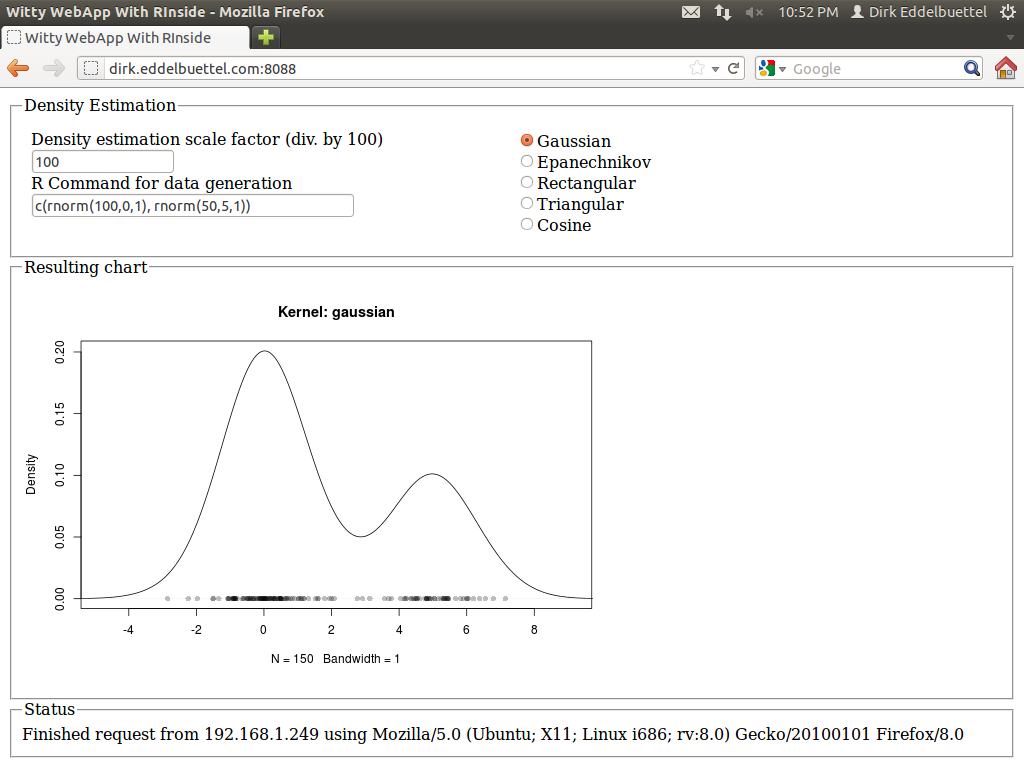 It is currently up and running at the address shown in the screenshot, so give it a go (though I may take it down at another point in
time). I quite like it: The application is responsive: changes in the radio buttons (for the density), or the bandwidth, each trigger
reestimation of the density, and a new and updated chart is displayed immediately with no noticeable delay---just like the desktop application did.
Best of all, the code logic is essentially unchanged from the Qt-based app. Signals and slots related events to actions, the layout is in
terms of standard GUI boxen and containers. And best of all, I did not have to write a line of html, javascript, css or ajax: it is all
handled by the

 I ran a backup of my backup home directory, to a USB drive with
full-disk encryption. Here's the result:
 Once the private key of some
 This secret is built from a 48byte premaster secret generated and
encrypted by the client with the public key of the server. It is then
sent in a Client Key Exchange message to the server during the third
step of the

 I have used a
 A while back I wrote some nodejs that mish-moshed email and web 2.0 long-poll action into a very ugly, but fairly up-to-date showing of debian changes. That is over on my server
 Commitments require care, and recently I have been suffering from the delusion
that making more commitments will make me more able to achieve them.
When overcommit reaches a certain point, the OOT (out of time) killer comes and
reaps time from whatever it finds, often with disappointing consequences.
(See also: