Search Results: "sto"

12 October 2008

Y Giridhar Appaji Nag: te_IN translation for Debian Installer

My parents found it strange that I spend considerable time in the night doing "some Linux thing", so the other day I explained to them what Free software is and we talked about copyright and licensing. I was very happy that they were able to appreciate it. I also gave a Debian Installer demo. While there are a bunch of Indian languages supported in the Debian Installer, (Telugu) isn't one of them. They noticed it and motivated me to work on te_IN translation for d-i and promised to help me. So the three of us have been discussing translation strings. I have been committing changes slowly and intend to complete this activity in a few months. Lack of interest in translation meant that I never gave much thought to it but I see that translating software is rather difficult and it is an activity that would benefit a lot from two or three people doing it together. I found a glossary at swecha.org but there are a bunch of problems I am using these simple guidelines for translation: A few resources that I have been using: I will have to find a good quality comprehensive Telugu general knowledge book or an official A.P. govt. document to translate ISO 3166 codes etc. The Manorama yearbook would've been great, unfortunately Telugu is not one of the few languages it is published in. I will also bring my copy of Sankaranarayan's dictionary from my next month Hyderabad visit. If you have suggestions on any of these (pointers to guidelines, resources that are DFSG free and I could copy from etc.) that would make doing this easy for me, please do let me know. Naidu does good one-off Telugu string translations in Launchpad (so does [info]praveenkumarg, btw), and Naidu has promised to do some of the work as well as review. If all goes well, I will try and create a debian-10n-telugu sometime in the future.

Rob Taylor: Boston Awesome

I’m at the Boston GNOME summit right now. Yesterday a lot of work got done on gobject-introspection and AT-SPI D-Bus, which is completely awesome. I had a great discussion with Dan Williams about where we should go with gnome-phone-manager, NM’s new ModemManager and OpenMoko’s gpsd. My interest here is having a consistent place for getting GSM/CDMA cell location information. A lot of very interesting ideas have been flying around about new user experience ideas. It seems a lot of people have been thinking similar things but didn’t really know that others were also working/thinking on the same ideas. We’ve just started the future user experience hackfest, I hope out of this we can forge some common future direction and common projects. I’ll report more after the hackfest!

11 October 2008

Andrew McMillan: Shiny New Laptop

After a few years of only buying laptops with Intel hardware, today I bought something totally different. It's not really what I wanted (which was an HP HDX 16t) but I get the feeling that none of these 16" HD 1080 laptops will make it to New Zealand for a while yet, and the NZ dollar has done such a nosedive recently that it's better not to wait any longer. In the places that hold stock there seem to be some good specials around at the moment, and as the owner of a new free, open-source consulting business (i.e: a cheap bastard) I went shopping for the cheapest dual-core I could find with a half-decent screen, and I found the Asus X53K for $999 (USD$589) at Dick Smith, including a 2G ram upgrade to take it to 3G. It's entirely non-intel, with a 2GHz Turion dual-core, ATI Radeon X2300 with 1440x900 panel, Atheros AR2425 wifi and 160G HD. I'd bought a replacement 320G hard drive even before I got the laptop, so now I have a pristine, unbooted 160G hard drive with the install files for some other OS on it - no doubt I'll find a use for the disk, at least! Since AMD got ATI to release all their chip documentation earlier this year I felt able to shell out for this, rather than the extra $100 for the model next to it, and it was nice too to get home and find that Atheros have recently released the HAL for their a/b/g chips. Which presumably means that they haven't done so for their 'n' chipsets, and I should continue to steer clear of that technology for a while yet... I'm running Debian GNU/Linux 'Sid' on the Asus X53K and, everything pretty much just works out of the box. My installation process was to rsync the old laptop onto a new disk, and boot the new laptop from that - after compiling a new kernel more appropriate to the changed hardware. After overcoming my own stupidity in not syncing the /dev/ underneath udev, which I easily googled my way out of, the only problem I've found so far is that the free radeon driver doesn't do 3d for me. Presumably the non-free ones would, but they won't compile against my 2.6.27 kernel so I don't know for sure. Fortunately I don't use 3d for anything so it's not a huge inconvenience to me. With 3G RAM and a fast 320G hard drive the laptop actually is an upgrade for me, too, and it has a webcam too, which I expect I'll look at in much the same way as I did the fingerprint reader on the old laptop. It will be good to finally hand that old one back to Catalyst, too, who have given me the flexibility to take my time on this. Now to try and peel off all these stickers without damaging anything!

10 October 2008

John Goerzen: One Hundred

Today, as I was riding my bicycle home from work, I noticed that the road maintainer had been by on the dirt and sand roads near our house. Unfortunately for me, he left a few sections of road with deep sand, and I almost wiped out several times. I ride a bike with narrow road tires that doesn't deal well with that.

But I'm not the first one to have a problem with roads.

A hundred years ago, the "brethren to the south" were having trouble getting to the community's main church, Alexanderwohl. Back in the days before paved roads, or heavy road-maintaining machinery, it took time and endurance to travel the distance even on good roads. A group of them started holding weekly Sunday Schools in local schoolhouses. Eventually, after much discussion, they decided to build a church, and it was completed in 1908 -- Tabor Mennonite, more than 4 miles from Alexanderwohl!

Tabor thrived over the years, though not without difficulty. Everything from how to shelter members' horses during services to what do to about the weighty social and political issues of the day were discussed and documented in church minutes. The church sent people out as missionaries, planted new churches, and supported several young pastors just starting out. In 1938, they expanded their building, and in 1965, replaced it entirely.

Tonight our weekend of centennial festivities began. It started with a prelude played on the church's first organ -- now about 90 years old if memory serves. Its current owner was tracked down, it was brought to the church, and still sounds wonderful. Tomorrow we will have music and activities outdoors under a tent, and all our living former pastors will be around, with a drama and meal in the evening. Then on Sunday, the big day with singing choirs (and a work commissioned for this occasion), each former pastor giving a short (we hope) message, a potluck (of course!), and the opening of the cornerstone.

It's been 6 years in the planning. I've spent the last couple of years collecting photos and other material for the archives and for the coffee table-style book we published for the centennial, and others have put in lots of hours too.

Sunday's worship service will conclude with singing the "Mennonite Anthem", also known as "606" from its number in an old hymnal. It will be a capella as is tradition for this piece. (Click for MP3 of a small choir singing it) It will be loud and beautiful, hundreds of voices joining in, a fitting way to mark this occasion.

What a wonderful thing we have been left by those that came before. And still, a responsibility for us as we look to the future. Rural churches are disappearing, and while Tabor is the rare rural church that is growing, still we hope that its location at the corner of two mostly dirt roads 4 miles from the nearest town (population 600) will not get in the way in years to come.

At the end of the events tonight, we were reminded of the favorite Bible verse of Rev. P. H. Richert, first pastor of Tabor, who served as pastor for almost 40 years:

the mountain of the LORD's temple will be established as chief among the mountains; it will be raised above the hills, and all nations will stream to it.


(Isaiah 2:2)

Somehow it seems improbable that dirt roads led to all this.

9 October 2008

Dirk Eddelbuettel: More running data visualization

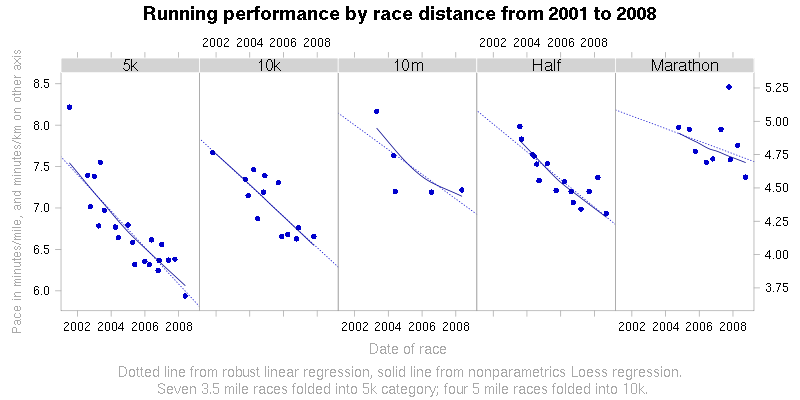
A few years into this running hobby, I realized that my times were getting better. But I had no feel for by how much, or whether that was a constant rate of improvement etc pp. Long story short, I started to plot some of the data. What seemed natural was to record the date, the distance in miles as well as in a qualitative variable, and finally the average pace. Additionally, I played with groupings into just three categories 'short', 'mid' and 'long'. This leads to a natural 'one-factor' model of pace as a function of race date grouped by race distance. And given how easy it is to do conditional plots in R, I quickly arrived at something that already resembled the following chart: (pace by date given group lattice chart) At first, some of the groups had too few data points to actually reliably construct regression lines, let alone non-parametric smoothers. But over time more and more data points were added as I kept running races. Including for example the somewhat disappointing result from last year's Chicago marathon in record heat that resulted in the outlier in the last panel. It actually made the smooth fit turn upwards! Luckily, the subsequent times in New York last fall, London in April, and of course in Berlin last month helped to dampen the effect of the one outlier, resulting in a more normal straight line for marathon performance that is comparable to the other four race lengths. All in all I am now quite happy with the chart. The combination of the non-parametric loess smoother and the robust linear regression (using lrm from the MASS package for R) shows that most groups exhibit very little non-linearity as both regression curves are very close to each other. The curvature in the '10m' group is probably mostly a small-sample effect. And I am obviously happy with the fact that three of the five panels show their respective last race as a PR :) The R script containing the data and code is available here but requires some familiarity with the lattice package for R (as the lattice book would provide).
Felipe Augusto van de Wiel: 10 Oct 2008

Random news

/back
Yes, I was away... long and sad story involving health issues. :-( I'm trying to get back, hopefully everything will be fine. Let me publicly apologize to some people that was expecting some work from me and I postponed it, not because of slackness but because I was unable to do it. I'm catching up with a lot of tasks and trying to solve long standing issues, feel free to ping me to get some update on a specific matter. I am really sorry!


Slogan
Do you know about the poll to choose a slogan for the release of Debian 5.0, also known as "lenny"?

No!? Shame on you! :-)

People behind Debian Art started a discussion to get opinions! After some input they prepared a poll, maybe they should try to use a doodle. Right now, The Universal Operating System is quite popular, but a lot of people did some nice suggestions, and some of them would like to see a slogan some way related to the Toy Story (tm) character Lenny:


The discussion is distributed across three lists: Debian Desktop, Debian Publicity and Debian Curiosa, I would also point to the comments made by Gustavo Noronha da Silva (here) and Andre Felipe Machado (here).

If you didn't say anything so far, please do!

David Welton: Dynamic Languages in Desktop Applications

Ted Leung talks about the lack of dynamic languages in desktop applications. There's something ironic about that: Ted works for Sun Microsystems. Sun Microsystems, back in the day, was a big contributor to Tcl and Tk. Despite not being the "in thing", Tcl and Tk are used a lot more than people think. Not so much in the latest and greatest things being built now, due to the (undeservedly) "uncool" reputation, but in lots of products that are still chugging along, earning money and serving their users well, if not noisily so. Interestingly enough, my biggest client here in the Innsbruck area is one of these. They have offices worldwide, make a good living at what they do, and their user interface is mostly in Tk.

Russell Coker: I Won t Use Drizzle

A couple of days ago I attended a lecture about the Drizzle database server [1]. Drizzle is a re-write of MySQL for use in large web applications. It is only going to run on 64bit platforms because apparently everyone uses 64bit servers - except of course people who are Amazon EC2 customers as the $0.10 per hour instances in EC2 are all 32bit. It’s also designed to use large amounts of RAM for more aggressive caching, it’s being optimised for large RAM at the expense of performance on systems with small amounts of RAM. This is OK if you buy one (or many) new servers to dedicate to the task of running a database. But if a database is one of many tasks running on the machine, or if the machine is a Xen instance then this isn’t going to be good. There are currently no plans to support replication between MySQL and Drizzle databases (although it would not be impossible to write the support). The good news is that regular MySQL development will apparently continue in the same manner as before, so people who have small systems, run on Xen instances, or use EC2 can keep using that. Drizzle seems just aimed at people who want to run very large sharded databases. Now I just wish that they would introduce checksums on all data transfers and stores into MySQL. I consider that to be a really significant feature of Drizzle.

MJ Ray: Listening to the Social Entrepreneur

Today, I shall be mostly at Listening to the Social Entrepreneur. If you’re in the area and have something to say, leave a comment here to contact me. (Comments won’t appear here until this evening, sorry.) I’ll write a review post after the event. Aside: Councils are worried about their Landsbanki deposits - thankfully, Kewstoke isn’t one of them, but ow! Yet another way that the banking problems will increase taxes.

8 October 2008

Wouter Verhelst: Why I don't want an iSomething, part II

Bjorn mentions that he doesn't want the nokia internet tablet, because it doesn't have a phone and he doesn't want to carry two devices with him. portable media player Bottom left, my portable media player. 4G solid-state storage, plays movies (the display shows a scene from Star Trek: Deep Space Nine that I converted from DVD), audio, FM radio, and after a firmware update can do games and some random applications. Does bluetooth. Does not do phone calls. Upper right, my cell phone. A simple Nokia 6021. Does bluetooth, makes phone calls, and (as the display somewhat shows) can do calendaring, too. With SyncML, I can synchronize it with my laptop. Together, they perform anything I'd possibly want from a smartphone (and don't anyone tell me 'SSH', because doing ssh on any screen smaller than, 7" and without decent keyboard is laughable). Together, they're smaller and weigh less than a smartphone. Together, they're less expensive than a smartphone ( 125 for the phone, 85 for the portable media player). Why does anyone buy a smartphone?

Rob Taylor: Wizbit ars d

So it seems ars technica picked up on Codethink’s little pet project! Obviously the little amount of info on the wiki isn’t enough for everyone who’s interested and enough has changed since the GUADEC talk that I should write a bit here to clarify what’s going on and where we’re going. First off, we’re currently not using GVFS or FUSE - the core Wizbit component is simply a versioning, distributed object store. The current plan is to later hook up with a metadata service, maybe tracker, and use this to export a FUSE filesystem using the metadata. This core Wizbit service is just a library with its own api, maybe hooking up to gio streams for ease of use from GLib based applications. The current focus of our work is solidifying this store and the synchronization between multiple machines. We’re prototyping its use in Tomboy. Karl is also working on making some of these pretty widgets for navigating history work. We’re not actually using Git underneath, but using our own implementation of concepts from both Git and Bzr. This is for a number of reasons, partially that making a library from git’s code proved more trouble than just reimplementing the concepts (as things like JGit found). Also the nature of the problem is sufficiently different that things like the packed format don’t behave in a suitable way for general file system usage. The work on packing is yet to be started but we’ll probably use Robert Collin’s groupcompress idea from bzr. I promise we’ll make the wiki a bit better when the code’s stabilised a bit!

Sven Mueller: How to solve a credit crisis

Anand Kumria wrote:
If IBM were to go bankrupt, would the government step in? Unlikely. Investors would lose (money), staff — another word for investors — would lose (jobs), but customers would win (their computers would keep working). Some customers would win more than others (especially those who had the equipment on lease); if no one is collecting, why pay?
I’m wondering here where Anand got the idea that once a company went bankrupt, that you don’t need to pay to that company anymore. When a company goes bankrupt, at least in Germany the following happens: A trustee/liquidator is selected. This liquidator is then collecting the information who owes money to the company and who still needs to get (how much) money from it. The liquidator also has to check the option of selling company assets (which might include the contracts of customers that still have to pay) to fulfill the debts of the bankrupt company. After he turned all assets into money, the money is distributed among those who still have to get money from the bankrupt company. Anyway, regarding his main argument that the (average) customer of a company (bank in this case) should never have to pay for the failed speculations of that company, I somehow have to agree with him. Someone putting money into a regular bank account or papers with fixed interest rate should never lose his money. But there are also customers buying bank shares with a chance of higher revenue than with fixed interest rate papers. These should suffer from failure of the bank management, as they more or less explicitly wanted to be tied to the success (or failure) of the bank. However, this is mostly irrelevant, since the failure of so many “investment banks” has side affects that might cost the average inhabitant of the affected countries even more than the discussed rescue plans. One of these effects is that the banks are now much more conservative regarding lease and mortgage plans, effectively leaving many home owners with no option to fulfill previous obligations (remaining debt after a previous mortgage expired can’t be refinanced by a new mortgage), causing them to have to sell their homes to pay the first mortgage. This is in some way stupid because this causes people who were perfectly paying their mortgage rates to loose their house, while the bank which would be giving them a new mortgage could get a new and good customer, improving their income. On the other hand, if the other side effects of the current crisis cause those “good” mortgage customers to loose their jobs, they might turn into bad customers who are unable to pay their rates. All in all, this is a spiral that could cause the whole economy to break down (a small example: The bank is not giving out mortgages, so no one will build new houses so the builders loose their jobs so they don’t pay their mortgage rates anymore,…. - over simplified, but still shows what I mean). Unless the spiral is terminated in time, before too drastic things happen. All in all, I do understand why the politicians try to rescue those banks (or at least the customers of those banks), though I think that in an economy with slightly higher regulation, there wouldn’t be the need for such a rescue plan. I know there are some german banks affected by the crisis as well (among them Hypo Real Estate and others), but the average private customer of such banks shouldn’t loose money due to the regulations we have in place. In general, there should be some security fund which makes sure that private customers never loose money put into regular bank accounts or fixed interest papers, vice-versa, banks should calculate mortgages so that they can be pretty sure their customers are actually able to pay off their rates - it doesn’t make sense if someone starts off having to pay 500$/month for their mortgage and has to pay over 1000$ a few years (as in 2-3 years) later, because the bank raised the interest that much. I have no problem with people loosing money from shares of banks or other companies directly or indirectly through investment funds.

MJ Ray: Pulling One File From a Plesk Backup

I won’t repeat my frequent anti-Plesk rant, but suffice to say: it’s a pain. For some reason, we wanted one file back out of a backup. It took me a few minutes to realise it, but Plesk’s backups are essentially MIMEd and gzipped. So, rather than fighting with their mysterious semi-documented backup-unpack tool, just say:- zcat backupfile sed -n -e '/name="filename.whatever/,/^--_--/p' >filename.whatever If you don’t know the filename, zless’ing the head of the file should find it from the XML description blocks pretty quickly. Slight editing of the output file will be necessary, to strip MIME and so on, but it’s easier than installing too much else on a webserver. Does anyone know why this gzipped-MIME is better than tar.gz or something else common and easy-to-use?

Ian Wienand: Why symbol visibility is good

ELF has two related concepts for managing symbols in your programs. The first concept is the symbol binding. Global binding means the symbol is visible outside the file being built; local binding is the opposite and keeps the symbol local only (static) and weak is like global, but suggests that the symbol can be overridden.
$ cat syms.c
static int local(void)    
int global(void)    
int  __attribute__((weak)) weak(void)    
$ gcc -o syms -c syms.c
$ readelf --syms ./syms
Symbol table '.symtab' contains 10 entries:
   Num:    Value  Size Type    Bind   Vis      Ndx Name
...
     5: 00000000     8 FUNC    LOCAL  DEFAULT    1 local
     8: 00000008     8 FUNC    GLOBAL DEFAULT    1 global
     9: 00000010     8 FUNC    WEAK   DEFAULT    1 weak
...
This is all well and good, but starts breaking down when you want to load many different modules and keep strict API's (such as, say, dynamic libraries!). Consider that for two files to share a common function, the function must end up with a global visibility.
$ cat file1.c
void common_but_not_part_of_api(void)    
$ cat file2.c
extern void common_but_not_part_of_api(void);
void api_function(void)  
     common_but_not_part_of_api();
 
$ gcc -shared -fPIC  -o library file1.c file2.c
$ readelf --syms ./library
Symbol table '.symtab' contains 60 entries:
   Num:    Value  Size Type    Bind   Vis      Ndx Name
...
    53: 00000424    29 FUNC    GLOBAL DEFAULT   11 api_function
    55: 0000041c     5 FUNC    GLOBAL DEFAULT   11 common_but_not_part_of_api
...
In the example above, both the function we want exported (api_function) and the function we don't wish exported (common_but_not_part_of_api) end up with exactly the same attributes. Binding attributes are useful for the linker putting together object files; but aren't a complete solution. To combat this, ELF provides for visibility attributes. Symbols can be default, protected, hidden or internal. Using these attributes, we can flag extra information for the dynamic loader so it can know which symbols are for public consumption, and which are for internal use only. The most logical way to use this is to make all symbols by default hidden with -fvisibility=hidden and then "punch holes in the wall" for those symbols you want visible.
$ cat file1.c
void common_but_not_part_of_api(void)    
$ cat file2.c
extern void common_but_not_part_of_api(void);
void  __attribute__((visibility("default"))) api_function(void)  
      common_but_not_part_of_api();
 
$ gcc -fvisibility=hidden -shared -fPIC  -o library file1.c file2.c
$ readelf --syms ./library
Symbol table '.symtab' contains 60 entries:
   Num:    Value  Size Type    Bind   Vis      Ndx Name
    48: 000003cc     5 FUNC    LOCAL  HIDDEN   11 common_but_not_part_of_api
    54: 000003d4    29 FUNC    GLOBAL DEFAULT  11 api_function
Now the dynamic loader has enough information to distinguish between the two, and can stop any external access to common_but_not_part_of_api easily. This extra information also has potential for performance improvements. Any time a symbol may be overridden, the compiler must generate a program lookup table (PLT) entry for the function so that the dynamic loader can re-direct the function call. The PLT is a trampoline which gets the correct address of the function being called (from the global offset table, GOT) and bounces the function call to the right place. An example should illustrate: Bouncing via the PLT In the first example, there was not enough information to tell if the function would ever be able to be overridden, hence a PLT entry had to be created and the function called through it (disassemble it to see the details!). With correct symbol visibility attributes, there is enough information to know that common_but_not_part_of_api is never to be overridden, hence the PLT (and the associated costs of trampolining) can be avoided. The internal attribute is even stricter; it says that this function will never be called from outside this module (for example, we might pass the address of common_but_not_part_of_api to anyone). This can lead to even better code, because on many architectures transitioning to another module might involve flipping global pointer registers or other similarly expensive operations. So that's how symbol binding and visibility attributes can work together to get you the best performance possible from your program!

7 October 2008

Marco d'Itri: Linux HA firewalls: how?

I am configuring a simple two-hosts redundant linux firewall. What should I use to move the virtual gateway IP between the customer-side interfaces? And why? Apparently the choices are: keepalived, ucarp, vrrpd, heartbeat and maybe even something else.

Miriam Ruiz: Apostasy in Spain

Data ordered by entry data is not a data file, and thus not protected by the law regarding personal data files, because it’s hard to do searches in them. I know it sounds ridiculous, but that’s the argument that the highest court in Spain (Tribunal Supremo) has used to prevent the Catholic Church from losing believers. Many children are automatically baptisted by their parents when they’re just babies, without having any decision in that, and thus they names are written down in the Church files^Wlists of baptisted people. That’s the numbers they will use later when asking for privileges for the Catholic Church, and that’s why it’s so important for them that all of us are counted as catholics, whether we are or not believers. Fewer than half of Spanish youth consider themselves Catholic, so it’s important for them to keep appearances to keep their power intact. In Spain thousands of non believers are demanding that the Church cancel their baptism records, in order to annul any official connection with Catholicism. And church leaders in turn have gone to the courts to try to stop parishioners deserting. The Tribunal Supremo seems to be taking a political side with their decision trying to vulnerate non-believers rights to artificially promote the Catholic Church. Apostasy is the formal religious disaffiliation or abandonment or renunciation of one’s religion. The United Nations Commission on Human Rights, considers the recanting of a person’s religion a human right legally protected by the International Covenant on Civil and Political Rights: “The Committee observes that the freedom to ‘have or to adopt’ a religion or belief necessarily entails the freedom to choose a religion or belief, including the right to replace ones current religion or belief with another or to adopt atheistic views […] Article 18.2 bars coercion that would impair the right to have or adopt a religion or belief, including the use of threat of physical force or penal sanctions to compel believers or non-believers to adhere to their religious beliefs and congregations, to recant their religion or belief or to convert.”. Anyway, many religious groups and even some states punish apostates. For Catholics, the word “apostasy” signifies the desertion of faith, which had been one of the three unpardonable sins in the early years of the Church. AEPD, the national agency for data protection, is pondering now whether to appeal against the sentence. I hope they do. There are other legitimate subjects that could appeal against it, too. No one should be forced to belong to a Church they don’t believe in.

Russell Coker: The Security Benefits of Being Unimportant

A recent news item is the “hacking” of the Yahoo mailbox used by Sarah Palin (the Republican VP candidate) [1]. It seems most likely that it was a simple social-engineering attack on the password reset process of Yahoo (although we are unlikely to learn the details unless the case comes to trial). The email address in question had been used for some time to avoid government data-retention legislation but had only been “hacked” after she was listed as the VP candidate. The reason of course is that most people don’t care much about who is the governor of one of the least populous US states. Remote attack on a mailbox (which is what we presume happened) is only one possible problem. Another of course is that of the integrity of the staff at the ISP. While I know nothing about what happens inside Yahoo, I have observed instances of unethical actions by employees at some ISPs where I have previously worked, I have no doubt that such people would have read the email of a VP candidate without any thought if they had sufficient access to do so. If an ISP stores unencrypted passwords then the way things usually work is that the helpdesk people are granted read access to the password data so that they can login to customer accounts to reproduce problems - this is a benefit for the customers in terms of convenience. But that also means that they can read the email of any customer at any time. I believe that my account on Gmail (the only webmail service I use) is relatively safe. I’m sure that there are a huge number of people who are more important than me who use Gmail. But if I was ever considered to have a reasonable chance of becoming Prime Minister then I would avoid using a Gmail account as a precaution. There is a rumoured Chinese proverb and curse in three parts:
May you live in interesting times
May you come to the attention of those in authority
May you find what you are looking for [2]
In terms of your email, everyone who has root access to the machine which stores it (which includes employees of the companies that provide warranty service to all the hardware in the server room) and every help-desk person who can login to your account to diagnose problems is in a position of authority. Being merely one of thousands of customers (or millions of customers for a larger service) is a measure of safety. As for the “interesting times” issue, the Republican party is trying to keep the issue focussed on the wars instead of on the economy. The problem with basing a campaign on wars is that many people will come to the conclusion that the election is not about people merely losing some money, but people dying. This could be sufficient to convince people that the right thing to do is not to abide by the usual standards for ethical behavior when dealing with private data, but to instead try and find something that can be used to affect the result of an election. Mail that is not encrypted (most mail isn’t) and which is not transferred with TLS (so few mail servers support TLS that it hardly seems worth the effort of implementing it) can be intercepted at many locations (the sending system and routers are two options). But the receiving system is the easiest location. A big advantage for a hostile party in getting mail from the receiving system is that it can be polled quickly (an external attacker could use an open wireless access-point and move on long before anyone could catch them) and that if it is polled from inside the company that runs the mail server there is almost never any useful audit trail (if a sysadmin logs in to a server 10 times a day for real work reasons, and 11th login to copy some files will not be noticed). One of the problems with leaks of secret data is that it is often impossible to know whether they have happened. While there is public evidence of one attack on Sarah Palin’s Yahoo account, there is no evidence that it was the first attack. If someone had obtained the password (through an insider in Yahoo, or through a compromised client machine) then they could have been copying all the mail for months without being noticed. It seems to me that your choice of ISP needs to be partly determined by how many hostile parties will want to access your mail and what resources they may be prepared to devote to it. For a significant political candidate using a government email address seems like the best option, with the alternative being to use a server owned and run by the political party in question, if you can have the staff fired for leaking your mail then your email will be a lot safer!

6 October 2008

Matthew Garrett

Things:
Things I want to do:

Russ Allbery: Config management and bundle

Today, among all the other things I accomplished, I converted the rest of the system templates for the eyrie.org systems to Git and tweaked my personal configuration management system to make better use of Git's features to push data around. I was feeling on a productive roll, so I also wrote up the system I use. This system has a long history. The first commit in the underlying repository for my personal workstation is dated September of 1998, and the underlying system was already in use at Stanford before I started working here more than 15 years ago. It survived several major OS changes and several significant reorganizations and only recently has been replaced for day-to-day server management by Puppet. We still use bundle to do some of the initial system configuration inside FAI before the system is put together enough to run Puppet. Puppet is overkill for a few personal systems, so the system I'm using is based on our previous revision of our server template system, with some modifications to not depend on AFS and to make remote deployment of changes easier and simpler. It's not as fancy as some of the new ideas for managing all of /etc in a VCS, but it's been reliable and capable enough for me that the core of the system remains unchanged after ten years.

5 October 2008

Anand Kumria: How to solve a credit crisis ...

Apologies to anyone bored of this topic but it is something I have been thinking about recently. You have people commenting on why Banks are special and need government funded bailouts. Others arguing that the Free market is not dead. We have even have a few solutions from some people within the Free Software community. I think the first thing is to identify who should lose, and who should win. Much of the annoyance about the rescue from ordinary people is that it seems that investors are not losing (enough). They took some risks, those gambles failed, and now everyone else is paying the price. If IBM were to go bankrupt, would the government step in? Unlikely. Investors would lose (money), staff -- another word for investors -- would lose (jobs), but customers would win (their computers would keep working). Some customers would win more than others (especially those who had the equipment on lease); if no one is collecting, why pay?. So let's apply the same set of outcomes to banks. But hang on, you rightly ask, - a bank has the title deed (a mortgage is a promise to pay amount X over Y year in return for the deed) - why would customers (depositors), realising a bank is no longer viable, since remove their funds I think that those two issues can be addressed fairly simply. The government would guarantee all depositors money. Customers never lose. They never have to worry about their funds. For banks, who enter into administration, the standard laws about possession should apply. If a borrower is utilising (living in) the asset to which the bank has title for over Z years (where Z equals 5 or 7), then the possesor now owns it outright. That is plenty of time for a bank to either be bought, have the underlying asset value recalibrated, or to completely go bust. All without a detrimental effect.

Next.

Previous.