Search Results: "ron"

24 April 2007

Michal Čihař: Kernel 2.6.21 hits Gammu

Since Linux kernel 2.6.21 entered higher release candidates, more people started to report that Gammu has problem on that with connecting over USB cable. First I thought it is some misconfiguration of kernel, but when several same reports appeared, I decided to take a look at it. As great side effect of this, I found out that I can use snapshots of Debian kernel, where current version (2.6.21-rc7) is available as Debian package. This saved me lot of time, thanks guys! After installing and booting new kernel, I quickly found out that the problem is not SIGSEGV as many people reported, but SIGIO. After quick look at code, it was obvious that setting file to asynchronous I/O causes this. Well this is how asynchronous I/O is supposed to work and kernel people implemented it now for (some?) serial drivers. I have no idea why there was attempt to use it in Gammu. The code is not at all ready for this and makes no use of asynchronous I/O. So the fix was quite easy - just to remove this flag from file. Fix now sits in SVN, impatient users who run kernel 2.6.21 can get SVN snapshot :-). Testing release will follow during next week.

Pete Nuttall: Sites and Blogs going downhill

I have been living at home for the past few weeks, and as such have been reading the paper after breakfast. I can do this in Durham too, its just a bit more of a fight to get the paper. After a couple of weeks, I commented to my mother than the columnists seemed to be a bit dire. She pointed out that they all started well, and steadily when't downhill. One would assume that they just ran out of interesting things to say. I was looking at the Daily WTF today, now renamed to Worse than Failure, and I was reminded of this observation. When I found the site, I did look at the entries and go "WTF?", now I just look and go "meh". I'm guessing that its running out of spectacular material, and that each new posting pushes the boundary of what it takes to be a good posting, or in the case of the Daily WTF, a bad one. At the same time, the number of readers is getting bigger, so the numbers of comments are getting bigger, so there are more silly comments. Add in the bigger readership means more demand for material, and the site's operator starts accepting lesser quality stories and the comments go down hill. Slashdot is the worst example of this, with both dire stories and comments. OSNews has also fallen over this problem. All in all, this means that as a good blogger / news site, you have to accept the fact that you aren't going to post that often, and accept the fact that you aren't going to get lots of hits and have a steady readership. A few folk, such as Steve Yegge and Joel Spolsky, seem to do this. Of course, writing without readers means writing for yourself, which is the normal advice writers offer on how to get started. So the best way to start is the best way to continue, writing about stuff that interests you and not really caring about having readers.Oh, and incase you are wondering, I don't care about folks reading my blog, and sometimes wish they didn't. They tell me I'm wrong. They get me in the coffee shop and start arguing about stuff I wrote while drunk two weeks ago. anyway... Getting back to where I started, both newpaper columnists and sites going downhill doesn't really bother me. After a while, they slip into the crap threshold and I stop reading them. Its just sad that they slip away. PS: Edwin Brady tells the Daily WTF was always quite bad. Maybe its just me who takes ages to pick up on bad sites.

MJ Ray: North Somerset April Cycle Forum

Thursday 26 April 2007 (7pm - 9pm), The Campus, Locking Castle, Weston-super-Mare. (Map) Topics to include: The Joint Local Transport Plan: How the forum may maintain pressure to implement cycling benefits in the plan? Appointment of new chair for the meetings Diversion of the Avon Cycleway onto the old NCN33 to Portishead New Local Rural Routes to be sign posted Date of next meeting: Thursday 28 June 2007 @7pm, The Campus - WSM Cycle Forum homepage

Russell Coker: first look at CentOS 5 Xen

I have just installed a machine running CentOS 5 as a Xen server. I installed a full GUI environment on the dom0 so that GUI tools can be used for managing the virtual servers.

The first problem I had was selecting the "Installation source", it's described in the error message as an "Invalid PV media address" when you get it wrong which caused me a little confusion when installing it at 10PM. Then I had a few problems getting the syntax of a nfs://1.2.3.4:/directory URL correct. But these were trivial annoyances. It was a little annoying that my attempts to use a "file://" URL were rejected, I had hoped that it would just run exportfs to make the NFS export from the local machine (much faster than using an NFS server over the network which is what the current setup will lead people to do).

The first true deficiency I found with the tools is that it provides no way of creating filesystems on block devices. The process of allocating a block device or file from the Xen configuration tool is merely assigning a virtual block device to the Xen image - and only one such virtual block device is permitted. Then the CentOS 5 installation instance that runs under Xen will have to partition the disk (it doesn't support installing directly to an unpartitioned disk) which will make things painful when it comes time to resize the filesystems.

When running Debian Xen servers I do everything manually. A typical Debian Xen instance that I run will have a virtual block device /dev/hda for the root FS, /dev/hdb for swap, and /dev/hdc for /home. Then if I want to resize them I merely stop the Xen instance, run "e2fsck -f" on the filesystem followed by "resize2fs" and the LVM command "lvresize" (in the appropriate order depending on whether I am extending or reducing the filesystem).

Xen also supports creating a virtual partitioned disk. This means I could have /dev/lvm/xenroot, and /dev/lvm/xenswap, and /dev/lvm/xenhome appear in the domU as /dev/hda1, /dev/hda2, and /dev/hda3. This means that I could have a single virtual disk that allows the partitions to be independently resized when the domU in question is not running. I have not tried using this feature as it doesn't suit my usage patterns. But it's interesting and unfortunate that the GUI tools which are part of CentOS don't support it.

When I finally got to run the install process it had a virtual graphics environment (which is good) but unfortunately it suffered badly from the two-mouse-cursor problem with different accellerations used for both cursors so the difference in position of the two cursors varied in different parts of the screen. This was rather surprising as the dom0 had a default GNOME install.

23 April 2007

Lars Wirzenius: Debian: Package school date fix

Argh! I got the date wrong for the packaging tutorial. The correct date is May 9 (that's nine), not May 5 (five). Mea culpa.

MJ Ray: Online Banking: What works with GNU/Linux? (Barclays v Linux 3)

I asked if anyone had seen the Barclays PINsentry keypad before... Kris Marsh wrote that:
"it looks a lot like the way secureid cards work. In which case, it won't physically connect to your PC, would provide you with proper two factor (password + token) and would definitely be a Good Thing(tm). Not only then, would a phisher have to take your password, but they'd have to steal your actual card and PINsentry device to get access to your online account. Thus pushing the phishing emphasis elsewhere (different banks? phone scamming?). I guess time will tell if they manage to mess it up to make it only work on Windows somehow. :-)"
Adam Bower opined:
"The Barclays devices just look like a challenge response system. Someone I know has something similar for a bank account which when you login the website presents you with a 4 digit number. You then type that number into the pad and then enter a pin and it presents another number that you enter onto the webpage and the online banking lets you in (along with a username and password). I should imagine that these new devices won't make any difference to people running Linux."
Neil McGovern noted:
"It seems that they're external devices for generating OTPs from C+P cards, so won't affect compatability."
Roger Gammans commented:
"Barclay use GEM plus usb smart card readers with their business internet banking. IIRC, this requires windows and IE so that the activeX controls on the page can talk to the reader. Having said that one desciription of the new device I heard sounded like it was a standard alone device with a display. You put your card into it and push a button and then it produces a code number which you copy onto the web page. But I haven't seen one yet - and the media are good at getting the wrong end of the stick."
So, let's wait and see.

Sam Hocevar: Use sshd and httpd on the same port (almost)

Running sshd on port 443 is common practice, because even in a very hostile environment full of firewalls and proxies that only allow web access, it is usually possible to use the HTTPS proxy to open a full TCP connection to port 443. I use this a lot. The problem is that I also want to run my SSL web server on the same IP. Here is a hack to do both. One essential difference between the SSH and HTTP/HTTPS protocols is that upon connection the SSH server sends a banner to the client, while the HTTP and HTTPS servers wait for the client to send a request. Which means that after a reasonable amount of time, one can be fairly sure the client at the other end talks HTTP/HTTPS or SSH. Due to recent interest in it, I m publishing redirect.c, a small program that implements this technique. Use it at your own risk, and read about the limitations.

22 April 2007

Gustavo Franco: Merge from Ubuntu, and do it now!

Well, I'm really tired of these comments on how Ubuntu doesn't contribute patches back for Debian and how some Ubuntu contributors tell that they do it and that everything is ok with the swirl side of the fence. The truth is, both sides are wrong or just lying!

The fact is that for quite some time Debian contributors can opt-in to receive Ubuntu patches by mail. It started with my scottwatcher script for utnubu that was sending mails for Debian's PTS (Package Tracking System), keyword derivatives. Ubuntu does it now, so scottwatcher was deprecated in favor of their infrastructure that also sends messages to ubuntu-patches mailing list. Dissatisfied? Go to: http://patches.ubuntu.com/

I'm sure that some will argue "well, why not wishlist bugs to our BTS then?". I would be glad to receive the reports, but a lot of Debian contributors, developers, whatever argued against that because "we've a lot of differences and I don't care about Ubuntu patches" or stuff like "I hate automatically generated bug reports, they should process them manually before sending, figuring out if it makes sense or not". It makes no sense! I would prefer the opt-out approach than opt-in, but blame some Debian lazy contributors, including me because the raw data is there. I can start pushing stuff from ubuntu-patches mailing list into our BTS. Do you want it?

Before you reply to my post, read every word at: https://wiki.ubuntu.com/UbuntuForDebianDevelopers . What's wrong with you? Aren't you a Debian zealot? Go there and apply what's needed for us, for a better Lenny release. Don't you love to argue how they do it all wrong? Redo their stuff right then!

Please never write again "I never received patches from Ubuntu for my package foo". You don't own a part of the Debian project, you're a maintainer, stop crying, go there and raise the bar again. Thanks in advance.

Neil Williams: Mandatory -dbg packages for libraries

I'd like to see all library source packages having a minimum of 4 binary packages required by Policy: the SONAME, the -dev (without SONAME), the -dbg (with SONAME) and a -doc package (without SONAME). (Libraries for perl or other non-compiled languages would be exempt from -dbg packages but not -doc.)

Currently, only a -dev is mandated. I'm currently writing a GtkHTML extension for quicklist and writing code to use an undocumented library is PITA.

Libraries without a -dbg are worse because Debian doesn't need any upstream involvement to create -dbg packages. Things like that make Debian a nicer environment to be upstream, not just a nice environment to be a DD or user.

Are there libraries written in compiled languages that cannot provide a -dbg?

Christian Perrier: Vote - 1st round

So, today is the first round of the French presidential election. I already explained where is my preference going, also who I fear the most and who I absolutely don't want ever (no link here: I will never give a link to this guy and his party's web site. You don't want to read the kind of crap they write, do you? This is of course Le Pen). For those reading this and not familiar with the French presidential eletion voting system, a few more hints: We have 12 candidates this year. on first round, a president may be elected if (s)he gets more than 50% of votes (not counting white and null votes). This is of course nearly impossible. The highest probability is thus for a second round. Here, the two best ranked candidates would stay and the president is elected among one of them two. That second round will happen on May 5th. Candidates are (non neutral comments!): Though choice, isn't it? Out of these 12, 4 have some chances to reach the second round: Bayrou, Royal, Le Pen and Sarkozy. It is pretty sure that Sarkozy will reach the second round (unfortunately, should I say). Bayrou and Royal have the best chances to be the second candidate (apparently the disaster of 2002 where Le Pen reached the second round will not happen, though still possible). So, let's vote and vote well...but, first of all, vote! See you at 20:01 +02:00.

Michael Prokop: Booting from USB pen: troubleshooting and pitfalls

As grml supports booting from usb devices (harddisk installation via grml2hd as well as booting from usb pens via grml2usb) and I helped many people at debugging booting problems I think I stumbled upon every existing pitfall. 8-) There are several situations where booting might fail. So here we go with a summary of the most common pitfalls and possible solutions:
  1. The Bootsplash is displayed, the kernel loads but you very soon get a:
  2. ran out of input data
    System halted
    
    Reason: everything OK, except for the filesystem used on your usb device. So instead of fat16 you use for example fat32. Fix: use the appropriate filesystem (fat16 for usb pens usually).
  3. When trying to boot from USB you get something like:
  4. Invalid operating system
    
    Possible reason: the partition layout is not ok. Very probably there’s no primary partition or none has the flag ‘bootable’ set. (Read on for further details.)
  5. When trying to boot from USB you get something like:
  6. No operating system found.
    
    Possible reason: you forgot to set the boot-flag on the partition. Or you did not install an operating system at all. ;-)
  7. When trying to set up the partition(s) on the USB device cfdisk reports something like:
  8. FATAL ERROR: Bad primary partition 0: Partition ends in the final partial cylinder
    
    Reason: the partition layout is not ok. Either use fdisk (requires detailed knowledge about partition setup!) or better: use a fronted of libparted, like gparted. gparted does an excellent job at setting up an appropriate partition layout for booting from USB (read on for details about the correct setup). As long as cfdisk has problems with the layout - it will exit on errors - your usb pen very probably does not have a valid partition setup for booting. Please notice that fdisk very often uses defaults which are not OK, whereas gparted uses the appropriate heads, sectors/track and cylinders settings. So if you really want to use fdisk for setting up the appropriate partition layout you might have to enter the ‘extra functionality (experts only)’ menu of fdisk.
  9. The system never displays the bootsplash of the usb device at all? Checklist:
    • does your system support booting from USB at all? Check settings in BIOS.
    • do you use the correct USB mode in BIOS? Check BIOS again, usually you want to use USB-HDD mode. Not possible? See USB-ZIP mode.
    • is "booting from USB" in the appropriate order of the booting sequence? Check the "boot"-section in your BIOS.
    • is the bootable flag set on the boot-partition? Check for example with cfdisk.
    • is the partition used for booting the first partition and a primary one on your device? Check with cfdisk again.
    • is the partition layout ok? The first partition (the one used for booting) has to start at cylinder 1/sector 63, otherwise booting will fail on most (all?) x86 systems. Check with ‘cfdisk -P s /dev/..’ or ‘fdisk -l -u /dev/…’. Do *not* trust the output of ‘fdisk -l /dev/…’. Really.
  10. syslinux does not work on your system (b0rken BIOS for example)? Possible solution: use grub instead.
  11. Kernel boots but fails to find the root filesystem with something like:
  12. kernel-panic: unable to mount root-fs...
    
    Yes? Then the root= argument in your kernel commandline (specified in the bootloader, usually lilo, grub or isolinux/syslinux) is pointing to the wrong device. Solution: adjust the root=-option in your bootmanager’s configuration. Tip: use root=UUID instead of root=/dev/[hs]d…
  13. All of the above tips don’t work? Maybe your USB pen is even larger than 1GB?
  14. Possible reason: Some BIOSes offer different modes for USB booting. The proper mode to boot a USB stick is USB-HDD. If that doesn’t work or is not supported by your system, you need to format your USB-Stick as USB-ZIP. To do this, the syslinux source distribution contains an utility called mkdiskimage, which you can use to re-format your USB stick in USB-ZIP format. For more information refer to the USB-webpage in the grml-wiki and Bootable USB Key in the knoppix-wiki.
I mentioned the correct partition layout several times. Reminder: a first, primary partition with fat16 (as filesystem as well as partition’s system id!) with bootable-flag set. The partition should start behind MBR at 1st cylinder and 63rd sector (see www.ata-atapi.com/hiwmbr.htm and thestarman.pcministry.com/asm/mbr/index.html for more details about MBR). So how does a correct partition look like? Output in several formats as reference:
# fdisk -l -u /dev/sda
Disk /dev/sda: 1039 MB, 1039663104 bytes
255 heads, 63 sectors/track, 126 cylinders, total 2030592 sectors
Units = sectors of 1 * 512 = 512 bytes
   Device Boot      Start         End      Blocks   Id  System
/dev/sda1   *          63     2024189     1012063+   6  FAT16
# fdisk -l /dev/sda
Disk /dev/sda: 1039 MB, 1039663104 bytes
255 heads, 63 sectors/track, 126 cylinders
Units = cylinders of 16065 * 512 = 8225280 bytes
   Device Boot      Start         End      Blocks   Id  System
/dev/sda1   *           1         126     1012063+   6  FAT16
# sfdisk -d /dev/sda
# partition table of /dev/sda
unit: sectors
/dev/sda1 : start=       63, size=  2024127, Id= 6, bootable
/dev/sda2 : start=        0, size=        0, Id= 0
/dev/sda3 : start=        0, size=        0, Id= 0
/dev/sda4 : start=        0, size=        0, Id= 0
Tip: if you have a working stick, store your partition layout using ’sfdisk -d /dev/sda > sfdisk.sda’ for later restore (via ’sfdisk /dev/sda < sfdisk.sda’). This is also very useful for cloning a working setup to other devices (though you might have to adjust cylinder/units later on). And of course you can use it as backup if you ran [sc]fdisk-commands on the wrong device. ;-)

20 April 2007

Gustavo Franco: Lenny and my work on new tasks.

I've started Lenny related work on my tasksel branch, hopefully joeyh will merge some of that, until now the new stuff is:

* Add lamp-server task.
Linux + Apache + Mysql + PHP, Python and Perl (LAMP^3). In other words this th web-server task + mysql-server and phpmyadmin. Keep in mind that our database-server for Etch installs PostgreSQL so you can install lamp-server + database-server and go with a full LAMP stack and both mysql and pgsql.

* Add lightweight-web-server task.
lighttpd with php4 and php5 support, perl and python are side effects due to fastcgi.

* Reintroduce backup-server task.
Bacula and related tools, basically.

* Add ltsp-server task.
This experimental task doesn't install a complete ltsp system yet, you need to run ltsp-build-client manually. Actual work for a fresh install is being done into ltsp-client-builder udeb.

My goal for Lenny is if you select both desktop environment and ltsp server you will end with a system ready to provide GNOME (KDE or Xfce) for thin or fat clients on the LAN. We just need the task ready, polish ltsp-client-builder, and solve some pending stuff in other packages: I think I've sorted out the nfs-kernel-server export issue (thanks Steinar!), we're still missing dhcp and tftp configuration or the possibility to 'preseed' it (wishlist bugs opened) to have all this working out of the box. Once in place you will be able to impress your friends spreading Debian on the LAN using a usb keychain or live cd.

Get ready for some more server related work, but I'll keep up with the desktop stuff also. :-)

Adam Rosi-Kessel: Unwise Crowds?

Many of us who believe in Web 2.0 (the concept, not the buzzword) have come to accept the wisdom of crowds like an article of faith. The Frontal Cortex describes a Columbia University sociology experiment that might undermine our dogma (apparently I missed it in Science):
In our study, published last year in Science, more than 14,000 participants registered at our Web site, Music Lab (www.musiclab.columbia.edu), and were asked to listen to, rate and, if they chose, download songs by bands they had never heard of. Some of the participants saw only the names of the songs and bands, while others also saw how many times the songs had been downloaded by previous participants. This second group — in what we called the “social influence” condition — was further split into eight parallel “worlds” such that participants could see the prior downloads of people only in their own world. We didn’t manipulate any of these rankings — all the artists in all the worlds started out identically, with zero downloads — but because the different worlds were kept separate, they subsequently evolved independently of one another. This setup let us test the possibility of prediction in two very direct ways. First, if people know what they like regardless of what they think other people like, the most successful songs should draw about the same amount of the total market share in both the independent and social-influence conditions — that is, hits shouldn’t be any bigger just because the people downloading them know what other people downloaded. And second, the very same songs — the “best” ones — should become hits in all social-influence worlds. What we found, however, was exactly the opposite. In all the social-influence worlds, the most popular songs were much more popular (and the least popular songs were less popular) than in the independent condition. At the same time, however, the particular songs that became hits were different in different worlds, just as cumulative-advantage theory would predict. Introducing social influence into human decision making, in other words, didn’t just make the hits bigger; it also made them more unpredictable.
I don’t accept this one study as proof that the entire user-centric content rating system is a failure (or random), but it does highlight some of the perils of a “winner takes most” mode of cultural evolution.

19 April 2007

Lars Wirzenius: Rant: On projects targetting mobile environments

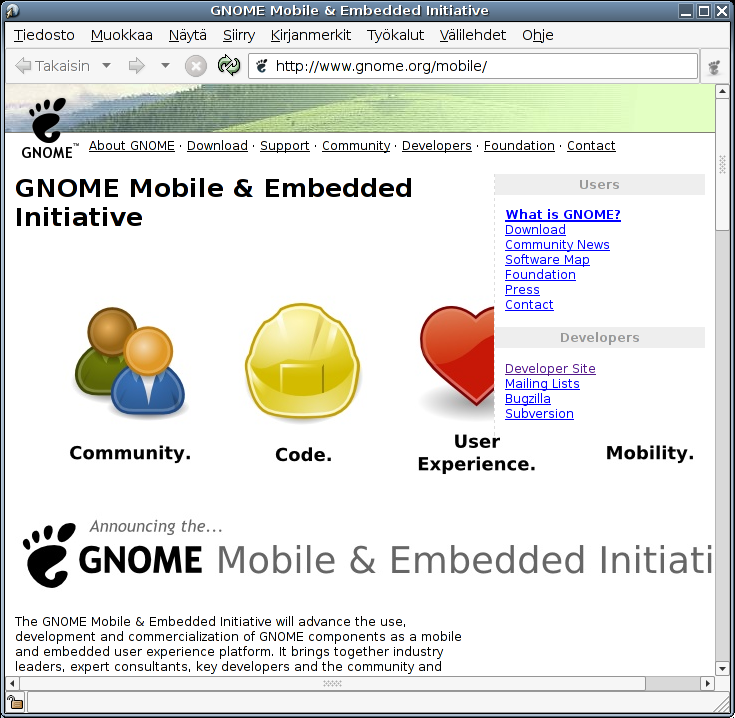
The GNOME project announced a GNOME Mobile & Embedded Initiative today. Here's a screenshot of the browser on my laptop of the web page:
screenshot
What's wrong with the above picture? The browser window is around 700 pixels wide, which about as wide as you'd get on, say, an N800 Internet tablet gadget. Significant parts of the web page are unreadable. I have to go to about a thousand pixels wide to get the whole page be visible. This is no way to design pages for a mobile environment. Other than that, it's obviously good. Not worth the hype, not worth keeping secret for months before the big revelation, but a good thing nevertheless.

Alastair McKinstry: Cool Stars: Brown dwarfs as pulsars

Super Aurora, believed to cause brown dwarf pulsations
Artist's impression of the "super-aurorae" present at the magnetic poles of these radio emitting dwarfs which are responsible for the radio pulsations. (Image thanks to Gregg Hallinan, NUI Galway).
As a followup to the talk given at Galway Astrofest 2007 by Dr. Aaron Golden on work done by the Cool Stars research Group here at NUIG, the detail of this work were announced this week at the RAS National Astronomy Meeting 2007. Other press releases can be found at Spaceflight Now, and NRAO, though the best summary is probably at the NUIG Webpage (Thanks to Ronan Newman for the links). Kudos to all involved: Gregg and Stephen are currently writing up their PhDs and should have an interesting dissertions from this. Basically, they discovered that some Brown Dwarfs can act as Pulsars, blasting out huge amounts of radio-wave energy. Brown Dwarfs are objects between 'Planet' and 'Star' in mass terms, often thought of as boring failed stars, not large enough to ignite into fusion. They were thought by most to be highly boring : this discovery was completely unexpected. As the group in Galway has a lot of pulsar experience, they were well set to explain this. It looks as though this phenomena is due to a 'coherent maser' : an effect seen in large planets such as Jupiter, where the magnetic field spins up electrons from a solar wind. Certainly, it makes Brown Dwarfs, undiscovered until 1994 but thought to be widespread across the universe, more interesting things to look at.

18 April 2007

Jos Parrella: Sobre moderaci n en Planeta Linux

Desde su concepci n, Planeta Linux ha exhortado a sus participantes a sindicar contenido exclusivamente relacionado con tecnolog a, computaci n, software libre y Linux, en orden incremental de preferencia. Pronto se determin que la exhortaci n no era suficiente y se pas al requerimiento. H ctor Colina y Milton Mazzarri, por nombrar dos venezolanos, estuvieron involucrados en los Lineamientos y las Preguntas Frecuentes de Planeta Linux Venezuela. Como para ese momento ya hab amos hecho un grupo inicial de “venezolanos con blog que hablan de Linux” (b sicamente gente de VELUG, SOLVE, Debian Venezuela y de unplug.org.ve), no tuvimos la oportunidad de requerirles que tuvieran una categor a dedicada a Planeta Linux. A las nuevas personas que se inscrib an por la lista, en ocasiones se les requer a la categor a si su blog conten a, a primera vista, contenido no relacionado con Linux. En todos los casos, se requer a estar de acuerdo con los Lineamientos. En el caso de las personas que me solicitaban a mi directamente (que desde hace no mucho tengo acceso al SVN de Planeta Linux) yo les requer a una categor a particular, a menos de que su software no lo permitiera. En este ltimo caso, muy a pesar de los quejones de oficio, elimin bamos a la persona de PL. Es el caso de Luigino Bracci, quien en alguna ocasi n lleg a llenar todo Planeta Linux con contenido pol tico parcializado, y quien manifest que su sistema de blogs no le permit a agregar categor as. Hay casos en los que una persona que escribe poco o que suele escribir de Linux llega y hace algun desastre al estilo Alberto Capella con su foto a tama o gigante. En esos casos alguien se da cuenta y me avisa (aunque es un error, al final de la p gina hay direcciones de contacto y en Venezuela somos varios que administramos!) pero estoy involucrado en muchas cosas como para dar respuesta inmediata a ese tipo de casos. Y ah viene otro problema. En Planeta Linux NO PODEMOS moderar un post o a una persona. Solo podemos suspenderlo o eliminarlo. No podemos borrar una imagen ni un post ni nada, porque en 15 minutos perdemos los cambios. Espero que eso de algunas luces cuando haya algo de que quejarse en Planeta Linux. El ltimo caso es particular. Jes s Lara hizo varios posts no relacionados con Linux en su blog. Particularmente hubo gente que reclam que hab an recien escrito algo relacionado con Linux y los posts de Jes s “empujaron” los posts relacionados con Linux hacia el final del Planeta. Por lo tanto suspendi la suscripci n de Jes s y lo contact el 9 de Abril. Cre una categor a y me lo comunic . Eso es suficiente para volver a reactivar su suscripci n (en este caso me tard unos d as porque el commit fall y nunca me enter de ello, ni Jes s me lo inform , realmente) Ya hay mucha gente que sindica categor as en PL, y pronto ser n muchos m s. Cont ctenme si quieren hacer el proceso pronto. Por favor, la pr xima vez que encuentren un problema en Planeta Linux:

David Welton: Startups and Pronouns

Aside from Paul Graham's list of reasons not to do a startup on your own (http://www.paulgraham.com/startupmistakes.html), there's another very simple one: pronouns. It's much, much nicer to be able to write "we" on a corporate web site. "We" could be anything from 2 to IBM's zillions, but it implies a real organization, whereas "I" implies some guy off working on his own. Of course, you could lie and write "we", but that will probably catch up with you at an inopportune moment.

Bastian Venthur: What about a contest for the next debian.org theme?

Currently there is a discussion about a new theme for debian.org going on on -www. Some people presented their ideas and build some mockups while others commented them. I strongly suggest to let some professional designers and other (not necessarily Debian related) talented people create some mockups, to avoid moving from one outdated and rusty design to the next. I wonder if we couldn’t open up the process a bit by starting some kind of contest. Skilled webdesigners could create some mockups and we could collect all those and let a vote decide which one to keep.

Biella Coleman: The Importance of Celebration

Recently a Debian user left a really nice note letting me know “It makes
me happy and proud to learn that boricuas are Debian developers! (Hopefully you are not the only one). This is for me the best Debian News since Etch released. Proud and happy for you.” Here I have to confess, however that I am neither a DD nor really a true Boriqua. I have studied Debian for many years, but have never officially joined. In terms of PR, none of my family is originally from there as my father is Jewish American and my mom was born in Russian, wandered as war refugee for many years in Europe and eventually landed in Venezuela, where I was born. But I have made my home in PR for many years and do consider it one of my many homes. Speaking of many homes, I also feel, even though I am not a DD, that Debian is an important touchstone in my life. It reminded me of a conversation I had with Manoj recently related to this topic, who almost mistook me for a DD: [biella] who is that DD that wrote an anthro thesis on debian? [08:55]
[biella] he is brazilian [manoj] I was gonna say that the dd who did an anthro thesis on debian
was you, then it struck me that you are not a dd, but I still
think of you as one now, and then it struck me further that
making you a dd might compromise your postiion as an observer After many years following the project, I have grown quite attached to it, and every year, a few months before Debconf I am reminded of this attachment. I have managed to make Debconf only every other year, and usually when I face this fact, a sense of melancholia and slight sadness sets in, especially when I hear of everyone making plans to go. I always start to question my decision to stay back, then hit all sorts of websites for cheap tickets, and start to wonder if I can perhaps manage to complete some work there, which is the main reason this year I am staying away. I then make myself confront REALITY and remind myself that the whole reason I love attending Debconf is because of its extreme vitality, which after a week, leaves you wrung out and tired, because you put so much of your attention and mind, soul and heart in the events. So even if I go for a week, or longer, you usually need a week ore more to recover. I am not sure I can spare such time this year, especially since less than a month after Debconf, I am packing my bags and moving back to the east coast of the United States. And as I learned last year and the year before and two years before, these sorts of long-distance moves take a lot of your time. My longing reminds me of how important it is to celebrate those things in life you love. And while there is more to Debconf than a celebration, much of it is just that, a chance, a space, a place by which and where you celebrate. And since I sit only in the shadows of Debian, I imagine the pleasure and joy runs deeper and wider for those who sit at its heart. So if you are on the fence on whether to go, this is your friendly public service announcement that it is, indeed, so worth your while.

Jordi Mallach: Debian's GNOME 2.18: are we there yet?

The short answer is no, but as our status page easily reflects, there has been lots of work going on during the last two weeks, once etch's release unblocked the way to upload new versions to unstable. This post intends to resume the trend of updating on the status of GNOME in Debian, after we ended up deciding we'd ship etch with 2.14 for a number of reasons, most notably some complications with the GTK 2.10 transition at that time. You'll be able to find other related news items in Debian GNOME team's website. What has the Debian GNOME team up to during the last 6 months? Our first priority was to focus on unstable's GNOME 2.14 packages again, in an attempt to fix any outstanding remaining bugs from our packaging, and get them in the best shape possible to deliver a polished GNOME desktop for etch. I think the result is really good, and Debian's default GNOME desktop is both very usable and attractive. In parallel, the preparations for a complete set of GNOME 2.16 packages continued in our Subversion repository and kept appearing, little by little, in experimental. The most visible consequence of our 2.16 efforts translated into nobse's backport of 2.16 for etch, which can be found in the corresponding repository. And then, with etch deep frozen and nearly ready to be released, GNOME 2.18 was released, and of course the GNOME team didn't wait too much to start working on it. Our current status is looking good: the Developer Platform is already available in unstable, although buildd's are fighting the builds on various architectures. When the dust settles (GTK 2.10's landing has generated quite a big cloud; we have a list of packages that still haven't completed the GTK+ 2.10 transition), we'll be able to prepare and upload the more complex Desktop components like the panel, nautilus, evolution or control-center. Unstable users should probably be seeing daily progress on this front, so keep an eye on your package managers! Although Debian 4.0 released with an old version of GNOME, vast amounts of time and work have been invested to release it with the necessary backported fixes and enhancements. The newer GNOME versions have been available in Debian official ftp archives in very reasonable timeframes; this has only been possible thanks to the restless efforts of the (fortunately) growing Debian GNOME team members: giskard, feedback, HE, lool, np237, slomo, shaka, sjoerd, xaiki and not forgetting our incredible bug triager, svena. Thanks! On the behind the scenes department, it's a pleasure to report that Lo c Minier and Jordi Mallach very recently joined the GNOME Foundation's board of advisors in representation of the Debian Project, replacing Matthew Garrett, who has been representing us for the last few years until he left the project. Thanks, Matthew!

Next.

Previous.