I intend to intend to package pump.io for Debian. It's going to take a
long time, but I don't know whether that's weeks or years yet. The
world needs decentralized social networking.
I discovered the tools that let me create this
wiki summary of the progress in pump.io packaging. There are at
least 35 dependencies that need uploading, so this would go a lot
faster if it weren't a solo effort - if anyone else has some time,
please let me know! But meanwhile I'm hoping to build some
momentum.
I think it's important to keep the quality of the packaging as high
as possible, even while working through so many. It would cost a lot
of time later if I had to go back and fix bugs in everything. I
really want to be running the test suites in these builds, but it's
not always easy.
One of the milestones along the way might be packaging
nodeunit. Nodeunit is a Nodejs unit testing framework (duh), used
by node-bcrypt (and, unrelatedly, statsd, which would be pretty cool
to have in Debian too). Last night I filed eight pull requests
to try and fix up copyright/licensing issues in dependencies of nodeunit.
Missing copyright statements are one of the few things I can't fix
by myself as a packager. All I can do is wait, and package other
dependencies in the meantime. Fortunately there are plenty of
those.
And I have not seen so many issues in direct dependencies of
pump.io itself - or at least they've been fixed in git.
So I previously talked about the setup behind Debian Administration, and my complaints about the slownes.
The previous post talked about the logical setup, and the hardware. This post talks about the more interesting thing. The code.
The code behind the site was originally written by Denny De La Haye. I found it and reworked it a lot, most obviously adding structure and test cases.
Once I did that the early version of the site was born.
Later my version became the official version, as when Denny setup Police State UK he used my codebase rather than his.
So the code huh? Well as you might expect it is written in Perl. There used to be this layout:
Almost every request would hit the index.cgi script, which would parse the request and return the appropriate output via the standard CGI interface.
How did it know what you wanted? Well sometimes there would be a paramater set which would be looked up in a dispatch-table:
/cgi-bin/index.cgi?article=40         - Show article 40
/cgi-bin/index.cgi?view_user=Steve    - Show the user Steve
/cgi-bin/index.cgi?recent_comments=10 - Show the most recent comments.
Over time the code became hard to update because there was no consistency, and over time the site became slow because this is not a quick setup. Spiders, bots, and just average users would cause a lot of perl processes to run.
So? What did I do? I moved the thing to using FastCGI, which avoids the cost of forking Perl and loading (100k+) the code.
Unfortunately this required a bit of work because all the parameter handling was messy and caused issues if I just renamed index.cgi -> index.fcgi. The most obvious solution was to use one parameter, globally, to specify the requested mode of operation.
Hang on? One parameter to control the page requested? A persistant environment? What does that remind me of? Yes. CGI::Application.
I started small, and pulled some of the code out of index.cgi + Pages.pl, and over into a dedicated CGI::Application class:
Application::Feeds - Called via /cgi-bin/f.fcgi.
Application::Ajax - Called via /cgi-bin/a.fcgi.
So now every part of the site that is called by Ajax has one persistent handler, and every part of the site which returns RSS feeds has another.
I had some fun setting up the sessions to match those created by the old stuff, but I quickly made it work, as this example shows:
The final job was the biggest, moving all the other (non-feed, non-ajax) modes over to a similar CGI::Application structure. There were 53 modes that had to be ported, and I did them methodically, first porting all the Poll-related requests, then all the article-releated ones, & etc. I think I did about 15 a day for three days. Then the rest in a sudden rush.
In conclusion the code is now fast because we don't use CGI, and instead use FastCGI.
This allowed minor changes to be carried out, such as compiling the HTML::Template templates which determine the look and feel, etc. Those things don't make sense in the CGI environment, but with persistence they are essentially free.
The site got a little more of a speed boost when I updated DNS, and a lot more when I blacklisted a bunch of IP-space.
As I was wrapping this up I realized that the code had accidentally become closed - because the old repository no longer exists. That is not deliberate, or intentional, and will be rectified soon.
The site would never have been started if I'd not seen Dennys original project, and although I don't think others would use the code it should be possible. I remember at the time I was searching for things like "Perl CMS" and finding Slashcode, and Scoop, which I knew were too heavyweight for my little toy blog.
In conclusion Debian Administration website is 10 years old now. It might not have changed the world, it might have become less relevant, but I'm glad I tried, and I'm glad there were years when it really was the best place to be.
These days there are HowtoForges, blogs, spam posts titled "How to install SSH on Trusty", "How to install SSH on Wheezy", "How to install SSH on Precise", and all that. No shortage of content, just finding the good from the bad is the challenge.
Me? The single best resource I read these days is probably LWN.net.
Starting to ramble now.
Go look at my quick hack for remote command execution https://github.com/skx/nanoexec ?
A lecture at LCA 2011 which included some inappropriate slides was followed by long discussions on mailing lists. In February 2011 I wrote a blog post debunking some of the bogus arguments in two lists [1]. One of the noteworthy incidents in the mailing list discussion concerned Ted Ts o (an influential member of the Linux community) debating the definition of rape. My main point on that issue in Feb 2011 was that it s insensitive to needlessly debate the statistics.
Recently Valerie Aurora wrote about another aspect of this on The Ada Initiative blog [2] and on her personal blog. Some of her significant points are that conference harassment doesn t end when the conference ends (it can continue on mailing lists etc), that good people shouldn t do nothing when bad things happen, and that free speech doesn t mean freedom from consequences or the freedom to use private resources (such as conference mailing lists) without restriction.
Craig Sanders wrote a very misguided post about the Ted Ts o situation [3]. One of the many things wrong with his post is his statement I m particularly disgusted by the men who intervene way too early without an explicit invitation or request for help or a clear need such as an immediate threat of violence in womens issues .
I believe that as a general rule when any group of people are involved in causing a problem they should be involved in fixing it. So when we have problems that are broadly based around men treating women badly the prime responsibility should be upon men to fix them. It seems very clear that no matter what scope is chosen for fixing the problems (whether it be lobbying for new legislation, sociological research, blogging, or directly discussing issues with people to change their attitudes) women are doing considerably more than half the work. I believe that this is an indication that overall men are failing.
Asking for Help
I don t believe that members of minority groups should have to ask for help. Asking isn t easy, having someone spontaneously offer help because it s the right thing to do can be a lot easier to accept psychologically than having to beg for help. There is a book named Women Don t Ask which has a page on the geek feminism Wiki [4]. I think the fact that so many women relate to a book named Women Don t Ask is an indication that we shouldn t expect women to ask directly, particularly in times of stress. The Wiki page notes a criticism of the book that some specific requests are framed as complaining , so I think we should consider a complaint from a woman as a direct request to do something.
The geek feminism blog has an article titled How To Exclude Women Without Really Trying which covers many aspects of one incident [5]. Near the end of the article is a direct call for men to be involved in dealing with such problems. The geek feminism Wiki has a page on Allies which includes Even a blog post helps [6]. It seems clear from public web sites run by women that women really want men to be involved.
Finally when I get blog comments and private email from women who thank me for my posts I take it as an implied request to do more of the same.
One thing that we really don t want is to have men wait and do nothing until there is an immediate threat of violence. There are two massive problems with that plan, one is that being saved from a violent situation isn t a fun experience, the other is that an immediate threat of violence is most likely to happen when there is no-one around to intervene.
Men Don t Listen to Women
Rebecca Solnit wrote an article about being ignored by men titled Men Explain Things to Me [7]. When discussing women s issues the term Mansplaining is often used for that sort of thing, the geek feminism Wiki has some background [8]. It seems obvious that the men who have the greatest need to be taught some things related to women s issues are the ones who are least likely to listen to women. This implies that other men have to teach them.
Craig says that women need space to discover and practice their own strength and their own voices . I think that the best way to achieve that goal is to listen when women speak. Of course that doesn t preclude speaking as well, just listen first, listen carefully, and listen more than you speak.
Craig claims that when men like me and Matthew Garrett comment on such issues we are making women s spaces more comfortable, more palatable, for men . From all the discussion on this it seems quite obvious that what would make things more comfortable for men would be for the issue to never be discussed at all. It seems to me that two of the ways of making such discussions uncomfortable for most men are to discuss sexual assault and to discuss what should be done when you have a friend who treats women in a way that you don t like. Matthew has covered both of those so it seems that he s doing a good job of making men uncomfortable I think that this is a good thing, a discussion that is comfortable and palatable for the people in power is not going to be any good for the people who aren t in power.
The Voting Aspect
It seems to me that when certain issues are discussed we have a social process that is some form of vote. If one person complains then they are portrayed as crazy. When other people agree with the complaint then their comments are marginalised to try and preserve the narrative of one crazy person. It seems that in the case of the discussion about Rape Apology and LCA2011 most men who comment regard it as one person (either Valeria Aurora or Matthew Garrett) causing a dispute. There is even some commentary which references my blog post about Rape Apology [9] but somehow manages to ignore me when it comes to counting more than one person agreeing with Valerie. For reference David Zanetti was the first person to use the term apologist for rapists in connection with the LCA 2011 discussion [10]. So we have a count of at least three men already.
These same patterns always happen so making a comment in support makes a difference. It doesn t have to be insightful, long, or well written, merely I agree and a link to a web page will help. Note that a blog post is much better than a comment in this regard, comments are much like conversation while a blog post is a stronger commitment to a position.
I don t believe that the majority is necessarily correct. But an opinion which is supported by too small a minority isn t going to be considered much by most people.
The Cost of Commenting
The Internet is a hostile environment, when you comment on a contentious issue there will be people who demonstrate their disagreement in uncivilised and even criminal ways. S. E. Smith wrote an informative post for Tiger Beatdown about the terrorism that feminist bloggers face [11]. I believe that men face fewer threats than women when they write about such things and the threats are less credible. I don t believe that any of the men who have threatened me have the ability to carry out their threats but I expect that many women who receive such threats will consider them to be credible.
The difference in the frequency and nature of the terrorism (and there is no other word for what S. E. Smith describes) experienced by men and women gives a vastly different cost to commenting. So when men fail to address issues related to the behavior of other men that isn t helping women in any way. It s imposing a significant cost on women for covering issues which could be addressed by men for minimal cost.
It s interesting to note that there are men who consider themselves to be brave because they write things which will cause women to criticise them or even accuse them of misogyny. I think that the women who write about such issues even though they will receive threats of significant violence are the brave ones.
Not Being Patronising
Craig raises the issue of not being patronising, which is of course very important. I think that the first thing to do to avoid being perceived as patronising in a blog post is to cite adequate references. I ve spent a lot of time reading what women have written about such issues and cited the articles that seem most useful in describing the issues. I m sure that some women will disagree with my choice of references and some will disagree with some of my conclusions, but I think that most women will appreciate that I read what women write (it seems that most men don t).
It seems to me that a significant part of feminism is about women not having men tell them what to do. So when men offer advice on how to go about feminist advocacy it s likely to be taken badly. It s not just that women don t want advice from men, but that advice from men is usually wrong. There are patterns in communication which mean that the effective strategies for women communicating with men are different from the effective strategies for men communicating with men (see my previous section on men not listening to women). Also there s a common trend of men offering simplistic advice on how to solve problems, one thing to keep in mind is that any problem which affects many people and is easy to solve has probably been solved a long time ago.
Often when social issues are discussed there is some background in the life experience of the people involved. For example Rookie Mag has an article about the street harassment women face which includes many disturbing anecdotes (some of which concern primary school students) [12]. Obviously anyone who has lived through that sort of thing (which means most women) will instinctively understand some issues related to threatening sexual behavior that I can t easily understand even when I spend some time considering the matter. So there will be things which don t immediately appear to be serious problems to me but which are interpreted very differently by women. The non-patronising approach to such things is to accept the concerns women express as legitimate, to try to understand them, and not to argue about it. For example the issue that Valerie recently raised wasn t something that seemed significant when I first read the email in question, but I carefully considered it when I saw her posts explaining the issue and what she wrote makes sense to me.
I don t think it s possible for a man to make a useful comment on any issue related to the treatment of women without consulting multiple women first. I suggest a pre-requisite for any man who wants to write any sort of long article about the treatment of women is to have conversations with multiple women who have relevant knowledge. I ve had some long discussions with more than a few women who are involved with the FOSS community. This has given me a reasonable understanding of some of the issues (I won t claim to be any sort of expert). I think that if you just go and imagine things about a group of people who have a significantly different life-experience then you will be wrong in many ways and often offensively wrong. Just reading isn t enough, you need to have conversations with multiple people so that they can point out the things you don t understand.
This isn t any sort of comprehensive list of ways to avoid being patronising, but it s a few things which seem like common mistakes.
Anne Onne wrote a detailed post advising men who want to comment on feminist blogs etc [13], most of it applies to any situation where men comment on women s issues.
Hi Everybody!
I have been keeping very busy on this blog the past few days with some very exciting updates! Everything is now in place for my Google Summer of Code project! Elektra now has the ability to merge KeySets, ucf has been patched to allow custom merge commands, we included a new elektra-merge script to use in conjunction with the new ucf command, and we wrote a great tutorial on how to use Elektra to merge configuration files in any package using ucf. There are few things I have missed updating you all on or are still wrapping up.
First of all, I would like to address the Debian packages. While Elektra includes everything needed for my Google Summer of Code Project, it must be built from source right now. Unfortunately, with the rapid development Elektra has seen the past few months, we did not pay enough attention to the Debian packages and they became dusty and riddles with bugs. Fortunately, we have a solution and his name is Pino Toscano. Pino has, very graciously, agreed to help us fix our Debian packages back into shape. If you wish to see the current progress of the packages, you can check his repo. Pino has already made fantastic progress creating the Debian packages. I will post here when packages are all fixed up and the latest versions of Elektra are into the Debian repo.
Some great news that we just received is that Elektra 0.8.7 has just been accepted into Debian unstable! This is huge progress for our team and means that users can now download our packages directly from Debian s unstable repo and test out these new features. Obviously, the normal caveats apply for any packages in unstable but this is still an amazing piece of news and I would like to thank Pino again for all the support he has provided.
Another worthy piece of news that I unfortunately haven t had time to cover is that thanks to Felix Berlakovich Elektra has a new plug-in called ini. In case you couldn t guess, this new plug-in is used to mount ini files and the good news is that it is a vast improvement on our older simpleini plug-in. While it is still a work in progress, this new plug-in is much more powerful than simpleini. The new plug-in supports section and comments and works with many more ini files than the old plug-in. You may have noticed that I used this new plug-in to mount smb.conf in my technical demo of Samba using Elektra from configuration merging. Since smb.conf follows the same syntax as an ini file this new plug-in works great for mounting this file into the Elektra Key Database.
I hope my blogs so far have been very informative and helpful.
Sincerely,
Ian S. Donnelly
A new upstream release of the Eigen C++ template
library for linear algebra was released a few days ago. And Yixuan Qiu did some
really nice work rolling this into a new
RcppEigen released
and then sent me a nice pull requent. The new version is now on
CRAN, and I will prepare a
Debian in a moment too.
Upstream changes for Eigen are
summarized in their changelog.
On the RcppEigen
side, Yixuan also rolled in some more changes on as() and
wrap() converters as noted below in the NEWS entry.
Changes in RcppEigen version 0.3.2.2.0 (2014-08-19)
Updated to version 3.2.2 of Eigen
Rcpp::as() now supports the conversion from R vector
to row array , i.e., Eigen::Array<T, 1,
Eigen::Dynamic>
Rcpp::as() now supports the conversion from
dgRMatrix (row oriented sparse matrices, defined in Matrix package) to Eigen::MappedSparseMatrix<T,
Eigen::RowMajor>
Conversion from R matrix to Eigen::MatrixXd and
Eigen::ArrayXXd using Rcpp::as() no longer gives
compilation errors
Recently I've been getting annoyed with the Debian Administration website; too often it would be slower than it should be considering the resources behind it.
As a brief recap I have six nodes:
1 x MySQL Database - The only MySQL database I personally manage these days.
4 x Web Nodes.
1 x Misc server.
The misc server is designed to display events. There is a node.js listener which receives UDP messages and stores them in a rotating buffer. The messages might contain things like "User bob logged in", "Slaughter ran", etc. It's a neat hack which gives a good feeling of what is going on cluster-wide.
I need to rationalize that code - but there's a very simple predecessor posted on github for the curious.
Anyway enough diversions, the database is tuned, and "small". The misc server is almost entirely irrelevent, non-public, and not explicitly advertised.
So what do the web nodes run? Well they run a lot. Potentially.
Each web node has four services configured:
Apache 2.x - All nodes.
uCarp - All nodes.
Pound - Master node.
Varnish - Master node.
Apache runs the main site, listening on *:8080.
One of the nodes will be special and will claim a virtual IP provided via ucarp. The virtual IP is actually the end-point visitors hit, meaning we have:
Master Host
Other hosts
Running:
Apache.
Pound.
Varnish
Running:
Apache.
Pound is configured to listen on the virtual IP and perform SSL termination. That means that incoming requests get proxied from "vip:443 -> vip:80". Varnish listens on "vip:80" and proxies to the back-end apache instances.
The end result should be high availability. In the typical case all four servers are alive, and all is well.
If one server dies, and it is not the master, then it will simply be dropped as a valid back-end. If a single server dies and it is the master then a new one will appear, thanks to the magic of ucarp, and the remaining three will be used as expected.
I'm sure there is a pathological case when all four hosts die, and at that point the site will be down, but that's something that should be atypical.
Yes, I am prone to over-engineering. The site doesn't have any availability requirements that justify this setup, but it is good to experiment and learn things.
So, with this setup in mind, with incoming requests (on average) being divided at random onto one of four hosts, why is the damn thing so slow?
We'll come back to that in the next post.
(Good news though; I fixed it ;)
Yesterday, I spent most of the day finishing up the multiarch work I'd
been doing on introducing
multiarch to the eID middleware, and did another release of the Linux
builds. As such, it's now possible to install 32-bit versions of the eID
middleware on a 64-bit Linux distribution. For more details, please see
the
announcement.
Learning how to do multiarch (or biarch, as the case may be) for three
different distribution families has been a, well, learning experience.
Being a Debian Developer, figuring out the technical details for doing
this on Debian and its derivatives wasn't all that hard. You just make
sure the libraries are installed to the multiarch-safe directories
(i.e., /usr/lib/<gnu arch triplet>), you add some
Multi-Arch: foreign or Multi-Arch: same headers where appropriate,
and you're done. Of course the devil is in the details (define "where
appropriate"), but all in all it's not that difficult and fairly
deterministic.
The Fedora (and derivatives, like RHEL) approach to biarch is that
64-bit distributions install into /usr/lib64 and 32-bit distributions
install into /usr/lib. This goes for any architecture family, not just
the x86 family; the same method works on ppc and ppc64. However, since
fedora doesn't do powerpc anymore, that part is a detail of little
relevance.
Once that's done, yum has some heuristics whereby it will prefer
native-architecture versions of binaries when asked, and may install
both the native-architecture and foreign-architecture version of a
particular library package at the same time. Since RPM already has
support for installing multiple versions of the same package on the same
system (a feature that was originally created, AIUI, to support the
installation of multiple kernel versions), that's really all there is to
it. It feels a bit fiddly and somewhat fragile, since there isn't really
a spec and some parts seem fairly undefined, but all in all it seems to
work well enough in practice.
The openSUSE approach is vastly different to the other two. Rather than
installing the foreign-architecture packages natively, as in the Debian
and Fedora approaches, openSUSE wants you to take the native
foo.ix86.rpm package and convert that to a foo-32bit.x86_64.rpm
package. The conversion process filters out non-unique files (only
allows files to remain in the package if they are in library
directories, IIUC), and copes with the lack of license files in
/usr/share/doc by adding a dependency header on the native package.
While the approach works, it feels like unnecessary extra work and
bandwidth to me, and obviously also wouldn't scale beyond biarch.
It also isn't documented very well; when I went to openSUSE IRC channels
and started asking questions, the reply was something along the lines of
"hand this configuration file to your OBS
instance". When I told them I wasn't actually using OBS and had no plans
of migrating to it (because my current setup is complex enough as it is,
and replacing it would be far too much work for too little gain), it
suddenly got eerily quiet.
Eventually I found out that the part of OBS which does the actual build
is a separate codebase, and
integrating just that part into my existing build system was not that
hard to do, even though it doesn't come with a specfile or RPM package
and wants to install files into /usr/bin and /usr/lib. With all that
and some more weirdness I've found in the past few months that I've been
building packages for openSUSE I now have... Ideas(TM) about how
openSUSE does things. That's for another time, though.
(disclaimer: there's a reason why I'm posting this on my personal blog
and not on an official website... don't take this as an official
statement of any sort!)
I still consider myself a newbie teacher. I'm just starting my fourth semester. And yes, I really enjoy it.
Now, how did I come to teaching? Well, my training has been mostly on stages for different conferences. More technical, more social, whatever I have been giving ~10 talks a year for ~15 years, and I must have learnt something from that.
Some good things, some bad habits.
When giving presentations, a most usual technique is to prepare a set of slides to follow/support the ideas. And yes, that's what I did for my classes: Since my first semester, I prepared a nice set of slides, thematically split in 17 files, with ~30 to ~110 pages each (yes, huge variation). Given the course spans 32 classes (72 hours, 2 hours per class), each slide lasts for about two classes.
But, yes, this tends to make the class much less dynamic, much more scripted, rigid, and... Boring. From my feedback, I understand the students don't think I am a bad teacher, but still, I want to improve!
So, today I was to give the introduction to memory management. Easy topic, with few diagrams and numbers, mostly talking about the intuitive parts of a set of functions. I started scribbling and shortening the main points on a piece of paper (yes, the one on the picture). I am sure I can get down to more reduction But this does feel like an improvement!
The class was quite successful. I didn't present the 100% of the material (which is one of the reasons I cling to my presentations I don't want to skip important material), and at some point I do feel I was a bit going in circles. However, Operating Systems is a very intuitive subject, and getting the students to sketch by themselves the answers that describe the working of real operating systems was a very pleasant experience!
Of course, when I use my slides I do try to make it as interactive and collaborative as possible. But it is often unfeasible when I'm following a script. Today I was able to go around with the group's questions, find my way back to the outline I prepared.
I don't think I'll completely abandon my slides, specially for some subjects which include many diagrams or pictures. But I'll try to have this alternative closer to my mind.
Hi Everybody,
Today I wanted to talk a bit about our technical demo. We patched a version of Samba to use our elektra-merge script in order to handle it s configuration file smb.conf. Using the steps from my previous tutorial, we patched Samba to use this new technique of config merging. This patched version of Samba mounts it s configuration to system/samba/smb in the Elektra Key Database. Then, during package upgrades, it uses the new --threeway-merge-command command with elektra-merge as the specified command. The result is automatic handling of smb.conf that is conffile-like (thanks ucf!) and the ability to have a powerful, automatic, three-way merge solution on package upgrades.
The main thing I would like to discuss is how this project is an improvement upon the current implementation of three-way merges in ucf. Before this project, ucf could attempt three-way merges on files it controlled using the diff3 tool. The main limitation of tools like diff3 are that they are line based and don t inherently understand the files they are dealing with. Elektra on the other hand allows for a powerful system of backends which use plug-ins to understand configuration files. Elektra doesn t store configuration data on a line-by-line basis, but in a more abstract way that is tailored to each configuration file using backends. smb.conf is a great example of this because it uses the syntax of an ini file so Elektra can mount it in a way that is intuitive to an ini file. Since data is stored in a format of key=data within ini files, Elektra stores this data in a similar way. For each key in smb.conf store a Key in Elektra with the value of that key store in a string. Then, during a merge, we can compare Keys in each version of smb.conf and easily see which ones changed and how they need to be merged into the result. On the other hand, diff3 has no concept of ini files or keys, it just compares the different versions line by line which results in many more conflicts than using elektra-merge. Moreover, a traditional weakness of diff is moving lines or data around. While diff3 does a very good job at handling this, it s not perfect. In Elektra, Keys are named in an intelligent way based on their backend, so for smb.conf the line workgroup = HOME would always be saved under system/samba/smb/workgroup. It doesn t matter if the lines are changed between versions because Elektra just has to check for the Key and its value.
My favorite example is a shortcoming in the diff3 algorithm (at least in my opinion). If something is changed to the same value in ours and theirs, but they differ from base, diff3 reports a conflict. On the other hand elektra-merge can easily handle this problem. A simple example of this would be changing the max log size value in Samba. Here is that line in each version of smb.conf:
Base:

max log size = 1000

Ours:

max log size = 2000

Theirs:

max log size = 2000
Obviously, in the merged version, result, one would expect this line to be: max log size = 2000
Let s check the result from elektra-merge:
max log size = 2000
Great! How about diff3:
<<<<<<< smb.conf.base

max log size = 1000

=======

max log size = 2000

>>>>>>> smb.conf.theirs
Whoops! As I mentioned the diff3 algorithm can t handle this type of change, it just results in a conflict. Note that smb.conf.base is just representative of the file used as base and that smb.conf.theirs is representative of the file used as theirs. The file names were changed for the sake of clarity.
There are many other examples of the benefits to storing configuration data in a database of Keys that can better conform to actual data as opposed to storing configuration parameters in files where they can only be compared on a line to line basis. With the help of storage plug-ins, Elektra can understand the configurations stored in it s Key Database. Since we store the data in a way that makes sense for configuration data, we can easily merge actual configuration data as opposed to just lines in a file. A good example of this is in-line comments. Many of our storage plug-ins understand the difference between comments and actual configuration data. So if a configuration file has an inline comment like so:
max log size = 10000 ; Controls the size of the log file (in KiB) we can compare the actual Keys, value pairs between versions max log size = 10000 and deal with the comments separately.
As a result, if we have a base:
max log size = 1000 ; Size in KiB
Ours:
max log size = 10000 ; Size in KiB
Theirs:
max log size = 1000 ; Controls the size of the log file (in KiB)
The result using elektra-merge would be:
max log size = 10000 ; Controls the size of the log file (in KiB)
Obviously, this line would cause a conflict on any line-based merge algorithm such as diff3 or git. It is worth noting that the ability of elektra-merge is directly related to the quality of the storage plug-ins that Elektra relies on. elektra-merge only looks at the name, value, and any metadata affiliated with each key. As a result, using the line plug-in would result in a merge only as powerful as any other line-based merge. Yet by using the ini plug-in on an ini file we get a much more advanced merge like the one described above.
As you can tell, this new method offers clear advantages to the traditional method of using diff3 to handle configuration merges. Also, I hope this demo shows how easy it is to implement these great features into your Debian packages. The community can only benefit if maintainers take advantage of these great features. I am glad to say that my Google Summer of Code Project has been a success, even if we had to do a little change of plans. The ucf integration ended up working great and is really easy for maintainers to implement. Hope you enjoyed this demo and better understand the power of using Elektra.
Sincerely,
Ian S. Donnelly
I have received two MIPS Creator CI20 boards, thanks to Imagination Technologies. It s a small MIPS32 development board:
As you can see it comes in a nice packaging with a world-compatible power adapter. It uses a Ingenic JZ4780 SoC with a dual core MIPS32 CPU running at 1.2GHz with a PowerVR SGX540 GPU. The board is fitted with 1GB of RAM, 8GB of NOR flash, HDMI output, USB 2.0 ports, Ethernet + Wi-Fi + BlueTooth, SD card slot, IR receiver, expansion headers and more. The schematics are available. The Linux kernel and the U-Boot bootloader sources are also available.
Powering this board with a USB keyboard, a USB mouse and a HDMI display, it boots off the internal flash on a Debian Wheezy up to the XFCE environment. Besides the kernel, the Wi-Fi + Bluetooth firmware, and very few configuration changes, it runs a vanilla Debian. Unfortunately I haven t found time to play more with it yet, but it looks already quite promising.
The board has not been formally announced yet, so I do not know when it will become available, nor the price, but if you are interested I ll bring it to DebConf14. Don t hesitate to ask me if you want to look at it or play with it.
We ve been busy setting up a Virtual Machine (VM) image to be used by participants of a MOOC that s opening in early september on Relational Databases at Telecom SudParis.
We ve chosen to use Vagrant and VirtualBox which are used to build, distribute and run the box, providing scriptability (reproducibility) and making it portable on most operating systems.
The VM itself contains a Debian (jessie) minimal system which runs (in the background) PostgreSQL, Apache + mod_php, phpPgAdmin, and a few applications of our own to play with example databases already populated in PostgreSQL.
As the MOOC s language will be french, we expect the box to be used mostly on machines with azerty keyboards. This and other context elements led us to add some customizations (locale, APT mirror) in provisioning scripts run during the box creation.
At the moment, we generate 2 variants of the box, one for 32 bits kernel (i686) and one for 64 bits kernel (amd64) which (once compressed) represent betw. 300 and 350 Mb.
The resulting boxes are uploaded to a self-hosting site, and distributed through vagrantcloud. Once the VM are created in VirtualBox, the typical VMDK drives file is around 1.3Gb.
We use our own Debian base boxes containing a minimal Debian jessie/testing, instead of relying on someone else s, and recreate them using (the development branch version of) bootsrap-vz. This ensure we can put more trust in the content as it s a native Debian package installation without MITM intervention.
The VM are meant to be run headless for the moment, keeping their size to the minimum, even though we also provide a script to install and configure a desktop environment based on XFCE4.
The applications are either used through vagrant ssh, for instance for SQL command-line in psql, or in the Web browser, for our own Web based SQL exerciser, or phpPgAdmin (see a demo screencast (in french, w/ english subtitles)), which can then be used even off-line by the participants, which also means this requires no servers availability for our IT staff.
The MOOC includes a section on PHP + SQL programming, whose exercises can be performed using a shared sub-folder of /vagrant/ which allows editing on the host with the favourite native editor/IDE, while running PHP inside the VM s Apache + mod_php.
The sources of our environment are available as free software, if you re interested to replicate a similar environment for another project.
As we re still polishing the environment before the MOOC opening (on september 10th), I m not mentioning the box URLs but they shouldn t be too hard to find if you re investigating (refering to the fusionforge project s web site).
We don t know yet how suitable this environment will be for learning SQL and database design and programming, and if Vagrant will bring more difficulties than benefits. Still we hope that the participants will find this practical, allowing them to work on the lab / exercises whenever and wherever they chose, removing the pain of installing and configuring a RDBMS on their machines, or the need to be connected to a cloud or to our overloaded servers. Of course, one limitation will be the requirements on the host machines, that will need to be reasonably modern, in order to run a virtualized Linux system. Another is access to high bandwidth for downloading the boxes, but this is kind of a requirement already for downloading/watching the videos of the MOOC classes
Big thanks go to our intern St phane Germain, who joined us this summer to work on this virtualized environment.
Summer is cool in Mexico City.
It is cool because, unlike Spring, this is our rainy season And rains are very predictable. Almost every day we wake up with a gorgeous, clean, blue sky.
Cool, nice temperature, around 15 C. The sun slowly evaporates the rain throughout the morning; when I go out for lunch, the sky is no longer so blue, giving way to a seemingly dirty white/grayish tint. No, it's not our world-famous pollution: It's just yesterday's rain.
Rain starts falling usually between 4 and 7 PM. Sometimes it starts as a light rain, sometimes it starts with all of its thunder, all of its might. But anyway, almost every night, there is a moment of awe, of not believing how much rain we are getting today.
It slowly fades away during the late night. And when I wake up, early next morning, everything is wet and still smells fresh.
Yes, I love our summer, even though it makes shy away from my much enjoyed cycling to work and school. And I love taking some minutes off work, look through the window of my office (located ~70m over the level of our mostly flat city) and watching how different parts of the city have sun or rain; learning to estimate the distance to the clouds, adding it to the direction and guessing which of my friends have which weather.
But I didn't realize our city had so clearly defined micro-climates... (would they really be *micro*-climates?) In fact, it even goes against my knowledge of Mexico City's logic I always thought Coyoac n, towards the South of the city, got more rain than the Center and North because we are near the mountains, and the dominant air currents go Southwards, "clumping" the clouds by us.
But no, or at least, not this year. Regina (still in the far South Far because she's too far away from me and I'm too egocentric; she returns home after DebConf) often asks me about the weather, as our friends working nearer the center of the city. According to the photos they post on their $social_media_of_the_day accounts, rains are really heavier there.
Today I heard on the radio accounts of yesterday's chaos after the rain. This evening, at ESIME-Culhuac n, I saw one of the reported fallen trees (of course, I am not sure if it's from yesterday's rain). And the media pushes galleries of images of a city covered in hail... While in Copilco we only had a regular rain, I'd even say a mild one.
This city is bigger than any cloud you can throw at it.
Debian LTS - impressions and thoughts from my first month involvement
About LTS - we want feedback and more companies supporting it financially
Squeeze LTS, and even more Debian LTS, is a pretty young project, started in May 2014, so it's still a bit unclear where exactly we'll be going One purpose of this post is to spread some information about the initiative and invite you to tell us what you think about it or what your needs are.
LTS stands for "Long Term Support" and the goal of the project is to extend the security support for Squeeze (aka the current oldstable distribution) by two years. If it weren't for Squeeze LTS, the security support for it would have been stopped in May 2014 (=one year after the release of the current stable distribution), which for many is a too short timespan after it's release in February 2011. It's an experiment, we hope that there will be a similar Wheezy LTS initiative in future, but the future is unwritten and things will change based on our experiences and your needs.
If you have feedback on the direction LTS should take (or anything else LTS related), please comment on the lts mailing list. For immediate feedback there is also the #debian-lts IRC channel.
Another quite pragmatic way to express your needs is to read more about how to financially contribute to LTS and then doing exactly that - and unsurprisingly we are prioritizing the updates based on the needs expressed from our paying customers.
My LTS work in July 2014
So, "somehow" I started working for money on Debian LTS in July, which means there were 10h I got paid, and probably another 10h where I did LTS related work unpaid. I used those to release four updates for squeeze-lts (linux-2.6, file, munin and reportbug) fixing 22 CVEs in total.
The unpaid work was mostly spent on unsuccessfully working on security updates and on adding support for LTS to the security team tracker, which I improved but couldn't fully address and which I haven't properly shared / committed yet... but at least I have a local instance of the tracker now, which - for LTS - is more useful than the .debian.org one. Hopefully during DebConf14 we'll manage to fix the tracker for good.
Without success I've looked at libtasn1-3 (where the first fixes applied easily but then the code had changed too much from what was in squeeze compared to the available patches that I gave up) and libxstream-java (which is at version 1.3, while patches exist for upstream branches 1.4 and 2.x, but those need newer java to build and maybe if I'll spend two more hours I'll can get it build and then I'll have to find a useful test case, which looked quite difficult on a brief look.. so maybe I give up on libxstream-java too.... OTOH, if you use it and can do some testing, please do tell me.
Working on all these updates turned out to be more team work than expected and a lot of work involving code (which I did expect), and often code which I'd normally not look at... similarily with tools: one has to deal with tools one doesnt like, eg I had to install cdbs... And as I usually like challenges, this has actually been a lot of fun! Though it's also pretty cool to use common best practices, easy and understandable workflows. I love README.Source (or better yet, when it's not needed). And while git is of course really really great, it's still very desirable if your package builds twice (=many times) in a row, without resetting it via git.
Some more observations
The first 16 updates (until July 19th) didn't have a DLA ID, until I suggested to introduce them and insisted until we agreed. So now we agreed to put the DLA ID in the subject of the announcement mails and there is also some tool support for generating the templates/mails, but enforcing proper subjects is not done, as silent bounces are useless (and non silent ones can be abused too easily). I'm not really happy about this, but who is happy with the way email works today? And I agree, it's not the end of the world if an LTS announcement is done without a proper ID, but it looks unprofessional and could be avoided, but we have more important work to do. But one day we should automate this better.
Another detail I'm not entirely happy is the policy/current decision that "almost everything is fine to upload if deemed sensible by the uploader" (which is everyone in the Debian upload keyring(s)). In discussions before actually having the archive some people suggested the desire to upload new upstream versions too (eg newer kernels, iceweasel or other software to keep running a squeeze desktop in the modern world were discussed). I sincerely hope for most intrusive new upstream versions squeeze-(sloppy-)backports is used instead, and squeeze-lts rather not. Luckily so far all uploads were (IMHO) sensible and so, right now, I will just say that I hope it will stay this way. And it's true, one also has to install these upgrades in the first place. But people do that blindly all the time...
So by design/desire currently there is no gatekeeping mechanism whatsover (no NEW, no proposed updates), except that only some selected "few" can upload. What is uploaded (and signed correctly), gets pushed to archive, buildds and the mirrors, and hopefully maybe someone will send an announcement. So far this has worked remarkedly well - and it's also the way the Debian Security team works, as I'm told. Looking at this from a process quality / automatisation perspective, all this manual and errorprone labour seems very strange to me.
And then there is another thing: as already mentioned, the people working paid hours for this, are prioritizing their work based on customer requests. So we did two updates (python-scipy and file), which are not fixed in wheezy yet. I think this is unfortunate and while I could probably prepare the wheezy DSA for file, I don't really want to join the Security Team... or maybe I want/should join the Security Team and be a seldomly active member (eg fixing file in wheezy now....)
A note related to this: out of those 37 uploads done until today, 16 were done by those two people being paid, while the other 21 uploads were done by 10 volunteers (or at least not paid by Debian LTS). It will be interesting to see how this statistics evolves over time.
Last, but not least, there is also this can of worms (aka: the discussion) about paying people to work on Debian... I do agree it's work we didnt find volunteers for and I also see how the (financial side of the) setup is done outside of Debian (and well too, btw!), but... then we also use Debian ressources like buildds, the archive itself and official mailing lists. Also I'm currently biased in this discussion, as I directly (and happily) profit from it. I'm mentioning this here, because I believe it's important we discuss this and come to both good and practical conclusions. FWIW, we have also discussed this on the list, feel free to search the archives for it.
To bring this post to an end: for those attending DebConf14 (directly or thanks to some ninjas), there will be an event about LTS in Portland, though I'm not sure yet what I will have to talk about what hasn't been already covered here But this probably means that will be a good opportunity for you to do lots of talking instead! I'm curious what you will have to say!
Thanks for reading this far. I think I can promise that my next LTS report will be shorter
After two pre-releases in the last few days,
Conrad finalised a new
Armadillo version 4.400 today.
I had kept up with the pre-releases, tested twice against all eighty (!!)
CRAN dependents of
RcppArmadillo
and have hence uploaded RcppArmadillo 0.4.400.0 to
CRAN and into
Debian.
This release brings a number of new upstream features which are detailed
below. As included is s bugfix for sparse matrix creation at the
RcppArmadillo
end which was found by the ASAN tests at CRAN ---
which are similar to the sanitizers
tests I recently blogged. I was able to develop and test the fix in the very
docker r-devel-san images
I had written about which was nice. Special thanks also to Ryan Curtin for help
with the fix.
Changes in RcppArmadillo version 0.4.400.0 (2014-08-19)
Upgraded to Armadillo release Version 4.400 (Winter Shark Alley)
added gmm_diag class for statistical modelling using Gaussian Mixture Models;
includes multi-threaded implementation of k-means and Expectation-Maximisation for parameter estimation
added clamp() for clamping values to be between lower and upper limits
expanded batch insertion constructors for sparse matrices to add values at repeated locations
faster handling of subvectors by dot()
faster handling of aliasing by submatrix views
Corrected a bug (found by the g++ Address Sanitizer) in sparse
matrix initialization where space for a sentinel was allocated, but
the sentinel was not set; with extra thanks to Ryan Curtin for help
Today I did something interesting with the Debian packaging for
propellor, which seems like it could
be a useful technique for other Debian packages as well.
Propellor is configured by a directory, which is maintained as a local git
repository. In propellor's case, it's ~/.propellor/. This contains a lot
of haskell files, in fact the entire source code of propellor! That's
really unusual, but I think this can be generalized to any package whose
configuration is maintained in its own git repository on the user's
system. For now on, I'll refer to this as the config repo.
The config repo is set up the first time a user runs
propellor. But, until now, I didn't provide an easy way to update
the config repo when the propellor package was updated. Nothing would
break, but the old version would be used until the user updated it
themselves somehow (probably by pulling from a git repository over the
network, bypassing apt's signature validation).
So, what I wanted was a way to update the config repo, merging in any
changes from the new version of the Debian package, while preserving the
user's local modifications. Ideally, the user could just run git merge
upstream/master, where the upstream repo was included in the
Debian package.
But, that can't work! The Debian package can't reasonably include the
full git repository of propellor with all its history. So, any git repository
included in the Debian binary package would need to be a synthetic one, that
only contains probably one commit that is not connected to anything else. Which
means that if the config repo was cloned from that repo in version 1.0, then
when version 1.1 came around, git would see no common parent when merging 1.1
into the config repo, and the merge would fail horribly.
To solve this, let's assume that the config repo's master branch has
a parent commit that can be identified, somehow, as coming from a past
version of the Debian package. It doesn't matter which version, although
the last one merged with will be best. (The easy way to do this is to set
refs/heads/upstream/master to point to it when creating the config repo.)
Once we have that parent commit, we have three things:
The current content of the config repo.
The content from some old version of the Debian package.
The new content of the Debian package.
Now git can be used to merge #3 onto #2, with -Xtheirs, so the result
is a git commit with parents of #3 and #2, and content of #3. (This can be
done using a temporary clone of the config repo to avoid touching its contents.)
Such a git commit can be merged into the config repo, without any conflicts
other than those the user might have caused with their own edits.
So, propellor will tell the user when updates are available, and they can
simply run git merge upstream/master to get them. The resulting history
looks like this:
* Merge remote-tracking branch 'upstream/master'
 \
  * merging upstream version
   \
    * upstream version
*   user change
 /
* upstream version
So, generalizing this, if a package has a lot of config files, and
creates a git repository containing them when the user uses it
(or automatically when it's installed), this method can be used to provide
an easily mergable branch that tracks the files as distributed with the package.
It would perhaps not be hard to get from here to a full git-backed version of
ucf. Note that the Debian binary package doesn't have to ship a git
repisitory, it can just as easily ship the current version of the config files
somewhere in /usr, and check them into a new empty repository as part of the
generation of the upstream/master branch.
I've switched my Git repositories to GitHub recently,
and started to watch my contributions statistics, which were very low
considering I spend my days hacking on open source software, especially
OpenStack.
OpenStack hosts its Git repositories on its own infrastructure at
git.openstack.org, but also mirrors them on
GitHub. Logically, I was expecting GitHub to track my commits there too, as
I'm using the same email address everywhere.
It turns out that it was not the case, and the
help page about that
on GitHub describes the rule in place to compute statistics. Indeed,
according to GitHub, I had no relations to the OpenStack repositories, as I
never forked them nor opened a pull request on them (OpenStack uses
Gerrit).
Starring a repository is enough to build a relationship between a user and a
repository, so this is was the only thing needed to inform GitHub that I
have contributed to those repositories. Considering OpenStack has hundreds
of repositories, I decided to star them all by using a small Python script
using pygithub.
And voil , my statistics are now including all my
contributions to OpenStack!
For a while, I've been wanting to set up configuration management for my home network.
With half a dozen servers, a VPS and a workstation it is not big, but large
enough to make it annoying to manually log into each machine for network-wide changes.
Most of the servers I have are low-end ARM machines, each responsible for a
couple of tasks. Most of my machines run Debian or something derived from Debian.
Oh, and I'm a member of the declarative school of configuration management.
Propellor
Propellor caught my eye earlier this year. Unlike some other configuration
management tools, it doesn't come with its own custom language but it is
written in Haskell, which I am already familiar with. It's also fairly simple,
declarative, and seems to do most of the handful of things that I need.
Propellor is essentially a Haskell application that you customize for your site.
It works very similar to e.g. xmonad, where you write a bit of Haskell code
for configuration which uses the upstream library code. When you run the
application it takes your code and builds a binary from your code and
the upstream libraries.
Each host on which Propellor is used keeps a clone of the site-local Propellor git
repository in /usr/local/propellor. Every time propellor runs
(either because of a manual "spin", or from a cronjob it can set up for you), it
fetches updates from the main site-local git repository, compiles the Haskell
application and runs it.
Setup
Propellor was surprisingly easy to set up. Running propellor
creates a clone of the upstream repository under ~/.propellor with a README
file and some example configuration. I copied config-simple.hs to
config.hs, updated it to reflect one of my hosts and within a few minutes I
had a basic working propellor setup.
You can use ./propellor <host> to trigger a run on a remote host.
At the moment I have propellor working for some basic things -
having certain Debian packages installed, a specific network configuration, mail
setup, basic Kerberos configuration and certain SSH options set.
This took surprisingly little time to set up, and it's been great being able
to take full advantage of Haskell.
Propellor comes with convenience functions for dealing with some commonly used
packages, such as Apt, SSH and Postfix. For a lot of the other packages, you'll
have to roll your own for now. I've written some extra code to make Propellor deal
with Kerberos keytabs and Dovecot, which I hope to submit upstream.
I don't have a lot of experience with other Free Software configuration
management tools such as Puppet and Chef, but for my use case Propellor works
very well.
The main disadvantage of propellor for me so far is that it needs to build
itself on each machine it runs on. This is fine for my workstation and
high-end servers, but it is somewhat more problematic on e.g. my Raspberry Pi's.
Compilation takes a while, and the Haskell compiler and libraries it needs amount
to 500Mb worth of disk space on the tiny root partition.
In order to work with Propellor, some Haskell knowledge is required.
The Haskell in the configuration file is reasonably easy to understand if you
keep it simple, but once the compiler spits out error messages then I suspect
you'll have a hard time without any Haskell knowledge.
Propellor relies on having a central repository with the configuration that it
can pull from as root. Unlike Joey, I am wary of publishing the configuration
of my home network and I don't have a highly available local git server setup.
With the exciting developments at rtc.debian.org, many people are starting to look more closely at browser-based real-time communications.
Some have dared to ask: does it solve the privacy problems of existing solutions?
Privacy is a relative term
Perfect privacy and its technical manifestations are hard to define. I had a go at it in a blog on the Gold Standard for free communications technology on 5 June 2013. By pure co-incidence, a few hours later, the first Snowden leaks appeared and this particular human right was suddenly thrust into the spotlight.
WebRTC and ICE privacy risk
WebRTC does not give you perfect privacy.
At least one astute observer at my session at Paris mini-DebConf 2014 questioned the privacy of Interactive Connectivity Establishment (ICE, RFC 5245).
In its most basic form, ICE scans all the local IP addresses on your machine and NAT gateway and sends them to the person calling you so that their phone can find the optimal path to contact you. This clearly has privacy implications as a caller can work out which ISP you are connected to and some rough details of your network topology at any given moment in time.
What WebRTC does bring to the table
Some of this can be mitigated though: an ICE implementation can be tuned so that it only advertises the IP address of a dedicated relay host. If you can afford a little latency, your privacy is safe again. This privacy protecting initiative could be made by a browser vendor such as Mozilla or it can be done in JavaScript by a softphone such as JSCommunicator.
Many individuals are now using a proprietary softphone to talk to family and friends around the world. The softphone in question has properties like a virus, siphoning away your private information. This proprietary softphone is also an insidious threat to open source and free operating systems on the desktop. WebRTC is a positive step back from the brink. It gives people a choice.
WebRTC is a particularly relevant choice for business. Can you imagine going to a business and asking them to make all their email communication through hotmail? When a business starts using a particular proprietary softphone, how is it any different? WebRTC offers a solution that is actually easier for the user and can be secured back to the business network using TLS.
WebRTC is based on open standards, particularly HTML5. Leading implementations, such as the SIP over WebSocket support in reSIProcate, JSCommunicator and the DruCall module for Drupal are fully open source. Not only is it great to be free, it is possible to extend and customize any of these components.
What is missing
There are some things that are not quite there yet and require a serious effort from the browser vendors. At the top of the list for privacy:
ZRTP support - browsers currently support DTLS-SRTP, which is based on X.509. ZRTP is more like PGP, a democratic and distributed peer-to-peer privacy solution without needing to trust some central certificate authority.
TLS with PGP - the TLS protocol used to secure the WebSocket signalling channel is also based on X.509 with the risk of a central certificate authority. There is increasing chatter about the need for TLS to use PGP instead of X.509 and WebRTC would be a big winner if this were to eventuate and be combined with ZRTP.
You may think "I'll believe it when I see it". Each of these features, including WebRTC itself, is a piece of the puzzle and even solving one piece at a time brings people further out of danger from the proprietary mess the world lives with today.
To find out more about practical integration of WebRTC into free software solutions, consider coming to my talk at xTupleCon in October.
A little more than 2 years ago, the
Ceilometer project was launched inside
the OpenStack ecosystem. Its main objective was to measure OpenStack cloud
platforms in order to provide data and mechanisms for functionalities such
as billing, alarming or capacity planning.
In this article, I would like to relate what I've been doing with other
Ceilometer developers in the last 5 months. I've lowered my involvement in
Ceilometer itself directly to concentrate on solving one of its biggest
issue at the source, and I think it's largely time to take a break and talk
about it.
Ceilometer early design
For the last years, Ceilometer didn't change in its core architecture.
Without diving too much in all its parts, one of the early design decision
was to build the metering around a data structure we called samples. A
sample is generated each time Ceilometer measures something. It is composed
of a few fields, such as the the resource id that is metered, the user and
project id owning that resources, the meter name, the measured value, a
timestamp and a few free-form metadata. Each time Ceilometer measures
something, one of its components (an agent, a pollster ) constructs and
emits a sample headed for the storage component that we call the
collector.
This collector is responsible for storing the samples into a database. The
Ceilometer collector uses a pluggable storage system, meaning that you can
pick any database system you prefer. Our original implementation has been
based on MongoDB from the beginning, but we then added a SQL driver, and
people contributed things such as HBase or DB2 support.
The REST API exposed by Ceilometer allows to execute various reading
requests on this data store. It can returns you the list of resources that
have been measured for a particular project, or compute some statistics on
metrics. Allowing such a large panel of possibilities and having such a
flexible data structure allows to do a lot of different things with
Ceilometer, as you can almost query the data in any mean you want.
The scalability issue
We soon started to encounter scalability issues in many of the read requests
made via the REST API. A lot of the requests requires the data storage to do
full scans of all the stored samples. Indeed, the fact that the API allows
you to filter on any fields and also on the free-form metadata (meaning non
indexed key/values tuples) has a terrible cost in terms of performance (as
pointed before, the metadata are attached to each sample generated by
Ceilometer and is stored as is). That basically means that the sample data
structure is stored in most drivers in just one table or collection, in
order to be able to scan them at once, and there's no good "perfect"
sharding solution, making data storage scalability painful.
It turns out that the Ceilometer REST API is unable to handle most of the
requests in a timely manner as most operations are O(n) where n is the
number of samples recorded (see
big O notation if you're
unfamiliar with it). That number of samples can grow very rapidly in an
environment of thousands of metered nodes and with a data retention of
several weeks. There is a few optimizations to make things smoother in
general cases fortunately, but as soon as you run specific queries, the API
gets barely usable.
During this last year, as the Ceilometer PTL, I discovered these issues
first hand since a lot of people were feeding me back with this kind of
testimony. We engaged several blueprints to improve the situation, but it
was soon clear to me that this was not going to be enough anyway.
Thinking outside the box
Unfortunately, the PTL job doesn't leave him enough time to work on the
actual code nor to play with anything new. I was coping with most of the
project bureaucracy and I wasn't able to work on any good solution to tackle
the issue at its root. Still, I had a few ideas that I wanted to try and as
soon as I stepped down from the PTL role, I stopped working on Ceilometer
itself to try something new and to think a bit outside the box.
When one takes a look at what have been brought recently in Ceilometer, they
can see the idea that Ceilometer actually needs to handle 2 types of data:
events and metrics.
Events are data generated when something happens: an instance start, a
volume is attached, or an HTTP request is sent to an REST API server. These
are events that Ceilometer needs to collect and store. Most OpenStack
components are able to send such events using the notification system built
into oslo.messaging.
Metrics is what Ceilometer needs to store but that is not necessarily tied
to an event. Think about an instance CPU usage, a router network bandwidth
usage, the number of images that Glance is storing for you, etc These are
not events, since nothing is happening. These are facts, states we need to
meter.
Computing statistics for billing or capacity planning requires both of these
data sources, but they should be distinct. Based on that assumption, and the
fact that Ceilometer was getting support for storing events, I started to
focus on getting the metric part right.
I had been a system administrator for a decade before jumping into OpenStack
development, so I know a thing or two on how monitoring is done in this
area, and what kind of technology operators rely on. I also know that
there's still no silver bullet this made it a good challenge.
The first thing that came to my mind was to use some kind of time-series
database, and export its access via a REST API as we do in all OpenStack
services. This should cover the metric storage pretty well.
Cooking Gnocchi
A cloud of gnocchis!
At the end of April 2014, this led met to start a new project code-named
Gnocchi. For the record, the name was picked after confusing so many times
the OpenStack Marconi project, reading OpenStack Macaroni instead. At least
one OpenStack project should have a "pasta" name, right?
The point of having a new project and not send patches on Ceilometer, was
that first I had no clue if it was going to make something that would be any
better, and second, being able to iterate more rapidly without being
strongly coupled with the release process.
The first prototype started around the following idea: what you want is to
meter things. That means storing a list of tuples of (timestamp, value) for
it. I've named these things "entities", as no assumption are made on what
they are. An entity can represent the temperature in a room or the CPU usage
of an instance. The service shouldn't care and should be agnostic in this
regard.
One feature that we discussed for several OpenStack summits in the
Ceilometer sessions, was the idea of doing aggregation. Meaning, aggregating
samples over a period of time to only store a smaller amount of them. These
are things that time-series format such as the
RRDtool have been doing for a long time on
the fly, and I decided it was a good trail to follow.
I assumed that this was going to be a requirement when storing metrics into
Gnocchi. The user would need to provide what kind of archiving it would
need: 1 second precision over a day, 1 hour precision over a year, or even
both.
The first driver written to achieve that and store those metrics inside
Gnocchi was based on whisper. Whisper
is the file format used to store metrics for the
Graphite project. For the actual storage,
the driver uses Swift, which has the advantages to be part of OpenStack and
scalable.
Storing metrics for each entities in a different whisper file and putting
them in Swift turned out to have a fantastic algorithm complexity: it was
O(1). Indeed, the complexity needed to store and retrieve metrics doesn't
depends on the number of metrics you have nor on the number of things you
are metering. Which is already a huge win compared to the current Ceilometer
collector design.
However, it turned out that whisper has a few limitations that I was
unable to circumvent in any manner. I needed to patch it to remove a lot of
its assumption about manipulating file, or that everything is relative to
now (time.time()). I've started to hack on that in my own fork, but then
everything broke. The whisper project code base is, well, not the state of
the art, and have 0 unit test. I was starring at a huge effort to transform
whisper into the time-series format I wanted, without being sure I wasn't
going to break everything (remember, no test coverage).
I decided to take a break and look into alternatives, and stumbled upon
Pandas, a data manipulation and statistics
library for Python. Turns out that Pandas support time-series natively, and
that it could do a lot of the smart computation needed in Gnocchi. I built a
new file format leveraging Pandas for computing the time-series and named it
carbonara (a wink to both the
Carbon project and pasta, how
clever!). The code is quite small (a third of whisper's, 200 SLOC vs 600
SLOC), does not have many of the whisper limitations and it has test
coverage. These Carbonara files are then, in the same fashion, stored into
Swift containers.
Anyway, Gnocchi storage driver system is designed in the same spirit that
the rest of OpenStack and Ceilometer storage driver system. It's a plug-in
system with an API, so anyone can write their own driver. Eoghan Glynn has
already started to write a InfluxDB driver, working
closely with the upstream developer of that database. Dina Belova started to
write an OpenTSDB driver. This helps to make sure
the API is designed directly in the right way.
Handling resources
Measuring individual entities is great and needed, but you also need to link
them with resources. When measuring the temperature and the number of a
people in a room, it is useful to link these 2 separate entities to a
resource, in that case the room, and give a name to these relations, so one
is able to identify what attribute of the resource is actually measured. It
is also important to provide the possibility to store attributes on these
resources, such as their owners, the time they started and ended their
existence, etc.
Relationship of entities and resources
Once this list of resource is collected, the next step is to list and filter
them, based on any criteria. One might want to retrieve the list of
resources created last week or the list of instances hosted on a particular
node right now.
Resources also need to be specialized. Some resources have attributes that
must be stored in order for filtering to be useful. Think about an instance
name or a router network.
All of these requirements led to to the design of what's called the
indexer. The indexer is responsible for indexing entities, resources, and
link them together. The initial implementation is based on
SQLAlchemy and should be pretty efficient. It's
easy enough to index the most requested attributes (columns), and they are
also correctly typed.
We plan to establish a model for all known OpenStack resources (instances,
volumes, networks, ) to store and index them into the Gnocchi indexer in
order to request them in an efficient way from one place. The generic
resource class can be used to handle generic resources that are not tied to
OpenStack. It'd be up to the users to store extra attributes.
Dropping the free form metadata we used to have in Ceilometer makes sure
that querying the indexer is going to be efficient and scalable.
The indexer classes and their relations
REST API
All of this is exported via a REST API that was partially designed and
documented in the
Gnocchi specification in the Ceilometer repository;
though the spec is not up-to-date yet. We plan to auto-generate the
documentation from the code as we are currently doing in Ceilometer.
The REST API is pretty easy to use, and you can use it to manipulate
entities and resources, and request the information back.
Macroscopic view of the Gnocchi architecture
Roadmap & Ceilometer integration
All of this plan has been exposed and discussed with the Ceilometer team
during the last
OpenStack summit in Atlanta
in May 2014, for the Juno release. I led a session about this entire
concept, and convinced the team that using Gnocchi for our metric storage
would be a good approach to solve the Ceilometer collector scalability
issue.
It was decided to conduct this project experiment in parallel of the current
Ceilometer collector for the time being, and see where that would lead the
project to.
Early benchmarks
Some engineers from Mirantis did a few benchmarks around Ceilometer and also
against an early version of Gnocchi, and Dina Belova presented them to us
during the mid-cycle sprint we organized in Paris in early July.
The following graph sums up pretty well the current Ceilometer performance
issue. The more you feed it with metrics, the more slow it becomes.
For Gnocchi, while the numbers themselves are not fantastic, what is
interesting is that all the graphs below show that the performances are
stable without correlation with the number of resources, entities or
measures. This proves that, indeed, most of the code is built around a
complexity of O(1), and not O(n) anymore.
Next steps
Cl ment drawing the logo
While the Juno cycle is being wrapped-up for most projects, including
Ceilometer, Gnocchi development is still ongoing. Fortunately, the composite
architecture of Ceilometer allows a lot of its features to be replaced by
some other code dynamically. That, for example, enables Gnocchi to provides
a Ceilometer dispatcher plugin for its collector, without having to ship the
actual code in Ceilometer itself. That should help the development of
Gnocchi to not be slowed down by the release process for now.
The Ceilometer team aims to provide Gnocchi as a sort of technology preview
with the Juno release, allowing it to be deployed along and plugged with
Ceilometer. We'll discuss how to integrate it in the project in a more
permanent and strong manner probably during the
OpenStack Summit for Kilo
that will take place next November in Paris.
 So I
 Slowly, but I ll be in by Tonight, PST (early morning EST!)
Hope to see everyone soon!
 A new upstream release of the
 Yesterday, I spent most of the day finishing up the multiarch work I'd


 I have received two
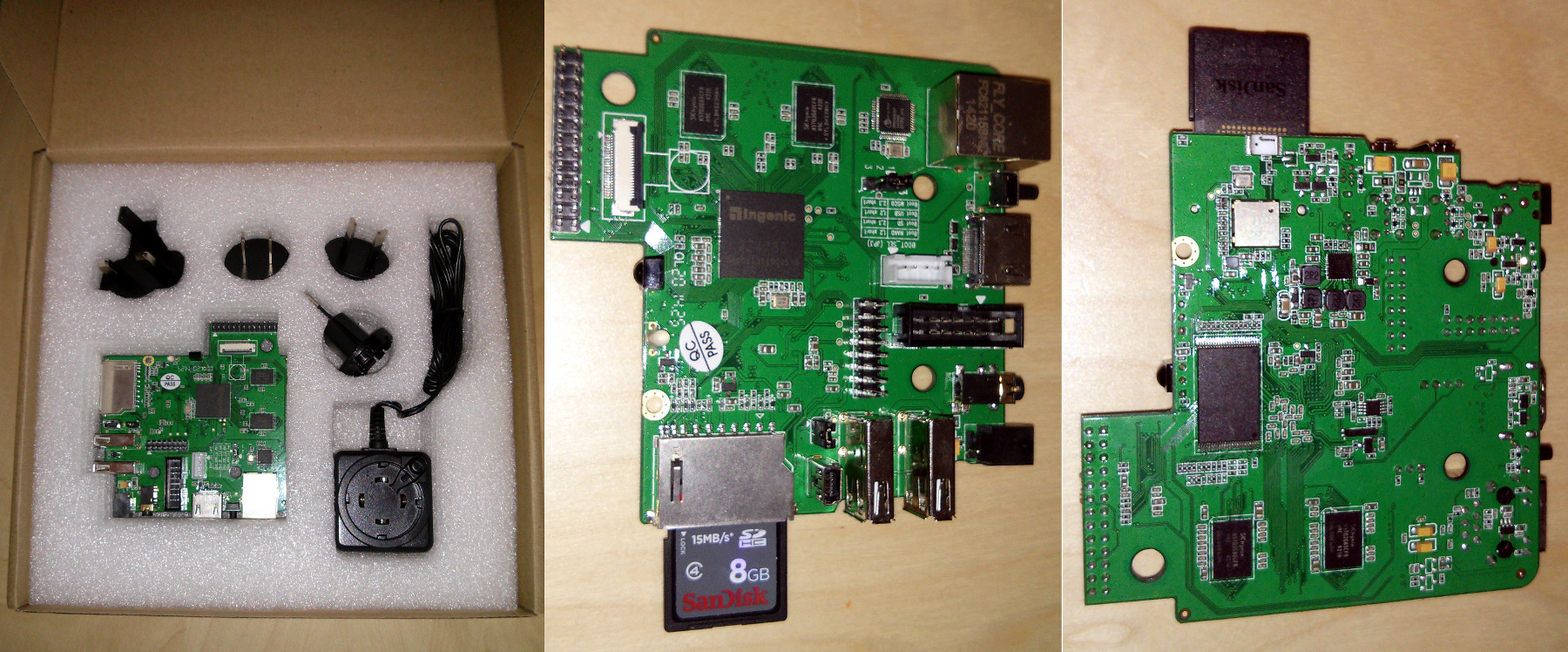
 We ve been busy setting up a Virtual Machine (VM) image to be used by participants of a
 Big thanks go to our intern St phane Germain, who joined us this summer to work on this virtualized environment.
 Debian LTS - impressions and thoughts from my first month involvement
About LTS - we want feedback and more companies supporting it financially
Squeeze LTS, and even more
 One purpose of this post is to spread some information about the initiative and invite you to tell us what you think about it or what your needs are.
LTS stands for "Long Term Support" and the goal of the project is to extend the security support for Squeeze (aka the current oldstable distribution) by two years. If it weren't for Squeeze LTS, the security support for it would have been stopped in May 2014 (=one year after the release of the current stable distribution), which for many is a too short timespan after it's release in February 2011. It's an experiment, we hope that there will be a similar Wheezy LTS initiative in future, but the future is unwritten and things will change based on our experiences and your needs.
If you have feedback on the direction LTS should take (or anything else LTS related), please comment on the
 And then there is another thing: as already mentioned, the people working paid hours for this, are prioritizing their work based on customer requests. So we did two updates (python-scipy and file), which are not fixed in wheezy yet. I think this is unfortunate and while I could probably prepare the wheezy DSA for file, I don't really want to join the Security Team... or maybe I want/should join the Security Team and be a seldomly active member (eg fixing file in wheezy now....)
A note related to this: out of those 37 uploads done until today, 16 were done by those

 Today I did something interesting with the Debian packaging for
 I've switched my Git repositories to


 A cloud of gnocchis!
 Relationship of entities and resources
 The indexer classes and their relations
 Macroscopic view of the Gnocchi architecture