Search Results: "ag"

11 September 2014

Stefano Zacchiroli: debsources bugs and easy hacks

debsources debbugs oh My ongoing quest for lowering the barrier for contributing to Debsources continues.
In this chapter: What's your excuse for not contributing to Debsources, again?

Dirk Eddelbuettel: pkgKitten 0.1.2: Still creating R Packages that purr

A brown bag release 0.1.2 of pkgKitten is now on CRAN, following yesterday's 0.1.1 upload Next time I'll try to remember that when I have parameters name and path, it won't work so well to call them as path and name ...
Changes in version 0.1.2 (2014-09-11)
  • Brown-bag fix of calling the new helper function with then correct order of arguments.
More details about the package are at the pkgKitten webpage and the pkgKitten GitHub repo. Courtesy of CRANberries, there is also a diffstat report for this release

This post by Dirk Eddelbuettel originated on his Thinking inside the box blog. Please report excessive re-aggregation in third-party for-profit settings.

Enrico Zini: suspend-i-really-mean-it

Laptop, I demand that you suspend! Dear Lazyweb, Sometimes some application prevents suspend on my laptop. I want to disable that feature: how? I understand that there may exist some people who like that feature. I, on the other hand, consider a scenario like this inconceivable:
  1. I'm on a plane working with my laptop, the captain announces preparations for landing, so I quickly hit the suspend button (or close the lid) on my laptop and stow it away.
  2. One connecting flight later, I pick up my backpack, I feel it unusually hot and realise that my laptop has been on all along, and is now dead from either running out of battery or thermal protection.
  3. I think things that, if spoken aloud in front of a pentacle, might invoke major lovecraftian horrors.
I do not want this scenario to ever be possible. I want my suspend button to suspend the laptop no matter what. If a process does not agree, I'm fine with suspending it anyway, or killing it. If I want my laptop to suspend, I generally have a good enough real-world reason for it, and I cannot conceive that a software could ever be allowed to override my command. How do I change this? I don't know if I should look into systemd, upowerd, pm-utils, the kernel, the display manager or something else entirely. I worry that I cannot even figure where to start looking for a solution. This happened to me multiple times already, and I consider it ridiculous. I know that it can cause me data loss. I know that it can cause me serious trouble in case I was relying on having some battery or state left at my arrival. I know that depending on what is in my backpack, this could also be physically dangerous. So, what knob do I tweak for this? How do I make suspend reliable? Update Systemd has an inhibitor system, and systemd-inhibit --list only lists 'delay' blocks in my system. It is an interesting feature that seems to be implemented in the right way, and it could mean that I finally can get my screen to be locked before the system is suspended. It is possible to configure the inhibitor system in /etc/systemd/logind.conf, including ways to ignore inhibitors, and a maximum time after which inhibitors are ignored if not yet released. Try as I might to run everything that I was running on the plane that time, I could not manage to see anything take an inhibitor block that could have prevented my suspend. I now suspect that what happened to me was a glitch caused by something else (hardware? kernel? cosmic rays!) during that specific suspend. When I had this issue in the past it looks like the infrastructure at the time was far more primitive that what we have now with systemd, so I guess that when writing my blog post I had simply correlated my old experiences with a one-off suspend glitch. If I want to investigate or tune further, to test the situation with a runaway block, I can use commands like systemd-inhibit --mode=block sleep 3600. I'm quite happy to see that we're moving to a standard and sane system for this. In the meantime, I have learnt that pm-utils has now become superfluous and can be deinstalled, and so can acpi-support and acpi-support-base. Thanks vbernat, mbiebl, and ah, on #debian-devel for all the help.

Sylvestre Ledru: Rebuild of Debian using Clang 3.5.0

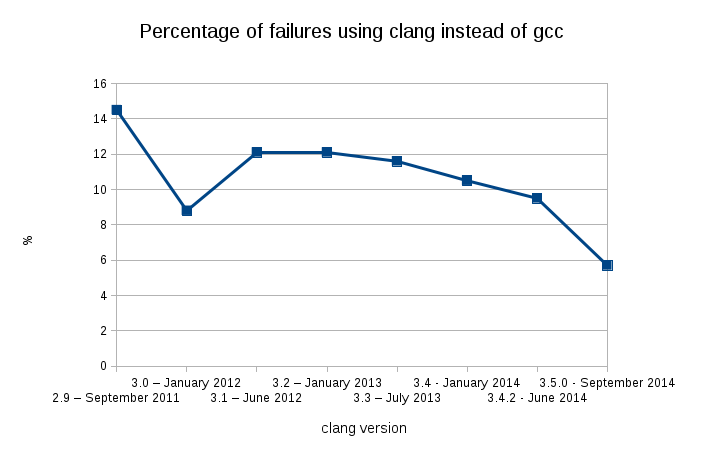
Clang 3.5.0 has just been released. A new rebuild has been done highlight the progress to get Debian built with clang. tl;dr: Great progress. We decreased from 9.5% to 5.7% of failures. Full results are available on http://clang.debian.net At time of the rebuild with 3.4.2, we had 2040 packages failing to build with clang. With 3.5.0, this dropped to 1261 packages. Fixes With Arthur Marble and Alexander Ovchinnikov, both GSoC students, we worked on various ways to decrease the number of errors. Upstream fixes First, the most obvious way, we fixed programming bugs/mistakes in upstream sources. Basically, we took categories of failure and fixed issues one after the other. We started with simple bugs like 'Wrong main declaration', 'non-void function should return a value' or 'Void function should not return a value'.

They are trivial to fix. We continued with harder fixes like ' Undefined reference' or 'Variable length array for a non POD (plain old data) element'.

So, besides these one, we worked on:
In total, we reported 295 bugs with patches. 85 of them have been fixed (meaning that the Debian maintainer uploaded a new version with the fix).

In parallel, I think that the switch by FreeBSD and Mac OS X to Clang also helped to fix various issues by upstreams. Hacking in clang As a parallel approach, we started to implement a suggestion from Linus Torvalds and a few others. Instead of trying to fix all upstream, where we can, we tried to update clang to improve the gcc compatibility.

gcc has many flags to disable or enable optimizations. Some of them are legacy, others have no sense in clang, etc. Instead of failing in clang with an error, we create a new category of warnings (showing optimization flag '%0' is not supported) and moved all relevant flags into it. Some examples, r212805, r213365, r214906 or r214907

We also updated clang to silent some useless arguments like -finput_charset=UTF-8 (r212110), clang being UTF-8 compliant.

Finally, we worked on the forwarding of linker flags. Clang and gcc have a very different behavior: when gcc does not know an argument, it is going to forward the argument to the linker. Clang, in this case, is going to reject the argument and fail with an error. In clang, we have to explicitly declare which arguments are going to be transfer to the linker. Of course, the correct way to pass arguments to the linker is to use -Xlinker or -Wl but the Debian rebuild proved that these shortcuts are used. Two of these arguments are now forwarded: New errors Just like in other releases, new warnings are added in clang. With (bad) usage of -Werror by upstream software, this causes new build failures: I also took the opportunity to add some further categorizations in the list of errors. Some examples: Next steps The Debile project being close to ready with Cl ment Schreiner's GSoC, we will now have an automatic and transparent way to rebuild packages using clang. Conclusion As stated, we can see a huge drop in term of number of failures over time:
Hopefully, Clang getting better and better, more and more projects adopting it as the default compiler or as a base for plugin/extension developments, this percentage will continue to decrease.
Having some kind of release goal with clang for Jessie+1 can now be considered as potentially reachable. Want to help? There are several things which can be done to help: Acknowledgments Thanks to David Suarez for the rebuilds of the archive, Arthur Marble and Alexander Ovchinnikov for their GSoC works and Nicolas S velin-Radiguet for the few fixes.

Steve Kemp: A small email utility and other updates.

Last night I was looking for an image I knew a model had mailed me a few months ago, as we were talking about rescheduling a shoot at the weekend. I couldn't find it, even with my awesome mail client and filing system. With some free time I figured I could write a little utility to dump all attachments from email folders, and find it that way. It did cross my mind that there is the simple mail-utility for dumping headers, etc, called formail, which is distributed alongside procmail, but it doesn't handle attachments .. I was tempted to write a general purpose script to dump attachments, email header values, etc, etc but given the lack of time I merely solved my own problem. I suspect there is room for a "mail utilities" package, similar to Joey's "moreutils" and my "sysadmin utils". However I note that there is a GNU Mailutils which does things differently than I'd expect - i.e. it contains a POP3 server. Still if you want to dump attachments from emails, have GMIME installed, and want to filter by attachment-name, or MIME-type, you might look at my trivial attachment-dump program. Related to that I spent some time last night updating my photography site, so the animals & pets section has updated images at least. During the course of that I found a bug in my static-site generator, templer which stopped it from automatically populating image height/widths when called in a glob:
Title: Pets & Animals
Images: file_glob( "*.jpg" )
---
This is the page body, it now has access to a variable called 'images'
which is a HTML::Template loop-structure containing name/height/width/etc
for each image in the current directory.
That should now be resolved, and life should once again be good.

Matthias Klumpp: Listaller: Back to the future!

Listaller-Logo (with text)It is time for another report on Listaller, the cross-distro 3rd-party package installer, which is now in development for depending how you count 5-6 years. This will become a longer post, so you might grab some coffee or tea ;-) The original idea The Listaller project was initially started with the goal to make application deployment on Linux distributions as simple as possible, by providing a unified package installation format and tools which make building apps for multiple distributions easier and deployment of updates simple. The key ideas were: The current state The current release of Listaller handles all of this with a plugin for PackageKit, the cross-distro package-management abstraction layer. It hooks into PackageKit and reads information passing through to the native distributor backend, and if it encounters Listaller software, it handles it appropriately. It can also inject update information. This results in all Listaller software being shown in any PackageKit frontends, and people can work with it just like if the packages were native packages. Listaller package installations are controlled by a machine policy, so the administrator can decide that e.g. only packages from a trusted source (= GPG signature in trusted database) can be installed. Dependencies can be pulled from the distributor s repositories, or optionally from external sources, like the PyPI. This sounds good on paper, but the current implementation has various problems. The issues The current Listaller approach has some problems. The biggest one lies in the future: Soon, there will be no PackageKit plugins anymore! PackageKit 1.0 will remove support for them, because they appear to be a major source for crashes, even the in-tree plugins cause problems. Also, the PackageKit service itself is currently being trimmed of unneeded features and less-used code. These changes in PackageKit are great and needed for the project (and I support these efforts), but they cause a pretty huge problem for Listaller: The project relies on the PackageKit plugin if used without it, you loose the system-integration part, which is one of the key concepts of Listaller, and a primary goal. But this issue is not the only one. There are more. One huge problem for Listaller is dependency-solving: It needs to know where to get software from in case it isn t installed already. And that has to be done in a cross-distributional way. This is an incredibly complex task, and Listaller contains lots of workarounds for various quirks. It contains so much hacks for distro-specific stuff, that it became really hard to understand. The Listaller dependency model also became very complex, because it tried to handle many corner-cases. This is bad, of course. But the workarounds weren t added for fun, but because it was assumed to be easier than to fixing the root cause, which would have required collaboration between distributors and some changes on the stack, which seemed unlikely to happen at the time the code was written. The systemd effort Also a thing which affects Listaller, is the latest push from the systemd team to allow cross-distro 3rd-party installations to happen. I definitively recommend reading the linked blogpost from Lennart, if you have some spare time! The identified problems are the same as for Listaller, but the solution they propose is completely different, and about three orders of magnitude more invasive than whatever the Listaller project had in mind (I make these numbers up, so don t ask!). There are also a few issues I see with Lennarts approach, I will probably go into detail about that in another blogpost (e.g. it requires multiple copies of a library lying around, where one version might have a security vulnerability, and another one doesn t it s hard to ensure everything is up to date and secure that way, even if you have a top-notch sandbox). I have great respect for the systemd crew and especially Lennart, and I hope them to succeed with their efforts. However, I also think Listaller can achieve a similar things with a less-invasive solution, at least for the 3rd-party app-installations (Listaller is one of the partial-fix solutions with strict focus, so not a direct competitor to the holistic systemd approach. Both solutions could happily live together.) A step into the future Some might have guessed it already: There are some bigger changes coming to Listaller! The most important one is that there will be no Listaller anymore, at least not in its old form. Since the current code relies heavily on the PackageKit plugin, and contains some ugly workarounds, it doesn t make much sense to continue working on it. Instead, I started the Listaller.NEXT project, which is a rewrite of Listaller in C. There are a some goals for the rewrite: I made a last release of the 0.5.x series of Listaller, to work with PackageKit 0.9.x the future lies in the C port. If you are using Listaller (and I know of people who do, for example some deploy statically-linked stuff on internal test-setups with it), stay tuned. The packaging format will stay mostly compatible with the current version, so you will not see many changes there (the plan is to freeze it very soon, so no backwards-incompatible changes are made anymore). The o.5.x series will receive critical bugfixes if necessary. Help needed! As always, there is help needed! Writing C is not that difficult ;-) But user feedback is welcome as well, in case you have an idea. The new code will be hosted on Github in the new listaller-next branch (currently not that much to find there). Long-term, we will completely migrate away from Launchpad. You can expect more blogposts about the Listaller concepts and progress in the next months (as soon as I am done with some AppStream-related things, which take priority).

Dirk Eddelbuettel: pkgKitten 0.1.1: Still creating R Packages that purr

A maintenance release 0.1.1 of pkgKitten is now on CRAN. It has only one small change: the function playWithPerPackageHelpPage() was factored out of the main function kitten() as I happened to be needing something just like playWithPerPackageHelpPage() to make packages created by the Rcpp function Rcpp.package.skeleton() a little nicer. We also added a NEWS.Rd file which restates major release features. As it is so short, we include it in its entirety.
Changes in version 0.1.1 (2014-09-09)
  • New (exported) function playWithPerPackageHelpPage() which lets other packages create a non-complaint-generating package help page
Changes in version 0.1.0 (2014-06-13)
  • Initial public version and CRAN upload
More details about the package are at the pkgKitten webpage and the pkgKitten GitHub repo. Courtesy of CRANberries, there is also a diffstat report for this release

This post by Dirk Eddelbuettel originated on his Thinking inside the box blog. Please report excessive re-aggregation in third-party for-profit settings.

10 September 2014

Lucas Nussbaum: Will the packages you rely on be part of Debian Jessie?

The start of the jessie freeze is quickly approaching, so now is a good time to ensure that packages you rely on will the part of the upcoming release. Thanks to automated removals, the number of release critical bugs has been kept low, but this was achieved by removing many packages from jessie: 841 packages from unstable are not part of jessie, and won t be part of the release if things don t change. It is actually simple to check if you have packages installed locally that are part of those 841 packages:
  1. apt-get install how-can-i-help (available in backports if you don t use testing or unstable)
  2. how-can-i-help --old
  3. Look at packages listed under Packages removed from Debian testing and Packages going to be removed from Debian testing
Then, please fix all the bugs :-) Seriously, not all RC bugs are hard to fix. A good starting point to understand why a package is not part of jessie is tracker.d.o. On my laptop, the two packages that are not part of jessie are the geeqie image viewer (which looks likely to be fixed in time), and josm, the OpenStreetMap editor, due to three RC bugs. It seems much harder to fix If you fix it in time for jessie, I ll offer you a $drink!

Steve Kemp: kvm-hosting will be ceasing, soon.

Seven years ago I wanted to move on from the small virtual machine I had to a larger one. Looking at the the options available it seemed the best approach was to rent a big host, and divide it up into virtual machines myself. Renting a machine with 8Gb of RAM and 500Gb of disk-space, then dividing that into eights would give a decent spec and assuming that I found enough users to pay for the other slots/shares it would be economically viable too. After a few weeks I took the plunge, advertised here, and found users. I had six users: There were some niggles, one user seemed to suffer from connectivity problems more than the others, but on the whole the experiment worked out well. These days, thanks to BigV, Digital Ocean, and all the new-comers there is less need for this kind of thing so last December I announced that the service would cease - and gave all current users 1 year of free service to give them time to migrate away. The service was due to terminate in December, but triggered by some upcoming downtime where our host would have been moved, in the back of a van, from Manchester to York, I've taken the decision to stop it early. It was a fun experiment, it provided me with low cost hosting (subsidized by the other paying users), and provided some other people with hosting of their own that was setup nicely. The only outstanding question is what to do with the domain-names? I could let them expire, I could try to sell them, or I could donate them to other people running hosting setups. If anybody reading this has a use for kvm-hosting.org, kvm-hosting.net, or kvm-hosting.com, then do feel free to get in touch. No promises, obviously, but it'd be a shame for them to end up hosting adverts in a year or twos time..

Raphaël Hertzog: Freexian s first report about Debian Long Term Support

When we setup Freexian s offer to bring together funding from multiple companies in order to sponsor the work of multiple developers on Debian LTS, one of the rules that I imposed is that all paid contributors must provide a public monthly report of their paid work. While the LTS project officially started in June, the first month where contributors were actually paid has been July. Freexian sponsored Thorsten Alteholz and Holger Levsen for 10.5 hours each in July and for 16.5 hours each in August. Here are their reports: It s worth noting that Freexian sponsored Holger s work to fix the security tracker to support squeeze-lts. It s my belief that using the money of our sponsors to make it easier for everybody to contribute to Debian LTS is money well spent. As evidenced by the progress bar on Freexian s offer page, we have not yet reached our minimal goal of funding the equivalent of a half-time position. And it shows in the results, the dla-needed.txt still shows around 30 open issues. This is slightly better than the state two months ago but we can improve a lot on the average time to push out a security update To have an idea of the relative importance of the contributions of the paid developers, I counted the number of uploads made by Thorsten and Holger since July: of 40 updates, they took care of 19 of them, so about the half. I also looked at the other contributors: Rapha l Geissert stands out with 9 updates (I believe that he is contracted by lectricit de France for doing this) and most of the other contributors look like regular Debian maintainers taking care of their own packages (Paul Gevers with cacti, Christoph Berg with postgresql, Peter Palfrader with tor, Didier Raboud with cups, Kurt Roeckx with openssl, Balint Reczey with wireshark) except Matt Palmer and Luciano Bello who (likely) are benevolent members of the LTS team. There are multiple things to learn here:
  1. Paid contributors already handle almost 70% of the updates. Counting only on volunteers would not have worked.
  2. Quite a few companies that promised help (and got mentioned in the press release) have not delivered the promised help yet (neither through Freexian nor directly).
Last but not least, this project wouldn t exist without the support of multiple companies and organizations. Many thanks to them: Hopefully this list will expand over time! Any help to reach out to new companies and organizations is more than welcome.

One comment Liked this article? Click here. My blog is Flattr-enabled.

Ian Donnelly: New Release: Elektra 0.8.8

Hi Everybody! Great news! I am very happy to announce that we have reached a new milestone for Elektra and released a new version, 0.8.8! This release comes right on the tail of the 0.8.7 release and it might just be our biggest release yet! We already have a great article covering all the changes from the previous release on our News documentation on GitHub. I just wanted to focus on a few of those changes on this blog, especially the ones that pertain to my Google Summer of Code Project. First of all, Felix has worked to greatly improve the ini plug-in. This is the plug-in I used in my technical demo for mounting Samba s smb.conf file. It now works even better with complex ini files such as smb.conf which means the automatic merging of files like smb.conf is even better now! That really goes to show one of the greatest strengths of the design of Elektra. Just by improving plug-ins, all the functions of Elektra can improve as well. The merge code was not changed in this release, yet because of an updated plug-in, the merge has improved. Secondly, there have been some good improvements to the kdb command-line tool. Many of these improvements were used in my technical demo, but now they are actually a part of release (and a little more refined from then). We added a new command called kdb remount which allows a user (or script) to mount a file to the Elektra Key Database using an existing backend. An example of this command is:
kdb remount [new filename] [new path] [existing mountpoint]

This command mounts the new file to the new path in the Key Database using an existing backend. This works with the conffile merging by allowing us to mount the various versions of the conffile without having to specify which backend to use (it will use the same backend as the currently used conffile). Additionally, the umount command was updated to allow users to umount using the current mountpath (allowing commands such as kdb umount system/smb.conf) as opposed to backends. Moreover, we added an option to the kdb import command to specify a merge strategy using thing -s option. Now you can import a file into the Key Database and merge the content of that file with the current Keys in the Database. Thirdly, we added some new scripts to Elektra to help with the ucf integration. These scripts were used in my technical demo, but now they are part of the release. elektra-mount and elektra-umount are wrappers for the commands kdb mount and kdb umount respectively. They are designed to be used in debian package scripts and are adapted for easier use than the generic commands. For instance, running elektra-mount will check to see if a file is already mounted at that location in the Key Database. Similarly, elektra-umount will not produce an error if the file was already unmounted. This is because maintainer scripts can be run multiple times in a row and producing an error will stop dpkg even when it shouldn t. Additionally, we added a script called elektra-merge which can be used as a method for ucf to merge configuration files. This script acts as a liaison between ucf and elektra allowing automatic merges to be done by ucf using Elektra s merge features in a seamless manner. For information of how these scripts work, check out my tutorial on integrating elektra-merge into a debian package. The last bit of news I would like to share is the great progress of the Debian package. Thanks to Pino Toscano, version 0.8.7-4 of Elektra is now available in the Debian testing repo! This is great news as we are now that much closer to replacing the outdated Elektra 0.7 versions that are currently the latest versions of Elektra in the stable repo. Once the 0.8.X versions of Elektra make it to stable it will be much easier for us to keep the latest versions of Elektra in Debian, and that s key to allowing Elektra to help improve users lives. You can download the release from:
http://www.markus-raab.org/ftp/elektra/releases/elektra-0.8.8.tar.gz size: 1644441
md5sum: fe11c6704b0032bdde2d0c8fa5e1c7e3
sha1: 16e43c63cd6d62b9fce82cb0a33288c390e39d12
sha256: ae75873966f4b5b5300ef5e5de5816542af50f35809f602847136a8cb21104e2 And the API-Documentation can be found here: http://doc.libelektra.org/api/0.8.8/html/ Hope you enjoy the new release! Sincerely,
Ian S. Donnelly

9 September 2014

Holger Levsen: 20140909-lts-august-2014

Debian LTS - feedback about the feedback from my LTS talk at DebConf14 So, I'm more or less back from dc14 and today, five days later, I think I might have mostly overcome jetlag. Probably... So, at DebConf14 I gave a talk about LTS and while I'm sorry that I was that tired, I'm more or less happy how the talk went. Thankfully at least I was calm and relaxed... There are a couple of things I learned from the talk: a.) LTS has been really really perceived well b.) it fits a demand c.) people already take it for granted (eg plan for Wheezy LTS) d.) people expect the same non-intrusive changes as currently done for security updates. To explain the last point: when I explained the - so far - rather theoretical problem that ''squeeze-lts'' has no gatekeeper mechanisms whatsoever (eg no ''proposed-updates'', no NEW queue..) the reaction in the audience was basically "something like this should exist, else how can we deploy this in large scale / on important setup?!". Also currently there is no, well-documented, easily to be found policy for what kind of updates are acceptable. I said that we basically follow the same rules as there are for debian-security updates, but this should really be documented properly. This doesn't seem very hard to fix, just like many things it "just" needs someone to do the work. IOW: we explain how to use LTS, we explain how to contribute to LTS (through uploads or financially) but we lack a simple explaination what LTS is and what kind of updates to expect. It's kinda self evident, but only kinda. So since giving the talk I changed one thing in my personal usage of LTS: I don't use my personal LTS repo anymore, where I made sure only good packages got in. This is for two reasons: a.) I had too add new packages too often and b.) if it really is a problem that LTS has no gatekeeping mechanism (which I'm not sure anymore it is, after all, the updates are prepared by reasonable people with a common goal...) then I want to suffer this first hand, so I can build solutions which benefit everyone, not just me. That personal LTS repo only helped me. On the technical side I prepared five DLAs, for lzo2, libwpd, squid3, lua5.1 and bind9. Not much to see here, they all were very smooth. I still enjoyed the challenge of digging in unknown sourcecode, as described in my previous post. Then more interestingly, and with the help of Raphael Geissert and Salvatore Bonaccorso I fixed the security-tracker to also know about oldstable, after waiting for more than 8 weeks to someone else doing it. I'm very glad that this is done now, as without it was really tedious to check which issues were applying to oldstable. Oh, and another afterthought from giving the talk: currently at least parts of the security-tracker codebase assume that there won't ever be support for oldoldstable, but once jessie has been released this won't be true anymore. Then we will support stable, oldstable and oldoldstable. And oldstable will be wheezy, not squeeze. We have something like 6 months to fix this, hopefully we won't have much more time... ;-) Oh, and surely there are other places than just the security-tracker which will need to be taught about this.

Daniel Pocock: xTupleCon WebRTC talk schedule change, new free event

As mentioned in my earlier blog, I'm visiting several events in the US and Canada in October and November. The first of these, the talk about WebRTC in CRM at xTupleCon, has moved from the previously advertised timeslot to Wednesday, 15 October at 14:15. WebRTC meeting, Norfolk, VA Later that day, there will be a WebRTC/JavaScript meetup in Norfolk hosted at the offices of xTuple. It is not part of xTupleCon and free to attend. Please register using the Eventbrite page created by xTuple. This will be a hands on event for developers and other IT professionals, especially those in web development, network administration and IP telephony. Please bring laptops and mobile devices with the latest versions of both Firefox and Chrome to experience WebRTC. Free software developers at xTupleCon If you do want to attend xTupleCon itself, please contact xTuple directly through this form for details about the promotional tickets for free software developers.

Holger Levsen: 20140819-lts-august-2014

Debian LTS - feedback about the feedback from my LTS talk at DebConf14 So, I'm more or less back from dc14 and today, five days later, I think I might have mostly overcome jetlag. Probably... So, at DebConf14 I gave a talk about LTS and while I'm sorry that I was that tired, I'm more or less happy how the talk went. Thankfully at least I was calm and relaxed. There are a couple of things I learned from the talk: a.) LTS has been really really perceived well b.) it fits a demand c.) people already take it for granted (eg plan for Wheezy LTS) d.) people expect the same non-intrusive changes as currently done for security updates. To explain the last point: when I explained the - so far - rather theoretical problem that ''squeeze-lts'' has no gatekeeper mechanisms whatsoever (eg no ''proposed-updates'', no NEW queue..) the reaction in the audience was basically "something like this should exist, else how can we deploy this in large scale / on important setup?!". Also currently there is no, well-documented, easily to be found policy for what kind of updates are acceptable. I said that we basically follow the same rules as there are for debian-security updates, but this should really be documented properly. This doesn't seem very hard to fix, just like many things it "just" needs someone to do the work. IOW: we explain how to use LTS, we explain how to contribute to LTS (through uploads or financially) but we lack a simple explaination what LTS is and what kind of updates to expect. It's kinda self evident, but only kinda. So since giving the talk I changed one thing in my personal usage of LTS: I don't use my personal LTS repo anymore, where I made sure only good packages got in. This is for two reasons: a.) I had too add new packages too often and b.) if it really is a problem that LTS has no gatekeeping mechanism (which I'm not sure anymore it is, after all, the updates are prepared by reasonable people with a common goal...) then I want to suffer this first hand, so I can build solutions which benefit everyone, not just me. That personal LTS repo only helped me. On the technical side I prepared five DLAs, for lzo2, libwpd, squid3, lua5.1 and bind9. Not much to see here, they all were very smooth. I still enjoyed the challenge of digging in unknown sourcecode, as described in my previous post. Then more interestingly, and with the help of Raphael Geissert and Salvatore Bonaccorso I fixed the security-tracker to also know about oldstable, after waiting for more than 8 weeks to someone else doing it. I'm very glad that this is done now, as without it was really tedious to check which issues were applying to oldstable. Oh, and another afterthought from giving the talk: currently at least parts of the security-tracker codebase assume that there won't ever be support for oldoldstable, but once jessie has been released this won't be true anymore. Then we will support stable, oldstable and oldoldstable. And oldstable will be wheezy, not squeeze. We have something like 6 months to fix this, hopefully we won't have much more time... ;-) Oh, and surely there are other places than just the security-tracker which will need to be taught about this.

8 September 2014

Ana Beatriz Guerrero Lopez: DebConf14 and ten years contributing to Debian

It has been one week since I m back from DebConf14 and I m still recovering and catching up with things. DebConf14 has been amazing, it has been great to be back after missing it for two years. Thanks a lot to everybody who helped to make it real. On my side, I helped a bit in the talks team. During DebConf14, I got the opportunity to discuss with Rene Mayorga about the MIA work-flow and we also got some feedback in the MIA BoF. We have plenty of ideas to implement and we re aiming to improve things during this next year. This summer has been also 10 years since I started contributing to Debian. It s hard to believe. Ten years ago I barely knew where to start helping and now I have an endless TODO list of things I would like to do. And always during DebConf this list seems to grow ten times faster than usual. Thankfully, also motivation increases a lot :)

Joey Hess: propellor is d-i 2.0

I think I've been writing the second system to replace d-i with in my spare time for a couple months, and never noticed. I'm as suprised as you are, but consider this design:
main :: IO
main = Installer.main
    & Installer.partition First "/boot" Ext3 (MiB 256)
    & Installer.partition Next "/" Ext4 (GiB 5)
    & Installer.partition Next "/home" Ext4 FreeSpace
    & Installer.grubBoots "hd0"
    & os (System (Debian Stable) "amd64")
    & Apt.stdSourcesList
    & Apt.installed ["task-gnome-desktop"]
main :: IO
main = Installer.main
    & Installer.target CdImage "installer.iso"
    & os (System (Debian Stable) "amd64")
    & Apt.stdSourcesList
    & Apt.installed ["task-xfce-desktop", "ghc", "propellor"]
    & User.autoLogin "root"
    & User.loginStarts "propellor --installer"
Well, now I know where propellor might end up if I felt like spending a month and adding a few thousand lines of code to it.

Jaldhar Vyas: Debconf 14 - Days 1 and 2

Unfortunately I was not able to attend debconf this year but thanks to the awesome video team the all the talks are available for your viewing pleasure. In order to recreate an authentic Portland experience, I took my laptop into the shower along with a vegan donut and had my children stand outside yelling excerpts from salon.com in whiny Canadianesque accents. Here are some notes I took as I watched the talks. Welcome Talk
Debian in the Dark Ages of Free software - Stefan Zacchiroli Weapons of the Geek - Gabriella Coleman bugs.debian.org -- Database Ho! - Don Armstrong Grub Ancient and Modern - Colin and Watson One year of fedmsg in Debian - Nicolas Dandrimont Coming of Age: My Life with Debian - Christine Spang Status report of the Debian Printing Team - Didier Raboud

7 September 2014

Craig Small: How not to get Galaxy Tab into Safe Mode

For weeks my Galaxy Tab 10.1 has reasonably consistently gone into safe mode. Not booting into it but I d use it fine then put it away and next time I looked at it, Safe Mode was there. It wasn t every time, but averaged to be about every second time. So the first thing was a bit of googling to see what this Safe Mode was. Most of the suggestions were around how to put it into safe mode during the boot process but my problem was opposite; it wasn t during booting and I wanted something to stop safe mode, not put the device into it. The closest I got to it was there was some misbehaving program that kicked the thing into safe mode. The problem was, I checked several times and there were no running programs. I really did start to worry I had a hardware fault or something wrong deep within the OS. When you have problems in IT, you re usually asked What s new? What s changed? . The answer is generally Nothing which gets a switch No really, what did change . The only answer I could come up with was a hardware keyboard. This slim aluminum uses bluetooth to communicate to the tablet and clips onto the front screen to protect it when not in use. Could this be the change I was looking for? The clue was that sometimes when you boot Android, if you hold down some keys it boots into safemode. It seems that holding down some combination of keys (volume up/down, power) puts into safe mode. The keyboard can clip onto the tablet in two ways, one long edge has some raised edges while one doesn t. If the raised edge was connected to the same side as the buttons, I d get safe mode sometimes as the edge pushed some of those buttons. More importantly, putting the raised edge on the side with no buttons meant no more safe mode. Not really a software or electrical fault, more one of just mechanics.

6 September 2014

Joachim Breitner: ICFP 2014

Another on-my-the-journey-back blog post; this time from the Frankfurt Airport Train Station my flight was delayed (if I knew that I could have watched the remaining Lightning Talks), and so was my train, but despite 5min of running through the Airport just not enough. And now that the free 30 Minutes of Railway Station Internet are used up, I have nothing else to do but blog... Last week I was attending ICFP 2014 in Gothenburg, followed by the Haskell Symposium and the Haskell Implementors Workshop. The justification to attend was the paper on Safe Coercions (joint work with Richard Eisenberg, Simon Peyton Jones and Stephanie Weirich), although Richard got to hold the talk, and did so quite well. So I got to leisurely attend the talks, while fighting the jet-lag that I brought from Portland. There were as expected quite a few interesting talks. Among them the first keynote, Kathleen Fisher on the need for formal methods in cars and toy-quadcopters and unmanned battle helicopters, which made me conclude that my Isabelle skills might eventually become relevant in practical applications. And did you know that if someone gains access to your car s electronics, they can make the seat belt pull you back hard? Stefanie Weirich s keynote (and the subsequent related talks by Jan Stolarek and Richard Eisenberg) on what a dependently typed Haskell would look like and what we could use it for was mouth-watering. I am a bit worried that Haskell will be become a bit obscure for newcomers and people that simply don t want to think about types too much, on the other hand it seems that Haskell as we know it will always stay there, just as a subset of the language. Similarly interesting were refinement types for Haskell (talks by Niki Vazou and by Eric Seidel), in the form of LiquidTypes, something that I have not paid attention to yet. It seems to be a good way for more high assurance in Haskell code. Finally, the Haskell Implementors Workshop had a truckload of exciting developments in and around Haskell: More on GHCJS, Partial type signatures, interactive type-driven development like we know it from Agda, the new Haskell module system and amazing user-defined error messages the latter unfortunately only in Helium, at least for now. But it s not the case that I only sat and listened. During the Haskell Implementors Workshop I held a talk Contributing to GHC with a live demo of me fixing a (tiny) bug in GHC, with the aim of getting more people to hack on GHC (slides, video). The main message here is that it is not that big of deal. And despite me not actually saying much interesting in the talk, I got good feedback afterwards. So if it now actually motivates someone to contribute to GHC, I m even more happier. And then there is of course the Hallway Track. I discussed the issues with fusing a left fold (unfortunately, without a great solution). In order to tackle this problem more systematically, John Wiegley and I created the beginning of a List Fusion Lab , i.e. a bunch of list benchmark and the possibility to compare various implementations (e.g. with different RULES) and various compilers. With that we can hopefully better assess the effect of a change to the list functions. PS: The next train is now also delayed, so I ll likely miss my tram and arrive home even later... PPS: I really have to update my 10 year old picture on my homepage (or redesign it completely). Quite a few people knew my name, but expected someone with shoulder-long hair... PPPS: Haskell is really becoming mainstream: I just talked to a randomly chosen person (the boy sitting next to me in the train), and he is a Haskell enthusiast, building a structured editor for Haskell together with his brother. And all that as a 12th-grader...

Jonathan McDowell: Breaking up with America

Back in January I changed jobs. This took me longer to decide to do than it should have. My US visa (an L-1B) was tied to the old job, and not transferable, so leaving the old job also meant leaving the US. That was hard to do; I'd had a mostly fun 3 and a half years in the SF Bay Area. The new job had an office in Belfast, and HQ in the Bay Area. I went to work in Belfast, and got sent out to the US to meet coworkers and generally get up to speed. During that visit the company applied for an H-1B visa for me. This would have let me return to the US in October 2014 and start working in the US office; up until that point I'd have continued to work from Belfast. Unfortunately there were 172,500 applications for 85,000 available visas and mine was not selected for processing. I'm disappointed by this. I've enjoyed my time in the US. I had a green card application in process, but after nearly 2 years it still hadn't completed the initial hurdle of the labor certification stage (a combination of a number of factors, human, organizational and governmental). However the effort of returning to live here seems too great for the benefits gained. I can work for a US company with a non-US office and return on an L-1B after a year. And once again have to leave should I grow out of the job, or the job change in some way that doesn't suit me, or the company hit problems and have to lay me off. Or I can try again for an H-1B next year, aiming for an October 2015 return, and hope that this time my application gets selected for processing. Neither really appeals. Both involve putting things on hold in the hope longer terms pans out as I hope. And to be honest I'm bored of that. I've loved living in America, but I ended up spending at least 6 months longer in the job I left in January than I'd have done if I'd been freely able to change employer without having to change continent. So it seems the time has come to accept that America and I must part ways, sad as that is. Which is why I'm currently sitting in SFO waiting for a flight back to Belfast and for the first time in 5 years not having any idea when I might be back in the US.

Next.

Previous.