Search Results: "mak"

3 January 2010

Dirk Eddelbuettel: Rcpp 0.7.1

Two weeks after the Rcpp 0.7.0 release, Romain and I are happy to announce release 0.7.1 of Rcpp. It is currently in the incoming section of CRAN and has been accepted into Debian. Mirrors will catch up over the next few days, in the meantime the local page is available for download too. A lot has changed under the hood since 0.7.0, and this is the first release that really reflects many of Romain's additions. Some of the changes are As before, fuller details are in the ChangeLog on the Rcpp page.

2 January 2010

Torsten Werner: Improving password security in Debian

Most readers probably have installed Debian version 5.0 (Lenny) or an older version and are using shadow passwords with the md5 hash algorithm. This is not bad but not good enough. You can find out the details by looking at /etc/passwd and /etc/shadow (as root). The second column in these files should be a simple character x in /etc/passwd and a string like
$1$biMft/Pr$Lo3zPpiItdLZrzx8t/mTy0
in /etc/shadow. The number 1 between the 1st and 2nd $ sign means md5, the following string biMft/Pr is the salt and the last string Lo3zPpiItdLZrzx8t/mTy0 is the actual hash for the password ('testmd5' in this case). The salt is used to avoid attacks based on precomputed hash tables.

The package pam has switched to the stronger sha512 algorithm in version 1.1.0-2 on 31st august 2009. Look for a line like
password        [success=1 default=ignore]      pam_unix.so obscure sha512
in file /etc/pam.d/common-password if you have installed at least version 1.1.0-2. After changing the password I have the new password string
$6$qjc5gFgK$vaz/gLKMyDuhsVOU2oVIkDZrD0.reJM.2Ft3CMEoAsjN/lenvHC2ls6g/MY1ZaYaYBP3HHDOxel1dvTerl17q1
in /etc/shadow. The number 6 means sha512 and the hash
vaz/gLKMyDuhsVOU2oVIkDZrD0.reJM.2Ft3CMEoAsjNlenvHC2ls6g/MY1ZaYaYBP3HHDOxel1dvTerl17q1
is much longer than before.

The pam_unix module in combination with the sha algorithms allows specifying the number of rounds for hashing the password with the argument rounds=... which defaults to 5000. My current machine needs about 20 milliseconds to hash my password. That can be tested with the command
/usr/bin/time -f %U su testmd5 -c true
I have changed the number to 1 million
password        [success=1 default=ignore]      pam_unix.so obscure sha512 rounds=1000000
to make brute force attacks more difficult. After changing the password again the string is
$6$rounds=1000000$Va4plzLi$EtixueZQ1ZQlzQa7eHHsG6UcNvu.EnuCqM79kIyUe82eAZ.JNegn4SBY1RduYlACs0RWLFHD4d//PzQXMsCqk0
with the number of rounds embedded. The su command needs 1.79 seconds now which is an acceptable delay for the login process considering the improved security.

Don't forget to change the root password too if you have set one.

Asheesh Laroia: Detecting stale versions of WordPress

I run a personal server that hosts web space for a few friends. Probably the most popular thing to do with the space is to install WordPress and run a personal blog. A few days ago, I discovered some attackers were abusing one of the sites. Once we upgraded the site to the latest version of WordPress, the attack went away. So I wrote a tool that, every night, emails me a report of the locations of old versions of WordPress. A sample email:
Current version of WordPress: 2.9

oldroommate has WordPress 2.5 in /home/oldroommate/web/oldroommate.com/
Eek! WordPress 2.5 is old!

How it works Each time it runs, it looks at wordpress.org to see what the current version is. The code to do that is written in Python and uses lxml.html. It prints the current version in the report, and it uses it when analyzing WordPress installs. To analyze WordPress installs, it executes locate readme.html, looking for WordPress's tell-tale documentation file. For every such readme.html, if it matches a simple regular expression suggesting it's a WordPress readme file, it performs the following analysis:
  • It does some simple seding and greping looking for the version of WordPress described by that file.
  • If the version detected is older (as calculated by dpkg --compare-versions), it creates a one-line report like the one above about oldroommate.
If it found any installs of old WordPress, it prints a report like the one blockquoted above to stdout.

How to use it To get emails, I run it with cron. You can add a stanza like this to your crontab (edit it with crontab -e):
@daily cd find-out-of-date-wordpress; ./look.sh
Ta-da, nightly reports.

To get a copy Do a git clone:
git clone git://git.asheesh.org/find-out-of-date-wordpress.git
or browse its gitweb.

Feedback I'm quite interested to hear what others do to avoid old web apps being attacked. If there's another bit of software that monitors web apps for needing upgrades, I'd love to hear about it! Obviously if you have feedback on this tidbit I wrote, let me know. (To me, apt-get doesn't seem to be the answer. Web apps (especially PHP ones) don't usually seem to support keeping the code in one place with multiple different configuration files. And users get excited about the latest and greatest and don't want to wait for me to upgrade, and I can't blame them.) If some of you don't like the Python dependency or anything else, I do welcome patches!

1 January 2010

Thorsten Glaser: RCBD #1

My first RC Bug-squashing Day (or rather night): I picked all of them mostly randomly from the list Zack gave me, and except dietlibc they are packages I had not even heard of before. The first one begun easily (track down licencing information, pimp debian/copyright, but I ended up fixing compiler and lintian warnings and even wrote a manpage for it while there (but for this one, I didn t bump the Standards-Version). The second one was only the second one to complete because the others took longer; it s basically a change of a d mon to use two instead of one listening socket, to work with a doble stack OS instead of just a dual stack OS by not using v4-mapped IPv6 addresses (I considered if to use select(2) or poll(2), or to just fork and have two d mons running, but that seemed too ressource-consuming to me so I chose the less-complicated poll(2) method, looking at popa3d(8) s source code (inherited from OpenBSD) in the MirBSD tree since I could not find my network programming book. The third one was basically communicating with upstream; the bug can be blosed with no change to the package. The fourth one took me a while; luckily I have qemu 0.11.0 on MirBSD, and aurel32 s mipsel qemu images helped a great deal; however, cowbuilder --create failed for me, so I ended up waiting almost the entire night for a-g d-u to finish; in the end, it was simply a bug in upstream s configure.ac which is only exposed due to a toolchain bug on mips(el). To do: my AM Zack needs to upload the NMUs (after checking, of course); I need to communicate some of the fixes upstream (the gidentd upstream is NXDOMAIN ), produce a very small testcase for the mipsel toolchain bug, maybe fix some more mipsel FTBFSen as I have a working qemu instance now, but maybe I ll do that at the BSP when I can t find IPv6 bugs or so that I feel I can fix (I also want to do an mksh release which has to be prepared first RSN, and there s still the need to formally publish the MirBSD-current bi-arch snapshot and make another ISO out of it for BT and prepare the multi-BSD USB stick for allbsd.de ). Annoyances: a-g d-u could ask me things at the start before working for some four+ hours instead of in the middle, and the same questions several times (PAM restart). The sid kernel doesn t boot today but did yesterday, the lenny kernel produces this:
Starting the hotplug events dispatcher: udevdudevd[320]: udev: missing sysfs features; please update the kernel or disable the kernel's CONFIG_SYSFS_DEPRECATED option; udev may fail to work correctly
(I hate udev.) And, worst of all, these annoying fireworks (some sounded like originating from inside our staircase, I pity the neighbour s cats) when one wants to hack Finally, I *loathe* CDBS. Debhelper v5 rules! Oh, and I also was under the impression that Firstname LASTNAME was a French thing, and to a much lesser extent Asian. (@bubulle)

Craig Small: Happy new RC

It's the late afternoon of the first day of 2010 here, though I suppose its still 2009 for someone for a little while.

After a lot of waiting, JFFNMS release candidate 1 for 0.8.5 got uploaded to sourceforge. This release is mainly about fixing some database release bugs 0.8.4 had and they're all caused by the fact that working with PHP and database to release code is plain awful.

The problem is tracking changes in your database. So version 1 has 3 tables and 60 rows, version 2 has 4 tables and 90 rows, but what changed? Everything I've seen so far is a bit of a hack or is real fiddly. JFFNMS release process is both which is why I'll go and release several versions of C code or Debian packages before trying to crack that nut again.

If you are wondering what JFFNMS is, its a Network Management System. It makes graphs and red/green icons depending on the status of your routers and servers. Written in PHP and web based and of course licensed under the GPL
<script defer="defer" src="http://static.zemanta.com/readside/loader.js" type="text/javascript"></script>

Joey Hess: naught but a decade

This has been a big decade for me. Ten years ago, I was living in Sunnyvale, in the heart of Silicon Valley; VA had just had its crazy IPO; my unvested options were worth over a million dollars on paper. I remember sitting in first class[1] on the way out of Atlanta after the holidays and wondering what one did with a million dollars. Avoid working too much? Have a lot of interesting computers? Build a distributed house[2]? Mostly I decided to not count my chickens, which turned out to be the right choice. Six months later, I started debian-installer, in many ways my biggest project to date. In spring of '01, VA was crashing; I was sick of the Valley; gloom was everywhere. I took the hint and quit, cashed in my options for five figures, not seven, bade forewell to the many people I'd come to know, and moved back east. By reading my old journal, I can tell that subconciously, I had long before decided what to do when it was time to leave the Bay Area. So without really thinking too much about why I was able to do this, about how not just my own family, but others were indirectly making it possible, I moved to a 150 acre wooded "farm", and mostly went off and did mostly my own thing for three years. This was such a huge life change. I lived in a building affectionatly called "the shack". It was renovated from a chicken coop in the 70's and leaked during heavy rain, but I preferred it to the main house (warmer). I went back to dialup for internet. I hauled groceries and most everything half a mile in by hand. There was an outhouse and washwater hauled from a creek. I cut barely enough firewood and readapted my body from California to cold. My main tech project during this time was mooix. In some ways my largest failed project, but it was neat to be able to go off and do such a thing. This was a blissful, reflective, peaceful, amazing time. Parts were a second childhood. Somewhere in there I properly confronted my mortality. And learned to use a chainsaw. And over the course of three years, I dug myself into a rut, a hole. I wasn't going anywhere. (Except for a month in Honduras, and my first DebConf in Oslo.) In '04, I found myself talking on the phone to a cosmonaut in a house that had been without power for days in a hard winter. I realized I was ready to leave the farm if I could figure out how to do it, and I almost took him up on the job working on his new Linux distro -- but at the last minute Oslo connections suggested I work for SkoleLinux instead, and so I did. Soon after moving into a rented house in town, I was jaunting off to Brazil for a month, a great time. Followed by a productive year where I got heavily back into debian-installer, started Debian's testing security tream, and generally worked a lot. The next summer I fooled around with an RV, and sort of fell into a job with ADS. But my time on the farm had changed me, I think. I ended up going back to the farm for a year and working part time from there. During this time I also started ikiwiki and other smaller projects. One day I came back from a camping trip and found the kitchen had been torn down in my absence. Reminded unsubtly that I was not the only one with a claim to the place, I got out, though I somehow suspect not for good. For the last four years, I've been more outwardly settled, buying a house in town, continuing to work at the same job, starting little projects like pristine-tar, mr, and etckeeper. About two years in I began to feel antsy sometimes (and had a minor medical scare), and set up the yurt as a relief valve so I can have crazy adventures in the cold woods again. Still, I sometimes feel that a big change is building up. From here, this decade feels like it contained endless changes, important decisions, interesting projects, strong experiences. The 90's, containing only little things like college and moving to California, pale in comparison. Maybe the naught's will be the decade I always remember.. or maybe not. Anything could be around the corner.
  1. Bumped up due to an airline scheduling snafu, not because I was throwing money around.
  2. Concept of mine perhaps not worth explaining here although it was oddly similar to how I ended up living at the farm. Good ol' subconcious..

31 December 2009

Lior Kaplan: My wishes for the new year


  • Time to start working again on my Debian packages.
  • To succeed with inserting free software to the Israeli Education system.
  • To make a step forward with free software in Israel though Hamakor
  • To visit DebConf in August (missed the last two conferences).
Posted in Debian GNU/Linux, Israeli Community

Julien Blache: VMware Workstation 7.0.0 packaging

I ve spent the last week packaging VMware Workstation 7.0.0 at work. Looking around on the net, I ve been unable to find anything helpful about packaging this new version, so it seems nobody s got around to packaging it yet. I ve asked our customer for its approval for releasing our packaging scripts to the community and got it, so here are our packaging scripts for this version, courtesy of EDF. See the instructions in debian/README.source for what has to be done to turn it into a full source package. The packaging is based on our previous 6.5.2 packaging, which was itself based (partially, at least) upon the Gento 6.5.2 ebuild. It uses a tweaked vmware-installer to install the products to debian/tmp, then makes use of the vmware-installer database to populate the packages. I think this method should work with any VMware product using vmware-installer 1.1. Packages have been built and tested on Etch and Lenny. Hope it helps! Bugs, comments, questions to the email address listed as Maintainer in debian/control, please :-)

Mike Hommey: About names and international affairs

Christian writes about the nightmare of using the proper name for people in an international context. I ll add that even in the same country/culture, you can have a hard time, because of another factor: the generational context. People don t necessarily address other people from their generation the same way as they would address people from different generations. And these rules may also vary when people age. Even people from the same generation can have different ways to address people. All in all, naming someone is complicated everywhere, though it is more complicated in international context. I ll also add that there are at least two persons involved in a conversation, and that while it is nice that the sender tries to make an effort to address a person the proper way, the recipient should also not take it bad when someone from far away uses the wrong name, and don t make a fuss about it. That s called tolerance. To give an example that is not about names, but about such tolerance, President Obama recently made a visit to the Japanese Emperor, and bowed before him. If you are living in the US, you probably heard about that, because the media there made a fuss about the US president bowing. It so appears that by japanese standards, he indeed did bow too deeply. But the japanese didn t care much. He s not japanese, he doesn t have the cultural background, and therefore can be wrong. At least he tried. What actually made news in Japan is the US news making a fuss about it.

Christian Perrier: About capitalizing names...

Wouter (and Faidon on IRC too) suggest I'm influenced by my (supposedly bad) French habits for writing names and suggest that capitalizing names is a French habit (which is of course bad, just like all French ways to do things...:-)). Well, sorry to disagree, but there's nearly nothing true in this, IMNSHO. I have never noticed that family name capitalization is more widespread in my own country (which I pretend to know in details, when it comes at its culture) than it is elsewhere. This is more personal habits than anything else. The only thing I can see where one is instructed to use capitals are manually-filled forms, where capitals are often the best way to avoid misreadings. I though my main point was clear: I don't like name capitalization. I just see it as a practical way to silently tell people "*this* is my family name and *that* is my first name". Actually, this is exactly what several Asian contributors are doing on a daily basis and, from what I've been told, for that exact purpose. So, my "proposal" is just returning them the favor and give them a chance to call me "Dear Christian" and call you "Dear Wouter". Let's say this is a way to show them some consideration. This is somewhat ugly but unless someone has a better proposal, I'll stick with it. And, on that matter, well, I think that Wolf's proposal to do the opposite would probably lead to weird results. Though let's admit that Gunnar has a point: there's often more than just "first" and "family" names in many places (including mine as my full name is "Christian Jean Antoine Perrier") and that make things pretty more complicated. Maybe we should all call ourselves "dude" or "pal", after all..:-)...but that again is "western" style habits. In some places, that would obviously be considered very rude...even in our friendly free software community. I just had the case 10 minutes ago, by the way. Had to answer by mail to the Khmer translator of D-I whose name is "Khoem Sokhem". And it just took me quite a while to dig into my archives and find out that I should use "Dear Sokhem" (plus another 10 minutes to confirm that he is a "he".... as I previously worked for months with the former translator before learning that "he" was indeed a "she"...quite a shame for someone who pretends to have some awareness about gender considerations in free software, sin't it?). Anyway, thanks for this "conversation" and Happy New Year to all my friends around. At least for those who celebrate a new year in the upcoming hours..:-)

30 December 2009

Filip Van Raemdonck: Unconscious imitation?

Forgetting that the product named Internet Explorer is from a certain Redmond company, and thus has to promote other products and services of the same company, I typed in a search term straight into the address bar in an IE6 window.
I ended up on the search results page for what I typed on Bing, and noticed a link at the top right which read Gebruik Bing om beslissingen te nemen ( Make Bing your decision engine ).


Curious about what a decision engine could do for me, I followed that link. The decisions weren't all that exciting I could add Bing as a search engine, but actually it already was the default one; and I could set Bing as my homepage not something that Microsoft already aimed for before, with live.com, and something which other search engines do as well if they have a chance.

What struck me however, was the example bing.com screenshot used on the page using a graphic of a puffin. Which, while not being some species of, could remotely pass for some sort of penguin.
Would it really be coincidence that they'd use this image of all possibilities, or is this a wicked taste of humor from someone within Microsoft?

Christine Spang: Coders at Work

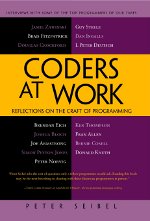
On the train to my parents' house for Christmas I finished up a wild run through the book Coders at Work. The book isn't even mine, but I'd been borrowing it very often, sometimes to the chagrin of its owner, because I could barely put it down. Coders at Work book cover The book is a collection of interviews with 15 great programmers of our time, starting with Jamie Zawinsky and ending with Donald Knuth. It's written in an interview style each interview starts with a brief introduction to the person being interviewed, summarizing what the person is known for and what he or she has accomplished and a few of the highlights of the interview, and then a transcript of the interview follows, with the author/editor, Peter Siebel, will saying something or asking a question, and the interviewee responding. I was skeptical about this format at first because I feel like it can be an easy way out of good editing and make the reader have to do the work of the editor, but on finishing I think that Siebel uses the format to his advantage in this case. For one, the speech format allows the reader to really form a picture of how the person being interviewed speaks and would act in a conversation. Jamie is somewhat bitter and pretty informal. Brad Fitzpatrick is flippant and energetic, his speech littered with profanity and colloquialisms. Others seem more stately and verbose Joe Armstrong's responses can go on for a page or more. In this way, not only do readers learn something about what these greats have learned about programming, but we also feel a bit more like we've met or know them, and can connect to them more as people. I always have this problem where I want to read computer books, but often computer books seem inextricably tied to the computer, so there's this dynamic of reading a bit and then wanting to get on a machine and try something out, write some code, play around especially with books focused on a specific language. Coders at Work retains some of this computer-book dynamic in that I constantly encountered things that I want to investigate or play around with more: Erlang, OCaml, various papers and essays, Knuth's literate programs, and books such as Higher Order Perl and others. Siebel makes a point to ask each person what her short-list of books and papers programmers should read are, so this book is a great source of pointers to other reading material. Unlike a more specific book, however, keeping a list in a notebook was enough to settle the mind to read away-from-a-computer for chapters at a time. It's obvious that despite the interview format, Siebel has done some serious editing. None of the prose is boring to read, and I can't imagine that the text is a straight transcript of how the interviews went. He also has arranged the interviews in an order such that different interviews play off each other. In Branden Eich's interview, for example, he disparages the book Design Patterns:
I never bought the Gamma book. Some people at Netscape did, some of Jamie Zawinski's and my nemeses from another acquisition, they waved it around like the Bible and they were kind of insufferable because they weren't the best programmers.
In the next chapter, Joshua Bloch names it as a book he thinks programmers should read:
Another one, which I have slightly mixed feelings about but I still think everyone should read, is Design Patterns. It gives us a common vocabulary. There are a lot of good ideas in there.
Similar plays, such as Ken Thompson and Fran Allen disagreeing on the badness of C, happen in later chapters, tieing together the different chapters and illustrating how even really good programmers disagree on the Right Thing all the time. Clearly the craft of programming is no settled thing. Besides the general structure of the book being well thought-out, the material is generally thought-provoking and interesting. One thing that stood out to me was Joshua Bloch describing what he called the "empathy gene", which is what a programmer has to have if he's going to be able to design good APIs and programming languages he has to be able to put himself in the shoes of the person who will be using the language or API. This is one thing that differentiates how different programmers can be good at different things. Another thing that stood out to me is that many of those interviewed stated that they don't use much in the way of modern tools and IDEs Joshua Bloch and Simon Peyton-Jones both touch on this, just to name a couple examples, even though some say that they think using these tools would make them more productive, especially when it comes to refactoring. This is a testament to the power of inertia sometimes there is just no chance to be unproductive now in order to be more productive later. Or perhaps just a sign that a programmable text-editor can stand on the same level as a heavier tool in terms of productivity in the right hands. I could go on with examples, but the conclusion here is that I thoroughly enjoyed Coders at Work, and I think it is a book that is well-worth the time spent reading the entire thing.

Gunnar Wolf: Internationalizing into your local customs

It seems strange to me. I don't think I know people as aware of internationalization issues as Bubulle, a.k.a. Christian PERRIER, and I have the feeling his last post regarding how he shall address himself is somewhat short-sighted. That might just mean I am in an even worse position. First, I recognize Christian's concern, but not only when dealing with people from around the globe It happens in my everyday life. When you show an ID stating Gunnar Eyal Wolf Iszaevich, the first reaction is a blank stare of disbelief, only to be followed by a question: So, what is your name? So I understand Christian wants to make it easier for people to guess what his name is in the least obtrusive way possible. I have seen the convention he suggests (uppercasing the family name) AFAICT used by French and Japanese people. But for me, it is intuitively backwards. If I were to emphasize a part of my name, it would be the part by which I expect people to address me with I would write GUNNAR Wolf. And yes, I usually leave out my second given name and my mother's family name, as it is customary here. Well, anyway... Reading my name, few people would guess I live in Mexico. Even fewer will believe I was born here. And if somebody calls me by the wrong part of my name, I won't feel at all offended. I strongly prefer my name to be used, as I like to be addressed casually, but quite often I am introduced as Dr. Wolf, in what at most would be an ex-profeso honoris causas doctorate, or at least an ignoratis causas one.

Torsten Landschoff: libtool silently skips shared libraries without -rpath

Ouch! This is the second time I am running into this so I ll write it up this time. I used libtool via automake for building a python module. Quite unhelpfully, libtool happens to build only the static library. It does that even though I passed the -module option, which should make it clear that a static library does not help at all. There is also no mention why it skips the shared library. After some research, my memory came back: libtool requires to pass the -rpath option to actually build shared libraries. I did not want to pass that options, since it is considered harmful where multiple variants of a library are available. It is even less useful in my specific case, as the module is only used inside the source tree for unit testing. Solution: I changed the Makefile.am to use
1
_helper_la_LDFLAGS = -module -rpath /freaking/libtool/requires/at/least/a/dummy/path
Interestingly, the same scheme (apart from the wording) is used in libtool s own source.

29 December 2009

Leo 'costela' Antunes: Re: Making pbuilder just that little bit faster

Absolutely, but there are at least two workarounds:
  1. Adding
    BINDMOUNTS="/var/cache/apt/archives"
    APTCACHE=""
    to your .pbuilderrc, in case you don t need any special separation of local and pbuilder caches (that s my case).
  2. Using apt-proxy or the like, which has its overhead, but also its other advantages.
None of them seem all that bad to me, considering the sensible speed improvements to pbuilder, but the ultimate decision probably depends on the amount of disk-access the packages in question need.

Daniel Leidert: Re: Making pbuilder just that little bit faster

It is true that making /var/cache/pbuilder/build a tmpfs makes a noticeable speed difference. But it seems you cannot cache the downloaded debs: ln: creating hard link ...: Invalid cross-device link.

Biella Coleman: This is one if for you: the hacker conference as ritual

One of the most frustrating things about being an untenured anthropology professor (aside from being untenured) is that, for the most part, the articles you must write to get tenure strike those you write about as hopelessly boring and jargony. I always imagine that when geeks read my articles, the experience can be represented as follows:
%*&%*&*(((& Linux *(&*(^%&%%^%% DeCSS &*(&^&&*^&^&^& Free Speech %^&%^%^%%^ Hacking &*(&^*(^^*^**^*Code*((*&&**&&*&* Emacs **(**)*( New Maintainer Process *&())))))))))&*&7&&*&)*&*&*&& DMCA **(**((( Copyleft. ****W$$&& TINC
Well, finally, I have my hands on the uncorrected proofs of an article that is far far more readable, accessible, and truth be told, romantic than anything I have written The Hacker Conference: A Ritual Condensation and Celebration of a Lifeworld. This article s ancestry goes back to this ancient blog entry that I wrote after Debconf4 in Brazil, later made it into my dissertation, and finally a gabillion years later is on the verge of publication. Debian developers, in particular, might dig this piece. I made use of your blog entries, mailing list discussions, interviews, and photos to reveal what is special about these events and also memorialize some important events, such as the the founding of Debian Women. So while some I am sure some academics will find this piece distasteful for idealizing these events, so be it. I grew very fond of these conferences, they changed the way I thought of computer hacking, and why not write something that makes those you worked with feel good (as opposed to bored and confused). Finally, academics have totally missed the theoretical boat when it comes to conferences, which are probably one of the most important ritual forms of modernity and yet there is so little written on them an issue I address briefly in the conclusion. Note that this version has various mistakes (including the name of Joel Espy Klecker and the caption under Figure 3, and Figure 9). Since many of your are human debugging machines, if anyone takes a preview read and finds any typos, feel free to send along as I will be sending the proofs back next week.

Wouter Verhelst: Perl on the N900

Since about a week, I have a Nokia N900. They're not actually on sale in Belgium yet, but I managed to get hold of one through a grey market shop. The device is quite nice. I do have a few irks with the interface here and there, but Nokia has a public bugzilla that I'll surely use to file bugs whenever and wherever appropriate. And after using it for about a week, I thought of migrating this small application which I once wrote on half an afternoon using perl, postgres, and Gtk2, to the device. It's mainly a cataloguing system that I store my DVD collection in (which has gotten large enough that this is necessary), nothing earthshattering. The ideal candidate to get my feet wet in developing for the N900, so to speak. That effort got stopped dead in its tracks pretty quickly.
Nokia-N900-42-11:~# perl
use Gtk2;
Can't locate Gtk2.pm in @INC (@INC contains: /etc/perl /usr/local/lib/perl/5.8.3 /usr/local/share/perl/5.8.3 /usr/lib/perl5 /usr/share/perl5 /usr/lib/perl/5.8 /usr/share/perl/5.8 /usr/local/lib/site_perl .) at - line 1.
BEGIN failed--compilation aborted at - line 1.
Nokia-N900-42-11:~# apt-cache search perl
perl - Larry Wall's Practical Extraction and Report Language.
libpcrecpp0 - Perl 5 Compatible Regular Expression Library - C++ runtime files
po4a - tools for helping translation of documentation
libpcre3 - Perl 5 Compatible Regular Expression Library - runtime files
libgdbm3 - GNU dbm database routines (runtime version)
perl-base - The Pathologically Eclectic Rubbish Lister.
liblocale-gettext-perl - Using libc functions for internationalization in Perl
Or, in other words: they only ship the perl bits needed to make dpkg run. Hrmpf. This would make stuff slightly more... involved. Oh well.

John Goerzen: Review: The Happiest Days of Our Lives (by Wil Wheaton)

I started to write this review last night, and went looking for Wil Wheaton s blog, where many of the stories came from, so I can link to it from my review. It was getting late, I was tired, and so I was a bit disoriented for a few seconds when I saw my own words flash up on the screen. At the time, his most recent story had excerpted my review of paper books. Wow, I thought. This never happens when I m about to review Dickens. And actually, it s never happened before, ever. I ll admit to owning a big grin when I saw that one of my favorite authors liked one of my blog posts. And Wil Wheaton is one of my favorite authors for sure. I enjoy reading others too, of course, but Wil s writing is something I can really identify with like no other. My parents were never in a London debtor s prison like Dickens were; I was never a promising medical student like A. C. Doyle. But I was, and am, a geek, and Wil Wheaton captures that more perfectly than anyone. After I read Just a Geek a few years ago, I gave it to my wife to read, claiming it would help her understand me better. I think it did. In The Happiest Days of Our Lives, Wil recounts memories of his childhood, and of more recent days. He talks of flashbacks to his elementary school days, when he and his classmates tried to have the coolest Star Wars action figures (for me: calculator watches). Or how his aunt introduced him to D&D, which reminded me of how my uncle got me interested in computers. Teaching himself D&D was an escape for the geeky kid that wasn t good at sports, as teaching myself Pascal and C was for me. Between us, the names and activities are different, but the story is the same. I particularly appreciated Wil s reflections on his teenage years. Like him, at that age, I often found myself as the youngest person in a room full of adults. Yet I was still a teenager, and like any teenager, did some things that I look back on with some embarrassment now. Wil was completely honest with himself he admitted crashing a golf cart on the Paramount studio lot, for instance, but also reminds me that he was a teenager then. He recognizes that he didn t always make the best choices and wasn t always successful with what he did, but isn t ashamed of himself either. That s helpful for me to remember; I shouldn t be unreasonably harsh on my 16-year-old self, and need to remember that I had to be a teenager too. I also identify with him as a dad. He wrote of counting the days until he could teach his boys about D&D, about passing on being a geek to his sons. I ve had a similar excitement about being able to help Jacob build his first computer. Already Jacob, who is 3, loves using the manual typewriter I cleaned up for him, and spent an hour using the adding machine I dug out on Sunday while I was watching the boys. (I regret that I didn t have time to take it apart and show him how it worked right then when he asked). And perhaps his 2nd-favorite present of Christmas was the $3.50 large-button calculator with solar cell power I got him as an impulse buy at the pharmacy the other day. He is particularly enamored with the square root button because a single press replaces all the numbers on the screen with completely different numbers! I can t find the exact passage now, but Wil wrote at one point about his transition from a career in acting to a career in writing. He said that he likes the feeling he gets when his writing can touch people. He s been able to redefine himself not as a guy that used to be an actor on Star Trek but a person that is a good author, now. I agree, and think his best work has been done with a keyboard instead of a camera. And that leaves me wondering where my career will take me. Yes, I m an author, but of technical books. Authors of technical books rarely touch people s hearts. There s a reason we read Shakespeare and Dickens in literature classes, but no high school English teacher has ever assigned Newton s Opticks, despite its incredible importance to the world. Newton revolutionized science, mathematics, and philosophy, but Opticks doesn t speak to the modern heart like Romeo and Jiuliet still does. Generations of people have learned more about the world from Shakespeare than from Newton. I don t have Wil s gift for writing such touching stories. I ve only been able to even approach that sort of thing once or twice, and it certainly won t make a career for me. Like Wil, I m rarely the youngest person in the room anymore. His days of being a famous teenage actor on a scifi series are long gone, as are mine of single-handedly defeating entire teams at jr. high programming contests. (OK, that s a stretch, but at the time it sure felt exciting.) But unlike him, I m not completely content with my niche yet. I blog about being a geek in rural Kansas, where there still aren t many. I m a dad, with an incredible family. And I write about programming, volunteer for Debian and a few other causes, and have a surprisingly satisfying job working for a company that builds lawn mowers. And yet, I have this unshakable feeling of unsettledness. That I need to stop and think more about what I really want to do with my life, perhaps cultivate some talents I don t yet have, or perhaps find a way to make my current path more meaningful. So I will take Wil s book as a challenge, to all those that were once sure of what their lives would look like, and are less sure with each passing year: take a chance, and make it yours. And on that score, perhaps I ve done more than I had realized at first. Terah and I took a big chance moving to Kansas, and another one when we bought my grandparents run-down house to fix up and live in. Perhaps it s not a bad idea to pause every few years and ask the question: Do I still like the direction I m heading? Can I change it? Wil Wheaton gives me lots to think about, in the form of easy-to-read reflections on his own life. I heartily recommend both Just a Geek and The Happiest Days of Our Lives. (And that has nothing to do with the fact that the Ubuntu machine he used to write the book probably had installed on it a few pieces of code that I wrote, I promise you.)

Next.

Previous.