Review: 2014 Hugos: Short Story Nominees, edited by Loncon 3
Publisher:
Loncon 3
Copyright:
2014
Format:
Kindle
This is a bit of a weird "book review," since this is not a book. Rather,
it's the collection of Hugo-nominated short stories for the 2014 Hugos
(given for works published in 2013) at Loncon 3, the 2014 Worldcon. As
such, the "editor" is the pool of attendees and supporting members who
chose to nominate works, all of which had been previously edited by other
editors in their original publication.
This is also not something that someone else can acquire; if you were not
a supporting or attending member, you didn't get the voting packet. But I
believe all of the stories here are available on-line for free in some
form, a short search away.
"If You Were a Dinosaur, My Love" by Rachel Swirsky: The most
common complaint about this story is that it's not really a story, and I
have to agree. It's a word image of an alternate world in which the
narrator's love is a human-sized dinosaur, starting with some surreal
humor and then slowly shifting tone as it reveals the horrible event
that's happened to the narrator's actual love, and that's sparked the wish
for her love to have claws and teeth. It's reasonably good at what it's
trying to do, but I wanted more of a story. The narrator's imagination
didn't do much for me. (5)
"The Ink Readers of Doi Saket" by Thomas Olde Heuvelt: At least
for me, this story suffered from being put in the context of a Hugo
nominee. It's an okay enough story about a Thai village downstream from a
ritual that involves floating wishes down the river, often with offerings
in the improvised small boats. The background of the story is somewhat
cynical: the villagers make some of the wishes come true, sort of, while
happily collecting the offerings and trying to spread the idea that the
wishes with better offerings are more likely to come true. The
protagonist follows a familiar twist: he actually can make wishes come
true, maybe, but is very innocent about his role in the world.
This is not a bad story, although stories written by people with
western-sounding names about non-western customs worry me, and there were
a few descriptions and approaches here (such as the nickname translations
in footnotes and the villager archetypes) that made my teeth itch. But it
is not a story that belongs on the Hugo nomination slate, at least in my
opinion. It's either cute or mildly irritating, depending on one's mood
when one meets it, not horribly original, and very forgettable. (5)
"Selkie Stories Are for Losers" by Sofia Samatar: I really
liked this story for much of its length. It features a couple of young,
blunt, and bitter women, and focuses on the players in the typical selkie
story that don't get much attention. The selkie's story is one of
captivity or freedom; her lover's story is the inverse, the captor or the
lover. But I don't recall a story about the children before, and I think
Samatar got the tone right. It has the bitterness of divorce and
abandonment mixed with the disillusionment of fantasy turned into pain.
My problem with this story is the ending, or rather, the conclusion, since
the story doesn't so much end as stop. There's a closing paragraph that
gives some hint of the shape to come, but it gave me almost no closure,
and it didn't answer any of the emotional questions that the rest of the
story raised for me. I wanted something more, some sort of epiphany or
clearer determination. (7)
"The Water That Falls on You from Nowhere" by John Chu: This
was by far my favorite of the nominees, which is convenient since it won.
I thought it was the only nominee that felt in the class of stories I
would expect to win a Hugo.
I think this story needs one important caveat up front. The key conceit
of the story is that, in this world, water falls on you out of nowhere if
you tell any sort of lie. It does not explore the practical impact on
that concept for the broader world. That didn't bother me; for some
reason, I wasn't really expecting it to do so. But it did bother several
other people I've seen comment on this story. They were quite frustrated
that the idea was used primarily to shape a personal and family emotional
dilemma, not to explore the impact on the world. So, go into this with
the right expectations: if you want world-building or deep exploration of
a change in physical laws, you will want a different story.
This story, instead, is a beautiful gem about honesty in relationships,
about communication about very hard things and very emotional things,
about coming out, about trusting people, and about understanding people.
I thought it was beautiful. If you read Captain Awkward, or other discussion of how to deal with difficult
families and the damage they cause to relationships, seek this one out.
It surprised me, and delighted me, and made me cry in places, and I loved
the ending. It's more fantasy than science fiction, and it uses the
conceit as a trigger for a story about people instead of a story about
worlds and technology, but I'm still very happy to see it win. (9)
Rating: 7 out of 10
Sending GCM send message from nodejs.
I wanted to send a message from emacs, but it seemed to be
relatively difficult to send HTTPS POST request from emacs,
so I just decided to use handy nodejs.
The attached 'data' is attached to intent as extra, so it can be extracted by
intent.getExtras.getString("message") in IntentService#onHandleIntent()
I (grudgingly) use the Calibre e-book management software to handle my collection of books, and copy them over to my kindle-toy.
One thing that has always bothered me was the fact that when books are imported their ratings are too. If I receive a small sample of ebooks from a friend their ratings are added to my collections.
I've always regarded ratings as things personal to me, rather than attributes of a book itself; as my tastes might not match yours, and vice-versa.
On that basis the last time I was importing a small number of books and getting annoyed at having to manually reset all the imported ratings I decided to do something about it. I started hacking and put together a simple Calibre plugin to automatically zero ratings when books are imported to the collection (i.e. set the rating to be zero).
Sadly this work wasn't painless, despite the small size, as an unfortunate bug in Calibre meant my plugin method wasn't called. Happily Kovid Goyal helped me work through the problem, and he committed a fix that will be in the next Calibre release. For the moment I'm using today's git-snapshot and it works well.
Similarly I've recently started using extended file attributes to store metadata on my desktop system. Unfortunately the GNU findutils package doesn't allow you to do the obvious thing:
There are several xattr patches floating around, but I had to bundle my own in debian/patches to get support for finding files that have particular attribute names.
Maybe one day extended attributes will be taken seriously. (rsync, cp, etc will preserve them. I'm hazy on the compatibility with tar, but most things seem to be working.)
Dear lazyweb,
I am tired of finding how to get my users to happily print again. Please help.
Details follow.
Several years ago, I configured our Institute's server to provide easy, nifty printing support for all of our users. Using Samba+CUPS, I automatically provided drivers to Windows client machines, integration with our network user scheme (allowing for groups authorization That means, you can only print in your designated printer), flexible printer management (i.e. I can change printers on the server side without the users even noticing Great when we get new hardware or printers get sent to repairs!)...
Then, this year the people in charge of client machines in the institute decided to finally ditch WinXP licenses and migrate to Windows 7. Sweet! How can it hurt?
Oh, it can hurt. Terribly.
Windows 7 uses a different driver model, and after quite a bit of hair loss, I was not able to convince Samba to deliver drivers to Win7 (FWIW, I think we are mostly using 64 bit versions). Not only that, it also barfs when we try to install drivers manually and print to a share. And of course, it barfs in the least useful way, so it took me quite a bit of debugging and Web reading to find out it was not only my fault.
So, many people have told me that Samba (or rather, Windows-type networking) is no longer regarded as a good idea for printing. The future is here, and it's called IPP. And it is simpler, because Windows can talk directly with CUPS! Not only that, CUPS allows me to set valid users+groups to each printer. So, what's there to lose?
Besides time, that is. It took me some more hair pulling to find out that Windows 7 is shipped by default (at least in the version I'm using) with the Internet Printing Server feature disabled. Duh. OK, enable it, and... Ta-da! It works with CUPS! Joy, happiness!
Only that... It works only when I use it with no authentication.
Windows has an open issue, with its corresponding hotfix even, because Win7 and 2008 fail to provide user credentials to print servers...
So, yes, I can provide site-wide printing capabilities, but I still cannot provide per-user or per-group authorization and accounting, which are needed here.
I cannot believe this issue cannot be solved under Windows 7, several years after it hit the market. Or am I just too blunt and cannot find an obvious solution?
Dear lazyweb, I did my homework. Please help me!
Pressure
I've just stumbled on this bit that seems relevant to me:
Insist on using objective criteria
The final step is to use mutually agreed and objective criteria for
evaluating the candidate solutions. During this stage they encourage
openness and surrender to principle not pressure.
http://www.wikisummaries.org/Getting_to_Yes
I find the concept of "pressure" very relevant, and I like the idea of
discussions being guided by content rather than pressure.
I'm exploring the idea of filing under this concept of "pressure" most
of the things described in code of conducts, and I'm toying with looking
at gender or race issues from the point of view of making people
surrender to pressure.
In that context, most code of conducts seem to be giving a partial
definition of "pressure". I've been uncomfortable at DebConf this year,
because the conference PG12 code of conduct would cause me trouble for
talking about what lessons can Debian learn from consent culture in BDSM
communities, but it would still allow situations in which people would
have to yield to pressure, as long as the pressure was done avoiding the
behaviours blacklisted by the CoC.
Pressure could be the phrase "you are wrong" without further explanation,
spoken by someone with more reputation than I have in a project. It could be
someone with the time for writing ten emails a day discussing with someone with
barely the time to write one. It could be someone using elaborate English
discussing with someone who needs to look up every other word in a dictionary.
It could be just ignoring emails from people who have issues different than
mine.
I like the idea of having "please do not use pressure to bring your
issues forward" written somewhere, rather than spend time blacklisting
all possible waysof pressuring people.
I love how the Diversity Statement is
elegantly getting all this where it says: We welcome contributions from
everyone as long as they interact constructively with our community.
However, I also find it hard not to fall back to using pressure, even
just for self-preservation: I have often found myself in the situation
of having the responsibility to get a job done, and not having the time
or emotional resources to even read the emails I get about the subject.
All my life I've seen people in such a situation yell "shut up and let
me work!", and I feel a burning thirst for other kinds of role models.
A CoC saying "do not use pressure" would not help me much here, but
being around people who do that, learning to notice when and how they do
it, and knowing that I could learn from them, that certainly would.
If you can link to examples, I'd like to add them here.
Last time I told that I would release software I used to make
RFS stats plots. You can find it in my github repo -
github.com/tdi/debrfstats.
The software contains small class to get data needed to generate plots, as well as for doing
some simple bug analysis. The software also contains an R script to make plots from a CSV file. For
now debrfstats uses SOAP interface to Debbugs but I am now working on adding a UDD data source.
The software is written in Python 2 (SOAPpy does not come in 3 flavour), some usage examples are in
the main.py file in the repository.
If you have any questions or wishes for debrfstats do not hesitate to contact me.
Neil Anderson Flies EasyMega to 118k' At BALLS 23
Altus Metrum would like to congratulate Neil Anderson and Steve
Cutonilli on the success the two stage rocket, A Money Pit , which
flew on Saturday the 20th of September on an N5800 booster followed by
an N1560 sustainer.
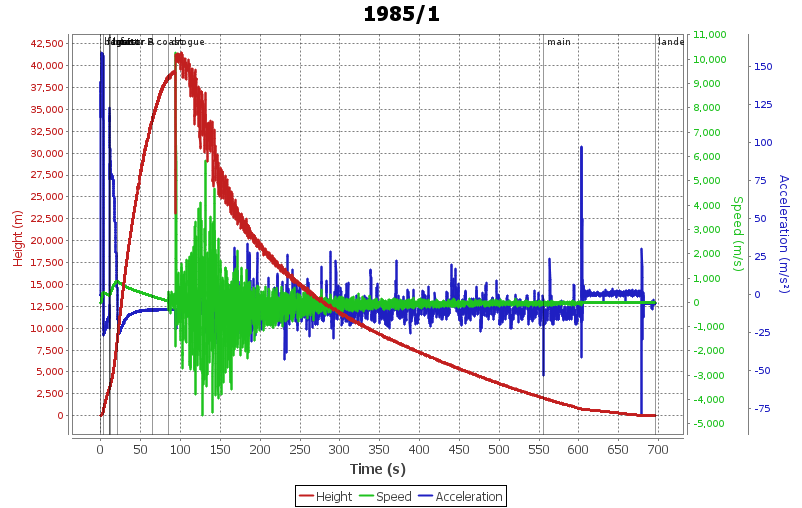
A Money Pit used two Altus MetrumEasyMega flight computers in the
sustainer, each one configured to light the sustainer motor and deploy
the drogue and main parachutes.
Safely Staged After a 7 Second Coast
After the booster burned out, the rocket coasted for 7 seconds to 250m/s, at
which point EasyMega was programmed
to light the sustainer. As a back-up, a timer was set to light the
sustainer 8 seconds after the booster burn-out. In both cases, the
sustainer ignition would have been inhibited if the rocket had tilted
more than 20 from vertical. During the coast, the rocket flew from
736m to 3151m, with speed going from 422m/s down to 250m/s.
This long coast, made safe by
EasyMega'squaternion-based tilt sensor,
allowed this flight to reach a spectacular altitude.
Apogee Determined by Accelerometer
Above 100k', the MS5607 barometric sensor is out of range. However, as
you can see from the graph, the barometric sensor continued to return
useful data. EasyMega doesn't expect that to work, and automatically
switched to accelerometer-only apogee determination mode.
Because off-vertical flight will under-estimate the time to apogee
when using only an accelerometer, the EasyMega boards were programmed
to wait for 10 seconds after apogee before deploying the drogue
parachute. That turned out to be just about right; the graph shows the
barometric data leveling off right as the apogee charges fired.
Fast Descent in Thin Air
Even with the drogue safely fired at apogee, the descent rate rose to
over 200m/s in the rarefied air of the upper atmosphere. With
increasing air density, the airframe slowed to 30m/s when the main
parachute charge fired at 2000m. The larger main chute slowed the
descent further to about 16m/s for landing.
Continuing with his standard pace of approximately one new version per month, Conrad released a new minor release of Armadillo a few days ago. As before, I had created a GitHub-only pre-release which was tested against all eighty-seven (!!) CRAN dependents of our RcppArmadillo package and then uploaded RcppArmadillo 0.4.450.0 to CRAN.
The CRAN maintainers pointed out that under the R-development release, a NOTE was issued concerning the C-library's rand() call. This is a pretty new NOTE, but it means using the (sometimes poor quality) rand() generator is now a no-no. Now, Armadillo being as robustly engineered as it is offers a new random number generator based on C++11 as well as a fallback generator for those unfortunate enough to live with an older C++98 compiler. (I would like to note here that I find Conrad's continued support for both C++11, offering very useful modern language idioms, as well as the fallback code for continued deployment and usage by those constrained in their choice of compilers rather exemplary --- because contrary to what some people may claim, it is not a matter of one or the other. C++ always was, and continues to be, a multi-paradigm language which can be supported easily by several standard. But I digress...)
In any event, one cannot argue with CRAN about their prescription of a C++98 compiler. So Conrad and I discussed this over email, and came up with a scheme where a user-package (such as RcppArmadillo) can provide an alternate generator which Armadillo then deploys. I implemented a first solution which was then altered / reflected by Conrad in a revised version 4.450.1 of Armadillo. I packaged, and now uploaded, that version as RcppArmadillo 0.4.450.1.0 to both CRAN and into Debian.
Besides the RNG change already discussed, this release brings a few smaller changes from the Armadillo side. These are detailed below in the extract from the NEWS file. On the RcppArmadillo side, we now have support for pkgKitten which is both very exciting and likely the topic of another blog post with an example of creating an RcppArmadillo package that purrs. In the process, I overhauled and polished how new packages are created by RcppArmadillo.package.skeleton(). An upcoming blog post may provide an example.
Changes in RcppArmadillo version 0.4.450.1.0 (2014-09-21)
Upgraded to Armadillo release Version 4.450.1 (Spring Hill Fort)
faster handling of matrix transposes within compound expressions
expanded symmatu()/symmatl() to optionally disable taking the complex conjugate of elements
expanded sort_index() to handle complex vectors
expanded the gmm_diag class with functions to generate random samples
A new random-number implementation for Armadillo uses the RNG from R as a fallback (when C++11 is not selected so the C++11-based RNG is unavailable) which avoids using the older C++98-based std::rand
The RcppArmadillo.package.skeleton() function was updated to only set an "Imports:" for Rcpp, but not RcppArmadillo which (as a template library) needs only LinkingTo:
The RcppArmadillo.package.skeleton() function will now prefer pkgKitten::kitten() over package.skeleton() in order to create a working package which passes R CMD check.
I have an office with a nice large window, but more often than not I have to close the shades to be able to see something on my screen. Even worse: There were so many nice and sunny days where I would have loved to take my laptop outside and work there, but it (a Thinkpad T430s) is simply not usable in bright sun. I have seen those nice eInk based eBook readers, who are clearer the brighter they are. That s what I want for my laptop, and I am willing to sacrifice color and a bit of usability due to latency for being able to work in the bright daylight!
So while I was in Portland for DebConf14 (where I guess I felt a bit more like tinkering than otherwise) I bought a Kobo Aura HD. I chose this device because it has a resolution similar to my laptop (1440 1080) and I have seen reports from people running their own software on it, including completely separate systems such as Debian or Android.
This week, I was able to play around with it. It was indeed simple to tinker with: You can simply copy a tarball to it which is then extracted over the root file system. There are plenty of instructions online, but I found it easier to take them as inspiration and do it my way with basic Linux knowledge that s possible. This way, I extended the system boot script with a hook to a file on the internal SD card, and this file then runs the telnetd daemon that comes with the device s busybox installation. Then I just have to make the device go online and telnet onto it. From there it is a pretty normal Linux system, albeit without an X server, using the framebuffer directly.
I even found an existing project providing a VNC client implementation for this and other devices, and pretty soon I could see my laptop screen on the Kobo. Black and white worked fine, but colors and greyscales, including all anti-aliased fonts, were quite broken. After some analysis I concluded that it was confusing the bit pattern of the pixels. Luckily kvncclient shares that code with koreader, which worked fine on my device, so I could copy some files and settings from there et voil : I now have an eInk monitor for my laptop. As a matter of fact, I am writing this text with my Kobo sitting on top of the folded-back laptop screen!
I did some minor adjustments to my laptop:
I changed the screen size to match the Kobo s resolution. Using xrandr s --panning option this is possible even though my real screen is only 900 pixels high.
I disabled the cursor-blink where possible. In general, screen updates should be avoided, so I hide my taffybar (which has a CPU usage monitor) and text is best written at the very end of the line (and not before a, say, </p>).
My terminal windows are now black-on-white.
I had to increase my font-size a bit (the kobo has quite a high DPI), and color is not helpful (so :set syntax=off in vim).
All this is still very manual (going online with the kobo, finding its IP address, logging in via telnet, killing the Kobo's normal main program, starting x11vnc, finding my ip address, starting the vnc client, doing the adjustments mentioned above), so I need to automate it a bit. Unfortunately, there is no canonical way to extend the Kobo by your own application: The Kobo developers made their device quite open, but stopped short from actually encouraging extensions, so people have created many weird ways to start programs on the Kobo dedicated start menus, background programs observing when the regular Kobo app opens a specific file, complete replacements for the system. I am considering to simply run an SSH server on the device and drive the whole process from the laptop. I ll keep you up-to-date.
A dream for the future would be to turn the kobo into a USB monitor and simply connect it to any computer, where it then shows up as a new external monitor. I wonder if there is a standard for USB monitors, and if it is simple enough (but I doubt it).
A word about the kobo development scene: It seems to be quite active and healthy, and a number of interesting applications are provided for it. But unfortunately it all happens on a web forum, and they use it not only for discussion, but also as a wiki, a release page, a bug tracker, a feature request list and as a support line often on one single thread with dozens of posts. This makes it quite hard to find relevant information and decide whether it is still up-to-date. Unfortunately, you cannot really do without it. The PDF viewer that comes with the kobo is barely okish (e.g. no crop functionality), so installing, say, koreader is a must if you read more PDFs than actual ebooks. And then you have to deal with the how-to-start-it problem.
That reminds me: I need to find a decent RSS reader for the kobo, or possibly a good RSS-to-epub converter that I can run automatically. Any suggestions?
PS and related to this project: Thanks to Kathey!
For some days I have been working on statistics of the sponsoring process in Debian. I find
this to be one of the most important things that Debian has to attract and enable new contributions.
It is important to know how this process works, whether we need more sponsors, how effective is the
sponsoring and what are the timings connected to it.
How I did this ?
I have used Debbugs SOAP interface to get all bugs that are filed against sponsorship-requests
pseudo package. SOAP gives a little bit of overhead because it needs to download a complete list of
bugs for the sponsorship-requests package, and then process them according to given date ranges.
The same information can be easily extracted from the UDD database in the future, it will be faster
because SQL is better when working with date ranges than python obviously.
The most problematic part was getting the "real done date" of a particular bug, and frankly most of
my time I have spent on writing a rather dirty and complicated script. The script gets a log for a
particular bug number and returns a "real done date". I have published a proof of concept in a
previous post..
What I measured ?
RFSs is a queue, and in every queue one is interested in a mean time to get processed. In this case I
called the metric global MTTGS (mean time to get sponsored). This is a metric that gives the overall
performance insight in RFS queue. Time to get sponsored (TTGS) for a bug is a number of days that
passed between filing an RFS bug and closing it (bug was sponsored). Mean time to get sponsored is calculated as
a sum of TTGSs of all bugs divided by number of bugs (in a given period of time). Global MTTGS is
MTTGS calculated for a period of time 2012-1-1 until today().
Besides MTTGS I have also measured typical bug related metrics:
number of bugs closed in a given day,
number of bugs opened in a given day,
number of bugs with status open in a given day,
number of bugs with status closed in a given day.
Plots and graphs
Below is a plot of global MTTGS vs. time (click for a larger image).
As you can see, the trend is roughly exponential and MTTGS tends to settle around 60 days at the end of the
year 2013. This does not mean that your package will wait 60 days on average nowadays to get
sponsored. I remind that this is a global MTTGS, so even if the MTTGS of last month was very low, the global MTTGS would decrease
just slightly. It gives, however, a good glance in performance of the process. Even that more
packages are filed for sponsoring (see next graphs) now, than in the beginning of the epoch, the
sponsoring rate is high enough to flatten the global MTTGS, and with time maybe decrease it.
The image below (click for a larger one) shows how many bugs reside in a queue with status open or
closed (calculated for each day). For closed we have an almost linear function, so each day more or less the same amount of
bugs are closed and they increase the pool of bugs with status closed. For bugs with status open the
interesting part begins around May 2012 after the system is saturated or gets popular. It can be interpreted
as a plot of how many bugs reside in the queue, the important part is that it is stable and does not
show clear increasing trend.
The last plot shows arrival and departure rate of bugs from RFS queue, i.e. how many bugs are opened
and closed each day. The interesting part here are the maxima. Let's look at them.
Maximal number of opened bugs (21) was on 2012-05-06. As it appears it was a bunch upload of RFSs
for tryton-modules-*..
The software
Most of the software was written in Python. Graphs were generated in R. After a code cleanup I will
publish a complete solution on my github account, free to use by everybody. If you would like to see
another statistics, please let me know, I can create them if the data provides sufficient
information.
Being the SIMD fanatic that I am, a few years ago I did the PowerPC Altivec and ARM NEON port for the Eigen linear algebra library, one of the best and most popular libraries -and most ported.
Recently I thought it would be a good idea to extend both ports to 64-bit, and it would also help me with the SIMD book, using VSX in one case and ARMv8 NEON (or Advanced SIMD as ARM likes to call it) in the latter. ARMv8 hardware is a bit scarce at the moment, so I thought I'd start with VSX. Being in Debian, I have access to a number of porterboxes in several architectures, and luckily one of those was a Power7 (with VSX) running ppc64. So I started the porting -or rather extending the code- to use VSX in the 64-bit doubles case. Unluckily, I could not test anything because Debian kernels do not have VSX enabled in wheezy -which is what the porterbox is running and enabling it is a non-option(#758620). So, running VSX code would turn out to be quite hard.
Today we celebrate the day of free software (each year, a saturday around mid-September) More info at softwarefreedomday.org
There are no public events in Madrid, but I m going to try to hack and write a bit more this weekend, as my personal celebration.
In this blog post you can find some of my very very recent activities on free software, and my plans for this weekend of celebration!
Debian
Children distros aka Derivatives
I had the translation/update of the page www.debian.org/misc/children-distros pending since long time. It s a long page, and I was not sure what was better: if picking up the too-outdated last translation, and review it carefully in order to update it, or starting from scratch. I decided to reuse the last translation (thanks Luis Uribe!) and after some days dedicating my commuting time on it, finally, yesterday evening I finished it at home. Now it s in the review queue, and I hope in 10 days or so it will be uploaded.
In the meantime, I have learned a bit about the Debian Derivatives subproject and census, I have watched the Derivatives Panel at DebConf13, and had a look at the bug #723069 about keeping the children-distros page up to date.
So now that I m liberated about this translation, I m going to put some time in keeping up to date the original English page (I m part of the www and publicity team, so I think it makes sense). My goal is to review at least one Debian derivative each two days, and when I finish the list, start again. I can update the wiki myself, and for the www, I ll send patches against #723069, unless I m told to do it other way.
BTW, wouldn t be nice to mark web/wiki pages as RFH the same as packages?, so other people can easily decide to put some time on them, and make http://www.debian.org even more awesome! Or make them appear in the how-can-i-help reminders :) Mmm maybe it s just a matter of filing a bug and tagging it as gift ? I think no, because nobody has the package www.debian.org installed in their system I ll talk with the maintainer about this.
New Member process
I promised myself to try to work a bit more in Debian during the summer and September, and if everything goes well, try to apply to the new member process in October.
I wanted to read all the documentation first, and one challenge is to review/update the translations of www.debian.org/devel/join folder. This way, both myself and the Spanish speaking community benefit from the effort. Yesterday I translated one of those pending pages and I hope during the weekend I can translate/update the rest. When I finish that, I ll keep reading the other documentation.
DebConf15
This summer I was invited to join the DebConf15 organization team and pick up tasks in the publicity area. I was very happy to join, I m not sure at all that I can go to DebConf15 in Heidelberg (Germany), in fact I m quite sure I will not go since mid-August is the only opportunity to visit family who lives far away, but anyway, there are things that we can do before DebConf15 and I can contribute.
For now, I attended last Monday to the meeting at IRC, and I m finishing a short blogpost about the DebConf14 talk presenting DebConf15, that will be published in the DebConf15 blog.
Android, F-Droid
I keep on trying to spread the word about F-Droid and the free software available for Android, last week some of my friends updated Kontalk to the 3.0.b1 version (I had updated at the beginning of September) and they liked that now, the images are sent encrypted as well as the text messages :)
Some friends also liked the 2048 game, since it can be played offline, without ads, and so.
I decided to spend some time this weekend contributing translations to the Android apps that I use.
A long pending issue is to try to put workforce in the F-Droid project itself so apps descriptions are internationalized (the program is fully translatable, but the categories of apps and the descriptions themselves, are not). This is a complicated issue, it requires to take some design decisions, and later, of course, the implementation. I cannot do it alone, and I cannot do it in the short time. But today I have filed a bug report (#35) so maybe I find other people able to help.
Jabber/XMPP and the RedesLibres chatroom
Since several months I ve been using more often my Jabber/XMPP account to join the chatroom redeslibres@salas.mijabber.es
I meet there some people that I follow in Pump.io (for example, the people that write in the Comun cate Libremente or Lignux blogs) and we talk about pump.io, free software, free services, and other things. I feel very comfortable there, it s nice to have a Spanish speaking group inside the Free Software community, and I m also learning a bit about XMPP (I ve tried a lot of desktop and Android clients, just for fun!), free networks, and so.
So today I wanted to publicly thank you everybody in that chatroom, that welcomed me so well :)
Thank you, free software friends
And, by extension, I want to thank you all the people that work and have fun in the Free Software communities, in the projects where I contribute or others. They (we) hack to make the world better, and to allow others join to this beautiful challenge that is making machines do what their (final) users wants.
Comments?
You can comment on this post in this Pump.io thread. Filed under: My experiences and opinion Tagged: Android, Communities, Contributing to libre software, Debian, English, F-Droid, federation, Free Software, Freedom, internationalization, libre software, localization, translations
"I have seen a picture," Havzhiva went on.
The Chosen was impassive; he might or might not know the word. "Lines and colors made with
earth on earth may hold knowledge in them. All knowledge is local, all truth is partial," Havzhiva said
with an easy, colloquial dignity that he knew was an imitation of his mother, the Heir of the Sun, talking
to foreign merchants. "No truth can make another truth untrue. All knowledge is a part of the whole
knowledge. A true line, a true color. Once you have seen the larger patttern, you cannot go back
to seeing the part as the whole.
I've just finished to read "Four Ways to Forgiveness" by U.K Le Guin.
It deeply resonated within me, it's still there doing its magic in my brain, lingering in the corners of my mind, tickling my view of reality, humming with the beauty of ideas you didn't knew were inside you till you've seen them written on paper.
And then, you know they were there all along, you just didn't know how to make them into words.
Le Guin knows how to do it, wonderfully.
I loved the whole book, but the last two stories were eye-openers.
Thanks Enrico for suggesting me this one, thanks dkg for having introduced me to Le Guin's books (with another fantastic book: The Left Hand of Darkness).
This week, the reSIProcate project completed the move from SVN to Git.
With many people using the SIP stack in both open source and commercial projects, the migration was carefully planned and tested over an extended period of time. Hopefully some of the experience from this migration can help other projects too.
Previous SVN committers were tracked down using my script for matching emails to Github accounts. This also allowed us to see their recent commits on other projects and see how they want their name and email address represented when their previous commits in SVN were mapped to Git commits.
For about a year, the sync2git script had been run hourly from cron to maintain an official mirror of the project in Github. This allowed people to test it and it also allowed us to start using some Github features like travis-CI.org before officially moving to Git.
At the cut-over, the SVN directories were made read-only, sync2git was run one last time and then people were advised they could commit in Git.
Documentation has also been created to help people get started quickly sharing patches as Github pull requests if they haven't used this facility before.
For the tl;dr: Docker FDW is a thing.
Star it, hack it, try it out. File bugs, be happy. If you want to see what it's
like to read, there's some example SQL down below.
The question is first, what the heck is a PostgreSQL Foreign Data Wrapper?
PostgreSQL Foreign Data Wrappers are plugins that allow C libraries
to provide an adaptor for PostgreSQL to talk to an external database.
Some folks have used this to wrap stuff like
MongoDB, which I always found
to be hilarous (and an epic hack).
Enter Multicorn
During my time at PyGotham, I saw a talk from
Wes Chow about something called
Multicorn. He was showing off some really neat
plugins, such as the git revision history of CPython, and parsed logfiles
from some stuff over at Chartbeat. This basically blew my mind.
All throughout the talk I was coming up with all sorts of things that I wanted
to do -- this whole library is basically exactly what I've been dreaming
about for years. I've always wanted to provide a SQL-like interface
into querying API data, joining data cross-API using common crosswalks,
such as using Capitol Words to query for
Legislators, and use the
bioguide ids
to JOIN against the congress api
to get their Twitter account names.
My first shot was to Multicorn the new
Open Civic Data API I was working on, chuckled
and put it aside as a really awesome hack.
Enter Docker
It wasn't until tianon connected the dots for me
and suggested a Docker FDW did I get really excited.
Cue a few hours of hacking, and I'm proud to say -- here's
Docker FDW.
This lets us ask all sorts of really interesting questions out of the API,
and might even help folks writing webapps avoid adding too much Docker-aware
logic. Abstractions can be fun!
Setting it up
I'm going to assume you have a working Multicorn, PostgreSQL and Docker setup
(including adding the postgres user to the docker group)
So, now let's pop open a psql session. Create a database (I called mine
dockerfdw, but it can be anything), and let's create some tables.
Before we create the tables, we need to let PostgreSQL know where our
objects are. This takes a name for the server, and the Python importable
path to our FDW.
Now that we have the server in place, we can tell PostgreSQL to create a table
backed by the FDW by creating a foreign table. I won't go too much into the
syntax here, but you might also note that we pass in some options - these are
passed to the constructor of the FDW, letting us set stuff like the Docker
host.
And, now that we have tables in place, we can try to learn something about the
Docker containers. Let's start with something fun - a join from containers
to images, showing all image tag names, the container names and the ip of the
container (if it has one!).
OK, let's see if we can bring this to the next level now. I finally got around
to implementing INSERT and DELETE operations, which turned out to be
pretty simple to do. Check this out:
DELETEFROMdocker_containers;
DELETE1
This will do a stop + kill after a 10 second hang behind the scenes. It's
actually a lot of fun to spawn up a container and terminate it from
PostgreSQL.
                                id
------------------------------------------------------------------
 0a903dcf5ae10ee1923064e25ab0f46e0debd513f54860beb44b2a187643ff05
INSERT 0 1
(1 row)
Spawning containers works too - this is still very immature and not super
practical, but I figure while I'm showing off, I might as well go all the way.
Success! This is just a taste of what's to come, so please feel free to hack on
Docker FDW,
tweet me @paultag, file bugs / feature requests.
It's currently a bit of a hack, and it's something that I think has
long-term potential after some work goes into making sure that this is a rock
solid interface to the Docker API.
I spend a surprising amount of my time as part of keyring-maint telling people their requests are badly formed and asking them to fix them up so I can actually process them. The one that's hardest to fault anyone on is that we require requests to be inline PGP signed (i.e. the same sort of output as you get with "gpg --clearsign"). That's because RT does various pieces of unpacking[0] of MIME messages that mean that a PGP/MIME signatures that have passed through it are no longer verifiable. Daniel has pointed out that inline PGP is a bad idea and got as far as filing a request that RT handle PGP/MIME correctly (you need a login for that but there's a generic read-only one that's easy to figure out), but until that happens the requirement stands when dealing with Debian's RT instance. So today I finally added the following lines to my .muttrc rather than having to remember to switch Mutt to inline signing for this one special case:
i.e. by default turn off auto inlined PGP signatures, but when emailing anything at rt.debian.org turn them on.
(Most of the other things I tell people to fix are covered by the replacing keys page; I advise anyone requesting a key replacement to read that page. There's even a helpful example request template at the bottom.)
[0] RT sticks a header on the plain text portion of the mail, rather than adding a new plain text part for the header if there are multiple parts (this is something Mailman handles better). It will also re-encode received mail into UTF-8 which I can understand, but Mutt will by default try to find an 8 bit encoding that can handle the mail, because that's more efficient, which tends to mean it picks latin1.
Update: Apparently Mutt in Jessie and beyond doesn't have the pgp_autosign option; you want crypt_autosign instead (and maybe crypt_autopgp but that defaults to yes so unless you've configured your setup to do S/MIME by default you should be fine). Thanks to Luca Capello for pointing this out.
I am working on a small project to create WNPP like statistics for open RFS bugs. I think this could
improve a little bit effectiveness of sponsoring new packages by giving insight into bugs that are on
their way to being starved (i.e. not ever sponsored, or rotting in a queue).
The script attached in this post is written in Python and uses Debbugs SOAP
interface to get currently open RFS bugs and
calculates their dust and age.
The dust factor is calculated as an absolute value of a difference between bugs's age and
log_modified.
Later I would like to create fully blown stats for an RFS queue, taking into account
the whole history (i.e. 2012-1-1 until now), and check its health, calculate MTTGS (mean time to get sponsored).
The list looks more or less like this:
Assuming this post shows up then I'll have successfully migrated from Chronicle to a temporary replacement.
Chronicle is awesome, and despite a lack of activity recently it is not dead. (No activity because it continued to do everything I needed for my blog.)
Unfortunately though there is a problem with chronicle, it suffers from a bit of a performance problem which has gradually become more and more vexing as the nubmer of entries I have has grown.
When chronicle runs it :
It reads each post into a complex data-structure.
Then it walks this multiple times.
Finally it outputs a whole bunch of posts.
In the general case you rebuild a blog because you've made a entry, or received a new comment. There is some code which tries to use memcached for caching, but in general chronicle just isn't fast and it is certainly memory-bound if you have a couple of thousand entries.
Currently my test data-set contains 2000 entries and to rebuild that from a clean start takes around 4 minutes, which is pretty horrific.
So what is the alternative? What if you could parse each post once, add it to an SQLite database, and then use that for writing your output pages? Instead of the complex data-structure in-RAM and the need to parse a zillion files you'd have a standard/simple SQL structure you could use to build a tag-cloud, an archive, & etc. If you store the contents of the parsed-blog, along with the mtime of the source file you can update it if the entry is changed in the future, as I sometimes make typos which I only spot once Ive run make steve on my blog sources.
Not surprisingly the newer code is significantly faster if you have 2000+ posts. If you've imported the posts into SQLite the most recent entries are updated in 3 seconds. If you're starting cold, parsing each entry, inserting it into SQLite, and then generating the blog from scratch the build time is still less than 10 seconds.
The downside is that I've removed features, obviously nothing that I use myself. Most notably the calendar view is gone, as is the ability to use date-based URLs. Less seriously there is only a single theme, which is what is used upon this site.
In conclusion I've written something last night which is a stepping stone between the current chronicle and chronicle2 which will appear in due course.
PS. This entry was written in markdown, just because I wanted to be sure it worked.
ACPI is a complicated specification - the latest version is 980 pages long. But that's because it's trying to define something complicated: an entire interface for abstracting away hardware details and making it easier for an unmodified OS to boot diverse platforms.
Inevitably, though, it can't define the full behaviour of an ACPI system. It doesn't explicitly state what should happen if you violate the spec, for instance. Obviously, in a just and fair world, no systems would violate the spec. But in the grim meathook future that we actually inhabit, systems do. We lack the technology to go back in time and retroactively prevent this, and so we're forced to deal with making these systems work.
This ends up being a pain in the neck in the x86 world, but it could be much worse. Way back in 2008 I wrote something about why the Linux kernel reports itself to firmware as "Windows" but refuses to identify itself as Linux. The short version is that "Linux" doesn't actually identify the behaviour of the kernel in a meaningful way. "Linux" doesn't tell you whether the kernel can deal with buffers being passed when the spec says it should be a package. "Linux" doesn't tell you whether the OS knows how to deal with an HPET. "Linux" doesn't tell you whether the OS can reinitialise graphics hardware.
Back then I was writing from the perspective of the firmware changing its behaviour in response to the OS, but it turns out that it's also relevant from the perspective of the OS changing its behaviour in response to the firmware. Windows 8 handles backlights differently to older versions. Firmware that's intended to support Windows 8 may expect this behaviour. If the OS tells the firmware that it's compatible with Windows 8, the OS has to behave compatibly with Windows 8.
In essence, if the firmware asks for Windows 8 support and the OS says yes, the OS is forming a contract with the firmware that it will behave in a specific way. If Windows 8 allows certain spec violations, the OS must permit those violations. If Windows 8 makes certain ACPI calls in a certain order, the OS must make those calls in the same order. Any firmware bug that is triggered by the OS not behaving identically to Windows 8 must be dealt with by modifying the OS to behave like Windows 8.
This sounds horrifying, but it's actually important. The existence of well-defined[1] OS behaviours means that the industry has something to target. Vendors test their hardware against Windows, and because Windows has consistent behaviour within a version[2] the vendors know that their machines won't suddenly stop working after an update. Linux benefits from this because we know that we can make hardware work as long as we're compatible with the Windows behaviour.
That's fine for x86. But remember when I said it could be worse? What if there were a platform that Microsoft weren't targeting? A platform where Linux was the dominant OS? A platform where vendors all test their hardware against Linux and expect it to have a consistent ACPI implementation?
Our even grimmer meathook future welcomes ARM to the ACPI world.
Software development is hard, and firmware development is software development with worse compilers. Firmware is inevitably going to rely on undefined behaviour. It's going to make assumptions about ordering. It's going to mishandle some cases. And it's the operating system's job to handle that. On x86 we know that systems are tested against Windows, and so we simply implement that behaviour. On ARM, we don't have that convenient reference. We are the reference. And that means that systems will end up accidentally depending on Linux-specific behaviour. Which means that if we ever change that behaviour, those systems will break.
So far we've resisted calls for Linux to provide a contract to the firmware in the way that Windows does, simply because there's been no need to - we can just implement the same contract as Windows. How are we going to manage this on ARM? The worst case scenario is that a system is tested against, say, Linux 3.19 and works fine. We make a change in 3.21 that breaks this system, but nobody notices at the time. Another system is tested against 3.21 and works fine. A few months later somebody finally notices that 3.21 broke their system and the change gets reverted, but oh no! Reverting it breaks the other system. What do we do now? The systems aren't telling us which behaviour they expect, so we're left with the prospect of adding machine-specific quirks. This isn't scalable.
Supporting ACPI on ARM means developing a sense of discipline around ACPI development that we simply haven't had so far. If we want to avoid breaking systems we have two options:
1) Commit to never modifying the ACPI behaviour of Linux. 2) Exposing an interface that indicates which well-defined ACPI behaviour a specific kernel implements, and bumping that whenever an incompatible change is made. Backward compatibility paths will be required if firmware only supports an older interface.
(1) is unlikely to be practical, but (2) isn't a great deal easier. Somebody is going to need to take responsibility for tracking ACPI behaviour and incrementing the exported interface whenever it changes, and we need to know who that's going to be before any of these systems start shipping. The alternative is a sea of ARM devices that only run specific kernel versions, which is exactly the scenario that ACPI was supposed to be fixing.
[1] Defined by implementation, not defined by specification [2] Windows may change behaviour between versions, but always adds a new _OSI string when it does so. It can then modify its behaviour depending on whether the firmware knows about later versions of Windows.
 Sending GCM send message from nodejs.
I wanted to send a message from emacs, but it seemed to be
relatively difficult to send HTTPS POST request from emacs,
so I just decided to use handy nodejs.
The attached 'data' is attached to intent as extra, so it can be extracted by
intent.getExtras.getString("message") in IntentService#onHandleIntent()
 I (grudgingly) use the
 Dear lazyweb,
I am tired of finding how to get my users to happily print again. Please help.
Details follow.
Several years ago, I configured our Institute's server to provide easy, nifty printing support for all of our users. Using Samba+CUPS, I automatically provided drivers to Windows client machines, integration with our network user scheme (allowing for groups authorization That means, you can only print in your designated printer), flexible printer management (i.e. I can change printers on the server side without the users even noticing Great when we get new hardware or printers get sent to repairs!)...
Then, this year the people in charge of client machines in the institute decided to finally ditch WinXP licenses and migrate to Windows 7. Sweet! How can it hurt?
Oh, it can hurt. Terribly.
Windows 7 uses a different driver model, and after quite a bit of hair loss, I was not able to convince Samba to deliver drivers to Win7 (FWIW, I think we are mostly using 64 bit versions). Not only that, it also barfs when we try to install drivers manually and print to a share. And of course, it barfs in the least useful way, so it took me quite a bit of debugging and Web reading to find out it was not only my fault.
So, many people have told me that Samba (or rather, Windows-type networking) is no longer regarded as a good idea for printing. The future is here, and it's called IPP. And it is simpler, because Windows can talk directly with CUPS! Not only that, CUPS allows me to set valid users+groups to each printer. So, what's there to lose?
Besides time, that is. It took me some more hair pulling to find out that Windows 7 is shipped by default (at least in the version I'm using) with the Internet Printing Server feature disabled. Duh. OK, enable it, and... Ta-da! It works with CUPS! Joy, happiness!
Only that... It works only when I use it with no authentication.
Windows has an open issue,
 Neil Anderson Flies EasyMega to 118k' At BALLS 23
Altus Metrum would like to congratulate Neil Anderson and Steve
Cutonilli on the success the two stage rocket, A Money Pit , which
flew on Saturday the 20th of September on an N5800 booster followed by
an N1560 sustainer.
A Money Pit used two
 Continuing with his standard pace of approximately one new version per month,

 I have an office with a nice large window, but more often than not I have to close the shades to be able to see something on my screen. Even worse: There were so many nice and sunny days where I would have loved to take my laptop outside and work there, but it (a Thinkpad T430s) is simply not usable in bright sun. I have seen those nice eInk based eBook readers, who are clearer the brighter they are. That s what I want for my laptop, and I am willing to sacrifice color and a bit of usability due to latency for being able to work in the bright daylight!
So while I was in Portland for DebConf14 (where I guess I felt a bit more like tinkering than otherwise) I bought a


 For the tl;dr:
 I spend a surprising amount of my time as part of
 ACPI is a complicated specification - the