Search Results: "xam"

6 January 2022

Jacob Adams: Linux Hibernation Documentation

Recently I ve been curious about how hibernation works on Linux, as it s an interesting interaction between hardware and software. There are some notes in the Arch wiki and the kernel documentation (as well as some kernel documentation on debugging hibernation and on sleep states more generally), and of course the ACPI Specification

The Formal Definition ACPI (Advanced Configuration and Power Interface) is, according to the spec, an architecture-independent power management and configuration framework that forms a subsystem within the host OS which defines a hardware register set to define power states. ACPI defines four global system states G0, working/on, G1, sleeping, G2, soft off, and G3, mechanical off1. Within G1 there are 4 sleep states, numbered S1 through S4. There are also S0 and S5, which are equivalent to G0 and G2 respectively2.

Sleep According to the spec, the ACPI S1-S4 states all do the same thing from the operating system s perspective, but each saves progressively more power, so the operating system is expected to pick the deepest of these states when entering sleep. However, most operating systems3 distinguish between S1-S3, which are typically referred to as sleep or suspend, and S4, which is typically referred to as hibernation.

S1: CPU Stop and Cache Wipe The CPU caches are wiped and then the CPU is stopped, which the spec notes is equivalent to the WBINVD instruction followed by the STPCLK signal on x86. However, nothing is powered off.

S2: Processor Power off The system stops the processor and most system clocks (except the real time clock), then powers off the processor. Upon waking, the processor will not continue what it was doing before, but instead use its reset vector4.

S3: Suspend/Sleep (Suspend-to-RAM) Mostly equivalent to S2, but hardware ensures that only memory and whatever other hardware memory requires are powered.

S4: Hibernate (Suspend-to-Disk) In this state, all hardware is completely powered off and an image of the system is written to disk, to be restored from upon reapplying power. Writing the system image to disk can be handled by the operating system if supported, or by the firmware.

Linux Sleep States Linux has its own set of sleep states which mostly correspond with ACPI states.

Suspend-to-Idle This is a software only sleep that puts all hardware into the lowest power state it can, suspends timekeeping, and freezes userspace processes. All userspace and some kernel threads5, except those tagged with PF_NOFREEZE, are frozen before the system enters a sleep state. Frozen tasks are sent to the __refrigerator(), where they set TASK_UNINTERRUPTIBLE and PF_FROZEN and infinitely loop until PF_FROZEN is unset6. This prevents these tasks from doing anything during the imaging process. Any userspace process running on a different CPU while the kernel is trying to create a memory image would cause havoc. This is also done because any filesystem changes made during this would be lost and could cause the filesystem and its related in-memory structures to become inconsistent. Also, creating a hibernation image requires about 50% of memory free, so no tasks should be allocating memory, which freezing also prevents.

Standby This is equivalent to ACPI S1.

Suspend-to-RAM This is equivalent to ACPI S3.

Hibernation Hibernation is mostly equivalent to ACPI S4 but does not require S4, only requiring low-level code for resuming the system to be present for the underlying CPU architecture according to the Linux sleep state docs. To hibernate, everything is stopped and the kernel takes a snapshot of memory. Then, the system writes out the memory image to disk. Finally, the system either enters S4 or turns off completely. When the system restores power it boots a new kernel, which looks for a hibernation image and loads it into memory. It then overwrites itself with the hibernation image and jumps to a resume area of the original kernel7. The resumed kernel restores the system to its previous state and resumes all processes.

Hybrid Suspend Hybrid suspend does not correspond to an official ACPI state, but instead is effectively a combination of S3 and S4. The system writes out a hibernation image, but then enters suspend-to-RAM. If the system wakes up from suspend it will discard the hibernation image, but if the system loses power it can safely restore from the hibernation image.
  1. The difference between soft and mechanical off is that mechanical off is entered and left by a mechanical means (for example, turning off the system s power through the movement of a large red switch)
  2. It s unclear to me why G and S states overlap like this. I assume this is a relic of an older spec that only had S states, but I have not as yet found any evidence of this. If someone has any information on this, please let me know and I ll update this footnote.
  3. Of the operating systems I know of that support ACPI sleep states (I checked Windows, Mac, Linux, and the three BSDs8), only MacOS does not allow the user to deliberately enable hibernation, instead supporting a hybrid suspend it calls safe sleep
  4. The reset vector of a processor is the default location where, upon a reset, the processor will go to find the first instruction to execute. In other words, the reset vector is a pointer or address where the processor should always begin its execution. This first instruction typically branches to the system initialization code. Xiaocong Fan, Real-Time Embedded Systems, 2015
  5. All kernel threads are tagged with PF_NOFREEZE by default, so they must specifically opt-in to task freezing.
  6. This is not from the docs, but from kernel/freezer.c which also notes Refrigerator is place where frozen processes are stored :-).
  7. This is the operation that requires special architecture-specific low-level code .
  8. Interestingly NetBSD has a setting to enable hibernation, but does not actually support hibernation


5 January 2022

Reproducible Builds: Reproducible Builds in December 2021

Welcome to the December 2021 report from the Reproducible Builds project! In these reports, we try and summarise what we have been up to over the past month, as well as what else has been occurring in the world of software supply-chain security. As a quick recap of what reproducible builds is trying to address, whilst anyone may inspect the source code of free software for malicious flaws, almost all software is distributed to end users as pre-compiled binaries. The motivation behind the reproducible builds effort is to ensure no flaws have been introduced during this compilation process by promising identical results are always generated from a given source, thus allowing multiple third-parties to come to a consensus on whether a build was compromised. As always, if you would like to contribute to the project, please get in touch with us directly or visit the Contribute page on our website.
Early in December, Julien Voisin blogged about setting up a rebuilderd instance in order to reproduce Tails images. Working on previous work from 2018, Julien has now set up a public-facing instance which is providing build attestations. As Julien dryly notes in his post, Currently, this isn t really super-useful to anyone, except maybe some Tails developers who want to check that the release manager didn t backdoor the released image. Naturally, we would contend sincerely that this is indeed useful.
The secure/anonymous Tor browser now supports reproducible source releases. According to the project s changelog, version 0.4.7.3-alpha of Tor can now build reproducible tarballs via the make dist-reprod command. This issue was tracked via Tor issue #26299.
Fabian Keil posted a question to our mailing list this month asking how they might analyse differences in images produced with the FreeBSD and ElectroBSD s mkimg and makefs commands:
After rebasing ElectroBSD from FreeBSD stable/11 to stable/12
I recently noticed that the "memstick" images are unfortunately
still not 100% reproducible.
Fabian s original post generated a short back-and-forth with Chris Lamb regarding how diffoscope might be able to support the particular format of images generated by this command set.

diffoscope diffoscope is our in-depth and content-aware diff utility. Not only can it locate and diagnose reproducibility issues, it can provide human-readable diffs from many kinds of binary formats. This month, Chris Lamb prepared and uploading versions 195, 196, 197 and 198 to Debian, as well as made the following changes:
  • Support showing Ordering differences only within .dsc field values. [ ]
  • Add support for XMLb files. [ ]
  • Also add, for example, /usr/lib/x86_64-linux-gnu to our local binary search path. [ ]
  • Support OCaml versions 4.11, 4.12 and 4.13. [ ]
  • Drop some unnecessary has_same_content_as logging calls. [ ]
  • Replace token variable with an anonymously-named variable instead to remove extra lines. [ ]
  • Don t use the runtime platform s native endianness when unpacking .pyc files. This fixes test failures on big-endian machines. [ ]
Mattia Rizzolo also made a number of changes to diffoscope this month as well, such as:
  • Also recognize GnuCash files as XML. [ ]
  • Support the pgpdump PGP packet visualiser version 0.34. [ ]
  • Ignore the new Lintian tag binary-with-bad-dynamic-table. [ ]
  • Fix the Enhances field in debian/control. [ ]
Finally, Brent Spillner fixed the version detection for Black uncompromising code formatter [ ], Jelle van der Waa added an external tool reference for Arch Linux [ ] and Roland Clobus added support for reporting when the GNU_BUILD_ID field has been modified [ ]. Thank you for your contributions!

Distribution work In Debian this month, 70 reviews of packages were added, 27 were updated and 41 were removed, adding to our database of knowledge about specific issues. A number of issue types were created as well, including: strip-nondeterminism version 1.13.0-1 was uploaded to Debian unstable by Holger Levsen. It included contributions already covered in previous months as well as new ones from Mattia Rizzolo, particularly that the dh_strip_nondeterminism Debian integration interface uses the new get_non_binnmu_date_epoch() utility when available: this is important to ensure that strip-nondeterminism does not break some kinds of binNMUs.
In the world of openSUSE, however, Bernhard M. Wiedemann posted his monthly reproducible builds status report.
In NixOS, work towards the longer-term goal of making the graphical installation image reproducible is ongoing. For example, Artturin made the gnome-desktop package reproducible.

Upstream patches The Reproducible Builds project attempts to fix as many currently-unreproducible packages as possible. In December, we wrote a large number of such patches, including:

Testing framework The Reproducible Builds project runs a significant testing framework at tests.reproducible-builds.org, to check packages and other artifacts for reproducibility. This month, the following changes were made:
  • Holger Levsen:
    • Run the Debian scheduler less often. [ ]
    • Fix the name of the Debian testing suite name. [ ]
    • Detect builds that are rescheduling due to problems with the diffoscope container. [ ]
    • No longer special-case particular machines having a different /boot partition size. [ ]
    • Automatically fix failed apt-daily and apt-daily-upgrade services [ ], failed e2scrub_all.service & user@ systemd units [ ][ ] as well as generic build failures [ ].
    • Simplify a script to powercycle arm64 architecture nodes hosted at/by codethink.co.uk. [ ]
    • Detect if the udd-mirror.debian.net service is down. [ ]
    • Various miscellaneous node maintenance. [ ][ ]
  • Roland Clobus (Debian live image generation):
    • If the latest snapshot is not complete yet, try to use the previous snapshot instead. [ ]
    • Minor: whitespace correction + comment correction. [ ]
    • Use unique folders and reports for each Debian version. [ ]
    • Turn off debugging. [ ]
    • Add a better error description for incorrect/missing arguments. [ ]
    • Report non-reproducible issues in Debian sid images. [ ]
Lastly, Mattia Rizzolo updated the automatic logfile parsing rules in a number of ways (eg. to ignore a warning about the Python setuptools deprecation) [ ][ ] and Vagrant Cascadian adjusted the config for the Squid caching proxy on a node. [ ]

If you are interested in contributing to the Reproducible Builds project, please visit our Contribute page on our website. However, you can get in touch with us via:

4 January 2022

Jelmer Vernooij: Personal Streaming Audio Server

For a while now, I ve been looking for a good way to stream music from my home music collection on my phone. There are quite a few options for music servers that support streaming. However, Android apps that can stream music from one of those servers tend to be unmaintained, clunky or slow (or more than one of those). It is possible to use something that runs in a web server, but that means no offline caching - which can be quite convenient in spots without connectivity, such as the Underground or other random bits of London with poor cell coverage.
Server Most music servers today support some form of the subsonic API. I ve tried a couple, with mixed results:
  • supysonic; Python. Slow. Ran into some issues with subsonic clients. No real web UI.
  • gonic; Go. Works well & fast enough. Minimal web UI, i.e. no ability to play music from a browser.
  • airsonic; Java. Last in a chain of (abandoned) forks. More effort to get to work, and resource intensive.
Eventually, I ve settled on Navidrome. It s got a couple of things going for it:
  • Good subsonic implementation that worked with all the Android apps I used it with.
  • Great Web UI for use in a browser
I run Navidrome in Kubernetes. It s surprisingly easy to get going. Here s the deployment I m using:
 1
 2
 3
 4
 5
 6
 7
 8
 9
10
11
12
13
14
15
16
17
18
19
20
21
22
23
24
25
26
27
28
29
30
31
32
33
34
35
36
37
38
39
40
41
42
43
44
45
46
47
48
49
50
51
52
53
54
55
56
57
58
59
60
61
62
63
64
65
66
67
68
69
apiVersion: apps/v1
kind: Deployment
metadata:
 name: navidrome
spec:
 replicas: 1
 selector:
   matchLabels:
     app: navidrome
 template:
   metadata:
     labels:
       app: navidrome
   spec:
     containers:
       - name: navidrome
         image: deluan/navidrome:latest
         imagePullPolicy: Always
         resources:
           limits:
             cpu: ".5"
             memory: "2Gi"
           requests:
             cpu: "0.1"
             memory: "10M"
         ports:
           - containerPort: 4533
         volumeMounts:
           - name: navidrome-data-volume
             mountPath: /data
           - name: navidrome-music-volume
             mountPath: /music
         env:
           - name: ND_SCANSCHEDULE
             value: 1h
           - name: ND_LOGLEVEL
             value: info
           - name: ND_SESSIONTIMEOUT
             value: 24h
           - name: ND_BASEURL
             value: /navidrome
         livenessProbe:
            httpGet:
              path: /navidrome/app
              port: 4533
            initialDelaySeconds: 30
            periodSeconds: 3
            timeoutSeconds: 90
     volumes:
        - name: navidrome-data-volume
          hostPath:
           path: /srv/navidrome
           type: Directory
        - name: navidrome-music-volume
          hostPath:
            path: /srv/media/music
            type: Directory
---
apiVersion: v1
kind: Service
metadata:
  name: navidrome
spec:
  ports:
    - port: 4533
      name: web
  selector:
    app: navidrome
  type: ClusterIP
At the moment, this deployment is still tied to the machine with my music on it since it relies on hostPath volumes, but I m planning to move that to ceph in the future. I then expose this service on /navidrome on my private domain (here replaced with example.com) using an Ingress:
 1
 2
 3
 4
 5
 6
 7
 8
 9
10
11
12
13
14
15
16
17
apiVersion: networking.k8s.io/v1
kind: Ingress
metadata:
  name: navidrome
spec:
  ingressClassName: nginx
  rules:
  - host: example.com
    http:
      paths:
      - backend:
          service:
            name: navidrome
            port:
              name: web
        path: /navidrome(/ $)(.*)
        pathType: Prefix
Client On the desktop, I usually just use navidrome s web interface. Clementine s support for subsonic is also okay. sublime-music is meant to be a music player specifically for Subsonic, but I ve not really found it stable enough for day-to-day usage. There are various Android clients for Subsonic, but I ve only really considered the Open Source ones that are hosted on F-Droid. Most of those are abandoned, but D-Sub works pretty well - as does my preferred option, Subtracks.

3 January 2022

Ian Jackson: Debian s approach to Rust - Dependency handling

tl;dr: Faithfully following upstream semver, in Debian package dependencies, is a bad idea. Introduction I have been involved in Debian for a very long time. And I ve been working with Rust for a few years now. Late last year I had cause to try to work on Rust things within Debian. When I did, I found it very difficult. The Debian Rust Team were very helpful. However, the workflow and tooling require very large amounts of manual clerical work - work which it is almost impossible to do correctly since the information required does not exist. I had wanted to package a fairly straightforward program I had written in Rust, partly as a learning exercise. But, unfortunately, after I got stuck in, it looked to me like the effort would be wildly greater than I was prepared for, so I gave up. Since then I ve been thinking about what I learned about how Rust is packaged in Debian. I think I can see how to fix some of the problems. Although I don t want to go charging in and try to tell everyone how to do things, I felt I ought at least to write up my ideas. Hence this blog post, which may become the first of a series. This post is going to be about semver handling. I see problems with other aspects of dependency handling and source code management and traceability as well, and of course if my ideas find favour in principle, there are a lot of details that need to be worked out, including some kind of transition plan. How Debian packages Rust, and build vs runtime dependencies Today I will be discussing almost entirely build-dependencies; Rust doesn t (yet?) support dynamic linking, so built Rust binaries don t have Rusty dependencies. However, things are a bit confusing because even the Debian binary packages for Rust libraries contain pure source code. So for a Rust library package, building the Debian binary package from the Debian source package does not involve running the Rust compiler; it s just file-copying and format conversion. The library s Rust dependencies do not need to be installed on the build machine for this. So I m mostly going to be talking about Depends fields, which are Debian s way of talking about runtime dependencies, even though they are used only at build-time. The way this works is that some ultimate leaf package (which is supposed to produce actual executable code) Build-Depends on the libraries it needs, and those Depends on their under-libraries, so that everything needed is installed. What do dependencies mean and what are they for anyway? In systems where packages declare dependencies on other packages, it generally becomes necessary to support versioned dependencies. In all but the most simple systems, this involves an ordering (or similar) on version numbers and a way for a package A to specify that it depends on certain versions of B. Both Debian and Rust have this. Rust upstream crates have version numbers and can specify their dependencies according to semver. Debian s dependency system can represent that. So it was natural for the designers of the scheme for packaging Rust code in Debian to simply translate the Rust version dependencies to Debian ones. However, while the two dependency schemes seem equivalent in the abstract, their concrete real-world semantics are totally different. These different package management systems have different practices and different meanings for dependencies. (Interestingly, the Python world also has debates about the meaning and proper use of dependency versions.) The epistemological problem Consider some package A which is known to depend on B. In general, it is not trivial to know which versions of B will be satisfactory. I.e., whether a new B, with potentially-breaking changes, will actually break A. Sometimes tooling can be used which calculates this (eg, the Debian shlibdeps system for runtime dependencies) but this is unusual - especially for build-time dependencies. Which versions of B are OK can normally only be discovered by a human consideration of changelogs etc., or by having a computer try particular combinations. Few ecosystems with dependencies, in the Free Software community at least, make an attempt to precisely calculate the versions of B that are actually required to build some A. So it turns out that there are three cases for a particular combination of A and B: it is believed to work; it is known not to work; and: it is not known whether it will work. And, I am not aware of any dependency system that has an explicit machine-readable representation for the unknown state, so that they can say something like A is known to depend on B; versions of B before v1 are known to break; version v2 is known to work . (Sometimes statements like that can be found in human-readable docs.) That leaves two possibilities for the semantics of a dependency A depends B, version(s) V..W: Precise: A will definitely work if B matches V..W, and Optimistic: We have no reason to think B breaks with any of V..W. At first sight the latter does not seem useful, since how would the package manager find a working combination? Taking Debian as an example, which uses optimistic version dependencies, the answer is as follows: The primary information about what package versions to use is not only the dependencies, but mostly in which Debian release is being targeted. (Other systems using optimistic version dependencies could use the date of the build, i.e. use only packages that are current .)
Precise Optimistic
People involved in version management Package developers,
downstream developers/users.
Package developers,
downstream developer/users,
distribution QA and release managers.
Package developers declare versions V and dependency ranges V..W so that It definitely works. A wide range of B can satisfy the declared requirement.
The principal version data used by the package manager Only dependency versions. Contextual, eg, Releases - set(s) of packages available.
Version dependencies are for Selecting working combinations (out of all that ever existed). Sequencing (ordering) of updates; QA.
Expected use pattern by a downstream Downstream can combine any
declared-good combination.
Use a particular release of the whole system. Mixing-and-matching requires additional QA and remedial work.
Downstreams are protected from breakage by Pessimistically updating versions and dependencies whenever anything might go wrong. Whole-release QA.
A substantial deployment will typically contain Multiple versions of many packages. A single version of each package, except where there are actual incompatibilities which are too hard to fix.
Package updates are driven by Top-down:
Depending package updates the declared metadata.
Bottom-up:
Depended-on package is updated in the repository for the work-in-progress release.
So, while Rust and Debian have systems that look superficially similar, they contain fundamentally different kinds of information. Simply representing the Rust versions directly into Debian doesn t work. What is currently done by the Debian Rust Team is to manually patch the dependency specifications, to relax them. This is very labour-intensive, and there is little automation supporting either decisionmaking or actually applying the resulting changes. What to do Desired end goal To update a Rust package in Debian, that many things depend on, one need simply update that package. Debian s sophisticated build and CI infrastructure will try building all the reverse-dependencies against the new version. Packages that actually fail against the new dependency are flagged as suffering from release-critical problems. Debian Rust developers then update those other packages too. If the problems turn out to be too difficult, it is possible to roll back. If a problem with a depending packages is not resolved in a timely fashion, priority is given to updating core packages, and the depending package falls by the wayside (since it is empirically unmaintainable, given available effort). There is no routine manual patching of dependency metadata (or of anything else). Radical proposal Debian should not precisely follow upstream Rust semver dependency information. Instead, Debian should optimistically try the combinations of packages that we want to have. The resulting breakages will be discovered by automated QA; they will have to be fixed by manual intervention of some kind, but usually, simply updating the depending package will be sufficient. This no longer ensures (unlike the upstream Rust scheme) that the result is expected to build and work if the dependencies are satisfied. But as discussed, we don t really need that property in Debian. More important is the new property we gain: that we are able to mix and match versions that we find work in practice, without a great deal of manual effort. Or to put it another way, in Debian we should do as a Rust upstream maintainer does when they do the regular update dependencies for new semvers task: we should update everything, see what breaks, and fix those. (In theory a Rust upstream package maintainer is supposed to do some additional checks or something. But the practices are not standardised and any checks one does almost never reveal anything untoward, so in practice I think many Rust upstreams just update and see what happens. The Rust upstream community has other mechanisms - often, reactive ones - to deal with any problems. Debian should subscribe to those same information sources, eg RustSec.) Nobbling cargo Somehow, when cargo is run to build Rust things against these Debian packages, cargo s dependency system will have to be overridden so that the version of the package that is actually selected by Debian s package manager is used by cargo without complaint. We probably don t want to change the Rust version numbers of Debian Rust library packages, so this should be done by either presenting cargo with an automatically-massaged Cargo.toml where the dependency version restrictions are relaxed, or by using a modified version of cargo which has special option(s) to relax certain dependencies. Handling breakage Rust packages in Debian should already be provided with autopkgtests so that ci.debian.net will detect build breakages. Build breakages will stop the updated dependency from migrating to the work-in-progress release, Debian testing. To resolve this, and allow forward progress, we will usually upload a new version of the dependency containing an appropriate Breaks, and either file an RC bug against the depending package, or update it. This can be done after the upload of the base package. Thus, resolution of breakage due to incompatibilities will be done collaboratively within the Debian archive, rather than ad-hoc locally. And it can be done without blocking. My proposal prioritises the ability to make progress in the core, over stability and in particular over retaining leaf packages. This is not Debian s usual approach but given the Rust ecosystem s practical attitudes to API design, versioning, etc., I think the instability will be manageable. In practice fixing leaf packages is not usually really that hard, but it s still work and the question is what happens if the work doesn t get done. After all we are always a shortage of effort - and we probably still will be, even if we get rid of the makework clerical work of patching dependency versions everywhere (so that usually no work is needed on depending packages). Exceptions to the one-version rule There will have to be some packages that we need to keep multiple versions of. We won t want to update every depending package manually when this happens. Instead, we ll probably want to set a version number split: rdepends which want version <X will get the old one. Details - a sketch I m going to sketch out some of the details of a scheme I think would work. But I haven t thought this through fully. This is still mostly at the handwaving stage. If my ideas find favour, we ll have to do some detailed review and consider a whole bunch of edge cases I m glossing over. The dependency specification consists of two halves: the depending .deb s Depends (or, for a leaf package, Build-Depends) and the base .deb Version and perhaps Breaks and Provides. Even though libraries vastly outnumber leaf packages, we still want to avoid updating leaf Debian source packages simply to bump dependencies. Dependency encoding proposal Compared to the existing scheme, I suggest we implement the dependency relaxation by changing the depended-on package, rather than the depending one. So we retain roughly the existing semver translation for Depends fields. But we drop all local patching of dependency versions. Into every library source package we insert a new Debian-specific metadata file declaring the earliest version that we uploaded. When we translate a library source package to a .deb, the binary package build adds Provides for every previous version. The effect is that when one updates a base package, the usual behaviour is to simply try to use it to satisfy everything that depends on that base package. The Debian CI will report the build or test failures of all the depending packages which the API changes broke. We will have a choice, then: Breakage handling - update broken depending packages individually If there are only a few packages that are broken, for each broken dependency, we add an appropriate Breaks to the base binary package. (The version field in the Breaks should be chosen narrowly, so that it is possible to resolve it without changing the major version of the dependency, eg by making a minor source change.) When can then do one of the following: Breakage handling - declare new incompatible API in Debian If the API changes are widespread and many dependencies are affected, we should represent this by changing the in-Debian-source-package metadata to arrange for fewer Provides lines to be generated - withdrawing the Provides lines for earlier APIs. Hopefully examination of the upstream changelog will show what the main compat break is, and therefore tell us which Provides we still want to retain. This is like declaring Breaks for all the rdepends. We should do it if many rdepends are affected. Then, for each rdependency, we must choose one of the responses in the bullet points above. In practice this will often be a mass bug filing campaign, or large update campaign. Breakage handling - multiple versions Sometimes there will be a big API rewrite in some package, and we can t easily update all of the rdependencies because the upstream ecosystem is fragmented and the work involved in reconciling it all is too substantial. When this happens we will bite the bullet and include multiple versions of the base package in Debian. The old version will become a new source package with a version number in its name. This is analogous to how key C/C++ libraries are handled. Downsides of this scheme The first obvious downside is that assembling some arbitrary set of Debian Rust library packages, that satisfy the dependencies declared by Debian, is no longer necessarily going to work. The combinations that Debian has tested - Debian releases - will work, though. And at least, any breakage will affect only people building Rust code using Debian-supplied libraries. Another less obvious problem is that because there is no such thing as Build-Breaks (in a Debian binary package), the per-package update scheme may result in no way to declare that a particular library update breaks the build of a particular leaf package. In other words, old source packages might no longer build when exposed to newer versions of their build-dependencies, taken from a newer Debian release. This is a thing that already happens in Debian, with source packages in other languages, though. Semver violation I am proposing that Debian should routinely compile Rust packages against dependencies in violation of the declared semver, and ship the results to Debian s millions of users. This sounds quite alarming! But I think it will not in fact lead to shipping bad binaries, for the following reasons: The Rust community strongly values safety (in a broad sense) in its APIs. An API which is merely capable of insecure (or other seriously bad) use is generally considered to be wrong. For example, such situations are regarded as vulnerabilities by the RustSec project, even if there is no suggestion that any actually-broken caller source code exists, let alone that actually-broken compiled code is likely. The Rust community also values alerting programmers to problems. Nontrivial semantic changes to APIs are typically accompanied not merely by a semver bump, but also by changes to names or types, precisely to ensure that broken combinations of code do not compile. Or to look at it another way, in Debian we would simply be doing what many Rust upstream developers routinely do: bump the versions of their dependencies, and throw it at the wall and hope it sticks. We can mitigate the risks the same way a Rust upstream maintainer would: when updating a package we should of course review the upstream changelog for any gotchas. We should look at RustSec and other upstream ecosystem tracking and authorship information. Difficulties for another day As I said, I see some other issues with Rust in Debian. Thanks all for your attention!

comment count unavailable comments

Birger Schacht: Introducing carl

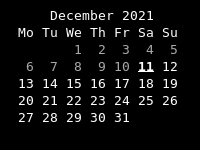
For some time now I wanted to learn Rust, but I either didn t have the time or couldn t come up with a nice beginner project. Given that I recently found myself to be without a job and we had another lockdown in the part of the world I happen to live in, I decided to give that idea another go (no pun intended). There is apparently a trend to reimplement existing Unix tools in Rust (see exa, a modern replacement for ls , delta, a syntax highlighting pager for git, diff and grep output, bat, a cat clone with wings , zellij, a terminal workspace, ripgrep, a line-oriented search tool ). I looked around what else was out there, but what I wasn t able to find was an implementation of cal(1) in Rust (maybe I wasn t looking hard enough, feel free to point anything out to me I might have overlooked). No cal in Rust even though a calendar implementation would provide the potential to go over the top with terminal colors, which is also very important when writing reimplementations of older CLI tools! So I started writing and soon had a simple prototype of a cal reimplementation. A couple of weeks later I can now present carl, a cal implementation in Rust: default carl output The default output of carl is what you would expect from a commandline calendar tool. It prints the days of the current month and highlights the current day. Other than the cal tools I tried, carl by default also prints days that are in the past in grey. Like cal it can also print three month if you use the -3 switch or the whole year if you use the -y switch.

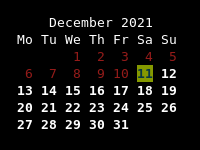
Colors You can use a theme file to change the colors carl uses for various dates. The name of the theme is set in carls configuration file (in XDG_CONFIG_HOME/.carl/config.toml or system-wide in XDG_CONFIG_DIRS/.carl/config.toml) using the theme setting - carl looks for the theme in the file $ themename .theme in the configuration folders. A custom theme could for example look like this: custom carl output You can change the foreground color, background color and/or style of a date using a combination of various stylenames like BGRed, Bold and FGCyan. The README lists all possible stylenames. A list of date properties defines which dates the specific style should affect- date properties are for example CurrentDate, AfterCurrentDate or FirstDayOfMonth. Again, the README lists the existing date properties and I m happy to implement more of them, if you have ideas.
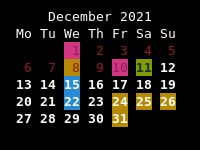
Ical support I also added the option to list .ical files in the configuration file. carl can display the dates from the ical file(s) with a separate style. There can either be a global style for all the dates from all the ical files by using the IsEvent date property or a separate style for the dates of a specific *.ical file. carl output with ical files Using the --agenda commandline switch carl also shows an agenda of dates from the ical files.

Installation I have uploaded carl to crates.io, so you can install carl using cargo: cargo install carl. I also plan to upload it to Debian at some point. If you find bugs or have feature requests, please don t hesitate to create issues.

1 January 2022

Chris Lamb: Favourite books of 2021: Classics

In my three most recent posts, I went over the memoirs and biographies, the non-fiction and fiction I enjoyed in 2021. But in the last of my 2021 book-related posts, however, I'll be going over my favourite classics. Of course, the difference between regular fiction and a 'classic' is an ambiguous, arbitrary and often-meaningless distinction: after all, what does it matter if Hemingway's The Old Man and the Sea (from 1951) is a classic or not? The term also smuggles in some of the ethnocentric gatekeeping encapsulated in the term 'Western canon' too. Nevertheless, the label of 'classic' has some utility for me in that it splits up the vast amount of non-fiction I read in two... Books that just missed the cut here include: Oscar Wilde's The Picture of Dorian Gray (moody and hilarious, but I cannot bring myself to include it due to the egregious antisemitism); Tolstoy's The Kreutzer Sonata (so angry! so funny!); and finally Notes from Underground by Fyodor Dostoevsky. Of significant note, though, would be the ghostly The Turn of the Screw by Henry James.

Heart of Darkness (1899) Joseph Conrad Heart of Darkness tells the story of Charles Marlow, a sailor who accepts an assignment from a Belgian trading company as a ferry-boat captain in the African interior, and the novella is widely regarded as a critique of European colonial rule in Africa. Loosely remade by Francis Ford Coppola as Apocalypse Now (1979), I started this book with the distinct possibility that this superb film adaptation would, for a rare treat, be 'better than the book'. However, Conrad demolished this idea of mine within two chapters, yet also elevated the film to a new level as well. This was chiefly due to how observant Conrad was of the universals that make up human nature. Some of his insight pertains to the barbarism of the colonialists, of course, but Conrad applies his shrewd acuity to the at the smaller level as well. Some of these quotes are justly famous: Ah! but it was something to have at least a choice of nightmares, for example, as well as the reference to a fastidiously turned-out colonial administrator who, with unimaginable horrors occurring mere yards from his tent, we learn he was devoted to his books, which were in applepie order . (It seems to me to be deliberately unclear whether his devotion arises from gross inhumanity, utter denial or some combination of the two.) Oh, and there's a favourite moment of mine when a character remarks that It was very fine for a time, but after a bit I did get tired of resting. Tired of resting! Yes, it's difficult to now say something original about a many-layered classic such as this, especially one that has analysed from so many angles already; from a literary perspective at first, of course, but much later from a critical postcolonial perspective, such as in Chinua Achebe's noted 1975 lecture, An Image of Africa. Indeed, the history of criticism in the twentieth century of Heart of Darkness must surely parallel the social and political developments in the Western world. (On a highly related note, the much-cited non-fiction book King Leopold's Ghost is on my reading list for 2022.) I will therefore limit myself to saying that the boat physically falling apart as it journeys deeper into the Congo may be intended to represent that our idea of 'Western civilisation' ceases to function, both morally as well as physically, in this remote environment. And, whilst I'm probably not the first to notice the potential ambiguity, when Marlow lies to Kurtz's 'Intended [wife]' in the closing section in order to save her from being exposed to the truth about Kurtz (surely a metaphor about the ignorance of the West whilst also possibly incorporating some comment on gender?), the Intended replies: I knew it. For me, though, it is not beyond doubt that what the Intended 'knows' is that she knew that Marlow would lie to her: in other words, that the alleged ignorance of everyday folk in the colonial homeland is studied and deliberate. Compact and fairly easy-to-read, it is clear that Heart of Darkness rewards even the most rudimentary analysis.

Rebecca (1938) Daphne du Maurier Daphne du Maurier creates in Rebecca a credible and suffocating atmosphere in the shape of Manderley, a grand English mansion owned by aristocratic widower Maxim de Winter. Our unnamed narrator (a young woman seemingly na ve in the ways of the world) meets Max in Monte Carlo, and she soon becomes the second Mrs. de Winter. The tale takes a turn to the 'gothic', though, when it becomes apparent that the unemotional Max, as well as potentially Manderley itself, appears to be haunted by the memory of his late first wife, the titular Rebecca. Still, Rebecca is less of a story about supernatural ghosts than one about the things that can haunt our minds. For Max, this might be something around guilt; for our narrator, the class-centered fear that she will never fit in. Besides, Rebecca doesn't need an actual ghost when you have Manderley's overbearing housekeeper, Mrs Danvers, surely one of the creepiest characters in all of fiction. Either way, the conflict of a kind between the fears of the protagonists means that they never really connect with each other. The most obvious criticism of Rebecca is that the main character is unreasonably weak and cannot quite think or function on her own. (Isn't it curious that the trait of the male 'everyman' is a kind of physical clumsiness yet the female equivalent is shorthanded by being slightly slow?) But the na vete of Rebecca's narrator makes her easier to relate to in a way, and it also makes the reader far more capable of empathising with her embarrassment. This is demonstrated best whilst she, in one of the best evocations of this particular anxiety I have yet come across, is gingerly creeping around Manderlay and trying to avoid running into the butler. A surprise of sorts comes in the latter stages of the book, and this particular twist brings us into contact with a female character who is anything but 'credulous'. This revelation might even change your idea of who the main character of this book really is too. (Speaking of amateur literary criticism, I have many fan theories about Rebecca, including that Maxim de Winter's estate manager, Frank Crawley, is actually having an affair with Max, and also that Maxim may have a lot more involvement in Mrs Danvers final act that he lets on.) An easily accessible novel (with a great-but-not-perfect 1940 adaptation by Alfred Hitchcock, Rebecca is a real indulgence.

A Clockwork Orange (1962) Anthony Burgess One of Stanley Kubrick's most prominent tricks was to use different visual languages in order to prevent the audience from immediately grasping the underlying story. In his 1975 Barry Lyndon, for instance, the intentionally sluggish pacing and elusive characters require significant digestion to fathom and appreciate, and the luminous and quasi-Renaissance splendour of the cinematography does its part to constantly distract the viewer from the film's greater meaning. This is very much the case in Kubrick's A Clockwork Orange as well whilst it ostensibly appears to be about a Saturnalia of violence, the 'greater meaning' of A Clockwork Orange pertains to the Christian conception of free will; admittedly, a much drier idea to bother making a film around. This is all made much clearer when reading Anthony Burgess' 1962 original novel. Alex became a 'true Christian' through the experimental rehabilitation process, and even offers to literally turn the other cheek at one point. But as Alex had no choice to do so (and can no longer choose to commit violence), he is incapable of making a free moral choice. Thus, is he really a Man? Yet whilst the book's central concern is our conception of free will in modern societies, it also appears to be a repudiation of two conservative principles. Firstly, A Clockwork Orange demolishes the idea that 'high art' leads to morally virtuous citizens. After all, if you can do a bit of the old ultra-violence whilst listening to the glorious 9th by old Ludvig van, then so much for the oft-repeated claims that culture makes you better as a person. (This, at least, I already knew from personal experience.) The other repudiation in A Clockwork Orange is in regard to the pervasive idea that the countryside is a refuge from crime and sin. By contrast, we see the gang commit their most horrific violence in rural areas, and, later, Alex is taken to the countryside by his former droogs for a savage beating. Although this doesn't seem to quite fit the novel, this was actually an important point for Burgess to include: otherwise his book could easily be read as a commentary on the corrupting influence of urban spaces, rather than of modernity itself. The language of this book cannot escape comment here. Alex narrates most of the book in a language called Nadsat, a fractured slang constructed by Burgess based on Russian and Cockney rhyming slang. (The language is strange for only a few pages, I promise. And note that 'Alex' is a very common Russian name.) Using Nadsat has the effect of making the book feel distinctly alien, but it also prevents it from prematurely aging too. Indeed, it comes as bit of a shock to realise that A Clockwork Orange was published 1962, the same year as The Beatles' released their first single, Love Me Do. I could probably say a whole lot more about this thoroughly engrossing book and its movie adaptation (eg. the meta-textual line in Kubrick's version: It's funny how the colours of the real world only seem really real when you watch them on a screen... appears verbatim in the textual original), but I'll leave it there. The book of A Clockwork Orange is not only worth the investment in the language, but is, again, somehow better than the film.

The Great Gatsby (1925) F. Scott Fitzgerald I'm actually being a little deceitful by including this book here: I cannot really say that The Great Gatsby was a 'favourite' read of the year, but its literary merit is so undeniable (and my respect for Fitzgerald's achievement is deep enough) that the experience was one of those pleasures you feel at seeing anything done well. Here you have a book so rich in symbolic meaning that you could easily confuse the experience with drinking Coke syrup undiluted. And a text that has made the difficulty and complexity of reading character a prominent theme of the novel, as well as a technical concern of the book itself. Yet at all times you have in your mind that The Great Gatsby is first and foremost a book about a man writing a book, and, therefore, about the construction of stories and myths. What is the myth being constructed in Gatsby? The usual answer today is that the book is really about the moral virtues of America. Or, rather, the lack thereof. Indeed, as James Boice wrote in 2016:
Could Wilson have killed Gatsby any other way? Could he have ran him over, or poisoned him, or attacked him with a knife? Not at all this an American story, the quintessential one, so Gatsby could have only died the quintessential American death.
The quintessential American death is, of course, being killed with a gun. Whatever your own analysis, The Great Gatsby is not only magnificently written, but it is captivating to the point where references intrude many months later. For instance, when reading something about Disney's 'princess culture', I was reminded of when Daisy says of her daughter: I hope she'll be a fool that's the best thing of a girl can be in this world, a beautiful little fool . Or the billboard with the eyes of 'Doctor T. J. Eckleburg'. Or the fact that the books in Gatsby's library have never been read (so what is 'Owl Eyes' doing there during the party?!). And the only plain room in Gatsby's great house is his bedroom... Okay, fine, I must have been deluding myself: I love this novel.

31 December 2021

Chris Lamb: Favourite books of 2021: Fiction

In my two most recent posts, I listed the memoirs and biographies and followed this up with the non-fiction I enjoyed the most in 2021. I'll leave my roundup of 'classic' fiction until tomorrow, but today I'll be going over my favourite fiction. Books that just miss the cut here include Kingsley Amis' comic Lucky Jim, Cormac McCarthy's The Road (although see below for McCarthy's Blood Meridian) and the Complete Adventures of Tintin by Herg , the latter forming an inadvertently incisive portrait of the first half of the 20th century. Like ever, there were a handful of books that didn't live up to prior expectations. Despite all of the hype, Emily St. John Mandel's post-pandemic dystopia Station Eleven didn't match her superb The Glass Hotel (one of my favourite books of 2020). The same could be said of John le Carr 's The Spy Who Came in from the Cold, which felt significantly shallower compared to Tinker, Tailor, Soldier, Spy again, a favourite of last year. The strangest book (and most difficult to classify at all) was undoubtedly Patrick S skind's Perfume: The Story of a Murderer, and the non-fiction book I disliked the most was almost-certainly Beartown by Fredrik Bachman. Two other mild disappointments were actually film adaptions. Specifically, the original source for Vertigo by Pierre Boileau and Thomas Narcejac didn't match Alfred Hitchock's 1958 masterpiece, as did James Sallis' Drive which was made into a superb 2011 neon-noir directed by Nicolas Winding Refn. These two films thus defy the usual trend and are 'better than the book', but that's a post for another day.

A Wizard of Earthsea (1971) Ursula K. Le Guin How did it come to be that Harry Potter is the publishing sensation of the century, yet Ursula K. Le Guin's Earthsea is only a popular cult novel? Indeed, the comparisons and unintentional intertextuality with Harry Potter are entirely unavoidable when reading this book, and, in almost every respect, Ursula K. Le Guin's universe comes out the victor. In particular, the wizarding world that Le Guin portrays feels a lot more generous and humble than the class-ridden world of Hogwarts School of Witchcraft and Wizardry. Just to take one example from many, in Earthsea, magic turns out to be nurtured in a bottom-up manner within small village communities, in almost complete contrast to J. K. Rowling's concept of benevolent government departments and NGOs-like institutions, which now seems a far too New Labour for me. Indeed, imagine an entire world imbued with the kindly benevolence of Dumbledore, and you've got some of the moral palette of Earthsea. The gently moralising tone that runs through A Wizard of Earthsea may put some people off:
Vetch had been three years at the School and soon would be made Sorcerer; he thought no more of performing the lesser arts of magic than a bird thinks of flying. Yet a greater, unlearned skill he possessed, which was the art of kindness.
Still, these parables aimed directly at the reader are fairly rare, and, for me, remain on the right side of being mawkish or hectoring. I'm thus looking forward to reading the next two books in the series soon.

Blood Meridian (1985) Cormac McCarthy Blood Meridian follows a band of American bounty hunters who are roaming the Mexican-American borderlands in the late 1840s. Far from being remotely swashbuckling, though, the group are collecting scalps for money and killing anyone who crosses their path. It is the most unsparing treatment of American genocide and moral depravity I have ever come across, an anti-Western that flouts every convention of the genre. Blood Meridian thus has a family resemblance to that other great anti-Western, Once Upon a Time in the West: after making a number of gun-toting films that venerate the American West (ie. his Dollars Trilogy), Sergio Leone turned his cynical eye to the western. Yet my previous paragraph actually euphemises just how violent Blood Meridian is. Indeed, I would need to be a much better writer (indeed, perhaps McCarthy himself) to adequately 0utline the tone of this book. In a certain sense, it's less than you read this book in a conventional sense, but rather that you are forced to witness successive chapters of grotesque violence... all occurring for no obvious reason. It is often said that books 'subvert' a genre and, indeed, I implied as such above. But the term subvert implies a kind of Puck-like mischievousness, or brings to mind court jesters licensed to poke fun at the courtiers. By contrast, however, Blood Meridian isn't funny in the slightest. There isn't animal cruelty per se, but rather wanton negligence of another kind entirely. In fact, recalling a particular passage involving an injured horse makes me feel physically ill. McCarthy's prose is at once both baroque in its language and thrifty in its presentation. As Philip Connors wrote back in 2007, McCarthy has spent forty years writing as if he were trying to expand the Old Testament, and learning that McCarthy grew up around the Church therefore came as no real surprise. As an example of his textual frugality, I often looked for greater precision in the text, finding myself asking whether who a particular 'he' is, or to which side of a fight some two men belonged to. Yet we must always remember that there is no precision to found in a gunfight, so this infidelity is turned into a virtue. It's not that these are fair fights anyway, or even 'murder': Blood Meridian is just slaughter; pure butchery. Murder is a gross understatement for what this book is, and at many points we are grateful that McCarthy spares us precision. At others, however, we can be thankful for his exactitude. There is no ambiguity regarding the morality of the puppy-drowning Judge, for example: a Colonel Kurtz who has been given free license over the entire American south. There is, thank God, no danger of Hollywood mythologising him into a badass hero. Indeed, we must all be thankful that it is impossible to film this ultra-violent book... Indeed, the broader idea of 'adapting' anything to this world is, beyond sick. An absolutely brutal read; I cannot recommend it highly enough.

Bodies of Light (2014) Sarah Moss Bodies of Light is a 2014 book by Glasgow-born Sarah Moss on the stirrings of women's suffrage within an arty clique in nineteenth-century England. Set in the intellectually smoggy cities of Manchester and London, this poignant book follows the studiously intelligent Alethia 'Ally' Moberly who is struggling to gain the acceptance of herself, her mother and the General Medical Council. You can read my full review from July.

House of Leaves (2000) Mark Z. Danielewski House of Leaves is a remarkably difficult book to explain. Although the plot refers to a fictional documentary about a family whose house is somehow larger on the inside than the outside, this quotidian horror premise doesn't explain the complex meta-commentary that Danielewski adds on top. For instance, the book contains a large number of pseudo-academic footnotes (many of which contain footnotes themselves), with references to scholarly papers, books, films and other articles. Most of these references are obviously fictional, but it's the kind of book where the joke is that some of them are not. The format, structure and typography of the book is highly unconventional too, with extremely unusual page layouts and styles. It's the sort of book and idea that should be a tired gimmick but somehow isn't. This is particularly so when you realise it seems specifically designed to create a fandom around it and to manufacturer its own 'cult' status, something that should be extremely tedious. But not only does this not happen, House of Leaves seems to have survived through two exhausting decades of found footage: The Blair Witch Project and Paranormal Activity are, to an admittedly lesser degree, doing much of the same thing as House of Leaves. House of Leaves might have its origins in Nabokov's Pale Fire or even Derrida's Glas, but it seems to have more in common with the claustrophobic horror of Cube (1997). And like all of these works, House of Leaves book has an extremely strange effect on the reader or viewer, something quite unlike reading a conventional book. It wasn't so much what I got out of the book itself, but how it added a glow to everything else I read, watched or saw at the time. An experience.

Milkman (2018) Anna Burns This quietly dazzling novel from Irish author Anna Burns is full of intellectual whimsy and oddball incident. Incongruously set in 1970s Belfast during The Irish Troubles, Milkman's 18-year-old narrator (known only as middle sister ), is the kind of dreamer who walks down the street with a Victorian-era novel in her hand. It's usually an error for a book that specifically mention other books, if only because inviting comparisons to great novels is grossly ill-advised. But it is a credit to Burns' writing that the references here actually add to the text and don't feel like they are a kind of literary paint by numbers. Our humble narrator has a boyfriend of sorts, but the figure who looms the largest in her life is a creepy milkman an older, married man who's deeply integrated in the paramilitary tribalism. And when gossip about the narrator and the milkman surfaces, the milkman beings to invade her life to a suffocating degree. Yet this milkman is not even a milkman at all. Indeed, it's precisely this kind of oblique irony that runs through this daring but darkly compelling book.

The First Fifteen Lives of Harry August (2014) Claire North Harry August is born, lives a relatively unremarkable life and finally dies a relatively unremarkable death. Not worth writing a novel about, I suppose. But then Harry finds himself born again in the very same circumstances, and as he grows from infancy into childhood again, he starts to remember his previous lives. This loop naturally drives Harry insane at first, but after finding that suicide doesn't stop the quasi-reincarnation, he becomes somewhat acclimatised to his fate. He prospers much better at school the next time around and is ultimately able to make better decisions about his life, especially when he just happens to know how to stay out of trouble during the Second World War. Yet what caught my attention in this 'soft' sci-fi book was not necessarily the book's core idea but rather the way its connotations were so intelligently thought through. Just like in a musical theme and varations, the success of any concept-driven book is far more a product of how the implications of the key idea are played out than how clever the central idea was to begin with. Otherwise, you just have another neat Borges short story: satisfying, to be sure, but in a narrower way. From her relatively simple premise, for example, North has divined that if there was a community of people who could remember their past lives, this would actually allow messages and knowledge to be passed backwards and forwards in time. Ah, of course! Indeed, this very mechanism drives the plot: news comes back from the future that the progress of history is being interfered with, and, because of this, the end of the world is slowly coming. Through the lives that follow, Harry sets out to find out who is passing on technology before its time, and work out how to stop them. With its gently-moralising romp through the salient historical touchpoints of the twentieth century, I sometimes got a whiff of Forrest Gump. But it must be stressed that this book is far less certain of its 'right-on' liberal credentials than Robert Zemeckis' badly-aged film. And whilst we're on the topic of other media, if you liked the underlying conceit behind Stuart Turton's The Seven Deaths of Evelyn Hardcastle yet didn't enjoy the 'variations' of that particular tale, then I'd definitely give The First Fifteen Lives a try. At the very least, 15 is bigger than 7. More seriously, though, The First Fifteen Lives appears to reflect anxieties about technology, particularly around modern technological accelerationism. At no point does it seriously suggest that if we could somehow possess the technology from a decade in the future then our lives would be improved in any meaningful way. Indeed, precisely the opposite is invariably implied. To me, at least, homo sapiens often seems to be merely marking time until we can blow each other up and destroying the climate whilst sleepwalking into some crisis that might precipitate a thermonuclear genocide sometimes seems to be built into our DNA. In an era of cli-fi fiction and our non-fiction newspaper headlines, to label North's insight as 'prescience' might perhaps be overstating it, but perhaps that is the point: this destructive and negative streak is universal to all periods of our violent, insecure species.

The Goldfinch (2013) Donna Tartt After Breaking Bad, the second biggest runaway success of 2014 was probably Donna Tartt's doorstop of a novel, The Goldfinch. Yet upon its release and popular reception, it got a significant number of bad reviews in the literary press with, of course, an equal number of predictable think pieces claiming this was sour grapes on the part of the cognoscenti. Ah, to be in 2014 again, when our arguments were so much more trivial. For the uninitiated, The Goldfinch is a sprawling bildungsroman that centres on Theo Decker, a 13-year-old whose world is turned upside down when a terrorist bomb goes off whilst visiting the Metropolitan Museum of Art, killing his mother among other bystanders. Perhaps more importantly, he makes off with a painting in order to fulfil a promise to a dying old man: Carel Fabritius' 1654 masterpiece The Goldfinch. For the next 14 years (and almost 800 pages), the painting becomes the only connection to his lost mother as he's flung, almost entirely rudderless, around the Western world, encountering an array of eccentric characters. Whatever the critics claimed, Tartt's near-perfect evocation of scenes, from the everyday to the unimaginable, is difficult to summarise. I wouldn't label it 'cinematic' due to her evocation of the interiority of the characters. Take, for example: Even the suggestion that my father had close friends conveyed a misunderstanding of his personality that I didn't know how to respond it's precisely this kind of relatable inner subjectivity that cannot be easily conveyed by film, likely is one of the main reasons why the 2019 film adaptation was such a damp squib. Tartt's writing is definitely not 'impressionistic' either: there are many near-perfect evocations of scenes, even ones we hope we cannot recognise from real life. In particular, some of the drug-taking scenes feel so credibly authentic that I sometimes worried about the author herself. Almost eight months on from first reading this novel, what I remember most was what a joy this was to read. I do worry that it won't stand up to a more critical re-reading (the character named Xandra even sounds like the pharmaceuticals she is taking), but I think I'll always treasure the first days I spent with this often-beautiful novel.

Beyond Black (2005) Hilary Mantel Published about five years before the hyperfamous Wolf Hall (2004), Hilary Mantel's Beyond Black is a deeply disturbing book about spiritualism and the nature of Hell, somewhat incongruously set in modern-day England. Alison Harte is a middle-aged physic medium who works in the various towns of the London orbital motorway. She is accompanied by her stuffy assistant, Colette, and her spirit guide, Morris, who is invisible to everyone but Alison. However, this is no gentle and musk-smelling world of the clairvoyant and mystic, for Alison is plagued by spirits from her past who infiltrate her physical world, becoming stronger and nastier every day. Alison's smiling and rotund persona thus conceals a truly desperate woman: she knows beyond doubt the terrors of the next life, yet must studiously conceal them from her credulous clients. Beyond Black would be worth reading for its dark atmosphere alone, but it offers much more than a chilling and creepy tale. Indeed, it is extraordinarily observant as well as unsettlingly funny about a particular tranche of British middle-class life. Still, the book's unnerving nature that sticks in the mind, and reading it noticeably changed my mood for days afterwards, and not necessarily for the best.

The Wall (2019) John Lanchester The Wall tells the story of a young man called Kavanagh, one of the thousands of Defenders standing guard around a solid fortress that envelopes the British Isles. A national service of sorts, it is Kavanagh's job to stop the so-called Others getting in. Lanchester is frank about what his wall provides to those who stand guard: the Defenders of the Wall are conscripted for two years on the Wall, with no exceptions, giving everyone in society a life plan and a story. But whilst The Wall is ostensibly about a physical wall, it works even better as a story about the walls in our mind. In fact, the book blends together of some of the most important issues of our time: climate change, increasing isolation, Brexit and other widening societal divisions. If you liked P. D. James' The Children of Men you'll undoubtedly recognise much of the same intellectual atmosphere, although the sterility of John Lanchester's dystopia is definitely figurative and textual rather than literal. Despite the final chapters perhaps not living up to the world-building of the opening, The Wall features a taut and engrossing narrative, and it undoubtedly warrants even the most cursory glance at its symbolism. I've yet to read something by Lanchester I haven't enjoyed (even his short essay on cheating in sports, for example) and will be definitely reading more from him in 2022.

The Only Story (2018) Julian Barnes The Only Story is the story of Paul, a 19-year-old boy who falls in love with 42-year-old Susan, a married woman with two daughters who are about Paul's age. The book begins with how Paul meets Susan in happy (albeit complicated) circumstances, but as the story unfolds, the novel becomes significantly more tragic and moving. Whilst the story begins from the first-person perspective, midway through the book it shifts into the second person, and, later, into the third as well. Both of these narrative changes suggested to me an attempt on the part of Paul the narrator (if not Barnes himself), to distance himself emotionally from the events taking place. This effect is a lot more subtle than it sounds, however: far more prominent and devastating is the underlying and deeply moving story about the relationship ends up. Throughout this touching book, Barnes uses his mastery of language and observation to avoid the saccharine and the maudlin, and ends up with a heart-wrenching and emotive narrative. Without a doubt, this is the saddest book I read this year.

Reproducible Builds (diffoscope): diffoscope 198 released

The diffoscope maintainers are pleased to announce the release of diffoscope version 198. This version includes the following changes:
[ Chris Lamb ]
* Support showing "Ordering differences only" within .dsc field values.
  (Closes: #1002002, reproducible-builds/diffoscope#297)
* Support OCaml versions 4.11, 4.12 and 4.13. (Closes: #1002678)
* Add support for XMLb files. (Closes: reproducible-builds/diffoscope#295)
* Also add, for example, /usr/lib/x86_64-linux-gnu to our internal PATH.
[ Mattia Rizzolo ]
* Also recognize "GnuCash file" files as XML.
You find out more by visiting the project homepage.

29 December 2021

Chris Lamb: Favourite books of 2021: Memoir/biography

Just as I did for 2020, I won't publically disclose exactly how many books I read in 2021, but they evidently provoked enough thoughts that felt it worth splitting my yearly writeup into separate posts. I will reveal, however, that I got through more books than the previous year, and, like before, I enjoyed the books I read this year even more in comparison as well. How much of this is due to refining my own preferences over time, and how much can be ascribed to feeling less pressure to read particular books? It s impossible to say, and the question is complicated further by the fact I found many of the classics I read well worth of their entry into the dreaded canon. But enough of the throat-clearing. In today's post I'll be looking at my favourite books filed under memoir and biography, in no particular order. Books that just missed the cut here include: Bernard Crick's celebrated 1980 biography of George Orwell, if nothing else because it was a pleasure to read; Hilary Mantel's exhilaratingly bitter early memoir, Giving up the Ghost (2003); and Patricia Lockwood's hilarious Priestdaddy (2017). I also had a soft spot for Tim Kreider's We Learn Nothing (2012) as well, despite not knowing anything about the author in advance, likely a sign of good writing. The strangest book in this category I read was definitely Michelle Zauner's Crying in H Mart. Based on a highly-recommended 2018 essay in the New Yorker, its rich broth of genuine yearning for a departed mother made my eyebrows raise numerous times when I encountered inadvertent extra details about Zauner's relationships.

Beethoven: A Life in Nine Pieces (2020) Laura Tunbridge Whilst it might immediately present itself as a clickbait conceit, organising an overarching narrative around just nine compositions by Beethoven turns out to be an elegant way of saying something fresh about this grizzled old bear. Some of Beethoven's most famous compositions are naturally included in the nine (eg. the Eroica and the Hammerklavier piano sonata), but the book raises itself above conventional Beethoven fare when it highlights, for instance, his Septet, Op. 20, an early work that is virtually nobody's favourite Beethoven piece today. The insight here is that it was widely popular in its time, played again and again around Vienna for the rest of his life. No doubt many contemporary authors can relate to this inability to escape being artistically haunted by an earlier runaway success. The easiest way to say something interesting about Beethoven in the twenty-first century is to talk about the myth of Beethoven instead. Or, as Tunbridge implies, perhaps that should really be 'Beethoven' in leaden quotation marks, given so much about what we think we know about the man is a quasi-fictional construction. Take Anton Schindler, Beethoven's first biographer and occasional amanuensis, who destroyed and fabricated details about Beethoven's life, casting himself in a favourable light and exaggerating his influence with the composer. Only a few decades later, the idea of a 'heroic' German was to be politically useful as well; the Anglosphere often need reminding that Germany did not exist as a nation-state prior to 1871, so it should be unsurprising to us that the late nineteenth-century saw a determined attempt to create a uniquely 'German' culture ex nihilo. (And the less we say about Immortal Beloved the better, even though I treasure that film.) Nevertheless, Tunbridge cuts through Beethoven's substantial legacy using surgical precision that not only avoids feeling like it is settling a score, but it also does so in a way that is unlikely to completely alienate anyone emotionally dedicated to some already-established idea of the man to bring forth the tediously predictable sentiment that Beethoven has 'gone woke'. With Alex Ross on the cult of Wagner, it seems that books about the 'myth of X' are somewhat in vogue right now. And this pattern within classical music might fit into some broader trend of deconstruction in popular non-fiction too, especially when we consider the numerous contemporary books on the long hangover of the Civil Rights era (Robin DiAngelo's White Fragility, etc.), the multifarious ghosts of Empire (Akala's Natives, Sathnam Sanghera's Empireland, etc.) or even the 'transmogrification' of George Orwell into myth. But regardless of its place in some wider canon, A Life in Nine Pieces is beautifully printed in hardback form (worth acquiring for that very reason alone), and it is one of the rare good books about classical music that can be recommended to both the connoisseur and the layperson alike.

Sea State (2021) Tabitha Lasley In her mid-30s and jerking herself out of a terrible relationship, Tabitha Lasley left London and put all her savings into a six-month lease on a flat within a questionable neighbourhood in Aberdeen, Scotland. She left to make good on a lukewarm idea for a book about oil rigs and the kinds of men who work on them: I wanted to see what men were like with no women around, she claims. The result is Sea State, a forthright examination of the life of North Sea oil riggers, and an unsparing portrayal of loneliness, masculinity, female desire and the decline of industry in Britain. (It might almost be said that Sea State is an update of a sort to George Orwell's visit to the mines in the North of England.) As bracing as the North Sea air, Sea State spoke to me on multiple levels but I found it additionally interesting to compare and contrast with Julian Barnes' The Man with Red Coat (see below). Women writers are rarely thought to be using fiction for higher purposes: it is assumed that, unlike men, whatever women commit to paper is confessional without any hint of artfulness. Indeed, it seems to me that the reaction against the decades-old genre of autofiction only really took hold when it became the domain of millennial women. (By contrast, as a 75-year-old male writer with a firmly established reputation in the literary establishment, Julian Barnes is allowed wide latitude in what he does with his sources and his writing can be imbued with supremely confident airs as a result.) Furthermore, women are rarely allowed metaphor or exaggeration for dramatic effect, and they certainly aren t permitted to emphasise darker parts in order to explore them... hence some of the transgressive gratification of reading Sea State. Sea State is admittedly not a work of autofiction, but the sense that you are reading about an author writing a book is pleasantly unavoidable throughout. It frequently returns to the topic of oil workers who live multiple lives, and Lasley admits to living two lives herself: she may be in love but she's also on assignment, and a lot of the pleasure in this candid and remarkably accessible book lies in the way these states become slowly inseparable.

Twilight of Democracy (2020) Anne Applebaum For the uninitiated, Anne Applebaum is a staff writer for The Atlantic magazine who won a Pulitzer-prize for her 2004 book on the Soviet Gulag system. Her latest book, however, Twilight of Democracy is part memoir and part political analysis and discusses the democratic decline and the rise of right-wing populism. This, according to Applebaum, displays distinctly authoritarian tendencies, and who am I to disagree? Applebaum does this through three main case studies (Poland, the United Kingdom and the United States), but the book also touches on Hungary as well. The strongest feature of this engaging book is that Appelbaum's analysis focuses on the intellectual classes and how they provide significant justification for a descent into authoritarianism. This is always an important point to be remembered, especially as much of the folk understanding of the rise of authoritarian regimes tends to place exaggerated responsibility on the ordinary and everyday citizen: the blame placed on the working-class in the Weimar Republic or the scorn heaped upon 'white trash' of the contemporary Rust Belt, for example. Applebaum is uniquely poised to discuss these intellectuals because, well, she actually knows a lot of them personally. Or at least, she used to know them. Indeed, the narrative of the book revolves around two parties she hosted, both in the same house in northwest Poland. The first party, on 31 December 1999, was attended by friends from around the Western world, but most of the guests were Poles from the broad anti-communist alliance. They all agreed about democracy, the rule of law and the route to prosperity whilst toasting in the new millennium. (I found it amusing to realise that War and Peace also starts with a party.) But nearly two decades later, many of the attendees have ended up as supporters of the problematic 'Law and Justice' party which currently governs the country. Applebaum would now cross the road to avoid them, and they would do the same to her, let alone behave themselves at a cordial reception. The result of this autobiographical detail is that by personalising the argument, Applebaum avoids the trap of making too much of high-minded abstract argument for 'democracy', and additionally makes her book compellingly spicy too. Yet the strongest part of this book is also its weakest. By individualising the argument, it often feels that Applebaum is settling a number of personal scores. She might be very well justified in doing this, but at times it feels like the reader has walked in halfway through some personal argument and is being asked to judge who is in the right. Furthermore, Applebaum's account of contemporary British politics sometimes deviates into the cartoonish: nothing was egregiously incorrect in any of her summations, but her explanation of the Brexit referendum result didn't read as completely sound. Nevertheless, this lively and entertaining book that can be read with profit, even if you disagree with significant portions of it, and its highly-personal approach makes it a refreshing change from similar contemporary political analysis (eg. David Runciman's How Democracy Ends) which reaches for that more 'objective' line.

The Man in the Red Coat (2019) Julian Barnes As rich as the eponymous red coat that adorns his cover, Julian Barnes quasi-biography of French gynaecologist Samuel-Jean Pozzi (1846 1918) is at once illuminating, perplexing and downright hilarious. Yet even that short description is rather misleading, for this book evades classification all manner number of ways. For instance, it is unclear that, with the biographer's narrative voice so obviously manifest, it is even a biography in the useful sense of the word. After all, doesn't the implied pact between author and reader require the biographer to at least pretend that they are hiding from the reader? Perhaps this is just what happens when an author of very fine fiction turns his hand to non-fiction history, and, if so, it represents a deeper incursion into enemy territory after his 1984 metafictional Flaubert's Parrot. Indeed, upon encountering an intriguing mystery in Pozzi's life crying out for a solution, Barnes baldly turns to the reader, winks and states: These matters could, of course, be solved in a novel. Well, quite. Perhaps Barnes' broader point is that, given that's impossible for the author to completely melt into air, why not simply put down your cards and have a bit of fun whilst you're at it? If there's any biography that makes the case for a rambling and lightly polemical treatment, then it is this one. Speaking of having fun, however, two qualities you do not expect in a typical biography is simply how witty they can be, as well as it having something of the whiff of the thriller about it. A bullet might be mentioned in an early chapter, but given the name and history of Monsieur Pozzi is not widely known, one is unlikely to learn how he lived his final years until the closing chapters. (Or what happened to that turtle.) Humour is primarily incorporated into the book in two main ways: first, by explicitly citing the various wits of the day ( What is a vice? Merely a taste you don t share. etc.), but perhaps more powerful is the gentle ironies, bon mots and observations in Barnes' entirely unflappable prose style, along with the satire implicit in him writing this moreish pseudo-biography to begin with. The opening page, with its steadfast refusal to even choose where to begin, is somewhat characteristic of Barnes' method, so if you don't enjoy the first few pages then you are unlikely to like the rest. (Indeed, the whole enterprise may be something of an acquired taste. Like Campari.) For me, though, I was left wryly grinning and often couldn't wait to turn the page. Indeed, at times it reminded me of a being at a dinner party with an extremely charming guest at the very peak of his form as a wit and raconteur, delighting the party with his rambling yet well-informed discursive on his topic de jour. A significant book, and a book of significance.

Thorsten Alteholz: Fun with Telescopes

Recently I purchased a small telescope to look at solar spots. When choosing a mount, I checked whether it can be controlled with OSS. In this context INDI is mentioned everywhere and my desired mount was supported. indi and kstars are already part of Debian, so apt install , selecting my mount, . oh, wait, the menu shows it, but I can not select it. Ok, that was the time when I learned about the difference of indi and indi-3rdparty. The indi package just contains a few drivers and others are available from a different repository. This split has been done either due to different release cycles of the driver, a different OSS license of it, or just due to binary blobs without source being part of some drivers. Fine, there are already packages of the 3rdparty-repository available from an Ubuntu PPA, so it should be no problem to add them do Debian as well. Some manufacturers freely distribute at least the specification of their API so that others are able to write the corresponding software. Some manufacturers even write their own driver. Examples are: A minor part actually does not have binary blobs but distributes the sources of their software. Unfortunately they have licenses that are not compatible with DFSG and those packages still need to go to non-free. Examples are: But there also seem to exist lots of manufacturers of astronomically accessories, especially cameras, that just distribute some binary blobs to talk to their hardware. This is sad, but at the moment it is just the way it is and such package need to go to non-free. Luckily their blobs are accompanied with corresponding licenses. At least those manufacturers understand how software licenses work and packaging their SDK is just straight forward. Examples are: However, when looking at the license information of some Ubuntu packages, several of them were distributed under a CC license. This is not a common license for software, so I wanted to get a confirmation whether these information are correct. Unfortunately most of such manufacturers don t want to disclose their licenses. For whatever reason they distribute their tarballs without any hint and emails to their support channels are just ignored. Examples of such bad behaviour are: However the best answer comes from the Levenhuk support. My question about the license of their SDK was answered by:
I am afraid we cannot disclose any further information except the software file that is available on our website.
So strictly speaking nobody is allowed to use their software. I wonder whether such competence also becomes visible in their products. I will never really know as there are more than enough OSS friendly manufacturers available. Anyway, most of the indi-3rdparty drivers are now available and I got lots of suggestions about hardware I need to buy in the future :-).

28 December 2021

Russ Allbery: Review: Out of Office

Review: Out of Office, by Charlie Warzel & Anne Helen Petersen
Publisher: Alfred A. Knopf
Copyright: 2021
ISBN: 0-593-32010-7
Format: Kindle
Pages: 260
Out of Office opens with the provocative assertion that you were not working from home during the pandemic, even if you were among the 42% of Americans who were able to work remotely.
You were, quite literally, doing your job from home. But you weren't working from home. You were laboring in confinement and under duress. Others have described it as living at work. You were frantically tapping out an email while trying to make lunch and supervise distance learning. You were stuck alone in a cramped apartment for weeks, unable to see friends or family, exhausted, and managing a level of stress you didn't know was possible. Work became life, and life became work. You weren't thriving. You were surviving.
The stated goal of this book is to reclaim the concept of working from home, not only from the pandemic, but also from the boundary-destroying metastasis of work into non-work life. It does work towards that goal, but the description of what would be required for working from home to live up to its promise becomes a sweeping critique of the organization and conception of work, leaving it nearly as applicable to those who continue working from an office. Turns out that the main problem with working from home is the work part, not the "from home" part. This was a fascinating book to read in conjunction with A World Without Email. Warzel and Petersen do the the structural and political analysis that I sometimes wish Newport would do more of, but as a result offer less concrete advice. Both, however, have similar diagnoses of the core problems of the sort of modern office work that could be done from home: it's poorly organized, poorly managed, and desperately inefficient. Rather than attempting to fix those problems, which is difficult, structural, and requires thought and institutional cooperation, we're compensating by working more. This both doesn't work and isn't sustainable. Newport has a background in productivity books and a love of systems and protocols, so his focus in A World Without Email is on building better systems of communication and organization of work. Warzel and Petersen come from a background of reporting and cultural critique, so they put more focus on power imbalances and power-serving myths about the American dream. Where Newport sees an easy-to-deploy ad hoc work style that isn't fit for purpose, Warzel and Petersen are more willing to point out intentional exploitation of workers in the guise of flexibility. But they arrive at some similar conclusions. The way office work is organized is not leading to more productivity. Tools like Slack encourage the public performance of apparent productivity at the cost of the attention and focus required to do meaningful work. And the process is making us miserable. Out of Office is, in part, a discussion of what would be required to do better work with less stress, but it also shares a goal with Newport and some (but not most) corners of productivity writing: spend less time and energy on work. The goal of Out of Office is not to get more work done. It's to work more efficiently and sustainably and thus work less. To reclaim the promise of flexibility so that it benefits the employee and not the employer. To recognize, in the authors' words, that the office can be a bully, locking people in to commute schedules and unnatural work patterns, although it also provides valuable moments of spontaneous human connection. Out of Office tries to envision a style of work that includes the office sometimes, home sometimes, time during the day to attend to personal chores or simply to take a mental break from an unnatural eight hours (or more) of continuous focus, universal design, real worker-centric flexibility, and an end to the constant productivity ratchet where faster work simply means more work for the same pay. That's a lot of topics for a short book, and structurally this is a grab bag. Some sections will land and some won't. Loom's video messages sound like a nightmare to me, and I rolled my eyes heavily at the VR boosterism, reluctant as it may be. The section on DEI (diversity, equity, and inclusion) was a valiant effort that at least gestures towards the dismal track record of most such efforts, but still left me unconvinced that anyone knows how to improve diversity in an existing organization without far more brute-force approaches than anyone with power is usually willing to consider. But there's enough here, and the authors move through topics quickly enough, that a section that isn't working for you will soon be over. And some of the sections that do work are great. For example, the whole discussion of management.
Many of these companies view middle management as bloat, waste, what David Graeber would call a "bullshit job." But that's because bad management is a waste; you're paying someone more money to essentially annoy everyone around them. And the more people experience that sort of bad management, and think of it as "just the way it is," the less they're going to value management in general.
I admit to a lot of confirmation bias here, since I've been ranting about this for years, but management must be the most wide-spread professional job for which we ignore both training and capability and assume that anyone who can do any type of useful work can also manage people doing that work. It's simply not true, it creates workplaces full of horrible management, and that in turn creates a deep and unhelpful cynicism about all management. There is still a tendency on the left to frame this problem in terms of class struggle, on the reasonable grounds that for decades under "scientific management" of manufacturing that's what it was. Managers were there to overwork workers and extract more profits for the owners, and labor unions were there to fight back against managers. But while some of this does happen in the sort of office work this book is focused on, I think Warzel and Petersen correctly point to a different cause.
"The reason she was underpaid on the team was not because her boss was cackling in the corner. It was because nobody told the boss it was their responsibility to look at the fucking spreadsheet."
We don't train managers, we have no clear expectations for what managers should do, we don't meaningfully measure their performance, we accept a high-overhead and high-chaos workstyle based on ad hoc one-to-one communication that de-emphasizes management, and many managers have never seen good management and therefore have no idea what they're supposed to be doing. The management problem for many office workers is less malicious management than incompetent management, or simply no effective management at all apart from an occasional reorg and a complicated and mind-numbing annual review form. The last section of this book (apart from concluding letters to bosses and workers) is on community, and more specifically on extracting time and energy from work (via the roadmap in previous chapters) and instead investing it in the people around you. Much ink has been spilled about the collapse of American civic life, about how we went from a nation of joiners to a nation of isolated individual workers with weak and failing community institutions. Warzel and Petersen correctly lay some blame for this at the foot of work, and see the reorganization of work and an increase in work from home (and thus a decrease in commutes) as an opportunity to reverse that trend. David Brooks recently filled in for Ezra Klein on his podcast and talked with University of Chicago professor Leon Kass, which I listened to shortly after reading this book. In one segment, they talked about marriage and complained about the decline in marriage rates. They were looking for causes in people's moral upbringing, in their life priorities, in the lack of aspiration for permanence in kids these days, and in any other personal or moral failing that would allow them to be smugly judgmental. It was a truly remarkable thing to witness. Neither man at any point in the conversation mentioned either money or time. Back in the world most Americans live in, real wages have been stagnant for decades, student loan debt is skyrocketing as people desperately try to keep up with the ever-shifting requirements for a halfway-decent job, and work has expanded to fill all hours of the day, even for people who don't have to work multiple jobs to make ends meet. Employers have fully embraced a "flexible" workforce via layoffs, micro-optimizing work scheduling, eliminating benefits, relying on contract and gig labor, and embracing exceptional levels of employee turnover. The American worker has far less of money, time, and stability, three important foundations for marriage and family as well as participation in most other civic institutions. People like Brooks and Kass stubbornly cling to their feelings of moral superiority instead of seeing a resource crisis. Work has stolen the resources that people previously put into those other areas of their life. And it's not even using those resources effectively. That's, in a way, a restatement of the topic of this book. Our current way of organizing work is not sustainable, healthy, or wise. Working from home may be part of a strategy for changing it. The pandemic has already heavily disrupted work, and some of those changes, including increased working from home, seem likely to stick. That provides a narrow opportunity to renegotiate our arrangement with work and try to make those changes stick. I largely agree with the analysis, but I'm pessimistic. I think the authors are as well. We're very bad at social change, and there will be immense pressure for everything to go "back to normal." Those in the best bargaining position to renegotiate work for themselves are not in the habit of sharing that renegotiation with anyone else. But I'm somewhat heartened by how much public discussion there currently is about a more fundamental renegotiation of the rules of office work. I'm also reminded of a deceptively profound aphorism from economist Herbert Stein: "If something cannot go on forever, it will stop." This book is a bit uneven and is more of a collection of related thoughts than a cohesive argument, but if you are hungry for more worker-centric analyses of the dynamics of office work (inside or outside the office), I think it's worth reading. Rating: 7 out of 10

26 December 2021

Vincent Bernat: Custom screen saver with XSecureLock

i3lock is a popular X11 screen lock utility. As far as customization goes, it only allows one to set a background from a PNG file. This limitation is part of the design of i3lock: its primary goal is to keep the screen locked, something difficult enough with X11. Each additional feature would increase the attack surface and move away from this goal.1 Many are frustrated with these limitations and extend i3lock through simple wrapper scripts or by forking it.2 The first solution is usually safe, but the second goes against the spirit of i3lock. XSecureLock is a less-known alternative to i3lock. One of the most attractive features of this locker is to delegate the screen saver feature to another process. This process can be anything as long it can attach to an existing window provided by XSecureLock, which won t pass any input to it. It will also put a black window below it to ensure the screen stays locked in case of a crash. XSecureLock is shipped with a few screen savers, notably one using mpv to display photos or videos, like the Apple TV aerial videos. I have written my own saver using Python and GTK.3 It shows a background image, a clock, and the current weather.4
Custom screen saver for XSecureLock, displaying a clock and the current weather
Custom screen saver for XSecureLock
I add two patches over XSecureLock: XSecureLock also delegates the authentication window to another process, but I was less comfortable providing a custom one as it is a bit more security-sensitive. While basic, the shipped authentication application is fine by me. I think people should avoid modifying i3lock code and use XSecureLock instead. I hope this post will help a bit.

Update (2022-01) XScreenSaver can also run arbitrary programs as a screen saver.


  1. See for example this comment or this one explaining the rationale.
  2. This Reddit post enumerates many of these alternatives.
  3. Using GTK makes it a bit difficult to use some low-level features, like embedding an application into an existing window. However, the high-level features are easier, notably drawing an image and a text with a shadow.
  4. Weather is retrieved by another script running on a timer and written to a file. The screen saver watches this file for updates.

15 December 2021

Dirk Eddelbuettel: nanotime 0.3.5 on CRAN: Update

Another (minor) nanotime release, now at version 0.3.5, just arrived at CRAN. It follows the updates RDieHarder 0.2.3 and RcppCCTZ 0.2.10 earlier today in bringing a patch kindly prepared by Tomas Kalibera for the upcoming (and very useful) UCRT changes for Windows involving small build changes for the updated Windows toolchain. nanotime relies on the RcppCCTZ package for (efficient) high(er) resolution time parsing and formatting up to nanosecond resolution, and the bit64 package for the actual integer64 arithmetic. Initially implemented using the S3 system, it has benefitted greatly from a rigorous refactoring by Leonardo who not only rejigged nanotime internals in S4 but also added new S4 types for periods, intervals and durations. The NEWS snippet adds more details.

Changes in version 0.3.5 (2021-12-14)
  • Applied patch by Tomas Kalibera for Windows UCRT under the upcoming R 4.2.0 expected for April.

Thanks to my CRANberries there is also a diff to the previous version. More details and examples are at the nanotime page; code, issue tickets etc at the GitHub repository. If you like this or other open-source work I do, you can now sponsor me at GitHub.

This post by Dirk Eddelbuettel originated on his Thinking inside the box blog. Please report excessive re-aggregation in third-party for-profit settings.

Dirk Eddelbuettel: RcppCCTZ 0.2.10: Updates

A new release 0.2.10 of RcppCCTZ is now on CRAN. RcppCCTZ uses Rcpp to bring CCTZ to R. CCTZ is a C++ library for translating between absolute and civil times using the rules of a time zone. In fact, it is two libraries. One for dealing with civil time: human-readable dates and times, and one for converting between between absolute and civil times via time zones. And while CCTZ is made by Google(rs), it is not an official Google product. The RcppCCTZ page has a few usage examples and details. This package was the first CRAN package to use CCTZ; by now four others packages include its sources too. Not ideal, but beyond our control. This version switches to r-ci, and just like RDieHarder includes a patch kindly prepared by Tomas Kalibera for the upcoming (and very useful) UCRT changes for Windows involving small build changes for the updated Windows toolchain.

Changes in version 0.2.10 (2021-12-14)
  • Switch CI use to r-ci
  • Applied patch by Tomas Kalibera for Windows UCRT under the upcoming R 4.2.0 expected for April.

We also have a diff to the previous version thanks to my CRANberries. More details are at the RcppCCTZ page; code, issue tickets etc at the GitHub repository. If you like this or other open-source work I do, you can now sponsor me at GitHub.

This post by Dirk Eddelbuettel originated on his Thinking inside the box blog. Please report excessive re-aggregation in third-party for-profit settings.

11 December 2021

Molly de Blanc: Applications

The first time I applied for grad school it was a bit of a lark. I was serious about it, I wanted to go, I had goals, and I am happy to be here now. However, it was a little fun. I took a white paper and crisped it up with the help of some friends who read it and provided comments. I wrote a personal statement, got some letters of recommendation, and generally felt pretty good about the process. It wasn t stressful. The second time I applied to grad school it was a slog. For several weeks I gave up most of my free time to application writing and when I wasn t working on applications I thought about how I ought to be doing something about it. Applications are due while you re coming up on the end of your semester or end of the year push at work or both! There just isn t enough time for everything. I think even applying for grad school qualifies you to attend. Here are some things I learned in the application process. Note, I haven t gotten in anywhere (yet), so we ll see how it pans out. You have to do a lot of research. This changes by field, school, and even individual faculty preference. Some possible mentors / advisors like to talk with prospective students ahead of time. On two of my applications I was explicitly asked who I spoke with in the department. On others I was asked to list faculty (in order of preference even!) that I would be interested in working with. Some schools requested in essays to list faculty. In general, it s considered important to explain why a particular school: what about that school attracts you? What resources do they have that you want to take advantage of? What research that they are doing interests you? Faculty profiles and department websites are useful for this, but far from complete. A co-worker suggested I contact someone who, based on their profile, I shared no research interests with. However, we talked and it turns out we had things in common! In general, colleagues, peers, other academics, and friends were the best resource I had for investigating schools and potential faculty. I also went to some Q&A sessions / office hours run by schools / departments / labs. Some really cool people wrote blog posts and / or Tweets soliciting grad students. These are great. Sometimes the people you want to work with aren t taking grad students. Most schools I looked at did not maintain lists of who is taking on grad students starting in the fall, but I think two did. Sometimes I contacted people and got back Sorry, not taking on anyone this year. Try $OtherProfessor. This was actually really helpful! But, it s a downer to learn you re not going to get to work with one of your academic heroes because the timing is wrong. It s expensive and waivers might not help. Most applications in the US cost about $100 (USD). In some fields it s recommended you apply to 8-10 schools. That s a lot of money. I think everywhere I applied had a waiver you could apply for, but I generally didn t qualify. Some waivers require you to submit days to weeks ahead of the deadline. Others require that you participate in certain professional organizations, student organizations, or live locally to the school. These might be less useful than you were hoping. Everyone says your writing sample matters, but only five people will read it. This is what I was told anyway. I was told that my writing sample (which was 20 pages!) will probably only be read by faculty who are thinking of taking me on as an advisee. Someone else might pick it up and read it out of curiosity. I was told stories about how the right writing sample turned eh, maybe candidates into enthusiastic yeses. Everyone says letters of recommendation matter and it s extremely frustrating. My recommenders are all amazing people I have so much respect and admiration for it s wild. They re people I want to be like in my academic career. They also all got their letters in the day they were due. I had a moment where I genuinely thought I was just not going to go to grad school because of how close the deadline was. I ve been told that a great letter matters a lot, but meh letters don t hold you back as much as it sounds like they will. I ve been told that where a recommender is affiliated matters a lot. My personal statement radically changed based on school / program. Two of the schools I applied to had very specific requirements for their personal statements. Other schools wanted me to mostly talk about my research interests. One school had a 350 word personal statement, but a 1,000 word research statement. I wrote a research statement and a personal statement and then used them as the basis for what I submitted to different schools. Each application ended up with something pretty different, and not just because I talked about why each program was exciting to me in different ways. I also applied to different kinds of programs, and presented myself a differently depending on the program s focus and the faculty. For the more social science heavy programs I emphasized the empirical research I did, while for others I leaned more heavily on my philosophical background and theoretical interests. Oh, also, I was told to not use contractions. Getting rid of them in all my materials was super tedious. Diversity Statements are becoming more common. A few of my schools had diversity statements either required or optional. The purpose of these, I was told, is not to play some sort of marginalization Olympics, but to show that you can talk about diversity (and equity and inclusion, etc) without being offensive. It s just as valid to write about your own disability as the disability of a parent (though, ask their permission first). Triple check what s required. I made spreadsheets about what each school required. For example, some people wanted official transcripts, some unofficial. Some places required essays rather than generic personal statements, and I needed to build in enough time to manage that. Ask your friends to help. I hate asking for help, but applying for grad school made me shameless. I asked anyone I could to read over materials, proofread, or just talk with me about what I was writing. People picked up on things like you used the word technology five times in this one sentence and it looks real weird. Some schools have projects where current grad students will even look over materials!

Neil Williams: Diversity and gender

As a follow on to a previous blog entry of mine, Free and Open, I feel it worthwhile to do my bit to dismantle the pseudo-science and over simplification in the idea that gender is binary at a biological level.
TL;DR: Science simply does not support binary sexes or binary genders. Truth is a bit more complicated.
There is certainty and there are binary answers in mathematics. Things get less definitive in physics, certainly as soon as quantum is broached. Processes become more of an equilibrium between states in chemistry, never wholly one or the other. Yes, there is the oddity of absolute zero but no experiment has yet achieved that fully. It is accurate to describe physics as a development of applied mathematics and to view chemistry as applied physics. Biology, at the biochemical level, is applied chemistry. The sciences build on each other, "on the shoulders of giants", but at each level, some certainty is lost, some amount of uncertainty is expanded and measurements become probabilities, proportions and percentages. Biology is dependent on biochemistry - chemistry is how a biological change results in a different organism. Physics is how that chemical change occurs - temperature, pressure and physical states are inherent to all chemical changes. Outside laboratory constraints, few chemical reactions, especially in organic chemistry, produce one and only one result from two or more known reagents. In biology, everyone is familiar with genetic mutations but a genetic mutation only happens because a biochemical reaction (hydrogen bonding of nucleobases) does not always produce the expected result. Every cell division, every viral infection, there is a finite probability that a change will occur. It might be a small number but it is never zero and can never be dismissed. This is obvious in the current Covid pandemic - genetic mutations result in new variants. Some variants are inviable, some variants produce no net change in the way that the viral particles infect adjacent cells. Sometimes, a mutation happens that changes everything. These mutations are not mistakes - these are simply changes with undetermined outcomes. Genetic changes are the foundation of biodiversity and variety is what allows lifeforms of all kinds to survive changes in environmental factors and/or changes in prevalent diseases. It is precisely the same in humans, particularly in one of the principle spheres of human life that involves replicating genetic material - the creation of gametes for sexual reproduction. Every single time any DNA is copied, there is a finite chance that a different base will be put in place compared to the original. Copying genetic material is therefore non-binary. Given precisely the same initial conditions, the result is not always predictable and the range of how the results vary from one to another increases with every iteration. Let me stress that - at the molecular level, no genetic operation in any biological lifeform has a truly binary result. Repeat that operation sufficiently often and an unexpected result WILL inevitably occur. It is a mathematical certainty that genetic changes will arise by attempting precisely the same genetic operation enough times. Genetic changes are fundamental to how lifeforms survive changing conditions. Life would likely have died out a long time ago on this planet if every genetic operation was perfect. Diversity is life. Similarity leads to extinction. Viral load is interesting at this point. Someone can be infected with a virus, including coronavirus, by encountering a small number of viral particles. Some viruses, it may be a few hundred, some viruses may need a few thousand particles to infect a vulnerable host. But here's the thing, for that host to be at risk of infecting another host, the virus needs the host to produce billions upon billions of copies of the virus by taking over the genetic machinery within a huge number of cells in the host. This, as is accepted with Covid, is before the virus has been copied enough times to produce symptoms in the host. Before those symptoms become serious, billions more copies will be made. The numbers become unimaginable - and that is within a single host, let alone the 265 million (and counting) hosts in the current Covid19 pandemic. It's also no wonder that viral infections cause tiredness, the infection is diverting huge resources to propagating itself - before even considering the activity of the immune system. It is idiocy of the highest order to expect all those copies to be identical. The rise of variants is inevitable - indeed essential - in all spheres of biology. A single viral particle is absolutely no threat of any kind - it must first get inside and then copy the genetic information in a host cell. This is where the complexity lies in the definition of life itself. A virus can be considered a lifeform but it is only able to reproduce using another, more complex, lifeform. In truth, a viral particle does not and cannot mutate. The infected host mutates the virus. The longer it takes that host to clear the infection, the more mutations that host will create and then potentially spread to others. Now apply this to the creation of gametes in humans. With seven billion humans, the amount of copying of genetic material is not as large as the pandemic but it is still easy for everyone to understand that children do not merely combine the DNA of both parents. Changes happen. Human sexual reproduction is not as simple as 1 + 1 = 2. Sometimes, the copying of the genetic material produces an unexpected result. Sexual reproduction itself is non-binary. Sexual reproduction is not easy or simple for lifeforms to adopt - the diversity which results from the non-binary operations are exactly why so many lifeforms invest so much energy in reproducing in this way. Whilst many genetic changes in humans will be benign or beneficial, I d like to take an example of a genetic disorder that results from the non-binary nature of sex. Humans can be born with the XY phenotype - i.e. at a genetic level, the individual has the same combination of chromosomes as another XY individual but there are changes within the genes in those chromosomes. We accept this, some children of blonde parents do not have blonde hair, etc. There are also genetic changes where an XY phenotype is not binary. Some people, who at a genetic level would be almost identical to another person who is genetically male, have a genetic mutation which makes it impossible for the cells of that individual to respond to androgens (testosterone). (See Androgen insensitivity syndrome). Genetically, that individual has an X and a Y chromosome, just like many other individuals. However, due to a change in how the genes on those chromosomes were copied, that individual is biologically incapable of constructing the secondary sexual characteristics of a male. At a genetic level, the individual has the XY phenotype of a male. At the physical level, the individual has all the sexual characteristics of a female and none of the sexual characteristics of a male. The gender of that individual is not binary. Treatment is centred on supporting the individual and minimising some risks from the inactive genes on the Y chromosome. Human sexual reproduction is non-binary. The results of any sexual reproduction in humans will not always produce the binary option of male or female. It is a lie to claim that human gender is binary. The science is in plain view and cannot be ignored. Identifying as non-binary is not a "cop out" - it can be a biological, genetic, scientific fact. Human sexuality and gender are malleable. Where genetic changes result in symptoms, these can be ameliorated by treatment with human sex hormones, like oestrogen and testosterone. There are valid medical uses for anabolic steroids and hormone replacement therapies to help individuals who, at a genetic level, have non-binary gender. These treatments can help align the physical outer signs with the personality and identity of the individual, whether with or without surgery. It is unacceptable to abandon such people to suffer life long discrimination and harassment by imposing a binary definition that has no basis in science. When a human being has an XY phenotype, that human being is not necessarily male. That individual will be on a spectrum from female (left unaffected by sex hormones in the womb, the foetus will be female, even with an X and a Y chromosome), to various degrees of male. So, at a genetic, biological level, it is a scientific fact that human beings do not have binary gender. There is no evidence that this is new to the modern era, there is no scientific basis for thinking that copying of genetic material was somehow perfectly reliable in earlier history, or that such mutations are specific to homo sapiens. Changes in genetic material provide the diversity to fight infections and adapt to changing environmental factors. Species have and will continue to go extinct if this diversity is absent. With that out of the way, it is no longer a stretch to encompass other aspects of human non-binary genders beyond the known genetic syndromes based on changes in the XY phenotype. Science has not uncovered all of the ways that genes affect personality, behaviour, or identity. How other, less studied, genetic changes affect the much more subtle human facets, especially anything to do with consciousness, identity, personality, sexuality and behaviour, is guesswork. All of these facets can and likely are being affected by genetic factors as well as environmental factors in an endless range of permutations. Personality traits are a beautiful and largely unknowable blend of genes and environment. Genetic information has a finite probability of changes at each and every iteration. Environmental factors are more akin to chaos theory. The idea that the results will fit into binary constructs is laughable. Human society puts huge emphasis on societal norms. Individuals who do not fit into those norms suffer discrimination. The norms themselves have evolved over time as a response to various influences on human civilisation but most are not based on science. It is up to all humans in that society to call out discrimination, to call for changes in the accepted norms and support those who are marginalised. It is a precarious balance, one that humans rarely get right, but it must be based on an acceptance that variation is the natural state. Artificial constraints, like binary genders, must be dismantled because human beings and human sexual reproduction are not binary. To those who think, "well it is for 99%", think again about Covid. 99% (or closer to 98%) of infected humans recover without notable after effects. That has still crippled the nations of the globe and humbled all those who tried to deny it. Five million human beings are dead because "most infected people recover". Just because something only affects a proportion of human beings does not invalidate the suffering of those humans and the discrimination that those humans will face. Societal norms are not necessarily correct. Religious and other influences typically obscure and ignore scientific fact and undermine human kindness. The scientific truth of life on this planet is that gender is not binary. The more complex the lifeform, the more factors will affect where on the spectrum any one individual will appear. Just because we do not yet fully understand how genes affect human personality and sexuality, does not invalidate the science that variation is the natural order. My previous blog about diversity is not just about male vs female, one nationality vs another, one ethnicity compared to another. Diversity is diverse. Diversity requires accepting that every facet of humanity is subject to variation. That leads to tension at times, it is inevitable. Tension against societal norms, tension against discrimination, tension around those individuals who would abuse the tolerance of others for their own gratification or from their own ignorance. None of us are perfect, none of us have any of this fully sorted and all of us will make mistakes. Personally, I try to respect those around me. I will use whatever pronouns and other conventions that the person requests, from their perspective and not mine. To do otherwise is to deny the natural order and to deny the science. Celebrate all diversity, it is the very stuff of life. The discussions around (typically female) bathroom facilities often miss the point. The concern is not about individuals who describe themselves as non-binary. The concern is about individuals who are fully certain of their own sexuality and who act as sexual predators for their own gratification. These people are acting out a lie for their own ends. The problem people are the predators, so stop blaming the victims who are just as at risk as anyone else who identifies as female. Maybe the best people to spot such predators are those who are non-binary, who have had to pretend to fit into societal norms. Just as travel can be a good antidote to racism, openness and discussion can be a tool to undermine the lies of sexual predators and reassure those who are justifiably fearful. There can never be a biological binary test of gender, there can never be any scientific justification for binary division of facilities. Humanity itself is not binary, even life itself has blurry borders around comas, suspended animation and locked-in syndrome. Legal definitions of human death vary around the world. The only common thread I have ever found is: Be kind to each other. If you find anything above objectionable, then I can only suggest that you reconsider the science and learn to be kind to your fellow humans. None of us are getting out of this alive. I Think You ll Find It s a Bit More Complicated Than That - Ben Goldacre ISBN 978-0-00-750514-2 https://www.amazon.co.uk/dp/B00HATQA8K/ https://en.wikipedia.org/wiki/Androgen_insensitivity_syndrome https://www.bbc.co.uk/news/world-51235105 https://en.wikipedia.org/wiki/Nucleobase My degree is in pharmaceutical sciences and I practised community and hospital pharmacy for 20 years before moving into programming. I have direct experience of supporting people who were prescribed hormones to transition their physical characteristics to match their personal identity. I had a Christian upbringing but my work showed me that those religious norms were incompatible with being kind to others, so I rejected religion and I now consider myself a secular humanist.

9 December 2021

Dirk Eddelbuettel: qlcal 0.0.1 on CRAN: New Package

A new package of mine arrived on CRAN yesterday in its inaugural 0.0.1 upload: qlcal. qlcal is based on the calendaring subset of QuantLib. It is provided (for the R package) as a set of included files, so the package is self-contained and does not depend on an external QuantLib library (which can be challenging to build). The only build requirements are Rcpp for the seamless R/C++ integration, and BH for Boost headers. qlcal covers over sixty country / market calendars and can compute holiday lists, its complement (i.e. business day lists) and much more. As a teaser see this two-liner for 2022 holiday for the Federal Reserve calendar in the United States, now including Juneteenth (on June 20 next year) as the most recently added holiday:
> library(qlcal)
> setCalendar("UnitedStates/FederalReserve")
> getHolidays(as.Date("2022-01-01"), as.Date("2022-12-31"))
 [1] "2022-01-17" "2022-02-21" "2022-05-30" "2022-06-20" "2022-07-04" "2022-09-05" "2022-10-10"
 [8] "2022-11-11" "2022-11-24" "2022-12-26"
> 
See the project page and package documentation for more details, and more examples. Going forward, and time permitting, it would be nice to slowly reduce the Boost dependency to make the underlying qlcal C++ library more self-sufficient. If you like this or other open-source work I do, you can now sponsor me at GitHub.

This post by Dirk Eddelbuettel originated on his Thinking inside the box blog. Please report excessive re-aggregation in third-party for-profit settings.

David Kalnischkies: APT for Advent of Code

Screenshot of my Advent of Code 2021 status page as of today Advent of Code 2021
Advent of Code, for those not in the know, is a yearly Advent calendar (since 2015) of coding puzzles many people participate in for a plenary of reasons ranging from speed coding to code golf with stops at learning a new language or practicing already known ones. I usually write boring C++, but any language and then some can be used. There are reports of people implementing it in hardware, solving them by hand on paper or using Microsoft Excel so, after solving a puzzle the easy way yesterday, this time I thought: CHALLENGE ACCEPTED! as I somehow remembered an old 2008 article about solving Sudoku with aptitude (Daniel Burrows via archive.org as the blog is long gone) and the good same old a package management system that can solve [puzzles] based on package dependency rules is not something that I think would be useful or worth having (Russell Coker). Day 8 has a rather lengthy problem description and can reasonably be approached in a bunch of different way. One unreasonable approach might be to massage the problem description into Debian packages and let apt help me solve the problem (specifically Part 2, which you unlock by solving Part 1. You can do that now, I will wait here.) Be warned: I am spoiling Part 2 in the following, so solve it yourself first if you are interested. I will try to be reasonable consistent in naming things in the following and so have chosen: The input we get are lines like acedgfb cdfbe gcdfa fbcad dab cefabd cdfgeb eafb cagedb ab cdfeb fcadb cdfeb cdbaf. The letters are wires mixed up and connected to the segments of the displays: A group of these letters is hence a digit (the first 10) which represent one of the digits 0 to 9 and (after the pipe) the four displays which match (after sorting) one of the digits which means this display shows this digit. We are interested in which digits are displayed to solve the puzzle. To help us we also know which segments form which digit, we just don't know the wiring in the back. So we should identify which wire maps to which segment! We are introducing the packages wire-X-connects-to-Y for this which each provide & conflict1 with the virtual packages segment-Y and wire-X-connects. The later ensures that for a given wire we can only pick one segment and the former ensures that not multiple wires map onto the same segment. As an example: wire a's possible association with segment b is described as:
Package: wire-a-connects-to-b
Provides: segment-b, wire-a-connects
Conflicts: segment-b, wire-a-connects
Note that we do not know if this is true! We generate packages for all possible (and then some) combinations and hope dependency resolution will solve the problem for us. So don't worry, the hard part will be done by apt, we just have to provide all (im)possibilities! What we need now is to translate the 10 digits (and 4 outputs) from something like acedgfb into digit-0-is-eight and not, say digit-0-is-one. A clever solution might realize that a one consists only of two segments so a digit wiring up seven segments can not be a 1 (and must be 8 instead), but again we aren't here to be clever: We want apt to figure that out for us! So what we do is simply making every digit-0-is-N (im)possible choice available as a package and apply constraints: A given digit-N can only display one number and each N is unique as digit so for both we deploy Provides & Conflicts again. We also need to reason about the segments in the digits: Each of the digit packages gets Depends on wire-X-connects-to-Y where X is each possible wire (e.g. acedgfb) and Y each segment forming the digit (e.g. cf for one). The different choices for X are or'ed together, so that either of them satisfies the Y. We know something else too through: The segments which are not used by the digit can not be wired to any of the Xs. We model this with Conflicts on wire-X-connects-to-Y. As an example: If digit-0s acedgfb would be displaying a one (remember, it can't) the following package would be installable:
Package: digit-0-is-one
Version: 1
Depends: wire-a-connects-to-c   wire-c-connects-to-c   wire-e-connects-to-c   wire-d-connects-to-c   wire-g-connects-to-c   wire-f-connects-to-c   wire-b-connects-to-c,
         wire-a-connects-to-f   wire-c-connects-to-f   wire-e-connects-to-f   wire-d-connects-to-f   wire-g-connects-to-f   wire-f-connects-to-f   wire-b-connects-to-f
Provides: digit-0, digit-is-one
Conflicts: digit-0, digit-is-one,
  wire-a-connects-to-a, wire-c-connects-to-a, wire-e-connects-to-a, wire-d-connects-to-a, wire-g-connects-to-a, wire-f-connects-to-a, wire-b-connects-to-a,
  wire-a-connects-to-b, wire-c-connects-to-b, wire-e-connects-to-b, wire-d-connects-to-b, wire-g-connects-to-b, wire-f-connects-to-b, wire-b-connects-to-b,
  wire-a-connects-to-d, wire-c-connects-to-d, wire-e-connects-to-d, wire-d-connects-to-d, wire-g-connects-to-d, wire-f-connects-to-d, wire-b-connects-to-d,
  wire-a-connects-to-e, wire-c-connects-to-e, wire-e-connects-to-e, wire-d-connects-to-e, wire-g-connects-to-e, wire-f-connects-to-e, wire-b-connects-to-e,
  wire-a-connects-to-g, wire-c-connects-to-g, wire-e-connects-to-g, wire-d-connects-to-g, wire-g-connects-to-g, wire-f-connects-to-g, wire-b-connects-to-g
Repeat such stanzas for all 10 possible digits for digit-0 and then repeat this for all the other nine digit-N. We produce pretty much the same stanzas for display-0(-is-one), just that we omit the second Provides & Conflicts from above (digit-is-one) as in the display digits can be repeated. The rest is the same (modulo using display instead of digit as name of course). Lastly we create a package dubbed solution which depends on all 10 digit-N and 4 display-N all of them virtual packages apt will have to choose an installable provider from and we are nearly done! The resulting Packages file2 we can give to apt while requesting to install the package solution and it will spit out not only the display values we are interested in but also which number each digit represents and which wire is connected to which segment. Nifty!
$ ./skip-aoc 'acedgfb cdfbe gcdfa fbcad dab cefabd cdfgeb eafb cagedb ab   cdfeb fcadb cdfeb cdbaf'
[ ]
The following additional packages will be installed:
  digit-0-is-eight digit-1-is-five digit-2-is-two digit-3-is-three
  digit-4-is-seven digit-5-is-nine digit-6-is-six digit-7-is-four
  digit-8-is-zero digit-9-is-one display-1-is-five display-2-is-three
  display-3-is-five display-4-is-three wire-a-connects-to-c
  wire-b-connects-to-f wire-c-connects-to-g wire-d-connects-to-a
  wire-e-connects-to-b wire-f-connects-to-d wire-g-connects-to-e
[ ]
0 upgraded, 22 newly installed, 0 to remove and 0 not upgraded.
We are only interested in the numbers on the display through, so grepping the apt output (-V is our friend here) a bit should let us end up with what we need as calculating3 is (unsurprisingly) not a strong suit of our package relationship language so we need a few shell commands to help us with the rest.
$ ./skip-aoc 'acedgfb cdfbe gcdfa fbcad dab cefabd cdfgeb eafb cagedb ab   cdfeb fcadb cdfeb cdbaf' -qq
5353
I have written the skip-aoc script as a testcase for apt, so to run it you need to place it in /path/to/source/of/apt/test/integration and built apt first, but that is only due to my laziness. We could write a standalone script interfacing with the system installed apt directly and in any apt version since ~2011. To hand in the solution for the puzzle we just need to run this on each line of the input (~200 lines) and add all numbers together. In other words: Behold this beautiful shell one-liner: parallel -I ' ' ./skip-aoc ' ' -qq < input.txt paste -s -d'+' - bc (You may want to run parallel with -P to properly grill your CPU as that process can take a while otherwise and it still does anyhow as I haven't optimized it at all the testing framework does a lot of pointless things wasting time here, but we aren't aiming for the leaderboard so ) That might or even likely will fail through as I have so far omitted a not unimportant detail: The default APT resolver is not able to solve this puzzle with the given problem description we need another solver! Thankfully that is as easy as installing apt-cudf (and with it aspcud) which the script is using via --solver aspcud to make apt hand over the puzzle to a "proper" solver (or better: A solver who is supposed to be good at "answering set" questions). The buildds are using this for experimental and/or backports builds and also for installability checks via dose3 btw, so you might have encountered it before. Be careful however: Just because aspcud can solve this puzzle doesn't mean it is a good default resolver for your day to day apt. One of the reasons the default resolver has such a hard time solving this here is that or-groups have usually an order in which the first is preferred over every later option and so fort. This is of no concern here as all these alternatives will collapse to a single solution anyhow, but if there are multiple viable solutions (which is often the case) picking the "wrong" alternative can have bad consequences. A classic example would be exim4 postfix nullmailer. They are all MTAs but behave very different. The non-default solvers also tend to lack certain features like keeping track of auto-installed packages or installing Recommends/Suggests. That said, Julian is working on another solver as I write this which might deal with more of these issues. And lastly: I am also relatively sure that with a bit of massaging the default resolver could be made to understand the problem, but I can't play all day with this maybe some other day. Disclaimer: Originally posted in the daily megathread on reddit, the version here is just slightly better understandable as I have hopefully renamed all the packages to have more conventional names and tried to explain what I am actually doing. No cows were harmed in this improved version, either.

  1. If you would upload those packages somewhere, it would be good style to add Replaces as well, but it is of minor concern for apt so I am leaving them out here for readability.
  2. We have generated 49 wires, 100 digits, 40 display and 1 solution package for a grant total of 190 packages. We are also making use of a few purely virtual ones, but that doesn't add up to many packages in total. So few packages are practically childs play for apt given it usually deals with thousand times more. The instability for those packages tends to be a lot better through as only 22 of 190 packages we generated can (and will) be installed. Britney will hate you if your uploads to Debian unstable are even remotely as bad as this.
  3. What we could do is introduce 10.000 packages which denote every possible display value from 0000 to 9999. We would then need to duplicate our 10.190 packages for each line (namespace them) and then add a bit more than a million packages with the correct dependencies for summing up the individual packages for apt to be able to display the final result all by itself. That would take a while through as at that point we are looking at working with ~22 million packages with a gazillion amount of dependencies probably overworking every solver we would throw at it a bit of shell glue seems the better option for now.
This article was written by David Kalnischkies on apt-get a life and republished here by pulling it from a syndication feed. You should check there for updates and more articles about apt and EDSP.

7 December 2021

Evgeni Golov: The Mocking will continue, until CI improves

One might think, this blog is exclusively about weird language behavior and yelling at computers Well, welcome to another episode of Jackass! Today's opponent is Ruby, or maybe minitest , or maybe Mocha. I'm not exactly sure, but it was a rather amusing exercise and I like to share my nightmares ;) It all started with the classical "you're using old and unmaintained software, please switch to something new". The first attempt was to switch from the ci_reporter_minitest plugin to the minitest-ci plugin. While the change worked great for Foreman itself, it broke the reporting in Katello - the tests would run but no junit.xml was generated and Jenkins rightfully complained that it got no test results. While investigating what the hell was wrong, we realized that Katello was already using a minitest reporting plugin: minitest-reporters. Loading two different reporting plugins seemed like a good source for problems, so I tried using the same plugin for Foreman too. Guess what? After a bit of massaging (mostly to disable the second minitest-reporters initialization in Katello) reporting of test results from Katello started to work like a charm. But now the Foreman tests started to fail. Not fail to report, fail to actually run. WTH The failure was quite interesting too:
test/unit/parameter_filter_test.rb:5:in  block in <class:ParameterFilterTest>':
  Mocha methods cannot be used outside the context of a test (Mocha::NotInitializedError)
Yes, this is a single test file failing, all others were fine. The failing code doesn't look problematic on first glance:
require 'test_helper'
class ParameterFilterTest < ActiveSupport::TestCase
  let(:klass) do
    mock('Example').tap do  k 
      k.stubs(:name).returns('Example')
    end
  end
  test 'something' do
    something
  end
end
The failing line (5) is mock('Example').tap and for some reason Mocha thinks it's not initialized here. This certainly has something to do with how the various reporting plugins inject themselves, but I really didn't want to debug how to run two reporting plugins in parallel (which, as you remember, didn't expose this behavior). So the only real path forward was to debug what's happening here. Calling the test on its own, with one of the working reporter was the first step:
$ bundle exec rake test TEST=test/unit/parameter_filter_test.rb TESTOPTS=-v
 
#<Mocha::Mock:0x0000557bf1f22e30>#test_0001_permits plugin-added attribute = 0.04 s = .
#<Mocha::Mock:0x0000557bf12cf750>#test_0002_permits plugin-added attributes from blocks = 0.49 s = .
 
Wait, what? #<Mocha::Mock: >? Shouldn't this read more like ParameterFilterTest:: as it happens for every single other test in our test suite? It definitely should! That's actually great, as it tells us that there is really something wrong with the test and the change of the reporting plugin just makes it worse. What comes next is sheer luck. Well, that, and years of experience in yelling at computers. We use let(:klass) to define an object called klass and this object is a Mocha::Mock that we'll use in our tests later. Now klass is a very common term in Ruby when talking about classes and needing to store them mostly because one can't use class which is a keyword. Is something else in the stack using klass and our let is overriding that, making this whole thing explode? It was! The moment we replaced klass with klass1 (silly, I know, but there also was a klass2 in that code, so it did fit), things started to work nicely. I really liked Tomer's comment in the PR: "no idea why, but I am not going to dig into mocha to figure that out." Turns out, I couldn't let (HAH!) the code rest and really wanted to understand what happened there. What I didn't want to do is to debug the whole Foreman test stack, because it is massive. So I started to write a minimal reproducer for the issue. All starts with a Gemfile, as we need a few dependencies:
gem 'rake'
gem 'mocha'
gem 'minitest', '~> 5.1', '< 5.11'
Then a Rakefile:
require 'rake/testtask'
Rake::TestTask.new(:test) do  t 
  t.libs << 'test'
  t.test_files = FileList["test/**/*_test.rb"]
end
task :default => :test
And a test! I took the liberty to replace ActiveSupport::TestCase with Minitest::Test, as the test won't be using any Rails features and I wanted to keep my environment minimal.
require 'minitest/autorun'
require 'minitest/spec'
require 'mocha/minitest'
class ParameterFilterTest < Minitest::Test
  extend Minitest::Spec::DSL
  let(:klass) do
    mock('Example').tap do  k 
      k.stubs(:name).returns('Example')
    end
  end
  def test_lol
    assert klass
  end
end
Well, damn, this passed! Is it Rails after all that breaks stuff? Let's add it to the Gemfile!
$ vim Gemfile
$ bundle install
$ bundle exec rake test TESTOPTS=-v
 
#<Mocha::Mock:0x0000564bbfe17e98>#test_lol = 0.00 s = .
Wait, I didn't change anything and it's already failing?! Fuck! I mean, cool! But the test isn't minimal yet. What can we reduce? let is just a fancy, lazy def, right? So instead of let(:klass) we should be able to write def class and achieve a similar outcome and drop that Minitest::Spec.
require 'minitest/autorun'
require 'mocha/minitest'
class ParameterFilterTest < Minitest::Test
  def klass
    mock
  end
  def test_lol
    assert klass
  end
end
$ bundle exec rake test TESTOPTS=-v
 
/home/evgeni/Devel/minitest-wtf/test/parameter_filter_test.rb:5:in  klass': Mocha methods cannot be used outside the context of a test (Mocha::NotInitializedError)
    from /home/evgeni/Devel/minitest-wtf/vendor/bundle/ruby/3.0.0/gems/railties-6.1.4.1/lib/rails/test_unit/reporter.rb:68:in  format_line'
    from /home/evgeni/Devel/minitest-wtf/vendor/bundle/ruby/3.0.0/gems/railties-6.1.4.1/lib/rails/test_unit/reporter.rb:15:in  record'
    from /home/evgeni/Devel/minitest-wtf/vendor/bundle/ruby/3.0.0/gems/minitest-5.10.3/lib/minitest.rb:682:in  block in record'
    from /home/evgeni/Devel/minitest-wtf/vendor/bundle/ruby/3.0.0/gems/minitest-5.10.3/lib/minitest.rb:681:in  each'
    from /home/evgeni/Devel/minitest-wtf/vendor/bundle/ruby/3.0.0/gems/minitest-5.10.3/lib/minitest.rb:681:in  record'
    from /home/evgeni/Devel/minitest-wtf/vendor/bundle/ruby/3.0.0/gems/minitest-5.10.3/lib/minitest.rb:324:in  run_one_method'
    from /home/evgeni/Devel/minitest-wtf/vendor/bundle/ruby/3.0.0/gems/minitest-5.10.3/lib/minitest.rb:311:in  block (2 levels) in run'
    from /home/evgeni/Devel/minitest-wtf/vendor/bundle/ruby/3.0.0/gems/minitest-5.10.3/lib/minitest.rb:310:in  each'
    from /home/evgeni/Devel/minitest-wtf/vendor/bundle/ruby/3.0.0/gems/minitest-5.10.3/lib/minitest.rb:310:in  block in run'
    from /home/evgeni/Devel/minitest-wtf/vendor/bundle/ruby/3.0.0/gems/minitest-5.10.3/lib/minitest.rb:350:in  on_signal'
    from /home/evgeni/Devel/minitest-wtf/vendor/bundle/ruby/3.0.0/gems/minitest-5.10.3/lib/minitest.rb:337:in  with_info_handler'
    from /home/evgeni/Devel/minitest-wtf/vendor/bundle/ruby/3.0.0/gems/minitest-5.10.3/lib/minitest.rb:309:in  run'
    from /home/evgeni/Devel/minitest-wtf/vendor/bundle/ruby/3.0.0/gems/minitest-5.10.3/lib/minitest.rb:159:in  block in __run'
    from /home/evgeni/Devel/minitest-wtf/vendor/bundle/ruby/3.0.0/gems/minitest-5.10.3/lib/minitest.rb:159:in  map'
    from /home/evgeni/Devel/minitest-wtf/vendor/bundle/ruby/3.0.0/gems/minitest-5.10.3/lib/minitest.rb:159:in  __run'
    from /home/evgeni/Devel/minitest-wtf/vendor/bundle/ruby/3.0.0/gems/minitest-5.10.3/lib/minitest.rb:136:in  run'
    from /home/evgeni/Devel/minitest-wtf/vendor/bundle/ruby/3.0.0/gems/minitest-5.10.3/lib/minitest.rb:63:in  block in autorun'
rake aborted!
Oh nice, this is even better! Instead of the mangled class name, we now get the very same error the Foreman tests aborted with, plus a nice stack trace! But wait, why is it pointing at railties? We're not loading that! Anyways, lets look at railties-6.1.4.1/lib/rails/test_unit/reporter.rb, line 68
def format_line(result)
  klass = result.respond_to?(:klass) ? result.klass : result.class
  "%s#%s = %.2f s = %s" % [klass, result.name, result.time, result.result_code]
end
Heh, this is touching result.klass, which we just messed up. Nice! But quickly back to railties What if we only add that to the Gemfile, not full blown Rails?
gem 'railties'
gem 'rake'
gem 'mocha'
gem 'minitest', '~> 5.1', '< 5.11'
Yepp, same failure. Also happens with require => false added to the line, so it seems railties somehow injects itself into rake even if nothing is using it?! "Cool"! By the way, why are we still pinning minitest to < 5.11? Oh right, this was the original reason to look into that whole topic. And, uh, it's pointing at klass there already! 4 years ago! So lets remove that boundary and funny enough, now tests are passing again, even if we use klass! Minitest 5.11 changed how Minitest::Test is structured, and seems not to rely on klass at that point anymore. And I guess Rails also changed a bit since the original pin was put in place four years ago. I didn't want to go another rabbit hole, finding out what changed in Rails, but I did try with 5.0 (well, 5.0.7.2) to be precise, and the output with newer (>= 5.11) Minitest was interesting:
$ bundle exec rake test TESTOPTS=-v
 
Minitest::Result#test_lol = 0.00 s = .
It's leaking Minitest::Result as klass now, instead of Mocha::Mock. So probably something along these lines was broken 4 years ago and triggered this pin. What do we learn from that?
  • klass is cursed and shouldn't be used in places where inheritance and tooling might decide to use it for some reason
  • inheritance is cursed - why the heck are implementation details of Minitest leaking inside my tests?!
  • tooling is cursed - why is railties injecting stuff when I didn't ask it to?!
  • dependency pinning is cursed - at least if you pin to avoid an issue and then forget about said issue for four years
  • I like cursed things!

6 December 2021

Matthias Klumpp: New things in AppStream 0.15

On the road to AppStream 1.0, a lot of items from the long todo list have been done so far only one major feature is remaining, external release descriptions, which is a tricky one to implement and specify. For AppStream 1.0 it needs to be present or be rejected though, as it would be a major change in how release data is handled in AppStream. Besides 1.0 preparation work, the recent 0.15 release and the releases before it come with their very own large set of changes, that are worth a look and may be interesting for your application to support. But first, for a change that affects the implementation and not the XML format: 1. Completely rewritten caching code Keeping all AppStream data in memory is expensive, especially if the data is huge (as on Debian and Ubuntu with their large repositories generated from desktop-entry files as well) and if processes using AppStream are long-running. The latter is more and more the case, not only does GNOME Software run in the background, KDE uses AppStream in KRunner and Phosh will use it too for reading form factor information. Therefore, AppStream via libappstream provides an on-disk cache that is memory-mapped, so data is only consuming RAM if we are actually doing anything with it. Previously, AppStream used an LMDB-based cache in the background, with indices for fulltext search and other common search operations. This was a very fast solution, but also came with limitations, LMDB s maximum key size of 511 bytes became a problem quite often, adjusting the maximum database size (since it has to be set at opening time) was annoyingly tricky, and building dedicated indices for each search operation was very inflexible. In addition to that, the caching code was changed multiple times in the past to allow system-wide metadata to be cached per-user, as some distributions didn t (want to) build a system-wide cache and therefore ran into performance issues when XML was parsed repeatedly for generation of a temporary cache. In addition to all that, the cache was designed around the concept of one cache for data from all sources , which meant that we had to rebuild it entirely if just a small aspect changed, like a MetaInfo file being added to /usr/share/metainfo, which was very inefficient. To shorten a long story, the old caching code was rewritten with the new concepts of caches not necessarily being system-wide and caches existing for more fine-grained groups of files in mind. The new caching code uses Richard Hughes excellent libxmlb internally for memory-mapped data storage. Unlike LMDB, libxmlb knows about the XML document model, so queries can be much more powerful and we do not need to build indices manually. The library is also already used by GNOME Software and fwupd for parsing of (refined) AppStream metadata, so it works quite well for that usecase. As a result, search queries via libappstream are now a bit slower (very much depends on the query, roughly 20% on average), but can be mmuch more powerful. The caching code is a lot more robust, which should speed up startup time of applications. And in addition to all of that, the AsPool class has gained a flag to allow it to monitor AppStream source data for changes and refresh the cache fully automatically and transparently in the background. All software written against the previous version of the libappstream library should continue to work with the new caching code, but to make use of some of the new features, software using it may need adjustments. A lot of methods have been deprecated too now. 2. Experimental compose support Compiling MetaInfo and other metadata into AppStream collection metadata, extracting icons, language information, refining data and caching media is an involved process. The appstream-generator tool does this very well for data from Linux distribution sources, but the tool is also pretty heavyweight with lots of knobs to adjust, an underlying database and a complex algorithm for icon extraction. Embedding it into other tools via anything else but its command-line API is also not easy (due to D s GC initialization, and because it was never written with that feature in mind). Sometimes a simpler tool is all you need, so the libappstream-compose library as well as appstreamcli compose are being developed at the moment. The library contains building blocks for developing a tool like appstream-generator while the cli tool allows to simply extract metadata from any directory tree, which can be used by e.g. Flatpak. For this to work well, a lot of appstream-generator s D code is translated into plain C, so the implementation stays identical but the language changes. Ultimately, the generator tool will use libappstream-compose for any general data refinement, and only implement things necessary to extract data from the archive of distributions. New applications (e.g. for new bundling systems and other purposes) can then use the same building blocks to implement new data generators similar to appstream-generator with ease, sharing much of the code that would be identical between implementations anyway. 2. Supporting user input controls Want to advertise that your application supports touch input? Keyboard input? Has support for graphics tablets? Gamepads? Sure, nothing is easier than that with the new control relation item and supports relation kind (since 0.12.11 / 0.15.0, details):
<supports>
  <control>pointing</control>
  <control>keyboard</control>
  <control>touch</control>
  <control>tablet</control>
</supports>
3. Defining minimum display size requirements Some applications are unusable below a certain window size, so you do not want to display them in a software center that is running on a device with a small screen, like a phone. In order to encode this information in a flexible way, AppStream now contains a display_length relation item to require or recommend a minimum (or maximum) display size that the described GUI application can work with. For example:
<requires>
  <display_length compare="ge">360</display_length>
</requires>
This will make the application require a display length greater or equal to 300 logical pixels. A logical pixel (also device independent pixel) is the amount of pixels that the application can draw in one direction. Since screens, especially phone screens but also screens on a desktop, can be rotated, the display_length value will be checked against the longest edge of a display by default (by explicitly specifying the shorter edge, this can be changed). This feature is available since 0.13.0, details. See also Tobias Bernard s blog entry on this topic. 4. Tags This is a feature that was originally requested for the LVFS/fwupd, but one of the great things about AppStream is that we can take very project-specific ideas and generalize them so something comes out of them that is useful for many. The new tags tag allows people to tag components with an arbitrary namespaced string. This can be useful for project-internal organization of applications, as well as to convey certain additional properties to a software center, e.g. an application could mark itself as featured in a specific software center only. Metadata generators may also add their own tags to components to improve organization. AppStream gives no recommendations as to how these tags are to be interpreted except for them being a strictly optional feature. So any meaning is something clients and metadata authors need to negotiate. It therefore is a more specialized usecase of the already existing custom tag, and I expect it to be primarily useful within larger organizations that produce a lot of software components that need sorting. For example:
<tags>
  <tag namespace="lvfs">vendor-2021q1</tag>
  <tag namespace="plasma">featured</tag>
</tags>
This feature is available since 0.15.0, details. 5. MetaInfo Creator changes The MetaInfo Creator (source) tool is a very simple web application that provides you with a form to fill out and will then generate MetaInfo XML to add to your project after you have answered all of its questions. It is an easy way for developers to add the required metadata without having to read the specification or any guides at all. Recently, I added support for the new control and display_length tags, resolved a few minor issues and also added a button to instantly copy the generated output to clipboard so people can paste it into their project. If you want to create a new MetaInfo file, this tool is the best way to do it! The creator tool will also not transfer any data out of your webbrowser, it is strictly a client-side application. And that is about it for the most notable changes in AppStream land! Of course there is a lot more, additional tags for the LVFS and content rating have been added, lots of bugs have been squashed, the documentation has been refined a lot and the library has gained a lot of new API to make building software centers easier. Still, there is a lot to do and quite a few open feature requests too. Onwards to 1.0!

Next.

Previous.