Search Results: "tach"

5 May 2010

Gunnar Wolf: Post-apocalyptic times

Pestilence, War, Famine, and Death, the mythological Four Horsemen of the Apocalypse. Mexico's de facto president, Felipe Calder n, once again showed his involuntary aptitude for deep political analysis: On Monday, on a State visit to Germany, he declared Mexico has faced the Five Horsemen of the Apocalypse (second source, in English). I agree: One year ago, we were facing a health emergency, the AH1N1 epidemic, hence pestilence. Since he took power in December 2006, the president's main action has been the war on drugs, hence war. The country was the worst performing Latin American country in 2009, with our economy falling 6.5%, more than any other country, and prices have been really on the rise, hence famine. Finally, death... official numbers state that there have been over 22000 deaths in the "war on drugs" And merrily he stated that only 10% of that were civilians. Whatever that meant... But... What about the fifth? Who is he? A plausible hypothesis is offered by cartoonist El Fisg n in today's cartoon in La Jornada:
We don't know how he got here, but he is the most effective one Now... However good El Fisg n's analysis might be... Lets not get distracted with silly details. Hern ndez, another of La Jornada's great cartoonists, shows the hidden meaning:
We are over the apocalypse!
Does that mean we are facing the Final Judgement?
The coming of the five horsemen of apocalypse can only mean... It is time for the Final Judgement and the end of time!
AttachmentSize
hernandez_20100505.jpg16.6 KB
fisgon_20100505.jpg28.11 KB

3 May 2010

David Welton: Mochiweb proto-deb and hacking

I had some time over the weekend to play a bit with Mochiweb. It's a very nice little bit of work, but kind of strange for an open source project. I think both things come from the fact that it was built to do some very specific things in a business, and once those goals were accomplished, that suited the owner just fine. There is no nice/fancy project home page, no links to documentation, and in general, all of the stuff you're supposed to do for a successful open source project. The code, however, is good, fast, and pretty easy to deal with. Anyway, I wanted to use it for a thing or two I'm working on, so I created some .deb packaging for it. It's been ages since I've done that (indeed, I officially retired from Debian), so it's probably missing something, but I thought I'd throw it out there for people to have a look. The git repository is here: http://github.com/davidw/mochiweb - my changes live in the 'deb' branch. The big thing I've tried to do is make it so that if you have several mochiweb projects on the same machine, they'll all be started/stopped by the init scripts, if you so choose. What you do is add a file with the path to the application to the /etc/mochiweb/apps directory, and when you do /etc/init.d/mochiweb start, it will start all of those. At stop time, it will run the stop.sh script, which shuts things down. It runs things as the user that owns the start.sh script, unless it's root, in which case it simply doesn't run. The thing that's missing right now is a way to get the thing to write logs somewhere, and I'm not quite sure how to do that, so here's hoping someone will write in with a suggestion. The .deb file I generated ought to be attached to this post, although there are no guarantees that I'll keep it up to date.

26 April 2010

Christoph Egger: [Review] AI Touchbook

Having my primary working Computer, a Lenovo Thinkpad, going into repair at the end of December I finally got up to ordering on of those TouchBook ARM based netbooks I was looking at for some time. After some processing time it finally got shipped in April and arrived here last Monday, time to write up my first impressions. Some words about the Hardware. The TouchBook ships with a so called "Beagle Board" featuring a OMAP3 Processor, ARM Cortex A8 running at 600MHz, 512MiB of RAM and a 8GiB SD Card for storage. It has a 8.9" touch screen and comes with USB and Bluetooth Sticks for wireless connectivity. The Display part contains all the needed Hardware and is detachable from the bottom that is just a keyboard sitting on the secondary Battery. You can open the Top to get at 4 intern USBs (3 USB-A and one Mini-USB) where 2 of these spots are occupied already for wireless networking and Bluetooth. First experience The TouchBook comes with an US Power Adaptor only so when I got the device I was running for some tiny Adaptor to get the plug into a normal EU Power Outlet (it's incredibly hard to get one for this Direction while it's easy to get some travelling stuff to plug EU Hardware into various different Outlets!). When I finally booted it the first thing you'll notice is the touch interface for the bootloader. That's quite a difference to all-text-based old grub! The shipped SD Card offers 3 Operating Systems, one custom Linux that might well be interesting to the average User, a Ubuntu Karmic that really OK for a Debianoid Hacker- both running a XFCE Desktop - and a Android that is really slow and doesn't seem to be good at anything. Needless to say I sticked with the Ubuntu for now. What to not expect Well this is a 600MHz CPU with half a Gig of RAM running of a SD Card. So don't expect it to be good at anything that can profit from today's High-End Hardware. The good Points First of all, I have to admit that the touch screen is a neat interface, way superior to the Touchpad Area you'll normally find on a Notebook - at least if you use the stylus. It's quite different from the inside-the-keyboard trackball the thinkpads have of course. The Website claims 10h of Battery life and while I've emptied the battery much faster under certain workloads (e.g. Playing cards) it does hold that promise with emacs fired up in org-mode, IRCing on a server over SSH and the mandatory wireless working. Same for a always-on on campus day which just works. Again putting the screen on the keyboard the wrong way 'round will give you a touchscreen tablet with the keyboard out of your way, an ideal configuration for playing. And I have to admit playing games like gtkballs or aisle riot real fun. So much fun actually I'm currently thinking on whether it would be feasible to get openpandora working on it. What I'm really missing There are two Properties that are really lacking from the device which would make it (in my personal opinion at least) a whole lot better: A simple Ethernet controller I could use to go online when sitting in the server room doing some maintenance without taking my WRT with me and some slot to store the stylus when not using it where it's easy to get out (currently I'm having it in my wallet). Then there's something (maybe a Kernel Bug): The Wireless is unable to find any new Access Point after disconnecting from some and walking out of reach from that. Force-unloading the kernel module and waiting 30 minutes worked for me multiple times but that's purely inacceptable. Finally there are some minor glitches. The shiny red cover just gets dirty every time you touch the thing and the Keyboard is really small (what a surprise on a 9" device) and has some of the special Keys (like the Home key) located at unusual spots (Page-Up/Down only available through the FN modifier). Shift and End at the right side are also labeled opposite from their actual function (at least on Ubuntu). The last ugliness is the top part battery only charging when the device is running, which means you"ll have the TouchBook running all night to get the battery charged and the Battery Monitor not working at all (at least in the current version of the operating systems). Where to go now I've not yet come around to really play with the operating system (apart from installing wicd, urxvt-unicode and awesome getting the most needed of my working environment). As I'm a Debian Developer I'll definitely need a Debian running on it (although I was told it'll be slow with software compiled for armv4te) and, as it needs to be running all night anyway, I'll try out gentoo pending another SD Card for experiments. Secondly there's currently no useable conforming Common Lisp Implementation in Debian for armel as far as I can tell. As arm was already working it shouldn't be that hard, let's see if I can change that but feel free to join me! Final Notes I was thinking of some mobile-ish note-taking device and remote ssh terminal for University which the device clearly can do even for 10h away from any power plug while being some non-standard non-x86 device to toy on (It's actually my second armel next to the sheeva plug mounted on my window board. As a final Remark: This blogpost was written on the TouchBook hacking some markdown into emacs while traveling by train to Erlangen where I study on Sunday Night after having read some chapters of Cory Doctorow's Little Brother on my E-Slick E-Book reader and finished later in my Room. Maybe I'll find some time to write a review for this device as well one day!

24 April 2010

Adam Rosi-Kessel: Green Lemonade Success

My most successful Green Lemonade to date:
Green Lemonade

Green Lemonade

Approximate recipe: Juice and consume. I have heard from green-juice skeptics before. It may be hopeless for some poor souls. But don t knock it until you ve tried it.

22 April 2010

Matt Zimmerman: On Cloud

If you re convinced that cloud is a useless buzzword, being used to describe everything under the sun, old and new, then well, you re right that is, except for the useless part. It s true that this word is being (ab)used in many different products, services and technologies, which do not seem to relate to each other in any concrete way. Cloud in the abstract is being defined in many different ways, based on different fundamental characteristics of cloud technology . Nonetheless, there is something genuinely important going on here, and this is my view of what it s about. The hype Countless business which only had web sites or web applications in 2008 now call them cloud services . They aren t delivering any new benefits to their users, and they haven t redesigned their infrastructure. What do they mean by this? Cloud is defined, some say, by where your data is kept, and cloud means storing your data on remote servers instead of internal ones. Millions of Gmail and Flickr users have been in the cloud without even knowing it, and so has everyone who reads their mail over IMAP, or uses voicemail. In short, cloud is just data that is somewhere else.

Credit: jurvetson

Last September, I watched a presentation on Cloud computing where Symantec pitched their anti-virus product as having something like three different cloud computing technologies. These, it turned out, all involved downloading files over the Internet. In this view, cloud is essentially about the network, derived from our habit of using a drawing of a cloud in our network diagrams for so many years. Wikipedia currently shares this view, as its Cloud computing article opens with Cloud computing is Internet-based computing . No Internet, no cloud. Maybe cloud is just SaaS, and any service provided on a pay-per-use basis over the Internet is a cloud service. It would seem that cloud is about paying for things, especially on a utility basis. The cloud is computing by the hour; it s something you buy. Others maintain that cloud is just virtualization, so if you re using KVM or VMWare, you ve got a cloud already. In this view, cloud is about operating systems, and whether they re running on real or virtual hardware. Cloud means deploying applications as virtual appliances, and creating new servers entirely in software. If your servers only have one OS on them, then they re not cloud-ready. If this vagueness and contradiction irritates you, then you re not alone. It bugs me, and a lot of other people who are getting on with developing, using and providing technology and services. Cloud is not just a new name for these familiar technologies. In fact, it isn t a technology at all. I don t think it even makes sense to categorize technologies as cloud and non-cloud , though some may be more cloudy than others. Nonetheless, there is some meaning and validity in each of these interpretations of cloud. So what is it? A different perspective

Credit: TangYauHoong

Cloud is a transition, a trend, a paradigm shift. It isn t something which exists or not: it is happening, and we won t understand its essential nature until it s over. Simon Wardley explains this, in presentation format, much better than I could in this blog post, so if you haven t already, I suggest that you take 14 minutes of your time and go and watch him do his thing. This change doesn t have a clear beginning or an end. Early on, it was a disconnected set of ideas without any identity. We re now somewhere in the middle of the bell curve, with enough insight to give it a name, and sufficient momentum to guess at what happens next. In the end, it will be absorbed into the way things are . What s going on? So, what is actually changing? The key trends I see are:
  1. People and organizations are becoming more comfortable relying on resources which do not exist in any particular place. Rather than storing precious metals under our beds, we entrust our finances to banks, which store our data and provide us with services which let us use our money . In computing terms, we re no longer enamored with keeping all of our programs and our data on our hard drive: as it turns out, it s not very safe there after all, and in some ways we can actually exercise more control over programs and data out there than in here . We can no longer hoard our gold, or drive off would-be thieves with a pistol, but that wasn t a productive way to spend our energies anyway. While we can t put our hands on our money, we can know exactly what s happening with it from minute to minute, and use it in a variety of ways at a moment s notice.
  2. IT products are ceding ground to services. In many cases, we no longer need to build software, or even buy it: we can simply use it. As computing needs become better understood, and can be met by commodity products, it becomes more feasible to develop services to meet them on-demand. This is why we see a spike in acronyms ending in aaS . Simon explains the progression in detail in his talk, linked above.
  3. Hardware, software and data are being reorganized according to new models, in order to provide these services effectively. Architectural patterns, such as hardware/OS/framework/application are giving way to new ones, like hardware/OS/IaaS/OS/PaaS/SaaS/Internet/web browser/OS/hardware . These are still evolving, and the lines between them are blurry. It s a bit early to say what the dominant patterns will be, but system, network, data and application architecture are all being transformed. No single technology or architecture defines cloud, but virtualization (at the infrastructure level) and the web (at the application level) both seem to resonate strongly with cloudy design patterns.
These trends are reinforcing and accelerating each other, driving information technologies and businesses in a common direction. That, in a nutshell, is what cloud is all about. So what? This transformation is disruptive in many different ways, but the angles which most interest me at the moment are: I d like to explore some of these topics in future posts.

21 April 2010

Keith Packard: Altus Metrum web store opens

Bdale has just opened up the Garbee and Garbee web store to sell Altus Metrum electronics including TeleMetrum and TeleDongle. The TeleMetrum boards aren t quite ready to ship, so they re marked as out of stock for another couple of days. That s because we ve decided to switch GPS antennas to improve GPS reception and we won t have enough of those until Friday to start shipping boards. The TM boards themselves are working great and we ve flown them several times. We ve already sold a couple of TeleDongle boards for use without TeleMetrum. These boards contain the CC1111 transceiver chip along with an 8-pin connector that can be used for USB, SPI or serial communication. This adds long-range wireless digital communication to almost any project. Steve Conklin has posted his plans for these boards. We sell TeleDongle as either bare boards or packaged in a pretty blue box with a USB cable attached. All of the hardware designs are licensed under the TAPR open hardware license and software under the GPL. All of the tools used to design the hardware and build the software are also free software (already packaged for Debian, of course) so you can take these designs and do whatever you want with them.

9 April 2010

C.J. Adams-Collier: Getting started with gtk

This is a quick tutorial for getting a first gtk-sharp app up and going. Install MonoDevelop
$ sudo apt-get install monodevelop libgtk2.0-cil-dev
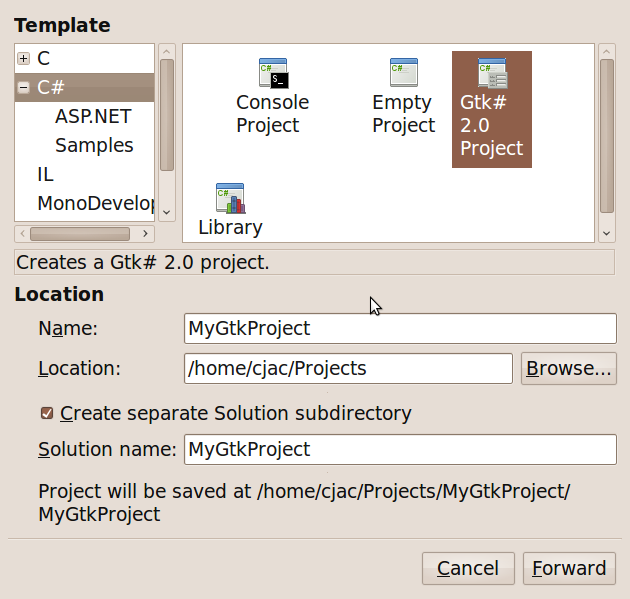
Start MonoDevelop It ll be in your GNOME application menu under Applications->Programming->MonoDevelop Create a new Gtk# Project
Create New Project

Create New Project

Select Gtk# 2.0 Project

Select Gtk# 2.0 Project

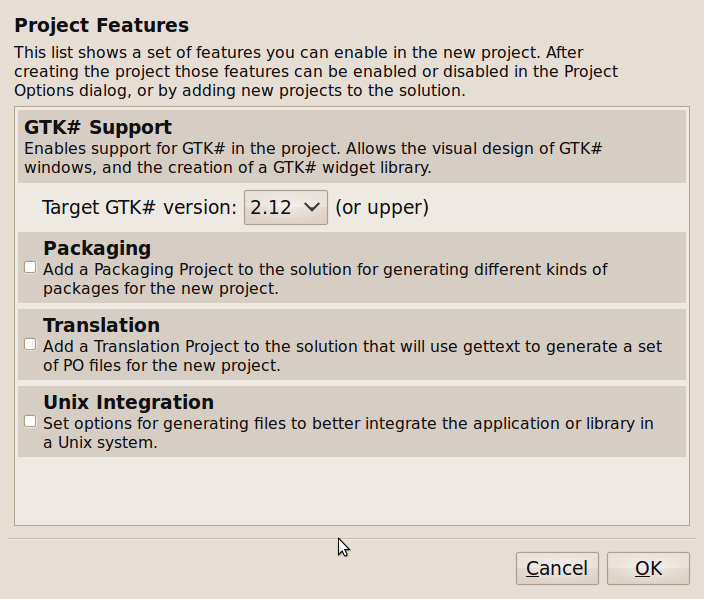
Select Project Features

Select Project Features

Hello World

Hello World

Run project You can run this boilerplate by pressing Ctrl-F5 Using the Designer Double-click on the file named MainWindow.cs in the Solution section. When the file opens, click the Designer button below the code view.
The Designer

The Designer

The Toolbox To add the Toolbox, press Alt-Shift-B or click View->Toolbox. Drag a VBox widget from the Toolbox to the main window.
Add VBox

Add VBox

Drop a Menu Bar widget into the top cell of the VBox, and a Statusbar into the bottom.
Insert Menu and Status Bar

Insert Menu and Status Bar

Properties grid Drop a Button widget into the middle cell of the VBox.
Add the Properties grid from the View menu (Alt+Shift+P or View->Properties).
Select the new button by clicking on it.
In the Properties grid, expand the Button Properties section and click the value of the Label field. Delete the default content and replace it with a different string.
Button with new Label

Button with new Label

Adding a Click handler Select the button in the Designer view
In the Property grid, select the Signals tab
Click twice on the text in the column to the right of the Clicked and replace Click here to add a new handler with MyButtonClickHandler
Add a click handler

Add a click handler

Click on the Source Code button below the viewer window to switch to the C code. You can use the find tool to search for the new handler you created, called MyButtonClickHandler. Ctrl-F will bring up the find dialogue.
Browse to click handler

Browse to click handler

Add some code to update the status bar.
	protected virtual void MyButtonClickHandler (object sender, System.EventArgs e)
	 
		var contextId = this.statusbar1.GetContextId("clicked");
		this.statusbar1.Push(contextId, "Clicky-Clicky" );
	 
Click handler code

Click handler code

Modify button layout The size of the running window is a little weird. I fixed mine by un-setting the Auto Size boolean and setting the Expand and Fill in the Box Child Layout section of the Properties grid.
Button layout changes

Button layout changes

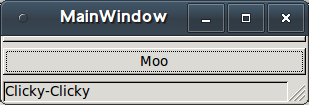
Exercise button click handler Run your application with Ctrl-F5 and click on the button. You should see the new string show up in the status bar at the bottom left of the window.
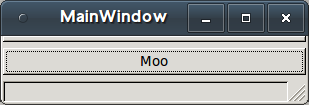
Not yet clicked

Not yet clicked

Clicked + Status update

Clicked + Status update

Add Menu items
Create File Menu Entry

Create File Menu Entry

Create File->Quit Menu Item

Create File->Quit Menu Item

Add Quit event handler

Add Quit event handler

Add Clear Statusbar Activate Handler

Add Clear Statusbar Activate Handler

7 April 2010

Jos? Parrella: Follow-up on Debian Sid on the Acer Aspire 1420P

Last year I got my hands on an Acer Aspire 1420P. It s now running Debian GNU/Linux unstable, and I m transitioning from my older Thinkpad T400. Of course, it won t install and work flawlessly out of the box, so here are my notes. Ethernet Use a recent kernel, say, 2.6.32 (2.6.32-3-686 in Debian, for example), since the Atheros GigaEthernet card won t work in older kernels without patching (e.g., you get a link but can t actually send packets). My lspci reports the Ethernet controller as Attansic Technology Corp. Device 1063 (1969:1063) which uses the atl1c kernel driver. Wi-Fi The Wi-Fi card, an Intel WiFi Link 100, which my pci-utils report as 8086:0083, needs a recent firmware-iwlwifi (or a recent firmware for that card, if you don t use the package) which I also took from sid. Tablet touchscreen It works with the evtouch driver, but you ll need to apply a patch to xf86-input-evtouch (0.8.8 is both in sid and lucid) and calibrate the tablet. It seems like the screen rotation does not generate an ACPI event, but if you attach a button with the xrandr rotation, you don t need nothing else for evtouch to catch up. Screen s multitouch, but software doesn t support it yet. Things that work Integrated Intel Mobile graphics chipset, Huawei integrated HSDPA modem (shows up as ttyUSBn), audio, wireless provided you have firmware, webcam, ACPI events for almost everything (lid rotation doesn t seem to work), function keys it s all working nicely. This model has a Core 2 Duo U2300 processor and 2 GB. RAM.

4 April 2010

Obey Arthur Liu: Apply for the Google Summer of Code at Debian!

gsoc2010_300x267px The student application period for the Google Summer of Code has started since March 29th, but there is still time: the deadline is Friday, April 9th at 19:00 UTC. If you re a student, go check out the Debian Ideas page. Pick an idea you like or suggest your own. Come talk to the Summer of Code team on #debian-soc on irc.debian.org and on the soc-coordination mailing list. Work with us to perfect your proposal before the deadline and hopefully, you ll get your awesome project and your ticket to DebConf10 in New York this summer. dfdcbkwm_48fnmsmgcb_b1
Do you like to tinker ? Do you like having a positive impact on all kinds of users ? The Google Summer of Code at Debian has been a exceptional experience for all our students over these past years and we look forward to welcoming you in this great family to work on the foundations of the Linux experience of millions of users spanning several distributions, from the smallest embedded devices to the largest supercomputers. So, please take a look at our Ideas page, apply and tell your friends to do so by rebloging, retweeting, reeverything!

1 April 2010

Adrian von Bidder: SCO: Ready to give up?

The answer is probably no way! I like the way Jon Corbet put it (article will be free in a few weeks):
The SCO affair is kind of like a bad zombie movie; the plot is implausible, the acting is horrible, and, even though you know the good guys must win in the end, that obnoxious zombie just keeps coming back and ruining the party.
Realistically, what will happen? The judge in the Chapter 11 case has so far been quite interested in helping SCO succeed, so I guess there will be an appeal on this. The contract claims in the cases surrounding this are probably not very relevant, so I'm not sure how much press they'll get (although I'm sure Pam will continue to cover the issue although I think the Apple vs. Hitachi patent cause should be the one that should be in the center of attention right now.) And, of course, there's the Canonical vs. SPI lawsuit coming up. I find it very difficult to tell in what direction that will get decided, but I hope it won't take as long as the SCO case.

30 March 2010

Norbert Tretkowski: MySQL distro meeting in Brussels

Last month I spent two days in Belgium, after I got invited to the MySQL distro meeting. It was a non-public meeting with some people from Sun Microsystems and MySQL maintainers from different Linux distributions. It took place directly after FOSDEM (which I unfortunately could not attend due to personal reasons) at the Sun Microsystems Belgium office in Brussels. It was great to meet with Mathias Gug from the Ubuntu Server team in person. He had some really good ideas on how we could reduce the differences between MySQL in Debian and Ubuntu in the future. As a consequence, Debian will soon switch from Subversion to Bazaar for maintenance of most MySQL packages.

However, we were not only talking about the MySQL Server itself, but also about MySQL Cluster, MySQL Proxy, the MySQL Connectors and the MySQL GUI Tools. Giuseppe Maxia has a more detailed blog entry about the event, including the whole list of participants and some pictures. I fully agree with him: The meeting was a success, we also had a lot of fun, and we should do that more often!

Thanks a lot to Sun Microsystems for sponsoring, and of course to Lenz Grimmer for organizing the event.

27 March 2010

Obey Arthur Liu: Wanted: 1 bottle of DebConf9 wine in the US before Wednesday

Hi Planet, 3745140041_9f4a3da997_o1 (cc-by-2.0 aigarius) I know it s kind of far fetched, but I would need a bottle of DebConf9 wine shipped to California before Wednesday 31st, March. Because of the urgency, the bottle needs to already be in the US and will need to be shipped by FedEx Overnight or equivalent. I will of course reimburse you all costs, including to get you a replacement bottle if needed. This is a gift to someone who has been a great friend of Debian for the past few years and has helped us a lot. Drop by IRC (ArthurLiu, OFTC) or mail me and I will give you more information about what this is about.

25 March 2010

Russell Coker: Bose vs Bauhn/Aldi Noise Canceling Headphones

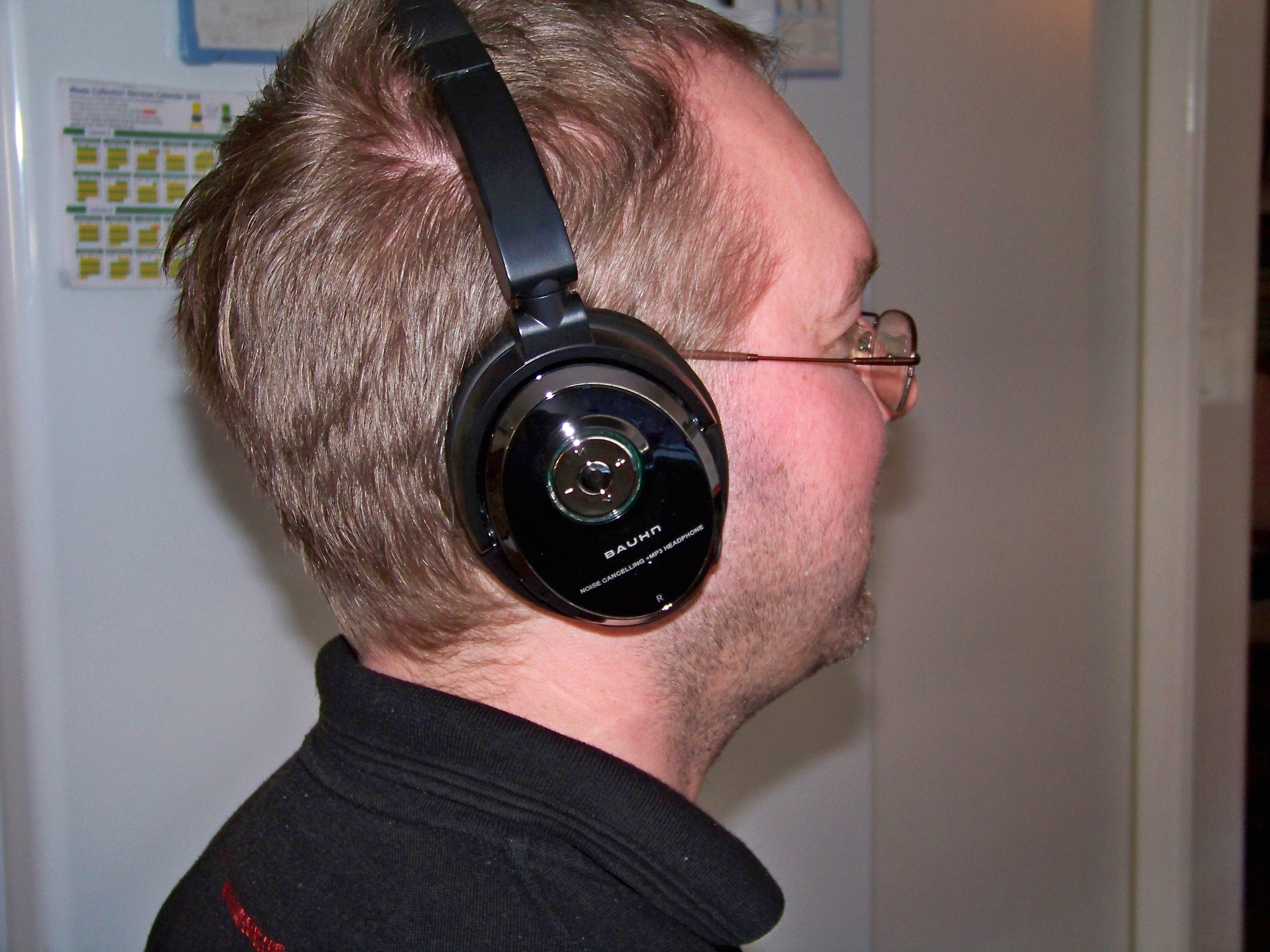
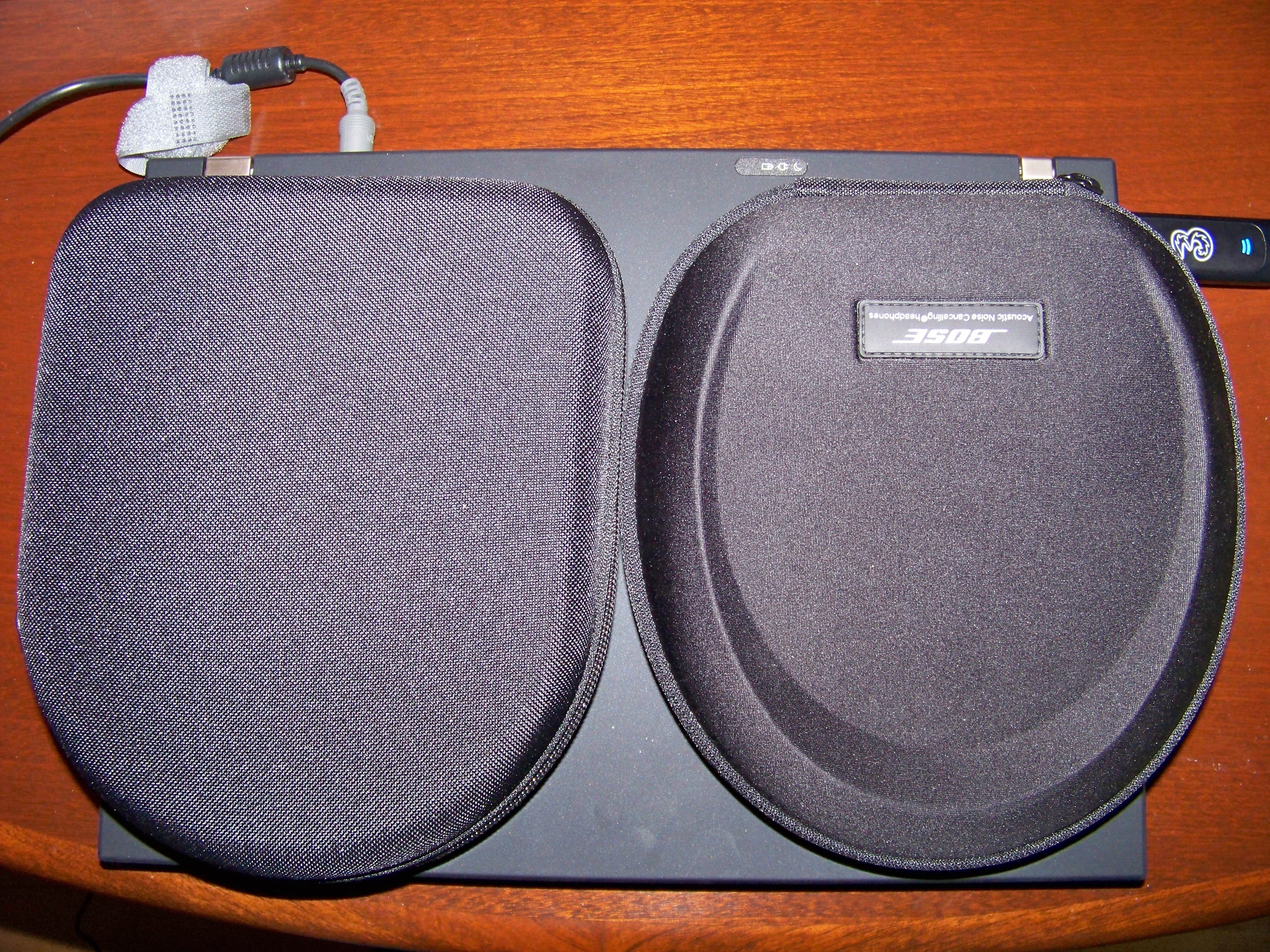
Me wearing Bauhn HeadphonesInside the case of Bauhn Noise Canceling Headphones showing the cable and connectorsOutside of the cases of Bauhn and Bose Headphones Overview The German supermarket chain Aldi has been running in Australia for 8 years now [1]. Their standard practice for a long time has been to offer regular special deals on a few items of consumer electronics every week, my chocolate fridge is one thing I bought from Aldi [2]. Today Aldi have started selling Noise Canceling Headphones [3]. These headphones are badged by Bauhn but that name is apparently applied to random products from cheap manufacturers, it may be an Aldi name that is applied to stuff that they sell. The headphones cost $69AU which is really cheap. But the deal will probably end in less than a week when stock runs out. Noise canceling headphones can be used in server rooms and other noisy environments. Every company that has a server room should buy a few sets. One of the features of noise-canceling is that it works best on low frequencies and on regular sounds it specifically doesn t block human voice well. In some noisy environments it will be easier to hear people talk if you wear such headphones! Noise canceling headphones are also very useful to people who are on the autism spectrum and other people who get more annoyed by noise pollution than average people. I have been wearing my Bose headphones on public transport and when walking around in the city, this not only stops traffic noise but it also helps to avoid people thinking that I want to talk to them. Features The first picture shows me wearing the Bauhn NC headphones, it s from the right to show the controls for the built-in MP3 player. I have not yet tested the MP3 functionality. It appears that as the controls are one power button, buttons for next/previous track, and for controlling the volume. This is fairly poor for MP3 functionality, ideally you would want to have a display to see a list of tracks, maybe have directories to store files, etc. I guess this could be a convenient feature on occasion, but you wouldn t buy the headphones for the MP3 functionality.
The next two pictures show a comparison of the Bauhn headset with the Bose QC-15 headset that I bought last year [4]. The cases of the Bauhn and Bose devices are almost exactly the same size and of a very similar shape, the Bose case is tapered and indented and also has a finer weave on the cloth covering it looks much nicer. Both devices come with an adapter for an airline socket and with a detachable cable. They also both have pouches attached to the inside of the case with velcro. But the Bauhn headphones come with an adapter for the 6.5mm TRS connector which could be convenient if you want to plug them in to a larger amplifier, the basic connector is 3.5mm in both cases. The Bauhn device uses a standard TRS connector at the headphone end while the Bose QC-15 use a special connector that matches the shape of the headset and which has a TRRS plug (to cater for the high/low volume switch), so it seems that a damaged Bauhn cable could be replaced cheaply while a replacement Bose cable would have to be purchased from Bose (presumably at great expense and delay). The Bauhn case also has a velcro attached pocket for storing business cards (or maybe a name tag or something). The supplied cable for the Bauhn is described as being 5 feet long which isn t quite long enough to reach a tower PC that is sitting on the floor. The Bose has a cable that is about a foot longer (maybe 6 feet total), but due to the non-standard connector you can t replace it. I presume that I could easily buy a 4 meter cable for the Bauhn headphones, but I could of course buy an extension cable to use with the Bose. Bose advertise the QC-15 headphones as having 35 hours of battery life from a single AAA battery. Aldi advertise the Bauhn headset as having 5 hours of battery life when NC is turned on and they use two AAA batteries. It s widely regarded that rechargeable batteries don t last as long as the batteries used for estimating the battery life (which presumably are the most expensive long-life batteries available). I ve found a single rechargeable AAA battery to last well over 5 hours in my Bose headphones, so it seems that battery life is considerably worse for the Bauhn device. One feature of the Bauhn device is that it can be used without any batteries for playing external music. The Bose headphones can t be used at all without a battery. So while the Bauhn will use the batteries faster it will at least be usable when the batteries run out. But if you are buying headphones for the purpose of avoiding noise then the Bose headphones are simply better. Comfort The Bose headphones have significantly deeper ear wells than the Bauhn about 23mm vs 18mm. If your ears stick out more than 18mm (as mine apparently do) then this is a good reason for choosing Bose. The Bose headphones are a tighter fit, the spring that pushes the ear-pieces together is stronger. But they have better padding so this doesn t cause me any discomfort. Also the Bose headphones have better passive noise reduction due to having a more snug fit around the ears. I ve worn my Bose headphones on a flight from the US to Australia with hardly a break and they were quite comfortable I would never want to do that with the Bauhn headphones. Noise Reduction I tested the Bose and Bauhn products against three noise scenarios, external music, an air-conditioner, and a car engine. The Bose headphones made good reductions of the noise from the external music (Numb by Linkin Park) and the air-conditioner. The Bauhn headphones did little to stop Linkin Park and was not very effective against the air-conditioner noise. I think that this is largely due to the lack of passive noise reduction, the air-conditioner in question makes little vibration noise and the sound of rushing air is generally immune to active noise cancellation. Both headphones were very effective when in a car with the engine idling. The engine noise of vehicles seems to fall in an ideal frequency range for active cancellation. Music Quality When listening to Youtube music played on my Thinkpad I could not notice any quality difference between the two sets of headphones. I did notice that the Bose headphones seemed to have a greater response in the higher frequency range, but that doesn t necessarily mean that one set is better than the other. Maybe if I was listening to FLAC0 encoded music that I had personally ripped from a CD then I would notice a difference. But for most people the Bauhn music quality should be good enough. Design Quality The Bose product is solidly designed, while the Bauhn product appears cheap in every way. Opening the battery compartment on the Bauhn headphones is difficult and if you do it wrong you could easily break the lid off, I expect that every set of Bauhn headphones that is used by children will be broken in a small amount of time but it should still be fully functional with a broken lid. The matt finish of the Bose headphones should hide minor scratches much better than the shiny Bauhn headphones. The Bauhn headphones also have lower quality plastic parts, it appears that the molds used were designed cheaply and without adequate care to prevent marking the final product. The design flaws that affect usage of the Bauhn product are the shallow ear wells, the poor fit of the cushions around the ears (which is probably mostly due to a weak spring pressing the ear cups to the wearer s head), and the battery compartment lid which is difficult to open and appears prone to breakage. The other flaws are all cosmetic. I wonder whether the Bauhn product was made by one of the big name manufacturers who deliberately reduced the quality to avoid competing with their more expensive products. It seems that the major flaws could have been corrected at design time with almost no increase in manufacturing costs. Recommendations If you can afford the Bose QuietComfort 15 Acoustic Noise Cancelling Headphones then they are really worth the extra expense, I have no regrets at all about spending about $320US (including tax) on my Bose QC-15. The Bauhn product is good for when you want something cheap, for example a set to be used in a server room, or for the use of children. I bought a Bauhn headset for a friend who is a pilot, he spent $1,100 on a noise-canceling headset for his plane but had never got around to buying one for recreational use I expect that he will allow his children to use his new Bauhn headphones, if they get broken it s only a $69 expense. The second cheapest NC headphones I ve seen on offer in Australia is Harvey Norman selling Phillips HN-110 Noise Canceling Headphones for $100AU [5]. Amazon sells Philips HN 110 Folding Noise-Canceling Headphones for $50US but doesn t seem to ship them outside the US (at least not to Australia). JB Hifi also has some NC headphones on sale in Australia [6], but they are more expensive at $219 for AKG and $319 for Sennheiser. Also the models they sell are on-ear which means that they will inherently have very little passive noise reduction and will also annoy anyone who doesn t like having their ears squashed. If I was buying NC headphones for my own use and didn t want to spend $300US then I would either buy the Philips HN 110 Folding Noise-Canceling Headphones from Amazon and get a friend in the US to post them to me or I would buy them from Harvey Norman. But the Bauhn product is good if you want cheap headphones to stop engine noise and give reasonable quality when playing music.

23 March 2010

Daniel Kahn Gillmor: Avoiding erroneous OpenPGP certifications

i'm aware that people don't always take proper measures during mass OpenPGP keysignings. Apparently, some keys even get signed with no one at the keysigning present speaking for that key (for example, if the key was submitted to the keysigning via online mechanisms beforehand, but the keyholder failed to show up). Unverified certifications are potentially erroneous, and erroneous certifications are bad for the OpenPGP web of trust. Debian and other projects rely on the OpenPGP web of trust being reasonable and healthy. People should make a habit of doing proper verifications at keysignings. People who make unverified certifications should probably be made aware of better practices. So for future keysignings, i may introduce a key to the set under consideration and see what sort of OpenPGP certifications that key receives. I won't pretend to hold that key in person, won't speak for it, and it won't have my name attached to it. But it may be on the list. Depending on the certifications received on that key (and the feedback i get on this blog post), i'll either publish the list of wayward certifiers, or contact the certifiers privately. Wayward certifiers should review their keysigning practices and revoke any certifications they did not adequately verify. Remember, at a keysigning party, for each key: After the keysigning, when you go to actually make your OpenPGP certifications: Feedback welcome! Tags: keysigning, openpgp, tip

19 March 2010

MJ Ray: Co-ops at the North Somerset Initiative

On Wednesday, I went to a meeting of the Business Initiative for North Somerset for Cooperatives-SW (our regional cooperative cooperative). It was the first time anyone from the cooperative and mutual sector was present.
platform
Conference Bank of England The first speaker was Geoff Harding from the Bank of England, who talked through topics in their agents summary and related news. One interesting graph showed a steep rise in the percentage of household income being saved. Answers to questions suggested that more of that goes to mutuals and building societies, but they find it difficult to be competitive while the banks are keen to increase their balances. There was mention of employment hoarding businesses short-time working, redeploying or shutting down temporarily to keep trained workers under contract, rather than make them redundant and rehire later. People from both the Federation of Small Businesses and the Hoteliers Association made strong comments about the banks claiming to government that they are willing to lend, but still offering deeply unattractive depth-of-recession rates and terms. If the regional agents get details of such cases, they pass them to the central bank. South West Regional Development Agency The second main speaker was Ann O Driscoll, who covers business development for the West of England (what many people call CUBA Councils that Used to Be Avon). She introduced their four strategic priorities:-

  1. Low Carbon Economy apparenly our region has good wind, wave and solar experience. However, Vestas were mentioned and I know that when Vestas closed the UK s only wind turbine blade factories in August 2009, the RDAs were criticised for not acting against the subsidy-chasing, socially irresponsible conduct of Vestas and related companies continue to worry workers. If Vestas is one of the praised companies, I wonder whether we re attracting sustainable work to the region. On a related note, North Somerset Council and NS Enterprise Agency are organising a Climate Change forum on 1st April, but it s at Cadbury House Hotel, which is awkward to get to except by car: no footpath to the door, a mile-and-a-half walk along a busy road from a train station, bad roads for biking, wheelbending speedhumps on the drive, I can t remember if there is bicycle parking and its website doesn t say
  2. Successful Businesses SWRDA funds our rather poor Business Link service. Does someone in the South West have some good news about Business Link? If so, please leave a comment on this article.
  3. Prosperous Places intervention in areas like south Bristol or central Weston.
  4. United Approach co-ordinating with other regional groups.
The main activities introduced were: The questions were fascinating, except for mine. The best one was probably about the forthcoming election and the Conservatives pledge to shut down the RDAs and Business Links. The answer was that much of the work will still need to be done somehow, so it s more a question of who will do it, rather than what the name on the door says. So I don t think axing RDAs is going to achieve more than shuffling people between organisations. When allowed to ask a question, I got too excited and ranted a bit about how the Co-operative Group s co-operative enterprise hub is doing work that Business Link should have been funding, but the RDA doesn t understand social enterprise and treats it as a ghetto service. I ll try to take that up in a more coherent form later. Overview I think Cooperatives-SW were invited to the North Somerset Initiative largely because of pressure from software.coop for co-ops to be represented better in the Local Strategic Partnership, which has treated us badly. NSI holds one of the three business places on the partnership board, with the other two being held by NSEA and Bristol International Airport. I think it s a bit off that a private company and an enterprise agency are both represented by other groups and also have their own board seats while co-ops don t even have a collective seat, so that pressure for a representative organisation for co-operatives and mutuals to have a board place (in line with national government guidance) should continue, useful though the NSI meetings seem to be. The other thing which would really help is some funding for co-operative business development specialists to work in North Somerset at strategic tasks like this, instead of it being left to ordinary workers from other sectors. I don t know where that funding will come from and until then, I ll continue to try my best. We need to make sure that local strategy at least does no harm to the sector.

16 March 2010

Russell Coker: Starting with KVM

I ve just bought a new Thinkpad that has hardware virtualisation support and I ve got KVM running. HugePages The Linux-KVM site has some information on using hugetlbfs to allow the use of 2MB pages for KVM [1]. I put vm.nr_hugepages = 1024 in /etc/sysctl.conf to reserve 2G of RAM for KVM use. The web page notes that it may be impossible to allocate enough pages if you set it some time after boot (the kernel can allocate memory that can t be paged and it s possible for RAM to become too fragmented to allow allocation). As a test I reduced my allocation to 296 pages and then increased it again to 1024, I was surprised to note that my system ran extremely slow while reserving the pages it seems that allocating such pages is efficient when done at boot time but not so efficient when done later. hugetlbfs /hugepages hugetlbfs mode=1770,gid=121 0 0 I put the above line in /etc/fstab to mount the hugetlbfs filesystem. The mode of 1770 allows anyone in the group to create files but not unlink or rename each other s files. The gid of 121 is for the kvm group. I m not sure how hugepages are used, they aren t used in the most obvious way. I expected that allocating 1024 huge pages would allow allocating 2G of RAM to the virtual machine, that s not the case as -m 2048 caused kvm to fail. I also expected that the number of HugePages free according to /proc/meminfo would reliably drop by an amount that approximately matches the size of the virtual machine which doesn t seem to be the case. I have no idea why KVM with Hugepages would be significantly slower for user and system CPU time but still slightly faster for the overall build time (see the performance section below). I ve been unable to find any documents explaining in which situations huge pages provide advantages and disadvantages or how they work with KVM virtualisation the virtual machine allocates memory in 4K pages so how does that work with 2M pages provided to it by the OS? But Hugepages does provide a slight benefit in performance and if you have plenty of RAM (I have 5G and can afford to buy more if I need it) you should just install it as soon as you start. I have filed Debian bug report #574073 about KVM displaying an error you normally can t see when it can t access the hugepages filesystem [6]. Permissions open /dev/kvm: Permission denied
Could not initialize KVM, will disable KVM support One thing that annoyed me about KVM is that the Debian/Lenny version will run QEMU instead if it can t run KVM. I discovered this when a routine rebuild of the SE Linux Policy packages in a Debian/Unstable virtual machine took an unreasonable amount of time. When I halted the virtual machine I noticed that it had displayed the above message on stderr before changing into curses mode (I m not sure the correct term for this) such that the message was obscured until the xterm was returned to the non-curses mode at program exit. I had to add the user in question to the kvm group. I ve filed Debian bug report #574063 about this [2]. Performance Below is a table showing the time taken for building the SE Linux reference policy on Debian/Unstable. It compares running QEMU emulation (using the kvm command but without permission to access /dev/kvm), KVM with and without hugepages, Xen, and a chroot. Xen is run on an Opteron 1212 Dell server system with 2*1TB SATA disks in a RAID-1 while the KVM/QEMU tests are on an Intel T7500 CPU in a Thinkpad T61 with a 100G SATA disk [4]. All virtual machines had 512M of RAM and 2 CPU cores. The Opteron 1212 system is running Debian/Lenny and the Thinkpad is running Debian/Lenny with a 2.6.32 kernel from Testing.
Elapsed User System
QEMU on Opteron 1212 with Xen installed 126m54 39m36 8m1
QEMU on T7500 95m42 42m57 8m29
KVM on Opteron 1212 7m54 4m47 2m26
Xen on Opteron 1212 6m54 3m5 1m5
KVM on T7500 6m3 2m3 1m9
KVM Hugepages on T7500 with NCurses console 5m58 3m32 2m16
KVM Hugepages on T7500 5m50 3m31 1m54
KVM Hugepages on T7500 with 1800M of RAM 5m39 3m30 1m48
KVM Hugepages on T7500 with 1800M and file output 5m7 3m28 1m38
Chroot on T7500 3m43 3m11 29
I was surprised to see how inefficient it is when compared with a chroot on the same hardware. It seems that the system time is the issue. Most of the tests were done with 512M of RAM for the virtual machine, I tried 1800M which improved performance slightly (less IO means less context switches to access the real block device) and redirecting the output of dpkg-buildpackage to /tmp/out and /tmp/err reduced the built time by 32 seconds it seems that the context switches for networking or console output really hurt performance. But for the default build it seems that it will take about 50% longer in a virtual machine than in a chroot, this is bearable for the things I do (of which building the SE Linux policy is the most time consuming), but if I was to start compiling KDE then I would be compelled to use a chroot. I was also surprised to see how slow it was when compared to Xen, for the tests on the Opteron 1212 system I used a later version of KVM (qemu-kvm 0.11.0+dfsg-1~bpo50+1 from Debian/Unstable) but could only use 2.6.26 as the virtualised kernel (the Debian 2.6.32 kernels gave a kernel Oops on boot). I doubt that the lower kernel version is responsible for any significant portion of the extra minute of build time. Storage One way of managing storage for a virtual machine is to use files on a large filesystem for it s block devices, this can work OK if you use a filesystem that is well designed for large files (such as XKS). I prefer to use LVM, one thing I have not yet discovered is how to make udev assign the KVM group to all devices that match /dev/V0/kvm-*. Startup KVM seems to be basically designed to run from a session, unlike Xen which can be started with xm create and then run in the background until you feel like running xm console to gain access to the console. One way of dealing with this is to use screen. The command screen -S kvm-foo -d -m kvm WHATEVER will start a screen session named kvm-foo that will be detached and will start by running kvm with WHATEVER as the command-line options. When screen is used for managing virtual machines you can use the command screen -ls to list the running sessions and then commands such as screen -r kvm-unstable to reattach to screen sessions. To detach from a running screen session you type ^A^D. The problem with this is that screen will exit when the process ends and that loses the shutdown messages from the virtual machine. To solve this you can put exec bash or sleep 200 at the end of the script that runs kvm. start-stop-daemon -S -c USERNAME --exec /usr/bin/screen -- -S kvm-unstable -d -m /usr/local/sbin/kvm-unstable On a Debian system the above command in a system boot script (maybe /etc/rc.local) could be used to start a KVM virtual machine on boot. In this example USERNAME would be replaced by the name of the account used to run kvm, and /usr/local/sbin/kvm-unstable is a shell script to run kvm with the correct parameters. Then as user USERNAME you can attach to the session later with the command screen -x kvm-unstable . Thanks to Jason White for the tip on using screen. I ve filed Debian bug report #574069 [3] requesting that kvm change it s argv[0] so that top(1) and similar programs can be used to distinguish different virtual machines. Currently when you have a few entries named kvm in top s output it is annoying to match the CPU hogging process to the virtual machine it s running. It is possible to use KVM with X or VNC for a graphical display by the virtual machine. I don t like these options, I believe that Xephyr provides better isolation, I ve previously documented how to use Xephyr [5]. kvm -kernel /boot/vmlinuz-2.6.32-2-amd64 -initrd /boot/initrd.img-2.6.32-2-amd64 -hda /dev/V0/unstable -hdb /dev/V0/unstable-swap -m 512 -mem-path /hugepages -append "selinux=1 audit=1 root=/dev/hda ro rootfstype=ext4" -smp 2 -curses -redir tcp:2022::22 The above is the current kvm command-line that I m using for my Debian/Unstable test environment. Networking I m using KVM options such as -redir tcp:2022::22 to redirect unprivileged ports (in this case 2022) to the ssh port. This works for a basic test virtual machine but is not suitable for production use. I want to run virtual machines with minimal access to the environment, this means not starting them as root. One thing I haven t yet investigated is the vde2 networking system which allows a private virtual network over multiple physical hosts and which should allow kvm to be run without root privs. It seems that all the other networking options for kvm which have appealing feature sets require that the kvm process be started with root privs. Is KVM worth using? It seems that KVM is significantly slower than a chroot, so for a basic build environment a secure chroot environment would probably be a better option. I had hoped that KVM would be more reliable than Xen which would offset the performance loss however as KVM and Debian kernel 2.6.32 don t work together on my Opteron system it seems that I will have some reliability issues with KVM that compare with the Xen issues. There are currently no Xen kernels in Debian/Testing so KVM is usable now with the latest bleeding edge stuff (on my Thinkpad at least) while Xen isn t. Qemu is really slow, so Xen is the only option for 32bit hardware. Therefore all my 32bit Xen servers need to keep running Xen. I don t plan to switch my 64bit production servers to KVM any time soon. When Debian/Squeeze is released I will consider whether to use KVM or Xen after upgrading my 64bit Debian server. I probably won t upgrade my 64bit RHEL-5 server any time soon maybe when RHEL-7 is released. My 64bit Debian test and development server will probably end up running KVM very soon, I need to upgrade the kernel for Ext4 support and that makes KVM more desirable. So it seems that for me KVM is only going to be seriously used on my laptop for a while. Generally I am disappointed with KVM. I had hoped that it would give almost the performance of Xen (admittedly it was only 14.5% slower). I had also hoped that it would be really reliable and work with the latest kernels (unlike Xen) but it is giving me problems with 2.6.32 on Opteron. Also it has some new issues such as deciding to quietly do something I don t want when it s unable to do what I want it to do.

11 March 2010

Obey Arthur Liu: Going to DebConf10 and more

Hi folks, I am coming to DebConf10! im_going_to_debconf10 In addition to New York, I ll also be in San Francisco and Seattle. And here s my travel plan to go with it: Day by Day Itinerary Depart: Zurich (ZRH), 19:45 CEST, Arrive: Paris (CDG), 21:10 CEST
Air France 5109 Aircraft Avro RJ85 Avroliner nonstop 1h, 25m 475 km Class K Depart: Paris (CDG), 10:40 CEST, Arrive: San Francisco (SFO), 12:50 PDT
Air France 84 Aircraft Boeing 747-400 nonstop 11h, 10m 8,958 km Class H seat 25A Depart: San Francisco (SFO), 07:00 PDT, Arrive: Seattle (SEA), 09:00 PDT
Virgin America 740 Aircraft Airbus A319 nonstop 2h, 00m 1,090 km Depart: Seattle (SEA), 07:00 PDT, Arrive: San Francisco (SFO), 09:15 PDT
Virgin America 751 Aircraft Airbus A319 nonstop 2h, 15m 1,090 km Depart: San Francisco (SFO), 23:05 PDT, Arrive: New York (JFK), 07:50 EDT(+1 day)
Virgin America 28 Aircraft Airbus A320-100/200 nonstop 5h, 45m 4,150 km DebCamp10! DebConf10! Depart: New York (JFK), 19:05 EDT, Arrive: Paris (CDG), 08:35 CEST(+1 day)
Air France 7 Aircraft 388 nonstop 7h, 30m 5,829 km Class V seat 86A To get an up to date version of my travel plans, visit the TripIt page: http://www.tripit.com/trip/public/id/4CE972068378 I m looking forward to getting as many of our Google Summer of Code students as possible at the DebConf. See you in the US! Update: Actually, I might attend DebCamp too.

8 March 2010

Vincent Sanders: Squashfs

Well my last post elicited a response from Mr Lougher the squashfs author. Just not one I was expecting. Apparently he did receive one of my emails (I sent five in total) to which he has not replied as I have accidentally come across as critical.

This is absolutely not my intent and I wish to publicly say that, It would have perhaps been more constructive to actually tell me this by email and this misunderstanding could have been avoided.

For reference The final email in the series is reproduced below, if I have been overly unhelpful please let me know in the comments so I can avoid this mistake in future.

Hi, we are using Squashfs and have come across several issues. We
initialy tried to use the Debian source package of the 4.0 release but
then moved to using the the CVS edition which fixed some bugs but had
issues of its own.

Couple of things to start with:

- The commit you made recently titled "Change get_basename() to use
getcwd rather than getting the PWD env var." does not seem to be
what you intended?
http://squashfs.cvs.sourceforge.net/viewvc/squashfs/squashfs/squashfs-tools/mksquashfs.c?r1=1.145&r2=1.146

- I would like to assist in improving these tools so they work better
for our use cases. To aid in this have you considered updating the
revision control system the project is kept in? an SVN or GIT
repository is much easier to work with than CVS.

- I will probably assist with maintainership of the Debian and Ubuntu
packages (I am a Debian Developer <vince> ) and would
like to bring a couple of patches to your attention, one to avoid a
division by zero error and a second to enable building with
alternative libc. These are both attached to this mail.

- The tools currently make a number of assumptions about structure
alignment which are incorrect on some architectures. I am crafting
a patch to address this which should make the tools work correctly
on ARM (they currently simply segfault).

I hope this is seen as constructive and we can work together to
improve this software. If you do not feel you want to interact with me
and choose to take a differnt route, please let me know at your earliest
conveniance.

I do hope that Mr. Lougher will accept that I intended to be helpful and constructive and not cause offence. I have chosen to use the blog format for this as that is the form I made the previous complaint and also email between myself and Mr. Lougher appears somewhat erratic.

It should be noted that some of there points have already been addressed, however there are several more issues which I hope to be able to contribute towards.


7 March 2010

Adam Rosi-Kessel: Windows curly quotes, accented characters on Linux Samba Shares and Cygwin XTerm: How to get Windows-1252 (AKA CP1252) from Linux

Before I forget: I have a bunch of files I mirror between Windows/NTFS and Linux/ext4 filesystems that include not only accented characters but curly quotes in the filenames. (I know: the easiest solution would be to just get rid of the extended characters). The curly quotes were created in Windows, so don t render properly in standard Linux character sets (UTF-8, iso8859-1, iso8859-15, etc.). This all came up because iTunes under Windows couldn t find curly-quote files when it was reading from the exported Samba share filesystem rather than an attached NTFS drive. The files showed up as missing because they had different filenames. The solution was not easily google-able, so for the record, in brief, add this to the [Global] section of /etc/samba/smb.conf:
unix charset = cp1252
display charset = cp1252
And reload Samba. Also, to make the characters render properly from a terminal on the Linux box, first create the relevant character set:
sudo localedef -f CP1252 -i en_US en_US.CP1252
Now you can use this charset on your Linux box, and, like magic, the curly characters will be back:
export LC_ALL='en_US.cp1252'

28 February 2010

Siegfried Gevatter: Zeitgeist Data-Source Registry

This post is about an upcoming feature in Zeitgeist 0.3.3 and is so far only available in checkouts from trunk or our PPA. It is expected to be released within the next weeks. Some weeks ago I implemented a new feature in Zeitgeist and I figured I d drop some lines about it. I m talking about a data-source registry. You may be wondering, what the hell is that even, a data-source? . So Zeitgeist is a database, a global event log, but it doesn t do any magic indexing or monitoring by itself; the information it logs needs to come from somewhere be it applications sending it to Zeitgeist themselves, daemons, plugins for applications, etc. Any such entity is called a data-source . Having a register of all data-sources interacting with Zeitgeist provides some benefits, like for example:
Screenshot of tools/gtk/zeitgeist-data-sources-gtk.py

Prototype of a data-source management user-interface

More details When they register, data-sources will need to provide the following information: an unique ID, a name (may be localized), a description (may be localized) and optionally a template specifying what sort of events it logs. Additionally, the last timestamp the data-source was seen by Zeitgeist, whether it is running right now and whether it is enabled will also be available. It is important to note that registration is not compulsory; while it is highly encouraged for data-sources to use it, is it still possible to anonymously insert information into Zeitgeist (for example from a shell script). The event template is also only informational, and will not be enforced by Zeitgeist at this time. Avoiding duplicates from GTK Recently Used You may know that zeitgeist-datahub provides basic support for applications which have no direct Zeitgeist support but do use GTK s RecentManager, which is not as detailed as we would like, but it is better than nothing. However, until now we had a problem: when applications had support for both, GTK s Recently Used and Zeitgeist (be it native or as an extension), it was possible for duplicate events to be inserted or other sorts of conflicts between both data-sources. Now that we have the information from the registry available, we ve been able to solve this modifying our Recently Used data-source to ignore any events concerning applications which already have another data-source logging the same types of events.

In case you don t care at all about what I m talking here and you just want to see fancy interfaces, go check this out. Related posts:
  1. Zeitgeist is out!
  2. Introduction to Zeitgeist 0.2 s API
  3. Zeitgeist Hackfest (II)

No comments
Siegfried-Angel Gevatter Pujals, 2010. Permalink License Post tags: , ,

Next.

Previous.